Part 2 — CHAPTER I. (continued 3)
Reading edition
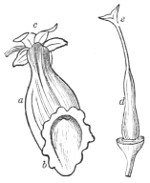
The new order Cyrtandraceæ, including Æschynanthus, Streptocarpus or Didymocarpus, Fieldia, and Amphicoma, is introduced here: the first and last of these genera are new, and the others were formerly included in Bignoniaceæ.
ORDER CXLII.—LABIATÆ.
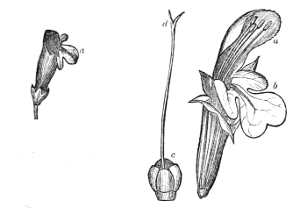
Fig. 141.—A Labiate Flower.Fig. 142.—Black Horehound (Ballota nigra).
The plants belonging to this order include Mint, Sage, Thyme, and other kitchen aromatic plants, and several well-known British weeds. They are all distinguished by a tubular, bilabiate corolla with a projecting under lip (see a in fig. 141). In some plants the corolla is ringent, as shown in fig. 142, taken from Dr. Lindley’s Ladies’ Botany, in which a is the galea or helmet, and b the lower lip, which is three-lobed. There are four stamens, two of which are longer than the others, and the cells of the anthers differ from those of most other plants in spreading widely apart from each other, each being joined to the filament only at the tip. The pistil consists of four distinct carpels (c), a very long style lobed at the tip, and furnished with a very small stigma at the tip of each lobe (d). The flowers of some of the plants belonging to this order are disposed in a whorl round the stem; as, for example, those of the Dead Nettle (Lamium). Among the other plants belonging to the order may be mentioned the Bugle (Ajuga), and the Ground Ivy (Glechoma), both common but very pretty British weeds.
ORDER CXLIII.—VERBENACEÆ.—THE VERVAIN TRIBE.
The genus Verbena is well known, from the many beautiful species now common in every greenhouse. The fruit is two or four celled, and a drupe or a berry, and the calyx of the flowers is tubular, and persistent round it; but the corolla is deciduous, and falls off long before the fruit is ripe. In the genus Verbena the calyx is tubular, with five distinct angles, ending in five teeth. The corolla has a cylindrical tube nearly double the length of the calyx, and a flat limb divided into five unequal segments, which are wedge-shaped and notched, the central one of the lower three appearing to have been slightly pinched; the throat of the corolla is hairy. There are four stamens, two longer than the others, the anthers having two widely-spreading lobes, as in the Labiatæ. The style is slender below, and thickest in the upper part; and the stigma is two-lobed. The leaves are opposite, and furnished with stipules The flowers form a corymb in the Scarlet Verbena, and a spike in some of the other kinds, which elongates gradually as the flowers expand. The principal other genera are Clerodendron, or Volkameria, Vitex (the Chaste-tree), Lantana, Aloysia (the Lemon-scented Verbena), and Tectona (the Teak) which is so much used in the East Indies for ship-building.
ORDER CXLIV.—MYOPORINÆ.
Australian and Polynesian plants, nearly allied to Verbenaceæ. The principal genera are Myoporum and Avicennia, the White Mangrove of Brazil.
ORDER CXLV.—ACANTHACEÆ.
These plants are known by the elastic opening of the capsules, which are two-celled, and the hooked points of the seeds by which they are attached to the placenta. The calyx remains on the ripe fruit, but in most of the plants it is so extremely small as to be inconspicuous, and its place is supplied by three large leafy bracts. The corolla varies considerably, being sometimes two-lipped as in Justicia, sometimes funnel-shaped as in Ruellia, and sometimes campanulate, with a spreading five-cleft limb, as in Thunbergia. There are only two stamens in Justicia and some of the other genera, but in Thunbergia, Acanthus, and Ruellia, there are four of unequal length, inclosed within the throat of the corolla. The ovary is imbedded in the disk, and it is two or many seeded; the style is simple, and the stigma one or two lobed.
ORDER CXLVI.—OROBANCHEÆ.
Leafless parasites, with brown or colourless scaly stems and flowers. The genera are Lathræa and Orobanche.
ORDER CXLVII.—LENTIBULARIÆ.
Pretty little marsh plants, natives of Europe and North America. Pinguicula has very much the appearance of a violet, and the Utricularias are floating plants.
ORDER CXLVIII.—PRIMULACEÆ, THE PRIMROSE TRIBE.
The plants belonging to this order are easily known by the stamens, or rather anthers, for they have scarcely any filaments, being affixed to the corolla in the centre of the lobes, instead of being alternate to them, and by the capsule, though five or ten ribbed, being only one-celled, with a central placenta, to which the seeds are attached. The calyx remains on the ripe fruit. In the genus Primula (the Primrose), the calyx is tubular, and strongly marked with five distinct angles, which end in as many teeth; and the corolla is salver-shaped, with a contraction in the tube, at the insertion of the stamens, the five segments of the limb being wedge-shaped and notched. The style is slender, and the stigma capitate. The capsule opens naturally by ten teeth, which curl back. The Cyclamen, or Sow-bread, one of the genera belonging to this order, has the lobes of the corolla bent back; and when the flower falls, the peduncle coils up in a most curious manner, so as to bury the seed-vessel in the earth. These plants have tuberous roots, which are so acrid as only to be eaten by the wild-boars. The seed-vessel of the Pimpernel (Anagallis) resembles a round case with a lid, which may be taken off, when it displays a great number of seeds, so closely packed, that no room is lost. The principal other genera are the American Cowslip (Dodecatheon), Bear’s-ear Sanicle (Cortusa), Soldanella, the Water Violet (Hootonia), and Loosestrife (Lysimachia).
ORDER CXLIX.—GLOBULARIÆ.
Pretty alpine plants, with blue flowers.
ORDER CL.—PLUMBAGINEÆ.
This order probably belongs to Monochlamydeæ. The principal genera are Sea Lavender (Statice), remarkable for the coloured footstalks of the flowers; Thrift (Armeria); and Leadwort (Plumbago). The corolla in these plants is either monopetalous, with the stamens free from the corolla and growing from beneath the pistil, or with five petals, to which the stamens are attached. There are five styles and five stigmas, but only a one-celled and one-seeded ovary. The fruit is thin and dry. The pedicels of all the species of the Sea Lavender, particularly of Statice arborea, are often mistaken for the flowers.