FARMERS ATTENTION! (continued 2)
Reading edition
Another Tuskegee graduate in whom Mr. Washington was especially interested is Isaac Fisher. Fisher has been awarded the following prizes for his writings:
"What We've Learned About the Rum Question," $500; "German and American Methods of Regulating Trusts," $400 (in order to write this paper Mr. Fisher had to acquire a reading knowledge of German which he did alone and unaided in a few months' time); "Ten of the Best Reasons Why People Should Live in Missouri," $100; "A Plan to Give the South a System of Highways Suited to Its Needs," $100; "The Most Practicable Method of Beginning a Tariff Reduction," honorable mention. (Upon the request of the chief examiner of the United States Tariff Board this essay was sent to that body for its use.) Besides these, Mr. Fisher has taken several minor prizes for compositions on various subjects.
It would be difficult to say, however, whether Booker Washington showed greater interest in the most brilliant or the most backward students. Certain it is that the most backward students won his special attention and encouragement.
In the early days of the school there was a student by the name of Jailous Perdue whom Mr. Washington constantly encouraged and in whom he never lost faith in spite of his almost total failure to master his classroom work. Monroe N. Work, the statistician of the Institute and the editor of "The Negro Year Book," under the title "The Man Who Failed," has thus told Perdue's story:
"Back in the days when the cooking for students at Tuskegee was done out of doors in pots and the principal entrance requirement was a 'desire to make something of himself' a young man, Jailous Perdue, came to Tuskegee to get an education. He was financially poor and intellectually dull. Examinations he could not pass. After struggling along for several years and accumulating a lot of examination failures, he decided to quit school, go out to work and help educate his sisters. Although he had failed in his literary subjects, he had nevertheless got an education in how to use his hands. He had learned to be a carpenter. Out in the world he went and began to work at his trade. As soon as he had earned a little money he placed three of his sisters in school at Tuskegee, and with the help of his brother Augustus, who had graduated some time before, supported two of them there for three years and one for four years.
"In the meantime he had succeeded at his trade and gone into business for himself at Montgomery, Ala., as a contractor and builder. Here also he was successful and did thousands of dollars' worth of work. No job was too small nor too large for him to make a bid on. If he did not have a contract of his own he was not above working for some other contractor, and as a result he was always busy. He has superintended the construction of some of the largest buildings in Montgomery. Among the buildings the erection of which he has superintended are the Exchange Hotel, at a cost of $150,000; the First Baptist Church, at a cost of $175,000; the First National Bank Building, at a cost of $350,000; and the Bell Building, at a cost of $450,000. Perdue also assisted as foreman or assistant foreman in erecting many of the important buildings at Tuskegee Institute, such as the Principal's house, the chapel, the library, Rockefeller Hall, the Academic Building, and the Millbank Agricultural Building.
"It is hardly necessary to say that Mr. Perdue has accumulated property or that he owns a good home in Montgomery, for in these progressive days every black man in the South with any foresight is investing some part of his earnings in property. The most interesting and somewhat remarkable thing about the career of Perdue and the greatest measure of his success is that twenty-three years after he had left Tuskegee a literary failure he was asked to come back and become a member of the faculty as an instructor in carpentry. Thus it was that the man who failed succeeded and returned to the scene of his failure a success. Perdue was constantly encouraged by Mr. Washington. He came under the type of those who were not brilliant, but who were always in his opinion worthy of help and encouragement."
Washington A. Tate was even duller in books than Perdue. During his early years at Tuskegee he seemed unable to grasp the most rudimentary information. His native dullness was made unpleasant and aggressive by a combative disposition. He was constantly trying to prove to his exasperated teachers that he knew what he did not know. He was almost twenty-five years of age when he reached the Institute and entered the lowest primary grade. He had the greatest difficulty in passing any examinations and never succeeded in passing all that were required. Motions were constantly made and passed in faculty meetings to drop Tate, and were as constantly vetoed by Mr. Washington on the plea of giving him one more chance. Finally when Tate's time to graduate came the teachers in a body protested against giving him a diploma. Mr. Washington argued that a man who had made all the sacrifices Tate had made at his age to stay in school, a man who had worked early and late in fair weather and foul for the school, a man who had stuck to his task in the face of repeated failures and discouragements, had in him something better than the mere ability to pass examinations. Through Mr. Washington's intercession for him Tate got his diploma. The next day Mr. Washington had him employed to take charge of the school's piggery. Because of his hard, conscientious, and effective work in this capacity he was afterward recommended to the United States Department of Agriculture at Washington as the proper man to take charge of the United States demonstration work in Macon County, Ala. Tate proved to be one of the Government's most successful demonstration agents. He is now farming successfully on his own account in an adjoining county.
Booker Washington, as previously pointed out, saw very much more clearly than most educators that education's only purpose and sole justification lies in preparation for right living. A man who has passed all manner of examinations may not be prepared to live rightly and hence may not justly claim to be educated. A man who has failed to pass examinations may be prepared for right living and hence may justly be called an educated man. In other words, Booker Washington realized that education was primarily a matter of the development of character and only secondarily a matter of the acquisition of information.
CHAPTERTEN
RAISING HUNDREDS OF THOUSANDS A YEAR
DURING recent years the expenses of Tuskegee Institute have run to between $250,000 and $300,000 a year. Of this sum Booker Washington had to raise over $100,000 annually aside from the large sums constantly demanded for new equipment such as the great central heating and power plant which was installed in 1915 at a cost of more than $245,000.
At the ceremonies commemorating the twenty-fifth anniversary of the founding of Tuskegee Institute President Charles W. Eliot of Harvard was one of the speakers. He said that one of his "first impressions of Tuskegee Institute," after just a glimpse, was "that the oldest and now largest American Institution of learning was more than 200 years arriving at the possession of much less land, fewer buildings, and a smaller quick capital than Tuskegee had come to possess in twenty-five years. That's just a fact," he said, "Harvard University was not as rich after living two hundred years among the people of Massachusetts as Tuskegee is to-day, after having lived twenty-five years among the people of Alabama. And that's the first impression that I have received here.
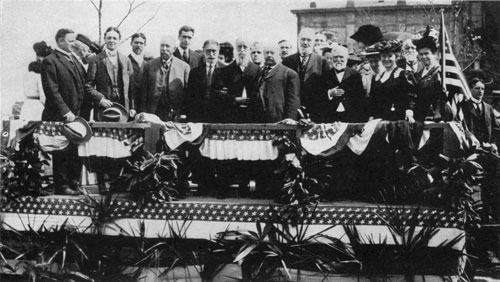
In 1906, the Tuskegee Institute celebrated its 25th anniversary. In the group above appear such well-known American characters as Dr. William J. Schieffelin, New York; Dr. H.B. Frissell, Hampton Institute, Va.; J.G. Phelps Stokes, philanthropist, New York; Isaac N. Seligman, banker, New York; Dr. Lyman Abbott, editor of the Outlook; Dr. Wallace Buttrick, Secretary General Education Board; William G. Willcox, now President of the New York Board of Education; Robert C. Ogden, philanthropist, New York; Andrew Carnegie, and Miss Clara Spence of the Spence School, with numbers of their friends.
"This evening I have received another impression from your Principal. He said that the great need of Tuskegee, to-day, was a considerable sum of money, which could be used at the discretion of the Trustees, to fill gaps, to make improvements, and to enlarge and strengthen the different branches of the institution. Now I should not find it possible to state in more precise terms the present needs of Harvard University. The needs of these two institutions, situated, to be sure, in very different communities, and founded on very different dates, are precisely the same." This comparison is the more striking when we realize that President Eliot had at the time been at the head of Harvard University for thirty years, five years longer than Tuskegee had been in existence—President Eliot of whom it was said, "When he goes to rich men they just throw up their hands and say, 'Don't shoot! How much do you want?'"
The magnitude of Booker Washington's financial task is indicated in his last annual report which he made to his Trustees in 1915. He reported:
"As of May 31st, we have received from all sources for current expenses $268,825.17; for buildings and improvements, $28,919.47; for endowment, $28,102.09; from undesignated legacies, $53,858.10, making the total receipts for the purposes named for the year $379,704.83.
"The gifts to the Endowment Fund for the year amounting to $28,102.09 now make the Fund stand at $1,970,214.17.
"The budget recommended for your consideration for the new year calls for an expenditure for current expenses, repairs, renewals, and equipment of $291,567.92...."
Later in the report he said: "Notwithstanding the depressed financial condition of a large part of the country, I feel it would be a great mistake for us in any degree to slacken our efforts to keep the school before the public or to get funds. I believe, as Dr. H.B. Frissell, Principal of the Hampton Institute, has often expressed it, that a large part of the mission of both Hampton and Tuskegee is to keep the cause of Negro education before the country, and that the benefits coming from such efforts of publicity do not confine themselves alone to Hampton and Tuskegee, but benefit all the schools in the South. With this end in view, I very much hope that the Trustees may see their way clear to encourage and help us as far as possible in holding a number of large public meetings during the coming year." These were brave words for a dying man. Five months later he died of sheer exhaustion shortly after addressing one of these "large public meetings." They also show the breadth of his conception of his task. You will note that he points out that such publicity as he urges, "benefits all the schools in the South"—not merely the schools for Negroes, but "all the schools." It never occurred to him to limit his sense of responsibility to his own school nor even to the schools for his own race. As previously mentioned he would sometimes devote an entire public address to an appeal for more and better schools for the poor whites of the South.
Booker Washington's money-raising efforts consumed two-thirds of his time and perhaps even more of his strength and energy. He planned these money-raising campaigns just as carefully as a good general plans a military campaign. His last big money-raising campaign was conducted during June, 1915. He and the Trustees of the Institute had been engaged for two or three years in the effort to raise the money to complete the cost of the central power and heating plant, but nearly $100,000 of the $245,000 needed had not been raised. This burden bore heavily upon him. At last, with the approval of the Trustees, he decided to make one last herculean effort not only to raise this huge sum, but in addition, the money necessary to end the school year free of debt. For this purpose he formulated a plan of campaign by which five representatives of the school should cover the chief centres of population throughout the Northern and Middle Western States. This was the outline of the territorial assignments of the collectors:
Frank P. Chisholm: New Hampshire, Vermont, Massachusetts, Rhode Island, Connecticut—important centre—Boston.
Charles W. Wood: New York east of Syracuse, and Binghamton—important centre—New York City.
Jesse O. Thomas: New York west of Syracuse and Binghamton, Pennsylvania—important centre—Philadelphia.
John D. Stevenson: Illinois, Wisconsin—important centre—Chicago.
Clarence A. Powell: Michigan, Ohio—important centres—Detroit and Cleveland.
Each representative carried letters of introduction to leading men and women in the various centres throughout his territory. All these letters were personally signed by Mr. Washington. At the close of each day each collector telegraphed Mr. Washington at Tuskegee giving the amount of subscriptions and pledges he had secured that day. The next morning Mr. Washington wired each collector, stating the total amount of gifts and pledges secured by all five collectors. When the Trustees met in New York City, on the last Thursday of June, 1915, all but four or five thousand dollars of the over $245,000 had been raised.
The Trustees themselves made up the difference by increasing by this amount their own subscriptions. Thus was successfully concluded the last great and difficult task which Booker Washington was to be permitted to perform.
Of the hundreds of invitations to speak here, there, and everywhere which kept pouring in upon him certain ones he definitely accepted because of the money-raising opportunities either direct or indirect which they offered; others of less promise he tentatively accepted to fall back upon in case the more desirable ones for any reason miscarried. Chautauqua engagements he considered only where they provided an opportunity for direct appeal for contributions for the work, or at least the chance to distribute printed matter. Chautauqua bureaus offering him as much as half the gate receipts above $500 in addition to a guarantee of $300 a night he turned down out of hand if they did not include one or both of these opportunities. No matter how much money they offered he would never accept such propositions unless they carried with them some opportunity to make a direct appeal for his work. It was sometimes suggested to him that he might receive these fees personally and then turn them over to the school. This he declined to do because he was unwilling to give even the appearance of capitalizing his reputation and oratorical gifts for his personal enrichment. Booker Washington was not one of those simple-hearted individuals who are guided solely by what they deem inherently right. He always strove to avoid the appearance of evil as well as the evil itself; and, with one unhappy exception, he always succeeded. He fully realized that his conduct was under constant scrutiny by enemies in both races eager to find some pretext to drag him down. So circumspect was he in his behavior that once only between the time he became a national character in 1895 until his death twenty years later did his critics succeed in distorting any deed of his into the semblance of misconduct. The very nature of the charge in this one instance was sufficient refutation for any person acquainted in even the slightest degree with the man's life, work, or character.
The press as well as the platform he constantly used to keep his work before the public for money-raising purposes. He had as good a "nose for a story" as the best of reporters, and every story that came his way was sure to find its way into print. No matter how driven with pressing matters nor how tired he never denied himself to "the newspaper boys." He believed that the more prominence, the more "limelight," he could secure the better, provided he used it for the promotion of his work. Thus he presented the apparent anomaly of being at the same time one of the most modest and unassuming of men and also one of the greatest advertisers of his day.
As well as the general press of both races he constantly used the school press for money-raising purposes. The school paper which circulates among donors and prospective donors as well as among the students, teachers, and graduates carries in each issue brief statements of some immediate and pressing needs and the money required to satisfy them. These needs are set forth in the following manner:
"WHAT $1,700 WILL DO"
"For a long while an important part of our extension work and publicity work has been greatly hindered and hampered because of the lack of a new and up-to-date printing press.
"One thousand and seven hundred dollars will supply us with this long-felt need and greatly add to the value and influence of our work."
"WHAT $3,000 WILL DO"
"One of our very greatest and most practical needs is a well but simply equipped Canning Factory. Three thousand dollars would help us to properly equip the Canning Factory we already have at Tuskegee. The factory will help not only in preserving large quantities of vegetables, fruits, berries, etc., during the summer, but at the same time could be used as a means of teaching large numbers of our girls a useful industry, and, more than that, the products could be used to sustain the institution during the winter months.
"We could not only use everything that might be put up in cans here at the school in feeding the students and teachers, but there is an increasing demand among the merchants of the South, in the large cities, for anything we can produce on the school grounds.
"We very much wish that some friend might see his way clear to give $3,000 with which to properly equip this factory."
The need for a new laundry building with equipment, a foundry, and a veterinary hospital were similarly presented. The funds to meet each of these needs were received as a result of these appeals, and a new list of needs is now being advertised.
In concluding his annual report each year Mr. Washington would summarize the immediate needs of the institution. In his last report he thus stated them:
1. $50 a year for annual scholarships for tuition for one student, the student himself providing for his own board and other personal expenses in labor and cash.
2. $1,200 for permanent scholarships.
3. Money for operating expenses in any amounts, however small.
4. $2,000 each for four teachers' cottages.
5. $40,000 for a building for religious purposes.
6. $16,000 to complete the Boys' Trades Building.
7. $50,000 for a Boys' Dormitory.
8. $50,000 for a Girls' Dormitory.
9. An addition to our Endowment Fund of at least $3,000,000.
A few months later, as he lay dying in a New York hospital, the following letter was received for him at Tuskegee. It was at once forwarded and passed him on his last journey to his home in the South. He never saw it. The donor, a Northern friend who withholds his name, has renewed the offer to the Trustees and they have accepted it.
November 8, 1915.
Dr. Booker T. Washington, Tuskegee Institute, Alabama.
Dear Mr. Washington: I have read your annual report and also your treasurer's report, and make you the following proposition: If you will raise enough money to pay all of your debts up to May 1, 1916, and add two hundred and fifty thousand dollars to your endowment fund, I will give you the sum of two hundred and fifty thousand dollars for your building fund, to be used in building the items such as Nos. 4, 6, 7, 8, and the "Barnes, etc.," mentioned under the head of "Special Needs," and for objects of similar character. The above does not include item No. 5, "Building for religious purposes," as I am not interested in that sort of work. I shall be glad to know whether this proposition interests you.
Yours very truly,
—— ——.
The interest of this giver was first aroused by his reading "Up from Slavery" when it appeared in book form in 1901. As soon as he had read the book he sent Dr. Washington a check for $10,000 for his work which he has renewed each year since until he made the above offer. "Up from Slavery" has brought more money to Tuskegee than all the other books, articles, speeches, and circulars written by Mr. Washington himself and the many others who have written or spoken about him and his work. Among its larger immediate results, aside from awakening the interest of the anonymous giver already mentioned, was its similar effect upon the late H.H. Rogers, Vice-President and active head at the time of the Standard Oil Company, and upon Andrew Carnegie. Mr. Rogers became so much interested that he not only gave large sums for the general needs of Tuskegee but eventually financed a large part of the rural school extension work, which has been described in earlier chapters, and which is now so important a part of the school's activities. Under Booker Washington's inspiration and guidance, too, Mr. Rogers later combined railroad building with race building. In building his Virginia railroad he undertook a wide-reaching work in agricultural education among the Negro farmers living within carting distance of his road. Booker Washington had demonstrated to his satisfaction that by increasing at the same time their wants and their ability to gratify their wants he would be building up business for his railroad.
Shortly after the publication in 1901 of "Up from Slavery," Frank N. Doubleday, of Doubleday, Page & Co., the publishers of the book, in playing golf with Mr. Carnegie mentioned Booker Washington and told him something of his life. Mr. Carnegie was interested and wanted to know more. Mr. Doubleday gave him a copy of "Up from Slavery." After reading the book he immediately got into communication with the author, told him of his interest in his life and work, and of his desire to help him. The result was that Mr. Carnegie agreed to pay for the construction and equipment of a library to be built by the students. Booker Washington, his Executive Council, and the school's architect, spent hours and hours of time in scrutinizing every detail to bring the cost down to the smallest possible figure consistent with an adequate result. The final cost to Mr. Carnegie was only $15,000. Mr. Carnegie was amazed that so large, convenient, and dignified a building could be built at so small a cost. Over and over again both to Mr. Washington and to friends of the school he expressed his surprise and pleasure at the result obtained by this relatively small expenditure. After that there was no doubt he would do more for the school. It was simply a question of how much more and what form it would take. In 1903 the following letter was received by the late William H. Baldwin, Jr., in his capacity as president of the Tuskegee Board of Trustees.
Andrew Carnegie 2 East 91st Street, New York
New York, April 17, 1903.
My Dear Mr. Baldwin: I have instructed Mr. Franks, Secretary, to deliver to you as Trustee of Tuskegee $600,000 of 5 per cent. U.S. Steel Company bonds to complete the Endowment Fund as per circular.
One condition only—the revenue of one hundred and fifty thousand of these bonds is to be subject to Booker Washington's order to be used by him first for his wants and those of his family during his life or the life of his widow—if any surplus is left he can use it for Tuskegee. I wish that great and good man to be free from pecuniary cares that he may devote himself wholly to his great Mission.
To me he seems one of the foremost of living men because his work is unique. The Modern Moses, who leads his race and lifts it through Education to even better and higher things than a land overflowing with milk and honey—History is to know two Washingtons, one white, the other black, both Fathers of their people. I am satisfied that the serious race question of the South is to be solved wisely only by following Booker Washington's policy which he seems to have been specially born—a slave among slaves—to establish, and even in his own day, greatly to advance.
So glad to be able to assist this good work in which you and others are engaged.
Yours truly,
(Signed) Andrew Carnegie.
To Mr. Wm. H. Baldwin, Jr., New York City, N.Y.
This great gift delighted Booker Washington not only for what it meant directly to his work, but because it so strikingly illustrated a truth which he had long and insistently impressed upon his staff and his students: namely, that if every dollar contributed were made to do the work of two, more dollars would be forthcoming from the same source.
The two events upon which Booker Washington's popular fame chiefly rests are his speech before the Cotton States Exposition in Atlanta, Ga., in 1895, and the publication of "Up from Slavery" five years later. Since "Up from Slavery" played so great a part in aiding its author to secure funds for his work it seems appropriate to give here some account of how it came to be written, how it was written, and how it was received.
In the year 1900 the editors of the Outlook decided to illustrate in the concrete the opportunities of America by getting some of the Americans of greatest achievement to tell how they had risen by their own efforts from the very depths of untoward circumstances. For this purpose they selected Jacob A. Riis and Booker T. Washington. After much hesitancy on his part and urgency on theirs Booker Washington finally agreed to write the story of his life for serial publication in the Outlook. His hesitancy was due merely to the fact that he could not believe that the events of his life would be of any interest to the public. So convinced was he in this belief that he had the greatest difficulty in starting to write even after he had agreed to do so. Finally, after a particularly urgent letter from the editors, he stole some hours from his absorbing and exacting duties at Tuskegee to write the first chapter. After these efforts had been typewritten by his stenographer they produced only three and one-half pages—an amount of copy discouragingly inadequate for the first installment. He mailed the material, however, with a line of apology for its inadequacy and promising to send more the next day. On receipt of this scant initial copy the editors wrote him a letter of congratulation and approval which greatly encouraged him, in spite of his heavy and unrelenting administrative duties, to push ahead with new courage. Notwithstanding, however, the best intentions on the part of the writer and the most patiently insistent reminders on the part of the editors there were many and wide gaps in the supposedly consecutive series of chapters before the story was finally finished. Much of the story he dragged from his tired brain, and jotted down on odds and ends of paper on trains, while waiting in railway stations, in hotels, and in ten and fifteen minute intervals snatched from overburdened days in his office. The fact that it was a physical impossibility to give adequate time and attention to so important a piece of work distressed him and made him feel even more apologetic about the product.
The enthusiastic reception of his story by the editors and later by the public was accordingly particularly surprising and gratifying to him. After its serial publication he was soon almost overwhelmed with congratulatory letters and laudatory reviews. Julian Ralph in the New York Mail and Express wrote in part:
"It does not matter if the reader feels a prejudice against the Negro, or if he be a Negrophile, or if he has never cared one way or the other whether the Negro does or does not exist. Whatever be his feelings, 'Up from Slavery' is as remarkable as the most important book ever written by an American. That book is 'Uncle Tom's Cabin.' Booker Washington's story is its echo and its antithesis. 'Uncle Tom's Cabin' was the wail of a fettered, hope-forsaken race. 'Up from Slavery' is the triumphant cry of the same race, led by its Moses upon a trail which leads to an intelligent use of the freedom that came to it as an almost direct result of Mrs. Stowe's revolutionary novel. 'Up from Slavery' and 'Uncle Tom's Cabin' are inseparably linked in the history of our relations with our dark-skinned fellow-citizen. One book begins precisely where the other left off."
William Dean Howells in the North American Review said of it: "... What strikes you first and last is his constant common sense. He has lived heroic poetry, and he can, therefore, afford to talk simple prose.... The mild might of his adroit, his subtle statesmanship (in the highest sense it is not less than statesmanship, and involves a more Philippine problem in our midst), is the only agency to which it can yield...."
Among the congratulatory letters came one from Athens, Greece, signed "Bob Burdette, Mrs. Burdette, and the children" which greatly amused and delighted Mr. Washington. It reads, paraphrasing the passage in the book where he tells of the insistent stranger who unerringly seeks him out when he tries to get a little quiet and rest on a train, "'Is not this Booker T. Washington? We wish to introduce ourselves.' You see, you can't escape it. We read that sentence, and shouted with delight over it, in Damascus. I was going to write—'far-away Damascus'—but no place is far away now. Damascus is very near to Tuskegee, in fact, only six or seven thousand years older, and not more than fifty thousand years behind. It must have had a good start, too, for Abraham went there or sent there to get that wise and tactful 'steward of his house,' Eliezir. But Damascus has always remained in the same place, whereas Tuskegee has been marching on by leaps and bounds. But you are a busy man—we have heard that, even in this land. And I can see you reading this letter five lines at a time. No use sitting next the window, piling your hand-baggage up in the seat, and pulling your hat over your eyes, is there? No, for we come along just the same, sit on the arm of the seat, touch your elbow, and—'Is not this Booker T. Washington?' We have been travelling for a year. The Outlook has followed us week by week. And week by week we have reached out to clasp your hand, and have knelt to thank God for the story of your life—for its inspiration, its hopefulness, its trust, its fidelity to duty and purpose. Such a wonderful story, told in the elegance of simplicity that only a great heart can feel and write. We paused again and again to say 'God bless him.' And now we send you our hand clasp and message—'God bless him and all of his.' There, now! You may pile up your baggage a little higher—pull your hat down over your eyes a little farther—and pretend to sleep a little harder. We will leave you. But not in peace. More likely in pieces. For I see other people, crowding in from the other car, with their glittering eyes gimleted upon you."
Barret Wendell, Professor of English at Harvard University, wrote him: "Will you allow me to express the pleasure which your book, 'Up from Slavery,' has given me? For about twenty years a teacher of English, and mostly of English composition, I have become perhaps a judge as to matters of style. Certainly I have grown less and less patient of all writing which is not simple and efficient; and more and more to believe in a style which does its work with a simple, manly distinctness. It is hard to remember when a book, casually taken up, has proved, in this respect, so satisfactory as yours. No style could be more simple, more unobtrusive; yet few styles which I know seem, to me more laden—as distinguished from overburdened—with meaning. On almost any of your pages you say as much again as most men would say in the space; yet you say it so simply and easily that one has no effort in reading. One is simply surprised at the quiet power which can so make words do their work."
Thus was received the simple narrative of his life up to this time as hastily written down in odd moments snatched from his already overcrowded days. In this country alone more than 110,000 copies of the book have since been sold. It has been translated into French, Spanish, German, Hindustani, and Braille.
Booker Washington's philosophy as to money raising after a generation of constant and successful experience was summed up in this statement which he made in "Up from Slavery": "My experience in getting money for Tuskegee has taught me to have no patience with those people who are always condemning the rich because they are rich, because they do not give more to objects of charity. In the first place, those who are guilty of such sweeping criticisms do not know how many people would be made poor, and how much suffering would result, if wealthy people were to part all at once with any large proportion of their wealth in a way to disorganize and cripple great business enterprises. Then very few people have any idea of the large number of applications for help that rich people are constantly being flooded with. I know wealthy people who receive as many as twenty calls a day for help. More than once, when I have gone into offices of rich men, I have found half a dozen persons waiting to see them, and all come for the same purpose, that of securing money. And all these calls in person, to say nothing of the applications received through the mails. Very few people have any idea of the amount of money given away by persons who never permit their names to be known. I have often heard persons condemned for not giving away money, who, to my own knowledge, were giving away thousands of dollars every year so quietly that the world knew nothing about it.... Although it has been my privilege to be the medium through which a good many hundred thousand dollars have been received for the work at Tuskegee, I have always avoided what the world calls 'begging.' My experience and observation have convinced me that persistent asking outright for money from the rich does not, as a rule, secure help. I have usually proceeded on the principle that persons who possess sense enough to earn money have sense enough to know how to give it away, and that the mere making known of the facts regarding the work of the graduates has been more effective than outright begging. I think that the presentation of facts, on a high, dignified plane, is all the begging that most rich people care for."
Although this favorable estimate of the money-giving rich was based upon many years of successful experience it must not be supposed that Booker Washington did not have his share of rebuffs and discouragements. In fact, scarcely a day went by that he did not receive some such disheartening rebuff as the following note from a man who had for several years contributed a small sum each year to Tuskegee Institute:
——, May 10, 1913.
Mr. Warren Logan, Treasurer, Tuskegee Institute, Tuskegee, Ala.
Dear Sir: I enclose my check for ten dollars in reply to President Washington's appeal of the 6th inst.
I do not understand why such an appeal should be necessary after the large gifts by Mr. Kennedy and others. The Indians have received much less than the Negroes in money and care, yet they beg less, and are more ready to imitate the whites in being self-reliant. All over the North I find the Negroes despised by the whites for their laziness and disposition to be dependent.
Very truly,
—— ——.
Mr. Washington's patient, circumstantial, and constructively informative reply is characteristic of his method of rejoinder. It also illustrates his habit of placing his reliance on facts and not on adjectives, and of so marshalling his facts that they fought his battles for him. He replied thus:
Tuskegee Institute, Alabama, May 26, 1913.
My Dear Sir: Our Treasurer has shown me your letter of May 10th, in which you inquire as to why it should be necessary for Tuskegee to appeal to the public for additional funds, also stating that the Indians receive much less than Negroes in money and care.
Under the circumstances, I thought you would not object to my making the following report to you, covering the inquiries suggested in your letter.
The Indians from a financial standpoint are better off than any other race or class of people in this country. The 265,863 Indians in the United States own 72,535,862 acres of land, which is 273 acres for each Indian man, woman, and child. If all the land in the country were apportioned among the inhabitants there would be 20 acres per person. The value of property and funds belonging to Indians is $678,564,253, or $2,554 per capita, or about $10,000 per family. The Negroes, but lately emancipated, are by contrast poor and are struggling to rise.
The Indians are carefully looked after by the United States Government. In addition to the elaborately organized Indian Bureau at Washington, there are six thousand (6,000) persons in the Indian field service, to especially look after and supervise them. There is one director, supervisor, or teacher for each 44 Indians.
Some of the things that the Government does for the Indians are:
(1) Look after the health of the Indians; for this purpose there are in the field one Medical Supervisor, 100 regular and 60 contract physicians, 54 nurses, and 88 field matrons.
(2) Supervise their farming and stock raising. For the 24,489 Indians engaged in farming there are two general supervisors, 48 expert farmers, that is, men with experience and scientific knowledge, and 210 men in subordinate farming positions.
Over $7,000,000 have been spent in irrigating lands for Indians. Congress in 1911 appropriated $1,300,000 for this purpose. For the 890,000 Negro farmers in the South, the United States Government maintains 34 Agricultural Demonstration Agents.
For the supervision of the 44,985 Indians engaged in stock raising, the Government maintains 22 superintendents of live stock. For the 700,000 Negro farmers engaged in live stock raising there is only one Government expert working especially among them.
(3) A system of schools is maintained by the Government for Indian children. For this purpose there are 223 day schools, 79 reservation boarding schools, and 35 boarding schools away from reservations. In these schools in 1911 there were 24,500 pupils. For the support of these schools the United States Government for 1912 appropriated $3,757,495. To assist in teaching the 1,700,000 Negro children in the South there was received in 1911 from the United States Government $245,518.
In general the Indians are not taxed for any purpose. On the other hand, the Negroes are taxed the same as other persons and in this way contribute a considerable amount for their own education and the education of the whites. In this connection, I call your attention to the enclosed pamphlet "Public Taxation and Negro Schools."
I enclose herewith copy of my Last Annual Report, giving information as to the various activities of the Institution.
Yours very truly,
[Signed] Booker T. Washington.
On October 25, 1915, a few weeks before he died, Mr. Washington delivered an address before the delegates to the National Council of Congregational Churches, in New Haven, Conn., in which he well illustrated his belief already quoted, "that a large part of the mission of both Hampton and Tuskegee is to keep the cause of Negro education before the country." He said in part:
"There is sometimes much talk about the inferiority of the Negro. In practice, however, the idea appears to be that he is a sort of super-man. He is expected with about one-fifth or one-tenth of what the whites receive for their education to make as much progress as they are making. Taking the Southern States as a whole, about $10.23 per capita is spent in educating the average white boy or girl, and the sum of $2.82 per capita in educating the average black child.
"In order to furnish the Negro with educational facilities so that the 2,000,000 children of school age now out of school and the 1,000,000 who are unable to read or write can have the proper chance in life it will be necessary to increase the $9,000,000 now being expended annually for Negro public school education in the South to about $25,000,000 or $30,000,000 annually."
And in conclusion he said: "At the present rate, it is taking not a few days or a few years, but a century or more to get Negro education on a plane at all similar to that on which the education of the whites now is. To bring Negro education up where it ought to be will take the combined and increased efforts of all the agencies now engaged in this work. The North, the South, the religious associations, the educational boards, white people and black people, all will have to coöperate in a great effort for this common end."
These were the last words he ever spoke at a great public meeting. They show his acute realization of the immensity of the task to which he literally gave his life, and his dread lest what had been accomplished be over-estimated with a consequent slackening of effort.
A very cordial friendship existed between Mr. Washington and his Trustees. Every man among them was his selection and joined the Board on his invitation. In the year 1912 they manifested their friendship and interest in the most practical of ways by volunteering to raise a guarantee fund of $50,000 a year for five years to help bridge the ever-widening gap between the income of the school and its unavoidably mounting expenses. To do this, aside from contributing handsomely themselves, almost all went out and "begged" of their friends. Mr. Julius Rosenwald of Chicago, for instance, after making his own liberal personal contribution, and soliciting funds among his Chicago friends, left his great and absorbing interests at a busy time of the year to go to New York and devote a week's time to "begging" money for Tuskegee among his friends and acquaintances, Messrs. Low, Willcox, Trumbull, Mason, and others also personally solicited funds. Many men have gotten millionaires to give large sums of money, but how many men have ever gotten millionaires both to give large sums and personally to solicit large sums for a purely unselfish purpose?
In his final report Booker Washington said of this guarantee fund: "It is not possible to describe in words what a relief and help this $50,000 guarantee fund has proven during the four years it has been in existence.... We shall have to begin now to consider some method of replacing these donations. The relief which has come to us because of this guarantee fund has been marked and far reaching."
The same qualities which enabled Booker Washington to get close to the plain people helped him to win the confidence of the great givers. Through his money-raising efforts he constantly added to his great stock of knowledge of human nature. Also the same qualities of heart and mind which enabled him to rise superior to the obstacles of race prejudice helped him to bear without discouragement or bitterness the many rebuffs of the money raiser. One cannot help speculating, however, on the loss to Tuskegee, to the Negro race, and to the general welfare, entailed by the necessity of his devoting two-thirds of his time, strength, and resourcefulness merely to the raising of money.
CHAPTERELEVEN
MANAGING A GREAT INSTITUTION
BOOKER WASHINGTON'S chief characteristic as an administrator was his faculty for attention to minute details without losing sight of his large purposes and ultimate ends. His grasp of every detail seems more remarkable when one realizes the dimensions of his administrative task. Besides leading his race in America, and to some extent throughout the world, and raising between one hundred thousand and two hundred thousand dollars each year, he administered an institution whose property and endowment are valued at almost four million dollars. Although the original property of the school was only a hundred acres of land with three small buildings, it now owns twenty-four hundred acres, with one hundred and eleven buildings, large and small, in its immediate vicinity. In addition to these twenty-four hundred acres of land the school now owns also about twenty thousand acres, being the unsold balance of a grant of twenty-five thousand acres of mineral land, made by the Federal Government as an endowment to the Institute in 1899.
The organization of the Institute ramifies throughout the entire county in which it is located. It has a resident student population of between fifteen hundred and two thousand boys and girls, with a teaching force of about two hundred men and women. It enrolls in its courses throughout the year from thirty-five hundred to four thousand persons. The receipts of its post office exceed those of the entire postal service of the Negro Republic of Liberia in Africa. In a given year the revenues of Liberia were $301,238 and the expenditures $314,000. In the same year the receipts from all sources of Tuskegee Institute were $321,864.87 and its expenditures $341,141.58.
Booker Washington so organized this great institution that it ran smoothly and without apparent loss of momentum for the nine months out of the twelve, during the greater part of which he was obliged to be absent raising the funds with which to keep it going. The Institute is in continuous session throughout the twelve months of the year. During the summer months a summer school for teachers is conducted in place of the academic department. For the purposes of this summer school all or most of the trades and industries are kept in operation.
The school is organized on this basis. There is, first, a Board of Trustees which holds the property in trust and advises the principal as to general policies, etc., and aids him in the raising of funds; second, the principal, who has sole charge of all administrative matters; third, an executive council, composed of the heads of departments, with the principal as its chairman. The following officers serve as members of this executive council: Principal, treasurer, secretary, general superintendent of industries, director mechanical industries, director department of research and Experiment Station, commandant, business agent, chief accountant, director agricultural department, registrar, medical director, dean women's department, director women's industries, chaplain, director extension department, superintendent buildings and grounds, dean Phelps Hall Bible Training School, director academic department.
The position of general superintendent of industries is held by John H. Washington, brother of Booker T. Washington. Mrs. Booker T. Washington fills the position of director women's industries.
After this executive council comes the faculty made up of the leading teachers who have charge of the instruction in the various divisions of the agricultural, industrial, and academic departments. This faculty Mr. Washington in turn subdivided into a series of standing and special committees having particular charge of certain phases of the work such as repairs, cleanliness, etc. The committee on cleanliness would, for instance, be expected to see that the boarding department was insisting upon the proper use of knives and forks and napkins—was serving the food hot and in proper dishes, and that the kitchens were at all times ready for inspection and models of cleanliness.
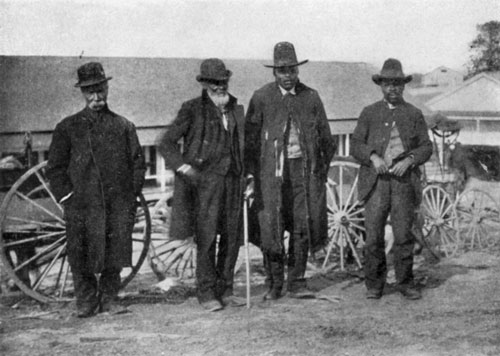
Some of Mr. Washington's humble friends. (See page 136)
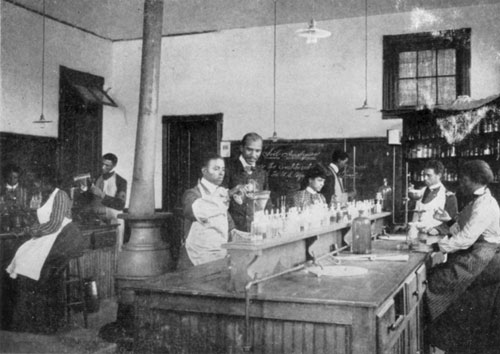
Soil analysis. The students are required to work out in the laboratory the problems of the field and the shop.
In the same way he constantly appointed committees to go into the academic classes and see that they were correlating their work with the trade work. The tendency to backslide is especially strong in an institution which, like Tuskegee, is working out original problems. It is fatally easy for the teachers in both academic and industrial classes to slip away from the correlative method, for which the institution stands, back to the traditional routine. The correlative method requires constant thought. As Mr. Washington well knew, the average person only thinks under constant prodding. Hence, the committees to do the prodding! It is so much easier to take one's problems from the textbooks than to dig them up in the shops or on the farm as to be practically irresistible unless one is being watched. Then, in the shops it requires a constant effort to work the theory in with the practice. If the instructors in the trades tended to become mere unthinking mechanics a vigilant committee was at hand to keep them true to their better lights. And if the committees themselves ever became slack, the all-seeing eye of the principal soon detected it and they in turn were "jacked up." Mr. Washington himself had a way of leisurely strolling about day or night into shop, classroom, or laboratory with a stenographer at his elbow. If he thus came upon a recitation in which no illustrative material was used, that teacher would receive within the next few hours a note such as this:
December 8, 1914.
Mr. ——: After a visit to your class yesterday, I want to make this suggestion—that you get into close contact with some of the teachers here like Mrs. Jones of the Children's House, and Mrs. Ferguson, Head of the Division of Education, and Mr. Whiting of the Division of Mathematics, who understand our methods of teaching and try to learn our methods.
Your work yesterday was very far from satisfactory, not based upon a single human experience or human activity.
[Signed] Booker T. Washington, Principal.
Three days before he had sent the following note to the head of the academic department:
Mr. Lee, Director of the Academic Department:
I was very glad to see the wideawake class conducted by Mr. Smith this morning. His methods are certainly good.
On asking questions of the individual members of the class, I found that about half of the class did not know just what was to be found out from the measurements. If Mr. Smith will go to the new Laundry Building, in case he has not done so, he will find an opportunity to teach the same lessons in connection with a real building. I hope you will make this suggestion to him. Nothing takes the place of reality wherever we can get something real.
[Signed] Booker T. Washington, Principal.
Previous to this he had written Mr. Lee the following letter relative to the general problem of the teaching efficiency in his department:
November 24, 1914.
Mr. Lee, Director Academic Department:
When you return, I want to urge that you give careful but serious attention to the following suggestions:
First, I am convinced that we must arrange to give more systematic and constant attention to the individual teachers in your department in the way of seeing that they follow your wishes and policy regarding the dovetailing of the academic work into the industrial work.
I am quite convinced that the matter is taken up in rather a spasmodic way; that is, so long as you are on hand and can give the matter personal attention, it is followed, but when you cease to give personal attention to it or are away, matters go back to the old rut, or nearly so.
In some way we must all get together and help you to organize your department so that this will not be true.
There are two elements of weakness in the academic work: First, I very much fear that we take into it every year too many green teachers, who know nothing about your methods. This pulls the whole tone of the academic work down before you can train them into your methods. I am quite sure that though you might not get teachers who have had so much book training, that it would be worth your considering to employ a larger number of Hampton graduates or Tuskegee graduates, who have had in a measure the methods which you believe in instilled into them.
In my opinion, the time has come when you must consider seriously the getting rid of, or shifting, some of your older teachers. You have teachers in your department who have been here a good many years, and experience proves that they do not adapt themselves readily and systematically to your methods. I think it would be far better for the school to find employment for them outside of the Academic Department, or to let them take some clerical work in your department, than for them to occupy positions of importance and influence, which they are not filling satisfactorily and where they have an influence in hurting the character of the whole teaching.
All these matters I hope you will consider very carefully. I am sure that the time has come when definite and serious action is needed.
Booker T. Washington, Principal.
First and last on these apparently aimless strolls with a stenographer he visited not only the classrooms and shops but every corner of the great institution. He would return to his office with a notebook full of memoranda of matters to be followed up or changed, and of people to be commended or censured for their efficient or inefficient handling of this, that, or the other piece of work. Once after writing a series of letters calling attention to ragged tablecloths, unclean napkins, and uncleanliness in other forms in kitchens, bakery, and dining-rooms without the desired result, he personally took charge of the situation, organized a squad of workers, put things in proper condition, and then insisted that they be kept in such condition.
His passion to utilize every fraction of time to its maximum advantage led him even to smuggle a stenographer into the formal annual exercises of the Bible Training School so that he might during the exercises clandestinely dictate notes for the head of the Bible school as to those features in which the program was weak, failed "to get across," did not hold the interest of the people, seemed to be over their heads, or whatever might be his diagnosis of the difficulty. He was not interested in the program for and of itself, but was keenly interested in its effect upon the people. If it interested and helped them, it was a good program; if it did not, it was a poor program and no amount of learning or technical perfection could redeem it. He sometimes reduced his more scholarly teachers to the verge of despair by his insistence that there should be nothing on the program at any exercise to which the public was invited which the every-day man and woman could not understand and appreciate.
In opening the chapter we mentioned Booker Washington's faculty for giving attention to apparently trivial details without losing sight of his large policies and purposes. This was part of his habit of taking nothing for granted. He never assumed that people would do or had done what they should do or should have done any more than he assumed they would not or had not done what they should. He neither trusted nor distrusted them. He kept himself constantly informed. Every person employed by the institution from the most important department heads down to the men who removed ashes and garbage were under the stimulating apprehension that his eye might be upon them at any moment. He harassed his subordinates by continually asking them if this or that matter had been attended to. He would sometimes ask three different people to do the same thing. This resulted in wasted effort on somebody's part, but it always accomplished the result, which was all that interested him. He took nothing for granted himself and he insisted that his subordinates take nothing for granted. He was a task master and a "driver" but he taxed himself more heavily and drove himself harder than he did any one else. Like other strong men, he had the weaknesses of his strength, and probably his most serious weakness was driving himself and his subordinates beyond his and their strength.
His eye was daily upon every part of the great machine which he had built up through an exhaustive system of daily reports. These reports were placed on his desk each morning when at the Institute and mailed to him each morning when away. They showed him the number of students in the hospital with the name, diagnosis, and progress of each case. From the poultry yard came reports giving the number of eggs in the incubators, the number hatched since the day before, the number of chickens which had died, the number of eggs and chickens sold, etc. Similarly daily reports came from the swine herd, the dairy herd, and all the other groups of live stock.
He received also each morning a report from the savings department giving the number of new depositors, the amounts of money deposited and withdrawn, and the condition of the bank at the close of the previous day. There was, too, a list of the requisitions approved by the Business Committee the previous day giving articles, prices, divisions, or departments in which each was to be used and totals for different classes of requisitions.
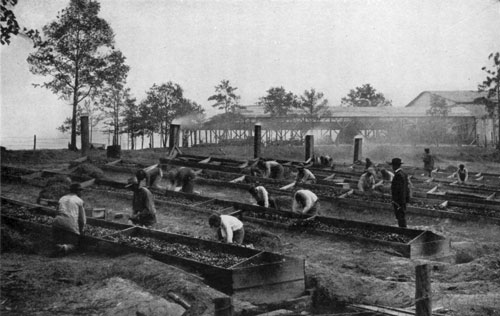
Mr. Washington was a great believer in the sweet potato. He personally supervised the work of preparing for sweet potato planting.
The Boarding Department head would report just what had been served the students at the three meals of the day before. In running over these menus he would give a contemptuous snort if he came upon any instance of what he called "feeding the students out of the barrel." By this he meant buying food which could as well or better have been raised on the Institute farms. He objected to this practice not only because it was more expensive, but because it eliminated the work of raising, preparing, and serving the foods which he regarded as a valuable exercise in civilization. He also insisted that everything raised on the farms should in one way or another be used by the students. Besides serving to the students every variety of Southern vegetable from the Institute's extensive truck gardens, he always insisted that their own corn be ground into meal and that they make their own preserves out of their own peaches, blackberries, and other fruits. In other words, he made the community feed itself just as far as possible. And this he did quite as much because of the knowledge of the processes of right living which it imparted as for the money which it saved.
The Treasurer also submitted a daily report of contributions and other receipts of the previous day with the name and address of each contributor. Mr. Washington arranged to receive and look over these daily reports even when travelling. Hence, in a sense, he was never absent. Only very rarely and under most unusual circumstances did he cut this means of daily contact with the multifold activities of the institution.
Although a task master, a driver, and a relentless critic, he was just in his dealings with his subordinates and his students, very appreciative of kindness or thoughtfulness, and generous in his approbation of tasks well done. Three of the younger children of officers of the school, while out walking with one of their teachers, discovered a fire in the woods near the Institute one day. After notifying the men working nearby, the children hurried home and wrote Mr. Washington a letter telling him about the fire. They had heard him warn people against the danger of forest fires and of the great harm they did. This letter the three children excitedly took to the Principal's home themselves, as it was on Sunday. He was not in, but the first letter he dictated on arriving at his office the next morning was this:
March 24, 1915.
Miss Beatrice Taylor, Miss Louise Logan, Miss Lenora Scott:
I have received your kind and thoughtful letter of yesterday regarding the forest fire and am very grateful to you for the information which it contains. It is very kind and thoughtful of you to write me. I shall pass your letter to Mr. Bridgeforth, the Head of the Department, and ask him to look after the matter.
[Signed] Booker T. Washington, Principal.
In the fall of the same year he addressed this letter of appreciation to Mr. Bridgeforth, director of the Agricultural Department, mentioned in the note of the children:
Principal's Office, Tuskegee Institute, Alabama
October 4, 1915.
Mr. G.R. Bridgeforth, Director of Agricultural Department:
I have been spending a considerable portion of each day in inspecting the farm, and I want to congratulate you and all of your assistants on account of the fine sweet potato crop which has been produced. It is certainly the finest crop produced in the history of the school.
You deserve equal commendation, especially in view of the season you have had to contend with, in connection with the fine hay crop, the pea crop, and the peanut crop.
I wish you would let the members of your force know how I feel regarding their work.
I believe if the farm goes on under present conditions, that at the end of the year it will very much please the Trustees to note the results accomplished especially so far as the Budget is concerned.
[Signed] Booker T. Washington, Principal.
His quick mind and his keen sense of humor would sometimes lead him to make fun in a kindly way of his slower colleagues. The members of the Executive Council and the Faculty sometimes felt he treated them rather too much as if he were the teacher and they the pupils. His frequent humorous sallies and stories exasperated some of the more serious-minded members of his staff very much as Lincoln's sallies and stories exasperated some of the members of his Cabinet, particularly Secretary Stanton. This sense of humor was undoubtedly with Booker Washington as with Abraham Lincoln one of the great safety valves without which he could not have carried his heavy burden as long as he did.
Among other things he always insisted that the human element be put into the work of the institution and kept in it. He would reprimand a subordinate just as sharply for failure to be human as for a specific neglect of duty. He was particularly insistent that all letters to the parents of the students should be intimate and friendly rather than formal and stereotyped. He believed that nothing would more quickly or more surely kill the effectiveness of the school than the application of cut-and-dried theories and formulas to the handling of the students and their problems. He never lost sight of the fact that the most perfect educational machine becomes worthless if the soul goes out of it.
On his return from trips he would write a personal letter about their boy or girl to each parent whom he had met while away. After he had addressed a meeting and was shaking hands with those who came forward to meet him a man would say, as one once did, with embarrassed pride, "I 'spec you know my boy—he's down to your school. He's a tall, black boy an' wears a derby hat." When Mr. Washington got back to Tuskegee he sent for "the tall, black boy" with the derby hat and wrote his proud father all about him.
On his return from journeys he would write individual letters not only to the parents of students and to his hosts and hostesses, but to each and every person who had tried in any way to contribute to the pleasure and success of his trip. On returning from the State educational tours which we have described he would write personal letters of thanks and appreciation not only to every member of the general committee on arrangements which had managed his tour throughout the State, but also to every member of the local committees for the various towns and cities which he visited. He would also write such a letter to the Governor or Mayor or whatever public official or prominent citizen had introduced him. Usually on these tours school children, or a group of women representing a local colored women's club, would present him with flowers. He would in such cases insist that the name of each child or each woman in the group be secured so that he might on his return write to each one a personal letter of thanks. Many such letters are now among the treasured possessions of humble Negro homes throughout the country.
Recognizing that Tuskegee's chief claim to support from the public must be found in the achievements of her graduates he built up the Division of Records and Research to keep in constant touch with the graduates and gather information about them and their work. By this means he could find out in detail at a moment's notice what most of the graduates were doing and in terms of statistics what all were doing. Eighteen to twenty of them are building up or conducting schools on the model of Tuskegee Institute in parts of the South where they are most needed. With these he naturally sought to keep in particularly close touch.
With funds provided for the purpose by one of the Tuskegee Trustees, committees of Tuskegee officers and teachers are sent from time to time to visit these schools established by Tuskegee graduates. They act as friendly inspectors and advisers. The following is the plan of report drafted for the guidance of these committees:
OBSERVATIONS
1. Physical. (a) Cleanliness of premises. (b) Keeping up repairs. 2. Teaching. (a) Methods of instruction. (b) Books used, etc., that is, are they up to date. (c) To what extent correlation is being carried out. (d) Visiting teachers might give some definite demonstrations in methods, etc. (e) Special meetings with the faculty should be held. 3. Financial. (a) To what extent does the school keep up with its accounts so that its receipts and expenditures can be easily ascertained? 4. Community work. (a) Extension activities carried on by the school, (b) The efficiency of these activities. 5. Attendance. (a) Number of students enrolled on date of visit. (b) Number in attendance on date of visit. (c) What efforts are being made to get the students to enter at the beginning of the term and remain throughout the year?
SUGGESTIONS
1. Before concluding its visit the committee should make, to proper persons in the school, suggestions concerning the improving of the teaching and of other things as may be necessary.
2. If committee makes a second visit, see to what extent the suggestions of the previous visit have been carried out.
REPORT
After each visit a written report by the committee covering all of the above shall be sent to Principal Washington.
To all the graduates of the Institute Mr. Washington sent a circular letter on the first of each year in which frequently he told them of the progress that had been made by the school during the year in improvements, number of students enrolled, etc., and asked them in turn to answer a list of questions about their life and work, or sometimes in such letters he merely wished them success and gave them some practical advice. The 1913 letter which follows is an example of the latter:
Tuskegee Institute, Alabama, January 1, 1913.
Dear Mr. (or Miss) Blank:
I take this opportunity to send you greetings, to inquire how you are getting along, and to express the hope that in every way you are prospering. If, however, you are having discouragements, I trust that you are meeting them bravely. If you have difficulties, or are laboring under disadvantages, use them as stepping-stones to success.
I again call your attention to the importance of keeping in touch with the Institute. Keeping your address on file with us and sending a report of your work will assist in doing this. I enclose herewith a blank for that purpose. Visits to the school should also be made from time to time. You should begin to prepare now to be here during the coming commencement exercises in May in order that you may see what is being done at the institution and to meet your former classmates. Already the officers of the General Alumni Association have begun preparations for your welcome.
I urge upon you the importance of keeping up the habit of study and of reading good books and papers. The accompanying circular on "How to Buy Books" gives valuable suggestions about how to secure the best books cheaply. I take this occasion to inform you that already we are making preparations for our 1913 Summer School. It is hoped that every graduate who is teaching will attend this or some other good summer school.
I trust that wherever you are located you will do all that you can for community uplift. Be active in church and Sunday-school work, help to improve the public schools, assist in bettering health conditions, help the people to secure property, to buy homes and to improve them. In doing all these things, you will be carrying out the Tuskegee idea.
Very truly yours,
[Signed] Booker T. Washington, Principal.
The questions were slightly varied from year to year. The following were those sent out with the 1915 letter—the last to bear the signature of the Institute's founder.
Please favor me by answering these questions and returning the blank as soon as you receive it.
1. Your full name when at Tuskegee? ______________________________________
2. What year were you graduated from Tuskegee? ____________________________
3. Your present home address? __________________________________________
4. If you are not at home, your temporary address for the winter of 1915-1916? __________________________________________________
5. If you have married, your wife's name before marriage? ______________________ Was she ever a student at Tuskegee? _________________________________ Is she living? ____________________________________________________
6. Your present occupation? If in educational work, give your position in the school. _________________________________________
7. How long have you followed it? _______________________________________
8. What are your average wages or earnings per day, week, or month? _______________________________________________________
9. What other occupation have you? _____________________________________
10. Average wages per day, week, or month at this occupation? ________________
11. Kind and amount of property owned? _________________________________
12. Tell us something of the work you are doing this year. (We will also be pleased to receive testimonials from white and colored persons concerning your work). _____________________________________________________________
13. We especially wish to get in touch this year with as many of our former students as possible. Please give present addresses and occupations of all of these that you can. _____________________________________________________________
Booker T. Washington, Principal.
Tuskegee Institute, Alabama.
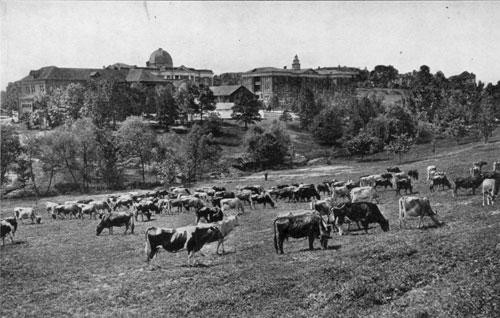
Mr. Washington had this picture especially posed to show off to the best advantage a part of the Tuskegee dairy herd.
As previously mentioned the relationship between Mr. Washington and his Trustees was at all times particularly friendly and harmonious. While they were always directors who directed instead of mere figureheads, they nevertheless were broad enough and wise enough to give the Principal a very free rein. Preëminent among the able and devoted Trustees of Tuskegee was the late William H. Baldwin, Jr. In order to commemorate his life and work the William H. Baldwin, Jr., Memorial Fund of $150,000 was raised by a committee of distinguished men, with Oswald Garrison Villard of the New York Evening Post as chairman, among whom were Theodore Roosevelt, Grover Cleveland, and Charles W. Eliot, and placed at the disposal of the Tuskegee Trustees. A bronze memorial tablet in memory of Mr. Baldwin was at the same time placed on the Institute grounds. At the ceremony at which this tablet was unveiled and this fund presented to the Trustees, Mr. Washington said in part, in speaking of his relations with Mr. Baldwin and Mr. Baldwin's relations to Tuskegee:
"Only those who are close to the business structure of the institution could really understand what the coming into our work of a man like William H. Baldwin meant to all of us. In the first place, it meant the bringing into our work a certain degree of order, a certain system, so far as the business side of the institution was concerned, that had not hitherto existed. Then the coming of him into our institution meant the bringing of new faith, meant the bringing of new friends. I shall never forget my first impression. I shall never forget my first experience in meeting Mr. Baldwin. At that time he was the General Manager and one of the Vice-Presidents of the Southern Railway, located then in its headquarters in the city of Washington. I remember that, a number of days previous, I had gone to the city of Boston and had asked his father if he would not give me a line of introduction to his son, about whom I had already heard in Washington. Mr. Baldwin's father readily gave me a line of introduction and I went in a few days after that and sought out Mr. Baldwin in his Washington office and he looked through this letter of introduction, read it carefully, then he looked me over, up and down, and I asked him if he would not become a trustee of this institution. After looking me over, looking me up and down for a few seconds or a few minutes longer, he said, 'No, I cannot become a trustee; I will not say I will become a trustee because when I give my word to become a trustee it must mean something.' He said, 'I will study the institution at Tuskegee, I will go there and look it over and after I have found out what your methods are, what you are driving at—if your methods and objects commend themselves to me, then I will consent to become a trustee.' And I remember how well—some of the older teachers and perhaps some of the older students will recall—that upon one day, when we were least expecting it, he stopped his private car off here at Chehaw and appeared here upon our grounds, and some of us will recall how he went into every department of the institution, how he went into the classrooms, how he went through the shops, how he went through the farm, how he went through the dining-room; I remember how he went to each table, and took pieces of bread from the table and broke them and examined the bread to see how well it was cooked, and even tasted some of it as he went into the kitchen. He wanted to be sure how we were doing things here at Tuskegee. Then after he had made this visit of examination for himself, after he had studied our financial condition, then after a number of months had passed by, he consented to permit us to use his name as one of our Trustees, and from the beginning to the end we never had such a trustee. He was one who devoted himself night and day, winter and summer, in season and out of season, to the interests of this institution. Now, having spoken this word, you can understand the thoughts and the feelings of some of us on this occasion as we think of the services of this great and good man.
"It is one of the privileges of people who are not always classed among the popular people of earth to have strong friends for the reason that nobody but a strong man will endure the public criticism that so often comes to one who is the friend of a weak or unpopular race. This, in the words of another, is one of the advantages enjoyed sometimes by a disadvantaged race."
Naturally no account of Booker Washington's administration of the great institution which he built would be complete without some mention of Mrs. Washington's part in her husband's work. Aside from her duties as wife, mother, and home maker—duties which any ordinary woman would find quite exacting enough to absorb all her time, thought, and strength particularly in view of the fact that a wide hospitality is part of the rôle—Mrs. Washington, as director of women's industries, is one of the half-dozen leading executives of the institution. In addition to her many and varied family and official duties at the Institute Mrs. Washington has always been a leader in social service and club work among the women of her race throughout the country, and has besides all this come to be a kind of mother confessor, advisor, and guide to hundreds of young men and women. We will conclude this chapter by quoting in large part an article written by Mr. Scott and published some years ago in the Ladies' Home Journal, which describes how and when Mrs. Washington entered her husband's life and work and the part she played in his affairs:
"Even before the war closed there came to the South on the heels of the army of emancipation an army of school teachers. They came to perfect with the spelling-book and the reader the work that the soldiers had begun with the sword. It was during this period in the little straggling village of Macon, Miss., that a little girl, called then Margaret Murray, but who is known now as Mrs. Booker T. Washington, was born. When she grew old enough to count she found herself one of a family of ten and, like nearly all children of Negro parentage, at that time, very poor.
"In the grand army of teachers who went South in 1864 and 1865 were many Quakers. Prevented by the tenets of their religion from entering the army as soldiers these people were the more eager to do the not less difficult and often dangerous work of teachers among the freedmen after the war was over.
"One of the first memories of her childhood is of her father's death. It was when she was seven years old. The next day she went to the Quaker school teachers, a brother and sister, Sanders by name, and never went back home to live.
"Thus at seven she became the arbiter of her own fate. The incident is interesting in showing thus early a certain individuality and independence of character which she has exhibited all through her life. In the breaking or loosening of the family relations after the death of her father she determined to bestow herself upon her Quaker neighbors. The secret of it, of course, was that the child was possessed even then with a passion for knowledge which has never since deserted her. Rarely does a day pass that Mrs. Washington amid the cares of her household, of the school, and of the many philanthropic and social enterprises in which she takes a leading part, does not devote half or three-quarters of an hour to downright study.
"And so it was that Margaret Murray became at seven a permanent part of the Quaker household, and became to all intents and purposes, so far as her habits of thought and religious attitude are concerned, herself a Quaker.
"'And in those early days,' says Mrs. Washington, laughing, 'I learned easily and quickly. It was only after I grew up that I began to grow dull. I used to sit up late at night and get up early in the morning to study my lessons. I was not always a good child, I am sorry to say, and sometimes I would hide away under the house in order to read and study.'...
"When Margaret Murray was fourteen years old the good Quaker teacher said one day, 'Margaret, would thee like to teach?' That very day the little girl borrowed a long skirt and went downtown to the office of Judge Ames, and took her examination. It was not a severe examination. Judge Ames had known Margaret all her life and he had known her father, and in those days white people were more lenient with Negro teachers than they are now. They did not expect so much of them. And so, the next day, Margaret Murray stepped into the schoolroom where she had been the day before a pupil and became a teacher....
"Then Margaret heard of the school at Nashville—Fisk University—and she went there. She had a little money when she started to school, and with that and what she was able to earn at the school and by teaching during vacations she managed to work her way as—what was termed rather contemptuously in those days—a 'half-rater.' It was not the fashion at that time, in spite of the poverty of the colored people, for students to work their way through school.
"In those days very little had been heard at Fisk of Tuskegee, of Hampton, or of Booker T. Washington. Students who expected to be teachers were looking forward to going to Texas. Texas has always been more favorable to Negro education than other Southern States and has always got the best of Negro public school teachers.
"But upon graduation day, June, 1889, Booker T. Washington was at Fisk, and he sat opposite Margaret Murray at table. About that time it was arranged that she should go to Texas, but, without knowing just how it came about, she decided to go to Tuskegee and become what was then called the Lady Principal of the school. Mrs. Washington has been at Tuskegee ever since.
"Mrs. Washington's duties as the wife of the Principal of the Tuskegee Institute are many and various. She has charge of all the industries for girls. She gives much time to the extension work of the school, which includes the 'Mothers' meetings' in the town of Tuskegee and the 'plantation settlement' nearby. Her most characteristic trait, however, is a boundless sympathy which has made her a sort of Mother Confessor to students and teachers of the Institute. All go to her for comfort and advice.
"The 'mothers' meetings' grew out of the first Tuskegee Negro Conference held at Tuskegee in February, 1892. Mrs. Washington, as she sat in the first meeting of Negro farmers and heard what they had to say, was impressed with the fact that history was repeating itself. Here again, as in the early days of the woman's suffrage movement, women had no place worth mentioning in the important concerns of life outside the household. While there were many women present at this first conference, they did not seem to realize that they had any interest in the practical affairs that were being discussed by their sons and husbands. While her husband was trying to give these farmers new ideas, new hopes, new aspirations, the thought came to Mrs. Washington that the Tuskegee village was the place for her to begin a work which should eventually include all the women of the county and of the neighboring counties. The country colored women crowd into the villages of the South on Saturday, seeking to vary the monotony of their hard and cheerless lives. Mrs. Washington determined to get hold of these women and utilize the time spent in town to some good purpose. Accordingly, the first mothers' meeting was organized in the upper story of an old store which then stood on the main street of the village. The stairs were so rickety that the women were almost afraid to ascend them. It answered the purpose temporarily, however, and there was no rent to pay. How to get the women to the meeting was, for a time, a question. For fear of opposition Mrs. Washington took no one into her confidence except the man who let her have the room. She sent a small boy through the streets with the instruction to go to every colored woman loitering about the streets and say: 'There is a woman upstairs who has something for you.' Mrs. Washington says: 'That first meeting I can never forget. The women came, and each one, as she entered, looked at me and seemed to say, 'Where is it?' We talked it all over, the needs of our women of the country, the best way of helping each other, and there and then began the first mothers' meeting which now has in its membership two hundred and twenty-nine women.'...
"Mrs. Washington asked some of the teachers at Tuskegee to begin to help these people (the people of the country districts surrounding the school). At first they went to the plantation (selected for the purpose) on Sundays only. Mrs. Washington selected what seemed to be the most promising cabin and asked the woman who lived there if she could come to that house the next Sunday and hold a meeting. When the party went down early the next Sunday morning a stout new broom was taken along. Making the woman a present of the broom, it was suggested that all take a hand in cleaning the house a little before the people should begin to come. The woman took the broom and swept half of the room, when Mrs. Washington volunteered to finish the job.
"She had not gone far along on her half before the woman was saying: 'Oh, Mis' Washington, lemme take de brom an' do mah half ovah.' Mrs. Washington says: 'I have always thought that that one unconscious lesson in thoroughness was the foundation of our work on that plantation.'...
"Not the least of the duties which fall to Mrs. Washington is that of caring for the distinguished people who visit the Tuskegee Institute. The Tuskegee rule that everything must be in readiness for the inspection of visitors, as much so in the kitchen as in any other department of the school, prevails in her home also.
"An interesting part of this home life is the Sunday morning breakfast. The teachers have slept later than usual, and, through the year, when Mr. Washington is at home, they are invited in groups of three and four to share this morning meal. In this way he keeps in personal touch with each of his teachers; he knows what they are doing; he hears their complaints, if they have any; he counsels with them; they 'get together.'
"Mrs. Washington's labors for the good of her people are not confined to the school. She is (has been) president of the Southern Federation of Colored Women's Clubs, editor of the official organ of the National Federation of Colored Women's Clubs, of which she is also an officer. She is a frequent contributor to the newspapers and magazines. (Mrs. Washington has since served two terms as president of the National Federation of Colored Women's Clubs.)
"Mr. Washington's own estimate of his wife's helpfulness to him may be gathered from his tribute in his widely read autobiography, 'Up from Slavery': 'She is completely one with me in the work directly connected with the school, relieving me of many burdens and perplexities.'"
CHAPTERTWELVE
WASHINGTON: THE MAN
JUST as in the first chapter we sought to show the man in the making, so in this last chapter we shall seek to picture him as he became in the full fruition of his life. In the fully developed man of the last decade of his life we find the same traits and qualities which began to show themselves in those early years of constant struggle and frequent privation. There is the same intense mental and physical activity; the same readiness to fight against any odds in a good cause; the same modesty, frankness, open-mindedness, and passion for service.
One of the many illustrations of this intense activity was shown in a trip he made to Atlanta, Ga., three or four years before he died. Even at this time his strength had begun to wane. In accordance with his unfailing practice he got up at six o'clock in the morning, and after visiting his poultry and his beloved pigs, mounted his horse and rode over farms and grounds inspecting crops and buildings and what-not until eight o'clock, when he went to his office and attacked his huge morning's mail. After dictating for an hour or more he left his office just in time to catch a train which brought him to Atlanta at two o'clock in the afternoon. At the station he shook hands with four hundred people who had gathered to meet him. As he went along the streets to the Government Building he shook hands with many others who recognized him in passing. At the Government Building he shook hands with another large group assembled there to meet him. After the dinner tendered him by some of the leading individuals and associations among the Negroes of the city he posed for his photograph with a group of those at the dinner. He then made a tour of the city by motor, during which he visited three or four schools for Negroes and at each made a half-hour speech into which, as always, he threw all the force and energy there was in him.
After supper that evening he addressed twelve hundred people in the Auditorium Armory, speaking for an hour and a half. From the armory he went to a banquet given in his honor where he gave a twenty-minute talk. He did not get to bed until one o'clock. Four hours later he took a return train which brought him back to the school by ten-thirty. He went at once to his office and to work, working until late in the afternoon when he called for his horse and took his usual ride before supper. After supper he presided at a meeting of the Executive Council and after the Council meeting he attended the Chapel exercises. After these exercises were over at ten o'clock he made an inspection on foot of various parts of the buildings and grounds before going to bed. By just such excessive overwork did he constantly undermine and finally break down his almost superhuman strength and powers of endurance. This he did with an obstinate persistence in spite of wise and increasingly urgent warnings from physicians, friends, and associates. Where his own health was concerned he obdurately refused to listen to reason. It would almost seem as though he had deliberately chosen to put forth herculean efforts until he dropped from sheer exhaustion rather than to work with moderation for a longer span of life.
Booker Washington was a man who thought, lived, and acted on a very high plane. He was, in other words, an idealist, but unlike too many idealists he was sternly practical. His mind worked with the rapidity of flashes of lightning, particularly when he was aroused. This led him at times to feel and show impatience in dealing with slower-minded people, particularly his subordinates. He was often stirred to righteous indignation by injustice, but always kept his temper under control. He had a lucid mind which reasoned from cause to effect with machine-like accuracy. His intuitions were amazingly keen and accurate. In other words, his subconscious reasoning powers were very highly developed. Consequently his judgments of men and events were almost infallible. Although practically devoid of personal vanity, he was a very proud and independent man, and one who could not brook dictation from any one or bear to be under obligation to any one. He had the tenacity of a bulldog. His capacity for incessant work and his unswerving pursuit of a purpose once formed, were a constant marvel to those who surrounded him. While he was without conceit or vanity he had almost unlimited self-confidence. While it cannot be said that he overrated his own abilities, neither can it be said that he underrated them. His sympathies were easily aroused and he was abnormally sensitive, but he never allowed his emotions to get the better of his judgment. He forgave easily and always tried to find excuses for people who wronged, insulted, or injured him. In repartee he could hold his own with any one and enjoyed nothing more than a duel of wits either with an individual or an audience.
Less than a month before he died, when he was wasted by disease and suffering almost constant pain, he received this letter of appeal from Madame Helena Paderewski:
New York, October 26, 1915.
My Dear Mr. Washington: I am writing you a very personal letter on a subject that is close to my heart, and I know the message it carries will find a response in your generous sympathy. It is with great pleasure that I recall our meeting, some years ago, and I have watched the success of your work among your people with sincere satisfaction, for I have always been an advocate of the principles for which you stand, the uplift of the colored race.
It is because I know you have ever directed your broad influence toward the most worthy causes that I am asking you in the name of the starving babies and their helpless mothers, to tell your people that we need them in our work of sending food and medicines to Poland. We need, my dear sir, even the smallest contribution that your beloved followers may offer, and I beg of you to make an appeal to your people. Tell them, for they may not all know as well as you, yourself, that it was a Pole—Kosciusko—who, in addition to fighting for American liberty, gave that which he needed himself to help the colored race. As you will recall, after refusing the grant of land offered him in recognition of his services in the War of the Revolution, he returned to Poland, not wishing to accept a reward for doing what he considered a sublime duty to those in need. Later, after eight years, when he again visited America, he was given a pension as General in the American Army. With the back pay during his absence, the sum amounted to about $15,000. Although poor himself, he felt deep compassion for the neglected colored children and, with the money given him, he established the first school in America devoted exclusively to the education of the colored youth.
I am sure you know the story in all its details, but I desire the colored people of America to know that to-day the descendants of the man who—unasked—aided them—plead for a crust of bread, a spoonful of milk for their hungry children. Tell them this and God will bless and prosper you in your telling and them in their giving. Do not think that small amounts are useless—five cents may save a life. I am sending Mr. Paderewski's appeal, but conditions, to-day, are worse now than when it was written. Will you help Poland? Will you do it now?
Please reply to Hotel Gotham.