BOOKER T. WASHINGTON (continued 2)
Reading edition
The commencement exercises which we have described are one of the numerous means evolved by Booker Washington to guide the masses of his own people, as well as the Southern whites, to a true conception of the value and meaning of real education for the Negro.
The correlation between the work of farm, shop, and classroom, first applied by General Armstrong at Hampton, was developed on an even larger scale by his one-time student, Booker Washington. The students at Tuskegee are divided into two groups: the day students who work in the classroom half the week and the other half on the farm and in the shops, and the night students who work all day on the farm or in the shops and then attend school at night. The day school students pay a small fee in cash toward their expenses, while the night school students not only pay no fee but by good and diligent work gradually accumulate a credit at the school bank which, when it becomes sufficiently large, enables them to become day school students. In fact, the great majority of the day students have thus fought their way in from the night school. But all students of both groups thus receive in the course of a week a fairly even balance between theory and practice.
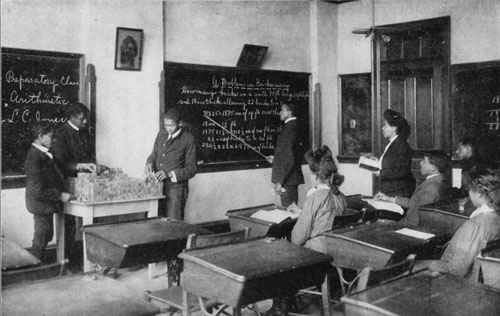
An academic class. A problem in brick masonry. Mr. Washington always insisted upon correlation; that is, drawing the problem from the various shops and laboratories.
In a corner of each of the shops, in which are carried on the forty or more different trades, is a blackboard on which are worked out the actual problems which arise in the course of the work. After school hours one always finds in the shops a certain number of the teachers from the Academic Department looking up problems for their classes for the next day. A physics teacher may be found in the blacksmithing shop digging up problems about the tractive strength of wires and the expansion and contraction of metals under heat and cold. A teacher of chemistry may be found in the kitchen of the cooking school unearthing problems relating to the chemistry of food for her class the next day. If, on the other hand, you go into a classroom you will find the shop is brought into the classroom just as the classroom has been brought into the shop. For instance, in a certain English class the topic assigned for papers was "a model house" instead of "bravery" or "the increase of crime in cities," or "the landing of the Pilgrims." The boys of the class had prepared papers on the architecture and construction of a model house, while the girls' papers were devoted to its interior decoration and furnishing. One of the girls described a meal for six which she had actually prepared and the six had actually consumed. The meal cost seventy-five cents. The discussion and criticism which followed each paper had all the zest which vitally practical and near-at-hand questions always arouse.
When the Department of Superintendence of the National Educational Association met in Atlanta, Ga., in 1904, many of the delegates, after adjournment, visited the Tuskegee Institute. Among these delegates was Prof. Paul Monroe of the Department of History and Principles of Education of the Teachers' College of Columbia University. In recording his impressions of his visit, Professor Monroe says: "My interest in Tuskegee and a few similar institutions is founded on the fact that here I find illustrated the two most marked tendencies which are being formulated in the most advanced educational thought, but are being worked out slowly and with great difficulty. These tendencies are: first, the endeavor to draw the subject matter of education, or the 'stuff' of schoolroom work, directly from the life of the pupils; and second, to relate the outcome of education to life's activities, occupations, and duties of the pupil in such a way that the connection is made directly and immediately between schoolroom work and the other activities of the person being educated. This is the ideal at Tuskegee, and, to a much greater extent than in any other institution I know of, the practice; so that the institution is working along not only the lines of practical endeavor, but of the most advanced educational thought. To such an extent is this true that Tuskegee and Hampton are of quite as great interest to the student of education on account of the illumination they are giving to educational theory as they are to those interested practically in the elevation of the Negro people and in the solution of a serious social problem. May I give just one illustration of a concrete nature coming under my observation while at the school, that will indicate the difference between the work of the school and that which was typical under old conditions, or is yet typical where the newer ideas, as so well grasped by Mr. Washington, are not accepted? In a class in English composition two boys, among others, had placed their written work upon the board, one having written upon 'Honor' in the most stilted language, with various historical references which meant nothing to himself or to his classmates—the whole paragraph evidently being drawn from some outside source; the other wrote upon 'My Trade—Blacksmithing'—and told in a simple and direct way of his day's work, the nature of the general course of training, and the use he expected to make of his training when completed. No better contrast could be found between the old ideas of formal language work, dominated by books and cast into forms not understood or at least not natural to the youth, and the newer ideas of simplicity, directness, and forcefulness in presenting the account of one's own experience. Not only was this contrast an illustration of the ideal of the entire education offered at Tuskegee in opposition to that of the old, formal, 'literary' education as imposed upon the colored race, but it gave in a nutshell a concept of the new education. This one experience drawn from the life of the boy and related directly to his life's duration and circumstances was education in the truest sense; the other was not save as Mr. Washington made it so in its failure...."
Among the delegates was also Mr. A.L. Rafter, the Assistant Superintendent of Schools of Boston, who in speaking at Tuskegee said: "What Tuskegee is doing for you we are going to take on home to the North. You are doing what we are talking about." In general, these foremost educational experts of the dominant race looked to Booker Washington and Tuskegee for leadership instead of expecting him or his school to follow them.
Booker Washington not only practised at Tuskegee this close relation between school life and real life—and it is being continued now that he is gone—but preached it whenever and wherever opportunity offered. Some years ago, in addressing himself to those of his own students who expected to become teachers, he said on this subject among other things: "... colored parents depend upon seeing the results of education in ways not true of the white parent. It is important that the colored teacher on this account give special attention to bringing school life into closer touch with real life. Any education is to my mind 'high' which enables the individual to do the very best work for the people by whom he is surrounded. Any education is 'low' which does not make for character and effective service.
"The average teacher in the public schools is very likely to yield to the temptation of thinking that he is educating an individual when he is teaching him to reason out examples in arithmetic, to prove propositions in geometry, and to recite pages of history. He conceives this to be the end of education. Herein is the sad deficiency in many teachers who are not able to use history, arithmetic, and geometry as means to an end. They get the idea that the student who has mastered a certain number of pages in a textbook is educated, forgetting that textbooks are at best but tools, and in many cases ineffective tools, for the development of man....
"The average parent cannot appreciate how many examples Johnny has worked out that day, how many questions in history he has answered; but when he says, 'Mother, I cannot go back to that school until all the buttons are sewed on my coat,' the parent will at once become conscious of school influence in the home. This will be the best kind of advertisement. The button propaganda tends to make the teacher a power in the community. A few lessons in applied chemistry will not be amiss. Take grease spots, for example. The teacher who with tact can teach his pupils to keep even threadbare clothes neatly brushed and free from grease spots is extending the school influence into the home and is adding immeasurably to the self-respect of the home."[2]
The idea that education is a matter of personal habits of cleanliness, industry, integrity, and right conduct while of course not original with Booker Washington was perhaps further developed and more effectively emphasized by him than by any other American educator. Just as Matthew Arnold insisted that religion was a matter of conduct rather than forms and dogmas so Booker Washington held that education is a matter of character and not forms. He concluded one of his Sunday night talks to his students with these words: "I want every Tuskegee student as he finds his place in the surging industrial life about him to give heed to the things which are 'honest and just and pure and of good report,' for these things make for character, which is the only thing worth fighting for...." In another of these talks he said: "A student should not be satisfied with himself until he has grown to the point where, when simply sweeping a room, he can go into the corners and crevices and remove the hidden trash which, although it should be left, would not be seen. It is not very hard to find people who will thoroughly clean a room which is going to be occupied, or wash a dish which is to be handled by strangers; but it is hard to find a person who will do a thing right when the eyes of the world are not likely to look upon what has been done. The cleaning of rooms and the washing of dishes have much to do with forming characters."[3]
This recalls Booker Washington's own experience when as a ragged and penniless youth he applied for admission to Hampton and was given a room to sweep by way of an entrance examination. Indeed, one of Booker Washington's greatest sources of strength as a teacher lay in the fact that his own life not only illustrated the truth of his assertions, but illustrated it in a striking and dramatic manner. His life was, in fact, an epitome of the hardships, struggles, and triumphs of the successful members of his race from the days of slavery to the present time. A great believer in the power of example he lived a life which gave him that power in its highest degree. Because of his inherent modesty and good taste he never referred to himself or his achievements as examples to be emulated, and this merely further enhanced their power.
In concluding another Sunday night talk he said: "As a race we are inclined, I fear, to make too much of the day of judgment. We have the idea that in some far-off period there is going to be a great and final day of judgment, when every individual will be called up, and all his bad deeds will be read out before him and all his good deeds made known. I believe that every day is a day of judgment, that we reap our rewards daily, and that whenever we sin we are punished by mental and physical anxiety and by a weakened character that separates us from God. Every day is, I take it, a day of judgment, and as we learn God's laws and grow into His likeness we shall find our reward in this world in a life of usefulness and honor. To do this is to have found the kingdom of God, which is the kingdom of character and righteousness and peace."[4]
To quote once more from these Sunday night talks, in another he said: "There is, then, opportunity for the colored people to enrich the material life of their adopted country by doing what their hands find to do, minor duties though they be, so well that nobody of any race can do them better. This is the aim that the Tuskegee student should keep steadily before him. If he remembers that all service, however lowly, is true service, an important step will have been taken in the solution of what we term 'the race problem.'"
As is shown by these quotations Booker Washington used these Sunday night talks to crystalize, interpret, and summarize the meaning and significance of the kind of education which Tuskegee gives. He, the supreme head of the institution, reserved to himself this supremely important task. The heads of the manifold trades are naturally and properly concerned primarily with turning raw boys and girls into good workmen and workwomen. The academic teachers in the school are similarly interested in helping them as students to secure a mastery of their several subjects. The military commandants are concerned with their ability to drill, march, carry themselves properly, and take proper care of their persons and rooms. The physician is interested in their physical health and the chaplain in their religious training. Important as are all these phases of Tuskegee's training and closely as he watched each Mr. Washington realized that they might all be well done and yet Tuskegee fail in its supreme purpose: namely, the making of manly men and womanly women out of raw boys and girls. As he said in one of the passages quoted, "character is the only thing worth fighting for." Now, while the forming of character is the aim, and in some appreciable degree the achievement, of every worth-while educational institution, it is to a peculiar degree the aim and the achievement of Tuskegee. The ten million Negroes in the United States need trained leaders of their own race more than they need anything else. Whatever else they should or should not have these leaders must have character. Since Tuskegee is the largest of the educational institutions for Negroes, with the man at its head who was commonly recognized as the leader of leaders in his race, naturally the heaviest responsibility in the training of these leaders fell, and will continue to fall, upon Tuskegee. Consequently the task at Tuskegee is not so much to educate so many thousands of young men and women as to train as many leaders for the Negro people as can possibly be done and done well within a given space of time. These Tuskegee graduates lead by the power of example and not by agitation. One runs a farm and achieves so much more success than his neighbors, through his better methods, that they gradually adopt these methods and with his help apply them to their own conditions. Another teaches a country school and does it so much better than the average country school teacher that his or her school comes to be regarded as a model to be emulated by the other schools of the locality. When a Tuskegee girl marries and settles in a community she keeps her house so much cleaner and in every way more attractive than the rank and file of her neighbors that gradually her house and her methods of housekeeping become the standard for the neighborhood. There is, however, nothing of the "holier than thou" or the complaisant about the true Tuskegee graduate and neither is there anything monopolistic. They have had the idea of service thoroughly drilled into their consciousness—the idea that their advantages of education are, as it were, a trust which they are to administer for the benefit of those who have not had such advantages.
Now such leaders as these must not only be provided if the so-called race problem is to be solved, but they must be provided speedily. In every community in which the black people are ignorant and vicious and without trained leaders among themselves they are likely at any time to come into conflict with the dominant race, and every such conflict engenders bitterness on both sides and makes just so much more difficult the final solution of the race problem. This is why Booker Washington labored so incessantly to increase the quantity of Tuskegee's output as well as to maintain the quality. He brought Tuskegee to the point where it reached through all its courses including its summer courses, short courses, and extension courses, more than 4,000 people in a single year, not counting the well-nigh innumerable hosts he counseled with on his State educational tours. In short, Booker Washington's task at Tuskegee was not only to turn out good leaders for his people, but to turn them out wholesale and as fast as possible. He was, as it were, running a race with the powers of ignorance, poverty, and vice. This in part accounted for the sense of terrific pressure which one felt at Tuskegee, particularly when he was present and personally driving forward his great educational machine. This also may have accounted for the seeming lack of finesse in small matters which occasionally annoyed critical visitors who did not understand that the great institution was racing under the spur of its indomitable master, and that just as in any race all but essentials must be thrown aside.
Long before the University of Wisconsin had, through its extension courses, extended its opportunities in greater or less degree to the citizens of the entire State, Booker Washington, through similar means, had extended the advantages of Tuskegee throughout Macon County in particular and the State of Alabama and neighboring States in general.
The extension work of Tuskegee began in a small way over twenty years ago. It preceded even the work of the demonstration agents of the United States Department of Agriculture. There was first only one man who in his spare time went out among the farming people and tried to arouse enthusiasm for better methods of farming, better schools, and better homes. He was followed by a committee of three members of the Tuskegee faculty, which committee still directs the work. One of the first efforts of this committee was to get the farmers to adopt deep plowing. There was not a two-horse plow to be found. There was a strong prejudice against deep plowing which was thus expressed by a Negro preacher farmer whom one of the committee tried to persuade: "We don't want deep plowing. You're fixin' for us to have no soil. If we plow deep it will all wash away and in a year or two we will have to clear new ground." Not long after this a member of the committee with a two-horse plow was practising what he had been preaching when a white planter who was passing stopped and said: "See here, its none of my business of course, but you're new here and I don't want to see you fail. But if you plow your land deep like that you'll ruin it sure. I know. I've been here."
After a time, however, the committee persuaded a few colored farmers to try deep plowing on a small scale as an experiment. One of the first of these was a poor man who had had the hardest kind of a struggle scraping a scant existence out of the soil for himself and his large family. He was desperate and agreed to try the new method. He got results the first year, moved on to better land and followed instructions. In a few years he bought 500 acres of land, gave each of his four sons 100 acres, and kept 100 acres for himself. Since then father and sons alike have been prosperous and contented and have added to their holdings.
In short, these Negro farmers were no more eager to be reformed and improved in their methods than are any normal people. There is a shallow popular sentiment that unless people are eager for enlightenment and gratefully receive what is offered them they should be left unenlightened. Booker Washington never shared this sentiment. His agent reported that in response to their appeals for the raising of a better grade of cattle, hogs, and fowl the farmers replied that the stock they had was good enough. One of their favorite comments was, "When you eat an egg what difference does it make to you whether that egg was laid by a full-blooded fowl or a mongrel?" Instead of being discouraged or disgusted by this attitude on the part of the people he merely regarded it as what was to be expected and set about devising means to overcome it. As always he placed his chief reliance upon the persuasive eloquence of the concrete. He decided to send blooded stock and properly raised products around among the farmers so that they might compare them with their inferior stock and products and see the difference with their own eyes. This plan was later carried out through the Jesup Wagon contributed by the late Morris K. Jesup of New York. This wagon was a peripatetic farmers' school. It took a concentrated essence of Tuskegees' agricultural department to the farmers who could not or would not come to Tuskegee.
The wagon was drawn by a well-bred and well-fed mule. A good breed of cow was tied behind. Several chickens of good breeds, well-developed ears of corn, stalks of cotton, bundles of oats and seeds, and garden products, which ought at the time to be growing in the locality, together with a proper plow, for deep plowing, were loaded upon the wagon. The driver would pull up before a farmhouse, deliver his message, and point out the strong points of his wagonload and would finally request a strip of ground for cultivation. This request granted he would harness the mule to the plow, break the ground deep, make his rows, plant his seeds, and move on to the next locality. With a carefully planned follow-up system he would return to each such plot for cultivation and harvest, and, most important of all, to demonstrate the truths he had sought to impress upon the people by word of mouth. Where the first driver sent out was a general farmer, the second would be, let us say, a dairyman, the third a truck gardener, and finally a poultry raiser would go; usually a woman, since in the South women, for the most part, handle this phase of farming. These agents also distribute pamphlets prepared by the Agricultural Research Department of Tuskegee on such subjects as school gardening, twenty-one ways to cook cowpeas, improvement of rural schools, how to fight insect pests, cotton growing, etc. The constant emphasis upon practice by no means entails any neglect of theory.
Besides this work there is each January for two weeks at Tuskegee the regular Farmers' Short Course. Many of the country schools adjourn for this period so that both teachers and pupils may attend. In this course not only teachers and pupils, but fathers and mothers, sons and daughters sit side by side in the classrooms receiving instruction in stock raising, canning, poultry raising, and farming in all its branches. There are special courses for the women and girls in the care of children and in housekeeping. The following breezy announcement is taken from the prospectus of this course for the year 1914:
"A creation of the farmer, by the farmers and for the farmer."
"It meets the crying needs of thousands of our boys and girls, fathers and mothers.
"It's free to all—no examination nor entrance fee is required.
"It started 7 years ago with 11 students; the second year we had 17, the third year we had 70, the fourth year we had 490, and last year we had nearly 2,000. It is the only thing of its kind for the betterment of the colored farmers. It lasts for only 12 days. It comes at a time when you would be celebrating Christmas.[5] In previous years the farmers have walked from 3 to 6 miles to attend; many have come on horseback, in wagons, and in buggies. You who live so that you cannot come in daily can secure board near the school for $2.50 per week. We expect 2,000 to 2,500 to enter this year."
And then as a further stimulus to attend there comes:
"Prizes will be given as follows:
"A prize of $5 will be given to the person who makes the greatest progress on all subjects taught.
"A prize of $2 will be given to the person who is the best judge of livestock.
"A prize of $1 will be given to the person who shows the best knowledge of the use and application of manures and fertilizers. And so on through a further list of one-dollar prizes for all the major activities of the Course."
It will be noted that there is nothing stilted or academic about this announcement.
Immediately following this Farmers' Short Course comes the Annual Farmers' Conference which holds its session in January of each year. To enforce the lessons in canning, stock raising, gardening, and all the other branches of farming, exhibits of the best products in each activity are displayed before the audience of farmers and their families, who number in all about 2,000. These exhibits are made and explained by the farmers themselves. The man, woman, or child who has produced the exhibit comes to the platform and explains in his or her own way just how it was done. In these explanations much human nature is thrown in. An amazingly energetic and capable woman had explained at one of these gatherings how she had paid off the mortgage on their farm by the proceeds from her eggs, her kitchen garden, and her preserving in her spare moments when she was not helping her husband in the cotton field, washing and dressing her six children, or cooking, mending, washing, and scrubbing for the household.
In conclusion she said:
"Now my ole man he's an' old-fashion farmer an' he don' kere fur dese modern notions, an' so I don't git no help from him, an' that makes it hard for me 'cause it ain't nat'ral for der woman to lead. If I could only git him to move I'd be happier jest ter foller him." While these explanations are going on the farmers in the audience are naturally saying to themselves over and over again, "I could do that!" or "Why couldn't I do that?"
One of Mr. Washington's chief aims was to increase the wants of his people and at the same time increase their ability to satisfy them. In other words, he believed in fermenting in their minds what might be termed an effective discontent with their circumstances. With this purpose in view he addressed to them at these conferences such questions as the following:
"What kind of house do you live in?"
"Do you own that house?"
"What kind of schoolhouse have you?"
"Do you send your children to school regularly?"
"How many months does your school run?"
"Do you keep your teacher in the community?"
"What kind of church have you?"
"Where does your pastor live?"
"Are your church, school, and home fences whitewashed?"
The farmers who were asked these questions would make an inward resolve that they would do what they could to put themselves in a position to answer the same questions more satisfactorily another year.
Another feature of the work of Tuskegee beyond its own borders is that of the Rural School Extension Department. Mr. Julius Rosenwald of Chicago, one of the trustees of Tuskegee, has offered, through this department, during a stated period of time, to add $300 to every $300 the Negroes in rural communities of the South raise for the building of a new and modern schoolhouse. Under this plan ninety-two modern rural school buildings have already been constructed. At the close of the time set Mr. Rosenwald will probably renew his offer for a further period. The social by-products of this campaign, in teaching the Negroes of these communities how to disregard their denominational and other feuds in working together for a high civic purpose of common advantage to all, and the friendly interest in Negro education awakened among their white neighbors, have been almost if not quite as important as the new schools themselves.
There is also at Tuskegee a summer school for teachers in which last year were registered 437 teachers from fifteen Southern and several other States. Most of these teachers elect such practical subjects as canning, basket-making, broom-making, shuck and pine needlework or some form of manual training, as well as the teacher-training courses. One of these students, who was the supervisor of the Negro schools of an entire county, when she returned from her summer school work proceeded to vivify her dead schools by introducing the making of wash-boards, trash baskets, baskets made of weeping-willow, and pine needle work in its various forms. The registration soared at once, the indifferent Negro parents became interested, and before long the parents of white children complained to the county superintendent that the colored children were being taught more than their children.
There is at the present time being developed at Tuskegee a unique experiment in the nature of what might be called a post-graduate school in real life for the graduates of the agricultural department. This consists in providing such graduates, who have no property of their own, with a forty-acre farm, on an 1,800-acre tract about nine miles from Tuskegee, known as Baldwin Farms, after the late Wm. H. Baldwin, Jr., who was one of the ablest and most devoted supporters and advisers of Booker Washington and Tuskegee. The land is held by the Tuskegee Farm and Improvement Company which is conducted on a business and not a charitable basis. The company sells the farms at an average price of $15 an acre, and purchasers who move directly on to the land are given ten years in which to pay for it, with the first payment at the end of the first year. If there is no house on the land the company will put up a $300 house so planned as to permit the addition of rooms and improvements as rapidly as the purchaser is able to pay for them; the cost to be added to the initial cost of the land. When the graduate lacks the money and equipment necessary to plant, raise, and harvest crops, for this, too, the company will advance a reasonable sum, taking as security a mortgage on crops and equipment until the loan has been paid off. This mortgage bears interest at 8 per cent. while the interest on the mortgage on the land is not more than 6 per cent. Through coöperative effort within this colony it is proposed to develop such organizations as coöperative dairy, fruit growing, poultry, and livestock associations and thus make it possible for the members of the colony to make not only a comfortable living but to lay by something. They will, of course, have also the great advantage of the advice and guidance of the experts of the Institute. Formerly the penniless Negro youth, who graduated even most creditably from the agricultural department of Tuskegee, had before him nothing better than a greater or less number of years of monotonous drudgery as a mere farm or plantation laborer. Now, he may at once take up his own farm at Baldwin and begin immediately to apply all he has learned in carving out his own fortune and future. Thus did Booker Washington plan to carry the benefits of classroom instruction directly into the actual life problems of these graduates as well as to bring the problems of actual life into the classroom.
However much Mr. Washington may have seemed to eliminate non-essentials in the pressure and haste of his wholesale educational task he never neglected essentials, but among essentials he included matters which might on the surface appear to be small and trifling. For instance, he insisted upon good table manners, and no boy or girl could spend any considerable time at Tuskegee without acquiring such manners. Instead of a trivial detail he regarded good table manners as an essential to self-respect and hence to the development of character. In short, he was engaged not so much in conducting a school as educating a race.
CHAPTERFOUR
THE RIGHTS OF THE NEGRO
BOOKER WASHINGTON was occasionally accused both by agitators in his own race and by a certain type of Northern white men who pose as the special champions of the "downtrodden" black man as encouraging a policy of submission to injustice on the part of his people. He was, for example, charged with tame acquiescence in the practical disfranchisement of the Negro in a number of the Southern States. As a matter of fact, when these disfranchising measures were under consideration and before they were enacted, he in each case earnestly pleaded with the legislators that whatever restrictions in the use of the ballot they put upon the statute books should be applied with absolute impartiality to both races. This he urged in fairness to the white man as well as the black man.
In an article entitled, "Is the Negro Having a Fair Chance?" published in the Century Magazine five years ago, Booker Washington said in illustrating the evil consequences of discrimination in the application of ballot regulations: "In a certain county of Virginia, where the county board had charge of registering those who were to be voters, a colored man, a graduate of Harvard University, who had long been a resident of the county, a quiet, unassuming man, went before the board to register. He was refused on the ground that he was not intelligent enough to vote. Before this colored man left the room a white man came in who was so intoxicated that he could scarcely tell where he lived. This white man was registered, and by a board of intelligent white men who had taken an oath to deal justly in administering the law.
"Will any one say that there is wisdom or statesmanship in such a policy as that? In my opinion it is a fatal mistake to teach the young black man and the young white man that the dominance of the white race in the South rests upon any other basis than absolute justice to the weaker man. It is a mistake to cultivate in the mind of any individual or group of individuals the feeling and belief that their happiness rests upon the misery of some one else, or that their intelligence is measured by the ignorance of some one else; or their wealth by the poverty of some one else. I do not advocate that the Negro make politics or the holding of office an important thing in his life. I do urge, in the interest of fair play for everybody, that a Negro who prepares himself in property, in intelligence, and in character to cast a ballot, and desires to do so, should have the opportunity."
While Booker Washington did not believe that political activities should play an important part among the Negroes as a whole he did believe that the exceptional Negro who was particularly qualified for holding public office should be given the opportunity just as he believed in the higher academic education for the relatively small minority capable of profiting by such an education.
In concluding a letter in which he asks Booker Washington to recommend a member of his race for a Federal office in Vicksburg, Miss., President Roosevelt said: "The question of the political importance of the colored man is really of no consequence. I do not care to consider it, and you must not consider it. Give me the very best colored man that you know of for the place, upon whose integrity and capacity we can surely rely."
The man, T.V. McAlister, whom Mr. Washington "gave" the President for this office was of such character and reputation that the white citizens of Vicksburg actually welcomed his appointment. Certainly neither Vicksburg nor any other portion of Mississippi can be accused of over-enthusiasm for conferring civil and political privileges upon Negroes.
Booker Washington's habit of never losing an opportunity to advance constructively the interests of his people is well illustrated by the following letter to President Roosevelt:
[Personal]
March 20, 1904.
My Dear Mr. President: It has occurred to me that there are a number of ways in which the colored people of the United States' could be of service in digging the Panama Canal, and personally I should be glad to do anything in my power in getting them interested if deemed practicable.
First: I think they can stand the climate better or as well as any other people from the United States.
Second: I have thought that a reasonably satisfactory number of them might be useful as common, or skilled, laborers.
Third: That in the Health Department our well-trained nurses and physicians might be found helpful.
Fourth: If the United States should assume any responsibility as to education, that many efficient colored teachers from our industrial schools, and colleges, might prove of great benefit. And, then, besides the presence of these educated persons would, in my opinion, both by character and example, aid in influencing the morality of the darker-skinned people to be employed at the Isthmus. I believe that these educated colored people could get closer to the masses than white men.
Yours truly,
Booker T. Washington.
To President Theodore Roosevelt, Washington, D.C.
Nothing came of this suggestion except an acknowledgment and an assurance that the matter would be considered. About two years ago, however, when Doctor Washington and Surgeon-General Gorgas met on a train the Surgeon-General said to Mr. Washington: "The biggest man at the canal was the Negro," and he added that when they came to the dedication of the canal at its formal opening some Negro should have a place on the program.
In recent years a certain section of the Republicans in the far Southern States have tried to free themselves of the reputation of being "nigger lovers" by vying with their Democratic rivals in seeking to deprive Negroes of civic and political rights. Republicans of this particular stripe are known colloquially as the "Lily Whites." In this connection the following correspondence is of interest.
[Copy]
[Personal]
White House, Washington, March 21, 1904.
Dear Mr. Washington: By direction of the President I send you herewith for your private information a copy of letter from the President to Mr. ——, dated February 24, 1904. Please return it to me when you have read it.
Yours very truly,
Wm. Loeb, Jr., Secretary to the President.
Principal Booker T. Washington, Tuskegee Normal and Industrial Institute, Tuskegee, Alabama.
This was the letter enclosed:
[Copy]
[Personal]
White House, Washington, February 24, 1904.
My Dear Mr. ——: I take it for granted that there is no intention of making the Louisiana delegation all white. I think it would be a mistake for my friends to take any such attitude in any state where there is a considerable Negro population. I think it is a great mistake from the standpoint of the whites; and in an organization composed of men whom I have especially favored it would put me in a false light. As you know, I feel as strongly as any one can that there must be nothing like "Negro domination." On the other hand, I feel equally strongly that the Republicans must consistently favor those comparatively few colored people who by character and intelligence show themselves entitled to such favor. To put a premium upon the possession of such qualities among the blacks is not only to benefit them, but to benefit the whites among whom they live. I very earnestly hope that the Louisiana Republicans whom I have so consistently favored will not by any action of theirs tend to put me in a false position in such a matter as this. With your entire approval, I have appointed one or two colored men entitled by character and standing to go to the National Convention.
Sincerely yours,
Theodore Roosevelt.
In the year 1898 the success of the suffrage amendments in South Carolina and Mississippi in excluding from the franchise more than nine-tenths of their Negro inhabitants inspired an agitation in Louisiana to cut off the Negro vote by similar means, and this agitation came to a head in the Constitutional Convention of that year. Mr. Washington, assisted by T. Thomas Fortune, the well-known Negro editor, and Mr. Scott, his secretary, prepared an open letter addressed to this convention which was taken to the convention by Mr. Scott and placed in the hands of the suffrage committee as well as the editors of the New Orleans Times-Democrat and the Picayune, the leading daily papers of the State. Extracts from the letter were sent out by the local representative of the Associated Press and widely published throughout the country. These New Orleans editors expressed to Mr. Scott their approval of the letter and their substantial agreement with its main features, and promised to publish it in full, which they not only did, but accompanied it by editorial reviews. This letter stated in part:
"The Negro agrees with you that it is necessary to the salvation of the South that restriction be put upon the ballot.... With the sincerest sympathy with you in your efforts to find a way out of the difficulty, I want to suggest that no State in the South can make a law that will provide an opportunity or temptation for an ignorant white man to vote and withhold the same opportunity from an ignorant colored man, without injuring both men.... Any law controlling the ballot, that is not absolutely just and fair to both races, will work more permanent injury to the whites than to the blacks.
"The Negro does not object to an educational or property test, but let the law be so clear that no one clothed with state authority will be tempted to perjure and degrade himself by putting one interpretation upon it for the white man and another for the black man. Study the history of the South, and you will find that where there has been the most dishonesty in the matter of voting, there you will find to-day the lowest moral condition of both races. First, there was the temptation to act wrongly with the Negro's ballot. From this it was an easy step to dishonesty with the white man's ballot, to the carrying of concealed weapons, to the murder of a Negro, and then to the murder of a white man and then to lynching. I entreat you not to pass such a law as will prove an eternal millstone about the neck of your children."
Later in the same appeal he said: "I beg of you, further, that in the degree that you close the ballot-box against the ignorant, that you open the schoolhouse.... Let the very best educational opportunities be provided for both races: and add to this the enactment of an election law that shall be incapable of unjust discrimination, at the same time providing that in proportion as the ignorant secure education, property, and character, they will be given the right of citizenship. Any other course will take from one half your citizens interest in the State, and hope and ambition to become intelligent producers and taxpayers—to become useful and virtuous citizens. Any other course will tie the white citizens of Louisiana to a body of death."
The New Orleans Times-Democrat, in its editorial accompanying the publication of this letter, said: "We have seen the corrupting influence in our politics and our elections of making fraud an element of our suffrage system. We are certainly not going to get away from fraud by encouraging it, or making it a part of the suffrage system we place in our new constitution." The same editorial further states that impartiality in the use of the ballot can be given Negro and white man not only "with the utmost safety," but "it would have a beneficial effect upon the politics of the State." In fact, the press of both North and South, both of the whites and the blacks, published this letter with practically unanimous editorial endorsement, but in spite of all this the leaders of the convention remained obdurate, the immediate object was lost, and Louisiana followed the example of Mississippi and South Carolina. No one realized, however, better than Booker Washington that the effort was by no means in vain. Owing to the general awakening of intelligent public opinion the convention leaders were forced into the position of driving through the discriminatory amendment not only in the face of the condemnation of the better element throughout the country but even with the disapproval of the better and leading citizens of their own State.
Shortly afterward members of the Georgia Legislature, seeking political preferment for themselves through the familiar means of anti-Negro agitation, introduced a bill which aimed to discriminate against the Negroes of Georgia by legislative enactment just as the Negroes of Louisiana had been discriminated against by a constitutional amendment. This time Mr. Washington went personally to Atlanta and appealed directly to a number of the members of the Legislature and to the editors of the leading papers in opposition to this bill. In an interview published in the Atlanta Constitution at the time he said:
"I cannot think that there is any large number of white people in the South who are so ignorant or so poor that they cannot get education and property enough to enable them to stand the test by the side of the Negro in these respects. I do not believe that these white people want it continually advertised to the world that some special law must be passed by which they will seem to be given an unfair advantage over the Negro by reason of their ignorance or their poverty. It is unfair to blame the Negro for not preparing himself for citizenship by acquiring intelligence, and then when he does get education and property, to pass a law that can be so operated as to prevent him from being a citizen, even though he may be a large taxpayer. The Southern white people have reached the point where they can afford to be just and generous; where there will be nothing to hide and nothing to explain. It is an easy matter, requiring little thought, generosity or statesmanship to push a weak man down when he is struggling to get up. Any one can do that. Greatness, generosity, statesmanship are shown in stimulating, encouraging every individual in the body politic to make of himself the most useful, intelligent, and patriotic citizen possible. Take from the Negro all incentive to make himself and his children useful property-holding citizens, and can any one blame him for becoming a beast capable of committing any crime?"
This time the immediate object was attained. The Atlanta Constitution and other leading Georgia papers indorsed Booker Washington's appeal and the Legislature voted down its anti-Negro members. Be it said to the credit of the Georgia Legislature that it has resisted several similar attempts to discriminate against the Negro citizens of the State, and it was not till 1908, ten years after the Louisiana law was passed, that Georgia finally passed a law disfranchising Negro voters.
Booker Washington has been accused of not protesting against the lynching of Negroes. In the article published in the Century Magazine in 1912, from which we have previously quoted, he said on this subject: "When he was Governor of Alabama, I heard Governor Jelks say in a public speech that he knew of five cases during his administration of innocent colored people having been lynched. If that many innocent people were known to the governor to have been lynched, it is safe to say that there were other innocent persons lynched whom the governor did not know about. What is true of Alabama in this respect is true of other states. In short, it is safe to say that a large proportion of the colored persons lynched are innocent.... Not a few cases have occurred where white people have blackened their faces and committed a crime, knowing that some Negro would be suspected and mobbed for it. In other cases it is known that where Negroes have committed crimes, innocent men have been lynched and the guilty ones have escaped and gone on committing more crimes.
"Within the last twelve months there have been seventy-one cases of lynching, nearly all of colored people. Only seventeen were charged with the crime of rape. Perhaps they are wrong to do so, but colored people do not feel that innocence offers them security against lynching. They do feel, however, that the lynching habit tends to give greater security to the criminal, white or black."
Mr. Washington often pointed out how the lynching of blacks leads inevitably to the lynching of whites and how the lynching of guilty persons of either race inevitably leads to the lynching of innocent persons of both races.
Let it not be supposed that Booker Washington confined his condemnation of lynching to the comparatively safe cover of the pages of an eminently respectable Northern magazine. Some years ago when he was on a speaking trip in the State of Florida two depraved Negroes in Jacksonville committed an atrocious murder. The crime aroused such intense race feeling that Mr. Washington's friends foresaw the likelihood of a lynching and, fearing for his safety, urged him to cancel his engagements in Jacksonville, where he was due to speak before white as well as black audiences within a few days. This he refused to do and insisted that because there was special racial friction it was especially necessary that he should keep his engagements in the city. While he was driving to the hall where he was to address a white audience the automobile of one of his Negro escorts was stopped by a crowd of excited white men who angrily demanded that Booker Washington be handed over to them. When they found he was not in the car they allowed it to pass on without molesting the Negro occupant, who enjoyed to an unusual degree the confidence and respect of both races in the city. What they would have done had they found Booker Washington one may only conjecture. At about the same time the Negro murderers were captured. The howls of the infuriated mob on its way to the jail to lynch the accused murderers could be heard in the distance from the hall where Mr. Washington spoke. Without referring in any way to the event which was taking place at the time Mr. Washington, to the alarm of his friends, launched into a fervid denunciation of lynching and ended with an earnest and eloquent appeal for better feeling between the races. Instead of his words breaking up the meeting in a storm of anger and rioting, this audience composed of Southern whites and colored people vigorously applauded his sentiments. Undoubtedly they were applauding not so much the views expressed as the courage shown in expressing them at that place and under those circumstances.
A somewhat similar experience occurred on a recent speaking tour which he and a party were making through the State of Louisiana. He was accompanied by a company of Negro leaders, including Major Moton of Hampton, who has since become his successor as Principal of Tuskegee Institute. They were in a portion of the State notorious for its lynchings of Negroes. No one who has ever seen Major Moton, or knows anything about him, would think of accusing him of timidity or cowardice. But when they went before a white audience in this particular district he urged Mr. Washington as a matter of common prudence to "soft pedal" what he had to say about lynching. Just as in Jacksonville Mr. Washington did just the opposite, and made his denunciation particularly emphatic, and just as in Jacksonville there was the same applause and apparent approval of his views.
Booker Washington also protested that in the matter of public education his people are not given a square deal in parts of the South, particularly in the country districts. He continually emphasized the relation between education and crime. Other things being equal the more and the better the education provided the less the number and seriousness of the crimes committed. Also he pointed out that the neglect of Negro school facilities injures the white citizens almost if not quite as much as the Negroes themselves. And conversely that good school facilities for the colored children benefit the whites almost as much as the Negroes. He also insisted that quite aside from all moral and ethical considerations Negro education pays in dollars and cents. As illustrating the relation between Negro education and crime or rather lack of Negro education and crime he related this incident in an article entitled, "Black and White in the South" published in the Outlook of March 14, 1914: "A few weeks ago three of the most prominent white men in Mississippi were shot and killed by two colored boys. Investigation brought to light that the two boys were rough and crude, that they had never been to school, hence that they were densely ignorant. While no one had taught these boys the use of books, some one had taught them, as mere children, the use of cocaine and whiskey. In a mad fit, when their minds and bodies were filled with cheap whiskey and cocaine, these two ignorant boys created a 'reign of murder,' in the course of which three white men, four colored men, and one colored woman met death. As soon as the shooting was over a crazed mob shot the two boys full of bullet-holes and then burned their bodies in the public streets.
"Now this is the kind of thing, more or less varied in form, that takes place too often in our country. Why? The answer is simple: it is dense ignorance on the part of the Negro and indifference arising out of a lack of knowledge of conditions on the part of the white people."
He then pointed out that the last enumeration in Mississippi, where this crime was committed, indicated that 64 per cent. of the colored children had had no schooling during the past year. That in Charleston County, South Carolina, another backward State in Negro education, there was expended on the public education of each white child $20.2; for the colored child $3.12; in Abbeville County $11.17 for the white, 69 cents for the colored child. This 69 cents per capita expense was incurred by maintaining a one-room school for two and one-half months, with a teacher paid at the rate of $15 a month. In another county the Negro school was in session but one month out of the twelve. Throughout the State, outside the cities and large towns, the school term for the colored children is from two to four months. Thus 200,000 colored children in South Carolina are given only three or four months of schooling a year. "Under these conditions it would require twenty-eight years for a child to complete the eight grades of the public school.... But South Carolina is by no means the only State that has these breeding spots for ignorance, crime, and filth which the nation will sooner or later have to reckon with."
In the article in the Century Magazine from which quotations have already been made Mr. Washington cites this statement made by W.N. Sheats, former Superintendent of Education for the State of Florida, in explanation of an analysis of the sources of the school fund of the State: "A glance at the foregoing statistics indicates that the section of the State designated as 'Middle Florida' is considerably behind all the rest in all stages of educational progress. The usual plea is that this is due to the intolerable burden of Negro education, and a general discouragement and inactivity is ascribed to this cause. The following figures are given to show that the education of the Negroes of Middle Florida does not cost the white people of that section one cent. Without discussing the American principle that it is the duty of all property to educate every citizen as a means of protection to the State, and with no reference to what taxes that citizen may pay, it is the purpose of this paragraph to show that the backwardness of education of the white people is in no degree due to the presence of the Negro, but that the presence of the Negro has been actually contributing to the sustenance of the white schools."
Mr. Sheats then shows that the cost of the Negro schools was $19,467, while the Negroes contributed to the school fund in direct taxes, together with their proper proportion of the indirect taxes, $23,984. He concludes: "If this is a fair calculation the schools for the Negroes are not only no burden on the white citizens, but $4,525 for Negro schools contributed from other sources was in some way diverted to the white schools."
Mr. Charles L. Coon, Superintendent of Schools at Wilson, N.C., is quoted as demonstrating that had there been expended upon the Negro schools the Negro's proportionate share of the receipts from indirect taxes, as well as the direct taxes paid by them, $18,077 more in a given year would have been expended on colored schools in Virginia, $26,539 more in North Carolina, and $141,682 more in Georgia. These figures would seem to show that in these States at least the Negro schools are not only no burden upon the white taxpayers but that the colored people do not get back in school facilities the equivalent of all they themselves contribute in taxes.
In the matter of passenger transportation facilities Booker Washington protested that injustice is done his people by most of the railroads of the South, not in providing separate accommodations for blacks and whites, but in furnishing the Negroes with inferior accommodations while charging them the same rates. This injustice causes, he believes, more resentment and bitterness among his people than all the other injustices to which they are subjected combined. The Negro or "Jim Crow" compartment is usually half of the baggage car which is usually inadequate for the traffic, badly lighted, badly ventilated, and dirty. The newsdealer of the train uses this coach and increases the congestion by spreading his wares over several seats. White men frequently enter this compartment to buy papers and almost always smoke in it, thus requiring the colored women to ride in what is virtually a smoker. Aside from these matters the Negroes rarely have through cars and no sleeping, parlor, or buffet cars, and frequently no means of securing food on long journeys since many if not most of the station restaurants refuse to serve them.
In the Century article Mr. Washington thus quoted the experience of a sensible and conservative Negro friend of his from Austin, Texas—a man of education and good reputation among both races in his native city: "At one time," he said, in describing some of his travelling experiences, "I got off at a station almost starved. I begged the keeper of the restaurant to sell me a lunch in a paper and hand it out of the window. He refused, and I had to travel a hundred miles farther before I could get a sandwich. At another time I went to a station to purchase my ticket. I was there thirty minutes before the ticket office was opened. When it did finally open I at once appeared at the window. While the ticket agent served the white people at one window, I remained waiting at the other until the train pulled out. I was compelled to jump aboard the train without my ticket and wire back to get my trunk expressed. Considering the temper of the people, the separate coach law may be the wisest plan for the South, but the statement that the two races have equal accommodations is all bosh. I pay the same money, but I cannot have a chair or a lavatory, and rarely a through car. I must crawl out at all times of night, and in all kinds of weather, in order to catch another dirty 'Jim Crow' coach to make my connections. I do not ask to ride with white people. I do ask for equal accommodations for the same money."
Booker Washington was of course obliged to travel in the South almost constantly and to a great extent at night. He nearly always travelled on a Pullman car, and so when not an interstate passenger usually "violated" the law of whatever State he happened to be passing through. The conductors, brakemen, and other trainmen, as a rule, treated him with great respect and consideration and oftentimes offered him a compartment in place of the berth which he had purchased.
Pullman cars in the South are not as a rule open to members of the Negro race. It is only under more or less unusual conditions that a black man is able to secure Pullman accommodations. Dr. Washington, however, was generally treated with marked consideration whenever he applied for Pullman car reservations. He was sometimes criticised, not only by members of his own race, but by the unthinking of the white race who accused him of thus seeking "social equality" with the white passengers.
The work he was compelled to do, however, in constantly travelling from place to place, and dictating letters while travelling, made it necessary that he conserve his strength as much as possible. He never believed that he was defying Southern traditions in seeking the comfort essential to his work.
Upon one occasion Dr. Washington went to Houston, Texas, and was invited by the Secretary of the Cotton Exchange, in the name of the Exchange, to speak to the members of the leading business organizations of Houston, upon the floor of the Cotton Exchange Bank. He was introduced by the secretary, who desired to give Dr. Washington the opportunity to put before representative Southern white men the thoughts and ideas of a representative colored man as to how the two races might live together in the South on terms of mutual helpfulness. Such was the impression he made upon the whites that when Dr. Washington's secretary applied for Pullman accommodations for him, returning East, they were not only ungrudgingly but even eagerly granted. In those days it was unheard of for a colored man to travel as a passenger in a Pullman car in Texas.
The injustices mentioned and all others connected with railway passenger service for Negroes Booker Washington sought in characteristic fashion to mitigate by instituting, through the agency of the National Negro Business League, what are known as Railroad Days. On these days each year colored patrons of railroads lay before the responsible officials the respects in which they believe they are unfairly treated and request certain definite changes. Although started only a few years ago these Railroad Days have already accomplished a number of the improvements desired in various localities.
As an aid to the committees appointed in the various communities Mr. Washington sent out a letter addressed to these committees which was published in the Negro papers. This letter advised that all protests on Railroad Days give: first, "a statement of present conditions," second, "a statement of conditions desired." There followed a sample detailed statement of the present conditions about which there is usually cause for complaint accompanied by a similar statement of the conditions desired.
It was then suggested that these specific recommendations be followed by these general requests:
"1. The same class and quality of accommodations for colored passengers as are provided for the most favored class of travellers.
"2. Such regulations as will protect colored passengers from the rudeness and insults of employees of the railroad.
"3. Some definite authority to whom these matters may be referred, where friction arises, and who will, in good faith, investigate and adjust them."
The letter concluded with this advice:
"All those who are going to act on the suggestions to make a united effort to bring about better railroad and other travelling facilities should not omit to remind our people that they have a duty to perform as well as the railroads.
"First, our people should try to keep themselves clean and presentable when travelling, and they should do their duty in trying to keep waiting-rooms and railroad coaches clean.
"Second, it should be borne in mind that little or nothing will be accomplished by merely talking about white people who are in charge of railroads, etc. The only way to get any results is to go to the people and talk to them and not about them."
Compare this definite, reasonable, and effective form of protest with the bitter, vague, and futile outcry against the "Jim Crow" car which is frequently heard.
Booker Washington sent a marked copy of the Century Magazine containing the article, "Is the Negro Having a Fair Chance?" to the head of every railroad in the South calling attention to the portion relating to unfair treatment in passenger service for his people. In response he received letters which in almost every case were friendly and in many cases showed an active desire to coöperate in the improvement of the conditions complained of. Mr. Washington published extracts from these letters in the Negro press prior to his Railroad Day proposal in order to show that the railroad officials were for the most part at least willing to give a respectful hearing to the complaints of their Negro patrons if properly approached. President Stevens of the Chesapeake & Ohio Railway Company wrote that he had had one hundred copies of the article distributed among the officials and employees of his road. Mr. J.M. Parker, Receiver and General Manager of the Arkansas, Louisiana & Gulf Railway Company, wrote: "I have your favor with enclosure.... I shall take pleasure in reading this article, and from glancing through it I am inclined to think that the statement that the Negro is not getting a square deal in the way of transportation facilities is well founded." Mr. William J. Black, Passenger Traffic Manager of the Atchison, Topeka & Santa Fé Railway System, wrote in part: "You will, no doubt, be pleased to learn that the Santa Fé has already provided equipment for colored travel in conformity with the plan outlined in your article." From all or most of the Southern railways came letters of the general tenor of those quoted, and thus was the way prepared for the successful inauguration of the Railroad Days.
Constantly as he labored for the rights of his people he never sought to obtain for them any special privileges. Unlike most leaders of groups, classes, or races of people he never sought any exclusive or special advantages for his followers. He did not want the Negro to receive any favors by reason of his race any more than he wanted him to be discriminated against on that account. He wanted all human beings, Negroes among the rest, to receive their deserts as individuals regardless of their race, color, religion, sex, or any other consideration which has nothing to do with the individual's merits. One of his favorite figures was that "one cannot hold another in a ditch without himself staying in the ditch." There is not a single right for which he contended for his people which if won would not directly or indirectly benefit all other people. Were they in all the States admitted to the franchise on equal terms with white citizens what Mr. Washington termed the "encouragement of vice and ignorance among white citizens" would cease.
Were the lynching of Negroes stopped the lynching of white men would also cease. Both the innocent black man and the innocent white man would feel a greater sense of security while the guilty black man as well as the guilty white man would be less secure. Were the Negroes given their full share of public education the whites would gain not only more reliable and intelligent Negro labor, but would be largely freed so far as Negroes are concerned from the menace of the crimes of violence which are committed almost exclusively by ignorant persons. Finally, were Negro travellers given equal accommodations and treatment for equal rates on all the Southern railways the volume of Negro travel would more rapidly increase, thus increasing the prosperity of the railways and their shareholders which would in turn promote the prosperity of the entire South.
True to his policy of always placing the emphasis upon those things which are encouraging instead of upon those things which are discouraging, Mr. Washington concluded the already much-quoted article, "Is the Negro Having a Fair Chance?" with these observations: "Notwithstanding all the defects in our system of dealing with him, the Negro in this country owns more property, lives in better houses, is in a larger measure encouraged in business, wears better clothes, eats better food, has more schoolhouses and churches, and more teachers and ministers, than any similar group of Negroes anywhere in the world."
CHAPTERFIVE
MEETING RACE PREJUDICE
ALTHOUGH intensely human and consumingly interested in humanity—both in the mass and as individuals, whether of his own race or any other—Booker Washington thought and acted to an uncommon degree on the impersonal plane. This characteristic was perhaps most strikingly illustrated in his attitude toward race prejudice. When, many years ago, he had charge of the Indian students at Hampton, and had occasion to travel with them, he found they were free to occupy in the hotels any rooms they could pay for, whereas he must either go without or take a room in the servants' quarters. He regarded these experiences as interesting illustrations of the illogical nature of race prejudice. The occupants of these hotels did not resent mingling with members of a backward race whose skin happened to be red, but they did object to mingling on the same terms with members of another backward race whose skin happened to be black. It apparently never entered his head to regard this discrimination with bitterness or as a personal rebuff. One could not, however, make a greater mistake than to assume from this impersonal attitude that he condoned race prejudice, or in any sense stood as an apologist for it. To dispel any such idea one has only to recall his speech at the Peace Jubilee in Chicago after the Spanish War, from which we have already quoted, and in which he characterized racial prejudice as "a cancer gnawing at the heart of the Republic, that shall one day prove as dangerous as an attack from an army without or within."
Very early in his career Washington worked out for himself a perfectly definite line of conduct in the matter of social mingling with white people. In the South he scrupulously observed the local customs and avoided offending the prejudices of the Southerners in so far as was possible without unduly handicapping his work. For instance, in his constant travelling throughout the South he not only violated their customs, but oftentimes their laws, in using sleeping cars, but this he was obliged to do because he could spare neither the time to travel by day nor the strength and energy to sit up all night. This particular Southern prejudice and the laws predicated upon it he was hence forced to violate, but he did so as a physical necessity to the accomplishment of his work and not in any sense as a defiance of custom or law. While in the South he observed Southern customs and bowed to Southern prejudices, but he declined to be bound by such customs, laws, and prejudices when in other parts of this country or the world. Except in the South he allowed himself whatever degree of social intercourse with the whites seemed best calculated to accomplish his immediate object and his ultimate aims. He never accepted purely social invitations from white persons. He always claimed that he could best satisfy his social desires among his own people. He believed that the question of so-called "social equality" between the races was too academic and meaningless to be worthy of serious discussion.
Probably he never made a more well-considered or illuminating statement of his personal attitude toward social intercourse with the dominant race than in a letter to the late Edgar Gardiner Murphy, a Southerner "of light and leading," author of "The Present South," "The Basis of Ascendancy," and other notable books on the relations between the races. Mr. Murphy, as a Southerner, became alarmed at the attacks upon Booker Washington by certain Southern newspapers and public men because of his appearance at so-called social functions in the North. Mr. Murphy, rightly regarding the retention of the favorable opinion of representative Southern whites as essential to the success of Washington's work, very naturally feared any course of action which seemed to threaten the continuance of that favorable opinion. In response to a letter in which Mr. Murphy expressed these fears and asked for an opportunity to discuss the situation with him Mr. Washington replied as follows:
[Personal]
My Dear Sir: I have received your kind letter, for which I thank you very much. I was very much disappointed that I did not have an opportunity of meeting you, as I had planned the other day, so as not to be so hurried in talking with you as I usually am. I shall be very glad, however, the very first time I can find another spare hour when in New York (Mr. Murphy was then living in New York City) to have you talk with me fully and frankly about the matters that are in your mind.
However we may differ in our view regarding certain matters, there is no man in the country whose frankness, earnestness, and sincere disinterestedness I respect more than yours, and whatever you say always has great weight with me.
Your letter emphasizes the tremendous difficulty of the work at the South. In most cases, and in most countries where a large section of the people are down, and are to be helped up, those attempting to do the work have before them a straight, simple problem of elevating the unfortunate people without the entanglement of racial prejudice to be grappled with. I think I do not exaggerate when I say that perhaps a third or half of the thought and energy of those engaged in the elevation of the colored people is given in the direction of trying to do the thing or not doing the thing which would enhance racial prejudice. This feature of the situation I believe very few people at the North or at the South appreciate. What is true of the Negro educator is true in a smaller degree of the white educator at the South. I am constantly trying, as best I can, to study the situation as it is right here on the ground, and I may be mistaken, but aside from the wild and demagogical talk on the part of a few I am unable to discover much or any change in the attitude of the best white people toward the best colored people. So far as my own individual experience and observation are concerned, I am treated about the same as I have always been. I was in Athens, Georgia, a few days ago, to deliver ah address before the colored people at the State Fair, and the meeting was attended by the best class of whites and the best class of colored people, who seemed to be pleased over what I said.
Mr. Blank, a Southern Congressman, just now is making a good deal of noise, but you will recall that Mr. Blank spoke just as bitterly against me before Mr. Roosevelt became President as he has since. I do not want to permit myself to be misled, but I repeat that I cannot see or feel that any great alienation has taken place between the two classes of people that you refer to.
For the sake of argument I want to grant for the moment a thing which I have never done before, even in a private letter, and which is very distasteful to me, and that is, that I am the leader of the colored people. Do you think it will ever be possible for one man to be set up as the leader of ten millions of people, meaning a population nearly twice as large as that of the Dominion of Canada and nearly equal to that of the Republic of Mexico, without the actions of that individual being carefully watched and commented upon, and what he does being exaggerated either in one direction or the other? Again, if I am the leader and therefore the mouthpiece for ten millions of colored people, is it possible for such a leader to avoid coming into contact with the representatives of the ruling classes of white people upon many occasions; and is it not to be expected that when questions that are racial and national and international in their character are to be discussed, that such a representative of the Negro race would be sought out both by individuals and by conventions? If, as you kindly suggest, I am the leader, I hardly see how such notoriety and prominence as will naturally come can be wholly or in any large degree avoided.
Judging by some of the criticisms that have appeared recently, mainly from the class of people to whom I have referred, it seems to me that some of the white people at the South are making an attempt to control my actions when I am in the North and in Europe. Heretofore, no man has been more careful to regard the feelings of the Southern people in actions and words than I have been, and this policy I shall continue to pursue, but I have never attempted to hide or to minimize the fact that when I am out of the South I do not conform to the same customs and rules that I do in the South. I say I have not attempted to hide it because everything that I have done in this respect was published four years ago in my book, "Up from Slavery," which has been read widely throughout the South, and I did not hear a word of adverse criticism passed upon what I had done. For fifteen years I have been doing at the North just what I have been doing during the past year. I have never attended a purely social function given by white people anywhere in the country. Nearly every week I receive invitations to weddings of rich people, but these I always refuse. Mrs. Washington almost never accompanies me on any occasion where there can be the least sign of purely social intercourse. Whenever I meet white people in the North at their offices, in their parlors, or at their dinner tables, or at banquets, it is with me purely a matter of business, either in the interest of our institution or in the interest of my race; no other thought ever enters my mind. For me to say now, after fifteen years of creating interest in my race and in this institution in that manner, that I must stop, would simply mean that I must cease to get money in a large measure for this institution. In meeting the people in this way I am simply doing what the head of practically every school, black and white, in the South is constantly doing. For purely social pleasure I have always found all my ambitions satisfied among my own people, and you will find that in proportion as the colored race becomes educated and prosperous, in the same proportion is this true of all colored people.
I said a minute ago that I had tried to be careful in regard to the feelings of the Southern people. It has been urged upon me time and time again to employ a number of white teachers at this institution. I have not done so and do not intend to do so, largely for the reason that they would be constantly mingling with each other at the table. For thirty years and more, in every one of our Southern States, white and colored people have sat down to the table three times a day nearly throughout the year, and I have heard very little criticism passed upon them. This kind of thing, however, at Tuskegee I have always tried to avoid so far as our regular teaching force is concerned. But I repeat, if I begin to yield in the performance of my duty when out of the South in one respect, I do not know where the end will be. It is very difficult for you, or any other person who is not in my place, to understand the difficulty and embarrassment that I am confronted with. You have no idea how many invitations of various kinds I am constantly refusing or trying to get away from because I want to avoid embarrassing situations. For example, over a year ago Mr. S—— invited me to go to Stockbridge, Massachusetts, near Lenox, to deliver an address on General Armstrong's life and work. When I reached Stockbridge an hour or so before the time of delivering the address, I found that Mr. S——, who had invited me, had also invited five or six other gentlemen to meet me at luncheon. The luncheon I knew nothing about until I reached the town. Under such circumstances I am at a loss to know how I could have avoided accepting the invitation. A few days afterward I filled a long-standing invitation to lecture at Amherst College. I reached the town a few hours before dinner and found that a number of people, including several college presidents, had been invited to meet me at dinner. Taking still another case: over a year ago I promised a colored club in Cambridge, Massachusetts, that I would be their guest at a banquet in October. The banquet was held on the third of the month, and when I reached Cambridge I found that in addition to the members of the colored club, the Mayor of the city and a number of Harvard professors, including President Eliot, had been invited; and I could go on and state case after case. Of course, if I wanted to make a martyr of myself and draw especial attention to me and to the institution, I could easily do so by simply writing whenever I receive an invitation to a dinner or banquet that I could not accept on account of the color of my skin.
Six years ago at the Peace Jubilee in Chicago, where I spoke at a meeting at which President McKinley was present, I took both luncheon and dinner in the same dining-room with President McKinley and was the guest of the same club that he was a guest of. There were Southern men present, and the fact that I was present and spoke was widely heralded throughout the South, and so far as I know not a word of adverse comment was made. For nearly fifteen years the addresses which I have been constantly making at dinners and banquets in the North have been published throughout the South, and no adverse comment has been made regarding my presence on these occasions.
Practically all of the invitations to functions that are of even a semi-social character are urged upon me by Northern people, and very often after I have refused to accept invitations pressure is brought to bear on special friends of mine in order to get me to accept. Notwithstanding all this, where I accept one invitation I refuse ten; in fact, you have no idea how many invitations to dinner I refuse while I am in the North. I not only do so for the reason that I do not care to excite undue criticism, but for the further reason that if I were to accept any large proportion of such invitations I would have little time left for my legitimate work. In many cases the invitations come from people who do not give money but simply want to secure a notoriety or satisfy curiosity.
I have stated the case as I see it, and with a view of having you think over these matters by the time that we meet.
[Signed] Booker T. Washington.
There were two particularly notable occasions upon which Mr. Washington unwittingly stirred the prejudices of the South. The first was when in 1901 he dined with President Roosevelt and his family at the White House; the second, when four years later he dined with Mr. John Wanamaker and his daughter at a hotel in Saratoga, New York.
The truth of his dining at the White House, of which so many imaginary versions have been given, was this: having received so many expressions of approval from all sections of the country on his appointment of ex-Governor Jones to a Federal judgeship in Alabama, which appointment was made, as described in a previous chapter, on the recommendation of Booker Washington and Grover Cleveland, President Roosevelt asked him to come to the White House and discuss with him some further appointments and other matters of mutual interest.
On arriving in Washington he went to the home of his friend, Whitefield McKinlay, a colored man with whom he usually stopped when in the Capital. The next morning he went to the White House by appointment for an interview with the President. Since they did not have time to finish their discussion, the President, in accordance with the course he had often followed with others under similar circumstances, invited Washington to come to dinner so that they might finish their discussion in the evening without loss of time.
In response to this oral invitation he went to the White House at the appointed time, dined with the President and his family and two other guests, and after dinner discussed with the President chiefly the character of individual colored office holders or applicants for office and, as says Colonel Roosevelt, "the desirability in specific cases, notably in all offices having to do with the administration of justice, of getting high-minded and fearless white men into office—men whom we could be sure would affirmatively protect the law-abiding Negro's right to life, liberty, and property just exactly as they protected the rights of law-abiding white men." Also they discussed the public service of the South so far as the representatives of the Federal Administration were concerned—the subject upon which President Roosevelt had wished to consult him. The next day the bare fact that he had dined with the President was obscurely announced by the Washington papers as a routine item of White House news. Some days later, however, an enterprising correspondent for a Southern paper lifted this unpretentious item from oblivion and sent it to his paper to be blazoned forth in a front-page headline. For days and weeks thereafter the Southern press fairly shrieked with the news of this quiet dinner. The very papers which had most loudly praised the President for his appointment of a Southern Democrat to a Federal judgeship now execrated him for inviting to dine with him the man upon whose recommendation he had made this appointment.
Mr. Washington was also roundly abused for his "presumption" in daring to dine at the White House. This was a little illogical in view of the well-known fact that an invitation to the White House is a summons rather than an invitation in the ordinary sense. Neither President Roosevelt nor Mr. Washington issued any statements by way of explanation or apology. While it was, of course, farthest from the wishes of either to offend the sensibilities of the South, neither one—the many statements to the contrary, notwithstanding—ever indicated subsequently any regret or admitted that the incident was a mistake.
During the furore over this incident both the President and Mr. Washington received many threats against their lives. The President had the Secret Service to protect him, while Mr. Washington had no such reliance. His co-workers surrounded him with such precautions as they could, and his secretary accumulated during this period enough threatening letters to fill a desk drawer. It was not discovered until some years after that one of these threats had been followed by the visit to Tuskegee of a hired assassin. A strange Negro was hurt in jumping off the train before it reached the Tuskegee Institute station. There being no hospital for Negroes in the town of Tuskegee he was taken to the hospital of the Institute, where he was cared for and nursed for several weeks before he was able to leave. Mr. Washington was absent in the North during all of this time. Many months later this Negro confessed that he had come to Tuskegee in the pay of a group of white men in Louisiana for the purpose of assassinating Booker Washington. He said that he became so ashamed of himself while being cared for by the doctors and nurses employed by the very man he had come to murder that he left as soon as he was able to do so instead of waiting to carry out his purpose on the return of his victim, as he had originally planned to do.
Booker Washington, with all his philosophy and capacity for rising above the personal, was probably more deeply pained by this affair than any other in his whole career. His pain was, however, almost solely on Mr. Roosevelt's account. He felt keenly hurt and chagrined that Mr. Roosevelt, whom he so intensely admired, and who was doing so much, not only for his own race but for the whole South as he believed, should suffer all this abuse and even vilification on his account. President Roosevelt evidently realized something of how he felt, for in a letter to him written at this time he added this postscript: "By the way, don't worry about me; it will all come right in time, and if I have helped by ever so little 'the ascent of man' I am more than satisfied."
Probably no single public event ever gave Booker Washington greater pleasure than Colonel Roosevelt's triumphant election to the Presidency in 1904. The day after the election he wrote the President the following letter:
[Personal]
Tuskegee Institute, Alabama, November 10, 1904.
My Dear Mr. President: I cannot find words in which to express my feeling regarding the tremendous outcome of Tuesday's election. I know that you feel the sacred and almost divine confidence imposed. In my opinion, no human being in America since Washington, perhaps, has been so honored and vindicated. The result shows that the great heart of the American people beats true and is in the direction of fair play for all, regardless of race or color. Nothing has ever occurred which has given me more faith in all races or shows more plainly that they will respond to high ideals when properly appealed to.
I know that you will not misunderstand me when I say I share somewhat the feeling of triumph and added responsibility that must animate your soul at the present time because of the personal abuse heaped upon you on account of myself. The great victory and vindication does not make me feel boastful or vainglorious, but, on the other hand, very humble, and gives me more faith in humanity and makes me more determined to work harder in the interest of all our people of both races regardless of race or color. I shall urge our people everywhere to manifest their gratitude by showing a spirit of meekness and added usefulness. The election shows to what a great height you have already lifted the character of American citizenship. Before you leave the White House I am sure that the whole South will understand you and love you.
God keep you and bless you.
Yours most sincerely,
[Signed] Booker T. Washington.
To President Theodore Roosevelt, White House, Washington
President Roosevelt expressed great appreciation of this letter and said that Mr. Washington had taken the election in just the way he would have wished him to take it.
About two years later Mr. Washington wrote President Roosevelt another letter which throws light upon the relations between the two men as well as upon the incongruous phases of racial prejudice:
Tuskegee Institute, Alabama, June 19, 1906.
My Dear Mr. President: It will interest you to know that the Cox family, over whom such a disturbance was made in connection with the Indianola, Miss., post-office, have started a bank in that same town which direct and reliable information convinces me is in a prosperous condition. The bank has the confidence of both races. It is a curious circumstance that while objection was made to this black family being at the head of the post-office no objection is made to this black man being president of a bank in the same town.
A letter just received from a reliable banker in Mississippi contains the following sentences:
"Now, with reference to Mr. W.W. Cox, of Indianola, Miss., I beg to advise that no man of color is as highly regarded and respected by the white people of his town and county as he. It is true that he organized and is cashier of the Delta Penny Savings Bank, domiciled there. I visited Indianola during the spring of 1905 and was very much surprised to note the esteem in which he was held by the bankers and business men (white) of that place. He is a good, clean man and above the average in intelligence, and knows how to handle the typical Southern white man. In the last statement furnished by his bank to the State Auditor, his bank showed total resources of $46,000. He owns and lives in one of the best resident houses in Indianola, regardless of race, and located in a part of the town where other colored men seem to be not desired. The whites adjacent to him seem to be his friends. He has a large plantation near the town, worth $35,000 or $40,000. He is a director in Mr. Pettiford's bank at Birmingham, Ala., and I think is vice-president of the same. He also owns stock in the bank of Mound Bayou."
Yours very truly,
[Signed] Booker T. Washington.
To President Theodore Roosevelt, Washington, D.C.
In August, 1905, Booker Washington spoke one Sunday morning before a large audience in Saratoga Springs, N.Y. After his address Mr. John Wanamaker and his daughter were among those who came forward to greet him. They also invited him to dine with them at the United States Hotel that afternoon. Mr. Wanamaker had been particularly interested in Booker Washington and his work for many years. Mr. Washington accepted this invitation without the least thought of reawakening the clamor caused by the Roosevelt dinner. The dinner itself passed off quietly, pleasantly, and without particular event. It was not until he took up the papers at his little hotel in New York the next morning that he found that he had again stirred up a hornet's nest similar to that of four years before. The denunciation was if anything more violent; for, as many of his assailants said, he should have profited by the protests of four years before. In an editorial entitled, "Booker Washington's Saratoga Performance" a Southern newspaper said: "Since the fateful day when Booker T. Washington sat down to the dinner table in the White House with President Roosevelt he has done many things to hurt the cause of which he is regarded as the foremost man.... Leaving out of the question the lack of delicacy and self-respect manifested by Wanamaker and his family, blame must rest upon Washington, because he knows how deep and impassable is the gulf between whites and blacks in the South when the social situation is involved. He deliberately flaunts all this in the face of the Southern people among whom he is living and among whom his work has to be carried on. He could have given no harder knock to his institution than he gave when he marched into that Saratoga dinner room with a white woman and her father."