VOLUME I (continued 4)
Reading edition
Sometimes a man or woman accompanies a friend or relative to the home of a stranger, for the purpose, previously arranged, of being introduced and paying a first call. Here the etiquette of card-leaving is clearly defined. If the call is made on the day at home, the caller leaves his or her cards on the hall table, just as for any other first call. But if it happens to be a chance call, and the hostess is not at home, the stranger leaves cards with those of a friend.
When two women pay a chance call together, and one is a perfect stranger at the house visited, no question of card etiquette arises if the hostess is not at home. But if she is at home, the stranger may pencil his or her name on the card that the friend sends up. No card is left by this stranger, unless he has been cordially entertained in the hostess' drawing-room, served with tea, and unless the hostess has expressed a desire of meeting him, or her, again. In this case, a card is left when the stranger is departing, and a return call is expected.
CARDS AND BUSINESS CALLS
The laws of social calling and card-leaving do not hold true when a business call is made. A special set of rules takes care of all business calls that the woman may make.
The usage which governs the woman who is calling upon a man on a matter of business has already been described. She does not send in her card. To give her name to the attendant, stating her business, or to write both on a slip of paper provided for the purpose, is sufficient.
If the business call is made on a woman who is a stranger to the other woman who is making the call, it is necessary to send in one card, inscribed with the name of the caller and a few penciled words regarding the nature of the business. Or the card may be sent in with a brief word to the servant regarding the purpose of the call.
Two women who are on charity committees, or other committees, together, who are social equals but who do not exchange cards and calls, have a special card etiquette to follow when calling upon each other regarding matters of mutual interest on the committee. The caller sends up one of her own personal cards with a word or two explaining the object of the call. This card is left with the servant to give to the hostess if she is not at home.
WHEN A MAN LEAVES CARDS
All the rules of card-leaving outlined for the woman who follows the dictates of social calling, may be applied to the well-bred young man—but with the following exceptions:
A man never leaves the cards of any other man, nor does he assume any of the card-leaving duties incurred by the feminine members of his family. When calling on a lady's afternoon at home, the gentleman leaves one card for the hostess and one for the host on the card tray, on entering the house. Whether the host is at home or not, if the caller is acquainted with him, he must leave one of his cards for him, provided that the call is being made in return for some hospitality enjoyed. If there is a young daughter in the family with whom the caller is acquainted, a third card must be left.
A young man, calling at the home of a young lady, asks to see the ladies, meaning the mother or chaperon as well as the particular young lady herself. No well-mannered young man asks to see only one lady, when there are several others in the house. If the ladies are out, he may leave a sufficient number of cards for all of them, including one for the host or he may leave one card without explanation. If the ladies are in, he still leaves a card for the host on the hall table when he is departing.
When making his first or last call of the season, a man may leave one card for each one of the ladies and each one of the men of the household with whom he is acquainted. This holds true only when the call is made on the day at home, or on a Sunday afternoon or evening. The man who calls on a lady's day at home, and whose call has no reference to any social debts or obligations, leaves only one card—and if he is an intimate friend of the house where the call is made, he leaves no cards at all.
Men's social calls are few. Business affairs require most of their time, and the duty of card-leaving is generally given into the hands of a feminine relative—either mother, sister or wife. Married men invariably entrust their formal social duties to their wives, but single men must not take advantage of this privilege. It is all very well for a mother or sister to leave the cards of a son or brother who is busy at his office on the hostesses whose hospitality they enjoyed together. But when a young man is entertained by a hostess who is not on his mother's or sister's visiting list, it is very important for him to make his return calls in person. This is especially true in regard to dinner and ball hospitalities—they require immediate and cordial reciprocation in the matter of calls and card-leaving.
THE MAN'S CHANCE CALL
Unless the ladies are in the drawing-room, ready to receive, a man, upon making a chance call, sends up his card or cards to the people he wishes to see. If the servant who opens the door does not know whether or not the ladies are at home, or if she says that they are at home but not downstairs, the caller places his cards on the tray and waits in the drawing-room for the return of the servant.
If the call is made after a ball, dinner or theater party, and the young man is calling on the young ladies of the household, he sends up a card for each young lady, and also one for the mother or chaperon. If the call is made for the express purpose of seeing one particular young lady, a card must be sent up for her and for her mother or chaperon. Two cards are also required when a man calls upon a married couple, in whose name he has received some hospitality. He sends up one card for each.
After having called several times at a certain house, obviously for the purpose of seeing a young lady of the family and enjoying her society, it is no longer necessary to include the chaperon in the ceremony of card-leaving. [2] (See footnote.) One may send a card up only to the lady one wishes to see.
ABOUT LEAVING AND POSTING CARDS
When an invalid, elderly lady or woman in deep mourning desires to repay by some courtesy, calls made upon her or invitations received, she may leave cards at a door instead of paying a personal call, or sending them by post or messenger. A very busy hostess may employ the same means of returning a dinner call or first call that she owes a friend or acquaintance, especially if she is desirous of extending an invitation. Instead of leaving the card, she may even, for lack of time and opportunity, post it with an engraved or written invitation.
A man or woman unable to accept an invitation, extended by a hostess to whom he or she is a stranger, is obligated to leave cards within two weeks after the entertainment. Similarly, the guests, men and women, invited to the ceremony of a church wedding, leave cards for the bride's mother within two weeks after the wedding. Even though one is a stranger to the mother, this card must be left as a matter of courtesy and social obligation. People who receive cards announcing a marriage are also expected to leave cards for the mother of the bride. A friend of the groom who is a stranger to the bride and her family, and who finds that he is unable to attend the ceremony to which he has been invited, need not pay a call, but must leave a card for the bride's mother a week or two after the wedding.
Other occasions requiring card-leaving are those inquiries regarding the health and condition of a friend; sympathy and good feeling in the event of some misfortune; condolence; congratulation; and upon announcing a prolonged absence from, or a reëntrance into, society. A change of address is also usually made known by means of card-leaving.
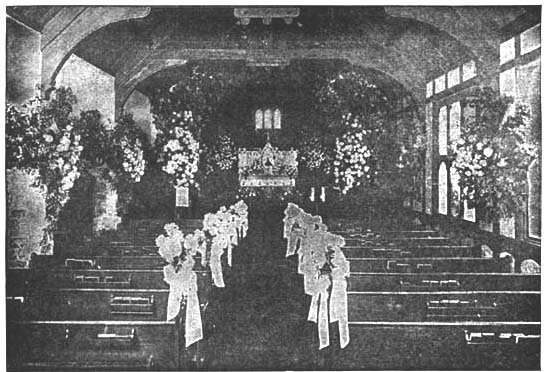
© Brown Bros.
DECORATIONS FOR A WEDDING IN A SMALL CHURCH
In a simple church such as the one pictured above the ribbon at the end of the pews may be omitted]
If one is invited to an afternoon or evening reception, and finds it impossible to attend, cards should be sent either by mail or messenger, so that they reach the hostess on the day of her entertainment. If the cards are sent by hand or by post, they should be enclosed in a card envelope, sealed, and addressed to the host and hostess—provided, of course, that both of their names appear on the invitation. If the affair is in honor of some special person a card is left for or sent to that person in addition to the one for the hostess.
If posted cards of regret are sent by a single woman, she includes one for the débutante or for the guest of honor, in addition to the one enclosed for the hostess. The married woman adds to these two, three more of her husband's. A single man, under the same circumstances, sends three of his cards if the reception is given in honor of a débutante or a guest of honor (masculine or feminine), and if the invitation was issued in the name of a host and hostess.
One may send cards of inquiry, congratulation and condolence by post or messenger, only if one is indisposed, invalided, or inconveniently situated at a great distance from the persons addressed. It is always better form to pay these calls in person, and leave the cards oneself. However, the cards of inquiry, congratulation and condolence may all be acknowledged by post or messenger, as one desires.
LEAVING CARDS OF INQUIRY
On one's card, the words "To inquire" or "May you recover rapidly" may be penciled when a call of inquiry regarding the health of a friend is made. During a long illness, calls by friends and acquaintances who have been in the habit of making social calls, should be made at least three times a week. By these "calls," you understand, we mean mere calls of inquiry when the card is left by the door and the patient is not seen personally.
Card-leaving for inquiry, condolence and congratulation is invariably made in person. Before a funeral, an engraved card with a word or two of regret penciled on the right side, may be entrusted to the servant. When husbands and wives call separately or together, they leave their own individual cards. In cases of this kind, they do not leave cards for each other. But when a married couple calls to offer sympathy for the loss of a daughter or son, two of the husband's and one of the wife's cards are left. Only one card each is left for a widow, as for a widower also. Cards left for orphaned children are meant for the oldest, who now represents the head of the family.
About two weeks after a funeral, cards are left with the mourning family, unless a special call of condolence is made. In this case, the cards are left just as though it were a social call being made. Black-bordered cards are never used except by people who are themselves in mourning. A matron may leave cards for her entire family, and a sister may fulfill the duty for a busy brother.
It is neither complimentary nor genuinely courteous to post a card to inquire after a friend or acquaintance who is ill. It should be left at the door in person, after asking news of the invalid's condition. A word of cheer or inquiry may be penciled below the caller's name, engraved on the card.
Calls of inquiry, condolence and the like are made without reference to social indebtedness, but in all other cases except among intimate friends, the convention of alternating calls should be adhered to.
ACKNOWLEDGING CALLS OF INQUIRY AND CONDOLENCE
A large, square card in plain white or with a black border, inscribed as follows, is ideal to send to those people who called to offer sympathy and condolence during a bereavement, posted two weeks after the funeral:
Mrs. Robert Guy Mannering and Family gratefully acknowledge your kind expression of sympathy upon the death of their beloved husband and father Robert Guy Mannering.
Another acceptable form frequently used to acknowledge calls of condolence before and after a funeral, is:
The family of the late John Ray acknowledge with sincere appreciation your kind sympathy.
The name "John Ray" may appear on the second line by itself, or it may be part of the first line as shown above, entirely according to taste or the prevalent popular custom. The address of the bereaved family should appear towards the bottom of the card, slightly to the left. It is always better form to have it printed in italics.
Invalids, to express gratitude for the courtesies shown them by friends, write or dictate notes of thanks immediately upon becoming well again. Often a popular hostess will receive a vast number of solicitous cards and notes of inquiry during an illness, and it will be necessary for her in her still weakened state, to trust to the mails to thank the friends and acquaintances who inquired for her. She may send her ordinary visiting card, with the words, "Thank you for your kind inquiries" or others to that effect, written across it. "Thanks" should never be used instead of "Thank you." Its brevity carries a suggestion of discourtesy.
ANNOUNCEMENT CARDS
At the present time, the vogue of sending out cards announcing a death in the family, has been almost entirely discontinued in better society. Instead, an announcement is inserted in the newspapers, giving particulars about the death and also the day of the funeral. It is by far a more satisfactory method. A typical newspaper announcement follows:
Cole.—At Whitehouse, N.J., on February 23, 1921, Rose Emily, beloved wife of Robert M. Cole, succumbed to pneumonia. Services at Chapel, Albany Rural Cemetery, Saturday, February 26, at 3 P.M.
When a betrothal takes place, announcement cards are sometimes sent out, but it is not necessary to have specially engraved cards. As a rule, the mother of the happy young bride writes notes to intimate friends and acquaintances, or inscribes the news on her visiting cards and posts them to those of her friends with whom both she and her daughter are most intimate.
Weddings are usually announced by means of engraved cards. The correct form for these is given elsewhere. Engraved cards also announce the birth of a child. For this, one may have a tiny white card engraved with the baby's name, and attached to the mother's card with a narrow white satin ribbon. It is posted to all friends and acquaintances. In lieu of an address, which appears on mother's card, baby's card bears the date of the birth in the lower right-hand corner. The joint card of the father and mother may be used to announce the birth of a child, the full name of the infant being engraved in small letters above the names of its parents.
The card announcing the birth of a child is sent by mail. Immediately upon its receipt, friends and acquaintances make calls to inquire after the health of mother and child, and to leave cards for both. When one is prevented from calling—and there should always be sufficient reason for not calling—one may respond to the card of announcement by posting one's own card to the mother, with congratulations penciled above the name. Acknowledgment of some kind must be made promptly.
WHEN TRAVELING
To the man or woman who travels, those tiny bits of bristol board are important factors in keeping him or her in touch with the home social life left behind. When one arrives at a strange place, perhaps thousands of miles from a friend, and one intends to remain there for several weeks—or months—one's visiting cards posted to all friends and acquaintances, and bearing one's temporary address, ties one to home in a particularly pleasing way. Letters follow in their wake. News of social activities reach one. And one begins to feel that after all, this strange land is not so distant!
And so, if you travel, remember that as soon as you reach a place where you intend to stop for a short while, send out visiting cards to all your friends, relatives and acquaintances, and let them know your temporary address. It may be written in pencil or ink above the home address. When you change your address permanently, be sure that all your friends and acquaintances know of the change. For this purpose, the old visiting cards are the best to use; they may be sent with a line drawn through the old address, and the new written above it.
A man stopping at a hotel for a week or two, and desirous of letting his friends in the vicinity know of his whereabouts, posts his cards bearing the temporary address, to all his masculine friends, and calls and leaves his card upon the women he wishes to see. A woman stopping at a hotel or resort, posts her visiting cards, with the temporary address above her home address, to all whose attention she wishes to claim,—men and women.
P.P.C. CARDS
Pour prendre congé, it means, a French expression translated to read, "To take leave." And it is used in connection with those last-day visits before one sails for Europe, or starts on a long trip to some distant place.
The ordinary visiting card is used, with the letters P.P.C. written in pencil or ink in one corner, indicating the departure and so differentiating it from other cards. Cards so inscribed are posted to, or left with, all friends and acquaintances, a day or two before setting out on the voyage. No acknowledgment is necessary as they are courtesy-cards with no relation whatever to one's social debts and dues.
P.P.C. cards are always necessary before an extended departure, but they are particularly so when one owes calls in return for hospitality, or calls in return for first calls. If there is very little time, and a great many calls to be attended to, it is entirely correct in this case to drive from house to house, leaving the cards with the servant who opens the door. The cards may even be posted a day before the departure, if time is very much limited.
It is not usual for P.P.C. cards to be distributed at the end of the season, when members of society make their regular change of residence. As explained under the head "When Traveling," a visiting card may be sent to one's friends and acquaintances, bearing the temporary address above the permanent home address. Thus the P.P.C. card would not be especially necessary.
CHAPTER V
INVITATIONS
SOME GENERAL RULES
No matter how informal, an invitation should always be acknowledged within a week of its receipt. It should be a definite acknowledgment—either an acceptance or refusal—and no doubt should be left as to whether the writer intends to be present or not. An invitation must always be answered in kind; that is, a formal invitation requires a formal reply, following closely the wording of the invitation. The informal invitation should be cordial enough to warrant a cordial and friendly reply; both invitation and acknowledgment should be free of all stilted phrasing.
Formal invitations for evening affairs should be addressed to husband and wife, omitting neither one nor the other. (The exception to this rule is the "stag" or its feminine equivalent.) If there is only one daughter in the family, she may be included in the invitation, but when there are two or more daughters to be invited, a separate invitation addressed to The Misses Brown is essential. Invitations sent to the masculine members of a family, other than the husband, are sent individually.
Invitations sent to a husband and wife are acknowledged in the names of both. If a daughter is included, her name is also added to the acknowledgment. The wife usually answers the invitation, and although it was sent in the name of Mr. and Mrs. Blank, she sends her acknowledgment to Mrs. Blank alone.
An invitation may never be acknowledged on any kind of a visiting card, although a visiting card may be used in an invitation. For very large, formal functions, invitations are always engraved. A young girl does not issue invitations to men in her own name, but in that of her mother or guardian. She should say in her invitations that her mother, Mrs. Blank, desires her to extend the invitation to Mr. Brown, etc.
In replying to invitations, explicit details must be given. The day of week, date and hour should be quoted, copying from the invitation, so that any discrepancy made in the invitation will be noted and corrected by the hostess when she receives the acknowledgment. This does away with any possibility of such embarrassing blunders as calling on the wrong day or at the wrong hour.
Only the most informal invitation should be given by telephone, by word of mouth or orally by a messenger, but every invitation should be either declined courteously or accepted with enthusiasm promptly.
INVITATION TO A FORMAL DANCE
The word "dancing" is usually placed in the lower left-hand corner of the invitation to denote the object of the evening's gathering; thus no specific mention that the entertainment is to be a ball is necessary.
Following are the most approved forms of invitations used for the very formal balls:
Mr. and Mrs. James Kilgore request the pleasure of your company on Thursday evening, January the tenth at nine o'clock Dancing Scarsdale
or
Mr. and Mrs. James Kilgore request the pleasure of ........................ company, at a costume dance to be given at their home on Thursday, January the twenty-sixth at eleven o' clock Costume de Rigueur 14 Main Street
The words, "Please reply," may be added although they should be unnecessary since every person of good breeding will reply immediately to such an invitation whether he intends to accept or refuse.
ACCEPTING THE INVITATION
When the invitation to a dance bears a request for a reply, a prompt answer should be sent. If the invitation itself is in the third person, the reply should follow the same form. For a formal ball, an acceptance or regret should be mailed within forty-eight hours after receipt of the invitation. Here are the correct forms for the invitations above:
Mr. and Mrs. John Harris accept with pleasure Mr. and Mrs. James Kilgore's kind invitation to be present for dancing on Thursday evening, January the tenth at nine o'clock 148 Grand Boulevard
Mr. and Mrs. John Harris regret exceedingly that they are unable to accept Mr. and Mrs. James Kilgore's kind invitation to a costume dance to be given at their home. Brookline.
When the acknowledgment is a regret, it is not necessary to repeat the date and hour for the obvious reason that as long as one is not going, it makes no difference whether or not the details of time are correct.
FOR THE INFORMAL DANCE
When the dance is a small and less formal affair, a short note is used, though the more punctilious social usage frowns upon the employment of visiting cards for such purposes. Following is the correct visiting card for informal dance purposes:
Mr. and Mrs. Harold Champ At Home Dancing at Ten 432 Maple Street April the Fifth
The acknowledgment should be hand-written on white note paper, and couched in a cordial, informal manner.
THE DINNER DANCE
The dinner dance seems to be one of society's most favored functions. For this affair it is necessary for the hostess to issue two sets of invitations; one set to the people she wishes to entertain at dinner, and one to those whom she wishes to invite for the dancing only. The dinner invitation would be the regular engraved dinner card with the words "Dancing at ten" written in the lower left-hand corner. The dance invitations would be her regular at-home cards with the words "Dancing at ten" written in the lower left-hand corner.
A very popular method of inviting people to informal dance parties—a method that has won favor among hostesses who are fond of inviting just a few young men and women in to dance and enjoy simple refreshment—is that of using the joint visiting card of herself and her husband and writing in the lower left-hand corner:
Dancing at eleven April the fourth
This may be written in in ink—and as an invitation the card may be used to take the place of the written invitation or the formal third-person note.
THE DEBUT DANCE
An ordinary dance invitation with the calling card of the débutante included may be used for the occasion of introducing the début daughter to society. A more strictly formal form follows:
Mr. and Mrs. Charles Wendover request the pleasure of introducing their daughter Emily Justine to ......................... on Tuesday, May the third at eight o'clock 10 Merril Parkway
INVITATIONS FOR THE SUBSCRIPTION DANCE
Following is the correct invitation to use when the subscription dance is held in the drawing-room of a hotel. It should be engraved in script upon large white letter sheets:
The pleasure of ........................... company is requested at the Third Reunion at the Richelieu Hotel on Friday evening, April the tenth from nine until one o'clock. Patronesses Mrs. Johnson Mrs. Meredith Mrs. Mooers Mrs. Thompson Mrs. Clure
With the invitation above, "vouchers" are invariably included. These "vouchers" are for the purpose of enabling subscribers and patronesses to extend hospitalities to their friends, but also to bar the admittance of those people who were not invited. Here is the form usually used for the "voucher":
Third Reunion Gentlemen's Voucher Admit ............................ on Friday evening, April the tenth Compliments of ...................
To do away with the necessity of the "voucher" a card like the following is used:
Third Reunion .......................... The pleasure of your company is requested on Tuesday, the tenth of June at eight o'clock Community Club 18 Forest Avenue Please present this card at the door.
If the invitations are issued and distributed by a committee or board of directors, instead of by private subscribers, the words:
The Committee of the Third Reunion Hilldale Club 234 Kingston Avenue
appear beneath the engraving, in the left-hand corner. The proper form is to use a letter sheet, engraving the invitation on the outer face, and listing on the second inner face, the names of the men who are giving the ball. However, it is also correct to use a large bristol board card, listing the hosts on the reverse side, or on another similar card.
ACKNOWLEDGING SUBSCRIPTION DANCE INVITATIONS
An invitation to a subscription ball, received in the name of the whole body of subscribers, requires a prompt acknowledgment of acceptance or denial to the address given on the card. But if a subscriber extends an invitation to a friend, enclosing with the invitation his or her own card, the answer is sent to this subscriber individually. It is usually a short, informal note, something like the following, and it may be addressed to the entire Committee or merely to its Chairman:
19 West Street, April 18, 19—
My dear Mrs. Blake:
It is with great pleasure that I accept your invitation to attend the Third Reunion of the Hilldale Club, on Friday, the tenth of April.
Sincerely yours,
Helen R. Haddock.
INVITATION TO PUBLIC BALL
Public balls that require purchased tickets have a very distinct kind of invitation. The following invitation should be printed or engraved on very large letter sheets or cards, giving, either on the second inner sheet or on the reverse of the card, the names of the patronesses.
The pleasure of your company is requested at the Annual Masquerade Ball To be given at the Taft Hotel Thursday Evening January the fifth, at ten o'clock
Cards of admission, Three Dollars On sale at the Taft Hotel and homes of the Patronesses
REQUESTING AN INVITATION
When one is invited to an entertainment and finds it impossible to attend without a visiting guest or relative, an invitation may be requested. But a great deal of tact and good judgment must be exerted. A note of request follows, but in writing notes for your own particular instances, you must remember that each note has to be adapted to the occasion in hand.
27 Claremont Terrace, May 8, 192—.
My dear Mrs. Jolson:
Elsie Millerton, whose brother you remember was at Hot Springs last year when we were, is spending a few days with me. I wonder if I may bring her to your dance next Thursday?
Sincerely yours,
Mary B. Hall.
It is rarely necessary to refuse such a request as this; but if the ballroom is already too crowded and if the hostess has received a number of similar petitions she may with propriety send a brief note of refusal with a courteous word or two of explanation.
THE DINNER INVITATION
A dinner invitation is the highest form of courtesy. That is why it requires prompt and very courteous acknowledgment.
Ordinarily dinner invitations are issued ten days ahead, unless it is a very large formal affair, when two full weeks are allowed. It is not good form to send an invitation just about a day or two before the day set for the dinner-party, for then the guest will be perfectly correct in feeling that the invitation was issued to her (or him) only because some other guest was unable to attend. If there are only three or four guests informal notes are usually sent, however elaborate the dinner itself is to be. Such an invitation should occupy only the first page of a sheet of note paper.
Dinner invitations may either be written on ordinary sheets of white stationery, or engraved on cards. If the latter is decided upon, it must be large, pure white, and of rather heavy bristol board. The hostess who gives many large and elaborate dinners may have cards like the following printed, leaving spaces for the insertion of the name of the person invited, the day, hour and date:
Mr. and Mrs. Jeremiah Knight request the pleasure of ................... company at dinner on ................ evening at ................ o'clock 55 Court Street
The words "To meet Mr. and Mrs. John Staple" may be written in ink at the bottom of the engraved card, when the dinner is in honor of a special guest. Or small cards may be printed and enclosed with the invitations.
IN HONOR OF CELEBRATED GUESTS
Often, to introduce someone of distinguished position to the hostess' acquaintances and friends, a large and elaborate dinner is given. The cards should be engraved in a fine script or block letter, in the following wording:
To meet Mr. and Mrs. McAllister Van Doren Mr. and Mrs. John King request the pleasure of ....................... company at dinner on Thursday, January the sixth at eight o'clock 455 North Avenue.
THE ACKNOWLEDGMENTS
For the formal invitation, written in the third person, a similar acknowledgment must be sent within twenty-four hours. Following are an acceptance and a regret that may serve as suggestions for the dinner invitations that you will accept and refuse in the future:
Mr. and Mrs. Herbert Thorne accept with pleasure Mr. and Mrs. Jeremiah Knight's kind invitation to dinner on Friday, August the fifth at eight o'clock 64 West Drive
Mr. and Mrs. Herbert Thorne regret that a previous engagement prevents their accepting Mr. and Mrs. Jeremiah Knight's kind invitation to dinner on Friday, August the fifth 64 West Drive
It is not necessary to give complete details regarding time and hour, in the second acknowledgment—which is a regret. Inasmuch as one does not expect to attend, it is unnecessary to pay great attention to details that are important only for those who expect to be guests. In writing regrets, it is always more courteous to give the reason for being unable to accept, but it is not important to do so unless one really wishes to.
FOR THE INFORMAL DINNER
The informal dinner invitation is invariably sent by the wife for her husband and herself, to the wife, including the latter's husband. The invitation takes the form of a short, friendly little social note, and is answered as such. For instance, here is an invitation to an informal dinner, and the acknowledgment:
356 Cosgrove Avenue, November 1, 19—
My dear Mrs. Harris:
Will you and Mr. Harris give us the pleasure of having you with us at a small dinner on Thursday, November the eighth, at seven o'clock?
Hoping that you will be disengaged that evening, I am
Yours very sincerely,
Margaret B. Leanders.
You will notice that in signing herself, the wife uses her Christian and married name, and the initial of her maiden name. She may spell her maiden name out, if she wishes, but the form given above is the most usual. Here is the correct acknowledgment to the invitation above:
654 Milton Street, November 5, 19—
My dear Mrs. Leanders:
Mr. Harris and I will be delighted to dine with you and Mr. Leanders on Thursday, November the eighth, at seven o'clock.
With kindest regards, I am
Sincerely yours,
Mildred Travers Harris.
WHEN THE DINNER IS NOT AT HOME
It happens quite frequently that a hostess gives a dinner for her friends outside of her own home. In this case, the fact must be fully noted on the invitation. For instance:
Mr. and Mrs. Walter Bruhn request the pleasure of Mr. and Mrs. John Perry Blascon's company at dinner at Shanley's on Wednesday, March the sixth at eight o'clock 41 Tompkins Place
The acceptance and regret would be exactly the same as the forms given previously, except that the words "At Shanley's" would necessarily have to appear.
THE DAUGHTER AS HOSTESS
It is necessary for the daughter, who is hostess in her father's house, to include his name in every dinner invitation she issues. Following is a model informal invitation to dinner, issued by a young daughter-hostess:
My dear Mrs. Curtis:
Father has asked me to extend an invitation to you and Mr. Curtis to dine with us on Tuesday, April the fifth, at half-past seven o'clock. We are looking forward to your coming with a great deal of pleasure.
Cordially yours,
Rose Meredith.
In acknowledging this invitation, whether it be acceptance or regret, the answer must go to the daughter, not the father. It is discourteous and rude to receive a letter or an invitation from one person, and acknowledge it to another.
POSTPONING OR CANCELING A DINNER
When it happens (and it often does!) that something unforeseen and unexpected happens to prevent one from giving the dinner for which engraved cards have been issued, the hostess must immediately dispatch, either through messenger or special delivery, short written notes canceling the engagement. The third-person formula may be used, but there must be a certain warmth in the note to avoid any semblance of indifference. And it is a mark of fine courtesy to offer the reason why the dinner has to be postponed. Here are two forms that may be used:
Because of the severe illness of their son Mr. and Mrs. John Smith beg to cancel their dinner, arranged for Tuesday, May the fifth
or
Mr. and Mrs. John Smith regret that the damages done to their home by a recent fire make it necessary for them to postpone the dinner arranged for May the fifth until May the thirtieth.
INVITING A STOP-GAP
When a vacancy occurs in a dinner party at the last moment, one may call upon a friend to fill the place as a special courtesy. This is an instance when tact and discretion are important, for not everyone is broad-minded and sensible, and some people may take offense at being asked to take the place that someone else relinquished. A short cordial note should be written, explaining the situation, and frankly asking the friend to come in the place of the invited guest who cannot be present. Here, for instance, is a typical note for just such a purpose:
41 Hemingway Place, March 14, 19—
My dear Mr. Cook:
I am going to ask a very special favor of you, and I know that you will be good enough to comply—if no other engagement stands in the way.
Ralph Townshend, who was to have been present at a little dinner party that I am giving to-morrow evening, has just written that he has been called out of town on business. Won't you be good enough to take his place and give me more reason than ever for subscribing myself
Gratefully yours,
Janet B. Raines.
In answering this letter, Mr. Cook must either accept or decline definitely. To be courteous, he must give a reason for declining. To write merely and say that one cannot serve as a stop-gap is both impolite and inconsiderate. Either a good reason or an acceptance must be given. Here is the way the acceptance may be worded:
1465 Emmet Road, March 16, 19—
My dear Mrs. Raines:
I'm rather glad that Ralph was called out of town, since it gives me an opportunity to be present at another of your delightful dinners. Thank you very much for the invitation.
Yours very sincerely,
Ralph B. Cook.
TO BREAK A DINNER ENGAGEMENT
There is no reason to feel embarrassed and unhappy because some unexpected happening prevents you from keeping a dinner engagement. A cordial note, containing a genuine and worth-while excuse for the cancellation of the engagement may be sent by messenger, or if there is time, by special delivery post, to the hostess. Here is an example of the kind of note that may be written to break a dinner engagement:
156 South Bend, March 18, 19—
My dear Mrs. Christy:
Mr. Cross has been called to Chicago on account of the illness of his mother. We are very anxious about her, and I am sure you will understand why it is impossible for either of us to attend your dinner party next Friday. With many regrets, I am
Sincerely yours,
Florence Bartlett Pitkin.
INVITATIONS FOR LUNCHEONS
Although considerably less formal than dinner invitations, those of the luncheon follow them in wording. They are issued about ten days before the day set for the luncheon, if it is to be an elaborate, formal affair, and only in the name of the hostess, unless men are invited and the hostess' husband intends to be present. They are engraved on large square white cards, with the name of the person invited, the day and hour, written in by the hostess' own hand. The correct form follows, but it must be remembered that this form can be used only when the luncheon is an elaborate, formal occasion:
Mrs. John Roy-Thorndyke Blake requests the pleasure of ....................... company at luncheon on .................... at ................. o'clock 11 Park Row
Very often a hostess invites friends and acquaintances to a luncheon for the purpose of presenting to them a certain visiting guest, and perhaps to attend, after the luncheon, a matinée planned for the purpose of enabling the newcomer to become better acquainted with the hostess' friends. In this case, an invitation like the one following should be used:
To meet Miss Helen Rhodes Mrs. Robert Blake requests the pleasure of Miss Joyce's company at luncheon on Tuesday, April the eleventh at one o'clock and afterward to the matinée 167 Grand Concourse
The name of the play and the theater may be included in the wording of the invitation.
Breakfast invitations are rarely issued, for the very good reason that formal breakfasts are very rarely given. But when they are, the wording of the invitation is identical with the wording given above for the luncheon invitations, substituting in each case the word "breakfast" for "luncheon." Acknowledgments are also the same as those used for the luncheon.
ACKNOWLEDGING THE LUNCHEON INVITATION
A prompt acceptance or regret must be sent upon receipt of an invitation to luncheon. The following two forms are correct for use with the two invitations given above.
Mrs. Frank Parsons accepts with pleasure Mrs. John Clancy Blake's kind invitation to luncheon on Friday, October the fourteenth at one o'clock 146 Park Place
Miss Jean Joyce accepts with pleasure Mrs. Blake's kind invitation for luncheon on Tuesday, April the eleventh at one o'clock to meet Miss Rhodes and to go afterward to the matinée 48 Fremont Avenue
THE INFORMAL INVITATION
For the informal luncheon, a brief note of invitation is sent from five to seven days ahead. In making the note brief, one must be careful not to sacrifice cordiality. We give here two notes of invitation, one for luncheon and one for breakfast; and also their respective acknowledgments:
86 Washington Terrace, April 14, 19—
My dear Mrs. Blank:
Will you come to luncheon on Wednesday April the twentieth, at half-past one o'clock? Mrs. Frank Richards will be here, and I know you will be glad to meet her.
Cordially yours,
Helen R. Roberts.
64 Main Street, April 16, 19—
My dear Mrs. Roberts:
I will be very glad to come to luncheon on Wednesday, April the twentieth, at half-past one o'clock. It was very kind of you to remember that I have been wanting to meet Mrs. Richards for a long time.
Yours very sincerely,
Justine Blank.
437 Fairview Terrace, May 5, 19—
Dear Mrs. Miller:
I expect a few friends to join me at an informal breakfast at half-past eleven o'clock on Tuesday, the tenth. Won't you be one of them?
Sincerely yours,
Maybelle Curtis.
822 Jennings Street, May 7, 19—
Dear Mrs. Curtis:
Thank you very much for asking me, but I regret that I will not be able to join you at breakfast on Tuesday. I have two young nieces stopping with me, and I promised to devote that morning to showing them the places of interest in town. They are planning so eagerly for the trip, and they are leaving here in such a short time, that I feel that I must not disappoint them.
With most sincere regrets, I am
Cordially yours,
Mary K. Miller.
There is still another approved form for inviting guests to luncheon or breakfast. When the occasion is neither too strictly formal nor too informal, the hostess may merely write, beneath the engraved name on her ordinary calling card, the words, "Luncheon at one-thirty o'clock March fourth." This is sent about five days before the chosen day. The acknowledgment must be by informal note, never by a calling card. And this holds true of all other invitations; when the personally inscribed calling card is used, a first-person note of acceptance or regret must be promptly written. The use of cards in this way is looked upon with disfavor among people who are most careful of the amenities of polite society.
RECEPTION INVITATION
The word "reception" may mean several social functions which may or may not be extremely ceremonious. There is the afternoon tea, for instance, an informal little affair to which one invites one's best friends and most interesting acquaintances. The invitation may be either written by the hostess or engraved. The at-home day is also called a reception, as is the more elaborate occasion when a special guest is introduced to the hostess' friends.
There was a time when it was considered extremely bad form for a host's name to appear on the invitation, but to-day the reception invitation often takes the form of the following:
Mr. and Mrs. Harold Blaine At Home Tuesday afternoon, May fifth from four until half-past seven o'clock Twelve, Park Terrace
The above invitation should be engraved in fine script on a large white card of bristol board, and it should be mailed at least ten days in advance of the day set for the entertainment. An acknowledgment is not expected; if the invitation is accepted, the presence of the guest on the day of the reception is sufficient. If one is unable to be present, one's visiting card is sent to arrive on the exact day of the reception—unless an answer is explicitly required on the invitation. Not to be present at the reception, and not to send one's visiting card, is to indicate either that one is ignorant of the correct social laws, or that one desires to discontinue friendship with the hostess.
When a mother and her daughter are to receive the guests at a reception together, the card is in this form:
Mrs. William B. Harris The Misses Harris At Home Friday Afternoon, October fifth from four until seven o'clock Thirty-two Amsterdam Avenue
If the reception is for the purpose of introducing a young débutante daughter, the hostess would issue cards similar to the one above, except that the débutante's name would appear immediately below her own. It would be merely "Miss Harris" with no Christian name or initial. If a second daughter is introduced to her mother's friends by means of an afternoon tea, the cards are also like the one above, except that the name of the second daughter is inscribed in full beneath that of the hostess. Thus invited guests would know that "Miss Harris" is the elder and introduced to society first, and "Miss Merian Harris" is the second daughter to be introduced to society.
RECEPTION IN HONOR OF A SPECIAL GUEST
When the purpose of the reception is to honor a special guest the fact should be indicated on the invitations. If the invitation is written on a card, the words, "To meet Governor and Mrs. Frank Curtis" should appear. The proper form for the engraved invitation follows:
To meet Governor and Mrs. Frank Curtis Mr. and Mrs. James Melvin request the pleasure of your company on Thursday afternoon, June fifth from four until seven o'clock Eighteen, Washington Garden Heights
No acknowledgment other than one's presence on the day of the reception is necessary to this invitation. However, if one is unable to attend, the visiting card should be mailed so that it arrives on the precise day of the entertainment, or if an unexpected happening prevents one from attending, a messenger may be dispatched with a card in an envelope, forwarding it to the hostess while the reception is in progress.
INVITATIONS TO GARDEN PARTIES
When the garden party is very formal, the invitations are engraved in black script or block lettering, on white note sheets or large white cards. The invitation is usually issued in the name of the hostess alone, and the most fashionable stationers are to-day printing cards that leave a blank space for the name of the person to be invited to be written in by the hostess. For instance:
Mrs. Maurice Bronson requests the pleasure of ........................ company on Friday afternoon May tenth from four until seven o'clock Garden Party Holyoke, West Lake
In society, the formal garden party holds the place of an at-home held out of doors. Thus the following invitation is considered the best form, better even than the form shown above, although either may be used in good taste:
Mrs. Maurice Bronson At Home Friday afternoon, May tenth from four until seven o'clock Garden Party Holyoke, West Lake
When the garden party is a small informal affair, the at-home card may be used with the words, "Garden Party, Friday, May the tenth, from four to seven o'clock," written by the hostess in the lower left-hand corner. This method is usually for personal friends only, and it is considered bad form when the garden party is elaborate and formal.
If the guest invited lives in another town, or must come from the city to the country, a small card bearing the necessary train and schedule information should be enclosed with the invitation, similar to the card explained in the chapter on wedding invitations. Or the information may be lettered neatly at the bottom of the invitation itself. The form is usually:
Train leaves Pennsylvania Station at 3 o'clock Train leaves Holyoke Station at 6.20 and 7.10 o'clock
Still another course is open to the hostess who wishes to give a small garden party, yet not undergo the expense and trouble of specially engraved invitations. She may write brief, friendly notes, in the first person, somewhat in the following form, and send them by post to her friends and acquaintances:
Holyoke, May 1, 19—
My dear Mrs. Keene:
I have asked a few of my friends to have tea with me, informally, on the lawn, Friday afternoon, May the tenth, at four o'clock. May I expect you also? Perhaps there will be a few sets of tennis. There is a racquet waiting for you.
Cordially yours,
Rose M. Roberts.
ACKNOWLEDGING THE GARDEN PARTY INVITATION
Whether the garden party invitation bears a request for a reply or not, the courteous thing to do is send an acceptance or regret at once. This is especially true when the invitation is engraved, for then one may assume that the affair is to be a large and elaborate one. The reply to an engraved invitation follows:
Mr. and Mrs. Raymond Bruce accept with pleasure Mrs. Bronson's kind invitation for May tenth Haywood Park, May second, 19—
or
Mr. and Mrs. Raymond Bruce regret that a previous engagement prevents their acceptance of Mrs. Bronson's kind invitation for May tenth Haywood Park, May second, 19—
In reply to a visiting card inscribed with the day and date of the garden party, a brief, polite note of acceptance or regret should be written. A similar note should be promptly written upon receipt of the informal written note of invitation.
Glendale, May 2, 19—
My dear Mrs. Bronson:
Mr. Harris and I are looking forward with great pleasure in joining you on May tenth. We hope the weather will continue to be as delightful as it is now.
Cordially yours,
Janet B. Winslow.
HOUSE OR WEEK-END PARTIES
The invitation for a house or week-end party differs from any other invitation. By the week-end party we mean a visit from Friday or Saturday until Monday. Thus the invited guest knows that he is expected to arrive Friday afternoon (or Saturday morning) and leave Monday morning. On the other hand, the house party may mean a visit of ten days or two weeks' duration, or even longer. It is necessary, therefore, for the hostess to mention specifically the date deciding the length of the visit. It is also courteous for her to mention the sports that will be indulged in and any special events planned, etc., and to send the necessary time-tables, indicating the best and most convenient trains.
Whether for house party or week-end party, the invitation is always a well-worded, cordial note offering the hospitalities of one's roof for the length of time indicated. We will give here one letter of invitation and its acknowledgment, which can be, perhaps, adapted to your own purposes.
Pine Rock, June 14, 19—
Dear Miss Janis:
We have planned a house party as a sort of farewell before our trip to Europe, and we are particularly anxious to have you join us. I hope there is nothing to prevent you from coming out to Pine Rock on June twenty-third and remaining here with us until the eighth of July.
I hope to have many of your own friends with us, including Jean and Marie Cordine, who are also planning to sail towards the end of July. Mr. Frank Parsons and Mr. and Mrs. Robert Kingsley may be here, too, along with several others whom you do not know, but whom I am most anxious to have you meet.
I am enclosing a time-table for your convenience, and I have checked the two trains that I believe are most convenient for you. If you take the 3.58 on Tuesday you will arrive here at 7.10, and you will be able to meet the guests at dinner at eight-thirty. There is an earlier train in the morning if you prefer it. If you let me know which train you expect to take, I will see that there is a car at the station to meet you.
Very cordially yours,
Alice M. Bevans.
Westville, June 16, 19—
Dear Mrs. Bevans:
It was very good of you and Mr. Bevans to ask me to your house party and I shall be delighted to come. I shall arrive on the 3.58 train, as you suggest. It was so thoughtful of you to inclose the time-table.
Very sincerely yours,
Helen R. Janis.
If the letter were one of regret, it would be necessary for Miss Janis to write definitely just what was making it impossible for her to accept the invitation. It would not be correct form to write vaguely, saying that "you hope you will be able to come," or that "if you are in town you will come." No doubt must be left in the hostess' mind as to whether or not you will be present.
THE "BREAD-AND-BUTTER" LETTER
From constant usage, the term "bread-and-butter" letter has become custom. Now, upon return from a week-end or house party, it is considered necessary and, indeed, it would be a gross neglect to fail in so obvious a duty, to write a cordial note to the hostess, expressing appreciation of the hospitality received, and informing her of your safe arrival.
The letter may be as long and chatty as one pleases, or it may be only a brief note such as the following:
Terrace Revain, June 23, 19—
Dear Mrs. Bevans:
This is to tell you again how very much I enjoyed the week-end at Pine Rock. We got into the city at five and Morgan brought me out home in a taxi. Mother is giving a small bridge this afternoon and so I found everyone busy, for while there is not a great deal to do it is impossible to get anyone to help do it.
Tell Mr. Bevans that I am arranging for three or four tennis games next week, so that when I come again, if I don't win, I shall at least not be beaten quite so shamefully.
Let me know when you come to town on your next shopping trip. Perhaps we can arrange for lunch together somewhere.
Very sincerely yours,
Helen R. Janis.
INVITATIONS TO THE THEATER AND OPERA
The host or hostess planning a theater or opera party should strive to have an equal number of men and women guests. For this reason, the person who receives an invitation should make prompt reply, so that if he or she is unable to attend, someone else can be asked to take the place. It is not necessary to have invitations engraved for these occasions; in fact, a brief note, written with just the correct degree of formality, yet with no sacrifice of cordiality, is much to be preferred. The following form is correct for theater or opera, changed to accord with the names, dates, and circumstances of the particular party:
22 South Street, October 13, 19—
My dear Miss Johnson:
Mr. Roberts and I have planned to have a small group of friends hear "Faust" at the Central Opera House, and we are hoping that you will be one of us. The time is Friday evening, the seventeenth of October. I have been fortunate enough to obtain a box in the parquet, where the eight of us who will comprise the party will be comfortably seated.
If you are free to join us on that evening, Mr. Roberts and I will stop for you in the car at half past seven.
Cordially yours,
Evelyn T. Roberts.
The acknowledgment must be made promptly. The host and hostess must not be kept waiting for a definite reply.
INVITATIONS TO MUSICALES AND PRIVATE THEATRICALS
A ceremonious drawing-room concert requires engraved invitations, issued at least two weeks in advance of the date decided upon. The two approved forms follow:
Mrs. John M. Cook At Home Tuesday evening, October first at nine o'clock Ten, Farnhut Terrace Music
or
Mr. and Mrs. John M. Cook request the pleasure of .......................'s company at a musicale on Tuesday evening the first of October at nine o'clock Ten, Farnhut Terrace
It is also permissible for the hostess to write in the lower left-hand corner of her visiting-card the following words, when she wishes to invite friends to hear a famous soloist or orchestra: "Tuesday, October first, half past three o'clock, to hear Mischa Elman." These cards are then posted to friends and acquaintances, and the recipient either accepts by attending, or sends his or her cards to the hostess' house while the entertainment is in progress, or shortly beforehand.
For private theatricals, invitations follow very much the same form as those used for musicales. The hostess may either add the phrase, "Theatricals at nine o'clock," to her invitation, or she may issue engraved cards requesting the pleasure of a friend's company at Private Theatricals. The word "dancing" may be engraved in the left-hand corner of the card, if dancing is to follow the theatricals. It is courteous to send a reply to these invitations.
CHILDREN'S PARTY INVITATIONS
The invitation to the child's party is the one exception to the rule of simplicity. Children love color and decoration, and so etiquette very graciously permits them to have cards and invitations that boast colorful designs. For instance, in a well-known stationer's shop in New York, there are little sheets of pink note paper, in the upper corner of which is a little girl courtesying and smiling. Beneath the picture the words "Won't you please come to my party?" are printed in fine italics. It makes most attractive stationery for the youngsters.
On stationery like that described above, mother might write in the following strain, providing the little host (or hostess) is not old enough to do the writing himself:
16 Blake Hall, June 14, 19—
My dear Mrs. Blank:
Harold will be seven years old on Thursday, the eighteenth of June. We are planning to give a little party for his friends on the Sunday following, June the twenty-first. I know he will not be happy unless little Marian is present. I do hope you will let her come.
If the nurse brings Marian here at three o'clock, she will be in time for the opening game, and I will see that she arrives home safely at about half past six.
Cordially yours,
Helen M. Roberts.
A friendly note of acceptance or regret should be written promptly upon receipt of the above, and if the child is unable to attend, the reason should be given.
Very often, a young host or hostess has a very large and formal party, in which case the invitations must be quite as dignified and formally correct as mother's. For instance, the youngsters who entertain their friends at a small afternoon dance word their invitations in the following manner:
Miss Jean and Master Walter Curran would like to have the pleasure of Miss Helen Thompson's company at a dance at 3 o'clock Thursday afternoon, November third Clover Hall
A young boy or girl just old enough to write his or her own invitations, may find some useful suggestions in the following model for a birthday party:
Hanover Court, October 6, 19—
Dear Elizabeth:
I am going to have a birthday party on Saturday afternoon, the thirteenth of October, at 3 o'clock. All of our friends from dancing school and a good many of Jack's friends from his school will be here. We are planning a donkey game, and I am sure we will all have a great deal of fun. Won't you come, too? I shall be very disappointed if you cannot.
Sincerely yours,
Helen Camden.
It is always wise, however, for the children to make some sort of acknowledgment of the formal engraved invitation, for it impresses upon them the importance of their social duties.
INVITATIONS TO A CHRISTENING
It is not usual for many guests to be invited to the christening of a child. But when it is made an occasion of formal entertainment, it is necessary to have engraved cards prepared and issued to friends and relatives. Here is the correct form:
Mr. and Mrs. John B. Meredith request the pleasure of your company at the christening of their son on Tuesday, April second at three-thirty o'clock Ten, Jerome Avenue
The letter requesting a relative or friend to serve as godfather or godmother must be tactful and well-worded. It is usually very intimate, for no one with fine sensibility will ask any except a dear friend to act as godmother or godfather. Such a request is much better given in person than by letter, whenever it is possible. And it requires an answer in kind. We give here one brief letter of request, and another of acknowledgment, to serve as suggestions:
34 Kinston Road, March 5, 19—
Dear Mr. Burke:
Jack and I have both agreed that we would rather have you serve as godfather for John Paxton, Jr., than anyone else. We hope that you will not refuse.
The baptism has already been arranged for four o'clock, next Sunday, at St. Peter's Church. We hope you will be present at the church, and later at a small reception here in our drawing-room.
With kindest regards from us both, I am
Cordially yours,
Amelia B. Johnson.
18 Woodlawn Hills, March 7, 19—
Dear Mrs. Johnson:
It will give me great pleasure to be godfather for your son. Truly, I count it no small honor, and no slight responsibility. I am very eager to see young John Paxton, and shall be present both at the christening and at the reception.
With every good wish for him and for his father and mother, I am
Sincerely yours,
William A. Burke.
A WORD OF SPECIAL CAUTION
In answering an invitation never say "will accept." The act of writing the answer involves either the acceptance or the regret, as the case may be, and the present tense should be used.
CHAPTER VI
CORRESPONDENCE
TO-DAY AND YESTERDAY
It is customary nowadays to deplore the fact that the art of letter-writing has fallen into decay, and when we read that the entire correspondence of an engaged couple recently was carried on for two years by telephone and telegraph we are inclined to believe it. Yet such is not the case. It is true that we no longer have—and for this we should be truly grateful—flowery expressions of rhetorical feeling interlarded with poetic sentiments selected from a "Home Book of Verse," or some similar compilation, but we do have letters which are genuine and wholesome expressions of friendship.
It is a gift to be able to write lovely notes of congratulation, sympathy and appreciation, and one that has to be cultivated. Writing of all kinds grows perfect with practice and the large majority of people have to serve a long apprenticeship before they have mastered the gentle art of expressing themselves on paper. It is an art worth mastering even if one never has to write anything but polite social notes and letters.
THE LETTER YOU WRITE
From Buckingham we have the following little rhyme that does full justice to the important art of letter-writing:
Of all those arts in which the wise excel, Nature's chief masterpiece is writing well.
A letter, business or social, is simply talk upon paper. And as a wise philosopher once said, "Never put on paper what you would not care to see printed in the newspaper for all to read." As in everything else connected with the social world, ease is absolutely essential to the correct letter. The style must not be cramped, stilted, forced. A free and easy flow of language, simple and understandable, and with just that acceptable degree of cordiality and heartiness that makes one enjoy reading, is essential in all correspondence.
And yet, letters should be written personally—that is, they should represent the sender. Be sure, first, that you know exactly what you want to say, and how you want to say it. Then put it down on paper as though you were speaking; make no pretense at being so very highly educated that you must use flowery language and poetical phrases. Simplicity in form and wording is the most effective and graceful method. It is a greater mark of learning and intelligence to write a simple, ably expressed, cordial letter, than to write one that shows an obvious effort to cover, by extravagant expressions and highly figurative language, the reserve and dignity that are the foundation of all good-breeding.
In the following pages it is possible for us only to give the prescribed principles of correct form, suggesting the forms and expressions to be avoided. But the true art of letter-writing rests with you—and your own personality. We would suggest that you read carefully each letter you receive, noting and remembering those expressions that most appeal to you. A good appeal is generally universal; what appeals to you in a letter you receive will appeal to others. Thus you will find that personal experience in this matter will help you much more than any book that gives you only the foundation of form and style.
THE BUSINESS LETTER
It is interesting to find in the midst of the lament that in the twentieth century people have ceased to find time to write letters or to be courteous that the Postmaster General has rescinded previous orders which directed that departmental correspondence should not begin with the ceremonial form of "My dear Sir," and that the complimentary close, "Yours sincerely," etc., should not be used. His order is worth quoting:
"In no part of our work does the demand for the human quality apply more than in the matter of writing letters. By far the largest contact of this department with the public is by means of the letters which are written. Letters can be cold, stereotyped, following the same routine day by day, appearing more or less machine made, and the impression which the recipient has upon reading the letter is that the suggestion, complaint, petition or application made has been given scant consideration.
"I want every letter that goes out from this department or any of the Post Offices or other field offices to convince the reader of the fact, for it must be a fact, that whatever he has written has been received sympathetically and that an effort has been made to give the writer the benefit of every possible service which the department affords.
"To this end I think the writers should endeavor to make their letters more informal than is now the case generally; that they should, wherever the exigencies of the case do not require otherwise, be as explicit as possible, and that reasons for the position taken by the department should be given. Above all, I do not want the letters to be stereotyped."
A business letter is written with a purpose. It is a good letter when it accomplishes that purpose briefly, thoroughly, and courteously. Women especially should be careful not to be discursive. Business men have not time to puzzle over bad handwriting or ambiguous sentences. Whenever it can be done conveniently the business letter should be written on the typewriter. Tinted stationery is never appropriate, and ruled stationery should never be used either for business or social correspondence.
The correct form for the salutation of a business letter includes the name and address of the person or firm to whom the letter is written as well as the ceremonial form of salutation. Thus:
Bradford and Munro, 534 Fifth Avenue, New York City, N.Y.
Gentlemen: (or Dear Sirs or My dear Sirs)
Mrs. H. K. Weatherly, Secretary of the Citizens' League, Smithville, Arkansas.
Dear Mrs. Weatherly: (or Dear Madam or My dear Madam)
Except when it is the first word of the salutation, dear should not begin with a capital letter. The address in the salutation should be repeated exactly on the envelope and particular care should be taken to make it legible. The stamp should always be placed in the upper right-hand corner. It is bad form to put it on obliquely or upside down or to place it in the left-hand corner or on the back flap of the envelope. It is a silly practice to do so and causes the postal clerks a great deal of trouble.
FUNCTION OF THE SOCIAL LETTER
There are, necessarily, several kinds of letters, the three most important divisions of which are the friendly letter, the business letter, and the social letter. In its strictest sense, the social letter is written for a distinct social purpose—usually about, or in response to, some purely social circumstance. The difference between a friendly letter and a social letter is relatively the same as the difference between a strictly formal and a friendly informal visit.
To write a friendly letter, one simply writes what one feels, heeding no very stringent rules regarding letter-writing. But the social letter-writer finds that there are certain forms that must be carefully observed, if his or her letters are to be considered entirely correct. There are two distinct forms of the social letters—the formal and the informal. The formal social note is used only for invitations, announcements and their respective acknowledgments. It is always written in the third person, and always requires an answer. Even though it is sent to the most intimate friend, the formal note remains formal; although later a friendly letter may be sent to remove any possible constraint or "chill." The informal note has no definite formula, except that it can be generally compared to all the informal trend of correct social usage. The first person is used in the writing of informal notes.
Whether formal or informal, the social note always bears the name of the person to whom it is addressed. To illustrate, when writing socially to Mrs. Joselyn, one does not use the expression, "Dear Madam," but "Dear Mrs. Joslyn." In America the form "my dear" is considered a trifle more formal than just "dear," although in England the reverse is true. "Dear Madam" and "Dear Sir" are forms reserved exclusively for use with business letters.
THE ETIQUETTE OF STATIONERY
The well-known proverb may well be changed to read, "A man is known by the stationery he uses." There is no greater opportunity to show good taste—or bad—than in the tone, design and type of note paper we use. It is as effective an index to one's individuality as are the clothes we wear.
Just as in everything else, there are new fashions in the sizes, forms and general appearance of social correspondence each season. Invariably, the new form is an improvement on the older and more stilted form. However, there are slight changes, and the general rules of correct correspondence remain unchanged from year to year. A good stationer is the best authority in regard to the minor modifications that come each new season.
The outré in everything pertaining to good social usage is offensive to good taste. Thus, those who are refined and well-bred avoid such startling color combinations as deep purple paper inscribed with white ink. Of course, by its very daring, such a letter would gain immediate attention. But the impression made would be one of poor taste and eccentricity, rather than the striking personality the writer doubtless tried to convey. Let us, then, avoid all fads in size and color of social stationery
LETTER AND NOTE PAPER
Plain, unruled sheets, either white or light gray in color, and folding once into their envelopes are the approved materials for all social correspondence. Black ink should always be used—violet, blue or purple expresses extremely bad taste. There are, of course, many varying qualities of note paper, depending entirely upon the means and preferences of the individual. Some manufacturers are to-day issuing delightful stationery in delicate tones of gray, blue and buff, and it is necessary to mention here that there can be no objection to note paper of this kind. It is only bad taste to use paper of vivid red, yellow or green—so glaring in color that it is conspicuous. Colored borders on stationery are in poor taste, as are also heavy gilt edges. Paneled stationery and that with the deckle edge are both very lovely and in excellent taste, if the color is subdued or pure white. And to be conspicuous is to be ill-bred.
The complete text of a formal note must appear on the first page only. Thus, a good size for a woman's social correspondence stationary is four and a half inches by six inches, although it may be slightly larger than that for general correspondence. Then there are the very small sheets used merely for a few words of condolence or congratulation. The size of stationery for men's social correspondence varies, but it is usually a trifle larger than a woman's note paper. A man never uses small sheets of paper, nor may he conduct social correspondence upon business or office paper. It is only when private stationery is not easily available, and a letter must be immediately mailed, that club or hotel paper may be used for social correspondence.
Letter paper and envelopes should be of the same color and of about the same material. We say "about" for, when the note paper is very thin, a slightly thicker paper should be used for the envelope. Incidentally, very thin paper is objectionable for social correspondence when both sides of the sheet are written upon.
Some women like to use perfumed paper for their social correspondence. While it is not exactly bad form to use perfumed stationery, a very strong fragrance is most objectionable. Thus only the most delicate of perfumes may be used. The use of perfumes for men's stationery is entirely discountenanced.
CRESTS AND MONOGRAMS
Just as the gaudy frills and furbelows of the dress of Queen Elizabeth's era have disappeared, so have the elaborate crests, seals and monograms of earlier social stationery gradually given way to a more graceful and dignified simplicity. Originality may be the possession of those who can attain it, but it must always be accompanied by simplicity of style.
Gorgeous monograms are not desirable. If used at all—and very few even of our proud and aristocratic families do use them—they should be decorative without being elaborate. A good stationer should be consulted before one determines upon a monogram. His taste and knowledge should direct the ultimate choice.
Monograms and crests should not appear on the envelope, only on the letter paper. Seals may be stamped wherever one wishes on the back of the envelope, although the most fashionable place is in the direct center of the flap. On mourning stationery, black wax is permissible for the seal; red, blue or any dark color may be used on white or light gray paper. Care should be taken in dropping the hot wax and pressing the seal, for nothing is so indicative of poor taste as an untidy seal on the envelope of a social letter. A seal should not be used unless it is actually needed. It is bad form to use it in addition to the mucilage on the flap of the envelope unless the mucilage is of a very poor quality.
A monogram or crest is placed in the center at the top of the page when no address is given. It should be omitted entirely when the address appears at the top of the page. The space occupied by a crest or monogram should not cover more than the approximate circumference of a silver dime. A crest is usually stamped in gilt, silver, black, white or dark green. Vivid colors must be avoided.
When an address is engraved on a sheet of paper the chest or monogram should be omitted. The stationery of a country house frequently has the name of the place in the upper right hand corner with the name of the post office or railroad station opposite. Authors sometimes have their names reproduced from their own handwriting and engraved across the top of the paper they use for their business correspondence.
The most fashionable stationery to-day does not bear crests or monograms or seals, but the address engraved in Gothic or Roman lettering in the upper center of note and letter sheets, also on the reverse side of the envelope. Black ink, of course, is used.
USE OF THE TYPEWRITER
Having invaded and conquered the business world, the typewriter has now become a social necessity. Personal typewriters, made in portable sizes, are now being used for social correspondence, although many conservative people prefer to remain loyal to the use of the old pen and ink method. Yet, when the best handwriting is often illegible and hard to read, a modern invention so necessary as the typewriter should be hailed with delight and used with enthusiasm.
There still may be a few "extremists" and etiquette fanatics who insist that typewritten letters are for business purposes only, and that they are an insult when used socially. Prevalent custom to-day permits typewritten correspondence for nearly every occasion, and the well-typed social letter reflects better taste upon the sender than a hand-written letter that is difficult to read—and yet took a much greater length of time to write.
Social letters, whether hand or typewritten should not be on ordinary commercial paper. The letter written on the machine should have a wide margin at the top, bottom and sides. Signatures to a typewritten letter, social or business, should be made personally, in ink.
REGARDING THE SALUTATION
It is only in cases of extreme formality that the expression "Dear Madam" or "Dear Sir" is used. For ordinary social correspondence, the salutation is either "Dear Mr. (Mrs.) Roberts" or "My dear Mr. (Mrs.) Roberts." The use of "My dear" is considered more formal than merely "Dear," except in England where the first form is considered the more intimate.
The form "Dear Miss" or "Dear Friend" may be used on no condition whatever. It is either "Dear Miss Wimberly" or "Dear Madam." It is considered presumptuous, in good society, for a man to address a lady as "Dear Mrs. Brown" until she has first dropped the formal "my" in her correspondence with him.
The strictly formal method for addressing a letter to a man by a woman who is a total stranger to him, is:
"Mr. John D. Brown, "Dear Sir."
If he is a distant relative, addressed for the first time, or the friend of a very intimate friend, the salutation may read, "My dear Mr. Brown."
CLOSING THE LETTER
The endings "Very truly yours" or "Yours truly" express a certain formality. Friendly letters are closed with such expressions as, "Yours most sincerely," "Cordially yours," "Very affectionately yours," "Lovingly yours." The latter two expressions are confined largely to intimate friends and relatives, while the others are used when letters are written to new acquaintances or casual friends. The pronoun yours should never be omitted, as it leaves the phrase unfinished and is not complimentary to the person addressed. Thus, closings, such as "Very truly" or "Sincerely" are in bad form.
Always remember in social letter-writing, to make a "graceful exit." An awkward sentence in closing often mars what would otherwise be a perfect letter. Forget certain strained expressions that remain in the mind and demand to be used as closings, merely because they have been used by so many people, over and over again. Make the farewell in your social letters as cordial and graceful as your farewell would be if you were talking to the person, instead of writing. Such kind expressions as "With kindest personal regards" or "Hoping to have the pleasure of seeing you soon" or "With best wishes to your dear mother and sisters" always add a note of warmth and cordiality to the social letter. These should be followed by "I am." It is not considered good form to end a letter,
Hoping to hear from you soon, Yours sincerely,
but it should be
Hoping to hear from you soon, I am Yours sincerely,
No comma is used after "am."
It is not good taste to use only the initials, the surnames or given names alone, or diminutives, when signing notes or letters except when they are addressed to one's most intimate friends. A married woman signs her self Ellen Scott, not Mrs. Guy Scott, in social correspondence. Often, in business letters, when the recipient would be in doubt as to whether or not the lady were to be addressed as Mrs. or Miss, the conclusion to the letter should be in this form:
Yours truly, Ellen Scott (Mrs. Guy Scott)
An unmarried woman signs her letters "Margaret Scott," unless it is a business communication and she is liable to be mistaken for a widow. In this case, she precedes her name by the word Miss in parentheses.
The first and last names of the man writing the letter must be given in full, and if there is a middle name, either the initial or full spelling may be given. But such a signature as J. Ferrin Robins is bad form.
It is both undignified and confusing to sign a letter with one's Christian name only, unless one is a relative or very intimate friend. A woman never signs her Christian name alone in a letter to a man unless he is a relative or her fiancé or a very old friend of the family.
ADDRESSING THE ENVELOPE
Although there is a distinction in England regarding the use of "Mr." and "Esq.," both forms are optional here in America. Either one may be used in good form. But to omit both, and address a man just as "Walter J. Smith" is exceedingly rude and bad taste. Neither should "Esq." and "Jr." be used together in this manner, "Walter J. Smith, Esq., Jr." The correct form would be "Walter J. Smith, Jr." A servant would be addressed merely as Walter J. Smith, without any title.
"Mrs." or "Miss" must invariably precede the name of a woman on an envelope unless she is a professional woman with some such title as "Dr." A woman does not assume her husband's honorary title; thus, it is not good form to address an envelope in this manner: "Mrs. Captain Smith" or "Mrs. Judge Andrews."
A practicing woman physician is addressed in this fashion, when the communication is professional: "Dr. Ellen R. Blank." This form is not used in social correspondence, except in the case of a very famous, elderly physician who is entitled to the honorary title at all times. Otherwise this form is used when the communication is social: "Miss Ellen R. Blank" or "Mrs. John T. Blank."
LETTERS OF CONDOLENCE
Letters of condolence should never be written, unless the writer has been genuinely moved to sympathy. For that reason, they are usually forthcoming only from relatives and intimate friends of the bereaved family. A letter of sympathy should be brief and cordial. Those pretentious letters that are filled with poetic quotations and sentimental expressions are not genuinely sympathetic, and those that refer constantly to the deceased are unkind. A few well-chosen words of sympathy are all that is necessary. Following are two model letters of condolence, that may be used as basic forms for other letters:
New York, August 24th.
Dear Miss Curtis:
I hasten to offer you my most profound sympathy for the great grief that has fallen upon you and your house-hold. If there is anything I can do, I hope you will not hesitate to call upon me.
Cordially yours,
Harriet B. Wainwright.
Philadelphia, May 5th.
My dear Mrs. Andrews:
Knowing as I do from my own experience how deep your grief must be I also know that there is little that anyone can say or do to make your sorrow any the less. Yet I cannot refrain from offering my sincerest sympathy, and along with it the hope that Time, which softens all things, will make even this easier to bear.
Believe me, most sincerely yours,
Lillian M. Roberts.
ACKNOWLEDGING A LETTER OF CONDOLENCE
Mourning or white paper is always used when answering a letter of condolence, except when the engraved cards of acknowledgment are sent. These are severely plain, and the message is always brief. Often they are sent in the name of the entire family, as:
Mr. and Mrs. John Hall Hammond gratefully acknowledge your expression of sympathy upon the death of their daughter. June 6, 1921.
This is certainly the easiest way for the bereaved to express their gratitude, though simple notes of thanks may be sent instead of the more formal card.
ETIQUETTE OF THE FRIENDLY LETTER
It is often a moot question among friends as to who shall write the first letter. Generally speaking, it is the one who has gone away rather than the one who remains behind who writes first, though among good friends there is no more necessity to count letters than there is to count visits. The writer knew a college girl who, when she came home, decided to wait before writing and see how many of her friends cared enough for her to write to her. She was rather gratified by the result but if each girl who came away from the school had arrived at the same decision the situation would have been a very queer one, to say the least of it.
A young lady who has gone away may send a card or write a brief note to a gentleman but if he is the one who has departed she should not write to him until she has received a letter from him.
Some people may feel that a discourse on friendly letters has no place in a book on social intercourse. But we feel that social success is just as largely dependent upon one's simple friendships as it is upon highly extravagant social activities, and therefore it is necessary to know something about the friendly letter.
The salutation in a friendly letter should always be "Dear Mary" or "Dear Miss Jones." The text of the letter should be written with ease, and instead of a long list of questions (as some letter-writers delight in using), bits of choice news of the day, interesting personal experiences, and the like should be disclosed. As Elizabeth Myers in her book "The Social Letter," says: "The friendly letter is our proxy for a little tête-à-tête, telling of the personal news of the day, and should be as extemporaneous as daily speech. Such letters are given free scope and it would be as bootless to dictate rules as it would be to commit a monologue to memory prior to a friendly visit."
Unless you are very intimate with a friend, and your letter contains "identifying" news, do not sign yourself merely with your Christian name. There are many Marys, and Johns and Harolds; and a letter signed with the full name is as cordial as one which gives only the baptismal name.
There is an old Latin proverb, "Litera scripta manet," meaning "The written letter remains." A very pretty sentiment is attached to this one short sentence. It means not only that the letter itself remains, but that the thoughts contained in that letter, the kind, unselfish, pretty thoughts of friendship, remain forever in heart and mind of the person for whom it was intended. When you write to your friends, make your letters so beautiful in form and text, that they will be read, re-read, and cherished a long time after as a fond memory. It will be a big step on the road to social perfection. Another point to be kept in mind is that nothing should be written in a letter that one would not be willing for almost anyone to see. Letters sometimes travel far, and one can never be altogether sure into what hands they may fall.
THE CHILD'S LETTER
The sooner the child is taught to take care of his or her own personal correspondence, the sooner he or she will become perfect in the art of letter-writing. The little ones should be taught early the significance of the correct letter, the importance of correct social correspondence. Their duties at first may be light, and guided entirely by mother's suggestions; but the youngsters will soon find keen pleasure and enjoyment in creating letters themselves.
Here are a few letters that might have been written by children between the ages of seven and twelve. They are not offered as model letters, for children have a great deal more personality than grown-ups, and they must get that personality into what they write; otherwise the letter will be strained and unnatural. Do not be too critical of their first efforts. Pass over mistakes, and let the letter sound as if the child and not you had written it. At the same time teach them to be careful. With a very small bit of diplomacy the child can be brought to take great pride in a letter which he wrote "with his own hand." And don't make the children say things that they do not want to. Protect them from the petty insincerities of social life as long as possible.
Dear Aunt May:
Thank you ever so much for the pretty doll. I have named her May. Mother thinks she is very pretty but Tom does not. Tom does not like dolls. He plays with the dog and his tops and marbles nearly all the time. The dog's name is Mike. He is black. I like him lots. We are going to have strawberry ice cream Sunday. I wish you could be here. I would give you a big plate full.
Please come to see me soon.
Your loving niece,
Helen.
Dear Uncle Frank,
I have a box of paints. I painted a dog and a soldier this morning. The soldier has on a red coat. The dog is a pointer. My dog is a rat terrier named Jack. He caught a big rat this morning in the barn. Mother says she thinks he has been eating the chickens. School will be out in a week. I will be glad. Mother says she will not. I know how to swim. There is a creek near here. The water is over my head in one place. I am going fishing one day next week. I caught two perch last time I went.
Your nephew,
John.
Dear Grandma:
I wish you a very happy birthday, and I hope that you will like the present I sent you. Mother says that she will take me to see you soon. I wish she could take me to-day.
Your loving grandchild,
Mabel.
LETTERS TO PERSONS OF TITLE
A certain set of definite rules is prescribed for all communication with titled people. The general rules given for ordinary social correspondence are not the same for persons of title, and as each executive, dignitary and man or woman of royal blood requires special address, it will be necessary to incorporate them into a compact scale that can be easily referred to. At the end of this volume is a scale giving the opening, closing and address, formal and informal, for every person of title.
CHAPTER VII
PARENTS AND CHILDREN
THE HOME
The home is the unit of our social life, and just as the whole can be no greater than the sum of its parts so the standard of behavior in a community can be no higher than the sum of the standards in the homes that make up that community. If in the home one observes strictly the rules of politeness, which means kindness, one will have very little trouble with the rules of etiquette, which is simply the way politeness finds expression in our intercourse with each other. Minor canons of etiquette change from time to time but good manners are always the same, and never out of fashion.
APPEARANCE OF THE HOUSE
Obviously a book on etiquette cannot go into the problems of interior decoration; yet a word or two will not be out of place. The influence of one's surroundings on one's temper is enormous though the person may be unconscious of the fact. A disordered room gives a feeling of depression and hopelessness to the one who enters it while one that is tidy tends to impart a feeling of restfulness. If in addition to its neatness it is furnished in harmonious colors—and one cannot be too careful of the colors that are used in the home—in subdued tones it will contribute much more to the peace and happiness of the home than even those who live there realize. It will not eliminate bad tempers or do away with disagreeable moments but it will certainly help to reduce them to a minimum.
DRESS
In another volume in the chapter on funerals we have spoken of the influence of dress, especially of the influence of the constant presence of black on young children. This is only one small phase of a very big subject.
In the home the chief requisite of one's dress is neatness. A man will find it much easier to accord the little courtesies of well-bred society to his wife if she is neatly and becomingly dressed, however simple the gown may be, than if she is slatternly and untidy. The children also will find it much easier to love, honor and obey if their parents give a reasonable amount of time to taking care of their personal appearance. It is not the most important thing in life but it is one of the little things "that of large life make the whole" and one that has much to do with making it pleasant or unpleasant.
In one of O. Henry's stories a little girl down on Chrystie Street asks her father, "a red-haired, unshaven, untidy man sitting shoeless by the window" to play a game of checkers with her. He refuses and the child goes out into the street to play with the other children "in the corridors of the house of sin." The story is not a pretty one. Six or seven years later there is a dance, a murder and a plunge into the East River. And then the great short story writer says that he dreamed the rest of the story. He thought he was in the next world and "Liz," for that was the girl's name, was being tried for murder and self-destruction. There was no doubt but that she had committed the crimes ascribed to her, but the verdict of the officer in the celestial court was, "Discharged." And he added, "The guilty party you've got to look for in this case is a red-haired, unshaven, untidy man, sitting by the window reading, in his stocking feet, while his children play in the streets." It is not so much that dress in itself is important but that it is an index to so much else, and while it is not an infallible one it is about as near right as any we have.