VOLUME I (continued 2)
Reading edition
The bride and groom enter the dining room first. They are followed by the bride's mother and the groom's father, and the groom's mother and the bride's father. The bridesmaids and ushers are always invited to the wedding breakfast, and they follow immediately after the parents of the happy couple. The precedence of the other invited guests is arranged by the mother of the bride.
The menu at a wedding breakfast is never elaborate. Consommée or bouillon, salads, birds, ices, jellies and bonbons are the usual order. Coffee and dainty cakes are served last. The wedding cake, if one is served at all, is set before the bride.
The bride gives one-and-one-half to two hours to her guests at the wedding breakfast. Then she retires to her room, accompanied by the maid of honor and her most intimate friends among the bridesmaids; and when she appears again she is in traveling costume. The groom has also retired to change his clothes, and he meets the bride at the foot of the stairs. The motor is at the door in readiness, and after the last whispered good-bys, warm handclasps and hasty kisses—the bride and groom are off!
THE WEDDING PRESENT
The custom of giving wedding presents dates from away back in Dutch history when the relatives and friends of the bride and groom took upon themselves the responsibility of furnishing the new household.
Great taste and discrimination should be exercised in the selecting of gifts and they should be sent early. Two months before the wedding is not too soon. It is wise for the friends whenever possible to consult each other so that they will not duplicate gifts. If most of the silver, etc., is gotten from the same jeweler he is a great help in selecting something that is not only appropriate in itself but in harmony with the other gifts.
Anyone who receives an invitation may send the bride a gift, though it is not absolutely necessary to respond to the invitation in this way. To the question: "What shall the gift be?" the answer is the prettiest and most useful article within one's means. China and silver are always appropriate, and cut glass, linen, books, and even checks or gold pieces are most acceptable.
There is a slight prejudice against giving money as a present at a wedding or at any other time, but one has only to see the joy that the bride and groom get out of spending the money over and over again before they finally do spend it to have this prejudice dispelled.
Silver and linen are usually marked with the initials of the bride, more often than not with the initials of her maiden name. If there is any doubt as to which she prefers and one is not able to find out indirectly, it is permissible to ask her.
Gifts should always be accompanied by the cards of the donors, but these should be removed when they are placed on display.
ACKNOWLEDGING WEDDING PRESENTS
It is not sufficient merely to keep the cards which accompany the wedding gifts but there must be some system by which the bride can remember which gift each one accompanied. She may indicate this on the card itself or she may keep a list of the names of the donors with the names of the gifts opposite, but she must be absolutely sure that she is thanking the right person.
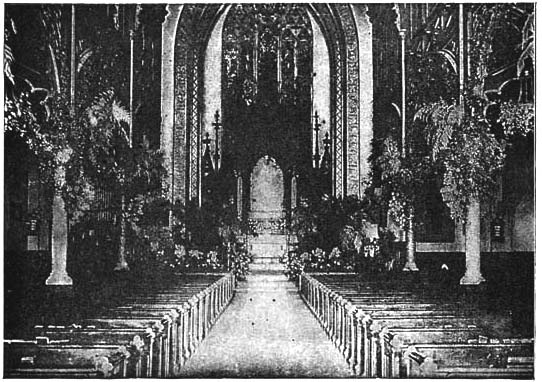
© Brown Bros.
CHURCH DECORATED FOR A FORMAL WEDDING
If the honeymoon is to be only two weeks or thereabouts the bride may wait until her return to thank her friends, but if it is to be of long duration she should write the notes of acknowledgment as soon as she finds it convenient to do so. These personal notes—and a personal note is the only proper way to thank one for a wedding present—are usually written by the bride, but she should always be careful to introduce her husband's name unless the gift was a very intimate one for her alone. The following note is a graceful way for both husband and wife to express their gratitude:
July 1, 1921.
Dear Rosalind:
George and I both wish to thank you for the lovely picture. When we return from Atlantic City we shall hang it in our living room where all of our friends can enjoy it with us. We hope that you will be among the first to visit us in our new home.
Very sincerely yours,
Annie Beard Hill.
Sometimes the groom receives personal gifts from friends of his. To these he writes notes of thanks in his own name.
THE HOME WEDDING
Home weddings can often be made as impressive as church weddings. With correct decorations the most spacious rooms in the bride's house can be transformed into an interior as lovely as the interior of a beautifully decorated church.
For instance, at a fashionable home wedding, held recently, the drawing room was decorated with massive floral wreaths and clusters of palms. A huge bell of flowers hung in the center of the room, and a canopy of flowers, occupying one corner, simulated a chapel. The effect was altogether delightful.
Only close relatives and friends should be invited to the home wedding. The bridegroom does not enter the home of the bride until a half hour before the ceremony begins, and when he does arrive, he and his best man do not mingle with the other guests but retire to an adjoining room provided for them. The clergyman also retires to this room when he arrives, and it is here that he dons his official robe. The three remain until it is announced that the bride is ready to enter the drawing room.
The bride's mother, assisted by her husband, receives the guests. It is not considered good form to begin the ceremony until they have all arrived. Then, when everything is in readiness, the bride is met at the head of the stairs by her father, and is conducted by him to the entrance of the room. Usually there is no elaborate wedding procession, and even in the most fashionable home wedding there is often only a maid or matron of honor to precede the bride. There are rarely more than half a dozen bridesmaids at most. The order of precedence is similar to that of the church wedding; the clergyman performs the ceremony under a floral canopy, and when it is completed, he steps aside and the newly married couple take his place to receive the congratulations and good wishes of the guests.
The wedding breakfast or reception proceeds immediately upon the conclusion of the ceremony. Everyone present is a guest; and everyone present attends the reception.
THE SECOND WEDDING
When a woman marries for the second time, her wedding should be very conservative. Elaborate ceremonies would, indeed, be out of place. However, the more important conditions of the ceremony are followed very much along the same lines.
White is for the girl-bride only. The woman who marries for the second time indulges in none of the age-old customs that the first bride does. She does not wear a white veil; she does not carry orange blossoms; she does not have flower girls or pages or bridesmaids. The more inconspicuous the second wedding is, the more it is in accordance with the rules of etiquette.
The bride-for-the-second-time may have a maid of honor only on one occasion. If she has a church wedding and invites numerous guests, she may have a maid of honor to precede her to the altar. As in the first wedding, her father gives her away. Her family assumes all responsibility for the expenses involved unless she prefers to do so herself. If a reception is given after the ceremony, the same order of precedence is followed as after the first wedding; the reception may be held either in the home of the bride's parents, or in her own home.
If married in church, there are none of the elaborate decorations that characterize the first bridal, although flowers are always acceptable. Especially if the second ceremony takes place only a short time after the mourning period for the first husband, any conspicuous display is in very bad taste.
SOME IMPORTANT CONVENTIONS
It is customary for a widow to remove the engagement ring and wedding ring of her first husband before the day of her second wedding. The sight of them cannot be in any way pleasant to her new husband, and they may be a source of sorrowful memory to her. It is best to discard them as soon as the second marriage is decided upon.
There has always been some doubt as to whether or not the family of the second-bride's first husband should be invited to her wedding. Absolutely. There is no reason why they should be ignored, any more than any of the other friends and acquaintances of the bride. In fact, she owes them a special courtesy, and if they accept the invitation, they must be treated with the kindest attention and courtesy. They must always occupy seats below the white ribbon, if the wedding is held at church. If there is for any reason dissension or disagreement between her and her first husband's family, she will not of course invite them. But that may only be an individual case; the general rule is to invite them and treat them with the utmost consideration.
Gifts at the second wedding will not be as elaborate as those at the first wedding. However, each gift must be acknowledged with a cordial note of thanks. In fact, all the etiquette of the first wedding is observed, except that it is on a much simpler scale.
As for the man who marries for the second time, he, too, follows the original dictates of wedding etiquette, and eliminates only the farewell bachelor dinner. Here also the ceremony and reception is on a considerably less extravagant style.
SEEKING ADVICE
The girl or woman who is about to be married can always get helpful suggestions from her friends who have been married or have witnessed fashionable weddings. The minister in charge is especially qualified to give you a great deal of important advice, and one should never hesitate to consult him. In his official capacity he has doubtless served at many weddings, many of them well-nigh perfect, some of them marred by the very blunders that he can teach you to avoid.
WEDDING ANNIVERSARIES
There is something strangely beautiful and poetic in the celebration of a wedding anniversary. It arouses slumbering sentiments and mellows old memories into a throbbing happiness. Here are the wedding anniversaries that are usually celebrated in our better society:
The Paper Wedding—first year.
The Wooden Wedding—fifth year.
The Tin Wedding—tenth year.
The Leather Wedding—twelfth year.
The Crystal Wedding—fifteenth year.
The China Wedding—twentieth year.
The Silver Wedding—twenty-fifth year.
The Ivory Wedding—thirtieth year.
The Woolen Wedding—fortieth year.
The Silk Wedding—forty-fifth year.
The Golden Wedding—fiftieth year.
The Diamond Wedding—seventy-fifth year.
Although many families celebrate all of these anniversaries, it is more generally the fashion to disregard all those that come before the quarter-century mark. The first anniversary to be celebrated is usually the silver wedding. The most favored way of doing this is to have a dinner party or a reception. Sometimes, especially when there are young unmarried daughters, a dance is given and a dinner follows later.
THE SILVER WEDDING
Cards for the silver wedding reception should be printed on white or silver-gray paper. They may be printed in silver or black. They may be worded in the usual "at home" form, or may be in this form:
Mr. and Mrs. S. Brown request the pleasure of ............'s presence at the dinner reception of their Silver Wedding on Tuesday, June the fourteenth at seven o'clock 1897 1922
If an invitation like the one above is issued, the guests will undoubtedly send beautiful gifts of silver—unless, as is often the case, it is requested in the invitation that no gifts be presented. Sometimes, in fact, the bride and groom of twenty-five years commemorate their silver wedding by themselves, sending handsome gifts of silver to those who started out in married life at about the same time that they did, but who have not been materially so fortunate.
THE RECEPTION
If a reception celebrates the silver wedding, the husband assists his wife in receiving. Often the occasion begins at the precise hour at which the marriage took place; but usually the preferred time is in the late afternoon or evening. The "bridal couple" should make an effort to have as many as the original party of bridal attendants present as possible. It will be interesting for the best man and the maid of honor to have a little chat together after twenty-five years.
The husband leads the way to the dining room with his wife on his arm, and she sits at the right of him at the table. If the historic wedding cake is included in the collation, it is placed before the bride, just as it was twenty-five years ago. The table decorations should be white and silver, with a touch of green.
The menu will be the regular formal dinner menu, served and garnished with a regard for decorative effect. Speeches are in order, and a toast is usually proposed for the couple. The husband responds with a little speech in which he honors his wife, and she acknowledges with a smile that is in itself sufficient eloquence for the occasion. Tiny silver favors, packed neatly in small white boxes and tied with silver ribbon are effective novelties at the silver wedding.
TIN AND WOODEN WEDDINGS
A general frolic is in order at the tin wedding. It is rarely celebrated, in fact, unless the ten-year-married husband and wife wish to gather together all their old friends and have a jolly good time. Gifts are usually in the form of tin kitchen utensils, tin candle-sticks, tin fans, tin ornaments—even tin tables and chairs are offered as gifts to celebrate the tenth anniversary. A dinner, very much like the ordinary informal dinner except for the additional "tin" celebrations, follows the reception.
Wooden weddings are not very often held, although some very fashionable ones are recorded in the annals of social history. Rolling-pins, step-ladders, and wooden kitchen utensils cause much merriment when presented as gifts, and the occasion is generally one of much pleasant raillery. Wooden ornaments make very appropriate gifts for this wedding, and a bit of wood artistically carved is always welcome to the five-year bride who loves pretty things for the home.
THE GOLDEN WEDDING
To have lived fifty years together, to have shared for fifty years each other's sorrows, joys and hopes, is to have enjoyed one of the greatest gifts life has to offer. It is an occasion well worthy of the most elaborate celebration.
A golden wedding has a touch of the romantic, a touch of the sentimental about it. Poets like to write about it; people like to dream about it. When it becomes a reality, all the world likes to watch—and wonder. It is a solemn and dignified event and should be treated as an occasion of the utmost importance.
The couple should issue pure white cards engraved in gold, announcing the celebration of the fiftieth anniversary of their wedding day. It is touching to have the maid of honor and the best man present, if they are both still living. As many of the original bridal attendants as are available should be invited, and all the old friends and acquaintances of the family. There must be no levity, the couple must be treated with reverence and honor, and the occasion must be given every appearance of dignified importance.
Unlike the silver wedding, gifts are always presented to the aged couple at the golden wedding. Delicate pieces of gold jewelry are always pleasing to the "bride." The "groom" may be presented with gold shirt-studs, cuff-links or rings. Gold services, gold chased cups, golden goblets and golden candle sticks are most appropriate.
The dinner should be elaborate. A huge wedding cake, inscribed with a frosting of the surnames and wedding date of the couple is worthy of holding the place of honor in the center of the table. Once again the "bride" enjoys the privilege of being the first to cut the cake—and in or with each slice that is given to the guests there should be some little golden token, a ring or thimble or tiny jewel box. If this is too costly, a golden flower such as a daffodil may be placed on each plate.
A beautiful and touching sentiment to be observed on the golden wedding is for the bride to wear something from her wedding day. Perhaps it is a treasured bit of the bridal veil. Perhaps it is a fan, or a pair of gloves, or even the wedding dress itself. She also carries a bouquet of white flowers—as she did fifty years ago on her first wedding day.
THE GOLDEN WEDDING A GLORIOUS ACHIEVEMENT
Beautiful indeed is the celebration of the golden wedding. With her children and grandchildren and friends grouped around her, with her husband at her side, doing her every honor he might pay a newly-won bride, the bride of fifty years can be naught but inexpressibly happy—though memories of lost youth rise constantly to haunt her. It is glorious—this reaching fifty years of married life—and any couple may well be proud to commemorate its occasion.
And, after all, isn't it happiness that makes life worth while? Of what use is wealth and power and position if we cannot have the ones we love, the ones who love us? The man and woman who have lived together in happy companionship for fifty years have more in their love of each other than the man who has lived alone for fifty years and amassed tremendous riches.
CHAPTER VI
THE BRIDE'S OUTFIT
ORIGIN OF THE TROUSSEAU
One must study the marriage customs of many countries before the development of the trousseau idea can be fully traced. But it is interesting—especially to the bride—to discover that at her impressive marriage ceremony to-day she is merely repeating the ancient customs of her ancestors, so very far back that Europe itself was not yet known.
We find the first trace of it in the book of Genesis (Gen. xxiv. 53). Perhaps you remember the story. Abraham's servant Eliezer brought handsome jewels to Rebecca as a seal to the marriage compact. It is one of the earliest evidences of outfitting for the wedding. And then we find a trace of it among the early Eskimos, where the bridegroom must supply his bride with all the clothes necessary for the "honeymoon." Later, in Roumania, we find the clothes and shoes are a very important part of the gifts to the bride. Largely from the customs practiced in this latter country, but also from Italy, Sweden, and Greece, the idea of the marriage trousseau sprang.
The development is most marked in Roumania. Here we find the tiniest girls, some of them as young as five years, working on bridal finery—each one striving to outdo the other in beauty and elaboration of work. Each finished article is laid carefully away in a huge chest, until such time as a suitor appears. In days gone by, the bridegroom had the privilege of examining the trousseau and deciding whether or not it was complete, and often his choice rested upon the worth of the bride's outfit.
Perhaps it was because a complete outfit was so very necessary to the young girl starting out upon her new duties as a wife that the development of the trousseau has been so rapid. In the year 1308, at the wedding of Edward II to Isabella of France, the trousseau played an important part indeed. Here is a description of the bride's outfit, as taken from E. L. Urlin's book, "A Short History of Marriage:"
"She (Isabella) brought two gold crowns ornamented with gems, gold and silver drinking vessels, golden spoons and fifty silver plates. Her dresses were made of gold and silver stuff, velvet and taffetas. She had six dresses of green cloth, six of rose scarlet and many costly furs. For linen she had 419 yards, and the tapestries for her chamber were elaborate with the arms of England and France woven in gold."
Elaborate, yes, and certainly "fit for a queen." But perhaps we find the trousseaux of our misses of the twentieth century more interesting!
THE TROUSSEAU OF TO-DAY
It would be ridiculous to attempt to list the articles that must be included in the trousseau of the bride of to-day. This matter must be entirely dependent upon circumstances, means and convenience. There can be no definite set of rules to govern the contents of one's wedding outfit. But there are certain conventionalities we can discuss that may be of value to the bride in preparing for her wedding.
There is, of course, something very beautiful in the thought of making one's trousseau entirely by hand. And there is an old tradition about "sewing happiness into the wedding outfit" that brides like to believe. But when we glance at the shop windows with their lavish displays of the daintiest creations, and when we think of the professional modiste with her developed sense of the artistic, we must admit that it is not a practical custom.
It used to be the practice for each young girl to have a "hope chest" into which she put linens, etc., against the wedding day. This was during the time when most of the trousseaux were made by hand.
It seems rather a foolish waste of time for the girl of moderate means to sit for endless hours sewing on rows and rows of lace when machine made garments may be had at reasonable figures. If she chooses her things carefully they will bear the stamp of her personality almost as much as if she had fashioned them herself; and, of course, there are many finishing touches that she can add which make the things peculiarly her own, such as initials and monograms, crocheted edges, etc.
It is gratifying to note that the trousseau of to-day does not contain such frilly, useless things as did the trousseaux of our grandmothers' time. Linens boast deep folds of the material and neat hemstitching instead of huge borders and inserts of lace. Under-things are made and bought with a regard for wear and utility, rather than merely to be pretty to look at. The entire outfit shows a tendency to be more useful and less ornamental. Which is, of course, as it should be.
And now let us consider some of the more important items to be included.
ABOUT THE LINENS
In selecting her linens the bride should pay particular attention to quality; the amount she buys depends upon the size of the new home, and upon the means at her command. There must be sheets and pillow-cases; bath towels and kitchen towels, napkins and table-covers. If she is fond of handwork, there may be hand-embroidered linens for the bed-spreads, hand-embroidered linen scarfs and hand-embroidered centerpieces of linen. One bride we know included a twenty-yard bolster of uncut linen in her trousseau in addition to the items mentioned above. If one can afford it, it is best to start out with a generous supply of linens, as somehow the older they grow, the longer we have them, the more precious they become.
Linens are usually initialed. When household and personal linens are marked, they bear the initials of the bride's maiden name. Towels for the bath are marked with a single initial in white or colored thread, to match the border. Table-covers, if initialed at all, have the letters placed in the center, half-way between the middle and edge of the table; napkins are initialed in the corner. White linens are invariably initialed in white.
FOR THE BRIDE
"Girl, do not exult in thy wedding dress; see how much trouble lurks behind it," says an old Syrian proverb. But where is the little American bride who does not exult in her dainty wedding things—who does not glory in the silks and cottons and laces and ribbons of her trousseau? Always a lover of the beautiful—especially in clothes—she finds a new charm in these pretty things that portend so much happiness to come.
There are her underthings—soft, frivolous, much-beribboned chemises, camisoles and petticoats. Some are of practical muslin or soft, crinkly crêpe. Others are of rich crêpe-de-chine, and lately, knitted undergarments of silk are favored. Then, there are the dresses, her chief delight. There is one smart street dress of serge or poiret twill; an afternoon frock or two of taffeta, georgette or satin as she prefers; one elaborate evening gown for important occasions, and one very much less elaborate for semi-evening affairs. And if she is a wise bride, she will include a smart dark-colored suit, with several fluffy little blouses. Then, of course, there are the crisp, neat, becoming little frocks for the morning-at-home. But she should not make the mistake, which is all too common to brides, of getting several times as much as she needs.
Other details, such as hose, shoes and hats are best decided by the bride herself. In fact, the entire trousseau must be determined by the bride in proportion to such important considerations as her means, the length of the honeymoon, and the distance of the trip she expects to make. The items above were offered as a suggestion, and one may add or detract according to the dictates of common sense. It is suggested, however, that the trousseau be small and carefully selected, rather than large and expensive, for the fashions are constantly changing and not even so momentous an occasion as one's wedding warrants heedless extravagance.
THE WEDDING DRESS
The origin of the white gown for the bride is not very difficult to trace. White, since time immemorial, has been the color used to denote purity. White animals, in certain countries, are held sacred, just as the white flowers are sacred elsewhere. The exclusive use of white for the bride is supposed to have grown out of an old custom of the Patagonians, who cover the body with white paint on the eve of the wedding ceremony.
To-day the keynote of the wedding gown is simplicity. The days of elaborate gowns with trains so heavy with the weight of precious jewels that eight girls had to carry them, is over. The sensible American bride knows that simplicity is more becoming to the solemn dignity of the occasion than extremely elaborate dress.
With styles constantly changing as they do, it would be of no value to offer any description here. However, this little item, taken from the announcement of a fashionable wedding recently held, may offer some helpful suggestions: "The gown in which Miss —— became the Countess —— was of heavy white satin cut with an almost austere simplicity. The drapery of the skirt was marked with a garland of lilies and orange-blossoms. The tulle veil was bordered with old English point lace, an heirloom of the —— family."
From a study of the descriptions of other bridal gowns at recent important weddings, we find that satin is without doubt the favorite material. Crêpe-de-chine and heavy white brocade are also used; and the bride may select whichever material she likes best, something soft and clinging unless she is inclined to be too slender, when taffeta is more suitable. Undoubtedly, no matter what the style of the gown happens to be, it should boast a train; and a draped skirt is always a popular wedding mode. The length of the sleeves and skirt is entirely governed by the fashion of the moment.
White satin slippers and white gloves enhance the simple beauty of the wedding gown. Jewels are rarely worn, except, perhaps, one large gem—a gift of the groom.
THE BRIDE'S VEIL
According to the marriage rites of the ancient Hebrews, ordained in days when marriage itself was unknown in many countries, a canopy must be held over the bride and groom by four intimate friends of the family. Later, we find that this custom among the early Hebrews, presaged an Anglo-Saxon custom of erecting a "care cloth" (a square vestment) above the bride and groom. Out of this developed that of covering the bride alone; to-day the beautiful bridal veil is the result of those ancient customs.
Not so long ago, the veil was of tulle, and from the top of the bride's head it fell over her shoulders, completely enveloping her to the very tips of her shoes. This all-enveloping veil is no longer considered good form. In its place, is the very charming veil that is gathered into a becoming, flower-trimmed crown at the back of her head, falling gracefully to the train of the dress, leaving the face entirely uncovered.
The veil is always of filmy material. Tulle is favored; and lace is particularly beautiful, especially if it is old lace that has been a long time in the bride's family. However, tulle is preferable to imitation lace. Orange blossoms or tiny lilies-of-the-valley may be entwined around the crown of the head, a spray or two nestling in the folds of the veil.
WEDDING FLOWERS
Important, indeed, is the bride's bouquet. Many a delicate flower pressed between the leaves of a book and cherished in mind and heart alike is silent and eloquent proof of this fact.
The most conventional form is the shower bouquet. This is a veritable cascade of flowers and ribbon; white roses, orange-blossoms or lilies-of-the-valley—or a combination of all three—are massed together in the center, entwined with narrow satin ribbon. From this "heart of flowers" lengths of ribbon wound around individual flowers trail almost to the hem of the bride's gown. It produces a most charming effect.
Often an ordinary bouquet of flowers is carried, which is just as pretty if not as elaborate as the shower bouquet. Green foliage is, of course, permissible; but there is a tendency against flowers of bright hues. Appearing entirely in white, is one of the customs which, ordinarily, the bride should observe, not only for the traditions woven around it, but the suggestions of sweet dignity, purity and girlishness that are associated with it. Lilies are appealing bridal flowers for this same reason.
An exception is the civil wedding, or the hurried, simple wedding when the bride is attired in traveling costume. But this will be taken up in detail in a later paragraph.
DRESS OF THE MAID OF HONOR
Satin is the most favored material for the dress of the maid of honor. It may be white, trimmed with pale colors, or it may be entirely pale pink or pale blue or some other becoming color. On no occasion may the maid of honor be dressed in pure white.
Her dress is always different from those worn by the bridesmaids. The style is a matter of taste and prevalent fashion. If the wedding takes place at noon in a church, the gown is either sleeveless or with very short sleeves, and it may or may not have a train, according to the taste of the wearer. Like the bride, she wears white gloves and carries flowers.
If the wedding is held in the afternoon or evening, at home, the maid of honor's gown is less formal. It may be a dainty afternoon frock of taffeta or satin, sometimes embroidered georgette dresses are worn—that is, for the afternoon alone. When it is in the evening, a silk gown may be worn.
MARRYING IN TRAVELING DRESS
Very often, when a wedding takes place before twelve o'clock, or when because of a difference of religious opinion the ceremony is performed by a Justice of the Peace, or when the wedding is to be a very simple one, or when for a number of other possible reasons the bride wishes it she wears a smart traveling suit instead of the white wedding gown.
The suit should be conservative in style and color. Flowers should be in the form of a corsage. Neither bouquets nor cut flowers are carried when one is in traveling costume. Instead of a suit a dress may be worn but it must be an attractive afternoon frock or street dress, not an evening dress of any sort.
When the bride is a widow marrying for the second time her dress is characterized by extreme simplicity whether the wedding takes place in the afternoon or evening.
CHAPTER VII
FUNERALS
FUNERAL CUSTOMS
There is no more eloquent commentary on the vanity of human wishes than the pomp and ceremony which, since the first syllable of recorded time have attended funeral services. Kings and emperors have erected splendid mausoleums in which they and their families might be buried, Pharaohs have kept slaves at work for twenty years on a pyramid beneath whose stones their bones might rest, savages in lonely forests have builded great mounds under which their chiefs may wait for the time to go to the Happy Hunting grounds. Slave and emperor, prince and pauper—it is all the same. Last week in New York a woman died in the ward where they treat patients free of charge, yet for more than fifteen years she had been paying premiums on an insurance policy which would permit her to have a funeral "as good as anybody's funeral." Three weeks ago a boy in a small town in Iowa spent nearly all he had in defraying the expenses of the funeral of his mother. In this case, and indeed in many another, a simple ceremony would have been far more appropriate, for even in paying the last tributes of respect to the dead there must be the saving grace of common sense. It is like salt—everything is the better for a pinch of it.
Recently a candidate for the Doctor's degree at one of the largest universities in the country chose for the subject of his thesis "Funeral Customs throughout the Ages." It is too large a subject for us to enter into here, and it would profit us little, for the day of hired mourners and splendid pageantry together with obtrusive music and gorgeous flowers is past. Simplicity characterizes the entire service among well-bred people everywhere. The music is soft and the flowers in many cases are sent to the hospitals where they may gladden the sufferers there instead of being allowed to wilt neglected on the grave. More often than not, nowadays, there is added to the notice of the funeral which is inserted in the newspapers the sentence, "Please omit flowers."
Even in the most primitive times it was felt that the dead were going forth on a long, long journey from which they would never return, and their friends wanted to do whatever they could to speed them along the way. It was in this manner that the custom of offering gifts to the dead came about. These gifts range all the way from food and household utensils to clothing, weapons and money. The money was sometimes gold, sometimes silver and sometimes paper, but in most instances it was to serve as a tip to the ferryman who was to row them across the river that separates this life from the next.
THE FUNERAL OF TO-DAY
Not long ago a New York newspaper devoted a full page in its magazine section to an article called "A King's Mother Buried." The purpose of the article was to reveal forcibly the mockery of some of our elaborate funerals of to-day, and show how they are proportionately no more civilized than those barbarous rituals of the early days. The story is worthy of repetition here.
A certain savage queen was murdered by her son. To convince the people that she had died a natural death, the son made her burial especially elaborate and impressive. First a huge hole was dug in the ground, in which the dead queen was placed in an upright position. Beside her was placed a large jug of water. And into this great hole were placed also ten young girls, who were to be buried alive to accompany the dead queen upon her journey. The hole was then covered with earth, and above it thousands of men were set to fighting each other until the ground was soaked with blood. This was not only to honor the dead queen, but to keep ill-luck away from the king.
You are horrified when you read about this savage burial. You wonder at the superstitious ignorance that allows ten girls to be buried alive, and thousands of young men to be slaughtered, merely in honor of a murdered queen and her brutal son. But considering the knowledge of those savages and our knowledge to-day, their education and our education, we find that we are entitled to no excessive praise. The funerals to-day are often comparatively as ridiculous and uncivilized, though the tendency is certainly toward better things.
To give one specific instance, there is the widow who spends every dollar left her by a departed husband to pay for an elaborate funeral for him. In the eyes of the world, he must be buried "right"; and though it leaves her in debt, she makes an impressive funeral service. Would it not have been more sensible to bury him simply and unostentatiously, preserving a little of the money left her for the necessities of life? It is one of the ironies of life that often more attention and honor are paid to the dead than they ever receive in life.
If we study present-day funerals carefully we will find that they have much in common with those savage burials of other days. It is because we do things merely because others did the same things before us. We have certain beliefs because tradition says they are true, and therefore, no matter how absurd they are, they are right, and we must hold to them with the same fervor of conviction that makes the savage cling to his.
WHEN DEATH ENTERS THE FAMILY
Aside from its psychological aspects—those entailing fear, superstition and the belief in religious and traditional customs—death brings with it heartache and sorrow. To lose a beloved one in death is to be conscious of the intangible something that binds the world together, and upon which all civilization is based. We call it love; and we know that it is the deepest tie of affection—indeed, the deepest emotion—of which human nature is capable.
And so, death brings with it sorrow and misery. Those of us who are most directly concerned can think of no rules of etiquette, no customs of good society, when we are suffering a deep bereavement. We think only of our great loss, and of our great sorrow. That is why it is necessary for us all to know the rules of correct conduct, so that when death does enter our household we will instinctively do what is correct. It is a test like this that shows innate good breeding.
One great rule to remember, for those who come in contact with people who have lost a beloved member of the family, is that sorrow is sacred, and that it is one of the most unforgivable breaches of good behavior to intrude upon it. A note of condolence, or a brief visit is a necessary social duty; but constant intrusion upon grief is as unkind and inconsiderate as it is ill-bred.
TAKING CHARGE
The world over, funeral customs have one factor in common: the belief that the dead man has not ceased to live. This belief finds expression in rites and ceremonies. It is for this reason that funeral and mourning practices are highly conventional. Another reason, perhaps, is because death is a shock, and a round of conventional ceremonies alleviates that strained feeling during the period of readjustment.
Thus, the members of the bereaved family should be left as nearly alone to their grief as possible. Nothing in the nature of business should be thrust upon them. A male member of the family should take complete charge; or the immediate duties may be left in the hands of the nearest outside relatives. But whoever does take charge should see that the family is not troubled with the minor details, and that the funeral ceremony is carried out according to the family's preconfided wishes.
The duties of the person, or persons, who take charge are many and varied. The first duty is to see that all the blinds are drawn and that the door-bell is muffled. Proper announcements must be made in the newspapers, pall-bearers must be selected, and the arrangements must be made with the sexton for the funeral itself. The clergyman who is to officiate must be interviewed and all the details concerning services, music and decorations of the church must be determined. Upon the person in charge also rests the duty of seeing that the undertaker does not take advantage of his authority to the extent of making the funeral unduly lavish.
It is within the power of the person who takes charge at a funeral to mitigate considerably the grief of the family. And it is a service that the family will not soon forget.
ANNOUNCING THE DEATH
Modern funeral customs demand a few lines in the newspapers making public announcement of a death. Attendant ceremonies are also included for the benefit of friends and acquaintances of the family. Following is a typical announcement of a death, copied with only a change in names from the newspaper:
Radcliff—At her residence, 410 West Fiftieth Street, Rose Speyer Radcliff, daughter of James and Helen Wilson Speyer, and beloved wife of Robert L. Radcliff. Funeral services in the Chapel of St. Bartholomew's Church, Park Avenue and Fiftieth Street, New York City, on Saturday morning, 11 o'clock. Interment at Waterbury, Conn.
When an announcement of this kind appears in the newspapers all friends and relatives of the family are expected to appear at St. Bartholomew's Church on Saturday morning at 11 o'clock to attend the services. If the words "Funeral private" or "Interment private" are added to the announcement, it is the height of ill-breeding for any except very intimate friends and relatives to be present. Very often the request "Kindly omit flowers," or "Please omit flowers" is added to the announcement of a death. In this event it is still the privilege of a friend to send flowers to some member of the family or to the family as a whole after the funeral ceremony has taken place.
SOME NECESSARY PREPARATIONS
Where there are servants, one should be stationed at the door to receive cards and messages. Otherwise this duty devolves upon the person who is taking charge. The servant should wear a black gown, white collar and cuffs and a white apron and white cap with black ribbons. If a man-servant is stationed at the door he wears a complete black livery.
With the growing taste for privacy and simplicity, many of the foolish demonstrations of grief, expressed in outward display, have been eliminated. It is now a very rare occurrence for the room in which the dead body lies to be filled with wreaths and masses of flowers, for people are beginning to realize that this is a relic of ancient and savage burial customs, and that it is not so much a manifestation of grief as a display of vanity. Of course it is a pretty way of expressing sentiment to send a floral offering to some one who has died; but modern principles of good conduct acclaim it better taste, and certainly more dignified, to express these sentiments of regard in some other way. A short expression of sorrow appearing as a semi-public announcement in the newspaper after the announcement of the death may be offered by a group of friends or business associates but it is not good form for a member of the family of the deceased to insert such an announcement in the papers. Family grief is private; and publicity cheapens it.
The somber crêpe announcing to the world that a death has occurred in the family is also fast becoming a thing of the past. One can easily see in this custom of crêpe-hanging a relic of that custom of ancient Patagonia that required all belongings of the deceased to be painted black. Even the body of the person who died was covered with black paint. The black crêpe of to-day is merely another form of that same custom. Now, instead of the broad black ribbon, a wreath or long sprays of white or lilac flowers are entwined around the flowing ends of white ribbon. This is especially appropriate when the deceased is a young person—man or woman. For a girl of tender years, or for a very young child, a sheaf of white roses or white carnations with white ribbons should be used; roses and violets with a white ribbon, or roses with a black ribbon denote the death of an older unmarried man or woman. The plain crêpe streamers are usually used for married people. Custom still demands this flower-and-ribbon tribute to the dead on the door of his or her residence, but gradually this custom, too, will be relegated to the forgotten things of the past.
THE LADIES OF THE FAMILY
A close friend or relative of the bereaved family should make the necessary purchases for the women members of that family. It is considered bad form for them to be seen abroad before the funeral. A dressmaker should be summoned to the house if orders are to be given for mourning dress.
The duty of writing necessary notes and seeing callers also devolves upon some intimate relative or friend. Notes or letters written in the name of the family are on either black-edged or plain white paper, and signed with the names of the people for whom they are written. Thus, if Mrs. Carr's husband has died, and her cousin is attending to the incident preparations and duties, the notes and letters written for Mrs. Carr would be signed with her name and not the name of the cousin, but with the initials of the cousin beneath the signature.
The ladies of a bereaved family should not see callers, even the most intimate friends, unless they are able to control their grief. It is a source of discomfort to the visitor, as well as to the mourner, to enact a scene of semi-hysteria in the drawing-room. Yet, at a time like this, one can hardly be expected to be in full control of one's emotions. Therefore it is always wise for the women to keep to their rooms until after the funeral.
THE PALL-BEARERS
If a guard of honor is to be appointed, the person in charge should consult the wishes of the immediate family. Those who are asked to serve receive an invitation by note or by messenger, sent either by the head of the family of the deceased or by the person in charge. Relatives are seldom appointed as pall-bearers. A request to serve as pall-bearer should be refused only for the most imperative reasons.
The number and age of the pall-bearers is a matter of taste and not of obligation. But it is considered good form to have six young girls, dressed in white, as the guard of honor for a young girl or woman. They should be selected from among intimate friends. Similarly, six young men are appropriate for a young man who has died; while for an elderly married man, eight gentlemen from among his closest friends and business associates form the usual guard of honor.
The pall-bearers, in the invitation, are told just when they are expected to assemble at the house of the deceased, and they should make it a particular point to be on time. There can be no greater breach of good manners, and in fact no greater unkindness, than to keep a funeral party waiting. If the pall-bearers are to be women, the carriages or cars may be sent for them individually; but as a general rule, pall-bearers are shown to their carriage or car before the door, when the funeral procession begins.
It is customary for all who attend a church funeral to assemble at the church, but this rule does not pertain to the pall-bearers. They are the only ones who accompany the immediate family and relatives from the house. Unless a special request to the contrary has been made, pall-bearers may send flowers if they wish.
DUTIES OF PALL-BEARERS
A prompt answer is necessary upon receipt of an invitation to serve as pall-bearer. Illness or absence from town at the time of the funeral are the only excuses for refusing to accept the invitation. The written answer must be followed by a personal call at the home of the deceased, and cards must be left.
Formerly the duty of the pall-bearer was to carry the cloth or velvet pall that covered the coffin—hence the name. Later the custom developed into a more important duty—the pall-bearers actually carried the casket into and out of the church. This is still done, although now the accepted form is for the pall-bearers to appear solely as a guard of honor for the dead.
In this latter case, they walk before the casket which is carried by the undertaker's or sexton's assistants. They halt before the hearse and stand in silent reverence with heads uncovered, while the casket is being placed into it, and again when it is taken out to be conveyed into the church. They do not enter their cars until the hearse has passed on ahead.
Each pall-bearer should speak a few words of condolence to the members of the bereaved family. However, he must not make obvious efforts to observe this duty, nor must he intrude upon grief. He offers his words of comfort only when it is convenient and when he is brought, by his duties, into the presence of his sorrowing friends. He should be kind, and most of all, tactful. He should not say anything that will cause a fresh outburst of grief.
A few days after the funeral, it is expected that the pall-bearer call and leave his card for the mourners. It is necessary only for him to inquire at the door after the ladies and to leave his card. It is more considerate not to ask to see the members of the family.
THE CHURCH FUNERAL
Because it is closely allied with religion, the funeral ceremony is nearly always conducted at church. Of course this is something entirely dependent upon conditions and personal preferences, but the church funeral is always more dignified and impressive.
The pall-bearers and nearest relatives of the deceased assemble at the house. Otherwise, all who are to attend the funeral assemble at the church. The casket is borne from the house by the undertaker's assistants, the pall-bearers preceding it two-by-two. As soon as the hearse drives off, the pall-bearers enter the carriages or cars immediately behind it, and the relatives follow in the next cars in the order of their relationship.
When the procession is ready to move, the music begins and the casket is borne down the aisle to the altar by the sexton's assistants. Sometimes the pall-bearers carry the casket to the altar.
ORDER OF PRECEDENCE
When attending the body of their child, parents walk arm in arm, their other children following immediately behind them in the order of seniority. Pall-bearers invariably precede the casket. A widow attends the body of her husband on the arm of her eldest son or daughter, with her other children just behind. After them come the deceased man's parents, followed by his brothers and sisters. Similarly, a widower follows the body of his wife attended by his eldest son or daughter. Children following the body of their only parent take precedence according to their ages, the elder always leading. A widow who has no children follows her husband on the arm of a brother or other near masculine relative.
During the services at the church, the relatives occupy the front pews on the right of the center aisle. The pall-bearers sit in the opposite pews on the left-hand side. After the services the procession leaves the church in the same order observed upon entering. If prayers are to be offered at the grave, the car of the clergyman follows immediately after the hearse.
Different religions have different burial services, but these are matters of faith rather than of etiquette.
THE HOUSE FUNERAL
A house funeral should always be very simple. Few flowers are used by people of good taste.
At a house funeral, a number of folding-chairs may be provided by the undertaker. The casket is placed on a draped stand at one end of the drawing-room, such flowers as are used being placed on and around it. The room may or may not be darkened according to the wishes of the family. Each guest should be greeted at the door by some representative of the family and shown to a seat in the drawing-room. A row of seats should be reserved near the casket for the immediate family, one being set aside for the clergyman who is to officiate. Though it is not obligatory it is very courteous to send a carriage or an automobile for him. A Protestant clergyman does not expect a fee but if he has come some distance or if the family wishes to express their thanks in that manner they may offer one which he is privileged to accept with perfect propriety.
It is not necessary to appoint pall-bearers for a home funeral. A quiet reserve and dignity should characterize the occasion, and it should be carried out with the greatest amount of expediency possible. If music is desired, the musicians or choristers should be in an adjacent room and the notes should be very low and soft.
Women do not remove their wraps during the ceremony, and men carry their hats in their hands. The women members of the bereaved family enter on the arms of masculine relatives, and if they intend going to the cemetery, they wear their hats and veils. The members of the family, however, do not enter the drawing-room until the clergyman arrives.
After the ceremony the guests quietly disperse, only those remaining who intend going to the cemetery. It is not expected that expressions of sympathy be offered on this occasion; cards are left for the family immediately after the announcement of the death, and a call of condolence is made, according to society's rules, within a week after the funeral. Thus it is superfluous to offer sympathy at the services, unless one is a very dear friend and wishes particularly to do so.
A POINT OF IMPORTANCE
Very often the women of the family, or perhaps just one woman, finds her grief uncontrollable. Even though the funeral is private, and only relatives and close friends are present it is the privilege of the bereaved to keep to her room and find solace in solitude. The world will not censure her for being absent; it is a time when petty conventions may safely be overlooked. When one is grieving, suffering, miserable; and prefers to find peace alone, without the sympathies of others, she has every right in the world to do so. And she is breaking no rules of good conduct, either, for people of good breeding will recognize the depth of her overpowering grief.
Surely it is better to remain away from the services than to go in a state of hysteria. When sorrow is so poignant, private home services are usually held, in which case the immediate members of the family may gather in a room adjoining that in which the guests are assembled. Even in the deepest grief it is possible to remember and observe the great law—"be calm, be silent and serene," and tears do not always mean sorrow, nor loud wailing, grief.
REMOVING SIGNS OF GRIEF
Upon their return from the funeral, the family should find the windows open with the warm sunlight streaming through them and all outward signs of sorrow removed. The ribbon and flowers on the door are generally taken down as soon as the procession leaves.
In the house, all signs of the bereavement should be effaced. The furniture should be placed in its usual order. Everything connected with the funeral must be out of sight. The members of the family should be greeted with nothing, upon their return, that would possibly give cause for fresh sorrow. A considerate friend or relative should stay behind to attend to these details. It is not enough to leave everything in the hands of the undertaker and his assistants.
But even relatives should remember that the bereaved ones will want to be by themselves, and that solitude is often the greatest solace for grief.
SECLUSION DURING MOURNING
For three weeks after a bereavement, women seclude themselves and receive no visitors except their most intimate friends. After this they are expected to be sufficiently resigned to receive the calls of condolence of their friends and acquaintances. They themselves make no visits until six months after the death.
While wearing crêpe veil and crêpe-trimmed gowns, a woman should refrain from taking part in all social gaieties. After the crêpe has been discarded, she may attend concerts, dinners and luncheons, and the theater; but she attends no large social functions or fashionable dinners until at least a year after the date of death. The usual round of social duties, including balls and the opera, are not resumed until colors are once again adopted.
A man does not observe the etiquette of mourning as rigidly as his wife or daughter; but it is necessary to mention here that it is exceedingly bad form for him to resume his active social duties, such as club dinners and entertainments, the theater, calls, small dinners with friends, until at least two months have elapsed. If business permits, he may observe ten days or two weeks of absolute seclusion.
DRESS AT FUNERALS
Those who attend the funeral should not appear in gay or brightly-colored clothes, in deference for the feelings of the sorrowing relatives. Women who wear simple, unrelieved black display an excellent taste although any subdued color is equally good. Gentlemen should wear either complete suits of black, or those of material dark enough to be suited to the solemnity of the occasion. Gray trousers with a black cutaway are permissible. A quiet hat, gloves and necktie are worn. Vivid colors, either on a man or woman, show a disregard for the feeling of the mourners, a lack of respect for oneself, and a distinct ignorance of the laws of good conduct. It is not a gala occasion and levity of any sort is atrociously bad form.
INTERMENT AND CREMATION
Etiquette has nothing to say with regard to the disposal of the body of the deceased. Whether it is to be interred or cremated, whether the casket shall rest in a grave or a vault or a mausoleum or whether the ashes shall be preserved in an urn or scattered upon a well-loved river or hill or upon some other chosen spot is entirely a matter of personal preference.
But etiquette unites with the laws of beauty and refined sentiment in protesting against the erecting of hideous monuments with absurd inscriptions. The purpose of the tombstone is to mark the resting place and to bear the name and the date of the birth and death of the person who lies beneath it. If the life itself has not left a record that will last a marble slab will not do much to perpetuate it. Sometimes there is a special achievement or a mark of distinction which may with propriety be cut into the stone or the family of the deceased may inscribe thereupon an expression of their grief or love; but flowery inscriptions belong to the past and since there are no words that can adequately express the grief of a sorrowing family for one who has died it is perhaps best not to attempt it.
The hour at which the interment is to take place is appointed to suit the convenience of the family. In cities where a multiplicity of duties makes attendance in the daytime difficult it is customary to have evening services, but under all other circumstances the funeral is scheduled to take place during the day.
MOURNING DRESS
Grief turns instinctively to the somber garments of mourning for the slight measure of comfort which they give, but modern ideas of enlightened civilization look with disfavor on long crêpe veils and any other form of mourning that is so pronounced as to be ostentatious. Black is very depressing, especially to young children, and a mother, however deep her sorrow because of the death of one of her children should keep this in mind and should, at any rate, not wear black every day. If she likes she may wear mourning when she leaves the house. It is a sort of protection, for strangers and thoughtless friends will not be so likely to make remarks that will wound, if they have the black dress to remind them of the bereavement which the mother has suffered. Under any other circumstances the wearing of colors at home and black abroad is a form of hypocrisy, and is, of course, to be deplored.
Black fabrics for mourning should not have a shiny finish nor should they be trimmed except in the simplest way possible. Serge, cloth, duvetyn, Canton crêpe, pongee, chiffon, and georgette are appropriate but one should avoid velvets and most fur trimmings. The most suitable furs are plain black seal, fox, lynx, etc., though others may be worn. Bright linings are not permissible.
A woman in mourning does not wear jewelry aside from the wedding and engagement rings. Dull bar pins may be used whenever needed and a brooch, plain or set with pearl, may be worn. Dress accessories should be of dull black, purse, gloves, etc. Handkerchiefs may have a black border or they may be pure white.
The length of the mourning period depends upon the tie which existed between the deceased and the bereaved. Except for an elderly woman whose husband has died and who never intends taking off black the longest period is usually two years, the first in deep mourning, the next in "second mourning" during which time gray, lavender, purple and black-and-white may be worn. This may be shortened at discretion to six months of deep mourning followed by six months of semi-mourning or three months of deep mourning and six of half mourning. The change from black to colors should never be so abrupt as to be startling.
A girl does not wear mourning for her fiancé except under extenuating circumstances. If he died on the eve of the wedding it is permissible but if the date for the wedding had not been set or if the engagement had not been announced it is questionable form for her to go into mourning for him. It is a very delicate matter and the final court of appeals is the young lady herself. But she should remember that the garments of mourning are after all only a symbol of grief and she should hesitate a long time before assuming them. Her mourning outfit is like that of a widow and she wears it for the same length of time.
Children should never wear black. Upon the death of a parent they may wear white perhaps relieved by lavender for six months or so. They do not use mourning stationery and they do not carry black bordered handkerchiefs. A girl fifteen or sixteen may wear delicate grays, lavenders, and mixed goods as well as white, but she should not wear black.
There is no iron-clad rule concerning mourning, and one may or may not wear it. Even a widow, a daughter, or a mother is under no compulsion to do so, though to appear in bright colors shortly after the death of a beloved one is certainly an evidence of bad taste.
MOURNING DRESS FOR MEN
The mourning outfit for men is not so pronounced as that for women. A black suit with dull black shoes, black gloves and white linen constitutes first mourning. Many men use only the black band around the coat sleeve. The custom grew out of the English practice of having the servants wear the black band in households that could not afford a complete mourning outfit, and for this reason has met with disfavor among the fastidious in this country. It has this much in its favor: it accomplishes the purpose of full mourning with the added virtue of economy, and when one's life has to be conducted on a frugal scale it is better to wear the simple black band than to spend one's substance foolishly for mourning.
A widower wears mourning for a year or a year and a half while a man grieving for some other relative than his wife may wear mourning a year or six months as he prefers. First mourning consists of a suit of black with white linen, and dull accessories such as shoes, gloves, cuff links, etc. The hat may have a crêpe border but it should not be a very wide one. For second mourning his suit is of gray or black, with gray gloves, white linen, etc. Men should never carry black bordered handkerchiefs. A man wears mourning for a wife, a child, a parent, or a brother or sister the length of time depending upon the strength of the bond which held them together.
MOURNING STATIONERY
White stationery of a good quality is correct for all occasions and mourning is no exception. That which has a narrow black border is good but a border nearly an inch wide is in bad taste. After three months have passed gray stationery is permissible.
Since there are no formal invitations issued during the period of mourning there are no special forms for them. There are, however, in addition to the regular mourning stationery cards acknowledging expressions of sympathy. These may be had from any up-to-date stationer's. They may or may not have the black border. The following is an example of such a card:
Mr. and Mrs. N. C. Graham thank you for your kind expression of sympathy during their recent bereavement.
The visiting card may have an unobtrusive border of black. The border on this and on the stationery may be lessened from time to time during the period of mourning or it may remain the same until it is discarded altogether.
CHAPTER VIII
CHRISTENINGS
ANNOUNCING THE BIRTH OF THE CHILD
When a child is born the mother and father announce the fact to their friends by means of cards. These may be obtained in the prevailing style from any good stationer. Sometimes only one card is sent bearing the names of the parents and that of the child or the word, "Son" or "Daughter" if the name has not been decided upon. Another fashion which has become standard is the use of two cards, one somewhat larger than the ordinary visiting card and attached to it by a tiny white ribbon one very much smaller bearing the name of the infant. There are also dainty and attractive cards specially designed for the occasion. While these are not so formal as the plain white cards they are, when chosen with discrimination, very delightful and almost as personal as a note. Notes are usually sent only to one's most intimate friends.
RESPONDING TO THE ANNOUNCEMENT
Friends of the parents will, of course, hasten to congratulate them upon their good fortune. They may send flowers, magazines, jellies, etc., to the mother and to the youngster some little article pleasing because of its beauty or its utility. Gifts are not necessary, however, and a warm and sincere note expressing one's happiness at the good fortune of the parents is quite sufficient. The note must not be perfunctory. You must remember that the child of your friend is the most wonderful infant that ever came to earth to live (and if your private opinion is to the contrary it is best to keep it private), and that conventional phrases are entirely inadequate. On the other hand it will not do to gush. Simplicity and sincerity are the best means to attain the end desired.
GODPARENTS
In the old world the selection of godparents is a very important duty and the office of the godfather and the godmother is actual rather than theoretical; but in this country it has a tendency to become a mere form. This should not be the case, for it is a high tribute to a friend to ask him to be the godfather of one's child and it is often an excellent thing for the child. It assures him at least one friend older than himself who has a very special interest in his welfare.
There may be four sponsors, or two, as one chooses, but in America there are usually only two, a godfather and a godmother. Whenever possible they should be asked in person and they should never be asked through a formally engraved card. For the sponsors are always intimate friends of the mother and father or relatives for whom they feel the highest regard. It is the interest of the child that is at stake and this should be taken into consideration by the parents before they make their final selection.
The duties of the godparents are not onerous. They promise always to befriend the child and at the time of the christening they present it with a gift of some sort—jewelry, garments, carriage or toilette accessories. They are present at the baptism, if possible, and accompany the mother and father to the altar. The father and godfather have little to do beyond lending the grace of their presence to the occasion. The godmother carries the infant to the altar, resplendent in his christening robe, and at the proper time hands it to the clergyman. If there are no sponsors the office of the godmother at the church may be filled by the baby's nurse or by the mother herself.
INVITATIONS TO A CHRISTENING
The christening is rarely an elaborate affair and the only guests are relatives and close friends. If it is not too much of a tax on the mother it is very lovely for her to write personal notes to each guest asking him or her to be present at the ceremony. If there is to be a considerable number present engraved cards may be dispatched. Examples of both the formal and the informal invitation are given below:
June 6, 19—
My dear Grace,
The baby is to be christened next Sunday at four o'clock at the Brick Church and both Harry and I are anxious to have you present. I think Harry Jr. would be also if he were old enough to know what it is all about.
Cordially yours,
Alice F. Duncan.
Mr. and Mrs. Harry T. Duncan request the pleasure of your company at the christening of their son on Sunday afternoon, June 6 at four o'clock at the Brick Church
A CHURCH CHRISTENING
If the christening is to be an occasion of great formality and elaboration the church should be decorated, not elaborately as for a wedding but simply and prettily with smilax and ferns and delicate white flowers or in some other way that will indicate that the event is for a child and not for an older person.
The child's christening robe should be simple but exquisite. He may be brought in more gracefully if he is carried on a pillow or a porte-bébé.
The mother usually wears a reception gown, hat, and gloves. The women sponsors are similarly dressed while the masculine guests wear the prescribed outfit for afternoon receptions, the cutaway coat, etc., unless the christening takes place in the summer when light flannels may be substituted.
THE HOUSE CHRISTENING
There is very little difference between a christening that takes place at home and one at church. The house should be decorated and a font may be placed in the drawing-room. The mother's gown is less formal than the one she would wear to the church but the other details are practically the same.
AFTER THE BAPTISM
After the ceremony is over and the youngster has been duly admired and sent back to the nursery, there may be a reception or tea or even a dinner or breakfast, according to the time of the christening, for the guests. If the baptism took place at church the guests may drive immediately from there to the home, allowing the automobile containing the mother and father to precede them by a few minutes. If it took place at home matters are simplified, for the guests may pass into another room or the font may be placed to one side.
If there is a breakfast or luncheon served the clergyman who performed the ceremony is invited to be present, and whether or not it is customary to ask a blessing he is requested to pronounce one. He enters the dining-room with the child's grandmother, or if both grandmothers are present, with the elder.
GIFTS
Each person who is invited to the christening is expected to remember the infant with a gift of some sort. In view of the fact that there is usually nothing that he needs and that he is too young to appreciate anything, many people give for the future rather than for the present. Sometimes a friend of the mother will give the infant daughter a silver spoon, adding duplicates each year after on its birthday or at Christmas until they form a complete set. Books which he will appreciate later may be given. Money in the form of gold pieces or checks is most appropriate and is one of the most popular of gifts. Carriage and toilette accessories, jewelry, etc., are, of course, suitable but one should make sure that there is an actual need for them. Most people nowadays live in a limited amount of space with neither a garret nor a cellar to store things in.
PART II
"Politeness itself is always the same. The rules of etiquette which are merely the forms in which it finds expression, vary with time and place. A sincere regard for the rights of others, in the smallest matters as well as the largest; genuine kindness of heart; good taste and self command, which are the foundations of good manners, are never out of fashion."
—Samuel R. Wells.
CHAPTER I
INTRODUCTIONS
PURPOSE OF THE INTRODUCTION
The days of gallant cavaliers and courteous knights who bowed profusely and doffed their feathered hats to the very ground when introduced to ladies of the court are over. To-day, simplicity is the keynote in introductions—as in everything else. But the significance of those charming introductions of yore remains. We find that the introduction of to-day is still made and acknowledged with a certain measured grace and courtesy of manner. What it lacks in old-time picturesque gallantry it gains in a new friendliness that is in accord with whole-hearted warmth for which the Americans are famous.
Every day, in the social and business worlds alike, there is the constant need of introducing people correctly. But the correct introduction does not consist merely of making two strangers known to each other—perhaps just temporarily. To create an immediate friendliness between two people who have met for the first time, to do away with all hesitancy and embarrassment, to create smooth and pleasant conversation, to make the strangers want to continue their acquaintance—that is the purpose of the correct introduction. And its achievement rests entirely with the man or woman who is the medium of introduction.
A great many people have the mistaken impression that an introduction is meant solely to make two people known to each other for the short time that they are in company together. The correct introduction helps to create friendship—the kind of friendship that lasts. It is not enough to exchange names. It is not enough to present one person to another, and then forget about it completely. The adroit introducer draws the strangers into conversation at once, and leads casually into channels that he, or she, knows are of interest to both.
To introduce people correctly is an art in itself, and like any other art, it requires constant study and practice before one becomes adept.
CREATING CONVERSATION
We have mentioned conversation as being an ideal means of establishing immediate understanding between two strangers—or between a stranger and a group of guests. Let us consider first the best means to employ in creating conversation between two persons who have just been introduced.
Elaborate manner should be avoided. Simple words and phraseology are always most effective, especially when one's manner and tone are sincere. Brevity is also a virtue to be developed in introducing people. If a scientist and a student meet in your home for the first time, the student is presented to the older man. The host or hostess might introduce them in this manner: "Mr. Rogers, let me present Mr. Brown, who is making a study of social science at Pennsylvania University." Naturally, an introduction of this kind would lead directly into a discussion on science—and both men would feel entirely at ease in each other's company.
In introducing a gentleman to a lady, the same rule of mutual interest for creating conversation holds true. The hostess might say, "Miss Murray, allow me to present Mr. Smith, who stopped at the Palms last summer just before you arrived." Of course, the young people would immediately have something to talk about, and there would be no strained feeling of the sort that usually follows in the wake of a poor introduction. Or, if Mr. Smith is an author, and Miss Murray is very fond of reading, the hostess would say, "Miss Murray, I'm sure you will be pleased to meet Mr. Smith, who writes such charming fiction. You remember how much we enjoyed 'The Rose Garden.'"
A great deal depends upon the strangers themselves, whether or not conversation will move forward, but the hostess who has introduced them skilfully has certainly given them a pleasant opening.
WHEN TO INTRODUCE
"To introduce or not to introduce?" has often puzzled men and women of better society. It requires infinite tact, and also a certain keen knowledge of the world, to determine just whom one should and one should not introduce to one's friends.
This does not refer to home or private entertainments where everyone is an invited guest. In this case, the host and hostess make whatever introductions they deem necessary, being sure that a stranger is carefully presented to each guest. When the reception is a large one—a ball, for instance—the roof may serve as an introduction; that is, the guests may take it for granted that everyone present, being an invited guest, has already the endorsement of the hostess. Thus they may address and converse with anyone they choose, without trespassing any laws of good conduct.
If a lady passes two gentlemen, one of whom she knows, both raise their hats and greet her, but no introductions are made. If he stops for a moment—and it must be only for a very brief moment—he does not present his companion. Street introductions are bad form unless the little group joins forces and walks on together.
In the business world, introductions are made whenever a mutual acquaintance or friend is present. Business introductions are governed very largely by diplomacy, although the gentleman will make sure that his business introduction is just as courteous and graceful as his social introduction.
Granting that all your friends and acquaintances are of the very best society, it is quite safe to say that you may introduce two people to each other, or a group of people to one another, whenever you chance to be a mutual friend. Whether or not the acquaintanceship continues depends entirely upon the people who have been introduced. It is certainly better form to introduce two people, even though you are in doubt as to their similarity of character and personality, than to have one of your friends—or several of them—feel slighted. There are few things more unkind and discourteous than to neglect introducing strangers to each other.
IMPORTANCE OF CARE
An awkward or haphazard introduction can not be effective. A common fault seems to be to mumble hurriedly over names—a very bad fault, indeed, as it leaves the strangers in ignorance as to each other's identity. Names should be pronounced carefully and distinctly, leaving no doubt whatever in the minds of those who are being presented to each other. To slur over names in haste or embarrassment, is to create a strained and uncomfortable atmosphere.
As in everything else in good society, ostentation is extremely vulgar. Deep bows, flourishes, and forced phrases have no place in the right sort of presentations. Brief, simple introductions, with a note of sincere cordiality, are certainly more impressive than much elaborate waving of hands and bowing.
SPECIAL INTRODUCTIONS
It is, of course, an established rule that a man should always be presented to a lady. But the rule does not hold true when a lady is presented to some gentleman of exceptionally high and distinguished position. Thus, if a lady is presented to the President of the United States, or to an ex-President, or prince, duke, or archduke, the gentleman's name is mentioned first. Another exception to the rule is when unmarried ladies are presented to important members of the clergy, such as the bishop or archbishop; here also the gentleman's name is mentioned first.
There is only one great exception to the rule that all unmarried women are presented to matrons: all women, no matter whether they are young unmarried women or elderly matrons, are introduced to the wife of the President of the United States.
There are several exceptions to the rule that all young and unmarried men be presented to older men. First, there is the President of the United States, to whom all men, young and old, are presented. Similarly, a host in his own home is always mentioned first. A member of a royal and reigning family is never presented to anyone unless it is someone of higher royalty; all introductions are made to him. A guest of honor at an entertainment is also given the distinction of having all guests presented to him.
WHEN THE NAME ISN'T HEARD
It very often happens, in making introductions, that one does not quite understand the name murmured by the one who is making the introduction. There is absolutely no reason to become flustered and embarrassed. Simply smile or nod in acknowledgment, and say, "I beg your pardon, I did not catch your name." Or one might say, "I am sorry, but I did not catch the name." Profuse apologies are not good form; in fact, they are entirely out of place, for the fault lies completely with the man or woman who has made the introduction. Address yourself to the stranger, when you wish the name to be repeated, and make your request simply, directly and with calm dignity. Do not show either by haste or embarrassment that you are ill at ease because the name escaped you.
Many times it is the fault of the people who are being introduced that they do not understand the names. They do not listen for them. It is one of the secrets of social success, if there can be anything secret about a thing so obvious, to be able to remember names correctly. People in business realize this and salesmen devote special time to training themselves to remember the names of their customers.
A very bad fault is to attempt to guess at a name when it is not heard distinctly. It is perfectly correct to ask: "Did Mrs. Roberts call you Miss Gray?" But never address the young lady as Miss Gray if you have the least doubt as to whether or not that was the name given. Her name may be Graham, or Grayerson! It is much wiser to ask and be correct, than to guess and be corrected.
THE CORRECT INTRODUCTION
Let us now consider the correct forms for the general introduction. For all ordinary occasions the simple form, "Mrs. Johns, let me present Mr. Brown," is the best. Because it is brief, direct and simple it may be used effectively on almost any occasion. In introducing men to women, the woman's name is invariably spoken first, and the gentleman is presented to her. Several phrases that are quite generally used in social circles are: "Mrs. A, allow me to introduce Mr. B," or "Mrs. A, Mr. B wishes to be presented to you," or "Mrs. A, may I present Mr. B?" Such phrases as "Let me make you acquainted with" and "I want you to shake hands with" are awkward and altogether too casual. They should never be used.
When there is a great difference in the ages of two women, the younger is presented to the elder. Thus, if Mrs. Brown is an elderly matron, and Mrs. Smith is a recent bride, one would say: "Mrs. Brown, let me present Mrs. Smith." An unmarried woman is always presented to a matron in this manner: "Mrs. Brown, may I present Miss Jones?" or "Mrs. Brown, this is Miss Jones." When it is hard to decide which of two married women is older, one may give due reference to both by introducing in this most satisfactory manner: "Mrs. Brown, let me present Mrs. Smith; Mrs. Smith, Mrs. Brown."
Similar distinctions are made in the introducing of two gentlemen. Where there is no difference in age, title or dignity, the introduction may be merely: "Mr. White, Mr. Jones." A young man is presented to an older man, a bachelor to a married man. However, if the bachelor is a venerable old gentleman, a married man is presented to him, in deference to his age. Citizens without official distinction are invariably presented to senators, judges, governors, etc.
When introducing a friend to one's parents it is correct to say, "Mother, may I present Miss Smith?" or "Mother, this is Mr. Jones." The friend is always introduced to the mother first, then to the father. Other relatives are introduced in the order of their age and position in the family.
In presenting a relative whose name is the same as your own it is unnecessary to repeat the name. For instance, "Miss Daniels, do you know my sister, Mildred?" or "Miss Daniels, may I present my brother, Harry?" If the name is different particular pains should be taken to pronounce it. "Miss Daniels, this is my sister, Mrs. Graham." Or, "Miss Daniels, may I present my brother, Mr. Franklin?"
GROUP INTRODUCTIONS
It is considered bad form to interrupt a conversation to introduce a newcomer. Always wait until the conversation has subsided before you venture to present a stranger to a group of people.
The best way to introduce a gentleman to a group of guests is to mention the names only, in this manner: "Mr. Jones—Miss Smith, Miss Roberts, Mr. Frank and Mr. Brown." Or one might say, "Mr. Jones, let me introduce you to——" and then give the names of the guests in the group, being sure to mention the ladies first.
A lady is introduced to a group of people in the same manner. It is indicative of bad taste to conduct a young lady around a large room and introduce her individually to each stranger. Gentlemen should always be taken to her to be presented to her. It is only when the young lady is a débutante or a youthful member of society that she is conducted across a room to be presented to some elderly dowager or to the guest of honor. It is inconsiderate to present any one person to a great number of others all at once. It is not only embarrassing but the task of remembering anyone of the people introduced is hopeless.
THE CHANCE INTRODUCTION
Before we go any further in the correct forms for introductions, we will offer a word of caution that should be carefully heeded. Never introduce people to each other unless you are quite certain that it will be agreeable to both. For instance, if two young women of your acquaintance have been attending the same church for several years and yet do not greet or recognize each other, it may be assumed that they have a reason for remaining strangers. In such a case, an introduction could only be painful to both.
An introduction is not merely a trivial convention—a duty that must be attended to. It is an important ceremony, the very corner-stone of friendship. To be formally introduced is to have a certain demand on one's future good graces and friendliness. Thus, it is bad taste to introduce rashly and indiscriminately.
Assuming that you have no reason to believe that they do not wish to know each other, this is the best form to employ in introducing two young women, both of whom you meet at the same time: "Miss Jones, Miss Smith." This form should invariably be used in making public introductions, at church, the theater, the opera, etc. If the name of one of the young women has been forgotten, one may say, "I'm afraid I have forgotten your name," or "Forgive me, but I cannot recall your name just now." As soon as the required information is given, the introduction may proceed as above.
INCOMPLETE INTRODUCTIONS
Some careless hostesses neglect to complete introductions. This causes embarrassment for both, or all, people concerned, and reflects discreditably on the hostess.
Who has not heard the otherwise charming hostess greet a friend cordially in this manner: "Oh, how-do-you-do, my dear! Let me introduce Mrs. Allen, Mrs. Baker and Mr. Carter." The young person who has just arrived can hardly avoid feeling a bit confused, and perhaps a bit slighted. And the people to whom this introduction was made will certainly feel embarrassed when they meet the stranger again and must ask his or her name.
Another type of incomplete introduction is to draw two strangers into conversation by saying casually: "Mrs. Roberts, Mrs. Jones was at the opera last night and heard the same pianist you heard two weeks ago." This is hardly sufficient. The remark should have been either preceded or followed by a bona fide introduction, though the smile and bow of the hostess as she speaks may be so cordial as to remove whatever feeling of constraint there might have been.
The incomplete introduction is careless and unkind. The hostess is unfair to her guests if she does not make each introduction definite and formal, if she does not pronounce clearly the names of both people to be presented to each other.
INDIRECT INTRODUCTIONS
The indirect introduction is entirely different from the incomplete introduction. The former is often necessary and purposely resorted to; the latter is invariably a mistake or the result of carelessness.
When it is desirable to draw another into conversation, then the hostess may make an indirect introduction to avoid stiffness and constraint. Thus, while conversing with one guest, she may turn to another and say: "Mrs. Blank, Mrs. Smith was just telling us about the famous picture that was brought recently to America. Have you seen it?" The purpose of the hostess will be achieved, for the guest addressed will join the conversation, although there has been no formal introduction.
When two people are brought together in this manner, the question of whether or not they continue their acquaintanceship depends entirely upon themselves. In taking leave of each other, women who have been only semi-introduced may nod or shake hands as they please. It is not necessary to seek out a woman to whom one has been indirectly introduced in order to take leave of her. If the semi-introduction is between a man and woman, the woman must either nod first, or offer her hand first, in leave-taking. It is the sign of her willingness to be formally introduced.
THE ACKNOWLEDGMENT
A courteous acknowledgment is essential to every introduction. It is not enough to chant a stilted phrase each time the hostess presents you to a stranger. Parrot-like repetition will make you appear dull and ordinary. But to make gracious, cordial acknowledgments is to gain the immediate sympathy and friendliness of those to whom you have been introduced.
The stiff formal bow is quickly losing all its prestige in the best social circles. In its place is the warm, cordial handclasp, or the friendly smile and inclination of the head. The bow is only acceptable when a stranger is presented to a group of guests. And even then it should consist merely of a nod and genial smile that includes the entire company.
A hostess rises to receive all introductions, and offers her hand both to men and women. But a woman guest retains her place when introduced to a gentleman, or when she is one of a group to whom a woman guest is presented. However, if the stranger is introduced to her individually, she rises in acknowledgment. Other occasions that require the woman of culture to rise are when she is being introduced to the hostess, to an elderly or distinguished gentleman, to a guest of honor, or to an elderly woman.
A gentleman invariably stands when introduced. If the introduction takes place out of doors, he is expected to lift his hat and bow slightly. When introduced to a lady, he must wait until she takes the initiative in offering him her hand. If she does not offer her hand in acknowledgment of the introduction, he may merely nod, lift his hat, and offer a word or two of gracious pleasure at having been introduced to her.
FORMS OF ACKNOWLEDGMENT
The hostess extends her hand and says cordially, "I am delighted to know you Mrs. Brown," or, "Mrs. Brown, I am most pleased to meet you." "How do you do, Mrs. Brown," is used a great deal.
On being presented to a lady, a gentleman might say, "Delighted to know you, Miss Jones," or "Miss Jones, I am very glad indeed to meet you." The correct form to use when one man is introduced to another is usually, "How do you do?" although a great many men like to use the expression, "I'm very glad to meet you." A young woman introduced to a matron might say, "This is a pleasure indeed, Mrs. Rogers." A gentleman might acknowledge an introduction to a lady by saying, "I am pleased to know you, Mrs. Jones," or simply, "How do you do, Mrs. Jones?" It is not so much a question of what is said as of how it is said.
It happens, sometimes, that a hostess unknowingly will introduce to each other two men, or two women, who have long been on unfriendly terms. To ignore each other completely under such circumstances would be a breach of good conduct, and an embarrassment to everyone concerned. It is certainly wiser, if not more agreeable, to nod as though one were a stranger, and later tactfully avoid the man or woman whose company you do not wish to share.