FIRST SEASON
Reading edition
I Off to the Hills of Berkshire and Bennington
It is not the walking merely, it is keeping yourself in tune for a walk, in the spiritual and bodily condition in which you can find entertainment and exhilaration in so simple and natural a pastime.—Burroughs, Pepacton.
All winter I had been promising myself the pleasure of watching the flowers unfold in the Bogs of Etchowog. On May 25th I reached the old farm on Mount Œta, having departed from New York on May 14th, fully equipped as a bog-trotter, with hunting-boots, rubber gloves, short skirts and vasculum.
My route was through New Haven and Hartford, across the States of Connecticut and Massachusetts. On my way I stopped for a brief visit at the home of a friend in New Haven. In her garden, I found a corner of the Taconic woodlands awakening. Here, in line and on time, stood five modest Yellow Lady’s Slippers (Cypripedium hirsutum), members of the Orchid Family; while along the same border clusters of the Showy Lady’s Slipper (Cypripedium reginæ) were pushing their dewy-tipped beaks into light and sunshine. Although rather late in their blossoming, compared with the other sisters of this genus in New England, this species usually reaches its prime about June 20th.
On the east side of the garden towered an ambitious row of ferns, some twenty root clusters or more, including many rare species. Here was an especially queer little strap-like leaf, which one would scarcely call a fern unless one were a professed fern-hunter. It is the rare Walking Leaf (Camptosorus rhizophyllus), the scientific name meaning a bent heap, and the appearance of the plant indeed is suggestive of the name. The frond is from four to twelve inches long, springing from a heart-shaped base and reaching out a long, narrow runner, which readily roots at the end again, and thence takes a step onward, and so on, until three or four steps are taken, often in this way forming a beautiful carpet for the cold gray lime rocks, which it prefers in its native haunts.
The Walking Fern is shy in its habitat, seeking the most hidden crevices in ledges along our mountain sides. I have collected it in many dark ravines, as well as along dry, rocky ridges in the Hoosac Highlands. It takes kindly to cultivation for a season or two, and then dies out for want of its natural soil of limestone.
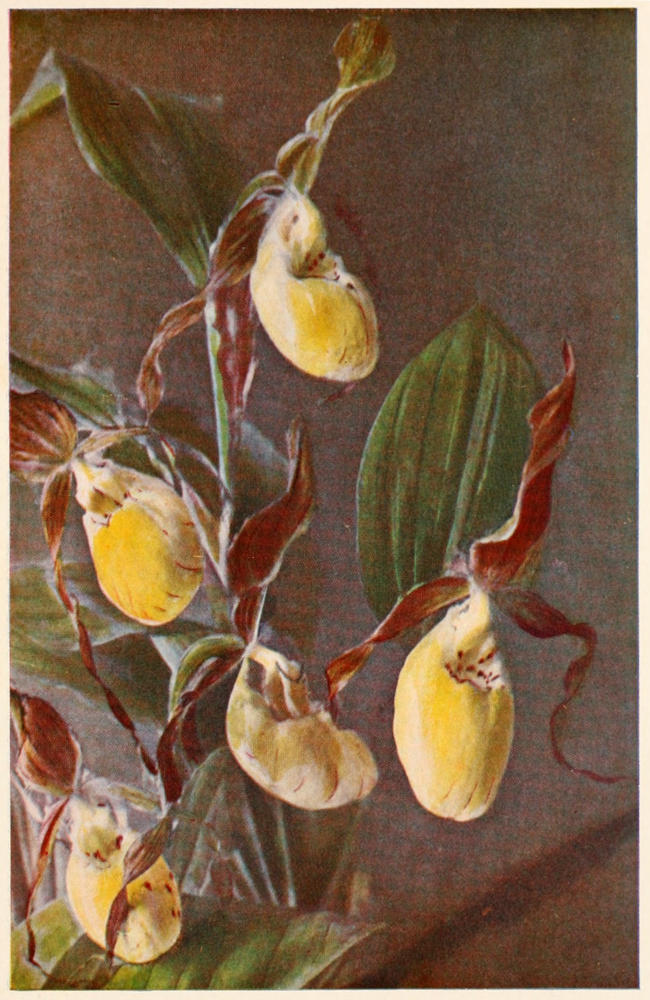
The Large Yellow Moccasin-Flower. (Cypripedium hirsutum.)
This common Cypripedium is closely allied with the Small Yellow Fragrant species—Cypripedium parviflorum—with which it grows in close comradeship, often intergrading. It is also nearly related with the European Yellow Cypripedium (Cypripedium calceolus), the first Cypripedium described by Linnæus in 1740-1753.
A short walk toward West Rock, New Haven, showed me how far advanced the season really was. Here were crowds of children playing in fields covered with violets and bluets, and farther down in the damp meadows were long, serpentine lines of gold, where the Marsh Marigolds (Caltha palustris), known commonly as Cowslips, were already fading. On the edges of the swamp, the Marsh Buttercups of the Crowfoot Family (Ranunculaceæ), were lifting their shallow yellow cups to catch the sunshine. We wandered on through a pretty, wild bit of young woodland until we reached the border of a murmuring stream, creeping onward through the vale and meadow, touching the blossoming orchards here and there, and freshening the sweet white violets on its brink.
North Adams, Massachusetts, was to be my next station. This city is about two hundred miles from New York, among the Hoosac Highlands. I almost expected to see reluctant snowdrifts still lingering in the fence corners and shaded pine glens of this part of “Beautiful Berkshire,” and I half hoped to find a few late clusters of the Trailing Arbutus (Epigæa repens) creeping through the cold, mossy ravines.
Upon my arrival in North Adams, I looked through the bogs under the brow of Hoosac Mountain near Aurora’s Lake, and I could perceive scarcely any difference in the progress of flowers or foliage here from that of the region from which I had just departed. Dogwood, apple trees, violets, anemones and wake-robins were in blossom, while in the deeper bogland I found one lone, pale Pink Moccasin-Flower (Cypripedium acaule).
American White Hellebore, so commonly known as Indian Poke or Itch Weed (Veratrum viride), had already sent out a luxuriant growth of green leaves, which for a moment deceived me—as it had done many times before—by its resemblance to the foliage of the Showy Lady’s Slipper. The leaves of both these plants are plicate, and have ever been confused even by the earliest herbalists. Unrolling a spike of leaves one day, I found I had actually disturbed the buds of the queen of the Lady’s Slippers instead of the Hellebore, although they proved to be blasted. No doubt some warm day had started them prematurely, frost and cold rains later proving their ruin.
Here on a sheltered damp hillside, I found my first clusters of the season of the Pink Azalea (Azalea nudiflora), which is commonly known hereabout as Swamp-Apple, and which is very similar to Rhodora Canadensis. These species belong to the Heath Family, one of the largest among the flora of Hoosac Valley. The beautiful pink flowers of the Great Rhododendron, which measure from one to two inches in diameter, render it the most charming species of this group. It is cultivated extensively, but grows in its natural wild state, in this region, only along the margins of ponds near Montpelier and Wells River, in Vermont.
The American Mountain Laurel (Kalmia), which becomes so gorgeous later in the season, the Lambkill, Labrador Tea, Andromeda and the Cassandra are closely allied species of this group, common to this region. Other familiar members of it are the Trailing Arbutus, Gaultheria, and the Creeping Snowberry. They may be found in Aurora’s Swamp.
North Adams is not far from the sources of the south and north branches of the Hoosac River, in a wild and rugged portion of Berkshire. The Hoosac proper is formed at the junction of these two streams, in the vicinity of the Print Works near Marshall Street in the city, and flows on gently in a northwesterly course to join the Hudson, near Lansingburg. Mountain streams in this region are numerous, and flow musically down through deep chasms and over great marble precipices, to swell the Hoosac as it glides slowly out through the deep-cut valley.
“We Hold the Western Gateway,” is part of the inscription on the seal of the city of North Adams, which is known as the “Tunnel City.” This is practically true, for the sole gateway of the trade from the Western States passes though the flinty wall of the Hoosac Mountain, in order to reach Boston direct. The idea of opening a path for transit through the “Forbidden Mountain,” as the Indians called it, was conceived six years after the first mail-coach and four-in-hand rattled through the street of this town to Greenfield, in 1814. It was found impossible to build the projected canal from Boston to Albany. The estimated cost of building the tunnel was less than two million dollars, but when it was completed in 1875, the total financial outlay had amounted to over twenty millions. Until January 1, 1887, this tunnel was owned by the State of Massachusetts, when it was purchased by the Fitchburg Railroad. It is four and three fourths miles long, and twenty-six feet wide, permitting of double tracks. The arch is from twenty-two to twenty-six feet high, and at each portal there is a massive granite façade.
Whenever I come to the Hoosac Valley, I enter, if possible, by way of this tunnel. I seem thus to close away the outer world, and to penetrate a new realm hidden here in the seclusion of the marble highlands. This triumph of man over the power of Nature needs no further introduction here. I can never forget, however, the weary years of hardships endured by those who toiled in its construction, entombed within the heart of the mountain, subject to the dangers of quicksands, falling rocks, damp and gases, explosives, fire and starvation, before the great work was accomplished.
I enjoyed the ridges in the pastures along the foothills of the grim-faced Tunnel Mountain, and about Aurora’s Lake, which reflects like a pretty little mirror the rugged beauty of the hills. This lake is partly natural, but now dammed artificially. Every line of its terraced shores bears the scars of antiquity, which would indicate that ten thousand years ago a larger lake slept in this hollow vale which geologists have estimated at a depth of six hundred feet. Here are rich deposits of glacial drift, and northeast of Aurora’s Lake are sphagnous swamps, where I find many rare orchids and early spring blossoms. Here both the pink and yellow Moccasin-Flowers bloom in May, while in June the queen of the tribe unfolds her white-petaled purity.
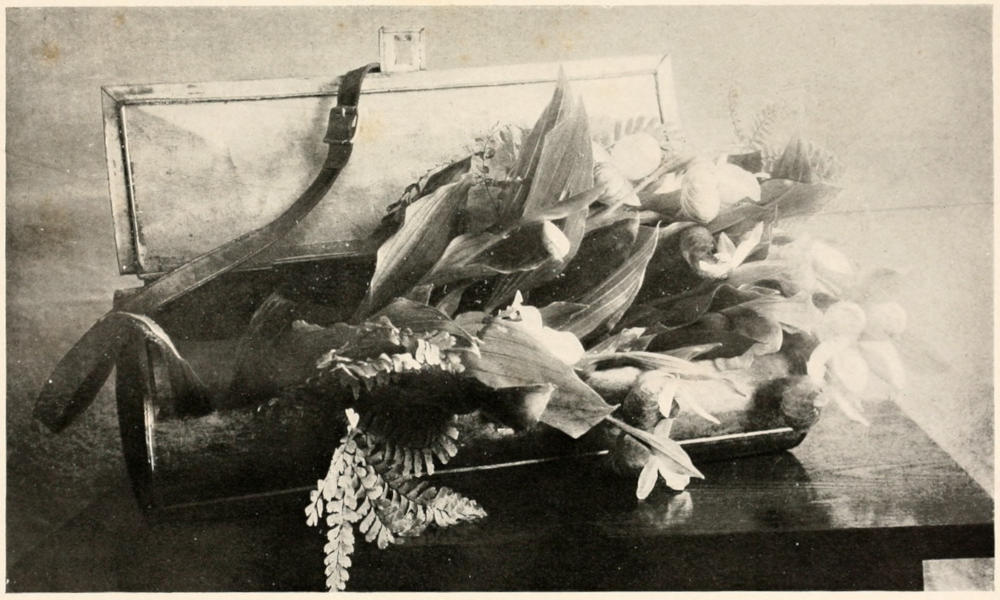
The Botanizing Can, or Vasculum, showing the White-Petaled Lady’s Slippers and Maiden-Hair Fern.
This bogland is very similar to that of the Swamp of Oracles in Pownal, in District Fourteen, save for the openness of the former’s shores. Aurora’s Swamp is located in a deep flinty basin, surrounded only by low tangled bushes and open pasture-land beyond, without forests to shield the bogs from the sweep of winds.
The hills are strewn with great boulders left here in the Glacial Age, which rest, poised as monuments of that mystical period. Especially interesting are the dimpled erosions upon one boulder, which rests just northeast of the lakelet, upon the ridges sloping eastward toward the sphagnous swamp. There are visible deep scratches, hollows, arches and miniature pillars, which the whirling eddies of the perilous waves have eroded during the ages unknown. Higher on the summit of the Hoosac rests another immense rock known to students of geology as the “Great Vermonter.” It is said to have been brought from the marble and granite heights of Vermont, imbedded in the ice-drift. Through the melting of the glacial sheet, one of the drifting bergs left this hero of the ages as we may see it now, moored and balanced high on old Hoosac’s brow.
The geological surveys of northern Massachusetts, by President Hitchcock of Amherst in 1838, early identified all of the low, round hills to be seen southward from Aurora’s Lake as the result of glacial action. Mount Greylock’s Brotherhood is a group of giant glacial hills, as it were, and is the highest pile of Taconic formation in this State. The erosions of the great ice-sheet are plainly seen on the rocky summits of these mountains, and only time and the decay of the rock itself will do away with these scars of that mystical age. The name of “Greylock” appears to be derived from the lowering cloud-mist so often capping the whole Brotherhood at early dawn or before a storm.
Vermonters who, from the hills at a great distance to the north, view this group of mountains, depend upon this capping of clouds as a forecast of the weather. Among the old folk, it is known and designated as “Greylock’s Nightcap,” a portent of a coming storm.
Mount Greylock, the highest swell of this range, is 3600 feet above sea level, and commands a variable and extensive view from its bald summit, on which was early erected that first wooden observatory, during President Griffin’s term at Williams College. Here the poet and the philosopher, Hawthorne and Thoreau, have climbed to meditate.
Many a message has gone forth from these heights to bless the busy world. Scarcely is there a son of old Williams who does not recall the mountain-day excursions led by Professor Albert Hopkins, and the glory of old Greylock at dawn and at the sunset hour.
Thoreau writes of it: “It would be no small advantage if every college were thus located at the base of a mountain, as good at least as one well-endowed professorship. It were as well to be educated in the shadow of a mountain as in more classical shades. Some will remember, no doubt, not only that they went to college, but that they went to the mountain. Every visit to its summit would, as it were, generalize the particular information gained below, and subject it to more catholic tests.”[1]
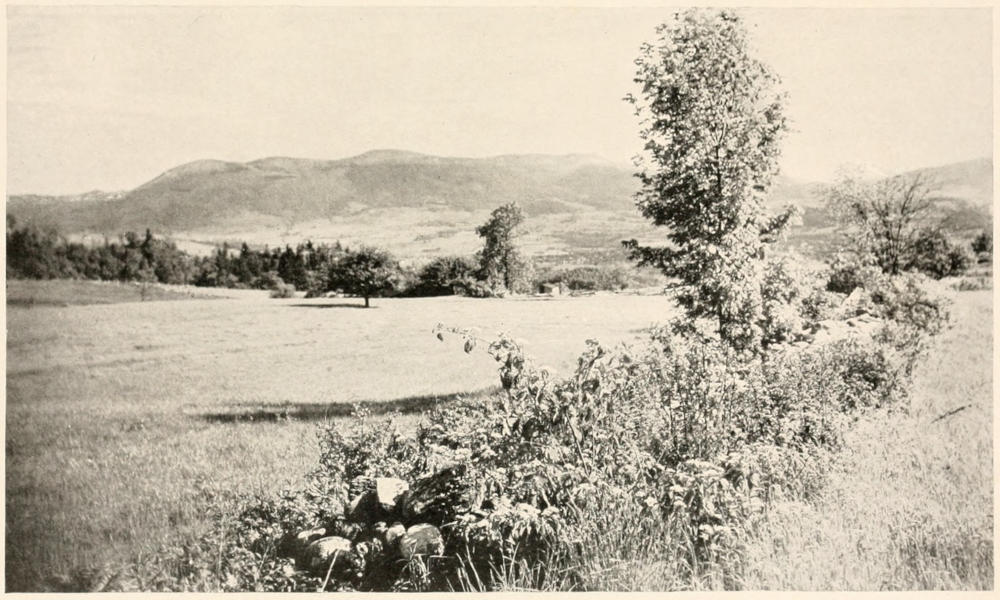
Mount Greylock’s Brotherhood—the Berkshire Highlands, from Mount Œta, Bennington County, Vermont, Showing the College Town of Williamstown in the Valley.
The peak especially designated as Saddleback Mountain is at the junction of the eastern abutments of that huge wall of Taconic Brotherhood which appears south of the old battle-ground where formerly stood the early border Fort Massachusetts, on the Harrison flats, near the flag station of Greylock. The union of Mount Williams, sloping to the east, and Prospect Mountain to the west forms the seat of the saddle.
Mount Hopkins—so named in honor of Professor Albert Hopkins of Williams, the first nature-student of our land, making excursions afield in 1833—lies south of these. Old Greylock, proper, lifts its lofty brow still farther south, being situated about in the centre of this great range as it extends from east to west.
Beyond Greylock stretches a long, misty line of blue peaks against the sky, which if observed from Mount Œta at the north, in Bennington County, Vermont, may be traced to the southwest to Symond’s Peak, the lowest of the group, named in memory of Captain Symond, who led the volunteer forces from our hills and vales to the memorable Battle of Bennington in 1777. Bald Mountain is also in the vicinity, and the closing in of these several peaks has conspired to form what is known as the “Hopper,” and the “Heart of Greylock.” The hollow vale amid these heights has the appearance of the hoppers used by millers years ago.
Surely in the heart of the Taconics we are in one of the oldest rock formations of the earth, and the green terraced stairs lead us slowly down to the deep-set valley of the Hoosac, where once slept that ancient lake. All that now remains of that Lake of Dawn is pocketed in the basin under the Hoosac. The shores of Aurora’s Lake are lonely and still, save for the marsh thrushes which skim low over the waves and whistle shrilly. The groves of pine to the southeast are the haunts of solitude, and those who wander here can well imagine that the Æolian harps among the whispering trees are repeating a music of ages past, when only wind and waves were known to these hills.
Amid these damp and reedy shores and swampy woods are tall brakes and delicate Maiden-Hair Ferns. Here, too, the tall and stately Royal-Fern (Osmunda regalis) flourishes in deep seclusion, sheltered by the low-branching pines along the shore. It grows from two to four feet high in this locality, and is of a deep rich crimson-green tone against the grasses and bushes near. Mounds of moss, marking one of the trees of a primitive forest rotting below the soil, are thickly carpeted with the leaves of the Dog’s-Tooth Lily. Indeed, the picturesque paths which lead through these woods wind through a veritable fairy-land of flowers and ferns. One of these trails runs southward through rocky pastures, swamps and thickets, toward the Tunnel’s western gate.
Along these slopes, among the limestone rocks, I found rows of the Ebony Spleenwort Fern, rather rare in this much-travelled way; and on the brow of this ridge were many species of common fern. The pastures are barren and dry, with few bushes to break the dreary horizon, as one approaches the western portal of the Tunnel.
I came upon one lone Apple-Thorn bush, of genus Cratægus of the Apple Family. Nearly opposite, across the valley of the south branch of the Hoosac, which the Indians named the Ashuilticook, may be distinguished the smoking Limekilns; while still farther southward, the white-spired village of Adams nestles at the base of Greylock, which towers serenely above the shaggy shoulders of Ragged Mountain. I wandered about the edges of the Tunnel cliffs where, in years gone by, had stood the impoverished cabins which sheltered the laborers who tunnelled the Hoosac. I descended into the chasm and seated myself upon the wall of rocks, waiting for the trains to appear and disappear at the portal in the side of the hill. Presently one from the West crept ponderously into the cavern. The echoing roar was smothered, and died slowly away until it became an indistinct murmur. Not long afterward I felt, as well as heard, the low breathings and rumblings of a locomotive coming in the opposite direction. I heard its subterranean groans as of a great spirit, while the smoke poured forth, pushed in volumes before the engine, wreathing and curling about it as it emerged, and partially concealing its grim outlines.
The faithful watchman, a modern Eckhart, sits before the entrance of the Western Gateway of Hoosac Mountain, and warns the people against entering through this portal to the greater world that lies beyond. It is as if he wished to guard these children of the marble highlands from the risks attendant upon the wild whirl of life beyond these quiet hills.
The sun was setting as I left him, calm but alert, at his post of duty, trimming and lighting his colored lanterns for signals of danger or safety to the approaching trains. Climbing up by the path which passes the little red cottage on the crest of the hill on the north bank of the chasm, I returned leisurely homeward, winding over the hillsides, far above Aurora’s Lake, then down along the borders of the swamp-lands. In the crevices of rock were creeping colonies of the Common Polypody (Polypodium vulgare). Along the edges of this bog are still seen the primeval stumps of the pine and hemlock forests, which clothed these hillsides when only the Redmen dwelt and hunted among these wildernesses.
In May and early June these decaying stumps are usually draped with Painted Trillium and the delicate vines of Gaultheria and the Creeping Snowberry, while the Arbutus trails about luxuriantly, covering up the ruins of years.
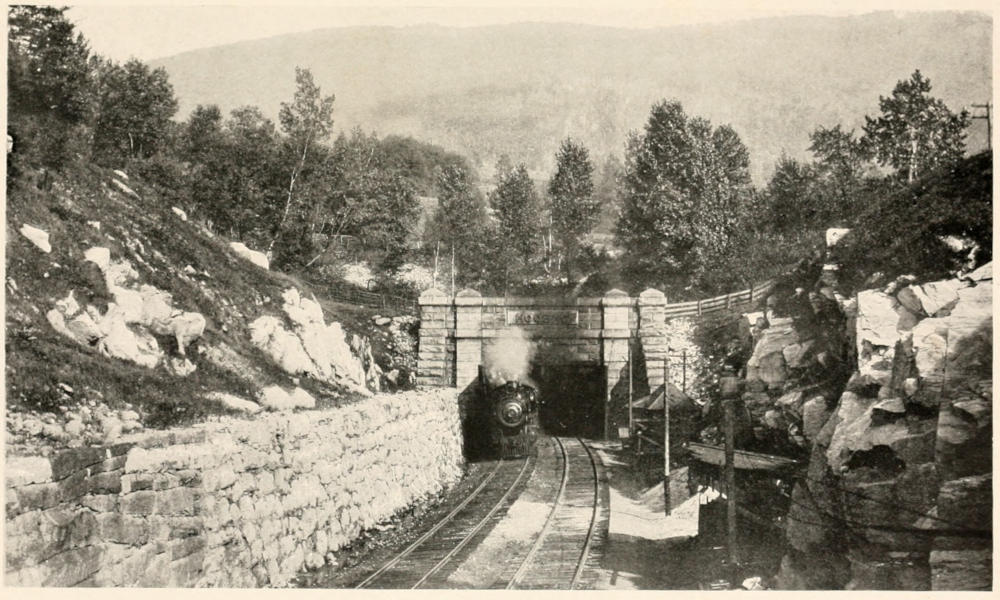
The Western Gateway of Hoosac Mountain, the Entrance to Hoosac Tunnel, North Adams, Massachusetts.
II Ball Brook and the Bogs of Etchowog
Fringing the stream, at every turn Swung low the waving fronds of fern; From stony cleft and mossy sod Pale asters sprang, and golden-rod. Whittier, The Seeking of the Waterfall.
On May 25th I reached Pownal, Bennington County. Upon the following day I explored the great swamps of Etchowog. Prepared with luncheon, vasculum, basket for roots and my hound Major, I started on one of those happy excursions such as Thoreau recommends we should take, “in the spirit of undying adventure, never to return,—prepared to send back our embalmed hearts only as relics to our desolate kingdoms.”[2]
Ball Brook, a sluggish stream flowing northwardly to East Pownal swamps—commonly called the Bogs of Etchowog—has its source in the marshy hillsides northwest of the schoolhouse in District Fourteen. Two streams flow from this valley. One is called Ladd Brook, running southwesterly and following the windings of the shady Ladd Road to Pownal village, where it joins the Hoosac River. The other stream, Ball Brook, flows north and northeast onward through innumerable and unfathomable swamps, to Bennington village, ten miles north, there meeting the Walloomsac River, which is also a tributary of the Hoosac, farther northward in its course. This brook is rich in a continuous chain of peat bogs—rich from an orchid-hunter’s point of view.
Although I have been familiar with this region from childhood, viewing it from the roadside only, I never at any time had ventured to follow Ball Brook through all its meanderings to the Bogs of Etchowog near Pownal Pond, a distance of some three miles. This would not be a long walk on a fair road, but it becomes rather dangerous and formidable when leading through quaking marshes in the soaking currents of a stream.
A short distance to the right, north of the schoolhouse in Number Fourteen, there is an old pathway nearly overgrown with bushy pines and birch and chestnut underbrush. This I followed, entering the hollow under the brow of the hill, and passing along the wood road which skirts the margins of one of the deepest, darkest jungles in these regions. The old people look upon it as akin to “Witch Hollow,” on the Gulf Road near by, and tell strange tales of ghosts, and of some mythological peddler who was swallowed here in the black mud of this ancient tarn, after having been robbed of his fine silks and precious jewels.
Weird, hollow drummings issue and echo through these shaded vales from time to time. Probably they are due, however, to nothing more startling than the alarum of a partridge, or the hoot of the screech-owl; or the creaking and rubbing of partially fallen trees against their supporting brothers, voicing a portent of coming storm. I hear in this woodland seclusion little save the whispering of the winds, the sighing of the pines, and snapping of dead twigs, mingled with the chorus of the thrushes. The first settlers here about interpreted these wood-sounds far differently; then the primeval forests were dense, and the noises were deep and full of mystery, and there was fear of the Redman’s war-whoop. As Burroughs writes: “The ancients, like women and children, were not accurate observers. Just at the critical moment their eyes were unsteady, or their fancy, or their credulity, or their impatience got the better of them, so that their science was half fact and half fable.... They sought to account for such things without stopping to ask, Are they true? Nature was too novel, or else too fearful to them to be deliberately pursued and hunted down.”[3]
I stopped on a corduroy bridge to draw on my high-water boots and rubber gloves, for one feels safer when entering this dense swamp if protected from poisonous roots and foliage, biting insects and things that creep and crawl.
I had started out with small belief that I would find any prime blossoms of the Orchid Family, for nothing of importance had yet unfolded in Aurora’s Swamp in North Adams. But when I penetrated the heart of these rich, warm glooms, I found waiting for me a fragrant company of Dwarf Yellow Lady’s Slipper (Cypripedium parviflorum); and innumerable Stemless Pink Lady’s Slippers, more frequently called the Indian’s Moccasin-Flower (Cypripedium acaule), stood as sentinels on the dryer edges of the swamp.
The Marsh Marigolds were here also in their last stages, fading away, but still sufficiently bright; with the late indigo-blue violets, which rear their faces at least a foot high above the dark pools, to carpet the marsh with gold and purple. Poison Ivy cropped out frequently among these graceful orchids,—a beautiful vine, although unfriendly to man.
It is difficult to describe the dense gloom of this bog, closed in on all sides by high rock-bound hills, which are clothed with pine and yellow birch trees, and which in their turn are but foothills to the higher watershed. It seems to have been a receiving basin for the waste and wear of the heights above for thousands of years. Here are fallen trees of every variety common in southwestern Vermont, and these prostrate giants helped to form a safe footing through the quaking bogs.
Many cold springs under the hill to the south conspire to freshen the marsh, and after sluggish oozing northward, they unite and form the brook proper. The stream leads directly through the heart of the swamp, and at last, gathering force, rushes down over rocky slopes, presently to enter another swamp of greater breadth, filled with different trees and flowers.
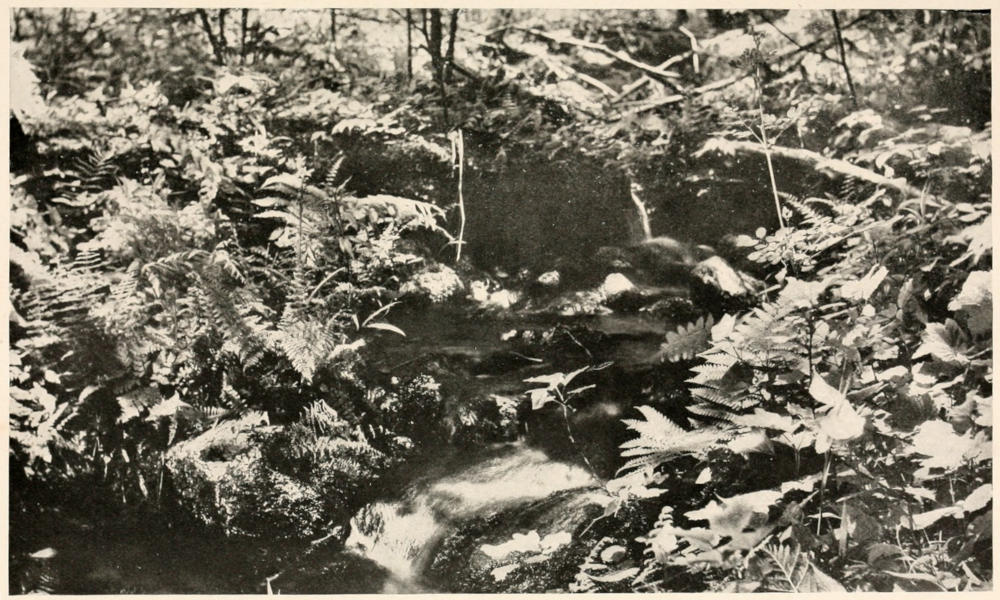
Ball Brook, in the Swamp of Oracles, Pownal, Vermont.
“Here, let these rivulets forever flow! Drink from these highland domes the melting snow; Drain from the dark ravines, and hollows near, The mountain cascades, flowing soft and clear.” G. G. N.
The Showy Lady’s Slipper (Cypripedium reginæ) was just sending forth its tiny roll of leaves, so I could not expect prime blossoms before June 15th at the earliest.
Seated on a decaying log, I ate my luncheon, with Major before me begging impolitely for his portion, until I divided my cake with him. The mosquitoes were so troublesome that I decided to push onward. Carefully picking my way out of the swamp, I crossed the muddy brook, and found myself in a dry, rocky pathway which winds around the hillside, but still keeps within sound of the brook’s murmur.
In exquisite little glens beside the path were Painted Trilliums and Stars-of-Bethlehem, while the white and gold stars of the dainty Goldthread (Coptis trifolia) were shining amid the moss and their own glossy green leaves.
In the bend of the stream a little farther on were some of the most graceful little ferns, just near enough to the brink to catch now and then a dash of spray from the rushing waters, swayed in the coolness all day long, adding beauty to the nook.
Still farther on, I saw that by crossing the stream I could enter a little ravine to the right, which promised hidden treasures. I waded through the brook, which was too wide to jump across; I found that it was also rather too deep for my boots, and that there were very few stepping-stones to make a dry crossing possible. But of what matter is a little water in one’s boots, when seeking the Gardens of the Gods? I landed safely on the opposite bank, after frightening many a shy, speckled trout from his hiding-place in this ideal fishing-hole.
I was now in a small, low-lying glen where foot of man has seldom been. The soil, though much drier than the ground over which I had recently passed, displayed a honeycombed appearance, showing where the water had oozed away through the rich leaf-mould to seek the flowing stream beyond.
Whole constellations of star-flowers were here; both the Painted and Crimson or Nodding Trilliums were abundant, asserting themselves and their rights, if size of flowers and leaves may indicate strength, among the tall, rank growth of the Common Brake (Pteris aquilina), which frequently rise five feet in height. Close by their long, harsh lobes grew the plicate leaves of the Indian Poke or White Hellebore. Skunk Cabbage (Spathyema fœtida), so frequent in the swamps along Bronx River in Greater New York, is rarely seen here, although I find lone specimens now and then in Aurora’s Swamp in northern Berkshire, and in this jungle. Lily leaves and Dwarf Cornel peeped out from every shadow. Here I found the red-spotted leaves of Dog’s-Tooth Lily (Erythronium Americanum) and Clintonia (Clintonia borealis), as well as the delicate leaves of the False Lily-of-the-Valley (Unifolium Canadense), and several species of Solomon’s Seal, while the weird Indian Cucumber (Medeola Virginiana) rose up everywhere beneath the luxuriant ferns.
Dwarf Cornel, or Bunch Berry, locally known as Bear Berry (Cornus Canadensis) was about to set its fruit. These berries are of a deep vermilion color, and eatable if one has the patience to sever the seeds. From the bark of this species of the Dogwood Family is extracted a tonic which is very bitter.
I found the beautiful Star-Flowered Solomon’s Seal (Vagnera stellata), and the deeper bogs revealed specimens of the rarer bog species, Vagnera trifolia, which, in spite of its name, produced plants with more than three leaves, and many beautiful fragrant flowers of a waxy white color. Indian Turnip (Arisæma triphyllum), more commonly known to-day as Jack-in-the-Pulpit, was numberless; the little priests in the pulpits were dressed in cardinal’s robes trimmed with stripes of green, white, and purple.
This sylvan retreat which yielded so many specimens of beautiful flowers I called the “Glen of Comus,” for I could not rid my thoughts of the deep, dark woodlands where Sabrina was lost among the enchanters.[4] I fancied that the Purple Trilliums stood with nodding petals bowed down to earth as though they were guilty of some crimson sin and dared not lift their faces to the sun.
I gathered from every species some perfect treasure, and then returned, wandering once more beside the cool brook. I wondered if it carried all the memories of the forest fastness, gleaned among the roots of our frail, beautiful hillside flowers, through the mighty rivers to the deep seaweeds and strange aquatic blossoms which had at one time bloomed among these very hills ages and ages ago.
Climbing a fence, I found myself in a parched, short-cropped cow-pasture, but the stream soon passed into a large tamarack swamp, where in many places neither man nor beast can wander with ease or safety. I rested under a wide-spreading pine tree, looking the marsh over to choose the best path through it, for I still had some distance to walk before I could reach Pownal Pond and the Bogs of Etchowog.
In order to make my journey less burdensome, I decided to leave my treasures of gold and crimson hidden in this stream, where they would not only keep fresh, but would be much safer than with me. I felt that they would be reasonably safe from marauders, for orchids are far more numerous than human beings in this forlorn locality; for where verdant meadows might spread were only uncultivated, almost impassable, dismal swamp-lands.
At last my flowers were safely placed in the bend of the brook near an old pine stump, where I made them fast, covering them with the coarse brakes which grow everywhere; then I strode on northward through the tamarack swamp. This marsh covers a large part of Ball Farm, from which the brook crossing it derives its name.
Through the trees I could see the old weather-worn farm buildings, nestling in the shade of a dozen or more large, thrifty maples, and now and then I heard a faint murmur of distant voices. Suddenly they subsided, and a small dog’s shrill bark told me that I was discovered, mistaken perhaps for the veritable “Witch of the Hollow,” by the present colored occupants.
There was no use in trying to follow the stream now, for its windings were intricate and indefinite. It wandered all over the meadow marsh, and splashed out in one great mud-hole, similar to that of the jungle in District Fourteen, save that the meadow here was open, with very little low tangle or underbrush in sight. Innumerable tamarack trees, however, lifted their graceful spires throughout the bog; yet this did not prevent the meadow from appearing flooded with sunshine.
Away over on the west side of this swamp were many low-spreading trees of virgin pine, contrasting prettily with the lighter greens of the delicate spires of tamarack. Between myself and the shore on either side of this mud-swamp waved acres of Fleur-de-lis, which would soon color the whole meadow with royal purple. Still westward of this lay an alder swamp. This shrub, called Speckled or Hoary Alder, belongs to the Willow Family, and grows about fifteen feet high, along swamp meadows, forming dense thickets.
Many saucy swamp birds dwell here and appear tame; they came chattering after me, fearing, no doubt, that I might be in search of their nests and birdlings.
Under the pines on the border of the swamp I rested, finding the while tender young Wintergreens (Gaultheria), and many edible red berries, called Checkerberries, fruit of Gaultheria, sometimes known as Partridge-berry and Boxberry. The last two names are more frequently applied to the fruit of Mitchella repens, found growing in company with Gaultheria, and producing edible scarlet berries on a trailing vine, resembling myrtle. The flowers of this vine were now in bloom, giving forth a delicate perfume. Their white and pinkish-purple blossoms dotted the moss with a brilliancy like that of the Trailing Arbutus (Epigæa repens), so lately faded.
The buds of Moneses uniflora were putting forth their “single-delight,” the name coming from their solitary flower. Here also were quantities of the glossy, waxen leaves of Pipsissewa or Prince’s Pine (Chimaphila), and low creeping evergreens. Common Club-Moss and Ground-Pine were interlaced in their dark green beds, where had recently nestled the clusters of arbutus, now brown and faded, although the mossy hummocks still held the fragrance of their luxuriant green leaves. Whittier, writing of these spicy flowers, associated them as the first flowers which the Pilgrims looked upon after their landing on the bleak shores of New England, at Plymouth, in the spring of 1621, and says:
Yet, “God be praise!” the Pilgrim said, Who saw the blossoms peer Above the brown leaves, dry and dead, “Behold our Mayflower here!”[5]
In New England the Arbutus is commonly called “Mayflower,”—not that it blooms especially in the month of May, for it has been found in northern Berkshire as early as February and March. My observation is that prime blossoms are found in the Hoosac Valley region from March 15th until May 15th. I have also gathered beautiful clusters as late as June 23d, in cold nooks beneath the shades of spruce and pines. Their spicy perfume is ever the delight of New Englanders.
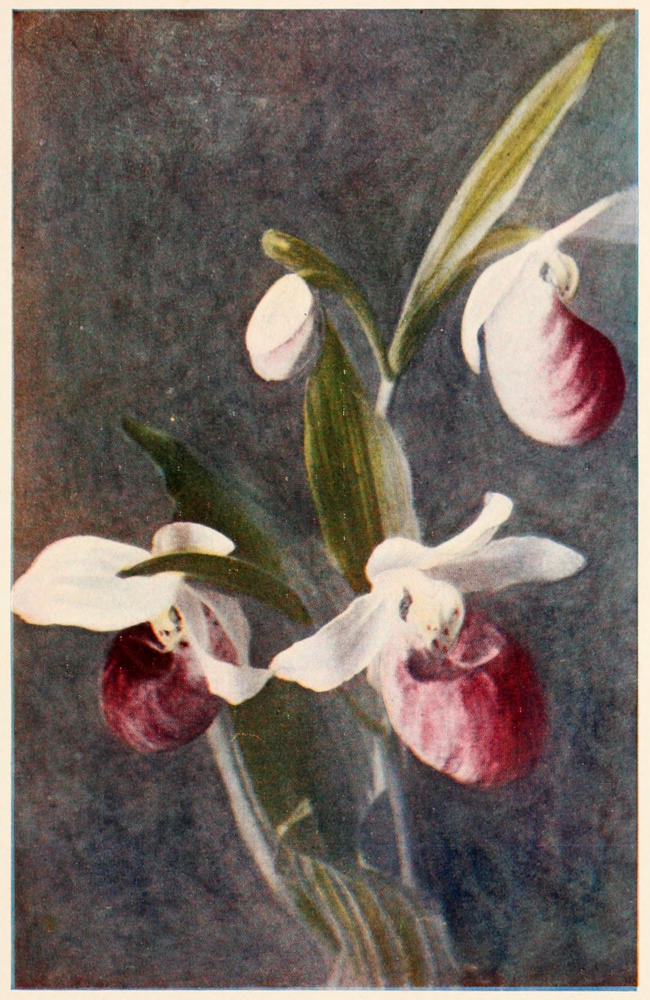
The Showy Lady’s Slipper—The Queen of the Indian’s Moccasin-Flowers. (Cypripedium reginæ.)
Few poets have ever sung the praises of the Queen of the Moccasin-Flowers, although a lovelier flower never beckoned to poetic fancy.
Scrambling with difficulty over a fence which sagged toward me, I entered a neighboring pasture, finding here more alder trees. Small tamaracks, Christmas spires of spruce, and pine seedlings filled the pasture with fresh evergreens, making me fancy myself in a cultivated park, so regular and trim they stood. Eastward crept Ball Brook, wandering through deep, reedy grasses, where here and there stood tall spikes of last year’s Cat-tail Flag (Typha). Here also grows the Sweet Flag or Calamus (Acorus), which is not only good to eat, but a panacea for sore eyes. The cat-tails stood stiffly erect, as if guarding the blossoming bog, and serving, notwithstanding their dignity, as perches for the saucy finches which still chattered after me.
Now I passed through a barway to the right, ever in hearing of the gurgling stream, which had reached a hard, dry, gravelly soil, abruptly following the downward slope around a hillside. A well-worn sheep path led me down into a bog similar to the Glen of Comus in District Fourteen, only if anything more wild and weird. Through the openings between the trees and knob-like glacial hills, I caught glimpses of the bold, rugged form of the Dome, standing coldly against the eastern horizon.
A glance through these glooms revealed another colony of the Showy or White-petalled Lady’s Slippers just bursting forth from the earth, perhaps four inches high. I have found them frequently in these bogs, when full-grown, standing three feet tall, but the usual height is about two feet; and in open meadow swamps often only eighteen inches, owing to the crowded soil, choked with grasses and low shrubs. In about three weeks these bogs would be gay with dainty Moccasin-Flowers.
In the upper part of this swamp, I found a rather quaking corner devoted entirely to the deep green leaves and tall, white-bearded spikes of the not common Buckbean (Menyanthes trifoliata), a distant cousin of the Blue Fringed Gentian. I know of several colonies of this rare plant in the bogs hereabout, where it grows plentifully, in its pet localities. It is liable to grow ever undisturbed, I am sure, since it chooses such dangerous swamps in which to flourish.
Thoreau mentions that Hodge the geologist once found at least an acre of this species. He writes: “We reached Shad Pond, or Noliseemack, an expansion of the river. Hodge, the assistant State Geologist, who passed through this region on the 25th of June, 1837, says, ‘We pushed our boats through an acre or more of buckbeans, which had taken root at the bottom, and bloomed above the surface in the greatest profusion and beauty.’”[6]
After leaving this jungle,—which reminded me of the luxuriant vegetation of tropical swamps,—I pushed onward, ever nearing the broad marsh-lands of Etchowog, east of Pownal Pond, in the shadow of the Dome. A shaded wood-road winds around the base of the hill, through an open gateway into a thrifty, well-kept apple orchard. This adjoins the old Kimball homestead, and I therefore designated these marshes Kimball Bogs. Out through the orchard meadow I passed, crossing the dusty highway which leads northward around the pond. There are several roads leading to Bennington village; some are rough, some are narrow and hilly, while others are broad and easy. The one to the left, called the Middle Road, follows through Pownal Centre to the county seat of courts and justice. By keeping to the right, one arrives at the same destination by the rough but picturesque East Road, under the brow of the Green Mountains. A direct route from Pownal Pond to Bennington is by way of the Hill Road, which leads directly north between the other highways. Thus the region is intersected from east to west by many roads running northward. I invariably recommend the Hill Road to the traveller who enjoys beauty of landscape. On this way, if he be a keen observer of nature, he will find much pleasure.
Instead of going by the trodden way to Pownal Pond, I chose to follow closely the windings of Ball Brook, which at this point of the road, opposite Kimball’s barns, mingles with another mountain torrent that comes down from the spring heads above Thompson’s Pond, under the Majestic Dome. The main current of this stream continues with the bend of the road, taking with it the volume of the water of Ball Brook as it crosses the greater stream. The courses of both streams are unnatural, having been removed, over one hundred years ago, from their original channels in order to form a mill-pond for sawmill use. Originally, I am told, a dense forest of pine trees occupied the hollow where now the waves of Pownal Pond wash over the decaying stumps.
The natural lake bed lies in these broad, sphagnous meadows east of Kimball’s homestead, winding around to the north, where now wave various small shrubs and trees. Barber’s sawmill, which stands close by the roadside, east of the pond to-day, is slowly crumbling away for want of use. Water finds its level, and although forced to go by the roadside, Ball Brook still seeks in part its old channels through the ancient meadows of Kimball’s Farm, where the stream is silent and elusive, as it glides among the tall, lush grasses. Walking along the borders of this hidden brook, through the tangle mingled with daisies and buttercups, I lost the stream entirely, only a line of gold marking its sleepy wanderings,—for marsh marigolds were still plentiful here, ever following the edges of the brook.
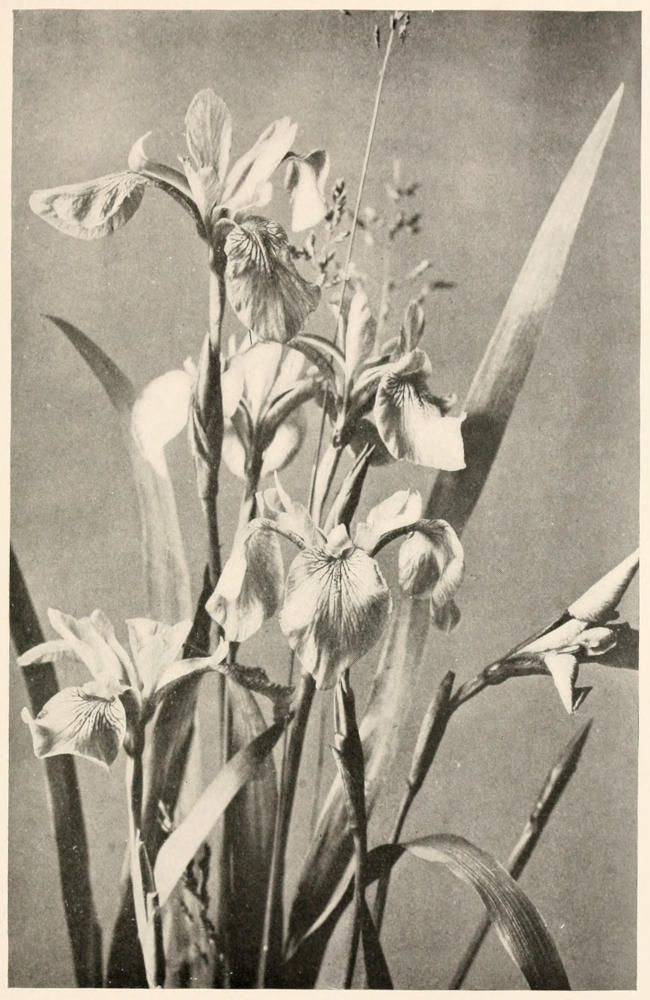
The Fleur-de-Lis. (Iris verisicolor.)
Hellebore grew over the swamp, and the tall grasses took on coarser forms as I waded farther on, deeper and deeper into the sphagnous grave of the ancient lake. At times it seemed so soft and spongy that I questioned my safety, even doubting the possibility of a search party securing my “embalmed heart,” if once I became fast in the mud, so I began to edge up toward firmer ground and the rocky hills near by.
This was the most uncertain swamp I had ever traversed, and not quite safe for one to wade through alone. It is reputed to have been at one time the bed of a great lake, as evidenced by the terraced hillsides about it. Its waters might still linger beneath the black-peat and forest débris which support the trees and spongy sphagnum. However, a fence closed off the most dangerous parts of the bog to keep back the cows from the mire and “dead holes,” as the unfathomable places are designated by the lads who penetrate these bogs for the marsh cranberries in the autumn.
I searched through this meadow for the Large Purple-Fringed Orchis (Habenaria grandiflora), thinking perhaps I might find the leaves, although I was somewhat too early to secure the flowers, since they are not due until June 20th and later.
On striking out for the hillside path, I found many problems to solve. It appeared impossible to gain a firm or safe footing in the sphagnum and mud, so securing a fence board which had been hurled about the marsh by the winds and storms, I slapped it down upon the soft earth and moss, and walked its length of eight feet. Then quickly relaying it, while my feet sank lower and lower in the moss, I hastened to pull out my muddy foot-gear and walked the length of my bridge once more,—repeating this perilous feat several times, until I had finally crossed the “dead hole” and stood on terra firma once more.
There is certainly no experience like being stuck in a bog to arouse fearful forebodings. The discouraging effort to keep one foot above the ground only to find the other sinking deeper is most terrifying, and leads to hasty and excited movements which but increase the danger, and may finally lodge both feet fast in the mud. In such a case the sight of a board fence upon which an elbow may be rested is as welcome as a sail to a ship-wrecked mariner. There is in truth much art and science in walking safely through mud and sphagnum. One cannot saunter over the surface, and meditate at ease, but one must be ever alert, elastic as a rubber ball, and quick to feel a danger before it can be seen.
The fields and woods are a good deal like the books we read: the more we become familiar with printed page or forest path, the oftener we return to certain thoughts and trails that lead us back to scenes and associations enjoyed before. I like to mark passages in books I love, here and there, as I would blaze a tree to guide me to the haunt of a cool stream or a rare flower’s hiding-place. Whenever I turn to such passages, I find that time and season have expanded some new thought in my mind, even as they have developed the buds to full-grown flowers since my first journey through the wood.
There is a beautiful cold spring under the hill near the swamps of Etchowog. I have known of it all my life, and were I to visit this region every day for months, I should invariably be drawn unconsciously to this fountain. It is here that I quench my thirst and rest after wading through the neighboring swamps. I have turned many stones here in the past, and lifted the dead leaves from the choking throat of the spring. I have gathered the sundew growing in the moss fringing the banks; and in the sweet solitude and peace I have dreamed many dreams, inextricably mingled with the music of the stream.
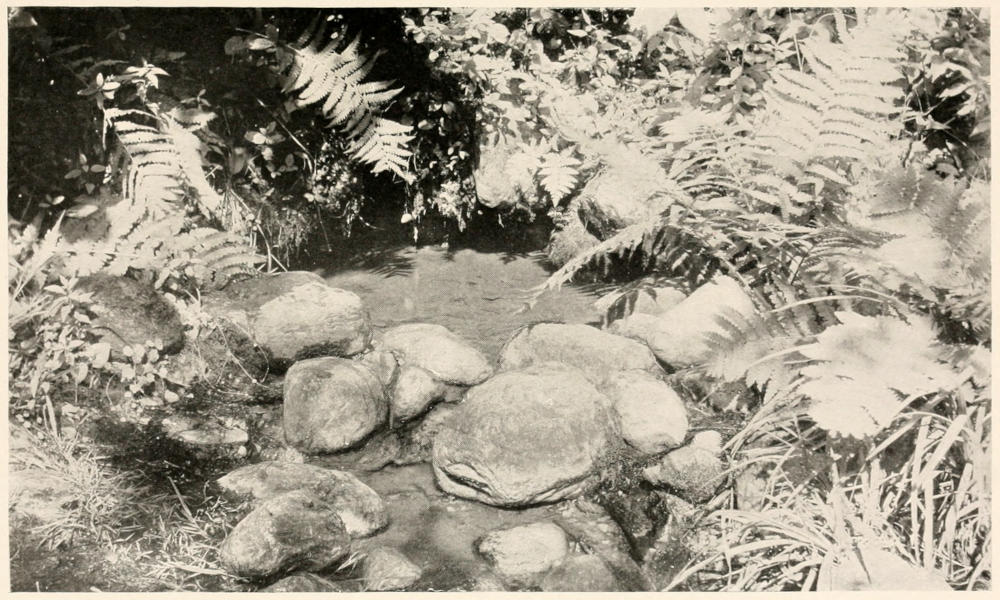
The Fountain of Arethusa, near the Bogs of Etchowog, Pownal, Vermont.
“If you would get exercise, go in search of the springs of life. Think of a man swinging dumb-bells for his health, when those springs are bubbling up in far-off pastures unsought by him!”—Thoreau.
To-day I sought this spring to rest. I bathed my face and combed my hair over Nature’s own mirror, after taking a generous draught from the sparkling water. It bubbles and gushes continuously from under the rocky hillside, bringing sand and delicate-hued pebbles to scatter in the bottom of its bowl the year round. I rested here a full hour, and rinsed the mud off my boots.
From here it is but a short walk to Barber’s Mill at the foot of Pownal Pond. Alders, willows, shad-bushes and pink azaleas, small white birches, tamaracks, pines, and beautiful swamp or soft maples fill the broad expanse of marsh-land to the right; while the rocky, burnt-over, and blackened hillside rises up to the left. I was tempted into the deeper underbrush, but proceeded very slowly, as the treacherous bog was so spongy with sphagnum that I would often sink from twelve to fifteen inches into its soft, pink depths. But here I felt secure, since there were many fallen trees and growing saplings to which I could hold and cling, in case I stepped into a “dead hole.”
Here, half buried in the moss, I found hundreds of crimson-veined Pitcher Plants, or Side-Saddle Flowers (Sarracenia purpurea), which bear olive-green, purple-veined, vase-like leaves that hold rain and dew. Often the species varies in color, and its absolute greenish-yellow with lighter green veinings. Many of the larger pitchers hold fully a tumbler of fluid. Their brilliant-hued brims are edged with crimson ridges, delicately coated with honey, thus enticing flies and moths to drink from the nectar beyond the brim. The more common prisoners are small flies and moths, but one day I found two dozen snails captive in the larger leaves of an ancient plant, for if once within, there is no escape even for snails. Consequently the Pitcher Plants—locally called St. Jacob’s Dippers and Dumb Watches by the children—are considered carnivorous plants, since they are flesh-eating by nature. This is also true of the small Round-leaved Sundew (Drosera rotundifolia).
These plants are traps that not only cunningly entice, but actually entrap and slowly devour their victims. Sundew delights in being fed beefsteak, and Professor Bailey cites Darwin’s experiment of feeding them steak, which “they accepted as readily as an insect.”[7] The Sundew is plentiful in these mossy bogs. It has red and white, dewy, bristling, round leaves, with long petioles spreading in a tuft. When a small fly or ant touches these sticky bristles or tentacles on the upper face of the leaf, the points of the outer row slowly turn inward, holding their prey closely until it is dead.
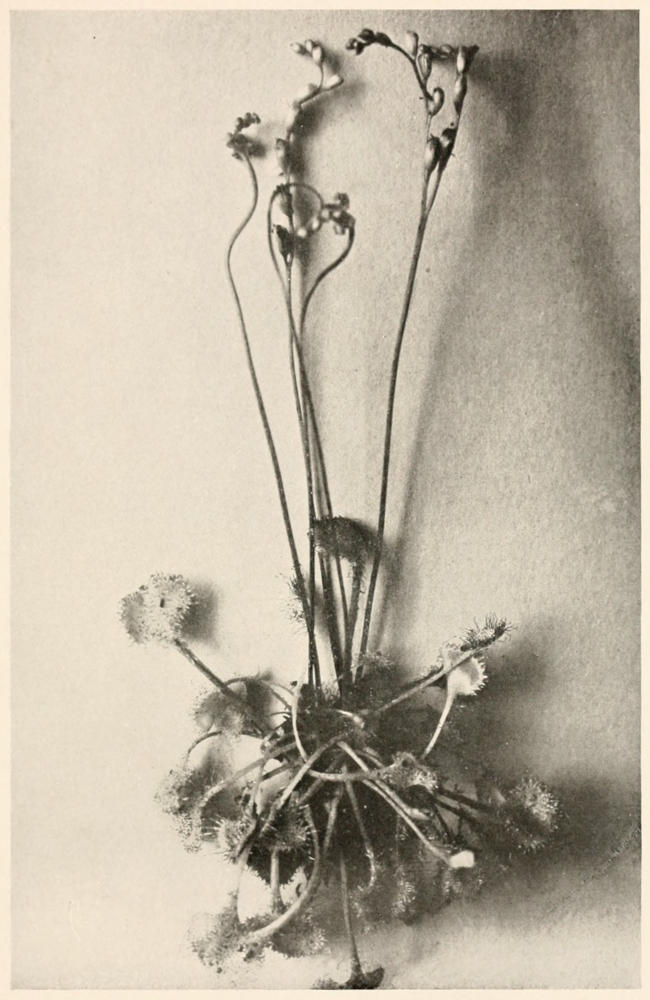
Round-Leaved Sundew. (Drosera rotundifolia.)
Like the enticing honey of the Pitcher Plant, the viscid fluid of the Sundew attracts the flies, and, once alighted upon it, they become entangled and doomed to certain death. After drawing the juices from their victim or bits of steak, they relax and slowly regain their normal positions. The glands of these leaves send out drops of a clean, sticky fluid which glitter like dew drops in the sunlight. The plant sends up a short spike of insignificant, whitish-green, bud-like flowers, which are said to open briefly one by one in their turn, each morning in the sunshine, till the whole spike has unfolded. Each flower turns brown and fades before the successive bud unfolds, so that there is never more than one full-grown flower to be seen at a time. This is not the case with the flowers of the Pitcher Plant. I found many crimson, ball-like buds sleeping tucked up in their mossy beds. They would be in their prime in a week or ten days.
Here I discovered some fine specimens of the Pink Moccasin-Flower, and I was just about to pluck one, when behold—stretching at full length, basking in the sunshine on one of those sphagnous stump mounds, lay a snake, very near the coveted blossom. He may have been black or he may have been checkered or variegated and even charming and beautiful to the snake-hunter, but to the orchid-hunter he was not a prize worthy of a place in the vasculum. I did not wait to study or designate him or count his diamonds, but softly stole away, leaving him still cunningly sleeping, in waiting for prey, beside that gorgeous Moccasin-Flower.
I now regarded with suspicion all the holes in the soft mounds of moss, as the possible homes of snakes, that might object to visitors in their Eden. Immense ant-hills were numerous, and the occupants may have afforded food for Satan’s prototype in his idle hours. Now and then the drum of a frightened partridge, giving her alarum, assured me that her brood of chickens was hidden under the leaves and logs not far distant. It is very probable that snakes in these bogs devour small birds and frogs, and lie in wait for them, as I found the one that I had seen this morning.
Before continuing my search, I secured a hardwood staff, feeling safer with a cudgel of some kind in my hand, in case I met Satan face to face. In my tussle to sever the birch limb from the green tree, I snapped off all the Venus Slippers that I had actually gathered here. I was therefore no richer in actual specimens upon my departure from the swamp than when I entered it; but I carried away memories of that vast solitude and slumbering desolation where foot of man, I dare say, has seldom if ever been.
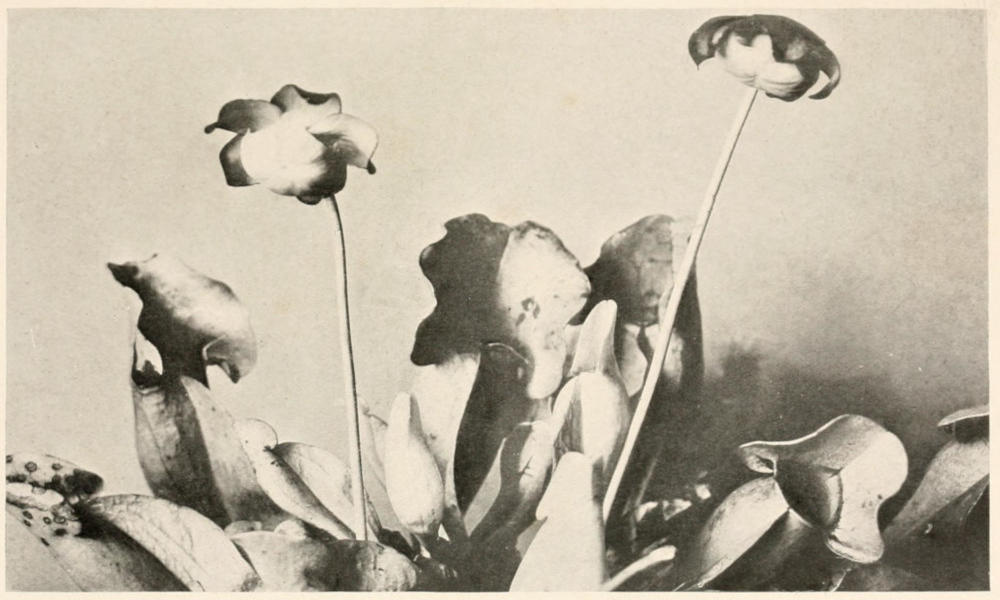
The Carnivorous Plants, commonly called Pitcher Plants, and Dumb Watches. (Sarracenia purpurea.)
“What’s this I hear About the new carnivora? Can little plants Eats bugs and ants And gnats and flies?— A sort of retrograding Surely the fare Of flowers is air, Or sunshine sweet; They shouldn’t eat, Or do aught so degrading.” Anonymous.
Now well out of this swamp, I found myself on the edge of an apple orchard, filled with rosy bloom and the fragrance of happy May. A newly planted garden bore witness to human life, and the long rows of potato-hills spoke of industry. Passing through the gate, I entered the East Pownal Road near the mill, and walking down the bank to the right, just north of the mill, where cobblestones had been dumped from the fields, I picked my way into the open Bogs of Etchowog, which lie directly east of the pond.
I wandered up and down through this swamp, finding hundreds of Pitcher Plants, which had begun to nod their crimson buds. Clusters of the Showy Lady’s Slippers were springing up on the higher, drier mounds among the lily leaves of Clintonia borealis and Dog’s Tooth. Fleur-de-lis grew everywhere, while the Poison Ivy flaunted its three-fingered palm on every side. Poison Sumach or Poison Dogwood, sometimes known as Poison Elder, grows luxuriantly in this swamp, and susceptible people have been poisoned merely by passing above along the roadside. By wearing high hunting-boots and rubber or chamois gloves, however, I am perfectly safe in such places. In fact, I never think of these plants as poisonous when brushing through the tangles of bushes and blossoming vines. These species of Rhus are in blossom most of the summer. The juice of the plant is resinous, and the fruit consists of white or dun-colored berries.
Going back to the roadside to rest, I took out my color-box and attempted to sketch the swamp I had just left. Eastward, rising boldly in the background, towered the Majestic Dome against the sky. In the middle distance, a long line of alders and willow shrubs blended softly into the blues, here and there dashed with the crimson and gold swamp-maple buds; while still nearer, amid the low, grassy reeds and poison sumachs of the wet swamp, three tall, stately pines reared their shaggy green forms against the dark blue tones of the mountains, lending strength and balance to the scene.
My day nearly spent, I packed away my colors, and started on my return trip, leaving the mill at the bend of the road at three o’clock. Just above the Kimball Farm, I came to a pent-road leading through the pastures to Ball Brook Farm, where I must go to get my Moccasin-Flowers, left hidden in the stream. I found them as fresh and fragrant as if just gathered.
The walking was good, so I exchanged my high, heavy boots for low shoes, which were much more comfortable for dry paths and climbing hillside roads.
Going directly up through the cow-pastures along the border of the Glen of Comus, I came upon a colony of Pink Moccasin-Flowers, growing on a sloping hillside under low-spreading pines and birches. Although the spot was shaded, many flowers were unfolding, but they were not so deep in color as time and sunshine would paint them. I counted at least two hundred buds and blossoms, thinking what a feast for the eyes I should have another day, when they were in their prime.
Later, as I turned into the Centre Road, I met Lorenna, one of the school children in District Fourteen. She, too, had her hands full of flowers. I asked her to keep a lookout for strange, small Moccasin-Flowers, hoping thereby that she might find the rare little Ram’s-Head (Cypripedium arietinum), for which I have so hopefully searched these woods in vain. I had found thus far all the representative species of the Moccasin-Flowers of this State, save the rarer Ram’s-Head.
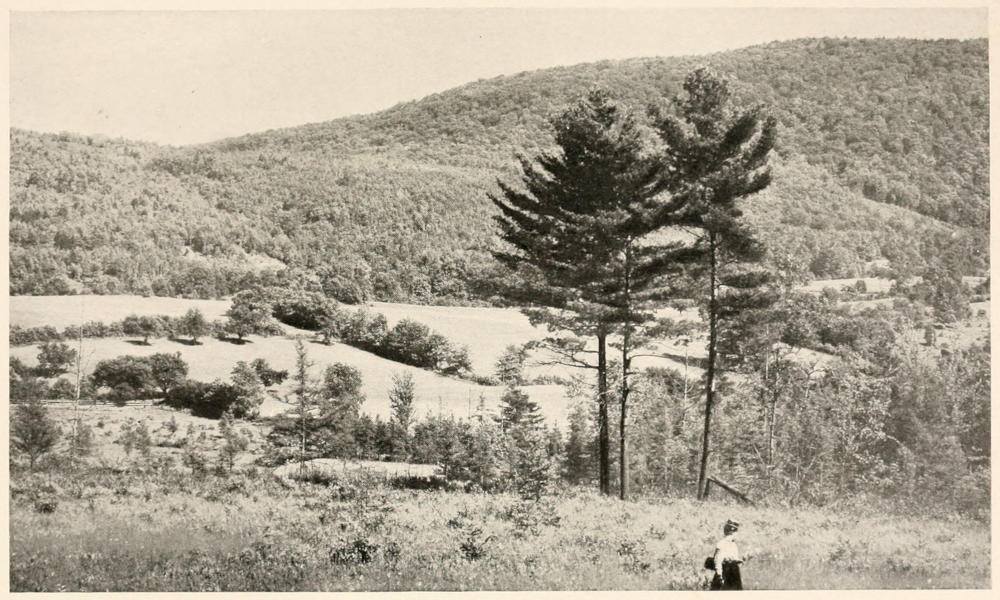
The Bogs of Etchowog, Showing the Dome in the Distance, Pownal, Vermont.
“There are not only stately pines, but fragile flowers, like the orchises, commonly described as too delicate for cultivation, which derive their nutriment from the crudest mass of peat. These remind us, that, not only for strength, but for beauty, the poet must, from time to time, travel the logger’s path and the Indian’s trail ... far in the recesses of the wilderness.”—Thoreau.
The name Ram’s-Head arose from the resemblance of this flower to that of a sheep’s or ram’s head, the conical or pouched-shaped shoe serving in certain positions to remind the early Canadian children of the noses of frisky lambs’ heads, while the twistings of both sepals and petals answered for the ram’s horns. This rare species was first collected in Canada near Montreal before 1808. In that year it was transplanted to English gardens by Messrs. Chandler and Buckingham, where they had opportunity to study it closely. For some time it was known as Chandler’s Cypripedium. Finally, Mr. Robert Brown of England published a description of North American Orchids in Aiton’s Catalogue of Plants, in 1813, and he must have learned what the children first named it in Canada and Vermont, for he gave it the Latin name, Cypripedium arietinum, which it has ever since borne in the science. Arietinum signifies shaped like a ram’s head, and so one readily observes how the common names of plants suggest to the botanist the origin of the strange Latin names, which are in one sense but the explanations of the common names.
I told Lorenna the story of this stray lamb, and she was as eager to find its trail as I was. The plant is shy at best, the flowers being of the most inconspicuous purple and white shades, found in cedar swamps and on the drier hillsides in mixed wood, of pine, chestnut, and birch. Truth to tell, I was not familiar with the appearance of the plant, nor did I know at what date to search for the blossoms.
After leaving Lorenna, I followed the road homeward, reaching Mount Œta at six o’clock, somewhat dusty and ragged and tired. Old Bonny and the buggy were now suggested as assistants in my trips, when the folk observed my load of herbs and flowers. But bog-trotting in a buggy is certainly beyond the limits of my imagination. It did, however, at that tired moment seem a favorable project, for Bonny and the buggy could wait for me by the roadside while I plunged into the marshes to secure my treasures.
It is true, as Thoreau writes: “we are but faint-hearted crusaders, even the walkers, nowadays, who undertake no persevering, never-ending enterprises. Our expeditions are but tours, and come round again at evening to the old hearth-side, from which we set out. Half the walk is but retracing our steps.”[8]
III The Haunts of the Ram’s-Head Moccasin-Flowers
I call the old time back: I bring my lay In tender memory of the summer day When, where our native river lapsed away, We dreamed it over, while the thrushes made Songs of their own, and the great pine-trees laid On warm noonlights the masses of their shade. Whittier, Mabel Martin.
The following morning, after my strenuous excursion through the swamps of Etchowog, I was somewhat tired and stiffened, but still ready for a journey which must be made to North Adams, a distance of ten miles from Mount Œta. As it was Saturday, Lorenna’s mother would soon be passing over the hill on her way to that city, with butter and eggs, so I decided to accompany her. Lorenna’s mother, formerly a teacher in District Fourteen in the neighborhood, had always considered my propensity for tramping through these bogs and woodlands, searching for flowers, as rather “queer.” This habit, coupled with my fondness for the poets, led her to believe I had sustained some great sorrow,—perhaps the loss of a lover,—and in those early days she invariably eyed me closely through her green goggles as I met her on the road. My evident annoyance and embarrassment under this scrutiny probably confirmed her suspicions. Nevertheless, she so far forgot her interest in this subject as to tell me to-day that Lorenna, on her way home with the cows the night previous, had found one of the strangest little flowers. None of them had ever seen the blossom before, nor did they know its name. She felt sure, however, that it belonged to the Nervine Family,—as they locally call the Moccasin-Flowers in many New England towns,—from the leaves and the little shoe-shaped flower.
That evening, as soon as the sun sank in the west, and the cool hours of twilight came, I sought Lorenna’s house in the vale below Mount Œta. As I sauntered through the fields, the distant sounds of Pownal’s church bells and the barking of dogs and the rolling wheels of the home-coming farmers’ wagons arose from the valley.
Under my arm I had tucked Baldwin’s Orchids of New England, a book which I had drawn from the North Adams Library, with permission to keep it as long as I desired, the calls for such books being very infrequent. This work contains many illustrations of species of orchids found in the New England States, and more especially in Vermont, the author having made his excursions and collections of species near Burlington, in the northwestern portion of the State. Among the sketches is one of the Ram’s-Head Cypripedium,[9] the species having been collected by him in cedar wood, in the neighborhood of Burlington, where he reports a colony of twenty plants.[10]
Arriving at Lorenna’s home, my hopes were realized, and I was introduced to the first fresh specimen I had ever seen of the Cypripedium arietinum. Later I was shown the spot where the flower grew. I was hoping to find several plants, but was disappointed. I studied the soil and locality, however, which gave me the clue for fresh trails. We had followed a winding wood-road that led from the Centre Road into the deep pine forests on the Amidon Farm, where the ground was strewn with piny needles and glittering with the Stars-of-Bethlehem, Goldthread blossoms, and the Painted Wake Robins. The broken stem that had borne the conical shoe stood on a rocky hillside, at the base of a chestnut tree. A dwarfed pine seedling was also struggling to grow in the hard soil, among the fibrous roots of the Ram’s-Head. The two had probably taken root there at the same time. We marked the spot, and sheltered the plant from the browsings of cows, by planting dead twigs near it.
Before the evening was ended, Lorenna’s mother had discovered that others besides myself must have made excursions afield and abog for flowers and herbs, and no doubt at some time in their lives must have also read poetry and made sketches. She became very much in earnest over a text-book on botany, and desired Lorenna to have a child’s manual.
Baldwin writes of the Ram’s-Head Cypripedium: “In Northern New England, one is sometimes fortunate enough to gather with the Yellow Lady’s Slippers, especially with the dwarf species, the Ram’s-Head Lady’s Slipper (Cypripedium arietinum), the rarest species North America produces, and to me, the most attractive.”[11]
The flower is peculiarly conical in shape and slightly fragrant. Baldwin was the first botanist to discover a “musk-like odor” to the roots of this plant, which I also have observed. The structure of this species differs from all other known Cypripediums by producing six distinct parts to its perianth, all the sepals being free to the base. There is in the regular structure of Cypripediums a union of the two lower sepals, usually showing a bifid condition at the apex, when not perfectly united, as shown, if closely studied, in some of the accompanying illustrations.
The brown-pink sepals of the Ram’s-Head are all free, and, twisting gracefully, remind one of the horns of a sheep’s or ram’s head, while the apex of the labellum serves for the nose. The labellum is of a dull purplish color, mottled or checked with white veins upon the crest of the shoe. The apex or toe is of a dull brownish green, the orifice of the labellum is triangular, filled with downy white hairs, and not large enough to admit a baby’s finger-tip. The flower, however, varies, as does also the plant, in size, according to the soil and the age of plant, those found in damp cedar swamps being a foot or more in height, adorned with large flowers, while those along the hillsides are from six to ten inches high.
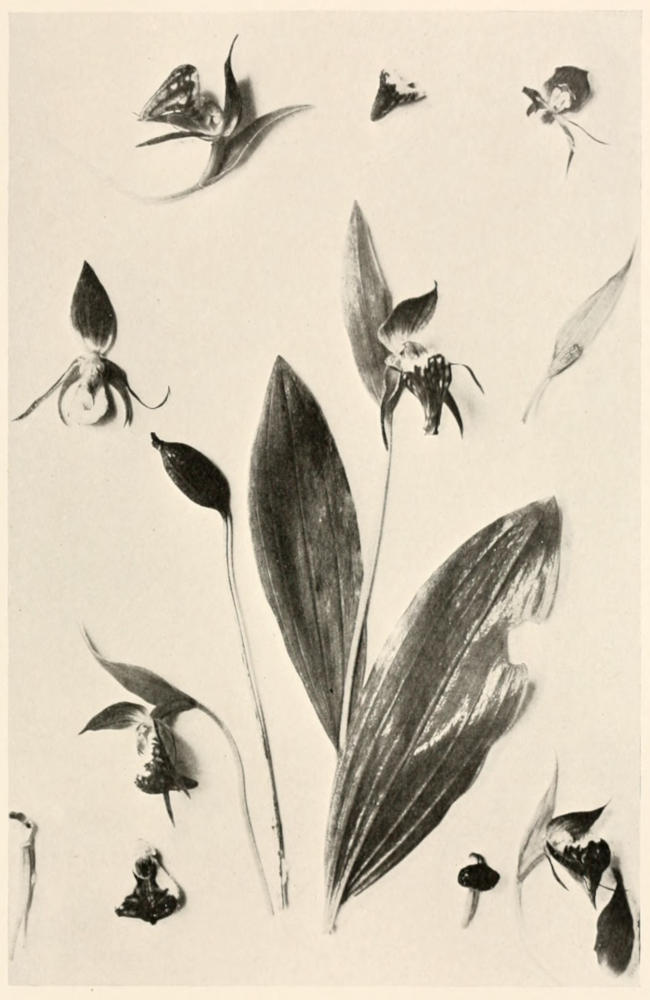
The Ram’s-Head Lady’s Slipper. (Cypripedium arietinum.)
In different positions this flower suggests a ram’s head.
This rare orchid is seldom, if ever, collected by botanists. It is one of the smallest Moccasin-Flowers found in the Northern Atlantic Region. The pigmy of the genus is Cypripedium fasciculatum, found under young Conifers in open woods in the swamp regions of northern California, along the Pacific slope, exclusively west of the Continental Divide. The Cypripedia found in the Pacific Region are very different from those of the Atlantic, Cypripedium Californicum, for instance, producing a simple raceme bearing from three to twelve flowers, all emerging from the axils of leafy bracts, the stem often growing four feet high. The shoe-shaped flowers resemble miniature blossoms of our eastern Cypripedium reginæ in color and structure of sepals and petals.
The Ram’s-Head Cypripedium is certainly one of the rarest species on the continent, and appears to be more plentiful, if this word can be used of so scarce a flower, in the State of Vermont than in any other region that has been reported in its continental range. It grows in low, damp marl and peat swamps.
IV The Stolen Moccasins
Woodlands, green and gay with dew, Here, to-day, I pledge anew All the love I gave to you. Alice Cary, A Lesson.
Whether the season is premature or backward, the Moccasin-Flowers always appear at the same date, along with the Painted and Crimson Trilliums, in the warm Glen of Comus. I am sure of finding these flowers unfolding, the week previous to Decoration Day, from the 20th to the 28th of May.
On the 30th of May, four days after I had discovered the famous two hundred Pink Moccasin buds on the hillside above the Glen of Comus, I imagined now that they must be in full array, wearing the rich hues of magenta and all the delicate tints of green, white, and pink. When once fully unfolded they change color very rapidly. Late in the afternoon I entered the edge of the Swamp of Oracles in District Fourteen, north of the schoolhouse. My hound was my sole companion, and I heard him in the distance making friends with children, whose voices came echoing from the direction of my fairy-land of Moccasins. A foreboding that all its beauty had been plundered took possession of me, for I knew that children are instinctively selfish about flowers, and pluck every blossom they see, even though they may throw them away afterward.
I picked my way carefully through the deeper swamp, around in the opposite direction, avoiding thus the children whom I heard approaching by way of the path, their arms laden, no doubt, with the blossoms I sought a sight of. Later my worst surmise was confirmed. Not one Moccasin hung on its stem to tell the tale of the invasion. Here and there were strewn bruised leaves and stemless blossoms, prostrate on the hillside. I was sorely disappointed, and I exclaimed aloud to the echoing wood that it was a sin,—this stealing all the flowers and leaving none to mature and develop their seed pods for the continuance of the species to be enjoyed by future generations. “And if I ever get hold of these youngsters,” I cried, “I’ll tell them why!”
The “youngsters” happened to be cousins of mine who had caught the orchid mania from me, and what to them had always appeared ordinary Indian Moccasins, or Lady’s Slippers, had now an added value and charm, since they were understood to belong to the Orchid Family. The very hint that I valued them caused strife among these children, eager to show me how many they also could gather in a day. As such treasures, they gathered them, hurrying homeward to tell me how many rare and beautiful orchids they had found. They wondered if I had been near the jungle, as they saw Major, my hound, during the afternoon. I admired their blossoms, now drooping and wilted and sadly bruised, but I never told them just where I had been, nor what I had missed. I had not the actual courage to scold them, since I had set the example for them, but although I find many flowers, I gather at random for mere pleasure very few. Indeed, there is no pleasure in making desolate these choice and hidden retreats of Nature.
There are laws protecting the deer in the Green Mountains and the brook trout in their spawning season, but as yet there is no legal or moral protection to shield the flowering and fruiting season of rare flowers, especially orchids, so scarce in northern New England. Some of our orchids are already so rare, that in localities where, only a few years ago, I found them abundant, to-day hardly a trace of them remains. They have suffered from school children and commerce alike. People seek them selfishly for pleasure and study, while the drug trade demands many roots, and places fair value upon them as an inducement to collectors. These roots are used for infusions, tinctures, and ointments,—a primitive Indian custom and one which, if continued on the present scale, must in time necessarily cease, through extinction of the rarer and most showy species of our native orchids.
The country folk know the Lady’s Slippers of genus Cypripedium as the Nervine Family, valuing them as a nerve tonic. I have met a man who makes a business of following trout streams, fishing and hunting through the swamps, searching for frogs, and rare roots and herbs in their season. He finds ready market for Ginseng, American Ipecacuanha, Hellebore, or Indian Poke, from which is obtained a powerful cardiac depressent,—Veratrum viride, and species of Cypripedium also produce our native drug American valerian, which takes the place of the European drug, procured from Valerian officinalis. Snakeroot, Dogwood, and various other plants afford excellent tonics. One can readily understand, as Thomas Wentworth Higginson remarks, “that many of our rarest flowers (in the vicinity of Boston) are being chased into the very recesses of the Green and White Mountains. The relics of the Indian tribes are supported by the Legislature at Martha’s Vineyard, while these precursors of the Indians are dying unfriended away.”[12]
Where years ago the swamps were fairly rose-purple with waving blossoms of the Grass Pink (Limodorum tuberosum) and Rose Pogonia or Snake-Mouth (Pogonia ophioglossoides), this year I found so few that I could readily count them. I discovered the possible secret of this extinction in the fact that a native of Etchowog was offered by some florist or gardener fifty cents a bulb or plant for all the specimens he could secure. This was an inducement for the vandal, but Nature cannot restore her species as fast as man can uproot them and devastate their haunts. Whether this is the true cause of extinction of these species in Pownal swamps I cannot ascertain beyond this inference; however, I am convinced that a small fortune has disappeared, estimated on the lost plants at fifty cents each.
Nearly all of the public schools are instructing the children in drawing,—teaching them to study the wild flowers as they find each in its season. Educators in all nature study urge the children to bring fresh specimens, and thus unconsciously encourage the extinction of the rare species of plant life in general. The children of each district school thus hunting over a limited area, soon, with childish strife, collect all the first and fairest flowers in their path. By the close study necessary, however, for the child to produce a drawing of the flower and its structural parts, a valuable lesson may in time be learned.
The story of fertilization, the necessity of the flower’s producing seeds in order to continue its successive generations, will not be forgotten by the true nature student. But if the teacher were able to designate the rarer plants of her district, and teach her children the fatal results of continually gathering their flowers, she might awaken in the minds of the young people a higher reverence for the blossoms themselves, and scruples against depriving generations of children to come of their beauty.
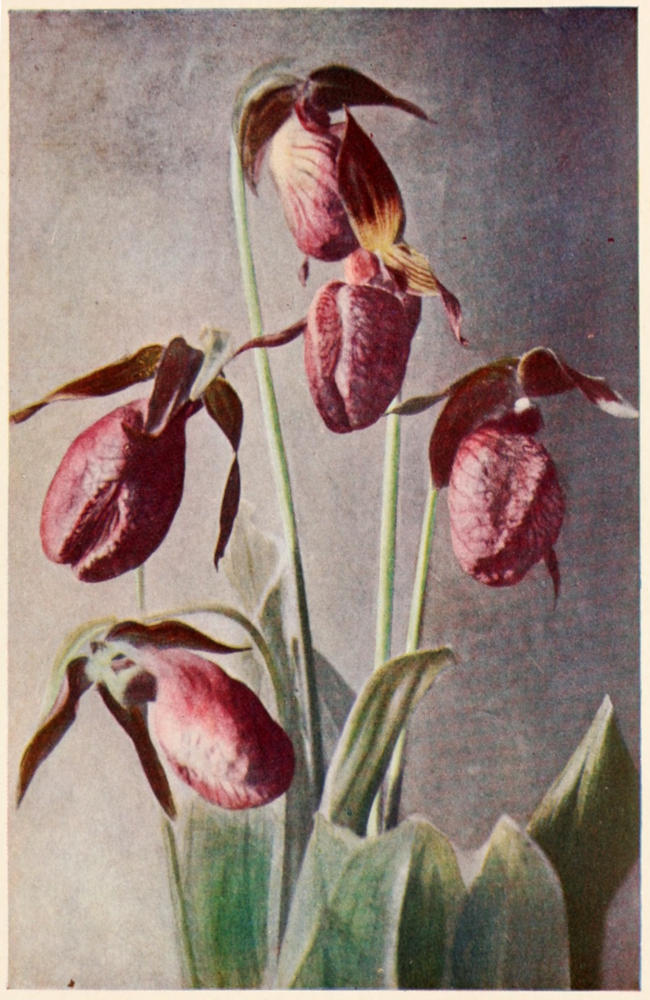
The Pink Moccasin-Flower. (Cypripedium acaule.)
This is the only two-leaved Cypripedium found in the Atlantic region. It is closely allied with Cypripedium guttatum of Alaska and with Cypripedium fasciculatum of the Pacific slope. It is the most common species of this genus.
There is hardly a child in the first grade in our schools who cannot tell the story of the bee and the Moccasin-Flower, and why the wonderful lines and dots of pink and gold are inside the downy shoe, instead of making the outside the more showy.
The first Moccasin-Flower which I found in Aurora’s Bog in North Adams I gave to Ray, a little lad of my acquaintance, and he happily and proudly carried it to his teacher. When he came home, he could tell me that all these inner decorations of pink and gold were dewy-tipped with sweets, and were called “Honey Guides,” just to invite bees within. And that although Master Bee goes through the front door of the Moccasin cottage, he somehow finds it locked when he wishes to escape, so in his excitement has to squeeze through the small back door next to the pollen-masses. He carries forth some of the pollen, and thus helps to fertilize the next blossom of this species, as he enters and rubs off the grains of pollen on the adhesive lobes of the viscid stigma. Insects thus are not permitted to rob the flowers of nectar and pollen without making a return for the food which the flower yields them.
Were it not for the bees and moths and various flies, the seeds of orchids would not mature, for it is a generally accepted fact that nearly all species of this family, wherever found growing, depend upon insect aid for fertilization and cross-fertilization. With the exception of one or two North American species of genus Habenaria, all other native species are aided by insects. These two species, Habenaria hyperborea and Habenaria clavellata, were, according to both Gray and Darwin, supposed regularly to fertilize themselves without aid of insects.
As the spikes of the Tall Green Orchis (Habenaria hyperborea) are frequent in the Pownal swamps, in company with the Showy Lady’s Slipper, I became interested in this plant, so independent of Master Bee or Moth.
Professor Asa Gray, in various papers on fertilization of our native orchids, has said that they were all arranged for fertilization by the aid of insects, and that very few were capable of unaided self-fertilization. He tested several species, and proved that it might occur by accident, but in general his two self-fertilized species of Habenaria were still an unsolved problem, as later developments have proven in the case of his supposed self-fertilized species, Habenaria hyperborea, which he asserted “habitually fertilized itself.” At least this species, although it may be fully equipped for self-fertilization, has been reported quite recently to be visited and fertilized by mosquitoes, proving that not in all instances is it found “habitually fertilizing” itself.[13]
In August, 1899, Professor C. A. Crandall, of the Agricultural College of Colorado, with a party of tourists camped on Medicine Bow Range, in that State, at an altitude of 10,200 feet, and observed abnormally developed mosquitoes bearing pollen-grains, which resembled those of Habenaria hyperborea; and so they proved to be, by subsequent experiments with specimens of this orchis gathered from a bog near by their camp.[14]
Another species of this genus, which is almost identical with the Tall Green Habenaria just mentioned, differs from it by bearing fragrant white flowers not adjusted for self-fertilization. This beautiful plant, Habenaria dilatata, grows sparingly in the choice haunts of the deeper Bogs of Etchowog, seeking frequently the pools near cold springs, and attracting numerous flies and moths by its rich perfumes, which one scents long before he discovers the flowers themselves.
Darwin mentions ten self-fertilized species of orchids for the whole world, and adds to that list ten more which were partially so, in case the proper insects failed to visit these plants in season.
He again asserts: “In my examination of orchids, hardly any fact has struck me so much as the endless diversities of the structure,—the prodigality of resources,—for gaining the very same end, namely, the fertilization of one flower by pollen from another plant. This fact is to a large extent intelligible on the principle of natural selection.”[15]
Of the self-fertile species, Darwin remarks: “It deserves especial attention that the flowers of all self-fertile species still retain various structures which, it is impossible to doubt, are not adapted for insuring cross-fertilization, though they are now rarely or never brought into play. We may therefore conclude that all these plants are descended from species or varieties which were formerly fertilized by insect aid.”[16]
Darwin believed that, “bearing also in mind the larger number of species in many parts of the world which from this same cause are seldom impregnated, we are led to believe that the self-fertilized plants formerly depended on the visits of insects for their fertilization, and that, from such visits failing, they did not yield a sufficiency of seed and were verging towards extinction. Under these circumstances, it is probable that they were gradually modified, so as to become more or less completely self-fertile; for it would manifestly be more advantageous to a plant to produce self-fertilized seeds rather than none at all or extremely few seeds.”[17]
Darwin questions: “Whether any species which is now never cross-fertilized will be able to resist the evil effects of long-continued self-fertilization, so as to survive for as long an average period as the other species of the same genera which are habitually cross-fertilized, cannot of course be told.... It is indeed possible that these self-fertile species may revert in the course of time to what was undoubtedly their pristine condition, and in this case their various adaptations for cross-fertilization would be again brought into action.”[18]
Indeed, the more this great scientist studied these strange flowers, the more he became impressed, and “with ever-increasing force, that the contrivances and beautiful adaptations slowly acquired through each part occasionally varying in a slight degree but in many ways, with the preservation of those variations which were beneficial to the organism under complex and ever-varying conditions of life, transcend in an incomparable manner the contrivances and adaptations which the most fertile imagination of man could invent.”[19]
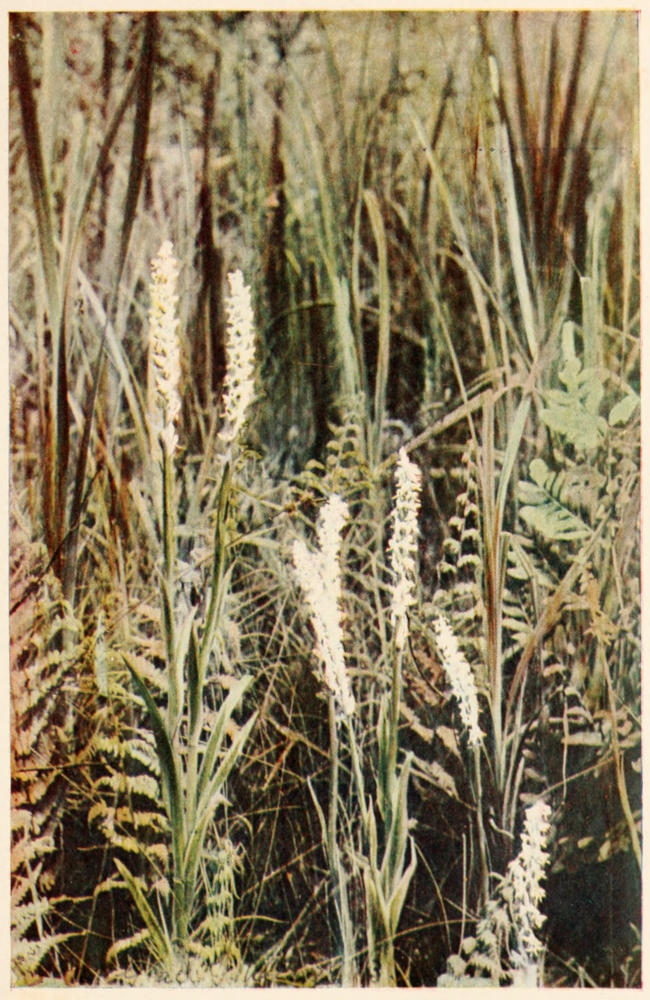
The Tall White Northern Orchis (Habenaria dilatata), Near Arethusa’s Spring, Bogs of Etchowog, Pownal, Vermont.
The extinction of species of orchids is due to causes inharmonious with Nature, therefore, more than to the failure of the insects in fertilization and cross-fertilization. Man and his bush-whack and bog-hoe are doing more toward the extinction of our rarer species of all plant-life in their continental range than any other natural element, in the swampy, mountainous districts of the East, as well as in the open swells on the prairies of the West.
The late Grant Allen expressed regret that the native Yellow Lady’s Slipper of England, Cypripedium calceolus, “lingers in but two places,” one of those stations being on “a single estate in Durham, where it is as carefully preserved by its owner as if it were pheasants or fallow-deer.”
The wind, rains, and flowing streams, the birds, as well as migration and immigration of the nations over the world, are ever unconscious bearers of the seeds of our rare flowers and common dooryard weeds; yet for the rarer species Nature is indebted to the insects for the important process of cross-fertilization.
In country towns of New England, where summer resorts for tourists are numerous, one finds youthful venders selling the roots of the Orchid Family to “lovers of flowers,” and thus even the lovers of Nature aid in the extinction of the treasures and wealth of her soil.
Species of Cypripedium are indeed the most gorgeous among our native orchids, and will be among the first of the family to become extinct, since they do not reproduce seedlings abundantly, even in their most choice haunts.
V The Queen of the Indian Moccasin-Flowers
The rounded world is fair to see, Nine times folded in mystery; Though baffled seers cannot impart The secret of its laboring heart, Throb thine with Nature’s throbbing breast, And all is clear from east to west. Emerson, Nature.
Between May 30th and June 8th, I made short excursions to the Bog of Oracles above the Glen of Comus. On the latter date I found my first blossoms of the season, of the Showy Queen of the Moccasin-Flowers (Cypripedium reginæ), the white sepals and petals standing fully unfurled, but still lacking the rich magenta-pink on the crest of the slippers which another week’s time would give them. One feature this season, among these plants, was the unusual number of two buds on a single scape. While a single blossom is generally found on a stalk, I discovered now that nearly every other stem bore two buds.
At the same time and in the same place, along the edges of decaying logs on the borders of Ball Brook, grew the spikes of the Tall Green Orchis (Habenaria hyperborea). Its greenish-yellow color is conspicuously different from the tones of its distant relative, the showy, white-petaled queen of this swamp. Another spike similar to that of the Tall Green Orchis, but short and smaller in every way, stood near. It was not so tall and coarse as its sister species, and may have been a stray specimen of the Tall White Habenaria (Habenaria dilatata). These two species are peculiar in appearance, and many inexperienced bog-hunters would pass them by as weeds, and homely weeds at that.
Upon closer scrutiny, the peculiar twisted seed-pods of these flowers suggest a rarity. The name Habenaria signifies “a rein or thong,” derived from the shape of the labellum in some species of this genus. They are often also called “Rein-Orchises.”
On June 10th I drove into the Chalk Pond region, on the “Witch Hollow,” or Gulf Road leading to the Centre-of-the-Town; and hitching old Bonny, took a circle around the peat and marl meadows, searching for signs of the Showy Orchis (Orchis spectabilis), a species of a sister genus of Habenaria. The Showy Orchis is due here about May 25th, the date on which the early Moccasin-Flowers awaken.
Four species of this genus unfold upon almost the same day. The Ram’s-Head Cypripedium should bloom first, according to general reports of botanists, the Pink Acaule immediately follows, and the Larger Yellow Moccasins, and, at the same time, the Small Yellow Fragrant Slippers unlace their beautiful twisting petals. The Showy Orchis is supposed to be the first orchid of the spring to blossom in New England.
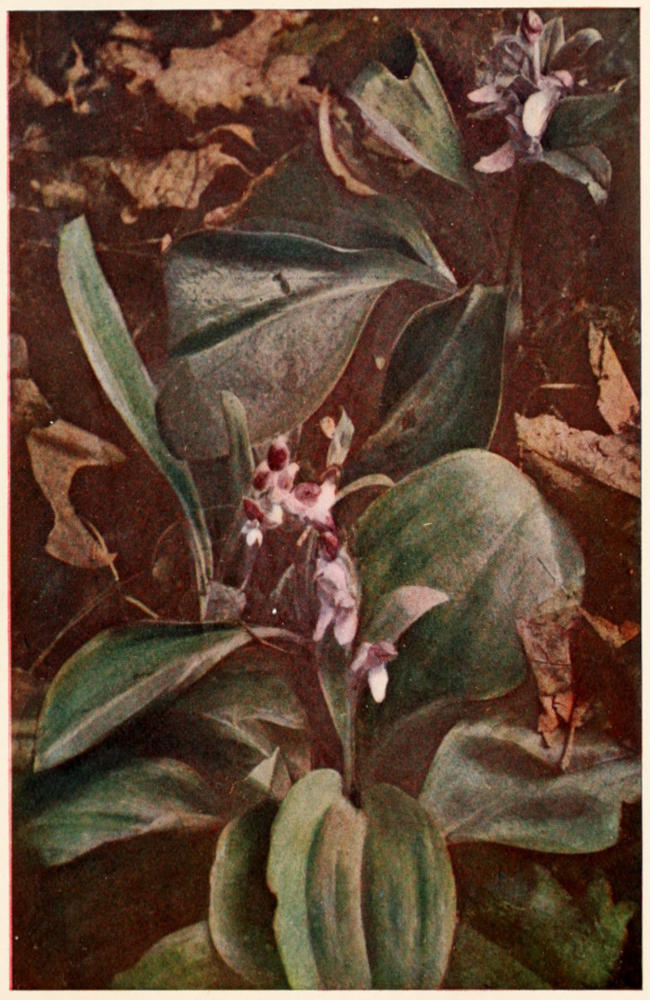
The Showy Orchis. (Orchis spectabilis.)
The first orchid of the spring, found near the rocky borders of Thompson’s Brook, East Pownal, Vermont.
I discovered nothing in the Chalk Pond meadows, however, save that it was one of the most charming little corners in the town, showing deep erosions about its terraced basin, proving that the ice-currents of the past flowed through these gulfs with terrible force.
I have found the Large Yellow Moccasin-Flower growing in close relationship with the dwarf fragrant species (Cypripedium parviflorum), in the Swamp of Oracles, in District Fourteen, about May 25th; while they appear later in the upland woods,—from June 6th until June 25th. They grow, as will be observed, along high, rocky hillsides as well as in damp, sphagnous marshes. The upland species are often found in open clearings on hillsides, among the dead brushwood heaps, where grow the Maiden-Hair and Christmas Ferns. Often they are in full sight, but sometimes they are hidden under small hazel-nut bushes, amid sapling white birches.
There seem to be three different forms of the Yellow Cypripediums, although there are but two accepted distinct North American species north of Mexico; these appear also to intergrade frequently. Close association of habitat has probably something to do with this cross-fertilization of the two species.
Finding the two marsh plants, Cypripedium hirsutum and Cypripedium parviflorum, growing side by side in the Swamp of Oracles, I observed a marked intergrading,—the larger species, Cypripedium hirsutum, producing variegated sepals and petals, or possibly now and then a brown-pink petal or sepal, imitating the type species of the smaller Moccasin-Flower. Both species were fragrant in a slight degree, Cypripedium parviflorum being, of course, the more fragrant of the two.
There is an European Yellow Cypripedium (Cypripedium calceolus) which is almost identical with the smaller species of North America, Cypripedium parviflorum. As early as 1760, Cypripedium calceolus was described and illustrated in color in Philip Miller’s Figures of Plants. Linnæus, 1740, gave the European yellow species the present generic and specific designation. Any history relating to that species of Lady’s Slipper, as it was first known in Europe by Dodoens as early as 1616 under the title of Calceolus Marianus, will also pertain to the history of the two closely allied Yellow Cypripediums found in North America.
The common English name “Lady’s Slipper” arose from the Latin Marianus, referring to “Our Lady,” the Virgin Mary, while Calceolus is the Latin for shoe or slipper. Linnæus, however, in 1740, being a devout Lutheran, objected to this species being dedicated to the Mother of Christ, and re-established the custom of dedicating the names of flowers to gods and goddesses of classical mythology known before Christ. The origin of the generic name Cypripedium is from the two Greek words Κύπρις, an ancient name for Venus, and πόδιον, a sock, buskin, or slipper.
Venus, in classical literature, was also known as “Our Lady,” the “Divine Mother” of the Romans, so that the common name has never in reality changed since 1616, when it was first applied to these shoe-shaped flowers of Europe, in honor of Mary, “Our Lady,” the “Divine Mother” of all nations.
The Algonquin Indians, in their forests of Northeastern North America, saw this same shoe-shape resemblance in these flowers, and called them Mawcahsun or Makkasin-Flowers, since they reminded them of little Indian Moccasins. Thus arose the common name Indian Moccasin-Flowers for all our native species of Cypripedium. Lady’s Slipper is distinctly of European origin, while Moccasin-Flower is most appropriately American, since this name was given by the first inhabitants of our shores, as it were, in mythological days. May the name of the Indian’s Moccasin-Flower pass down through the coming centuries in honor of a race that will disappear long before these flowers, which they christened so appropriately.
I have never thus far found the Dwarf Fragrant Moccasin-Flower, an upland flower, which Higginson describes as growing on the “Rattlesnake Ledge” on “Tatessit Hill,”[20] in the neighborhood of Boston. The larger yellow species, Cypripedium hirsutum, grows in the Hoosac Valley high on the steep sides of the Domelet, while the smaller species seeks the deepest parts of the Swamp of Oracles and Aurora’s Bog. I have collected it also in damp, marshy woods in Mosholu, near New York City.
The Large Yellow Moccasin-Flower seems, of the two yellow species, the more generally distributed over the continent, although most botanists state that the smaller species is the commoner. The dwarf yellow species is certainly the rarer plant in New England. In the Hoosac Valley, particularly in Pownal swamps, it is quite as rare as the Ram’s-Head Cypripedium. I have discovered only one swamp here where it grows.
It will be of interest to make note of two species of our Eastern Cypripediums, which extend nearly to the Arctic Circle northward, as well as adjusting themselves southward near the Tropic of Cancer. One of these species is the Large Yellow Moccasin-Flower, reported as found associated with the Pink Acaule, in latitude 54° to 60° North, by Dr. John Richardson on Captain Franklin’s journey to the Arctic lands in 1823.[21]
Dr. F. Kurtz, in an Arctic Expedition in 1882, collected the large yellow species, Cypripedium hirsutum[22] of the Atlantic Region, as well as Cypripedium passerinum, which is endemic only to the Northern Pacific Region. Cypripedium hirsutum also extends from New England westward much farther than the pink species, Cypripedium acaule. The dwarf yellow, Cypripedium parviflorum, closely follows the larger yellow species both southward and westward, but according to the stations reported to the author for the continent, it cannot be said to have the broader range of the two species.
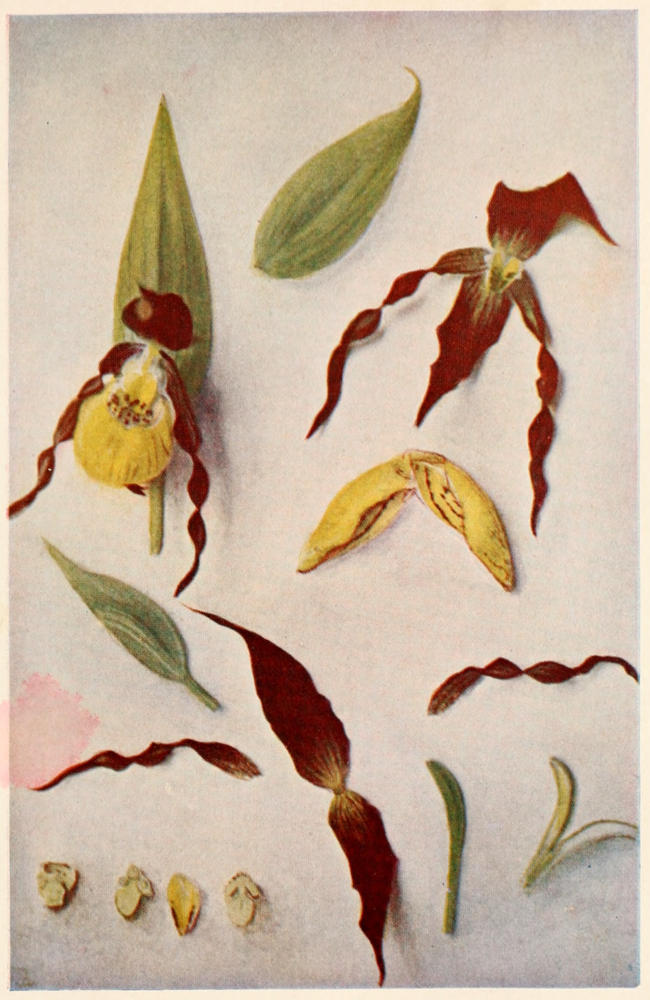
The Small Yellow Fragrant Moccasin-Flower. (Cypripedium parviflorum.)
The only really fragrant Cypripedium of the Atlantic region, closely allied with Cypripedium Montanum—the Fragrant White Lady’s Slipper of the Pacific slope. The plate shows the undulating sepals and petals as well as their rich brown-pink coloring. The two lower sepals are imperfectly united and are bifid at the apex. This species is almost identical with the European species Cypripedium calceolus,—the first Cypripedium described by Linnæus in 1740-1753.
The Dwarf White Moccasin-Flower (Cypripedium candidum) may also be counted with Ram’s-Head Cypripedium as one of the rare species of the Northern Atlantic Region. It is seldom found in the New England States. In the range reported to the author for this species, there is but one New England station. This has been given by A. W. Driggs of East Hartford, Connecticut.[23] This orchid belongs more especially to the damp swells of the prairie. It is very similar to the Dwarf Yellow Cypripedium, except in color, and like it produces a faint fragrance. This dainty white shoe is often no larger than the tiny Ram’s-Head flower, the plant being about six to ten inches high, bearing small waxen shoes, the shape of the blossoms of Cypripedium parviflorum. I have often received descriptions from country lads, supposedly of these White Moccasin-Flowers, only to find that they were either albinos, or bleached out and pale specimens of the gorgeous colored Cypripedium reginæ. Often the latter seem pure white to the hurried observer in the swamps, for the albino or white variety rarely occurs. I found one plant, however, this season bearing two blossoms, the first I ever saw, and I removed the plant to watch it in my garden.
After Decoration Day, I had all I could do to keep pace with the unfolding flowers in the woods on Mount Œta. In the Chestnut Woods and Rattlesnake Swamp region, near Lloyd Spring, and along the mountain sides of the Knubble and Domelet, I found beautiful azalea shrubs laden with luxuriant clusters of fragrant pink flowers. These open woodlands become brilliant with these rose-colored blossoms. The Large Yellow Moccasin-Flower was here too, with violets, Stars-of-Bethlehem, and innumerable pink blossoms of Cypripedium acaule growing along the side hill, shining out from every corner. All at once, these nearer woodlands had unfurled their banners of spring, and now, “With blossom, and birds, and wild bees’ hum,” they held me from the more distant Bogs of Etchowog. On the 14th of June, however, I decided to take old Bonny and the buggy, and drive to these bogs to see if any Pogonias and Limodorums were budded as yet amid the grasses of the open cranberry marsh.
Bonny hitched to the old buggy, my faithful old Major at my side, and I, with my vasculum for rare flowers, a basket containing drinking glass, carving knife, and bog-hoe for gathering special roots, started down the hill on an easy trot toward Pownal Pond. As I passed School Fourteen, I was cheered and hailed by the children, who shouted, “Going a-flowering?” I nodded “Yes,” with a “Get-ty up” to old Bonny, who had thought I wished to visit along the way.
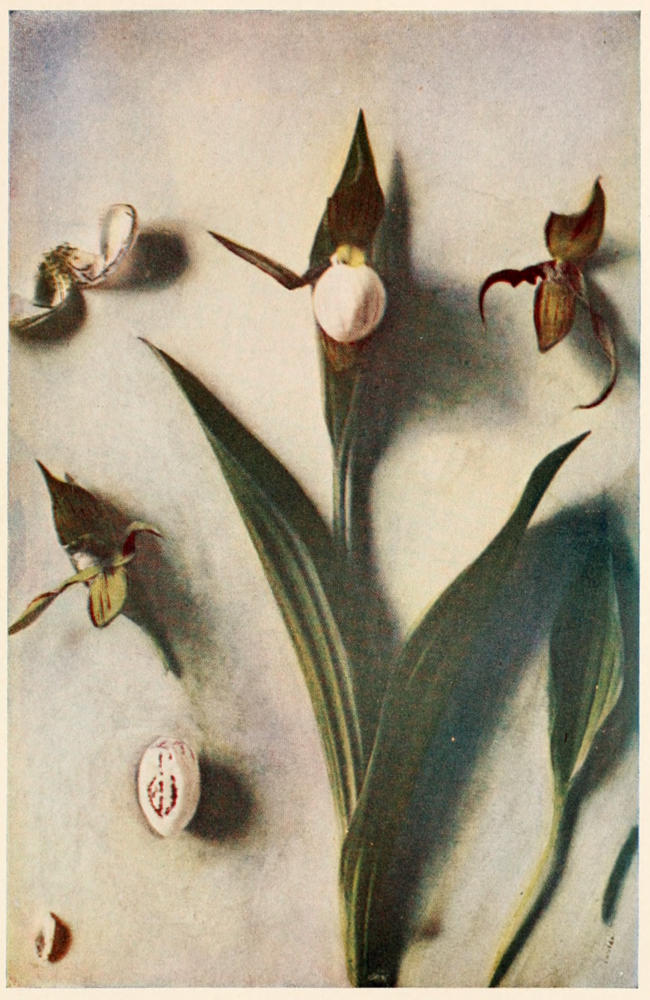
The Small White Moccasin-Flower. (Cypripedium candidum.)
This species is especially an orchid of the damp swells of the prairie, growing in company with the Painted Cup and Iris.
“There, I think, on that lonely grave, Violets spring in the soft May shower; There, in the summer breezes, wave Crimson phlox and moccasin flower.” Bryant.
It was warm and dusty, and whenever I could, I drove through the streams which crossed the road, in order to swell the felly, and thus tighten the tires to my rattling wheels. Although I felt that by driving along the highway I was losing much beauty that was unfolding in the fields and fence corners, I found this method of progress quite comfortable.
How these East Pownal bogs came by the musical name of Etchowog, I am not quite certain; nor do I know exactly what it means. It may have come from a primitive language of a mythological age for all I know, or it may have come from the Itch-Weed or Indian Poke and Poison Rhus, which cause much irritation of the skin. I am safe in saying that it is a corruption of the Indian’s Greek and Latin words for “itch” and “bog,”—at least this etymology quite suits the designation of these swamps. Ever since I can remember I have heard the older folk of the town call it Etchowog. I have associated the region with rare flowers, orchids, pollywogs, snapping-turtles and mud-holes, together with the schoolhouse in District Thirteen, where the good people hold Advent meetings, and set the dates for the world to come to an end. To me it seems one of the brightest, richest of swamps, full of “Bottomless Dead Holes,” where only bull-frogs peep and trill and croak the whole season through, till their notes blend with the chirp and whirr of the autumn crickets.
At the Barber Mill, I hitched Bonny to a fence-post and started on my excursions. I looked through the open meadow east of the mill to see if I could find any rose-colored Pogonias and Grass-Pinks. There was as yet no sign of them; so I came back to the mill and turned in through the bars, on the north side of the pond, where I followed a grassy path around the hill to the treacherous Cranberry Swamp farther northward, where I had been cautioned not to wander alone.
Sounding the margin of the marshy meadow, I found quaking and unstable ground. With a ten-foot pole I probed the depths of the mud, and found it unfathomable, and no signs of terra firma about it. Pickerel-weed, eel-grass, frog’s-bit, and the leaves of arrow-head grew about the pools. I could not very well find an entrance here, unless for a permanent residence. So going northward along the west shore of this mud-pond, I came to a place which promised fair and safe walking, with my waterproof boots for protection. At first I felt my way very cautiously, then grew bolder and forgot that I was in a dangerous place, for the farther I advanced, the firmer and drier and more enchanting became the field of my vision.
Before me opened a wide expanse of meadow-land, where even unruly cows dared not wander, and man seldom ventured to trespass. Nature’s remote solitude indeed was peacefully hidden here. No human voices nor sounds of hay-making ever echoed over these luxuriant fields, and the grasses grew sweetly, to fall untouched to earth again, mown as it were by the autumn winds, and stored beneath the drifts of November snow, to lay, in time, one more thin coat of soil upon the unplumbed depths of this ancient lake bed. During some long-ago winter, some one had ventured here while the earth was frozen and safe, and had built a homely hedge-fence through the meadow, probably to keep the cattle pasturing hereabout away from the dangerous bog. This fence was the only visible trace of man. In its tumbled-down and overgrown condition, it became a part of Nature’s self, and added to the picturesqueness of the field. Although Rafinesque says “that he hates the sight of fences like the Indians,” to me the hedge-fence is one of the wildest and most primitive of forest barriers. Indeed, it must have originated with the veritable wild man himself.
I was tempted on and still farther on through the meadow, by the brilliant crimson-purple blossoms of the Pitcher Plant, or Side-Saddle Flowers, so named on account of the hard shells of the stigma of these flowers resembling the padded cushions of a lady’s ancient side-saddle. This cushion was known as the “pillion.” The more common name in this locality for these flowers is St. Jacob’s-Dippers and Dumb-Watches, children playing with the hard shells of the stigmas left after the purple petals have fallen, calling them watches. The convex surface of the stigma does indeed resemble the face of a watch, although there are no hands to point the hour. Gay blossoms of Fleur-de-lis flaunted their gaudy petals, and many times deceived me by making me imagine that I spied the Purple-Fringed Orchises in the distance, waving amid the tall grasses.
Here I dreamed away an hour or more, following out some little paths, worn perhaps by the muskrats or swamp minks or wicked weasels, or perchance by the tiny feet of the meadow-moles, who apparently had blindly rooted various underground tunnels in every direction. I can fancy them all trotting swiftly along, playful at times, yet with an eye to their affairs,—quite as important in the scheme of Nature and Science as are the brokers’ studied operations in Wall Street. The weasels and minks are the terrors of the other path-holders in this natural syndicate. They are indeed the high and dreaded trust officials of the lesser and blind rooters of the earth.
Tangled vines of the marsh cranberry were now in full bloom, and at the same time the soft fruit of last autumn’s crop was present on the vines, still bright crimson, even after enduring the winter’s frosts and stubborn snows.
Looking northward to see what fields lay unexplored beyond me, I realized the remoteness of this region slumbering amid these glacial hills. To my right towered the Dome, the highest mountain of Pownal, of a bluish-green tone, against the sky. Nearer, graceful elms, tall pines, and numerous low pointed, lighter green tamarack trees lifted their spires, and adorned the distant meadow; while in the wide expanse on the west side, along the edges of the swamp, rose the giant forms of elm and pine, and tall, lithe trees of the swamp maple, flashing forth their crimson and gold blossoms, reminding me of the coloring of autumn leaves. The nearer marsh was rich with tasselled grasses and blossoming vines, dotted here and there with the cardinal buds of the Pitcher Plant and the purple Fleur-de-lis. It seemed a land of dreams.