FIRST SEASON (continued 2)
Reading edition
The air vibrated with the happy, mellow song of birds, interspersed with the ever-present lesser sounds of deep solitudes. Major, like me, at first, was cautious where he wandered, but once amid the various haunts of wild creatures of the wood, he caught the happy spirit of the hound, frisking and studiously following the paths of the wild little animals to the very doors of their homes.
To test the land, I stood and deliberately shook the foundation of the earth. All the blossoming ground about me, for at least fifteen feet distant, trembled as if it were so much jelly. Yet the spot was honeycombed and dry on the surface, there having been little rain in this region during the month.
I now sought the western hillside path, and bearing northwestward around the border of the swamp, I occasionally ventured in and out along the edges of the meadow bushes. Finally I reached the swamp maples, which I had observed from the interior, and I secured a good-sized branch of the gold and crimson clusters to carry off with my load of treasures. On every hand, out of the small, muddy pools of water, rose the leaves of the Buckbean (Menyanthes trifoliata). The beautiful spikes of white-bearded flowers were turning brown with age, and the plants were setting their bullet-like seed-pods. Now and then, beneath the low, shaggy pines, I found the humble Pink Moccasin-Flower (Cypripedium acaule), which I hailed as a sign that the Showy Queen of the genus might dwell not far distant.
Knowing the favorite haunts which this orchid seeks, I searched through all the dark corners of the swamp. At the extreme northwestern portion of the region, I entered a dense shaded corner about fifty feet square, where were many springs soaking through the sphagnum to the deeper fields of the interior which I had so lately left. Here were numerous decaying pine and tamarack logs, low sapling willows tangled amid the small scrubby spruces and tender pines, which were striving against the greater natives of the forest to lift their spires as high as possible; but however eager they were, they had not attained a height above ten or fifteen feet at most. Many were already discouraged or had died in the competition, and their wasting forms were still standing with broken and weather-worn trunks and limbs.
Tall brakes and Indian Poke ran riot among the deeper mounds of moss, which covered the decaying roots of the long wasted primeval pitch pines. The dark, sluggish pools reflected weirdly the ferns and trees above them.
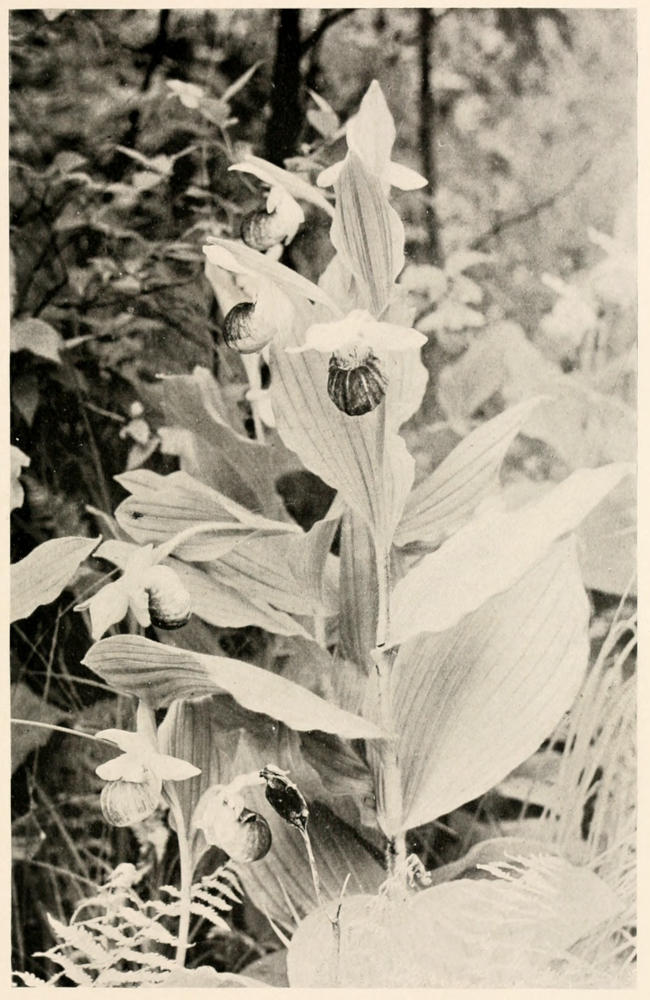
The Queen of the Indian Moccasin-Flowers. (Cypripedium reginæ.) From the Bogs of Etchowog, Pownal, Vermont.
Shooting up from these piles of sphagnum, I found at least fifty plants of the Showy Moccasin-Flower (Cypripedium reginæ). They were pregnant with slumbering buds, and would surely be in full blossom by June 20th. Happy over my good fortune at locating another station for this species, I prepared to bend my footsteps toward my horse and buggy,—glad indeed to know that I would not be obliged to walk home, laden as I was with Pitcher Plant roots and various other shrubs and vines.
Near the mill, just north of the little bay in the pond, I found quantities of the Yellow Pond Lily or Spatter-Dock (Nymphæa advena) just beyond my reach. Securing a long willow sapling with a tender end, I tied it into a loop, and stepping out into the shallow edges of the pond to an old pine log, I snared off several of these golden cups, which the children call Cow-Lilies. I floated them in to the shore, where I soon gathered them up and packed them in my vasculum.
A glance into the water along the edges of the old log revealed thousands of tiny pollywogs or tadpoles, as well as half-formed frogs, the hind legs beginning to put forth on the large tadpoles. Here, basking in the sunshine, were lizards, snails, leeches; and various species of small fish were sporting in the shallow waters. Perch, suckers, and eels are plentiful in Pownal Pond, which is locally called Perch Pond, from the abundance of perch found in its waters. These fish seemed to seek this sheltered arm of the pond to leave their young fry under the sheltering lily-pads.
Near the projecting stumps, amid floating logs were snails’ eggs, and I noticed several baby turtles, recently hatched from eggs in the sand, varying from the size of nickels to that of a silver dollar. Eel-grass and many marsh grasses and sedges grew or floated on the water, among which the small fish could hide.
On the edge of the water among the ferns and brakes I found the leaves of the Purple-Fringed Orchis (Habenaria psycodes), but no plants likely to bloom this season.
When I reached the mill, I placed my treasures in the buggy, and started after that part of my load which I had left around the hill. On my return, I gathered some waxen, crimson cones of the beautiful tamarack tree by the path. When I bade farewell to little Merwin and his mother, who lived in the mill-house, I asked them to watch for the rose-purple orchids,—Pogonias and Limodorums,—which were now due any day, east of the mill. The boy was very earnest and observing, and I knew that I now had a comrade to guard over the Bogs of Etchowog.
Students from Williams College, and tourists from near and afar seek these swamps of Pownal for botanical specimens, and Merwin had often been their guide to the haunts of these rare treasures. He told me that students from Williams had, the year before, gathered innumerable pink and purple flowers in these marshes, as well as the beautiful bearded spikes of the Buckbean.
For a succession of years—during all of President Carter’s term at Williams College at least—it has been the unique custom to bank the chancel of the Congregational Church with the Showy Moccasin-Flowers and Maiden-Hair Ferns, on Baccalaureate Sunday,—which occurs usually about June twentieth. These gorgeously colored orchids reach the height of their perfection about this date. They seem a fitting decoration for the church during the Commencement services of this college, situated in the heart of these Hoosac Highlands.
Plentiful as are the colonies of this Showy Moccasin-Flower in its pet localities, it has always been an interesting question to me where the great numbers of perfect blossoms grouped about the chancel are secured. They are known to the children in each school district, and usually they are collected as soon as discovered.
It is surprising to me that extinction of this rare plant is not taking place more rapidly hereabout. This orchid produces very few seedlings in its native haunts, and at the rate of collecting both its blossoms and roots in this valley, we must surely look for total extinction in less than half a century more, unless this ruthless plucking is modified.
VI Hail Storms at Etchowog
... Suddenly, a flaw Of chill wind menaced; then a strong blast beat Down the long valley’s murmuring pines and awoke The noon-dreams of the sleeping lake, and broke Its smooth steel mirror at the mountain’s feet. Whittier, Storm on Lake Asquam.
On June 21st, with Major I walked down through the Swamp of Oracles in District Fourteen, along Ball Brook to the Kimball Farm bogs, and so on once more to the Bogs of Etchowog and the new colony of Reginæ—the queen of the Indian Moccasin-Flowers—which I had so recently discovered in Cranberry Bog north of the pond. I found prime blossoms all along the tiny path, in the course of the stream through the deeper parts of Glen of Comus, and in the Kimball Bogs, and I was in hopes of finding them in the swamps of Etchowog.
As I passed through the sphagnous meadows east of Kimball’s barns, around the hillside path to Arethusa’s Fountain, I noticed several flowers of the Cypripedium I was seeking, and recognized the leaves and green-budded spikes of Habenaria psycodes, which would later, when fully in bloom, change to a delicate purple.
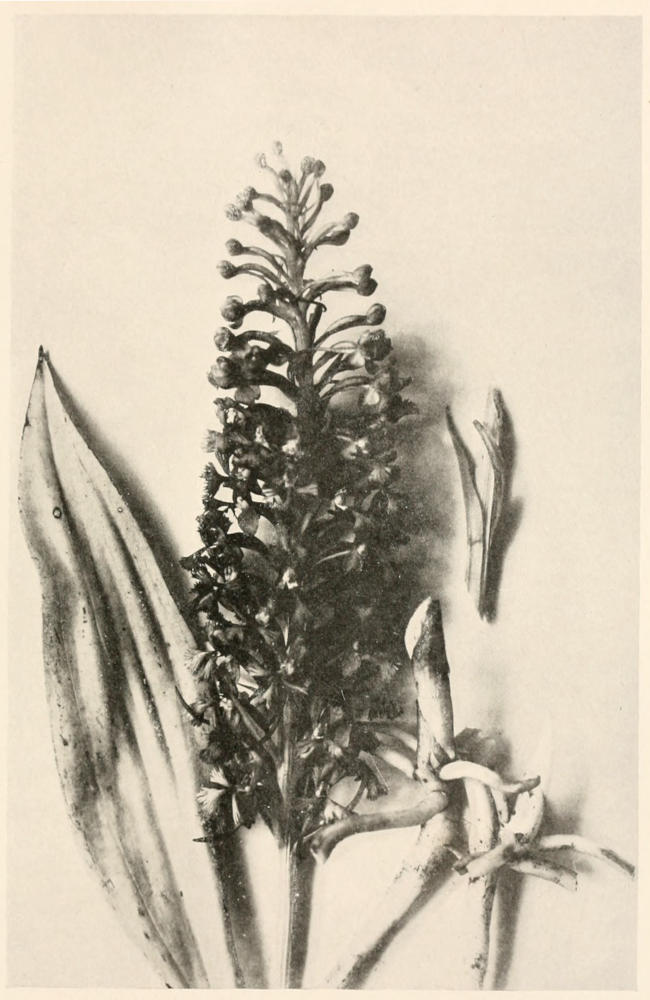
The Small Purple-Fringed Orchis. (Habenaria psycodes.)
I made use of the fence boards to walk through the muddy portions of my path. I had learned by former experiences here to avoid the “dead holes.” Stepping on some boards just above a muddy pool, and suddenly turning, I was happily surprised to see many spikes of the Tall White Northern-Orchis (Habenaria dilatata) standing near. The air was full of their rich perfume, and many small flies and moths hovered around them, sipping the nectar. I gathered a few spikes, and went on to the cool spring beyond, finding meanwhile an abundance of wild strawberries along the borders of my path. These were very large from growing in the moist shade.
On the hillside, up which I climbed to the west for a short distance, I found pretty leaves of grasses, delicate emerald in color, growing in a triangular form, and resembling lily leaves.
I had heard distant thunder rolling off to the northwest, and it caused me to hasten onward. My rest, therefore, at the spring was brief to-day; although so far away from home, I was not so far from shelter, and the thought of a shower was welcome, for the air was sultry. As I neared the open swamp, beyond the mill, the storm made rapid strides, but I wandered up and down the meadow long enough to assure myself that this season the Pogonias and Limodorums were not in bloom on time.
Large drops of rain began to fall from the black clouds, and as I hurried toward the shelter of the mill, I met Merwin and his mother returning to their home. They motioned me to join them. As I did so, great gusts of wind dashed over us, and suddenly huge hailstones pelted the earth. Leaves and small twigs and young apples fell on every side, while the half-grown nuts from the Butternut-tree (Juglans cinerea), in the dooryard, were soon stripped away, with the leaves and broken limbs of the tree. Some of the hailstones were the size of small hen’s-eggs, perfect, oval ices which might have been turned out of glass moulds.
Soon the air became very chilly, as during the first snow on a damp November day, while the ground was white with hailstones. This abrupt change in the atmosphere from heat to extreme cold caused untimely deaths in the chicken yard. The old mother hen lost her head completely, and unable to find shelter in the barn because of the banging doors, she put her head in a crevice while her brood ran about and perished with cold or were killed by the stones.
Merwin’s mother sadly watched the devastation of her little garden, and the death of her chickens. It was impossible to go to their rescue without danger to our own heads. This storm continued about two hours, alternating now and then with a calm, to return again and again with sudden fury. At the end of that time, although it still rained sadly, I started for home, knowing that with rubber boots I could wade, if necessary, through any ordinary streams.
The weather had turned so cold that an icy coating covered the meadow grass and the borders of the road, and promised not to melt away in haste.
As I neared Kimball Farm, where Ball Brook meets Thompson’s stream, I found the road opposite the barns flooded,—like a river flowing across the road. It was far too deep for me to wade through, besides, the current was so strong that I should have been tripped had I ventured it. I had to walk some distance on the stone wall and over a heavy plank, which some one during a previous deluge had placed here for a high-water foot-bridge in an emergency.
A walk up the hill, and I turned off the road, entering a path through the cow-pastures, to see the heaps of hail under the pines along Thompson’s Brook, which was a beautiful, roaring and seething torrent now, as it plunged and leaped down through its rocky flume to the valley below.
As I came out on the highway again, at the bend in the road near Ball Farm, I heard the familiar voice of some one who had been sent in search of me. I was warmed with enthusiasm and interest in the storm’s ravages, and thoroughly enjoying my walk. However, I was grateful for a ride home. Passing by School Fourteen, we saw the prudent teacher scanning the sky before she ventured forth. We noticed many broken panes of glass in the schoolhouse windows, while dozens were shattered in the houses along the way.
I had hoped to revisit the colony of the Showy Moccasin-Flowers which I had found in Cranberry Swamp, north of the pond on June 14th. But Merwin’s mother told me that without doubt they had been gathered on Saturday afternoon, June 19th, by three students from Williams College; she had seen two of them come around the hill by the pond about five o’clock on that day, bearing a new bushel-basket filled with these gorgeous orchids, while the third soon followed laden with more than he could easily carry far in his arms. They followed the cool mountain road over the Domelet to Williamstown, a road over which the yeomen from northern Berkshire were led to battle at Bennington, on the 16th of August, 1777. The road is seldom traversed now, and at best is rough and rocky. It leads directly from Bennington southward to North Adams, under the mountains, and indirectly to Boston.
Had the storm come on Saturday, instead of Monday, very few blossoms of these orchids would have decorated the church chancel on Baccalaureate Sunday for Williams’ Commencement exercises.
The fact that these students come to the Pownal bogs for these orchids assured me of the scarcity and rarity of the species in Williamstown, although they may be found sparingly in the swamps of The Forks along Broad Brook, just over the Vermont State Line in Pownal. This stream rises on the east side of the Majestic Dome, and flows down to the Hoosac by way of White Oaks, and thus enters Williamstown, where it soon joins the river. The orchids in The Forks are quickly plundered, long before June 20th, by ignorant tourists or students afield botanizing, who either do not realize or do not care that plucking all these rare blossoms will in time bring about their total extinction.
Orchids may in many instances produce seeds in abundance, but why they do not reproduce more seedlings is a problem not easily solved nor remedied.
Darwin once estimated that a single spike of the English Orchis (Orchis masculata) produced over 186,000 seeds, and that at this rate its grandchildren would soon carpet the earth; while Müller says also that his brother estimated 1,750,000 seeds in a single capsule of another species of the family (Maxillaria). We must remember that the species of Orchidacea are not as a rule self-fertilized, as are the more abundant and common flowers and weeds, which often cover acres of swampy land and fields of waste land. Our native orchids are wholly dependent upon insects for fertilization and cross-fertilization; yet, for some cause or other, comparatively few of the ripened and fertile seeds germinate and reproduce new seedlings. Our Moccasin-Flowers do not appear to multiply in many swamps, while species of Orchis and Habenaria are never abundant in this region.
For years now, I have noticed large groups of the Showy Lady’s Slippers growing in Rattlesnake Swamp near Lloyd Spring, and I can find little increase in the number of plants, or the size of the old snarl of roots. In fact, they seem to be diminishing in numbers.
There is an old colony in this region that has stood for about seventy-five years, much the same in size, on the authority of the old inhabitants of this neighborhood. It stands to-day among the shrub-like willows and swamp maples, at the feet of little scrub pines and dwarf double spruces, hidden from the sight of travellers in the path by a prostrate tree trunk and decaying primeval pine stump. I observed this colony years ago, and this season it appeared the same to me, occupying a space about two feet square. I counted forty-two full-grown flowers, many stems bearing two blossoms. This indeed was one of the most charming sights, suggesting the luxuriance of the humid climate of the tropics. It was even more enchanting than the colony of Pink Moccasin-Flowers,—that famous group of two hundred buds which the children in District Fourteen secured ahead of me, since this group of flowers were massed more closely together. I wished a sight of the Pink Moccasin-Flowers at their best. I left these, too, undisturbed save by the little moths and mosquitoes and honeybees, which came to drink the nectar within the pearly pink and white cups.
Notwithstanding the recent hailstorms, which had split many cups and spilt the dew, the flowers were developing plump, hard seed-capsules. Thousands of fertile seeds must fall and fly about from this colony; and yet the aged snarl of roots remains the same.
A unique row of seedlings of this species (Cypripedium reginæ) too young to blossom, and reminding one of a row of barn-swallows, not yet sufficiently matured to fly, grew along a moss-covered pine log, near the parent colony of plants. Digging down, I found the old log about twelve inches below the surface. It was sound at the heart, bare of its outer bark, and had become so imbedded in the water-soaked peat as to be absolutely preserved. The stump from which this tree had fallen was worn and crumbled away to the very earth, and capped with moss. It will require years for this log to settle into the peat deeply enough to allow these seedling orchids to ply and mass their roots in generous soft soil. Unless their roots deeply penetrate rich soil, the plants become pale in color and dwarfed, like the plants growing in loose sphagnum.
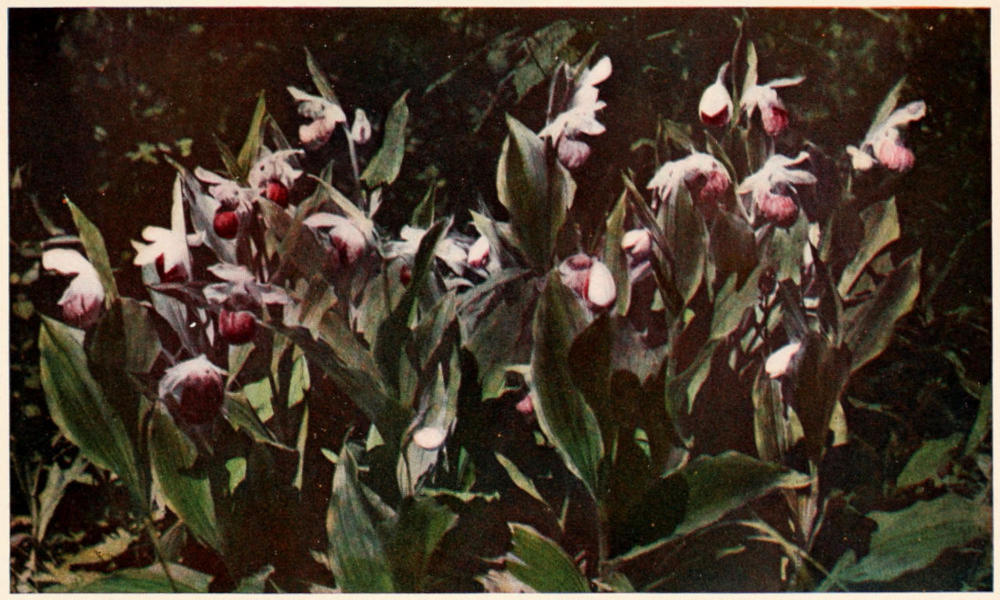
The Showy Moccasin-Flower—The White-Petaled Lady’s-Slipper—The Queen of the Indian’s Moccasin-Flowers. (Cypripedium reginæ.)
“Rushes tilting their burnished spears, These are her courtly cavaliers. Heart of my heart, we forswear the rose, We have been where the lady slipper grows.” Clinton Scollard, In the Heart of June.
I missed some old colonies; these were of a new generation, and if they are not starved out, will blossom here in a row another year.
Another cluster of plants growing near by produces the deepest magenta blossoms that I ever beheld, and only in this one group have I seen this particular hue. A deep rose-purple extends over almost the whole labellum, and from a distance I thought I had discovered the long-sought Purple-Fringed Orchis,—such a flame of color rose before me. It almost seemed a variety of the true Cypripedium reginæ.
This swamp produced just one hundred blossoms this season. Of this number I gathered about twenty-five among the scattered plants, leaving the older groups to ripen their seeds, if possible.
I found the first fully unfolded Showy Lady’s Slippers of the season, on June 8th, in the Swamp of Oracles in District Fourteen; while those of Rattlesnake Swamp unfolded fully this season on June 20th, and faded about July 1st, the season being shortened by the heavy hailstorms.
I have noticed that orchids growing in open, sunny swamps are stocky and short-scaped, bearing highly colored blossoms; while in shaded, muddy glooms the plants are rank and tender, with pale flowers, which do not last nearly so long as those which grow in the sunlight. The deeply colored specimens mentioned above grew wholly in the sunshine, and beside a fresh flowing stream.
I have transplanted all the New England species of Cypripedium, but only two of them took kindly to the garden for a succession of seasons. The small yellow species, Cypripedium parviflorum, seems easily naturalized in our damp woodland corners of the garden. The large yellow species, Cypripedium hirsutum, closely allied with the small yellow species, is easily managed in the same colony. The Ram’s-Head (Cypripedium arietinum) is more choice in its home, being rarely seen in cultivation. It is not very plentiful even in its native haunts.
I have sent plants of the Showy Lady’s Slipper and the Large Yellow Lady’s Slipper found on Mount Œta, to New Bedford, Massachusetts, to Herkimer, New York, and to New Haven, Connecticut. In every instance they have become happy in their new surroundings, thriving and blooming through several seasons. The Small Yellow Cypripedium in New Haven has flourished and bloomed for ten seasons. The seed-capsules of these orchids, however, have never matured fertile seeds in this garden; and the pods wither up and do not develop as in the forest bogs, for want of the proper insects to fertilize them. It would be well to secure pollen from sister species of this plant in the Swamp of Oracles, and insure fertilization and cross-fertilization of this tame garden plant. We might look for possible hybrids, since this species is well broken away, by ten years of cultivation, from its primeval condition.
The Showy Lady’s Slipper does not take so naturally to the garden, and in many instances does not live so long in captivity as would be expected. It will, however, produce seedlings readily, if care is taken to protect the surrounding soil in winter, where the seed is sown.
An interesting experiment, with artificial agencies producing fertile seed of this species, is related by F. F. Le Moyne of Chicago. He sowed the seed thus obtained artificially for two successive seasons, and secured seedlings from each sowing. He also believes that “this plant could be multiplied very rapidly from seed thus fertilized,” in garden culture.[24]
This year, I sent the rare Ram’s-Head to the New Haven Garden, with hopes of its blossoming next May. This Cypripedium is the rarest orchid in North America.
The Pink Moccasin-Flower (Cypripedium acaule) is the most common species of the genus in New England, and on the continent of North America, north of Mexico, with the exception of the two Yellow Cypripediums, which claim a broader range from east to west. The Pink Cypripedium proves the most stubborn and difficult in cultivation. It may be potted during the winter, but seldom, if ever, blooms more than a single season.
While many of our native orchids have a certain amount of adaptiveness to environment, they never will be found to choose absolutely dry soil, such as the rocky sheep pastures in which the common pennyroyal thrives. A sheltered, damp corner is safest for the exiled plant, where the sunshine searches long to brighten its petals.
One cold day in early March, I secured a frozen sod containing the roots of the Showy Lady’s Slipper, and made an artificial bog in the bay-window, where I watched it thaw out. The flowers burst forth about a month earlier than when in the swamps. But although they were fully in the warm rays of the May sun, the blossoms were pale and delicate. The same cluster of plants sent forth deep rose-tinged blossoms the next season, in the damp corner of my garden, where I planted them. They became strong, healthy plants, flowering several seasons on the regular date for Pownal, June 20th. It is therefore evident that dates for blossoming differ more according to the exposure of the haunt than to the variations of seasons. But in the Swamp of Oracles I know where I can find this Showy Queen of the Indian Moccasins as early as June 8th, and I know of other haunts where it is not unfurled until the 15th and 20th of the month.
VII Sweet Pogonias and Limodorums
Come bring me wild pinks from the valleys, Ablaze with the fire o’ the sun— No poor little pitiful lilies That speak of a life that is done! Alice Cary, Be Still.
On June 26th we drove over to Thompson’s Trout Pond. We took the old flat-bottomed boat, and with one slab board for a paddle, steered slowly over the whole surface of the lake,—a beautiful, clear little mountain mirror, with good-sized fish swimming about. I searched along the shores for the long-desired Purple-Fringed Orchises, but still without success. Fleur-de-lis grew abundantly about the lake; and in the little dents and bays among the sedges and cat-tails, I found the Yellow Spatter-Dock or Cow-Lily (Nymphæa), so named in the time of Christ by the ancient herbalist, Dioscorides, who first gave it the Greek name Blephara, and later, in Latin, Nymphæa lutea and Nenuphar citrinum. It was known in England in 1500 as Yellow Nenuphar or, Water Lily.
The swamp birds are tame and saucy here. Paddling our boat into the reedy shores among the alder bushes, where they were nesting, they seemed to take no alarm at our approach, but stood their ground pouring forth beautiful liquid notes. In one place near the centre of the lake, we crossed an expanse of deep water where long rootlets of the Water Persicaria (Polygonum amphibium) supported glossy carmine, lance-like leaves, which swayed gracefully on the surface of the swelling waves as we approached. These strange deep-water weeds send forth rich crimson or pinkish flowers a little later, seeming fairly to stain the lake. I had never seen this species before growing in such depths of water. It is a species of the Buckwheat Family, and a near cousin of the barnyard smart-weed and the knot-grass or door-weed. The generic name, Polygonum, comes from the Greek, meaning “many knees.” It is so called on account of the swollen joints of some of the species of this family. The leaves of the Water Persicaria are brilliant crimson on the lower surface, and with age and exposure the upper surface turns deep Indian-red.
These plants were rooted at least fifteen feet below the water’s surface in the mud. They may be found, too, along the shallow shores of Pownal Pond. They also grow in ponds and lakes far northward to Quebec and Alaska, and as far south as New Jersey and Kentucky, and westward to California. They thrive at an altitude of two thousand feet, in the lakes of the Adirondacks, blooming there, as a rule, in July and August. Thoreau observed this species in the lakes of the Maine woods, during his journey in 1853.
On the 30th of June I ventured forth to Etchowog, in search of Pogonias and Limodorums, although the season was almost too far advanced for prime specimens. I had heard the day before that some blossoms of these plants had been gathered in the Westville Swamps, near New Haven, Connecticut. I thus felt encouraged to search once more for these beautiful orchids. With luncheon and vasculum, and Major following me, I journeyed over the meadows and hills of Mount Œta to the north slope of the Domelet, where I crossed the country road. Finally I descended into a deep basin under the Dome, which rises east of the Domelet. Northward nestled the neat white and red farm buildings near Thompson’s Pond, and far beyond them all I saw the blue, blue hills of Bennington County.
Everywhere I searched for the Fringed Orchis, which had so far eluded me in these swamps. The meadow seemed interminable as I circled around to the east of the pond. Bearing to the northward, I noticed nothing new except the ravages of the recent hailstorm. It had cut down flowers and corn-fields alike. The very hills were washed down from the mountain sides; great gutters and still flowing streams were eroding the corn-fields, scattering the sandy soil broadcast over the once green meadows. Even the edges of the grasses were brown and sear, and the Timothy-heads of the Cat’s-tail Grass were stripped prematurely of their seed.
I followed Thompson’s Brook, leading northerly from the pond, in through several willow and alder swamps. Then, instead of following down the rocky channel to Ball Brook Forks, I struck out directly at the head of the Meyers Road, over the fields, north from the maple-sugar house, and landed on the high hills south of the great meadows of Etchowog. Sleeping at my feet lay those sphagnous bogs which had already yielded me so many rare flowers, and so much pleasure. Northward stretched out a vast sweep of hills and valleys, reaching nearly the whole length of Bennington County. To the right towered the massive abutments of the Dome, and to the left rose the isolated form of Mount Anthony,—these two mountains framing, as it were, the gap northward, through whose wide vista I could define the dim blue heights of Mount Equinox, at Manchester. Nearer, I could trace fertile vales and sloping hillsides, dotted here and there with woodlands, scattered trees and farm buildings.
Standing still nearer in the shadow of Mount Anthony was Bennington Hill, with the Battle Monument clearly outlined even at this distance, some ten miles away. In the nearer landscape were discernible the serpentine windings of Ball Brook, with its long chain of tamarack and balsam-fir swamps, spreading out here and there toward Bennington,—where, I dare say, are many rich and undiscovered colonies of Lady’s Slippers.
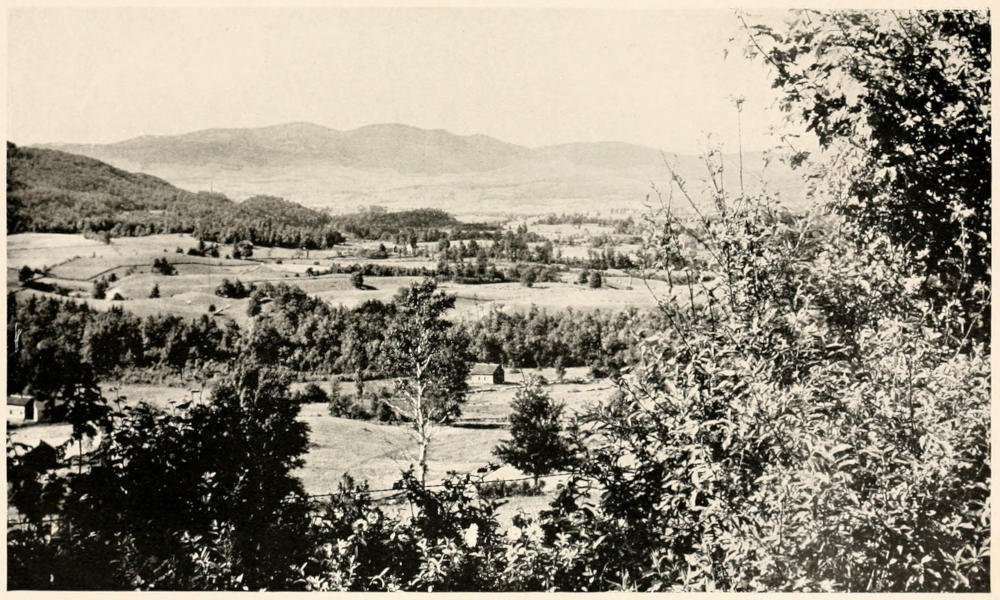
The Northern Gap. Showing the Taconic Mountains of Bennington County, from Mount Œta, Vermont. The Bennington Battle Monument towers to the left in the distance.
“Over all the mountains Is peace.”
Nearer yet, the knob-like glacial hills around Pownal Pond shield the Cranberry Swamp to the north, and the open Bogs of Etchowog east of the pond. Nestling among the trees by the mill, I picked out the roof of the mill-house where little Merwin lives. But the shadows of hill and mountain were growing longer in the valley as the sun sank toward the west, and it behooved me to waste no more time dreaming on the hilltop. So I slowly descended to the valley, groping my way between bushy young pines, passing a herd of gentle, meek-faced Jersey cows feeding on the hillside. I found many cow-paths running around the bog, and was led out into the swamp at a point nearly opposite the little white schoolhouse of Barber District, Number Thirteen.
I did not find the place rose-purple with the little orchids, as it should have been, but I did find a few dozen plants of Grass-Pinks (Limodorum tuberosum), and six or eight delicate rose-pink blossoms of Snake-Mouth (Pogonia ophioglossoides). I gathered a few flowers of each, grateful that any remained to assure me that they were not quite extinct here, and I observed how very careful one must be in plucking the flowers not to pull the little roots and bulbs out of the moss at the same time.
All my plants grew east of the stream that runs through the centre of the swamp. When I tried to cross this creek, I found it so broad and deep and muddy that I could not get anywhere near it. Wandering toward the road skirting the bog, I came to a rude board bridge over the stream, indicating a path formerly leading through the swamp to Barber’s Mill. Some high-water tide had twisted and turned the plank about so that only by catching and clinging to small bushes and saplings on the other bank could I succeed in crossing. I found no Pogonias and Limodorums on the west side of the stream, and it was just here that I had once found the meadow one wave of rose-purple.
Reaching the mill, I hastened around the bend in the road. A little to the south of Arethusa’s Spring, and scarcely five feet to the left of the path, under some willows, I saw a dark, insignificant looking pool. Stooping down and touching the surface, I found it icy cold. This pool, Merwin’s mother tells me, has always been here, and at no time in her memory has she heard of any one being successful in measuring its depth, although it has been probed with very long sounding-poles. These have been dropped fifty feet or more. Frequently she has left a long pole standing in the pool, only to find upon returning later that it had disappeared in the depths below, proving great suction. Such holes and springs are characteristic of the swamps of Etchowog, where the original lake bed was located over a century ago, before the water of Ball Brook was turned in its course through the present pond west of the mill. This “dead hole” should be fenced in and marked “dangerous,” since it might so easily be stepped into by one unacquainted with its character.
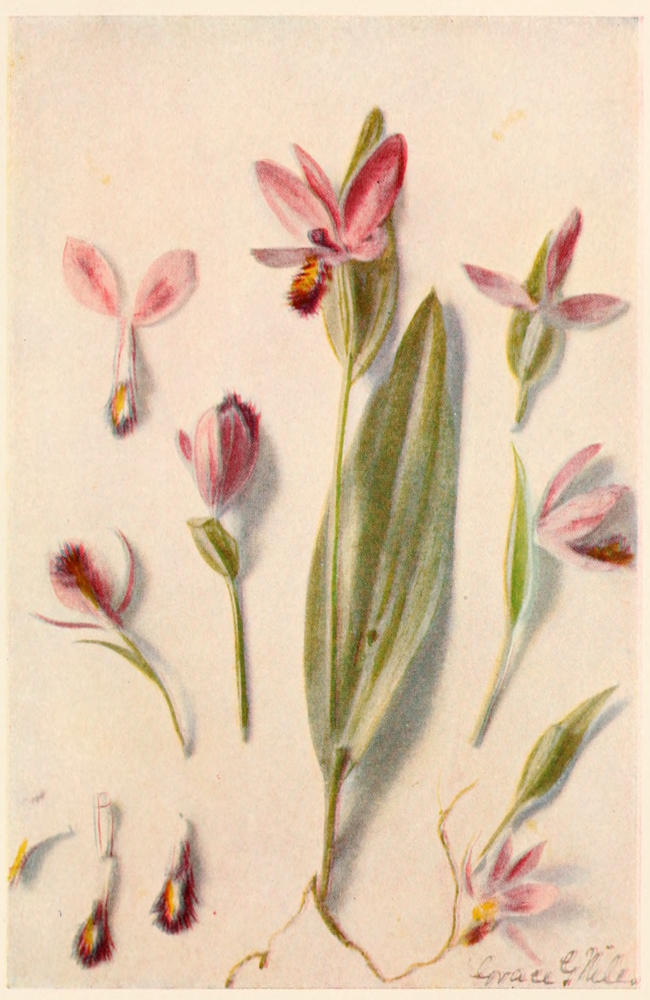
The Rose Pogonia. (Pogonia ophioglossoides.)
A delicate little orchid, found as comrade with the Grass Pink, and frequently with Arethusa, in wild sphagnous meadows.
I followed the familiar and loved path out to the sphagnous meadows east of Kimball’s barns. Taking a straight line southward up the hill, back of an orchard, along the border of a field of Indian corn, I came again to Thompson’s Brook, on its way to join Ball Brook, near the Kimball barns below. It is one of the stoniest channels, narrow and deeply worn, with here and there graceful clinging ferns slightly caught to the banks, and often completely hiding the huge boulders and ledges. Pines and hemlocks are the principal trees along this stream. The twisted and uncovered reddish roots of the hemlocks seemed to have split the black shelving slate rocks asunder with their growth. I threaded my way as near the brook as possible, often finding it necessary to wade in the stream until I reached the bend in the road near Meyers’s sugar-kitchen among the maples. Here, turning to my right, I followed the shaded road leading past the schoolhouse in District Fourteen, and homeward to Mount Œta.
My orchids were pretty well withered on reaching home, and not in good condition for studying. These delicate species of Pogonia and Limodorum are easily wilted, losing their beauty and elasticity soon after being severed from their roots. These two species, Adder’s-Mouth Pogonia and Limodorum tuberosum, are almost invariably found together,—comrades of different genera that travel far and wide in company throughout their continental ranges.
The Adder’s-Mouth Pogonia has been formerly confused with our native species of Arethusa bulbosa, and for some time was known as Adder’s-Tongue Arethusa. Thomas Wentworth Higginson writes: “On peat-meadows the Adder’s-Tongue Arethusa (now called Pogonia) flowers profusely, with a faint, delicious perfume,—and its more elegant cousin, the Calopogon, (now called Limodorum) by its side.”[25]
Yet Thoreau had a different impression of the rose-pink Pogonia’s fragrance, and says in his notes in Summer, on June 21, 1852: “The adder’s-tongue arethusa smells exactly like a snake. How singular that in Nature, too, beauty and offensiveness should be thus combined!”[26] On July 7, 1852, he again mentions these species of orchids: “The very handsome ‘pink-purple’ flowers of the Calopogon pulchellus (now known as Limodorum tuberosum) enrich the grass all around the edge of Hubbard’s blueberry swamp, and are now in their prime. The Arethusa bulbosa, ‘crystalline purple,’ Pogonia ophioglossoides, snake-mouthed (tongued) arethusa, ‘pale-purple,’ and the Calopogon pulchellus, grass-pink, ‘pink-purple,’ make one family in my mind (next to the purple orchis, or with it), being flowers par excellence, all flower, naked flowers, and difficult, at least the Calopogons, to preserve. But they are flowers, excepting the first, at least, without a name. Pogonia! Calopogon!! They would blush still deeper if they knew what names man had given them.”[27]
The Pogonia seems to bloom slightly in advance of Limodorum, and is a delicate, waxen-pink flower. It raises its single terminal blossom about six inches high amid the tall grasses of the swampy meadow. It is not so beautiful as its comrade species, the Grass-Pink; but to me it is sweetly fragrant, and since it is an orchid, it is precious, although small and somewhat unsightly in its suggestiveness.
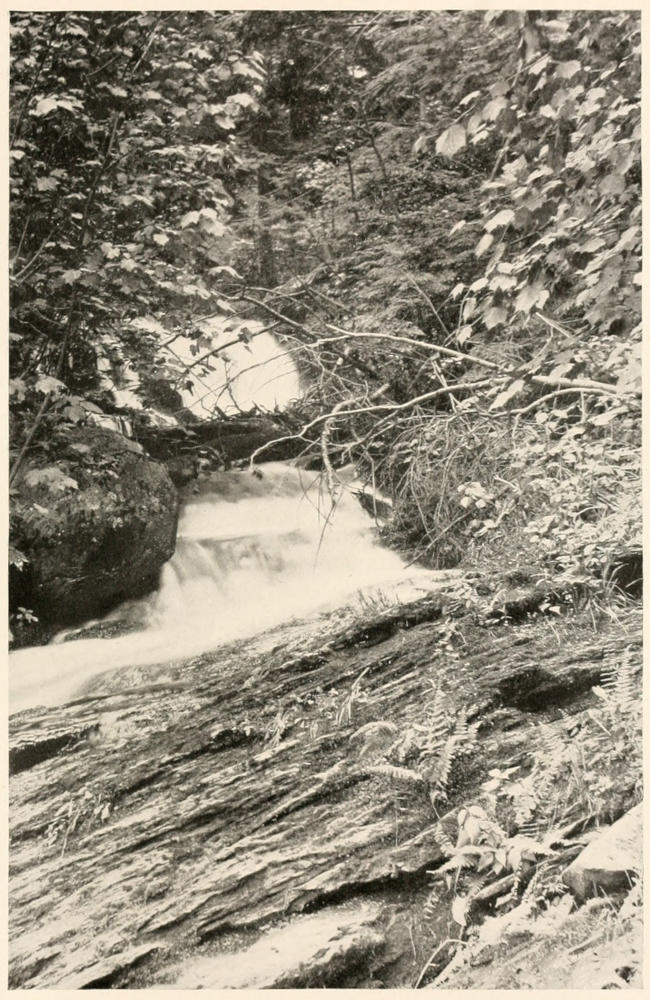
The Thompson Brook, East Pownal, Vermont.
“They left their home of Summer ease Beneath the lowland’s sheltering trees, To seek, by ways unknown to all, The promise of the waterfall.” Whittier.
There are two leaves: one, oblong and sessile, appears in the middle of the stem; and another smaller, bract-like leaf is found at the base of the seed-capsule, bearing the nodding blossom with its alert bearded petals. The roots are little clusters of fibrous threads, loosely attached in the moss-grown mounds of the primeval forest stumps,—which are slowly decaying below the soil in these aged swamps.
The Grass-Pink (Limodorum tuberosum) is much more attractive, with its rose and pink-purple blossoms. The spike, often a foot high, bears from two to fifteen beautiful and slightly fragrant flowers. The origin of the generic name, Limodorum, comes from the Greek, meaning “a meadow gift.” These flowers, according to Mr. Coleman, are called Grass-Pinks in Michigan, while Thoreau also called them by the same name in Massachusetts.[28] The labellum seems hinged at the insertion, and is bearded with yellow and purple hairs. There is seldom more than one freshly blown blossom on the stalk at a time, and thus the plant remains attractive for some days. Beginning at the lowermost bud, each one takes its turn in unfolding, the spike slowly lengthening while the buds constantly increase in size and color.
One interesting peculiarity of this species is that it remains as Nature originally intended all species of orchids,—with the labellum as the upper petal, instead of the lower, as seen in all other native species. It will be observed in species of the Orchid Family that a twist of the seed-pod has taken place: if not a complete revolution, at least half a turn. The labellum is, therefore, directed forward on the lower or inferior side, as in the species of Cypripedium, where it appears in the position of a shoe or moccasin, instead of holding itself above like a dome, as originally intended by Nature. Darwin says of this: “An enormous amount of extinction must have swept away a multitude of intermediate forms, and has left this single genus, now widely distributed, as a record of a former and more simple state of the great Orchidean Order.”[29]
The ovary of the Grass-Pink is straight, and the labellum so hinged that it falls down like an arch above, bearded with delicate hairs. The column bearing the anther, containing four soft pollen-masses, curves slightly at the end, producing a hollow wherein lies the pollinia. The stigmatic surface lies still farther toward the centre of the column. An insect sipping nectar from these flowers, safely enters without distributing the adhesive pollinia, since the anthers containing the cells are so hinged that not until he turns to leave the heart of the flower does he swing open the lid of the cup containing the powdery gold, which fastens to the velvet of his coat beneath his body. The next flower of this species, therefore, becomes fertilized properly, and in turn unlocks her treasure-store as the insect backs off the keel of the pollen mass. Professor Meehan writes that this plant “rarely fails to produce perfect seed-vessels. Yet it is seldom that plants which depend on insects for their supply of pollen, as these are supposed to do, and which are not fertilized by their own pollen, produce seeds from every flower.”[30]
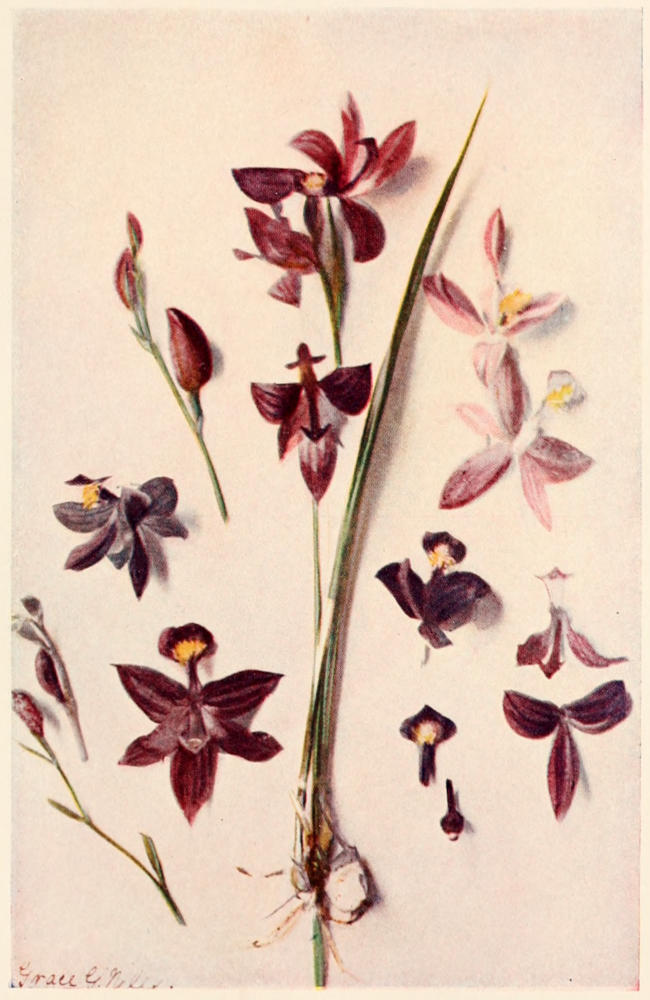
The Grass-Pink. (Limodorum tuberosum.)
This is a strange, beautiful orchid with a straight seed-pod (ovary), which causes the labellum to remain on the upper side of the inner whorl, instead of the lower side by torsion as in nearly all other orchids.
It is said that the twisted ovary seen in orchids came about through necessity in fertilization. This has caused, as Darwin says, “the labellum to assume the position of a lower petal, so that insects can easily visit the flower; but from slow changes in the form or position of the petals, or from new sorts of insects visiting the flowers, it might be advantageous to the plant that the labellum should resume its normal position on the upper side of the flower.”[31] In the present position of the labellum of Cypripedium we observe the convenient resting-place for the bee as it alights and descends to the interior, where are stored the nectar and attractive colors. The insect must be persevering indeed to win the soul of the orchids, since Nature has constructed their organs with such care and modifications. The hidden hinge to the cups of pollen—as instanced in the flowers of the Grass-Pink—demonstrates that even the finest hairs and tissues in these plants have their meaning and their values.
Self-fertilization seems impossible to the Rose-colored Pogonia, which bears but one flower. The plants must inter-cross. An interesting account of the fertilization of this orchid is given at length by Dr. Samuel H. Scudder,[32] in the Proceedings of the Boston Society of Natural History.
VIII A Colony of Ram’s-Heads in Witch Hollow
The solemn wood had spread Shadows around my head,— “Curtains they are,” I said, “Hung dim and still about the house of prayer”; Softly among the limbs, Turning the leaves of hymns, I heard the winds, and asked if God were there. No voice replied, but while I listening stood, Sweet peace made holy hushes through the wood. Alice Cary, The Sure Witness.
It was often a temptation during my search for wild strawberries, to saunter through the swampy meadows on the northern slopes of Mount Œta, where nesting bobolinks were busy about their homes. Their happy notes are the first to awaken one in the morning, and almost the last heard at twilight, about the edges of the road and the orchard, where they come in a very business-like way to search for food, crying the while, “Bob-o’-link, bob-o’-link, spink, spank, spink; chee, chee, chee!”
As twilight deepens and the moon comes up from behind the grim form of the Dome, the mournful notes of a distant chorus of whippoorwills begin, echoing on until far into the early morning. The other noon I was startled to hear a baby whippoorwill practising his melancholy tale on the hillside above the house, where no doubt his mother had lost him the night before. He had “stayed out all night,” and knew no better than to sing in the daytime. I suppose his mother had not yet taught him when and how to sing, for he could only lisp now, saying “’Tis-so-still! ’Tis-so-still!” It sounded very odd at noon, although it was dark and rainy. I searched through the daisied meadow for him, and found that he was a full-sized bird,—too large to be lisping such baby notes, though not old enough to find the way to the twilight woods alone. Perhaps he was backward in his singing lessons, and his mother had punished him by leaving him to practise all day, when other birds of the night were drowsing under the shelter of old logs in the deep wood. So he sang on and on, at intervals, all the afternoon in the rain, out on the grassy hilltop.
I found a bobolink’s nest low in the swamp meadow, near where there were many busy “Roberts of Lincoln.” Their rich, energetic, gladsome song was very contagious, and brightened many an hour when I was housed, or sat on the porch, watching the storms come up in the north and west.
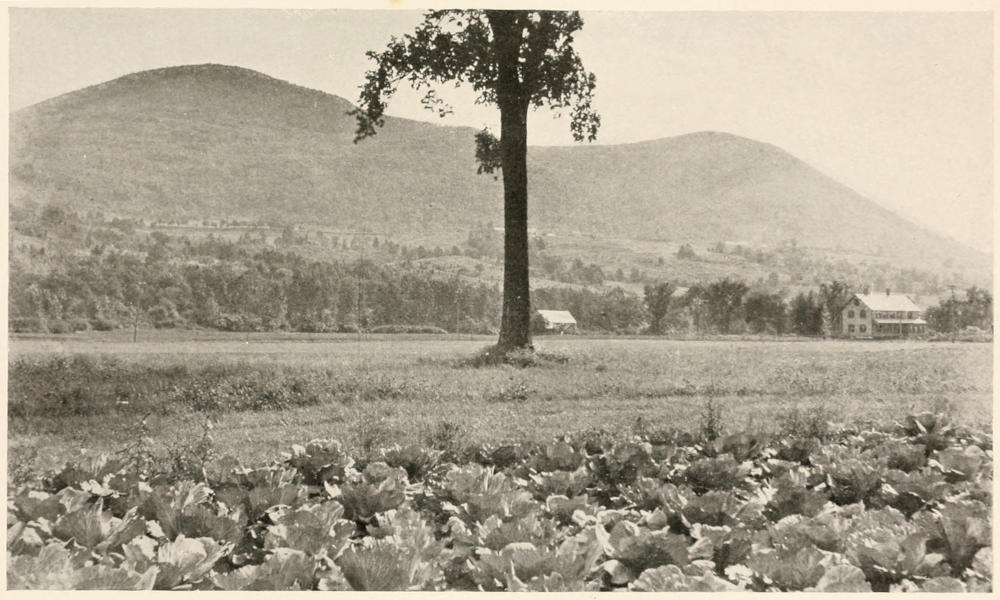
The Perry Elm, Marking the Site of Fort Massachusetts, on the Harrison’s Flats, North Adams, Massachusetts, Showing Saddleback Mountain in the Distance.
Mount Œta is one of the foothills of the Dome, lying just west of the Domelet. The Hoosac glides around its “dug-away” base, passing through the narrowest portion of the valley near the Massachusetts State Line. This pass is often called the “Golden Gate,” likened to the Pass of Thermopylæ, among the mountains of ancient Greece. Indeed, the warring history of this valley may be comparable with that of the plains of Marathon and the mountains of Hellas. Through the Hoosac Pass, during the French and Indian Wars, have marched the French cadets and cunning Indians, led by General Rigaud de Vaudreuil, to storm and capture Fort Massachusetts near the base of Greylock’s Brotherhood. Here they fought, sixty to one. These encounters were but forerunners of the Bennington rebellion among the Green Mountain Boys, and the conflicts at Ticonderoga, which led to one of the world’s great battles, fought among the hills and vales of Saratoga.
The summit of Mount Œta is crowned with luxuriant farms, with flowing fields of grain and grasses. Miniature hills and vales between, with little streams leading down the slopes, perfect an ideal pastoral dream. There is none of the boldness in the scene from this height, as observed from Mount Greylock, Mount Anthony, or the Majestic Dome.
Very often the highest summits, especially those of the Dome and the Greylock group, are draped with rosy-tinged clouds and lowering veils of mist at the sunrise hour. One of the rarest visions seen from our modern Mount Œta occurs about six o’clock in the morning, frequently during the months of June and July, when the whole valley of the Hoosac appears filled with a perfect sea of billowy fog, the distant blue mountain peaks rising above. With the golden lights of dawn falling upon this ocean of beauty, one can trace twenty miles of fairy-sea, as the foaming fog follows the serpentine windings of the Hoosac from its source under Greylock, ever broadening toward the plains of Hoosac Falls and the hills of Saratoga. Before ten o’clock the mist usually dissolves, or rises as the sun burns forth.
In all my wanderings, I had kept an eye out for the leaves and seed-capsules of the Ram’s-Head Moccasin-Flower (Cypripedium arietinum), and had revisited the Amidon Woods, where Lorenna found the first specimen for me, but without discovering any new plants. On Sunday, the second day of July, a friend and myself drove to Pownal Centre. We returned by the Gulf, or “Witch-Hollow” path,—a cross-town road seldom travelled, although shaded and pleasant. Here the sounds of the winds, breathing and reverberating through the narrow vales, then dying mournfully in the distance, intimidated the early settlers, who, being superstitious, attributed the sounds to the witches so prevalent in the history of New England. To-day there are no more dreadful sounds in these glens than the hoots of owls and the piping of frogs in the Chalk Pond pools.
We were nearing the pond region. Just west of the road there is a beautiful, ever-bubbling spring, known far and wide to tourists sauntering to Mann Mountain beyond. From this I wished to get a draught of delicious water for my friend, so I hitched the old horse to a tree by the roadside. Somehow this morning I lost my bearings, and entered the wrong ravine. I had supposed that I could find the spring in the dark; but I penetrated the thicket a little north of the right place, by the slab-bridge where, in rainy seasons, the water drains from the hills. Hunting around, however, to learn where the spring lay, I stumbled straight upon a little company of Ram’s-Head Lady’s Slippers. In my pleasure and excitement, I exclaimed, “Here are Ram’s-Heads!” frightening my friend so that she ran clear out of the thicket. She soon returned, however, when assured that there was no danger, and admired the rare little flock with me. There were only a dozen plants in the group, none of course in blossom; but several bore plump seed-capsules, proving that they had bloomed early in the season. I determined to return to this nook another day.
The next morning I started off cross-lots, over the hills afoot, to my sylvan shades, carrying my usual basket and kit of tools, with an added two-quart pail, which I promised to fill with raspberries. These berries were plentiful, I had observed, through the John-Fallow sheep pastures. Here I found a spring trickling from the shelving slate rocks, and this guided me through a meandering network of swamps, all the way to Cold Spring, in Witch Hollow below.
Major frisked about among the fields, and we had a happy time sliding down the dry and slippery pasture slopes. There, at the foot of the hill, we entered a deep, dark woodland,—just Major and I, who are faithful, congenial comrades. My constant hound is ever ready to follow my footsteps, and if he chances to lose me, I soon hear his yelp on my track. Dear old Major! I value you more than I tell you by these gentle strokes,—you, whose searching instincts would find me out wherever I might be, and whose keen scent of danger is my constant protection!
Everything was still in the hollow to-day, save for the croaking of the bull-frogs and the buzzing of flies and humming of bees, echoing from the pools and numerous flowers of Solomon’s Seal along the edges of the swamp. It was noon when I reached my colony of Ram’s-Heads, and I was glad to be sheltered in these cool glades this sweltering July day. I took note near what species of trees my rare Cypripediums grew, and found that they were rooted in loose leaf mould, from long decayed heaps of pine branches and tree-tops, left by the woodman when the forest was first hewn from these slopes. Here, also, stood crumbling stumps, and prostrate trunks lay at full length, decaying in the marl and peat. Among this mouldering soil was a pile of four-foot white birchwood—near some of the best plants of Ram’s-Head, three of which bore maturing seed-pods. Directly through the group, a wood-path wound around the hill from Cold Spring toward the north, worn by the small wild animals of the forest.
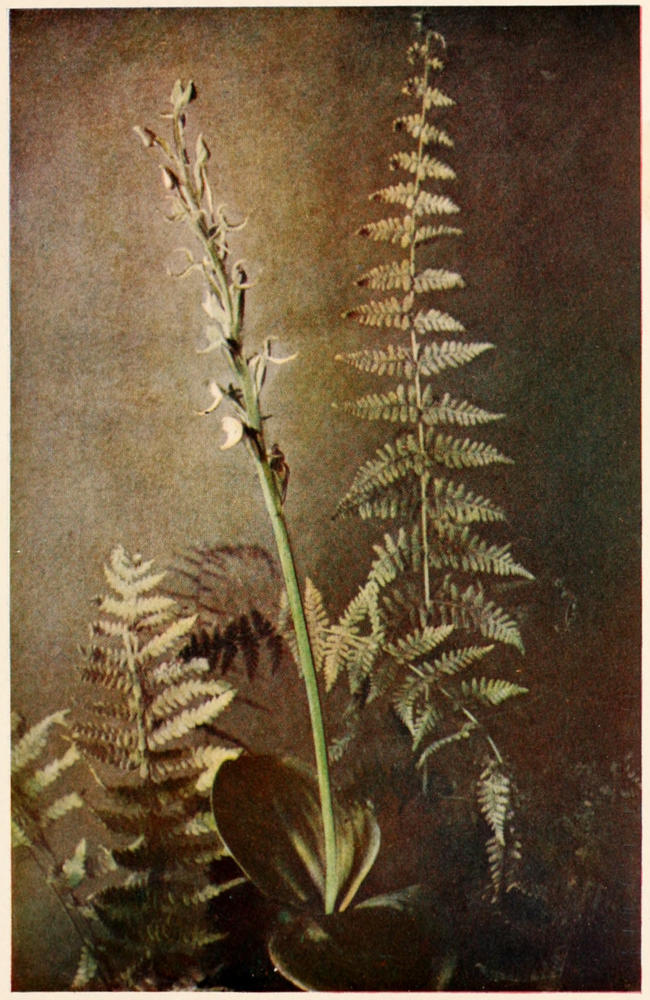
The Small Round-Leaved Orchis. (Habenaria Hookeriana.)
This species is closely related to the Large Round-Leaved Orchis (Habenaria orbiculata) and Habenaria oblongifolia, with which it grows in company.
Just east of the plants I had found on Sunday, I discovered at least fifty more, withdrawn to themselves, in aristocratic exclusiveness. I lifted three of the oldest and largest plants, two of which bore large seed-pods, taking them up carefully and with plenty of soil, so as not to disturb the fibrous roots. The layer of leaf mould was loosely strewn, and not so deep here as I had expected to find it. Scarcely three inches beneath the surface, I came to a bright, whitish gravel. The spot was situated on a sloping hillside, which seemed to surround a hollow among the hills, where a glacial lake had formerly slept. It is called to-day “Chalk Pond,” the water being whitish at times in the streams flowing from the heart of the region. The soil was rich with unfathomable depths of peat and marl in the lake bed below. Peat is formed by decaying moss, ferns, and vegetable matter in general, while the marl, which lends a chalky appearance to the water and gravel, comes from the crumbling and decayed shells abounding in the soil. This loam seems to be valuable, and the pond bed is now well drained for the purpose of selling the substance as a fertilizer for lawns.
White birch, chestnut, pines, and nearer the pond meadow below, beautiful elms towered skyward. From this corner I searched the hillsides to the north, along the path. At the feet of some chestnut saplings, I found the Small Round-Leaved Orchis (Habenaria Hookeriana). The plant was young, and apparently had not put forth blossoms this summer. They appear in early June in this region. Leaving the plant to study another year, I sought the southern hillside, and came suddenly upon a sight which I shall not soon forget. Before me stood the Great Round-Leaved Orchis (Habenaria orbiculata), with its two huge, round, flat-lying leaves of a soft emerald green, about eight inches long by seven wide. It bore a tall, bracted spike of greenish-white flowers,—strange, fantastic shapes, trimmed with spurs and hoods and capes. This spike of flowers rose straight up from between the two round basal leaves. It was about two feet high originally, but had been broken, doubtless by the hailstorms of June. The common names of the Round-Leaved Orchises hereabout are “Shin-plaster” and “Heal-all,” since they are applied to bruised shins, and are used as plasters for weak lungs. Thoreau, in Maine Woods, gives even larger dimensions of the Great Green Orchis found by him in the vicinity of Mud Pond, Moosehead and Chamberlain Carries, Maine,—where he reported it very common in July.
I sat for some time admiring this weird plant; when finding that it had sown seed the former season, I decided to transport it to a garden of civilization, to see if it would take kindly to cultivation. Then I turned westward, following the sluggish yet sparkling stream down from Cold Spring. At times the stream was almost hidden by moss, through which it crept slowly.
This brook enters a large, open, meadow marsh,—the ancient lake bed of which I have spoken before,—the Chalk Pond hollow. Since it is now drained, it appears to be a promising soil in which to seek the Purple-Fringed Habenarias in the proper season. I found the leaves of a plant which I believe to have been that of one of the Purple-Fringed Orchises, but from its producing no flowers this season I was not able to designate it. Here, also, small ferns and luxuriant brakes were sheltered amid the low sumach bushes and willows. Wild grape-vines entwined the trunks of trees, reaching far into the tops of the high elms. One immense elm had been blown over by some northeast hurricane, which had quite recently swept through this hollow. The upturned roots of this ruined tree had apparently grown about a deeply buried fellow in the peat and marl, for they still retained the impression of the buried trunk about which they had clung. In the mud and water from which the tree had been torn, lay in its deep grave this log, bare of its outer bark, but still sound and round. It was now well water-soaked, after having been so long sealed from the air and light beneath the earth. How many centuries it had been buried there, no one can guess. The now apparently aged elm upon the surface had torn up several feet of earth as it fell. Forest after forest had thus fallen, a new one rising over it, eventually to give place to another, and itself to form a strata of mould, enriching the soil of these bogs which yield so many floral treasures.
I did not remain in this meadow long, as it proved still too damp to walk through grasses and sedges without water-tight boots. Coming out of this place at the foot of the little ravine below the colony of Ram’s-Heads, I ran upon numerous oblong, waxen, green leaves, which at first reminded me of the similar leaves of the Pink Moccasin-Flower (Cypripedium acaule). But on closer search for their seed-capsules, I found the fresh bracted processes of a spike containing several ovaries instead of one, as in the Moccasin-Flower. Evidently this plant was not a species of Cypripedium; and although the scape was broken, enough of the alternating process of twisting ovaries remained to assure me that I had found a colony of the early and Showy Orchis (Orchis spectabilis), which is one of the first species of orchids to bloom in New England. Indeed, it is said to open the orchid season as early as May 19th, and is found with the Wake-Robins and Arbutus, when the woods are otherwise bare and brown. I secured three of the finest plants.
My basket was now laden with choice species, including those of the Ram’s-Head, the Showy Orchis, and two species of Habenaria, a sister genus of Orchis spectabilis. The locality had proven a treasure-ground to me, for here were both the Great and the Small Round-Leaved Orchis (Habenaria orbiculata and Habenaria Hookeriana); while the Tall Green Orchis (Habenaria hyperborea) dwells in the deeper bogs along the stream.
The leaves of the Purple-Fringed Orchis (Habenaria grandiflora) are hidden in the borders of the open meadow. I found a few plants of that very rare orchid called Adder’s-Mouth (Achroanthes unifolia) seldom if ever before collected in this town. The plants are so small and inconspicuous that one may search long without seeing them. Two stood among the select company of Ram’s-Heads, while others grew along a damp, silent brook bed that had ceased to flow,—a ravine formed during spring freshets and melting snows.
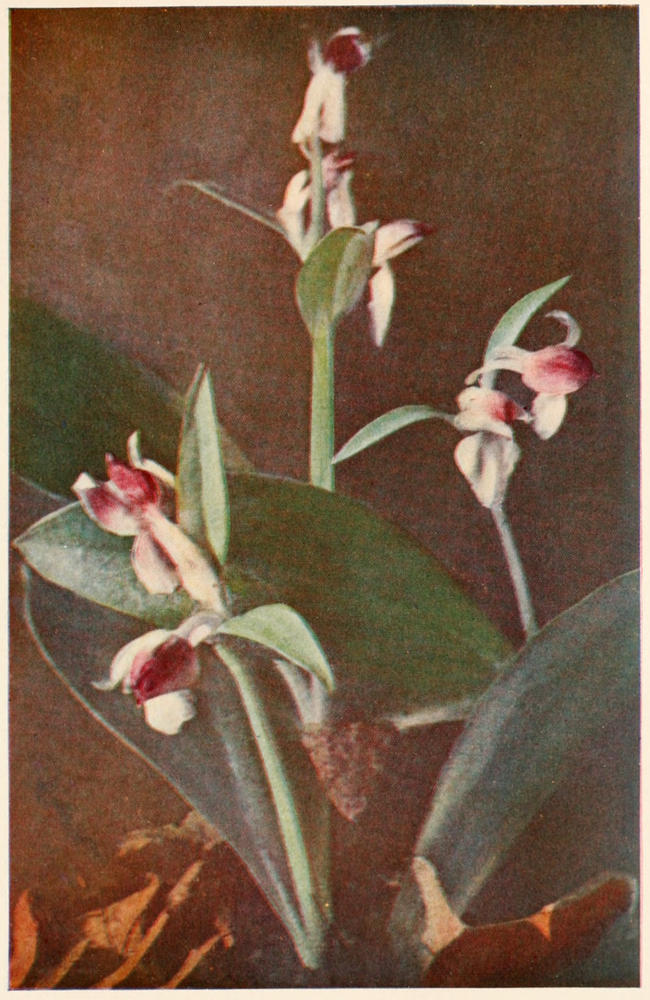
The Showy Orchis. (Orchis spectabilis.)
Showing the plant nearly natural size. This species is closely allied with the Early Spring Orchis (Orchis mascula) of England. It is the most highly organized of our native orchids.
This pigmy of the Orchid Family—with its pale and odorless flower and its unassuming habit of concealing itself in the darkest recesses of our forests and swamps—grows plentifully in its native haunts to the north.
I had searched long and closely for the last month, hoping to find the Large Purple-Fringed Orchis. Thoreau says: “It is remarkable that this, one of the fairest of all our flowers, should also be one of the rarest—for the most part not seen at all.... The village belle never sees this more delicate belle of the swamp.... A beauty reared in the shade of a convent, who has never strayed beyond the convent bell. Only the skunk or the owl, or other inhabitant of the swamp, beholds it.”[33]
The Yellow-Fringed Orchis follows later, blooming through August and September,—the blossoming season of the flaming Cardinal-Flower, whose brilliant coloring brightens the dark shades along streams in moist woods. The Yellow-Fringed Habenarias are found growing with the Pitcher Plant, and often fill the sphagnous swamps with a glowing mass of orange-flamed torches. Gray considered them among our handsomest species of Habenaria. They are abundant in swamps about New Haven, Connecticut, while the White-Fringed Orchises seek the coast-lines of Massachusetts, although also found sparingly in the highlands.
Species of Habenaria are called False Orchises, while species of Orchis are known as True Orchises. These species are members of sister genera, but all belong to the Orchid Family. There are but three True Orchises found on the continent north of Mexico, while not less than forty-four species of Habenaria are reported for the same area.
The genus of True Orchises comprises eighty species, distributed throughout the temperate zone of the world; while of Habenaria there are about five hundred species. Orchis spectabilis and Orchis rotundifolia are found in Vermont. The latter is the rarer, and limited in its range from northern New England to Greenland. The Orchis spectabilis ranges from Ontario southward to Georgia. The third species, Orchis aristata, is endemic to the wooded regions of Alaska.
Our common Showy Orchis resembles the Early Spring Orchis (Orchis mascula) of England, which Darwin never tired of praising. The high organism distinguishes species of this genus as True Orchises. The origin of this distinction lies in the complex structure of the organs of fertilization. The stigmatic lobes, or female organs, and the anther containing the pollinia or male substance in fertilizing, are enclosed in this genus in a pouch or hooded fold above and within the anterior portion of the orifice of the spur. In False Orchises, the stigma and anther are naked, and their glands are exposed. They are also known as Naked Gland Orchises. The more complex the structure, the more highly organized becomes the species. Orchis spectabilis displays a marvellous intelligence in its mechanism for inviting fertilization and cross-fertilization. The enclosure of the glands within the hooded pouch protects the pollinia from rains or improper insects.
The moth finds a resting-place on the petaled platform, while he pushes his tongue and head into the depths of the dainty spur attached to the flower anteriorly. In doing this he forces his forehead against the viscid lobes of the stigma, situated in the back, opposite to the entrance of the spur. In pushing, as he must, to reach the nectar in the twisting spur, he ruptures the interior membrane of the rostellum above the orifice containing the pollinia. Each mass of this fertilizing substance in this species contains viscid disks or handles, fastened with elastic hair-like caudicles attached to the pollinia. When the insect ruptures the cellular tissues of the anther, these disks shoot out of their sockets, and fasten firmly to his head. As he flies away, he possesses one or two pollinia, unique in their completeness. In visiting the next spike of the Showy Orchis, he repeats the insertion of his tongue and forehead in the spur of the nectary. The golden horn of pollinum thus rubs against the viscid surface of the stigma, and fertilization and cross-fertilization are brought about. The insect thus accomplishes all that Nature has designed for the future of the species, even if only a small portion of the pollinum is absorbed by the attractive surface of the stigma. One mass fastened to the head of a moth would, in this manner, fertilize several flowers.
According to Darwin, orchids with short-spurred nectaries are fertilized by bees and flies; while those with long spurs are visited by moths and butterflies with long proboscides.
The structure of various species calls for special insects to fertilize and cross-fertilize them. The failure to attract the proper agencies has led Nature slowly to change the organs of many orchids so that self-fertilization might be accomplished. In this way, “an enormous amount of extinction” must have taken place. A wide gap of obliteration intervenes between species of Orchis and Cypripedium, the former being the most highly organized and the latter the lowest, or abnormal species of the Orchid Family.
The species included under the great genus Habenaria grow more abundantly than any other on our continent. It is not unusual to find five or six species of this genus in a neighborhood such as the Bogs of Etchowog or Witch Hollow region. In the latter locality I found four species of Habenaria, two of Cypripedium, one of Achroanthes, and one of Orchis, making in all eight rare species for a very small area of swamp-land.
Soon after I reached home with my basket of roots, the front porch exhibited a long row of pots and tin cans, where stood my transplanted treasures, ultimately to be placed in the garden of a friend in New Haven.
It has always been a source of wonder that Thoreau did not find more species of the Orchid Family in the conifer swamps in the Maine woods. His journeys made in July, through pine and cedar and mud-pond regions, should have led to the discovery of more species than he mentions. He writes of but three species of Habenaria, one of Ladies’ Tresses (Gyrostachys), and one of Twayblade (Leptorchis liliifolia). To be sure, he found the Great Round-Leaved Habenaria and the two Purple-Fringed species in abundance, but there is no record of a Cypripedium in his data save as reported for Concord.
Species of Orchis and Habenaria are among the oldest orchids known in the records of ancient herbalists and naturalists. Both of our native Purple-Fringed Orchises (Habenaria grandiflora and Habenaria psycodes) are closely allied with Orchis morio, found so abundantly in the fields of England. Pliny, in the time of Christ, knew this plant as Orchis or Serapias, which Fée has identified with the Orchis morio now known in Europe. This species is more nearly related to our Small Purple-Fringed Orchis than to the larger species.
The origin of the name Orchis arose from the ancient lore of classical mythology. Orchis, a son of a rural god named Patellanus, failed to observe the rules of politeness while attending a festival of Bacchus, and offended one of the priestesses with his rude behavior. He was reported to the attendants for punishment, who in anger tore him to pieces. His father Patellanus, and his mother, that sweet nymph Acolasia, sought the co-deities’ influence, who, it is said, urged the superior gods to command a flower to rise from the earth perpetuating the name and memory of their son. Thus arose the strange untamable species of this family.
The species now known under genus Orchis and Habenaria had various common names in ancient literature. There were five kinds of Orchis which the Greeks commonly called Cynorchis; this became in Latin Testiculus canis and Testiculus morionis, and later in England, Orchis morio. Satyrion was also an ancient common English name for the species of Cynorchis known to the Greek apothecaries.
In the sixteenth century the Purple-Fringed Orchises of England were known as Satyrion Royall, Noble Satyrion, Palma Christi, and Royall Standergrasse. In fact, all species of orchids in 1578 were described under the group of plants designated as Standlewort, or Standergrasse.[34]
Shakespeare mentions them in Hamlet as “Long-Purples” and “Dead-Men’s Fingers.” Tennyson also speaks of them as Long-Purples in A Dirge. Rev. Mr. Ellacomb, in Robinson’s Garden, alludes to these orchises as “Dead-Men’s Thumbs.”
The Great Royall Satyrion of England and Germany, known to Dodoens and Lyte in 1578, was found in meadows and moist woods. The flowers were light purple, and gave forth sweet perfume. The roots were described as double, like a pair of hands, and each palm was parted into four or five small roots like fingers; one palm being withered and spongy, the other full and sound. From this peculiarity of form many of the names were undoubtedly derived. There was also another small purple species of Royall Satyrion, with a perfume like musk. The roots were like the larger purple Royall Satyrion.
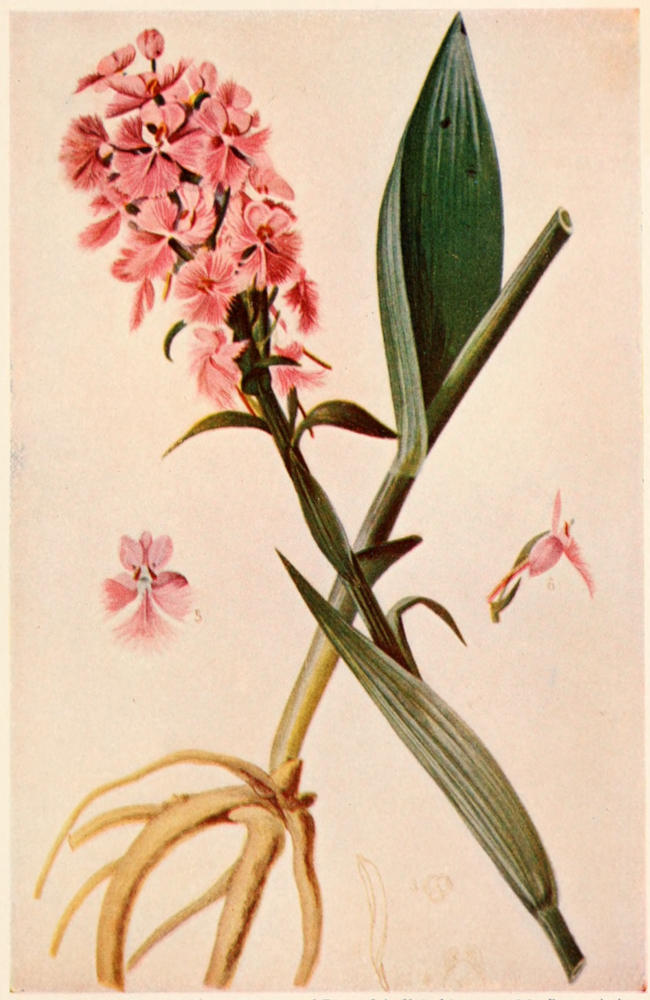
The Large Purple-Fringed Orchis. (Habenaria grandiflora.)
Closely allied to Habenaria psycodes of New England, and to the English Long Purples (Orchis Morio) of ancient literature. They are mentioned by Shakespeare in Hamlet.
“There with fantastic garlands did she come Of crow-flowers, nettles, daisies, and long purples.” “Hamlet,” Act IV., Sc. 7.
From lithograph in Meehan’s Native Flowers and Ferns of the United States, 1: 1878. By permission.
The roots of Royall Satyrion were used as remedies against many diseases. “If an inch or as much as one’s thombe of this roote be pound and ministered in wine, it is good for many diseases,” writes Dr. Nicholas Nicols, according to Dodoens and Lyte in 1578.[35]
These orchises have figured in literature from time unknown, and although shy in New England, seeking the haunts of moose and bear, they delight still to grow in hearing of the cathedral bells in old England, where they are the common flowers of meadow and borders of corn-fields.
The proverb, that all things come round to him who waits, may for the orchis-hunter be paraphrased rather, “All things come round to him who tramps.” I was destined sooner or later, by lonely lake or mountain bog, to find the Purple-Fringed Orchis for which I had so long searched. Later in the season, on July 8th, I visited Notch Brook, North Adams, a stream flowing down through the northern Notch Valley. Wandering past the beautiful Cascade, I slowly explored the wooded vales among the Ragged Mountains. The afternoon was sultry; the sun pouring down upon the parched sod of the rocky pasture-land had shrivelled up the grasses, and now the bushes themselves were turning brown, and the leaves curling up on their edges. Through the trembling haze, partially due to the vile smoke of civilization, which arose from the various factories in the City, the sun appeared as a round, red ball of fire.
I had chosen a poor day for walking, but there were cool, shady retreats on the way, where I could find rest and shelter. I clambered down from the slopes of Aurora’s Hill, into the shadow of the valley’s smoke, crossing the sluggish stream of the Ashuilticook, by way of the iron bridge in Flag’s Meadows. I climbed to the swamps along the Ragged Hills leading to The Notch. Here the slopes of pasture-lands above State Street are clothed with bushes and brambles, through which rough, stony paths wind, where dwell the children of sunny Italy. Witt’s Ledge of lime and marble stone lies along this swell. These rough paths, with wooden steps leading summitward, were new to me.
Upon the brow of the hill was a small pond hidden at the head of an extensive swamp, amid willows and lush tangled grasses, where little lads were bathing. It was one of those wild mountainous pasture-lands where blackberry briars and sweet-fern run riot, and where the pepper-bushes and tall brakes shed forth an aromatic perfume under the full blaze of the summer sun. About the drier portions of the swamp were well-worn cow-paths, winding irregularly about the hummocks and boulders; and along the borders grew many familiar weeds and vines amid the swails and flags.
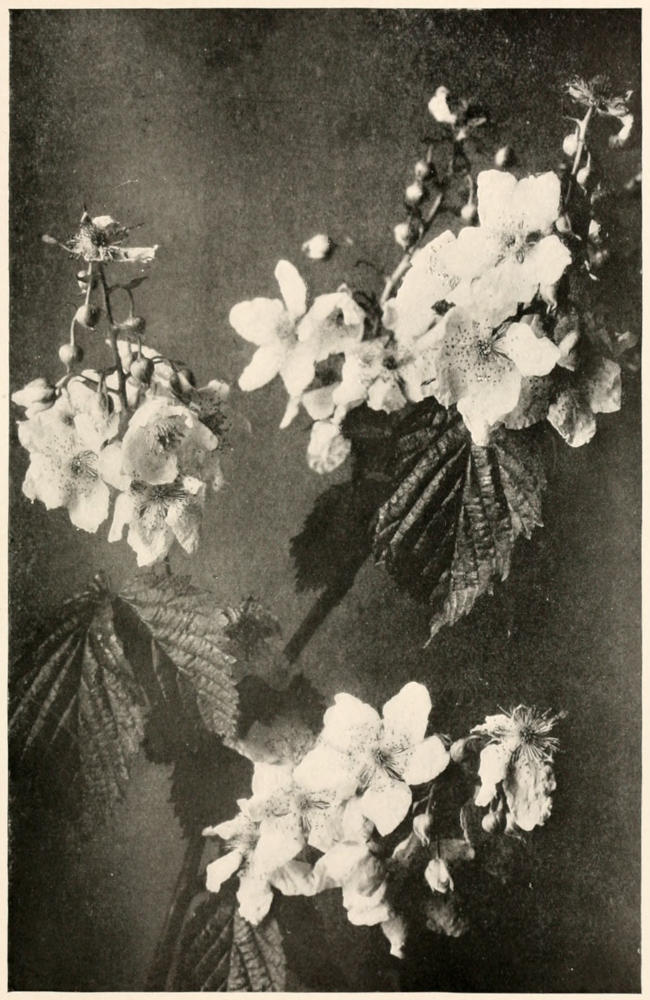
The Blackberry Blossoms from Mount Œta, Pownal, Vermont.
My boots being high and waterproof, I waded warily through the coarse lush grasses and cat-tail flags, encountering many deep pools. As I pushed forward, my heart sang in the very joy of living:
Is this a time to be cloudy and sad, When our mother Nature laughs around; When even the deep blue heavens look glad, And gladness breathes from the blossoming ground?[36]
At the west end of the cow-path I came suddenly upon one tall, Purple-Fringed Orchis. This was my first good fortune in finding this beautiful species, although I have since found many. I stood long in wonderment and silent adoration before this fragrant beauty of the weird and lonely bogland, rearing its strange fringed petals high above the common swamp grasses. Searching about to the north and south, I found a colony of six more spikes, which assured me that I would be justified in taking the first plant I had found; and placing it with the utmost care in my crowded vasculum, I then proceeded mountainward.
On the very brow of the hill I wound around to the left, entering the wood-road leading to the Notch Valley. A beautiful cold spring gushes out in the heart of this wood, under the hill at the right, near the Cascade path. I freshened my flowers here, and hurried on to the famous foot-bridge over Notch Brook, plunging on down through the hemlock wood to get a hurried view of the Cascade below.
As I returned homeward over the heated fields, I found the atmosphere very exhausting; and the flowers, although protected in my botanizing can, were wilted. Measuring the broad expanse that intervened between me and the hill of Aurora’s Lake, the journey seemed interminable. The distance was finally covered, however, and both my fatigue and the fact that I was late for tea were forgotten in the ecstasy of having found that first Purple-Fringed Orchis. This spike grew, and every bud expanded, until within a few days it became beautiful indeed, giving forth its delicate fragrance, and proving itself the prize I had esteemed it, as I lifted it from the dark earth of the bogland of northern Berkshire.
IX Over the Huckleberry Plains
Thou shalt gaze, at once, Here on white villages, and tilth, and herds, And swarming roads, and there on solitudes That only hear the torrent and the wind. Bryant, Monument Mountain.
On July 17th, two days before departing from the Hoosac Valley, I was guided to a group of swamps lying along the summit of the Domelet. The brow of this mountain is yearly devastated by forest fires, after which it appears quite barren, save for the trees and bushes protected in the swamps. A few tall trees, branchless and blackened, stand as sentinels about the huckleberry plains. But soon the young and tender growth of oak, chestnut, and birch springs up on these rocky ridges, while the clearings everywhere are carpeted with low blueberry bushes.
Between the Domelet and the Dome lies a valley known as “Rocky Hollow.” The ledges of rock, walling it about, bear deep erosions in evidence of the Ice Age, when a gigantic glacier once crowned and rounded the Dome. The formation of these deep vales lying at its base is due to the moraines which flowed down from the ice-capped heights.
The little swamp-like pockets along the summit of the Domelet, where luxuriant trees locate the moisture of springs, were formed, perchance, when a deeper lake rolled over this peak.
In ascending the Domelet, we drove around the northern brow of the mountain, up by the County Road,—frequently called the “Dummy Road” in Pownal, because a deaf and dumb man once lived in the vicinity. Soon we turned off eastward, beyond the Dummy Farm, through the low bushes, until we came to a shady vale. We unhitched our horses from the wagon, and fastened them to trees; then we proceeded to explore the hills and plains, carrying pails for berries, and a basket and spade for collecting roots. The flora of this region appeared luxuriant all along the road, as well as over the ledges and plains. I found great numbers of plants of the Pink Moccasin-Flower (Cypripedium acaule). The unusually large leaves were of a deep dark green, with marked veining. Many stems bore seed-pods, which were the largest capsules for this species I have ever seen, being an inch and a half long, with circumference in proportion.
The beautiful emerald-green leaves and bright berries of the lily, Clintonia borealis, were almost as common as the piles of sphagnum and the tall brakes and ferns on the edges of these swamps; yet everything about recorded the ravages of the recent hailstorms. Very few seed-capsules could have remained to mature their seed this season, as most of the plants were either badly bruised, or broken from the root, causing the ovary of the flower to droop and wither. The low huckleberry bushes, known as the dwarf black species (Gaylussacia dumosa), were also damaged by the hailstorms, and were without fruit.
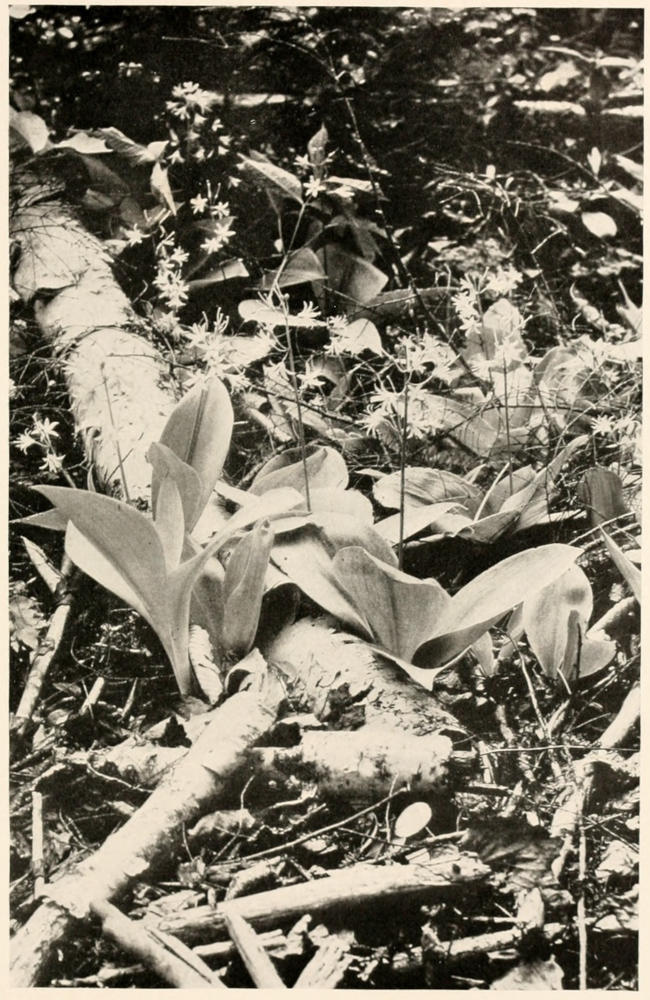
The Yellow Clintonia (Clintonia borealis), Rattlesnake Brook Region, Mount Œta, Pownal, Vermont.
We came upon numbers of trees shattered by lightning, and blackened pine stubs and “turnovers” mingled among the beautiful evergreens of the tangled swamp. Low blueberry bushes, with rich heaps of ashes about their roots, covered the rolling, rock-bound plains, as far as one could see. Huckleberries usually thrive in the trail of forest fires. Indeed, the spring and autumn fires are often started by the huckleberry venders for the sole purpose of securing a better yield of fruit for supplying the market. These berries are among the small fruits which have not thus far taken kindly to cultivation, as has nearly every other wild berry in the markets to-day.
We found the third swamp eastward marked by the odd spires of the Scrub Pine (Pinus divaricata), and the Red Pine (Pinus resinosa), which is often wrongly called Norway Pine. These evergreen trees were known to Theophrastus before Christ. There were two kinds, the wild and the garden trees. Many species of each are described, the pines and spruces not being distinguished from each other.
I observed also many Dwarf Black or Double Spruces (Picea Mariana),—very dark green trees with pretty cones. The name for this tree originated with Theophrastus. It became in the Latin Pinus Mariana.
Frequently I saw a lone Balsam-Fir tree,—Abies balsamea. The name Abies comes down to us from remote antiquity, since this tree grew in Greece, and was valued by the learned physicians before Christ for the balsamic resin found in the bark of young trees. Matthiolus and Peter Bellon described this substance as bitter and aromatic, similar to citron-pills. In England, this resin was known to the writers of the sixteenth century as the Turpentine of Venice. In Canada, where this tree is abundant, it is called “Balm-of-Gilead Fir,” or “Canada Balsam.” It is common on the summit of the Dome. The powerful balsamic fluid drawn from it is now used medicinally. This species resembles the black spruce, save that it is of a silvery-green color, giving forth its peculiar fragrance, and producing small blisters on its trunk and branches, which the spruce does not.
Cedar is not plentiful in the Hoosac Valley region, our only species being American Arbor Vitæ (Thuja occidentalis), often called white cedar. Northward this tree forms extensive cedar swamps, which are rich haunts for species of Orchidaceæ.
On the border of the third swamp, and in the heart of it as well, grow High Huckleberry bushes (Vaccinium corymbosum). Blueberries are known in New England as huckleberries, and this common swamp species grows very tall. These bushes before me were over twelve feet in height. The Dwarf Low Blueberry (Vaccinium vacillans) grows from one to two feet high. The Early Dwarf species (Vaccinium Pennsylvanicum) is from six to fifteen inches in height, and produces our earliest market blueberries or huckleberries. The late Dwarf Low Blueberry ripens late in July.
The giant bushes in the swamp were laden with both green and ripe fruit. The cadet-blue berries hanging side by side with the soft velvety crimson-purple fruit of Shad-trees (Amelanchier Canadensis) made a pretty dash of color among the rich greens. Most country lads are familiar with the mountains at this season, and to go “shad-berrying” is one of their pleasures. In Pownal one hears of shadberry pies and cakes with happy anticipations.
These berries are fresh and sweet, eaten direct from the bending branches, but they become as bitter as medicine after being gathered for any length of time. Their white flowers often appear early in April and May, and brighten the waste places along with the Pigeon Cherry blossoms,—better known as Wild Red Cherries (Prunus Pennsylvanica). The flowers of the latter tree are also white, producing small light red cherries, which delighted flocks of returning pigeons before their extermination. The generic name Prunus is the Latin for plum or prune, derived from the Greek for all species commonly known as Sloes, Bullies, and Snags. The species of Prunus and Amelanchier are members of the Rose Family, as their miniature rose-blossoms indicate.
The original designations of huckleberry, or whortleberry, are also of ancient derivation. The species of Vaccinium were known to Virgil under the title of Vacinia,[37] because their berries were little. The ancient writers recognized the black, white, and red fruited species. The white was seldom seen, however, while the red also was rare. The true English name for these berries in the sixteenth century was “whorts” or “whortleberries.” The black whorts grew commonly in many woods in England, in June and July.
After wandering through these swamps on the Domelet for two or three hours, and securing some fine roots of the Pink Moccasin-Flower for the New Haven garden, we slowly walked back toward our horses in the shaded vale, up and over ledges and rolling hills, passing a ridge of outcropping marble. We finally sat a while and drank in the cool mountain breeze, catching here and there through the trees the varied panorama of the great world below and the clouds above us. Distant sounds from human abodes rose to our ears faintly,—such as the engine whistle of the “Wild-cat” Express as it wound through the deep-cut valley of the Hoosac, nearly a thousand feet below us, westward beyond Mount Œta. On one of these marble ridges, along the plains, I found several plants of the Large Round-Leaved Orchis (Habenaria orbiculata).
We drove homeward by way of White Oaks Road,—southward along the entire summit of the Domelet,—getting an excellent view of the Hoosac and Green Rivers, following their serpentine windings about the hills and vales far below us near Williamstown. White Oaks is a remote corner of Pownal, lying, however, partly in Williamstown in northern Berkshire, a region locally noted for the earliest arbutus blossoms.
In nearly all the swamps I have visited, I have found a long procession of flowers marching close upon each other through the seasons,—from the trailing arbutus and the snowy dogwood blossoms in early April, to the golden-rod and asters of the late October days. Even as late as December 8th I have found the dainty dandelions and violets running wild with glee, only to be frozen before sunrise the following morning. It can be said that in some seasons different flowers bloom nearly every month, in the Hoosac Highlands, if the Transcript’s reports be true.
“On February 1, 1900, some trailing arbutus was brought from the woods. There is usually a little strife in the spring for the distinction of bringing these first flowers, but Mr. Briggs has forestalled all the flower hunters this year by his January discovery, which is most unusual.”[38]
I have collected March arbutus in the White Oaks as early as the 12th, although never in January or February. Indeed, there come many arbutus days long before April and May, if only we go abroad to realize them in the warm, sunny glens among the Taconic Hills, where the cold winds never blow in March.