"Bob Strong's Holidays" (continued 6)
Reading edition
Our friend Antoine, without wasting a moment, at once stepped on board, exclaiming, “Tenez bon dessus—Hold on.”
The man was shocked at what he saw, the dead bodies, as he thought, of Bob and Dick lying across each other on the floor of the little cabin, half in and half out of which the boys were exposed to his view at the first glance.
“Pauvres garçons!” he cried in a husky voice, wiping away a tear that sprang unbidden to his eye, with the characteristic ready emotional sympathy of his countrymen. “Pauvres garçons.”
Jacques, who was a little longer in coming to inspect the derelict, hearing what his companion said, called out for further information.
“De quel pays sont-ils?” he asked. “Can you tell their nationality?”
“Anglais, sans doute!” was his reply. “Je le crois par leur air.”
This made Jacques prick up his ears.
“Comment?” said he; and, without waiting to hear anything else he, too, jumped down into the boat. “Anglais? Mon Dieu!”
Jacques was a man of common-sense; so, instead of contenting himself with staring at the apparently lifeless boys, as Antoine did, he bent down to see whether they yet breathed.
“Bête! Quant aux enfants, ils ne sont pas plus morts que toi ou moi!” he sang out indignantly. “You fool! The boys are no more dead than you or me.”
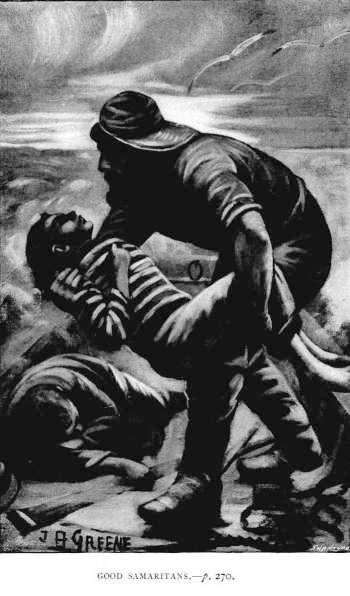
But Jacques was a kind-hearted man as well as one possessed of common-sense.
So, under his directions, he and Antoine between them transshipped the apparently lifeless but still animate forms of Bob and Dick from the wrecked cutter into the fo’c’s’le of the lugger, where a charcoal, fire was smouldering in a small stove on which simmered a saucepan containing something savoury, judging by its smell.
Here Jacques proceeded to rub the bodies of the boys alternately with a piece of flannel dipped in spirit, which he first held in front of the stove to warm; Maître Antoine, meanwhile, attending to the navigation of the lugger and guarding lest she should run upon the Casquettes, or get led astray out of her course by Alderney Race, a current of these regions which, like the Saint Malo stream, is not to be played with when the wind’s on shore!
Not content with merely rubbing them down with the spirit, Jacques presently varied his external application of some brandy, a remedy with him for most complaints to which flesh is heir, by administering to each boy in turn a few drops internally of the spirit, forcing it dexterously between their lips as soon as respiration was restored and they began to breathe with some regularity; Bob, however, progressing much more rapidly than Dick, whose pulse obstinately remained feeble and barely perceptible, while the author of all the mischief was nearly all right.
Bob opened his eyes almost as soon as he tasted the brandy.
“Where am I?” he stammered out, gazing round the little fo’c’s’le of the lugger in wonder. “Where am I?”
Chapter Twenty Eight.
Jim Craddock.
“Ah, le petit bon homme vit encore!” cried Antoine, hearing the voice and bending over from his seat on the after-thwart, being anxious as to the condition of the patients to whom Jacques was ministering. “Donnez lui encore d’eau de vie, mon ami!”
Jacques thereupon repeated the dose of brandy to Bob, who closed his eyes again and leant back, the spirit and the sound of the strange language, with the queer surroundings that had met his gaze on looking round the fo’c’s’le of the lugger, making him believe he was still in a dream.
“Where am I?” he presently repeated, rousing up again. “Where am I?”
“In France,” replied Jacques in English as good as his own, smiling as he spoke. “At least, you’re aboard a French vessel; and, that’s as good as being in France!”
“But, you are English,” replied Bob freely. “You are English, eh?”
“Yes, I’m English,” answered the other. “But, you had better not talk now. Wait till after you’ve taken some nice soup which I’ve got cooking here that will put new strength into you, and then we’ll tell each other all about ourselves.”
He then left Bob to attend to Dick, whom it took considerably longer to bring round; although by administering a few drops of brandy at intervals, varied by an occasional spoonful every now and then of the savoury soup from the saucepan on the fire, which was really a regular French stew, Dick became ultimately, as Bob already was through the same regimen, much better—the poor boy now recovering his consciousness and being able to speak.
The two invalids were then put to bed comfortably in a couple of bunks on either side of the fo’c’s’le; while the lugger, whose name, by the way, was the Jeanne d’Arc, reached over towards the English coast, to see what fishing she could get in those prohibited waters.
Late in the afternoon, Bob and Dick both woke up refreshed; when, each had another jorum of the savoury soup, which Bob said subsequently was the nicest thing, he believed, he had ever tasted in his life! The boys, then, feeling quite well, so to speak, went on to tell the kind sailors all about their adventures, Bob, of course, being the principal spokesman.
“Ah!” observed Jacques. “You are living at Portsmouth, then?”
“No, I’ve only been stopping there for the season,” replied Bob. “But, I like it very much!”
“It’s my native place, sir. I was born there!” cried Jacques. “My father was in the English navy; and my old mother, who is yet alive, has a house of her own in the town! It’s only through my having married a French wife that has took me over here along with the Parlyvoos!”
“How strange!” exclaimed Bob. “Why, we went to see only the other day a Mrs Craddock, who has a daughter who’s very ill, that my aunt Polly goes to see; and she told us she had a son married to a French girl and he was living at Saint Malo!”
“Why, that’s me!” cried Jacques; although “Jacques” no longer to us. “I’m Jim Craddock, and the old lady that you saw is my mother! My word! this is a rum start!”
After the curious coincidence of Bob and Dick being rescued by the son of “the old egg-woman,” as they always called her, between whom and themselves Rover had in the original instance scraped an acquaintance, nothing would content Jim Craddock but that he must bear up at once for Portsmouth, and restore Bob and Dick to those who bewailed them as lost, as well as return the battered little yacht, which the lugger had in tow astern, to her proper owner.
The meeting between Bob and his parents is too sacred a matter to touch upon here; but, it is easy enough to imagine the delight of those welcoming one coming back to them as it were from the dead; Dick, too, being received like another son.
As for Nellie, her joy was so great at beholding again her brother Bob, whom she loved so dearly, that she laughed till she cried and then fainted; while, on her recovery, she laughed and cried again, though she did not faint a second time!
But, you should only have seen Rover when he saw his young master.
Sarah, “the good Sarah,” said that she would never forget “the way in which that there dog went on as long as she lived!”
Of course, it can be well understood that there were no ill-feelings between Bob and the retriever anent the desertion of the latter from the cutter on the day of the boys’ terribly punished escapade; though, the mystery of the dog’s swimming ashore so strangely on that memorable occasion, it may be mentioned here, was never cleared up!
The Captain, it must be said, behaved much more unconcernedly than Rover.
“By Jove! I told you they’d turn up all right!” said he, chuckling away at such a rate that he could hardly stop to get out the next words. “I always told you so, didn’t I ma’am—now, didn’t I?”
“My gracious goodness, Cap’en Dresser, why you were the first to give them up!” cried Mrs Gilmour laughing. “Sure, I never did see such a man!”
At this the Captain chuckled still more; and he then told Dick, whom every one was as glad almost to see amongst them again as they were to see Bob, that he intended, when he got strong enough, to send him into the navy so as to prevent him from going to sea again!
After a few days’ rest, in order to recuperate from the effects of the strain on all their nerves, Bob’s father said they must all go back to town, their holiday limit being at length reached.
Bob and Nellie, on this intimation, began a round of leave-taking which would well-nigh have consumed another long holiday, to have been carried out in accordance with their intention; for they wanted to say “good-bye!” to all their favourite haunts and many acquaintances of the animate and inanimate world in turn.
Yes, they must see once more the halcyon spot where they caught the Pandalus, that gem of their aquarium; they had to bid adieu to Mrs Craddock’s cottage, and the old lady herself and daughter; and again inspect the place where the unfortunate Bembridge Belle was wrecked.
They had to give a handshake, too, to their friend Hellyer—and all his fellow-coastguardsmen; besides having to go over the Captain’s yacht, which had been sparred and rigged anew, the little Zephyr looking now “as fresh as paint again” after her eventful vicissitudes adrift in the Channel.
Aye, they paid farewell visits to every one and everything, and then wanted to begin over again, it was so hard to part with them all!
At last, however, the ordeal was accomplished; and all their goods and chattels and new acquisitions, especially the aquarium and its various occupants, that terrible Mesembryanthemum included, being properly packed up and labelled, behold the party one fine morning at the railway-station on their way to London as soon as the train should start!
Here Rover, despite his frantic howls on escaping his former prison, was snugly incarcerated in the guard’s van; when the others, after exchanging last words with Mrs Gilmour and the Captain, entered a saloon-carriage which had been reserved for them for the journey, Bob and Nell, it may be taken for granted, being the last to get in, loth to leave “aunt Polly” and “that dear old sailor” who had won their hearts, as well as say “good-bye” to Dick, the whilom uninvited guest of their first eventful journey “Down the line,” and subsequent faithful companion of Bob in his wonderful adventures by sea and land.
Chapter Twenty Nine.
A last Word.
There was a warning shriek from the engine’s steam-whistle, as if it were impatient to be off, and angrily wanting to know why it was kept thus unnecessarily waiting.
Following up the scream of the whistle came the last cling! clang! of the railway-porter’s bell, telling belated passengers that “time” was “up.”
Next ensued the scrambling and scurrying of the aforesaid belated passengers, who always appear to put off making up their minds as to whether they shall start or not until the last moment of grace has expired.
Then, finally, after much clanging of doors upon the backs of those thus nearly left behind, with a snort of indignation and defiance of things in general, and late passengers in particular, the panting, puffing, fuming iron horse metaphorically and practically “put his shoulder to the wheel,” lugging the rolling, rumbling, heavy train out of the station Londonwards, with a “puff-puff, pant-pant!” from his hoarse throat, answered by the groans and creaks of sympathy from the laden carriages and the clinking rattle of the coupling-chains, as they drew taut from the tension, lending a sort of cymbal-like accompaniment to the noisy chorus.
Bob and Nellie watched their aunt and the Captain standing on the platform, waving their handkerchiefs from the window of their compartment, which they found it a hard matter to shove their heads through two at a time, until a bend in the line swept aunt Pollys Captain Dresser, platform and all out of sight.
Then, sitting down disconsolately in their seats, Bob, who, of course, thought it unmanly to cry, screwed himself up in a corner in default of that alleviation of his misery, looking the very picture of woe; while poor Nell, being a girl and freed from such Spartan obligations, sought refuge from her sorrow in silent tears.
“Now, Nellie dear,” said her mother reprovingly, “you mustn’t be so foolish! Of course, I can make allowance for your sorrow at leaving Southsea, where you have been so happy; but these partings, dearie, will come some time or other, and, besides, you know, both aunt Polly and Captain Dresser have promised to come up to us at Christmas, so you’ll see them again soon.”
This made poor Nell try to compose herself; and presently she smiled through her tears, exchanging reminiscences of the past few weeks of their enjoyment by the sea with Bob, who also, after a time, shook off his grumpiness—the feeling that they were going “home” again, by and by overcoming their depression at leaving, perhaps for ever, the scene of so many delights and such a terrible ordeal at the last!
“I wonder how old Blinkie will look?” said Bob, trying to picture the jackdaw as he would appear when conscious of his owner’s return; and then, deciding in his own mind that the only tribute of affection which he might expect would, most probably, be a sharp peck from Blinkie’s beak, he added, “I dare say he won’t remember me at all!”
Nellie’s thoughts were directed to Snuffles the asthmatic cat, her great pet; and she believed that highly-trained animal would not only know her again after her long absence, but would certainly express her satisfaction in a much more endearing manner, if not quite so touching or pointed!
Thus the two beguiled the tedium of their journey; and, such was their joy on the train’s arrival in town at last, that no one would have believed them to be the same Bob and Nell who had given way so greatly to their grief on leaving the seaside!
Naturally, Rover’s pleasure at being released from his temporary imprisonment in the guard’s van could be easily accounted for; but, the way in which, when he got back to his old home, he walked deliberately to the bottom of the garden in perfect remembrance of the spot where he had buried his last bone before going away, showed that he, at least, did not forget so easily.
The dog’s memory, too, was equally green concerning his old friends Snuffles and Blinkie, as that of his young master and mistress; for he so sniffed and snuffed Snuffles in his exuberance at seeing her again, that he seriously disarranged her fur, while he allowed the jackdaw to peck at his legs and even his nose, without the slightest attempt at retaliation!
Not long after their getting back, Bob and Nell had a great joke all to themselves.
Their father and mother were sending down an invalid chair for Mrs Craddock’s daughter, one in which she could be taken out into the open-air—it was a thing for which the poor girl had always been longing, as aunt Polly managed to find out for them when they were thinking of what sort of return they could make for the kind way in which the old lady’s son had rescued Bob, Jim himself refusing any recompense whatever, despite all the barrister’s and Captain Dresser’s efforts.
So, this parcel being about to be dispatched “Down the line,” Master Bob and Miss Nell bethought them that they would send a present too; not only to Dick, who was always in their minds, but one also for—whom do you think?
Why, for Sarah, “the good Sarah!”
And, what do you think the present was, eh?
You would never guess.
Well, a nice little loaf of bread and an ounce packet of the best black tea, both packed up in a very pretty box that also contained a remarkably smart cap, with ribbons of a colour such as the soul of Sarah loved.
Nor was this all,
On the lid of the box was an elaborate device in hieroglyphic characters, which could be readily understood when properly explained by the young designers, detailing the leading incidents of a celebrated picnic in the woods which once occurred; although, possibly the uninitiated might experience some little difficulty at first in discriminating between what were meant for the figures of the principal personages of the story and the objects of still life depicted in the drawing, though otherwise it was an admirable work of art.
Regarding the copy of verses also pinned on to the box, which the device in question was intended to illustrate, there could be no mistake; the verses, indeed, being a replica of an original poem, preserved in the Bobo-Nellonian archives and entitled, “Sarah’s forget-me-nots,” wherewith the reader has been already made acquainted.
The parcel was duly dispatched down to Southsea; but, though Nellie subsequently wrote a nice little letter to the Captain in her own nice handwriting, large and legible, such as the old sailor could read comfortably without spectacles, wherein she mentioned all the latest news of her aquarium tenants, telling how the hermit crab had distrained for his rent on a young lobster who had cast-off his shell, and that a small skate objected to the ice, she could learn nothing of how “the good Sarah” received her present.
Nor could Bob gain any information on the subject from aunt Polly, to whom he sent a long epistle bearing on the same momentous theme.
Both had to wait to have their curiosity satisfied until their aunt Polly and Captain Dresser came up to London at Christmastide; when at length the two of them managed to worm the secret out of the Captain.
The old sailor had been giving them all the news about those they had known down at Southsea; how Dick had at last been accepted for the navy and entered as a second-class boy on board the Saint Vincent, being bound to make a full able-bodied sailor in time; and how Hellyer had got a little pension in addition to his pay, as he was now “chief officer” of the coastguard; after which, the Captain at last referred to Sarah, “the good Sarah!”
“By Jove!” said he, “I shall never forget that night your box came! I was playing cribbage with your aunt Polly—and she cheated me, too, by the same token, in the fuss that occurred on opening the parcel, by scoring ‘two for his heels,’ when it only should have been ‘one for his nob.’ You never saw such a disgraceful thing done in your life, really a most barefaced piece of cheating!”
“Oh!” exclaimed Mrs Gilmour. “Sure, I’m listening to all those stories you are telling! Won’t I pay you out, too, by and by, when you come round to ‘the Moorings’ again. You just wait and see!”
“I assure you, ma’am, it’s a fact,” persisted the Captain unblushingly, his little eyes blinking with fun under his bushy eyebrows, which were going up and down at a fine rate, I can tell you. “I saw you move the pegs, ma’am, when you thought I wasn’t looking!”
“But, what did Sarah say?” asked Nellie, clinging to the old sailor and trying to attract his attention to the point at issue, from which he seemed sadly inclined to stray. “What did the good Sarah say?”
“Eh?” said he, cocking his head on one side in his most bird-like fashion and pretending not to understand his questioner. “Eh?”
“Oh, do tell us!” cried Bob, catching hold of him by the other arm. “How did ‘the good Sarah’ look?”
“Why,” chuckled the Captain, bringing down his old malacca cane with a thump on the floor. “Jolly, my boy, jolly!”
The End.
| Chapter 1 | | Chapter 2 | | Chapter 3 | | Chapter 4 | | Chapter 5 | | Chapter 6 | | Chapter 7 | | Chapter 8 | | Chapter 9 | | Chapter 10 | | Chapter 11 | | Chapter 12 | | Chapter 13 | | Chapter 14 | | Chapter 15 | | Chapter 16 | | Chapter 17 | | Chapter 18 | | Chapter 19 | | Chapter 20 | | Chapter 21 | | Chapter 22 | | Chapter 23 | | Chapter 24 | | Chapter 25 | | Chapter 26 | | Chapter 27 | | Chapter 28 | | Chapter 29 |