"Bob Strong's Holidays" (continued 4)
Reading edition
“So far, so good,” said the Captain, placing some bits of rock in the background, which, leaning against each other, formed so many small caverns. “These will do for those crabs, which Master Bob insists on having, to retreat to when some of the other fry pay them too much attention.”
On the right and left of the aquarium the old sailor dexterously built up larger pieces of rock-work, intermixed with bits of red seaweed that grows in the form of a feathery plume, called by naturalists the “bryopsis plumosa,” than which no more graceful marine plant can be found.
Close to this and serving as a contrast, the Captain placed the green laver he had made Nell pick up at the last moment when they were leaving Seaview and running to catch the steamer.
“This chap, styled the ‘ulva latissima’ by the scientific gentlemen who manufacture such titles, is a capital thermometer,” said the Captain on putting in the laver. “You’ll find he’ll always rise to the surface when the weather is bright and sunny; while he sinks back to the bottom, as I’ve put him now, on its being damp and overcast.”
In the more immediate foreground, a number of little starfish squatted about on the miniature strand that shelved down from the rocks, arranged with much care to the general spectacular effect by Nellie, who was most painstaking in the matter.
To be introduced into this very select marine retreat, the anemones had to go through similar ablutions to the sand and the shells, as well as other things, all of them being at the outset cleansed with the greatest care. When, however, this was done and the actinea put into their future home, the aquarium blossomed out into a garden of live flowers, whose tentacles of various colours resembled so many chrysanthemums, dahlias, and daisies, of the most gorgeous hues ever seen on Nature’s palette!
Of course, the actinea did not make themselves at home in their new lodgings and disclose their beauties all at once; but, in a few days, none of them having been hurt by Bob’s knife, they seemed to have become acclimatised, putting out the petals of their flower-like bodies as freely as when in their native pools at Seaview. So, too, did a beautiful rose and white dianthus, which Dick had picked up adhering to an ugly old oyster-shell; and, the even rarer anthea, whose long hanging filaments were never altogether withdrawn into its body when disturbed, as was the case with the other sea-anemones, and which were thus a constant source of alarm to Bob’s little crabs; for, it was ever listlessly waving perilously near these nervous creatures, making them hurry out of their way in such frantic haste as their lateral conformation permitted.
It was a long job arranging the aquarium, engrossing the attention of all engaged and taking up the entire morning; aye, and all midday, too!
“Good gracious me!” exclaimed Mrs Gilmour, coming into the room when they had just completed the task. “What a long time you’ve been at it, to be sure! I believe I could have made an aquarium by now, let alone fit it up.”
“Ah, ma’am, ‘more haste, worse speed,’” retorted the old sailor. “‘Rome wasn’t built in a day,’ you know.”
“I thought you had enough of the Romans yesterday,” said Mrs Gilmour, giving him this little cut in return for his brace of proverbs. “But, come, Sarah, you must see about getting luncheon now. I want it ready as soon as possible. You’ll stop, Captain Dresser, I suppose?”
“Oh yes, ma’am, if you’ll allow me,” he replied with a chuckle. “I know when I’m well off. You recollect, ma’am, you said just now the cook was my friend.”
“Do you know why I wanted to have lunch especially early to-day?” she asked him anon, when they were seated at the table. “Can you guess?”
“No, by Jove, I can’t!” he snorted out indignantly. “I’m not a clairvoyant, or whatever else you call those people who pretend to read other people’s thoughts.”
“Sure, then, I’ll tell you,” she said, laughing at his quaint manner, “I’m going to see Mrs Craddock.”
“I’m just as much in the dark as ever,” he retorted. “Who the dickens is the woman, eh?”
Nell saved her aunt the trouble of answering.
“Why, don’t you remember the old lady at the station whom Rover tumbled down and broke her eggs?” she cried out eagerly. “You must recollect, for you sent her some port wine for her poor daughter, which auntie and I took the second time we went to see her.—You must remember her!”
“Ah, yes, I remember now,” said the Captain, scratching his head reflectively. “So that’s her name, eh—Craddock, Craddock. Where have I heard it before? By Jove, I’ve got it now! Why, ma’am, there was a Craddock who was boatswain of the old Bucephalus on the West Coast.”
“What!” cried Mrs Gilmour. “My poor dear Ted’s ship?”
“The same, ma’am,” he answered. “I recollect the man very well now. He was a tall, spare, intellectual-looking chap, more like a longshore man than a sailor. He was delicate, too, suffering from a weak chest; and, Ted told me, now I come to think of it, that he volunteered for a second term of service on the African station in order to be in a warm climate. It didn’t do him much good, though, for he died on the commission.”
“How strange!” said Mrs Gilmour pensively. “I don’t remember poor Ted writing me anything about it, but I’ve no doubt the man was our Mrs Craddock’s husband, and, if so, that will make me take an additional interest in her. Run upstairs, Nell, and get ready at once, my dear. As soon as you come down we’ll start, for I have only got to put on my bonnet.”
“Do you want me to come, too?” faltered the Captain, who, unless visiting a sick-bed on an errand of mercy, dreaded going to see any one whom he had been kind to, the old sailor doing all his good deeds, and they were many, by stealth. Indeed, the very idea of being thanked made him always inclined to run away, a thing he had never done from an enemy.
“Well, if you’d rather not, or if you’ve somewhere else to go, I won’t insist.”
“Why, I did promise to go down to the Club,” he replied, still speaking in a half-hesitating way. “I—I—I—”
“I know,” said Mrs Gilmour, interrupting him, and looking very knowing—“you don’t want to go to Mrs Craddock’s, because you sent her poor daughter some port wine, and are afraid of being thanked for it—that’s the reason, I know.” The Captain blushed.
“I assure you, ma’am,” he began timidly to remonstrate against her conclusion, when suddenly some little recollection gave him renewed courage. “By Jove, I declare I nearly forgot all about it! I’ve got to meet Sponson at the Club to see when that ship is going out for her trials; I mean the one which I’m going to take Bob on board of.”
“Well, be off with you to your Club,” she rejoined laughing, giving him a little push in joke. “Away with you at once!”
“You see, she turns me out,” he said humorously to Bob, in a sort of stage aside. “That’s what you might call Irish hospitality.”
He hurried out after his insulting remark, but popped in his head again at the door to make a parting request.
“May I come back to dinner, please?” he asked, with his hands clasped in mute entreaty also. “I have breakfasted and lunched with you, so I may just as well make a day of it, and come to dinner.”
“Yes, if you’re good,” she replied. “But why so particularly this evening? I’m afraid it’s a Banian day, and Molly will not have anything nice for you.”
“Never mind that, ma’am. I want to take you all down to see the wreck at high-water,” said he. “It will probably be the last of the old ship.”
“Hurrah!” exclaimed Bob, pitching his hat in the air, and catching it dexterously again. “Won’t that be jolly?”
On Nell now coming downstairs, they proceeded on their respective ways; the Captain into Portsmouth, and Mrs Gilmour, with Bob and Nellie, accompanied by Dick carrying a basket, to Mrs Craddock’s old-fashioned cottage, at Fratton—almost in the opposite direction.
Here Mrs Gilmour, after one or two inquiries, discovered, much to her satisfaction, that the widow and her daughter were the wife and child of her husband’s boatswain, whence ensued much talk between herself and the old lady, who declared the invalid to be “the very image of poor dear Craddock!”
While their elders were conversing, Nellie was also having a chat with the bedridden girl, who, she was glad to see, looked decidedly better than at the time of her last visit; an improvement doubtless due to the Captain’s old port; and other nourishing things Mrs Gilmour had taken her.
Bob meanwhile had been overhauling the various curios in the little parlour, where the invalid was lying, this being the first time he had been there.
“Oh, auntie,” he called out presently, “do look at this Chinese idol here! It’s just like one I saw at the South Kensington Museum, only it has such funny wooden shoes on.”
Mrs Gilmour came across the room to look at the monster figure squatting down in the corner; but, on Bob’s showing her the shoes, she laughed.
“Those are not Chinese, my boy,” she exclaimed, “they are a pair of wooden sabots from France, such as are worn by the peasants of Brittany and Normandy.”
“You’re quite right, my lady,” said the widow Craddock, approaching them. “My son, who was a sailor like his father, found them on board a French vessel he helped that was in distress in the Channel; so, he brought them home and stuck them on that there h’image in fun. Lawk, mum, if them wooden shoes could talk, it’s a queer tale they’d tell ye, fur they was the means, or leastways it wer’ through his boarding the vessel where he found ’em, that my son Jim, which was his name, my lady, come to give up the sea; although, mind you, he’s summat to do with it still, being a fisherman fur that matter. However, the end of it was that he marries the French gal as took his fancy when he comed across them shoes, and went to live at Saint Mailer, as they calls it.”
“Saint Malo, I suppose,” corrected Mrs Gilmour. “Eh?”
“Yes, my lady, I sed Saint Mailer, didn’t I?” replied the old dame, not perceiving where the delicate distinction lay; and then she went on to relate in a very roundabout fashion all the incidents connected with her son’s marriage—as well as talking of everything else under the sun, so it seemed to Bob, who thought it an interminably long story, and was heartily glad when old Mrs Craddock got to the end of it.
But, little did he think in how short a space of time he would be brought in contact with that son of hers, Jim Craddock, in the very strangest manner, and under circumstances that would never have entered his wildest dreams!
However, he did not know this; and, while the old dame was spinning her yarn, Bob employed the time by looking at the model of a ship over the mantelpiece, which brought back to his mind all about the Bembridge Belle, making him feel on tenter-hooks lest they should be late for dinner, and so be unable to go down afterwards and see the wreck, as the Captain had arranged.
He need not have been so fidgety, though.
Everything comes to an end in time, as did the old lady’s talk; and then, they were able to start home again, Rover coming in for much praise from his waiting so patiently for such a lengthy period outside Mrs Craddock’s cottage, without bark or whine betraying his presence there.
The dinner was not late, much to Bob’s joy; and, the Captain being also punctuality itself, they set out for the beach, just when the dim shadows of the fading twilight were mingling with those of night.
There was a stiff breeze blowing from the southward and eastward, almost half a gale, as a sailor would express it, the wind causing the incoming tide to break on the shore with a low, dull roar, as if the spirit of the deep felt half inclined to be angry, and yet had not quite made up his mind!
It was almost dark by the time the little party from “the Moorings” reached the wreck, and things were beginning to get indistinct a little distance off; but, soon after their arrival on the spot, the silvery moon rising at the full, passing through occasional strata of dark cloud that veiled her light at intervals, illumined the sky with her weird beams, making it bright as day, but with a ghostly radiance that lent a mystic spectral effect to all the surroundings.
What a difference the vessel presented to her appearance of the morning!
Then she was high and dry on the shingle, with the retreating tide going out to sea to flood coasts elsewhere, only indicating that it had not quite gone yet by a faint splash and ripple on the shore; and, deserted by the element that should have supported her and did when she moved and had her being, gliding through the waters “like a thing of life,” the wretched steamer stood up so gaunt and grim that she seemed more than twice her natural size.
That was in the morning, barely twelve hours ago! But, now, where was she? The tell-tale light of the moon explained all, without a word being wanted.
At first no doubt, the breakers!—how aptly named!—had begun their attack against the poor crippled thing’s hull by degrees, little billows leading the assault that could only leap half-way up the side of the stranded steamer, falling back with impotent mutterings in a passion of spray; then, as the tide rose, these were succeeded by bigger waves rolling in from the eastwards, which, swollen with pride and brimming with destruction, beat and blustered all about the vessel from cutwater to sternpost, seeking ingress through the timbers that they might fall upon her and devour her.
Through it all the poor Bembridge Belle battled bravely, holding her own as long as she could keep her head above the boisterous billows; but, when the tide rose yet higher, and the waters flowed through her fore and aft, her upper deck became submerged, the sea made a clean breach over her, the waves took her in their rough hands and shook her so that she trembled, her hull working to and fro in the shingle, the blustering billows dashed against her, and she began to break up. The loose upper or hurricane-deck parted. Then the contents of the main saloon below, of which this deck formed the roof, commenced washing adrift, the broken water round the deck pitching and tossing about cushions and chairs, flaps of tables, and all sorts of pieces of furniture, some of which were cast up ashore near by, and others carried out by the tide to goodness knows where!
The Captain and Mrs Gilmour, with Bob and Nell, and Dick and Rover, too, watched this sad ending of the steamer’s career with almost as heavy hearts as if they were her owners. Rover, indeed, took such a very deep interest in her that he assisted Hellyer and the other coastguardsmen on duty at the spot by helping them bravely in dragging out of the clutches of the waves everything that floated near enough inshore for him to jump at and seize.
“We’d better go home now,” said the Captain, when the vessel separated amidships, her funnel and masts falling over into the water. “There’s nothing more to see now, poor old ship!”
He spoke quite sadly, as if he had lost a friend; and the others, too, seemed equally affected by the scene, even Bob turning his back on the beach without a murmur at their going indoors so early, as he would otherwise have done; this being the young gentleman’s usual plaint. But, if depressed for the moment, on reaching “the Moorings” the thermometer of their spirits jumped suddenly to fever-heat.
Sarah, “the good Sarah,” opened the door, as she usually did; but she appeared to perform the task on the present occasion with even more than her usual alacrity, while her face wore a pleased expression that had not visited it since the composition of that celebrated poem in honour of her memory! She actually beamed with delight and looked “bursting, aye, bursting with good news!” as the Captain said afterwards.
“Why, whatever is the matter, Sarah?” asked Mrs Gilmour. “Speak, my good girl!”
She paid no attention, however, to her mistress.
“Oh, Master Bob—oh, Miss Nell!” she exclaimed. “Who do you think have come, and is now in the house?”
Chapter Seventeen.
On Board the old “Victory.”
Bob and Nellie both stared at Sarah in surprise.
They thought, for the moment, the poor girl had lost her wits!
An inkling of the truth, however, flashed across their minds the next instant; and, pushing past the almost incoherent Sarah, who said something which neither of them caught the sense of, the two rushed into the lighted hall in a flurry of excitement.
Here the sight of several corded trunks and other luggage, which had not been there when they went out of the house earlier in the evening, at once confirmed their joyous anticipations.
“Hurrah!” cried Bob, giving vent to his feelings first. “Dad and mother are here at last!”
Nell, though, got ahead of him in greeting the new-comers.
“Oh, mamma!” she said, dashing towards the door of the dining-room which opened into the hall and meeting half-way a stately lady who was advancing with open arms. “My own dear mamma!”
The Captain and Mrs Gilmour had now come into the hall, following more sedately the harum-scarum youngsters; and while the former hung back, waiting to be introduced as soon as the first greetings were over, the good lady of the house advanced eagerly to welcome a tall and bearded gentleman, with a right good pair of broad shoulders of his own, who came forward to meet her, with Bob clinging to one of his arms while the other was round his neck.
“Why, me dear Dugald, it’s never you!” exclaimed Mrs Gilmour as her brother let go Bob and caught both her outstretched hands in his, giving them a fraternal grip. “Sure, is it yoursilf, or somebody ilse?”
“Mesilf, Polly, sure enough,” replied he in a deep baritone voice, that resembled Bob’s, but had a very slight suspicion of the Irish brogue in it like her own. “Right glad am I to say ye again, too, mavourneen! Ye’re a sight good for sore eyes, sure!”
He laughed as he said this, a racy, genial laugh in keeping with his looks; and the Captain instantly took a liking to him for his own sake, apart from his likeness to his sister, Mrs Gilmour, who now introduced him, having already prepossessed the old sailor in his favour.
“Me brother—Captain Dresser,” she said smiling. “I’m sure you ought to know each other by this time, if you don’t already!”
“Glad to meet you, sir, glad to meet you,” cried the Captain in his bluff hearty way. “I’ve often heard of you, especially since Master Bob here has been down at Southsea.”
“Ah! I have to thank you for the kind way in which you’ve made their stay here pleasant for him and my little girl,” rejoined the other warmly as the two shook hands. “But, there was little need, Captain Dresser, for my sister to introduce you. She’s told me so much about you, that I seem to have known you already for years!”
“Oh, yes,” said the Captain; “your sister is one of my oldest friends.”
“What’s that you’re saying about my being an old friend?” exclaimed Mrs Gilmour, pretending to be indignant. “You speak as if I were an aged person; but, I’d have you to know, that, although I’m not quite a chicken, sure, I’m not as old as old Methuselah yet!”
“No, no, I didn’t mean that,” chuckled the Captain; and turning to her brother he remarked on the likeness between him and Mrs Gilmour. “It is absolutely striking, by Jove!”
“We’re almost twins,” replied he innocently; “only, I’m ten years older!”
The Captain burst into a regular roar of laughter at this; his sides shaking and his face getting so red that it seemed as if he were going to have a fit of apoplexy.
“By Jove!” he exclaimed, “you ought to be twins!”
It was only then that the other perceived the slip he had made, as did his sister, and the two joined in the Captain’s mirth; while Master Bob also lent his help, although witless of what the general merriment was about, the deep ho-ho-ho! of his father being even more contagious than the catching laugh of his old friend the Captain.
“Sure, Dugald, you’re the same careless fellow still,” cried Mrs Gilmour, as soon as she was able to get out a word. “As me poor dear Ted used to say, you’re an Irishman to the backbone. Sure you never open your mouth but you put your foot in it!”
“That is what I’m always telling him, too,” said her sister-in-law, whom the laughter in the hall, renewed with such force when Mrs Gilmour, in trying to set matters straight, made another Irish bull as big as her brother’s, had brought out of the parlour, accompanied by Nellie. “Dugald is really incorrigible!”
“That’s just what Mrs Gilmour says I am,” observed the Captain, bowing between his chuckles. “You must let me introduce myself. I don’t need anybody to introduce you, ma’am; for I’m sure from your sweet soft voice alone that you are little missy’s mother. She and I, you know, are sworn friends!”
Mrs Strong smiled; and, if the Captain had called her voice a sweet one, he could find no words in which to describe the light that stole into her eyes, irradiating the face now.
“I see you can pay compliments, Captain Dresser, although you are not an Irishman,” she said pleasantly, caressing Nell, who in the joy of seeing her mother again had never left her side. “I suppose that’s the reason this young lady has lost her heart to you?”
“You’d better be wary of him, Edith,” interposed Mrs Gilmour jokingly. “He’s a terrible old flirt with all the ladies, young and old alike! But, wouldn’t you like to go upstairs and take your things off?”
“No, thanks, not till it’s time for bed; and, it must be very near that now.”
“Oh, the day’s yet young!” cried her hospitable hostess, leading the way back into the parlour. “We didn’t expect you before to-morrow, or next day at the earliest; and Nell, indeed, stopped in all the morning to finish her letter in time, so that you could get it to-night in London, as she thought. Still, my dear, I dare say we’ll be able to find you something to eat, and your rooms shall be got ready for you as soon as possible.”
“Please, mum,” said Sarah, who was still waiting in the hall, at hand for whatever the guests might need, “they are quite ready, mum!”
“Ready!” repeated Mrs Gilmour surprised. “The spare rooms?”
“Yes, mum,” replied Sarah, dropping a curtsey, with the proud consciousness of having done well in her mistress’s sight. “Me and Molly went up to the rooms and did what you told me I’d have to do to-morrow, as soon as ever Mr and Mrs Strong came, mum; so now they’re quite ready. Molly, too, went back afterwards to her kitchen, and is warming up the curry, in case you should like it hot for supper.”
“You’ve done quite right, Sarah, and just as I would have directed if I’d been at home. Tell Molly from me, that there is nothing my brother is fonder of than curry; and that she may send up supper as soon as she’s got it ready.”
Sarah hurried off to quicken the preparations of her fellow-servant below, her movements somewhat accelerated by Bob shouting out the cruel refrain of the “forget-me-not poem!”
“Ah, but,” put in the Captain, “the ‘good Sarah’ did not forget her head this time, at any rate! You’ll have to alter your poem, Master Bob!”
Then, of course, ensued a lot of explanations, which led up to an account of the picnic, the elaborate description of which Nellie had taken such pains to write in her letter home to her mother.
All of which pains, alas! were thrown away; for here was her mother by her side, while her graphic letter was lying uselessly in the box at the post-office!
A series of questions and answers then followed rapidly in reference to Bob and Miss Nell’s doings since they had been down by the sea; interspersed with sundry inquiries after Blinkie, the old dissipated jackdaw left behind at home, and Snuffles, the black cat, who was a martyr to chronic influenza, whence his very appropriate name!
Rover, who was wild with delight on seeing his old master and mistress when he came in damp and dripping from his experiences of the wreck, was not altogether forgotten, you may be sure, just because London friends were thought of! On the contrary, he received many pats and caresses besides getting an unexpected supper; a thing not generally in Rover’s line, but which, none the less, did not seem to come amiss to him on the present occasion.
By this time, it was very late, the “tattoo” having sounded long since, summoning all truant soldiers into barracks; so, the Captain, declaring that his landlady would “haul him over the coals” for stopping out so late, stumped away chuckling down the parade with his malacca cane.
The exhausted household at “the Moorings” then went to bed in peace, tired out with their day’s doings—tired even of talk—Bob and Nell composing in their dreams a fresh version, as the old sailor had humorously suggested, of Sarah’s celebrated picnic poem; in which, instead of their original quatrain, “bed” now rhymed with “head,” in lieu of the unfortunately forgotten “bread,” and “curry” with “hurry!”
The next day, both Mr and Mrs Dugald Strong said that they were too fatigued to do anything else save lie in the sun and bask on the beach; but the following morning, the Captain, insisting on their seeing the sights of the place, took them all down to the harbour, when they went on board the Victory, Nelson’s old flagship, which Mrs Gilmour said she had been over “at laste a hundred times before,” although she accompanied them now “for company’s sake, sure!”
If a hackneyed theme to her, this visit to the historic vessel was, however, replete with interest to the others; being full of floating memories of the past, in which the grand figure of the hero of Trafalgar stood out in relief with that wonderfully blood-stirring last signal of his, like a laurel wreath encircling his brows— “England expects every man this day to do his duty!”
To Bob and Nellie it was especially delightful to see the real ship in which Nelson had fought so gallantly that battle of which they had read, knowing, by heart almost, the principal incidents of the glorious day, when the British fleet “crumpled up the combined squadrons of France and Spain”; and, with the able assistance of the Captain, who made an admirable cicerone, they could, standing there on board the Victory, imagine themselves in the thick of the celebrated sea-fight. Aye, boarding the Santissima Trinidada, with the guns banging about them and the sulphurous gunpowder-smoke filling the air around, hiding everything beyond the ponderous hulls of the enemy’s three-deckers between which, yard-arm to yard-arm, the old Victory lay!
“Here it was,” said the Captain, pointing out the spot on the quarter-deck below the poop, close to a hatchway, and marked by a copper plate let into the planking, bearing a short inscription commemorating the fact, “that Nelson was standing when that villainous marksman in the Redoutable’s mizzen-top hit him, catching sight of the medals on his breast; for, he would stick ’em on, in spite of the advice of Hardy, who was his flag-captain, you know.”
“That was very foolish of him,” interposed Mrs Gilmour. “I suppose he did it to show off, like most of you men; for you’re a consayted lot! The same as you punish your malacca cane, Captain!”
“Not a bit of it!” retorted the old sailor indignantly, up in arms at once at the slightest aspersion on his hero’s fame. “He wore his medals because, ma’am, in the first place, he wasn’t a bit ashamed of them; and, secondly, to encourage his men—there, ma’am!”
“That’s a settler for you, Polly!” said her brother quizzingly; but, he didn’t laugh, the Captain appeared so very much in earnest in speaking of Nelson, whom he regarded with the deepest veneration. “I don’t think, my dear, though, it’s a subject for joking!”
“I’m very sorry I spoke, sure,” pleaded she in extenuation of her offence, “I didn’t mean any harm!”
“Well, well, let it pass,” replied the Captain, dismissing the painful point in dispute with a wave of his arm and continuing his description of the tragic end of the conqueror of Trafalgar, which Mrs Gilmour’s interruption had somewhat confused in his mind. “We were just where he was shot, eh?”
“Yes,” replied Bob, who had been hanging on his words and was all attention and had not lost a word of the narrative. “The French marksman saw his medals.”
“Humph!” ejaculated the old sailor, “making sail again with a fair wind,” as he expressed it in his nautical way. “Well, then, the fellow who shot him was potted immediately afterwards, you’ll be glad to hear, by one of our ‘jollies’—marines, you know—on the poop, who saw the chap aiming at Nelson, but fired too late to prevent the fatal leaden messenger doing its deadly work! The poor Admiral sank down here, just by that hatchway, and there used to be the stain of his blood, as they said, on the old timbers of the deck; but those have been removed, and, indeed, they’ve restored the ship so often that there’s hardly one of her old planks left in her save this with the memorial plate here.”
“But, what was done after Nelson was wounded?” inquired Nellie, who had been listening as intently as Bob. “Didn’t they do anything to help him?”
“Why, they took him down to the cock-pit, as they called the midshipmen’s berth on the lower deck, where we’re going now,” replied the Captain, leading the way down the companion and an interminable series of other ladders afterwards, as if they were descending to the kelson, the space getting all the narrower and darker as they went down. “They took him below—to die!”
Here, in a small, confined apartment, which Bob’s father said looked “like the condemned cell at Newgate,” and whose sole apparent advantage, as the Captain explained, was in its being below the water-line, and therefore the only safe place in a ship before the days of torpedoes and submarine warfare, he went on to tell the children, the hero breathed his last; his dying moments eased by the knowledge that he had done his duty to his country and cheered by the news that the foe was vanquished, Hardy making him smile by saying how many ships of the line had struck their colours already or been destroyed. Nell shivered.
“Let us go upstairs,” she said, in a very depressed tone, in keeping with the melancholy associations of the place. “Let us go upstairs!”
The Captain laughed out at this.
“You’d make a sailor faint, if he heard you ever use that expression!” he cried. “The idea of speaking about ‘upstairs’ on board a ship, and your uncle a sailor, too, missy!”
“What should I say?” she asked, looking into his face as well as the dim light would permit. “What should I say instead?”
“Why, ‘on deck,’ of course,” he replied. “We’ve got no stairs on board ship. They’re either ‘companion-ways’ or ‘ladders,’ up one of which we’ll go now, if you like!”
So saying, he led the way on deck as he had down below, taking them all into the ward-room under the poop, where they now saw various relics of the hero, besides letters and orders in his writing, which were framed and hung round the cabin like pictures.
Bob, whose calligraphy was none of the clearest or most legible, had the benefit of a little moral lesson here from his father, who seemed to take a mean advantage of the fact of Nelson writing so well with his left hand after he lost his right; but Master Bob evaded the issue very well by saying that “when he was similarly circumstanced,” he would try and write as well, too!
“Bravo!” cried the Captain, as they left the ship, going down the “accommodation-ladder,” which, as he was careful to tell Nellie, was not a staircase either, although outside the ship. Then, turning to her father he added, chuckling— “That boy of yours, Strong, is a regular chip of the old block, and a credit to your country!”
They had a laugh at this, of course; and, then, on Mrs Gilmour suggesting their taking advantage of the high tide to visit Porchester Castle, as the harbour looked its best, the watermen in charge of their wherry were directed to row up stream towards the creek on the northern side, where the old fortress, embowered in trees, nestled under the shelter of the Portsdown hills, a monolith of past grandeur and present decay!
Chapter Eighteen.
A Steam Trial, and a Gun-burst.
On their way up the harbour, the Captain pointed out the long line of old hulks moored on either side of the stream that had once, when in their prime, been esteemed the pride of the Navy.
With towering masts and gallant rig they had flown the flag that has borne the battle and the breeze for many a long year.
But, within the last decade, their glory has departed, alas, like the glories of “Rotten Row,” as this anchorage of broken-down ships is called; many of the old historic vessels having been sold out of the service and their places know them no more!
“Ah, these are something like ‘Roman remains’!” exclaimed Captain Dresser, when their wherry ultimately glided up to the ruins of Porchester Castle, the base of whose swelling walls was laved by the rippling tide. “That ‘villa’ at Brading was a regular take-in, and I shall always regret that half-crown in hard cash, out of which I was swindled!”
“Sure, I don’t think you’ll ever forget that day,” cried Mrs Gilmour, laughing as she explained the matter more lucidly to her brother and sister-in-law. “Just as Queen Mary said that Calais would be found engraved on her heart after she was dead, the Roman villa at Brading will be found graven on yours, Captain, sure!”
“I don’t mind,” said he resignedly, “I like something for my money; and, here, there is something to see and nothing to pay for it either!”
The boatmen rowed the boat close inshore in order to allow them to inspect the place nearer, as they did not have sufficient time to land and examine it properly. Mrs Gilmour, while they laid off making thus a cursory inspection of the ruins, became the castle’s historian—telling how the Romans originally built the fortress on their invasion of England over eighteen hundred years ago, styling it “Portus Magnus,” or “the great port,” it being situated on a tongue of land commanding the approaches to their encampments in the interior of the country—the harbour being then more open to the sea than it now is.
“Aye,” corroborated the Captain. “It has silted up considerably, even in my time, in spite of continual dredging.”
“The Saxons afterwards called the place Portceaster, whence its present name ‘Porchester,’” continued the narrator; “and, subsequently, the stronghold has played an important part in history, from the days of Canute up to the reign of Queen Elizabeth.”
“That’s something at any rate!” interposed the Captain. “More than you can say for the Brading villa!”
“You mustn’t interrupt, sure,” said Mrs Gilmour, tapping him with her parasol as her brother laughed, exchanging winks with the old sailor. “After the time of good Queen Bess, however, the castle is not memorable for much in its history till we come to the early part of the present century; when it was used as a depot for the prisoners taken in the French war, some eight or ten thousand being incarcerated within its walls at one time!”
“What a lot!” cried Bob. “It must have cost a heap of money to keep them in food, auntie?”
“It did, ‘a lot,’ my dear,” replied his aunt, adopting his favourite word. “Several men with names distinguished in the Revolution were confined here, among them being the Irish general Tate, who led that ridiculous invasion of this country planned by Buonaparte, which was routed by a body of Welsh women at Fishguard.”
“Hurrah for the sex!” interrupted the Captain again, Mr Strong joining in his cheer, while the boatmen grinned. “More power to their petticoats!”
Mrs Gilmour only smiled at this, not venturing to explain that the invaders mistook the red-cloaked, tall-hatted women of the Principality, who were ranged along the crests of their native mountains, for British regiments on the march to annihilate them; and so, capitulated to avoid capture!
“One of the most comical characters imprisoned in the castle,” she went on, “was a seaman named François Dufrèsne, who was a regular Jack Sheppard in the way of breaking out of confinement.”
“Oh!” exclaimed Bob, pricking up his ears at the mention of the noted celebrity of the Newgate Calendar. “That’s jolly! What did he do, auntie?”
“Why, he would, for a mere frolic or for a trifling wager, seals the walls of the castle under the very eye; of the sentries, making his way into the woodlands on the north of Portsdown Hill, where he would ramble at large, stealing all the eggs and fowls he could lay his hands on. He had, as he explained, a great weakness for poultry.”
“By Jove, I can quite excuse him,” said the Captain in his funny way. “I’m partial to a chicken, myself!”
“So am I, too,” remarked Mrs Strong. “It was only what might be called ‘an amiable weakness’ on his part, considering that probably the poor prisoners were not too well fed.”
“They were not, my dear Edith,” replied her sister-in-law, “if all accounts be true; for the French Government complained of their being half-starved! However, be that as it may, Dufrèsne used to plunder away amongst the cottagers, until their anger at losing their stock led to his recapture and remission to durance vile. Once he actually made his way to London; when, calling at the house of the ‘French Commissioner’ there, who was the agent for all the prisoners of the war, he procured a decent dress and a passport, with which he presented himself again at Porchester and made a triumphant return to his prison!”
“The governor must have been surprised,” said Bob. “Wasn’t he, auntie?”
“He was,” assented his aunt. “Very much surprised, my dear.”
“Did they punish him for escaping?” asked Nell. “I don’t think they ought to have, as he came back.”
“No, I don’t think they did,” replied Mrs Gilmour. “But, my dear, I think I’ve told you enough now of the castle and all belonging to it, and must really stop, for it’s time for us to be going back.”
“Indeed we must, ma’am,” said the Captain, “that is, if we’re going over the Victualling Yard.”
“What, more sight-seeing!” exclaimed Mrs Strong in a voice of despair. “Can’t you let us off doing any more to-day?”
“Well, ma’am,” pleaded the Captain apologetically, “only just one place more and you will then have ‘killed all the lions’; that is, all save the Dockyard, which Master Bob will have to tell you about.”
“Do let us go, mamma! I do so want to see them making the biscuits. They do it all by machinery, just fancy!” said Nellie coaxingly. “Do, let us go, please, won’t you?”
“Do, please,” also pleaded Bob, “it will be so very jolly!”
“I suppose I must give in,” sighed his mother. “Oh, Captain Dresser, Captain Dresser, you have a good deal to answer for!”
The old sailor only chuckled in response; and, giving the necessary orders to the boatmen, the wherry, which had come down rapidly from Porchester, the tide having turned and being now on the ebb, was pulled in to the Gosport shore, its passengers landing at Clarence Yard, the great food depot of the Navy.
Here they saw all that was to be seen, gazing with wonder at the vast stores of things eatable accumulated for the service of the fleet—Bob and Miss Nell being particularly interested in the bread-factory and bakery, where the attendant who showed them over the place completed their satisfaction by filling their respective pockets with the curious hexagonal-shaped biscuits there made, “thus provisioning them,” as the Captain said, “for the remainder of their stay.”
They crossed back from Gosport to Portsmouth by the floating bridge, which, of course, Bob wanted to know all about, the Captain explaining to him how it was fixed on two chains passing through the vessel and moored on either shore, so as to prevent the “bridge” from being swayed by the action of the tide, which runs very strongly in and out of the harbour at the point of its passage.
“But how does the bridge move?” asked the inquiring Bob, full of questions as usual. “I can’t see how it can, if it be chained up like Rover!”
“There is a steam-engine in the centre of the vessel, as you can see for yourself, there,” replied the Captain, pointing to the funnels that bore out his statement. “This engine works a pair of vertical wheels inside that casing between the two divisions of the boat; and these wheels, which are each some eight feet in diameter and cogged, wind in the chains at one end, paying them out at the other.”
“I see,” said Bob; and the floating bridge having by this time reached its terminus at the Portsmouth side of the water, they all stepped ashore and made their way home, Mrs Strong declaring that she had had “enough of going about, for one day at least!”
In spite of her exertions, however, she was none the worse for them after dinner; being able, indeed, to accompany the others down to the beach, Rover now forming one of the party, and magnanimously forgiving his young master for leaving him behind all day in the house while he went gallivanting about sight-seeing, albeit Dick’s company and Sarah’s kindness in the way of tit-bits somewhat made amends to the poor dog for the neglect of the truant Bob.
“By the way,” said the Captain to the latter, on taking his leave in the evening after escorting them back to “the Moorings,” “you mustn’t forget the trial of the Archimedes to-morrow, my boy. Captain Sponson told me the other day at the Club that she’d go out of harbour at nine o’clock sharp in the morning!”
“Oh, I’ll remember,” replied Bob. “Where will she start from, Captain?”
“Why, from Coaling Point, at the further end of the Dockyard; so we’ll have to be under weigh half-an-hour earlier,” cried the old sailor from the doorstep. “You had better call at my place, as it is on the way. Mind you’re not later than 8:30 sharp, or she’ll be off without you!”
“I’ll be there in time, never fear,” was Bob’s response as the Captain bade him “Good-night!” and stumped off homeward. “I’ll be in time!”
Poor Rover!
He was doomed to another day of desertion; for, much to his surprise, his young master, instead of taking him down to the sea as usual in the morning, started off alone, and without his towels, too, which puzzled Rover more than anything else.
Dogs have their feelings, similarly to other people; and so, his brown eyes filled with tears as he watched Bob rushing out of the house, in a terrible hurry lest he might keep the Captain waiting, or even, indeed, be too late altogether—with never a word for him save a peremptory, “Lie down, Rover; I can’t take you with me; lie down, sir!”
It was really too bad of Bob!
In consequence of this unhandsome treatment, it may be likewise added, Rover’s tail, which he generally carried in a jaunty fashion, with the trifle of a twist to one side, as became a dog of his degree and one moving in the best canine society, now drooped down between his legs—of a verity it almost touched the ground!
This made the deserted animal look such a picture of misery that, on Nell’s drawing her aunt’s attention to him, the good lady of the house not only spoke sympathising words unto him, to which the sad dog replied by ever so feeble a wag of his drooping tail; but Mrs Gilmour also, sanctioned, nay, even directed, his being entertained with a basin of hot bread-and-milk served up on the best dining-room carpet, an event unparalleled in the annals of “the Moorings!”
Bob meanwhile, with never a thought of Rover, was proceeding across the Dockyard with the Captain, who hobbled painfully over the knobbly paving-stones with which that national institution is ornamented, anathematising at every step he took the rulers of the “Queen’s Navee,” who put him thus to unnecessary pain.
“I can’t think how, in a Christian land, people’s poor feet should be so mercilessly disregarded!” he exclaimed, on giving his favourite corn an extra pinch between two projecting boulders—“I’d like to make ‘my Lords’ of the Admiralty do the goose-step regularly here for four hours a day; and then, perhaps, there’d be a chance of a poor creature being enabled to walk about the place in comfort!”
Notwithstanding the instruments of torture in the shape of paving-stones of which the Captain complained, and justly, he and Bob just managed to reach the Archimedes before she cast-off from the jetty alongside of which she had been coaling, the two only having time to jump on board as the gangway connecting her with the shore was withdrawn. Another moment and they would have been too late; for “time and tide,” and ships going out on trial, wait for no man, or boy either.
However, there they were, “better late than never,” Bob thought, and he thought further, too, as he gazed round the deck of the ironclad, which was somewhat begrimed with coal-dust, and about the ugliest and most mis-shapen monster imaginable, “Can I really be on board a ship?”
He was, though; and, presently, the sound of the escape steam, that had previously been roaring up through the rattling funnels, ceased; while the fan-blades of the screw-propeller began to revolve, surging up the water of the open dock in which the vessel lay into a mass of foam, and creating, so to speak, a sort of “tempest in a teapot.”
Then, a couple of attendant tugs sent their tow-ropes aboard, so as to check and guide the unwieldy leviathan in her progress through the deeper channels of the harbour which ships of heavy draught have to take to get out to sea; and “going easy,” little by little, with an occasional stop, as some impertinent craft or other got into the fairway, they finally reached Spithead.
“What is that funny red vessel coming down to us for?” inquired Bob, pointing out a dandy-rigged yawl that just then rounded-up under the stern of the Archimedes, laying-to a little way off. “She’s coming alongside, I think.”
“That’s the powder-hoy,” replied the Captain. “She’s brought the ammunition for our big guns here.”
“And why is she painted red?” asked Bob again—“eh?”
“Just for the same reason that danger-signals on railways and warning flags are always red,” said the other. “I suppose because the colour is more glaring and likely to be taken notice of; and no doubt, too, that’s why our soldiers are clothed in scarlet so that they can be all the more readily potted by the enemy?”
“You are pretty right there, Captain Dresser!” said, laughingly, a young naval officer standing near, who kindly took all further trouble off the Captain’s hands in the way of answering Bob’s questions and showing him round the ship, the machinery of which especially charmed him, being so much more imposing and complicated than that of the poor Bembridge Belle, which had interested him only yesterday, so to speak, though now washed to pieces by the relentless sea!
The movements of the eccentric aroused Bob’s chief wonder, the two piston-rods connected with it and guiding the motion appearing in their working like the crooked limbs of a bandy-legged giant “jumping up and down,” as he expressed it, “in a hoppety-kickety dance.”
Bob was called up from the engine-room by an extraordinary sound that proceeded apparently from the deck above.
This, as he ascended, grew louder and louder; until it became to him really awesome.
“What is that?” he asked the young lieutenant, who had accompanied him below and now followed him up, keeping close to his side. “Has anything happened, sir?”
“No, nothing’s happened,” replied the young officer, who was a bit of a wag. “That is our steam siren.”
“What is that, sir?” said Bob again—“I don’t understand you.”
“It’s the siren,” explained the other, “a thing like the steam-whistle, for signalling to passing ships.”
“It makes an awful row,” cried Bob. “Don’t you think so, sir?”
“It does,” said the lieutenant laughing. “A great row!”
“Why do they call it a siren, though?” inquired the insatiable Bob. “The ‘sirens’ I’ve read of in my lessons at school used to be mermaids that sang so sweetly and made such beautiful music, as they played on their harps or lyres, that they lured poor mariners to destruction!”
“But doesn’t our siren make beautiful music?” asked the lieutenant in a joking way. “It is loud, it is true; but don’t you think it sweet?”
“No,” answered Bob, most emphatically. “It isn’t! It is more like a thousand wild bulls all with the toothache and roaring with pain!”
“That’s not a bad description,” said the other, laughing heartily again. “Hullo, though, they are going to fire now! Don’t you see they’ve just run up a red flag on that spar we have forward as an apology for a mast?”
“I see,” replied Bob, concentrating his attention on the preparations being made around for testing the machine-guns and larger weapons with which the vessel was armed, long cylindrical shot, ribbed with brass bands, being piled by the side of the various batteries, and nicely-made cases of cartridges placed ready for the hoppers of the Nordenfeldts and Gatlings. “How awfully jolly!”
The Archimedes, after taking her ammunition on board, had steamed out seaward so as to get a good offing where she might fire her guns without the risk of hitting any passing craft; and, by the time Bob had come on deck again from inspecting the machinery, she was well beyond the Nab light and far out into the waters of the Channel.
On the order being presently given to fire, the machine-guns went popping away, to test how many shots they can fire off in a minute—the report of some of them sounding like an asthmatic old gentleman with a very bad cough.
“What a funny noise!” cried Bob—“Rover barks just the same when he’s asleep and dreaming!”
“Indeed!” said the young lieutenant, more intent, however, on watching a party of blue-jackets getting ready a big gun for firing in the bows than paying much attention to Bob. “Look out there, youngster!”
“What are they going to do, eh?” asked Bob—“all those sailors there!”
“Why, fire one of our forty-three ton guns; so you’d better look out for squalls. Have you got any cotton-wool about you?”
“No,” answered Bob. “What for?”
“To put in your ears, so as to deaden the noise of the report,” said the lieutenant. “I’ve got some, though, so it doesn’t matter. Here’s a bit to stick in your ears—you’d better take my advice, it’ll save your tympanum!”
Bob did not know what he meant; but he put the cotton-wool in his ears, as desired, on seeing Captain Dresser and some other officers standing near doing the same, and that the lieutenant was not “taking a rise out of him,” as at first he was inclined to think.
The enormous gun, carrying a charge of two hundred and eighty pounds of powder, with a shot weighing nearly a quarter of a ton, was now loaded; when the officer directing the operation ordered all persons to move away from the vicinity of the weapon, which was about to be fired for the first time—at least on board the Archimedes.
Everybody retreated behind the armoured screen bulkhead that formed a sort of “shelter trench” across the deck; for, if an accident should happen in the way of an unexpected explosion, refuge might be had there from any flying fragments.
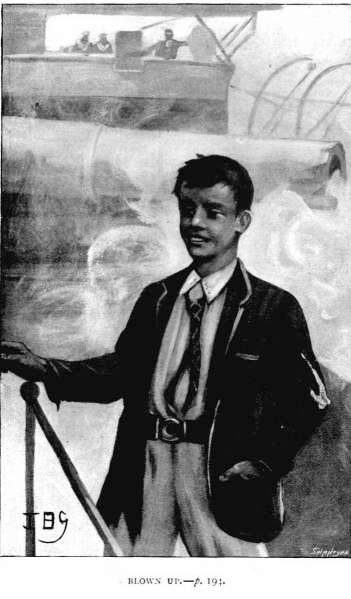
Everybody, as has been said, at once, on the order being given, sought this retreat—everybody, that is, but Bob, who, instead of stepping back like the others, stepped forwards.
At the same moment the signal was given, “Fire!”
A terrific report followed, as if the ship and all its contents were blown up, there being none of the reverberating sound, like that usually heard when heavy guns are fired, as of an express train rushing at speed through the air; but a dull, hollow, sullen, sharp roar, succeeded by the heavy swish of some body, or something, falling into the water alongside, while a thick smoke hung over the deck like a pall.
“By Jingo!” exclaimed the Captain, “the gun has burst!”
Chapter Nineteen.
Bob gets “Blown Up.”
The unexpected explosion, though, caused no confusion, nor indeed any apparent excitement such as would have at once occurred had the accident happened on shore; for, thanks to the admirable discipline always observed on board a man-of-war that flies the glorious old Union Jack, not a man stirred from his station.
It was only through the unusual stillness that prevailed for a moment or two afterwards, that those not on deck became aware that something out of the common had occurred.
“Anybody hurt?” sang out, presently, the officer commanding the ship from the bridge, near the conning tower, where he had been directing her steering—“Anybody hurt there, forrud?”
“No, sir,” promptly replied the gunnery lieutenant in charge of the firing-party, who was standing close by the exploded gun. “Not a soul, sir!”
“Thank God!” said the other in a tone of deep feeling, the anxious expression clearing from his face. “It’s a wonderful escape!”
It was—and more. It was a merciful interposition of Providence!
There were three flag-officers, four post-captains, and several others of lesser rank, in addition to a number of blue-jackets in the immediate neighbourhood of the exploded gun when it burst; but, strange to say, although the muzzle of the weapon had been blown off completely from the chase at the trunnions, and some hundred-weight of the fragments scattered in all directions, many of them piercing the deck and screen bulkhead, every one fortunately escaped injury.
While exchanging congratulations with the other officers, all at once Captain Dresser looked about him for Bob.
But, nowhere was he to be seen in sight.
“By Jove, he must have been blown overboard, and that was the splash in the water I heard!” he exclaimed in alarm; and, turning to his friend the young lieutenant, as they now advanced further forward to have a nearer view of the still smoking gun, he said, “Where, Neville, did you last see the boy?”
“There!” replied the young officer, pointing to the ledge outside the bulkhead, just over the iron ladder-way that led down to the fo’c’s’le, the scene of the accident. “He cannot well have fallen overboard from there!”
“No,” assented the Captain, doubtfully; still at a loss to account for Bob’s mysterious disappearance. “Where can the boy be, though?”
They were just about instituting an organised search through the ship, both in great anxiety; when, who should crawl up from below but the missing young gentleman!
Rover’s look of dejection on being left behind at home in the morning was nothing to that of his young master now; the latter appearing, from his blackened face and rumpled collar, not to speak of his soiled suit of flannels, so beautifully white and clean the moment before, to have “been in the wars” with a vengeance!
“Why, what have you been doing with yourself?” exclaimed the Captain, in blank dismay. “Where have you been?”
Albeit dilapidated in his general exterior, Bob had not lost his voice; his powers of speech being happily still unimpaired.
“I’m all right,” he answered with an attempt at a grin. “I’m all right!”
“But where have you been?” repeated the Captain, whom this off-hand statement did not quite satisfy. “Where have you been?”
“Oh, I got blown up,” explained Bob. “When the gun fired I felt an awful pain in my ears, as if somebody was running a red-hot needle through them going right down to my boots!”
“You must have long ears, youngster,” remarked the young lieutenant slily here. “Very long to reach so far!”
“I didn’t mean that my ears went down to my boots,” replied Bob, rather nettled at the insinuation; and he then continued the account of his experiences of the explosion. “But, as I was saying, I first felt this pain; and then I seemed to be lifted off my feet, tumbling down this ladder here, and after that through a hole in the deck, amongst a lot of coal-dust and oil-cans, that messed my clothes a bit.”
“A bit?” queried the Captain, chuckling now with much satisfaction at seeing him unhurt—“I should say a good deal, judging by appearances, Master Bob!”
“Really?” said he surveying himself ruefully, turning and twisting so as to get a view of his back. “Well, I certainly am dirty, but I didn’t look half so bad before I came up.”
“Ah, it’s the light that does it,” observed the lieutenant, chaffing him. “However, if you will go rolling in the coal-bunkers and making love to the engineer’s oil-cans, you must take the consequences!”
“I didn’t,” replied Bob indignantly. “You don’t think I tumbled down there on purpose, do you?”
“Perhaps not,” said the other, smiling. “But, pray remember, you were told to keep away from the gun; and, if you had obeyed orders, you wouldn’t have got into any mischief.”
“Well, let us be thankful it is no worse,” observed the Captain cheerily. “I hope you are not hurt, Bob, by your roll dawn the hatchway?”
“No, Captain,” he answered, brightening up again after the snub of the lieutenant anent his disobedience, “I fell on the coal-sacks quite softly and haven’t got a scratch.”
“That’s all right then,” echoed Captain Dresser in his joking way; adding to the young officer on his other side, “I wonder if all the ‘cocked hats’ have done examining the gun, and whether there’s a chance now for an old retired fogey like myself having a look at the damage?”
“I should think so, sir,” replied the young officer. “The Admiral, I see, has gone away, and the fellows also from the Ordnance department; so, you’d better come and have a glance round while the coast is clear.”
“I will,” was the response of the old sailor, as, in company with the lieutenant and Bob, he made his way through one of the watertight doors in the forward bulkhead on to the fo’c’s’le; the trio then grouping themselves round the broken breech of the exploded weapon, all that was left now of the whilom big forty-three ton gun!
“Ah! I can see how it happened,” said the old sailor, after a cursory inspection of the fractured portion. “The gun was strong enough at the breech, but went at the muzzle. It has given way, of course, at its weakest point.”
“Yes,” agreed the young lieutenant. “It has parted just here, where the last protecting coil of steel has been shrunk on; the tube of the gun has burst at this unprotected portion of it, right in front of the chase.”
“What’s the reason, sir,” asked Bob, “of its bursting there like that?”
“I suppose because the metal was unable to withstand the strain of the powder charge,” said the Captain. “So, Bob, it went!”
“Pardon me, but I don’t think you’ve got it quite right, sir,” observed the lieutenant apologetically. “The gun was strong enough for the old ‘pebble powder’ it was originally intended to be fired with, the force of whose explosion would have been expended in the breech, which you can’t say is weak?”
“No,” asserted the other, “the gun seems strong enough there.”
“Well, that being the case,” continued the young officer, “the gun might have been fired as many times as you please with the heaviest charges of that powder without its sustaining the slightest injury. Our wise Ordnance people, however, having taken a fancy to a ‘slow combustion powder,’ whose force, instead of being expended in the breech, is sustained throughout the whole length of the gun, as the particles of powder ignite and expand, bethought themselves they would, for cheapness’ sake, use this ‘cocoa powder,’ as it is called, without going to the expense of building additional coils round their heavy guns to enable them to resist the extra strain!”
“So this is the result,” said the old Captain. “It’s just like putting new wine into old bottles!”
“Precisely,” replied the lieutenant, joining in his laugh. “But, don’t you feel hungry, Captain Dresser?”
“I do,” he promptly rejoined. “This sea air give; one the very deuce of an appetite; and I confess to feeling slightly peckish.”
“So am I,” said the other, leading the way to the nearest hatchway. “Let us go down below and see what they’ve got for luncheon. Mind how you step, it’s all dark here, as they haven’t fitted her up yet.”
“That’s plain enough as I can feel!” muttered the Captain in reply as he stumbled against the projecting ledge of one of the watertight bulkheads, knocking his shin. “These new-fashioned ships are all at odds and ends, it seems to me, in their accommodation below. Give me one of the old sort, where everything was really plain sailing and one hadn’t to dive down here and climb up there to get for’ard or aft!”
“Ah,” rejoined the lieutenant, holding out a hand to guide him, “you’d get used to it in time.”
“Just as the eels do to skinning!” growled the Captain, rubbing his sore shins. “I’d rather be excused the practice, though, on my part.”
Bob sniggered at this; and, passing along a narrow dark passage, its obscurity rather increased than diminished by the solitary illuminating power of a single “dip” in a ship’s lantern hung up against the side, the lieutenant stopped the Captain from any further grumbling by introducing him into the ward-room, which, being well lit up with little electric lamps, offered a marked contrast to the other parts of the vessel they had traversed.
To the Captain, indeed, it was like passing from purgatory to fairyland, as he said; the more so from the fact of his seeing a well-spread table before him, and there being a savoury smell permeating the atmosphere.
So, he took his seat with alacrity, prepared to do ample justice to whatever viands were brought forward.
Bob, who came in a little later, his curiosity being attracted by the sight of the open torpedo-room adjacent, with its stores of Whitehead tubes, gave the witty young surgeon, who was facing the door, an opportunity of cracking a joke at the expense of his smutty face, which he had been unable to wash since his tumble amongst the coals.
“Hullo, Pompey!” cried out this worthy, who by the way had been previously chaffed by his brother officers, such is the levity of sailors in imminent peril, about the gun accident not having provided him with any patients. “Hullo, Pompey, you’ve forgotten your banjo and bones!”
Bob did not see the point of the joke at first, although there was a general titter round the lower part of the table where the young surgeon was seated; when Master Bob did, however, he blushed pretty red, looking uncommonly sheepish.
But the lieutenant came to his rescue.
“He has left his bones behind advisedly, Phillips,” said he to the young surgeon, who was smiling still at his own witticism, “because he knew, if he brought them, you would only carve and saw them about as you served those fossils at the hospital.”
This turned the laugh against the other, enabling Bob to sit down in peace and enjoy his luncheon, during which he was much amused at the fun going on amongst the junior officers at their end of the festive board about the splendid chances offered for promotion and “unfortunately missed” by the bursting cannon.
“Just fancy!” observed one of those, speaking in an undertone, so that those of superior rank at the upper end of the table could not hear him. “Three ‘flags,’ four ‘posts,’ half-a-dozen commanders, and two ‘first luffs,’ all within range of that blessed muzzle that carried away; and not one vacancy on the list!”
“It’s positively awful,” chimed in another, in cordial agreement with his brother sub, “we may never have such a chance again!”
The Captain subsequently explained to Bob that they meant that had the several admirals and other officers of rank who stood behind the forty-three ton gun been killed or materially injured when it burst, these thoughtless juniors believed they would have “received a step” on the list, or in other words, would have been probably promoted—which Bob thought extremely wicked and reprehensible on their part.
After the explosion, of course, there was no more gun-practice, the Archimedes slowly making her way back to Spithead, and then into harbour; the broken breech of the unfortunate weapon that had come to grief being carefully covered over with a piece of tarpaulin, so that those on board an Austrian frigate lying in the roadstead, which the ironclad had to go by, should know nothing of the burst, at least from passing observation. We do not like to show our failures to our friends—only our successes!
The Captain and Bob, naturally, got back all the sooner from the trial trip of the Archimedes being thus cut short, reaching “the Moorings,” indeed, just as Mrs Gilmour and her guests were going out for a stroll before dinner; when, Rover pranced up to his young master, all affection and oblivious of any “hard feelings” he might have entertained by being left behind in the morning, repeating his magnanimous conduct on a previous occasion!
“By Jove!” cried the Captain jocularly, addressing Bob’s father. “That son of yours is bound to turn out something great.”
“Really, what’s he been doing now?”
“Why,” replied the old sailor with his customary chuckle, thumping the pavement with his malacca cane to give greater emphasis to his words, “he was half-drowned almost the first evening he came down here; was wrecked in the poor Bembridge Belle the other afternoon; and now, to complete the category, has been blown up to-day.”
“Boys are like cats,” said the barrister smiling. “They all seem endowed with the same proverbial number of lives.”
“How funny, Bob,” observed Nellie here. “Papa says you’re like a cat; so, you must be like Snuffles!”
Bob, however, did not appear to see the joke of this; though it afforded his sister much amusement, which was increased anon by the Captain asking her a question.
“I say, Miss Nell,” he cried out in his jocular way, chuckling the while, “what colour is this celebrated cat of yours, Snuffles?”
“He’s black all over, Captain,” replied Nellie as distinctly as her giggles would permit. “Only, he has four white paws, just as if he had lamb’s-wool socks on, like those mamma makes Bob wear in winter.”
“Humph!” snorted out the old sailor, his beady eyes twinkling with fire and his bushy eyebrows moving rapidly up and down. “If you had seen Master Bob when he first emerged from the fore-peak of the Archimedes after his tumble through the fo’c’s’le and roll amongst the coal-sacks, you would have thought him, missy, more like Snuffles than ever. The only drawback to the likeness was that Bob had but two paws instead of four, and that they were as black as his face!”
“Oh, my!” exclaimed Nellie, shrieking with laughter. “Do you hear that, mamma?”
“Aye, my dear, I’m not joking,” went on the Captain, his face now as grave as a judge. “Do you know he was so black, that they mistook him for one of the Christy minstrels when he came into the ward-room afterwards!”
This finished poor Nell; even Bob, too, joining in the laugh against himself.
Chapter Twenty.
Trawling off the Nab.
The same evening, while they were all on the pier, listening to the band, and chatting pleasantly together in the pauses between the music, Mrs Gilmour turned the conversation upon a matter of extreme interest to Master Bob, and one concerning which he had been in much doubt of mind for some time past; although his native diffidence had prevented him from personally broaching the subject in his own right.
Sitting there within hail of the sea, the soft arpeggio of whose faint ripple on the shore seemed to harmonise with the louder instrumentation of the orchestra, which was just then playing a selection from Weber’s “Oberon,” the talk naturally drifted into a nautical channel; the old sailor dilating, to the delight of his listeners, on the charms of a life afloat and the divine beauty of the ocean, whether in storm or at rest.
“Aye, there’s no life like it,” said he. “A life on the ocean wave!”
“It sounds nice in poetry,” observed the Irish barrister, who although full of sentiment, like most of his countrymen, always tried to hide it under a mask of comedy. “But, I think it must be a very up and down sort of existence. Too uncertain for me, at all events!”
“Oh, Dugald!” remonstrated his wife. “Why, this morning you were rhapsodising over the sea, and wishing you were able to spend your brief life afloat.”
“My brief life, indeed!” exclaimed Mr Strong. “It’s precious few briefs I get, or it would be more pleasant. I wish more of ’em would come in, my dear, to pay for those children’s shoes. They’ve worn out half-a-dozen pairs apiece, I believe, since they’ve been down here!”
“Better a shoemaker’s bill,” said Mrs Gilmour, “than a doctor’s, sure, me dear Dugald.”
“Aye, by Jove!” put in the Captain with a chuckle. “There’s nothing like leather, you know.”
“By the way, talking of that, though I don’t mean to say it’s made like the old Britons’ coracles,” observed Mrs Gilmour silly, “when is that yacht of yours going to be ready, Captain?”
This unexpected inquiry made the old sailor blush a rosy red, for his face was turned westwards towards the setting sun, and all could see it plainly; albeit, he tried to conceal his perturbation by drawing out his brilliant bandana handkerchief and blowing his nose vigorously—an old trick of his.
“I—I—I’m having her done up,” he at length stammered out. “She wanted a lot of repair.”
“So I should think,” rejoined his persecutor, turning round to the others. “You must know, good people, that I’ve been hearing of nothing but this yacht for the last two years; and, would you believe it, I’ve never seen her yet!”
“I assure you—,” began the Captain; but, alas! his enemy, in addition to being a host in herself, had allies of whom he little dreamt; and so he was interrupted ere he could get at a second stammering “I assure you!”
“Why, you promised, Captain,” said Nell mischievously, “the very first time we saw you in the train, to take us out for a ‘sail in your yacht’; and I have been longing so much for it ever since. We thought that was what you meant when you said you were going to take us somewhere or do something that ‘to-morrow come never’ as you called it!”
“You wicked man, to deceive the poor children so!” cried
Mrs Gilmour, shaking her finger at him. “Oh, you bad man!”
But, before he could answer a word, Bob, who had been waiting anxiously for an opening, likewise assailed him.
“Ah! Don’t you remember, Captain, that day when you took Dick down to the Dockyard to get him entered as a sailor boy on board the Saint Vincent, and they wouldn’t take him because he was too thin, you said it didn’t matter, for you would employ him on board your yacht when the racing season began? Why, Dick and I have been looking out for a sail ever since. Don’t you remember?”
“Now, aren’t you ashamed of yourself, sure?” said Mrs Gilmour, following up Bob’s flank attack; his father and mother enjoying the discussion immensely, coupled as it was with the old sailor’s comical embarrassment. “Tell me, now, aren’t you ashamed of yourself?”
Taking off his hat and shoving his hands through his hair until he raised it up on the top of his head in a high ridge, he looked at his tormentors appealingly; although, the merry twinkle in his bird-like eyes took off somewhat from his contrition.
“Do forgive me!” implored he in accents that had a very suspicious chuckle about them. “I confess my sins!”
“You must clear yourself completely, sir, before you can hope to obtain absolution for your sins of omission,” insisted Mrs Gilmour, pretending to be very stern indeed. “Now, prisoner at the bar, answer truly, have you or have you not got a yacht?”
“I have,” he replied solemnly, entering into her humour. “By Jove, I have, ma’am!”
“Well, I’m glad to hear that at all events,” retorted his questioner in rather an injudicial way. “Sure, I didn’t think you had one at all, not having seen it after all your talking about it. What sort of a yacht is it, now?”
“Only a half-decked little cutter of about two or three tons,” answered the Captain abjectly, trying to minimise his offence. “A very little one, ma’am, I assure you.”
Mrs Gilmour burst into a fit of laughter, in which they all joined heartily; the barrister’s jovial roar being heard above the music of the band.
“Ah, no wonder you didn’t like my seeing it!” she cried with pleasant irony, which, however, made the old sailor wince, this “yacht” of his being a subject on which he was wont to enlarge amongst his friends. “Why, from what you said, I thought she was a big schooner like the one that took the cup at Cowes last year when we all went over with those horrid Tomkinses to see the regatta! Call that a yacht, a boat of such a size? I call it a cockleshell!”
This nettled the Captain very considerably, it must be confessed.
“Well, ma’am, you may call it what you please,” he replied shortly, with some little heat, putting on his hat again and jamming it down on his head firmly, using a good deal of force as if expending in that way his latent caloric. “But, cockleshell or no cockleshell, she’s big enough for me!”
“But, Captain dear, isn’t there room enough for me, too?” asked Nell coaxingly, seeing that he was vexed, and sliding her little hand into his, as if to show that she at all events was not joining in the fun against him. “Won’t you take Bob and me?”
Her touch somehow or, other banished his pettishness, enabling him to see that Mrs Gilmour was only joking, and that he had but played into her hands, as he said to himself, by losing his temper over it.
“I tell you what,” he now exclaimed, without a single trace of ill-humour. “You shall see that I’m not ashamed of my little craft, for I’ll have the Zephyr brought over from Gosport to-morrow. What is more, too, the whole lot of you shall go out for a sail in her—by Jove!”
The Captain was as good as his word, the yacht being towed across the following afternoon from Haslar Creek, where she had been lying, ever since the last yachting season, on the mud flats that there exist.
The little craft, which was a dapper cutter with an oyster-knife sort of bow and a clean run aft, as if she could race well when heeling over and show a good deal of her copper sheathing, did not exceed the tonnage mentioned by the Captain.
But, in spite of her smallness of size, she appeared to have the making of a good sea boat in her, and gained many admirers amongst the Southsea watermen as they surveyed her at her new moorings; the little craft being anchored off the coastguard-station and placed now under the charge of Hellyer, when the Captain was not immediately looking after her himself.
Mrs Gilmour, however, remained obdurate; for, though satisfied now that the “yacht” really was an actual fact instead of merely a creation of her old friend’s fancy, being somewhat averse to adventuring her life on the deep save in large vessels, and even of these she confessed feeling rather shy since the wreck of the Bembridge Belle, she, very aggravatingly, declined going out in the cutter—a want of taste on her part shared by her sister-in-law, whose weak nerves supplied a more reasonable pretext for not accepting the Captain’s usual invitation to make the little vessel’s better acquaintance.
Bob’s father, however, exhibited no such reluctance; and, as for Bob himself, he and Nellie and Dick were all in the seventh heaven of delight when, a morning or two afterwards, there being a nice nor’-westerly breeze blowing, which was good both for working out to sea and running home again, the Captain took them for a sail, managing single-handed the smart cutter as only a sailor, such as he was, could.
Thenceforward, Bob’s holidays were all halcyon days.
He had certainly enjoyed himself before; in his rambles on the beach, in his daily dip and new experiences of the delights of swimming; in the various little trips he and Nellie had taken; aye, and in the pleasurable occupation of collecting all those strange wonders of the shore, with which they had been so recently made familiar.
But, never had he enjoyed himself to the extent he did now!
There was nothing, on his once having tasted the joy of sailing, that could compare with it for a moment in his mind; and, if his own tastes had been consulted, he would have been content to have spent morning, noon, and night on board the Zephyr.
It was the same with Dick; and, under the Captain’s able tuition, both the boys soon acquired sufficient knowledge of tacking and wearing, sailing close-hauled and going free with the helm amidships, besides other nice points of seamanship, as to be able almost to handle the cutter as well as their instructor.
Nellie, naturally, could not enter so fully into these details as Bob and Dick; but, still, she took quite as much pleasure as they did in skimming over the undulating surface of the water and hearing the gurgling ripple made by the boat’s keel.
She felt a little alarm sometimes, perhaps, when, with her mainsail sharply braced up, the Zephyr would heel over to leeward, burying her gunwale in the foam ploughed up by her keen-edged bow, as it raced past, boiling and eddying, astern.
On one occasion the Captain took them out trawling between the Nab and Warner light-ships; where a bank of sand stretches out to sea, forming the favourite fishing-ground of the Portsmouth watermen hailing from Point and the Camber at the mouth of the harbour.
“What is trawling?” asked Master Bob, of course, when the matter was mooted by the owner of the cutter.
“What is trawling, eh?” repeated the old sailor, humming and cogitating for a minute or so. “Let me see; ah, yes, you let down a trawl and catch your fish in it, instead of using a line or drag-net.”
“Sure, Captain,” cried Mrs Gilmour, laughing at this, “that’s as good as your definition of steam the other day! You’ll have Bob asking you now what is a trawl, the same as I’ve got to do; please tell us, won’t you?”
“Sure and I will,” returned he, imitating her accent and making her brother and herself laugh, Mrs Strong only smiling faintly, as she had a marked dislike to any allusion to the Irish brogue. “The trawl, ma’am, is a very simple contrivance when it is understood; and, by your leave, I’ll try and make it plain to you. It consists of an ordinary net, like a seine, which you’ve seen, of course?”
“Yes,” replied his questioner, “I have seen them dragging the seine, as it is called, down on the beach often.”
“Oh, auntie, Nell and I saw them, too, the day after that storm we had when we first came,” said Bob eagerly. “I know, because I asked the men what they were doing, and they told me.”
“There’s nothing like asking for information,” observed the Captain approvingly. “It’s lucky, though, those men told you at once, or you’d have worried their lives out!”
“Sure and you may well say that,” put in Mrs Gilmour. “You have to suffer frequently from some little people’s thirst for knowledge.”
“I don’t mind,” chuckled the Captain, beaming with good-humour. “But, to go on with my description of the trawl. You must imagine, as I have said, an ordinary seine net, which must be a small one, and that looped up at the corners, too, somewhat in the shape of a funnel, or rather in the form of a cone sliced in two. The mouth of this apparatus is kept open on its flat side by means of a pole some ten or twelve feet long, termed the ‘trawl-beam,’ which floats uppermost when the net is down; while the lower side is weighted with a thick heavy piece of hawser styled the ‘ground-rope,’ around which the meshes of the net are woven. A bridle or ‘martingale’ unites the two ends of the trawl-beam.”
“Yes, I see,” said Bob, who was all attention, and taking the greatest interest in the Captain’s explanation. “I see.”
“Well,” continued the old sailor, “to this bridle there is attached a double-sheaved block, through which runs a hundred-and-fifty fathom rope, capable of bearing a heavy strain. But, in hauling this in, great nicety must be observed, for, the slightest hitch or deflection will cause the beam to turn the wrong way; when, if the net ‘gets on her back,’ as the fisher-folk say, all your catch is simply turned out into ‘the vasty deep,’ and your toil results in a case of ‘Love’s labour lost!’”
“But, what do you do with the net and beam, when it’s all ready?” asked Bob. “You haven’t told us that, yet.”
“Why, drop it over the side as soon as you get out to the fishing-ground,” replied the Captain laconically; “and now, I hope, you understand all about it?”
“Oh yes,” responded his listeners with alacrity; all, that is, but Mrs Gilmour, who assented somewhat dubiously, as if she could not quite grasp the idea, requiring the whole thing to be explained to her over again, when she declared herself still “all in a fog!”
Her brother, however, the barrister, comprehended it at once.
“I should think it was great fun,” he observed; “so I would like to come with you.”
“Do,” said the Captain, with much heartiness. “You’ll be amply repaid for the trouble. It is intensely exciting waiting and watching for what the trawl will bring up. It’s just like dipping your hands in the ‘lucky bag,’ Miss Nellie, at Christmas-time.”
“Do you ever find any very curious things, Captain?” she inquired on being thus appealed to. “I mean really curious things!”
“Oh yes, my dear,” replied the old sailor. “I was once out trawling with a fisherman off Saint Helens, when we dragged up a donkey-cart!”
“O-oh!” exclaimed Nellie, opening her blue eyes wide with wonder. “Did you catch the donkey as well?”
“Well, no,” answered the Captain, smiling at her amazement, her eyes being so big and her face such a study. “The poor man’s donkey, missy, had been eaten by the crabs, but the cart was there, shafts, wheels, and all; and, a nice mess the lot made of the trawl-net, tearing it all to pieces!”
“That clenches it then. I’ll come with you by all means!” cried Mr Dugald Strong, a pleased smile creeping over his face as he rubbed his hands with expectant glee. “If you find such strange fish as that, it must be worth going out.”
“All right, I shall be glad of your company,” replied the Captain; “only, mind, you’ll have to work your passage, and help hauling in the trawl.”
“I agree to that,” said the other; and, the matter being thus settled, it was arranged that they should proceed the following day on their expedition, if the weather were favourable and nothing occurred to alter their plans. Nellie was specially granted permission to accompany the party, much against the wish of her mother, who declared that she would spoil all her things to a certainty; saying besides, that, from what she had gathered of the conversation, she did not believe trawling was a very ladylike pursuit, “for little girls, at all events.”
However, all the same, Miss Nellie was up betimes the next morning, and sallied out with Bob and his father, whose pet she was, just as the early milkman was coming his rounds; the trio getting down to the beach punctually at seven o’clock, the hour fixed by the Captain for their start.
Here they found the old sailor and Dick, ready and waiting for them; when, going off in the little dinghy belonging to the Zephyr, although the boat had to make a couple of passages to and fro, being only capable of accommodating two passengers besides proud Dick the sculler, they were soon all on board.
The cutter, then, having her jib and mainsail already set, had only to slip her moorings, and was off and away, bowling out seaward before the breeze, which was blowing from the land.
The morning was bright and balmy; and the sun having risen some hours earlier even than the very early risers of the party, its beams by this time warmed the heavens and lit up the landscape, the rose-tints of dawn being succeeded by a golden glow all over the sky, the sea dancing in sympathy and sparkling in the sunlight—being altogether too merry to look blue.
It did not take the little craft long, running before the wind with a slack sheet, to reach the Horse Shingle shoal, beyond the outlying fort, and near the Warner light-ship, where lay the fishing-ground, or “bank,” which the Captain had described as being especially favourable for their sport.
“Now,” said the old sailor, “the time for action has at last arrived. We must get ready to ‘shoot’ the trawl.”
“You are not going to fire?” cried Nell in alarm, hearing him use the technical term he had employed. “I’m so afraid of guns.”
“No, my dear,” he answered chuckling, “I meant pitching the trawl over the side, just in the same way as you say ‘shooting’ coals or rubbish. Are you ready at your end, Strong?”
“Yes, I’m all right,” replied the barrister, who had been ably helping the Captain in arranging the meshes of the net along the starboard-gunwale, out of the way of the swing of the boom, and getting the trawl-beam across the stern-sheets of the cutter; while Bob and Dick attended to the sheets and tiller. “Fire away, Captain Dresser!”
“Well, then, let us heave over,” sang out the Captain, in his quarter—deck voice, as he called it. “One—two—three—off she goes!”
So, with a dull plunge, the trawl was “shot,” the old sailor and Mr Strong quickly pitching over the side, after it, the bunchy folds of the net; when the guy-rope fastened to the bridle of the beam was secured to the bowsprit-bitts and then again to a thole-pin aft, so as to prevent its getting under the keel.
The boat was then allowed to fill her jib and drift out with the ebbing tide, keeping a straight course for the Nab, and steering herself by means of the dragging net astern; neither the services of Bob nor of Dick being required any further at the helm under the circumstances.
“You can light your pipe now, if you like,” said Captain Dresser to Mr Strong, when this was satisfactorily accomplished. “We shall have nothing to do for the next hour or two; for we must have the net down long enough to let something have a chance of getting into the pocket of it.”
“I suppose the smell of tobacco won’t frighten the fish?” observed the barrister, gladly taking advantage of the permission and striking a vesuvian, his pipe being already loaded and ready. “Fresh-water anglers are rather particular on the point.”
“Bless you, no!” replied the old sailor laughing, “our fish at sea know what’s good for them and like it!”
Miss Nell, who seemed anxious about something, presently hazarded a question when her father had lit his pipe and was smoking comfortably on the forecastle.
“Are we not going to have any breakfast?” said she, in a very grave way, as befitted a matter of such deep importance. “I feel very hungry.”
“Dear me, I was almost forgetting breakfast!” cried the Captain, throwing away the end of the cigar the barrister had offered him, which he was smoking rather against the grain, preferring his tobacco in the form of snuff. “Dick, did you bring the things all right as I told you?”
“Yes, sir,” replied Dick. “They be in the fo’c’s’le, sir.”
“Is the coffee on the stove?”
“Yes, sir, and biling.”
“That’s right,” said the Captain, who continued, turning to Nellie, “Now, missy, you can preside over our breakfast-table if you like. You’ll find all the traps ready in the little cabin for’ard under the half-deck.”
Thereupon, Miss Nellie, with much dignity, busied herself in pouring out the coffee, which had been kept hot all the while on “such a dear little stove,” as she called out to Bob the moment she caught sight of it in the fore-cabin; the pair constituting themselves steward and stewardess instanter, and serving out, with Dick’s help, their rations to the rest of the company.
They were in the midst of breakfast, the trawl having been dragging along the bottom of the sea for not quite an hour, when, all at once, the rope holding it attached to the bowsprit-bitts began to jerk violently.
“Hallo!” cried the Captain, starting up from his seat on one of the bunks in the little cabin, which, even with stooping, he and Mr Strong found it a hard matter to squeeze themselves into. “We’ve caught something big this time!”
“Do you think it’s a whale?” said Nell, jumping up also, abandoning in her hurry her post as mistress of the ceremonies. “It must be awfully big to make that great rope shake so!”
The old sailor chuckled till his sides shook.
“You seem wonderfully fond of whales, missy!” he exclaimed, turning round as soon as he had managed to wriggle himself out of the fo’c’s’le and was able to stand erect again. “Don’t you remember, you mistook those grampuses we came across the other day when going to Seaview for whales?”
“Yes; and I remember, too, Captain, your making fun of me then, the same as now,” replied Nell, smiling as she went on. “I don’t mind it though, for I like being here with you and dad!”
“That’s right, my dear,” replied the old sailor. “There’s nothing like keeping your temper. But, we must now see about hauling in the trawl; for the chap who has got into the net is a big fellow, whoever he is, and, if we don’t pull him in pretty sharp, he’ll knock our net to pieces!”
So saying, the Captain brought the end of the tackle to the little windlass placed amidships; when he and Mr Dugald Strong, who did not find the task, by the way, as easy as he imagined, began reeling in the trawl rope fathom by fathom, until, anon, the end of the beam was seen peering above the water alongside.
The jerking of the tackle, which had continued all the time they were hauling in, appeared to increase as the trawl was raised to the surface, the net now that it was within view swaying from side to side; and, when Captain Dresser and the barrister leant over the gunwale to lift in the beam with its pocket attached, there was a hoarse barking sound heard proceeding from the folds of the net, like that of a dog in the distance.
“Oh!” cried Nellie, in alarm, climbing up on the thwarts and getting as far away as she could—“what is it?”
“What is it?” echoed Bob in the same breath. “What is it?”
The Captain, however, did not immediately satisfy their curiosity.
“I’ve got my suspicions,” he commenced in a leisurely way as he bent a little more over the side to get a better hold of the net; but, what he saw, as the trawl lifted out of the sea, made him quicken his speech, and he exclaimed in a much louder tone— “Take care, missy, and look out, you boys! There’s a shark in the trawl-net, and a pretty venomous beast, too!”
Chapter Twenty One.
The Spoils of the Sea.
“A shark!” yelled out Mister Bob, evincing much greater fright than his sister Nell, although he was very fond of referring to her contemptuously as “being only a girl,” when manly exploits happened to be the topic of conversation and she chanced to hazard an opinion; and, at the same instant, he jumped madly from the gunwale of the little cutter on to the top of her half-deck forwards, climbing from thence into the lee rigging, where he evidently thought he would be safer. “A shark! Won’t it bite?”
“Aye, by Jove, it will!” said the Captain ironically. “I’d swarm up to the masthead, if I were you, so as to be out of harm’s way. You needn’t mind your sister or any of us down here. We can take care of ourselves!”