Part 1 — PART I.
Reading edition
PART I.
COME AND SHOW YOUR FACE, LIKE A MAN!
If I were asked to point to a space of ground which, of all other spaces in the world, most truly represents the good and bad, the high and low, of humanity, I should unhesitatingly describe a circle of a mile around Westminster Abbey. Within that space is contained all that ennobles life, and all that debases it; and within that space, at the same moment, the lofty aspiration of the statesman pulses in the great Senate House in unison with the degraded desires of the inhabitant of Old Pye-street. There St. Giles and St. James elbow each other. There may be seen, in one swift comprehensive glance, all the beauty and ugliness of life, all its hope and hopelessness, all its vanity and modesty, all its knowledge and ignorance, all its piety and profanity, all its fragrance and foulness. The wisdom of ages, the nobility that sprung from fortunate circumstance or from brave endeavour, the sublime lessons that lie in faith and heroism, sanctify the solemn aisles of the grand old Abbey. Within its sacred cloisters rest the ashes of the great: outside its walls, brushing them with his ragged garments, skulks the thief--and worse.
But not with these contrasts, nor with any lesson that they may teach, have you and I to deal now. Our attention is fixed upon the striking of eight o'clock by the sonorous tongue of Westminster. And not our attention alone--for many of the friends with whom we shall presently shake hands are listening also; so that we find ourselves suddenly plunged into very various company. Ben Sparrow, the old grocer, who, just as One tolls, is weighing out a quarter of a pound of brown sugar for a young urchin without a cap, inclines his head and listens, for all the world as if he were a sparrow, so birdlike is the movement: Bessie Sparrow, his granddaughter, who, having put Tottie to bed, is coming downstairs in the dark (she has left the candle in the washhand-basin in Tottie's room, for Tottie cannot go to sleep without a light), stops and counts from One to Eight, and thinks the while, with eyes that have tears in them, of Somebody who at the same moment is thinking of her: Tottie, with one acid-drop very nearly at the point of dissolution in her mouth, and with another perspiring in her hand, lies in bed and listens and forgets to suck until the sound dies quite away: a patient-looking woman, pausing in the contemplation of a great crisis in her life, seeks to find in the tolling of the bell some assurance of a happy result: James Million, Member of Parliament, whose name, as he is a very rich man, may be said to be multitudinous, listens also as he rolls by in his cab; and as his cab passes the end of the street in which Mrs. Naldret resides, that worthy woman, who is standing on a chair before an open cupboard, follows the sound, with the tablecloth in her hand, and mutely counts One, Two, Three, Four, Five, Six, Seven, Eight, the last number being accompanied by a resigned sigh, as if Eight were the end of all things.
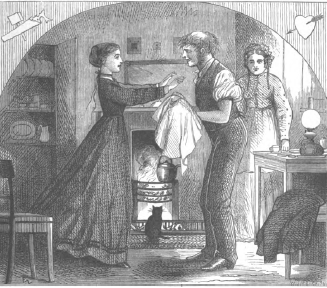
The room in which Mrs. Naldret is standing is poor and comfortable; a cheerful fire is burning, and the kettle is making up its mind to begin to sing. An old black cat is lazily blinking her eyes at the little jets of gas that thrust their forked tongues from between the bars of the stove. This cat is lying on a faded hearthrug, in which once upon a time a rampant lion reigned in brilliant colours; and she is not at all disturbed by the thought that a cat lying full-length upon a lion, with his tongue hanging out, is an anomaly in nature and a parody in art. There is certainly some excuse for her in the circumstance that the lion is very old, and is almost entirely rubbed out.
Mrs. Naldret steps from the chair with the tablecloth in her hand, and in one clever shake, and with as nimble a movement as any wizard could have made, shakes it open. As it forms a balloon over the table, she assists it to expel the wind, and to settle down comfortably--being herself of a comfortable turn of mind--and smoothes the creases with her palms, until the cloth fits the table like wax. Then she sets the tea-things, scalds the teapot, and begins to cut the bread and to butter it. She cuts the bread very thick, and butters it very thin. Butter is like fine gold to poor people.
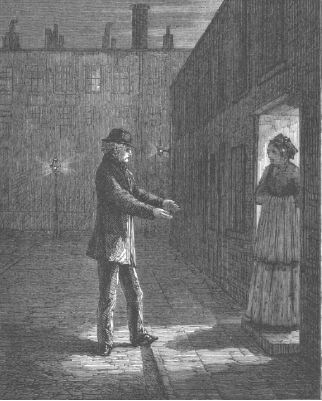
'I don't remember,' she says, pausing to make the reflection, with the knife in the middle of the loaf, 'its being so cold for a long time. To be sure, we're in December, and it'll be Christmas in three weeks. Christmas!' she repeats, with a sigh, 'and George'll not be here. He'll be on the sea--on the stormy ocean. It'll be a heavy Christmas to us. But, there! perhaps it's all for the best; though how George got the idea of emigrating into his head, I can't tell; it seemed to come all of a sudden like. The house won't seem like the same when he's away.' For comfort, her thoughts turn in another direction--towards her husband. 'I wish father was home, though it isn't quite his time--and he's pretty punctual, is father.' She goes to the window, and peeps at the sky through a chink in the shutters. 'It looks as if it was going to snow. What a bright clear night it is, but how cold! It's freezing hard!' Turning, she looks at the fire, and at the cozy room, gratefully. 'Thank God, we've got a fire, and a roof to cover us! God help those who haven't! There are a many of 'em, poor creatures, and times are hard.' She turns again to the window, to takes another peep at the sky through the shutters, and finds the light shut out. 'There's some one looking into the room!' she exclaims, retreating hastily out of view. 'It can't be Jim--he's never done such a thing. He's only too glad to get indoors such nights as this. And it can't be George. And there's the lock of the street-door broken--no more use than a teapot with a hole in the bottom.' Being a woman of courage, Mrs. Naldret runs into the passage, and opens the street-door. 'Who's there? she cries, looking into the street, and shivering, as the cold wind blows into her face. 'Who's there? Don't sneak away like that, but come and show your face, like a man!'
The man pauses at the challenge, stands irresolute for a moment or two, then walks slowly back to the window, with hanging head.
'Show my face, like a man!' he repeats, sadly, bitterly, and with a world of self-reproach in his tone. 'There's not much of that stuff left in me, Mrs. Naldret.'
'Good Lord!' she exclaims, as he stands before her like a criminal. 'It's Saul Fielding!'
'Yes,' he replies. 'It's Saul Fielding, God help him!'
'Why can't Saul Fielding help himself?' she retorts, half angrily, half pityingly. 'There was stuff enough in him once--at all events I thought so.'
'Show me the way!' he cries; but lowers his tone instantly, and says humbly, 'I beg your pardon, Mrs. Naldret, for speaking in that manner. It's ungrateful of me to speak like that to any of George's friends. and least of all to his mother, that George loves like the apple of his eye.'
'So he does, dear lad,' says the grateful woman, 'and it does my heart good to hear you say so. But you've nothing to be grateful to me for, Saul. I've never done you any good; it's never been in my power.'
'Yes, you have, and it has been in your power, Mrs. Naldret. Why, it was only last week that you offered me----'
'What you wouldn't take,' she interrupts hastily; 'so you don't know if I meant it. Let be! Let be!'
'----That you offered me food,' he continues steadily. 'But it's like you and yours to make light of it. You've never done me any good! Why, you're George's mother, and you brought him into the world! And I owe him more than my life--ay, more than my life!'
'I know the friendship there was between you and George,' she says, setting the strength of his words to that account, 'and that George loved you like a brother. More's the pity, because of that, that you are as you are.'
'It is so,' he assents meekly; 'but the milk's spilt; I can't pick it up again.'
'Saul, Saul! you talk like a woman!'
'Do I?' he asks tenderly, and looking into her face with respect and esteem in his eyes. 'Then there's some good left in me. I know one who is stronger than I am, better, wiser, than a hundred such as I--and I showed my appreciation of her goodness and her worth by doing her wrong. Show my face like a man! I ought to hide it, as the moles do, and show my contempt for myself by flying from the sight of men!'
Filled with compassion, she turns her face from him so that she may not witness his grief.
'She is the noblest, the best of women!' he continues. 'In the face of God, I say it. Standing here, with His light shining upon me, with His keen wind piercing me to my bones (but it is just!), I bow to her, although I see her not, as the nearest approach to perfect goodness which it has ever been my happiness and my unhappiness to come in contact with. Ay; although virtue, as humanly exercised, would turn its back upon her.'
'Are you blaming the world, Saul Fielding,' she asks, in a tone that has a touch of sternness in it, 'for a fault which is all your own?'
'No,' he answers; 'I am justifying Jane. I blame the world! a pretty object I, to turn accuser!'
He appeals to his rags, in scorn of them and of himself.
'Saul Fielding,' she says, after a pause during which she feels nothing but ruth for his misery, 'you are a bit of a scholar; you have gifts that others could turn to account, if they had them. Before you--you----'
'Went wrong,' he adds, as she hesitates, 'I know what you want to say. Go on, Mrs. Naldret. Your words don't hurt me.'
'Before that time, George used to come home full of admiration for you and your gifts. He said that you were the best-read man in all the trade, and I'm sure, to hear you speak is proof enough of that. Well, let be, Saul; let the past die, and make up your mind, like a man, to do better in the future.'
'Let the past die!' he repeats, as through the clouds that darken his mind rifts of human love shine, under the influence of which his voice grows indescribably soft and tender. 'Let the past die! No, not for a world of worlds. Though it is filled with shame, I would not let it go.--What are you looking for?'
'It's Jim's time--my husband's--for coming home,' she says, a little anxiously, looking up the street. 'He mightn't like----' But again she hesitates and stumbles over her words.
'To see you talking to me. He shall not My eyes are better than his, and the moment I see him turn the corner of the street, I will go.'
'What were you looking through the shutters for?'
'I wanted to see if George was at home.'
'And supposing he had been?'
'I should have waited in the street until he came out.'
'Do you think Jim Naldret would like to see his son talking to Saul Fielding?'
'No, I don't suppose he would,' he replies quietly; 'but for all that, I shall do George no harm. I would lay down my life to serve him. You don't know what binds me and George together. And he is going away soon--how soon, Mrs. Naldret?'
'In a very few days,' she answers, with a sob in her throat.
'God speed him! Ask him to see me before he goes, will you, Mrs. Naldret?'
'Yes, I will, Saul; and thank you a thousand times for the good feeling you show to him.'
'Tell him that I have joined the waits, and that he will hear my flute among them any night this week. I'll manage so that we don't go away from this neighbourhood till he bids good-bye to it.'
'Joined the waits!' she exclaims. 'Good Lord! Have you come to that?'
'That's pretty low, isn't it?' he says, with a light laugh, and with a dash of satire in his tone. 'But, then, you know--playing the flute--is one of my gifts--(I learnt it myself when I was a boy)--and if s the only thing I can get to do. Is there any tune you're very fond of, and would like to hear as you lie a-bed? If there is, we'll play it.'
'If you could play a tune to keep George at home,' says Mrs. Naldret, 'that's the tune I'd like to hear.'
'Your old Gospel of contentment, Mrs. Naldret,' he remarks.
'I like to let well alone,' she replies, with emphatic nods; 'if you'd been content with that, years ago, instead of trying to stir men up----'
'I shouldn't be as I am now,' he says, interrupting her; 'you are right--you are right. Good-night, and God bless you!'
He shuffles off, without waiting for another word, blowing on his fingers, which are almost frozen. Mrs. Naldret, who is also cold enough by this time, is glad to get to her fireside, to warm herself. Her thoughts follow Saul Fielding. 'Poor fellow!' she muses. 'I should like to have had him by the fire for a while, but Jim would have been angry. And to be sure it wouldn't be right, with the life he's been leading. But how well he talks, and how clever he is! What'll be the end of him, goodness only knows. He's made me feel quite soft. And how he loves George! That's what makes me like him. "You don't know what binds me and George together," he said. "I would lay down my life to serve him," he said. Well, there must be some good in a man who speaks like that!'
AND SO THE LAD GOES ON WITH HIS BESSIE AND HIS BESSIE, UNTIL ONE WOULD THINK HE HAS NEVER A MOTHER IN THE WORLD.
By an egregious oversight on the part of the architect, designer, or what not, the door of Mrs. Naldret's room turned into the passage, so that whenever it was opened the cold wind had free play, and made itself felt. Mrs. Naldret, bending before the fire to warm herself, does not hear the softest of raps on the panel, but is immediately afterwards made sensible that somebody is coming into the room by a chill on the nape of her neck and down the small of her back, 'enough to freeze one's marrow,' she says. She knows the soft footfall, and, without turning, is aware that Bessie Sparrow is in the room.
'Come to the fire, my dear,' she says.
Bessie kneels by her side, and the two women, matron and maid, look into the glowing flames, and see pictures there. Their thoughts being on the same subject, the pictures they see are of the same character--all relating to George, and ships, and wild seas, and strange lands.
'I dreamt of you and George last night,' says Mrs. Naldret, taking Bessie's hand in hers. She likes the soft touch of Bessie's fingers; her own are hard and full of knuckles. The liking for anything that is soft is essentially womanly. 'I dreamt that you were happily married, and we were all sitting by your fireside, as it might be now, and I was dancing a little one upon my knee.'
'O, mother!' exclaims Bessie, hiding her face on Mrs. Naldret's neck.
'I told father my dream before breakfast this morning, so it's sure to come true. The little fellow was on my knee as naked as ever it was born, a-cocking out its little legs and drawing of them up again, like a young Samson. Many a time I've had George on my knee like that, and he used to double up his fists as if he wanted to fight all the world at once. George was the finest babby I ever did see; he walked at nine months. He's been a good son, and'll make a good husband; and he's as genuine as salt, though I say it perhaps as shouldn't, being his mother. Is your grandfather coming into-night, Bess?
'I don't think it. He's busy getting ready a Christmas show for the window; he wants to make it look very gay, to attract business: Grandfather's dreadfully worried because business is so bad. People are not laying out as much money as they used to do.'
'Money don't buy what it used to do, Bess; things are dearer, and money's the same. Father isn't earning a shilling more to-day than he earnt ten years ago, and meat's gone up, and rent's gone up, and plenty of other things have gone up' But we've got to be contented, my dear, and make the best of things. If George could get enough work at home to keep him going, do you suppose he'd ever ha' thought of going to the other end of the world?' She asks this question, with a shrewd, watchful look into Bessie's face, which the girl does not see, her eyes being towards the fire; and adds immediately, 'Although he's not going for long, thank God.'
'It is very, very hard,' sighs Bessie, 'that he should have to go.'
'It would be harder, my dear, for him to remain here doing nothing. There's nothing that does a man--or a woman either, Bess--so much mischief as idleness. My old mother used to say that when a man's idle, he's worshipping the devil. You know very well, Bess, that I'm all for contentment. One can make a little do if one's mind is made up for it--just as one can find a great deal not enough if one's mind is set that way. For my part, I think that life's too short to worrit your inside out, a-wishing for this, and a-longing for that, and a-sighing for t'other. When George began to talk of going abroad, I said to him, "Home's home, George, and you can be happy on bread-and-cheese and kisses, supposing you can't get better." "Very well, mother," said George, "I'm satisfied with that. But come," said he, in his coaxing way--you know, Bessie!--"But come, you say home's home, and you're right, mammy." (He always calls me mammy when he's going to get the best of me with his tongue--he knows, the cunning lad, that it reminds me of the time when he was a babby!) "You're right, mammy," he said; "but I love Bess, and I want to marry her. I want to have her all to myself," he said. "I'm not happy when I'm away from her," he said. "I want to see her a-setting by my fireside," he said. "I don't want to be standing at the street-door a-saying goodnight to her"--(what a long time it takes a-saying! don't it, Bess? Ah, I remember!) "a-saying good-night to her with my arm round her waist, and my heart so full of love for her that I can hardly speak"--(his very words, my dear!)--"and then, just as I'm feeling happy and forgetting everything else in the world, to hear grandfather's voice piping out from the room behind the shop, 'Don't you think it's time to go home, George? Don't you think that it's time for Bessie to be a-bed?' And I don't want," said George, "when I answer in a shamefaced way, 'All right, grandfather; just five minutes more!' to hear his voice, in less than a half a minute, waking me out of a happy dream, calling out, 'Time's up, George! Don't you think you ought to go home, George? Don't you think Bessie's tired, George?" "That's all well and good," said I to him; "but what's that to do with going abroad?" "O, mammy," he said, "when I marry Bessie, don't I want to give her a decent bed to lie upon? Ain't I bound to get a bit of furniture together?" Well, well; and so the lad goes on with his Bessie and his Bessie, until one would think he has never a mother in the world.'
There is not a spice of jealousy in her tone as she says this, although she pretends to pout, for the arm that is around Bessie tightens on the girl's waist, and the mother's lips touch the girl's face lovingly. All that Mrs. Naldret has said is honey to Bessie, and the girl drinks it in, and enjoys it, as bright fresh youth only can enjoy.
'So,' continues Mrs. Naldret, pursuing her story, 'when George comes home very down in the mouth, as he does a little while ago, and says that trade's slack, and he don't see how he's to get the bit of furniture together that he's bound to have when he's married, I knew what was coming. And as he's got the opportunity--and a passage free, thanks to Mr. Million'--(here Mrs. Naldret looks again at Bessie in the same watchful manner as before, and Bessie, in whose eyes the tears are gathering, and upon whose face the soft glow of the firelight is reflected, again does not observe it)--'I can't blame him; though, mind you, my dear, if he could earn what he wants here, I'd be the last to give him a word of encouragement But he can't earn it here, he says; times are too bad. He can't get enough work here, he says; there's too little to do, and too many workmen to do it. So he's going abroad to get it, and good luck go with him, and come back with him! Say that, my dear.'
'Good luck go with him,' repeats Bessie, unable to keep back her tears, 'and come back with him!'
'That's right. And, as George has made up his mind and can't turn back now, we must put strength into him, whether he's right or whether he's wrong. So dry your eyes, my girl, and send him away with a light heart instead of a heavy one. Don't you know that wet things are always heavier to carry than dry? George has got to fight with the world, you see; and if a young fellow stands up to fight with the tears running down his cheeks, he's bound to get the worst of it But if he says, "Come on!" with a cheerful heart and a smiling face, he stands a good chance of winning--as George will, you see if he don't!'
'You dear good mother!' and Bessie kisses Mrs. Naldret's neck again and again.
'Now, then,' says Mrs. Naldret, rising from before the fire, 'go and wash your eyes with cold water, my dear. Go into George's room. Lord forgive me!' she soliloquises when Bessie has gone, 'I'd give my fingers for George not to go. But what's the use of fretting and worriting one's life away now that he's made up his mind? I shall be glad when they are married, though I doubt she doesn't love George as well as George loves her. But it'll come; it'll come. Times are different now to what they were, and girls are different. A little more fond of dress and pleasure and fine ways. She was very tender just now--she feels it now that George is really going. It would be better for her if he was to stay; but George is right about the times being hard. Ah, well! it ain't many of us as gets our bread well buttered in this part of the world! But there! I've tasted sweet bread without a bit of butter on it many and many a time!'
YOU WORE ROSES THEN, MOTHER.
Having made this reflection, Mrs. Naldret thinks of her husband again, and wonders what makes him so late to-night. But in a few moments she hears a stamping in the passage. 'That's Jim,' she thinks, with a light in her eyes. A rough comely man; with no hair on his face but a bit of English whisker of a light sandy colour in keeping with his skin, which is of a light sandy colour also. Head well shaped, slightly bald, especially on one side, where the hair has been worn away by the friction of his two-foot rule. When Jim Naldret makes a purse of his lips, and rubs the side of his head with his rule, his mates know that he is in earnest. And he is very often in earnest.
'It's mortal cold, mother,' he says almost before he enters.
'There's a nice fire, father,' replies Mrs. Naldret cheerfully; 'that'll soon warm you.'
'I don't know about that,' he returns, with the handle of the door in his hand. 'Now look here,--did you ever see such a door as this? Opens bang into the passage.'
'You're always grumbling about the door, father.'
'Well, if I like it, it doesn't do any one any harm, does it? The architect was a born fool, that's what he was.'
To support his assertion that the architect was a born fool, Jim Naldret thinks it necessary to make a martyr of himself; so he stands in the draught, and shivers demonstratively as the cold wind blows upon him.
'Never mind the door, Jim,' says Mrs. Naldret coaxingly. 'Come and wash your hands.'
'But I shall mind the door!' exclaims Jim Naldret, who is endowed with a large organ of combativeness, and never can be induced to shirk an argument. 'The architect he made this door for warm weather. Then it's all very well. But in this weather, it's a mistake, that's what it is. Directly you open it, comes a blast cold enough to freeze one. I ain't swearing, mother, because I say blast.'
This small pleasantry restores his equanimity, and he repeats it with approving nods; but it produces little effect upon his wife, who says,
'Will you wash your hands and face, father, instead of maudlin?'
'All right, all right, mother! Bring the basin in here, and I'll soon sluice myself.'
Mrs. Naldret, going to their bedroom, which is at the back of the parlour, to get the soap and water, calls out softly from that sanctuary,
'Bessie's here, father.'
'Ah,' he says, rubbing his knuckles before the fire. 'Where is she?'
'Up-stairs in George's room. She'll be down presently. She's pretty low in spirits, father.'
'I suppose you've been having a cry together, mother,' By this time Mrs. Naldret has brought in a basin of water and a towel, which she places on a wooden chair, 'I daresay George'll pipe his eye a bit too, when he says good-bye to some of his mates. Ugh! the water is cold!'
'George pipe his eye! Not him! He's a man is George--not one of your crying sort.'
'I don't know about that,' gasps Jim Naldret; 'a man may be crying although you don't see the tears running down his face. Ugh!'
There was something apposite to his own condition in this remark, for Jim's eyes were smarting and watering in consequence of the soap getting into them.
'That's true, Jim. Many a one's heart cries when the eyes are dry.'
'I can't get over Mr. Million getting that passage-ticket for George. I can't get over it, mother. It's bothered me ever so much.'
'Well, it's only steerage, Jim, and you can't say that it wasn't kind of Mr. Million.'
'I don't know so much about that, mother.'
'Do you know, Jim,' says Mrs. Naldret, after a pause, during which both seem to be thinking of something that they deem it not prudent or wise to speak about, 'that I've sometimes fancied----' Here the old black cat rubs itself against her ankles, and she stoops to fondle it, which perhaps is the reason why she does not complete the sentence.
'Fancied what, mother?
'That young Mr. Million was fond of Bessie.'
'I shouldn't wonder,' he replies, with a cough. 'Who wouldn't be?'
'Yes; but not in that way.'
'Not in what way, mother?'
'You drive me out of all patience, Jim. As if you couldn't understand--but you men are so blind!'
'And you women are so knowing!' retorts Jim Naldret, in a tone made slightly acid because he is groping about for the towel, and cannot find it. 'Where is the towel, mother? That's Bessie's step, I know. Come and kiss me, my girl.'
'There!' exclaims Bessie, who has just entered the room, standing before him with an air of comical remonstrance, with patches of soapsuds on her nose and face, 'you've made my face all wet.'
'Father never will wash the soap off his skin before he dries it,' says Mrs. Naldret, wiping Bessie's face with her apron.
'Never mind, Bessie,' says Mr. Naldret, rubbing himself hot; 'your face'll stand it better than some I've seen. I can't wash the colour out of your cheeks.'
Bessie laughs, and asks him how does he know? and says there is a sort of paint that women use that defies water. While Mrs. Naldret tells him not to be satirical, remarking that all women have their little weaknesses.
'Weaknesses!' echoes Mr. Naldret, digging into the corners of his eyes viciously. 'It's imposition, that's what it is!'
'You'll rub all the skin off your face, if you rub like that.'
'It's a playing a man false,' continues Jim Naldret, not to be diverted from the subject, 'that's what it is. It's a----'
'Is George coming home to tea, do you know, father?' asks Mrs. Naldret, endeavouring to stem the torrent.
'No; he told me we wasn't to wait for him. It's a trading under false pretences----'
'Not coming home to tea! And here I've been laying the tablecloth for him, because I know he enjoys his tea better when there's something white on the table. Mind you remember that, Bessie. There's nothing like studying a man's little ways, if you want to live happy with him.'
'I wondered what the tablecloth was on for,' remarks Jim Naldret; and then resumes with bulldog tenacity, 'It's a trading under false pretences, that's what it is! Little weaknesses! Why----'
'Now, father, will you come and have tea?'
'Now, mother, will you learn manners, and not interrupt? But I can have my tea and talk too.'
Mrs. Naldret makes a great fuss in setting chairs, and a great clatter with the cups and saucers, but her wiles produce not the slightest effect on her husband, who seats himself, and says,
'Well, this is my opinion, and I wouldn't mind a-telling of it to the Queen. What do girls look forward to naturally? Why, matrimony to be sure----'
'Put another lump of sugar in father's cup, Bessie. He likes it sweet.'
'Well,' continues the irrepressible Jim, 'looking forward to that, they ought to be honest and fair to the men, and not try to take them in by painting themselves up. It's a good many years ago that I fell in love with you, mother, and a bright-looking girl you was when you said Yes, to me. You wore roses then, mother! But if, when I married you, I had found that the roses in your cheek came off with a damp towel, and that you hadn't any eyebrows to speak of except what you put on with a brush, and that what I saw of your skin before I married you was a deal whiter than what I saw of your skin after I married you,--I'd--I'd----'
'What on earth would you have done, father?' asks Mrs. Naldret, laughing.
'I'd have had you up before the magistrate,' replies Jim Naldret, with a look of sly humour. 'I'd have had you fined, as sure as my name's Jim.'
'That wouldn't have hurt me,' says Mrs. Naldret, entering into the humour of the idea, and winking at Bessie; 'my husband would have had to pay the fine.'
Jim Naldret gives a great laugh at this conclusion of the argument, in appreciation of having been worsted by these last few pithy words, and says, with an admiring look at his wife,
'Well, let you women alone!'
Then, this subject being disposed of, and Jim Naldret having had his say, Mrs. Naldret asks if he has brought home the Ha'penny Trumpet.
'Yes,' he answers, 'here it is. A great comfort to the poor man are the ha'penny papers. He gets all the news of the day for a ha'penny--all the police-courts----'.
'Ah,' interrupts Mrs. Naldret, 'that's the sort of reading I like. Give me a newspaper with plenty of police-court cases.'
But police-court cases have not the charm for Jim Naldret that they have for the women, with whom a trial for breach-of promise is perhaps the most interesting reading in the world.
'There's a strike in the North among the colliers,' says Jim. 'The old hands are beating the new men, and setting fire to their houses.'
'And turning,' adds Mrs. Naldret, 'the women and children into the streets, I daresay--the wretches!'
'I don't know so much about that, mother. Men are goaded sometimes, till they lose their heads. If a man puts my blood up, I hit him.'
'You, father! You hurt any one.'
'I said I'd hit him--I didn't say I'd hurt him. I'd hit him soft, perhaps; but I'd be bound to hit him if he put my blood up!'
'A strike's a wicked thing, father,' is Mrs. Naldret's commentary.
'I don't know so much about that. There's a good deal to be said on both sides.'
'There's Saul Fielding,' says Mrs. Naldret; 'getting up a strike was the ruin of him--and hurt a good many others, hurt 'em badly, as you know, Jim.'
By this time the tea-things are cleared away, the hearth is swept up, and the fire is trimmed. The picture that is presented in this humble room is a very pleasant one; Bessie and Mrs. Naldret are doing needlework more as a pastime than anything else, and Jim is looking down the columns of the Trumpet.
'Saul Fielding went too far,' says Jim; 'and when he had dragged a lot of men into a mess, he deserted them, and showed the white feather. I'm for my rights, and I'll stand up for them, but I'm not for violence nor unreasonable measures. Saul Fielding's fine speech misled a many, who swore by him, and would have followed him through thick and thin. He makes a speech one night that set the men on fire. I heard it myself, and I was all of a quiver; but when I was in the cold air by myself I got my reason back, and I saw that Saul Fielding was putting things in a wrong light. But other men didn't see it. Then, what does he do? Deserts his colours the very next day, and leaves the men that he's misled in the lurch.'
'He may have got in the air, as you did, Jim, and thought better of what he had said. He may have found out afterwards that he was wrong.'
'Not he! He had plenty of time to consider beforehand--seemed as if he had studied his speeches by heart--never stumbled over a word, as the others did, who were a deal honester than him--stumbled over 'em as if words was stones.'
'Well, poor fellow, he's suffered enough. From that day masters and men have been against him.'
'He's made his bed, and he must lay on it,' says Jim Naldret; 'and you know, mother, even if he could wipe that part of his life away, he's not fit company for honest men and women.'
Jim Naldret feels inclined to say a great deal more on another subject about Saul Fielding, but as the subject which he would have ventilated is a delicate one, and refers to a woman who is not Saul Fielding's wife, he refrains, because Bessie is present.
'Let Saul Fielding drop, mother.'
Mrs. Naldret deems it wise to say no more about Saul, and allows a minute or so to elapse before she speaks again.
'Anything in the paper, Jim, about that working-man that put up for Parliament?'
'He didn't get in.'
Mrs. Naldret expresses her satisfaction at this result by saying that 'it's a good job for his family, if he's got one.'
'Why shouldn't a working-man be in Parliament, mother?' asks Jim Naldret.
'Because he can't be two things at once. If he fuddles away all his time at Parliament, he can't have time to work; and if he don't work for his living, he's not a workingman.'
'He'd work with his tongue, mother.'
'He'd better work with his hands,' says Mrs. Naldret emphatically, 'and leave the tongue work to his wife. She'd do it better, I'll be bound.'
'I've no doubt she would,' says Jim Naldret, with a chuckle. 'But that working-man in Parliament question is a problem.'
'Well, don't you bother your head about it--that's other people's business. My old mother used to say that every hen's got enough to do to look after its own chicks, and it clacks enough over that, goodness knows.'
'But I'm not a hen, mother,' remonstrates Jim; 'I'm a cock, and I like to have a crow now and then.'
'Well,' exclaims Mrs. Naldret, stitching viciously, 'crow on your own dunghill. Don't you go encroaching on other people's premises.'
IF I DID NOT LOVE HER, I WOULD NOT GO AWAY.
The entrance of George Naldret and young Mr. Million gives a new turn to the conversation, and to the aspect of affairs. George Naldret needs but a very few words of introduction. He is like his father was when his father was a young man. More comely-looking because of the difference in their ages, but his little bit of English whisker is after the same model as his father's, and his hair is also of a light sandy colour. His head is well shaped, and he has contracted his father's habit of rubbing one side of it with his two-foot rule when he is in earnest. When he came into the world, his mother declared that he was as like his father as two peas, which statement, regarded from a purely grammatical point of view, involved a contradiction of ideas. But grammar stands for nothing with some. Poor folk who have received imperfect education are not given to hypercriticism. It is not what is said, but what is meant. George's father and his father's father had been carpenters before him, and as he has taken after them, he may be said to have become a carpenter by hereditary law. Mrs. Naldret was satisfied. To have a trade at one's finger-ends, as she would have expressed it, is not a bad inheritance.
Young Mr. Million was named after his father, James, and was therefore called young Mr. Million to prevent confusion. His father and his father's father had been brewers, or, more correctly speaking, in the brewing interest before him, and he was supposed to take after them. There was this difference, however, between him and George Naldret. George Naldret was a thoroughly good carpenter, but it cannot be said that young Mr. Million was a thoroughly good brewer. In point of fact, he was not a brewer at all, for he knew no more of the trade than I do. He knew a good glass of beer when he was drinking it, but he did not know how to make it; as George knew a good piece of carpentering work when it was before him; but then George could produce a similar piece of work himself. George took pride in his trade; young Mr. Million looked down upon his because it was a trade--he thought it ought to be a profession. Although he and his were the last who should have thought unkindly of it, for from the profits of the family brewery a vast fortune had been accumulated. Estates had been bought; position in society had been bought; a seat in the House had been bought; perhaps, by and by, a title would be bought: for eminence deserves recognition. And a man can be eminent in so many different ways. One maybe an eminent tea-dealer, or an eminent chiropodist, or an eminent dentist, if one's profits are large enough. The seat in the House was occupied at the present time by Mr. James Million senior, whose chief business in the Senate appeared to be to look sharply after his own interests and those of his class, and to vote as he was bid upon those indifferent questions of public interest which did not affect the profits of his brewery, and which were not likely to lessen his income from it. For Mr. Million's brewery, being an old-established institution, had become a sacred 'vested interest,' which it was absolute sacrilege to touch or interfere with. And it is true that 'vested interests' are ticklish questions to deal with; but it happens, now and then, in the course of time, that what is a 'vested interest' with the few (being fed and pampered until it has attained a monstrous growth) becomes a vested wrong to the many. Then the safety of society demands that something should be done to stop the monstrous growth from becoming more monstrous still. The name of Million was well known in the locality in which the Naldrets resided, for a great many of the beershops and public-houses in the streets round about were under the family thumb, so to speak, and it was more than the commercial lives of the proprietors were worth to supply any liquids but those that Million brewed to the thirsty souls who patronised them. And nice houses they were for a man to thrive upon--worthy steps upon the ladder of fame for a man to grow Eminent by!
Young Mr. Million was a handsome-looking fellow, with the best of clothes, and with plenty of money in his purse. Having no career marked out for him pending the time when he would have to step into his father's shoes, he made one for himself. He became a merchant in wild oats--a kind of merchandise which is popularly considered to be rather a creditable thing for young men to speculate in; and it was a proof of his industry that he was accumulating a large supply of the corn--having regard probably to its future value in the market. But in this respect he was emulated by many who deem it almost a point of honour to have their granaries well supplied with the commodity.
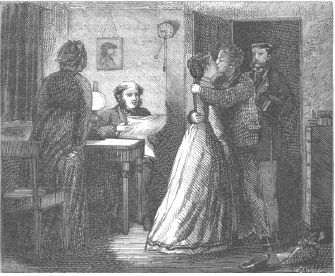
As the young men enter the room, Bessie's eyes brighten. She knows George's footsteps well, and has not recognised the other. George enters first, and he has drawn Bessie to him and kissed her, and she him, before she sees young Mr. Million. When she does see that heir to the family brewery, she gently releases herself from George's embrace, and stands a little aside, with a heightened colour in her face. The action is perfectly natural, and just what a modest girl would do in the presence of a comparative stranger--as young Mr. Million must have been, necessarily, he being so high in the social scale, and she so low. The young gentleman, in the most affable manner, shakes hands all round, and gives them good evening.
'Meeting George as I was strolling this way,' he says, accepting the chair which Mrs. Naldret offers him, 'and having something to say to him, I thought I might take advantage of his offer to step in, and rest for a minute or so.'
Had he told the exact truth, he would have confessed that he had no idea of coming into the house until he heard from old Ben Sparrow, at whose shop he had called, that Bessie was at Mrs. Naldret's, and that, meeting George afterwards, he had walked with him to the door, and had accepted a casual invitation to walk in, given out of mere politeness, and almost as a matter of form.
'You have the Trumpet there, I see,' continues young Mr. Million, addressing the master of the house; 'is there anything particular in it?'
'No, sir,' replies Jim, 'nothing but the usual things--strikes, elections, and that like. There's always plenty stirring to fill a newspaper.'
'That there is,' says the young brewer; 'I'm sorry to hear of the strikes spreading. They make things bad in every way.'
'That they do, sir,' chimes in Mrs. Naldret; 'let well alone, I say.'
Young Mr. Million assents with a motion of his head. Perhaps he would have spoken if his attention had not been fixed upon Bessie, whom George has drawn within the circle of his arm.
'Women can't be expected,' says Jim Naldret, with rather less politeness than he usually shows to his wife in company, 'to understand the rights and wrongs of this sort of thing. It's only the horse in the shafts that feels the weight of the pull.'
'Well,' says young Mr. Million in a careless manner, 'I'm no politician; I leave that to my father. So, without venturing an opinion in the presence of one who has studied these questions'--with a condescending nod to Jim Naldret--'I can't do better than side with Mrs. Naldret, and say with her. Let well alone.' With a graceful bow to that worthy creature, who receives it without gratitude, for it does not please her to find herself trapped into taking sides with a stranger, however much of a gentleman he may be, against her husband.
'Mr. Million came to tell me,' says George during the lull that follows, clearing his throat, 'that the Queen of the South sails earlier than was expected. It goes out of the Mersey the day after to-morrow.'
He does not look at any one of them as he says this, but they all, with the exception of young Mr. Million, turn their anxious eyes to George. The Queen of the South is the name of the ship in which George is to sail for the other end of the world.
'So soon!' exclaims Mrs. Naldret, with a motherly movement towards her son.
'So soon!' echoes Bessie faintly, clinging closer to her lover.
And 'Why not stop at home?' is on the mother's tongue. 'Even now, why not stop at home, and be contented? But she knows what George's answer would be, so she restrains her speech. 'I want my Bessie,' he would have answered, 'and I want a home to bring her to. If I did not love her, I would not go away, but I would be content to work here as you have done all your lives, and live as you have done, from hand to mouth.'
To cheer them, young Mr. Million tells them the latest best news from the other side of the world--how cheaply a man could live; how much larger a workman's earnings were there than here; what a demand there was for skilled labour; and what chances there were for every man whose head was screwed on the right way.
'Suppose a man doesn't wish to work at his trade,' he says, 'and takes it into his head to make a venture for three or four months. There are the gold-fields. All over New South Wales and New Zealand new gold-fields are being discovered. They say that the natives of New Zealand are bringing in great lumps of gold from the north, and that the ground there has never been turned over, and is full of gold. Once in the colonies, it takes no time to get to these places; and even if a man is not fortunate enough to do well, he can come back to his trade. The experiment that occupies three or four months in making is not a great slice out of a young man's life, and the prize that's likely to be gained is worth the venture. Then at these new places, supposing George does not care to run the risk that lies in gold-digging, but determines to stick to his trade, what better one can he have than that of a carpenter? Houses and shops must be built, and they must be built of wood. Who is to build them? Why, carpenters! Think of the scope there is for good workmen. Why, a carpenter must be almost a king in those places! If I hadn't been born into a fortune,' he concludes, 'I would give three cheers for Captain Cook, and be off without a day's delay.'
'When he bids them good-night, as he does presently, seeing that silence falls upon them and that they wish to be left alone, he does not leave a bad impression behind him. But although he has not addressed half a dozen words to the girl, he sees with his mind's eye Bessie's bright face, and no other, as he walks through the cold air. Now, what on earth could a pretty girl like Bessie have to do with the stock of wild oats which young Mr. Million was so industriously collecting?
WITH THE DAWNING OF A NEW YEAR, BEGIN A NEW LIFE.
When Saul Fielding left Mrs. Naldret he made his way through the narrow streets, shivering and stamping, until he came to a house, the lower portion of which was devoted to the sale of plum- and peas-pudding, and food of that description. The side door which led to the upper portion of the house was open, and Saul ascended the dark stairs until there were no more stairs to ascend, and entered a room, the low roof of which shelved in one part almost to the floor. A common lamp was alight, the flame being turned very low down, more, it is to be presumed, for the sake of economy than for safety, for there was nothing in the room of the slightest value. What little furniture there was was rickety and broken: two cane chairs, nearly bald; the few ragged pieces of cane that were left in the frames were tattered and of various lengths, and mournfully proclaimed, 'See what we have come to!' while one of the chairs was so completely decrepit, that it had lost its backbone, and had so little life left in it, that it wheezed when sat upon; a turn-up bedstead, which made a miserable pretence of being something else; a deal table, which once could flap its wings, but could do so no longer; on the table two cups, which were not of a match, but this was really of the smallest consequence, for one was chipped and one was without a handle; and a metal teapot, the surface of which was so battered, that it might be likened to the face of a worn-out prizefighter who had played second best in a hundred fierce encounters. But, common and poor as was everything in the room, everything was as clean and tidy as orderly hands could make it.
Saul Fielding turned up the light of the lamp, and the lamp spat and spluttered in the operation with a discontented air of being ill-fed; this discontent was plainly expressed in the top of the wick, which was lurid and inflamed. There were signs in the room of a woman's care, and Saul Fielding sat down upon the wheezy chair, and waited with his head resting upon his hand. He had not long to wait; the sound of light steps running up the stairs caused him to rise, and look towards the door.
'Jane!'
She nodded and kissed him, and asked him if he were hungry.
'No,' he answered; 'where have you been to?'
'Only on a little errand. Come, you must be hungry. You've had no tea, I know.'
She took the remains of a loaf, and a yellow basin containing a little dripping, from a cupboard, and cut the bread and spread the dripping solicitously. Then she pressed him to eat.
'I shall have some with you,' she said.
To please her, he forced himself to eat.
'It's very cold, Jane.'
'Very, Saul.'
She was a woman who once was very fair to look at, who was fair now, despite her poverty. She was not more than twenty-five years of age, but she looked older; there was no wedding-ring on her finger, and she was too poor for adornment of any kind about her person. There was beauty in her, however; the beauty that lies in resignation. And now, as Saul Fielding looked at her furtively, he noticed, with evident inward fear, a certain kind of sad resolution in her manner which tempered the signs of long suffering that dwelt in her face. He put his hand timidly upon her once, and said in a troubled voice.
'You have no flannel petticoat on, Jane.'
'No, Saul,' she answered cheerfully; 'I have pledged it.'
An impressive silence followed. As the darkness that fell upon Egypt could be felt, so the silence that fell upon this room spoke: with bitter, brazen tongue.
'I have been out all the afternoon,' she said presently. 'First I went to----you know where.' Her soft voice faltered, and carried the meaning of the vague words to his sense.
'And saw her?' he asked wistfully.
'Yes; she was playing on the door-step. She looked so beautiful! I--I kissed her!'
All the love that woman's heart can feel, all the tenderness of which woman's love is capable, were expressed in the tone in which she uttered these simple words. She placed her fingers on her lips, and dwelt upon the memory of the kiss with tearful eyes, with heart that ached with excess of love.
'Did I tell you that last week I tried again to get work, Saul?'
'No,' he said; 'you failed!' As if he knew for certain with what result.
'Yes; I failed,' she repeated sadly.
'I ask myself sometimes if I am a man,' exclaimed Saul, in contempt of himself, spurning himself as it were; 'if I have anything of a man's spirit left within me. Mrs. Naldret said something of that sort to me this very night--not unkindly, but with a good purpose. When I think of myself as I was many years ago, it seems to me that I am transformed. And the future! Good God! what lies in it for us?'
'I am a tie upon you, Saul.'
'A tie upon me!' he said, in a tone of wonder. 'Jane, you are my salvation! But for you I should have drifted into God knows what. You are at once my joy and my remorse.'
He took from the mantelshelf a broken piece of looking-glass, and gazed at the reflection of his face. A bold and handsome face, but with deeper lines in it than his years, which were not more than thirty-two or three, warranted. Strong passion and dissipation had left striking marks behind them, but his clear blue eyes were as yet undimmed, and shone with a lustre which denoted that there was vigour still in him. His mouth was large, and the lips were the most noticeable features in his face; they were the lips of one to whom eloquence came as a natural gift, firm, and tremulous when need be. The change that he saw in himself as he looked back to the time gone by gave point and bitterness to his next words.
'I was not like this once. When you first saw me, Jane, these marks and lines were wanting--they have come all too soon. But no one is to blame but I. I have brought it all on myself. On myself! On you!--you suffer with me, patiently, uncomplainingly. You have a greater load than I to bear; and you will not let me lighten it.'
'I will not let you, Saul! I don't understand.'
'Because every time I approach the subject, I try to approach it by a different road.'
'Ah, I know now,' she said softly.
'Jane, I ask you for the twentieth time.' He held out his hands supplicatingly to her. 'Let me do what I can to remove the shame from you. Let me do what I can to atone for my fault. As you love me, Jane, marry me!'
'As I love you, Saul, I refuse!'
He turned from her, and paced the room; she watched him with steady loving eyes, and the signs of a sad, fixed resolution deepened in her face.
'Come and sit by me, Saul.'
He obeyed her, and she drew his head upon her breast and kissed his lips.
'There's no question--no doubt of the love between us, Saul?'
'None, Jane.'
'If some chance were to part us this night, and I was never to look upon your face again----'
'Jane!'
--'And I was never to look upon your face again,' she repeated with a cheerful smile, 'I should, if I lived to be an old woman, and you to be an old man, never for one moment doubt that you loved me through all the years.'
'It is like you, Jane; your faith would not be misplaced.'
'I know it, and I know that you would be to me the same--you would believe that no other man could hold the place in my heart that you have always held.'
He took her in his arms, and said that she was his anchor; that as nothing on earth could shake her faith in him, so nothing on earth could shake his faith in her; after what she had said (although he knew it before, and would have staked his worthless life on it) could she still refuse to allow him to make her the only reparation it was in his power to make?
She waived the question for the present and said,
'We are at the lowest ebb, Saul.'
'Ay,' he answered.
'Then you must not speak of drifting,' she said tenderly; 'we have drifted low enough. Remember, Saul,' and she took his hand in hers, and looked into his eyes, 'we have not ourselves alone to think of. There is another. It only needs resolution. Come--let us talk of it Here, there is no hope.'
'There seems none, Jane; all heart has left me.'
'Elsewhere things might be better for you.'
'For us,' he said, correcting her. 'What is better for you is better for me,' she replied. 'I heard today that George Naldret----'
'God bless him!'
'Amen! God bless him! I heard to-day that he was going away sooner than was expected.'
'I heard so too, Jane; and I went round to Mrs. Naldret's tonight to see him if I could. But he had not come home.'
'Saul,' she said, hiding her face on his shoulder, and pressing him in her arms, as one might do who was about to lose what she loved best in this world, 'we have suffered much together; our love for each other seems to keep us down.'
'It is I--I only who am to blame. I commenced life badly, and went from bad to worse.'
She placed her hand upon his lips, and stopped farther self-accusation.
'It is a blessing for many,' she said, 'that those new lands have been discovered. A man can commence a new life there without being crushed by the misfortunes or faults of the past, if he be earnest enough to acquire strength. It might be a blessing to you.'
'It might,' he assented, 'if you were with me.'
'You, with your gifts, with your talent for many things, might do so well there. Saul, turn that lamp down; the light glares, and hurts my eyes.'
He turned down the lamp; the sullen wick flickered, once, twice, thrice, and the room was in darkness.
'Let it be, Saul; don't light it. I love to talk to you in the dark. It reminds me of a time----do you remember?'
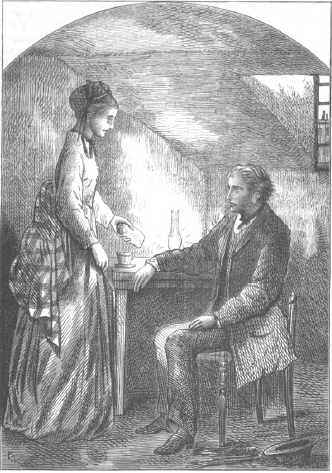
Did he remember? There came to him, in the gloom of the mean room, the memory of the time, years ago, when he first told her that he loved her. In the few brief moments that followed, after the light had gone out, the entire scene was presented to him; every word that was uttered by him and by her came to him. It was in the dark that he had told her; it was in the dark that he vowed to be faithful to her, and she to him. It seemed as if it might have been yesterday, for he held her in his arms now, as he had held her then, and he felt her heart beating against his. But the misery of the present time was too pressing to forget for more than a brief space, and he raised his head from her breast, and faced the gleams of the clear bright cold night, as they shone through the garret-window.
'If I were to tell you,' she resumed, 'that I have felt no sorrow because of the position we are in--not as regards money, though that cannot be worse, but as regards our living together, not being married--I should tell you what is not true. I have felt bitter, bitter sorrow--bitter, bitter shame. When friends fell off from me, I suffered much--when the dearest one I had, a girl of my own age, said, "Father forbids me to speak to you because you are leading a wrong life; when you are married, perhaps father will not be so hard upon you, and we may be friends again,--though never as we were, Jane! never as we were!" I turned sick, Saul, because I loved her.'
She paused a moment, and he, with a full sense of his own unworthiness, drew a little away from her. What she was saying now was all the more bitter because hitherto no word of implied reproach had passed her lips. She knew his thoughts, and in her tenderness for him, put forth her hand to draw him closer to her; but withdrew it immediately without fulfilling her purpose, as though it might make her waver.
'I said to myself, Saul knows what is right; when he is in a position he will say to me, Come, Jane; and I pictured to myself our going to some quiet church one morning, without any one knowing it but ourselves, and coming back married. But it was not to be; the part you took in the strike crushed you and kept you down. The masters were against you naturally; and I knew that as my friends had fallen off from me, so your friends and fellow workmen had fallen off from you. I blamed myself for it, for it was my counsel that caused you to desert the men as you had deserted the masters. I did not see the consequences when I spoke; I should have held my tongue.'
'Jane,' said Saul gloomily, 'you were right; I had my doubts that very night, after I had made the speech that inflamed me in the making as much as it inflamed the men in the hearing. I lost my head; no wonder they turned against me afterwards. I should have done the same by them. But in acting as I did, I acted conscientiously. What, then, did I do, when I began to feel the consequences of my own act? Sought for consolation in drink, and but for your steady, unwavering faith--but for your patient endurance, and your untiring efforts to bring me back to reason--might have found a lower depth even than that. But patient love prevailed. Death will overtake me, or I will overtake it, when I break the promise I gave you not long ago!'
'I know it,' she said, with a bright look which he could not see, her back being towards the light, 'and that is why I can trust you now; that is why I have courage to say what I am about to say. There is no fear between us of misapprehension of each other's words, of each other's acts; and therefore I do not hesitate. Saul, if I have done my duty by you--and I have striven to do it, with all my heart and soul--it remains for you to do your duty by me.'
He had no word to say in reply; that he had failed in his duty to her, that upon her had fallen the greater part of the misery, and all the shame, of their lot, he was fully conscious. But he had never heard her speak like this before; her voice was firm, though tender, and he held his breath, waiting for her next words.
'It remains for you to do your duty by me.' As she repeated these words it required the strongest effort of her will to keep the beating of her heart and her inward suffering from affecting her voice. She was successful in her effort; for knowing what would occur within the next few hours, the imminence of the coming crisis gave her strength, and her voice was clear and steady.
'How--in what way?' he asked, in an agitated tone.
'Be sure of one thing, Saul,' she cried, turned aside for an instant only by the agitation in his voice; 'be sure that I love you, wholly, heartfully!'
'I am sure of it. Teach me my duty. I will do it.'
She steadied herself again.
'Saul, we cannot go on as we are. We have come low--very low; but worse is before us, if we are content to let it come, without an effort to avoid it. Listen. The greatest happiness that can fall to my lot is to be your wife.'
'I believe it,' he said.
'But not as you are, Saul! Tear yourself from your present surroundings--tear yourself from this place, where there is no hope for you nor for me! If we were at opposite ends of the world, there is a tie that binds us which neither of us can ever forget. If she were in her grave, her lips would seek my breast, her little hands would stretch themselves out to you, to caress your face! What kind of happiness would it be for you to be able to say, Come, Jane; I have a home for you, for her?'
He repeated, with his lips, 'What kind of happiness!' but uttered no sound.
'Make the effort!--away from here. If you succeed--never mind how humble it is, never mind how poor--I will be your wife, loving you no more than I love you now, and you will repay me for all that I have suffered. If you fail---- But you will not fail, Saul. I know it! I feel it! Make the effort; for the sake of my love for you, for the sake of yours for me. I think, if it were placed before me that you should make the effort, and, failing, die, or that we should remain as we are, I should choose to lose you, and never look upon your face again---- Here! We are near the end of this sad year. Christmas is coming, Saul. Let it be the turning over of a new leaf for us. Nerve yourself--I will not say for your own sake, for I know how poor an incentive that would be to you--but for mine, and with the dawning of a new year, begin a new life!'
'And this is the duty that remains for me to do, Jane?'
'This is the duty.'
Not from any doubt of her, or of the task she set before him, did he pause, but because he was for a while overpowered by the goodness of the woman who had sacrificed all for him--who loved him, believed in him, and saw still some capacity for good in him. When he had conquered his emotion, he said in a broken tone,
'And then, should such a happy time ever come, you will let me make the poor reparation--you will marry me?'
'How gladly!' she exclaimed, 'O, how gladly!'
'No more words are needed than that I promise, Jane?'
'No more, Saul.'
'I promise. With all my strength I will try.'
He knelt before her, and, with his head in her lap, shed tears there, and prayed for strength, prayed with trustfulness, though the road was dark before him. Lifting his head, he saw the light of the clear cold sky shining through the window at her back. With her arms clasped round his neck, she leant forward and kissed him, and as he folded her in his embrace, he felt that there were tears also on her face.
'The world would be dark without you, dear woman,' he said.
Again she kissed him, and asked if it was not time for him to go.
He answered. Yes; and yet was loth to go.
'Good-night, Jane.'
'Good-night, dear Saul.'
With the handle of the door in his hand, he turned towards her, and saw her standing with the light shining upon her.
DEAR LOVE, GOOD-BYE.
It was three o'clock in the morning before Saul Fielding came home. The bell of Westminster proclaimed the hour with deep-sounding tongue. Saul ascended the stairs quietly. He did not wish to disturb any one in the house--least of all, Jane, if she were asleep. 'Although,' he thought, dwelling in love upon her, 'the dear woman wakes at my lightest footfall.' He crept into the room softly, and paused, with hand upraised and listening ear. 'She is asleep,' he whispered gladly. He stepped gently to the bedside and laid his hand lightly upon the pillow; it was cold. 'Jane!' he cried, with a sudden fear upon him. His hand travelled over the bed; it was empty. So strong a trembling took possession of him that he could not stand, and he sank, almost powerless, on the bed. 'What is this? he asked of himself. 'Why is she not abed? Jane! Jane! Where are you?' Although he spoke in a tone scarcely above a whisper, every word he uttered sounded in the dark room like a knell, and seemed to come back to him charged with terrible meaning--as though some one else were speaking. 'Let me think,' he muttered vaguely. 'How did I leave her? She was not angry with me. Her words were full of hope. She kissed me, and stood--there!' He looked towards the window, and saw the outlines of her face in the light--saw her eyes gazing tenderly, lovingly, upon him. He knew that what he saw was but a trick of the imagination; but he moved towards the light, and clasped a shadow in his arms. 'The world is dark without you, dear woman!' he sobbed, with closed eyes, repeating almost the last words he had said to her. 'The world is dark without you! Where are you? Have you left me?' The table shook beneath his hand, as he rested upon it to steady himself. But he could not control his agitation; it mastered him. With trembling hands he struck a match and lit the lamp; then saw with certainty that Jane was not in the room. Mechanically he took from the table a sheet of paper with writing upon it, which the light disclosed. 'Jane's writing,' he muttered, and then read:
'Dear Love,--I have left you for your good--for mine. I had this in my mind when I spoke to you to-night. I have had it in my mind for a long time. It is the only secret I have ever had which you did not share. We have been so unfortunate in the past, and so clear a duty remains before us, that we should be undeserving of better fortune if we did not strive ourselves to better it. I rely implicitly upon your promise. Tear yourself away from this place, and begin a new life. As long as I live, not a day will pass without my praying for a better fortune for you and for me to Him who sees all things, and who my heart tells me approves of what I am doing now. Pray to Him also, dear Love. He will hear you, and pity. Remember what is the greatest happiness that can fall to my lot, and remember that I shall not be unhappy--loving you and having you always in my thoughts--while I think that you are working towards a happier end. I have no fears in leaving you. I know how you will keep your promise--and you have said so much to-night to comfort me! I treasure your words. They are balm to my heart.
I have taken service with a respectable family, who live a long way from here, and I have adopted an assumed name. The address I enclose is where you can write to me. You will not, I know, seek to turn me from my purpose. I shall write to you to the care of Mrs. Naldret; for the sake of George's friendship for you she will receive the letters. Tell George.
Pear Love, good-bye! All my prayers are with you. Let them and the memory of me sustain your heart; as the consciousness of your love for me, and my faith in God's goodness, will sustain mine.
Till death, and after it,
Your own
Jane.'
He read the letter twice, first with only a vague sense of its meaning, but the second time with a clearer understanding. Sobs came from his chest, tears came from his eyes, the hand that held the paper trembled, as he read. He knew that she was right. But it was hard to bear--bitterly hard to bear. How lonely the room looked--how mean and miserable and desolate! Faint as he was--for he had been standing in the cold streets for hours, playing with the waits, and nothing but a sup of water from a drinking fountain had passed his lips--he had no consciousness of physical weakness. All his thoughts were of Jane, all his heart and soul and mind were charged with tenderness for his dear woman. He looked at the words 'Dear Love,' until he heard her voice speaking them. He had no thought of following her; her happiness depended upon his obeying her, and he would obey her. He had resolved upon that immediately. But, O, if he could hold her in his embrace once more! If he could hear her dear voice again! If, with her arms around him, he could tell her that he would be faithful to his promise! He dashed the tears from his eyes. 'She is thinking of me now,' he sobbed; 'she is awake and praying for me now! All the suffering of our parting was hers. She took it all upon herself, dear soul! She knew, and I did not; and her heart was bleeding while she shed the light of hope upon mine! What does she say here, dear soul, to lessen my pain? "You have said so much to-night to comfort me! I treasure your words. They are balm to my heart." It is like her--it is like her, to write those words. She knew, dear woman, she knew, dear heart, that they would comfort me! But I want strength! I want strength!' His eyes travelled over the letter again, and again he read the words, 'Pray to Him also, dear Love. He will hear you, and pity.' Pressing the paper to his lips, Saul Fielding sank upon his knees, and bowed his head upon the bed.
TOTTIE IS READY TO TEAR OLD BEN SPARROW LIMB FROM LIMB.
As nearly all the persons with whom this history has to deal are almost in the same station of life, and live within a stone's throw of each other, it is not a difficult task for us to transport ourselves to the little parlour in the rear of old Ben Sparrow's grocer's shop, where Ben Sparrow himself is at present considering the mechanism of a curious and complicated piece of work, the separate parts of which are lying before him. Although the parlour and the shop adjoin each other, Ben Sparrow looks upon the parlour as being a long way off, like a country house, as a place where he can obtain repose from the cares of the counter and shelves. And it really is a snug, cozy retreat.
Ben Sparrow came into the world exactly at midnight of the 21st of October 1805, a few hours after the battle of Trafalgar was fought and won; and the doubtful compliment was at once passed on the new arrival of being the very smallest baby that ever was seen. But then women go into extremes in these matters, and their statements that this is the most beautiful baby in the world, and this the smallest, and this the chubbiest, and this the darlingest, must be taken with very large pinches of salt. On that occasion the very smallest baby in the world acted in precisely the same manner as he would have done if he had been the very largest baby in the world. Looking upon the world as his own especial dunghill (as we all of us do), he immediately began to crow, and sounded his trumpet with the weakest of lungs to show that he had made his appearance upon the stage. The sound of Westminster bells was ringing in his ears as he gathered up his little toes and legs and clenched his little fists with an air of saying, Come on! to his brothers and sisters in the profession; and in after-days he often declared jocosely that he perfectly well remembered hearing his first twelve o'clock proclaimed by the tongue of old Westminster. Between that time and this, Ben Sparrow had grown from a very small baby to a very small man, and many eventful things had occurred to him. When he came to man's estate--the only estate he ever came into--he entered into business as a grocer; married, and lost his wife, who left behind her one child, a son, who had 'gone wrong,' as the saying is, and whose place knew him no more. The 'ups and downs' of life are generally believed to be a very common experience; but they could scarcely have been so with Ben Sparrow, he had so very many downs and so very few ups (if any) in the course of his career. Still he managed to plod on, somehow or other, until the present time, when he and his granddaughter, Bessie Sparrow, whom you have seen, and Tottie, a child of whom you have had a glimpse, after she had been put to bed by Bessie, are living together in the small house of which the grocer's shop forms part.
This short biography being concluded, we come upon Ben Sparrow, sitting in his parlour, contemplating the separate parts of the curious piece of work above referred to. The only other person in the room is Tottie, who is perched on a high chair, with a rail in front, to prevent her making an attempt to walk in the air, and whose attention is divided between the old man and certain sweet things which are spread upon the table. Such as three large fat figs--luscious young fellows, new, ripe, and with so tempting an air about them as to make their destruction appear inevitable. (Tottie is ready to act as executioner; her eager eyes attest that they would have short shrift with her.) Such as half-a-dozen or so sticks of cinnamon, not as fresh-looking as the figs, being indeed rather wrinkled specimens of spice; but, notwithstanding their snuffy colour, they have an inviting odour about them, and tickle the nose tantalisingly. (Tottie would not say them nay, and is ready to devote them to destruction on the first word of command.) Such as a few dozen of plump dried currants, of exquisite sweetness. (As Tottie well knows, from experience of their fellows, not honestly come by; for, notwithstanding her tender years, Tottie has a vice, as you shall presently see.) Such as two or three bunches of muscatel raisins, rich-looking, princes among grapes, with a bloom upon their skins, which speaks eloquently of luscious juices within. (Tottie's eyes wander to these, and her mouth waters, and her fingers wait but for the opportunity. If some kind fairy would but cry 'Shop!' now, and call for a quarter of a pound of brown sugar, or an ounce of tea--the best one-and-fourpenny--or a ha'porth of barley-sugar! But business is slack, as Ben Sparrow will tell you, with a doleful shake of the head, and there appears no such fairy, in the form of a slattern with shoes down at heel, or of a bold-faced girl with her baby in her arms, and with a blue handkerchief tied crosswise over her bosom, or of a gutter-student, capless, with straggling-hair, or of a man of any age, weak-eyed with shaking limbs: no such fairy calls 'Shop!' in Tottie's interest, and taps the counter with the nimble penny.) Such as two whole halves (the prettiest of paradoxes) of candied lemon-peel, with such an appetising fragrance oozing out of them, with such delicious patches, of sugar clinging to their aldermanic insides and outsides--pearls in mussels are valueless as a comparison--that the precious things of the world, such as dolls and boxes of wooden soldiers (would they were all so!), and oyster-shells and pieces of broken china to play at dinners and teas with, fade in the contemplation of them. (At least, such are Tottie's feelings, as she looks and longs. O, for the fairy!) Such, to conclude with, as a few shreds of mace, and a clove or two--scarcely worth mentioning in the presence of their superiors.
These delectable joys of life being spread upon the table, immediately under Tottie's nose, and Tottie's attention being divided between them and their lawful owner, Ben Sparrow, it will not be difficult to see which of the two possessed the greater charms for her. A rapid glance at Ben Sparrow's face, a lingering gaze upon fruit and spice, another rapid glance (with a slight reproach in it this time) at Ben Sparrow's face, and, finding no benevolent intention there, a more fixed and longing gaze upon the treasures of the earth--thus it goes without a word on either side (the thoughts of each being so intensely engrossing), and thus it might have continued for goodness knows how long, but that Ben Sparrow, with a cheery laugh, taps Tottie's cheek with his forefinger, and cries, in a tone of satisfaction,
'Now, I've got it!'
(Tottie wishes she had.)
'Now, I've got it,' cries the old man again; 'all complete.'
Tottie shifts restlessly in her high chair.
'And Tottie shall see me make it,' says Ben, with beaming face, rubbing his hands, and shifting the fruit and the spice about much the same as if they form pieces of a puzzle, and he has found the key to it. 'Especially,' adds Ben, 'as Tottie will sit still, and won't touch.'
'No, I never!' exclaims Tottie.
This is Tottie's oath, which she is much given to swearing when her honour is called into question. Tottie's 'No, I never!' is in her estimation worth a volume of affidavits, but it is much to be feared that her sense of moral obligation is not of a high order.
'And as Tottie's a good little girl----'
'Tottie's a dood little girl!'
There is no expression of doubt in the nods of the head with which Tottie strengthens this declaration.
'And'll sit still, she shall see me make it.'
The good old fellow laughs. He does not seem to realise how difficult is the task he has set Tottie. To sit still, with these treasures in view! Here an agonising incident occurs. A small piece of candied sugar has become detached from one of the halves of lemon-peel, and Ben Sparrow, with an air of abstraction, picks it up, and puts it--in his own mouth! Tottie watches him as he moves it about with his tongue, and her own waters as the sweet dissolves in her imagination. She knows the process as well as Ben, and appreciates it more, and she sighs when the candy is finally disposed of.
'You see, Tottie,' says Ben, taking her into his confidence, 'business is very slack, and Christmas is coming, Tottie.'
Tottie gives a nod of acquiescence.
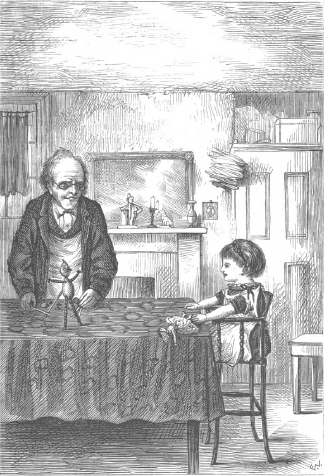
'So I think to myself--another nod from Tottie; she also is thinking to herself--'if I can put some thing in the window that'll make the people look at the figs----'
Here Tottie introduces an artful piece of diplomacy. 'Tottie can spell fig,' she says, and proceeds to do it smilingly--'F-I-G, fig.'
But Ben, intent upon his scheme, does not see the point of Tottie's interruption, and proceeds:
'--Something that'll make 'em look at the figs, and the currants, and the raisins--something new and spicy'--(Ben laughs at this joke, and repeats it)--'something new and spicy, perhaps it'll wake 'em up, and bring 'em in here instead of going to another shop. For they want waking up, Tottie, they want waking up badly.'
Solemn nods from Tottie proclaim the serious consideration she has given to the general sleepiness and indifference of Ben Sparrow's customers.
Ben Sparrow picks up a fat currant and contemplates it with as much interest as a geologist would contemplate a new fossil. Tottie's eyes follow his movements; she sits like Patience on a monument, and another sigh escapes her as Ben Sparrow (again abstractedly) puts the currant in his mouth, and swallows it. Draw a veil mercifully over Tottie's feelings.
'It was in the middle of the night,' says Ben Sparrow with all the impressiveness demanded by the historical fact, 'that I first thought of making ME, and putting ME in the window to attract custom. I was a good deal puzzled about my legs, and my stomach got into my head, and I couldn't get it out; but little by little all my limbs and every other part of me came to me until the idea was complete. And now we'll try it--now we'll set to work and make a MAN! And if you're a good girl, and'll sit still, you shall see ME made.'
Tottie's experience in literature is very limited--extending no farther, indeed, than b-a-t bat, c-a-t cat, r-a-t rat, d-i-g dig, f-i-g fig, p-i-g pig--and she knows nothing of the terrible story of Frankenstein; therefore, she is not at all frightened at the idea of seeing a man made, nor has she any fear that it will turn out to be a monster. On the contrary, if Ben Sparrow's thoughts would only take a benevolent turn in the shape of a fig for Tottie, or a few plums for Tottie, or some candied sugar for Tottie, she would be prepared to enjoy the feat which Ben is about to perform as much as if it were the best bit of fun in the world.
'Now, then,' commences Ben, with a whimsical glance at Tottie, who smiles back at him like a true diplomatist, 'I don't know what part is generally made first, but perhaps it'll be as well to commence with the stomach. Here it is--here's my stomach.'
He takes one of the halves of the candied lemon-peel, and places it before him, round side up.
'There's a little too much sugar in me,' he says, with a more whimsical glance than the first; 'it'll make me rather too heavy, I'm afraid. And besides, Tottie, it ain't true to nature. My inside ain't got such a coating as this.'
He breaks a piece of candied sugar from the inside of his stomach, looks at Tottie, notices her wistful eyes, and gives it to her. She eats it eagerly, and so quickly as to cause amazement to Ben Sparrow, who says,
'You shouldn't eat so fast, Tottie. Good little girls don't eat so fast as that.'
Tottie, with feminine duplicity, accepts this warning in an inverted sense, and cries, with her mouth full of sugar,
'Tottie's a dood little girl!' as if indorsing a statement made by her grandfather. But Tottie's thoughts are not upon the good little girl; at the present moment she resembles a savage. She has tasted blood, and thirsts for more.
'It's a fatter stomach than mine,' proceeds Ben, laying his hand upon his stomach of flesh, the stomach he came into the world with; 'it's rounder and plumper, and would fit the Lord Mayor or an alderman, but it'll do, I daresay. Now for my neck.'
He picks up the thickest piece of cinnamon, and measures it with his eye, breaking the stick in two. 'I mustn't make my neck too long--nor too short--and I take the thickest piece, Tottie, because it's got to support my head. Like this.' He makes a hole in the end of the lemon-peel, and sticks the cinnamon in firmly. 'Now to stick my head on, Tottie.'
He selects the largest of the fat figs, and attaches it to his neck. 'What's the next thing? My eyes, to be sure. Currants.' Remarkably like eyes do they look when they are inserted in the face of the fat fig. Then he takes a clove for his nose, and, making a thin slit in the fig for his mouth, inserts an appropriate morsel of mace. All this being successfully accomplished, he holds himself up (as far as he goes) for his own and Tottie's inspection and approval. Tottie claps her hands, and laughs, but subsides into a quieter humour at a guilty thought that steals into her mind. She thinks what a delightful thing it would be to take her grandfather (as far as he goes) and eat him bit by bit.
'I begin to look ship-shape,' observes Ben Sparrow, gazing admiringly at the unfinished effigy of himself. 'You see, Tottie, what the people want nowadays is novelty--something new, something they haven't seen before. Give them that, and you're all right' (Which vague generality appears to satisfy him.) 'Now, here it is--here's novelty--here's something they've never seen before; and if this don't bring custom, I don't know what will.'
Tottie gives a grave and silent assent; she cannot speak, for her mind is bent upon cannibalism. She is ready to tear the old man limb from limb.
'But,' continues Ben Sparrow, unconscious of the horrible thought at work in the mind of the apparently innocent child before him, 'I must get along with myself, or I shall never be finished. I haven't been in any battle that I know of, and I wasn't born a cripple, so my limbs must be all right when I appear in public. Now for my arms. More cinnamon! I think I may call cinnamon my bones.'
When two pieces of cinnamon are stuck into the sides of the candied lemon-peel, they look so naked that he says,
'I must put sleeves on my arms.'
And impales raisins upon them, and sticks five small slips of mace in each of the last raisins, which serve for fingers.
'Now for my legs, and there I am. More cinnamon!'
Two sticks of cinnamon stuck in the bottom of his candied stomach, and then clothed with raisins, form his legs, and there he is, complete.
'I think I'll do,' he says complacently.
At this moment a voice calls 'Shop!' and a fairy, in the shape of a shoeless ragged girl, taps upon the counter. Ben Sparrow goes into the shop to serve, and Tottie is left alone with his effigy. Now it has been mentioned above that Tottie has a vice, and this is it: she is afflicted, not with a raging tooth, but with a tooth so sweet as to weaken her moral sense, so to speak: she is unable to resist temptation when it presents itself to her in the shape of sweetmeats or fruit, and her notions as to the sacredness of such-like property are so loose that (no one being by to see her do it) she helps herself. And yet it is a proof that she possesses a wakeful conscience, that she turns her back upon herself when she pilfers, as if she would wish to make herself believe that she is unconscious of what she is doing. Thus, seeing, say, a bowl of currants near, and no person within sight, she will approach the bowl stealthily, and, turning her back to it, will put her hand behind her, and take a fistful, with an air of thinking of something else all the while. And it is a proof that the moral obligation of her conscience is not entirely dormant, that, after the act is committed and enjoyed, she will, under the influence of a human eye, instantly defend herself without being accused, by 'No, I never! no, I never!' This express admission of guilt she can no more resist than she can resist the temptation itself. At the present time the sweet effigy of Ben Sparrow is lying within reach upon the table. Shutting her eyes. Tottie stretches out her hand, and plucking her grandfather's left leg bodily from his candied stomach, instantly devours it, cinnamon, raisins, and all--and has just made the last gulp when Ben Sparrow, having served his customer, reënters the parlour. He casts a puzzled look at his dismembered effigy, and mutters,
'Well! if I didn't think I had made my two legs, may I be sugared!' Which sweet oath is exactly appropriate to the occasion. Then he turns to Tottie, who is gazing unconsciously at vacancy, with a wonderfully intense expression in her eyes, and she immediately shakes her head piteously, and cries,
'No, I never! no, I never!'
Ben Sparrow, having his doubts aroused by this vehement asseveration of innocence, says mournfully,
'O, Tottie! Tottie! I didn't think you'd do it! To begin to eat me up like that!'
But Tottie shakes her head still more vehemently, and desperately reiterates, 'No, I never! no, I never!' With the frightful consciousness that the proofs of her guilt are in her inside, and that she has only to be cut open for them to be produced.
Ben Sparrow, with a grave face, makes himself another leg, moving himself, however, out of Tottie's reach with reproachful significance. An unexpected difficulty occurs at this point. Being top-heavy he cannot balance himself upon his legs; but Ben is of an ingenious turn of mind, and he hits upon the expedient of shoring himself up from behind with stout sticks of cinnamon. Then, setting himself up, he gazes at himself in admiration. Tottie's eyes are also fixed upon the effigy; it possesses a horrible fascination for her.
HERE AND THERE ARE FORGET-ME-NOTS.
All night long Saul Fielding kneels by the side of his bed, absorbed in the memory of the woman whom he loves, and who, out of her great love for him, has deserted him. At first his grief is so great that he cannot think coherently; his mind is storm-tossed. But after a time the violence of his grief abates, and things begin to shape themselves in his mind. The night is cold, but he does not feel the winter's chill. The wind sighs and moans at his window, but he does not hear it. As it leaves his lattice, and travels through the courts and streets, it bears upon its wings the influence of the grief it has witnessed, and it sobs to the stone walls, 'There kneels a man in woe!' It gathers strength when it leaves the packed thoroughfares, which, huddled together like a crowd of beggars, seem to seek warmth in close contact, and becomes angry when it reaches the wide streets, angrier still when it reaches the woods, where the trees tremble as it rushes past them. Say that it rushes onward and still onward, and that we have the power to follow it--that we see it merge into other winds, and become furious--that we see its fury die away--that we leave the winter and the night behind us--that we travel ahead of it over lands and seas until we come to where spring and daylight are--that we travel onward and still onward, until noon and spring are passed, and we come to where bright sun and summer are. Where are we? Thousands, upon thousands of miles away; but the time is the same, for as the warm wind kisses us we look back and see the man kneeling by the side of his bed. It is winter and night, and there kneels the man. It is summer and day, and here is another man among the mountains lying on the earth, looking at the clouds. And the time is the same. The thoughts of both these men are in the past. What connection can there be between these two in such adverse places, seasons, and circumstances? They have never touched hands. What link can bind them? Heart-links? Perhaps. It would not be so strange. It may be that at this present moment, in some distant part of the world of which we have only read or dreamt, links in your life's chain and mine are being forged by persons whose faces we have never seen.