Part 1 — PART I. (continued 2)
Reading edition
He is desolate. Jane has gone from him. She has left words of comfort behind her, but he may never look upon her face again. She has given him a task to fulfill. 'If I have done my duty by you,' she said, 'and I have tried to do it, it remains for you to do your duty by me.' He will be true to his dear woman, as she has been to him. He will strive to perform the task she has set before him--he will strive to find a way. Ay, if he dies in the attempt. He will consider presently how he shall commence. In the mean time, he must think of Jane.
He falls into a doze, thinking of her, and with her in his mind the past comes to him. The aspirations which filled his boyish mind--his love for books--his desire to rise above his surroundings--his reasonings upon the relation of this and that, and his theoretical conclusions, which were to suddenly divert the common custom of things, as if a creation could in a moment crumble into dust the growth of centuries--his delight when he found that he was an orator, and could move an assembly of men to various passions--his meeting with Jane---- He went no farther. The memory of her as she was when he first saw her, a bright flower--ah, how bright, how trustful and womanly!--stopped farther thought, and for a time no vision appears of his downfall, his weakness, his disgrace, his sinking lower, lower, until he is almost a lost man. It comes to him presently with all its shame; but when he wakes, the chaos of images in his mind resolves itself into this: his life is before him, full of weeds, like an untended garden, but here and there are Forget-me-nots, and each one bears the name of Jane.
The morning light steals in upon his vigil, and still he has not decided how or in what way he shall commence his new life. In truth he is powerless. He has no weapons to fight with. His old confidence in himself, his pride, his strength of will, are covered with the rust of long weakness. Rising from his knees, he breaks the crust of ice upon the water in his pitcher, and bathes his face. The cold water seems to bring strength to him. He looks about the room, and everything within the poor walls speaks of Jane's love and care for him. The fire is laid with the last few sticks of wood and the last few lumps of coal. The old kettle, filled, is on the hob. The last pinch of tea is in the cup; the remains of the loaf are on the table. Not a thing is forgotten. 'Dear woman!' he murmurs. 'It is like you!' He paces the room slowly, striving to think of some path by which he can obtain a home for Jane, and thereby win her and reward her. It is useless, he knows, to seek for work here in the neighbourhood where he is known. He is known too well, and has sunk too low. Who would believe in his profession of amendment? Besides, what is the use of trying? He is of the same trade as George Naldret, and even George, a better workman than he, has resolved to leave, and try his fortune elsewhere, because of the difficulty he finds in saving sufficient money to buy a home for the girl he desires to marry. Even George is compelled to emigrate---- He stops suddenly in the middle of the room, and draws himself up with a spasmodic motion. Jane's words come to him: 'It is a blessing for many that these new lands have been discovered. A man can commence a new life there, without being crushed by the misfortunes or faults of the past, if he be earnest enough to acquire strength. It might be a blessing to you.' 'A new life in a new land!' he says aloud. 'All the weakness and shame of the past wiped away because they will not be known to those around me. I should feel myself a new man--a better man; my strength, my courage would come back to me!' So strong an impression does the inspiration of the thought make upon him, that he trembles with excitement. But can he leave Jane--leave the country which holds her dear form? Yes, he can, he will; the memory of her will sustain him; and she will approve, as indeed she has done already by her words. 'It is the only way!' he cries; 'the only way!' Thus far he thinks, and then sinks into a chair, despairing. The means! How can he obtain the means? He has not a shilling in the world, nor any friends powerful enough to help him. Heaven's gate seems to be more easily accessible to him than this new land across the seas. But he does not allow himself to sink into the lowest depth of despondency. Jane stands before him; her words are with him; like wine they revive his fainting soul. 'Come, Saul,' he cries aloud to himself, resolutely. 'Come--think! Cast aside your weakness. Be your old self once more!' These words, spoken to himself as though they came from the lips of a strong man, sound like a trumpet in his ears, and really strengthen him. Again he thinks of George Naldret. 'Mr. Million gave him his passage ticket,' he says; 'would Mr. Million give me one?' No sooner has he uttered the words than the current of his thoughts is diverted, and he finds himself speculating upon the cause of Mr. Million's generosity to George. Friendship? No, it can scarcely be that. There can be no friendship between George and Mr. Million. Kindness? Perhaps; and yet he has never heard that Mr. Million was noted for the performance of kindly actions. These considerations trouble him somewhat on George's account, although he cannot explain to himself why the fact of Mr. Million giving George a free passage ticket to the other end of the world should cause him uneasiness. 'I wonder how it came about,' he thinks. 'I never heard George speak of emigrating until the ticket was promised to him. At all events, if George has any claim upon him, I have none. But Mr. Million is a public man, and may be in favour of emigration. It will cost him but little to assist me. There are Government emigration ships which take a man over for almost nothing, I have heard. A line of recommendation from Mr. Million in my favour would be sufficient, perhaps. I will try; I will try. If I knew a prayer that would make my appeal successful, I would say it.'
BATTLEDOOR AND SHUTTLECOCK.
As a public man, James Million, Esquire, M.P. for Brewingham, felt it necessary to his position to spend two or three hours in his study every morning, and to 'make-believe' to be busy. Had you asked James Million what he was, he would not have told you that he was a brewer or a capitalist, but would have replied briefly and emphatically, 'A public man, sir.' Now, to be a public man, you must have a shuttlecock; and whether it was that Mr. Million had a real sympathy for the institution known as the working man, or because the working man drank large quantities of Million's Entire and Million's Treble X, it is certain that he set up the working man as his shuttlecock; and it is quite as certain that he set it up without in the least understanding it, being, indeed, a most unskilful player at any game in which his own interests were not directly involved. The game of battledoor and shuttlecock is a popular one with us from childhood upwards, but I am not aware that any close observer and noter of curious things has ever calculated how many shuttlecocks an ordinary battledoor will outlast. Popular as the game is with children, it is more popular with public men, who, battledoor in hand, are apt (in their enthusiasm and love for the game) to run into exceedingly wild, extremes when a new shuttlecock, with spick and span new feathers, is cast among them. Such a superabundance of energy do they in their zeal impart into the game that they often sorely bruise the poor shuttlecock, and so knock it out of all shape and proportion that the members of its family find it impossible to recognise it. How many a poor shuttlecock have you and I seen on its last legs, as one might say, in a desperate condition from being much hit and much missed and much trodden into the mud, and with feathers that would rival those of a roupy old hen in the last stage of dissolution! and looking upon it in melancholy mood, may we not be excused for dwelling sadly upon the time (but yesterday!) when its feathers were new and crimson-tipped, and when it proudly took its first flight in the air?
In appearance, James Million, the eminent brewer, was a small, flabby man, with a white face on which the flesh hung loosely. It had been said of him that his morals were as flabby as his flesh--but this was invented by a detractor, and if it conveyed any reproach, it was at best a hazy one. He had a curious trick with his eyes. They were sound and of the first water--not a flaw in them, as diamond merchants say; but whenever there was presented for his contemplation or consideration a question of a perplexing or disagreeable nature, he would close one of his eyes, and look at it with the other. It was a favourite habit with him to walk along the streets so, with one eye closed; and a man who set himself up for a satirist, or a wag, or both, once said: 'Jimmy Million is so moral that he doesn't like to look on the wickedness of the world; so he shuts one eye, and can only see half of it, and thereby saves himself half the pain.'
To James Million, as he sits in his study, comes a servant, who, after due tapping at the door, so as not to disturb the ruminations of the legislator, announces a man in the passage who desires to see Mr. Million.
'Name? asks Mr. Million.
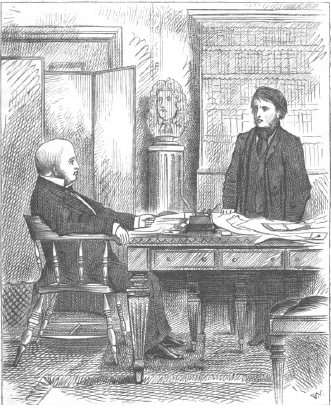
'Saul Fielding,' answers the servant, and adds, 'but he says he does not think you know him.'
'What does he look like?'
The servant hesitates; he has not made up his mind. Although Saul Fielding is shabbily dressed, he is clean, and Jane's watchful care has made his wardrobe (the whole of which he wears on his back) seem better than it is. Besides, there is 'an air' about Saul Fielding which prevents him being placed, in the servant's mind, on the lowest rung of vagabondism.
'Is he a poor man? Is he a working man? demands Mr. Million impatiently.
'He looks like it, sir,' replies the servant, not committing himself distinctly to either statement.
Mr. Million has an idle hour before him, which he is not disinclined to devote to the workingman question, so he bids the servant admit the visitor.
'Wait a minute,' says Mr. Million to Saul Fielding as he enters the room. Mr. Million evidently has found some very knotty problem in the papers before him, for he bends over them, with knitted brows and studious face, and shifts them about, and makes notes on other pieces of paper, and mutters 'Pish!' and 'Psha!' and 'Very true!' and 'This must be seen to!' with many remarks indicative of the engrossing nature of the subject which engages his attention. After a sufficient exhibition of this by-play, which doubtless impresses his visitor with a proper idea of his importance and of the immense interest he takes in public matters, he pushes the papers aside with a weary air, and looks up, with one eye closed and one eye open. What he sees before him does not seem to afford him any comfort: for it is a strange thing with public players of battledoor and shuttlecock, that although they have in theory a high respect for their shuttlecocks, they have in absolute fact a very strong distaste for them. Seeing that he is expected to speak, Saul Fielding commences; he is at no loss for words, but he speaks more slowly than usual, in consequence of the heavy stake he has in the interview.
'I have ventured to call upon you, sir,' he says, 'in the hope that you will take some interest in my story, and that you will extend a helping hand to a poor man.'
Somewhat fretfully--for careful as he strives to be, Saul Fielding has been unwise in his introduction, which might be construed into an appeal for alms--somewhat fretfully, then, Mr. Million interposes with
'A working man?'
'I hope I may call myself so--although, strictly speaking, I have done but little work for a long time.'
Mr. Million gazes with curiosity at his visitor, and asks, in a self-complacent, insolent tone, as if he knows all about it,
'Not able to get work, eh?
'I have not been able to get it, sir.'
'But quite willing to do it if you could get it?'
'Quite willing, sir more than willing--thankful.'
Saul Fielding knows that already he is beginning to lose ground,' but his voice is even more respectful and humble than at first--although the very nature of the man causes him to speak with a certain confidence and independence which is eminently offensive to the delicate ears of the friend of the working man.
'Of course!' exclaims Mr. Million triumphantly and disdainfully. 'The old cry! I knew it. The old cry! I suppose you will say presently that there is not room for all, and that there are numbers of men who are in the same position as yourself--willing to work, unable to obtain it.'
Saul Fielding makes no reply; words are rushing to his tongue, but he does not utter them. But Mr. Million insists upon being answered, and repeats what he has said in such a manner and tone that Saul cannot escape.
'I think, sir, that there are many men who are forced to be idle against their will; that seems to be a necessity in all countries where population increases so fast as ours does. But I don't complain of that.'
'O!' cries Mr. Million, opening both his eyes very wide indeed. 'You don't complain of that! You are one of those glib speakers, I have no doubt, who foment dissatisfaction among the working classes, who tell them that they are down-trodden and oppressed, and that masters are fattening upon them! I should not be surprised to hear that you are a freethinker.'
'No, sir, I am not that,' urges Saul Fielding, exquisitely distressed at the unpromising turn the interview has taken; 'nor indeed have I anything to complain of myself. I am too crushed and broken-down, as you may see.'
'But if you were not so,' persists Mr. Million, growing harder as Saul grows humbler, 'if you were in regular work, and in receipt of regular wages, it would be different with you--eh? You would have something to complain of then doubtless. You would say pretty loudly that the working man is underpaid, and you would do your best to fan the flame of discontent kept up by a few grumblers and idlers. You would do this--eh? Come, come,' he adds haughtily, seeing that Saul Fielding does not wish to answer; 'you are here upon a begging petition, you know. Don't you think it will be best to answer my questions?'
'What is it you wish me to answer, sir?' asks Saul Fielding sorrowfully.
'The question of wages. I want to ascertain whether you are one of those who think the working classes are underpaid.'
Saul Fielding pauses for a moment; and in that brief time determines to be true to himself. 'Jane would not have me do otherwise,' he thinks.
'I think, sir,' he says, firmly and respectfully, 'that the working classes--by which I mean all in the land who have to work with their hands for daily bread--do not receive, as things go, a fair equivalent for their work. Their wages are not sufficient. They seem to me to be framed upon a basis which makes the work of ekeing them out so as to make both ends meet a harder task than the toil by which they are earned. The working man's discontent does not spring from his work; he does that cheerfully almost always. It springs out of the fact, that the results of his work are not sufficient for comfort, and certainly not sufficient to dispel the terrible anxiety which hangs over the future, when he is ill and unable to work, perhaps, or when he and his wife are too old for work.'
'O, indeed!' exclaims Mr. Million. 'You give him a wife!'
'Yes, sir; his life would be a burden indeed without a woman's love.'
Mr. Million stares loftily at Saul Fielding.
'And children, doubtless!'
'Happy he who has them! It is Nature's law; and no man can gainsay it.' The theme possesses a fascination for Saul Fielding, and he continues warmly, 'I put aside as distinctly outrageous all that is said of the folly and wickedness of poor people marrying and having large families. This very fact, which theorists wax indignant over--theorists, mind you, who have wives and families themselves, and who, by their arguments, lay down the monstrous proposition that nature works in the blood according to the length of a man's purse--this very fact has made England strong; had it been otherwise, the nation would have been emasculated. Besides, you can't set natural feeling to the tune of theory; nor, when a man's individual happiness is concerned, can you induce him to believe in the truth of general propositions which, being carried out in his own person as one of the units, would make his very existence hateful to him.'
Mr. Million opens his eyes even wider than before; such language from the lips of the ragged man before him is indeed astonishing.
'What more have you to say? he gasps. 'You will want property equally divided----'
'No, sir, indeed,' interrupts Saul Fielding, daring to feel indignant, even in the presence of so rich a man, at the suggestion. 'The man who makes honestly for himself is entitled to possess and enjoy. I am no socialist.'
'You would, at all events,' pursues Mr. Million, 'feed the working man with a silver spoon?--You would open the places of amusement for him on the Sabbath?'
'I would open some places and shut others.'
'What places, now?'
'The museums, the public galleries. I would give him every chance--he has a right to it--to elevate himself during the only leisure he has.'
'And in this way,' demands Mr. Million severely, 'you would desecrate the Sabbath!'
For the life of him Saul Fielding cannot help saying,
'A greater desecration than even that can be in your eyes takes place on the Sabbath in places that are open in the name of the law.'
'You refer to----'
'Public-houses. If they are allowed to be open, what reasonable argument can be brought against the opening of places the good influence of which is universally acknowledged? It is the withholding of these just privileges that causes much discontent and ill-feeling.'
This is quite enough for Mr. Million. This man, ragged, penniless, has the effrontery to tell the rich brewer to his face that he would have the public picture-galleries and museums of art opened on the Sabbath-day, and that he would shut the public-houses. Mr. Million can find no words to express his indignation. He can only say, stiffly and coldly,
'I have heard quite enough of your opinions, sir. Come to the point of your visit. You see'--pointing to the papers scattered about the table--'that I am very busy.'
'I came, sir,' he says sadly, 'in the hope that, seeing my distress, you would not have been disinclined to assist me--not with money, sir,' he adds swiftly, in answer to an impatient look of dissent from Mr. Million, 'but with your good word. But I am afraid that I have injured my cause by the expression of my opinions.'
'In what way did you expect that I could aid you?' asks Mr. Million carelessly, as he settles himself to his papers.
'I have been especially unfortunate in my career, sir. As I told you, I am willing to work, but am unable to obtain it. If I could emigrate; if I could get into a new country, where labour is scarce, things might be better for me.'
The poor man is helpless at the rich man's foot; and the rich man plays with him, as a cat with a mouse.
'Well,' he says, 'emigrate. The country would be well rid of such as you.'
Saul Fielding takes no notice of the insult. He is not to be turned aside from his purpose, although he knows full well that he has missed his mark.
'I have no means, sir; I am poor and helpless.'
'How do you propose to effect your object, then?'
'There are Government emigrant ships which take men out, I have heard, for very little--for nothing almost. A line of recommendation from you would be sufficiently powerful, I thought, to obtain me a passage.'
'Doubtless, doubtless,' this with a smile; 'but you are a man of some perception, and having observed how utterly I disagree with your opinions--which I consider abominable and mischievous to the last degree--you can hardly expect me to give you the recommendation you ask for. May I ask, as you are a perfect stranger to me, for I have no recollection of you in any way, to what I am indebted for the honour you have done me by choosing me to give you a good character?'
'You are a public man, sir, and I have heard a friend to the working man. And as you had helped a friend of mine to emigrate by giving him a free passage in a ship that sails this week----'
'Stop, stop, if you please. I help a friend of yours to emigrate by giving him a free passage! I think you are mistaken.'
'If you say so, sir, I must be. But this is what George Naldret gave me to understand.'
'And pray who is George Naldret?' demands Mr. Million haughtily; 'and what are his reasons for emigrating?'
'George Naldret,' returns Saul Fielding, in perplexity, 'is almost the only friend I have in the world, and he is emigrating for the purpose of putting himself into a position to marry more quickly than his prospects here will allow him.'
'As you are introducing me,' says Mr. Million, with an air of supreme indifference, 'to your friends, perhaps you would like also to introduce me to the young lady--for of course' (with a sneer) 'she is a young lady--he desires to marry.'
'Her name is Sparrow--Bessie Sparrow, granddaughter to an old grocer.'
Mr. Million becomes suddenly interested, and pushes his papers aside with an exclamation of anger.
'What name did you say?'
'Miss Bessie Sparrow.'
The rich brewer ponders for a moment, evidently in no pleasant mood. Then suddenly rings a bell. A servant appears.
'Is my son in the house?'
'Yes, sir.'
'Tell him to come to me instantly.'
Saul Fielding waits gravely. Seemingly, he also has found new food for contemplation. Presently young Mr. Million appears.
'You sent for me, sir.'
'Yes, James. Do you know this person?' with a slight wave of the hand in the direction of Saul Fielding, as towards a thing of no consequence. Saul Fielding knows that his mission has failed, but does not resent this contemptuous reference to him. He stands, humble and watchful, before father and son.
'I have seen him,' says young Mr. Million, 'and I should say he is not a desirable person in this house.'
'My opinion exactly. Yet, influenced by some cock-and-a-bull story, he comes here soliciting my assistance to enable him to emigrate. The country would be well rid of him, I am sure; but of course it is out of my power to give such a person a good character to the emigration commissioners.'
'Out of anybody's power, I should say,' assents young Mr. Million gaily. 'To what cock-and-a-bull story do you refer?'
'He tells me--which is news to me--that I have given a free passage ticket to a friend of his, George--George--what did you say?'
'George Naldret, sir.' Saul Fielding supplies the name in a manner perfectly respectful.
'Ay--George Naldret. Such a statement is in itself, of course, a falsehood. Even if I knew George Naldret, which I do not, and desired to assist him, which I do not, the fact of his being engaged to be married to any one of the name of Sparrow--a name which means disgrace in our firm, as you are aware-would be sufficient for me not to do so.'
Young Mr. Million steals a look at Saul Fielding, whose face, however, is a mask; and in a hesitating voice says: 'I think I can explain the matter; but it is not necessary for this person to remain. You do not know, perhaps, that he was the chief mover in a strike a few years ago, which threatened to do much mischief.'
'I am not surprised to hear it,' says the rich brewer; 'the opinions he has expressed have prepared me for some such statement concerning him. He would desecrate the Sabbath-day by opening museums and picture-galleries, and he would curtail the liberty of the subject by closing public-houses, and depriving the working man of his beer! Monstrous! monstrous! He has nothing to say for himself, I suppose.'
'No, sir,' answers Saul Fielding, raising his head, and looking steadily at young Mr. Million, 'except that I believed in the truth of what I told you, and that I don't know whether I am sorry or glad that I made the application to you.'
The rich brewer has already touched the bell, and the servant comes into the room.
'Show this person to the door,' Mr. Million says haughtily; 'and if he comes again, send for a policeman. He is a dangerous character.'
Saul Fielding's lips wreathe disdainfully, but he walks out of the room, and out of the house, without a word of remonstrance. This chance has slipped from him. Where next shall he turn? He walks slowly onwards until he is clear of the rich brewer's house, and then stops, casting uncertain looks about him. As a sense of his utter helplessness comes upon him, a young woman brushes past him without seeing him. He looks up. Bessie Sparrow! She is walking quickly, and seems to see nothing, seems to wish to see nothing. Without any distinct purpose in his mind, but impelled by an uncontrollable undefinable impulse, Saul Fielding turns and follows her. A gasp of pain escapes him as he sees her pause before Mr. Million's house. She rings the bell, and the door is opened. She hands the servant a letter, and the next moment she is in the house, shut from Saul Fielding's view. The terror that comes upon him is so great that the street and the sky swim before his eyes, and he clings to a lamp-post for support.
'O, George!' he groans. 'O, my friend! How will you bear this? Good God! what bitterness there is in life even for those who have not fallen as I have done!'
TOTTIE'S DREAM.
When Tottie was put to bed, it was no wonder that she was haunted by the sweet effigy of old Ben Sparrow, and that his stomach of candied lemon-peel and his head of rich figs and currants presented themselves to her in the most tempting shapes and forms her warm imagination could devise. As she lay in bed, looking at the rushlight in the washhand basin, the effigy appeared bit by bit in front of the basin until it was complete, and when it winked one of its currant eyes at her--as it actually did--the light of the candle threw a halo of glory over the form. Her eyes wandering to the mantelshelf, she saw the effigy come out of the wall and stand in the middle of the shelf; and turning to the table, it rose from beneath it, and sat comfortably down; with its legs of cinnamon and raisins tucked under it like a tailor. When she closed her eyes she saw it loom in the centre of dilating rainbow circles, and in the centre of dark-coloured discs, which as they swelled to larger proportions assumed bright borderings of colour, for the express purpose of setting off more vividly the attraction of the figure. Opening her eyes drowsily, she saw the old man come down the chimney and vanish in the grate, and as he disappeared, down the chimney he came again, and continued thus to repeat himself as it were, as if he were a regiment under full marching orders. Whichever way, indeed, Tottie's eyes turned, she saw him, until the room was full of him and his sweetness, and with his multiplied image in her mind she fell asleep.
No wonder that she dreamt of him. Tottie and Bessie slept in the same room, and Tottie dreamt that long after she fell asleep--it must have been long after, for Bessie was in bed--she woke up suddenly. There she was, lying in bed, wide awake, in the middle of the night. The room was dark, and she could not see anything, but she could hear Bessie's soft breathing. She was not frightened, as she usually was in the dark, for her attention was completely engrossed by one feeling. A frightful craving was upon her, which every moment grew stronger and stronger. This craving had something horrible in it, which, however, she did not quite realise. In the next room slept old Ben Sparrow, who, according to the fancy of her dream, was not made of blood, and flesh, and bone, but of lemon-peel, fig, and currants and raisins. All the sweet things in the shop had been employed in the manufacture, and there they lay embodied in him.
Tottie knew nothing of theology; knew nothing of the value of her soul, which, without a moment's hesitation, she would have bartered for figs and candied lemon-peel. And there the delicious things lay, in the very next room. If she could only get there!--perhaps he would not miss an arm or a leg. But to eat the old man who was so kind to her! She had a dim consciousness of the wickedness of the wish, but she could not rid herself of it. Thought Tottie, 'He won't know if he's asleep, and perhaps it won't hurt him. I know it would do me good.' Her mouth watered, her eyes glistened, her fingers twitched to be at him, her stomach cried out to her. She could not withstand the temptation. Slowly and tremblingly she crept out of bed, and groped along the ground towards the door. Bessie was asleep. Everybody was asleep. The house was very quiet. Everything favoured the accomplishment of the horrible deed. 'Nobody will know,' thought Tottie. Thoroughly engrossed in her desperate cannibalistic purpose, and with her teeth grating against each other, Tottie turned the handle of the door and opened it; but as she looked into the dark passage Ben Sparrow's door opened, and a sudden flood of light poured upon her. It so dazzled her, and terrified her, that she fled back to her bed on all-fours, and scrambled upon it, with a beating heart and a face as white as a ghost's. Sitting there glaring at the door, which she had left partly open in her flight, she saw the light steal into the room, and flying in the midst of it, old Ben Sparrow. He was not quite as large as life, but he was ever so many times more sweet and delicious-looking. As old Ben Sparrow appeared, the room became as light as day, and Tottie noticed how rich and luscious were the gigantic fig which formed his head, the candied lemon-peel which formed his stomach, the raisins which clothed his legs and arms; and as for the ripeness of his dark, beady, fruity eyes, there was no form of thought that could truly express the temptation that lay in them. Ben Sparrow hovered in the air for a few moments, and then steadied himself, as it were: he stood bolt upright, and, treading upon nothing; advanced slowly and solemnly, putting out one leg carefully, and setting it down firmly upon nothing before he could make up his mind to move the other. In this manner he approached Tottie, and sat down on her bed. For a little while Tottie was too frightened to speak. She held her breath, and waited with closed lips for him to say something. But as grandfather did not move or speak, her courage gradually returned, and with it, her craving for some of him. She became hungrier than the most unfortunate church-mouse that ever breathed; her rapacious longing could only be satisfied in one way. Timorously she reached out her hand towards his face; he did not stir. Towards his eyes; he did not wink. Her finger touched his eye; it did not quiver--and out it came, and was in her hand! Her heart throbbed with fearful ecstasy, as with averted head she put the terrible morsel in her mouth. It was delicious. She chewed it and swallowed it with infinite relish, and, when it was gone, thirsted for its fellow. She looked timidly at the old man. There was a queer expression in his fig face, which the loss of one of his eyes had doubtless imparted to it. 'It doesn't seem to hurt him,' thought Tottie. Her eager fingers were soon close to the remaining eye, and out that came, and was disposed of in like manner. Tottie certainly never knew how good Ben Sparrow was until the present time. She had always loved him, but never so much as now. The eyeless face had a mournful expression upon it, and seemed to say sadly, 'Hadn't you better take me next?' Tottie clutched it desperately. It wagged at her, and from its mace lips a murmur seemed to issue, 'O, Tottie! Tottie! To serve me like so this!' But Tottie was ravenous. No fear of consequences could stop her now that she had tasted him, and found how sweet he was. She shut her eyes nevertheless, as, in the execution of her murderous purpose, she tugged at his head, which, when she had torn from his body, she ate bit by bit with a rare and fearful enjoyment. When she looked again at the headless figure of the old man, one of the legs moved briskly and held itself out to her with an air of 'Me next!' in the action. But Tottie, hungering for the lemon-peel stomach, disregarded the invitation. It was difficult to get the stomach off, it was so tightly fixed to its legs. When she succeeded, the arms came with it, and she broke them off short at the shoulder blade, and thought she heard a groan as she performed the cruel operation. But her heart was hardened, and she continued her feast without remorse. How delicious it was! She was a long time disposing of it, for it was very large, but at length it was all eaten, and not a piece of candied sugar was left. As she sucked her fingers with the delight of a savage, a sense of the wickedness of what she had done came upon her. Her grandfather, who had always been so kind to her! She began to tremble and to cry. But the arms and legs remained. They must be eaten. Something dreadful would be done to her if they were discovered in her bed; so with feverish haste she devoured the limbs. And now, not a trace of the old man remained. She had devoured him from head to foot She would never see him again--never, never! How dreadful the table looked, with him not on it! How Tottie wished she hadn't done it! She was appalled at the contemplation of her guilt, and by the thought of how she would be punished if she were found out. In the midst of these fears the light in the room vanished, and oblivion fell upon Tottie in the darkness that followed.
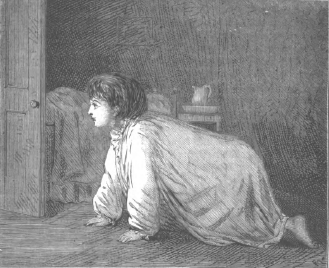
I CAN SEE YOU NOW, KISSING HER LITTLE TOES.
The next day, being George's last day at home, was a day of sorrow to all the humble persons interested in his career. He, was to start for Liverpool by an early train on the following morning, and was to pass his last evening at Ben Sparrow's, with the old man and Bessie and Tottie and his mother and father. He had decided to bid Bessie good-bye in her grandfather's house. Bessie was for sitting up all night, but he said gently,
'I think, Bessie, that mother would like to have me all to herself the last hour or two. You know what mothers are! By and by, heart's treasure! you will have the first claim on me; but now mother looks upon me as all her own, and it will comfort her heart, dear soul! to let it be as I say.'
There were tears in George's eyes as he looked down upon the face of his darling, and his heart almost fainted within him at the thought of parting from her. And, 'Do you love me, Bess?' he asked, for the thousandth time.
'With all my heart and soul,' replied Bessie, pressing him in her arms. And so, with his head bowed down to hers, they remained in silent communion for many minutes. They were sitting in Ben Sparrow's parlour, and the old man had left the young people by themselves, finding occupation in his shop, in the contemplation of his effigy, and in weighing up quarters of a pound of sugar. There was a woful look in Ben Sparrow's face as he stood behind his counter; times were hard with him, and his till was empty.
'Bess, darling,' said George, waking up from his dream. She raised her tearful eyes to his. He kissed them. 'As I kiss away your tears now, my dear, so I will try to take sorrow and trouble from you when we commence our new life.'
'I know it, George; I know it,' she said, and cried the more.
'But that is not what I was going to say. I was going to say this. Listen to me, dearest: If it were not for you, I shouldn't go; if it were not for you, I should stay at home, and be content. For I love home, I love the dear old land, I love mother and father, and the old black cat, and the little house I was born in. And it's because of you that I am tearing myself from these dear things. I am going to earn money enough to make a home for you and me; to make you more quickly all my own, all my own! How my heart will yearn for you, dear, when I am over the seas! But it will not be for long; I will work and save, and come back soon, and then, my darling, then!----' The tenderness of his tone, and the tenderness there was in the silence that followed, were a fitter and more expressive conclusion to the sentence than words could have made. 'I shall say when I am in the ship, I am here for Bessie's sake. When I am among strangers, I shall think of you, and think, if I endure any hardship, that I endure it for my darling--and that will soften it, and make it sweet; it will, my dear! I shall not be able to sleep very much, Bess, and that will give me all the more hours to work--for you, my darling, for you! See here, heart's treasure; here is the purse you worked for me, round my neck. It shall never leave me--it rests upon my heart. The pretty little beads! How I love them! I shall kiss every piece of gold I put in it, and shall think I am kissing you, as I do now, dear, dearest, best! I shall live in the future. The time will soon pass, and as the ship comes back, with me in it, and with my Bessie's purse filled with chairs and tables and pots and pans, I shall see my little girl waiting for me, thinking of me, longing to have me in her arms as I long to have her in mine. And then, when I do come, and you start up from your chair as I open the door!----Think of that moment, Bess--think of it!'
'O, George, George, you make me happy!'
And in such tender words they passed the next hour together, until George tore himself away to look after some tools, which he was to take with him to coin chairs and tables and pots and pans with. But if he did not wish his tools to rust, it behoved him not to bring them too close to his eyes, for his eyelashes were dewy with tears.
Now, late as it was in the day for such common folk as ours, Tottie had not yet made her appearance downstairs. The first in the morning to get up in the house was old Ben Sparrow, and while he was taking down his shutters, and sweeping his shop and setting it in order, Bessie rose and dressed, and prepared the breakfast. Then, when breakfast was nearly ready, Bessie would go upstairs to dress and wash Tottie; but on this particular morning, on going to the little girl's bedside, Tottie cried and sobbed and shammed headache, and as Tottie was not usually a lie-abed, Bessie thought it would do the child good to let her rest. And besides being as cunning as the rest of her sex, Bessie was the more inclined to humour Tottie's whim, because she knew that George would be sure to drop in early; and if Tottie were out of the way, she and her lover could have the parlour all to themselves. George being gone, however, there was no longer any reason for Tottie keeping her bed; so Bessie washed and dressed the child, and was surprised, when taking her hand to lead her downstairs, to see Tottie shrink back and sob and cry that she didn't want to go.
'Come, be a good child, Tottie,' said Bessuel 'grandfather's downstairs, and he wants to play with you.'
At this Tottie sobbed and sobbed, and shook her head vehemently. She knew very well that it was impossible for Ben Sparrow to be downstairs, for had she not eaten him in the night, every bone of him? She was morally convinced that there was not a bit of him left. Grandfather play with her! He would never play with her any more; she had done for him! Her fears were so great that she fancied she could feel him stirring inside of her. But although she was rebellious, she was weak, and so, shutting her eyes tight, she went into the parlour with Bessie. Then she ran tremblingly into a corner, and stood with her face to the wall, and her pinafore over her head; and there Bessie, having more pressing cares upon her just then, left her. When Tottie, therefore, heard the old man's voice calling to her, she sobbed, 'No, I never! No, I never!' and was ready to sink through the floor in her fright; and when the old man lifted her in his arms to kiss her, it was a long time before she could muster sufficient courage to open her eyes and feel his face and his arms and his legs, to satisfy herself that he was really real. And even after that, as if she could not believe the evidence of her senses, she crept towards him at intervals, and touched him and pinched his legs, to make assurance doubly sure.
Ben Sparrow found it hard work to be playful to-day, and Tottie had most of her time to herself. If the anxiety depicted on his face were any criterion, his special cares and sorrows must have been of an overwhelming nature. In the afternoon young Mr. Million came in, spruce and dandified, and handsome as usual. The young gentleman was not an unfrequent visitor at the little grocer's shop, and would often pop in and chat for an hour with Ben Sparrow; he would sit down in the back parlour in the most affable manner, and chat and laugh as if they were equals. Bessie was not at home when he came this afternoon, and he seemed a little disappointed; but he stopped and chatted for all that, and when he went away, the old grocer brightened, and his face looked as if a load were lifted from his heart. His brighter mood met with no response from Bessie, when she came in shortly afterwards. Some new trouble seemed to have come on her since the morning--some new grief to which she hardly dared give expression. She had been stabbed by a few presumably chance and careless words spoken by a neighbour--need it be told that this neighbour was a woman? No weapon can be keener than a woman's tongue, when she chooses to use it to stab. The woman who had uttered the words was young--a year older than Bessie--and it was known at one time that she was setting her cap at Bessie's sweetheart. But she had met with no encouragement from George, who, being wrapt heart and soul in Bessie, had no eyes for other women. George often nodded a laughing assent to a favourite saying of his mother's, that 'One woman was enough for any man; more than enough, sometimes,' Mrs. Naldret would occasionally add. The stab which Bessie received shall be given in the few words that conveyed it.
'So George goes away to-morrow morning,' was the woman's remark to Bessie as she was hurrying home with heavy heart.
'Yes,' sighed Bessie; 'to-morrow morning.'
'Ah,' said the woman, 'he'll be nicely cut up at leaving. I daresay he'd give a good deal, if he could take some one with him.'
'I am sure he would,' said Bessie, thinking that by 'some one' herself was meant.
'O, I don't mean you,' said the woman, seeing the interpretation that Bessie put upon her words.
'Who do you mean, then?' asked Bessie, looking up quickly.
The woman laughed and shrugged her shoulders.
'Well!' she exclaimed. 'Some girls are blind! Thank goodness, the best man in the world couldn't blind me so!'
'What do you mean?' demanded Bessie, in an agitated tone, all the blood deserting her face. 'What have you to say against George?'
The woman laughed again.
'You've no cause to be jealous, Bessie,' she said, 'it's only a child. But I do think, if I was George's sweetheart'--Bessie's lip curled, and this little expression made the woman's tone more venomous--'I do think,' she added with scornful emphasis, 'that if I was George's sweetheart--O, you needn't curl your lip, Bessie!--I should ask him--who--Tottie's--father--was! A woman isn't worth that'--with a snap of her finger--'if she hasn't got a spirit.'
And George's discarded left Bessie white and trembling, with this wound in her heart.
Bessie looked after the woman, dazed for a few moments by the accusation conveyed in the words; then she became suddenly indignant, and the blood rushed back to her face and neck; it dyed her bosom, and she knew it and felt it, and felt the stab there also. Then she hurried home.
Ben Sparrow did not notice her agitation at first; he was too much rejoiced at the lifting of a heavy weight from him. In the morning ruin had stared him in the face; a small creditor had come down upon him; had given him twenty-four hours to pay an account which, trifling as it was, he was not possessed of. But young Mr. Million had been to see him and had saved him. He would be able to pay this hard creditor--I am ashamed to say for how trifling an amount--in the morning, and he was exultant 'I am only too glad,' this young gentleman had said, 'to have the opportunity of rendering a service to Bessie's grandfather.' When he departed, old Ben Sparrow actually danced in his parlour in thankfulness for the danger escaped.
'Bessie,' cried Ben Sparrow as his granddaughter entered, 'young Mr. Million has been here.'
Bessie nodded, scarcely heeding the words.
'He's a gentleman,' continued Ben Sparrow, 'every inch of him; to forget the past, as he does.'
'What past, grandfather?' asked Bessie. 'Forget what?'
'O, nothing--nothing, my dear,' exclaimed Ben hurriedly, and coughing as if something had come up or gone down the wrong way. 'What I say is, he's a gentleman, every inch of him.'
'You said that before, grandfather.'
'Did I? yes, of course. But I'm an old man, Bessie, and you must make allowances. We can't be all bright and fresh, and always happy as my dear child is.'
Bessie kissed Ben Sparrow's neck, and laid her head oh his shoulder. 'Always happy, grandfather! Am I always happy?'
'Of course you are, dear child, and it's natural and right and proper. Sorry and grieved, of course, because our sweetheart's going away--but he'll be back soon, never fear. And we'll talk of him every day and every night, my dear, and the time'll fly away'--he blew a light breath--'like that! Ah, my dear! it's only the old that knows how quickly time flies!'
Bessie said nothing, but pressed closer to the old shield that had sheltered her from babyhood to womanhood.
'And now see,' said the old shield, 'what young Mr. Million brought for you. And you're to wear them at once, he said, and I say so too, and I promised him you would, for he's coming here tonight, and is going to do me such a kindness as only the kindest heart in the world could do.'
Ben Sparrow took from his pocket a little box, and opened it, and produced therefrom a piece of tissue-paper, and from the tissue-paper a pair of pretty turquoise earrings set in gold. Bessie scarcely looked at them, and allowed Ben to take from her ears the pair of old ear-rings she had worn for ever so many years, and replace them with Mr. Million's pretty present.
'You look, Bessie,' said old Ben, falling back and contemplating her, 'you look like a Princess! and it's my opinion, my dear, that you are every bit as good as one.'
He held a piece of looking-glass before her, and desired her to look at herself. To please him she said they were very pretty, and then said, suddenly coming to what was uppermost in her mind, 'Grandfather, I want you to tell me about Tottie.'
'About Tottie, my dear!' exclaimed Ben Sparrow wonderingly.
'Yes,' replied Bessie, sitting down, 'about Tottie. All I know is that you came and asked me once if I would mind if you brought a little friendless girl home to live with us, and if I would take care of her.'
'And you said Yes, gladly, for it would be company for us, and would make the place pleasant. And I'm sure neither you nor me have ever repented it. If Tottie was our own flesh and blood we couldn't be fonder of her. I shouldn't know what to do without her now I've got so used to her. I'll tell you the story by and by, my dear, when George has gone----'
'No,' interrupted Bessie, so impetuously as to cause old Ben to jump; 'now! I want to know now. Ah, dear grandfather! you have always been so good to me that I can't help being a tyrant.'
'You a tyrant!' cried Ben, appealing with raised hands to the walls and the furniture to join him in the repudiation of the astonishing statement. 'That's a good one, that is. Well, my dear, as you want to know at once, and as you're such a tyrant--ha, ha! I can't help laughing, my dear--here goes. It's now three years gone, Bess--before George and you began to keep company, my dear--that George comes and tells me a story of a poor little thing that had been thrown helpless upon the world. "Such a pretty little thing!" says George, "and not a friend but me to look after her! I wish I knew some one," says George, "who would take care of the dear; I'm sure I could never be grateful enough to them." Then I asked how old the child was, and whether she did not have relations. "Yes," said George, "she had two, but they had no home and were altogether in too bad a position to take care of the little one." Then I thought of you, my dear, and thought it would be company for my Bessie and for me, and that if we grew to love the child, there would be nothing to repent of. I told George this, and George confessed that he had the same thing in his mind too, and that was the reason why he spoke to me about it--hoping that I would say what I had said. And so, to cut a long story short, one night a woman came to the door with little Tottie in her arms, and kissed the child a many times, and George brought Tottie in. I didn't see the woman's face, but I fancied that she was crying. I have often wished since that I had seen her face, the poor creature seemed in such distress. You remember, Bessie, when you came home an hour afterwards, and found me sitting before the fire with Tottie in my lap, warming her little toes, how you fell in love with her directly, and how happy she made us, and how this very parlour was, because Tottie was with us, really made a great deal more cheerfuller than ever it had been before! You remember the wonderful dimples that came into her face when she looked at us, and broke out a-smiling, as much as to say, 'How d'you do, old Ben and young Bess? I'm very glad to see you!' Why, it was as good as a play! I can see you now kissing her little toes, and can see her crowing and laughing when you kissed her neck--so fat, and so full of creases! and I can see her clenching her little fist and flourishing it in the air as much as to say, "In this fist I've got a hundred-pound note, and all the world and his wife sha'n't take it from me!" Dear, dear! the child has been a comfort to us, and it was a bright day when she came into the house, the poor little thing! Then George says, "You're not to be expected to keep Tottie for nothing, Mr. Sparrow; and here's three shillings a week, and when she gets a big girl perhaps we'll be able to spare more." And he's paid the three shillings a week regular, and has brought little things for her now and then, such as a frock, you know, or a flannel petticoat, or a little pair of shoes. And that's the whole of the story, Bess.'
Bessie had listened very attentively to the narration of Tottie's history, and now said, after a pause, with a strange hesitation in her voice,
'Grandfather, did George never tell you--who--Tottie's--father--was?
'No, my dear. I remember once it coming up between us somehow, but George turned it off, and said it didn't matter to Tottie, who seemed as happy as the day was long--and so she was, and is, my dear.'
At that moment 'Shop!' was called, and Ben Sparrow hurried in to attend to his customer, and the subject dropped.
ONE KISS FOR HOPE, ONE FOR FAITH, AND ONE FOR LOVE.
Tea was over and cleared away in the little back parlour, and Bessie and old Ben Sparrow sat looking sadly into the fire. Tottie was also present in her high chair, but there was nothing of sadness in her thoughts. She was enjoying, in anticipation, what was spread upon the table; for after the fashion of humble folk, preparations had been made for 'a party' on this last evening which George was to spend with them. There was a bottle of 'sherry wine' on the table, and another of port, which old Ben had bought at a large grocer's shop over Westminster-bridge, at a cost, for the two bottles, of two shillings and fourpence; and that the wine was of an old and rich vintage, was proved by the mildew and sawdust which clung to the bottles. There were six wine-glasses of different shapes and patterns; and there was a plate of almonds and raisins, and another of figs, and some small seed-cakes, and four oranges cut in quarters; so that, altogether, the table presented quite a festive appearance. There was nothing festive, however, in the countenances of Bessie and her grandfather; their faces were as sad as their thoughts. It was but natural. And yet they would have been loth to have confessed to each other the exact tenor of their contemplations.
A bustle in the shop caused Ben Sparrow to jump from his chair.
'That's Mr. and Mrs. Naldret,' he said, and opened the parlour-door and gave them welcome.
'Well, Bessie,' said Mrs. Naldret, and 'Well, my girl,' said Jim Naldret, and they both kissed her, and shook hands with old Ben, who bustled about doing nothing, while Bessie assisted Mrs. Naldret to take off her bonnet and things. Mrs. Naldret had with one glance taken in the preparations for the party, and approved of them.
'What a pretty pair of earrings!' exclaimed Mrs. Naldret, admiring the turquoise trifles in Bessie's pink ears, and, 'Well, George is a sly one!' said Jim Naldret, pinching the pretty ears.
'George didn't give them to her,' said Ben Sparrow, rubbing his hands; 'no, nor me either. I'm not rich enough; though if I could afford it, Bessie should have had such a pair long ago, and a gold chain and a watch as well.'
'She's pretty enough to have them,' said Jim Naldret.
'And good enough,' added Ben. 'Well, I am glad to see you! But I wish it was to welcome George back instead of wishing him good-bye. Eh, Bess?'
'Yes, grandfather,' replied Bessie, with a heavy sigh.
Mrs. Naldret said nothing; she was thinking who had given Bessie the turquoise ear-rings; she knew they could not have cost less than four pounds at least.
'There's George,' said Jim Naldret, as the shop-door opened.
Bessie turned eagerly to the door, but Ben Sparrow stepped before her and said in a hurried agitated tone,
'I should like to have a few quiet words with George, my dear; I sha'n't have another opportunity. Mrs. Naldret won't mind.'
That worthy woman nodded, and Ben Sparrow, going into the shop, stopped George's entrance into the parlour.
'Don't go in for a minute,' said Ben; 'I want to speak to you.'
'All right, grandfather; but I must have a kiss of Bessie first. Bessie!'
The girl ran into the shop at his call, and nestled in his arms for a moment.
'There! there!' exclaimed old Ben, taking Bessie's hand gently and kindly. 'Go inside, Bess, my dear. That's all George wanted with you. We'll be in presently.'
Bessie went into the parlour, and George's heart was like a nest from which the dearly-loved bird had flown. That little embrace, with Bessie, warm and soft and tender in his arms, contained such exquisite happiness as to be painful.
'I'll not keep you two minutes,' said Ben Sparrow; 'come to the door, so that we may not be heard.'
They went to the shop-door, and into the street, which they paced slowly as they conversed.
'As I was sitting inside by the fire, just now, George,' resumed Ben, 'there came into my mind something which I think I ought to speak of before you go away. It brought back old-time memories, too. You see, my dear boy, I am an old man, and there's no telling what may happen. It is a comfort to me that Bessie will have a good man for a husband--for I believe you to be good, and--and a man, George!'
'Indeed, Mr. Sparrow, I will do my best. It will be my happiness to make her happy.'
'I believe it will be, George, and that's why I'm glad she will be yours. I have nothing to give her, George, nothing. I am so poor that I don't know which way to turn sometimes to pay little pay little bills.'
'I want nothing with her, Mr. Sparrow. I want no better fortune than Bessie herself.' He was overflowing with love for his dear girl.
'She's good enough to be a Princess,' said Ben proudly, 'good enough to be a Queen.'
'She's my Princess and my Queen,' replied George; 'and she's a good girl and will be a good wife, and that's better than all.'
'That it is--that it is. But don't interrupt me, George. I thought once I should be better off than I am, but something went wrong with me, and I lost all my little savings. Since then, I have been going down, till sometimes I think I can't go down any lower.' Old Ben Sparrow paused here, and before he resumed closed his eyes, and put his hand over them, as if with his inner sense of sight he were looking into the past. 'George, I am going to speak of Bessie's father--and my son; it is only right that I should, for you may meet him.'
'Meet him, Mr. Sparrow!'
'Yes,' replied the old man in a quiet tone, 'I daresay you have heard that he ran away, years ago, in disgrace. Bessie was quite a little thing then, and I don't think any one has been so unkind as to speak of it to her. To tell you the truth, George, she believed years ago that her father was dead, and it is best that she should not be told different. And he may be dead, George, for all I know. He was employed as one of old Mr. Million's collectors, and he used money that didn't belong to him. He used my money, too, and put my name to papers without my knowing; so that when he ran away, to prevent something worse happening, I had to pay, which brought me down, and kept me down, George. This is a solemn secret between us, George, and must never again be spoken of.'
'I understand, sir.'
'But I thought it right that you should know before you go away. It don't alter your opinion of Bessie, does it, George? does it, my boy?'
'Alter my opinion of Bessie!' exclaimed George warmly. 'It gives her a greater claim on me. I love her more for it, dear girl, knowing how unhappy it would cause her to know this. Of course, it must be kept from her!'
'Dear boy, God bless you! God bless you, dear boy!' cried old Ben Sparrow, with the tears running down his face. 'And, George--when you make a little money, and come home with it to make Bessie happy, be contented. Don't go striving after riches, as my son did, and forgot the meaning of honesty and the happiness there is in contentment. From the time he ran away, I have never had a line from him. But I heard that he was seen in Australia, and if he is alive, you may meet him, for there are not many people there. Strange things do happen, George! You may meet him, and know him. I daresay he has grown something like me, but taller and more gentlemanly. Ah, that was his ruin, wanting to be a gentleman! Well, if you do meet him, George,' and the old man took George's hand and pressed it hard, and twined his fingers with George's nervously; 'if you do, give him--my--my love, George--my dear love--and tell him to write to me, and that his old father forgives him, George--that he forgives him! And tell him about you and Bessie, and how beautiful Bessie has grown, and how she's fit to be a Princess'----Old Ben broke down here, and George put his arm round the old man's neck, and patted him on the back, and said, 'Yes, yes, Mr. Sparrow, I understand, I understand. I'll do all that you wish and in the way that you wish. And now that I know, I'll look out for him. What part of Australia do you think he's in?'
'I don't know, George; but Australia can't be very large. I've done right to tell you, George, haven't I?'
'Yes, quite right.'
With that, they went into the house, and joined the party in the parlour. It was not a very merry one, and the conversation chiefly consisted of tender reminiscences and hopeful anticipation. George tried to be gay, but broke down, and if it had not been for old Ben Sparrow chirruping out a line of 'Cheer, boys, cheer, there's wealth for honest labour,' now and then, it would have been difficult to keep matters going. But a diversion was occasioned in the course of the evening by the arrival of young Mr. Million, who came in to shake hands with George, he said, and to wish him good-bye. George was sitting in the corner, with Tottie on his knee; the child was in a state of repletion, having feasted her full on the pleasures of the table, and was curled up in George's arms, feeling very sleepy. Bessie, sitting next to George (he had a spare arm for her waist, Tottie notwithstanding), cast strangely disturbed glances at her lover and the child, and her heart was bleeding from the wound inflicted upon it by what she had heard that afternoon. Every time George stooped and kissed Tottie, Bessie's wound opened, and she was almost distracted with doubt and grief and love. Young Mr. Million was very sunny and bright--a sunbeam lighting up the sad clouds. He gave just a glance at the earrings in Bessie's ears, and Bessie blushed as she rose to allow George to shake hands with him. No one saw the glance but Mrs. Naldret, and she looked gravely at Bessie. Young Mr. Million was profuse in his good wishes for George; he wished the young man all sorts of luck, and hoped he would soon be back. Every one was gratified at the heartiness with which young Mr. Million expressed his good wishes--every one but Mrs. Naldret; but then nothing seemed to please her to-night.
'I must drink your health, George,' said the young brewer.
Ben Sparrow asked him with a grand air whether he would take sherry wine or port, and he chose sherry, and said that Miss Sparrow should fill his glass for him. Bessie filled his glass and handed it to him with a bright flame in her cheeks; her hand shook, too, and a few drops of the wine were spilt upon the table, which young Mr. Million said gaily was a good omen.
'And here's good luck to you, George, and a prosperous voyage,' he said, and shook hands with George and wished him good-bye, and shook hands also with all in the room. Old Ben Sparrow looked at him very anxiously, and when the young prince with a quietly significant glance at the old man, proposed that Miss Sparrow should open the shop-door for him, Ben said, 'Yes, yes, certainly, sir,' and almost pushed Bessie into the shop. Now what made Mrs. Naldret open the parlour-door, and seat herself so that she could see the shop-door? It may have been done unconsciously, but certain it is that, seeing something pass between young Mr. Million and Bessie as they shook hands at the shop-door, she gave a sudden cry, as if overtaken by a spasm. Bessie ran in at the cry, and then Mrs. Naldret saw in one quick flash, what no one else saw (for Bessie slipped it into her pocket), a letter in Bessie's hand! The matron said it was nothing, merely a stitch in her side; and turned from the maid to her son, around whose neck she threw her arms, and kissed him again and again.
'Why, mother!' exclaimed George, for Mrs. Naldret was beginning to sob convulsively. 'Come, bear up, there's a dear soul! or we shall all be as bad as you!'
Mrs. Naldret repressed her sobs, and pressed him closer to her faithful breast, and whispered,
'Ah, George, there are a many women in the world for you, but there's only one mother!'
He whispered back to her, 'There's only one woman in the world for me, and that's my darling Bessie; and there is only one other who is as good as she is, and that's the mother I hold in my arms.'
And all she could reply to this was, 'O, George, George! O, my dear, dear boy!' with a world of love and pity in her voice.
And so the sad evening passed away, until George said, Hadn't father and mother better go home? He would soon be with them. They knew that he wanted to say good-bye to Bessie, who sat pale and tearful, with her hand in his; and they rose to go, saying he would find them up when he came home.
'I know that, dear mother and father,' he said, and went with them to the door, and kissed them, and came back with the tears running down his face.
'I'll tell you what, George,' whispered old Ben Sparrow in George's ear. 'You shall say good-bye to Tottie and me, and we'll go to bed; and then you'll have Bessie all to yourself. But don't keep too long, my dear boy, don't keep too long.'
Tottie had been fast asleep for more than an hour, and George took her in his arms without waking her.
'Good-bye, Tottie,' he said; 'good-bye, little one!' He kissed her many times, and the child, stirred by his caresses, raised her pretty little hand to his face. He kissed her fingers, and then resigned her to old Ben, who, with his burden in his arms, grasped George's hand tight, and bade him good-bye and God speed.
'And don't forget, George,' he said, with a secret look towards Bessie.
'No, Mr. Sparrow,' George replied, 'I'll bear in mind what you told me.'
'God bless you, then, and speed you back!'
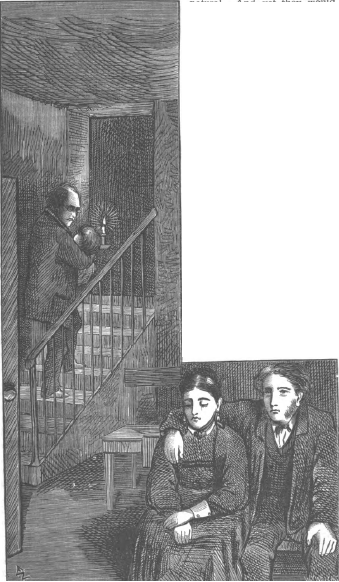
With this the old man ascended the stairs, with Tottie in his arms, turning over his shoulder to give George a parting look, and humming 'Cheer, boys, cheer!' softly, to keep up the spirit of the lovers.
They had listened with a kind of strained attention to the old man's voice, and when it was hushed, and silence fell upon them, George turned to Bessie, and in an instant she was in his arms, lying on his breast. A long silence followed. George heard Bessie's heart beat plainer than the tick of the old-fashioned clock, which stood like a ghost in a corner of the room. Not another sound could be heard but the ticking of the old clock and the beating of their hearts. As Bessie lay in her lover's arms, she thought whether it would be generous in her to question him about Tottie. The very asking of the question would imply a doubt. A voice whispered to her, 'Trust him; perfect love means perfect confidence.' But the woman's words were present to her also; and George was paying for the child. She would not admit the thought of anything dishonourable in George; but the sting of the doubt was in her. Would it not be better for her to ask a simple question, which George could easily answer, than to be tormented with doubt during the long months he would be away from her? Would it not be simple justice to Tottie? for if she were not satisfied, she might grow to hate the child. And Bessie really loved the pretty little forsaken one. The maternal instinct was in her, like the seedling of a flower in the ground, waiting for the summer-time to ripen it into the perfect beauty of motherly love. She loved children.
And here, a word. Whether out of place or not, it must be written. Trust not that woman who has no love for little ones. She is unworthy of love.
How long the lovers remained silent they did not know. But the time flew all too swiftly, for the solemn tongue of Westminster proclaimed the hour. Each clang was like a knell. It was midnight.
Midnight! What solemn reflections arise at such a moment, if the mind be attuned to them! If the world were spread before us like a map, what varied emotion and feeling, what unworthy striving, what unmerited suffering, what new lives born to pain, what old lives dying out in it, what thoughts dark and bright, what flowers of tender love, what weeds of ruthless circumstance, what souls born in the mire and kept there, what hope, what remorse, what sounds of woe and pleasant fountain-voices with sparkles in them, what angel-lights and divine touches of compassion, would, in the brief space occupied by the striking of the hour, there be displayed! And so that bell may toll, night after night, for generation after generation, until a time shall come--say in a hundred years--when every human pulse that at this moment beats throughout the world, when every heart that thrills and thirsts, when every vainful mortal that struts and boasts and makes grand schemes for self's exaltment, shall lie dead in earth and sea! Such thoughts should make us humble.
The bell awoke the lovers from their dream, and they spoke in low tones of the future and the hopes that lay in it for them.
'When I come back with a little bit of money, my darling,' said George, 'I shall be content to settle down to my trade, and we shall jog along as happy as can be. We couldn't settle down without pots and pans, and these I am going away to earn. I can see our little home, with you sitting by the fireside, or waiting at the door for me to give me a kiss when my day's work is done. Then I shall come round to mother's old way, with her bread-and-cheese and kisses. That will be good enough for me, my darling, with you to give me the kisses.'
And he gave and took an earnest of them there and then.
So they talked of one thing and another until One o'clock was tolled by the Westminster bell, and during all that time Bessie had not found courage to speak of what was in her mind. George had noticed the ear-rings in Bessie's ears, but had not spoken of them, thinking that Bessie would have drawn his attention to them. But Bessie's wound was too fresh; the pain and bewilderment of it were all engrossing. She had no thought for anything else.
'And now I must go, my darling,' said George, as they stood by the shop-door; 'for mother and father are waiting for me.' He took her face between his hands and kissed her lips. 'One kiss for hope; one for faith; and one for love.'
Bessie raised her face again to his, and whispered as she kissed,
'And one for confidence.'
'And one for confidence,' he repeated, as heartily as his sadness would allow.
'There should be no secrets between us, George dear.'
'Certainly there should not be, darling,' he replied, 'though you've been keeping one from me all the night, you puss!'
'I, George!'
'Yes, you, dearest. You have never told me who gave you those pretty ear-rings.'
Upon such slight threads often do our dearest hopes hang! Bessie, yielding to the weak impulse, to play off confidence for confidence, said,
'Never mind those, George. I want to ask you something first.'
At this moment the sound of music came to them, and the waits commenced to play the dear old air of 'Home, sweet home.'
'That's Saul's doing,' thought George. 'Good fellow! What will become of him during the time I am away?' As he and Bessie stood linked in a close embrace, the soft strains floated through the air into their hearts.
'There shall be no secrets between us, George, in our own home, sweet home!'
'None, darling.'
'And you'll not be angry with me for saying something?'
'What can my dear girl say to make me angry? and at such a time!'
'Then tell me, George--about Tottie.'
'The dear little thing! What about her, dearest?'
'George, is she an orphan?'
How long seemed the interval before he replied! Tick--tick--tick--went the clock, so slowly! O, so slowly, now!
'No, Bessie.'
How strangely his voice sounded! But he held her closer to him, and she had no power to free herself from his embrace. Indeed, she would have fallen had he loosed her.
'Do not be angry with me, George,' she whispered, slowly and painfully. 'She has a father living?'
Another long, long pause, and then, 'Yes,' from George, in the same strange tone.
'Tell me his name, George.'
He held her from him suddenly, and with his hands upon her shoulders, looked her steadily in the face. But her eyes drooped in the light of his earnest gaze.
'I cannot, Bessie,' he said; 'I must not. When we are married I will tell you all. There shall be no secrets between us in our home, sweet home. Till then, be satisfied.'
Softer came the dear old air to Bessie's ears. But the tenderer meaning in it was gone for her. She turned from her lover petulantly.
'I did not think you would refuse me this, George.'
Wiser, stronger, than she, he said,
'Do not let this trivial matter come between us, my dear;' and would have taken her to his heart again, but she did not meet him as before. 'This trivial matter!' Was he so lost to honour and to love for her? Something of her mind he saw in her face, and it made his blood hot. 'Good God,' he thought, 'is it possible she suspects me?' Then he strove to soothe her, but she would not be soothed. She said but little now; but her face was white with misery; doubt tore at the wound in her heart. She knew the pain she was inflicting upon him by the pain she felt herself. But she could not yield; she could not say, 'I know you are true to me. I will be satisfied, and will wait.' So his efforts were vain, and two o'clock struck, and their agony was not over. The tolling of the bell, however, brought to him the picture of his father and mother waiting up at home for him. 'I must go,' he said hurriedly. 'Good-bye, dear Bessie, and God bless you! Trust to me, and believe that no girl ever had more faithful lover.'
In spite of her coldness, he pressed her close to his breast, and whispered assurances of his love and faithfulness. Then tore himself away, and left her almost fainting in the shop, love and doubt fighting a sickening battle in her heart.
YOU ALONE, AND MY MOTHER, ARE TRUE; ALL THE REST OF THE WORLD IS FALSE.
The night was very cold, and George felt the keen wind a relief. He took off his hat, and looked around. The street was still and quiet; the last strains of 'Home, sweet home,' had been played, and the players had departed. All but one, and he waited at the end of the street for George to come up to him.
'What, Saul!'
'George!'
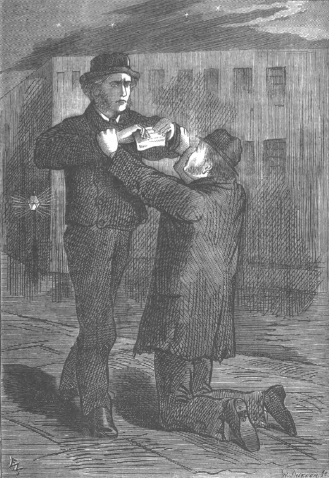
They clasped hands.
'I am glad you are here, Saul. I should not have liked to go without wishing you good-bye.'
'I waited for you, George. I knew you were in there. Mother and father sitting up for you, I suppose?'
'Yes. In a few hours I shall go from here; then I shall be alone!'
'As I am, George.'
'Nay, Saul, you have Jane.'
'She has left me, dear woman. I may never see her face again. It is for my good, George, that she has done this. You do not know how low we have sunk. George,' and here his voice fell to a whisper, 'at times we have been almost starving! It could not go on like this, and she has left me, and taken service somewhere in the country. She has done right. As I suffer, as I stretch out my arms in vain for her, as I look round the walls of my garret and am desolate in the light of my misery, I feel and confess she has done right. Here is her letter. Come to the lamp; there is light enough to read it by.'
George read the letter, and returned it to Saul, saying, 'Yes, she is right. What do you intend to do?'
'God knows. To try if I can see any way. But all is dark before me now, George.'
'I wish I could help you, Saul.'
'I know, I know. You are my only friend. If it ever be in my power to repay you for what you have done----' He dashed the tears from his eyes, and stood silent for a few moments, holding George's hand in his. 'George,' he said, in unsteady tones, 'in times gone by you and I have had many good conversations; we passed happy hours together. Words that have passed between us are in my mind now.'
'In mine too, Saul.'
'We had once,' continued Saul in the same strange unsteady tones, 'a conversation on friendship. I remember it well, and the night on which it took place. We walked up and down Westminster-bridge, and stopped now and then, gazing at the lights on the water. There is something grand and solemn in that sight, George; I do not know why, but it always brings to my mind a dim idea of death and immortality. The lights stretch out and out, smaller and smaller, until not a glimmer can be seen; darkness succeeds them as death does life. But the lights are there, George, although our vision is too limited to see them. You remember that conversation, George?'
'As if it had taken place this night, Saul. I can see the lights, and the darkness that follows them.'
'We agreed then upon the quality of friendship, but gave utterance to many generalities.' Saul paused awhile, and then said slowly, 'I am considering, George, whether I rightly understand the duties that lie in friendship.'
'Faithfulness, trustfulness.'
'Yes, those; and other things as well. Say that you had a friend, and had learnt something, had seen something, of which he is ignorant, and which he should know; say it is something that you would keep from your friend if you were false instead of true to him----'
'I should be a traitor to friendship,' interrupted George warmly, 'if I kept it from him. If I were truly his friend, I should seek him out and say what I had learnt, what I had seen.'
'Even if it contained pain, George; even if it would hurt him to know?'
'Even if it contained pain; even if it would hurt him to know. There is often pain in friendship; there is often pain in love. You have felt this, Saul, yourself. I have too, dear friend! Often into life's sweetness and tenderness pain creeps, and we do not know how it got there.'
George uttered this in a gentle tone; he was thinking of Bessie. 'Come, friend,' he said, seeing that Saul hesitated to speak, 'you have something to tell your friend. If you are true to him, tell it.'
Thus urged, Saul said: 'First answer me this. When did you first think of emigrating?'
'I did not think of it at all, before it was put in my head.'
'By whom?'
'By young Mr. Million. One night, not very long ago now, he met me, and got into conversation with me. Trade had been a little slack, and I had had a few idle days. This made me fret, for I saw that if things went on in the same way it might be years before I could save enough to buy furniture to make a home for Bessie. I let this out in conversation with young Mr. Million, and he sympathised with me, and said it was a shame, but that if he were in my place he would put himself in a position to marry his sweetheart in less than a year. How? I asked. By emigrating, he said. It staggered me, as you may guess, Saul. The idea of going away had never entered my head. He went on to say that his father took a great interest in working men, and was very interested also in emigration; that only that morning his father had mentioned my name and had said that he had a passage ticket for the very ship that is going out of the Mersey to-morrow, Saul--and that if I had a mind to better myself, he would give the ticket to me. I thanked him, and told him I would think of it. Well, I did think of it, and I read about wages over the water, and saw that I could do what he said. He gave me the ticket, and that's how it came about.'
'George,' said Saul pityingly, for things that were at present dark to George seemed clear to him, 'Mr. Million never heard your name until this morning.'
'Stop!' exclaimed George, passing his hand over his eyes with a bewildered air. 'Speak slowly. I don't know that I understand you. Say that again.'
Saul repeated: 'Mr. Million never heard your name until this morning. I went to his house, thinking that as he had helped you, he might help me; and he scoffed at me, and taunted me bitterly. He had no more to do with getting your ticket than I had. Every word young Mr. Million told you about the passage and about his father was false.'
'Good God!' cried George. 'What could be his motive, then, in telling me these things, and in obtaining this passage ticket for me?'
'Think, George,' said Saul; 'there is such a thing as false kindness. He may have a motive in wishing you away. I could say more, but I cannot bring my tongue to utter it.'
'You must, Saul, you must!' cried George, in a voice that rang through the street. They had walked as they conversed, and they were now standing outside his mother's house. 'You must! By the friendship I have borne for you! By the memory of what I have done for you!' The door of his house was opened as he spoke. His mother had heard his voice, and the agony in it, and came to the door. George saw her standing there, looking anxiously towards him, and he said in a voice thick with pain, 'Stay here until I come out. By the love you bear to Jane, stop until I come. My mother will know--she is far-seeing, and I may have been blind.'
He hurried to his mother, and went into the house with her. For full half an hour Saul waited in suspense, and at the end of that time George came out of the house, staggering like a drunken man. Saul caught him, and held him up. His face was as the face of death; a strong agony dwelt in it.
'I have heard something,' he said, in a tone that trembled with passion and pain and weakness. 'My mother has doubted for a long time past. She took a letter from him secretly to-night! Those earrings she wore he gave her. O, my God! Tell me, you, what more you know! By the memory of all you hold dear, tell me!'
'George, my dear,' said Saul, in a broken voice, 'a few moments after I quitted Mr. Million's house, I saw her enter it.'
A long, long silence followed. The stars and the moon shone brightly, but there was no light in the heavens for George. A sob broke from him, and another, and another.
'For God's sake,' exclaimed Saul, 'for your mother's sake, who suffers now a grief as keen as yours, bear up! Dear friend, if I could lay down my life for you, I would!'
'I know it. You alone, and my mother, are true; all the rest of the world is false! He wished to get rid of me, did he, and this was a trap! The false lying dog! But when I meet him!---- See here! Here is the ticket he gave me. If I had him before me now, I would do to him as I do to this----'
He crumpled the paper in his hand, and tore it fiercely in twain. Saul caught his arm, and stayed its destruction.
'No, no, George!' he cried, but his cry was like a whisper. 'Don't destroy it! Give it, O, give it to me! Remember the letter that Jane wrote to me. Think of the future that is open to me, to her, unless I can see a way. The way is here! Here is my salvation! Let me go instead of you!' He fell upon his knee's and raised his hands tremblingly, as if the Death-Angel were before him, and he was not prepared. 'If I live, I will repay you, so help me, the Great God!'
George muttered, 'Take it. For me it is useless. May it bring you the happiness that I have lost!'
Saul kissed his friend's hand, which fell from his grasp. When he looked up, his friend was gone. And the light in the heavens that George could not see, shone on the face of the kneeling man.