THE GRAY-CROWNED LEUCOSTICTE. (Leucosticte tephrocotis.)
Reading edition
The Gray-crowned Leucosticte or Gray-crowned Rosy Finch, as it is often called, is a resident of the interior of British America during the warmer months. In the winter it passes southward, frequenting the Rocky Mountain region of the United States, where it is quite common on the eastern slopes. So far as known, within the border of the United States, it only nests in the Sierra Nevada in California. While on the slopes of the mountains this Finch is usually seen in flocks. During the most severe weather it will frequent settled districts, becoming quite tame, and it has been known to seek the sheltering cover of the nests of cliff swallows under the eaves of buildings. When in the fields it is a restless bird and quite shy.
Dr. R. W. Shufeldt, while stationed at Fort Fetterman, Wyoming, had an excellent opportunity to study the habits of this handsome bird. He captured eight, including both males and females, which he placed in a cage especially prepared for them. “In a few days they not only became accustomed to their quarters, but apparently thoroughly satisfied and happy. Flocks of their companions passing over were certain to be called down, to alight on the fences, the ground, and in fact, everything in the neighborhood of the cage, to even the cage itself.” The birds were given canary and flax seeds, cracked wheat and finally lettuce and other tender leaves, all of which they seemed to relish. Dr. Shufeldt also says:
“Every morning, as I approached the cage, a general and impatient chattering commenced for their breakfast and bath, and they immediately availed themselves of both in my presence. Often I deluged the entire cage, birds and all, with a large watering pot, and they enjoyed the sprinkling immensely. Later in the spring this part of the programme was followed by their pluming themselves in the sun, chattering among themselves and the males giving utterance to a low, subdued and plaintive sort of song, being different from the shrill whistle they gave to attract the attention of their passing fellows outside.” By the middle of May all the birds of this species had left the vicinity for their breeding grounds further north. Dr. Shufeldt’s captives did not even pair and early in July he released them. Their plumage seemed to be at its best in the early part of May.
Another authority, speaking of this bird’s habits in the mountain regions, says, “During summer and autumn the Gray-crowned Finch is common above timber line, where it breeds, ranging higher than the titlark and being usually found in the vicinity of snow fields and the frozen lakes near the summit of the range. It is rather shy in such localities, though exceedingly tame in winter. Its flight is in undulating lines, like the crossbills. The only note I have heard it utter is a kind of churr, like the call of the scarlet tanager. They stay above timber-line till the close of October or the middle of November. They are perpetually roving from place to place feeding upon the seeds of weeds and grasses and are never at rest for a moment at a time, constantly whirling about in close, dense masses, like so many longspurs.”
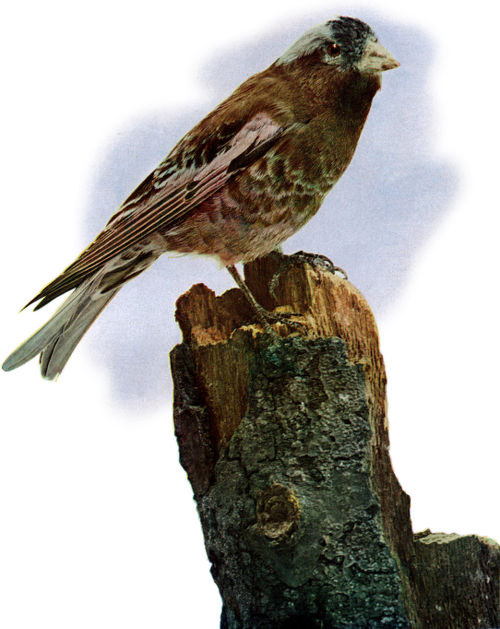
GRAY-CROWNED LEUCOSTICTE. (Leucosticte tephrocotis). Life-size. FROM COL. CHI. ACAD. SCIENCES.
207