AS TO ALLIGATORS.
Reading edition
The alligator generally impresses the mind as a reptile so dangerous that he should be given a wide berth on any and all occasions, yet it is really peaceable and harmless unless aroused to the defensive.
Anywhere south of the Mason and Dixon line, among the rivers, lakes and marshes, are found the alligators, but Florida, because of its great area of such places which the alligator delights in, may almost be termed the home of the alligator.
In traveling through the dense hammocks, where for miles and miles the sun scarcely penetrates through the heavy timber and the rank vegetation beneath, one may often meet with the huge saurian as he travels from one cave or mud hole to another. Tease or wound him, and he will show fight, and woe to him who then comes within reach of his vengeance. And it matters little to him with which end he must fight. He can crush equally well with his tail as with his jaws—or, to end the matter more speedily, he may use both. But if you go on about your business his ’gator-ship will do the same, and not notice you so much as ever to wink. Come upon him as he is lying asleep or sunning himself on a mud bank, if he is aroused and finds you between himself and the river he will sweep you aside as you yourself would a fly from the sugar bowl, and then slide into his native element, and he does this so quickly as to allow you little time to explain that you just happened there and had no designs on him whatever.
At other times you might think you are stepping out onto a sunken log imbedded in the mud, but find that the log suddenly gets very much alive, for under that slimy mud and grass an alligator was taking a sitz bath. You might have walked all around him with impunity, but walking on him is an indignity he resents quickly—so quickly that it is a question whether you get back to safety or are served up for the alligator’s dinner. Sometimes you may see an alligator lying motionless just under the surface of the water, with his long snout protruding. His jaws are open far enough to allow the flow of the current through them, and when a stray fish or other tid-bit comes along with that flow, the jaws snap down on it. He can be seen keeping his trap thus set for hours at a time. Should you row near in order to watch him, he will not seem to pay the least attention to you if you behave yourself; but if you drop an oar or shout at him he will drop down out of sight and lie low waiting to see what you are really up to. Now, if you will remain perfectly quiet as to motion, but will imitate the barking of a puppy, the squealing of a pig, or the caw of a crow, although there was not an alligator in sight, you will soon see several snouts appear, and gradually, if you keep up the call, the alligators will come near and nearer, in curiosity as to what the call means. A half dozen or more will be nosing about the boat, and you have a good chance to observe them closely—if your nerves can stand it. This sport is exceedingly dangerous, for if the boat should bump an alligator on the nose, straightway all would make common cause and reduce the offending boat into splinters; and that the occupant of the boat should escape would be next to impossible.
When the female alligator wishes to build her nest, she selects a dry place, open to the rays of the sun, yet near to water. She commences her nest by scraping together a lot of dry leaves, grass or other trash, until she has a round, compact bed as large as a cartwheel. On this she deposits her eggs. This done, she proceeds to cover them up by going round and round the nest and, with her body pushing more leaves and trash over the eggs. A well made nest is of the shape of a hay-cock, and very nearly so large. The nest completed, the alligator goes off to the nearby water, and leaves the sun to do the hatching. Many differ 232 as to the time it takes for the eggs to hatch, as much depends on the construction of the nest, and also on the heat of the sun. So, also, many differ as to the number of eggs a female will lay in one season. Some aver that eighty is the average number, but the writer has never found more than forty in one nest.
Alligator eggs are white, oblong in shape, about three inches and a half in length, and have a ring around the middle. When first hatched the little fellows are red and black spotted and striped. They are exceedingly lively, and, as soon as hatched, make straight for the water—apparently in search of the protecting care of their mammy—but they often come back to sun themselves about the old nest.
The male alligator is a cannibal, and will eat his own young if he finds them. For this reason the female selects a place far from the usual haunts of her spouse when she prepares for maternal cares by building her nest. And she stays with her babies until she thinks they are capable of wiggling away from dangers themselves.
When in Florida many of the winter tourists secure these little alligators and take them North to keep them as pets. As they are exceedingly slow in growing, they make “little” and “cunning” pets for many years. When they get to be “big fellows,” they had best be dispensed with.
Although the alligator has long been considered one of the despised species of animals, or reptiles, it is far from being a useless one—though its use is only practical after it has been killed. One may say that there is no good alligator but a dead one, but one may qualify the remark by adding that the dead one is very good, indeed, for commercial purposes.
There is a great demand for alligator hides, and good prices are being paid for them. Consequently the hunting of alligators for the sake of their hides, and the preparing of them for shipment is a profitable industry. Then the tanning of these hides and, finally, the making of the leather into trunks, valises, purses, etc., makes three distinct industries due to the alligators.
Those making a business of hunting alligators generally take the night time for it, and the darker the night, the better.
Two men, provided with a light, easy-going skiff, a good rifle, an ax, and a bull’s eye lantern fastened to the forehead of one of the hunters, start out together. One man—the one with the lantern—sits in the bow of the boat; it is his business to “shine the eyes” of any alligator who might come within the radius of the light. The eyes of the game will shine like two balls of fire, and if the man is careful to make no unnecessary movements, and his partner is careful to scull the boat steadily and silently, they can get so near the game as to almost touch it.
The man in the bow holds, from the very start, the rifle ready for a quick shot. This shot comes so suddenly and so unexpectedly to the alligator, that, quick as he generally is, he falls a prey to his prolonged curiosity as to the nature of that approaching light.
The hunters must be so expert at their trade that as soon as the shot has been fired the man who did the shooting must lean over and grasp the alligator by the tail, pull him half way over the gunnel of the boat and hold him there for the quick cut with the ax in the back, which his partner must be, by this time, prepared to strike. All this is done far quicker than it can be told; so quickly is it done that often the alligator is killed by the ax only, and it is found that the bullet had never struck him, and he had only been either stunned, or so demoralized as to forget his own power.
This cut in the back, severing the vertebrae, places the alligator entirely hors de combat. There is even no flopping about in the bottom of the boat where he is then thrown. Now the hunters are ready to proceed on to their next capture.
The morning generally finds the hunters with their boat loaded, and they are glad of a short rest and—breakfast. There then remains but the task of skinning their game and salting the hides down in barrels, ready for shipment.
Leo L. Stratner.
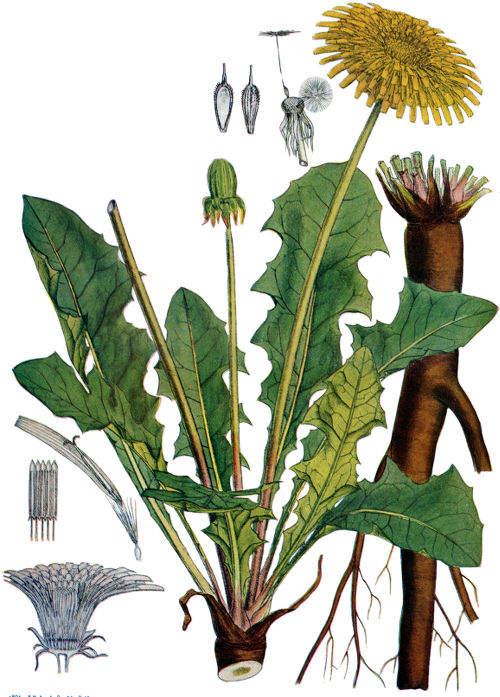
DANDELION. (Taraxacum taraxacum). FROM TRIMEN’S MEDICINAL PLANTS.
235