Part 1 — THE FIRE-WEED OR GREAT WILLOW-HERB. (Chamaenerion angustifolium.)
Reading edition
Scattered throughout the world, but more abundant in the temperate regions of America, there are three hundred and fifty species of plants that are closely related and grouped by the botanist as the evening primrose family. By him this family is called the Onagraceæ, possibly derived from two Greek words, meaning wine and a hunt or eager pursuit. The Greek name is supposed, by some authorities, to have been applied to a plant a portion of which when eaten would develop a taste for wine. Even now the roots of some species are used in scenting wine. The word may also be derived from the Greek word meaning the ass, and used here because many of the species bear elongated, erect and pointed leaves resembling the ears of that animal.
This family includes a number of interesting plants. Here are classed the fuchsias or ladies’ eardrops, of which there are many brilliant varieties under cultivation as house plants. These are natives of the mountain regions from Mexico southward. Another cultivated plant is the Clarkia, a native of Oregon and California.
Among the more common wild species are the evening primroses, the willow-herbs and the enchanter’s night-shade, named Circaea in honor of Circe, the enchantress. Why Linnæus should have chosen this plant with which to honor Circe is difficult to understand, for the Circaea is an insignificant plant of the woods.
The Fire-weed is one of the most interesting of the wild members of the family. It is abundant in dry fields and along roadsides throughout that portion of North America lying north of North Carolina, Kansas, Arizona and California. With its spike-like racemes of rather broad purple or sometimes white flowers, it beautifies many waste places from the Atlantic to the Pacific coast. A plant of the Fire-weed is a continuous bouquet, for it blossoms from June to October. The flowers are followed by attractive fruits which are long and slender and when ripe split into four sections, thus releasing the numerous seeds which have a tuft of long cottony hairs by means of which they are wafted by the wind to long distances. Many of these seeds fall where the conditions are not favorable for growth, but they retain their vitality for a long time.
The Fire-weed is a plant of the open country and not of the forest. It must have a great deal of sunshine. When its seeds fall in the deep shade of a dense forest, where the rays of the sun penetrate but a short distance if at all, they cannot grow. But let the woodman or a fire lay low or destroy the noble growth of trees, then there is soon a transformation—the landscape is enlivened by the bright flowers of the Fire-weed. Where the northern coniferous forests have been burned, it is not an uncommon sight to see a Fire-weed plant, from six to ten feet tall, with its broad top of flowers closely contrasted with the blackened remains of a forest monarch. The Fire-weed is an excellent illustration of the perfect provision that is found in Nature for the perpetuation of the species. Its seeds are distributed by both animate and inanimate forces. They are dropped on both favorable and unfavorable soil. If on the latter, their structure is such that the little embryo plant within the seed can lie dormant for a long time. The deep forest is an unfavorable soil for the seed of the Fire-weed, but remove the trees and it can find no better home.
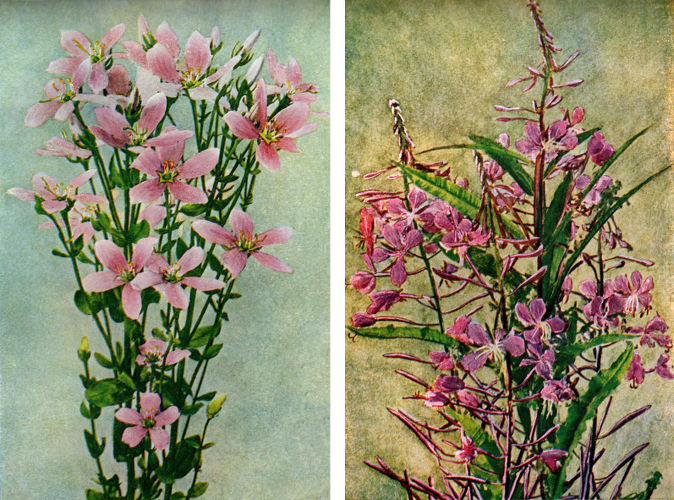
SEA OR MARSH PINK. (Sabbatia stellaris). FIRE-WEED. (Chamaenerion angustifolium). FROM “NATURE’S GARDEN” COPYRIGHT 1900, By DOUBLEDAY, PAGE & COMPANY
41