Part 1 — THE CAROLINA CHICKADEE. (Parus carolinensis.)
Reading edition
As one walks through the forest, either in winter when the snow is deep, or in summer when the sun is highest, the stillness will be broken from time to time by the merry “Chicka-dee-dee,” “day, day,” or “hey-de, hey-de,” coming from a little throat only a few feet away.
The Carolina Chickadee is very similar to the blackcapped chickadee with the exception that it has a decidedly shorter tail. Its range is also different, being seldom found north of a line extending from New Jersey, through central Indiana, west to Texas and Indian Territory. The blackcapped is seldom found south of this line.
The nest of this bird is a very cozy affair sheltered in a hollow snag or post. It often takes advantage of the deserted home of a downy woodpecker to make its nest. It also frequently excavates a cavity in some rotten snag or tree trunk. As soft wood is preferred one generally finds the nest in a willow snag. I found a nest of this interesting little bird in a rotten willow snag only a few feet from a small stream. The stump was so decayed that I could easily have pushed it over. The excavation had been recently done, because fresh bits of wood were scattered about the ground. Looking in at the hole, which was about four feet from the ground, I could easily see the nest and eggs in the cavity some ten inches below. Desiring to study it more closely and to obtain a photograph, I carefully pushed my knife through the soft trunk and pried off a large slab. This exposed the cavity and the nest. The nest was a beautiful soft affair, composed of hair, feathers, down, etc., and contained seven small, pinkish white eggs, spotted with reddish brown most profusely at the larger end.
I then carefully replaced the slab and tied it on securely, trusting I had not disturbed the home too much to prevent further nesting.
When I again passed the nest an hour later and looked in I met the gaze of a pair of small bead-like eyes. The parent bird had returned and had resumed her task, apparently in no way disturbed by the rude attack on her domicile.
Whenever I desired to examine the progress of development of this small family I had but to remove the door and look in. This was easily done, for the latchstring was always out. About eight days after hatching the young left the nest.
The Chickadee is one of the farmer’s best friends. During the egg-laying season of the canker-worm moth it destroys a great many eggs. Examination of the stomach contents shows between 200 and 300 canker-worm eggs in each. It has been estimated that each of these birds destroys 14,000 of these eggs during the month of egg laying. The Chickadee has been accused of destroying the buds of fruit trees, but this is not substantiated. It has been found that whenever it attacks a bud it does so to secure the worm which has burrowed into the center.
These birds are doubly useful because they remain with us the entire year and continue their destruction of eggs and larvæ. The amount of work done by a pair of these birds in destroying eggs and larvæ of injurious insects is more than could be accomplished by any man. They should therefore receive the greatest protection possible.
J. Rollin Slonaker.
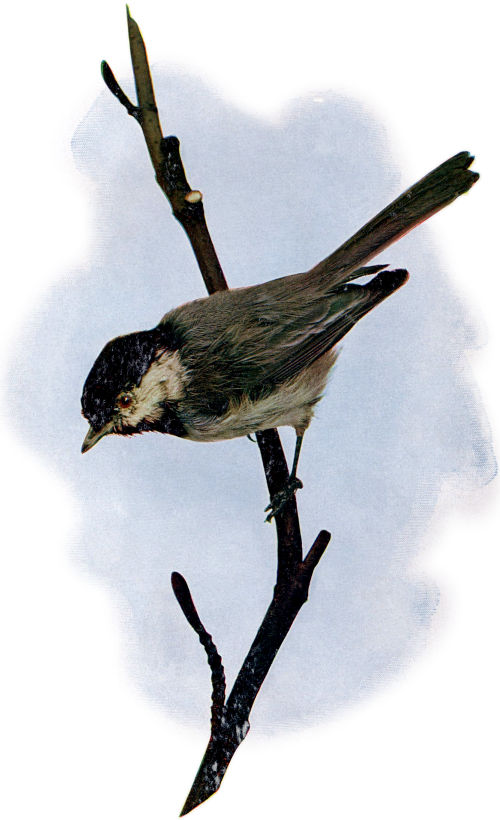
CAROLINA CHICKADEE. (Parus carolinensis.) Life-size. FROM COL. CHI. ACAD. SCIENCES.
17