SOME OF OUR WINTER BIRDS. IN EASTERN MASSACHUSETTS.
Reading edition
One of our most interesting winter birds and (with the exception of the English sparrow) perhaps the commonest, is the little black-cap chicadee. He is frequently seen in one’s orchard and around the door, and a stroll into the woods will reveal him at any time. He may be easily distinguished by his jet black cap, his bluish drab back and wings, and a yellow tinge on his downy breast. Cedar trees are a special delight of his and, in the winter season, he may be found in nearly every grove of these evergreens. As one walks along through the woods, he is attracted by their notes, usually the simple, cheerful “chic-a-dee-ee e e,” varied with squeaks and chirps, or if it be in February or March, he may hear a beautiful whistle (“pee-a-wee-a”), and possibly catch a pretty warbling song. They are always lively and cheerful and on a gloomy winter day they cause one to forget everything but them and their pleasant notes. They feed principally on berries and seeds, such as can be found in cold weather when the ground is covered with snow. But our little friends are seldom alone; as almost constant companions they have the nuthatches, snowbirds, tree sparrows and goldfinches.
Another very common cold weather bird is the slate colored snowbird or junco. Bluish slate above and grayish below, with some white tail feathers which show as he flies, he is a pretty sight to behold when one starts a flock of them from some frozen swamp or meadow, where they feed upon seeds and berries. They utter a loud chirp when you disturb them in the winter time, and as they hop about keep up an incessant twittering, which are the only notes you will hear from them, unless you are lucky enough to hear their song which they seldom sing before starting for their summer homes. When it is stormy or severely cold they come up to one’s door and eat bread crumbs and other things which may be thrown out. They are real friendly and will come quite near to you, and a man once told me that the reason for this was blindness on the part of the birds, and even as he spoke one of the birds flew to a nearby fence and, cocking his head, looked my informer over as if to give him the lie. John B. Tabb has written a short poem, which nicely describes him:
When snow, like silence visible, Hath hushed the summer bird, Thy voice, a never frozen rill Of melody, is heard. But when from winter’s lethargy The buds begin to blow, Thy voice is mute, and suddenly Thou vanishest like snow.
The tree sparrow, one of our most interesting sparrows, is another bird who does not fear the winter winds and storms. Although he carries the name of tree sparrow, he is most emphatically a bird of the ground, and may be seen during the winter months in almost any remote patch of plowed ground where there are old weed stalks for him to eat. They are especially addicted to old tomato fields and seem to delight in the seeds of this plant. This sparrow looks like a large chippy, our door yard neighbor of the summer months, excepting that he has distinguishing white bars across his wings. They travel in large flocks, and where one sees a few of them scratching in the snow, a step too close will scare dozens of them away. They associate considerably with snowbirds and where there are members of one family you will most always find the others either with them or close by.
One of our prettiest winter birds is the downy woodpecker, his glossy black and white, with the bright red spot on his head, showing up strongly from some tree trunk, where he raps for insects, as he goes up, propping himself with his tail as he works. One notices him by hearing his rapping on a branch or his loud note, which he utters frequently. He delights in boring holes in trees and, especially in the spring, he drills out complete nests which he probably has no intention of ever using. The hairy woodpecker has 68 almost precisely the same habits and colors as the downy, and differs only in size. He, also, is one of our winter residents, but not so commonly as the other.
The flicker or yellow hammer is another woodpecker that is with us in winter as well as summer. He varies somewhat from the rest of his family in habits, in that, he feeds considerably on the ground, consuming a large number of ants. He is quiet during the winter, but his loud and cheerful notes are one of the first bird songs of spring.
A bird which resembles the woodpecker in his method of feeding, is the brown creeper, a pretty little brown bird, with a long curved bill and long sharp claws, who spends most of his time in climbing trees. Unlike a woodpecker, he goes up the trunk by going spirally around it, thus going over the whole tree before he flies to the next one and repeats the operation. The color of his back closely resembles the bark of a tree, and when disturbed he will sometimes crouch close to the tree where it is almost impossible to see him. In the spring, before departing north to breed, they often sing their pretty tune to us, which, however, we are lucky to hear. In the coldest weather they are frequently seen on trees by the wayside, and I have seen them on Boylston street, Boston, as busy and contented as ever.
The nuthatch is another bird which climbs, and, unlike either the woodpeckers or creepers, he goes down the tree head first, instead of backing down, and for this reason has been nicknamed “Devil Downhead.” There are two nuthatches which are fairly common during the winter months, the white-breasted and the red-breasted. The former more commonly frequents orchards and the roadside, while the latter prefers to frolic, with the chicadees, among the evergreens. They seldom stay with us in the summer, usually nesting farther north.
The goldfinch is also a regular winter visitor; but at this season he has none of his bright colors of the summer time; but is a plain little olive green bird, with dark wings and a gray breast. They feed considerably on thistles, but when the snow falls they take whatever berries they can find. I remember seeing four or five of them, one day two winters ago, coming up and feeding upon the berries of a honeysuckle vine near my window, and at another time I saw them eating with chicadees in some cedars.
Cedar birds, although they do not stay with us any length of time, may be seen at different periods during the winter. They are very pretty birds, being brownish drab above and sulphur yellow below, while the wings are marked by spots of bright red. They travel in very large flocks and soon have one locality completely cleared of food, when they depart elsewhere. One is first attracted by their peculiar lisping notes, which, coming from so many throats, make quite a noise, and upon looking up, he will see them perhaps in flight or more probably roosting on the branches of some elm or oak; or flitting about a cedar, stripping it of its berries. They are also great lovers of cherries, and when this fruit is ripe they may be seen in large numbers in some orchard.
A journey into the woods on a cold winter day may reveal to one a flock of small birds, which have the appearance of a lot of sparrows which had been dyed purple, the colors of the sparrow plainly showing, beneath the purple tinge or wash on their backs and heads. These are lesser redpoll linnets. Very hard working little birds, that usually delight in the arctic regions, we see them only when the severest cold drives them south. They fly in very large flocks, and Miss Blanchan says of them, “First, we see a quantity of dots, like a shake of pepper, in the cloud above, then the specks grow larger and larger, and finally the birds seem to drop from the sky upon some tall tree that they completely cover—a veritable cloudburst of birds.”
The red crossbill is a similar bird to the redpoll, but is larger and has the two mandibles of his bill crossed, by the means of which he extracts the seeds from the pine cones. We only see him in the coldest winters, but then he is very tame and may allow one to pick him up, and he has even been known to stay in a cage without a murmur.
These are all our important winter birds, but the robin and bluejay might be mentioned although they are more birds of the summer than winter.
Winthrop Smith.
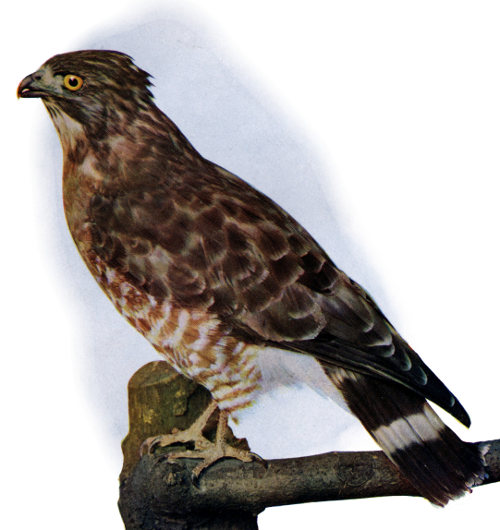
BROAD-WINGED HAWK. (Buteo latissimus.) ½ Life-size. FROM COL. CHI. ACAD. SCIENCES.
71