Front matter
Reading edition · Edition 2
GOLDFINCH
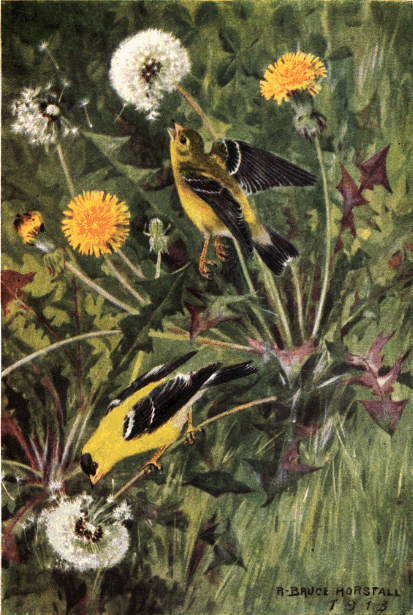
BIRD NEIGHBORS. AN INTRODUCTORY ACQUAINTANCE WITH ONE HUNDRED AND FIFTY BIRDS COMMONLY FOUND IN THE GARDENS, MEADOWS, AND WOODS ABOUT OUR HOMES
BY
NELTJE BLANCHAN
WITH INTRODUCTION BY JOHN BURROUGHS
WITH MANY PHOTOGRAPHIC ILLUSTRATIONS IN COLOR AND IN BLACK AND WHITE

GARDEN CITY NEW YORK DOUBLEDAY, PAGE & COMPANY 1923
COPYRIGHT, 1904, 1922, BY DOUBLEDAY, PAGE & COMPANY
COPYRIGHT, 1897, BY DOUBLEDAY & MCCLURE COMPANY
COLOURED PLATES COPYRIGHTED, 1897, BY THE NATURE STUDY PUBLISHING COMPANY CHICAGO, ILL.
ALL RIGHTS RESERVED, INCLUDING THAT OF TRANSLATION INTO FOREIGN LANGUAGES, INCLUDING THE SCANDINAVIAN
PRINTED IN THE UNITED STATES AT THE COUNTRY LIFE PRESS, GARDEN CITY, N. Y.
TABLE OF CONTENTS
PAGE
PREFACEvii
INTRODUCTION BY JOHN BURROUGHSix
LIST OF COLOURED PLATESxviii
I.BIRD FAMILIES:
Their Characteristics and the Representatives of Each Family included in "Bird Neighbors"1
II.HABITATS OF BIRDS17
III.SEASONS OF BIRDS25
IV.BIRDS GROUPED ACCORDING TO SIZE33
V.DESCRIPTIONS OF BIRDS GROUPED ACCORDING TO COLOR:
Birds Conspicuously Black39
Birds Conspicuously Black and White51
Dusky, Gray, and Slate-colored Birds65
Blue and Bluish Birds97
Brown, Olive or Grayish Brown, and Brown and Gray Sparrowy Birds113
Green, Greenish Gray, Olive, and Yellowish Olive Birds167
Birds Conspicuously Yellow and Orange187
Birds Conspicuously Red of any Shade213
INDEX229
PREFACE
Not to have so much as a bowing acquaintance with the birds that nest in our gardens or under the very eaves of our houses; that haunt our wood-piles; keep our fruit-trees free from slugs; waken us with their songs, and enliven our walks along the roadside and through the woods, seems to be, at least, a breach of etiquette toward some of our most kindly disposed neighbors.
Birds of prey, game and water birds are not included in the book. The following pages are intended to be nothing more than a familiar introduction to the birds that live near us. Even in the principal park of a great city like New York, a bird-lover has found more than one hundred and thirty species; as many, probably, as could be discovered in the same sized territory anywhere.
The plan of the book is not a scientific one, if the term scientific is understood to mean technical and anatomical. The purpose of the writer is to give, in a popular and accessible form, knowledge which is accurate and reliable about the life of our common birds. This knowledge has not been collected from the stuffed carcasses of birds in museums, but gleaned afield. In a word, these short narrative descriptions treat of the bird's characteristics of size, color, and flight; its peculiarities of instinct and temperament; its nest and home life; its choice of food; its songs; and of the season in which we may expect it to play its part in the great panorama Nature unfolds with faithful precision year after year. They are an attempt to make the bird so live before the reader that, when seen out of doors, its recognition shall be instant and cordial, like that given to a friend.
The coloring described in this book is sometimes more vivid than that found in the works of some learned authorities whose conflicting testimony is often sadly bewildering to the novice. In different parts of the country, and at different seasons of the year, the plumage of some birds undergoes many changes. The reader must remember, therefore, that the specimens examined and described were not, as before stated, the faded ones in our museums, but live birds in their fresh, spring plumage, studied afield.
The birds have been classed into color groups, in the belief that this method, more than any other will make identification most easy. The color of the bird is the first, and often the only, characteristic noticed. But they have also been classified according to the localities for which they show decided preferences and in which they are most likely to be found. Again, they have been grouped according to the season when they may be expected. In the brief paragraphs that deal with groups of birds separated into the various families represented in the book, the characteristics and traits of each clan are clearly emphasized. By these several aids it is believed the merest novice will be able to quickly identify any bird neighbor that is neither local nor rare.
To the uninitiated or uninterested observer, all small, dull-colored birds are "common sparrows." The closer scrutiny of the trained eye quickly differentiates, and picks out not only the Song, the Canada, and the Fox Sparrows, but finds a dozen other familiar friends where one who "has eyes and sees not" does not even suspect their presence. Ruskin says: "The more I think of it, I find this conclusion more impressed upon me, that the greatest thing a human soul ever does in this world is to see something. Hundreds of people can talk for one who can think, but thousands can think for one who can see. To see clearly is poetry, prophecy, and religion—all in one."
While the author is indebted to all the time-honored standard authorities, and to many ornithologists of the present day—too many for individual mention—it is to Mr. John Burroughs her deepest debt is due. To this clear-visioned prophet, who has opened the blind eyes of thousands to the delights that Nature holds within our easy reach, she would gratefully acknowledge many obligations; first of all, for the plan on which "Bird Neighbors" is arranged; next, for his patient kindness in reading and annotating the manuscript of the book; and, not least, for the inspiration of his perennially charming writings that are so largely responsible for the ready-made audience now awaiting writers on out-of-door topics.
• • • • •
It is hoped that the illustrations in this edition of "Bird Neighbors" will do much to add to the pleasure and profit of the reader. Through the courtesy of the National Association of Audubon Societies, the pictures painted by artists who are specialists in bird portraiture embellish this book. Each portrait has been examined and corrected when necessary by an authority. The birds are pictured as they are in life, each according to its own habit of existence.
The author takes this opportunity to express her appreciation of the work the National Association of Audubon Societies has done and is doing to prevent the slaughter of birds in all parts of the United States, to develop bird sanctuaries and inaugurate protective legislation. Indeed to it, more than to all other agencies combined, is due the credit of eliminating so much of the Prussian like cruelty toward birds that once characterized American treatment of them, from the rising generation.
NELTJE BLANCHAN.
THE NATURE LIBRARY
By JOHN BURROUGHS
I do not propose in these introductory remarks to this Nature Library to discuss the merits or the character of the separate volumes further than to say that they are all by competent hands and, so far as I can judge, entirely reliable. While accurate and scientific, I have found them very readable. The treatment is popular without being sensational.
This library is free from the scientific dry rot on the one hand and from the florid and misleading romanticism of much recent nature writing on the other. It is a safe guide to the world of animal and plant life that lies about us. And that is all the wise reader wants. He should want to explore this world for himself. Indeed, nature-study, as it appeals to us in books, fails of its chief end if it does not send us to nature itself. What we want is not the mere facts about the flowers or the animals—we want through them to add to the resources of our lives; and I know of nothing better calculated to do this than the study of nature at first hand. To add to the resources of one's life—think how much that means! To add to those things that make us more at home in the world; that help guard us against ennui and stagnation; that invest the country with new interest and enticement; that make every walk in the fields or woods an excursion into a land of unexhausted treasures; that make the returning seasons fill us with expectation and delight; that make every rod of ground like the page of a book in which new and strange things may be read; in short, those things that help keep us fresh and sane and young, and make us immune to the strife and fever of the world.
The main thing is to feel an interest in Nature—an interest that leads to a loving unconscious study of her. Not entirely a scientific interest, but a human interest as well; science upon the one hand and an appreciation of the mystery, the beauty, and the bounty of life upon the other. The child feels a human interest in nature: when the schoolgirls come to school with their hands full of wild flowers, or the boys make excursions to the woods in May for wintergreens, or black birch, or crinkle root, they are all moved by an interest that is old and deep-seated in the race. Now, if to this interest and curiosity we can add a little science, just enough to guide them, we lift these feelings to another plane and give them a longer lease of life. The boy will not be so likely to rob birds' nests after the savage in him has been humanized by a touch of real knowledge and he has come to look upon the bird as something worthy of naming and studying and that has its place in the economy of the fields and woods.
A touch of real knowledge—how humanizing and elevating it is! Simply to learn that all the plants have been studied and named, even the humblest; that they all have vital relations with one another—family ties; that the great biological laws are operative in them also; that the deep, mysterious principle of variation, which is at the bottom of Darwin's theory of the origin of the species, is working in the lowliest plant we tread upon; to know that the chain of cause and effect runs through the whole organic world, binding together its remotest parts; that everywhere is plan, development, evolution—to know these and kindred things—a few of the fundamentals of science—is a joy to the spirit and a light to the mind.
Science in the world is like the surveyor and the engineer in a new country; it opens up highways for the mind; it bridges the chasms and marshes; it gives us dominion over the wild; it brings order out of chaos. What a maze, what a tangle the world is till we come to look upon it with the clews and solutions in mind which science affords! The heavens seem a haphazard spatter of stars, the earth a wild jumble of plants, and animals, and blind forces all struggling with one another—confusion, contradiction, failure everywhere. And so it was to the early men, and so it still is to those who have not the light of science, but so it need not remain to the child born into the world to-day. The great mysteries of life and death, of final causes and ultimate ends, still remain and will continue, but nature now, compared with the nature of a few centuries ago, is like a land subdued and peopled and cultivated compared with a pathless wilderness.
And yet I would not in this connection, when considering the field of natural history, lay too much stress upon the scientific aspects of the question. To the real nature-lover the bird in the bush is worth much more than the bird in the hand, because the nature-lover is not after a specimen: he is after a living fact; he is after a new joy in life.
It is an important part, but by no means the main part of what ornithology holds for us, to be able to name every bird on sight or call. To love the bird, to appreciate its place in the landscape and in the season, to relate it to your daily life, to divine its character, to know it emotionally in your heart—that is much more. To know the birds as the sportsman knows his game; to experience the same thrill, purged of all thoughts of slaughter; to make their songs music in your life—this is indeed something to be desired.
The same with botany. I regard its class-room uses as very slight. The educational value of the technical part is almost nil. But the humanizing value of a love of the flowers, the hygienic value of a walk in their haunts, the æsthetic value of the observation of their forms and tints—these are all vital. The scientific value which attaches to your knowledge of the names of their parts or of their families—what is that? Their habits are interesting; their means of fertilization are interesting; the part insects play in their lives—the honey-yielders, the pollen-yielders, their means of scattering their seeds, and so forth—all are interesting. To know their habitats and seasons; to have associations with them when you go fishing; to land your trout in a bed of bee-palm or jewel-weed; to pluck the linnæa in the moss on the Adirondack mountain you are climbing; to gather pond-lilies from a boat with your friend; to pluck the arbutus on the first balmy day of April; to see the scarlet lobelia lighting up a dark nook by the stream as you row by in August; to walk or drive past vast acres of purple loosestrife, looking like a lake or sea of color—this is botany with something back of it, and the only place to learn it is where it grows. The botany that trails the days and the season and the woods and the fields with it—that is the kind that has educational value in it.
I confess I have not much sympathy with the laboratory study of nature, except for economic purposes. Nature under the dissecting knife and the microscope yields important secrets to the students of biology, but the unprofessional students want but little of all this. I know a young woman who took a post-graduate course in biology at a noted summer school, and the one thing she learned was that certain bacilli were found only in the aqueous humor of the eyes of white mice. The world is full of curious facts like that, that have no human interest or educational value whatever.
If one could number all the trees of the forest and all the leaves upon the trees, what would it profit him? To know the different kinds of trees when you see them, and the function of the leaves upon them—that were more worth while. I have read studies of leaves that were just as profitless as to know their numbers. I have heard discourses upon the changes in the plumage of certain water-fowl from youth to age, and from one moult to another, that were as profitless and wearisome as studying the variations of the leaves or their numbers.
I hardly know why I am impatient when people come to me with their hands full of different leaves and ask me what tree is this from, and this, and this? If your business is not with trees, if you live in the city and care mainly for city things, why bother about the trees, unless for the pleasure of it during your summer excursions into the country; and if it affords you pleasure, you will not want any one to tell you: you will want to identify the trees themselves.
The same with the birds. The main profit of this branch of natural history is in the pursuit—not in the name, but in the bird. It is the chase that allures the sportsman, and it is the chase that profits the nature-student. Did you ever receive a gift of brook-trout by express? How pitiful they look—stale fish only! But the trout you brought in at night after threading for miles the mountain stream: its voice all day in your ears; its sparkle all day in your eyes; the love of its beauty and purity all day in your heart; wading through bee-balm or jewel-weed; skirting wild pastures; starting the grouse or the woodcock with their young; surprising bird and beast at their home occupations—these were trout with a flavor.
Whatever opens up new doors or windows for us into the world about us, whatever widens the field of our interests and sympathies, has some sort of value—moral, intellectual, or æsthetic. But much of the so-called nature-study opens no new doors or windows; it affords no mental satisfaction, or illumination, or æsthetic pleasure; it is mainly pottering with dry, unimportant facts and details. Do you know the edelweiss of our own matchless arbutus after you have merely analyzed and classified them? No more than you know a man after having weighed and measured him. The function of things is always interesting. What do they do? How do they pay their way in the rigid economy of nature? How do they survive? How does the bulb of the common fawn-lily[1] get deeper and deeper into the ground each year? Why does the wild ginger hide its blossom when nearly all other plants flaunt theirs? Why are the plants of the common mouse-ear (antennaria) [2] always in groups, one sex here, another there, as if prohibited from mingling by some moral code in nature? Why do nearly all our trees have a twist to the right or the left—hard woods one way, and soft woods the other? Why do the roots of trees flow through the ground like "runnels of molten metal," often separating and uniting again while the branches are thrust out in right lines or curves? Why is our common yellow birch more often than any other tree planted upon a rock? Why do oaks or chestnuts so often spring up where a pine or hemlock forest has been cleared away? Why does lightning so commonly strike a hemlock tree or a pine or an oak, and rarely or never a beech? Why does the bolt sometimes scatter the tree about, and at others only plow a channel down its trunk? Why does the bumblebee complain so loudly when working upon certain flowers? Why does the honey-bee lose the sting when it stings a person, while the wasp, the hornet, and the bumblebee do not? How does the chimney-swallow get the twigs it builds its nest with? From what does the hornet make its paper?
One of Herbert Spencer's questions was, Why do animals and birds of prey have their eyes in front, and others, as sheep and domestic fowl, on the side of the head? Man, then, by the position of his eyes belongs to the predaceous animals. I have never been greatly interested in spiders, but I have always wanted to know how a certain spider managed to stretch her cable squarely across the road in the woods about my height from the ground? Why are mud turtles so wild? Why is the excrement of the young of some birds carried away by the parents, while with others it is voided from the nest? Among certain of our birds the family relation, more or less marked, is kept up a long time after the young have left the nest. One sees the parent birds and the young going about in loose flocks often till late into the fall. Of what birds is this true?
The questions I have suggested are not important; they do not hold the key to any great storehouse of natural knowledge. Their only value is as a means to quicken the powers of observation. We see vaguely, diffusely. Concentrate the attention—not to the extent of missing total effects, as the specialist so often does, but for the purpose of reading correctly the play of life that is constantly going about us.
Nature's book is like any other book: you must open the covers; you must fix your eyes upon the text; you must get into the spirit of it. When you have read one sentence correctly you are so much the better prepared to read the next one.
A world of nature about us that we are quite apt to be oblivious to, except as it results in our annoyance, is the insect world. We do not take an intelligent interest in the ants, or the bees, or the moths, or the butterflies, yet here is a field of observation that will amply repay one. One day in a great city I saw a butterfly calmly winging its way high above the crowded street. I knew it was the monarch (Anosia plexippus), probably the greatest traveler of all our butterflies. It is quite certain that they migrate to the South in the fall, and that many return in the spring. I learn from Mr. Holland's Butterfly Book in this library that they have even crossed both oceans—of course, by catching a ride on vessels—and are now found in Australia and in the Philippines, and they have been collected in England. Have you not seen its chrysalis suspended from some weed or bush, looking like the trunk from some tiny warrior encased in pale-green armor, riveted with gold-headed rivets, a broad, heavy shield over the abdomen, and plate upon plate over the shoulders and back? It is a milkweed butterfly, and will serve as a good introduction to this new world of winged life. Early last spring I found upon the window of my cabin in the woods a butterfly that had evidently hybernated in some snug crack or corner of the building. This was the mourning cloak, with me the first vernal butterfly. When one sees this butterfly dancing through the open sunny woods in March or early April he may know spring has really come and that the first hepatica will soon open its blue eye.
Mr. Howard's Insect Book ought to start many of its readers to observing flies and bees and prying into their life-histories, many of which are as yet not fully known. Not a farm-boy but knows of the big fat grubs in cows' backs in the spring. It was always a mystery to me how they got there. Now it is known that the creature has traveled all the way from the cow's stomach, where the egg of its parent—the bot-fly—was hatched, making its way slowly "through the connective tissues of the cow, between the skin and the flesh, penetrating gradually along the neck, and ultimately reaching a point beneath the skin on the back of the animal."
We have only to look into nature a little more closely and intently, to whet our powers of observation by the use of such books as this Nature Library contains, to add vastly to our pleasure in and our knowledge of the world that lies about us.
INTRODUCTION
I write these few introductory sentences to this volume only to second so worthy an attempt to quicken and enlarge the general interest in our birds. The book itself is merely an introduction, and is only designed to place a few clews in the reader's hands which he himself or herself is to follow up. I can say that it is reliable and is written in a vivacious strain and by a real bird lover, and should prove a help and a stimulus to any one who seeks by the aid of its pages to become better acquainted with our songsters. The pictures, with a few exceptions, are remarkably good and accurate, and these, with the various grouping of the birds according to color, season, habitat, etc., ought to render the identification of the birds, with no other weapon than an opera glass, an easy matter.
When I began the study of the birds I had access to a copy of Audubon, which greatly stimulated my interest in the pursuit, but I did not have the opera glass, and I could not take Audubon with me on my walks, as the reader may this volume, and he will find these colored plates quite as helpful as those of Audubon or Wilson.
But you do not want to make out your bird the first time; the book or your friend must not make the problem too easy for you. You must go again and again, and see and hear your bird under varying conditions and get a good hold of several of its characteristic traits. Things easily learned are apt to be easily forgotten. Some ladies, beginning the study of birds, once wrote to me, asking if I would not please come and help them, and set them right about certain birds in dispute. I replied that that would be getting their knowledge too easily; that what I and any one else told them they would be very apt to forget, but that the things they found out themselves they would always remember. We must in a way earn what we have or keep. Only thus does it become ours, a real part of us.
Not very long afterward I had the pleasure of walking with one of the ladies, and I found her eye and ear quite as sharp as my own, and that she was in a fair way to conquer the bird kingdom without any outside help. She said that the groves and fields, through which she used to walk with only a languid interest, were now completely transformed to her and afforded her the keenest pleasure; a whole new world of interest had been disclosed to her; she felt as if she was constantly on the eve of some new discovery; the next turn in the path might reveal to her a new warbler or a new vireo. I remember the thrill she seemed to experience when I called her attention to a purple finch singing in the tree-tops in front of her house, a rare visitant she had not before heard. The thrill would of course have been greater had she identified the bird without my aid. One would rather bag one's own game, whether it be with a bullet or an eyebeam.
The experience of this lady is the experience of all in whom is kindled this bird enthusiasm. A new interest is added to life; one more resource against ennui and stagnation. If you have only a city yard with a few sickly trees in it, you will find great delight in noting the numerous stragglers from the great army of spring and autumn migrants that find their way there. If you live in the country, it is as if new eyes and new ears were given you, with a correspondingly increased capacity for rural enjoyment.
The birds link themselves to your memory of seasons and places, so that a song, a call, a gleam of color, set going a sequence of delightful reminiscences in your mind. When a solitary great Carolina wren came one August day and took up its abode near me and sang and called and warbled as I had heard it long before on the Potomac, how it brought the old days, the old scenes back again, and made me for the moment younger by all those years!
A few seasons ago I feared the tribe of bluebirds were on the verge of extinction from the enormous number of them that perished from cold and hunger in the South in the winter of '94. For two summers not a blue wing, not a blue warble. I seemed to miss something kindred and precious from my environment—the visible embodiment of the tender sky and the wistful soil. What a loss, I said, to the coming generations of dwellers in the country—no bluebird in the spring! What will the farm-boy date from? But the fear was groundless: the birds are regaining their lost ground; broods of young blue-coats are again seen drifting from stake to stake or from mullen-stalk to mullen-stalk about the fields in summer, and our April air will doubtless again be warmed and thrilled by this lovely harbinger of spring.
JOHN BURROUGHS.
August 17, 07.
LIST OF COLOURED PLATES
FACING PAGE
GOLDFINCH—Frontispiece
KINGBIRD12
MOCKING-BIRD13
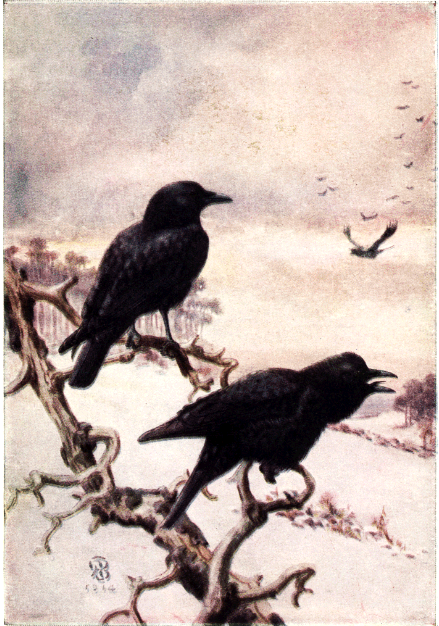
CROW28
RED-WINGED BLACKBIRD29
PURPLE MARTIN44
DOWNY WOODPECKER45
TOWHEES58
ROSE-BREASTED GROSBEAKS59
BOBOLINKS74
PHOEBE75
CHICKADEE78
TUFTED TITMOUSE79
CATBIRD86
WHITE-BREASTED NUTHATCH87
CHESTNUT-SIDED WARBLER94
BLUEBIRD95
KINGFISHER102
BLUE JAY103
BARN SWALLOW110
MOURNING DOVE111
HOUSE WREN118
BROWN THRASHER119
VEERY126
WOOD THRUSH127
FLICKER134
MEADOWLARK135
HORNED LARK138
WHIPPOORWILL139
NIGHTHAWK154
YELLOW-BILLED CUCKOO155
CEDAR WAXWING158
CHIPPING SPARROW159
SONG SPARROW166
TREE SPARROW167
WHITE-THROATED SPARROW170
TREE SWALLOW171
RUBY-THROATED HUMMINGBIRDS186
RUBY-CROWNED KINGLET187
REDSTART190
BALTIMORE ORIOLE191
CARDINAL198
SCARLET TANAGER199
RED CROSSBILL226
PURPLE FINCH226
ROBIN226
ORCHARD ORIOLE227
LIST OF HALF-TONE PLATES
FACING PAGE
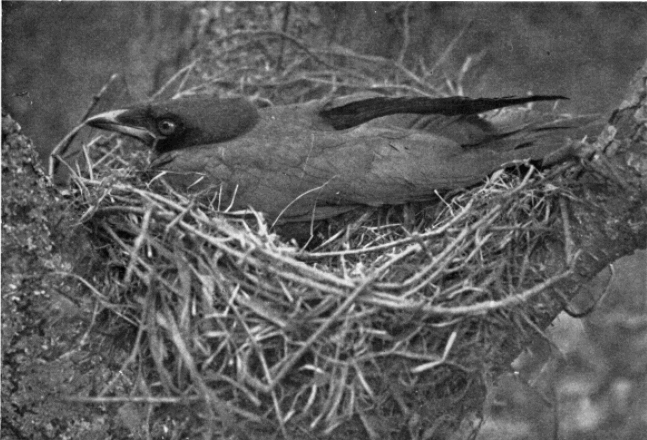
CROW ON NEST16
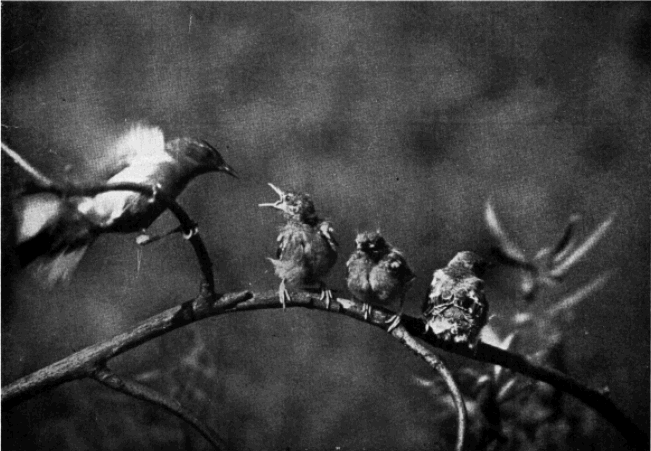
BLUE-WINGED WARBLER ALIGHTING TO FEED HER YOUNG17
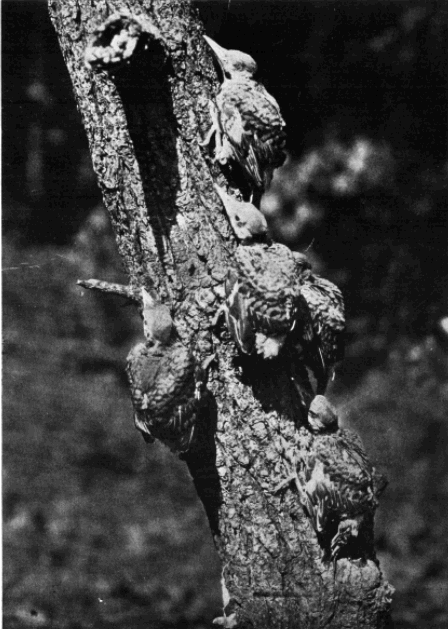
YOUNG FLICKERS ON DAY OF LEAVING NEST24
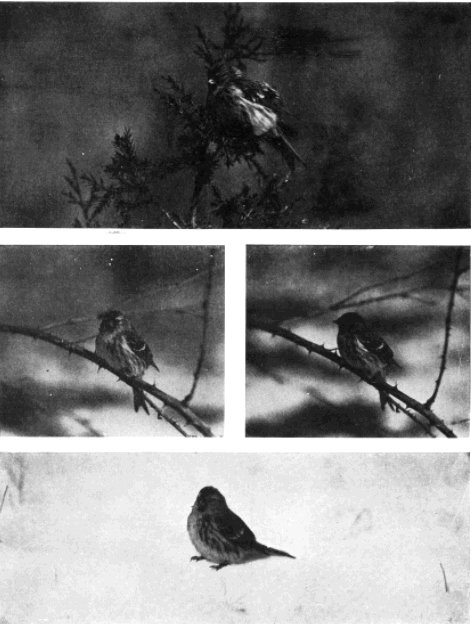
WINTER VISITORS: REDPOLLS25
YOUNG KINGFISHERS48
GRACKLE'S NEST AND YOUNG49
YELLOWBIRD'S NEST, SHOWING COWBIRD'S EGG54
BROTHER AND SISTER ROSE-BREASTED GROSBEAKS, TWO WEEKS OLD55
ROSE-BREASTED GROSBEAKS, SIX DAYS OLD55
CHIMNEY SWIFT66
YOUNG CRESTED FLYCATCHERS WITH HAIR STANDING ON END106
YOUNG MOCKING-BIRD107
HUNGRY YOUNG MOCKING-BIRDS107
A CHESTNUT-SIDED WARBLER FAMILY122
THE WOOD THRUSH HEARS THE CLICK OF THE CAMERA123
YELLOW-BILLED CUCKOOS THE DAY BEFORE LEAVING NEST202
FIELD SPARROW BABIES203
MOTHER OVENBIRD IN NEST; A BABY BIRD ON IT218
THE ROBIN'S MUD-WALLED NURSERY219
BIRD FAMILIES
HEIR CHARACTERISTICS AND THE REPRESENTATIVES OF EACH FAMILY INCLUDED IN "BIRD NEIGHBORS"
Order Coccyges: CUCKOOS AND KINGFISHERS
Family Cuculidæ: CUCKOOS
Long, pigeon-shaped birds, whose backs are grayish brown with a bronze lustre and whose under parts are whitish. Bill long and curved. Tail long; raised and drooped slowly while the bird is perching. Two toes point forward and two backward. Call-note loud and like a tree-toad's rattle. Song lacking. Birds of low trees and undergrowth, where they also nest; partial to neighborhood of streams, or wherever the tent caterpillar is abundant. Habits rather solitary, silent, and eccentric. Migratory.
Yellow-billed Cuckoo.
Black-billed Cuckoo.
Family Alcedinidæ: KINGFISHERS
Large, top-heavy birds of streams and ponds. Usually seen perching over the water looking for fish. Head crested; upper parts slate-blue; underneath white, and belted with blue or rusty. Bill large and heavy. Middle and outer toes joined for half their length. Call-note loud and prolonged, like a policeman's rattle. Solitary birds; little inclined to rove from a chosen locality. Migratory.
Belted Kingfisher.
Order Pici: WOODPECKERS
Family Picidæ: WOODPECKERS
Medium-sized and small birds, usually with plumage black and white, and always with some red feathers about the head. (The flicker is brownish and yellow instead of black and white.) Stocky, high-shouldered build; bill strong and long for drilling holes in bark of trees. Tail feathers pointed and stiffened to serve as a prop. Two toes before and two behind for clinging. Usually seen clinging erect on tree-trunks; rarely, if ever, head downward, like the nuthatches, titmice, etc. Woodpeckers feed as they creep around the trunks and branches. Habits rather phlegmatic. The flicker has better developed vocal powers than other birds of this class, whose rolling tattoo, beaten with their bills against the tree-trunks, must answer for their love-song. Nest in hollowed-out trees.
Red-headed Woodpecker.
Hairy Woodpecker.
Downy Woodpecker.
Yellow-bellied Woodpecker.
Flicker.
Order Macrochires: GOATSUCKERS, SWIFTS, AND HUMMING-BIRDS
Family Caprimulgidæ: NIGHTHAWKS, WHIPPOORWILLS, ETC.
Medium-sized, mottled brownish, gray, black, and white birds of heavy build. Short, thick head; gaping, large mouth; very small bill, with bristles at base. Take insect food on the wing. Feet small and weak; wings long and powerful. These birds rest lengthwise on their perch while sleeping through the brightest daylight hours, or on the ground, where they nest.
Nighthawk.
Whippoorwill.
Family Micropolidæ: SWIFTS
Sooty, dusky birds seen on the wing, never resting except in chimneys of houses, or hollow trees, where they nest. Tips of tail feathers with sharp spines, used as props. They show their kinship with the goatsuckers in their nocturnal as well as diurnal habits, their small bills and large mouths for catching insects or the wing, and their weak feet. Gregarious, especially at the nesting season.
Chimney Swift.
Family Trochilidæ: HUMMING-BIRDS
Very small birds with green plumage (iridescent red or orange breast in males); long, needle-shaped bill for extracting insects and nectar from deep-cupped flowers, and exceedingly rapid, darting flight. Small feet.
Ruby-throated Humming-bird.
Order Passeres: PERCHING BIRDS
Family Tyrannidæ: FLYCATCHERS
Small and medium-sized dull, dark-olive, or gray birds, with big heads that are sometimes crested. Bills hooked at end, and with bristles at base. Harsh or plaintive voices. Wings longer than tail; both wings and tails usually drooped and vibrating when the birds are perching. Habits moody and silent when perching on a conspicuous limb, telegraph wire, dead tree, or fence rail and waiting for insects to fly within range. Sudden, nervous, spasmodic sallies in midair to seize insects on the wing. Usually they return to their identical perch or lookout. Pugnacious and fearless. Excellent nest builders and devoted mates.
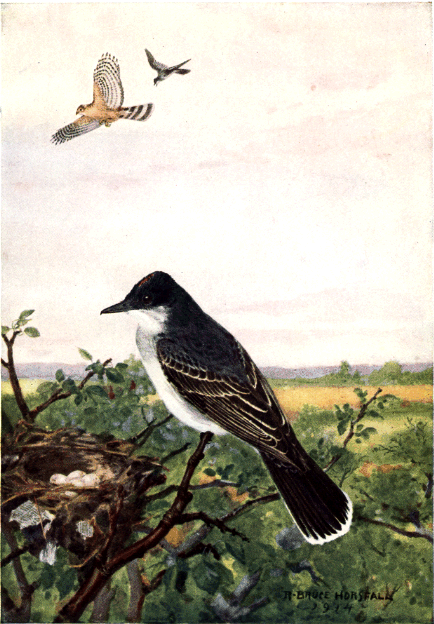
Kingbird.
Phœbe.
Wood Pewee.
Acadian Flycatcher.
Great Crested Flycatcher.
Least Flycatcher.
Olive-sided Flycatcher.
Yellow-bellied Flycatcher.
Say's Flycatcher.
Family Alaudidæ: LARKS
The only true larks to be found in this country are the two species given below. They are the kin of the European skylark, of which several unsuccessful attempts to introduce the bird have been made in this country. These two larks must not be confused with the meadow larks and titlarks, which belong to the blackbird and pipit families respectively. The horned larks are birds of the ground, and are seen in the United States only in the autumn and winter. In the nesting season at the North their voices are most musical. Plumage grayish and brown, in color harmony with their habitats. Usually found in flocks; the first species on or near the shore.
Horned Lark.
Prairie Horned Lark.
Family Corvidæ: CROWS AND JAYS
The crows are large black birds, walkers, with stout feet adapted for the purpose. Fond of shifting their residence at different seasons rather than strictly migratory, for, except at the northern limit of range, they remain resident all the year. Gregarious. Sexes alike. Omnivorous feeders, being partly carnivorous, as are also the jays. Both crows and jays inhabit wooded country. Their voices are harsh and clamorous; and their habits are boisterous and bold, particularly the jays. Devoted mates; unpleasant neighbors.
Common Crow.
Fish Crow.
Northern Raven.
Blue Jay.
Canada Jay.
Family Icteridæ: BLACKBIRDS, ORIOLES, ETC.
Plumage black or a brilliant color combined with black. (The meadow lark a sole exception.) Sexes unlike. These birds form a connecting link between the crows and the finches. The blackbirds have strong feet for use upon the ground, where they generally feed, while the orioles are birds of the trees. They are both seed and insect eaters. The bills of the bobolink and cowbird are short and conical, for they are conspicuous seed eaters. Bills of the others long and conical, adapted for insectivorous diet. About half the family are gifted songsters.
Red-winged Blackbird.Rusty Blackbird.
Purple Grackle.Bronzed Grackle.
Cowbird.Meadow Lark.
Western Meadow Lark.Bobolink.
Orchard Oriole.Baltimore Oriole.
Family Fringillidæ: FINCHES, SPARROWS, GROSBEAKS, BUNTINGS, LINNETS, AND CROSSBILLS
Generally fine songsters. Bills conical, short, and stout for cracking seeds. Length from five to nine inches, usually under eight inches. This, the largest family of birds that we have (about one-seventh of all our birds belong to it), comprises birds of such varied plumage and habit that, while certain family resemblances may be traced throughout, it is almost impossible to characterize the family as such. The sparrows are comparatively small gray and brown birds with striped upper parts, lighter underneath. Birds of the ground, or not far from it, elevated perches being chosen for rest and song. Nest in low bushes or on the ground. (Chipping sparrow often selects tall trees.) Coloring adapted to grassy, dusty habitats. Males and females similar. Flight labored. About forty species of sparrows are found in the United States; of these, fourteen may be met with by a novice, and six, at least, surely will be.
The finches and their larger kin are chiefly bright-plumaged birds, the females either duller or distinct from males; bills heavy, dull, and conical, befitting seed eaters. Not so migratory as insectivorous birds nor so restless. Mostly phlegmatic in temperament. Fine songsters.
Chipping Sparrow.Pine Siskin (or Finch).
English Sparrow.Purple Finch.
Field Sparrow.Goldfinch.
Fox Sparrow.Redpoll.
Grasshopper Sparrow.Greater Redpoll.
Savanna Sparrow.Red Crossbill.
Seaside Sparrow.White-winged Red Crossbill.
Sharp-tailed Sparrow.Cardinal Grosbeak.
Song Sparrow.Rose-breasted Grosbeak.
Swamp Song Sparrow.Pine Grosbeak.
Tree Sparrow.Evening Grosbeak.
Vesper Sparrow.Blue Grosbeak.
White-crowned Sparrow.Indigo Bunting.
White-throated Sparrow.Junco.
Lapland Longspur.Snowflake.
Smith's Painted Longspur.Chewink.
Family Tanagridæ: TANAGERS
Distinctly an American family, remarkable for their brilliant plumage, which, however, undergoes great changes twice a year, Females different from males, being dull and inconspicuous. Birds of the tropics, two species only finding their way north, and the summer tanager rarely found north of Pennsylvania. Shy inhabitants of woods. Though they may nest low in trees, they choose high perches when singing or feeding upon flowers, fruits, and insects. As a family, the tanagers have weak, squeaky voices, but both our species are good songsters. Suffering the fate of most bright-plumaged birds, immense numbers have been shot annually.
Scarlet Tanager.
Summer Tanager.
Family Hirundinidæ: SWALLOWS
Birds of the air, that take their insect food on the wing. Migratory. Flight strong, skimming, darting; exceedingly graceful. When not flying they choose slender, conspicuous perches like telegraph wires, gutters, and eaves of barns. Plumage of some species dull, of others iridescent blues and greens above, whitish or ruddy below. Sexes similar. Bills small; mouths large. Long and pointed wings, generally reaching the tip of the tail or beyond. Tail more or less forked. Feet small and weak from disuse. Song a twittering warble without power. Gregarious birds.
Barn Swallow.
Bank Swallow.
Cliff (or Eaves) Swallow.
Tree Swallow.
Bough-winged Swallow.
Purple Martin.
Family Ampelidæ: WAXWINGS
Medium-sized Quaker-like birds, with plumage of soft browns and grays. Head crested; black band across forehead and through the eye. Bodies plump from indolence. Tail tipped with yellow; wings with red tips to coverts, resembling sealing-wax. Sexes similar. Silent, gentle, courteous, elegant birds. Usually seen in large flocks feeding upon berries in the trees or perching on the branches, except at the nesting season. Voices resemble a soft, lisping twitter.
Cedar Bird.
Bohemian Waxwing.
Family Laniidæ: SHRIKES
Medium-sized grayish, black-and-white birds, with hooked and hawk-like bill for tearing the flesh of smaller birds, field-mice, and large insects that they impale on thorns. Handsome, bold birds, the terror of all small, feathered neighbors, not excluding the English sparrow. They choose conspicuous perches when on the lookout for prey: a projecting or dead limb of a tree, the cupola of a house, the ridge-pole or weather-vane of a barn, or a telegraph wire, from which to suddenly drop upon a victim. Eyesight remarkable. Call-notes harsh and unmusical. Habits solitary and wandering. The first-named species is resident during the colder months of the year; the latter is a summer resident only north of Maryland.
Northern Shrike.
Loggerhead Shrike.
Family Vireonidæ: VIREOS OR GREENLETS
Small greenish-gray or olive birds, whitish or yellowish underneath, their plumage resembling the foliage of the trees they hunt, nest, and live among. Sexes alike. More deliberate in habit than the restless, flitting warblers that are chiefly seen darting about the ends of twigs. Vireos are more painstaking gleaners; they carefully explore the bark, turn their heads upward to investigate the under side of leaves, and usually keep well hidden among the foliage. Bill hooked at tip for holding worms and insects. Gifted songsters, superior to the warblers. This family is peculiar to America.
Red-eyed Vireo.
Solitary Vireo.
Warbling Vireo.
White-eyed Vireo.
Yellow-throated Vireo.
Family Mniotiltidæ: WOOD WARBLERS
A large group of birds, for the most part smaller than the English sparrow; all, except the ground warblers, of beautiful plumage, in which yellow, olive, slate-blue, black, and white are predominant colors. Females generally duller than males. Exceedingly active, graceful, restless feeders among the terminal twigs of trees and shrubbery; haunters of tree-tops in the woods at nesting time. Abundant birds, especially during May and September, when the majority are migrating to and from regions north of the United States; but they are strangely unknown to all but devoted bird lovers, who seek them out during these months that particularly favor acquaintance. Several species are erratic in their migrations and choose a different course to return southward from the one they travelled over in spring. A few species are summer residents, and one, at least, of this tropical family, the myrtle warbler, winters at the north. The habits of the family are not identical in every representative; some are more deliberate and less nervous than others; a few, like the Canadian and Wilson's warblers, are expert flycatchers, taking their food on the wing, but not usually returning to the same perch, like true flycatchers; and a few of the warblers, as, for example, the black-and-white, the pine, and the worm-eating species, have the nuthatches' habit of creeping around the bark of trees. Quite a number feed upon the ground. All are insectivorous, though many vary their diet with blossom, fruit, or berries, and naturally their bills are slender and sharply pointed, rarely finch-like. The yellow-breasted chat has the greatest variety of vocal expressions. The ground warblers are compensated for their sober, thrush-like plumage by their exquisite voices, while the great majority of the family that are gaily dressed have notes that either resemble the trill of midsummer insects or, by their limited range and feeble utterance, sadly belie the family name.
Bay-breasted Warbler.Nashville Warbler.
Blackburnian Warbler.Palm Warbler.
Blackpoll Warbler.Parula Warbler.
Black-throated Blue Warbler.Pine Warbler.
Black-throated Green Warbler.Prairie Warbler.
Black-and-white Creeping Warbler.Redstart.
Blue-winged Warbler.Wilson's Warbler.
Canadian Warbler.Worm-eating Warbler.
Chestnut-sided Warbler.Yellow Warbler.
Golden-winged Warbler.Yellow Palm Warbler.
Hooded Warbler.Ovenbird.
Kentucky Warbler.Northern Water Thrush.
Magnolia Warbler.Louisiana Water Thrush.
Mourning Warbler.Maryland Yellowthroat.
Myrtle Warbler.Yellow-breasted Chat.
Family Motacillidæ: WAGTAILS AND PIPITS
Only three birds of this family inhabit North America, and of these only one is common enough, east of the Mississippi, to be included in this book. Terrestrial birds of open tracts near the coast, stubble-fields, and country roadsides, with brownish plumage to harmonize with their surroundings. The American pipit, or titlark, has a peculiar wavering flight when, after being flushed, it reluctantly leaves the ground. Then its white tail feathers are conspicuous. Its habit of wagging its tail when perching is not an exclusive family trait, as the family name might imply.
American Pipit, or Titlark.
Family Troglodytidæ: THRASHERS, WRENS, ETC.
Subfamily Miminæ: THRASHERS, MOCKING-BIRDS, AND CATBIRDS
Apparently the birds that comprise this large general family are too unlike to be related, but the missing links or intermediate species may all be found far South. The first subfamily is comprised of distinctively American birds. Most numerous in the tropics. Their long tails serve a double purpose—in assisting their flight and acting as an outlet for their vivacity. Usually they inhabit scrubby undergrowth bordering woods. They rank among our finest songsters, with ventriloquial and imitative powers added to sweetness of tone.
Brown Thrasher.
Catbird.
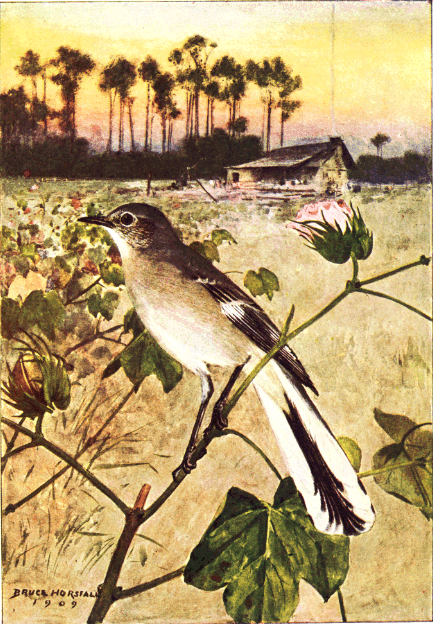
Mocking-bird.
KINGBIRD
MOCKING-BIRD
Subfamily Troglodytinæ: WRENS
Small brown birds, more or less barred with darkest brown above, much lighter below. Usually carry their short tails erect. Wings are small, for short flight. Vivacious, busy, excitable, easily displeased, quick to take alarm. Most of the species have scolding notes in addition to their lyrical, gushing song, that seems much too powerful a performance for a diminutive bird. As a rule, wrens haunt thickets or marshes, but at least one species is thoroughly domesticated. All are insectivorous.
Carolina Wren.
House Wren.
Winter Wren.
Long-billed Marsh Wren.
Short-billed Marsh Wren.
Family Certhiidæ: CREEPERS
Only one species of this Old World family is found in America. It is a brown, much mottled bird, that creeps spirally around and around the trunks of trees in fall and winter, pecking at the larvæ in the bark with its long, sharp bill, and doing its work with faithful exactness but little spirit. It uses its tail as a prop in climbing, like the woodpeckers.
Brown Creeper.
Family Paridæ: NUTHATCHES AND TITMICE
Two distinct subfamilies are included under this general head.
The nuthatches (Sittinæ) are small, slate-colored birds, seen chiefly in winter walking up and down the barks of trees, and sometimes running along the under side of branches upside down, like flies. Plumage compact and smooth. Their name is derived from their habit of wedging nuts (usually beech-nuts) in the bark of trees, and then hatching them open with their strong straight bills.
White-breasted Nuthatch.
Red-breasted Nuthatch.
The titmice or chickadees (Parinæ) are fluffy little gray birds, the one crested, the other with a black cap. They are also expert climbers, though not such wonderful gymnasts as the nuthatches. These cousins are frequently seen together in winter woods or in the evergreens about houses. Chickadees are partial to tree-tops, especially to the highest pine cones, on which they hang fearlessly. Cheerful, constant residents, retreating to the deep woods only to nest.
Tufted Titmouse.
Chickadee.
Family Sylviidæ: KINGLETS AND GNATCATCHERS
The kinglets (Regulinæ) are very small greenish-gray birds, with highly colored crown patch, that are seen chiefly in autumn, winter, and spring south of Labrador. Habits active; diligent flitters among trees and shrubbery from limb to limb after minute insects. Beautiful nest builders. Song remarkable for so small a bird.
Golden-crowned Kinglet.
Ruby-crowned Kinglet.
The one representative of the distinctly American subfamily of gnatcatchers (Polioptilinæ) that we have, is a small blue-gray bird, whitish below. It is rarely found outside moist, low tracts of woodland, where insects abound. These it takes on the wing with wonderful dexterity. It is exceedingly graceful and assumes many charming postures. A bird of trees, nesting in the high branches. A bird of strong character and an exquisitely finished though feeble songster.
Blue-gray Gnatcatcher.
Family Turdidæ: THRUSHES, BLUEBIRDS, ETC.
This group includes our finest songsters. Birds of moderate size, stout build; as a rule, inhabitants of woodlands, but the robin and the bluebird are notable exceptions. Bills long and slender, suitable for worm diet. Only casual fruit-eaters. Slender, strong legs for running and hopping. True thrushes are grayish or olive-brown above; buff or whitish below, heavily streaked or spotted.
Bluebird.
Robin.
Alice's Thrush.
Hermit Thrush.
Olive-backed Thrush.
Wilson's Thrush (Veery).
Wood Thrush.
Order Columbæ: PIGEONS AND DOVES
Family Columbidæ: PIGEONS AND DOVES
The wild pigeon is now too rare to be included among our bird neighbors; but its beautiful relative, without the fatally gregarious habit, still nests and sings a-coo-oo-oo to its devoted mate in unfrequented corners of the farm or the borders of woodland. Delicately shaded fawn-colored and bluish plumage. Small heads, protruding breasts. Often seen on ground. Flight strong and rapid, owing to long wings.
Mourning or Carolina Dove.
CROW ON NEST.
BLUE-WINGED WARBLER ALIGHTING TO FEED HER YOUNG.
II
HABITATS OF BIRDS
BIRDS OF THE AIR CATCHING THEIR FOOD AS THEY FLY
Acadian Flycatcher, Great Crested Flycatcher, Least Flycatcher, Olive-sided Flycatcher, Say's Flycatcher, Yellow-bellied Flycatcher, Kingbird, Phœbe, Wood Pewee, Purple Martin, Chimney Swift, Barn Swallow, Bank Swallow, Cliff Swallow, Tree Swallow, Rough-winged Swallow, Canadian Warbler, Blackpoll, Wilson's Warbler, Nighthawk, Whippoorwill, Ruby-throated Humming-bird, Blue-gray Gnatcatcher.
BIRDS MOST FREQUENTLY SEEN IN THE UPPER HALF OF TREES
Scarlet Tanager, Summer Tanager, Baltimore Oriole, Orchard Oriole, Chickadee, Tufted Titmouse, Blue-gray Gnatcatcher, nearly all the Warblers except the Ground Warblers; Cedar Bird, Bohemian Waxwing, the Vireos, Robin, Red Crossbill, White-winged Crossbill, Purple Grackle, Bronzed Grackle, Redstart, Northern Shrike, Loggerhead Shrike, Crow, Fish Crow, Raven, Purple Finch, Tree and Chipping Sparrows, Cardinal, Blue Jay, Kingbird, the Crested and other Flycatchers.
BIRDS OF LOW TREES OR LOWER PARTS OF TREES
Black-billed Cuckoo, Yellow-billed Cuckoo, the Sparrows, the Thrushes, the Grosbeaks, Goldfinch, Summer Yellowbird and other Warblers; the Wrens, Bluebird, Mocking-bird, Catbird, Brown Thrasher, Maryland Yellowthroat, Yellow-breasted Chat.
BIRDS OF TREE-TRUNKS AND LARGE LIMBS
Hairy Woodpecker, Downy Woodpecker, Red-headed Woodpecker, Yellow-bellied Woodpecker, Flicker, White-breasted Nuthatch, Red-breasted Nuthatch, Brown Creeper, Chickadee, Tufted Titmouse, Golden-crowned Kinglet, Ruby-crowned Kinglet, Black-and-white Creeping Warbler, Blue-winged Warbler, Worm-eating Warbler, Pine Warbler, Blackpoll Warbler, Whippoorwill, Nighthawk.
BIRDS THAT SHOW A PREFERENCE FOR PINES AND OTHER EVERGREENS
Chickadee, Tufted Titmouse, the Nuthatches, Brown Creeper, the Kinglets, Pine Warbler, Black-and-white Creeping Warbler and all the Warblers except the Ground Warblers; Pine Siskin, Cedar Bird and Bohemian Waxwing (in juniper and cedar trees), Pine Grosbeak, Red Crossbill, White-winged Crossbill, the Grackles, Crow, Raven, Pine Finch.
BIRDS SEEN FEEDING AMONG THE FOLIAGE AND TERMINAL TWIGS OF TREES
The Red-eyed Vireo, White-eyed Vireo, Warbling Vireo, Solitary Vireo, Yellow-throated Vireo, Golden-crowned Kinglet, Ruby-crowned Kinglet, Black-billed Cuckoo, Yellow-billed Cuckoo, Yellow Warbler or Summer Yellowbird, nearly all the Warblers except the Pine and the Ground Warblers; the Flycatchers, Blue-gray Gnatcatcher.
BIRDS THAT CHOOSE CONSPICUOUS PERCHES
Northern Shrike, Loggerhead Shrike, Kingbird, the Wood Pewee, the Phœbe and other Flycatchers, the Swallows, Kingfisher, Crows, Grackles, Blue Jay and Canada Jay; the Song, the White-throated, and the Fox Sparrows; the Grosbeaks, Cedar Bird, Goldfinch, Robin, Purple Finch, Cowbird, Brown Thrasher while in song.
BIRDS OF THE GARDENS AND ORCHARDS
Bluebird, Robin; the English, Song, White-throated, Vesper, White-crowned, Fox, Chipping, and Tree Sparrows; Phœbe, Wood Pewee, the Least Flycatcher, Crested Flycatcher, Kingbird, Brown Thrasher, Wood Thrush, Mocking-bird, Catbird, House Wren; nearly all the Warblers, especially at blossom time among the shrubbery and fruit trees; Cedar Bird, Purple Martin, Eaves Swallow, Barn Swallow, Purple Finch, Cowbird, Baltimore and Orchard Orioles, Purple Grackle, Bronzed Grackle, Blue Jay, Crow, Fish Crow, Chimney Swift, Ruby-throated Humming-bird, the Woodpeckers, Flicker, the Nuthatches, Chickadee, Tufted Titmouse, the Cuckoos, Mourning Dove, Junco, Starling.
BIRDS OF THE WOODS
The Warblers almost without exception; the Thrushes, the Woodpeckers, the Flycatchers, the Winter and the Carolina Wrens, the Tanagers, the Nuthatches and Titmice, the Kinglets, the Water Thrushes, the Vireos, Whippoorwill, Nighthawk, Kingfisher, Cardinal, Ovenbird, Brown Creeper, Tree Sparrow, Fox Sparrow, White-throated Sparrow, White-crowned Sparrow, Junco.
BIRDS SEEN NEAR THE EDGES OF WOODS
The Wrens, the Woodpeckers, the Flycatchers, the Warblers, Purple Finch, the Cuckoos, Brown Thrasher, Wood Thrush, Cowbird, Brown Creepers, the Nuthatches and Titmice, the Kinglets, Chewink; the White-crowned, White-throated, Tree, Fox, and Song Sparrows; Humming-bird, Bluebird, Junco, the Crossbills, the Grosbeaks, Nighthawk, Whippoorwill, Mourning Dove, Indigo Bird, Brown Thrasher.
BIRDS OF SHRUBBERY, BUSHES, AND THICKETS
Maryland Yellowthroat, Ovenbird (in woods); Myrtle Warbler, Mourning Warbler, Yellow-breasted Chat, and other Warblers during the migrations; the Shrikes; the White-throated, the Fox, the Song, and other Sparrows; Chickadee, Junco, Chewink, Rose-breasted Grosbeak, Cowbird, Red-winged Blackbird, Catbird, Mocking-bird, Wilson's Thrush, Goldfinch, Redpolls, Maryland Yellowthroat, White-eyed Vireo, Hooded Warbler.
BIRDS SEEN FEEDING ON THE GROUND
The Sparrows, Junco, Meadowlark, Horned Lark, Chewink, Robin, Ovenbird, Pipit or Titlark, Redpoll, Greater Redpoll, Snowflake, Lapland Longspur, Smith's Painted Longspur, Rusty Blackbird, Red-winged Blackbird, the Crows, Cowbird, the Water Thrushes, Bobolink, Canada Jay, the Grackles, Mourning Dove; the Worm-eating, the Prairie, the Kentucky, and the Mourning Ground Warblers; Flicker.
BIRDS OF MEADOW, FIELD, AND UPLAND
The Field and Vesper Sparrows, Bobolink, Meadowlark, Horned Lark, Goldfinch, the Swallows, Pipit or Titlark, Cowbird, Redpoll, Greater Redpoll, Snowflake, Junco, Lapland Longspur, Smith's Painted Longspur, Rusty Blackbird, Crow, Fish Crow, Nighthawk, Whippoorwill; the Yellow, the Palm, and the Prairie Warblers; the Grackles, Flicker, Bluebird, Indigo Bird.
BIRDS OF ROADSIDE AND FENCES
The Sparrows, Kingbird, Crested Flycatcher, Yellow-breasted Chat, Indigo Bird, Bluebird, Flicker, Goldfinch, Brown Thrasher, Catbird, Robin, the Woodpeckers, Yellow Palm Warbler, the Vireos.
BIRDS OF MARSHES AND BOGGY MEADOWS
Long-billed Marsh Wren, Short-billed Marsh Wren; the Swamp, the Savanna, the Sharp-tailed, and the Seaside Sparrows; Red-winged Blackbird.
BIRDS OF WET WOODLANDS AND MARSHY THICKETS
Northern Water Thrush, Louisiana Water Thrush, Ovenbird, Winter Wren, Carolina Wren, Phœbe; Wood Pewee and the other Flycatchers; Wilson's Thrush or Veery, Blue-gray Gnatcatcher, Yellow-breasted Chat; the Canadian, Wilson's Black-capped, the Maryland Yellowthroat, the Hooded, and the Yellow-throated Warblers.
BIRDS FOUND NEAR SALT WATER
Fish Crow, Common Crow, Bank Swallow, Tree Swallow, Savanna Sparrow, Sharp-tailed Sparrow, Seaside Sparrow, Horned Lark, Pipit or Titlark.
BIRDS FOUND NEAR STREAMS AND PONDS
Kingfisher, the Swallows, Northern Water Thrush, Louisiana Water Thrush, Phœbe, Wood Pewee, the Flycatchers, Winter Wren, Wilson's Black-capped Warbler, the Canadian and the Yellow Warblers.
BIRDS THAT SING ON THE WING
Bobolink, Meadowlark, Indigo Bird, Purple Finch, Goldfinch, Ovenbird, Kingbird, Vesper Sparrow (rarely), Maryland Yellowthroat, Horned Lark, Kingfisher, the Swallows, Chimney Swift, Nighthawk, Song Sparrow, Red-winged Blackbird, Pipit or Titlark, Mocking-bird.
YOUNG FLICKERS ON DAY OF LEAVING NEST
WINTER VISITORS: REDPOLLS
III
SEASONS OF BIRDS
THE LATITUDE OF NEW YORK IS TAKEN AS AN ARBITRARY DIVISION FOR WHICH ALLOWANCES MUST BE MADE FOR OTHER LOCALITIES
THE SEASONS OF BIRDS IN THE VICINITY OF NEW YORK OR, APPROXIMATELY, OF THE FORTY-SECOND DEGREE OF LATITUDE
PERMANENT RESIDENTS
Hairy Woodpecker.Swamp Sparrow.
Downy Woodpecker.Song Sparrow.
Yellow-bellied Woodpecker.Cedar Bird.
Red-headed Woodpecker.Cardinal.
Flicker.Carolina Wren.
Meadowlark.White-breasted Nuthatch.
Prairie Horned Lark.Tufted Titmouse.
Blue Jay.Chickadee.
Crow.Robin.
Fish Crow.Bluebird.
English Sparrow.Goldfinch.
Social Sparrow.Starling.
WINTER RESIDENTS AND VISITORS
BIRDS SEEN BETWEEN NOVEMBER AND APRIL
English Sparrow.Red-breasted Nuthatch.
Tree Sparrow.Tufted Titmouse.
White-throated Sparrow.Chickadee.
Swamp Sparrow.Robin.
Vesper Sparrow.Bluebird.
White-crowned Sparrow.Ruby-crowned Kinglet.
Fox Sparrow.Golden-crowned Kinglet.
Song Sparrow.Brown Creeper.
Snowflake.Carolina Wren.
Junco.Winter Wren.
Horned Lark.Pipit.
Meadowlark.Purple Finch.
Pine Grosbeak.Goldfinch.
Redpoll.Pine Siskin.
Greater Redpoll.Lapland Longspur.
Cedar Bird.Smith's Painted Longspur.
Bohemian Waxwing.Evening Grosbeak.
Hairy Woodpecker.Cardinal.
Downy Woodpecker.Blue Jay.
Yellow-bellied Woodpecker.Red Crossbill.
Flicker.White-winged Crossbill.
Myrtle Warbler.Crow.
Northern Shrike.Fish Crow.
White-breasted Nuthatch.Kingfisher.
CROW.
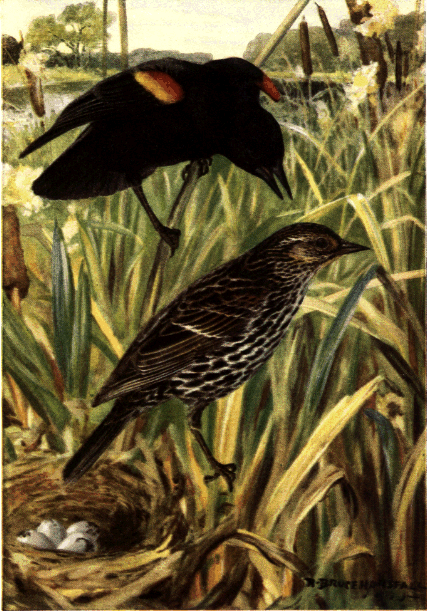
RED-WINGED BLACKBIRD (Upper Figure, Male; Lower Figure, Female)
SUMMER RESIDENTS
BIRDS SEEN BETWEEN APRIL AND NOVEMBER
Mourning Dove.Red-winged Blackbird.
Black-billed Cuckoo.Rusty Blackbird.
Yellow-billed Cuckoo.Orchard Oriole.
Kingfisher.Baltimore Oriole.
Red-headed Woodpecker.Purple Grackle.
Hairy Woodpecker.Bronzed Grackle.
Downy Woodpecker.Crow.
Yellow-bellied Woodpecker.Fish Crow.
Flicker.Raven.
Whippoorwill.Blue Jay.
Nighthawk.Canada Jay.
Chimney Swift.Chipping Sparrow.
Ruby-throated Humming-bird.English Sparrow.
Kingbird.Field Sparrow.
Wood Pewee.Fox Sparrow.
Phœbe.Grasshopper Sparrow.
Acadian Flycatcher.Savanna Sparrow.
Crested Flycatcher.Seaside Sparrow.
Least Flycatcher.Sharp-tailed Sparrow.
Olive-sided Flycatcher.Swamp Song Sparrow.
Yellow-bellied Flycatcher.Song Sparrow.
Say's Flycatcher.Vesper Sparrow.
Bobolink.Rose-breasted Grosbeak.
Cowbird.Blue Grosbeak.
Indigo Bird.Yellow-breasted Chat.
Scarlet Tanager.Maryland Yellowthroat.
Purple Martin.Mocking-bird.
Barn Swallow.Catbird.
Bank Swallow.Brown Thrasher.
Cliff Swallow.House Wren.
Tree Swallow.Carolina Wren.
Rough-winged Swallow.Long-billed Marsh Wren.
Red-eyed Vireo.Short-billed Marsh Wren.
White-eyed Vireo.Alice's Thrush.
Solitary Vireo.Hermit Thrush.
Warbling Vireo.Olive-backed Thrush.
Yellow-throated Vireo.Wilson's Thrush or Veery.
Black-and-white Warbler.Wood Thrush.
Black-throated Green Warbler.Meadowlark.
Blue-winged Warbler.Western Meadowlark.
Chestnut-sided Warbler.Prairie Horned Lark.
Golden-winged Warbler.White-breasted Nuthatch.
Hooded Warbler.Chickadee.
Pine Warbler.Tufted Titmouse.
Prairie Warbler.Chewink.
Parula Warbler.Purple Finch.
Worm-eating Warbler.Goldfinch.
Yellow Warbler.Cardinal.
Redstart.Robin.
Ovenbird.Bluebird.
Northern Water Thrush.Cedar-Bird.
Louisiana Water Thrush.Loggerhead Shrike.
SPRING AND AUTUMN MIGRANTS ONLY, OR RARE SUMMER VISITORS
The following Warblers:
Bay-breasted.Myrtle.
Blackburnian.Nashville.
Blackpolled.Wilson's Black-capped.
Black-throated Blue.Palm.
Canadian.Yellow Palm.
Magnolia.Blue-gray Gnatcatcher.
Mourning.Summer Tanager.
MIGRATIONS OF BIRDS IN VICINITY OF NEW YORK
FEBRUARY 15 TO MARCH 15
Bluebird, Robin, the Grackles, Song Sparrow, Fox Sparrow, Red-winged Blackbird, Kingfisher, Flicker, Purple Finch.
MARCH 15 TO APRIL 1
Increased numbers of foregoing group; Cowbird, Meadowlark, Phoebe; the Field, the Vesper, and the Swamp Sparrows.
APRIL 1 TO 15
The White-throated and the Chipping Sparrows, the Tree and the Barn Swallows, Rusty Blackbird, the Red-headed and the Yellow-bellied Woodpeckers, Hermit Thrush, Ruby-crowned Kinglet, Pipit; the Pine, the Myrtle, and the Yellow Palm Warblers; Goldfinch.
APRIL 15 TO MAY 1
Increased numbers of foregoing group; Brown Thrasher; Alice's, the Olive-backed, and the Wood Thrushes; Chimney Swift, Whippoorwill, Chewink, the Purple Martin, and the Cliff and the Bank Swallows; Least Flycatcher; the Black-and-white Creeping, the Parula, and the Black-throated Green Warblers; Ovenbird, House Wren, Catbird.
MAY 1 TO 15
Increased numbers of foregoing group; Wilson's Thrush or Veery; Nighthawk, Ruby-throated Humming-bird, the Cuckoos, Crested Flycatcher, Kingbird, Wood Pewee, the Marsh Wrens, Bank Swallow, the five Vireos, the Baltimore and Orchard Orioles, Bobolink, Indigo Bird, Rose-breasted Grosbeak, Scarlet Tanager, Maryland Yellowthroat, Yellow-breasted Chat, the Water Thrushes; and the Magnolia, the Yellow, the Black-throated Blue, the Bay-breasted, the Chestnut-sided, and the Golden-winged Warblers.
MAY 15 TO JUNE 1
Increased numbers of foregoing group; Yellow-bellied Flycatcher, Mocking-bird, Summer Tanager; and the Blackburnian, the Blackpoll, the Worm-eating, the Hooded, Wilson's Black-capped, and the Canadian Warblers.
JUNE, JULY, AUGUST
In June few species of birds are not nesting; in July they may rove about more or less with their increased families, searching for their favorite foods; August finds them moulting and moping in silence, but toward the end of the month, thoughts of returning southward set them astir again.
AUGUST 15 TO SEPTEMBER 15
Bobolink, Cliff Swallow, Scarlet Tanager, Yellow-bellied Flycatcher, Purple Martin; the Blackburnian, the Worm-eating, the Bay-breasted, the Chestnut-sided, the Hooded, the Mourning, Wilson's Black-capped, and the Canadian Warblers; Baltimore Oriole, Humming-bird.
SEPTEMBER 15 TO OCTOBER 1
Increased numbers of foregoing group; Wilson's Thrush, Wood Thrush, Kingbird, Wood Pewee, Crested Flycatcher; the Least, the Olive-sided, and the Acadian Flycatchers; the Marsh Wrens, the Cuckoos, Whippoorwill, Rose-breasted Grosbeak, Orchard Oriole, Indigo Bird; the Warbling, the Solitary, and the Yellow-throated Vireos; the Black-and-white Creeping, the Golden-winged, the Yellow, and the Black-throated Blue Warblers; Maryland Yellowthroat, Yellow-breasted Chat, Redstart.
OCTOBER 1 TO 15
Increased numbers of foregoing group; Hermit Thrush, Catbird, House Wren, Ovenbird, the Water Thrushes, the Red-eyed and the White-eyed Vireos, Wood Pewee, Nighthawk, Chimney Swift, Cowbird, Horned Lark, Winter Wren, Junco; the Tree, the Vesper, the White-throated, and the Grasshopper Sparrows; the Blackpoll, the Parula, the Pine, the Yellow Palm, and the Prairie Warblers; Chickadee, Tufted Titmouse.
OCTOBER 15 TO NOVEMBER 15
Increased numbers of foregoing group; Wood Thrush, Wilson's Thrush or Veery, Alice's Thrush, Olive-backed Thrush, Robin, Chewink, Brown Thrasher, Phœbe, Shrike; the Fox, the Field, the Swamp, the Savanna, the White-crowned, the Chipping, and the Song Sparrows; the Red-winged and the Rusty Blackbirds; Meadowlark, the Grackles, Flicker, the Red-headed and the Yellow-bellied Woodpeckers; Purple Finch, the Kinglets, the Nuthatches, Pine Siskin.
IV
BIRDS GROUPED ACCORDING TO SIZE
SMALLER THAN THE ENGLISH SPARROW
Humming-bird.The Redpolls.
The Kinglets.Goldfinch.
The Wrens.Pine Siskin.
All the Warblers notSavanna Sparrow.
mentioned elsewhere.Grasshopper Sparrow.
Redstart.Sharp-tailed Sparrow.
Ovenbird.Chipping Sparrow.
Chickadee.Field Sparrow.
Tufted Titmouse.Swamp Song Sparrow.
Red-breasted Nuthatch.Indigo-Bunting.
White-breasted Nuthatch.Warbling Vireo.
Blue-gray Gnatcatcher.Yellow-throated Vireo.
Yellow-bellied Flycatcher.Red-eyed Vireo.
Acadian Flycatcher.White-eyed Vireo.
Least Flycatcher.Brown Creeper.
ABOUT THE SIZE OF THE ENGLISH SPARROW
Purple Finch.Junco.
The Crossbills.Song Sparrow.
The Longspurs.Solitary Vireo.
Vesper Sparrow.The Water-thrushes.
Seaside Sparrow.Pipit or Titlark.
Tree Sparrow.Downy Woodpecker.
LARGER THAN THE ENGLISH SPARROW AND SMALLER THAN THE ROBIN
Yellow-bellied Woodpecker.The Grosbeaks: Evening, Blue, Pine, Rose-breasted, and Cardinal.
Chimney Swift (apparently).
The Swallows (apparently).Snowflake.
Kingbird.White-crowned Sparrow.
Crested Flycatcher.White-throated Sparrow.
Phoebe.Fox Sparrow.
Olive-sided Flycatcher.The Tanagers.
Wood Pewee.Cedar Bird.
Horned Lark.Bohemian Waxwing.
Bobolink.Yellow-breasted Chat.
Cowbird.The Thrushes.
Orchard Oriole.Bluebird.
Baltimore Oriole.
ABOUT THE LENGTH OF THE ROBIN
Red-headed Woodpecker.
Hairy Woodpecker.
Red-winged Blackbird.
Rusty Blackbird.
Loggerhead Shrike.
Northern Shrike.
Mocking-bird.
Catbird.
Chewink.
Purple Martin (apparently).
Starling.
LONGER THAN THE ROBIN
Mourning Dove.
The Cuckoos.
Kingfisher.
Flicker.
Raven.
Crow.
Fish Crow.
Blue Jay.
Canada Jay.
Meadowlark.
Whippoorwill (apparently).
Nighthawk (apparently).
The Grackles.
Brown Thrasher.
V
DESCRIPTIONS OF BIRDS GROUPED ACCORDING TO COLOR
BIRDS CONSPICUOUSLY BLACK
Common Crow.
Fish Crow.
American Raven.
Purple Grackle.
Bronzed Grackle.
Rusty Blackbird.
Red-winged Blackbird.
Purple Martin.
Cowbird.
Starling.
See also several of the Swallows; the Kingbird, the Phoebe, the Wood Pewee and other Flycatchers; the Chimney Swift; and the Chewink.
The Common Crow (Corvus Aamericanus) Crow family
Called also: CORN THIEF (Illustrations facing pp. 16 and 28)
Length—16 to 17.50 inches.
Male—Glossy black with violet reflections. Wings appear saw-toothed when spread, and almost equal the tail in length.
Female—Like male, except that the black is less brilliant.
Range—Throughout North America, from Hudson Bay to the Gulf of Mexico.
Migrations—March. October. Summer and winter resident.
If we have an eye for the picturesque, we place a certain value upon the broad, strong dash of color in the landscape, given by a flock of crows flapping their course above a corn-field, against an October sky; but the practical eye of the farmer looks only for his gun in such a case. To him the crow is an unmitigated nuisance, all the more maddening because it is clever enough to circumvent every means devised for its ruin. Nothing escapes its rapacity; fear is unknown to it. It migrates in broad daylight, chooses the most conspicuous perches, and yet its assurance is amply justified in its steadily increasing numbers.
In the very early spring, note well the friendly way in which the crow follows the plow, ingratiating itself by eating the larvæ, field mice, and worms upturned in the furrows, for this is its one serviceable act throughout the year. When the first brood of chickens is hatched, its serious depredations begin. Not only the farmer's young fledglings, ducks, turkeys, and chicks, are snatched up and devoured, but the nests of song birds are made desolate, eggs being crushed and eaten on the spot, when there are no birds to carry off to the rickety, coarse nest in the high tree top in the woods. The fish crow, however, is the much greater enemy of the birds. Like the common crows, this, their smaller cousin, likes to congregate in winter along the seacoast to feed upon shell-fish and other sea-food that the tide brings to its feet.
Samuels claims to have seen a pair of crows visit an orchard and destroy the young in two robins' nests in half an hour. He calculates that two crows kill, in one day alone, young birds that in the course of the season would have eaten a hundred thousand insects. When, in addition to these atrocities, we remember the crow's depredations in the corn-field, it is small wonder that among the first laws enacted in New York State was one offering a reward for its head. But the more scientific agriculturists now concede that the crow is the farmer's true friend.
Fish Crow (Corvus ossifragus) Crow family
Length—14 to 16 inches. About half as large again as the robin.
Male and Female—Glossy black, with purplish-blue reflections, generally greener underneath. Chin naked.
Range—Along Atlantic coast and that of the Gulf of Mexico, northward to southern New England. Rare stragglers on the Pacific coast.
Migrations—March or April. September. Summer resident only at northern limit of range. Is found in Hudson River valley about half-way to Albany.
Compared with the common crow, with which it is often confounded, the fish crow is of much smaller, more slender build. Thus its flight is less labored and more like a gull's, whose habit of catching fish that may be swimming near the surface of the water it sometimes adopts. Both Audubon and Wilson, who first made this species known, record its habit of snatching food as it flies over the southern waters—a rare practice at the north. Its plumage, too, differs slightly from the common crow's in being a richer black everywhere, and particularly underneath, where the "corn thief" is dull. But it is the difference between the two crows' call-note that we chiefly depend upon to distinguish these confusing cousins. To say that the fish crow says car-r-r instead of a loud, clear caw, means little until we have had an opportunity to compare its hoarse, cracked voice with the other bird's familiar call.
From the farmer's point of view, there is still another distinction: the fish crow lets his crops alone. It contents itself with picking up refuse on the shores of the sea or rivers not far inland; haunting the neighborhood of fishermen's huts for the small fish discarded when the seines are drawn, and treading out with its toes the shell-fish hidden in the sand at low tide. When we see it in the fields it is usually intent upon catching field-mice, grubs, and worms, with which it often varies its fish diet. It is, however, the worst nest robber we have; it probably destroys ten times as many eggs and young birds as its larger cousin.
The fishermen have a tradition that this southern crow comes and goes with the shad and herring—a saw which science unkindly disapproves.
American Raven (Corvus corax principalis) Crow family
Called also: NORTHERN RAVEN
Length—26 to 27 inches. Nearly three times as large as a robin.
Male and Female—Glossy black above, with purplish and greenish reflections. Duller underneath. Feathers of the throat and breast long and loose, like fringe.
Range—North America, from polar regions to Mexico. Rare along Atlantic coast and in the south. Common in the west, and very abundant in the northwest.
Migrations—An erratic wanderer, usually resident where it finds its way.
The weird, uncanny voice of this great bird that soars in wide circles above the evergreen trees of dark northern forests seems to come out of the skies like the malediction of an evil spirit. Without uttering the words of any language—Poe's "Nevermore" was, of course, a poetic license—people of all nationalities appear to understand that some dire calamity, some wicked portent, is being announced every time the unbirdlike creature utters its rasping call. The superstitious folk crow with an "I told you so," as they solemnly wag their heads when they hear of some death in the village after "the bird of ill-omen" has made an unwelcome visit to the neighborhood. It receives the blame for every possible misfortune.
When seen in the air, the crow is the only other bird for which the raven could be mistaken; but the raven does more sailing and less flapping, and he delights in describing circles as he easily soars high above the trees. On the ground, he is seen to be a far larger bird than the largest crow. The curious beard or fringe of feathers on his breast at once distinguishes him.
These birds show the family instinct for living in flocks large and small, not of ravens only, but of any birds of their own genera. In the art of nest building they could instruct most of their relatives. High up in evergreen trees or on the top of cliffs, never very near the seashore, they make a compact, symmetrical nest of sticks, neatly lined with grasses and wool from the sheep pastures, adding soft, comfortable linings to the old nest from year to year for each new brood. When the young emerge from the eggs, which take many curious freaks of color and markings, they are pied black and white, suggesting the young of the western white-necked raven, a similarity which, so far as plumage is concerned, they quickly outgrow. They early acquire the fortunate habit of eating whatever their parents set before them—grubs, worms, grain, field-mice; anything, in fact, for the raven is a conspicuously omnivorous bird.
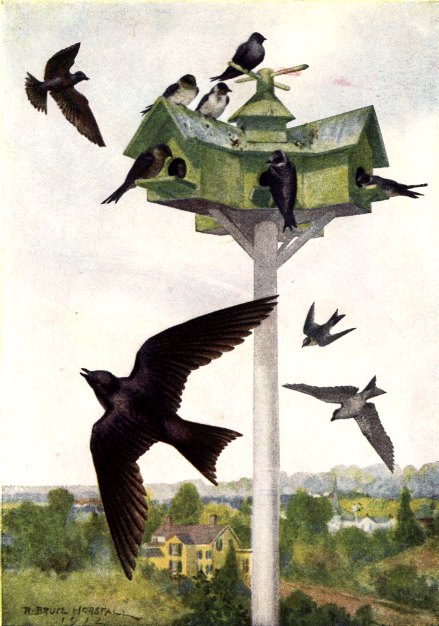
PURPLE MARTIN
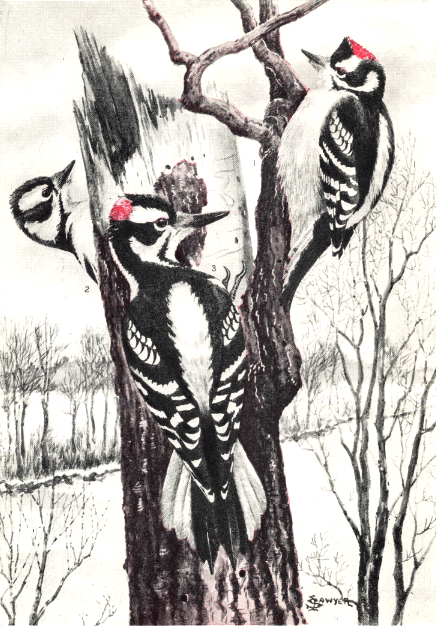
DOWNY (figs. 1 and 2) and HAIRY WOODPECKERS (fig. 3)
Purple Grackle (Quiscalus quiscula) Blackbird family
Called also: CROW BLACKBIRD; MAIZE THIEF; KEEL-TAILED GRACKLE (Illustration facing p. 49)
Length—12 to 13 inches. About one-fourth as large again as the robin.
Male—Iridescent black, in which metallic violet, blue, copper, and green tints predominate. The plumage of this grackle has iridescent bars. Iris of eye bright yellow and conspicuous. Tail longer than wings.
Female—Less brilliant black than male, and smaller.
Range—Gulf of Mexico to 57th parallel north latitude.
Migrations—Permanent resident in Southern States. Few are permanent throughout range. Migrates in immense flocks in March and September.
This "refined crow" (which is really no crow at all except in appearance) has scarcely more friends than a thief is entitled to; for, although in many sections of the country it has given up its old habit of stealing Indian corn and substituted ravages upon the grasshoppers instead, it still indulges a crow-like instinct for pillaging nests and eating young birds.
Travelling in immense flocks of its own kind, a gregarious bird of the first order, it nevertheless is not the social fellow that its cousin, the red-winged blackbird, is. It especially holds aloof from mankind, and mankind reciprocates its suspicion.
The tallest, densest evergreens are not too remote for it to build its home, according to Dr. Abbott, though in other States than New Jersey, where he observed them, an old orchard often contains dozens of nests. One peculiarity of the grackles is that their eggs vary so much in coloring and markings that different sets examined in the same groups of trees are often wholly unlike. The average groundwork, however, is soiled blue or greenish, waved, streaked, or clouded with brown. These are laid in a nest made of miscellaneous sticks and grasses, rather carefully constructed, and lined with mud. Another peculiarity is the bird's method of steering itself by its tail when it wishes to turn its direction or alight.
Peering at you from the top of a dark pine tree with its staring yellow eye, the grackle is certainly uncanny. There, very early in the spring, you may hear its cracked and wheezy whistle, for, being aware that however much it may look like a crow it belongs to another family, it makes a ridiculous attempt to sing. When a number of grackles lift up their voices at once, some one has aptly likened the result to a "good wheel-barrow chorus!" The grackle's mate alone appreciates his efforts as, standing on tiptoe, with half-spread wings and tail, he pours forth his craven soul to her through a disjointed larynx.
With all their faults, and they are numerous, let it be recorded of both crows and grackles that they are as devoted lovers as turtle-doves. Lowell characterizes them in these four lines:
"Fust come the black birds, clatt'rin' in tall trees, And settlin' things in windy Congresses; Queer politicians, though, for I'll be skinned If all on 'em don't head against the wind." • • • • •
The Bronzed Grackle (Quiscalus quiscula æneus) differs from the preceding chiefly in the more brownish bronze tint of its plumage and its lack of iridescent bars. Its range is more westerly, and in the southwest it is particularly common; but as a summer resident it finds its way to New England in large numbers. The call-note is louder and more metallic than the purple grackle's. In nearly all respects the habits of these two birds are identical.
Rusty Blackbird (Scolecophagus carolinus) Blackbird family
Called also: THRUSH BLACKBIRD; RUSTY GRACKLE; RUSTY ORIOLE; RUSTY CROW; BLACKBIRD
Length—9 to 9.55 inches. A trifle smaller than the robin.
Male—In full plumage, glossy black with metallic reflections, intermixed with rusty brown that becomes more pronounced as the season advances. Pale straw-colored eyes.
Female—Duller plumage and more rusty, inclining to gray. Light line over eye. Smaller than male.
Range—North America, from Newfoundland to Gulf of Mexico and westward to the Plains.
Migrations—April. November. A few winter north.
A more sociable bird than the grackle, though it travel in smaller flocks, the rusty blackbird condescends to mingle freely with other feathered friends in marshes and by brooksides. You can identify it by its rusty feathers and pale yellow eye, and easily distinguish the rusty-gray female from the female red-wing that is conspicuously streaked.
In April flocks of these birds may frequently be seen along sluggish, secluded streams in the woods, feeding upon the seeds of various water or brookside plants, and probably upon insects also. At such times they often indulge in a curious spluttering, squeaking, musical concert that one listens to with pleasure. The breeding range is mostly north of the United States. But little seems to be known of the birds' habits in their northern home.
Why it should ever have been called a thrush blackbird is one of those inscrutable mysteries peculiar to the naming of birds which are so frequently called precisely what they are not. In spite of the compliment implied in associating the name of one of our finest songsters with it, the rusty blackbird has a clucking call as unmusical as it is infrequent, and only very rarely in the spring does it pipe a note that even suggests the sweetness of the redwing's.
Red-winged Blackbird (Agelaius phœniceus) Blackbird family
Called also: SWAMP BLACKBIRD; RED-WINGED ORIOLE; RED-WINGED STARLING (Illustration facing p. 29)
Length—Exceptionally variable—7.50 to 9.80 inches. Usually about an inch smaller than the robin.
Male—Coal-black. Shoulders scarlet, edged with yellow.
Female—Feathers finely and inconspicuously speckled with brown, rusty black, whitish, and orange. Upper wing-coverts rusty black, tipped with white, or rufous and sometimes spotted with black and red.
Range—North America. Breeds from Texas to Columbia River, and throughout the United States. Commonly found from Mexico to 57th degree north latitude.
Migrations—March. October. Common summer resident.
In oozy pastures where a brook lazily finds its way through the farm is the ideal pleasure ground of this "bird of society." His notes, "h'-wa-ker-ee" or "con-quer-ee" (on an ascending scale), are liquid in quality, suggesting the sweet, moist, cool retreats where he nests. Liking either heat or cold (he is fond of wintering in Florida, but often retreats to the north while the marshes are still frozen); enjoying not only the company of large flocks of his own kind with whom he travels, but any bird associates with whom he can scrape acquaintance; or to sit quietly on a tree-top in the secluded, inaccessible bog while his mate is nesting; satisfied with cut-worms, grubs, and insects, or with fruit and grain for his food—the blackbird is an impressive and helpful example of how to get the best out of life.
Yet, of all the birds, some farmers complain that the blackbird is the greatest nuisance. They dislike the noisy chatterings when a flock is simply indulging its social instincts. They complain, too, that the blackbirds eat their corn, forgetting that having devoured innumerable grubs from it during the summer, the birds feel justly entitled to a share of the profits. Though occasionally guilty of eating the farmer's corn and oats and rice, yet it has been found that nearly seven-eighths of the redwing's food is made up of weed-seeds or of insects injurious to agriculture.
This bird builds its nest in low bushes on the margin of ponds or low in the bog grass of marshes. From three to five pale-blue eggs, curiously streaked, spotted, and scrawled with black or purple, constitute a brood. Nursery duties are soon finished, for in July the young birds are ready to gather in flocks with their elders.
"The blackbirds make the maples ring With social cheer and jubilee; The red-wing flutes his 'O-ka-lee!'" —Emerson.
YOUNG KINGFISHERS
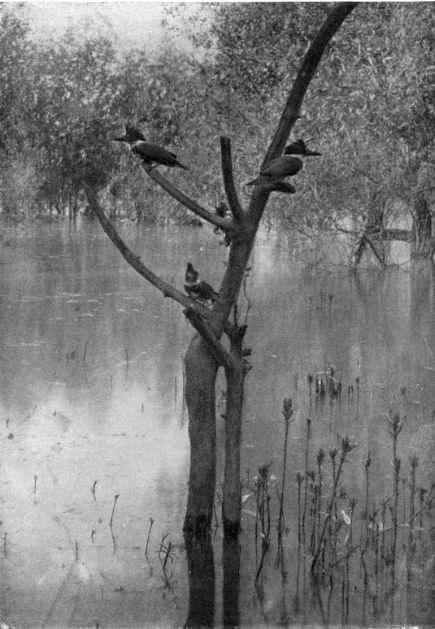
GRACKLE'S NEST AND YOUNG.
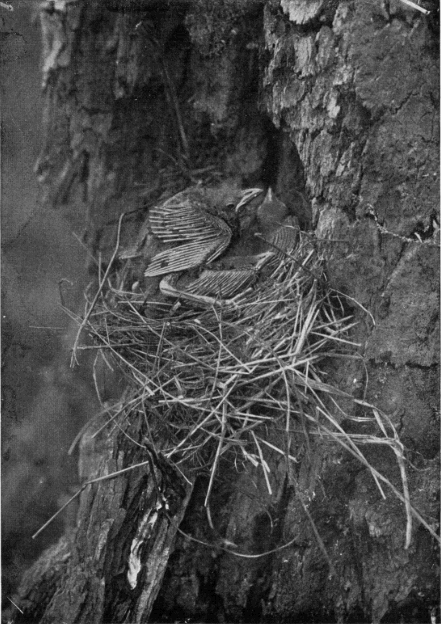
Purple Martin (Progne subis) Swallow family
(Illustration facing p. 44)
Length—7 to 8 inches. Two or three inches smaller than the robin.
Male—Rich glossy black with bluish and purple reflections; duller black on wings and tail. Wings rather longer than the tail, which is forked.
Female—More brownish and mottled; grayish below.
Range—Peculiar to America. Penetrates from Arctic Circle to South America.
Migrations—Late April. Early September. Summer resident.
In old-fashioned gardens, set on a pole over which honeysuckle and roses climbed from a bed where China pinks, phlox, sweet Williams, and hollyhocks crowded each other below, martin boxes used always to be seen with a pair of these large, beautiful swallows circling overhead. But now, alas! the boxes, where set up at all, are quickly monopolized by the English sparrow, a bird that the martin, courageous as a kingbird in attacking crows and hawks, tolerates as a neighbor only when it must.
Bradford Torrey tells of seeing quantities of long-necked squashes dangling from poles about the negro cabins all through the South. One day he asked an old colored man what these squashes were for.
"Why, deh is martins' boxes," said Uncle Remus. "No danger of hawks carryin' off de chickens so long as de martins am around."
The Indians, too, have always had a special liking for this bird. They often lined a hollowed-out gourd with bits of bark and fastened it in the crotch of their tent poles to invite its friendship. The Mohegan Indians have called it "the bird that never rests"—a name better suited to the tireless barn swallow, Dr. Abbott thinks.
Wasps, beetles, and all manner of injurious garden insects constitute its diet—another reason for its universal popularity. It is simple enough to distinguish the martins from the other swallows by their larger size and iridescent dark coat, not to mention their song, which is very soft and sweet, like musical laughter, rippling up through the throat.
Cowbird (Molothrus ater) Blackbird family
Called also: BROWN-HEADED ORIOLE; COW-PEN BIRD; COW BLACKBIRD; COW BUNTING
Length—7 to 8 inches. About one-fifth smaller than the robin.
Male—Iridescent black, with head, neck, and breast glistening brown. Bill dark brown, feet brownish.
Female—Dull grayish-brown above, a shade lighter below, and streaked with paler shades of brown.
Range—United States, from coast to coast. North into British America, south into Mexico.
Migrations—March. November. Common summer resident.
The cowbird takes its name from its habit of walking about among the cattle in the pasture, picking up the small insects which the cattle disturb in their grazing. The bird may often be seen within a foot or two of the nose of a cow or heifer, walking briskly about like a miniature hen, intently watching for its insect prey.
Its marital and domestic character is thoroughly bad. Polygamous and utterly irresponsible for its offspring, this bird forms a striking contrast to other feathered neighbors, and indeed is almost an anomaly in the animal kingdom. In the breeding season an unnatural mother may be seen skulking about in the trees and shrubbery, seeking for nests in which to place a surreptitious egg, never imposing it upon a bird of its size, but selecting in a cowardly way a small nest, as that of the vireos or warblers or chipping sparrows, and there leaving the hatching and care of its young to the tender mercies of some already burdened little mother. It has been seen to remove an egg from the nest of the red-eyed vireo in order to place one of its own in its place. Not finding a convenient nest, it will even drop its eggs on the ground, trusting them to merciless fate, or, still worse, devouring them. The eggs are nearly an inch long, white speckled with brown or gray. (Illustration facing p. 54.)
Cowbirds are gregarious. The ungrateful young birds, as soon as they are able to go roaming, leave their foster-parents and join the flock of their own kind. In keeping with its unclean habits and unholy life and character, the cowbird's ordinary note is a gurgling, rasping whistle, followed by a few sharp notes.
The Starling (Sturnus vulgaris)
Length—8 to 9 inches. Weight about equals that of robin, but the starling, with its short, drooping tail, is chunkier in appearance.
Male—Iridescent black with glints of purple, green, and blue. On back the black feathers, with iridescence of green, and bronze, are tipped with brown, as are some of the tail and wing feathers. In autumn and early winter feathers of sides of head, breast, flanks and underparts are tipped with white, giving a gray, mottled appearance. During the winter most of the white tips on breast and underparts wear off. Until the first moult in late summer the young birds are a dark olive-brown in color, with white or whitish throat. These differences in plumage at different seasons and different ages make starlings hard to identify. Red-winged blackbirds and grackles are often mistaken for them. From early spring till mid-June, starling's rather long, sharp bill is yellow. Later in summer it darkens. No other black bird of ours has this yellow bill at any season.
Female—Similar in appearance.
Range—Massachusetts to Maryland. Not common beyond 100 miles inland. (Native of northern Europe and Asia.)
Migrations—Permanent resident, but flocks show some tendency to drift southward in winter.
This newcomer to our shores is by no means so black as he has been painted. Like many other European immigrants he landed at or near Castle Garden, New York City, and his descendants have not cared to wander very far from this vicinity, preferring regions with a pretty numerous human population. The starlings have increased so fast in this limited region since their first permanent settlement in Central Park about 1890 that farmers and suburban dwellers have feared that they might become as undesirable citizens as some other Europeans—the brown rat, the house mouse, and the English sparrow. But a very thorough investigation conducted by the United States Bureau of Biological Survey (Bulletin No. 868, 1921) is most reassuring in its results.
Let us first state the case for the prosecution: (1) the starling must plead guilty to a fondness for cultivated cherries; (2) he is often a persecutor of native birds, like the bluebird and flicker; (3) his roosts, where he sometimes congregates in thousands in the autumn, are apt to become public nuisances, offensive alike to the eye, the nose and the ear.
But these offences are not so very serious after all. He does not eat so many cherries as our old friend the robin, though his depredations are more conspicuous, for whereas the robins in ones and twos will pilfer steadily from many trees for many days without attracting notice, a crowd of starlings is occasionally observed to descend en masse upon a single tree and strip it in a few hours. Naturally such high-handed procedure is observed by many and deeply resented by the owner of the tree, who suffers the steady but less spectacular raids of the robins without serious disquiet.
Less can be said in defense of the starling's scandalous treatment of some native birds. "Unrelenting perseverance dominates the starling's activities when engaged in a controversy over a nesting site. More of its battles are won by dogged persistence in annoying its victim than by bold aggression, and its irritating tactics are sometimes carried to such a point that it seems almost as if the bird were actuated more by a morbid pleasure of annoying its neighbors than by any necessity arising from a scarcity of nesting sites….
"In contests with the flicker the starling frequently makes up in numbers what disadvantage it may have in size. Typical of such combats was the one observed on May 9, at Hartford, Conn., where a group of starlings and a flicker were in controversy over a newly excavated nest. The number of starlings varied, but as many as 6 were noted at one time. Attention was first attracted to the dispute by a number of starlings in close proximity to the hole and by the sounds of a tussle within. Presently a flicker came out dragging a starling after him. The starling continued the battle outside long enough to allow one of its comrades to slip into the nest. Of course the flicker had to repeat the entire performance. He did this for about half an hour, when he gave up, leaving the starlings in possession of the nest….
"Economically considered, the starling is the superior of either the flicker, the robin, or the English sparrow, three of the species with which it comes in contact in its breeding operations. The eggs and young of bluebirds and wrens may be protected by the use of nest boxes with circular openings 1½ inches or less in diameter. This leaves the purple martin the only species readily subject to attack by the starling, whose economic worth may be considered greater than that of the latter, but in no case was the disturbance of a well-established colony of martins noted."
As for the nuisance of a big established roost of starlings, it may be abated by nightly salvos of Roman candles or blank cartridges, continued for a week or at most ten days.
So much for the starling in his aspect as an undesirable citizen. Government investigators, by a long-continued study, have discovered that his good deeds far outnumber his misdemeanors. Primarily he feeds on noxious insects and useless wild fruits. Small truck gardens and individual cherry trees may be occasionally raided by large flocks with disastrous results in a small way. But on the whole he is a useful frequenter of our door-yards who pays his way by destroying hosts of cut-worms and equally noxious insects. "A thorough consideration of the evidence at hand indicates that, based on food habits, the adult starling is the economic superior of the robin, catbird, flicker, red-winged blackbird, or grackle." Need more be said for him?
BIRDS CONSPICUOUSLY BLACK AND WHITE
Red-headed Woodpecker
Hairy Woodpecker
Downy Woodpecker
Yellow-bellied Woodpecker
Chewink
Snowflake
Rose-breasted Grosbeak
Bobolink
Blackpoll Warbler
Black-and-white Creeping Warbler
See also the Swallows; the Shrikes; Nuthatches and Titmice; the Kingbird and other Flycatchers; the Nighthawk; the Redstart; and the following Warblers: the Myrtle; the Bay-breasted; the Blackburnian; and the Black-throated Blue Warbler.
Red-headed Woodpecker (Melanerpes erythrocephalus) Woodpecker family
Called also: TRI-COLOR, RED-HEAD
Length—8.50 to 9.75 inches. An inch or less smaller than the robin.
Male and Female—Head, neck, and throat crimson; breast and underneath white; back black and white; wings and tail blue black, with broad white band on wings conspicuous in flight.
Range—United States, east of Rocky Mountains and north to Manitoba.
Migrations—Abundant but irregular migrant. Most commonly seen in Autumn, and rarely resident.
In thinly populated sections, where there are few guns about, this is still one of the commonest as it is perhaps the most conspicuous member of the woodpecker family, but its striking glossy black-and-white body and its still more striking crimson head, flattened out against the side of a tree like a target, where it is feeding, have made it all too tempting a mark for the rifles of the sportsmen and the sling-shots of small boys. As if sufficient attention were not attracted to it by its plumage, it must needs keep up a noisy, guttural rattle, ker-r-ruck, ker-r-ruck, very like a tree-toad's call, and flit about among the trees with the restlessness of a flycatcher. Yet, in spite of these invitations for a shot to the passing gunner, it still multiplies in districts where nuts abound, being "more common than the robin" about Washington, says John Burroughs.
All the familiar woodpeckers have two characteristics most prominently exemplified in this red-headed member of their tribe. The hairy, the downy, the crested, the red-bellied, the sapsucker, and the flicker have each a red mark somewhere about their heads as if they had been wounded there and bled a little—some more, some less; and the figures of all of them, from much flattening against tree-trunks, have become high-shouldered and long-waisted.
The red-headed woodpecker selects, by preference, a partly decayed tree in which to excavate a hole for its nest, because the digging is easier, and the sawdust and chips make a softer lining than green wood. Both male and female take turns in this hollowing-out process. The one that is off duty is allowed "twenty minutes for refreshments," consisting of grubs, beetles, ripe apples or cherries, corn, or preferably beech-nuts. At a loving call from its mate in the hollow tree, it returns promptly to perform its share of the work, when the carefully observed "time is up." The heap of sawdust at the bottom of the hollow will eventually cradle from four to six glossy-white eggs.
This woodpecker has the thrifty habit of storing away nuts in the knot-holes of trees, between cracks in the bark, or in decayed fence rails—too often a convenient storehouse at which the squirrels may help themselves. But it is the black snake that enters the nest and eats the young family, and that is a more deadly foe than even the sportsman or the milliner.
YELLOWBIRD'S NEST, SHOWING COWBIRD'S EGG
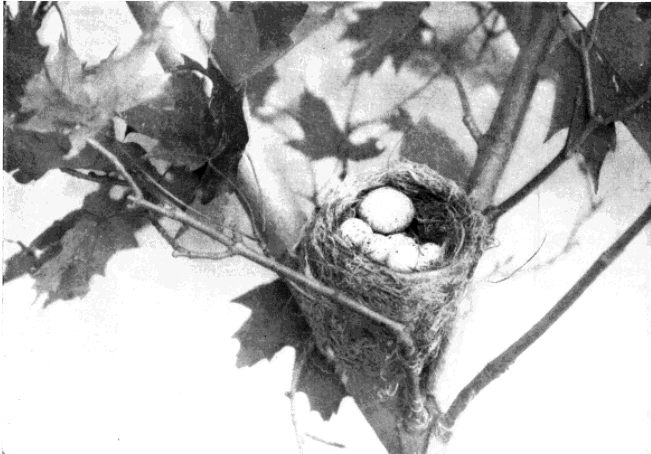
BROTHER AND SISTER ROSE-BREASTED GROSBEAKS, TWO WEEKS OLD
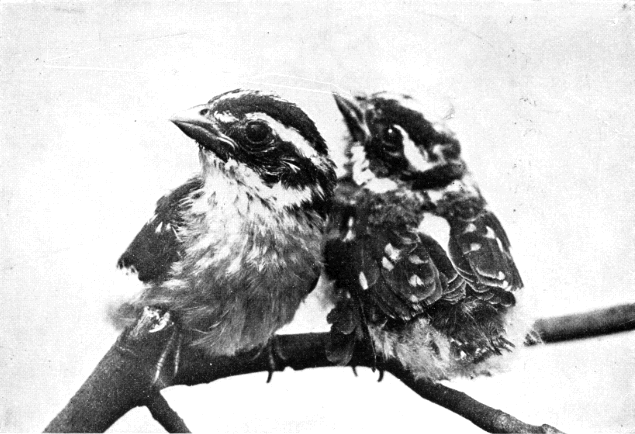
ROSE-BREASTED GROSBEAKS, SIX DAYS OLD.
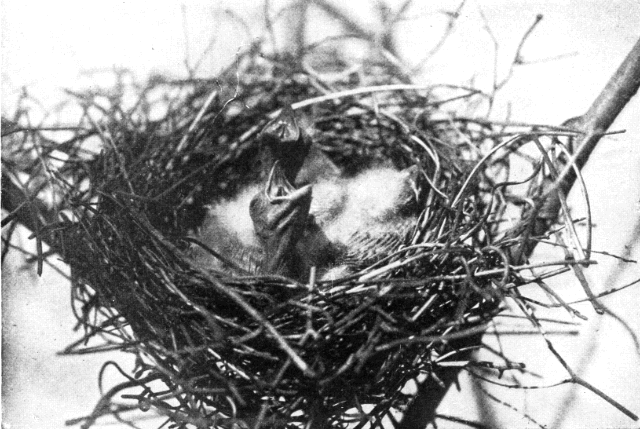
The Hairy Woodpecker (Dryobates villosus) Woodpecker family
(Illustration facing p. 45)
Length—9 to 10 inches. About the size of the robin.
Male—Black and white above, white beneath. White stripe down the back, composed of long hair-like feathers. Bright-red band on the nape of neck. Wings striped and dashed with black and white. Outer tail feathers white, without bars. White stripe about eyes and on sides of the head.
Female—Without the red band on head, and body more brownish than that of the male.
Range—Eastern parts of United States, from the Canadian border to the Carolinas.
Migrations—Resident throughout its range.
The bill of the woodpecker is a hammering tool, well fitted for its work. Its mission in life is to rid the trees of insects, which hide beneath the bark, and with this end in view, the bird is seen clinging to the trunks and branches of trees through fair and wintry weather, industriously scanning every inch for the well-known signs of the boring worm or destructive fly.
In the autumn the male begins to excavate his winter quarters, carrying or throwing out the chips, by which this good workman is known, with his beak, while the female may make herself cosey or not, as she chooses, in an abandoned hole. About her comfort he seems shamefully unconcerned. Intent only on his own, he drills a perfectly round hole, usually on the under side of a limb where neither snow nor wind can harm him, and digs out a horizontal tunnel in the dry, brittle wood in the very heart of the tree, before turning downward into the deep, pear-shaped chamber, where he lives in selfish solitude. But when the nesting season comes, how devoted he is temporarily to the mate he has neglected and even abused through the winter! Will she never learn that after her clear-white eggs are laid and her brood raised he will relapse into the savage and forget all his tender wiles?
The hairy woodpecker, like many another bird and beast, furnishes much doubtful weather lore for credulous and inexact observers. "When the woodpecker pecks low on the trees, expect warm weather" is a common saying, but when different individuals are seen pecking at the same time, one but a few feet from the ground, and another among the high branches, one may make the prophecy that pleases him best.
The hairy woodpeckers love the deep woods. They are drummers, not singers; but when walking in the desolate winter woods even the drumming and tapping of the busy feathered workmen on a resonant limb is a solace, giving a sense of life and cheerful activity which is invigorating.
The Downy Woodpecker (Dryobates pubescens) Woodpecker family
(Illustration facing p. 45)
Length—6 to 7 inches. About the size of the English sparrow.
Male—Black above, striped with white. Tail shaped like a wedge. Outer tail feathers white, and barred with black. Middle tail feathers black. A black stripe on top of head, and distinct white band over and under the eyes. Red patch on upper side of neck. Wings, with six white bands crossing them transversely; white underneath.
Female—Similar, but without scarlet on the nape, which is white.
Range—Eastern North America, from Labrador to Florida.
Migrations—Resident all the year throughout its range.
The downy woodpecker is similar to his big relative, the hairy woodpecker, in color and shape, though much smaller. His outer tail feathers are white, barred with black, but the hairy's white outer tail feathers lack these distinguishing marks.
He is often called a sapsucker—though quite another bird alone merits that name—from the supposition that he bores into the trees for the purpose of sucking the sap; but his tongue is ill adapted for such use, being barbed at the end, and most ornithologists consider the charge libellous. It has been surmised that he bores the numerous little round holes close together, so often seen, with the idea of attracting insects to the luscious sap. The woodpeckers never drill for insects in live wood. The downy actually drills these little holes in apple and other trees to feed upon the inner milky bark of the tree—the cambium layer. The only harm to be laid to his account is that, in his zeal, he sometimes makes a ring of small holes so continuous as to inadvertently damage the tree by girdling it. The bird, like most others, does not debar himself entirely from fruit diet, but enjoys berries, especially poke-berries.
He is very social with birds and men alike. In winter he attaches himself to strolling bands of nuthatches and chickadees, and in summer is fond of making friendly visits among village folk, frequenting the shade trees of the streets and grapevines of back gardens. He has even been known to fearlessly peck at flies on window panes.
In contrast to his large brother woodpecker, who is seldom drawn from timber lands, the little downy member of the family brings the comfort of his cheery presence to country homes, beating his rolling tattoo in spring on some resonant limb under our windows in the garden with a strength worthy of a larger drummer.
This rolling tattoo, or drumming, answers several purposes: by it he determines whether the tree is green or hollow; it startles insects from their lurking places underneath the bark, and it also serves as a love song.
Yellow-bellied Woodpecker (Sphyrapicus varius) Woodpecker family
Called also: THE SAPSUCKER
Length—8 to 8.6 inches. About one-fifth smaller than the robin.
Male—Black, white, and yellowish white above, with bright-red crown, chin, and throat. Breast black, in form of crescent. A yellowish-white line, beginning at bill and passing below eye, merges into the pale yellow of the bird underneath. Wings spotted with white, and coverts chiefly white. Tail black; white on middle of feathers.
Female—Paler, and with head and throat white.
Range—Eastern North America, from Labrador to Central America.
Migrations—April. October. Resident north of Massachusetts. Most common in autumn.
It is sad to record that this exquisitely marked woodpecker, the most jovial and boisterous of its family, is one of the very few bird visitors whose intimacy should be discouraged. For its useful appetite for slugs and insects which it can take on the wing with wonderful dexterity, it need not be wholly condemned. But as we look upon a favorite maple or fruit tree devitalized or perhaps wholly dead from its ravages, we cannot forget that this bird, while a most abstemious fruit-eater, has a pernicious and most intemperate thirst for sap. Indeed, it spends much of its time in the orchard, drilling holes into the freshest, most vigorous trees; then, when their sap begins to flow, it siphons it into an insatiable throat, stopping in its orgie only long enough to snap at the insects that have been attracted to the wounded tree by the streams of its heart-blood now trickling down its sides. Another favorite pastime is to strip the bark off a tree, then peck at the soft wood underneath—almost as fatal a habit. It drills holes in maples in early spring for sap only. If it drills holes in fruit trees it is for the cambium layer, a soft, pulpy, nutritious under-bark.
These woodpeckers have a variety of call-notes, but their rapid drumming against the limbs and trunks of trees is the sound we always associate with them and the sound that Mr. Bicknell says is the love-note of the family.
Unhappily, these birds, that many would be glad to have decrease in numbers, take extra precautions for the safety of their young by making very deep excavations for their nests, often as deep as eighteen or twenty inches.
The Chewink (Pipilo erythrophthalmus) Finch family
Called also: GROUND ROBIN; TOWHEE; TOWHEE BUNTING; TOWHEE GROUND FINCH; GRASEL
Length—8 to 8.5 inches. About one-fifth smaller than the robin.
Male—Upper parts black, sometimes margined with rufous. Breast white; chestnut color on sides and rump. Wings marked with white. Three outer feathers of tail striped with white, conspicuous in flight. Bill black and stout. Red eyes; feet brown.
Female—Brownish where the male is black. Abdomen shading from chestnut to white in the centre.
Range—From Labrador, on the north, to the Southern States; west to the Rocky Mountains.
Migrations—April. September and October. Summer resident. Very rarely a winter resident at the north.
The unobtrusive little chewink is not infrequently mistaken for a robin, because of the reddish chestnut on its under parts. Careful observation, however, shows important distinctions. It is rather smaller and darker in color; its carriage and form are not those of the robin, but of the finch. The female is smaller still, and has an olive tint in her brown back. Her eggs are inconspicuous in color, dirty white speckled with brown, and laid in a sunken nest on the ground. Dead leaves and twigs abound, and form, as the anxious mother fondly hopes, a safe hiding place for her brood. So careful concealment, however, brings peril to the fledglings, for the most cautious bird-lover may, and often does, inadvertently set his foot on the hidden nest.