Front matter (continued 5)
Reading edition · Edition 2
If, however, your visit to the undergrowth is unfortunately timed and there happens to be a bulky nest in process of construction on the ground, a quickly repeated, vigorous chit, pit, quit, impatiently inquires the reason for your bold intrusion. Withdraw discreetly and listen to the love-song that is presently poured out to reassure his plain little maskless mate. The music is delivered with all the force and energy of his vigorous nature and penetrates to a surprising distance. "Follow me, follow me, follow me," many people hear him say; others write the syllables, "Wichity, wichity, wichity, wichity"; and still others write them, "I beseech you, I beseech you, I beseech you," though the tones of this self-assertive bird rather command than entreat. Mr. Frank Chapman says of the yellowthroats: "They sing throughout the summer, and in August add a flight-song to their repertoire. This is usually uttered toward evening, when the bird springs several feet into the air, hovers for a second, and then drops back to the bushes."
Blackburnian Warbler (Dendroica blackburniæ) Wood Warbler family
Called also: HEMLOCK WARBLER; ORANGE-THROATED WARBLER; TORCH-BIRD
Length—4.5 to 5.5 inches. An inch and a half smaller than the English sparrow.
Male—Head black, striped with orange-flame; throat and breast orange, shading through yellow to white underneath; wings, tail, and part of back black, with white markings.
Female—Olive-brown above, shading into yellow on breast, and paler under parts.
Range—Eastern North America to plains. Winters in tropics.
Migrations—May. September. Spring and autumn migrant.
"The orange-throated warbler would seem to be his right name, his characteristic cognomen," says John Burroughs, in ever-delightful "Wake Robin"; "but no, he is doomed to wear the name of some discoverer, perhaps the first who robbed his nest or rifled him of his mate—Blackburn; hence, Blackburnian warbler. The burn seems appropriate enough, for in these dark evergreens his throat and breast show like flame. He has a very fine warble, suggesting that of the redstart, but not especially musical."
No foliage is dense enough to hide, and no autumnal tint too brilliant to outshine this luminous little bird that in May, as it migrates northward to its nesting ground, darts in and out of the leafy shadows like a tongue of fire.
It is by far the most glorious of all the warblers—a sort of diminutive oriole. The quiet-colored little mate flits about after him, apparently lost in admiration of his fine feathers and the ease with which his thin tenor voice can end his lover's warble in a high Z.
Take a good look at this attractive couple, for in May they leave us to build a nest of bark and moss in the evergreens of Canada—that paradise for warblers—or of the Catskills and Adirondacks, and in autumn they hurry south to escape the first frosts.
Redstart (Setophaga ruticilla) Wood Warbler family
Called also: YELLOW-TAILED WARBLER (Illustration facing p. 190)
Length—5 to 5.5 inches.
Male—In spring plumage: Head, neck, back, and middle breast glossy black, with blue reflections. Breast and underneath white, slightly flushed with salmon, increasing to bright salmon-orange on the sides of the body and on the wing linings. Occasional specimens show orange-red. Tail feathers partly black, partly orange, with broad black band across the end. Orange markings on wings. Bill and feet black. In autumn: Fading into rusty black, olive, and yellow.
Female—Olive-brown, and yellow where the male is orange. Young browner than the females.
Range—North America to upper Canada. West occasionally, as far as the Pacific coast, but commonly found in summer in the Atlantic and Middle States.
Migrations—Early May. End of September. Summer resident.
Late some evening, early in May, when one by one the birds have withdrawn their voices from the vesper chorus, listen for the lingering "'tsee, 'tsee, 'tseet" (usually twelve times repeated in a minute), that the redstart sweetly but rather monotonously sings from the evergreens, where, as his tiny body burns in the twilight, Mrs. Wright likens him to a "wind-blown firebrand, half glowing, half charred."
But by daylight this brilliant little warbler is constantly on the alert. It is true he has the habit, like the flycatchers (among which some learned ornithologists still class him), of sitting pensively on a branch, with fluffy feathers and drooping wings; but the very next instant he shows true warbler blood by making a sudden dash upward, then downward through the air, tumbling somersaults, as if blown by the wind, flitting from branch to branch, busily snapping at the tiny insects hidden beneath the leaves, clinging to the tree-trunk like a creeper, and singing between bites.
Possibly he will stop long enough in his mad chase to open and shut his tail, fan-fashion, with a dainty egotism that, in the peacock, becomes rank vanity.
The Germans call this little bird roth Stert (red tail), but, like so many popular names, this is a misnomer, as, strictly speaking, the redstart is never red, though its salmon-orange markings often border on to orange-flame.
In a fork of some tall bush or tree, placed ten or fifteen feet from the ground, a carefully constructed little nest is made of moss, horsehair, and strippings from the bark, against which the nest is built, the better to conceal its location. Four or five whitish eggs, thickly sprinkled with pale brown and lilac, like the other warblers', are too jealously guarded by the little mother-bird to be very often seen.
Baltimore Oriole (Icterus galbula) Oriole and Blackbird family
Called also: GOLDEN ORIOLE; FIREBIRD; GOLDEN ROBIN; HANG-NEST; ENGLISH ROBIN (Illustration facing p. 191)
Length—7 to 8 inches. About one-fifth smaller than the robin.
Male—Head, throat, upper part of back glossy black. Wings black, with white spots and edgings. Tail-quills black, with yellow markings on the tips. Everywhere else orange, shading into flame.
Female—Yellowish olive. Wings dark brown, and quills margined with white. Tail yellowish brown, with obscure, dusky bars.
Range—The whole United States. Most numerous in Eastern States below 55° north latitude.
Migrations—Early May. Middle of September. Common summer resident.
A flash of fire through the air; a rich, high, whistled song floating in the wake of the feathered meteor: the Baltimore oriole cannot be mistaken. When the orchards are in blossom he arrives in full plumage and song, and awaits the coming of the female birds, that travel northward more leisurely in flocks. He is decidedly in evidence. No foliage is dense enough to hide his brilliancy; his temper, quite as fiery as his feathers, leads him into noisy quarrels, and his insistent song with its martial, interrogative notes becomes almost tiresome until he is happily mated and family cares check his enthusiasm.
Among the best architects in the world is his plain but energetic mate. Gracefully swung from a high branch of some tall tree, the nest is woven with exquisite skill into a long, flexible pouch that rain cannot penetrate, nor wind shake from its horsehair moorings. Bits of string, threads of silk, and sometimes yarn of the gayest colors, if laid about the shrubbery in the garden, will be quickly interwoven with the shreds of bark and milkweed stalks that the bird has found afield. The shape of the nest often differs, because in unsettled regions, where hawks abound, it is necessary to make it deeper than seven inches (the customary depth when it is built near the homes of men), and to partly close it at the top to conceal the sitting bird. From four to six whitish eggs, scrawled over with black-brown, are hatched by the mother oriole, and most jealously guarded by her now truly domesticated mate.
The number of grubs, worms, flies, caterpillars, and even cocoons, that go to satisfy the hunger of a family of orioles in a day, might indicate, if it could be computed, the great value these birds are about our homes, aside from the good cheer they bring.
There is a popular tradition about the naming of this gorgeous bird: When George Calvert, the first Lord Baltimore, worn out and discouraged by various hardships in his Newfoundland colony, decided to visit Virginia in 1628, he wrote that nothing in the Chesapeake country so impressed him as the myriads of birds in its woods. But the song and color of the oriole particularly cheered and delighted him, and orange and black became the heraldic colors of the first lords proprietors of Maryland.
Hush!'tis he! My Oriole, my glance of summer fire, Is come at last; and ever on the watch, Twitches the pack-thread I had lightly wound About the bough to help his housekeeping. Twitches and scouts by turns, blessing his luck, Yet fearing me who laid it in his way. Nor, more than wiser we in our affairs, Divines the Providence that hides and helps. Heave, ho! Heave, ho! he whistles as the twine Slackens its hold; once more, now! and a flash Lightens across the sunlight to the elm Where his mate dangles at her cup of felt. —James Russell Lowell.
BIRDS CONSPICUOUSLY RED OF ANY SHADE
Cardinal Grosbeak
Summer Tanager
Scarlet Tanager
Pine Grosbeak
American Crossbill and the White-winged Crossbill
Redpoll and Greater Redpoll
Purple Finch
Robin
Orchard Oriole
See the Red-winged Blackbird (Black). See also the males of the Rose-breasted Grosbeak, the Woodpeckers, the Chewink (Black and White), the Red-breasted Nuthatch, the Bay-breasted and the Chestnut-sided Warblers (Slate and Gray); the Bluebird and Barn Swallow (Blue); the Flicker (Brown); the Humming-bird and the Kinglets (Greenish Gray); and the Blackburnian and Redstart Warblers, and the Baltimore Oriole (Orange).
Cardinal Grosbeak (Cardinalis cardinalis) Finch family
Called also: CRESTED REDBIRD; VIRGINIA REDBIRD; VIRGINIA NIGHTINGALE; CARDINAL BIRD (Illustration facing p. 198)
Length—8 to 9 inches. A little smaller than the robin.
Male—Brilliant cardinal; chin and band around bill black. Beak stout and red. Crest conspicuous. In winter dress, wings washed with gray.
Female—Brownish yellow above, shading to gray below. Tail shorter than the male's. Crest, wings, and tail reddish. Breast sometimes tinged with red.
Range—Eastern United States. A Southern bird, becoming more and more common during the summer in States north of Virginia, especially in Ohio, south of which it is resident throughout the year.
Migrations—Resident rather than migrating birds, remaining throughout the winter in localities where they have found their way. Travel in flocks.
Among the numerous names by which this beautiful bird is known, it has become immortalized under the title of Mr. James Lane Allen's exquisite book, "The Kentucky Cardinal." Here, while we are given a most charmingly sympathetic, delicate account of the bird "who has only to be seen or heard, and Death adjusts an arrow," it is the cardinal's pathetic fate that impresses one most. Seen through less poetical eyes, however, the bird appears to be a haughty autocrat, a sort of "F. F. V." among the feathered tribes, as, indeed, his title, "Virginia redbird," has been unkindly said to imply. Bearing himself with a refined and courtly dignity, not stooping to soil his feet by walking on the ground like the more democratic robin, or even condescending below the level of the laurel bushes, the cardinal is literally a shining example of self-conscious superiority—a bird to call forth respect and admiration rather than affection. But a group of cardinals in a cedar tree in a snowy winter landscape makes us forgetful of everything but their supreme beauty.
As might be expected in one of the finch family, the cardinal is a songster—the fact which, in connection with his lovely plumage, accounts for the number of these birds shipped in cages to Europe, where they are known as Virginia nightingales. Commencing with a strong, rich whistle, like the high notes of a fife, "Cheo-cheo-cheo-cheo," repeated over and over as if to make perfect the start of a song he is about to sing, suddenly he stops, and you learn that there is to be no glorious performance after all, only a prelude to—nothing. The song, such as it is, begins, with both male and female, in March, and lasts, with a brief intermission, until September—"the most melodious sigh," as Mr. Allen calls it. Early in May the cardinals build a bulky and loosely made nest, usually in the holly, laurel, or other evergreen shrubs that they always love to frequent, especially if these are near fields of corn or other grain. And often two broods in a year come forth from the pale-gray, brown-marked eggs, bearing what is literally for them the "fatal gift of beauty."
Summer Tanager (Piranga rubra) Tanager family
Called also: REDBIRD; SMOOTH-HEADED REDBIRD
Length—7.5 inches. About one-fourth smaller than the robin.
Male—Uniform red. Wings and tail like the body.
Female—Upper parts yellowish olive-green; underneath inclining to orange-yellow.
Range—Tropical portions of two Americas and eastern United States. Most common in Southern States. Rare north of Pennsylvania. Winters in the tropics.
Migrations—In Southern States: April. October. Irregular migrant north of the Carolinas.
Thirty years ago, it is recorded that so far north as New Jersey the summer redbird was quite as common as any of the thrushes. In the South still there is scarcely an orchard that does not contain this tropical-looking beauty—the redbird par excellence, the sweetest singer of the family. Is there a more beautiful sight in all nature than a grove of orange trees laden with fruit, starred with their delicious blossoms, and with flocks of redbirds disporting themselves among the dark, glossy leaves? Pine and oak woods are also favorite resorts, especially at the north, where the bird nowadays forsakes the orchards to hide his beauty, if he can, unharmed by the rifle that only rarely is offered so shining a mark. He shows the scarlet tanager's preference for tree-tops, where his musical voice, calling "Chicky-tucky-tuk," alone betrays his presence in the woods. The Southern farmers declare that he is an infallible weather prophet, his "WET, WET, WET," being the certain indication of rain—another absurd saw, for the call-note is by no means confined to the rainy season.
The yellowish-olive mate, whose quiet colors betray no nest secrets, collects twigs and grasses for the cradle to be saddled on the end of some horizontal branch, though in this work the male sometimes cautiously takes an insignificant part. After her three or four eggs are laid she sits upon them for nearly two weeks, being only rarely and stealthily visited by her mate with some choice grub, blossom, or berry in his beak. But how cheerfully his fife-like whistle rings out during the temporary exile! Then his song is at its best. Later in the summer he has an aggravating way of joining in the chorus of other birds' songs, by which the pleasant individuality of his own voice is lost.
A nest of these tanagers, observed not far from New York City, was commenced the last week of May on the extreme edge of a hickory limb in an open wood; four eggs were laid on the fourth of June, and twelve days later the tiny fledglings, that all look like their mother in the early stages of their existence, burst from the greenish-white, speckled shells. In less than a month the young birds were able to fly quite well and collect their food.
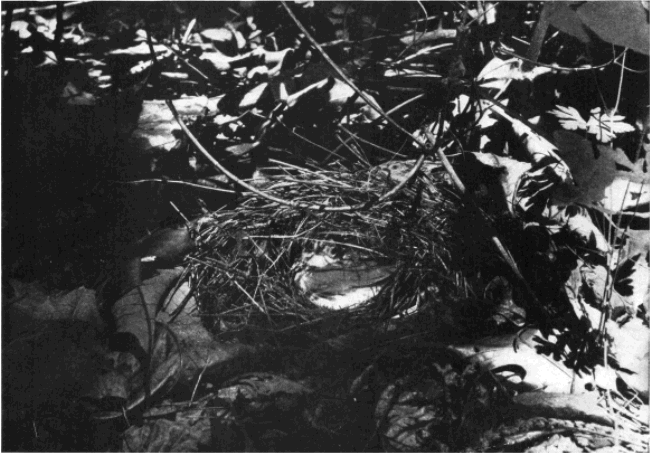
MOTHER OVENBIRD IN NEST; A BABY BIRD ON IT.
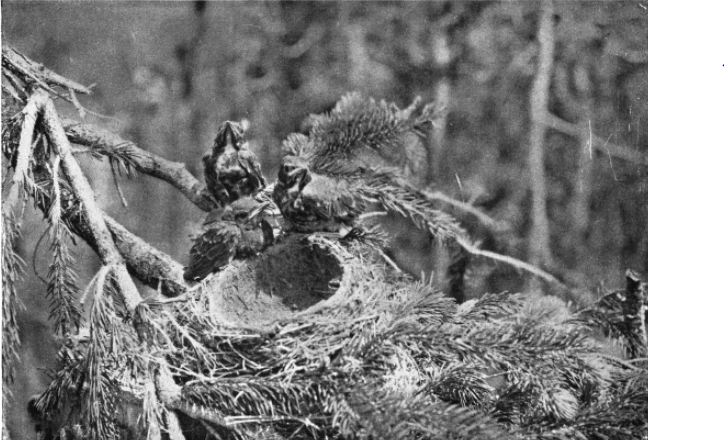
THE ROBIN'S MUD-WALLED NURSERY
Scarlet Tanager (Piranga erythromelas) Tanager family
Called also: BLACK-WINGED REDBIRD; FIREBIRD; CANADA TANAGER; POCKET-BIRD (Illustration facing p. 199)
Length—7 to 7.5 inches. About one-fourth smaller than the robin.
Male—In spring plumage: Brilliant scarlet, with black wings and tail. Under wing coverts grayish white. In autumn: Similar to female.
Female—Olive-green above; wings and tail dark, lightly margined with olive. Underneath greenish yellow.
Range—North America to northern Canada boundaries, and southward in winter to South America.
Migrations—May. October. Summer resident.
The gorgeous coloring of the scarlet tanager has been its snare and destruction. The densest evergreens could not altogether hide this blazing target for the sportsman's gun, too often fired at the instigation of city milliners. "Fine feathers make fine birds"—and cruel, silly women, the adage might be adapted for latter-day use. This rarely beautiful tanager, thanks to them, is now only an infrequent flash of beauty in our country roads.
Instinct leads it to be chary of its charms; and whereas it used to be one of the commonest of bird neighbors, it is now shy and solitary. An ideal resort for it is a grove of oak or swamp maple near a stream or pond where it can bathe. Evergreen trees, too, are favorites, possibly because the bird knows how exquisitely its bright scarlet coat is set off by their dark background.
High in the tree-tops he perches, all unsuspected by the visitor passing through the woods below, until a burst of rich, sweet melody directs the opera-glasses suddenly upward. There we detect him carolling loud and cheerfully, like a robin. He is an apparition of beauty—a veritable bird of paradise, as, indeed, he is sometimes called. Because of their similar coloring, the tanager and cardinal are sometimes confounded, but an instant's comparison of the two birds shows nothing in common except red feathers, and even those of quite different shades. The inconspicuous olive-green and yellow of the female tanager's plumage is another striking instance of Nature's unequal distribution of gifts; but if our bright-colored birds have become shockingly few under existing conditions, would any at all remain were the females prominent, like the males, as they brood upon the nest? Both tanagers construct a rather disorderly-looking nest of fibres and sticks, through which daylight can be seen where it rests securely upon the horizontal branch of some oak or pine tree; but as soon as three or four bluish-green eggs have been laid in the cradle, off goes the father, wearing his tell-tale coat, to a distant tree. There he sings his sweetest carol to the patient, brooding mate, returning to her side only long enough to feed her with the insects and berries that form their food.
Happily for the young birds' fate, they are clothed at first in motley, dull colors, with here and there only a bright touch of scarlet, yellow, and olive to prove their claim to the parent whose gorgeous plumage must be their admiration. But after the moulting season it would be a wise tanager that knew its own father. His scarlet feathers are now replaced by an autumn coat of olive and yellow not unlike his mate's.
Pine Grosbeak (Pinicola enucleator) Finch family
Called also: PINE BULLFINCH
Length—Variously recorded from 6.5 to 11 inches. Specimen measured 8.5 inches. About one-fifth smaller than the robin.
Male—General color strawberry-red, with some slate-gray fleckings about head, under wings, and on legs. Tail brown; wings brown, marked with black and white and slate. A band-shaped series of markings between the shoulders. Underneath paler red, merging into grayish green. Heavy, conspicuous bill.
Female—Ash-brown. Head and hind neck yellowish brown, each feather having central dusky streak. Cheeks and throat yellowish. Beneath ash-gray, tinged with brownish yellow under tail.
Range—British American provinces and northern United States.
Migrations—Irregular winter visitors; length of visits as uncertain as their coming.
As inseparable as bees from flowers, so are these beautiful winter visitors from the evergreen woods, where their red feathers, shining against the dark-green background of the trees, give them charming prominence; but they also feed freely upon the buds of various deciduous trees.
South of Canada we may not look for them except in the severest winter weather. Even then their coming is not to be positively depended upon; but when their caprice—or was it an unusually fierce northern blast?—sends them over the Canada border, it is a simple matter to identify them when such brilliant birds are rare. The brownish-yellow and grayish females and young males, however, always seem to be in the majority with us, though our Canadian friends assure us of the irreproachable morals of this gay bird.
Wherever there are clusters of pine or cedar trees, when there is a flock of pine grosbeaks in the neighborhood, you may expect to find a pair of birds diligently feeding upon the seeds and berries. No cheerful note escapes them as they persistently gormandize, and, if the truth must be confessed, they appear to be rather stupid and uninteresting, albeit they visit us at a time when we are most inclined to rapture over our bird visitors. They are said to have a deliciously sweet song in the nesting season. When, however, few except the Canadian voyageurs hear it.
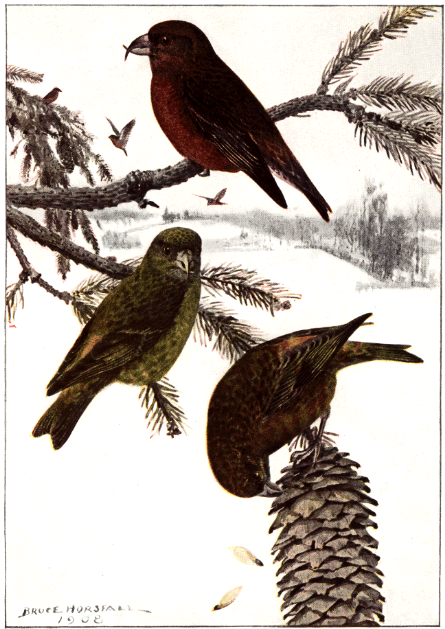
American Crossbill (Loxia curvirostra minor) Finch family
Called also: RED CROSSBILL (Illustration facing p. 226)
Length—6 to 7 inches. About the size of the English sparrow.
Male—General color Indian red, passing into brownish gray, with red tinge beneath. Wings (without bands), also tail, brown. Beak crossed at the tip.
Female—General color greenish yellow, with brownish tints. Dull-yellowish tints on head, throat, breast, and underneath. Wings and tail pale brown. Beak crossed at tip.
Range—Pennsylvania to northern British America. West of Mississippi, range more southerly.
Migrations—Irregular winter visitor. November. Sometimes resident until April.
It is a rash statement to say that a bird is rare simply because you have never seen it in your neighborhood, for while you are going out of the front door your rara avis may be eating the crumbs about your kitchen. Even with our eyes and ears constantly alert for some fresh bird excitement, our phlegmatic neighbor over the way may be enjoying a visit from a whole flock of the very bird we have been looking and listening for in vain all the year. The red crossbills are capricious little visitors, it is true, but by no means uncommon.
About the size of an English sparrow, of a brick or Indian red color, for the most part, the peculiarity of its parrot-like beak is its certain mark of identification.
Longfellow has rendered into verse the German legend of the crossbill, which tells that as the Saviour hung upon the cross, a little bird tried to pull out the nails that pierced His hands and feet, thus twisting its beak and staining its feathers with the blood.
At first glance the birds would seem to be hampered by their crossed beaks in getting at the seeds in the pine cones—a superficial criticism when the thoroughness and admirable dexterity of their work are better understood.
Various seeds of fruits, berries, and the buds of trees enlarge their bill of fare. They are said to be inordinately fond of salt. Mr. Romeyn B. Hough tells of a certain old ice-cream freezer that attracted flocks of crossbills one winter, as a salt-lick attracts deer. Whether the traditional salt that may have stuck to the bird's tail is responsible for its tameness is not related, but it is certain the crossbills, like most bird visitors from the far north, are remarkably gentle, friendly little birds. As they swing about the pine trees, parrot-fashion, with the help of their bill, calling out kimp, kimp, that sounds like the snapping of the pine cones on a sunny day, it often seems easily possible to catch them with the hand.
There is another species of crossbill, called the White-winged (Loxia leucoptera), that differs from the preceding chiefly in having two white bands across its wings and in being more rare.
The Redpoll (Acanthis linaria) Finch family
Called also: REDPOLL LINNET; LITTLE SNOWBIRD; LESSER REDPOLL (Illustration facing p. 25)
Length—5.25 to 5.5 inches. About an inch shorter than the English sparrow.
Male—A rich crimson wash on head, neck, breast, and lower back, that is sometimes only a pink when we see the bird in midwinter. Grayish-brown, sparrowy feathers show underneath the red wash. Dusky wings and tail, the feathers more or less edged with whitish. Soiled white underneath; the sides with dusky streaks. Bill sharply pointed.
Female—More dingy than male, sides more heavily streaked, and having crimson only on the crown.
Range—An arctic bird that descends irregularly into the northern United States.
Migrations—An irregular winter visitor.
"Ere long, amid the cold and powdery snow, as it were a fruit of the season, will come twittering a flock of delicate crimson-tinged birds, lesser redpolls, to sport and feed on the buds just ripe for them on the sunny side of a wood, shaking down the powdery snow there in their cheerful feeding, as if it were high midsummer to them." Thoreau's beautiful description of these tiny winter visitors, which should be read entire, shows the man in one of his most sympathetic, exalted moods, and it is the best brief characterization of the redpoll that we have.
When the arctic cold becomes too cruel for even the snowbirds and crossbills to withstand, flocks of the sociable little redpolls flying southward are the merest specks in the sullen, gray sky, when they can be seen at all. So high do they keep that often they must pass above our heads without our knowing it. First we see a quantity of tiny dots, like a shake of pepper, in the cloud above, then the specks grow larger and larger, and finally the birds seem to drop from the sky upon some tall tree that they completely cover—a veritable cloudburst of birds. Without pausing to rest after the long journey, down they flutter into the weedy pastures with much cheerful twittering, to feed upon whatever seeds may be protruding through the snow. Every action of a flock seems to be concerted, as if some rigid disciplinarian had drilled them, and yet no leader can be distinguished in the merry company. When one flies, all fly; where one feeds, all feed, and by some subtle telepathy all rise at the identical instant from their feeding ground and cheerfully twitter in concert where they all alight at once. They are more easily disturbed than the goldfinches, that are often seen feeding with them in the lowlands; nevertheless, they quite often venture into our gardens and orchards, even in suburbs penetrated by the trolley-car.
Usually in winter we hear only their lisping call-note; but if the birds linger late enough in the spring, when their "fancy lightly turns to thoughts of love," a gleeful, canary-like song comes from the naked branches, and we may know by it that the flock will soon disappear for their nesting grounds in the northern forests.
• • • • •
The Greater Redpoll (Acanthis linaria rostrata) may be distinguished from the foregoing species by its slightly larger size, darker upper parts, and shorter, stouter bill. But the notes, habits, and general appearance of both redpolls are so nearly identical that the birds are usually mistaken for each other.
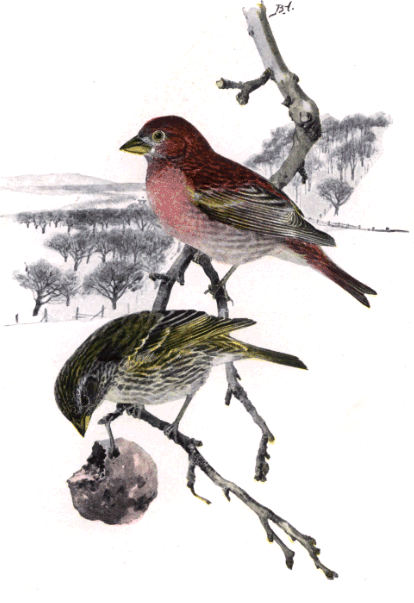
Purple Finch (Carpodacus purpureus) Finch family
Called also: PURPLE LINNET (Illustration facing p. 226a)
Length—6 to 6.25 inches. About the same size as the English sparrow.
Male—Until two years old, sparrow-like in appearance like the female, but with olive-yellow on chin and lower back. Afterwards entire body suffused with a bright raspberry-red, deepest on head, lower back, and breast, and other parts only faintly washed with this color. More brown on back; and wings and tail, which are dusky, have some reddish-brown feathers. Underneath grayish white. Bill heavy. Tail forked.
Female—Grayish olive-brown above; whitish below; finely streaked everywhere with very dark brown, like a sparrow. Sides of breast have arrow-shaped marks. Wings and tail darkest.
Range—North America, from Columbia River eastward to Atlantic, and from Mexico northward to Manitoba. Most common in Middle States and New England. Winters south of Pennsylvania.
Migrations—March. November. Common summer resident. Rarely individuals winter at the north.
In this "much be-sparrowed country" of ours familiarity is apt to breed contempt for any bird that looks sparrowy, in which case one of the most delicious songsters we have might easily be overlooked. It is not until the purple finch reaches maturity in his second year that his plumage takes on the raspberry-red tints that some ornithologists named purple. Oriental purple is our magenta, it is true, but not a raspberry shade. Before maturity, but for the yellow on his lower back and throat, he and his mate alike suggest a song-sparrow; and it is important to note their particularly heavy, rounded bills, with the tufts of feathers at the base, and their forked tails, to name them correctly. But the identification of the purple finch, after all, depends quite as much upon his song as his color. In March, when flocks of these birds come north, he has begun to sing a little; by the beginning of May he is desperately in love, and sudden, joyous peals of music from the elm or evergreen trees on the lawn enliven the garden. How could his little brown lady-love fail to be impressed with a suitor so gayly dressed, so tender and solicitous, so deliciously sweet-voiced? With fuller, richer song than the warbling vireo's, which Nuttall has said it resembles, a perfect ecstasy of love pours incessantly from his throat during the early summer days. There is a suggestion of the robin's love-song in his, but its copiousness, variety, and rapidity give it a character all its own.
In some old, neglected hedge or low tree about the country-place a flat, grassy nest, lined with horsehair, contains four or five green eggs in June, and the old birds are devotion itself to each other, and soon to their young, sparrowy brood.
But when parental duties are over, the finches leave our lawns and gardens to join flocks of their own kind in more remote orchards or woods, their favorite haunts. Their subdued warble may be heard during October and later, as if the birds were humming to themselves.
Much is said of their fondness for fruit blossoms and tree buds, but the truth is that noxious insects and seeds of grain constitute their food in summer, the berries of evergreens in winter. To a bird so gay of color, charming of voice, social, and trustful of disposition, surely a few blossoms might be spared without grudging.
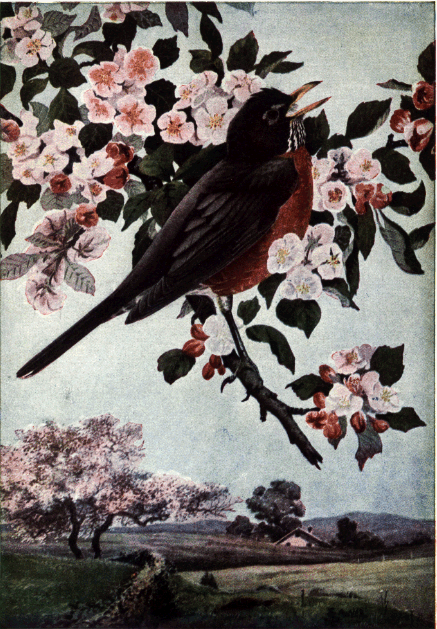
The American Robin (Merula migratoria) Thrush family
Called also: RED-BREASTED OR MIGRATORY THRUSH; ROBIN-REDBREAST (Illustrations facing pp. 219 and 226b)
Length—10 inches.
Male—Dull brownish olive-gray above. Head black; tail brownish black, with exterior feathers white at inner tip. Wings dark brownish. Throat streaked with black and white. White eyelids. Entire breast bright rusty red; whitish below the tail.
Female—Duller and with paler breast, resembling the male in autumn.
Range—North America, from Mexico to arctic regions.
Migrations—March. October or November. Often resident throughout the year.
It seems almost superfluous to write a line of description about a bird that is as familiar as a chicken; yet how can this nearest of our bird neighbors be passed without a reference? Probably he was the very first bird we learned to call by name.
The early English colonists, who had doubtless been brought up, like the rest of us, on "The Babes in the Wood," named the bird after the only heroes in that melancholy tale; but in reality the American robin is a much larger bird than the English robin-redbreast and less brilliantly colored. John Burroughs calls him, of all our birds, "the most native and democratic."
How the robin dominates birddom with his strong, aggressive personality! His voice rings out strong and clear in the early morning chorus, and, more tenderly subdued at twilight, it still rises above all the sleepy notes about him. Whether lightly tripping over the lawn after the "early worm," or rising with his sharp, quick cry of alarm, when startled, to his nest near by, every motion is decided, alert, and free. No pensive hermit of the woods, like his cousins, the thrushes, is this joyous vigorous "bird of the morning." Such a presence is inspiriting.
Does any bird excel the robin in the great variety of his vocal expressions? Mr. Parkhurst, in his charming "Birds' Calendar," says he knows of "no other bird that is able to give so many shades of meaning to a single note, running through the entire gamut of its possible feelings. From the soft and mellow quality, almost as coaxing as a dove's note, with which it encourages its young when just out of the nest, the tone, with minute gradations, becomes more vehement, and then harsh and with quickened reiteration, until it expresses the greatest intensity of a bird's emotions. Love, contentment, anxiety, exultation, rage—what other bird can throw such multifarious meaning into its tone? And herein the robin seems more nearly human than any of its kind."
There is no one thing that attracts more birds about the house than a drinking-dish—large enough for a bathtub as well; and certainly no bird delights in sprinkling the water over his back more than a robin, often aided in his ablutions by the spattering of the sparrows. But see to it that this drinking-dish is well raised above the reach of lurking cats.
While the robin is a famous splasher, his neatness stops there. A robin's nest is notoriously dirty within, and so carelessly constructed of weed-stalks, grass, and mud, that a heavy summer shower brings more robins' nests to the ground than we like to contemplate. The color of the eggs, as every one knows, has given their name to the tint. Four is the number of eggs laid, and two broods are often reared in the same nest.
Too much stress is laid on the mischief done by the robins in the cherry trees and strawberry patches, and too little upon the quantity of worms and insects they devour. Professor Treadwell, who experimented upon some young robins kept in captivity, learned that they ate sixty-eight earthworms daily—"that is, each bird ate forty-one per cent. more than its own weight in twelve hours! The length of these worms, if laid end to end, would be about fourteen feet. Man, at this rate, would eat about seventy pounds of flesh a day, and drink five or six gallons of water."
RED CROSSBILL
PURPLE FINCH (Upper Figure, Male; Lower Figure, Female)
ROBIN
ORCHARD ORIOLE (Upper figure, adult male; middle figure, young male; Lower Figure, Female)
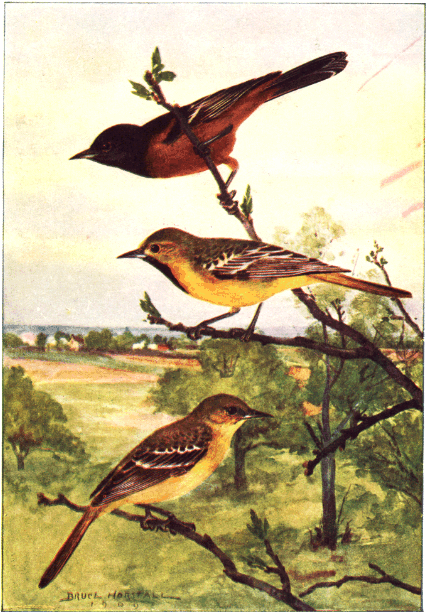
Orchard Oriole (Icterus spurius) Blackbird and Oriole family
Called also: ORCHARD STARLING; ORCHARD HANG-NEST
Length—7 to 7.3 inches. About one-fourth smaller than the robin.
Male—Head, throat, upper back, tail, and part of wings black. Breast, rump, shoulders, under wing and tail coverts, and under parts bright reddish brown. Whitish-yellow markings on a few tail and wing feathers.
Female—Head and upper parts olive, shading into brown; brighter on head and near tail. Back and wings dusky brown, with pale-buff shoulder-bars and edges of coverts. Throat black. Under parts olive, shading into yellow.
Range—Canada to Central America. Common in temperate latitudes of the United States.
Migrations—Early May. Middle of September. Common summer resident.
With a more southerly range than the Baltimore oriole and less conspicuous coloring, the orchard oriole is not so familiar a bird in many Northern States, where, nevertheless, it is quite common enough to be classed among our would-be intimates. The orchard is not always as close to the house as this bird cares to venture; he will pursue an insect even to the piazza vines.
His song, says John Burroughs, is like scarlet, "strong, intense, emphatic," but it is sweet and is more rapidly uttered than that of others of the family. It is ended for the season early in July.
This oriole, too, builds a beautiful nest, not often pendent like the Baltimore's, but securely placed in the fork of a sturdy fruit tree, at a moderate height, and woven with skill and precision, like a basket. When the dried grasses from one of these nests were stretched and measured, all were found to be very nearly the same length, showing to what pains the little weaver had gone to make the nest neat and pliable, yet strong. Four cloudy-white eggs with dark-brown spots are usually found in the nest in June.
INDEX
The figures in
black-faced type
indicate the page upon which the biography of the bird is given.
Accentor, Golden-crowned (
see
Ovenbird),
180
.
Bellbird (
see
Wood Thrush),
123
.
Bird, Blue (
see
Bluebird),
99
.
Butcher (
see
Northern Shrike),
87
.
Butter (
see
Bobolink),
61
.
Cardinal (
see
Cardinal Grosbeak),
215
.
Cedar,
9
,
19
,
20
,
21
,
27
,
29
,
36
,
144
.
Cow-pen (
see
Cowbird),
49
.
Grass (
see
Vesper Sparrow),
162
.
Grease (
see
Canada Jay),
79
.
Meadow (
see
Bobolink),
61
.
Meat (
see
Canada Jay),
79
.
Moose (
see
Canada Jay),
79
.
Myrtle (
see
Myrtle Warbler),
92
.
Peabody (
see
White-throated Sparrow),
165
.
Potato Bug (
see
Rose-breasted Grosbeak),
60
.
Thistle (
see
American Goldfinch),
190
.
Blackbird (
see
Rusty Blackbird),
46
.
and Oriole family,
6
.
Cow (
see
Cowbird),
49
.
Crow (
see
Purple Grackle),
44
.
Red-winged,
6
,
21
,
22
,
23
,
28
,
30
,
32
,
36
,
47
.
Rusty,
6
,
22
,
28
,
30
,
32
,
36
,
46
.
Skunk (
see
Bobolink),
61
.
Swamp (
see
Red-winged Blackbird),
47
.
Thrush (
see
Rusty Blackbird),
46
.
Black-cap (
see
Wilson's Warbler),
202
.
Bluebird,
14
,
19
,
20
,
21
,
22
,
27
,
28
,
29
,
30
,
36
,
99
.
Bobolink,
7
,
22
,
23
,
28
,
30
,
31
,
36
,
61
.
Bull-bat (
see
Nighthawk),
138
.
Bullfinch, Pine (
see
Pine Grosbeak),
219
.
Bunting, Bay-winged (
see
Vesper Sparrow),
162
.
Cow (
see
Cowbird),
49
.
Field (
see
Field Sparrow),
152
.
Indigo,
8
,
21
,
22
,
23
,
29
,
30
,
31
,
35
,
101
.
Lapland Lark (
see
Lapland Longspur),
148
.
Savanna (
see
Savanna Sparrow),
155
.
Snow (
see
Snowflake),
59
.
Towhee (
see
Chewink),
58
.
Tree (
see
Tree Sparrow),
161
.
Buntings, the,
7
.
Camp Robber (
see
Canada Jay),
79
.
Canary, Wild (
see
American Goldfinch),
190
.
Cardinal (
see
Cardinal Grosbeak),
215
.
Carrion-bird, Canadian (
see
Canada Jay),
79
·
Catbird,
12
,
19
,
20
,
21
,
22
,
29
,
30
,
31
,
36
,
80
.
Catbirds, the,
12
.
Cedar Bird (
see
Bird, Cedar),
144
.
Chat, Polyglot (
see
Yellow-breasted Chat),
206
.
Yellow-breasted,
12
,
19
,
21
,
22
,
29
,
30
,
31
,
36
,
206
.
Chebec (
see
Least Flycatcher),
75
.
Cherry-bird (
see
Cedar Bird),
144
.
Chewink,
8
,
21
,
29
,
30
,
32
,
36
,
58
.
Chickadee,
14
,
19
,
20
,
21
,
27
,
28
,
29
,
31
,
35
,
76
.
family (
see
Titmouse family),
13
.
Chip-bird (
see
Chipping Sparrow
),
149
.
Chipper, Arctic (
see
Tree Sparrow
),
161
.
Chippy (
see
Chipping Sparrow
),
149
.
Meadow (
see
Seaside Sparrow
),
156
.
Winter (
see
Tree Sparrow
),
161
.
Clape (
see
Flicker
),
130
.
Corn Thief (
see
Common Crow
),
41
.
Cowbird,
7
,
20
,
21
,
22
,
28
,
30
,
31
,
36
,
49
.
Creeper, Brown,
13
,
20
,
21
,
28
,
35
,
145
.
family,
13
.
Crossbill, American,
8
,
19
,
20
,
28
,
220
.
Red (
see
American Crossbill),
220
.
White-winged Red,
8
,
19
,
20
,
28
,
221
.
Crossbills, the,
7
,
21
,
35
.
Crow and Jay family,
6
.
Crow, Common,
6
,
19
,
20
,
21
,
22
,
27
,
28
,
36
,
41
.
Fish,
6
,
19
,
20
,
21
,
22
,
27
,
28
,
36
,
42
.
Rain (
see
Black-billed Cuckoo)
139
; also Yellow-billed Cuckoo,
141
.
Rusty (
see
Rusty Blackbird),
46
.
Cuckoo family,
3
.
Black-billed,
3
,
19
,
20
,
21
,
28
,
30
,
31
,
36
,
139
.
Yellow-billed,
3
,
19
,
20
,
21
,
28
,
30
,
31
,
36
,
141
.
Devil Downhead (
see
White-breasted Nuthatch
),
84
.
Dove, Carolina (
see
Mourning Dove
),
108
.
family (see Pigeon and Dove family),
15
.
Mourning,
15
,
21
,
22
,
28
,
36
,
108
.
Turtle (
see
Mourning Dove
),
108
.
Finch family,
7
.
Ferruginous (
see
Fox Sparrow),
153
.
Foxy (
see
Fox Sparrow),
153
.
Gold (
see
Goldfinch),
190
.
Grass (
see
Vesper Sparrow),
162
.
Pine (
see
Pine Siskin),
146
.
Purple,
8
,
19
,
20
,
21
,
23
,
28
,
29
,
30
,
32
,
35
,
223
.
Seaside (
see
Seaside Sparrow
),
156
.
Swamp (
see
Swamp Song Sparrow),
160
.
Towhee Ground (
see
Chewink
),
58
.
Firebird (
see
Scarlet Tanager
),
218
.
Flicker,
4
,
19
,
21
,
22
,
27
,
28
,
30
,
32
,
36
,
130
.
Flycatcher, Acadian,
5
,
19
,
22
,
28
,
31
,
35
,
182
.
Canadian (
see
Canadian Warbler),
194
.
Crested (
see
Great Crested Flycatcher),
72
.
Dusky (
see
Phœbe),
71
.
family,
5
,
19
,
20
,
21
,
22
,
23
.
Great Crested,
5
,
19
,
20
,
22
,
28
,
30
,
31
,
35
,
72
.
Least,
5
,
19
,
20
,
22
,
28
,
30
,
31
,
35
,
75
.
Olive-sided,
5
,
19
,
28
,
31
,
36
,
74
.
Say's,
5
,
19
,
22
,
28
,
72
.
Small Green-crested (
see
Acadian Flycatcher),
182
.
Sylvan (
see
Blue-gray Gnatcatcher),
110
.
Tyrant (
see
Kingbird),
68
.
Wilson's (
see
Wilson's Warbler),
202
.
Yellow-bellied,
5
,
19
,
22
,
28
,
31
,
35
,
183
.
Gnatcatcher, Blue-gray,
14
,
19
,
20
,
22
,
29
,
35
,
110
.
Gnatcatcher family,
14
.
Goatsucker family,
4
.
Long-winged (
see
Nighthawk),
138
.
Goldcrest, Golden-crowned (
see
Golden-crowned Kinglet
),
174
.
Goldfinch,
8
,
19
,
20
,
21
,
22
,
23
,
27
,
28
,
29
,
30
,
35
,
190
.
European,
191
.
Grackle, Bronzed,
7
,
19
,
20
,
21
,
22
,
28
,
30
,
32
,
36
,
46
.
Keel-tailed (
see
Purple Grackle
),
44
.
Purple,
7
,
19
,
20
,
21
,
22
,
28
,
30
,
32
,
36
,
44
.
Rusty (
see
Rusty Blackbird),
46
.
Grasel (
see
Chewink)
,
58
.
Grass-bird, Red (
see
Swamp Song Sparrow),
160
.
Greenlet family (
see
Vireo family),
10
.
Grosbeak, Blue,
8
,
28
,
36
,
105
.
Cardinal,
8
,
21
,
27
,
28
,
29
,
36
,
215
.
Evening,
8
,
28
,
36
,
192
.
Pine,
8
,
20
,
27
,
36
,
219
.
Rose-breasted,
8
,
21
,
28
,
30
,
31
,
36
,
60
.
Grosbeaks, the,
7
,
19
,
20
,
21
.
Hair-bird (
see
Chipping Sparrow),
149
.
Halcyon (
see
Belted Kingfisher),
102
.
Hang-nest (
see
Baltimore Oriole),
211
.
Orchard (
see
Orchard Oriole),
227
.
Hawk, Mosquito (
see
Nighthawk),
138
.
Heron, Venison (
see
Canada Jay
),
79
.
High-hole or High-holder (
see
Flicker),
130
.
Humming-bird family,
5
.
Ruby-throated,
5
,
19
,
21
,
28
,
30
,
31
,
35
,
170
.
Indigo Bird (
see
Indigo Bunting),
101
.
Jay, Blue,
6
,
19
,
20
,
21
,
27
,
28
,
36
,
104
.
Canada,
6
,
20
,
21
,
22
,
28
,
36
,
79
.
family (
see
Crow and Jay family),
6
.
Junco,
8
,
21
,
22
,
27
,
31
,
35
,
83
.
Kingbird,
5
,
19
,
20
,
22
,
23
,
28
,
30
,
31
,
35
,
68
.
Kingfisher, Belted,
3
,
20
,
21
,
23
,
28
,
30
,
36
,
102
.
family,
3
.
Kinglet family,
14
.
Golden-crowned,
14
,
20
,
21
. 28,
32
,
35
,
174
.
Ruby-crowned,
14
,
20
,
21
,
28
,
30
,
32
,
35
,
172
.
Lark, Brown or Red (
see
American Pipit),
135
.
family,
5
.
Field (
see
Meadowlark),
132
.
Horned,
6
,
21
,
22
,
23
,
27
,
31
,
36
,
134
.
Meadow (
see
Meadowlark),
132
.
Oldfield (
see
Meadowlark),
132
.
Pine (
see
Pine Siskin),
146
.
Prairie (
see
Western Meadowlark),
133
.
Prairie Horned,
6
,
22
,
27
,
29
,
135
.
Purple (
see
Purple Finch),
223
.
Redpoll (
see
Redpoll),
222
.
Shore (
see
Horned Lark),
134
.
Snow (
see
Snowflake
),
59
.
Tit (
see
American Pipit),
135
.
Linnets, the,
7
.
Longspur, Lapland,
8
,
22
,
28
,
35
,
148
.
Smith's Painted,
8
,
22
,
28
,
35
,
147
.
Maize Thief (
see
Purple Grackle),
44
.
Martin, Bee (
see
Kingbird),
68
.
Purple,
9
,
19
,
21
,
29
,
30
,
31
,
36
,
48
.
Sand (
see
Bank Swallow),
143
.
Mavis (
see
Brown Thrasher),
121
.
Maybird (
see
Bobolink),
61
.
Meadowlark,
7
,
21
,
22
,
23
,
27
,
29
,
30
,
32
,
36
,
132
.
Western,
7
,
21
,
22
,
23
,
27
,
29
,
36
,
133
.
Mocking-bird,
12
,
19
,
20
,
21
,
29
,
36
,
81
.
Brown (
see
Brown Thrasher),
121
.
French (
see
Brown Thrasher),
121
.
Yellow,
206
.
Mocking-birds, the,
12
.
Nighthawk,
4
,
19
,
20
,
21
,
22
,
23
,
28
,
30
,
31
,
36
,
138
.
Nightingale, European,
125
.
Virginia (
see
Cardinal Grosbeak),
215
.
Nightjar (
see
Nighthawk),
138
.
Nine-killer (
see
Northern Shrike),
87
.
Nuthatch, Canada (
see
Red-breasted Nuthatch),
85
.
family,
13
,
21
.
Red-breasted,
13
,
20
,
28
,
32
,
35
,
85
.
White-breasted,
13
,
20
,
27
,
29
,
32
,
35
,
84
.
Oriole, Baltimore,
7
,
19
,
21
,
28
,
30
,
31
,
36
,
211
.
Brown-headed (
see
Cowbird),
49
.
family (
see
Blackbird and Oriole family),
6
.
Golden (
see
Baltimore Oriole),
211
.
Orchard,
7
,
19
,
21
,
28
,
30
,
31
,
36
,
227
.
Red-winged (
see
Red-winged Blackbird),
47
.
Rusty (
see
Rusty Blackbird),
46
.
Ortolan, American (
see
Bobolink),
61
.
Ovenbird,
12
,
21
,
22
,
23
,
29
,
30
,
31
,
35
,
180
.
Pewee, Bridge (
see
Phœbe),
71
.
Small (
see
Acadian Flycatcher),
182
.
Water (
see
Phœbe),
71
.
Wood,
5
,
19
,
20
,
22
,
23
,
28
,
30
,
31
,
36
,
69
.
Phœbe,
5
,
19
,
20
,
22
,
23
,
28
,
30
,
32
,
35
,
71
.
Say's,
72
.
Pigeon and Dove family,
15
.
Pipit, American,
12
,
21
,
22
,
23
,
28
,
30
,
35
,
135
.
Pipits, the,
12
.
Piramidig (
see
Nighthawk),
138
.
Pisk (
see
Nighthawk),
138
.
Pocket-bird (
see
Scarlet Tanager),
218
.
Preacher, the (
see
Red-eyed Vireo),
176
.
Raven, American,
6
,
19
,
20
,
28
,
36
,
43
.
Northern (
see
American Raven),
43
.
White-necked,
44
.
Récollet (
see
Cedar Bird),
144
.
Redbird, Black-winged (
see
Scarlet Tanager),
218
.
Crested (
see
Cardinal Grosbeak),
215
.
(
see
Summer Tanager),
216
.
Smooth-headed (
see
Summer Tanager),
216
.
Virginia (
see
Cardinal Grosbeak),
215
.
Redhead (
see
Red-headed Woodpecker) 53.
Redpoll,
8
,
21
,
22
,
27
,
35
,
222
.
Greater,
8
,
21
,
22
,
27
,
35
,
223
.
Lesser (
see
Redpoll),
222
.
Redstart,
12
,
19
,
29
,
31
,
35
,
210
.
Reedbird (
see
Bobolink),
61
.
Robin, American,
14
,
19
,
20
,
21
,
22
,
27
,
28
,
29
,
30
,
32
,
225
.
Blue (
see
Bluebird),
99
.
Canada (
see
Cedar Bird),
144
.
English (
see
Baltimore Oriole),
211
.
Golden (
see
Baltimore Oriole),
211
.
Ground (
see
Chewink),
58
.
Redbreast (
see
American Robin),
225
.
Wood (
see
Wood Thrush),
123
.
Sapsucker (
see
Yellow-bellied Woodpecker),
57
.
Shrike family,
9
.
Loggerhead,
10
,
19
,
20
,
21
,
29
,
36
,
86
.
Northern,
10
,
19
,
20
,
21
,
27
,
32
,
36
,
87
.
Silktail (
see
Bohemian Waxwing),
88
.
Siskin, Pine,
8
,
20
,
28
,
32
,
35
,
146
.
Skylark, European,
5
.
Snowbird (
see
Junco),
83
; also Snowflake,
59
.
Lapland (
see
Lapland Longspur),
148
.
Little (
see
Redpoll),
222
.
Slate-colored (
see
Junco),
83
.
Snowflake,
8
,
22
,
27
,
36
,
59
.
Sparrow, Bush (
see
Field Sparrow),
152
.
Canada (see Tree Sparrow),
161
;
also White-throated Sparrow,
165
.
Chipping,
7
,
19
,
20
,
22
,
27
,
28
,
30
,
35
,
149
.
English,
7
,
20
,
22
,
27
,
28
,
151
.
Field,
7
,
22
,
28
,
30
,
32
,
152
.
Fox,
7
,
20
,
21
,
22
,
27
,
28
,
29
,
32
,
36
,
153
.
Fox-colored (
see
Fox Sparrow),
153
.
Grasshopper,
7
,
22
,
28
,
31
,
35
,
154
.
House (
see
English Sparrow),
151
.
Marsh (
see
Swamp Song Sparrow),
160
.
Savanna,
7
,
22
,
28
,
32
,
35
,
155
.
Seaside,
7
,
22
,
28
,
35
,
156
.
Sharp-tailed,
7
,
22
,
28
,
35
,
157
.
Social (
see
Chipping Sparrow),
149
.
Song,
8
,
20
,
21
,
22
,
23
,
27
,
28
,
30
,
35
,
158
.
Swamp (
see
Swamp Song Sparrow),
160
.
Swamp Song,
8
,
22
,
27
,
28
,
30
,
32
,
35
,
160
.
Tree,
8
,
19
,
20
,
21
,
22
,
27
,
31
,
35
,
161
.
Vesper,
8
,
20
,
22
,
23
,
27
,
28
,
30
,
31
,
35
,
162
.
White-crowned,
8
,
20
,
21
,
22
,
27
,
32
,
36
,
164
.
White-throated,
8
,
20
,
21
,
22
,
27
,
30
,
31
,
36
,
165
.
Wood (
see
Field Sparrow),
152
.
Yellow-winged (
see
Grasshopper Sparrow),
154
.
Sparrows, the,
7
,
19
,
21
,
22
.
Starling,
50
Orchard Starling,
227
Red-winged (
see
Red-winged Blackbird),
47
.
Swallow, Bank,
9
,
19
,
22
,
23
,
29
,
30
,
35
,
143
.
Barn,
9
,
19
,
21
,
22
,
23
,
29
,
30
,
35
,
106
.
Chimney (
see
Chimney Swift),
67
.
Cliff,
9
,
19
,
21
,
22
,
23
,
29
,
30
,
31
,
35
,
107
.
Crescent (
see
Cliff Swallow),
107
.
Eave (
see
Cliff Swallow),
107
.
family,
9
,
20
,
22
,
23
.
Rocky Mountain (
see
Cliff Swallow),
107
.
Rough-winged,
9
,
19
,
22
,
23
,
29
,
35
,
144
.
Sand (
see
Bank Swallow),
143
.
Tree,
9
,
19
,
22
,
23
,
29
,
30
,
35
,
169
.
White-bellied (
see
Tree Swallow),
169
.
Swamp Angel (
see
Hermit Thrush),
125
.
Swift, American (
see
Chimney Swift),
67
.
Swift, Chimney,
5
,
19
,
21
,
23
,
28
,
30
,
31
,
35
,
67
.
family,
4
.
Tanager, Canada (
see
Scarlet Tanager),
218
.
family,
8
,
21
.
Scarlet,
8
,
19
,
28
,
30
,
31
,
36
,
218
.
Summer,
8
,
19
,
29
,
36
,
216
.
Teacher, the (
see
Ovenbird),
180
.
Thrasher, Brown,
12
,
19
,
20
,
21
,
22
,
29
,
30
,
32
,
36
,
121
.
Thrashers, the,
12
.
Thrush, Alice's,
15
,
29
,
30
,
32
,
36
,
126
.
Aquatic (
see
Northern Water Thrush),
129
.
Black-capped (
see
Catbird),
80
.
Brown (
see
Brown Thrasher),
121
.
family,
14
,
19
,
21
.
Gray-cheeked (
see
Alice's Thrush),
126
.
Golden-crowned (
see
Ovenbird),
180
.
Ground (
see
Brown Thrasher),
121
.
Hermit,
15
,
29
,
30
,
31
,
36
,
125
.
Little (
see
Hermit Thrush),
125
.
Louisiana Water
,
12
,
21
,
22
,
23
,
29
,
30
,
31
,
35
,
128
.
New York (
see
Northern Water Thrush),
129
.
Northern Water
,
12
,
21
,
22
,
23
,
29
,
30
,
31
,
35
,
129
.
Olive-backed,
15
,
29
,
30
,
32
,
36
,
127
.
Red (
see
Brown Thrasher),
121
.
Red-breasted or Migratory (
see
American Robin),
225
.
Song (
see
Wood Thrush),
123
.
Swainson's (
see
Olive-backed Thrush),
127
.
Tawny (
see
Wilson's Thrush),
122
.
Wilson's,
15
,
21
,
22
,
29
,
30
,
31
,
32
,
36
,
122
.
Wood,
15
,
20
,
21
,
29
,
30
,
31
,
32
,
36
,
123
.
Tit, Black-capped (
see
Chickadee),
76
.
Titlark (
see
American Pipit),
135
.
Titmouse Black-capped (
see
Chickadee),
76
.
Crested (
see
Tufted Titmouse),
78
.
family,
13
,
21
.
Tufted,
14
,
19
,
20
,
21
,
27
,
28
,
29
,
31
,
35
,
78
.
Tomtit, Crested (
see
Tufted Titmouse),
78
.
Torch-bird (
see
Blackburnian Warbler),
209
.
Towhee (
see
Chewink),
58
.
Tree-mouse (
see
White-breasted Nuthatch),
84
.
Tricolor (
see
Red-headed Woodpecker),
53
.
Veery (see Wilson's Thrush),
122
.
Vireo, Blue-headed (
see
Solitary Vireo),
175
.
family,
10
,
19
,
21
,
22
.
Red-eyed,
10
,
20
,
22
,
29
,
30
,
31
,
35
,
176
.
Solitary,
10
,
20
,
22
,
29
,
30
,
31
,
35
,
175
.
Warbling,
10
,
20
,
22
,
29
,
30
,
31
,
35
,
179
.
White-eyed,
10
,
20
,
21
,
22
,
29
,
30
,
31
,
35
,
177
.
Yellow-throated,
10
,
20
,
22
,
29
,
30
,
31
,
35
,
189
.
Wagtail, Aquatic Wood (
see
Northern Water Thrush),
129
.
Golden-crowned (
see
Ovenbird),
180
.
Wood (
see
Ovenbird),
180
.
Wagtails, the,
12
.
Wake-up (
see
Flicker),
130
.
Warbler, Bay-breasted,
11
,
29
,
30
,
31
,
90
.
Black-and-white Creeping,
10
,
20
,
29
,
30
,
31
,
64
.
Black-and-yellow (
see
Magnolia Warbler),
197
.
Blackburnian,
11
,
29
,
31
,
209
.
Black-masked Ground (
see
Maryland Yellowthroat),
207
.
Blackpoll,
11
,
19
,
20
,
29
,
63
.
Black-throated Blue,
11
,
29
,
30
,
31
,
95
.
Black-throated Green,
11
,
29
,
30
,
184
.
Bloody-sided (
see
Chestnut-sided Warbler),
90
.
Blue-headed Yellow-rumped (
see
Magnolia Warbler),
197
.
Blue-winged,
11
,
20
,
29
,
193
.
Blue-winged Yellow (
see
Blue-winged Warbler),
193
.
Blue Yellow-backed (
see
Parula Warbler),
94
.
Canadian,
11
,
19
,
22
,
23
,
29
,
31
,
194
.
Chestnut-sided,
11
,
29
,
30
,
31
,
90
.
Golden (
see
Yellow Warbler),
204
.
Golden-winged,
11
,
29
,
30
,
31
,
91
.
Green Black-capped (
see
Wilson's Warbler),
202
.
Hemlock (
see
Blackburnian Warbler),
209
.
Hooded,
11
,
21
,
22
,
20
,
31
,
195
.
Kentucky,
11
,
22
,
196
.
Magnolia,
11
,
29
,
30
,
197
.
Mourning,
11
,
21
,
22
,
29
,
198
.
Mourning Ground (
see
Mourning Warbler),
198
.
Myrtle,
11
,
21
,
27
,
29
,
30
,
92
.
Nashville,
11
,
29
,
199
.
Orange-throated (
see
Blackburnian Warbler),
209
.
Palm,
11
,
22
,
29
,
204
.
Parula,
11
,
29
,
30
,
31
,
94
.
Pine,
11
,
20
,
29
,
30
,
31
,
200
.
Pine Creeping (
see
Pine Warbler),
200
.
Prairie,
11
,
22
,
29
,
31
,
201
.
Redpoll (
see
Palm Warbler),
204
.
Ruby-crowned (
see
Ruby-crowned Kinglet),
172
.
Spotted (
see
Magnolia Warbler),
197
.
Spotted Canadian (
see
Canadian Warbler),
194
.
Wilson's,
12
,
19
,
22
,
23
,
29
,
31
,
202
.
Worm-eating,
12
,
20
,
22
,
29
,
31
,
181
.
Yellow,
12
,
19
,
20
,
22
,
23
,
29
,
30
,
31
,
204
.
Yellow-crowned (
see
Myrtle Warbler),
92
.
Yellow Palm (
see
Yellow Redpoll Warbler),
203
.
Yellow Redpoll,
12
,
22
,
29
,
30
,
31
,
203
.
Yellow-rumped (
see
Myrtle Warbler),
92
.
Yellow-tailed (
see
Redstart),
210
.
Waxwing, Black-throated (
see
Bohemian Waxwing),
88
.
Bohemian,
9
,
19
,
20
,
27
,
36
,
88
.
Cedar (
see
Cedar Bird),
144
.
family,
9
.
Lapland (
see
Bohemian Waxwing),
88
.
Whisky Jack or John (
see
Canada Jay)
79
.
Whitebird (
see
Snowflake),
59
.
Whippoorwill,
4
,
19
,
20
,
21
,
22
,
28
,
31
,
35
,
136
.
Will-o'-the-Wisp (
see
Nighthawk),
138
.
Woodpecker, Downy,
4
,
19
,
27
,
28
,
35
,
55
.
family,
3
,
21
,
22
.
Golden-winged (
see
Flicker),
130
.
Hairy,
4
,
19
,
27
,
28
,
36
,
54
.
Pigeon (
see
Flicker),
130
.
Red-headed,
4
,
19
,
27
,
28
,
30
,
32
,
36
,
53
.
Yellow-bellied,
4
,
19
,
27
,
28
,
30
,
32
,
35
,
57
.
Yellow-shafted (
see
Flicker),
130
.
Wood Warbler family,
10
,
19
,
20
,
21
,
35
.
Wren, Carolina,
13
,
21
,
22
,
27
,
28
,
29
,
116
.
family,
13
,
19
,
21
,
22
,
35
.
Fiery-crowned (
see
Golden-crowned Kinglet),
174
.
House,
13
,
20
,
29
,
30
,
31
,
115
.
Long-billed Marsh,
13
,
22
,
29
,
30
,
31
,
119
.
Mocking (
see
Carolina Wren),
116
.
Ruby-crowned (
see
Ruby-crowned Kinglet),
172
.
Short-billed Marsh,
13
,
29
,
30
,
31
,
120
.
Winter,
13
,
21
,
22
,
23
,
28
,
31
,
117
.
Yarup (
see
Flicker),
130
.
Yellowbird (
see
American Goldfinch
) 190.
Summer (
see
Yellow Warbler),
204
.
Yellowhammer (
see
Flicker),
130
.
Yellow Poll (
see
Yellow Warbler),
204
.
Yellowthroat, Maryland,
12
,
19
,
21
,
22
,
23
,
29
,
30
,
31
,
207
.
Transcriber's Notes
With the exception of the correction detailed below, the text is a transcription of the original printed book. Several minor corrections were made where punctuation was missing (comma or period) or formatting differed from that used for similar sections elsewhere. Several forms of the verb travel appear with an alternative spelling than is common in the present era. For example, travelled and travelling are used. The book's images were moved so that they are between the descriptive passages rather than interrupt the "flow" of the text by just moving them between paragraphs as is typically done.
PageCorrection
vCOLORED PLATES → COLOURED PLATES and page number xi → xviii
162Poocœtes → Poœcetes
226that → than
229Vesper Sparrow → White-throated
232Louisiana Water Thrush: 125 → 128
232Northern Water Thrush: 126 → 129