BIRD GUIDE (continued 3)
Reading edition
Notes.—A shrill a “kee-kee-kee.”
Nest.—A very bulky structure of large sticks, lined with twigs, needles and in some cases evergreen; eggs creamy-white, spotted, splashed and clouded with various shades of brown and gray (2.90 × 2.50).
Range.—West of the Miss., from Mexico northward; rarely eastward to the Atlantic coast.
[213]
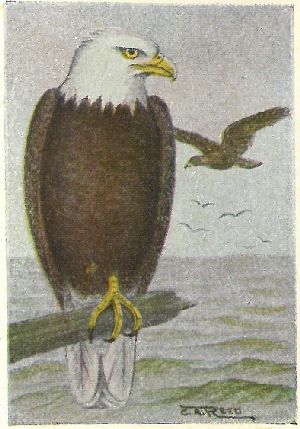
BALD EAGLE
352. Haliœetus leucocephalus. 34 in.
Legs not feathered to the toes. Adults with white head and tail. Young birds similar in color to those of the Golden Eagle, but blacker and with the legs always bare on the lower half. Young, with brown eyes, like those of the last; adults with yellow eyes and feet. This handsome bird of prey, our national emblem, is resident and locally distributed throughout the United States and Canada, always near streams or lakes, and most abundant on the seacoasts. Their food, like that of the Golden Eagle, is chiefly caught by themselves, and consists of any small mammals, geese, ducks, etc., and during the summer, or when their usual food is scarce, they feed upon fish, which they either catch for themselves or taken by force from Ospreys.
Nest.—Of sticks large and bulky, and usually in tops of very tall trees; two eggs, pure white (2.75 × 2.10).
Range.—Resident locally in whole of North America.
[214]
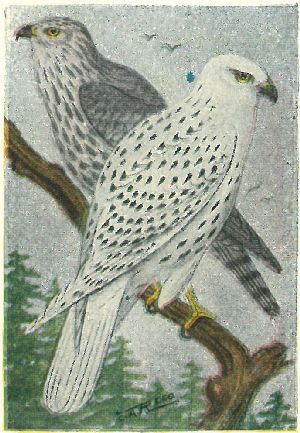
WHITE GRYFALCON
353. Falco islandus. 23 in.
Adults in perfect plumage, pure white, slightly barred on the back and spotted below with black.
Nest.—Of sticks, lined with grasses and feathers; placed on ledges of cliffs; eggs bulky white, specked with reddish brown, often so thickly that the ground color is obscured (2.30 × 1.80).
Range.—Arctic region, breeding in Northern Greenland, and wintering to the Gulf of St. Lawrence, and casually to northern Maine.
GRAY GYRFALCON
354. Falco rusticolus. 23 in.
Adults white, heavily barred above, and streaked below with gray and black.
Range.—Arctic regions, south in winter, rarely to northern United States.
354a. GYRFALCON (F. r. gyrfalco). Similar to the last but darker, the latter being usually more white than dusky, while this is the reverse.
354b. BLACK GYRFALCON (F. r. obsoletus). Much darker than the last, the markings tending to be buffy white spots on a grayish black ground.
[215]
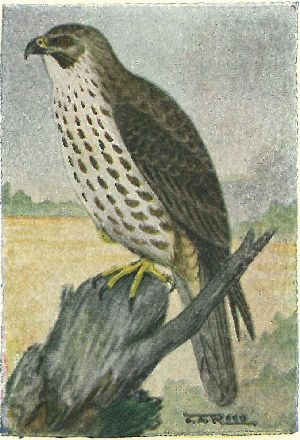
PRAIRIE FALCON
355. Falco mexicanus. 18 in.
A blackish patch on the sides of the throat, similar to that of the Duck Hawk. Above brownish black, much paler and never with the slaty color of the Duck Hawk; below streaked or spotted with blackish brown. These falcons are fairly abundant on the western plains and prairies, and are also found in wooded mountain regions. They are strong and active and will fight fiercely if captured. They live upon small mammals, birds and occasionally, grouse. Their flight is very swift and accomplished by rapid wing beats, with occasional sailings.
Notes.—A cackle, and rapidly repeated “kee-kee-kee.” (Bendire).
Nest.—A mass of sticks and trash, on bluffs or rocky ledges, and sometimes in trees; eggs reddish buff, thickly sprinkled and blotched with brown (2.50 × 1.60).
Range.—Eastern border of the Great Plains to the Pacific; and from Saskatchewan to southern Mexico.
[216]
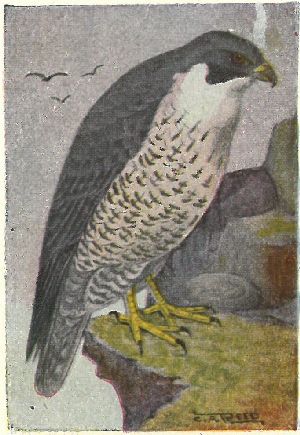
DUCK HAWK
356a. Falco peregrinus anatum. 17 in.
Black moustache mark, or patch on each side of the throat. Adults white below, tinged with buffy on the breast and sides, and lightly barred with black; above bluish slate, darkest on the crown. Some adults are darker, and much more heavily barred than others. Young, brownish black with rusty edges to the feathers; below, buffy, heavily streaked with blackish. This is one of the handsomest and most dashing of the raptores, and is very similar to the one formerly most used for the chase in England. They are swift and fearless in pursuit of their prey, and the fastest flying ducks as well as the slower herons fall easy victims to their valor. Their feet are exceptionally large, and they are often, on this account, known as Great-footed Hawks.
Nest.—Eggs laid upon bare ledges or soil, with very little, if any, nest. Bright buff, marked with rich rusty brown (2.05 × 1.55).
Range.—Breeds in Northern United States and Canada, most abundant west of the Miss.
[217]
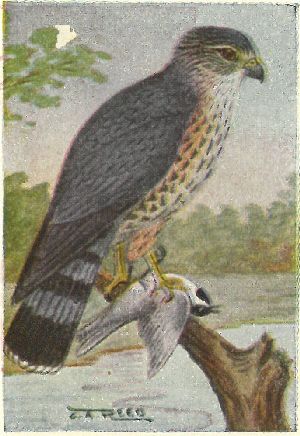
PIGEON HAWK
357. Falco columbarius. 12 in.
Adult male, bluish slate above, with black shaft lines to the feathers; below buffy on the breast, sides and thighs; streaked on the breast and barred on the flanks with black; tail with four black bands. Female and young, blackish brown above; below streaked with dusky. These little falcons are very bold and courageous when led by the pangs of hunger, chasing their prey close to human beings, and they have been known to follow birds, which, in their fright, have dashed through windows in houses. They live upon any of the smaller birds, as well as rodents, grasshoppers and other insects.
Nest.—Usually a slight platform of twigs in trees, deep in the woods, less often in cavities in trees, and sometimes on ledges; eggs buffy, heavily blotched with chestnut (1.50 × 1.20).
Range.—Breeds chiefly north of the United States, but occasionally on the northern border; winters in northern United States.
[218]
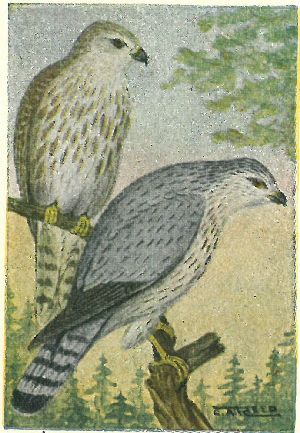
RICHARDSON MERLIN
357b. Falco columbarius richardsonii. 12 in.
Both adults and young are similar to the same of the last species, but they are much paler colored, and the tail is crossed by six light bars. The habits of this species, which seems to have quite a limited range, are precisely like those of the Pigeon Hawk. Like that species, it flies swiftly, with rapidly beating wings, and occasionally sails and soars. The under surface of the wings is prominently barred, but not as much so as that of the Pigeon Hawk; it is very conspicuous when in flight.
Nest.—Either in hollow trees, or a rude platform of sticks, usually not very high from the ground; eggs buffy white, handsomely blotched with brown (1.60 × 1.25).
Range.—From the Miss. to the Rockies, and from Mexico north to Saskatchewan, locally distributed.
[219]
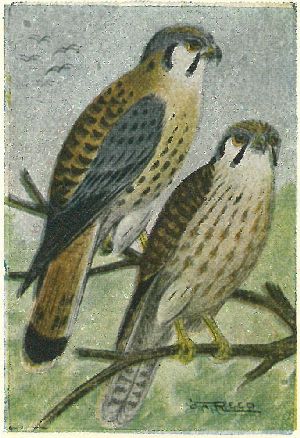
SPARROW HAWK
360. Falco sparverius. 10.5 in.
This is the smallest and one of the handsomest of our hawks. Cannot be mistaken for any other species, because of its bright colors and odd marking. The female is barred on the back, wings and tail, while the male has but a few short bars on the back. The general tone of both, above, is a bright rusty-brown. This is the most abundant hawk that we have, and it is also best known, chiefly because it is found commonly in the vicinity of farmhouses and commonly on the outskirts of cities. Their flight is peculiar, a few rapid wing beats, then a short sail, alternately. They are very noisy in mating season and when the young birds first fly, their notes being a rapidly repeated, “killy-killy-killy.” Their food is of grasshoppers, mice and rarely small birds.
Nest.—Usually in cavities in trees, often in deserted Flicker holes, the eggs being laid upon the bare wood. They are cream colored, finely sprinkled and spotted with brown (1.35 × 1.10).
Range.—Breeds from the Gulf States to Labrador and Hudson Bay. Winters in southern United States.
[220]
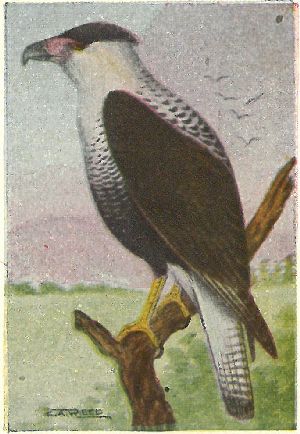
AUDUBON CARACARA
362. Polyborus cheriway. 22 in.
These peculiar birds cannot be mistaken for any of our hawks or falcons. They are very sluggish birds, with habits resembling both those of buzzards and some of the hawks. They are usually known in localities where they are found, as Caracara Eagles. As we might suspect from the shape of their bill, the naked and bristle-covered lores, and the feet, which have not the strongly hooked talons of hawks, the food of these birds is largely carrion. It is terrestrial in its habits and is most often seen, when not in flight, either upon the ground, or standing erect on branches at low elevations. They are more quarrelsome in their disposition than are vultures, and frequently fight over their prey.
Nest.—A bulky, but shabby pile of sticks and weeds, in bushes or low trees; eggs buff, sprinkled, spotted or blotched with yellowish brown or chestnut (2.50 × 1.80).
Range.—Resident of the Mexican border of the U. S. and in southern Florida.
[221]
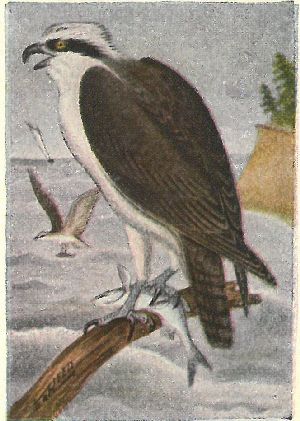
AMERICAN OSPREY; FISH HAWK
364. Pandion haliætus carolinensis. 23 in.
Real old birds have the head whiter, and less white edging to the back feathers, than do the young. Feet very strong, and very hard and rough, perfectly adapted to grasping slippery fish; outer toe can be used equally as well, either in front or behind, when perching or grasping their prey. Their food is entirely of fish, which they catch themselves, by plunging after it, hovering in the air a few seconds while watching the fish, preparatory to diving upon it. They are always found about water and are very numerous on the seacoasts, where twenty or more may frequently be seen at a time. They are protected by law in some states, and by public sentiment in most others.
Notes.—A loud, tremulous, piercing whistle.
Nest.—Usually in trees; large and bulky, of sticks; sometimes on the ground, telegraph poles, chimneys, etc. Eggs creamy buff, blotched with rich brown (2.40 × 1.80).
Range.—Breeds from the Gulf to Labrador and Alaska; winters in the southern half of the U. S.
[222]
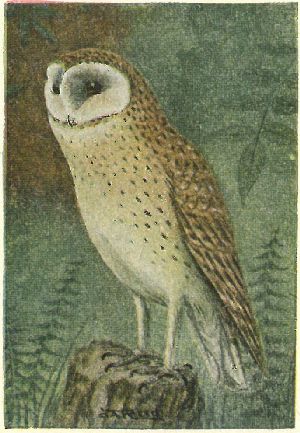
FAMILY ALUCONIDÆ
BARN OWL
365. Aluco pratincola. 18 in.
Plumage very soft, finely barred and specked; general coloration gray, yellowish-brown and white. No ear tufts; eyes small and brown; face very long; legs very long. These peculiar owls are abundant in the south, where they are commonly known as “Monkey-faced Owls,” because of their odd visage. They are very useful birds, and are usually recognized as such. Their food consists almost wholly of small squirrels, rodents, reptiles and insects. It does most of its hunting just after dusk and early in the morning. Its flight is rather slow and entirely noiseless, as is that of all the members of the family.
Nest.—In hollow trees, under the roofs of barns or in caves; the four to six eggs are pure white (l.70 × 1.30).
Range.—United States, breeding north to New York, Ontario, and Washington. Winters in the southern half of the United States.
[223]
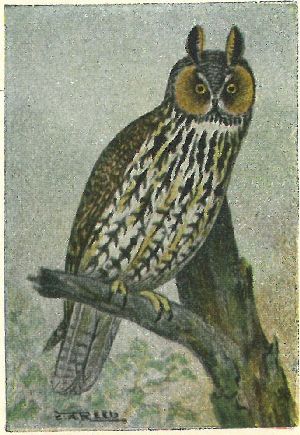
HORNED OWLS—Family Bubonidæ
AMERICAN LONG-EARED OWL
366. Asio wilsonianus. 15 in.
This species can readily be distinguished from the next, which is the only one of the same size, by its long ear tufts; it is also darker, and the markings on the breast are largely in the form of bars. In the northern portions of the United States, this species is probably the most abundant of owls, excepting the little Screech Owl. It is often quite common, where its presence is little suspected, because, unless disturbed, it flies only at night and is a rather silent species. During the daytime it is usually sitting upright in the dense tops of evergreen trees. Crows often discover them, and proclaim their hiding place to the whole neighborhood by their incessant cawing. Owls of all kinds are in disfavor with crows.
Notes.—A soft-toned “wo-hunk, wo-hunk.” (Bendire.)
Nest.—They lay from four to seven pure white eggs, usually in old crow nests.
Range.—Resident from the Gulf to Nova Scotia and Manitoba.
[224]
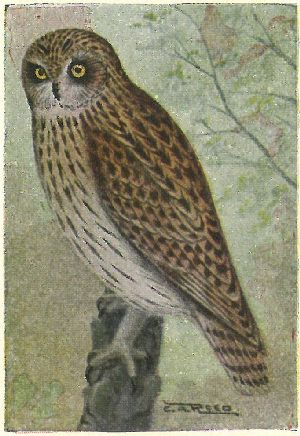
SHORT-EARED OWL
367. Asio flammeus. 15.5 in.
Ear tufts very short; general color buffy, not nearly as brown nor as dark as the last species usually is. They are not nearly as nocturnal as most of the owls, and most of their hunting is done about dusk, when they may be seen flying close to the ground over marshes or low land. Their flight is perfectly silent, which aids them in securing their prey of field mice, which they usually get without stopping in their flight, just swooping down, extending their long legs, armed with wicked little claws, and it is all over with the little rodent, he being carried to a nearby stump, and devoured, fur, bones and all.
Notes.—A very short, shrill cry, evidently their call note, and a low clucking uttered as they swoop over your head; besides the usual snapping of the bill.
Nest.—On the ground, usually in marshes; the four to seven eggs are pure white, (1.55 × 1.25).
Range.—Breeds locally from the Gulf to the Arctic regions; winters throughout the United States.
[225]
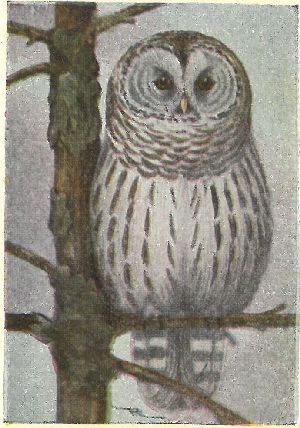
BARRED OWL
368. Strix varia. 20 in.
Eyes dark brown. This is the most abundant of the large owls throughout its range. It has no ears. This species is the common “hoot owl,” that is the terror of small children and many older ones. They are noisy birds, and two of them like to get at opposite sides of a piece of woods and talk to each other. Their notes are very variable but are oftenest combinations of “who-whos” and “too-toos,” often ending in a mournful wail. They spend the day in slumber, unless routed out of the dense trees where they rest, by crows or human beings. They are one of the least harmful of the family and should be protected.
Nest.—Usually in hollow trees, but sometimes in old crow nests. Eggs pure white (1.95 × 1.65).
Range.—Resident in eastern North America. 368a. Florida Barred Owl (alleni), is smaller, darker and the toes are unfeathered, as are those of 368b, Texas Barred Owl, found in southern Texas.
[226]
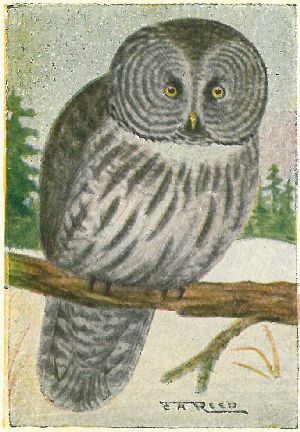
GREAT GRAY OWL
370. Scotiaptex nebulosa. 27 in.
Tail long; eyes small and yellow. This large owl is only found in Northern United States during the winter. Its tail is unusually long, as are all its feathers, thereby making it appear a very much larger bird than it really is; it weighs but little more than the Barred Owl. They do not appear to be in especial abundance anywhere, but occasionally large flights of them will occur in some parts of the country; they seem to occur most freely in Minnesota and North Dakota. They are nocturnal like the majority of the family, and subsist largely upon mice and hares.
Nest.—Of sticks, in trees, usually pines, in heavily wooded districts; eggs white (2.15 × 1.70).
Range.—Breeds from southern Labrador, Hudson Bay and Alaska northward; winters south to the northern border of the United States and casually to Long Island and Illinois.
[227]
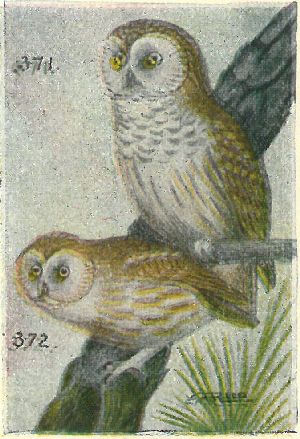
RICHARDSON OWL
371. Cryptoglaux funerea richardsoni. 10 in.
This species bears considerable resemblance to the little Acadian Owls, but is grayer; the top of the head has numerous round white spots and the wing coverts are spotted with white.
Nest.—Usually in holes of trees; eggs white.
Range.—Breeds throughout Canada, and possibly in the northern parts of the northern states; winters south to northern United States.
SAW-WHET OWL; ACADIAN OWL.
372. Cryptoglaux acadica. 8 in.
Smallest of our eastern Owls; no ear tufts. General color brownish above and white below with the sides streaked with brown. No markings on wing coverts, but scapulars spotted with white. It is chiefly nocturnal in its habits and, consequently, is not often seen even if they are abundant.
Range.—Breeds from northern U. S. northward; winters in northern United States.
[228]
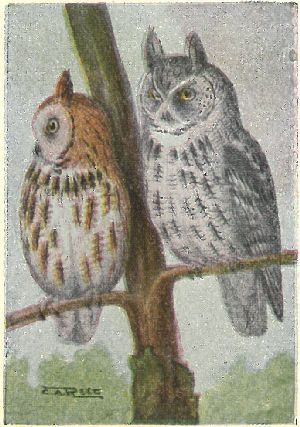
SCREECH OWL
373. Otus asio. 9.5 in.
Two color phases independent of age, sex or season; eyes yellow; has ear tufts. The Screech Owl, or its sub-species, is found throughout the United States, and is one of the most abundant and best known of the family. They are not at all timid, in winter frequently being found in church towers, while on the outskirts of cities and in the country, they reside, at all seasons of the year, in orchards. They remain mated for life, and live in the same tree for years, if not too much disturbed by curious boys. Both adults and the four young are often found in the nest together, and they offer no resistance when they are removed by hand. Their food is almost wholly of insects and rodents.
Notes.—A wavering trill.
Nest.—In holes of trees; eggs white (1.35 × 1.20).
Range.—Resident in U. S. and southern Canada. 373a. Florida Screech Owl (floridanus), is smaller and slightly darker, 373b. Texas Screech Owl (mccalli), is smaller and more heavily barred on the sides.
[229]
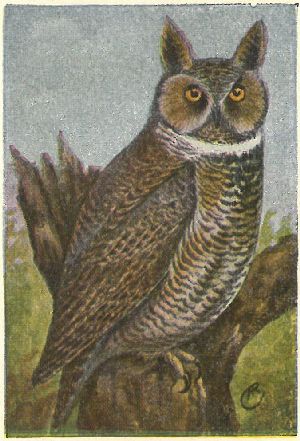
GREAT HORNED OWL
375. Bubo virginianus. 23 in.
Has ear tufts, thus distinguishing it from any other of our large, powerfully built owls. These large birds are the fiercest, most active and most destructive of the family. Their size and strength allows them to kill skunks and woodchucks, as well as poultry, grouse and small mammals and birds. They seem to be especially fond of skunks, and nearly all of them that I have seen or handled, have given unmistakable evidence of their recent and close association with these animals.
Notes.—A deep, dismal “who-who,” and a loud unearthly shriek.
Nest.—Usually in deserted hawk or crow nests, and also in hollow trees; eggs white (2.25 × 1.85). Feb., March.
Range.—Breeds and resident from the Gulf to Labrador. 375a. Western Horned Owl (pallescens) is paler colored; found in the plains and Rockies north to Manitoba. 375b. Arctic Horned Owl (subarcticus), is chiefly black and white; found in Arctic America, wintering south to northern border of United States.
[230]
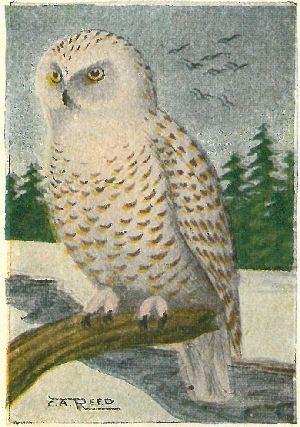
SNOWY OWL
376. Nyctea nyctea. 25 in.
No ear tufts. Plumage white, more or less heavily spotted with black, the female usually being quite strongly barred on the back. They are locally abundant in the far north, preferring low, mossy lands to the more timbered districts. Here they find an abundance of food during the summer months, living upon hares, lemmings, ptarmigan and ducks. They are about the equal of the Horned Owl in strength, and usually will weigh a few ounces more; they will frequently kill animals or birds as heavy, or heavier, than themselves. They also catch a great many fish; these they get in shallow water among the rock-weed covered stones, by reaching down quickly and seizing their prey in their strong claws.
Nest.—On the ground in dry portions of marshes; the 2 to 8 eggs are pure white.
Range.—Breeds from Labrador and Hudson Bay, northward, and possibly farther south; winters casually to the Middle States, and commonly to Minnesota and Maine.
[231]
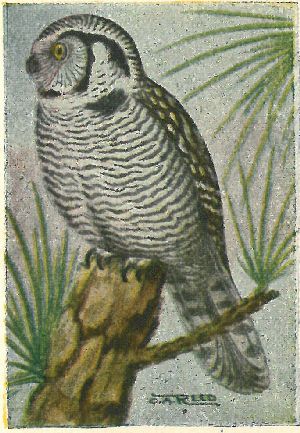
AMERICAN HAWK OWL
377a. Surnia ulula caparoch. 15 in.
Tail long and rounded; plumage mottled black, white and gray, with little, if any, brownish tinge; heavily barred with black. These owls, curiously resembling a hawk in build, and more so in flight, are very active and hunt more during the daytime than after dark. They feed largely upon small rodents and lemmings which are very abundant in their summer home, and also kill a great many small birds. They seem to be impartial to wooded districts, or open marshes and low lands, where they may be seen skimming about close to the ground.
Nest.—Either of sticks in the tops of trees, or in hollow cavities. The eggs are white, as are those of all owls, and nearly globular in shape (1.40 × 1.25).
Range.—Breeds from Newfoundland and Manitoba northward, and possibly farther south on the mountains. Winters south to northern United States, rarely to New York and Illinois.
[232]
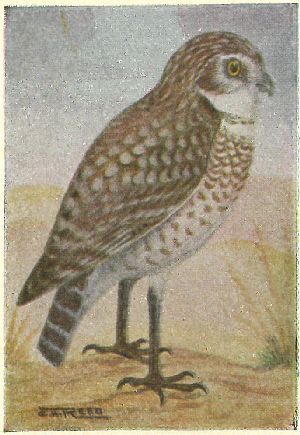
BURROWING OWL
378. Speotyto cunicularia hypogœa. 10 in.
Legs very long, and nearly bare on the lower part of tarsi; tail short; no ear tufts. An abundant and useful species in the prairie regions west of the Mississippi. They live in the same region that prairie dogs are found, using deserted burrows of these animals, or taking them by force, for they are more than a match for these curious animals; they do not, as has often been said, live peaceably in the same burrows with them. On the contrary, young prairie dogs, as well as rodents, small snakes and birds, form a large part of their daily diet. They are both diurnal and nocturnal, doing most of their hunting after dusk, but often seen sitting at the mouth of the burrow during the daytime. The six to ten eggs that they deposit at the end of these burrows are white.
Range.—West of the Miss. Valley, north to Southern Manitoba and British Columbia. 378a. Florida Burrowing Owl (floridana), is smaller and whiter; found in southern Florida.
[233]