BIRD GUIDE (continued 2)
Reading edition
Range.—Florida and the Gulf States, and Southern Texas.
[114]
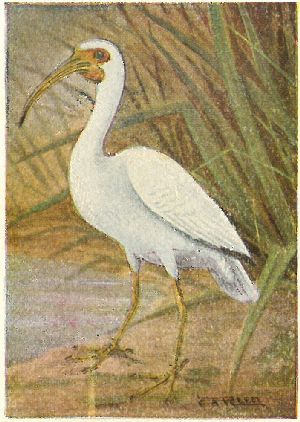
IBISES—Family Ibididæ
WHITE IBIS
184. Guara alba. 25 in.
Tips of primaries black; plumage, otherwise, entirely white; bill, face and legs, orange red or carmine. Young with head and neck, and more or less of the body, brownish or streaked with brown. White Ibises are very abundant in the South Atlantic and Gulf States, breeding in immense rookeries in remote swamps, placing their frail platforms in bushes over the water or sometimes weaving nests out of rushes, attached to upright canes and brake. These rookeries are very untidy and offensive to human beings, and millions and millions of black flies and mosquitoes will be encountered by any who wish to investigate the breeding places of these birds.
Notes.—A loud, harsh croak.
Nest.—Of twigs in bushes, or of rushes in the tangle and brake of marshes; 3 or 4 whitish eggs, handsomely spotted and splashed with brownish.
Range.—Breeds north to South Carolina and Southern Ill. Winters from the Gulf States southward.
[115]
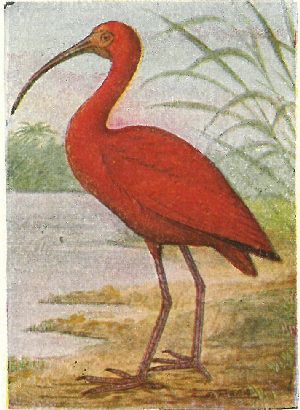
SCARLET IBIS
185. Guara rubra. 25 in.
This beautiful species is wholly bright scarlet, except for the black primaries; young birds are found in all stages of plumage from the brownish-gray and white of the first year birds, to the full plumage of the adults.
This is a tropical ibis that abounds in northern South America, but is yearly decreasing in numbers, owing to the persistency with which they are hunted, their feathers being much in demand for tying trout flies, as well as for decorating hats, a barbarous practice that is being stopped in this country, by legislation and public sentiment.
Nest.—In rushes or mangroves like that of the last species; the eggs are the same size but average brighter in color (2.25 × 1.60).
Range.—Northern South America, casually north to the Gulf States, but has not been reported for years in our country.
[116]
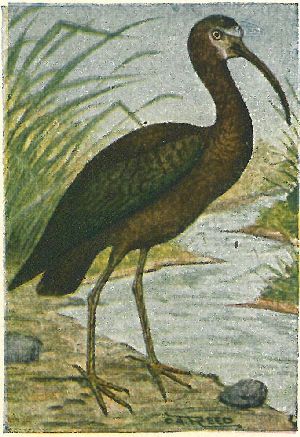
GLOSSY IBIS
186. Plegadis autumnalis. 25 in.
Like the next, which is our common species, but with the feathers about the face not white, as in that species.
Range.—Tropical America, casually north to southeastern United States.
WHITE-FACED GLOSSY IBIS
187. Plegadis guarauna. 24 in.
Bill, face and legs, carmine red; feathers bordering the face, white; wings and tail glossy greenish-black; rest of plumage rich chestnut-brown, glossed with purple on the head. They nest by thousands in extensive swamps, in company with herons.
Nest.—Strongly and compactly woven of dead rushes attached to living stalks, well cupped, thus differing from that of any of the herons; eggs plain greenish blue (1.95 × 1.35); deeper and brighter than those of any of the herons.
Range.—Texas, New Mexico, Ariz., Calif., and southward.
[117]
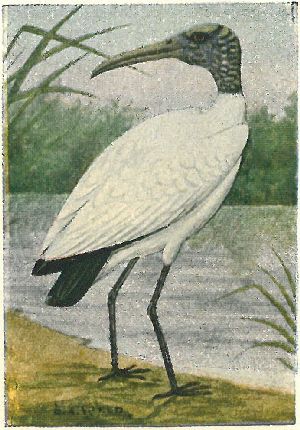
STORKS—Family Ciconidæ
WOOD IBIS
188. Mycteria americana. 40 to 46 in.
Entire head unfeathered and covered with scales; both head and legs are pale bluish in color; eye brown; plumage entirely white except for the glossy purplish-black primaries and tail. This large bird is a true stork and is very similar to the common European Stork. The name ibis was incorrectly and unfortunately applied to this species, and tends to confusion. Its flight is very easy and graceful, accomplished with a slow flapping of the wings, alternated at short intervals with long sails. At times they mount high in the air and circle about like hawks or vultures.
Notes.—Loud, hoarse croaks.
Nest.—A shallow platform of sticks in bushes or at low elevations in trees, usually over the water, the birds swarming in the most inaccessible swamps. Their 3 or 4 eggs are white and granular.
Range.—Breeds in the Gulf States and north to South Carolina; later may stray north to New York.
[118]
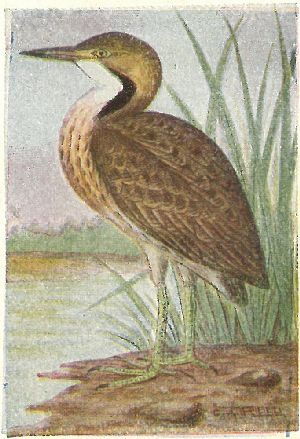
BITTERNS, ETC.—Family Ardeidæ
AMERICAN BITTERN
190. Botaurus lentiginosus. 28 in.
Much variegated with brown and yellowish-brown; adults with a long, broad, black stripe on either side of the white throat; eye yellow; legs and base of bill greenish-yellow. Bitterns have a great many local names, most of which refer to the peculiar pumping noise that the male makes during the mating season. Perhaps the most common of these is “Stake-driver.” Bitterns are found in bogs or marshes; they remain concealed by the tall grass until any intruder is very near, before they take flight.
Notes.—A squawk of alarm; song a hollow “punker-lunk.”
Nest.—A grass-lined hollow in tufts of grass or turf, in the middle of bogs or marshes. 3 or 4 plain brownish eggs, measuring 1.95 × 1.50. But one or two pairs nest in a locality; May, June.
Range.—Breeds in the northern half of the United States and Southern Canada; winters in southern half of the United States.
[119]
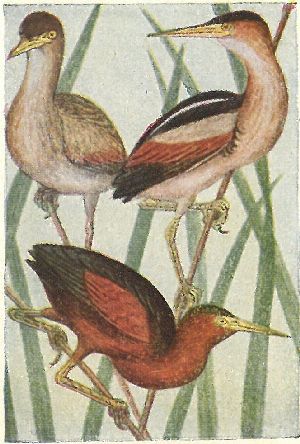
LEAST BITTERN
191. Ixobrychus exilis. 13 in.
Male with the crown and back glossy black; female with these areas hair-brown, and streaked with brown below. These diminutive little bitterns are very shy and retiring, and seldom seen away from the reed grown marshes or ponds that they frequent.
Notes.—A hoarse croak, and a softly repeated “coo.”
Nest.—A platform of dead rushes twisted about the living stalks. The 3 or 4 eggs are pale bluish white. (1.2 × .9); May, June.
Range.—Breeds from the Gulf States, locally to Southern Canada; winters from the Gulf States southward.
CORY LEAST BITTERN
191.1. Ixobrychus neoxynus. 13 in.
This extremely rare little bittern is of the same size and form as the common species. The crown, back, wing-feathers and tail are black, and the rest of the plumage is more or less intense chestnut brown. The majority of specimens have been taken in Florida and Ontario, with one each from Michigan and Massachusetts. There are about twenty of them known to be preserved.
[120]
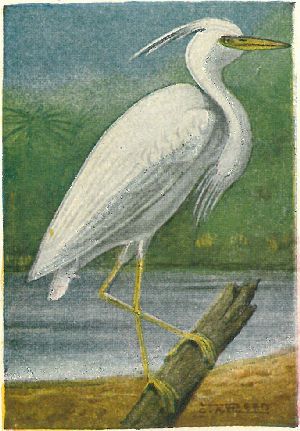
GREAT WHITE HERON
192. Ardea occidentalis. 50 in.
This is the largest heron that we get in North America, surpassing even the Great Blue. Its plumage is entirely white; no “aigrettes” on the back, but two white plumes on the back of the head and the feathers of the breast much lengthened, the same as in adult Blue Herons; bill, eyes and legs yellow. A gray phase of this heron, or a hybrid between it and the Great Blue Heron, is occasionally found in Southern Florida; it is similar to the Blue Heron, but paler and with the head and neck white.
Nest.—A large platform of sticks placed in the tops of mangroves. Their three or four eggs are not distinguishable from those of the next species; June.
Range.—Said to be not uncommon on some of the Florida Keys.
[121]
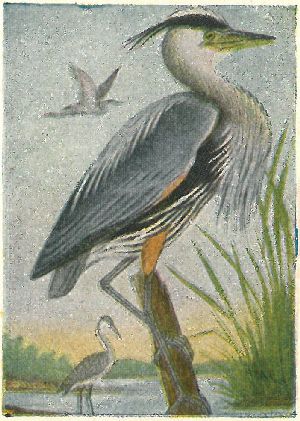
GREAT BLUE HERON
194. Ardea herodias. 48 in.
Adult Blue Herons are very handsome birds, as may be seen in the illustration. Young birds, and nine out of ten that we see will be young birds, are much duller colored and have no plumes. It takes several years for them to attain their perfect plumage. Their nests are placed in the tops of the tallest trees and are, consequently, difficult to get at. In some heronries, trees have been found containing as many as 40 nests. In flight, herons always carry their head drawn in against the shoulders, the neck being curved below.
Nest.—A platform of sticks in tall trees in wet woods. 3 or 4 pale greenish-blue eggs (2.50 × 1.50); May, June.
Range.—Breeds locally throughout the United States and Canada, either in colonies, or single pairs where they are persecuted as in New England; winters in Southern U.S. 149b. Ward Heron (A. h. wardi) is similar but lighter below and the neck is darker and browner; it abounds in Florida.
[122]
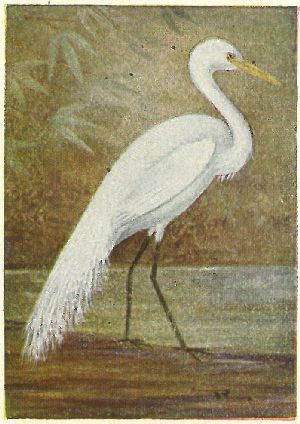
AMERICAN EGRET
196. Herodias egretta. 41 in.
Entirely white, with no plumes on the head but with a long train of straight “aigrette” plumes growing from the middle of the back; bill and eye, yellow; legs and feet, black. Young and adults in winter, without plumes. The hand of man, to gratify the desire of woman, has ruthlessly slaughtered thousands upon thousands of these exquisitely beautiful birds; in Florida where they were abundant a few years ago, only stragglers are seen. A few of these heronries are yet left, either because they are in wildernesses where man has not yet penetrated, or are strongly protected by the humane owners of the land. It is only at the breeding places that they can be killed in numbers, as at other times they are shy; and it is only during nesting season that they wear their beautiful plumes.
Nest.—A frail platform of sticks, at low elevations, in bushes usually over water in swamps. Eggs, 3 or 4 in number, plain bluish green (2.25 × 1.45); April to June.
[123]
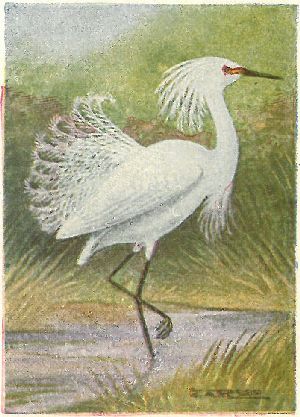
SNOWY HERON
197. Egretta candidissima. 24 in.
Plumage white; in breeding season with numerous recurved plumes growing from the middle of the back; long crest of plumes on the back of the head, and on the breast. Bill black, greenish at the base and about the eyes; legs black; feet yellow. This species is the most beautiful of the Egrets and consequently is the one that has suffered most from “plume hunters.” Although they are now protected wherever they can be, their ranks have been so decimated that extermination is threatened within a few years; the demand for their plumes is still so great that lawless men will commit murder to obtain them (Warden Bradley having been shot in 1905, while preventing the destruction of herons in Southern Florida).
Nest.—In swamps, in company with other small herons, the nests being frail platforms of twigs on branches of trees. Eggs pale greenish-blue.
Range.—Breeding range formerly coincident with that of the last, but now very rare.
[124]
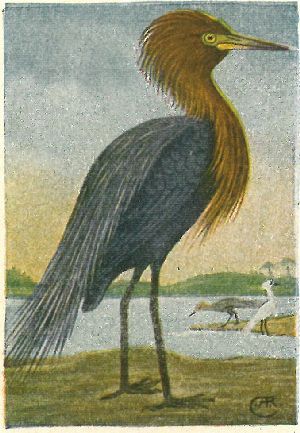
REDDISH EGRET
198. Dichromanassa rufescens. 29 in.
Two color phases, the gray being the most common:—Head and neck, including plumes on neck and breast, reddish-brown; rest of plumage gray, the plumes on the back being lightest; feet blue-black; bill yellowish at the base and black at the tip. In the white phase, the plumage is entirely, or nearly, white, including the plumes. As usual, these egrets associate in large flocks, of their own kind or other small herons. Their food consists of small fish, frogs, lizards, insects and mice. They will stand motionless in shallow water, for a long time waiting for their prey, and woe to the creature that comes within striking distance of their spear-like bill. Their flight is strong and graceful as they make their way from their breeding places to their feeding grounds on the mud flats, left bare by the receding tide.
Nest.—Like that of other herons; eggs slightly more greenish blue than those of the other egrets (1.9 × 1.45); May, June.
Range.—Breeds in the Gulf coast states, and north to South Carolina.
[125]
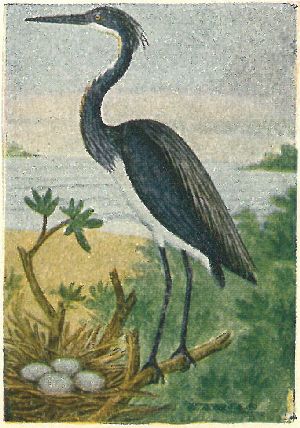
LOUISIANA HERON
199. Hydranassa tricolor ruficollis. 26 in.
In breeding plumage, with short plumes on the back, extending three or four inches beyond the tips of the wings. Throat, front line of neck, and underparts white; head and neck reddish-purple; back and wings slaty; crest whitish; bill and legs dark; eyes red. A very abundant species throughout the year, on the Gulf coast of the United States. Their bearing is one of self-esteem and their walk slow and stately; they are often called “Lady of the Waters,” because of the imposing picture that they make. They are very sociable, rarely quarrel among themselves, and are usually found in company with Little Blue Herons and Egrets.
Nest.—They nest in communities in mangroves in southern Florida and in swamps, in company with many other species, in the northern portions of their range. Their nesting habits and eggs are the same as those of the Snowy Heron.
Range.—Breeds and is resident in the South Atlantic and Gulf States.
[126]
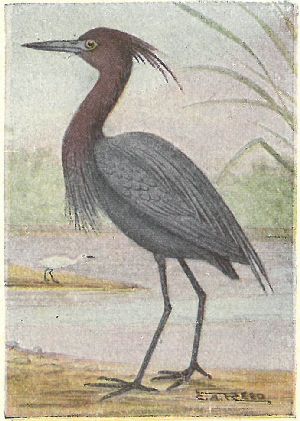
LITTLE BLUE HERON
200. Florida cærulea. 22 in.
Head and neck, maroon; rest of plumage slaty-blue; plumes on back of head, breast and on the back; eyes yellow; bill and feet greenish. Young birds are white, usually with a tinge of bluish on the forehead and ends of the wings. They can be distinguished from the similar Snowy Herons by the greenish-black legs, while the legs of the latter are black with yellow feet. These little herons are resident and most abundant in the South Atlantic and Gulf States. They are at home in and enjoy the rankest and most impenetrable swamps, where only birds or reptiles can tread with safety. Yet herons are an interesting group and, in their own way, perform useful service to mankind by destroying quantities of reptiles, insects and mice.
Nest.—The nesting habits and eggs of this species are the same as those of the little Snowy Heron and the eggs cannot be distinguished with certainty.
Range.—Breeds north to Virginia and Illinois; later may stray north to New England.
[127]
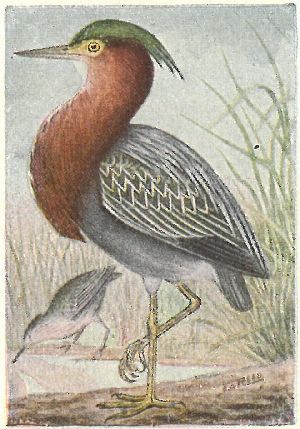
GREEN HERON
201. Butorides virescens. 17 in.
Smallest of the family, except the Least Bittern. In breeding plumage, they are one of the most beautiful of herons. They may be found in marshes, along creeks or about the edges of shallow ponds or lakes. They are often seen sitting upon a partly submerged log sunning themselves, or waiting for a tempting frog or fish to pass within reach. When they are among rushes, they will usually attempt to escape observation by mimicking their surroundings, and they do so very successfully. When they are alarmed and take flight they utter a single sharp shriek. At other times they utter a series of hollow screams, “qu-ick, qu-ick,” and also a hollow croak.
Nest.—In bushes, in communities or in company with other species in the south, but usually a few pairs nest in a locality in the northern states and Canada. Eggs pale bluish-green (1.45 × 1.10).
Range.—Breeds from the Gulf to Manitoba and Nova Scotia; winters in the Gulf States.
[128]
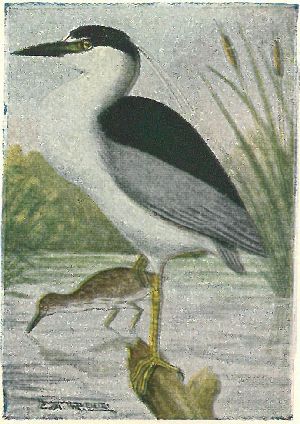
BLACK-CROWNED NIGHT HERON
202. Nycticorax nycticorax nævius. 24 in.
Bill much heavier than that of the herons; neck and legs shorter and stouter; eye red; bill black; legs and bare space in front of eye, pale yellowish-green. Young birds are mottled with brownish-gray and white; eyes yellow. As their name implies, these herons do most of their feeding after dusk, sleeping during the greater part of the day. Their heronries are usually located in swamps, and preferably in coniferous trees. A visit to one of these is very interesting, but old clothes must be worn, for their homes are filthy. On your approach, the old birds flap away, and circle about with squawks of disapproval, and all the young birds commence a loud ticking noise, like what would be produced by hundreds of huge “grandfather’s clocks.”
Notes.—A harsh “quark.”
Nest.—A platform of sticks; eggs pale bluish-green. (2.00 × 1.40).
Range.—Breeds north to New Brunswick and Manitoba; winters in the Gulf States and southward.
[129]
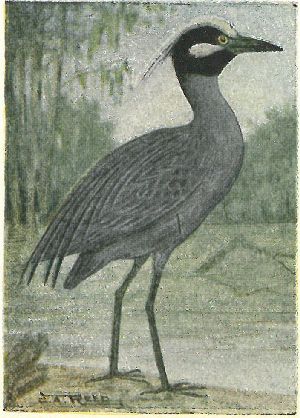
YELLOW-CROWNED NIGHT HERON
203. Nyctanassa violacea. 23 in.
Like the last species, the head of this one is adorned with three long, rounded, white plumes; in life these plumes are rarely separated, but are nested together so that there appears to be but one. As dusk approaches, these birds sally out from their roosting or nesting places, and with slow, measured flaps, wing their way to their feeding grounds, which are usually fresh water bogs, teeming with animal and insect life. After dark the “quark” of Night Herons is frequently heard as the birds pass overhead, and they can very easily be decoyed by a crude imitation of their call. This species is principally confined to the South where it is found in heronries of its own kind, or in company with others.
Notes.—Like those of the Black-crowned Night Heron.
Nest.—A platform of sticks in trees, in swamps. 3 or 4 pale bluish-green eggs (2.00 × 1.40); May.
Range.—Breeds north to South Carolina and Southern Illinois; later may stray farther north.
[130]
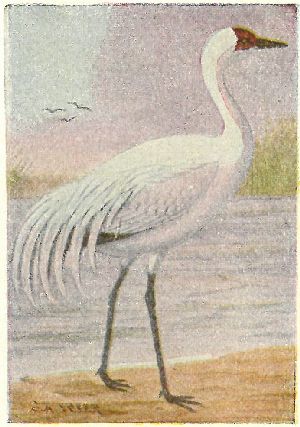
CRANES, RAILS, ETC.—Order Paludicolæ CRANES—Family Gruidæ
WHOOPING CRANE
204. Grus americana. 50 in.
Plumage white, with black primaries; the inner wing feathers greatly lengthened, making a flowing train. Head of adult, largely bare, carmine colored, and with a few black hair-like feathers; eye yellow; bill and legs black. Young birds are whitish, mixed with gray. These great birds are not uncommon on the prairies of interior America, where they frequent the edges of marshes and sloughs. They are very wary and their great height enables them to see anyone a long way off, above the marsh grass. They were formerly found on the South Atlantic coast, but are now extremely rare there.
Notes.—A loud whooping scream.
Nest.—On the ground, usually in marshes; it is a bulky mass of grass and weeds, with the hollowed top a foot or more above ground. The two eggs that they lay are brownish-buff, spotted with brown (3.75 × 2.50); May, June.
[131]
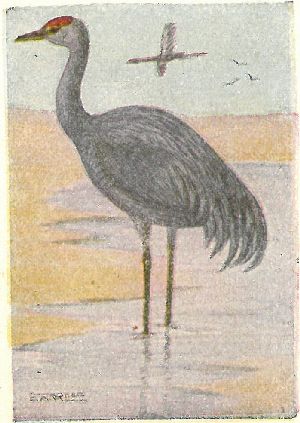
LITTLE BROWN CRANE
205. Grus canadensis. 36 in.
Like the next and better known species, but smaller and browner, especially on the wings.
Range.—Breeds in the interior of Northern Canada; migrates, west of the Mississippi and east of the Rockies, to Mexico.
SANDHILL CRANE
206. Grus mexicana. 44 in.
Plumage entirely grayish with a few brownish feathers; bare skin on top of head, red. These cranes are locally distributed in the Gulf States, and in the interior north to Manitoba. Their food consists largely of grasshoppers, worms and lizards. Unlike herons, their young are born covered with down and can run about as soon as they appear. When flying, cranes carry their neck full outstretched.
Nest.—On the ground like that of the Whooping Crane.
Range.—Winters on the Gulf coast and in Florida; breeds north to Manitoba.
[132]
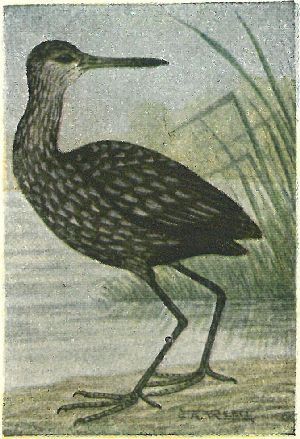
COURLANS—Family Aramidæ
LIMPKIN
207. Aramus vociferus. 27 in.
These singular birds are the connecting link between the cranes and the rails. They are rarely seen in flocks, usually living a secluded life in pairs. They are often known as the “crying bird,” because of the peculiar wailing cries that they utter, both in daytime and after nightfall. They are great skulkers, and it is difficult to make them fly; when they do take wing, it is only to go a few rods before dropping into the shelter of the reeds again. They can run rapidly, having a peculiar mincing gait, that is said to have given them the name of Limpkin.
Notes.—A peculiar wailing “whee-ee-eu.”
Nest.—A loosely constructed platform of sticks, leaves, grass and moss, located a few feet from the ground in tangled underbrush or vines. The 4 to 7 eggs are buffy white, blotched with brown (2.30 × 1.70); April, May.
Range.—Breeds and is resident in Southern Florida, and casually Texas.
[133]
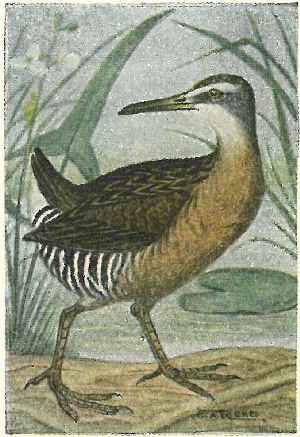
RAILS, GALLINULES AND COOTS—Family Rallidæ
KING RAIL
208. Rallus elegans. 18 in.
Back handsomely patterned with black, olive-brown and gray; wing coverts reddish-brown; neck and breast, rich cinnamon-brown, brightest on the breast. Sides sharply barred with black and white. This species is the handsomest of the rails, and is the most distinctly and brightly marked. They are excellent runners and are very difficult to start from the marsh grass within which they are concealed. They are usually found in fresh water marshes, while the next species is most abundant in salt marshes; they are both often found in the same place and must be seen at close range to distinguish them.
Notes.—A loud “bup, bup, bup” repeated and ending in a roll. (Chapman).
Nest.—Of grass and weeds on the ground in marshes. The eggs are pale buff, spotted with reddish-brown (1.6 × 1.2); June.
Range.—Breeds from the Gulf coast north to Conn., Ont., and Minn. Winters in southern U. S.
[134]
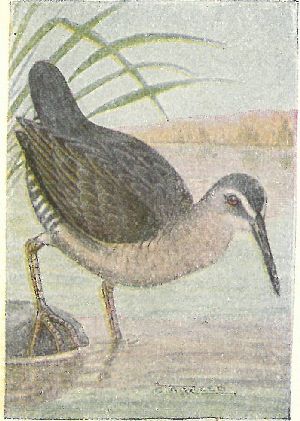
CLAPPER RAIL
211. Rallus crepitans. 15 in.
General color above olive-grayish, with no strong black markings; breast pale brown; flanks barred with gray and white. This species is found almost exclusively in salt marshes, where they skulk about like rats. During exceptionally high tides, when their hiding places are covered, many of them are killed by negroes and white men for food; they can swim, but usually run across the marsh, making use of blades of grass, sticks or whatever trash may be in their course, as stepping stones.
Notes.—Loud and clacking like those of the King Rail.
Nest.—Of grasses on the ground in salt marshes; 6 to 14 buffy eggs, spotted with brown (1.70 × 1.20).
Range.—Salt marshes of the Atlantic coast, north to Mass. The following subspecies are darker and very locally distributed. 211a, Louisiana Clapper (R. c. saturatus), coast of La. 211b, Scott Clapper (R. c. scotti), Gulf coast of Fla. 211c, Wayne Clapper (R. e. waynei), east coast of Fla. to S. C.
[135]
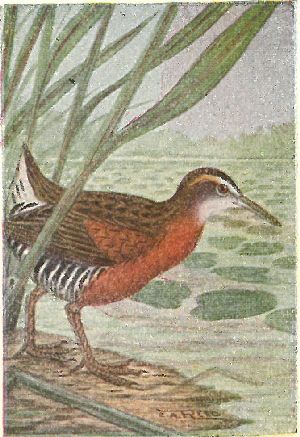
VIRGINIA RAIL
212. Rallus virginianus. 9.5 in.
Coloration almost exactly like that of the King Rail, but the bird is much smaller. Like that species, this one prefers fresh water marshes. They have a great aversion to flying, and, like other rails, will trust to their legs for safety, should danger threaten; probably no other birds are as dexterous as the rails in threading their way through the close standing rushes. Although they do not have webbed feet, they can swim fairly well, and also dive, but they do so only when they are forced to. They look extremely awkward as they run over the trash on the marsh, their head and neck erect and extended, with their head rapidly turning from side to side as though looking for a place of safety.
Notes.—A guttural, rattling “cut-cut-cut-ee.”
Nest.—Of grasses, on the ground or in tufts of rushes; eggs creamy-white, specked with brown (1.25 × .90); May, June.
Range.—Breeds in the northern half of the United States and southern Canada; winters in southern U. S.
[136]
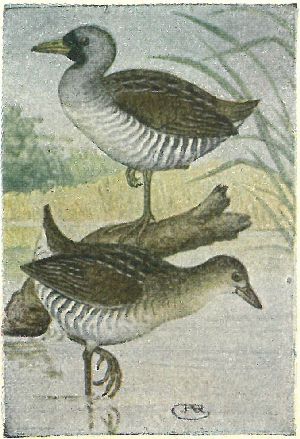
CAROLINA RAIL; SORA
214. Porzana Carolina. 8.5 in.
Adults with the face and throat black. Young with no black on the head. This species is not apt to be confused with any, except, possibly, the Virginia Rail, which is somewhat larger, and always has the breast conspicuously cinnamon color. These birds are very abundant in nearly their whole range, but they are so secretive in their habits that their presence is often not noticed. Unless disturbed, they pass the greater portion of the day in slumber, and do most of their feeding after dusk, when their confused, clucking notes are heard all over the marshes. All of the rails have this habit of feeding chiefly at night, perhaps through fear of enemies during the daytime, for they seem to be very timid birds.
Notes.—A rapid clucking, “kuk, kuk, kuk,” etc.
Nest.—A rude structure of grass and rushes on the ground in either salt or fresh marshes; 6 to 16 buff colored eggs with reddish brown specks.
Range.—Breeds in the northern half of the U. S. and northwards; winters in the southern half.
[137]
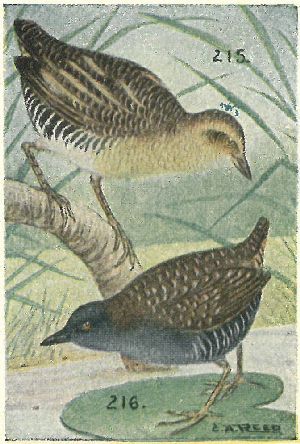
YELLOW RAIL
215. Coturnicops noveboracensis. 7 in.
This is a handsome bird, the entire plumage having a glossy lustre. The back is blackish, with all the feathers edged with white, while the head, neck and breast have a peculiar yellowish-brown shade.
Nest.—On the ground; made of rushes and grass woven and twisted together; the 6 to 12 eggs are rich buff color, specked in a wreath about the large end, with reddish-brown; size 1.10 × .80; June.
Range.—Breeds in northern U.S. and southern Canada; winters in the southern states.
BLACK RAIL
216. Creciscus jamaicensis. 5 in.
Much smaller than any of our other rails; very dark.
Notes.—A peculiar, loud clicking sound.
Nest.—Of grass and rushes, well cupped to receive the 6 to 12 eggs; these are creamy white, speckled with reddish brown (1.03 × .75); June.
Range.—Breeds in the United States north to Mass., southern Minn, and Oregon. Winters in the West Indies and Central America.
[138]
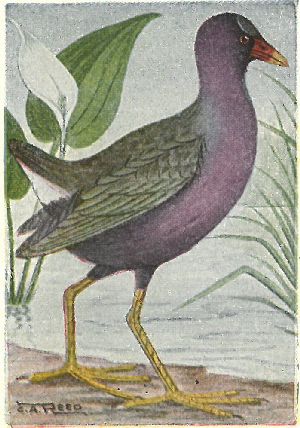
PURPLE GALLINULE
218. Ionornis martinicus. 13 in.
Bill shorter and stouter than that of the rails, and with a hard shield at the base, that extends on the forehead to the top of the head. This species is beautifully colored with purplish-red and blue on the underparts, and greenish on the back and wings; legs yellow; bill carmine, tipped with yellow. The habits of the gallinules are practically the same as those of the rails. They inhabit marshes, where they creep cautiously but rapidly through the upright stalks, or run over the slimy surface, where none but birds with extremely long toes could get a foothold. Their powers of flight are weak, and they do not take wing unless they are cornered or wish to cross some stream.
Nest.—Woven of grasses and rushes, and placed either on the ground or attached to living rushes, usually over the water; their 5 to 10 eggs are rich cream color, spotted with reddish brown (1.60 × 1.15).
Range.—Breeds in eastern United States, north to North Carolina and southern Illinois; winters south of the U. S.
[139]
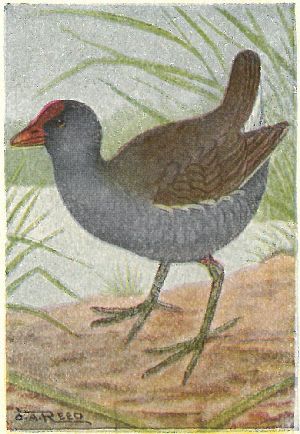
FLORIDA GALLINULE
219. Gallinula galeata. 13 in.
Bill and crown plate, red, tipped with yellow; legs greenish with a red ring around the top; plumage gray changing to blackish on the head and neck. Florida Gallinules are very noisy, especially during the mating and breeding season, and marshes in the south, where they breed by hundreds, fairly ring with their cries chuckles and squawks. They have an almost endless variety of notes but all of them are harsh and explosive. At times they appear to be stupid, and allow anyone to approach in a boat, near enough to touch them with an oar. When frightened, and with no protecting rushes to conceal them, they will rush off over the grass and water, with much spattering and squawking.
Nest.—Usually fastened in the marsh grass or flags above water; made of rushes and grass; the eggs are similar to those of the Purple Gallinule but are duller.
Range.—Breeds north to southern New England, Ontario, Minnesota and Oregon; winters in southern U. S.
[140]
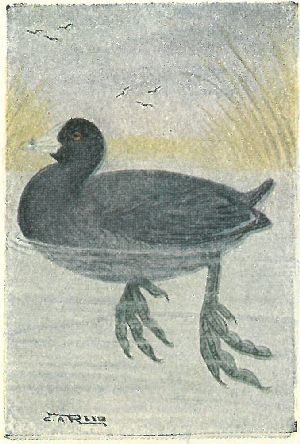
AMERICAN COOT
221. Fulica americana. 15 in.
Bill and frontal shield as in the gallinules, but the bill is whitish with a blackish ring near the tip; each individual toe is furnished with a large scalloped web; otherwise their plumage is grayish like that of the Florida Gallinule. Coots are, locally, very abundant throughout temperate North America in summer. Like gallinules, they inhabit reedy pools, sluggish streams and boggy marshes, where they are at least safe from human pursuit. They conceal themselves among the reeds, so as to escape observation, taking wing only when they are obliged to. They are expert swimmers, and can dive and swim for long distances under water; in this respect they have a decided advantage over the rails and gallinules.
Nest.—Like that of the gallinules; 6 to 15 grayish eggs, finely speckled with black (1.80 × 1.30). May, June.
Range.—Breeds throughout temperate America, rare on the North Atlantic coast; winters in southern U. S.
[141]
SHORE BIRDS—Order Limicolæ PHALAROPES—Family Phalaropodidæ
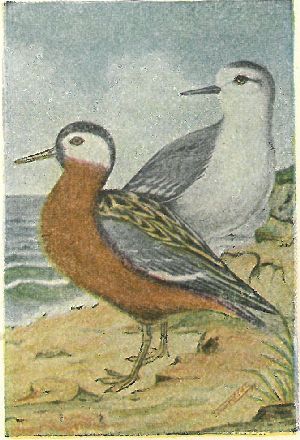
RED PHALAROPE
222. Phalaropus fulicarius. 8 in.
Bill heavier than any of the other phalaropes; feet lobate-webbed. Adults in summer have the entire underparts reddish brown; side of head white; upper parts gray, white and black. In winter, head and underparts are white; back gray. Phalaropes differ from any other of our birds, in that the female is the larger and brighter plumaged bird, and the duties of incubation are largely or chiefly performed by the male bird. These phalaropes are very rarely seen in the United States in their breeding plumage; when they come in the Fall, nearly all have changed to their dull winter dress, and they keep this until after they leave us in the Spring.
Nest.—A hollow in the ground, lined with a few grasses; eggs greenish buff, spotted with blackish.
Range.—Breeds in the Arctic regions; winters south to New York, Calif., and Ohio, chiefly on the sea coasts.
[142]
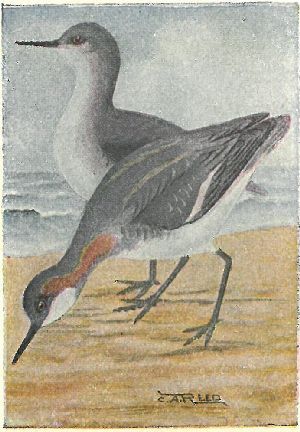
NORTHERN PHALAROPE
223. Lobipes lobatus. 7.5 in.
Bill short and slender. Female in summer with reddish-brown breast; gray upper parts mixed with white and buff; throat and belly, white. Male, similar but duller colored. In winter, the upper parts are gray mixed with white, and the underparts are pure white. This is a maritime species that nests in the far north, and appears on our coast only for a short time during migrations. Like the last, they are expert swimmers and pass most of their time, when not breeding, upon the surface of the water, where they can outride the most severe storms in safety. They feed upon minute insects that they secure from beds of floating kelp.
Notes.—A sharp, rapidly repeated, metallic “tweet.”
Nest.—A grass-lined hollow in the ground; eggs greenish-buff, spotted with black (1.30 × .90).
Range.—Breeds from Labrador, Hudson Bay and Alaska northward. Winters south of the United States, migrating along both coasts, and to some extent in the interior.
[143]
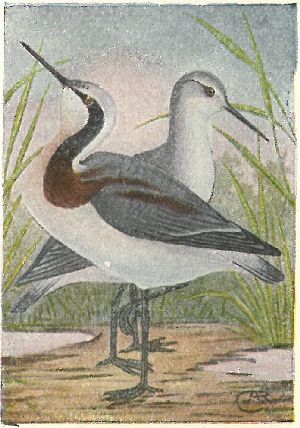
WILSON PHALAROPE
224. Steganopus tricolor. 9 in.
Bill long and slender. Female in summer with a black line through eye, shading into a broad stripe of rich chestnut on the sides of the neck. Male much duller colored and slightly smaller. This phalarope is one of the most beautiful of all our shore birds, and is the most southerly distributed of the phalaropes. It is a bird of the interior, and is only rarely or casually met with on the sea coasts. It commonly travels about in small companies instead of large flocks as the other two species do, and is not as often seen on the water, although it can swim well.
Notes.—Usually silent, but has a low quack.
Nest.—Of grasses, on the ground, usually concealed in a tuft of grass, and near the border of a marsh or pond; the 3 or 4 eggs are brownish or greenish-buff with black markings (1.30 × .90); June.
Range.—Breeds chiefly in the interior, from Iowa and California, north to Hudson Bay; winters south of the U. S.
[144]
AVOCETS AND STILTS—Family Recurvirostridæ
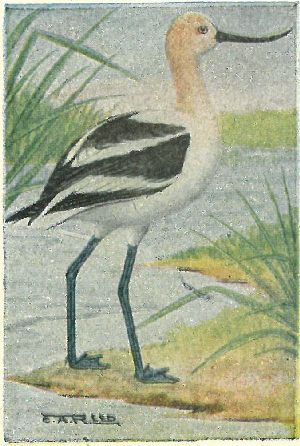
AMERICAN AVOCET
225. Recurvirostra americana. 17 in.
Bill slender and recurved; feet webbed; feathers on the underparts very thick and duck-like, being impervious to water. In summer, the head and neck are pale cinnamon color; young birds and winter adults have the head and neck white, but the rest of the plumage is the same as in summer. These interesting waders are very abundant in some localities on the western plains. During the breeding season, if not molested, they become very tame; at other times they are quite wary. Their food consists of water insects and small Crustacea, which they secure in a novel manner. Wading along in shallow water, with their head immersed, they keep their bill moving from side to side through the soft mud.
Nest.—Of grass, on the ground; the eggs are brownish-buff spotted with black (1.90 × 1.30); May, June.
Range.—Breeds locally from Texas and southern California northward to Saskatchewan; rare or casual east of the Miss, and on the Atlantic coast.
[145]
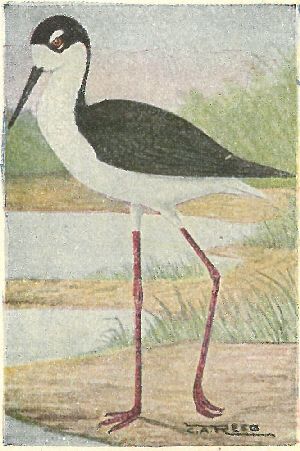
BLACK-NECKED STILT
226. Himantopus mexicanus. 15 in.
Legs extremely long, and bright red; neck and bill moderately long and slender. Male black and white as shown; female and young with the back brownish. These very long-legged creatures are found in suitable places west of the Mississippi River, and are especially abundant in southern California. Stilts are poor swimmers, but habitually feed in comparatively deep water, that is up to their bodies, their whole head, neck and upper parts of the body often being submerged while thus engaged. They are strong and swift on the wing, twisting as they fly, so as to alternately show their black upper parts, then the white surfaces beneath; this is a habit that is common to several varieties of shore birds.
Nest.—On the ground as usual; eggs greenish-buff, spotted with black (1.80 × 1.25); May, June.
Range.—Breeds in the Gulf states and southern California, north to Dakota; winters south of U. S., except in southern California. Rare on the Atlantic coast.
[146]
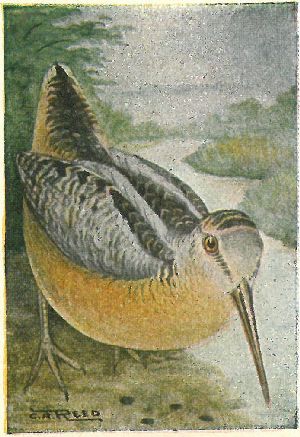
SNIPES, SANDPIPERS, ETC.—Family Scolopacidæ
AMERICAN WOODCOCK
228. Philohela minor. 11 in.
Bill very long; eyes very large and located near the top of the head; form heavy; legs short; plumage much mottled with black, brown and gray. These peculiar birds are very well known throughout their range, to gunners and sportsmen, who have been the means of almost completely exterminating them in some localities. They are found in runs along the edges of brooks, where the mud is soft. Their food is of worms, insects and their larvæ, which they get from the ground by boring with their long bills. Their flight is very rapid, and when startled they double and twist in their haste to get away, their three narrow outer wing feathers producing a peculiar whistling sound.
Notes.—A low peep, and a twittering.
Nest.—Simply a hollow amid the surrounding leaves; the 4 eggs are buff, with yellowish-brown spots (1.50 × 1.15); April, May.
Range.—Eastern N. A., breeding chiefly from Ohio and New Jersey, northward; winters in southern U. S.
[147]
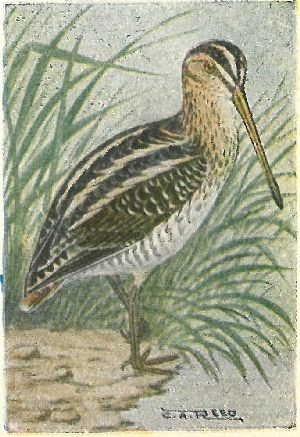
WILSON SNIPE
230. Gallinago delicata. 11 in.
Bill very long, but not as heavy as that of the Woodcock; eyes not abnormally large; head striped with black and whitish; back handsomely variegated with black, brown and white; sides barred with black and white. The Snipe frequents more open country than the Woodcock, being found in marshes or along open brooks. Like the Woodcock, they often lie still and trust to their colors to prevent their being seen, but if they are observed, and they are always on the alert, they instantly take wing and pursue a zigzag course out of sight. Like the last species they procure their food by boring, the tip of the bill being flexible, so they can grasp their food when they feel it.
Notes.—A sharp, harsh whistle as they take wing.
Nest.—Depressions in the grassy edges of ponds or marshes; eggs olive gray, marked with blackish (1.50 × 1.10); May, June.
Range.—Breeds from the northern tier of states northward. Winters in southern U. S.
[148]
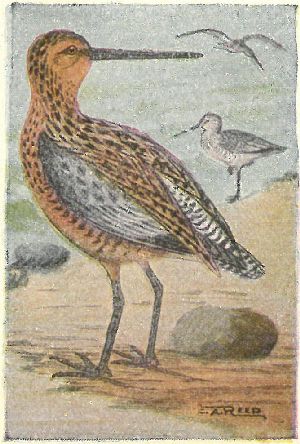
DOWITCHER
231. Macrorhamphus griseus. 10.5 in.
Bill very long like that of the Snipe. Adults in summer are reddish-brown below, more or less specked with black on the breast and barred with black on the sides; above mottled with brown and black, lighter, or even white, on the rump. In winter, they are gray above and white below, the breast being tinged with gray and streaked with dusty. Dowitchers are known as Red-breasted Snipe and as Robin Snipe by gunners, with whom they are great favorites. They usually travel in flocks, and often with flocks of other species. Their notes are a series of musical whistles, easily imitated, and the birds are easily attracted thereby.
Nest.—As usual on the ground; eggs greenish-buff, spotted.
Range.—Eastern N. A., breeding in the Arctic regions; winters south of the U. S.
232. LONG-BILLED DOWITCHER (M. scolopaceus), is found in western N. A. The bill is supposed to be longer, but the plumage is identical and the birds probably are.
[149]
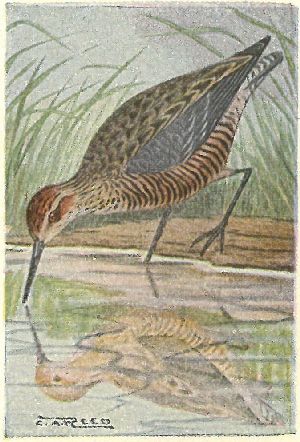
STILT SANDPIPER
233. Micropalama himantopus. 8.5 in.
Bill slender and only moderately long. In summer, the entire underparts are rusty-white, barred with blackish; ear-coverts and top of head browner; back mixed brown and black. In winter, they are gray above and whitish below, with the breast streaked with dusty. They seem to be one of the least abundant of our shore birds, single individuals being found in flocks of other species, rather than in flocks of themselves. They are usually more shy than the birds with which they are associated, perhaps because they lack companionship of their own kind. They have a musical whistle, not distinctive from that of many others of our small shore birds.
Nest.—The three or four eggs are laid in a hollow in the ground, usually in the grass back from the beach; eggs grayish, blotched with various, shades of brown.
Range.—Eastern North America, breeding in the Arctic regions and migrating through the United States to South America, chiefly on the Atlantic coast.
[150]
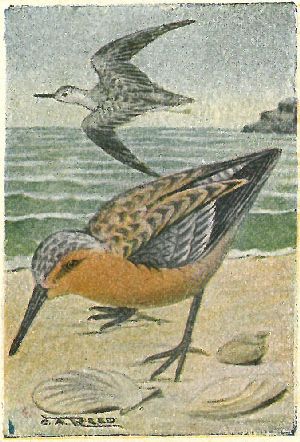
KNOT
234. Tringa canutus. 10.5 in.
Bill moderately long and quite stout; form more robust than most of our shore birds. Adults in summer, mixed brownish and gray, above, and uniform reddish-brown below. In winter, plain gray above and white below; young similar but with feathers on the back edged with white. It is an abundant species on the Atlantic coast during migrations, and is known by various names such as Red-breasted Sandpiper and Robin Snipe, when in summer dress, and as Gray-back when in winter plumage. It is usually found on the ocean beach, where it follows the waves as they recede, picking up numerous insects left there, and retreating before the next wave.
Notes.—An ordinary Sandpiper whistle.
Nest.—Not positively known, but a supposed egg obtained by Lieutenant Greely in the vicinity of Fort Conger was pea-green in color, with small brown spots. (1.10 × 1.00).
Range.—Breeds in the Arctic regions; migrates chiefly on the Atlantic coast, to South America.
[151]
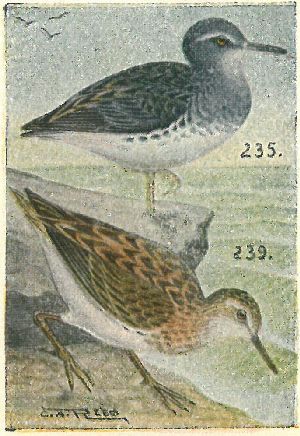
PURPLE SANDPIPER
235. Arquatella maritima. 9 in.
Upper parts blackish, margined with buffy; breast and sides slaty purple. In winter, blackish, without the rusty edging to the feathers. These dark colored little sandpipers prefer bold rocky coasts.
Notes.—A loud, shrill whistle.
Nest.—A hollow in the ground, among grass and weeds, lined with a few grasses; eggs grayish buff, handsomely splashed with various shades of brown.
Range.—Breeds from northern Labrador and the mouth of Hudson Bay northward; winters south to Long Island Sound and the Great Lakes.
PECTORAL SANDPIPER
239. Pisobia maculata. 9 in.
Crown and back blackish, strongly edged with reddish-brown; an ashy-gray wash on the breast, with numerous streaks of blackish. Well known and called by a great variety of names, of which Jack Snipe and Grass Snipe are probably the most common.
Range.—Breeds in the Arctic regions; migrates through the U. S. to South America.
[152]
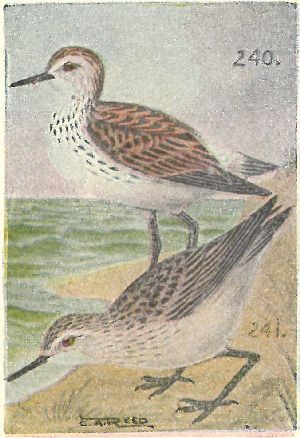
WHITE-RUMPED SANDPIPER
240. Pisobia fuscicollis. 7.5 in.
Upper tail coverts white; below white, but with the throat and breast streaked with dusky, these markings extending on the sides to the tail.
Notes.—Musical whistles in no way different from those of the Least Sandpiper.
Nest.—On the ground, in grass back of beaches; eggs gray, profusely blotched with blackish brown.
Range.—Eastern N. A., breeding from Labrador and Hudson Bay northward; migrates through the U. S. east of the Rockies, to southern South America.
BAIRD SANDPIPER
241. Pisobia bairdi. 7.5 in.
Of the same, size, form and general coloration as the White-rumped Sandpiper, but the upper tail-coverts are blackish, and the breast is only very faintly streaked.
Range.—Breeds in the Arctic regions, and migrates chiefly through the interior, but to some extent on the coast, south to southern South America.
[153]
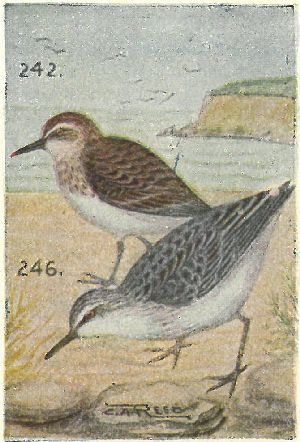
LEAST SANDPIPER
242. Pisobia minutilla. 6 in.
Smallest of our sandpipers. Upperparts blackish, edged with bright chestnut; breast and sides ashy-gray, conspicuously streaked with dusky.
Notes.—A musical whistle, “peet-weet.”
Nest.—A grass lined hollow; eggs grayish, heavily blotched with blackish brown (1.15 × .80).
Range.—Breeds from Nova Scotia and northern British Columbia northward; winters from the Gulf States and California southward.
SEMIPALMATED SANDPIPER
246. Ereunetes pusillus. 6.25 in.
Feet with small webs between the toes at their base. Similar in size and form to the Least Sandpiper, but the upper parts are not as bright rusty, and the breast is only faintly streaked with dusky.
Range.—Breeds from Labrador northward.
247. WESTERN SANDPIPER (E. mauri) is very similar; more rusty above, with stronger markings.
[154]
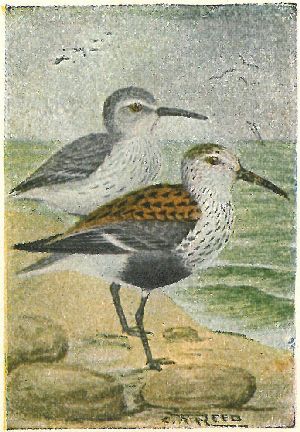
RED-BACKED SANDPIPER
243. Pelidna alpina sakhalina. 8 in.
Bill slightly decurved and rather stout. Adults in summer, with the upper parts largely bright rusty; belly black; head, throat, breast and sides strongly streaked with black. In winter, dull brownish-gray above and white below, with the breast washed with grayish and slightly streaked with dusky. Found in large flocks on both the Atlantic and Pacific coasts, during migrations, but rarely in the interior. Their flight is very rapid and performed in very compact flocks that act as if governed by one impulse. They are very active, feeding for a short time in one place, then flying to another. They are found most abundantly on sand bars and mud flats, rather than on the open beach.
Nest.—Usually on dry, grassy knolls, a hollow in the earth being lined with a few dried grasses. Eggs pale greenish or brownish gray, spotted with blackish (1.40 × 1.00); June.
Range.—Breeds in the Arctic regions, and winters from the Gulf coast and southern California, southward.
[155]
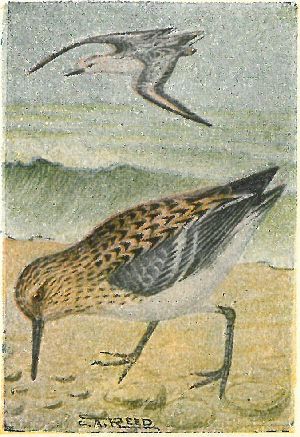
SANDERLING
248. Calidris leucophæa. 8 in.
Toes short and stout; no hind toe. Adults in summer, variegated above with bright reddish-brown and black; below white, the breast being strongly washed with rusty and spotted with black. In winter, plain grayish above and white below; head white, except the crown; young birds are like winter adults but have the back with some blackish. In the interior this species is found on the edges of lakes and rivers. On the coast, it is one of the boldest of the shore birds, feeding on the edge of the outer beach, often under the combing crest of the incoming waves, retreating just as the wave breaks and is dashed to foam on the beach. They are usually wary and will not allow a close approach.
Nest.—On the ground; eggs greenish-buff, spotted with black.
Range.—Breeds in the Arctic regions; winters south to Patagonia, migrating on both coasts and to a less extent in the interior.
[156]
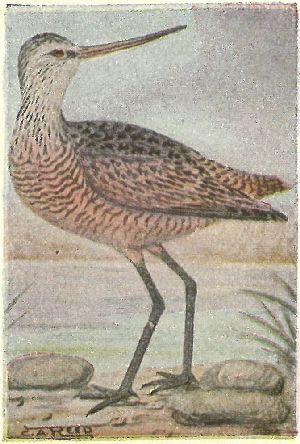
MARBLED GODWIT
249. Limosa fedoa. 19 in.
Bill long and slightly recurved. Back, wings and tail, rufous, barred with black; rump usually white, with black bars; underparts pale rufous with narrow bars; head grayish, with black streaks on the crown and sides. Young similar, but whiter below and with few or no bars. These large waders are found in moderately large flocks both in the interior and on the coast in the fall. They frequent salt marshes on the coast, and the borders of ponds and lakes in the interior. They are much hunted and are consequently very wary, usually taking wing as soon as anyone appears in sight. They are readily decoyed, and thousands perish annually at the hands of sportsmen. They are known by many names, Marlin and Straight-bill Curlew probably being the most commonly used.
Range.—Breeds in the interior from Iowa north to Saskatchewan. Winters south of the U. S., migrating along both coasts as well as in the interior.
[157]
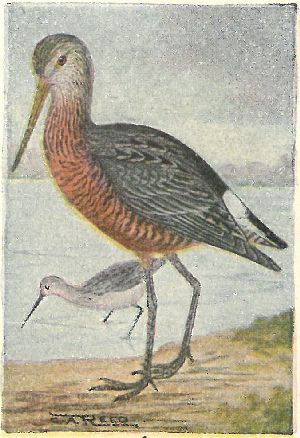
HUDSONIAN GODWIT
251. Limosa hæmastica. 15 in.
Bill slightly recurved; tail black at the end, and white at the base, not barred as that of the last species always is. Above blackish, with rusty margins; below deep reddish-chestnut, barred, chiefly on the sides, with black. In winter, similar but duller both above and below, with only traces of bars on the flanks, and with the breast more or less streaked. This species is more abundant on the Atlantic coast during migrations than the last. It is most often known as the Ring-tailed Marlin, owing to a very strong contrast between the black tail, white rump and dark upper parts as the bird flies. They are usually found in the marshes back of the ocean beach, and, owing to their large size, can be seen for a long distance.
Notes.—A loud, shrill Whistle.
Nest.—A grass lined hollow in marshes; eggs brownish buff, blotched with blackish (2.20 × 1.40).
Range.—Breeds in the Arctic regions; winters south of the United States, migrating chiefly on the Atlantic coast, but to some extent down the Miss. Valley.
[158]
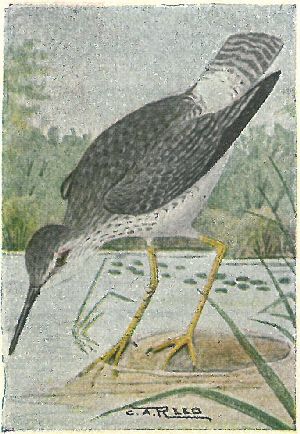
GREATER YELLOW-LEGS
254. Totanus melanoleucus. 14 in.
Bill long and rather slender; legs long and yellow or greenish yellow. Head and neck streaked with gray and white; back black margined with white; rump white; tail barred black and white; underparts white, washed with gray on the breast; and with numerous black arrow-head markings. In winter, similar, but with no black markings below.
Notes.—A loud three-syllabled whistle.
Range.—Breeds from northern portion of Miss. Valley in the U. S. northward; winters from the Gulf States and southern California southward.
LESSER YELLOW-LEGS
255. Totanus flavipes. 10.5 in.
Very similar in form, color and markings to the large Yellow-legs, but smaller in every way.
Range.—Breeds in the interior of Canada, north to the Arctic Ocean, and possibly in northern Miss. Valley. Winters from the Gulf States southward, migrating in the interior and along the Atlantic coast.
[159]
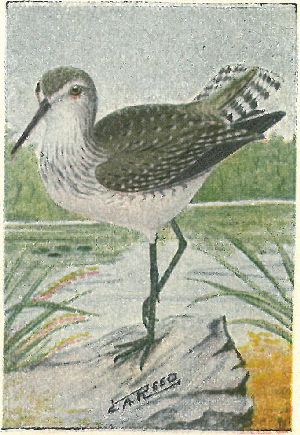
SOLITARY SANDPIPER
256. Helodromas solitarius. 8.5 in.
Above olive-grayish, streaked on the head and neck, and sharply speckled on the back and wings, with white; tail sharply barred with black and white; below white, streaked on the breast and barred on the sides with gray and white. In winter, with fewer white markings on the back. It is often confused with the Spotted Sandpiper that frequents the same places, but should be easily identified when it flies by its barred tail and linings of the wings. They have the habit, common to nearly all the shore birds, of elevating their wings after alighting, and then carefully folding them on the back.
Nest.—For a long time their eggs were unknown, but are now known to be laid in the nests of other land birds, at low elevations in trees or bushes near water. They have been found in Manitoba in a Waxwing’s nest. Eggs bluish-green with blackish-brown blotches.
Range.—Breeds from Northern U. S. northward; winters south of the U. S.
[160]
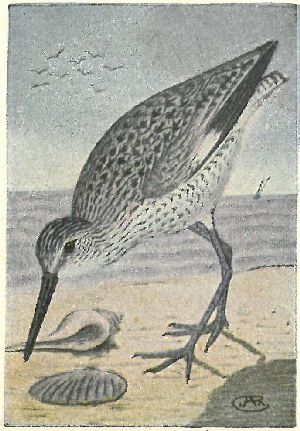
WILLET
258. Catophophorus semipalmatus. 16 in.
Bill long and quite stout; feet with small webs between the bases of the toes. Upper parts brownish-gray, more or less speckled with black; most of secondaries and bases of primaries white, very conspicuous in flight, and easily distinguishing it from any other wader of its size. Usually found in small flocks along the edges of marshes; they are said to be quite shy except during nesting season, and to be difficult to decoy. After breeding they wander northward and are often seen in flocks of other migrating species. When standing on the beach they often indulge in curious antics, bowing and flirting their tails.
Notes.—A loud, shrill whistle, “pill-will-willet.”
Nest.—On the ground; eggs buffy, blotched with brown.
Range.—Breeds from the Gulf to New Jersey; later strays to Maine. 258a, Western Willet (S. s. inornata) is supposed to be slightly larger and paler. Breeds from Texas to Manitoba; winters along the Gulf coast.
[161]
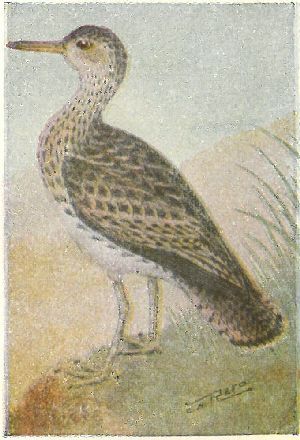
BARTRAMIAN SANDPIPER
261. Bartramia longicauda. 12 in.
Upper parts blackish with greenish-brown edgings; tail brownish with black bars, and white tips to the outer feathers. Underparts white, with prominent inverted, black arrow head markings on the breast and along the sides. These birds are more often known as Upland Plovers, because they are found on dry hillsides, rarely near water. West of the Miss. they are said to occur in large flocks in the Fall, but in the East, half a dozen or so would be considered a fair sized flock. They feed upon small grasshoppers and other small insects, sometimes chasing them for a considerable distance before securing them. They are shy and usually take wing as soon as they see you.
Nest.—Of grasses, usually concealed in clumps of grass or weeds in the middle of fields; eggs buffy, blotched with yellowish-brown (1.75 × 1.25); May, June.
Range.—Breeds locally in the northern half of the United States and Southern Canada; winters south of the U. S.
[162]
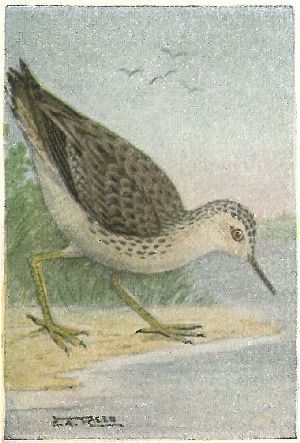
BUFF-BREASTED SANDPIPER
262. Tryngites subruficollis. 8 in.
Bill short and slender. General color above, blackish-brown margined with tawny; underparts buffy, with a few black specks on the sides of the breast. Primaries blackish-brown on the outer webs, the inner webs, as well as those of the secondaries, being whitish, peculiarly speckled with black; these markings are characteristic and are found on no other of our shore birds. It seems to be most nearly related to the last species, and like that, is often found on hillsides at a distance from water.
Notes.—A low, weak “tweet.”
Nest.—A scantily lined depression on the ground; the four eggs are grayish-buff, boldly blotched with rich chestnut-brown and black (1.45 × 1.05); June.
Range.—Breeds in Arctic America; winters in South America, migrating chiefly through the interior of the United States, but to a less degree on the coast.
[163]
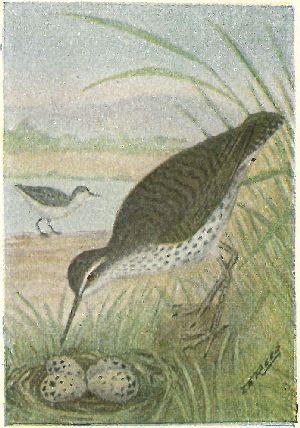
SPOTTED SANDPIPER
263. Actitis macularia. 7.5 in.
Below white, with round blackish spots, heaviest on the breast and sides; above olive-brown or gray, with faint black bars; a narrow black line from the bill through the eye to the ears. Young entirely white below, with the breast faintly tinged with gray. These birds are abundant and breed locally throughout the United States and the greater part of Canada. One or more pairs will usually be found nesting in the fields about all small ponds, or among the weeds that grow about edges of pools and lakes. They have a peculiar habit of “teetering,” whether standing still or while feeding on the banks of streams or ponds; other birds do this but not nearly as persistently as Spotted Sandpipers.
Notes.—A clear “peet-weet;” also a single melodious whistle.
Nest.—On the ground in fields or near the edges of pools or streams; eggs buffy, boldly spotted.
Range.—Breeds from the Gulf to Hudson Bay; winters south of the U. S.
[164]
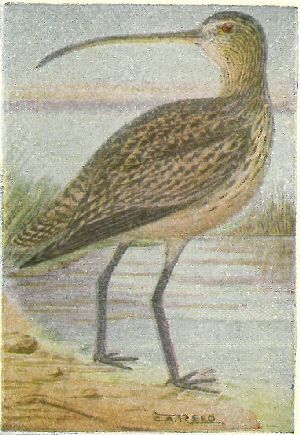
LONG-BILLED CURLEW
264. Numenius americanus. 23 in.
Bill much decurved and very long (4 to 8 in.), the longest of any of our shore birds. Plumage variegated with rufous and blackish above; bright buffy or rufous below, streaked on neck and breast, and barred on the sides with blackish. “Sickle-bills,” as these birds are often called, are the largest of our shore birds. They are very conspicuous either when flying or walking on the marshes or sandbars, their size appearing gigantic when they are in a flock of smaller plover, as sometimes happens. They fly in compact flocks, evidently led by one individual, for they wheel and circle in perfect unison, sailing up in the wind on outspread wings, when about to alight.
Notes.—A flute-like whistle, “ker-loo.”
Nest.—On the ground; eggs greenish-buff, with small black spots over the whole surface (2.50 × 1.80).
Range.—Breeds in the Upper Miss. Valley, north to Manitoba; winters in the Gulf States, and southward; formerly bred on the South Atlantic coast; strays to New England and New Brunswick in the fall.
[165]
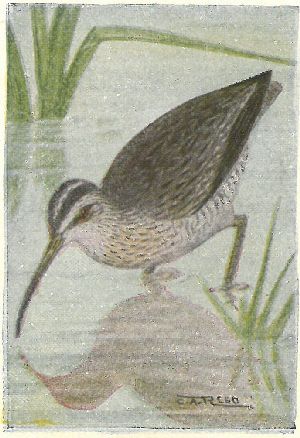
HUDSONIAN CURLEW
265. Numenius hudsonicus. 17 in.
Darker brown above, than the Sickle-bill; crown broadly striped with blackish and buff; underparts grayish, streaked on the breast and barred on the sides with blackish. This and the succeeding species are summer inhabitants of the Arctic regions, being found within our borders only for a short time in the Fall and Spring. It is found in fresh and salt water marshes, as well as on mud-flats and on sandy beaches of the seashore. They are very unsuspicious and are easily stalked, or decoy very easily, coming to wooden caricatures of themselves stuck up in the mud, or to crude imitations of their whistles; consequently large numbers of them are shot and they are becoming scarce.
Notes.—Similar to that of the last.
Nest.—Hollows in the ground, lined with grasses and weeds; eggs buffy, blotched with brownish-black (2.25 × 1.60).
Range.—Breeds in the Arctic regions. Winters south of the United States, migrating both on the coast and in the interior.
[166]
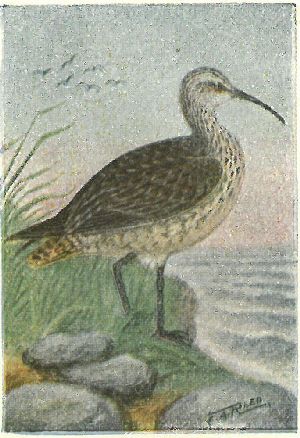
ESKIMO CURLEW
266. Numenius borealis. 13.5 in.
Bill comparatively short (about 2 in.) and little curved. Above, marked similarly to the last; below white or pale buff, often thickly covered on the breast and sides with streaks and arrow head markings of blackish. Primaries and most of the secondaries plain brownish-black, without the variegation of the last species. A few years ago this was considered the most abundant of the curlews, but so persistently have they been hunted that they are now practically exterminated. When it comes to looking after their safety, curlews are, perhaps, the most stupid of the shore birds for they do not seem to realize the dangerous character of mankind in general, and they have paid the penalty. I trust that all sportsmen will refrain from shooting these birds.
Nest.—Like that of the Hudsonian; eggs similar but smaller.
Range.—Eastern N. A., breeding in the Arctic regions and migrating through the Plains, Mississippi Valley, and to a less extent on the Atlantic coast, to South America. Very rare now anywhere.
[167]
PLOVERS—Family Charadriidæ
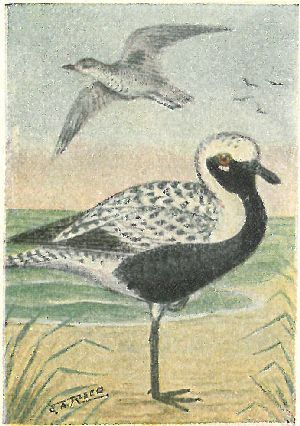
BLACK-BELLIED PLOVER
270. Squatarola squatarola. 11.5 in.
Hind toe very small. Bill short and stout. Adults in summer with the back, wings and tail barred or marked with black and white; top of head and nape white, except for a few black markings on the crown; face, throat, breast and fore part of belly, black. In winter, brownish-black, somewhat mottled, above; below dull white. Young similar to winter adults, but the back is spotted with yellowish-white. While these handsome plover migrate to some extent, and sometimes in large flocks, through the interior of the United States, they are chiefly and most abundantly found on the coast. They are the plover most eagerly sought by gunners.
Call.—A plaintive whistle, “ter-lee.”
Nest.—Grass-lined hollows in marshes or dry land, back from the beach; eggs greenish-buff, spotted with black.
Range.—Breeds in the Arctic regions; winters in South America, migrating through the U. S. in Sept. and May.
[168]
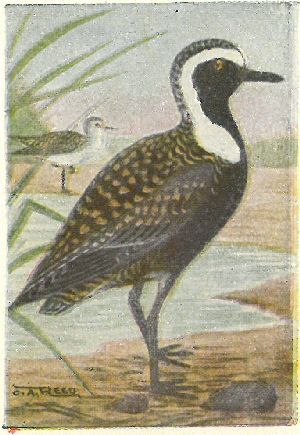
AMERICAN GOLDEN PLOVER
272. Charadrius dominicus. 10.5 in.
No hind toe. Back and tail mottled with black and yellow; below, more or less entirely black to the tail. Young and winter adults, more or less spotted with yellow and blackish-brown above, and grayish-white below, with indistinct streaks on the breast. Often confused with the last species in this plumage, but is smaller, bill smaller and more slender, and the axillars, or feathers nearest the body, under the wings, are gray while those of the Black-bellied Plover are black. This species is now regarded as rare on the North Atlantic coast during migrations, while in the interior it is more abundant than the last species. They do not seem to be as suspicious as the Black-bellies, and a flock will often allow a close approach, even when they see you.
Nest.—Nesting habits like those of the last, and other shore birds; eggs slightly smaller (1.90 × 1.30).
Range.—Breeds in the Arctic regions; winters south to South America.
[169]
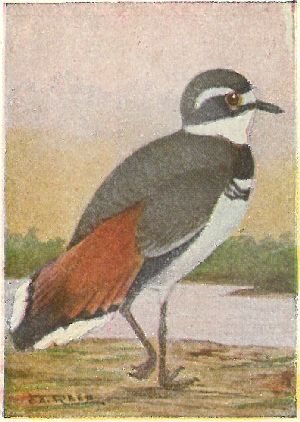
KILLDEER
273. Oxyechus vociferus. 10 in.
No hind toe. Rump and base of tail reddish-brown; breast crossed by two black bands. Like the Spotted Sandpiper, this bird is locally and abundantly distributed throughout the United States and Southern Canada; it is, however, rare in New England, where it is sometimes found in the Fall. It frequents meadows, fields and ploughed ground, where it feeds upon insects, and around the edges of pools and streams where it gets small shellfish and larvæ. As usual, they will attempt to lead an intruder away from their nest by feigning lameness.
Notes.—A loud, noisy and incessant “killdee.”
Nest.—A slight hollow in the ground, usually in a clump of weeds; sometimes lined and sometimes not; the four eggs are greenish-buff, heavily blotched with black.
Range.—Breeds locally throughout United States, except New England, and southern Canada; winters in southern U. S.
[170]
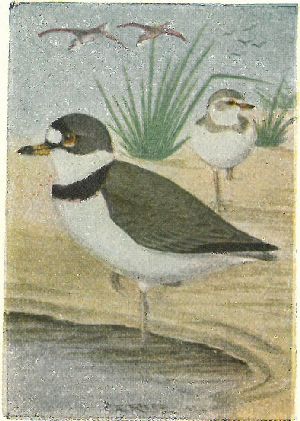
SEMIPALMATED PLOVER
274. Ægialitis semipalmata. 7 in.
Small web between the bases of the two outer toes. Single broad, black band across the breast; black line from base of bill to eye. They are very abundant on our seacoast in Fall, both in flocks composed entirely of their own kind, and also with Least and Semipalmated Sandpipers. They usually keep on the inner side of sandbars or muddy flats bordering marshes, rather than on the open ocean beach. It is also found in smaller flocks, about ponds and marshes in the interior of the country. They are usually unsuspicious and will allow a close approach, or if you are still, will run by within a very few feet.
Notes.—A clear double whistle, usually uttered when on the wing or when alarmed. They decoy to an imitation of it.
Nest.—On the ground; eggs buffy, sparsely specked with black (1.30 × .90); June.
Range.—Breeds from the Gulf of St. Lawrence northward; winters from the Gulf States southward.
[171]
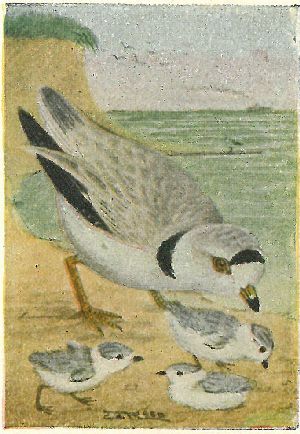
PIPING PLOVER
277. Ægialitis meloda. 7 in.
Very pale above; no black in front of eye; black patch on each side of breast. Young similar, but the black replaced by grayish, as is the case with the last species. This species, apparently, never could be classed as abundant and of late years, it is becoming rather rare along our Atlantic coast; this is probably more due to the building of summer resorts and homes along their former breeding grounds than to hunters. They are rather more shy than the last species, but will usually attempt to escape by running along the beach or by hiding, rather than by flight. Owing to their light colors it is very difficult to see them at any distance.
Notes.—A two-syllabled piping whistle.
Nest.—On the ground; eggs buff with fine black specks.
Range.—Breeds on the coast from Va. to Newfoundland and in the Mississippi Valley.
[172]
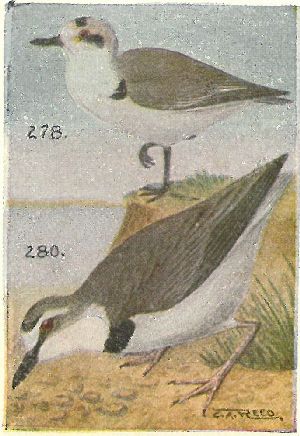
SNOWY PLOVER
278. Ægialitis nivosa. 6.5 in.
Very small and very pale colored. Small black patch on either side of the breast, on ear coverts, and on crown. Bill more slender but longer than that of the Piping Plover.
Notes.—Low, mournful, piping whistles.
Range.—United States chiefly west of the Rockies, east to Kansas and north to Dakota.
WILSON PLOVER
280. Ochthodromus wilsonius. 7.5 in.
Bill large and heavy for birds of this genus. A black band across the neck, not extending to the back of the neck; dark line between eye and bill.
Notes.—A “mixture of whistle and chirp,” very different from that of allied plovers. (Elliott).
Nest.—A shallow hollow in the sand, sometimes concealed by short beach grass; eggs grayish, spotted and scratched with blackish brown (1.25 × .95).
Range.—Breeds on the Gulf and South Atlantic coasts north to Virginia; later may stray to Maine.
[173]
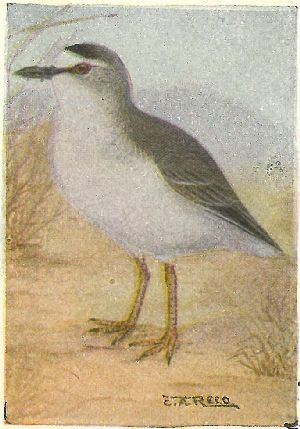
MOUNTAIN PLOVER
281. Podasocys montanus. 9 in.
No black on breast or sides, but with black hand on fop of head and a black line from bill to eye. Above grayish-brown; below buffy across the breast, white elsewhere. Mountain or Prairie Plover, as they are often and better called, are abundant on the western prairies. Like the Bartramian Sandpiper, they do not frequent the vicinity of water, but live and get their food in the dry grass-covered districts. They are not at all shy where they are not hunted. Like all the family, they are very fleet on foot, and may often be seen chasing grasshoppers or other active insects. Their flight is very rapid, often devious and usually at a low elevation.
Notes.—A single, low, musical whistle.
Nest.—A depression in the ground, anywhere on the prairie. Eggs brownish-gray, blotched with blackish.
Range.—West of the Mississippi River, breeding north to Dakota. Winters from Southwestern United States southward.
[174]
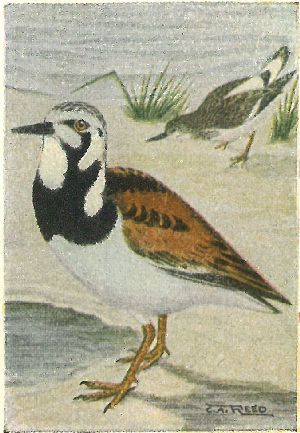
TURNSTONE
283. Arenaria interpres. 9.75 in.
Very similar to the next, which is the one figured, but slightly larger, and with black prevailing in the upperparts. This is the Old World species, found in America only in Labrador and Alaska.
RUDDY TURNSTONE
283.1. Arenaria interpres morinella. 9.5 in.
Bill short and stout, the upper mandible being straight, so that the bill has an upturned appearance. Legs reddish on adult birds and orange on young.
Known by a great many names, referring to its peculiarly pied appearance:—Calico-bird, Checkered-snipe, etc. An abundant species usually found on pebbled beaches.
Notes.—One or two clear whistles.
Nest.—A scantily lined hollow; eggs grayish, beautifully marbled with brown, lilac and blackish.
Range.—Breeds in the Arctic regions; winters in Southern South America, migrating on both coasts.
[175]
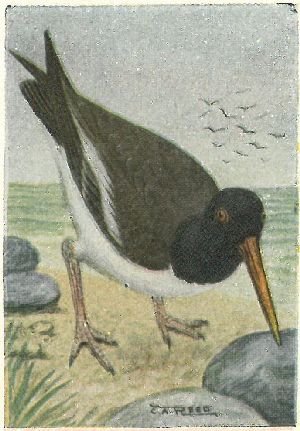
AMERICAN OYSTER-CATCHER
286. Hæmatopus palliatus. 19 in.
Bill very long, heavy, compressed, and thin and chisel-like at the tip. Bill and eye, red; legs flesh color. These large, awkward looking birds are not scarce on the South Atlantic coast, where they are met with in pairs or small companies. They run with great swiftness, or walk sedately along the beaches and marshes gathering insects and fiddler crabs, of which they are very fond. They are said to have got their name from the habit of eating oysters when they found them with the shell open, a practice that would be extremely hazardous for them to undertake, as these shellfish close their two valves very quickly and would be apt to catch the bird. Owing to their large size they are frequently shot at and, consequently, are usually shy.
Nest.—A depression in the sand; the two or three eggs are buffy, spotted with blackish-brown (2.20 × 1.50); May.
Range.—Breeds on the coast north to Virginia; later may stray to Nova Scotia. Winters south of the U. S.
[176]
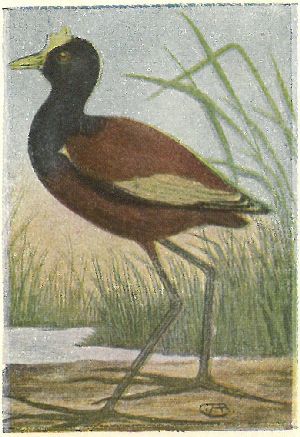
MEXICAN JACANA
*** Jacana spinosa. 8 in.
A very peculiar species. Bill plover-like; at the base, terminating in a leaf-like sheaf that covers the forehead; a hard spur on the shoulder of each wing; legs and toes extremely long, the toenails being abnormally so, the hind nail often being an inch and a half long. Young very different from the adult.—Grayish-brown above, with wings greenish-yellow as in adult; below whitish, darker across the breast and on the sides; a light line above the eye. Jacanas are inhabitants of marshy, muddy pools and ponds, where they can easily run over the surface, their long toes getting a good foothold on the floating aquatic plants. They are said to be very pugnacious in defence of their young, and also to fight among themselves during the mating season.
Nest.—Nests made of weeds and trash, on little floating islands or lily pads. 3 to 5 olive colored eggs, curiously scrawled with black (1.20 × .95); May.
Range.—Is found and breeds within our borders only in Southern Texas.
[177]
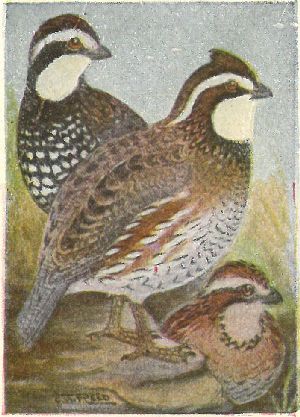
GROUSE, PARTRIDGES, ETC.—Order Gallinæ Family Odontophoridæ
BOB-WHITE; QUAIL; VIRGINIA PARTRIDGE
289. Colinus virginianus. 10 in.
Male with white throat, bordered with black; female with a yellowish-brown throat, and line above eye. One of the most popular “game birds,” so popular that it is exterminated in New England, and birds imported from the west are unable to regain the lost foothold. Found in stubble and low brush, where they hide until almost stepped upon. They feed upon insects and grain.
Notes.—A clear whistled “bob-white” and a series of low, clear whistles when in flocks.
Nest.—Of grass at the end of tunnel in tall grass bordering fields; 8 to 16 white eggs (1.20 × .95); May.
Range.—Resident east of the Rockies, north to Minn. and Ontario. 289a, Fla. Bob-white (C. v. floridanus), found in southern Florida, is extremely dark (shown on plate). 289b, Texan Bob-white (C. v. texanus) is paler with black areas wider.
[178]
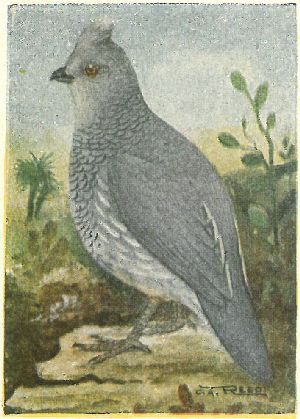
SCALED PARTRIDGE
*** Callipepla squamata. 10 in.
With a whitish or buffy-white crest; plumage bluish-gray, with darker edges giving the bird the appearance of being covered with scales. The female is more brownish, but is marked the same as the male. These birds are locally abundant in arid, cactus-covered deserts, often at a distance from water, and frequently in company with Gambel Partridge.
Nest.—8 to 15 eggs are laid in some hollow under a low bush or cactus; they are creamy-white, dotted with minute specks of pale brown (1.25 × .95); April, May.
Range.—Mexico north to Central and Western Texas, New Mexico and Arizona.
293a. Chestnut-bellied Scaled Partridge (C. s. castanogastris), is more richly colored and has a chestnut patch on the middle of the belly. It is found in southern Texas and northeastern Mexico.
[179]
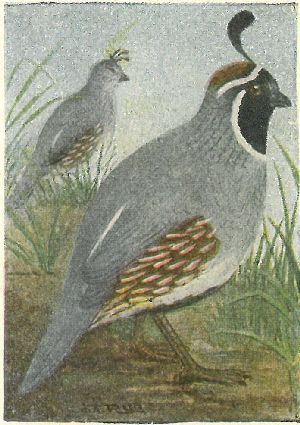
GAMBEL PARTRIDGE
295. Lophortyx gambelii. 10 in.
Head with an elegant recurved crest of six or seven feathers; normally these are carried in one packet so that there appears to be but one feather, but when excited, or during the mating season, they may separate the feathers, or sometimes curve them forward so as to touch the bill. Hindhead and sides chestnut, throat and middle of belly black. Female with the throat light and hindhead gray; crest small; no black on belly. An abundant species both in mountains, valleys or deserts, near or remote from water. Habits like those of the eastern Bob-white, but instead of taking wing, they will generally run.
Nest.—Eggs laid on the ground under any suitable cover; creamy-white, handsomely blotched with brown.
Range.—Resident in western Texas, New Mexico and Arizona, north to southern Utah and Nevada.
[180]
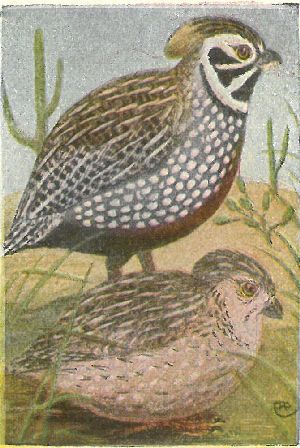
MEARNS OR MASSENA PARTRIDGE
296. Cyrtonyx montezumæ mearnsi. 9 in.
Bill very stout and compressed. Crest large, puffy and flat. Markings on the male very grotesque and clownish; general color of the female, pinkish brown with streaks of black, and white specks, below, and barred and streaked above. These strange birds are very local in their distribution in the southwest, rare in some localities and occurring in quite large flocks in others. They are so confiding in their disposition, that this, in connection with their clownish plumage, has given them the name of “Fool” Quail. They frequent dry deserts, valleys, or mountains up to an elevation of at least 8,000 feet. When startled, they often squat down, and can almost be caught in the hand, but when they do fly, their flight is very rapid, and accompanied with a peculiar clucking noise.
Nest.—A depression in the ground, lined with grasses, and concealed in clumps of weeds or grass. Their eggs, like those of other partridges, are numerous, pure white, and not as sharply pointed as those of the Bob-white.
Range.—Western Texas, New Mexico and Arizona.
[181]
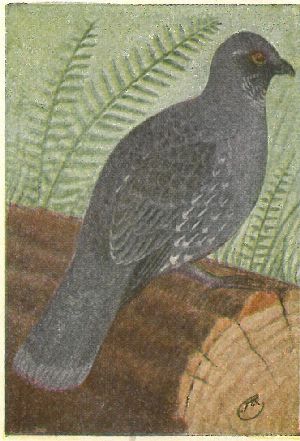
DUSKY GROUSE
297. Dendragapus obscurus. 20 in.
Plumage gray, white and black, with a few rusty markings on the back; wide gray band on tip of tail. Female smaller, browner and more barred above. These large grouse are found on side hills or in gulches, usually not far from water. Like our common Ruffed Grouse, during mating season, the males of this species strut about with tail fully spread over the back, and head thrown back until it nearly touches the tail. At this season they are very pugnacious and the woods will resound with their challenging “toots,”—loud and hollow sounds with a ventriloquial effect.
Nest.—Eggs laid on ground in woods, usually under fallen logs or at the bases of trees; buffy, sparsely spotted with brown (2.00 × 1.40); May, June.
Range.—Rocky Mts., from Mexico to Montana and east to South Dakota. 297b., Richardson Grouse (D. o. richardsonii), is found on the eastern slopes of the Rockies, north to British America. Little or no band on the tail.
[182]
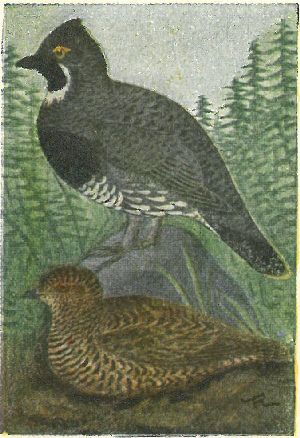
HUDSONIAN SPRUCE GROUSE
298. Canachites canadensis. 15 in.
Very similar to the next, which is our common species, but the female is not quite as rusty. Found in Labrador and about Hudson Bay.
CANADA GROUSE; SPRUCE GROUSE
298c. C. c. canace. 15 in.
Male black and grayish; female chiefly rusty, barred with black. The Spruce Grouse is usually found in dense thickets and groves or swamps of evergreen woods. It is one of the least suspicious of birds, and in winter, is sometimes knocked down by sticks in the hands of deer hunters. Their flesh is unfit to eat and consequently they are not hunted.
Notes.—A drumming, said to be produced by the wings, when in the air; a clucking by the female.
Nest.—Eggs laid on the ground, usually under low, spreading branches of spruces; bright buff with bold black blotches (1.70 × 1.25).
Range.—Northern New England, New York and Minnesota, northward.
[183]
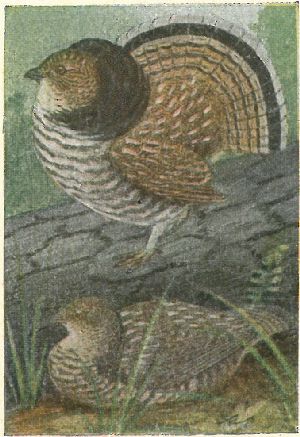
RUFFED GROUSE
300. Bonassa umbellus. 17 in.
Crested and with two large, black, neck-ruffs; plumage brown, black and white. Female with the ruffs smaller and usually brownish. These grouse have two color phases, the general tone of plumage being either reddish brown or gray, independent of age or sex of bird. These naturally wild, shy grouse are the kings of the eastern game birds, their wariness and speed with which they will dodge through the trees being the only reasons they have so long withstood the hunting to which they are subjected. During spring, the male struts often, tail expanded into a half circle, head thrown back to meet the upturned tail, and ruff spread so as to form a complete collar. They make a loud drumming by beating the air with their wings.
Nest.—Eggs on leaves in the woods; plain brownish-buff (1.55 × 1.15).
Range.—Resident from Va. and Ark. north to southern Canada. 300a., Canadian Ruffed Grouse (B. u. togata), is found in the southern British provinces and northern New England.
[184]
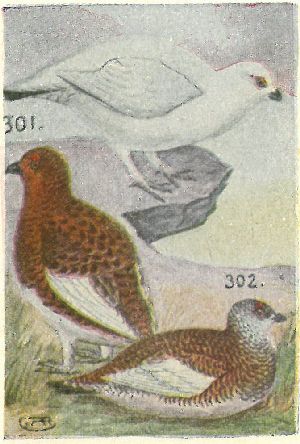
WILLOW PTARMIGAN
301. Lagopus lagopus. 15 in.
In winter, white with black tail feathers. In summer, usually reddish-brown with black bars. This species has a much stouter bill than the next.
Nest.—Eggs laid on the ground. Rich buffy, so heavily blotched and streaked with black as to nearly conceal it (1.75 × 1.25).
Range.—Breeds in the northern half of Canada, migrating southward to southern Canada.
301a., Allen Ptarmigan (L. l. alleni), found in Newfoundland, is similar, but in winter the shafts of the primaries are always black.
ROCK PTARMIGAN
302. Lagopus rupestris. 14 in.
In winter, like the last species, except that the bill is smaller, and the lores are black.
Range.—From the Gulf of St. Lawrence and northern British Columbia northward. 302a. Reinhardt Ptarmigan, replaces the last variety in northern Labrador. 303. Welch Ptarmigan (L. welchi), found in Newfoundland, is said to be grayer in summer.
[185]
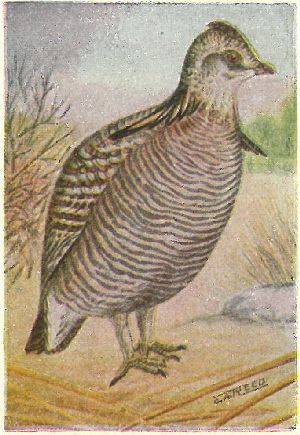
PRAIRIE HEN; PINNATED GROUSE
305. Tympanuchus americanus. 18 in.
Tufts of neck feathers rounded or square at the ends, long on the males, and short on the females. Above, barred with brownish-black and white or buffy white, the bars being of about equal width; top of head barred black and grayish. Female differs from the male in having the tail feathers barred, whereas they are black in the male. Found locally throughout the prairie regions of the Mississippi Valley north to Manitoba. Owing to the immense numbers shot for sale in eastern markets, they have become exterminated in many places where they were formerly abundant. Male birds have a loose sac or naked skin beneath the tufts of feathers on the neck; they inflate these to the size of small oranges, and then produce a loud, hollow, resonant booming sound.
Nest.—Anywhere on the ground on the prairie; eggs olive-buff, finely specked with brown.
Range.—From La. and Tex. north to Manitoba and Dakota. 305. Attwater Prairie Hen, smaller and darker, is found in Louisiana and Eastern Texas.
[186]
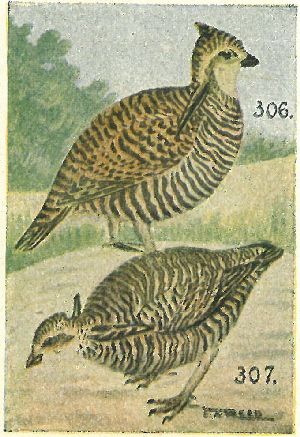
HEATH HEN
306. Tympanuchus cupido. 17 in.
Neck feathers pointed; scapulars more broadly tipped with white; axillars always barred; top of head paler and always brownish. These differences will always separate this species from the very similar western bird. They were formerly found throughout Southern New England and the Middle States, their range meeting that of the Prairie Hen, but now they are restricted to the island of Martha’s Vineyard, south of Mass., and probably the true form is extinct there for western birds have been liberated on the island and interbred with the natives.
LESSER PRAIRIE HEN
307. Tympanuchus pallidicinctus. 16 in.
Nearest like the prairie hen but paler above, the brown bars being narrower and lighter colored, but with the edges blackish, giving the back of the bird a very different appearance from that of the Prairie Hen. It is found in western Kansas, Indian Territory and Texas.
[187]
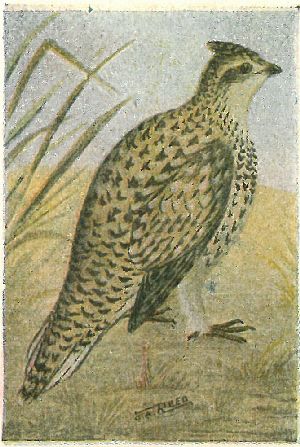
PRAIRIE SHARP-TAILED GROUSE
308b. Pediæcetes phasianellus campestris. 18 in.
No pinnates or ruffs on the neck, but the head is crested a little more than that of the Prairie Hen; tail with the central feathers nearly two inches longer than the rest, which are also graduated so the outside ones are much the shortest. Plumage much paler than that of the Prairie Hen, and feathers on the breast and sides being marked with blackish loops. Found in more or less abundance on the plains and prairies west of the Mississippi River. In mating season flocks of them indulge in curious antics, dancing, ruffling their feathers, and cooing and crowing.
Nest.—Eggs laid in a hollow in the ground, usually sheltered by a tuft of grass or bunch of weeds. The eggs are brownish-drab, finely specked, over the whole surface, with blackish-brown (1.70 × 1.25).
Range.—West of the Miss. River, from New Mexico and Indian Territory north to Manitoba. 308. Sharp-tailed Grouse, is found in the interior of British America from Hudson Bay to Alaska. Darker and less rusty than the preceding.
[188]
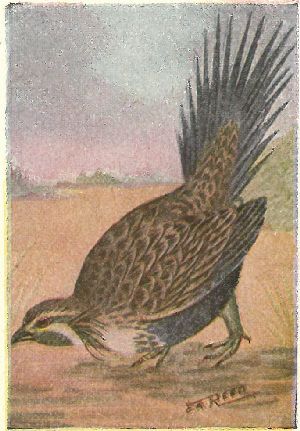
SAGE GROUSE
309. Centrocercus urophasianus. 29 in.
The female of this large and very interesting grouse differs from the male only in its smaller size and paler, duller plumage. They are found in abundance on the dry sagebrush-covered plains about the Rocky Mts. and to the westward. In summer they feed largely upon insects and buds of various plants, but in fall and winter, their food is almost entirely the leaves of the sagebrush; at this season, in consequence, their flesh is unfit to eat, so they are not hunted for market, and are able to pursue a life of quiet as far as man is concerned. In spring, they indulge in amusing play, as do all the grouse; they have a few wiry hairs on either side of the neck, covering the naked sacs that correspond to those of the Prairie Hen; they strut about with these sacs inflated, and their spread tail, erect, making peculiar buzzing sounds.
Nest.—Eggs laid on the ground under sagebrush; greenish-buff, spotted rather sparingly with brown.
Range.—Sagebrush covered plains from New Mexico to Southern British Columbia and Assiniboia.
[189]
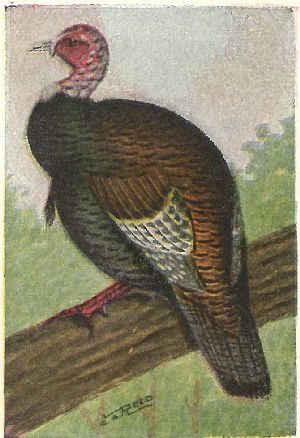
Family Meleagridæ
WILD TURKEY
310. Meleagres gallopavo silvestris. 48 in.
Female much smaller and duller colored than the male. These fine, large birds frequent woodlands and borders of streams, where they search through the underbrush for food in the daytime and sleep in the tallest trees at night. They are one of the shyest birds, and they have reasons for being, for they have been hunted until there are none left in New England and northern Middle States. Wild Turkeys strut and gobble precisely like domestic ones. Their plumage is more of a coppery bronze color and their upper tail coverts are rusty, without white edges.
Nest.—Eggs laid on the ground among leaves, usually in dense thickets; buff, spotted with brown (2.55 × 1.90).
Range.—From Penn. and Ohio south to the Gulf States west to Arkansas. 310b., Florida Wild Turkey, found in Florida, is smaller. 310c., Rio Grande Turkey, is found in southern Texas; it has upper tail-coverts edged with buff.
[190]
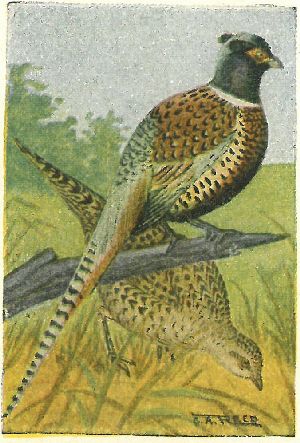
RING-NECKED OR MONGOLIAN PHEASANT
*** Phasianus torquatus ?
The male of this beautiful pheasant varies greatly in length according to the development of the tail, sometimes being 36 in. in length; the female averages about 22 in. and is plain colored, but still a very handsome bird. Males vary greatly in the richness of their colors, and in the width of the white collar on the neck, the latter depending upon the extent to which they have been interbred with the English Pheasant, the latter bird having no white on the neck. These pheasants have been introduced in Oregon and Washington and are very abundant there now. Attempts at introducing them in the East have not been as successful, but in some private preserves they are doing well. They are rather sluggish in their habits, compared to our Ruffed Grouse, and usually try to escape by running or hiding rather than by taking wing; when they do fly, they go in a straight line and rather slowly.
[191]
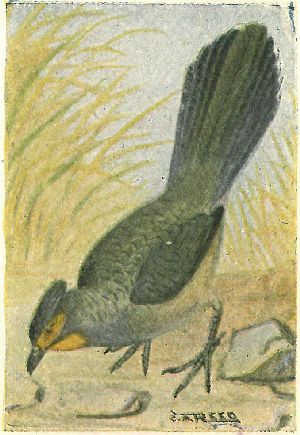
FAMILY CRACIDÆ
CHACHALACA
311. Ortalis vetula mecalli. 21 in.
Plumage olive-brown above, and gray below; head crested; sides of head and chin, naked, orange-red. These birds are found in southern Texas, in dense woods, thickets and chaparral. They are very noisy, their calls being loud, harsh, clackings, “cha-cha-lac,” repeated rapidly and taken up by all the birds in the neighborhood. They are not usually shy and are often domesticated. They are also hunted to some extent, but their flesh is said not to be very good eating, and their body is quite small compared to the length of the bird.
Nest.—A frail platform of sticks, placed in scrubby brush or bushes, a few feet above the ground. They lay four white or buffy-white eggs, the shell of which is very rough and hard (2.25 × 1.55); April.
Range.—Eastern Mexico north to southern Texas.
[192]
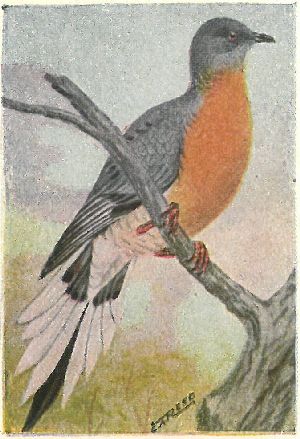
PIGEONS AND DOVES—Order Columbæ Family Columbidæ
PASSENGER PIGEON
315. Ectopistes migratorius. 16 in.
Head and back bluish-slate; below, rich rusty brown. Only a few years ago, up to 1880, they were extremely abundant in eastern North America. Seemingly incredible stories are told of the immense flocks and roosting places of these birds, and most of them are authentic. It is unfortunate that the camera was not extensively used then, so we have no visual records of them. A nesting place in Michigan is described as 28 miles in length by about four in width, and every tree in the woods, throughout this whole tract, had several nests, and some were filled with them. Flocks darkening the sky and covering several square miles are recorded. And, today, but one or two stragglers are reported in a year, and these are usually doubtful. They were shot and netted at their roosting and nesting places, barreled up and sent to market for sale, this continuing so long as there were birds enough to make it profitable, and we reap the result—no birds.
[193]
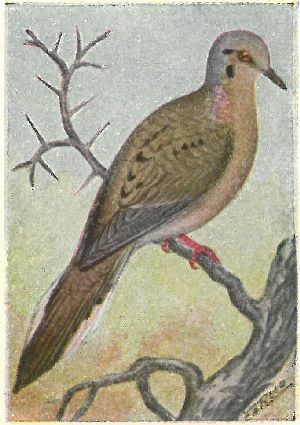
MOURNING DOVE
316. Zenaidura macroura carolinensis. 12 in.
Upperparts olive-brown; below, buffy-gray; a small black mark on the ears above the iridescent neck patch.
These birds never flock as Passenger Pigeons did, traveling in companies of six to a dozen, and they have no common nesting or roosting places, but nest anywhere in the woods, orchards or vines. As they are not often hunted, they are not shy, and in some localities are very tame, especially when they are breeding. Their food consists of seeds, grain, berries and insects, most of which they get from the ground. They nest either in trees, bushes or on the ground, most often the former. Their nests are very frail platforms, composed of only a few twigs and rootlets; when on the ground, usually no nest is made. Their two eggs are pure white, as are those of all doves. They are loving birds, always cooing to each other, and are very attentive to their young until they are full grown.
Range.—Breeds throughout the United States and southern Canada, except northern New England and the Provinces.
[194]
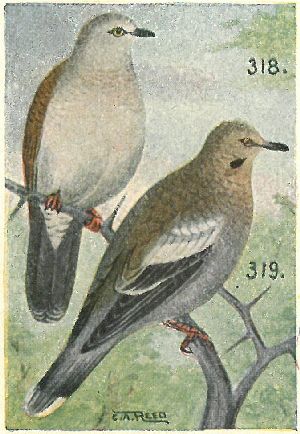
WHITE-FRONTED DOVE
318. Leptotila fulviventris brachyptera. 12 in.
No black ear-mark; under wing coverts rusty chestnut. Forehead whitish; all but central pair of tail feathers tipped with white.
Nest.—Indistinguishable from that of the next species.
Range.—Central America and Mexico, north in February to valley of Lower Rio Grande.
WHITE-WINGED DOVE
319. Melopelia asiatica. 12 in.
Large black patch on the ears; tail only moderately long, and broadly rounded, with large white ends to the outer feathers. Besides the regular cooing notes, common to doves, this species has a peculiar song likened by some, to the first attempts at crowing, of a young rooster.
Nest.—A shabby platform of twigs, lined with bits of weeds, moss and leaves; placed at any height from the ground in bushes, trees or cacti. Eggs white.
Range.—Texas, New Mexico, Arizona and casually southern Florida, southward.
[195]
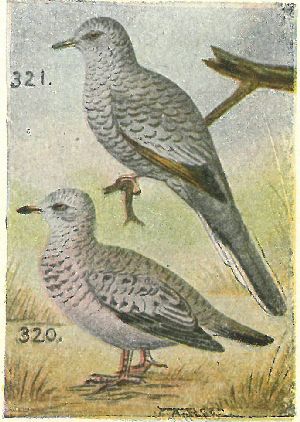
GROUND DOVE
320. Chæmepelia passerina terrestris. 6.75 in.
Size very small; tail short and nearly square. Back of head blue-gray; forehead and most of underparts pinkish. Bill, feet and eye, more or less red.
Nest.—A frail structure of twigs, lined with pine needles; placed usually at low elevations in bushes. The two eggs are pure white.
Range.—South Atlantic and Gulf States; abundant near the coasts; winters throughout its range.
320a., Mexican Ground Dove, found from Texas to California, is slightly paler than the eastern species.
INCA DOVE
321. Scardafella inca. 8 in.
Tail long, with the outer feathers tipped with white, and shorter than the middle ones. Feathers mostly margined with brownish-black. The bases of the primaries are bright chestnut, and the whole underwing is of that color; bill black; eye and feet reddish.
Range.—Southern Texas, southern Arizona and southern New Mexico.
[196]
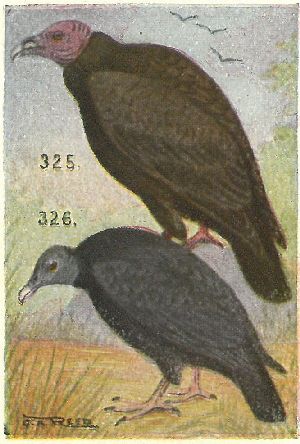
VULTURES, HAWKS AND OWLS—Order Raptores AMERICAN VULTURES—Family Cathartidæ
TURKEY VULTURE OR BUZZARD
325. Cathartes aura septentrionalis. 30 in.
Head naked; red or carmine; bill dull whitish; eyes brown; feet pinkish. Plumage blackish-brown.
Nest.—Their two eggs are laid upon the ground, between rocks, under logs, or in hollow trees; they are whitish, handsomely blotched with brown.
Range.—Breeds from the Gulf north to New Jersey, Illinois, Minnesota and British Columbia.
BLACK VULTURE
326. Catharista urubu. 24 in.
Entire plumage, including the naked head, black; feet and tip of bill yellowish. Under surface of the wings white, making it very easy to identify.
Nest.—Two eggs, greenish-white, blotched with brownish. (3.00 × 2.00).
Range.—Resident north to North Carolina, southern Illinois and Kansas.
[197]
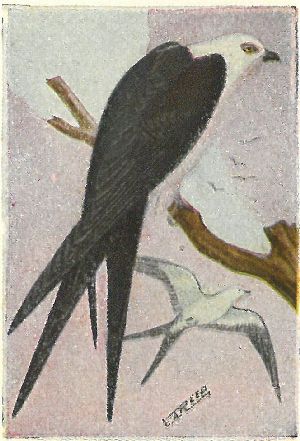
FALCONS, HAWKS AND EAGLES—Family Falconidæ
SWALLOW-TAILED KITE
327. Elanoides forficatus. 24 in.
Tail long and deeply forked; plumage white, and glossy black; feet short but stout; bill black, with cere and feet bluish-gray. The flight of these birds is very swift and swallow-like; at times they circle about for long periods, on motionless wings; at others, they will be seen swooping over marshes and low ground; the evolutions they perform during the mating season are wonderful to behold, floating, sailing, doubling and turning, in all imaginable positions, as though they were a part of the air itself.
Notes.—A shrill whistled “peet-peet.”
Nest.—Composed of twigs, lined with moss and rootlets; usually located in the tops of trees at great heights; 90 to 125 feet from the ground not being uncommon; eggs pale bluish-white, very handsomely marked with brown (1.85 × 1.5).
Range.—Breeds north to Virginia, Manitoba and Minnesota; winters south of the United States.
[198]
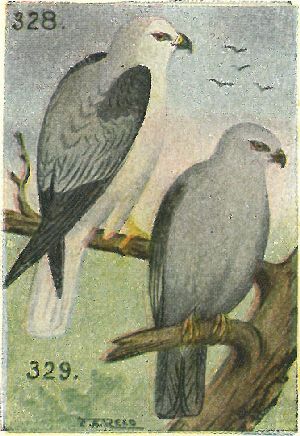
WHITE-TAILED KITE
328. Elanus leucurus. 16 in.
Head, underparts and tail, white; shoulders black; upperparts gray. Young, with the back tinged with rusty. Their food consists largely of snakes, but they also eat a great many small rodents and insects.
Nest.—Made of sticks, weeds and leaves, and placed in trees at quite an elevation from the ground; eggs creamy white, profusely blotched with brown.
Range.—Texas to central California, and less often east of the Miss. River, north to South Carolina.
MISSISSIPPI KITE
329. Ictinia mississippiensis. 14 in.
Head, underparts and ends of secondaries, bluish-gray. Lores and tail black; back dark; eyes red.
Nest.—Of sticks and weeds in the tops of tall trees; eggs bluish white, usually unmarked, but occasionally with a few brownish specks (1.65 × 1.25).
Range.—Breeds north to South Carolina, southern Illinois and Kansas; winters south of the United States.
[199]
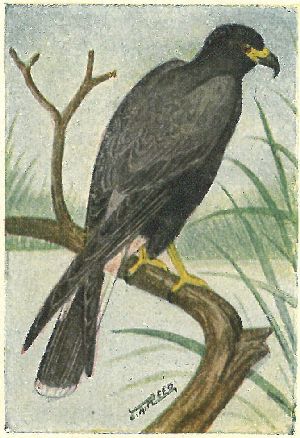
EVERGLADE KITE
330. Rostrhamus sociabilis. 15 in.
Bill very slender and much hooked, the lower mandible being decurved somewhat, to match the upper; the cutting edge of the bill without a tooth or notch, as most hawks and kites have. Lores naked and yellowish, like the cere; eyes red. Plumage blackish; rump and bases of outer tail feathers, as well as tip white. This tropical species is found in the United States, only in the southern half of Florida, in the densest swamps, being fairly abundant in the Everglades. They are said to feed exclusively upon a certain species of water snail, and each bird has a particular perch to which he takes every snail he captures, and after skillfully extracting the animal with its curiously modified beak, it drops the shell on the mound beneath. (Bendire).
Nest.—Of twigs, lined with leaves and weeds, placed at low elevations in bushes or underbrush, often over water; eggs pale greenish-white, spotted with brown.
Range.—Southern Florida.
[200]
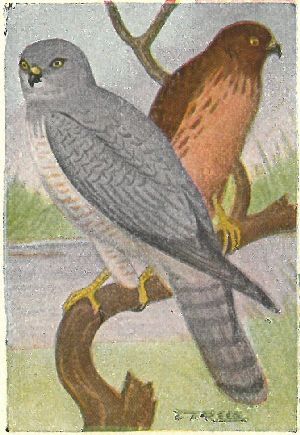
MARSH HAWK
331. Circus hudsonius. 19 in.
Upper tail coverts and base of tail white. Male, blue-gray above; below, whitish, streaked and barred with rusty. Female and young.—Above rusty brownish-black; below rusty with dusky streaks on the breast and sides. As shown by its name, this hawk is found most abundantly in or around marshes or wet meadows. I have found them especially abundant in boggy marshes such as frequented by bitterns. Their flight is quiet and owl-like, and as they do most of their feeding toward dusk, they often seem like owls as they flit by without a sound. Their food is composed chiefly of meadow mice and moles, which they spy and dash down upon as they fly at low elevations.
Notes.—A shrill whistle when their nest is approached.
Nest.—Of grasses, on the ground in marshes; four plain bluish-white eggs (1.80 × 1.40); May, June.
Range.—Breeds locally in the whole of the United States and Canada, north to Hudson Bay; winters in the southern half of the United States.
[201]
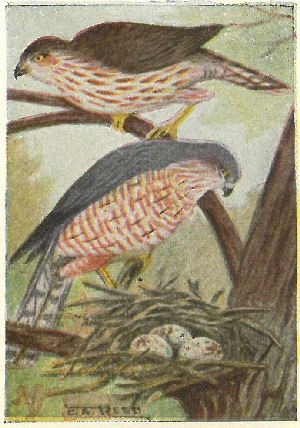
SHARP-SHINNED HAWK
332. Accipiter velox. 12 in.
This little hawk, so near like the Cooper, is one of the most active of the family, and from this fact it gets its name velox, meaning swift. It is often seen in woods, orchard, or even about buildings in large cities, in which latter places, it does good service in catching English Sparrows. If they would confine their food to these birds, no one would object, but unfortunately they will take any little bird that comes within their reach, or that they are able to catch. They are one of the very few hawks that do live largely upon birds, and even they destroy a great many mice.
Notes.—A shrill, three-syllabled whistle.
Nest.—A rude and usually frail structure of twigs, placed in branches of trees, usually at quite low elevations (15 ft.). Eggs white, beautifully blotched with brown (1.45 × 1.15).
Range.—Breeds chiefly in northern U. S. and Canada; winters throughout the United States.
[202]
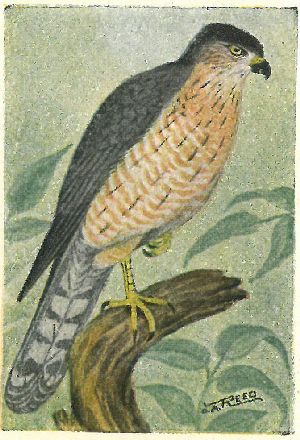
COOPER HAWK
333. Accipiter cooperi. 16 in.
This hawk is a large edition of the last species. All hawks vary in size, this one and the last, perhaps, more than any others. Female hawks are always the largest. A large female of the Sharp-shinned variety, is often as large as a small male Cooper, but the crown of the Cooper is darker than that of the Sharp-shinned, and his tail is always rounded, while that of the last species is nearly square at the end. This is also a destructive species; it is usually one of these two hawks, or the Goshawk, that is responsible for the ill-feeling with which farmers regard all of the family. All small hawks are known to farmers as “Chicken Hawks,” and large ones as “Hen Hawks,” but the majority of our hawks rarely disturb fowls.
Nest.—Of sticks in crotches of trees, usually quite high up; often old crows’ nests are used; eggs bluish-white, unmarked or very faintly specked with brown. (1.90 × 1.45); April.
Range.—Breeds from the Gulf north to southern Canada; winters from Mass. and Oregon southward.
[203]
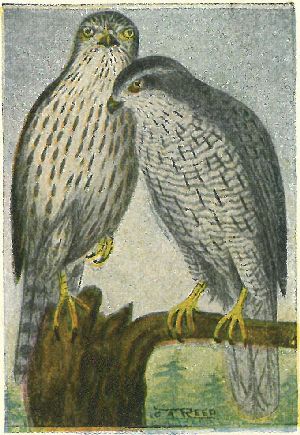
AMERICAN GOSHAWK
334. Astur atricapillus. 23 in.
Adults, above bluish-slate, darkest on the crown; a whitish line over the eye; below white, finely waved with gray. Young, brownish-black, with lighter edgings to the feathers; below whitish, streaked with blackish-brown. Young birds can easily be distinguished from those of any other species by their large size and the long tail. This handsome species is one of the most rapacious and destructive of our birds of prey. Their short wings and long tail enable them to glide among the thickest foliage with great speed, and even the Ruffled Grouse cannot escape them. In the north where they live in summer, they destroy great numbers of Ptarmigan and Spruce Grouse, and come to us in the winter with their appetite whetted for a diet of poultry and our game birds, being exceedingly bold in their capture.
Nest.—Of sticks lined with weeds and bark, in tall trees; eggs white, unmarked.
Range.—Breeds throughout Canada; winters in the northern half of the United States.
[204]
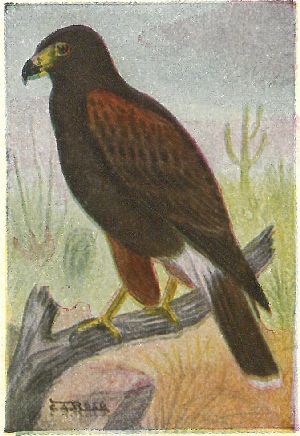
HARRIS HAWK
335. Parabuteo unicinctus harrisi. 20 in.
Tail coverts, base and tip of tail, white. Adults with the shoulders, thighs and under wing-coverts, reddish-brown. Young with rusty edgings to feathers on the back; below, rusty buff with blackish spots or streaks; thighs barred with blackish. Space in front of eye, bare except for stiff hair-like bristles, yellowish like the cere. This species is the connecting link between the vultures and hawks of the genus buteo. Its feedings habits are similar to those of the vultures, with which it often associates when feeding upon carrion. They are very sluggish birds and their flight is slow and heavy; when not feeding they are usually perched on one foot on some dead limb, dozing.
Nest.—Made of sticks, twigs and weeds, placed in bushes or low trees. Their three or four eggs are dull white, unmarked (2.10 × 1.65).
Range.—Mexico, north to southern United States chiefly in Texas, but also found in New Mexico and casually east to Louisiana.
[205]
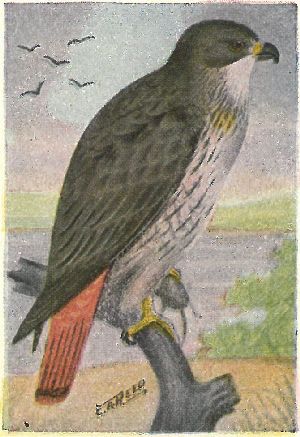
RED-TAILED HAWK
337. Buteo borealis. 21 in.
One of the handsomest and most powerfully built of our hawks. Adults with the tail rusty-red, with or without a narrow blackish band near the tip; below white, with a band of blackish streaks across the breast, and dusky markings on the sides. Young birds are similar, but have the tail grayish-brown with black bands. An examination of the food of this bird of prey, made by the Department of Agriculture, shows that, instead of living upon poultry as most farmers think, their food consists chiefly of frogs, snakes, lizards, mice and insects, less than one in ten of the stomachs examined containing any remains of poultry.
Notes.—A shrill whistle or scream.
Nest.—Of sticks, weeds, leaves and trash high up in tall trees; eggs white, spotted with blackish-brown.
Range.—Breeds in United States and Southern Canada; winters in the United States. 337a., Krider Hawk is a paler race found on the plains from Minn. to Texas. 337d., Harlan Hawk, is darker and has the tail mottled with blackish; found in the Gulf States.
[206]
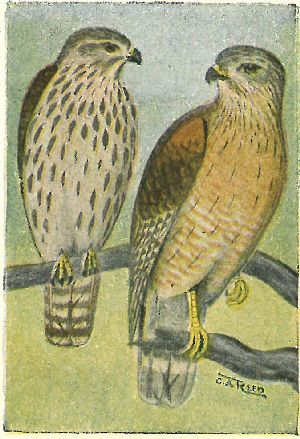
RED-SHOULDERED HAWK
339. Buteo lineatus. 19 in.
Adults with the shoulders bright reddish-brown; primaries and secondaries barred with black and white; below buffy thickly barred with rusty-brown. Young with the shoulders duller; underparts white, streaked all over with blackish-brown. This is one of the most abundant of the birds of prey in Eastern United States, and it is also one of the most useful, destroying quantities of moles and field mice, as well as grasshoppers. Usually one or more pairs will be found in a piece of woods. One pair that I know, and I presume it is the same pair, each year has its nest on the edge of a colony of Black-crowned Night Herons and, during the season, they live and feed their young largely upon the young of these birds.
Nest.—Of sticks, lined with weeds and strips of bark; eggs white, blotched with brown (2.15 × 1.75). April, May.
Range.—Breeds from the Gulf to Maine and Minnesota. 339a. Fla. Red-Shouldered Hawk, found in Florida and north to So. Car., is paler colored.
[207]
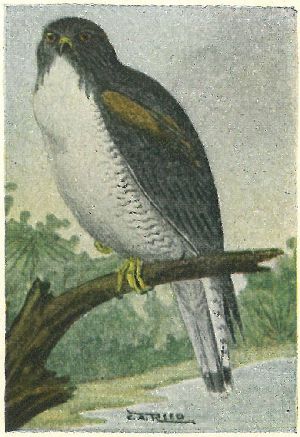
SENNETT WHITE-TAILED HAWK
341. Buteo albicaudatus sennetti. 22 in.
Adults grayish-slate above and to the sides of the throat; tail and underparts white, the former with a subterminal band of black and indistinct wavy lines and the latter with fine barring on the sides. The shoulders are largely chestnut. Young birds are brownish-black above and usually white below, but the underparts are variable—often streaked with rusty and blackish, or even wholly black.
They are useful hawks, their food consisting chiefly of insects and moles or mice.
Nest.—Built in bushes in open land, rarely more than six feet above ground. Composed of sticks, dry weeds and grasses making a bulky structure visible for a long distance. Three eggs are not uncommon but two is the usual number; they are dirty white with very few marks of brown (2.35 × 1.85). Their nesting season ranges from as early as February to July.
Range.—Not uncommon on the Gulf coast of Texas and in the lower Rio Grande Valley, southwards into South America.
[208]
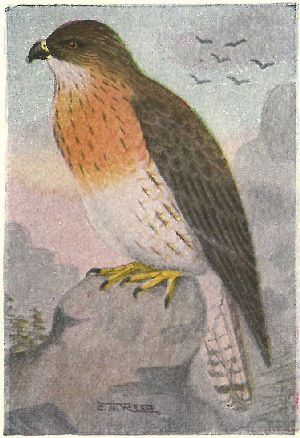
SWAINSON HAWK
342. Buteo swainsoni. 20 in.
This species has the greatest variety of plumages of any of our hawks. It has only three outer primaries notched near the tips, while the two last species, which are the only ones that can be confused with it, have four. Adults in the light phase have a band of rich chestnut across the breast. Adults in the dark phase are uniform blackish-brown, with some rusty edgings and with thighs more or less rusty. Young birds are buffy below, with elongated blackish spots. Its harmless character can be understood from the fact that it is no unusual sight to find other birds, such as Arkansas Kingbird and Bullock Oriole, nesting in the same tree; and the first mentioned species goes even further than this, sometimes constructing its home in the sides of the nests of the hawks.
Nest.—Of sticks and twigs, either in trees or on the ground on rocky ledges; eggs white, spotted with brown (2.20 × 1.70).
Range.—Western N. A., breeding from Texas to the Arctic regions; east to Illinois and west to the Pacific.
[209]
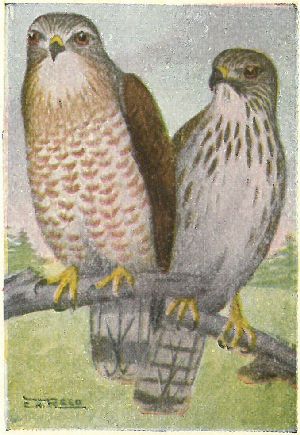
BROAD-WINGED HAWK
343. Buteo platypterus. 16 in.
Adults grayish-brown above; below, streaked on the throat and breast, and barred below, with rusty-brown; tail with three blackish bars. Young similar above; below white, streaked with blackish-brown. They are most apt to be confused with the Cooper and Red-Shouldered Hawk, but when in flight, it can usually be distinguished at a distance, from the former by its shorter tail, and from the latter by its smaller size and rounded wings. They may be classed as abundant east of the Great Plains. They are rather solitary in their habits, especially during the breeding season, when but one pair is usually found in a piece of woods.
Notes.—A long, squeaking wail, sounding much like two branches rubbing together and creaking.
Nest.—Of sticks, invariably lined with pieces of bark; usually placed in crotches next to the trunks of large trees, but not usually at a great height; eggs whitish, more or less blotched with brown and gray.
Range.—Breeds north to New Brunswick and Manitoba; winters in southern half of the United States.
[210]
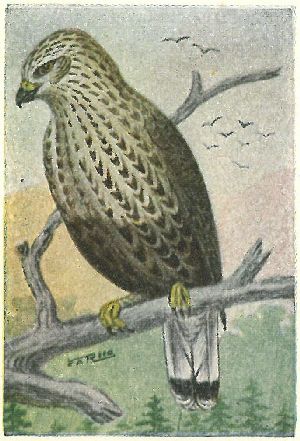
AMERICAN ROUGH-LEGGED HAWK
347a. Archibuteo lagopus sancti-johannis. 22 in.
Legs feathered to the toes. Adults blackish on the back and belly; head and breast, more or less grayish-white, streaked with dusky; tail white, barred on the end with black; eyes brown. In the dark phase they are blackish-brown, more or less mixed with rusty. This large, heavily-built species is found in the United States, only in winter; it frequents thinly wooded districts or meadows, where it catches its prey, which consists of small rodents, insects and reptiles. It is very irregular in its appearance, especially in the east, but it is most often found near the coast. It is a sluggish species and I doubt if it does any harm to wild birds or to poultry; it certainly does a great deal of good.
Nest.—Of sticks, on rocky ledges; eggs bluish-white, boldly splashed with brown (1.90 × 1.55).
Range.—Breeds north of the United States border; winters in northern United States.
[211]
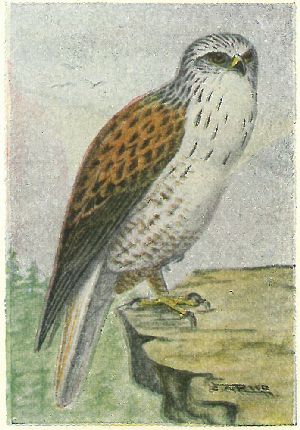
FERRUGINOUS ROUGH-LEGGED HAWK
348. Archibuteo ferrugineus. 23 in.
Legs feathered to the toes. Adults with back, shoulders, thighs and legs, rusty, barred or streaked with black; tail grayish-white, tinged with rusty. Young birds are brownish-black, above and without any rusty below. In the dark phase they are sooty-brown, more or less varied with rusty, and the tail is the same as in the light plumage. Their bill is larger and tail longer than that of the last species. A fairly abundant hawk on the plains and prairies west of the Miss., usually not at a great distance from water.
Nest.—Usually on the ground on bluffs or rocky ledges, but sometimes in trees; made of sticks and weeds; sometimes used year after year, and then becoming bulky, as it is added to each year; eggs white, handsomely spotted and blotched with blackish-brown, very variable.
Range.—Breeds west of the Miss., from Kansas, locally, and the Dakotas, abundantly, north to Saskatchewan. Winters south to Mexico.
[212]
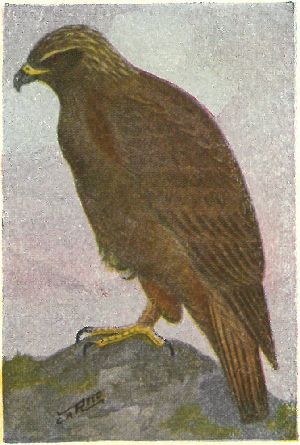
GOLDEN EAGLE
349. Aquila chryœtos. 35 in.
Legs feathered to the toes. Plumage blackish-brown, adults having the lengthened feathers on the nape, golden-brown, and the tail more or less mixed with white; leg feathers rusty. These large, handsome, well-built birds of prey are fairly abundant in thinly settled country west of the Miss., especially in mountains and foot-hills. They are very powerful birds and a single pair of them will rule the whole country in which they reside. They are very shy in the presence of man and will never attack a person or show fight unless wounded or surprised at their meals. Their food consist of prairie dogs, rodents, ducks and even fawns.