Part II. FABLES, with Reflections. (continued 2)
Reading edition
Morals.
The vengeance of Heaven, sooner or later, treads upon the heels of wilful disobedience to parents.

When wayward children in the pride of youth, Scorn wisdom’s precepts, and the curb of truth; Laugh at experience, and her sagest rules, And hold restraints the doting fits of fools; They thoughtless rush, where folly leads the way, Where evils throng, and vice holds lordly sway. Yet hoary age by long experience knows, Where vices flourish, and where evil grows; With cautious fondness for the budding mind, Warns from the path, where ill with ill’s combin’d; Whilst heedless youth, in all the pomp of pride, Spurn at his prudence, and his laws deride. A few short years disperse the dazzling shade, Which fame excited, and which transports made; Wearied and pall’d with pleasure’s fleeting joys, Which madness raves for, and which health destroys; Too late they find, by sage experience taught, The rules of age are with true wisdom fraught.
Reflection.
Children are not to reason upon obedience to parents, provided there be nothing in the command, or in the imposition, that is simply evil; for headstrong and undutiful children seldom escape a remarkable punishment, which gives them reason to say to their parents, this had never been, if I had followed your advice.
Fable XXXVI. The Countryman and Ass.
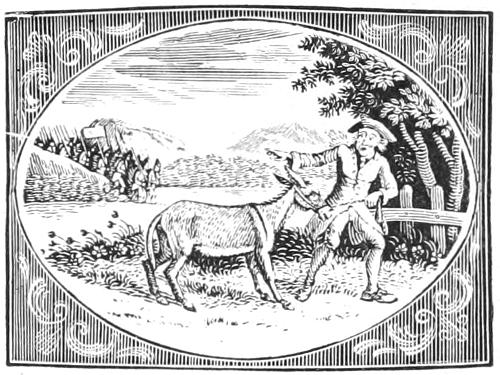
An old fellow was feeding an Ass in a fine green meadow; and being alarmed with the sudden approach of the enemy, was impatient with the Ass to put himself forward, and fly with all the speed that he was able. The Ass asked him, Whether or no he thought the enemy would clap two pair of panniers upon his back? The man said, No, there was no fear of that. Why then, says the Ass, I will not stir an inch; for what is it to me who my master is, since I shall but carry my panniers as usual?
Morals.
Men in a fright, or alarmed with the apprehensions of some imminent danger to themselves, often fly for succour to those from whom they have not deserved any. It is prudent so to behave in our prosperity, as that we may make every one our friend in times of adversity: for no one is exempted from the mutability of fortune.

The man that is poor may be void of all care, If there’s nothing to hope, he has nothing to fear: Whether stocks rise or fall, or whate’er be the news, He is sure not to win, and has nothing to lose.
Reflection.
This fable shows us how much in the wrong the poorer sort of people most commonly are, when they are under any concern about the revolutions of a government. All the alteration which they can feel is, perhaps, in the name of their sovereign, or some such important trifle. But they cannot well be poorer, or made to work harder than they did before. And yet how are they sometimes imposed upon, and drawn in by the artifices of a few mistaken or designing men, to foment factions, and raise rebellions, in cases where they can get nothing by the success; but, if they miscarry, are in danger of suffering an ignominious, untimely death.
Fable XXXVII. Joy and Sorrow.
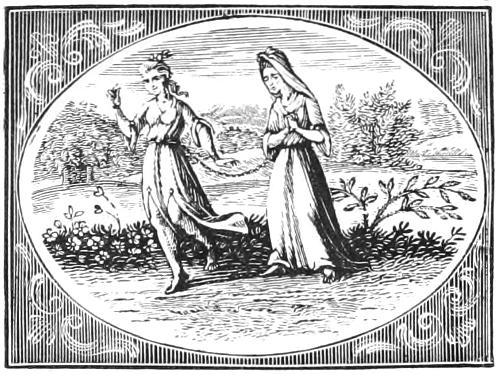
Joy and Sorrow, two twin-sisters, once quarrelled vehemently who should have the preference; and being unable to decide the matter, left it to Minos to determine. He tried all means to make them agree and go hand in hand together, as loving sisters ought; but finding his counsel had no effect upon them, he decreed that they should be linked together in a chain; and each of them in turn should be perpetually treading upon the heel of the other; and not a pin matter then, says he, which goes foremost.
Morals.
No man is to presume in prosperity, or despair in adversity; for good and ill fortune do as naturally succeed one another, as day and night.

The Gods one time, as poets feign, Would pleasure intermix with pain; And perfectly incorporate so, As one from t’other none might know; That mortals might alike partake The Good and Evil which they make. In mighty bowl they put these twain, And stirr’d and stirr’d, but all in vain: Pleasure would sometimes float aloft, And pain keep pleasure down as oft: Yet still from one another fly, Detesting either’s company. The Gods, who saw they sooner might Mix fire and water, day and night, Unanimously then decreed They should alternately succeed; Each other’s motions still pursue, And a perpetual round renew: Yet still divided should remain, Tho’ link’d together with a chain. Thence comes it that we never see A perfect bliss or misery; Each happiness has some alloy; And grief succeeded is by joy. The happiest mortal needs must own He has a time of sorrow known: Nor can the poorest wretch deny But in his life he felt a joy.
Reflection.
It is the lot of mankind to be happy and miserable by turns. The wisdom of Providence will have it so; and it is exceedingly for our advantage that so it should be. There is nothing pure and unmixed under the heavens; and if there were, such an abstracted simplicity would be neither nourishing nor profitable to us. By the mediation of this mixture, we have the comfort of Hope to support us in our distresses, and the apprehensions of a change to keep a check upon us in the very pride of our greatness: so that by this vicissitude of good and evil we are kept steady in our philosophy and in our religion. The one minds us of God’s omnipotence and justice; the other, of His goodness and mercy: the one tells us, there is no trusting to our own strength; the other preaches faith and resignation in the prospect of an overruling Providence that takes care of us. What is it but sickness that gives us a taste of health? bondage, the relish of liberty? and what but the experience of want that enhances the value of plenty? that which we call ease is only an indolence or a freedom from pain; and there is no such thing as felicity or misery but by comparison. It is very true, that hopes and fears are the snares of life in some respects, but they are the reliefs of it in others. Now for fear of the worst, however, on either hand every man has it in his power, by the force of natural reason, to avoid the danger of falling either into presumption or despair.
Fable XXXVIII. The Fox and the Ape.
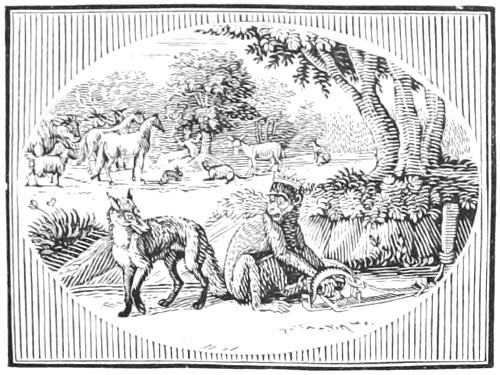
Once upon a time, the beasts were so void of reason as to choose an Ape for their King. He had danced, and diverted them with playing antic tricks, and truly nothing would serve but they must anoint him their sovereign. Accordingly crowned he was, and affected to look very wise and politic. But the Fox, vexed at his heart to see his fellow-brutes act so foolishly, was resolved the first opportunity to convince them of their sorry choice, and punish their jackanapes of a king for his presumption. Soon after, spying a trap in a ditch, which was baited with a piece of flesh, he went and informed the Ape of it, as a treasure, which, being found upon the waste, belonged to his Majesty only. The Ape, dreaming nothing of the matter, went very briskly to take possession, but had no sooner laid his paws upon the bait, than he was caught in the trap; where, betwixt shame and anger, he began to reproach the Fox, calling him rebel and traitor, and threatening to be revenged of him. At all which Reynard laughed heartily; and going off, added, with a sneer, You a king, and not understand trap!
Morals.
When Apes are in power, Foxes will never be wanting to play upon them.

When nations raise an idiot to the throne, He shows the people’s weakness and his own.
Reflection.
A weak man should not aspire to be a king; for if he were, in the end it would prove as inconvenient to himself, as disadvantageous to the public. To be qualified for such an office—an office of the last importance to mankind—the person should be of a distinguished prudence and most unblemished integrity; too honest to impose upon others, and too penetrating to be imposed upon; thoroughly acquainted with the laws and genius of the realm he is to govern; brave, but not passionate; good-natured, but not soft; aspiring at just esteem; despising vain-glory; without superstition; without hypocrisy. When thrones have been filled by people of a different turn from this, histories show what a wretched figure they always made; what tools they were to particular persons, and what plagues to their subjects in general. They who studied their passions and entered into their foibles, led them by the nose as they pleased; and took them off from the guardianship of the public, by some paltry amusement, that themselves might have the better opportunity to rifle and plunder it.
Fable XXXIX. The Satyr and the Traveller.
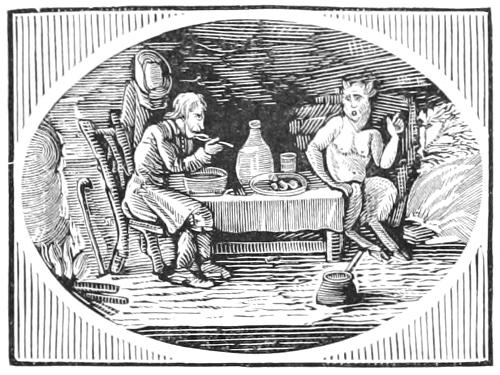
A Satyr, as he was ranging the Forest in an exceeding cold, snowy season, met with a Traveller half-starved with the extremity of the weather. He took compassion on him, and kindly invited him home, to a warm comfortable cave he had in the hollow of a rock. As soon as they had entered and sat down, notwithstanding there was a good fire in the place, the chilly Traveller could not forbear blowing his finger ends. Upon the Satyr’s asking him why he did so, he answered: That he did it to warm his hands. The honest silvan having seen little of the world, admired a man who was master of so valuable a quality as that of blowing heat, and therefore was resolved to entertain him in the best manner he could. He spread the table before him with dried fruits of several sorts; and produced a remnant of old cordial wine, which, as the rigour of the season made very proper, he mulled with some warm spices, infused over the fire, and presented to his shivering guest. But this the Traveller thought fit to blow likewise; and upon the Satyr’s demanding a reason why he blowed again, he replied: To cool his dish. This second answer provoked the Satyr’s indignation, as much as the first had kindled his surprise. So, taking the man by the shoulder, he thrust him out of doors, saying: He would have nothing to do with a wretch who had so vile a quality as to blow hot and cold with the same mouth.
Morals.
There is no conversing with any man that carries two faces under one hood.
With such an inmate who would be perplext, One hour all coldness, and all heat the next! Who would his fev’rish shiv’ring fits endure? That ague of the heart, no drug can cure.
Reflection.
Though the poor Traveller in the Fable was not guilty of any real crime in what he did, yet one cannot help approving the honest simplicity of the Satyr, who could not be reconciled to such double dealing. In the moral sense of the Fable, nothing can be more offensive to one of a sincere heart, than he that blows with a different breath from the same mouth; who flatters a man to his face, and reviles him behind his back. Some again, just like this man, to serve a present view, will blow nothing but what is warm, benevolent, and cherishing; and when they have raised the expectations of a dependant to a degree which they think may prove troublesome, can, with putting on a cold air, easily chill and blast all his blooming hopes. But such a temper, whether it proceeds from a designed or natural levity, is detestable, and has been the cause of much trouble and mortification to many a brave deserving man. Unless the tenor of a man’s life be always true and consistent with itself, the less one has to do with him the better.
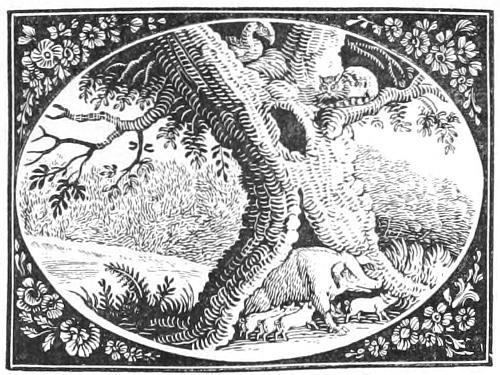
Fable XL. The Eagle, the Cat, and the Sow.
An Eagle had built her nest upon the top branches of an old oak. A wild Cat inhabited a hole in the middle; and in the hollow part at the bottom was a Sow, with a whole litter of pigs. A happy neighbourhood; and might long have continued so, had it not been for the wicked insinuations of the designing Cat. For, first of all, up she crept to the Eagle; and, good neighbour, says she, we shall be all undone: That filthy Sow yonder does nothing but lie routing at the foot of the tree, and, as I suspect, intends to grub it up, that she may the more easily come at our young ones. For my part I will take care of my own concerns; you may do as you please, but I will watch her motions, though I stay at home this month for it. When she had said this, which could not fail of putting the Eagle into a great fright, down she went, and made a visit to the Sow at the bottom; and, putting on a sorrowful face, I hope, says she, you do not intend to go abroad to-day? Why not? says the Sow. Nay, replies the other, you may do as you please; but I overheard the Eagle tell her young ones, that she would treat them with a pig the first time she saw you go out; and I am not sure but she may take up with a kitten in the meantime; so, good-morrow to you; you will excuse me, I must go and take care of the little folks at home. Away she went accordingly; and, by contriving to steal out softly at nights for her prey, and to stand watching and peeping all day at her hole, as under great concern, she made such an impression upon the Eagle and the Sow, that neither of them dared to venture abroad for fear of the other. The consequence of which was, that themselves, and their young ones, in a little time were all starved, and made prize of by the treacherous Cat and her kittens.
Morals.
There can be no peace in any state or family where whisperers and tale-bearers are encouraged.

Ill fares that neighbourhood, where sland’rers meet With easy faith to back their base deceit: From house to house the plague of discord spreads, And brings down ruin on their hapless heads.
Reflection.
Busy-bodies and intermeddlers are a dangerous sort of people to have to do withal; for there is no mischief that may not be wrought by the craft and management of a double tongue, with a foolish credulity to work upon. There is hardly a greater pest to government, to conversation, to the peace of societies, relations, and families, than officious tale-bearers and busy intermeddlers. These pick-thanks are enough to set mankind together by the ears; they live upon calumny and slander, and cover themselves, too, under the seal of secrecy and friendship; these are the people who set their neighbours’ houses on fire to roast their own eggs. The sin of traducing is diabolical, according to the very letter; and if the office be artificially managed, it is enough to put the whole world into a flame, and nobody the wiser which way it came. The mischief may be promoted, by misrepresenting, misunderstanding, or misinterpreting our neighbour’s thoughts, words, and deeds; and no wound so mortal, as that where the poison works under a pretence of kindness: nay, there are ways of commendation, and insinuations of affection and esteem, that kill a man as sure as a bullet. This practice is the bane of trust and confidence; and it is as frequent in the intrigues of courts and states, as in the most ordinary accidents of life. It is enough to break the neck of all honest purposes, to stifle all generous and public-spirited motions, and to suppress all honourable inclinations in the very conception. But, next to the practice of these lewd offices, deliver all honest men, say I, from lying at the mercy of those that encourage and entertain them.
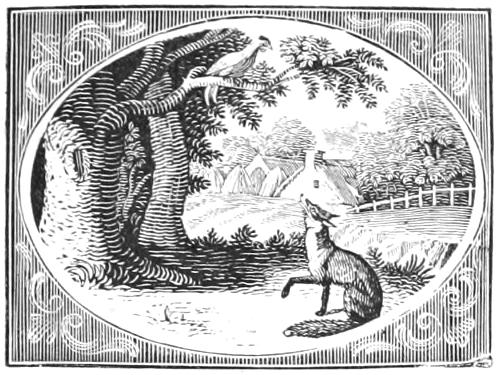
Fable XLI. The Cock and the Fox.
A Cock being perched among the branches of a lofty Tree, crowed aloud, so that the shrillness of his voice echoed through the wood and invited a Fox to the place, who was prowling in that neighbourhood, in quest of his prey. But Reynard, finding the Cock was inaccessible, by reason of the height of his situation, had recourse to stratagem, in order to decoy him down; so, approaching the tree, Cousin, says he, I am heartily glad to see you; but at the same time I cannot forbear expressing my uneasiness at the inconvenience of the place, which will not let me pay my respects to you in a handsomer manner; though I suppose you will come down presently, and so that difficulty is easily removed. Indeed, Cousin, says the Cock, to tell you the truth I don’t think it safe to venture myself upon the ground, for though I am convinced how much you are my friend, yet I may have the misfortune to fall into the clutches of some other beast, and what will become of me then? O dear, says Reynard, is it possible that you can be so ignorant, as not to know of the peace that has been lately proclaimed between all kinds of birds and beasts; and that we are, for the future, to forbear hostilities on all sides, and to live in the utmost love and harmony, and that under penalty of suffering the severest punishment that can be inflicted? All this while the Cock seemed to give little attention to what was said, but stretched out his neck, as if he saw something at a distance: Cousin, says the Fox, what’s that you look at so earnestly? Why, says the Cock, I think I see a pack of hounds yonder a little way off. Oh then, says the Fox, your humble servant, I must be gone. Nay, pray, Cousin, don’t go, says the Cock, I’m just coming down; sure you are not afraid of dogs in these peaceable times. No, no, says he; but ten to one whether they have heard of the proclamation yet.
Morals.
Perfidious people are naturally to be suspected in reports that favour their own interest.
Take courage, hence, ye wise, nor dread deceit; Good sense and craft, how seldom do they meet! Tho’ keen, yet feeble, are the sharper’s tools, And cunning’s the peculiar gift of fools.
Reflection.
It is a very agreeable thing to see craft repelled by cunning; more especially to behold the snares of the wicked broken and defeated by the discreet management of the innocent. The moral of this Fable principally puts us in mind, not to be too credulous towards the insinuations of those who are already distinguished by their want of faith and honesty. When, therefore, any such would draw us into a compliance with their destructive measures, by a pretended civility and extraordinary concern for our interest, we should consider such proposals in their true light, as a bait artfully placed to conceal the fatal hook, which is intended to draw us into captivity and thraldom. An honest man, with a little plain sense, may do a thousand advantageous things for the public good; and, without being master of much address or rhetoric, as easily convince people that his designs are intended for their welfare. But a wicked designing politician, though he has a tongue as eloquent as ever spoke, may sometimes be disappointed in his projects and be foiled in his schemes; especially when their destructive texture is so coarsely spun, and the threads of mischief are so large in them, as to be seen even by those whose senses are scarce perfect enough to see and understand them.
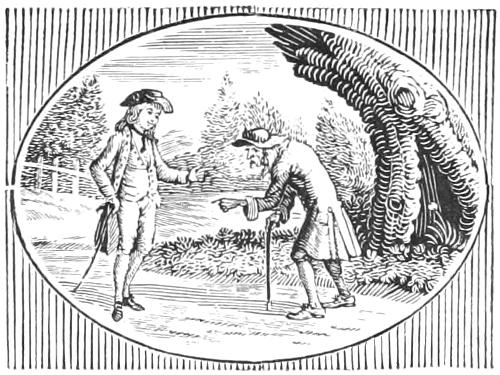
Fable XLII. Age to be Honoured.
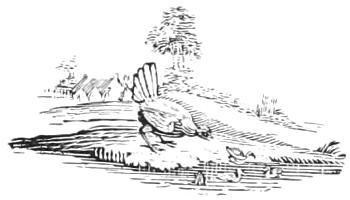
A pert and inconsiderate young Man happened to meet an old Man, whose age and infirmity had brought his body almost to the shape of a bent bow. Pray, father, says he, will you sell your bow? Save your money, you fool, says the other; for when you come to my years, you shall have such a bow for nothing.
Morals.
There cannot be a greater folly and impertinence, than that of young men scoffing at the infirmities of age.

Though vig’rous health thy tide of life sustains, And youthful manhood revels in thy veins: With rev’rend awe regard the bending sage, Nor thoughtless mock th’ infirmities of age.
Reflection.
We are all born to die, and it is every jot as certain that we shall go out of the world, as that we are already come into it: we are helpless in infancy; ungovernable in youth; our strength and vigour scarce outlast a morning sun; our infirmities hasten upon us as our years advance, and we grow helpless in our old age as in our infancy. What, then, have the best of us to boast of? Even time and human frailty alone will bring us to our end without the help of any accidents or distempers; so that our decays are as much the works of nature, as the first principles of our being; and the young man’s conceit of the crooked bow is no better than an irreverent way of making sport with the course of Providence; besides shewing the folly of scoffing at that in another which he himself was sure to come to at last, or worse.
Fable XLIII. The Splenetic Traveller.
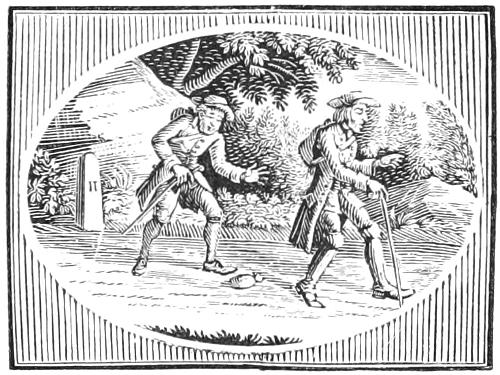
A splenetic and a facetious man were once upon a journey: the former went slugging on with a thousand cares and troubles in his head, exclaiming over and over: “Lord, what shall I do to live?” The other jogged merrily away, and left his matters to Providence and good fortune. “Well, brother,” says the sorrowful wight, “how can you be so frolicksome now? As I am a sinner, my heart’s e’en ready to break for fear I should want bread.” “Come, come,” says the other, “fall back, fall edge, I have fixed my resolution, and my mind’s at rest.” “Ay, but for all that,” says the other, “I have known the confidence of as resolute people as yourself has deceived them in the conclusion;” and so the poor man fell into another fit of doubting and musing, till he started out of it all on a sudden: “Good Sir!” says he, “what if I should fall blind?” and so he walked a good way before his companion with his eyes shut, to try how it would be if that misfortune should befall him. In this interim, his fellow-traveller, who followed him, found a purse of money upon the way, which rewarded his trust in Providence; whereas the other missed that encounter as a punishment of his distrust; for the purse had been his, as he went first, if he had not put himself out of condition of seeing it.
Morals.
He that commits himself to Providence is sure of a friend in time of need; while an anxious distrust of the divine goodness makes a man more and more unworthy of it, and miserable beforehand for fear of being so afterwards.

Who with vain fancies do themselves possess, Are never bless’d, or can never bless; Their life perplex’d, and fretful to no end— The truly wise on Providence depend.
Reflection.
The two opposite humours of a cheerful trust in Providence and a suspicious diffidence of it, with the ordinary effects and consequences of the one and the other, are very well set forth here for our instruction and comfort. The Divine goodness never fails those that depend upon it, provided that, according to the advice of Hercules to the Carter, they put their own shoulders to the work.
The most wretched sort of people under the sun are your dreamers upon events, your low-spirited foreboders, supposers, and putters of cases: they are still calculating within themselves, what if this or that calamity, judgment, or disaster should befall them? and so they really suffer the evils they dread most. It is very certain, that what we fear we feel; besides that, fancy breeds misery as naturally as it does the small-pox. Set a whimsical head once agog upon sprites and goblins, and he will be ready to squirt his wits at his own shadow. There is no surer remedy for this superstitious and desponding weakness, than first to govern ourselves by the best improvement of that reason which Providence has given us for a guide; and then, when we have done our own part, to commit all cheerfully for the rest to the good pleasure of Heaven, with trust and resignation. Why should I not as well comfort myself with the hope of what may be, as torment myself with the fear of it? he that distrusts in God’s providence, does effectually put himself out of His protection.
Fable XLIV. The Young Man and the Swallow.
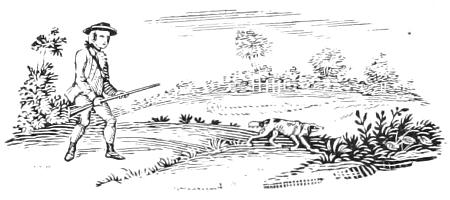
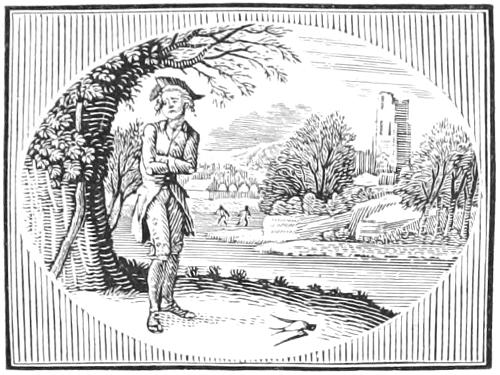
A prodigal young spendthrift, who had wasted his whole patrimony in taverns and gaming-houses among lewd, idle company, was taking a melancholy walk near a brook. It was in the month of January, and happened to be one of those warm sunshiny days which sometimes smile upon us even in that wintry season of the year; and to make it the more flattering, a swallow, which had made its appearance by mistake too soon, flew skimming along upon the surface of the water. The giddy youth, observing this, without any further consideration, concluded that summer was now come, and that he should have little or no occasion for clothes, so went and pawned them at the broker’s, and ventured the money for one stake more, among his sharping companions. When this too was gone the same way with the rest, he took another solitary walk in the same place as before. But the weather, being severe and frosty, had made everything look with an aspect very different from what it did before: the brook was quite frozen over, and the poor swallow lay dead upon the bank of it; the very sight of which cooled the young spark’s brains, and coming to a kind of sense of his misery, he reproached the deceased bird as the author of all his misfortunes: Ah, wretch that thou wert! says he, thou hast undone both thyself and me, who was so credulous as to depend upon thee.
Morals.
Some will listen to no conviction but what they derive from fatal experience.
Still blind to reason, nature, and his God, Youth follows pleasure, till he feels the rod Of sad experience, then bemoans his fate, Nor sees his folly till it is too late.
Reflection.
They who frequent taverns and gaming-houses, and keep bad company, should not wonder if they are reduced, in a very small time, to penury and want. The wretched young fellows who once addict themselves to such a scandalous kind of life, scarce think of, or attend to, any one thing besides. They seem to have nothing else in their heads, but how they may squander what they have got, and where they may get more when that is gone. They do not make the same use of their reason that other people do; but, like the jaundiced eye, view everything in that false light in which their distemper and debauchery represent it. The young man in the Fable gives us a pretty example of this; he sees a swallow in the midst of winter, and instead of being surprised at it, as a very irregular and extraordinary thing, concludes from thence that it is summer, as if he had never thought before about the season. Well, the result of this wise conclusion is of a piece with the conclusion itself; if it is summer, he shall not want so many clothes, therefore he sells them,—for what? For more money to squander away; as if (had his observation been just) summer would have lasted all the year round. But the true result and conclusion of all this is: When both his money and clothes are irrecoverably gone, he comes to his right senses, is ready to perish with hunger, to starve with cold, and to tear his own flesh with remorse and vexation at his former stupidity.
Fable XLV. The Brother and Sister.
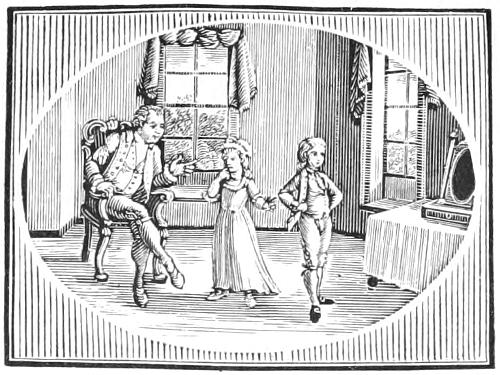
A certain man had two children, a son and a daughter: The boy beautiful and handsome enough; the girl not quite so well. They were both very young, and happened one day to be playing near the looking-glass, which stood on their mother’s toilet. The boy, pleased with the novelty of the thing, viewed himself for some time, and, in a wanton roguish manner, took notice to the girl how handsome he was. She resented it, and could not bear the insolent manner in which he did it; for she understood it (how could she do otherwise) as intended for a direct affront to her. Therefore she ran immediately to her father, and, with a great deal of aggravation, complained of her brother; particularly, for having acted so effeminate a part as to look in a glass, and meddle with things which belonged to women only. The father, embracing them both with much tenderness and affection, told them, that he should like to have them both look in the glass every day; to the intent that you, says he to the boy, if you think that face of yours handsome, you may not disgrace and spoil it by an ugly temper and a foul behaviour. You, says he, speaking to the girl, that you may make up for the defects of your person, if there be any, by the sweetness of your manners and the agreeableness of your conversation.
Morals.
We often make a false estimate in preferring our ornamental talents to our useful ones.
Ill manners may deform the fairest face, But gentleness gives ugliness a grace: Sure snarling Veny’s beauty less we prize, Than Pug’s black nose with his good-natured eyes.
Reflection.
There is scarce anything we see in the world, especially what belongs to and hangs about our own person, but is capable of affording us matter for some serious and useful consideration. And this Fable, notwithstanding the scene of it is laid at the very beginning and entrance of life, yet utters a doctrine worthy the attention of every stage and degree thereof, from the child to the old man. Let each of us take a glass, and view himself considerately. He that is vain and self-conceited, will find beauties in every feature, and his whole shape will be without fault. Let it be so; yet, if he would be complete, he must take care that the inward man does not detract from and disgrace the outward; that the depravity of his manners does not spoil his face, nor the wrongness of his behaviour distort his limbs; or, which is the same thing, make his whole person odious and detestable to the eye of his beholders. Is any one modest in this respect, and deficient of himself? Or has he indeed blemishes and imperfections, which may depreciate him in the sight of mankind? Let him strive to improve the faculties of the mind, where perhaps nature has not crampt him; and to excel in the beauties of a good temper and an agreeable conversation, the charms of which are so much more lasting and unalterably endearing, than those of the other sort. They who are beautiful in person have this peculiar advantage, that, with a moderate regard to complaisance and good manners, they bespeak every one’s opinion in their favour. But then, be the outside of a man ever so rough and uncouth, if his acquired accomplishments are but sweet and engaging, how easily do we overlook the rest, and value him, like an oriental jewel, not by a glittering outside, which is common to baser stones, but by his true intrinsic worth, his bright imagination, his clear reason, and the transparent sincerity of his honest heart.
Fable XLVI. The Mice in Council.
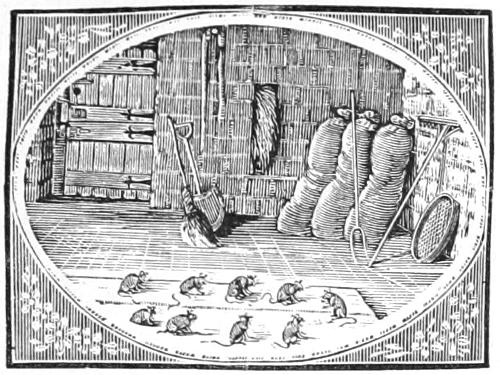
The Mice called a General Council; and, having met, after the doors were locked, entered into a free consultation about ways and means how to render their fortunes and estates more secure from the danger of the Cat. Many things were offered, and much was debated, pro and con, upon the matter. At last a young Mouse, in a fine florid speech, concluded upon an expedient, and that the only one, which was to put them, for the future, entirely out of the power of the enemy: and this was, that the Cat should wear a bell about her neck, which upon the least motion would give the alarm, and be a signal for them to retire into their holes. This speech was received with great applause, and it was even proposed by some, that the Mouse who made it should have the thanks of the assembly. Upon which, an old grave Mouse, who had sat silent all the while, stood up, and in another speech, owned that the contrivance was admirable, and the author of it, without doubt, an ingenious Mouse; but, he said, he thought it would not be so proper to vote him thanks, till he should farther inform them how this bell was to be fastened about the Cat’s neck, and what Mouse would undertake to do it.
Morals.
The different lights, in which things appear to different judgments, recommend candour to the opinions of others, even at the time we retain our own.
Not urged by vain ambition’s airy dreams, Or specious wit, does wisdom form her schemes, Poise well the scales, with due reflection scan The means proposed, and then adopt a plan.
Reflection.
Many things appear feasible in speculation, which are afterwards found to be impracticable. And since the execution of anything is that which is to complete and finish its very existence, what raw counsellors are those who advise, what precipitate politicians those who proceed, to the management of things in their nature incapable of answering their own expectations, or their promises to others. At the same time, the Fable teaches us not to expose ourselves in any of our little politic coffee-house committees, by determining what should be done upon every occurrence of maladministration, when we have neither commission nor power to execute it. He that, upon such occasion, adjudges, as a preservative for the state, that this or that should be applied to the neck of those who have been enemies to it, will appear full as ridiculous as the Mouse in the Fable, when the question is asked, Who shall put it there? In reality we do but expose ourselves to the hatred of some, and the contempt of others, when we inadvertently utter our impracticable speculations, in respect of the public, either in private company or authorised assemblies.
Fable XLVII. The Old Man and Death.
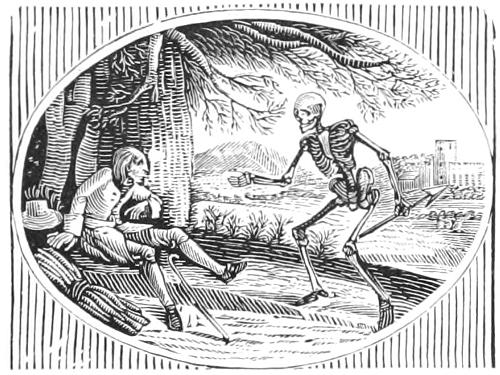
A poor feeble old man, who had crawled out into a neighbouring wood to gather a few sticks, had made up his bundle, and, laying it over his shoulders, was trudging homeward with it; but, what with age, and the length of the way, and the weight of his burden, he grew so faint and weak that he sunk under it; and, as he sat on the ground, called upon Death to come, once for all, and ease him of his troubles. Death no sooner heard him, but he came and demanded of him what he wanted. The poor old creature, who little thought Death had been so near, and frightened almost out of his senses with his terrible aspect, answered him trembling: That having by chance let his bundle of sticks fall, and being too infirm to get it up himself, he had made bold to call upon him to help him; that, indeed, this was all he wanted at present; and that he hoped his Worship was not offended with him for the liberty he had taken in so doing.
Morals.
Men under calamity may seem to wish for death; but they seldom bid him welcome when he stares them in the face.
“Oh with what joy would I resign my breath!” The wretch exclaims, and prays for instant death: The fiend approaching, he inverts his pray’r, “Oh grant me life, and double all my care!”
Reflection.
This Fable gives us a lively representation of the general behaviour of mankind towards that grim king of terrors, Death. Such liberties do they take with him behind his back, that upon every little cross accident which happens in their way, Death is immediately called upon; and they even wish it might be lawful for them to finish by their own hands a life so odious, so perpetually tormenting and vexatious. When, let but Death only offer to make his appearance, and the very sense of his near approach almost does the business: Oh then, all they want is a longer life; and they would be glad to come off so well, as to have their old burden laid upon their shoulders again. One may well conclude what an utter aversion they, who are in youth, health, and vigour of body, have to dying, when age, poverty, and wretchedness, are not sufficient to reconcile us to the thought.
Fable XLVIII. The Crow and the Pitcher.
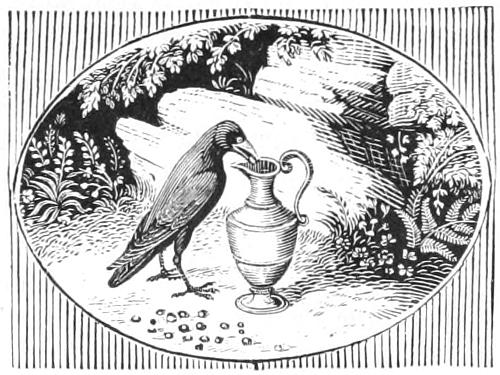
A Crow, ready to die with thirst, flew with joy to a pitcher which he beheld at some distance. When he came, he found water in it indeed, but so near the bottom, that with all his stooping and straining, he was not able to reach it. Then he endeavoured to overturn the pitcher, that so at least he might be able to get a little of it; but his strength was not sufficient for this. At last, seeing some pebbles lie near the place, he cast them one by one into the pitcher; and thus, by degrees, raised the water up to the very brim, and satisfied his thirst.
Morals.
What we cannot compass by force, we may by invention and industry.

When frowning fates thy sanguine hopes defeat, And virtuous aims with disappointment meet, Submit not to despair, th’ attempt renew, And rise superior to the vulgar crew.
Reflection.
Many things which cannot be effected by strength, or by the old vulgar way of enterprising, may yet be brought about by some new and untried means. A man of sagacity and penetration, upon encountering a difficulty or two, does not immediately despair; but if he cannot succeed one way, employs his wit and ingenuity another; and, to avoid or get over an impediment, makes no scruple of stepping out of the path of his forefathers. Since our happiness, next to the regulation of our minds, depends altogether upon our having and enjoying the conveniences of life, why should we stand upon ceremony about the methods of obtaining them, or pay any deference to antiquity upon that score? If almost every age had not exerted itself in some new improvements of its own, we should want a thousand arts; or, at least, many degrees of perfection in every art, which at present we are in possession of. The invention of anything which is more commodious for the mind or body than what they had before, ought to be embraced readily, and the projector of it distinguished with a suitable encouragement. Such as the use of the compass, for example, from which mankind reaps so much benefit and advantage, and which was not known to former ages. When we follow the steps of those who have gone before us in the old beaten tract of life, how do we differ from horses in a team, which are linked to each other by a chain of harness, and move on in a dull, heavy pace to the tune of their leader’s bells? But the man who enriches the present fund of knowledge with some new and useful improvement, like a happy adventurer at sea, discovers, as it were, an unknown land, and imports an additional trade into his own country.
Fable XLIX. The Fox and the Grapes.
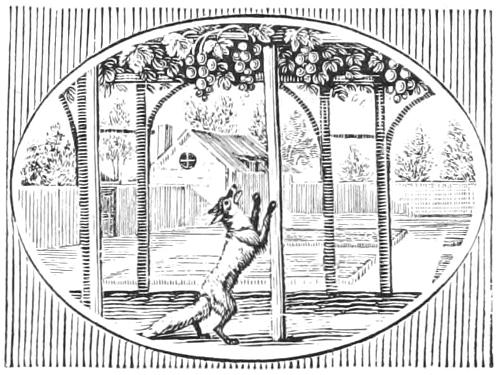
A Fox, very hungry, chanced to come into a Vineyard, where there hung many bunches of charming ripe grapes; but nailed up to a trellis so high, that he leaped till he quite tired himself without being able to reach one of them. At last, Let who will take them! says he; they are but green and sour; so I’ll even let them alone.
Morals.
When a man finds it impossible to obtain the things he longs for, it is a mark of sound wisdom and discretion to make a virtue of necessity.
Old maids who loathe the matrimonial state, Poor rogues who laugh to scorn the rich and great, Patriots who rail at placemen and at pow’r, All, like sly Reynard, say “The Grapes are sour.”
Reflection.
This Fable is a good reprimand to a parcel of vain coxcombs in the world, who, because they would never be thought to be disappointed in any of their pursuits, pretend a dislike to everything which they cannot obtain. There is a strange propensity in mankind to this temper, and there are numbers of grumbling malcontents in every different faculty and sect in life. The discarded statesman, considering the corruption of the times, would not have any hand in the administration of affairs for all the world. The country squire damns a court life, and would not go cringing and creeping to a drawing-room for the best place the King has in his disposal. A young fellow, being asked how he liked a celebrated beauty, by whom all the world knew he was despised, answered, She had a stinking breath. How insufferable is the pride of this poor creature man! who would stoop to the basest, vilest actions, rather than be thought not able to do anything. For what is more base and vile than lying? And when do we lie more notoriously, than when we disparage and find fault with a thing for no other reason but because it is out of our power.
Fable L. The Viper and the File.
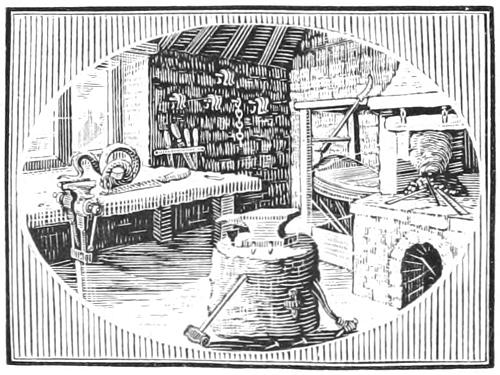
A Viper entering a smith’s shop, looked up and down for something to eat, and seeing a File, fell to gnawing it as greedily as could be. The File told him, very gruffly, that he had best be quiet and let him alone; for that he would get very little by nibbling at one, who, upon occasion, could bite iron and steel.
Morals.
It’s the fate of envy to attack those characters that are superior to its malice.
Witlings! beware, nor wantonly provoke Those who with int’rest may repay the joke; Some claim our pity who fall preys to wit, But all men triumph o’er the Biter Bit.
Reflection.
By this Fable we are cautioned to consider what any person is, before we make an attack upon him after any manner whatsoever: Particularly how we let our tongues slip in censuring the actions of those who are, in the opinion of the world, not only of an unquestioned reputation, so that nobody will believe what we insinuate against them; but of such an influence, upon account of their own veracity, that the least word from them would ruin our credit to all intents and purposes. If wit be the case, and we have a satirical vein, which at certain periods must have a flow, let us be cautious at whom we level it; for if the person’s understanding be of better proof than our own, all our ingenious sallies, like liquor squirted against the wind, will recoil back upon our own faces, and make us the ridicule of every spectator. This Fable, besides, is not an improper emblem of Envy; which, rather than not bite at all, will fall foul where it can hurt nothing but itself; and such is its malignancy, that the greatest wits and brightest characters in all ages have ever been the objects of its attack. Ought we not, then, to guard against the admission of an inmate that not only attempts to injure the virtuous part of mankind, but also effectually ruins the peace of its possessor?
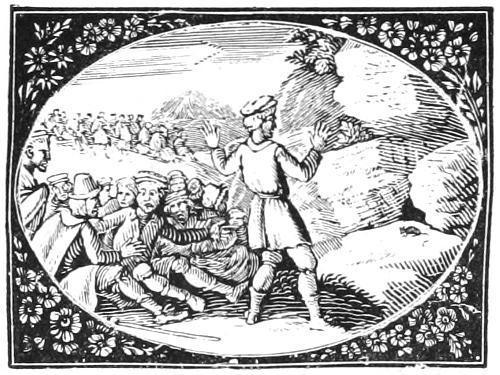
Fable LI. The Mountains in Labour.
The Mountains were said to be in labour, and uttered most dreadful groans. People came together, far and near, to see what birth would be produced; and after they had waited a considerable time in expectation, out crept a mouse.
Morals.
To raise uncommon expectations renders an ordinary event ridiculous.
Thus the vain Alchymist, in promise bold, Beholds projection big with mines of gold: But now, his glasses burst, he thinks him rich To save a little oil to cure the itch.
Reflection.
Great cry and little wool, is the English proverb; the sense of which bears an exact proportion to this Fable. By which are exposed, all those who promise something exceeding great, but come off with a production ridiculously little. Projectors of all kinds, who endeavour by artificial rumours to raise the expectations of mankind, and then by their mean performances defeat and disappoint them, have, time out of mind, been lashed with the recital of this Fable. How agreeably surprising is it to see an unpromising favourite, whom the caprice of fortune has placed at the helm of state, serving the commonwealth with justice and integrity, instead of smothering and embezzling the public treasure to his own private and wicked ends! And on the contrary, how melancholy, how dreadful! or rather, how exasperating and provoking a sight is it to behold one, whose constant declarations for liberty and the public good have raised people’s expectations of him to the highest pitch, as soon as he is got into power exerting his whole art and cunning to ruin and enslave his country! The sanguine hopes of all those that wished well to virtue, and flattered themselves with a reformation of everything that opposed the well-being of the community, vanish away in smoke, and are lost in a dark, gloomy, uncomfortable prospect.
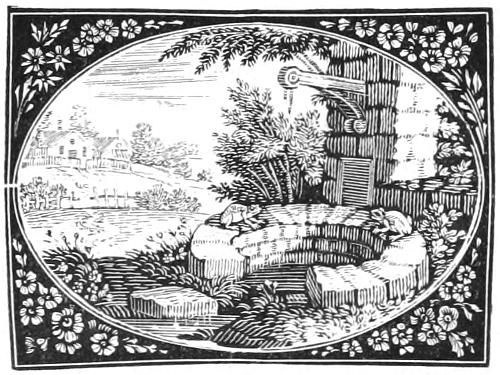
Fable LII. The Two Frogs.
One hot sultry summer, the lakes and ponds being almost everywhere dried up, a couple of Frogs agreed to travel together in search of water. At last they came to a deep well, and sitting upon the brink of it, began to consult, whether they should leap in or no. One of them was for it; urging, that there was plenty of clear spring water, and no danger of being disturbed. Well, says t’other, all this may be true; and yet I can’t come into your opinion for my life: For, if the water should happen to dry up here too, how should we get out again?
Morals.
We ought never to change our situation in life, without duly considering the consequences of such a change.
On things of moment with thyself debate. Nor, inconsiderate, change thy present state, Nor on the specious good lay too much stress, Lest greater Ills incur, in shunning less.
Reflection.
The moral of this Fable is intended to put us in mind to look before we leap. That we should not undertake any action of importance, without considering first, what the event of it is like to prove, and how we shall be able to come off, upon such and such provisos. A good General does not think he diminishes anything of his character when he looks forward, beyond the main action, and concerts measures, in case there should be occasion, for a safe retreat.
How many unfortunate matches are struck up every day for want of this wholesome consideration? Profuse living, and extravagant gaming, both which terminate in the ruin of those that follow them, are mostly owing to a neglect of this precaution. Wicked counsellors advise, and ignorant princes execute those things, which afterwards they often dearly repent. Wars are begun by this blind stupidity, from which a state is not able to extricate itself with either honour or safety; and projects are encouraged by the rash accession of those, who never considered how they were to get out, till they had plunged themselves irrecoverably into them.
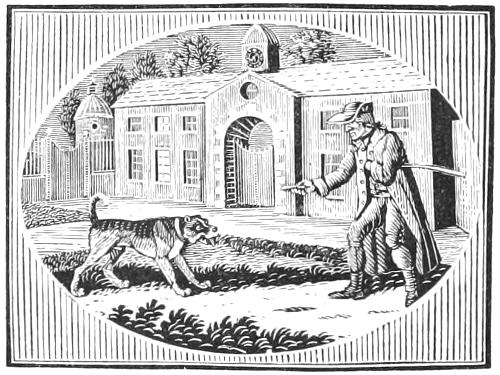
Fable LIII. The Thief and the Dog.
A thief coming to rob a certain house in the night, was disturbed in his attempts by a fierce vigilant dog who kept barking at him continually. Upon which the thief, thinking to stop his mouth, threw him a piece of bread: But the dog refused it with indignation; telling him, that before, he only suspected him to be a bad man; but now, upon his offering to bribe him, he was confirmed in his opinion; and that, as he was entrusted with the guardianship of his master’s house, he should never cease barking while such a rogue as he lay lurking about it.
Morals.
Nothing can alter the honest purposes of the man, who despises an insidious bribe; and whose mind is proof against temptation.
Faithful to man, and to thy conscience just, Spurn him who tempts thee to betray thy trust. An honest mind’s the choicest gift of heav’n, How blest to whom th’ etherial spark is given!
Reflection.
A man who is very free in his protestations of friendship, or offers of great civility, upon the first interview may meet with applause and esteem from fools, but contrives his schemes of that sort to little or no purpose, in the company of men of sense.
It is a common and known maxim, to suspect an enemy, even the more, for his endeavouring to convince us of his benevolence; because the oddness of the thing puts us upon our guard, and makes us conclude, that some pernicious design must be couched under so sudden and unexpected a turn of behaviour: But it is no unnecessary caution to be upon the watch against even indifferent people, when we perceive them uncommonly forward in their approaches of civility and kindness. The man, who at first sight makes us an offer, which is due only to particular and well-acquainted friends, must be either a knave, and intends by such a bait to draw us into his net; or a fool, with whom we ought to avoid having any communication.
Thus far the consideration of this Fable may be useful to us in private life; what it contains farther, in relation to the public, is, That a man, truly honest, will never let his mouth be stopped with a bribe; but the greater the offer is which is designed to buy his silence, the louder and more constantly will he open against the miscreants who would practise it upon him.
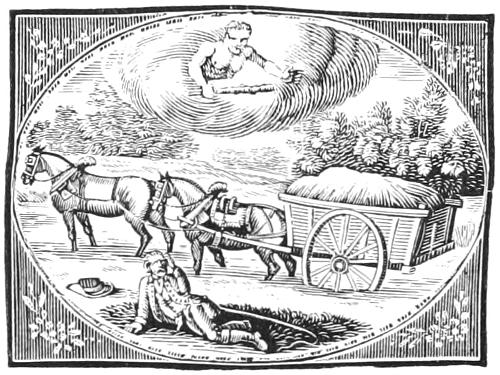
Fable LIV. Hercules and the Carter.
As a clownish fellow was driving his Cart along a deep miry lane, the wheels stuck so fast in the clay, that the horses could not draw them out. Upon this, he fell a bawling and praying to Hercules to come and help him. Hercules looking down from a cloud, bid him not lie there, like an idle rascal as he was, but get up and whip his horses stoutly, and clap his shoulder to the wheel, adding, That this was the only way for him to obtain his assistance.
Morals.
Prayers and wishes amount to nothing: We must put forth our own honest endeavours to obtain success on the assistance of heaven.
Inactive wishes are but waste of time, And, without efforts, pray’rs themselves a crime: Vain are their hopes who miracles expect, And ask from heaven what themselves neglect.
Reflection.
This Fable shews us how vain and ill-grounded the expectations of those people are, who imagine they can obtain whatever they want by importuning heaven with their prayers; for it is so agreeable to the nature of the Divine Being, to be better pleased with virtuous actions and an honest industry, than idle Prayers, that it is a sort of blasphemy to say otherwise. These were the sentiments of honest good heathens, who were strangers to all revealed religion: But it is not strange that they should embrace and propagate such a notion, since it is no other than the dictate of common reason. What is both strange in itself, and surprising how it could be made so fashionable, is, that most of those whose reason should be enlightened by Revelation, are very apt to be guilty of this stupidity, and, by praying often for the comforts of life, to neglect that business which is the proper means of procuring them. How such a mistaken devotion came to prevail, one cannot imagine, unless from one of these two motives; either that people, by such a veil of hypocrisy, would pass themselves upon mankind for better than they really are; or are influenced by unskilful preachers (which is sometimes, indeed too often, the case) to mind the world as little as possible, even to the neglect of their necessary callings. No question but it is a great sin for a man to fail in his trade or occupation, by running often to prayers: it being a demonstration in itself, though the Scripture had never said it, that we please God most, when we are doing the most good: And how can we do more good, than by a sober honest industry, to provide for those of our own household, and to endeavour to have to give to him that needeth. The man who is virtuously and honestly engaged, is actually serving God all the while, and is more likely to have his silent wishes, accompanied with strenuous endeavours, complied with by the Supreme Being, than he who begs with a fruitless vehemence, and solicits with an empty hand: A hand which would be more religious were it usefully employed, and more devout, were it stretched forth to do good to those that want it.
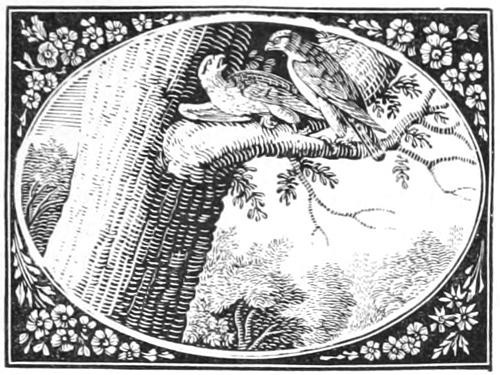
Fable LV. The Sick Kite.
A Kite had been sick a long time; and finding there were no hopes of recovery, begged of his mother to go to all the churches and religious houses in the country, to try what prayers and promises would effect in his behalf. The old Kite replied: Indeed, dear Son, I would willingly undertake anything to save your life, but I have great reason to despair of doing you any service in the way you propose: For, with what face can I ask anything of the Gods in favour of one whose whole life has been a continued scene of rapine and injustice, and who has not scrupled upon occasion to rob the very altars themselves?
Morals.
After a long life spent in acts of impiety and wickedness, we may justly suspect the sincerity of a death-bed repentance.
Thus early sinning, and repenting late, The dying debauchee would bribe his fate; Pray’rs, alms, and promises he tries in vain, Not sick of follies past, but present pain.
Reflection.
The rehearsal of this Fable almost unavoidably draws our attention to that very serious and important point, the consideration of a death-bed repentance. And, to expose the absurdity of relying upon such a weak foundation, we need only ask the same question with the Kite in the Fable: How can he, that has offended the Gods all his life-time by doing acts of dishonour and injustice, expect that they should be pleased with him at last, for no other reason but because he fears he shall not be able to offend them any longer; when, in truth, such a repentance can signify nothing, but a confirmation of his former impudence and folly? For sure no stupidity can exceed that of the man who expects a future judgment, and yet can bear to commit any piece of injustice, with a sense and deliberation of the fact.
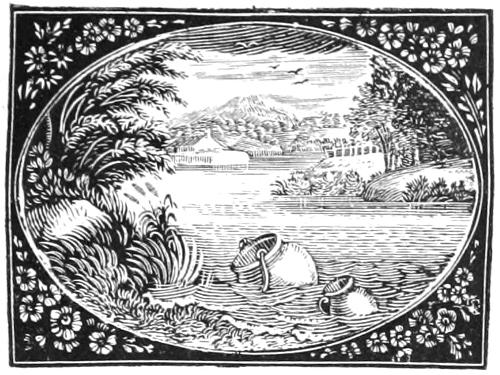
Fable LVI. The Two Pots.
An earthen pot and one of brass, standing together upon the river’s brink, were both carried away by the flowing in of the tide. The earthen pot showed some uneasiness, as fearing he should be broken; but his companion of brass bid him be under no apprehensions, for that he would take care of him. Oh! replies the other, keep as far off as ever you can, I entreat you; it is you I am most afraid of: For, whether the stream dashes you against me, or me against you, I am sure to be the sufferer; and therefore, I beg of you, do not let us come near one another.
Morals.
Reciprocal pleasure and advantage is the only rational foundation for real friendship.
Born to the comforts of an humble state, Fly their embrace, if courted by the great. Happy to learn, how ill you can afford The vast expense of how-d’yes from my lord.
Reflection.
A man of a moderate fortune, who is contented with what he has, and finds he can live happily upon it, should take care not to hazard and expose his felicity by consorting with the great and the powerful. People of equal conditions may float down the current of life without hurting each other; but it is a point of some difficulty to steer one’s course in the company of the great, so as to escape without a bulge. One would not choose to have one’s little country-box situated in the neighbourhood of a very great man; for whether I ignorantly trespass upon him, or he knowingly encroaches upon me, I only am like to be the sufferer. I can neither entertain nor play with him upon his own terms; for that which is moderation and diversion to him, in me would be extravagance and ruin.
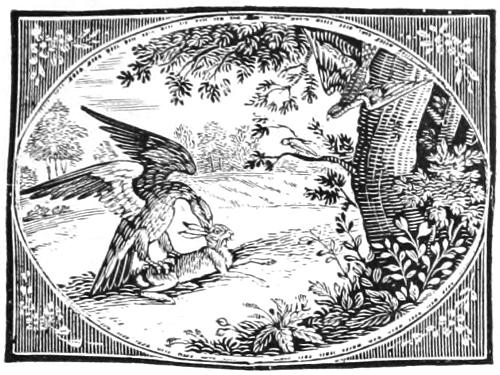
Fable LVII. The Sparrow and the Hare.
A Hare, being seized by an Eagle, squeaked out in a most woful manner. A Sparrow that sat upon a tree just by and saw it, could not forbear being unseasonably witty, but called out, and said to the Hare: So ho! what! sit there and be killed? Pr’ythee, up and away; I dare say, if you would but try, so swift a creature as you are would easily escape from the Eagle. As he was going on with his cruel raillery, down came a Hawk, and snapt him up; and, notwithstanding his vain cries and lamentations, fell a devouring of him in an instant. The Hare, who was just expiring, yet received comfort from this accident, even in the agonies of death; and, addressing her last words to the Sparrow, said: You, who just now insulted my misfortune with so much security, as you thought, may please to shew us how well you can bear the like, now it has befallen you.
Morals.
The mutability of human affairs is such, that no situation, however seemingly advantageous, ought to make us jest with the misfortunes of others.
Tradesman, insult not, if a neighbour fail. Lest, by and by, yourself should go to jail; Nor, if a damsel slip, Prude, shake your head, Lest you yourself next month be brought to bed.
Reflection.
Nothing is more impertinent than for people to be giving their opinion and advice in cases in which, were they to be their own, themselves would be as much at a loss what to do. But so great an itch have most men to be directors in the affairs of others, either to shew the superiority of their understanding, or their own security and exemption from the ills they would have removed, that they forwardly and conceitedly obtrude their counsel, even at the hazard of their own safety and reputation. There have been instances of those who, either officiously or for the jest’s sake, have spent much of their time in reading lectures of economy to the rest of the world, when at the same time their own ill husbandry has been such, that they were forced to quit their dwelling and take lodgings, while their goods were sold to make a composition for the debts which they owed to petty tradesmen.
Without giving more examples of this kind, of which every one may furnish himself with enough from his own observation, we cannot but conclude that none are greater objects of ridicule than they who thus merrily assume a character which, at the same time, by some incidents of their life, they convince us of their being so unfit for.
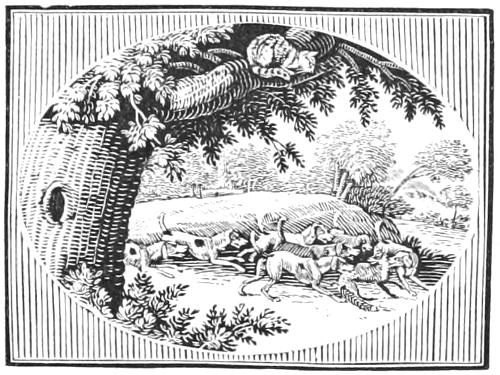
Fable LVIII. The Cat and the Fox.
As the Cat and the Fox were talking politics together, on a time, in the middle of the forest, Reynard said, Let things turn out ever so bad, he did not care, for he had a thousand tricks for them yet before they should hurt him. But pray, says he, Mrs Puss, suppose there should be an invasion, what course do you design to take? Nay, says the Cat, I have but one shift for it; and if that won’t do, I am undone. I am sorry for you, replies Reynard, with all my heart, and would gladly furnish you with one or two of mine, but indeed, neighbour, as times go, it is not good to trust; we must even be every one for himself, as the saying is, and so your humble servant. These words were scarce out of his mouth, when they were alarmed with a pack of hounds that came upon them full cry. The Cat, by the help of her single shift, ran up a tree, and sat securely among the top branches; from whence she beheld Reynard, who had not been able to get out of sight, overtaken with his thousand tricks, and torn in as many pieces by the dogs which had surrounded him.
Morals.
Successful cunning often makes an ostentatious pretension to wisdom.
The sly politician may boast of his arts, How his budget is full, and by cunning he’s guided; But the wise and the wary, less proud of his parts, With a single expedient is better provided.
Reflection.
A man that sets up for more cunning than the rest of his neighbours, is generally a silly fellow at the bottom. Whoever is master of a little judgment and insight into things, let him keep them to himself and make use of them as he sees occasion; but he should not be teasing others with an idle and impertinent ostentation of them. One good discreet expedient made use of upon an emergency, will do a man more real service, and make others think better of him, than to have passed all along for a shrewd, crafty knave, and be bubbled at last. When any one has been such a coxcomb as to insult his acquaintance, by pretending to more policy and stratagem than the rest of mankind, they are apt to wish for some difficulty for him to shew his skill in; where, if he should miscarry (as ten to one but he does), his misfortune, instead of pity, is sure to be attended with laughter. He that sets up for a biter, as the phrase is, being generally intent upon his prey, or vain of shewing his art, frequently exposes himself to the traps of one sharper than himself, and incurs the ridicule of those whom he designed to make ridiculous.
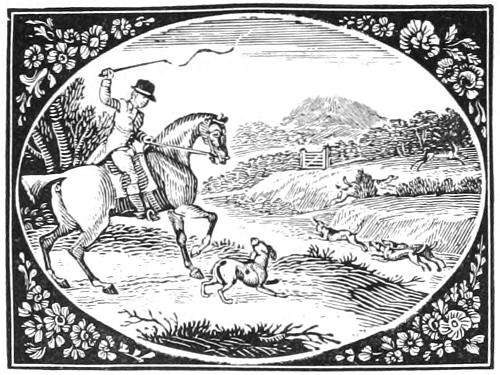
Fable LIX. The Old Hound.
An old Hound, who had been an excellent good one in his time, and given his master great sport and satisfaction in many a chase, at last, by the effect of years, became feeble and unserviceable. However, being in the field one day, when the Stag was almost run down, he happened to be the first that came in with him, and seized him by one of his haunches; but, his decayed and broken teeth not being able to keep their hold, the Deer escaped, and threw him quite out. Upon which, his master, being in a great passion, was going to strike him, when the honest old creature is said to have barked out his apology: Ah! do not strike your poor old servant; it is not my heart and inclination, but my strength and speed that fail me. If what I now am displeases, pray don’t forget what I have been.
Morals.
Useful services, performed in youth, ought not to be cancelled by old age and infirmities.
Oh let not those whom honest servants bless, With cruel hand their age infirm oppress; Forget their service past, their former truth, And all the cares and labours of their youth.
Reflection.
This Fable may serve to give us a general view of the ingratitude of the greatest part of mankind. Notwithstanding all the civility and complaisance that is used among people where there is a common intercourse of business, yet, let the main spring, the probability of their being serviceable to each other, either in point of pleasure or profit, be but once broken, and farewell courtesy. So far from continuing any regard in behalf of past favours, that it is very well if they forbear doing anything that is injurious. If the master had only ceased to caress and make much of the old Hound when he was past doing any service, it had not been very strange; but to treat a poor creature ill, not for a failure of inclination, but merely a defect of nature, must, notwithstanding the crowd of examples there are to countenance it, be pronounced inhuman and unreasonable.
There are two accounts upon which people that have been useful are frequently neglected. One, when they are so decayed, either through age or some accident, that they are no longer equal to the services they have formerly done; the other, when the occasion or emergency which required such talents no longer exists. Phædrus, who more than once complains of the bad consequences of age, makes no other application to this Fable, than by telling his friend Philetas, with some regret, that he wrote it with such a view; having, it seems, been repaid with neglect, or worse usage, for services done in his youth to those who were then able to afford him a better recompense.
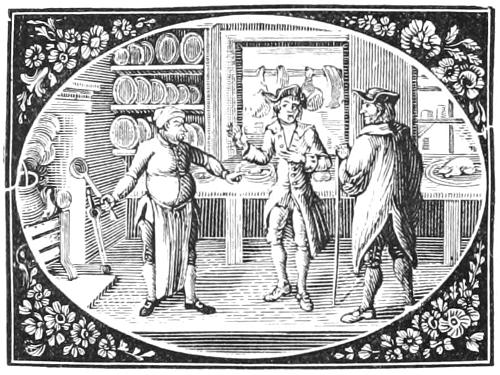
Fable LX. Two Young Men and the Cook.
Two young men went into a cook’s shop, under pretence of buying meat; and while the cook’s back was turned, one of them snatched up a piece of beef, and gave it to his companion, who presently clapt it under his cloak. The cook turning about again, and missing his beef, began to charge them with it; upon which, he that first took it swore bitterly he had none of it. He that had it swore as heartily, that he had taken up none of his meat. Why look ye, gentlemen, says the cook, I see your equivocation; and though I can’t tell which of you has taken my meat, I am sure, between you both, there’s a thief, and a couple of rascals.
Morals.
Evading the truth is just as blameable as denying it.
Thus quibbling thieves evade the charge, Offend the laws, and go at large: But though ’tis hard the crime to fix, We know they’re guilty by their tricks.
Reflection.
An honest man’s word is as good as his oath; and so is a rogue’s too; for he that will cheat and lie, why should he scruple to forswear himself? Is the latter more criminal than either of the former? An honest man needs no oath to oblige him; and a rogue only deceives you the more certainly by it, because you think you have tied him up, and he is sure you have not. In truth, it is not easy, with the eye of reason, to discern, that there is any good in swearing at all. We need not scruple to take an honest man’s bare asseveration; and we shall do wrong if we believe a rogue, though he swears by the most solemn oaths that can be invented.
There are, besides, a sort of people who are rogues, and yet don’t know that they are such; who, when they have taken an oath, make a scruple of breaking it, but rack their invention to evade it by some equivocation or other; by which, if they can but satisfy their acquaintance, and serve their own scheme they think all is well, and never once consider the black and heinous guilt which must attend such a behaviour. They solemnly call the supreme Being to witness; to what? to a sham, an evasion, a lie. Thus these unthinking, prevaricating wretches, at the same time that they believe there is a God, act as if there were none; or, which is worse, dare affront him in the highest degree. They who by swearing would clear themselves of a crime, of which they are really guilty, need not be at much pains about wording their oath; for, express themselves how they will, they are sure to be forsworn.
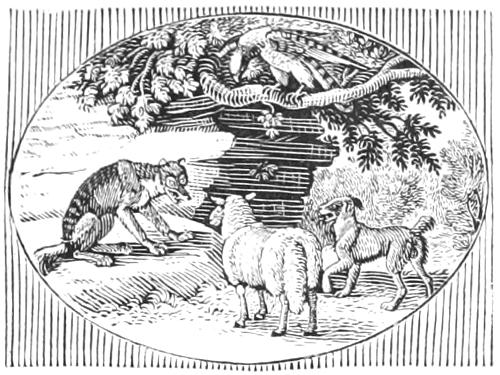
Fable LXI. The Dog and the Sheep.
The Dog sued the Sheep for a debt, of which the Kite and the Wolf were to be judges. They, without debating long upon the matter, or making any scruple for want of evidence, gave sentence for the plaintiff; who immediately tore the poor Sheep in pieces, and divided the spoil with the unjust judges.
Morals.
We cannot reasonably hope for justice in a court, where the judges are interested in the decision.
Whose life is safe, if tried before a judge, That to the hapless pris’ner bears a grudge? Whose property secur’d from lawless fury, If any private int’rest warps the jury?
Reflection.
Deplorable are the times, when open bare-faced villany is protected and encouraged, when innocence is obnoxious, honesty contemptible, and it is reckoned criminal to espouse the cause of virtue. Men originally entered into covenants and simple compacts with each other for the promotion of their happiness and well-being, for the establishment of justice and public peace. How comes it then that they look stupidly on, and tamely acquiesce, when wicked men pervert this end, and establish an arbitrary tyranny of their own upon the foundation of fraud and oppression? Among beasts, who are incapable of being civilised by social laws, it is no strange thing to see innocent helpless sheep fall a prey to dogs, wolves, and kites: But it is amazing how mankind could ever sink down to such a low degree of base cowardice, as to suffer some of the worst of their species to usurp a power over them, to supersede the righteous laws of good government, and to exercise all kinds of injustice and hardship in gratifying their own vicious lusts. Wherever such enormities are practised, it is when a few rapacious statesmen combine together, to get and secure the power in their own hands, and agree to divide the spoils among themselves. For as long as the cause is to be tried only among themselves, no question but they will always vouch for each other. But, at the same time, it is hard to determine which resemble brutes most, they in acting, or the people in suffering them to act their vile selfish schemes.
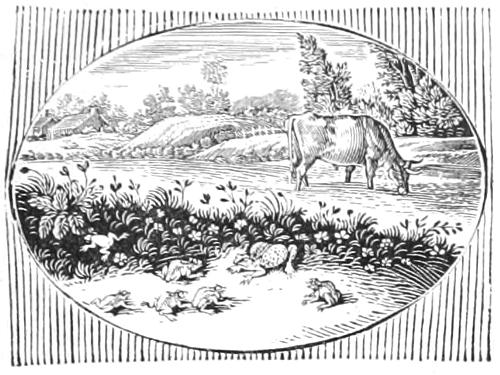
Fable LXII. The Proud Frog.
An Ox, grazing in a meadow, chanced to set his foot among a parcel of young frogs, and trod one of them to death. The rest informed their mother, when she came home, what had happened; telling her, that the beast which did it was the hugest creature that ever they saw in their lives. What, was it so big? says the old Frog, swelling and blowing up her speckled belly to a great degree. Oh, bigger by a vast deal, say they. And so big? says she, straining herself yet more. Indeed, Mamma, say they, if you were to burst yourself, you would never be so big. She strove yet again, and burst herself indeed.
Morals.
The silly ambition of vying with our superiors, in station and fortune, is the direct road to ruin.
Ye cits! of narrow means and small estate, View not with envy the luxurious great: Think that from riot bankruptcies will come, And mark your prudent neighbour worth a plum.
Reflection.
Whenever a man endeavours to live equal with one of a greater fortune than himself, he is sure to share a like fate with the Frog in the Fable. How many vain people of moderate easy circumstances burst and come to nothing, by vying with those whose estates are more ample than their own! Sir Changeling Plumbstock was possessed of a very considerable demesne, devolved to him by the death of an old uncle of the city, who had adopted him his heir. He had a false taste of happiness; and, without the least economy, trusting to the sufficiency of his vast revenue, was resolved to be outdone by nobody, in shewish grandeur and expensive living. He gave five thousand pounds for a piece of ground in the country, to set a house upon, the building and furniture of which cost fifty thousand more; and his gardens were proportionably magnificent. Besides which, he thought himself under a necessity of buying out two or three tenements which stood in his neighbourhood, that he might have elbow room enough. All this he could very well bear; and still might have been happy, had it not been for an unfortunate view which he one day happened to take of my Lord Castlebuilder’s gardens, which consist of twenty acres, whereas his own were not above twelve. For from that time he grew pensive; and before the ensuing winter, gave five and thirty years’ purchase for a dozen acres more to enlarge his gardens, built a couple of exorbitant greenhouses and a large pavilion at the farther end of a terrace walk, the bare repairs and superintendencies of all which call for the remaining part of his income. He is mortgaged pretty deep, and pays nobody; but, being a privileged person, resides altogether at a private cheap lodging in the city of Westminster.
Fable LXIII. The Dove and the Bee.
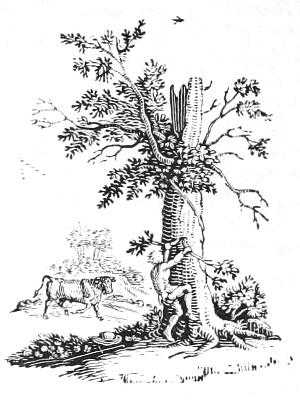
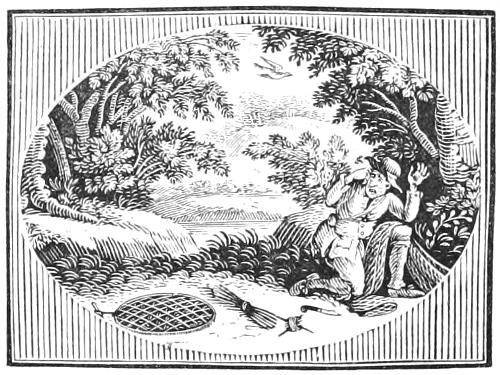
The Bee, compelled by thirst, went to drink in a clear purling rivulet; but the current, with its circling eddy, snatched her away, and carried her down the stream. A Dove, pitying her distressed condition, cropt a branch from a neighbouring tree, and let it fall into the water, by means of which the Bee saved herself, and got ashore. Not long after, a Fowler, having a design upon the Dove, planted his nets and all his little artillery in due order, without the Bird’s observing what he was about; which the Bee perceiving, just as he was going to put his design in execution she bit him by the heel, and made him give so sudden a start, that the Dove took the alarm, and flew away.
Morals.
Charity will have its rewards one time or other; for certain in the promised recompense hereafter, perhaps in a grateful return here.
Hail gratitude! the spark whence virtue springs, And adoration to the King of kings; The greatest bliss the feeling bosom knows, The source whence every gen’rous action flows.
Reflection.
One good turn deserves another; and gratitude is excited by so noble and natural a spirit, that he ought to be looked upon as the vilest of creatures, who has no sense of it. It is, indeed, so very just and equitable a thing, and so much every man’s duty, that to speak of it properly one should not mention it as anything meritorious, or that may claim praise and admiration, any more than we should say a man ought to be rewarded or commended for not killing his father, or forbearing to set fire to his neighbour’s house. The bright and shining piece of morality, therefore, which is recommended to us in this Fable, is set forth in this example of the Dove, who, without any obligation or expectation, does a voluntary office of charity to its fellow-creature in distress. The constant uninterrupted practice of this virtue is the only thing in which we are capable of imitating the great Author of our being, whose Beloved Son, besides the many precepts He has given to enforce this duty, used this expression as a common saying, It is more blessed to give than to receive.
Fable LXIV. The Collier and the Fuller.
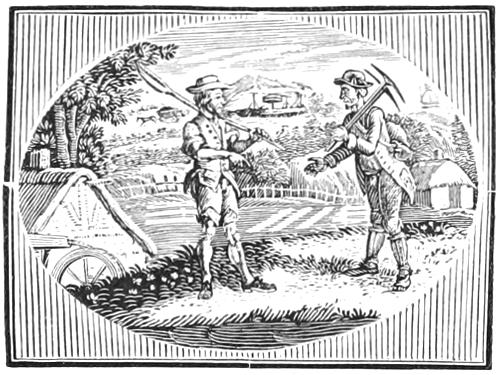
The Collier and the Fuller, being old acquaintance, happened upon a time to meet together; and the latter, being but ill provided with a habitation, was invited by the former to come and live in the same house with him. I thank you, my dear friend, replies the Fuller, for your kind offer, but it cannot be; for if I were to dwell with you, whatever I should take pains to scour and make clean in the morning, the dust of you and your coals would blacken and defile, as bad as ever, before night.
Morals.
We commonly imbibe the principles and manners of those with whom we associate.
With vice allied, however pure, No virtue can be long secure: Shun then the traitress and her wiles, Whate’er she touches she defiles.
Reflection.
It is of no small importance in life, to be cautious what company we keep, and with whom we enter into friendships. For though we are ever so well disposed ourselves, and happen to be ever so free from vice and debauchery, yet, if those with whom we frequently converse are engaged in a lewd, wicked course, it will be almost impossible for us to escape being drawn in with them.
If we are truly wise, and would shun those siren rocks of pleasure upon which so many have split before us, we should forbid ourselves all manner of commerce and correspondence with those who are steering a course which, reason tells us, is not only not for our advantage, but must end in our destruction.
All the virtue we can boast of will not be sufficient to ensure us, if we embark in bad company. For though our philosophy were such, as that we could preserve ourselves from being tainted and infected with their manners, yet their character would twist and entwine itself along with ours in so intricate a fold, that the world would not take the trouble to unravel and separate them. Reputations are of a subtle insinuating texture like water; that which is derived from the clearest spring, if it chances to mix with a foul current, runs on, undistinguished, in one muddy stream for the future, and must for ever partake of the colour and condition of its associate.
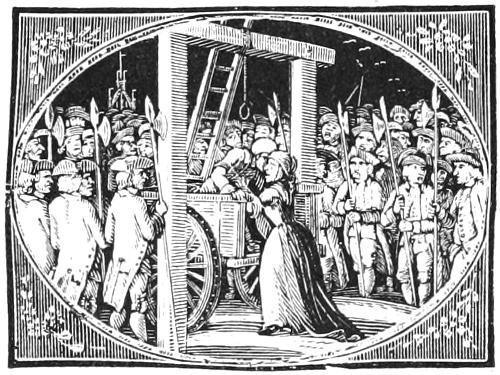
Fable LXV. The Boy and his Mother.
A little Boy, who went to school, stole one of his school-fellow’s horn-books, and brought it home to his mother; who was so far from correcting and discouraging him upon account of the theft, that she commended and gave him an apple for his pains. In process of time, as the child grew up to be a man, he accustomed himself to greater robberies; and at last, being apprehended and committed to gaol, he was tried and condemned for a felony. On the day of his execution, as the officers were conducting him to the gallows, he was attended by a vast crowd of people, and among the rest by his mother, who came sighing and sobbing along, and deploring extremely her son’s unhappy fate; which the criminal observing, he called to the sheriff, and begged the favour of him, that he would give him leave to speak a word or two to his poor afflicted mother. The sheriff (as who would deny a dying man so reasonable a request) gave him permission; and the felon, while every one thought he was whispering something of importance to his mother, bit off her ear, to the great offence and surprise of the whole assembly. What, say they, was not this villain contented with the impious acts which he has already committed, but he must increase the number of them, by doing this violence to his mother? Good people, replied he, I would not have you be under a mistake; that wicked woman deserves this, and even worse at my hands; for if she had chastised and chid, instead of rewarding and caressing me, when in my infancy I stole the horn-book from the school, I had not come to this ignominious untimely end.
Morals.
Youthful minds, like the pliant wax, are susceptible of the most lasting impressions, and the good or evil bias they then receive is seldom or ever eradicated.
Fathers and mothers! train your children’s youth To virtue, honour, honesty, and truth; Dreadful! to bring about your child’s damnation, And give your sons a Tyburn education.
Reflection.
Notwithstanding the great innate depravity of mankind, one need not scruple to affirm, that most of the wickedness, which is so frequent and so pernicious in the world, arises from a bad education; and that the child is obliged either to the example or connivance of its parents, for most of the vicious habits which it wears through the course of its future life. The mind of one that is young is, like wax, soft and capable of any impression which is given it: but it is hardened by time, and the first signature grows so firm and durable, that scarce any pains or application can erase it. It is a mistaken notion in people, when they imagine that there is no occasion for regulating or restraining the actions of very young children, which though allowed to be sometimes very naughty in those of a more advanced age, are in them, they suppose, altogether innocent and inoffensive. But, however innocent they may be, as to their intention then, yet, as the practice may grow upon them unobserved, and root itself into a habit, they ought to be checked and discountenanced in their first efforts towards anything that is injurious or dishonest; that the love of virtue and the abhorrence of wrong and oppression may be let into their minds, at the same time that they receive the very first dawn of understanding, and glimmering of reason. Whatever guilt arises from the actions of one whose education has been deficient as to this point, no question but a just share of it will be laid, by the great Judge of the world, to the charge of those who were, or should have been, his instructors.
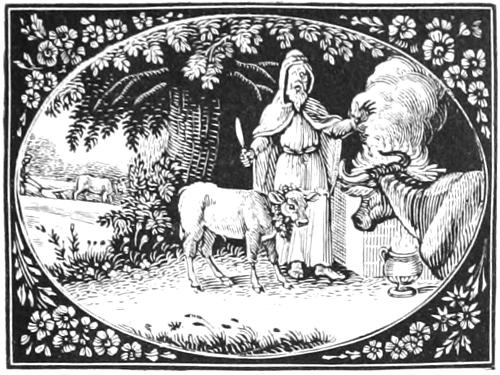
Fable LXVI. The Wanton Calf.
A Calf, full of play and wantonness, seeing the Ox at plough, could not forbear insulting him. What a sorry poor drudge art thou, says he, to bear that heavy yoke upon your neck, and go all day drawing a plough at your tail, to turn up the ground for your master! But you are a wretched dull slave, and know no better, or else you would not do it. See what a happy life I lead; I go just where I please; sometimes I lie down under the cool shade; sometimes frisk about in the open sunshine; and, when I please, slake my thirst in the clear sweet brook: But you, if you were to perish, have not so much as a little dirty water to refresh you. The Ox, not at all moved with what he said, went quietly and calmly on with his work: and, in the evening, was unyoked and turned loose. Soon after which he saw the Calf taken out of the field, and delivered into the hands of a priest, who immediately led him to the altar, and prepared to sacrifice him. His head was hung round with fillets of flowers, and the fatal knife was just going to be applied to his throat, when the Ox drew near and whispered him to this purpose: Behold the end of your insolence and arrogance; it was for this only you were suffered to live at all; and pray now, friend, whose condition is best, yours or mine?
Morals.
To insult people in distress is the property of a cruel, indiscreet, and giddy temper; for on the next turn of fortune’s wheel, we may be thrown down to their condition, and they exalted to ours.
Thus oft the industrious poor endures reproach From rogues in lace, and sharpers in a coach; But soon to Tyburn sees the villains led, While he still earns in peace his daily bread.
Reflection.
We may learn by this Fable the consequence of an idle life, and how well satisfied laborious, diligent men are, in the end, when they come quietly to enjoy the fruits of their industry. They who, by little tricks and sharpings, or by open violence and robbery, live in a high extensive way, often, in their hearts at least, despise the poor honest man, who is contented with the virtuous product of his daily labour, and patiently submits to his destiny. But how often is the poor man comforted, by seeing these wanton villains led in triumph to the altar of justice, while he has many a cheerful summer’s morning to enjoy abroad, and many a long winter’s evening to indulge himself in at home, by a quiet hearth, and under an unenvied roof: Blessings, which often attend a sober, industrious man, though the idle and the profligate are utter strangers to them.
Luxury and intemperance, besides their being certain to shorten a man’s days, are very apt not only to engage people with their seeming charms into a debauched life, utterly prejudicial to their health, but to make them have a contempt for others, whose good sense and true taste of happiness inspire them with an aversion to idleness and effeminacy, and put them upon hardening their constitution by innocent exercise and laudable employment. How many do gluttony and sloth tumble into an untimely grave! while the temperate and the active drink sober draughts of life, and spin out their thread to the most desirable length.
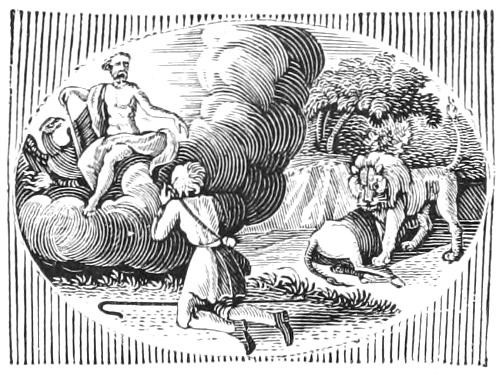
Fable LXVII. Jupiter and the Herdsman.
A Herdsman, missing a young heifer that belonged to his herd, went up and down the forest to seek it. And having walked a great deal of ground to no purpose, he fell a praying to Jupiter for relief; promising to sacrifice a Kid to him, if he would help him to a discovery of the thief. After this, he went on a little farther, and came near a grove of oaks, where he found the carcase of his heifer, and a lion grumbling over it, and feeding upon it. This sight almost scared him out of his wits; so down he fell upon his knees once more, and addressing himself to Jupiter; O Jupiter! says he, I promised thee a Kid to show me the thief, but now I promise thee a bull, if thou wilt be so merciful as to deliver me out of his clutches.
Morals.
We ought never to supplicate the Divine power, but through motives of religion and virtue; prayers, dictated by passion or interest, are unacceptable to the Deity.
Short-sighted wretch! endure thy care, Nor heave th’ impatient sigh: Heav’n hears thee, but perhaps thy pray’r ’Tis mercy to deny.
Reflection.
How ignorant and stupid are some people, who form their notions of the Supreme Being from their own poor shallow conceptions; and then, like froward children with their nurses, think it consistent with infinite wisdom and unerring justice to comply with all their whimsical petitions. Let men but live as justly as they can, and just Providence will give them what they ought to have. Of all the involuntary sins which men commit, scarce any are more frequent, than that of their praying absurdly and improperly, as well as unseasonably, when their time might have been employed so much better. The many private collections, sold up and down the nation, do not a little contribute to this injudicious practice: Which is the more to be condemned, in that we have so incomparable a public liturgy; one single address whereof (except the Lord’s Prayer) may be pronounced to be the best that ever was compiled; and alone preferable to all the various manuals of occasional devotion, which are vended by hawkers and pedlars about our streets. It is as follows:—
Almighty God, the fountain of all wisdom, who knowest our necessities before we ask, and our ignorance in asking; we beseech thee to have compassion upon our infirmities; and those things, which for our unworthiness we dare not, and for our blindness we cannot ask, vouchsafe to give us, for the worthiness of thy Son Jesus Christ our Lord.
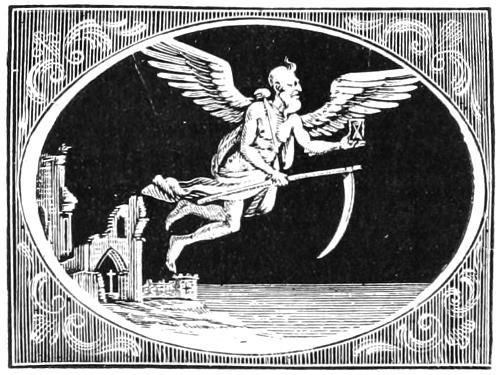
Fable LXVIII. There’s no To-morrow.
A Man, who had lived a very profligate life, at length being awakened by the lively representations of a sober friend on the apprehensions of a feverish indisposition, promised that he would heartily set about his reformation, and that To-morrow he would seriously begin it. But the symptoms going off, and that To-morrow coming, he still put it off till the next, and so he went on from one To-morrow to another; but still he continued his reprobate life. This his friend observing, said to him, I am very much concerned to find how little effect my disinterested advice has upon you: But, my friend, let me tell you, that since your To-morrow never comes, nor do you seem to intend it shall, I will believe you no more, except you set about your repentance and amendment this very moment: for, to say nothing of your repeated broken promises, you must consider, that the time that is past is no more; that To-morrow is not OURS; and the present NOW is all we have to boast of.
Morals.
That compunction of heart cannot be sincere, which takes not immediate effect, and can be put off till To-morrow. The friend’s closing observation in the Fable is so good a moral, that we need add nothing to it.
Eager to mend, and brookless of delay, Sincere repentance waits no future day; The present moment only is allow’d; Uncertain hopes and fears to-morrow shroud.
Reflection.
Whoever considers this emblem, will find it to be his own case; we promise, and we put off, and we sin, and go on sinning: but still, as our conscience checks us for it, we take up faint purposes, and half resolutions, to do so no more, and to lead a new life for the future. Thus, with the young fellow here, we indulge ourselves in our pleasures from time to time; and when we have trifled away our lives, day after day, from one To-morrow to another, that same To-morrow never comes. This is the sluggard’s plea and practice; the libertine’s, the miser’s; and in short, whose is it not? Now, if we would but consider the vanity and vexation of a lewd course of life; the impiety first of entering into vows, which we intend beforehand not to perform, and afterward of breaking them; the folly and the presumption of undertaking anything that is wholly out of our power; the necessity of improving every moment of our lives; the desperate and the irreparable hazard of losing opportunities; we should not venture body and soul upon the necessity of a procrastinated repentance, and postpone the most certain duties of a man, and of a Christian; for there is no To-morrow, nor anything, in truth, but the present instant, that we can call our own.