Part III. FABLES, in Verse.
Reading edition

Fable I. The Cuckoo Traveller.
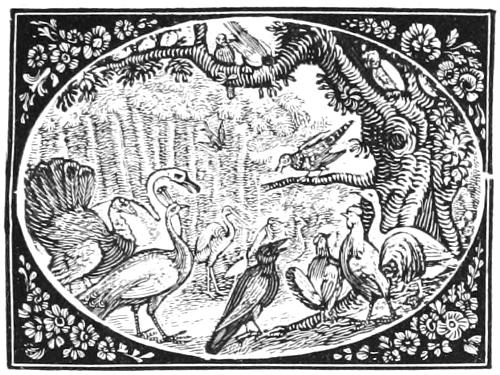
A Cuckoo once, as Cuckoos use, Who’d been upon a winter’s cruise, Return’d with the returning spring— Some hundred brothers of the wing, Curious to hear from foreign realms, Got round him in a tuft of elms. He shook his pinions, struck his beak, Attempted twice or thrice to speak; At length, up-rising on his stand, “Old England! Well, the land’s a land! But rat me, gentlemen,” says he, “We passage-fowl that cross the sea Have vast advantages o’er you; Whose native woods are all you view. The season past, I took a jaunt Among the isles of the Levant; Where, by the way, I stuff’d my guts With almonds and pistachio nuts. ’Twas then my whim some weeks to be In that choice garden, Italy: But, underneath the sky’s expanse, No climate like the south of France! You’ve often heard, I dare to swear, How plenty ortolans are there; ’Tis true, and more delicious meat, Upon my honour, I ne’er eat; The eggs are good; it was ill luck What day I had not ten to suck; Yet notwithstanding, to my goût, The bird’s the sweeter of the two.” He went on, talking pert and loud, When an old Raven, ’mongst the crowd, Stopp’d short his insolent career— “Why, what a monstrous bustle’s here! You travell’d, sir! I speak to you, Who’ve passed so many countries thro’; Say, to what purpose is’t you roam, And what improvements bring you home? Has Italy, on which you doat, Supply’d you with another note? Or France, which you extol so high, Taught you with better grace to fly? I cannot see that both together Have alter’d you a single feather: Then tell not us of where you’ve been, Of what you’ve done, or what you’ve seen; While you and all your rambling pack Cuckoos go out, Cuckoos come back.”
Fable II. The Ant and the Grasshopper.
’Twas that bleak season of the year, In which no smiles, no charms appear; Bare were the trees; the rivers froze; The hills and mountains capt with snows; When, lodging scarce and victuals scant, A Grasshopper address’d an Ant: And, in a supplicating tone, Begg’d he would make her case his own. “It was, indeed, a bitter task To those who were unused to ask; Yet she was forc’d the truth to say, She had not broke her fast that day; His worship, tho’, with plenty bless’d, Knew how to pity the distress’d; A grain of corn to her was gold, And Heav’n would yield him fifty-fold.” The Ant beheld her wretched plight, Nor seem’d unfeeling at the sight; Yet, still inquisitive to know How she became reduc’d so low, Asked her—we’ll e’en suppose in rhyme— What she did all the summer time? “In summer time, good sir,” said she, “Ah! these were merry months with me! I thought of nothing but delight, And sung, Lord, help me! day and night: Through yonder meadows did you pass, You must have heard me in the grass.” “Ah!” cry’d the Ant, and knit his brow— “But ’tis enough I hear you now; And, Madam Songstress, to be plain, You seek my charity in vain: What, shall th’ industrious yield his due To thriftless vagabonds like you! Some corn I have, but none to spare, Next summer learn to take more care; And in your frolic moods, remember, July is follow’d by December.”
Fable III. The Wolf and the Dog.
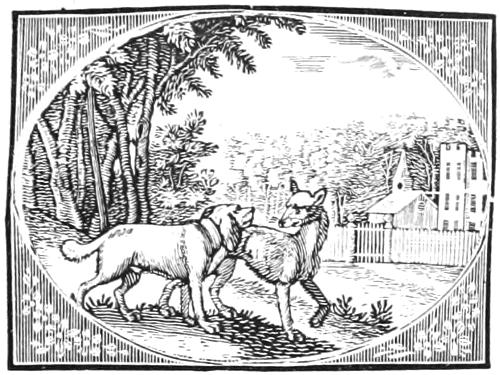
A prowling Wolf, that scour’d the plains, To ease his hunger’s griping pains, Ragged as courtier in disgrace, Hide-bound, and lean, and out of case, By chance a well-fed Dog espy’d, And being kin, and near ally’d, He civilly salutes the cur: “How do you, Cuz? Your servant, sir. O happy friend! how gay thy mien! How plump thy sides, how sleek thy skin! Triumphant plenty shines all o’er, And the fat melts at ev’ry pore! While I, alas! decay’d and old, With hunger pin’d, and stiff with cold, With many a howl and hideous groan, Tell the relentless woods my moan. Pr’ythee (my happy friend!) impart Thy wondrous, cunning, thriving art.” “Why, faith, I’ll tell thee as a friend, But first thy surly manners mend; Be complaisant, obliging, kind, And leave the Wolf for once behind.” The Wolf, whose mouth began to water, With joy and rapture gallop’d after, When thus the Dog: “At bed and board, I share the plenty of my lord; From ev’ry guest I claim a fee, Who court my lord by bribing me. In mirth I revel all the day, And many a game at romps I play: I fetch and carry, leap o’er sticks, With twenty such diverting tricks.” “’Tis pretty, faith,” the Wolf reply’d, And on his neck the collar spy’d: He starts, and without more ado, He bids the abject wretch adieu: “Enjoy your dainties, friend; to me The noblest feast is liberty: The famish’d Wolf, upon these desert plains, Is happier than a fawning cur in chains.”
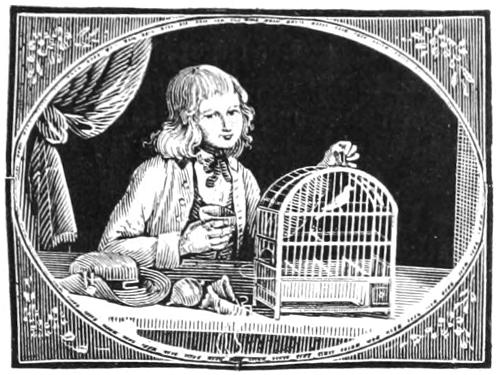
Fable IV. The Nightingale.
How few with patience can endure The evils they themselves procure. A Nightingale, with snares beset, At last was taken in a net: When first she found her wings confin’d, She beat and flutter’d in the wind, Still thinking she could fly away; Still hoping to regain the spray: But, finding there was no retreat, Her little heart with anger beat; Nor did it aught abate her rage; To be transmitted to a cage. The wire apartment, tho’ commodious, To her appear’d excessive odious; And though it furnish’d drink and meat, She car’d not, for she could not eat; ’Twas not supplying her with food; She lik’d to gather it from the wood: And water clear, her thirst to slake, She chose to sip from the cool lake: And, when she sung herself to rest, ’Twas in what hedge she lik’d the best: And thus, because she was not free, Hating the chain of slavery, She rather added link to link: —Just so men reach misfortune’s brink. At length, revolving on her state, She cries, “I might have met worse fate, Been seiz’d by kites or prowling cat, Or stifled in a school boy’s hat; Or been the first unlucky mark, Sure hit by some fantastic spark.” Then conscience told her, want of care Had made her fall into the snare; That men were free their nets to throw; And birds were free to come or go: And all the evils she lamented, By caution might have been prevented. So, on her perch more pleas’d she stood, And peck’d the kindly offer’d food; Resolv’d, with patience, to endure Ills she had brought, but could not cure.
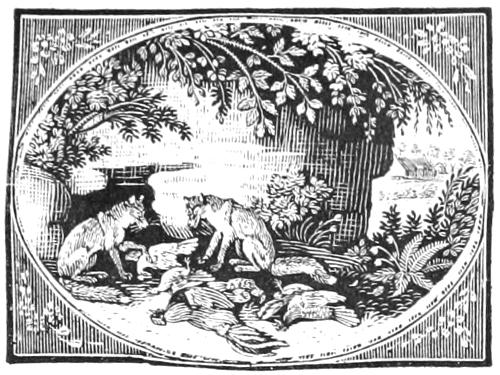
Fable V. The Two Foxes.
Two hungry Foxes once agreed To execute a bloody deed, And make the farmer’s poultry bleed. Thus, as their rage was very hot, Cocks, hens, and chickens went to pot. The one (the slaughter being o’er) Young, and a perfect epicure, Propos’d on all the spoil to sup, And at one meal to eat it up. The other old, at heart a miser, Refus’d his scheme, and thought it wiser To lay aside some of the prey, And so provide for a bad day. “Listen, my child,” says he, “to age; Experience has made me sage: I know the various turns of fate: How changeable is every state! A mighty treasure we have found; Success has all our wishes crown’d; See! the vast havoc all around! Oh let us not be lavish, son, Nor throw away what we have won! Oh let us not consume our store, But, being frugal, make it more!” “Your fine harangue,” replies the other, “Might take, were I a griping brother: But, as I’m generous and free, It ne’er shall have effect on me. I’ll live, old daddy, while I may Indulge my noble self with prey, And feast in spite of all you say. But should I not—why, to our sorrow, The fowls will stink before to-morrow. If we return—the clown will watch us; And, hang the dog, he’ll surely catch us: In ambush he will watch our waters, Or else with dogs beat up our quarters.” This said, each fox himself obey’d, Pursu’d the scheme that he had laid. The younger one fell to the meat;— And died o’ercharg’d with what he eat. The old one, as with joy next morning, To his hid spoil he was returning, Ta’en by the farmer in surprise, Fell by his hand a sacrifice. Thus each man has his ruling passion, And ev’ry age its inclination: The young are heedless in their measures, And boundless in pursuit of pleasures: The old are all persuasion past, Positive, and griping to the last.
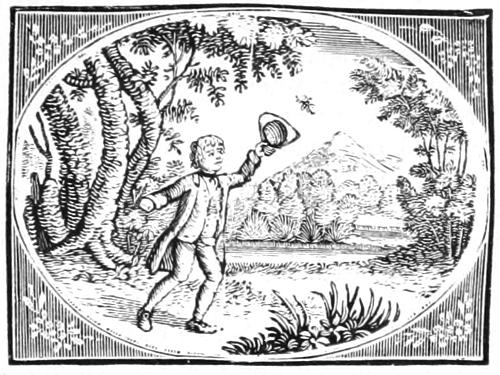
Fable VI. The Butterfly and Boy.
’Twas on a day serene and fair, The sun was bright and æther clear, The rocking winds were lull’d to rest, And ev’ry murmuring gale supprest; When, tempted by th’ alluring heat, A Fly forsook her dark retreat To taste the sweetness of the skies, And tinge her wings with various dyes; Restless she rov’d her narrow tour, And borrow’d paint from ev’ry flow’r; Till, deck’d with all the insect grace, She sparkled fairest of her race. In all her splendour, pomp, and pride, The winged-gem a Boy espy’d; Who, pleas’d to see how bright it shone, Resolv’d to make the prize his own; And straight with speed began to trace The gilded Fly from place to place: But, conscious of some danger near, The Butterfly her course would steer, Now high, then low, now here, then there, To balk the aim, or shun the blow She justly dreaded from her foe. The Lad, still eager to pursue The Fly that always kept in view, Thro’ many a lane and meadow went, His soul so on the prize was bent, Undaunted ran from morn to noon, To gain the heart-enchanting boon. At length, when sweat bedew’d his face, And almost weary of the chase, The Fly in evil hour is caught, And homewards by the conqueror brought; Who vainly hop’d, the glorious spoil Would more than recompense his toil; But while, with pleasure and surprise, Her form and beauty feast his eyes, The Fly escapes, and mounts the skies, With rallied force augments her flight, And quick evades his keenest sight; Then he, deluded youth! gave o’er All hope to find the booty more. Enrag’d condemns his cruel fate, And wept his folly—but too late. Thus foolish mortals waste their days, In seeking pleasures, wealth, and praise; They hunt for honours, titles, fame, And risk their souls to gain a—name; Chase every glitt’ring toy they spy, Just as the Lad pursu’d the Fly, And e’er they grasp the bauble—die.
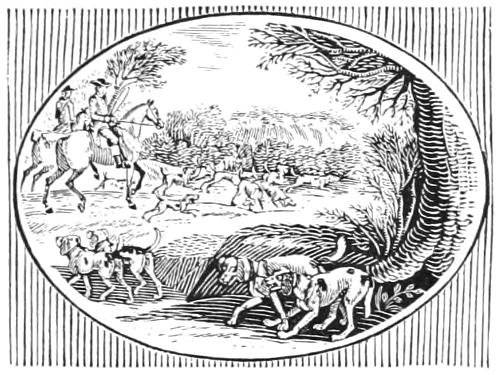
Fable VII. The Hounds in Couples.
Wedlock, a name not much in fashion, Subservient ofttimes is to passion. How oft we see a thoughtless pair, Brought up by Nature’s fost’ring care, When love first fires their youthful breast, Pant with impatience to be blest: Tempers unstudied! thoughts untried! Yet sigh, alas! to be allied. Because their hours of courtship run Sweet, under love’s meridian sun, They think to breathe a tranquil life, And be the happy man and wife. Vain thought!—the flatt’ring phantom flies, And opes at length their purblind eyes. Then—— but attend my simple story, The sequel will appear before ye. The morning dawns, with orient sky, Clad with its purple royalty, Once more’s the throne of infant day, And all th’ horizon round looks gay. The horn deep-ton’d the huntsman fills, The strains re-echo from the hills; Unkennell’d for the bloody chase, Impatient rush the babbling race: Some, widely stretching o’er the plain, Vocif’rous chaunt the heedless train; These stretch their limbs, while others bound In wanton circles o’er the ground. The squire survey’d with secret pride The mottled pack on either side: The puppies did not ’scape his view; Their youthful tricks were pleasing too. But lest a part unskill’d, and young, Should lead the rest with lavish tongue, It was decreed they should be tied, And trudge in couples, side by side. To Ringwood, Sweetlips was assign’d: These two with patience jogg’d behind. To Trueman, so ’twas doom’d by fate, Maiden was yok’d as trav’lling mate: In these an early fondness grew, If he did this, she’d do so too; From Maiden Trueman scarce would stray, But spent with her the livelong day; For her the half-pick’d bone he’d spare, And guard her with a lover’s care. If he in playful frolic run, Or bask’d beneath th’ enlivening sun, As sure she would his steps attend, Or near his side her length extend. From one calm mind their actions grew; But now, alas! they spring from two. Divided cares invade each breast; Divided thoughts and interest; Now ’tis they feel the galling chain, And howl for liberty again. To join the pack if he’s inclin’d, She with slow pace will drag behind: He this way draws, she tugs another, They prove tormentors to each other. Now boldly they exert their might, Snarl answers snarl—bite follows bite; With double ire their fury burns, And gains them mastership by turns. But strength victorious rules the field, To force superior all must yield: At length subdued the fair one lies, And calls assistance by her cries; But ah! in vain, no succour’s near, The hunt pursue the tim’rous hare. Too late she sees from whence arose The source of all her bleeding woes: Secluded now from every friend, Her sorrows but with life can end, What’s to be done—reflection’s vain, And serves but to increase her pain; Quite spent, she howling yields her life, A prey to discontent and strife.
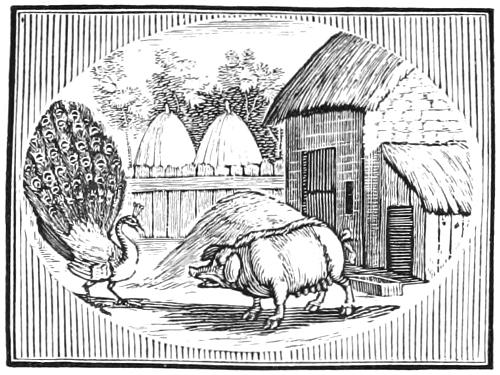
Fable VIII. The Sow and the Peacock.
In days of yore, as authors tell, When beasts and birds could read and spell, No matter where, in town or city, There liv’d a Swine exceeding witty; And, for the beauties of her mind, Excelling all her bristl’d kind: But yet, to mortify her pride, She found at last her failing side. Philosophy she had good store, Had ponder’d Seneca all o’er; Yet all precautions useless prove Against the pow’r of mighty love. It happen’d on a sultry day, Upon her fav’rite couch she lay,— ’Twas a round dunghill soft and warm, O’ershadow’d by a neighb’ring barn,— When lo, her winking eyes behold A creature with a neck of gold, With painted wings and gorgeous train, That sparkled like the starry plain: His neck and breast all brilliant shine Against the sun. The dazzl’d Swine, Who never saw the like before, Began to wonder and adore; But seeing him so fair and nice, She left her dunghill in a trice; And, fond to please, the grunting elf Began to wash and trim herself; And from the stinking pool she run To dry her carcase in the sun; And rubb’d her sides against a tree: And now, as clean as hogs can be, With cautious air and doubtful breast, The glitt’ring Peacock thus address’d: “Sir, I, a homely rural Swine, Can boast of nothing fair nor fine, No dainties in our troughs appear, But, as you seem a stranger here, Be pleas’d to walk into my sty, A little hut as plain as I. Pray venture through the humble door; And tho’ your entertainment’s poor, With me you shall be sure to find An open heart and honest mind; And that’s a dainty seldom found On cedar floors and city ground.” Thus far the Sow had preach’d by rule, She preach’d, alas! but to a fool; For this same Peacock, you must know, Had he been man, had been a beau: And spoke, like them, but mighty little That to the point could tend a tittle: And with an air that testify’d He’d got at least his share of pride, He thus began: “Why, truly now, You’re very civil, Mrs Sow: But I am very clean, d’ye see; Your sty is not a place for me. Should I go through that narrow door, My feathers might be soil’d or tore; Or scented with unsav’ry fumes: And what am I without my plumes?” The much offended Sow replies, And turns asquint her narrow eyes, “Sir, you’re incorrigibly vain, To value thus a shining train; For when the northern wind shall blow, And send us hail, and sleet, and snow, How will you save from such keen weathers, Your merit—sir, I mean your feathers? As for myself,—to think that I Should lead an idiot to my sty, Or strive to make an oaf my friend, Makes all my bristles stand on end: But for the future, when I see A bird that much resembles thee, I’ll ever make it as a rule, The shining case contains a fool.”
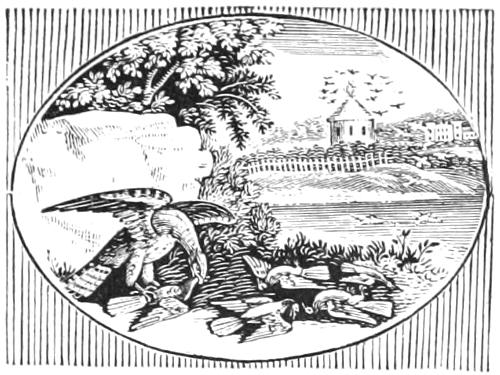
Fable IX. The King-Dove.
Thousands, who start at Nero’s name, With Nero’s power would act the same; And few in humble spheres can know How much to want of pow’r they owe— The passions sleep unrous’d by might, As objects lie forgot in night; Tho’ unregarded till they’re seen, They both exist beneath the screen, And Sol returning, grandeur near, The passions rise, and shapes appear: And e’en a dove, the Fable tells, Begirt with pow’r a tyrant swells— Thus runs the tale—Between the Kite And Doves there chanc’d a fatal fight, Before his force their numbers fled, The victor on the captives fed— What can be done?—they pine, they grieve, The spar’d can scarce be said to live.— At last, their king Columbo’s call Commands the senate to the hall: Columbo, best of doves and kings, Up-rising clapt his painted wings, Then thus harangu’d ’em from above, And spake the monarch, and the Dove— “My suff’ring friends, with grief and pain I fear we meet but to complain; Yet my fond bosom fain would know Your thoughts of our relentless foe— If any, blest with skill to save, Have plann’d the proud oppressor’s grave, Whatever perils shall attend A scheme to save one bleeding friend, I’ll meet, I’ll vanquish, or no more Return to this opprobrious shore: For oh! to steal the tyrant’s breath, I’d perch upon the dart of death.” He ceas’d, and soft applauses sprung From ev’ry heart to ev’ry tongue: Then one arose among the rest, And mov’d,—That Jove might be addrest, Arms on their monarch to bestow, Like those so dreadful on their foe. The rest consent, the pray’r is made, Jove will’d, and Nature straight obey’d. Columbo feels his form distend, His beak grow crook’d, claws extend; On his increasing strength presumes, And pleas’d he shakes his alter’d plumes, To single combat dares the foe, And deep imprints the fatal blow. The Kite expires,—and peace again Reviv’d to bless Columbo’s reign. But flush’d with conquest, proud in arms, He longs, he pants, for fresh alarms, And to himself elated thought— “Had I these gifts of Jove for nought?” Now swelling high with proud disdain, He scorns his meek, his peaceful train; A thousand wives the monarch claims, And seizes all their fairest dames; A thousand slaves attend his will, A thousand nests his treasures fill; None for themselves eat, sleep, or love, ’Tis all the King’s—imperial Dove! Too noble grown for common food, He longs to taste of pigeon’s blood; Nor long the appetite withstood. With treble anguish now they moan A wide destroyer on their throne, Despairing drag the galling chain, And vainly curse Columbo’s reign. This fatal change let man informed pursue, Catch rising truths from every fabled view, And learn from hence no dang’rous pow’r to trust, E’en with the wise, the gentle, and the just. Since e’en that pow’r less prompts to good than ill, And bends to vice vain man’s unequal will— Wrongs to redress ne’er arm alone your friend, But, cloth’d in equal might, his steps attend; Let equal arms your injur’d rights maintain, Divide the strength, the labours, honours, gain: Still on a level, tho’ with conquest bright, No traitor thoughts shall rise from matchless might: Peace with her genuine charms shall either bless, And just dependencies prevent excess.
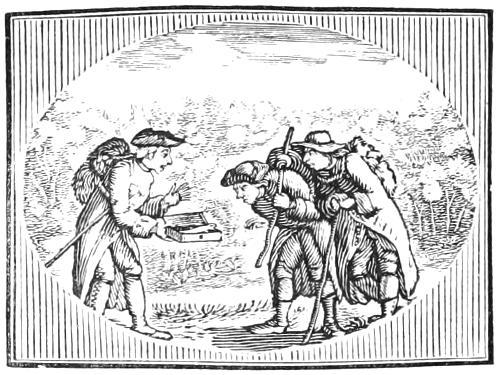
Fable X. The Camelion.
Oft has it been my lot to mark A proud, conceited, talking spark, With eyes, that hardly serv’d at most To guard their master ’gainst a post, Yet round the world the blade has been To see whatever could be seen. Returning from his finish’d tour, Grown ten times perter than before, Whatever word you chance to drop, The travell’d fool your mouth will stop; “Sir, if my judgment you’ll allow— I’ve seen—and sure I ought to know”— So begs you’d pay a due submission, And acquiesce in his decision. Two travellers of such a cast, As o’er Arabia’s wild they past, And on their way in friendly chat Now talk’d of this, and then of that, Discours’d a while ’mongst other matter, Of the Camelion’s form and nature. “A stranger animal,” cries one, “Sure never liv’d beneath the sun: A lizard’s body lean and long, A fish’s head, a serpent’s tongue; Its tooth with triple claw disjoin’d; And what a length of tail behind! How slow its pace, and then its hue— Who ever saw so fine a blue?” “Hold there,” the other quick replies, “’Tis green—I saw it with these eyes, As late with open mouth it lay, And warm’d itself in sunny ray; Stretch’d at its ease the beast I view’d, And saw it eat the air for food.” “I’ve seen it, sir, as well as you, And must again affirm it blue: At leisure I the beast survey’d, Extended in the cooling shade.” “’Tis green, ’tis green, sir, I assure ye.” “Green!” cries the other in a fury. “Why, sir—d’ye think I’ve lost my eyes?” “’Twere no great loss,” the friend replies; “For, if they always serve you thus, You’ll find ’em but of little use.” So high at last the contest rose, From words they almost came to blows: When luckily came by a third— To him the question they refer’d; And begg’d he’d tell ’em, if he knew, Whether the thing was green or blue. “Sirs,” cries the umpire, “cease your pother— The creature’s neither one nor t’other. I caught the animal last night, And view’d it o’er by candle light: I mark’d it well—’twas black as jet— You stare—but, sirs, I’ve got it yet, And can produce it.” “Pray, sir, do: I’ll lay my life, the thing is blue.” “And I’ll be sworn, that when you’ve seen The reptile, you’ll pronounce him green.” “Well, then, at once to ease the doubt,” Replies the man, “I’ll turn him out: And when before your eyes I’ve set him, If you don’t find him black, I’ll eat him.” He said; then full before their sight Produc’d the beast, and lo! ’twas white. Both star’d, the man look’d wondrous wise— “My children,” the Camelion cries, Then first the creature found a tongue, “You all are right, and all are wrong: When next you talk of what you view, Think others see, as well as you: Nor wonder, if you find that none Prefers your eye-sight to his own.”
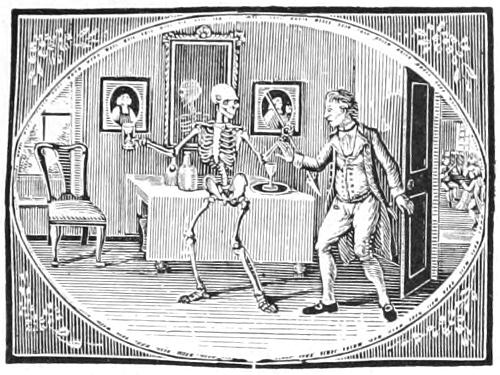
Fable XI. The Three Warnings.
The tree of deepest root is found Least willing still to quit the ground; ’Twas therefore said by ancient sages, That love of life increas’d with years: So much, that in our latter stages, When pains grow sharp, and sickness rages, The greatest love of life appears. This great affection to believe, Which all confess, but few perceive, If old assertions can’t prevail, Be pleas’d to hear a modern tale. When sports went round, and all were gay On neighbour Dobson’s wedding-day, Death call’d aside the jocund groom With him into another room: And looking grave,—“You must,” says he, “Quit your sweet bride, and come with me.” “With you! and quit my Susan’s side! With you!” the hapless husband cry’d: “Young as I am; ’tis monstrous hard; Besides, in truth, I’m not prepar’d: My thoughts on other matters go, This is my wedding-night, you know.” What more he urg’d I have not heard: His reasons could not well be stronger; For Death the poor delinquent spar’d, And left to live a little longer. Yet calling up a serious look, His hour-glass trembling while he spoke, “Neighbour,” he said, “Farewell: No more Shall death disturb your mirthful hour; And further to avoid all blame Of cruelty upon my name, To give you time for preparation, And fit you for your future station, Three several warnings you shall have Before you’re summon’d to the grave, Willing for once I’ll quit my prey, And grant a kind reprieve: In hopes you’ll have no more to say, But when I call again this way Well pleas’d the world will leave.” To these conditions both consented, And parted, perfectly contented. What next the hero of our tale befell, How long he liv’d, how wise, how well, How roundly he pursu’d his course,— And smok’d his pipe, and strok’d his horse,— The willing muse shall tell: He chaffer’d on, he bought, he sold, Nor once perceiv’d his growing old, Nor thought of death as near: His friends not false, his wife no shrew, Many his gains, his children few, He pass’d his hours in peace; But while he view’d his wealth increase, While thus along life’s dusty road The beaten track content he trod, Old time, whose haste no mortal spares, Uncall’d, unheeded, unawares, Brought on his eightieth year. And now one night in musing mood, As all alone he sat, Th’ unwelcome messenger of fate, Once more before him stood. Half kill’d with anger and surprise, “So soon return’d!” old Dobson cries: “So soon, d’ye call it!” Death replies: “Surely, my friend, you’re but in jest; Since I was here before, ’Tis six and forty or fifty years at least, And you are now fourscore.” “So much the worse,” the clown rejoin’d: “To spare the aged would be kind: However, see your search be legal; And your authority—Is’t regal? Else you are come on a fool’s errand, With but a secretary’s warrant. Besides, you promis’d me three warnings, Which I have look’d for nights and mornings. But, for that loss of time and ease, I can recover damages.” “I know,” cries Death, “that at the best, I seldom am a welcome guest; But don’t be captious, friend, at least: I little thought you’d still be able To stump about your farm and stable; Your years have run to a great length, I wish you joy tho’ of your strength.” “Hold,” says the farmer, “not so fast, I have been lame these four years past.” “And no great wonder,” Death replies, “However you still keep your eyes, And sure to see one’s loves and friends For legs and arms would make amends.” “Perhaps,” says Dobson, “so it might, But latterly I’ve lost my sight.” “This is a shocking story, faith, Yet there’s some comfort still,” says Death; “Each strives your sadness to amuse, I warrant you hear all the news.” “There’s none,” cries he, “and if there were I’m grown so deaf I could not hear.” “Nay then,” the spectre stern rejoin’d, “These are unjustifi’ble yearnings; If you are lame, and deaf, and blind, You’ve had your three sufficient warnings. So come along, no more we’ll part, He said, and touch’d him with his dart; And now old Dobson, turning pale, Yields to his fate—so ends my tale.”
Fable XII. The Caterpillar and Butterfly.
The morning blush’d with vivid red, And night in sudden silence fled; Sad Philomel no more complains, The lark begins his sprightly strains; Light paints the flow’rs of various hue, And sparkles in the pendent dew; Life moves o’er all the quicken’d green, And beauty reigns, unrival’d queen. Green as the leaf, on which he lay, A Caterpillar wak’d to-day: And look’d around, and chanc’d to ’spy A leaf of more inviting dye; From where he lay he crawl’d, and found The verdant spot’s indented bound; Stretch’d from the verge, he strove to gain The neighb’ring leaf, but strove in vain. In that nice moment, prompt to save, A brother worm this warning gave. “Oh! turn, advent’rous as thou art, Nor hence, deceiv’d by hope, depart; What though the leaf, that tempts thee, shows More tasteful food, more soft repose; What, though with brighter spangles gay, Its dew reflects an earlier ray? Oh! think what dangers guard the prize; Oh! think what dangers; and be wise! The pass from leaf to leaf forbear; Behold how high they wave in air! And should’st thou fall, tremendous thought! What ruin would avenge thy fault? Thy mangled carcase, writh’d with pain, Shall mark with blood the dusty plain: Then death, the dread of all below, Thy wish—will surely end thy woe; Untimely death, for now to die, Is ne’er to rise a butterfly.” “A Butterfly!” th’ Advent’rer cry’d, “What’s that?” “A bird,” his friend reply’d, “To which this reptile form shall rise, And gorgeous mount the lofty skies; The joyful season time shall bring, He bears it on his rapid wing. An age there is, when all our kind, Disdain the ground, and mount the wind: And should thy friend this age attain—” With haste the worm reply’d again, “Say what assurance canst thou give, That I with birds a bird shall live? For could I trust thy pleasing tale, No wanton wish should e’er prevail; For what, that worms obtain, can vie With bliss of birds that wing the sky?” “Believe my words,” th’ Adviser said, “Since not of private int’rest bred; Not on thy life or death depend My pleasure or my pain—— Attend! Like thee, to all the future blind, I knew not wings for worms design’d, Till yon last sun’s ascending light Remov’d the dusky shades of night. Soon as his rays, from heav’n sublime, Shone on that leaf you wish to climb; That leaf, which shades, in earliest hours, This less conspicuous spot of ours: Surpris’d, a lovely form I saw, That touch’d me with delight and awe; ’Twas near, and while my looks betray’d My wonder,” thus the Stranger said: “If view’d by thee with wond’rous eyes My graceful shape and vary’d dyes, New wonder still prepare to feel, Amazing truths my words reveal: For know, like thine my humble birth; Like thee, I crawl’d a worm on earth.” “Ah! mock me not,” said I, “nor seek A worthless triumph o’er the weak; Canst thou, thy form with down o’erspread, By nature crown’d thy regal head, Canst thou my reptile shape have worn? My reptile shape, of all the scorn! Hast thou! whose gorgeous wings display Each vary’d tint that drinks the day, More bright than drops of orient dew, More gay than flow’rs of gaudiest hue, With purple edg’d, and fring’d with gold, Like light, too splendid to behold! Hast thou, an abject worm like me, Crawl’d prone on earth! it cannot be.” “Oh! cease the doubts,” the Stranger cry’d, “To faith thy happiness ally’d— Not thrice the morn these eyes have view’d, Since genial spring my life renew’d; From death-like slumbers wak’d, I found A guardian shell invest me round; The circling shield I broke, nor knew How long my safety hence I drew; But soon perceiv’d, and knew the spot, Where once, a worm, I fix’d my lot; The past with wonder touch’d my breast, More wonder still the now imprest, With pleasure mixt—the pleasure grew, At ev’ry thought, at ev’ry view; Transform’d, my unknown pow’r I try, I wave my wings, I rise! I fly! Enraptur’d with the blissful change, From field to field I wanton range; From flow’r to flow’r, from tree to tree, And see whate’er I wish to see; Now glide along the daisy’d ground; Now wheel in wanton circles round; Now mount aloft, and sport in air, Transported, when I will, and where, Still present, to whate’er invites, Each moment brings me new delights; Nor fear allays the joys I know, The dangers scorn’d that lurk below; No trampling hoof, my former dread, Can crush me, mangled, to the dead. Ev’n man himself pursues, in vain, My sportive circuit o’er the plain.” He said, and raptur’d with the thought, New charms his bright’ning plumage caught, He clapt his wings, his rapid flight I trac’d with fond desiring sight, Oh! glorious state—reserv’d to this, I risk not life for reptile bliss; Oh! catch the glowing wish from me, The same the bliss reserv’d for thee; Desist from ev’ry rash design, And beauty, plumes, and wings are thine. He ceas’d—th’ Advent’rer thus reply’d: “By thee the fancy’d change be try’d, The now is mine, the now alone, The future fate’s—a dark unknown! To nature’s voice my ears incline; All lovely, loving, all divine! To joy she courts, she points the way, And chides this cold, this dull delay. Farewell—let hope thy bliss supply, And count thy gains with fancy’s eye; Be thine the wings that time shall send, Believing and obliging friend.”— He said, and sneering sly disdain, The neighb’ring leaf attempts to gain; He falls—all bruis’d on earth he lies; Too late repents, and groans, and dies. His friendly monitor, with care, Avoids each pleasure-baited snare, False pleasure, false, and fatal too! Superior joys he keeps in view; They come—the genial spring supplies The wings he hoped, and lo! he flies; Tastes all that summer suns prepare, And all the joys of earth and air!
Fable XIII. The Two Doves.
Two Turtles once, of gentlest kind, In softest bands by love were join’d; ’Til tired of home Columbo grew, And pensive sigh’d for something new; For distant realms prepar’d to part,— When spoke the partner of his heart: “Why should my dear Columbo rove, And leave me widow’d in the grove— What ill can worse than absence prove? Yet let the toils, the perils, cares, Which fate for travellers prepares, Retard thy speed—attend the spring, And wait the zephyr’s aiding wing; What haste?—this hour, ill omen’d found! The raven’s croak was heard around; Hawks, nets, and ills of ev’ry kind Henceforth shall haunt my boding mind; And what does Heav’n at home deny That thou canst wish, or Heav’n supply?” These words in doubt Columbo hold, Still weakly vain, and rashly bold; At length his restless wish prevails, And love, and fear, and prudence fails: When thus he spoke with cheerful air— “From Turturella far be care, No more let tears those eyes distain, Whate’er I seek three days shall gain; Returning then, to thee I’ll tell Whate’er I saw, or me befell: Amusing thus the pensive day, Who little see, can little say, Of rich description full, my tale Shall oft thy listening ear regale; The scenes I’ll paint so strong, so true, In fancy thou shalt travel too.” This said, Farewell dissolves his heart, And wet with mutual tears they part. As Turturella pensive sate, In fancy wand’ring with her mate, Far as her utmost ken she sees A bird approach by slow degrees; Not form’d for flight he seem’d, nor song, But stopp’d by turns, and limp’d along: Her pains who feels can tell alone, The bird for chang’d Columbo known; Her mate, with pearly tears to greet, Down from her nest she flew to meet. Awhile with silent grief opprest, At length she softly him addrest: “Oh! tell me, dear Columbo, tell What scenes you saw, what woes befell; Why wounded thus Columbo mourns, And ere th’ appointed day returns?” With falt’ring voice Columbo cry’d, “From thee no more my heart I hide— Scarce from this peaceful grove I past When sudden clouds the skies o’ercast; I saw the storm, for shelter sought, A single tree that shelter brought, Thin leav’d, and pervious to the show’r, I felt the rig’rous season’s power. The cloud dissolv’d, benumb’d with cold, Again my dripping wings unfold; In neighb’ring fields some corn I view, And, hov’ring near, a turtle too; By flatt’ring hopes deluded there, I struggled in the fowler’s snare: The turtle tutor’d to betray, Beneath the bait a net there lay. Unwonted strength despair supply’d, I broke the snare my feet that ty’d; With less than half my tail I fled, And trail’d behind a broken thread, A remnant of the snare, when lo! A vulture sees me, dreadful foe! Just as he stoop’d to snatch the prey, From heav’n an eagle wing’d his way; I, while the sons of rapine fight, Improv’d the lucky hour in flight The ruins of a cot were near, I thought my dangers ended here; Deceitful thought! a playful boy (The cruel race in sport destroy) Whirl’d round the sling, the rapid stone Laid bare my pinion to the bone. Yet reach I living this abode, What signal mercies Heav’n bestow’d! Left in this grove to sigh alone What fate has Turturella known?” “More signal yet, by far,” said she, “The mercies Heav’n bestow’d on me.” “Alas! what woes,” Columbo cry’d, “In this short absence hast thou try’d? What near escapes to equal mine? Amazing marks of love divine!” “The woes averted from my head Are those which thou hast felt,” she said; “No near escapes ’twas mine to prove, What more amazing mark of love! In ease and safety more I gain Than life to thee, preserv’d with pain, See then the mercies that I meant, Which Heav’n to give me, gave Content! Learn hence the gifts of Jove to prize, And, ere misfortunes teach, be wise.”
Fable XIV. The Beau and Butterfly.
When summer deckt each sylvan scene, And sunshine smil’d along the green, When groves allur’d with noon-tide shade, And purling brooks refresh’d the glade; An empty form of empty show, A flutt’ring insect, call’d a Beau, In gaudy colours rich and gay, A mere papilio of the day, Was seen around the fields to rove, And haunt, by turns, the stream and grove: A silver zone entwin’d his head, His belly shone with lively red, His wings were green, but studded o’er With gold-embroider’d spots before. Around him various insects came, Of diff’rent colour, different name; And, ting’d with every gorgeous dye, Among the rest a Butterfly; His wings are spread with wanton pride, And beauty fades from all beside. The Beau beholds, with envious eyes, The living radiance as it flies: “And shall,” said he, “this worthless thing. That lives but on a summer’s wing, This flying worm, more gaudy shine, And wear a dress more gay than mine? Is this wise Nature’s equal care To deck a Butterfly so fair, While man, her worthiest, greatest part, Must wear the homely rags of art?” Thus reason’d he, as reason beaux, The subject of their logic clothes; When thus the Butterfly reply’d, With deeper tints by anger dy’d: “Vain, trifling mortal! could’st thou boast To prize what Nature prizes most On man bestow’d, thou would’st not see With envy aught she gives to me. This painted vestment, all my store, She gives, and I can claim no more— But man, for greater ends design’d, Should boast the beauties of the mind. More bright than gold with wisdom shine, And virtue’s sacred charms be thine: To rule the world by reason taught, On dress disdain to waste a thought; For he, whom folly bends so low, Ambitious to be thought a beau. Is studious only to be gay, In toilet-arts consumes the day; And, the long trifling labours o’er, Takes wing, and bids the world adore; Looks down with scorn on rival flies, Himself less splendid and less wise; With scorn, his scorn return’d again, Proud insect! impotently vain! The fool who thus by self is priz’d, By others justly is despis’d.” She said, and flutter’d round on high, Nor stay’d to hear the Beau’s reply.
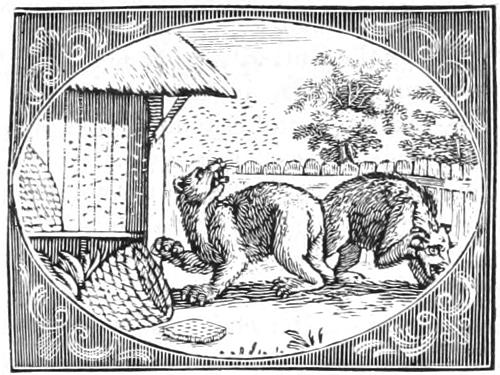
Fable XV. The Bears and Bees.
As two young Bears in wanton mood, Forth-issuing from a neighb’ring wood, Came where th’ industrious Bees had stor’d In artful cells their luscious hoard; O’erjoy’d they seiz’d with eager haste Luxurious on the rich repast. Alarm’d at this, the little crew About their ears vindictive flew. The beasts, unable to sustain Th’ unequal combat, quit the plain: Half blind with rage, and mad with pain, Their native shelter they regain; There sit, and now discreeter grown, Too late their rashness they bemoan; And this by dear experience gain, “That pleasure’s ever bought with pain.” So when the gilded baits of vice Are plac’d before our longing eyes, With greedy haste we snatch our fill, And swallow down the latent ill; But when experience opes our eyes, Away the fancied pleasure flies— It flies, but oh! too late we find It leaves a real sting behind.
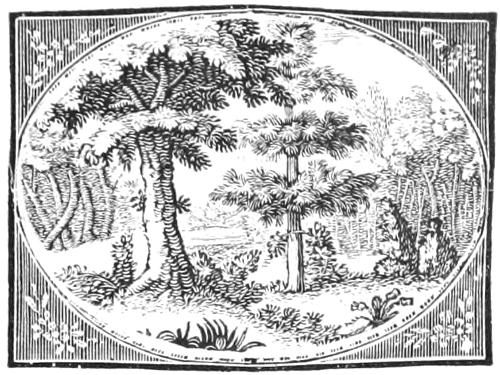
Fable XVI. The Trees.
Once on a time, when great Sir Oak Held all the trees beneath his yoke, The monarch, anxious to maintain, In peaceful state, his sylvan reign, Saw, to his sorrow and distraction, His subject trees take root in faction, And, though late join’d in union hearty, Now branching into shoots of party, Each sturdy stick of factious wood Stood stiff and stout for public good: For patriots ever, ’tis well known, Seek others welfare, not their own, And all they undertake, you know, Is meant pro bono publico. The hardy Fir, from northern earth Who took its name, and drew its birth, The Oak plac’d next him to support His government, and grace his court. The Fir, of an uncommon size, Rear’d his tall head unto the skies, O’er-topp’d his fellow-plants, his height Who view’d, and sicken’d at the sight: With envy ev’ry fibre swell’d, While in them the proud sap rebell’d; “Shall then,” they cried, “the Ash, the Elm, The Beech, no longer rule the helm? What! shall the ignoble Fir, a plant, In tempest born, and nurs’d in want, Far from black regions of the north, And native famine, issue forth; In this our happier soil take root, And dare our birthright to dispute?” On this the fatal storm began, Confusion thro’ the forest ran; Mischief in each dark shade was brewing, And all betoken’d general ruin: While each, to make their party good, Brib’d the vile shrubs and underwood: And now the Bramble and the Thistle Sent forth essay, ode, epistle; To which anon, with equal mettle, Replied the Thorn and stinging Nettle. “What’s to be done, or how oppose The storm which in the forest rose?” Grief shook the mighty monarch’s mind, And his sighs labour’d in the wind. At length, the tumult, strife, and quarrel, Alarming the sagacious laurel, His mind unto the King he broke, And thus addrest him: “Heart of Oak! Sedition is on foot, make ready; And fix your empire firm and steady. Faction in vain shall shake the wood, While you pursue the general good. Fear not a foe, trust not a friend, Upon yourself alone depend. If not too partially ally’d, By fear or love to either side, In vain shall jarring factions strive, Cabals in vain dark plots contrive. Slave to no foe, dupe to no minion, Maintain an equal just dominion: So shall you stand by storms unbroke, And all revere the Royal Oak.”
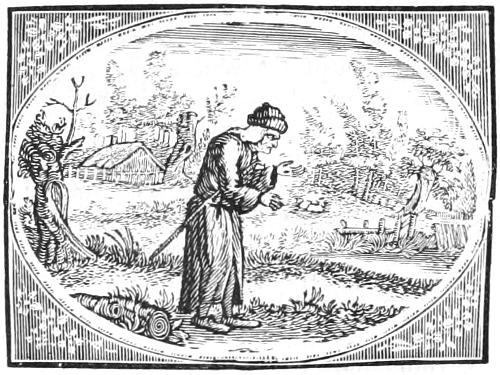
Fable XVII. The Philosopher and Glow-Worm.
When toilsome hours of day were spent, The world seem’d wrapt in calm content, Each anxious care forsook the breast, Sleep gently clos’d each eye to rest, Cynthia her brightest aspect wore, And Heav’n’s expanse was studded o’er, A sage, by meditation drawn, Forsook his cot, and sought the lawn; In contemplation deep he stray’d, And nature’s dozing charms survey’d; On either hand new beauties view’d, As he his tranquil walk pursu’d. By chance, a Glow-Worm, in his way, Shone forth his little glitt’ring ray, Proudly unfolding ev’ry grace, As trailing round from place to place; Illumining the moss-fring’d plain. On other worms he look’d disdain. The sage, with philosophic eye, Survey’d the wand’rer crawling by; Then stooping low, with gentle hand, High lifts him from the dew-fraught land. The grub, tho’ not dismay’d thro’ fear, Conscious he was not in his sphere, Withdrew his beam of light away, To hear what man—vain man—would say. The learn’d Philosopher, amaz’d, Paus’d for some time, and anxious gaz’d; Astonish’d that the worm should die So soon, then careless threw it by; But first, this application made:— “This creeping reptile, lo! is dead, And with his life, his glory’s fled. So is’t with all ambition’s race, Who fill up each exalted place: Brilliant they shine with borrow’d ray, And wanton in the blaze of day, ’Till fortune’s second wheel turns round, And leaves them where they first were found.” The Glow-Worm with attention heard, And weigh’d with prudence ev’ry word, Trim’d bright his little lamp again. And shone more beauteous o’er the plain Then thus address’d the wond’ring sage, The known Philos’pher of the age: “Know thou, the happy pow’r to shine Is truly man’s as well as mine; I know my sphere, did he the same, He’d tread that path that leads to fame; Did he in dang’rous times retire, And check with care ambition’s fire, Like me he might new lustre spread. And deck with laurels fresh his head. But, coxcomb like, he’s led astray To shine, and shines but for a day.”
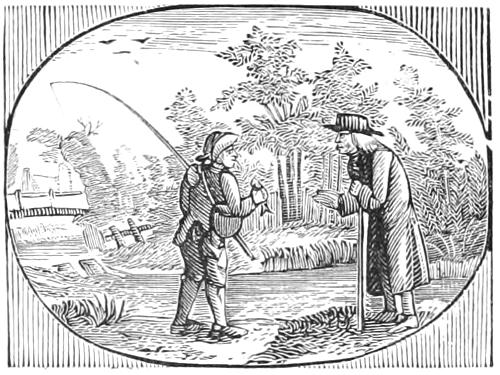
Fable XVIII. The Angler and the Philosopher.
Beside a gentle murm’ring brook An Angler took his patient stand; He ey’d the stream with anxious look, And wav’d his rod with cautious hand. The bait with nicest art was drest, The fishes left their safe retreat; And one more eager than the rest, Look’d, long’d, and swallow’d the deceit. Too late she felt the poignant smart, Her pitying friends her fate deplore; The Angler with well-practis’d art, Play’d, hook’d, and drew her to the shore. Lur’d by the beauty of the day, The sun now sinking in the sky, A sage pursu’d his walk that way, And saw the bleeding victim lie. Far in the vale of years declin’d, He watch’d the course of nature’s law; And thus with philosophic mind, He moralis’d on what he saw: “Indulge, awhile, the pensive vein, And fix this image in your mind; You’ve hook’d a fish; observe its pain, And view the state of human kind. “Fate gives us line, we shift the scene, And jocund traverse to and fro; Pain, sickness, still will intervene, We feel the hook where’er we go. “If, proudly, we our schemes extend, And look beyond the present hour, We find our straiten’d prospects end, And own an over-ruling pow’r. “Awhile we sport, awhile lament, Fate checks the line, and we are gone; Dragg’d from our wonted element, To distant climes, untry’d, unknown.”
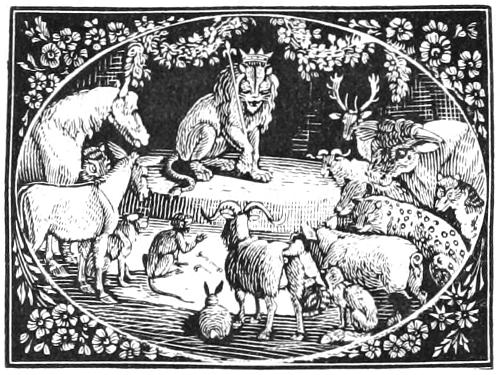
Fable XIX. The Lion and other Beasts in Council.
The kingly ruler of the plain,[10] Just ent’ring on his savage reign, To grace his coronation feast, Sent and invited every beast; And soon the royal cave beheld With all his various subjects fill’d: For leagues of peace were lately made, And lambs and wolves together play’d; Foxes and tim’rous hares agree With dogs, their common enemy: And now a sumptuous table spread, Friendly they altogether fed; And having din’d, sit still and prate Familiarly of this and that: Till with a kind, yet serious look, The King, desiring audience, spoke. “My friends, and loving subjects all, Who’ve kindly thus obey’d my call, I give you thanks, and now I crave Your further kindness to receive: I’m seated on the throne, you see, In peaceable tranquillity; No cares of war disturb my breast; With taxes you are not opprest; This life I’ll therefore spend in joy; None shall be happier than I. But lest I should pursue false bliss, What I would ask of you is this, To tell me—what true pleasure is?” The beasts seem’d pleas’d with this request; Each thought he could advise him best, And striving who should silence break, They all at once rose up to speak: Till by his majesty’s command, Their forward zeal was soon restrain’d; Who calmly bidding them sit down, And let him hear them one by one, Th’ impatient Monkey thus began: “Pleasure, my liege, is free from strife, To lead a thoughtless, easy life; Airy, and wild, and brisk, and gay, To sing, and dance, and laugh, and play; Now following this, now that, and that, And so’t be new, no matter what; Free from all rules of just and fit, Do mischief first, then laugh at it: This is diversion, pleasure, wit.” The Ass was here provok’d to rise, And gravely thus bray’d his advice: “If,” said he, “real pleasure is In such buffoonery as this, Then beaux and smarts, amongst mankind, Are in their notions most refin’d; But well we know, by men of sense, They’re tax’d with vain impertinence. I therefore think true pleasure lies (If I may be thought fit t’advise) In careless indolence and ease, Not suff’ring anything to tease, Regardless what th’ ambitious fly at, So we’re but undisturb’d and quiet; Well knowing ’tis but to attain More ease, that they’re at so much pain. And he’s more happy, none can doubt it, Who’s easy without taking pains about it.” Now rose the Hog, and with a grunt, “Pleasure,” cry’d he, “they know nought on’t. A life trail’d on in laziness Can only suit a stupid Ass, And fool’d away in Monkey mirth, It’s really full as little worth; For doing nothing worthy fame And doing nothing’s much the same. But if you’d real pleasure know, Let generous liquor smiling flow; In jovial crews spend every hour, And drink, and sing, and rant, and roar: Thus every care will sink and drown, Whilst mirth and joy run laughing round. I seem a monarch while I drink so, And you’ll be a god do you but think so.” Here bursts the Goat into a laugh, And thus beginning with a scoff: “Doubtless,” said he, “it must be fine T’exalt a nasty, dirty swine, To such a height in fancying, As to believe himself a King. But that which thus perverts our senses Can have, I think, but small pretences To recommend it to our favour, As pleasure of the truest flavour. Nature, methinks, should guide in this, Who seems t’have shewn the highest bliss, In having plac’d the sweetest gust, In gratifying natural lust. And that ’tis the sublimest joy, I think ’s so plain none can deny. Witness the mad tormenting pain, When disappointed, we sustain. Witness how eagerly we press on, Witness our raptures in possession.” But here the Leopard, rising slow, Expos’d his beauteous spots to show, And with a grave majestic face, Thus gave his verdict in the case: “Pleasure consists not in such short Imperfect transitory sport, Of which the pains we’re at to get it, O’erpays the bliss when we come at it; Nor can it e’er be call’d true joy, With such a mixture of alloy. No, that must be the most refin’d Which most exalts and charms the mind; And nothing sure more charming is, Than honour, pomp, and dignities, Than grandeur and magnificence, Than sumptuous trains and vast expense, Than place, distinction, and preferment, And when we die, a grand interment.” At this the Horse, with noble look, Raising his crested neck, thus spoke: “That merit should be rais’d on high, I think ’s so just none can deny; But he who places all his bliss In the external pomp of this, Knows not what greatness, nor what pleasure is; His judgment errs as much at least As his who thinks that painting best Which is in gaudiest colours drest. Of both we may affirm the same, Their taste lies only in the gilded frame. I grant preferment, honour, place, Are rising steps to happiness; But whilst we’re upwards thus aspiring, We’re anxious still, and still desiring. To act with an unbounded will, Can only our desires fulfil; Whence, the highest bliss, in my opinion, Must be in power and dominion.” Thus all their various sense exprest, And each advis’d what he thought best: But still what each as best esteem’d Was by the next that spoke condemn’d: Meanwhile the savage monarch sate, Attentive to the warm debate; The nature saw, without disguise, Of every beast in his advice. But soon the disputants grew rude, Confusion, noise, tumultuous feud Enrage the jarring multitude. Till weary’d out, the royal beast Thus spoke, and silenc’d all the rest: “Cease, cease your vain contention, cease Your shallow schemes of happiness; Which only have confirm’d me more, ’Tis where I thought it was before. Greatness is no establishment Of real bliss, or true content; Luxurious banquets soon disgust; We’re quickly pall’d with sensual lust: Virtue alone can give true joy; The sweets of virtue never cloy. To take delight in doing good, In justice, truth, and gratitude, In aiding those whom cares oppress, Administ’ring comfort to distress: These, these are joys which all who prove Anticipate the bliss above. These are the joys, and these alone We ne’er repent or wish undone.” He spoke; the beasts without delay Rose from their seats, and sneak’d away.
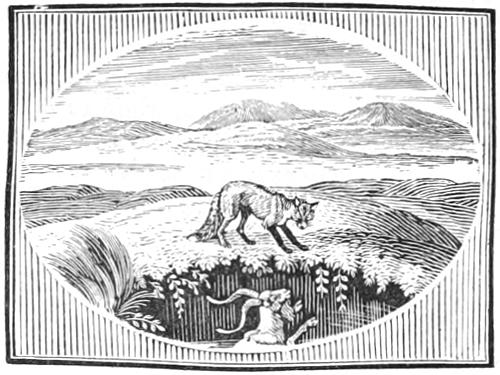
Fable XX. The Goat and Fox.
Studious from diff’ring tales to show That virtue makes our bliss below, My warning voice to ev’ry heart, May ev’ry faithful ear impart; This one important truth believ’d, Who can by vice be still deceiv’d? Bliss is our aim, and bliss our end, And he who points the path, a friend. A Goat and Fox, by joint consent, Together once a journey went; With patient steps from morning’s dawn, They measur’d hill, and vale, and lawn; When Phœbus in the zenith rode, A cheerless, pathless waste they trod; The fainting wand’rers wide around, With sighs survey’d the burning ground; Again, and yet again they look, To find the welcome cooling brook; The welcome cooling brook in vain They sought around the sun-burnt plain. Onward they slowly pass, when lo! A pit—and water—deep below; Urg’d by a strong desire to drink, They both leap headlong from the brink. For appetite still foremost goes, Quite blind to all beyond its nose; And reason, impotently kind, A tardy friend, limps far behind. Now when our pair had drank amain, They thought of getting out again; And long with aching hearts they try’d, But this the steep ascent denied. Reynard at length the goat addrest, And thus his wily thought exprest: “Courage, my friend,—be rul’d by me, We’ll soon from this mischance be free; Here—of the pit the shallowest place, On your hind legs your body raise, And while thy horns my weight sustain, At one light bound the shore I’ll gain; And thence effectual aid can lend To save thee, too, my dearest friend?”— The Goat consents—and by his aid The Fox his leap successful made; His friend look’d up, well pleased no doubt, And deem’d himself as good as out; But the false Fox with barb’rous sneer, Cry’d, “Pox! how came you scrambling here?” The Goat reply’d, “Forbear to flout, Lest I should ask how you got out.” Said he, “Of that no doubt remains, You’d horns, my friend,—and I had brains, You wear that wisdom on your chin, Which I, more modest, hide within. We beasts of sprightly thought despise All who like thee look gravely wise— Improve these useful hints aright, You’ll profit much—and so good night.” This said, he titt’ring slunk away, The Goat remain’d to death a prey. In wonder lost, with horror chill’d, With anguish, indignation fill’d, The traitor-friend’s enormous guile, Engross’d his shudd’ring soul awhile; Awhile the wretched beast forgot His pity’d, helpless, hopeless lot; But after short suspense his woes Return’d—as the stem’d torrent flows, With trebled force—he scarce sustain’d The shock—and thus at length profan’d: “For ever let that maxim cease, ‘That virtue’s paths are paths of peace.’ Where’s that reward which learned pride Boasts none from virtue can divide? Where the sure woes of various kinds, Which fate to vice for ever binds? Life, joy (or what could make him smile). The Fox obtains thro’ horrid guile; My life, my humble guiltless joys, At once a gen’rous trust destroys; Jove’s slumb’ring vengeance lets him fly, His goodness slumbers while I die.” A sylvan god who pass’d that way (Of old none wander’d more than they), By chance the rash impeachment heard, And instant on the brink appear’d. “Look up,” he cries, “no more despair, The help you wish prevents your prayer; Safe on the wish’d substantial plain, I’ll set thy dying feet again. The Fox with envy didst thou see? Henceforth thyself a Fox shalt be.— Thou shalt his prosp’rous vice possess, And taste a Fox’s happiness.” The thing was done as soon as said, A Fox, the Goat enfranchis’d, fled; But feels within his alter’d mind, His narrow’d love to self confin’d. No more from others good his breast The social joy serene possess’d; No more by kind compassion mov’d, His mercy is by foes approv’d. Now mutual wants, love’s band below, No means to fix a friend bestow; Unlov’d, unloving, deep in earth He gives his schemes of plunder birth. From injur’d man, his friend so late, He fears the stroke of potent hate; With grief looks back on periods past, His bloodless food, a blest repast! Which late he cropt in peace profound, With flocks, and herds, and men around; Yet now abhors that guiltless food, To rapine doom’d, and thirst of blood; And mourns the days (to this a slave) When heav’n a happier nature gave: “By dear experience now I know, That virtue’s only bliss below,” He, sighing, said, in sad despair, And thus prefers a falt’ring pray’r: “Ye gracious pow’rs who rule above! Who virtue and it’s vot’ries love! I see my fault, my fault repent, And own I ask’d the pains you sent. I now th’ unrighteous thought forego. That vice is bliss, and virtue woe: Oh! make me what I was again, Tho’ faint I tread the scorching plain; Tho’ with a faithless Fox I stray, Me tho’ again his wiles betray, Make me a goat, tho’ void of wit, You leave me dying in the pit: ’Tis better far than thus alone To live without one joy my own; For while the past my mind retains, My present pleasures are but pains.” He pray’d, to Jove the pray’r ascends; His ear to pray’rs like these He lends. “I (said the god) thy wish fulfil, Henceforth, be virtuous—if you will Be man—to him that pow’r I give; Go, and by past experience live.” Transform’d again with lifted eyes, The man his story thus applies:— “From what appears, how little do we know What others feel of happiness or woe! Is vice your envy when of health possess’d, With power, and pelf, and all externals blest? Know that amidst that health, and power and pelf, The thriving villain must abhor himself; For who can bear, tho’ desperately brave, The voice of conscience when it calls him knave? Or who so dull, without regret to miss Of conscious goodness the substantial bliss? Ask your own heart, and search thro’ all you know, Consult each various scene of life below, All, all this universal truth attest, The virtuous are, and can alone be blest.”
Fable XXI. The Kite and Nightingale.
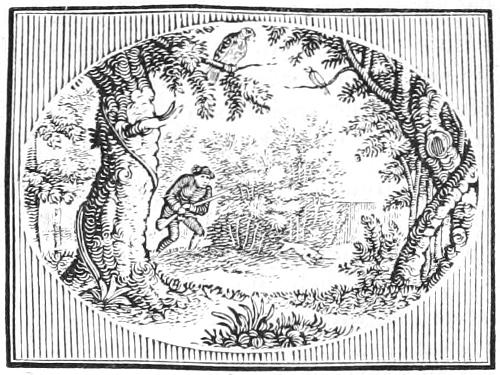
I’ll try to mimic honest Gay, Who had a very decent way; A pleasant wight of simple sort, For ever filliping the court. Let courts be quiet, if they know The happy knack of being so. The pestilence flies everywhere, Almost indefinite as air: All places need the fanning breeze, To dissipate the rank disease. Vice—(not like beasts for show—confin’d) Runs mad at large, and bites mankind: Alike the taint infects the brain Of those that dwell in court and plain: The same wild fury acts the will In different ways, with different skill. A starving Kite, upon a bar (Worn out with long fatigues of war), Whose pointed claws, and hooked bill, Shew’d his profession was to kill, Thus grieving spoke in doleful strain: (Your heart will pity and disdain)— “How blind is everything on earth! And how injurious to my worth! Tho’ all the cote my sorrow see, No dove will help me with a pea: Hob’s field they robb’d a month together, I never hurt a single feather; The lark, whom I secure to rest (I slew the snake that robb’d her nest), Will not a little worm supply; But would rejoice to see me die. No crow invites me to a treat, Tho’ what I kill’d he often eat. Man, were he grateful, would determine My merit in destroying vermin; And make me happy to the last, In justice to my service past. But man, that thankless wretch is he, Prefers yon Nightingale to me.” “Alas! (the Nightingale replies) I own my little merit lies In innocence and tender cares About my family affairs; Or chaunting soft a pretty tale, To please my neighbours of the vale; Perhaps we gratitude may want, Because you are too arrogant: Your worth, display’d with all your skill, Lies chiefly in omitting ill; And only then for want of power To seize the dove you would devour. There’s not a lark that flies, but knows You long to grasp her in your claws. The crow you never meant to treat; You left him what you could not eat; And man, who most a villain needs, Detests you for your wicked deeds. You pilfer duckling, game, and chicken, Which furnish man with dainty picking. There’s not a poacher roams the wood, But who would shoot you, if he could.” Just had he said; forth pops a spark, With gun and spaniel from the park; The Kite he kens, with levell’d gun, And brings the bloody boaster down. Thus justly villains are repaid, Who follow mischief as a trade: Who merit can pretend alone, When cruel work is to be done, To crush their kindred sort of men With sword, with halter, or with pen; Whose hollow merit is, at best, To seem the most, and be the least; Who own no right, pursue no guide, But only interest or pride; Or both together do prefer, To run most certainly to err. Such always claim beyond their due, And always think you wrong them too; Do all the wrong, yet most complain, Whene’er they spread the net in vain; Or bait a hook that fails to catch The simple trout for which they watch And innocence, with squint and frown, Condemn for vices all their own.
Fable XXII. The Four Bulls.
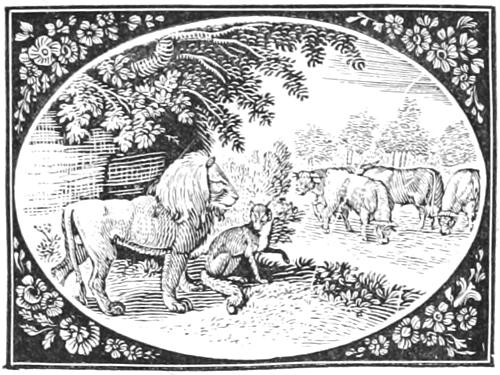
Friendship! source of bliss sedate, Best balm for all the wounds of fate! ’Tis thine the sinking heart to raise, When love retires, and health decays; Unmix’d with thy sublimer fire, Love’s but a fev’rish low desire, And ill the self-destroying flame Deserves that soft angelic name. Oh! could this verse, this fabling lay, Extend or but confirm thy sway! Or, warn’d by this, if only one Thy foes’ destructive arts shall shun! Since dangers rise with every sun, With ev’ry sand united run; Four Bulls, by mutual vows ally’d, The morrow’s unknown ills defy’d; As one they mov’d, they fought, they fed, And safety rose by union bred, Nor this alone the good they found, The private bliss of each went round; Hence doubly bless’d the gen’rous heart, Which scorns the bliss it can’t impart. From day to day the Lion came, But matters still appear’d the same: This smote his inmost soul with grief, For much he long’d for fav’rite beef; What can he do? he fears to wage Unequal war, and four engage. Thought follows thought—he finds in vain: Yet thought to thought succeeds again. Half-form’d resolves, and embryo schemes, And all the train of statesmen’s dreams, With conflict rude disturb his mind, To this nor that success inclin’d. Suspense presides with fluttering wings, From which she shakes a thousand stings. In this disastrous doubting case, The Fox appears—with thinking face; On him his royal master laid His load of care, secure of aid; Who paus’d a while with sober grace, Then thus refin’d upon the case:— Not things of moment most, I find, Have broke the union of the mind; Ev’n mere mistakes, that pet or pride Have made, the sacred band divide, And deepest enmities arise. From trifling things among the wise. In friendship, slight’s the deepest wound, And that is fancy’d more than found. These hints improv’d, our ends may gain, The Bulls divided, count ’em slain; The Lion, pleas’d, reply’d, he knew The Fox could forge a lie—or two; Which he opin’d, in points like this, Would not be very much amiss. Here wiser Reynard shook his head, And this would never do, he said: ’Tis ours to make these foolish elves, My lord, be liars to themselves: Suspicion rais’d, the very eye Will unsuspected gravely lie, And, when a friend it shall survey, Th’ idea of a foe display, As you shall see—— Away he flew, And, to the friends as near he drew, He smooth’d his brow, he coin’d a smile, And put on all the masks of guile. Then whispers one with friendly nod, “Mark, is not yon behaviour odd? The Bull must surely mean affront, His tail is next you—fie upon’t! How slighting that! and there’s another Can scarce some high resentment smother; He snorts, he paws, and fain would shew By vengeance whence his troubles flow. The third, how dull! regardless still, What fate you prove, or good or ill.” Appearance (treach’rous witness) here Confirms the sounds that cheat his ear; Suspicion soon alarm’d, and pride, At once, to self the whole apply’d. The Bull withdraws, resolv’d as due, They first for his return should sue. The Fox returns, and boasts his arts, And to his liege the truth imparts: “The Bull who turn’d his tail so rude, Meant only not his ear t’ intrude; And he that spurn’d so fierce the ground With anguish felt a hornet wound. The third, the downy turf who prest, Sought but the sweets of peaceful rest. But come, to his remote retreat I’ll guide my royal master’s feet.” They go; the victim mourns too late His absent friends and helpless state. And slain, the Fox exulting cries, “Not one but all shall be our prize.” Away he goes, and thus again Infus’d soft flatt’ry, deadly bane! “Great sir (says he to one), I swear Your friends are rude, indeed they are; Friendship a decent due respect Should, rather than destroy, protect. Superior far to these you rise, The wise affirm: we trust the wise; Your nobler port, your finer wit, All with united voice admit; And yet no just distinction’s made No deference shewn, no homage paid. I wonder at your choice, but here ’Tis silence best becomes my sphere, Tho’ might your slave presume to tell What all the forest thinks as well, These are perhaps the only Two With whom your worth would lose its due.” The Bull (how easy praise deceives!) With pleasure hears, with pride believes; Puts on the lofty looks and airs Which humble merit never wears. To treat him as an equal now Inflames his heart, contracts his brow ’Tis envy, or, ’tis worse, ’tis hate, Denies due honour to his state; He could not bear th’ affronts they gave, They break his peace, they make him rave; They lov’d and they rever’d, he thought, Less than the wretches knew they ought; And (as is usual) storm’d and swore That they might love and rev’rence more. His friends, alarm’d, in deep amaze On him, and on each other, gaze, Disgust, in either’s bosom bred, Was shewn as diff’ring tempers led, One bold and warm the taunts returns, And with contagious anger burns, Than this, not plagues are sooner caught, Nor with more dreadful evils fraught, The other, meek, in secret pines, And friends he could not keep resigns; Resigns, tho’ late, with yearning heart, And mourns persuasion’s useless art. Retiring now he leaves the fray, The Fox still mark’d his pensive way, The Lion found and seiz’d his prize, And, like the first, the second dies. The two who yet alive remain, In dreadful conflict shake the plain; The Fox observes the doubtful fight, One drops—he smiles with fell delight; Flies with the joyful news, and brings The King to take what’s now the King’s. Faint, breathless, bleeding on the ground, The hapless victor soon they found; He falls an unresisting prey, And crowns the triumphs of the day. This tale a sage once told his son, And thus apply’d it when he’d done:— “Do you, my child, with unsuspecting eye, O’erlook what others labour to descry; Kind to all faults, and to all failings blind, Be you the last to think affronts design’d. Cold seems thy friend?—by the severest laws Thy conduct try, to find the latent cause. Let thy heart pant for universal praise, Such as, unbrib’d, to virtue, virtue pays. Is this withheld? try ev’ry winning art To melt the hard, to soothe the froward heart. Sue for esteem—to all but fawning bend, Whom this will purchase is a worthless friend; But scorn the thought as vainest of the vain, That what good-nature loses, pride will gain. Less than your merit does your friend approve? Still merit more—his love constrain with love. This conduct try’d remains he still the same? Learn you to pity what the world will blame. The gen’ral censure, his neglect ensures, Thy honour brightens and thy praise secures.”
Fable XXIII. The Pepper-Box and Salt-Cellar.
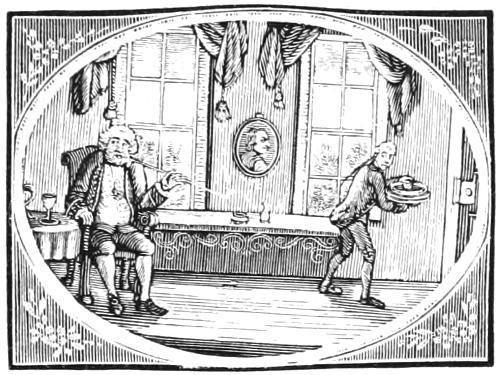
The ’squire had din’d alone one day, And Tom was call’d to take away: Tom clear’d the board with dextrous art: But, willing to secure a tart, The liquorish youth had made an halt, And left the pepper-box and salt Alone upon the marble table: Who thus, like men, were heard to squabble. Pepper began, “Pray, sir,” says he, “What business have you here with me? Is’t fit that spices of my birth Should rank with thee, thou scum of earth? I’d have you know, sir, I’ve a spirit Suited to my superior merit— Tho’ now, confin’d within this caster, I serve a Northern Gothic master; Yet born in Java’s fragrant wood, To warm an Eastern monarch’s blood, The sun those rich perfections gave me, Which tempted Dutchmen to enslave me. “Nor are my virtues here unknown, Tho’ old and wrinkled now I’m grown. Black as I am, the fairest maid Invokes my stimulating aid, To give her food the poignant flavour, And, to each sauce, its proper savour. Pasties, ragouts, and fricassees, Without my seasoning, fail to please: ’Tis I, like wit, must give a zest, And sprightliness to ev’ry feast. “Physicians too my use confess; My influence sagest matrons bless; When drams prove vain, and cholics teaze, To me they fly for certain ease. Nay, I fresh vigour can dispense, And cure ev’n age and impotence: And when of dulness wits complain, I brace the nerves, and clear the brain. “But to the ’squire here, I appeal— He knows my real value well: Who, with one pepper-corn content, Remits the vassal’s annual rent— Hence then, Sir Brine, and keep your distance, Go lend the scullion your assistance; For culinary uses fit, To salt the meat upon the spit; Or just to keep our meat from stinking— And then—a special friend to drinking!” “Your folly moves me with surprise,” The silver tripod thus replies, “Pray, Master Pepper, why so hot? First cousin to the mustard-pot! What boots it how our life began? ’Tis breeding makes the Gentleman; Yet would you search my pedigree, I rose like Venus from the sea: The sun, whose influence you boast, Nurs’d me upon the British coast. “The chymists know my rank and place, When nature’s principles they trace: And wisest moderns yield to me The elemental monarchy. By me all nature is supply’d With all her beauty, all her pride! In vegetation I ascend; To animals their vigour lend; Corruption’s foe, I life preserve, And stimulate each slacken’d nerve. I give jonquils their high perfume; The peach its flavour, rose its bloom: Nay, I’m the cause, when rightly trac’d, Of Pepper’s aromatic taste. “Such claims you teach me to produce; But need I plead my obvious use, In seasoning all terrestrial food; When heaven declares, that Salt is good. “Grant then, some few thy virtues find; Yet Salt gives health to all mankind: Physicians sure will side with me, While cooks alone shall plead for thee: In short, with all thine airs about thee, The world were happier far without thee.” The ’squire, who all this time sat mute, Now put an end to their dispute: He rung the bell—bade Tom convey The doughty disputants away— The Salt, refresh’d by shaking up, At night did with his master sup: The Pepper, Tom assign’d his lot With vinegar, and mustard pot: A fop with bites and sharpers join’d, And, to the side-board, well confin’d.
Fable XXIV. The Sheep and the Bramble-Bush.
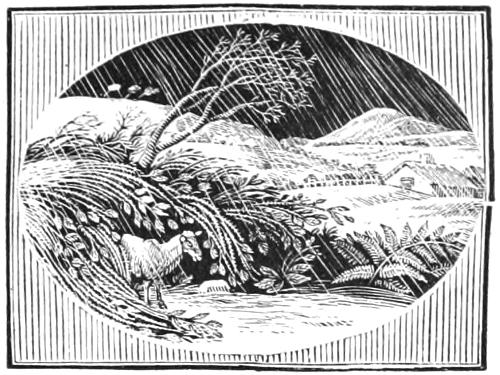
A thick-twisted brake in the time of a storm, Seem’d kindly to cover a sheep: So snug, for a while, he lay shelter’d and warm. It quietly sooth’d him asleep. The clouds are now scatter’d—the winds are at peace, The sheep’s to his pasture inclin’d; But ah! the fell thicket lays hold of his fleece, His coat is left forfeit behind. My friend, who the thicket of law never tried, Consider before you get in; Tho’ judgment and sentence are pass’d on your side, By Jove, you’ll be fleec’d to your skin.
Fable XXV. The Blackbird and Bullfinch.
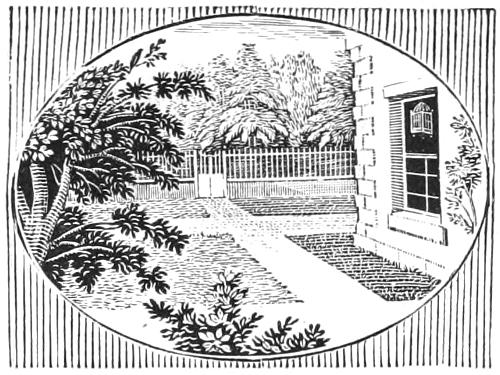
Perch’d on a poplar’s verdant spray, A Blackbird sung the hours away; Charm’d all around, and seem’d to call On echo from his Lordship’s hall. Confin’d in state a Bullfinch there, The melting music chanc’d to hear— Bursting with envy, silence broke, And thus from gilded cage he spoke:— “Cease, bungler, thy discordant noise, Untun’d thy throat, and harsh thy voice; How dar’st thou, vagrant, as thou art, To me thy dissonance impart? Know’st thou I sing by studied rules, And brag the learning of the schools? Soft rapture to the heart convey, And charm the list’ning soul away? To please my Lord, and soothe his cares, I warble soft Italian airs; Which he in gratitude repays With costly food, and gen’rous praise: Whilst thou, condemn’d through air to rove, Or hide thee in the gloomy grove, To feebly suck thy beverage scant, And pine in endless care and want; To rocks and woods thy tale belongs, Fit audience for thy stupid songs! Away! no more my palace dun, Or Dick, or Tom, shall fetch the gun.” He ceas’d—The fable bird returns (With rising scorn his bosom burns), “Thou little lordling, void of sense, Dar’st thou, imperious, warn me hence? Know, parasite, thy threats are nought, Nor boast thy cage too dearly bought: Above the frigid rules of art, ’Tis nature’s dictates I impart; Nor ever prostitute my lays, But grateful sing my Maker’s praise; Whilst echoing o’er the hills and plains, I cheer the nymphs and lab’ring swains; Whether the rising notes I swell, Or lightly load the passing gale; With bolder music fill the grove, Or gently call my mate to love: Whether the joys of summer sing, Or chant the beauties of the spring; The varied notes still new appear, And sweet transition charms the ear: Whilst thou, puff’d up with self-conceit, And idle thoughts of being great, Nor freedom canst thyself allow, Nor give to others what is due; But pedant-like, in pride, elate (With notions, as thy prison, strait), Think’st thou alone can urge the strain, Thy boasted learning then, how vain! Attend this truth, and know for once, That learning ne’er unmade the dunce.”
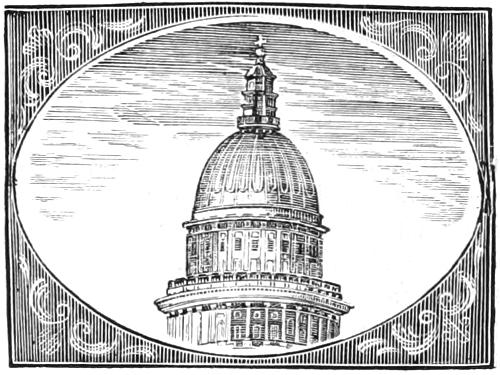
Fable XXVI. The Conceited Fly.
’Twas in the charming month of May (No matter, critics, for the day), When Phœbus had his noon attain’d, And in his blaze of glory reign’d; A Fly as gay as e’er was seen, Clad o’er in azure, jet, and green; Gay, for his part, as birthday beau, Whose soul is vanish’d into show; On Paul’s famed temple chanc’d to light, To ease his long laborious flight: There, as his optics gaz’d around (An inch or two their utmost bound), He thus began:—“Men vainly tell How they in works of skill excel: This edifice they proudly show To prove what human art can do; ’Tis all a cheat—before my eyes What infinite disorders rise! Here hideous cavities appear, And broken precipices There: They never us’d the plane or line, But jumbled heaps without design.” He ceas’d contemptuous;—and as Flies Discern with microscopic eyes, From what he saw he reason’d right, But how inadequate the sight! To mark the building from its base, The pillar’d pomp, the sculptur’d grace, The dome, the cross, the golden ball, Much less the grand result of all! So impious wits, with proud disdain, Redemption’s hidden ways arraign, Deem it beneath a being wise, And, judging with their insect eyes, View but a part, and then deny Th’ eternal wisdom of the sky. But can thy ken, presumptuous man, Unfold this deep and wondrous plan? As well might insect organs see Th’ harmonious structure rais’d by thee, As thine imperfect tube explore This wise and gracious system o’er.
FINIS.