Part I (continued 5)
Reading edition
Go constantly to church, whoever preaches. The act of devotion in the Common Prayer Book is your principal business there, and if properly attended to, will do more towards amending the heart than sermons generally can do. For they were composed by men of much greater piety and wisdom, than our common composers of sermons can pretend to be; and therefore I wish you would never miss the prayer days; yet I do not mean you should despise sermons, even of the preachers you dislike, for the discourse is often much better than the man, as sweet and clear waters come through very dirty earth. I am the more particular on this head, as you seemed to express a little before I came away some inclination to leave our church, which I would not have you do.
For the rest, I would only recommend to you in my absence, to acquire those useful accomplishments, arithmetic and bookkeeping. This you might do with ease, if you would resolve not to see company on the hours you set apart for those studies.
We expect to be at sea to-morrow, if this wind holds; after which I shall have no opportunity of writing to you, till I arrive (if it please God I do arrive) in England. I pray that his blessing may attend you, which is worth more than a thousand of mine, though they are never wanting. Give my love to your brother and sister,[67] as I cannot write to them, and remember me affectionately to the young ladies your friends, and to our good neighbours. I am, my dear child, your affectionate father,
B. Franklin.
From A NARRATIVE OF THE LATE MASSACRES
IN LANCASTER COUNTY, OF A NUMBER OF INDIANS, FRIENDS OF THIS PROVINCE, BY PERSONS UNKNOWN. WITH SOME OBSERVATIONS ON THE SAME.[68]
[1764]
... On Wednesday, the 14th of December, 1763, Fifty-seven Men, from some of our Frontier Townships, who had projected the Destruction of this little Commonwealth, came, all well mounted, and armed with Firelocks, Hangers and Hatchets, having travelled through the Country in the Night, to Conestogoe Manor. There they surrounded the small Village of Indian Huts, and just at Break of Day broke into them all at once. Only three Men, two Women, and a young Boy, were found at home, the rest being out among the neighbouring White People, some to sell the Baskets, Brooms and Bowls they manufactured, and others on other Occasions. These poor defenceless Creatures were immediately fired upon, stabbed, and hatcheted to Death! The good Shehaes, among the rest, cut to Pieces in his Bed. All of them were scalped and otherwise horribly mangled. Then their Huts were set on Fire, and most of them burnt down. When the Troop, pleased with their own Conduct and Bravery, but enraged that any of the poor Indians had escaped the Massacre, rode off, and in small Parties, by different Roads, went home.
The universal Concern of the neighbouring White People on hearing of this Event, and the Lamentations of the younger Indians, when they returned and saw the Desolation, and the butchered half-burnt Bodies of their murdered Parents and other Relations, cannot well be expressed.
Notwithstanding this Proclamation [by the Governor], those cruel men again assembled themselves, and hearing that the remaining fourteen Indians were in the Workhouse at Lancaster, they suddenly appeared in that Town, on the 27th of December. Fifty of them, armed as before, dismounting, went directly to the Workhouse, and by Violence broke open the Door, and entered with the utmost Fury in their Countenances. When the poor Wretches saw they had no Protection nigh, nor could possibly escape, and being without the least Weapon for Defence, they divided into their little Families, the Children clinging to the Parents; they fell on their Knees, protested their Innocence, declared their Love to the English, and that, in their whole Lives, they had never done them Injury; and in this Posture they all received the Hatchet! Men, Women and little Children were every one inhumanly murdered!—in cold Blood!
The barbarous Men who committed the atrocious Fact, in defiance of Government, of all Laws human and divine, and to the eternal Disgrace of their Country and Colour, then mounted their Horses, huzza'd in Triumph, as if they had gained a Victory, and rode off—unmolested!
The Bodies of the Murdered were then brought out and exposed in the Street, till a Hole could be made in the Earth to receive and cover them.
But the Wickedness cannot be covered, the Guilt will lie on the whole Land, till Justice is done on the Murderers. The Blood of the Innocent will cry to Heaven for Vengeance.
If an Indian injures me, does it follow that I may revenge that Injury on all Indians? It is well known, that Indians are of different Tribes, Nations and Languages, as well as the White People. In Europe if the French, who are White People, should injure the Dutch, are they to revenge it on the English, because they too are White People? The only Crime of these poor Wretches seems to have been, that they had a reddish-brown Skin, and black Hair; and some People of that Sort, it seems, had murdered some of our Relations. If it be right to kill Men for such a Reason, then, should any Man, with a freckled Face and red Hair, kill a Wife or Child of mine, it would be right for me to revenge it, by killing all the freckled red-haired Men, Women and Children, I could afterwards anywhere meet with.
But it seems these People think they have a better Justification; nothing less than the Word of God. With the Scriptures in their Hands and Mouths, they can set at nought that express Command, Thou shalt do no Murder; and justify their Wickedness by the Command given Joshua to destroy the Heathen. Horrid Perversion of Scripture and of Religion! To father the worst of Crimes on the God of Peace and Love! Even the Jews, to whom that particular Commission was directed, spared the Gibeonites, on Account of their Faith once given. The Faith of this Government has been frequently given to those Indians; but that did not avail them with People who despise Government.
We pretend to be Christians, and, from the superior Light we enjoy, ought to exceed Heathens, Turks, Saracens, Moors, Negroes and Indians, in the Knowledge and Practice of what is right. I will endeavour to show, by a few Examples from Books and History, the Sense those People have had of such Actions.
Homer wrote his Poem, called the Odyssey, some Hundred Years before the Birth of Christ. He frequently speaks of what he calls not only the Duties, but the Sacred Rites of Hospitality, (exercised towards Strangers, while in our House or Territory) as including, besides all the common Circumstances of Entertainment, full Safety and Protection of Person, from all Danger of Life, from all Injuries, and even Insults. The Rites of Hospitality were called sacred, because the Stranger, the Poor, and the Weak, when they applied for Protection and Relief, were, from the Religion of those Times, supposed to be sent by the Deity to try the Goodness of Men, and that he would avenge the Injuries they might receive, where they ought to have been protected. These Sentiments therefore influenced the Manners of all Ranks of People, even the meanest; for we find that when Ulysses came, as a poor Stranger, to the Hut of Eumæus, the Swineherd, and his great Dogs ran out to tear the ragged Man, Eumæus drave them away with Stones; and
"'Unhappy Stranger!' (thus the faithful Swain Began, with Accent gracious and humane,) 'What Sorrow had been mine, if at my Gate Thy rev'rend Age had met a shameful Fate! But enter this my homely Roof, and see Our Woods not void of Hospitality.' He said, and seconding the kind Request, With friendly Step precedes the unknown Guest, A shaggy Goat's soft Hide beneath him spread, And with fresh Rushes heap'd an ample Bed. Joy touch'd the Hero's tender Soul, to find So just Reception from a Heart so kind: And [']Oh, ye Gods! with all your Blessings grace' (He thus broke forth) 'this Friend of human Race!['] The Swain reply'd. [']It never was our guise To slight the Poor, or aught humane despise. For Jove unfolds the hospitable Door, 'Tis Jove that sends the Stranger and the Poor.[']"[69]
These Heathen People thought, that after a Breach of the Rites of Hospitality, a Curse from Heaven would attend them in every thing they did, and even their honest Industry in their Callings would fail of Success. Thus when Ulysses tells Eumæus, who doubted the Truth of what he related, "If I deceive you in this, I should deserve Death, and I consent that you should put me to Death," Eumæus rejects the Proposal, as what would be attended with both Infamy and Misfortune, saying ironically,
"Doubtless, O Guest! great Laud and Praise were mine, If, after social Rites and Gifts bestow'd, I stain'd my Hospitable Hearth with Blood. How would the Gods my righteous Toils succeed, And bless the Hand that made a Stranger bleed? No more."—
Even an open Enemy, in the Heat of Battle, throwing down his Arms, submitting to his Foe, and asking Life and Protection, was supposed to acquire an immediate Right to that Protection. Thus one describes his being saved, when his Party was defeated;
"We turn'd to Flight; the gath'ring Vengeance spread On all Parts round, and Heaps on Heaps lie dead. The radiant Helmet from my Brows unlac'd, And lo, on Earth my Shield and Javelin cast, I meet the Monarch with a Suppliant's Face, Approach his Chariot, and his Knees embrace. He heard, he sav'd, he plac'd me at his Side; My State he pity'd, and my Tears he dry'd; Restrain'd the Rage the vengeful Foe express'd, And turn'd the deadly Weapons from my Breast. Pious to guard the Hospitable Rite, And fearing Jove, whom Mercy's Works delight."
The Suitors of Penelope are by the same ancient Poet described as a sett of lawless Men, who were regardless of the sacred Rites of Hospitality. And therefore when the Queen was informed they were slain, and that by Ulysses, she, not believing that Ulysses was returned, says,
"Ah no! some God the Suitors Deaths decreed, Some God descends, and by his Hand they bleed: Blind, to contemn the Stranger's righteous Cause, And violate all hospitable Laws! ... The Powers they defy'd; But Heav'n is just, and by a God they dy'd."
Now I am about to mention something of Indians, I beg that I may not be understood as framing Apologies for all Indians. I am far from desiring to lessen the laudable Spirit of Resentment in my Countrymen against those now at War with us, so far as it is justified by their Perfidy and Inhumanity. I would only observe, that the Six Nations, as a Body, have kept Faith with the English ever since we knew them, now near an Hundred Years; and that the governing Part of those People have had Notions of Honour, whatever may be the Case with the Rum-debauched, Trader-corrupted Vagabonds and Thieves on the Sasquehannah and Ohio, at present in Arms against us.
Unhappy People! to have lived in such Times, and by such Neighbours! We have seen, that they would have been safer among the ancient Heathens, with whom the Rites of Hospitality were sacred. They would have been considered as Guests of the Publick, and the Religion of the Country would have operated in their Favour. But our Frontier People call themselves Christians! They would have been safer, if they had submitted to the Turks; for ever since Mahomet's Reproof to Khaled, even the cruel Turks never kill Prisoners in cold Blood. These were not even Prisoners. But what is the Example of Turks to Scripture Christians? They would have been safer, though they had been taken in actual War against the Saracens, if they had once drank Water with them. These were not taken in War against us, and have drank with us, and we with them, for Fourscore Years. But shall we compare Saracens to Christians?
They would have been safer among the Moors in Spain, though they had been Murderers of Sons; if Faith had once been pledged to them, and a Promise of Protection given. But these have had the Faith of the English given to them many Times by the Government, and, in Reliance on that Faith, they lived among us, and gave us the Opportunity of murdering them. However, what was honourable in Moors, may not be a Rule to us; for we are Christians! They would have been safer it seems among Popish Spaniards, even if Enemies, and delivered into their Hands by a Tempest. These were not Enemies; they were born among us, and yet we have killed them all. But shall we imitate idolatrous Papists, we that are enlightened Protestants? They would have even been safer among the Negroes of Africa, where at least one manly Soul would have been found, with Sense, Spirit and Humanity enough, to stand in their Defence. But shall Whitemen and Christians act like a Pagan Negroe? In short it appears, that they would have been safe in any Part of the known World, except in the Neighbourhood of the Christian white Savages of Peckstang and Donesgall!
O, ye unhappy Perpetrators of this horrid Wickedness! reflect a Moment on the Mischief ye have done, the Disgrace ye have brought on your Country, on your Religion, and your Bible, on your Families and Children! Think on the Destruction of your captivated Country-folks (now among the wild Indians) which probably may follow, in Resentment of your Barbarity! Think on the Wrath of the United Five Nations, hitherto our Friends, but now provoked by your murdering one of their Tribes, in Danger of becoming our bitter Enemies. Think of the mild and good Government you have so audaciously insulted; the Laws of your King, your Country, and your God, that you have broken; the infamous Death that hangs over your Heads; for Justice, though slow, will come at last. All good People everywhere detest your Actions. You have imbrued your Hands in innocent Blood; how will you make them clean? The dying Shrieks and Groans of the Murdered, will often sound in your Ears: Their Spectres will sometimes attend you, and affright even your innocent Children! Fly where you will, your Consciences will go with you. Talking in your Sleep shall betray you, in the Delirium of a Fever you yourselves shall make your own Wickedness known.
Let us rouze ourselves, for Shame, and redeem the Honour of our Province from the Contempt of its Neighbours; let all good Men join heartily and unanimously in Support of the Laws, and in strengthening the Hands of Government; that Justice may be done, the Wicked punished, and the Innocent protected; otherwise we can, as a People, expect no Blessing from Heaven; there will be no Security for our Persons or Properties; Anarchy and Confusion will prevail over all; and Violence without Judgment, dispose of every Thing.
TO THE EDITOR OF A NEWSPAPER
Monday, May 20, [1765].
Sir,
In your Paper of Wednesday last, an ingenious Correspondent that calls himself The Spectator, and dates from Pimlico, under the Guise of Good Will to the News-writers, whom he calls an "useful Body of Men in this great City," has, in my Opinion, artfully attempted to turn them & their Works into Ridicule, wherein if he could succeed, great Injury might be done to the Public as well as to those good People.
Supposing, Sir, that the "We hears" they give us of this & t'other intended Voyage or Tour of this & t'other great Personage, were mere Inventions, yet they at least offer us an innocent Amusement while we read, and useful Matter of Conversation when we are dispos'd to converse.
Englishmen, Sir, are too apt to be silent when they have nothing to say; too apt to be sullen when they are silent; and, when they are sullen, to hang themselves. But, by these We hears, we are supplied with abundant funds of Discourse, we discuss the Motives for such Voyages, the Probability of their being undertaken, and the Practicability of their Execution. Here we display our Judgment in Politics, our Knowledge of the Interests of Princes, and our Skill in Geography, and (if we have it) show our Dexterity moreover in Argumentation. In the mean time, the tedious Hour is kill'd, we go home pleas'd with the Applauses we have receiv'd from others, or at least with those we secretly give to ourselves: We sleep soundly, & live on, to the Comfort of our Families. But, Sir, I beg leave to say, that all the Articles of News that seem improbable are not mere Inventions. Some of them, I can assure you on the Faith of a Traveller, are serious Truths. And here, quitting Mr. Spectator of Pimlico, give me leave to instance the various numberless Accounts the Newswriters have given us, with so much honest Zeal for the welfare of Poor Old England, of the establishing Manufactures in the Colonies to the Prejudice of those of this Kingdom. It is objected by superficial Readers, who yet pretend to some Knowledge of those Countries, that such Establishments are not only improbable, but impossible, for that their Sheep have but little Wooll, not in the whole sufficient for a Pair of Stockings a Year to each Inhabitant; and that, from the Universal Dearness of Labour among them, the Working of Iron and other Materials, except in some few coarse Instances, is impracticable to any Advantage.
Dear Sir, do not let us suffer ourselves to be amus'd with such groundless Objections. The very Tails of the American Sheep are so laden with Wooll, that each has a little Car or Waggon on four little Wheels, to support & keep it from trailing on the Ground.[70] Would they caulk their Ships, would they fill their Beds, would they even litter their Horses with Wooll, if it were not both plenty and cheap? And what signifies Dearness of Labour, when an English Shilling passes for five and Twenty? Their engaging 300 Silk Throwsters here in one Week, for New York, was treated as a Fable, because, forsooth, they have "no Silk there to throw." Those, who made this Objection, perhaps did not know, that at the same time the Agents from the King of Spain were at Quebec to contract for 1000 Pieces of Cannon to be made there for the Fortification of Mexico, and at N York engaging the annual Supply of woven Floor-Carpets for their West India Houses, other Agents from the Emperor of China were at Boston treating about an Exchange of raw Silk for Wooll, to be carried in Chinese Junks through the Straits of Magellan.
And yet all this is as certainly true, as the Account said to be from Quebec, in all the Papers of last Week, that the Inhabitants of Canada are making Preparations for a Cod and Whale Fishery this "Summer in the upper Lakes." Ignorant People may object that the upper Lakes are fresh, and that Cod and Whale are Salt Water Fish: But let them know, Sir, that Cod, like other Fish when attack'd by their Enemies, fly into any Water where they can be safest; that Whales, when they have a mind to eat Cod, pursue them wherever they fly; and that the grand Leap of the Whale in that Chase up the Fall of Niagara is esteemed, by all who have seen it, as one of the finest Spectacles in Nature. Really, Sir, the World is grown too incredulous. It is like the Pendulum ever swinging from one Extream to another. Formerly every thing printed was believed, because it was in print. Now Things seem to be disbelieved for just the very same Reason. Wise Men wonder at the present Growth of Infidelity. They should have consider'd, when they taught People to doubt the Authority of Newspapers and the Truth of Predictions in Almanacks, that the next Step might be a Disbelief in the well vouch'd Accts of Ghosts Witches, and Doubts even of the Truths of the Creed!
Thus much I thought it necessary to say in favour of an honest Set of Writers, whose comfortable Living depends on collecting & supplying the Printers with News at the small Price of Sixpence an Article, and who always show their Regard to Truth, by contradicting in a subsequent Article such as are wrong,—for another Sixpence,—to the great Satisfaction & Improvement of us Coffee-house Students in History & Politics, and the infinite Advantage of all future Livies, Rapins, Robertsons, Humes, and McAulays, who may be sincerely inclin'd to furnish the World with that rara Avis, a true History. I am, Sir, your humble Servant,
A Traveller.
TO LORD KAMES
Craven Street, London, June 2, 1765.
My Dear Lord,
... In my passage to America I read your excellent work, the Elements of Criticism, in which I found great entertainment: much to admire and nothing to reprove. I only wished you had examined more fully the subject of Music, and demonstrated, that the pleasure which artists feel in hearing much of that composed in the modern taste, is not the natural pleasure arising from melody or harmony of sounds, but of the same kind with the pleasure we feel on seeing the surprising feats of tumblers and rope-dancers, who execute difficult things. For my part I take this to be really the case, and suppose it is the reason why those, who being unpractised in music, and therefore unacquainted with those difficulties have little or no pleasure in hearing this music. Many pieces of it are mere compositions of tricks. I have sometimes, at a concert, attended by a common audience, placed myself so as to see all their faces, and observed no signs of pleasure in them during the performance of a great part that was admired by the performers themselves; while a plain old Scottish tune, which they disdained, and could scarcely be prevailed on to play, gave manifest and general delight.
Give me leave on this occasion to extend a little the sense of your position, that "Melody and Harmony are separately agreeable, and in union delightful," and to give it as my opinion, that the reason why the Scotch tunes have lived so long, and will probably live for ever (if they escape being stifled in modern affected ornament), is merely this, that they are really compositions of melody and harmony united, or rather that their melody is harmony. I mean the simple tunes sung by a single voice. As this will appear paradoxical, I must explain my meaning. In common acceptation, indeed, only an agreeable succession of sounds is called Melody, and only the co-existence of agreeing sounds, Harmony. But, since the memory is capable of retaining for some moments a perfect idea of the pitch of a past sound, so as to compare with it the pitch of a succeeding sound, and judge truly of their agreement or disagreement, there may and does arise from thence a sense of harmony between the present and past sounds, equally pleasing with that between two present sounds.
Now the construction of the old Scotch tunes is this, that almost every succeeding emphatical note is a third, a fifth, an octave, or in short some note that is in concord with the preceding note. Thirds are chiefly used, which are very pleasing concords. I use the word emphatical to distinguish those notes which have a stress laid on them in singing the tune, from the lighter connecting notes, that serve merely, like grammar articles, to tack the others together.
That we have a most perfect idea of a sound just past, I might appeal to all acquainted with music, who know how easy it is to repeat a sound in the same pitch with one just heard. In tuning an instrument, a good ear can as easily determine that two strings are in unison by sounding them separately, as by sounding them together; their disagreement is also as easily, I believe I may say more easily and better distinguished, when sounded separately; for when sounded together, though you know by the beating that one is higher than the other, you cannot tell which it is. [I have ascribed to memory the ability of comparing the pitch of a present tone with that of one past. But, if there should be, as possibly there may be, something in the ear, similar to what we find in the eye, that ability would not be entirely owing to memory. Possibly the vibrations given to the auditory nerves by a particular sound may actually continue some time after the cause of those vibrations is past, and the agreement or disagreement of a subsequent sound become by comparison with them more discernible. For the impression made on the visual nerves by a luminous object will continue for twenty or thirty seconds. Sitting in a room, look earnestly at the middle of a window a little while when the day is bright, and then shut your eyes; the figure of the window will still remain in the eye, and so distinct that you may count the panes.
A remarkable circumstance attending this experiment, is, that the impression of forms is better retained than that of colors; for after the eyes are shut, when you first discern the image of the window, the panes appear dark, and the cross bars of the sashes, with the window frames and walls, appear white or bright; but, if you still add to the darkness in the eyes by covering them with your hand, the reverse instantly takes place, the panes appear luminous and the cross bars dark. And by removing the hand they are again reversed. This I know not how to account for. Nor for the following; that, after looking long through green spectacles, the white paper of a book will on first taking them off appear to have a blush of red; and, after long looking through red glasses, a greenish cast; this seems to intimate a relation between green and red not yet explained.]
Farther, when we consider by whom these ancient tunes were composed, and how they were first performed, we shall see that such harmonical succession of sounds was natural and even necessary in their construction. They were composed by the minstrels of those days to be played on the harp accompanied by the voice. The harp was strung with wire, [which gives a sound of long continuance,] and had no contrivance, like that in the modern harpsichord, by which the sound of the preceding could be stoppt, the moment a succeeding note began. To avoid actual discord, it was therefore necessary that the succeeding emphatic note should be a chord with the preceding, as their sounds must exist at the same time. Hence arose that beauty in those tunes that has so long pleased, and will please for ever, though men scarce know why. That they were originally composed for the harp, and of the most simple kind, I mean a harp without any half notes but those in the natural scale, and with no more than two octaves of strings, from C to C, I conjecture from another circumstance, which is, that not one of those tunes, really ancient, has a single artificial half note in it, and that in tunes where it was most convenient for the voice to use the middle notes of the harp, and place the key in F, there the B, which if used should be a B flat, is always omitted by passing over it with a third. The connoisseurs in modern music will say, I have no taste; but I cannot help adding, that I believe our ancestors, in hearing a good song, distinctly articulated, sung to one of those tunes, and accompanied by the harp, felt more real pleasure than is communicated by the generality of modern operas, exclusive of that arising from the scenery and dancing. Most tunes of late composition, not having this natural harmony united with their melody, have recourse to the artificial harmony of a bass, and other accompanying parts. This support, in my opinion, the old tunes do not need, and are rather confused than aided by it. Whoever has heard James Oswald play them on his violoncello, will be less inclined to dispute this with me. I have more than once seen tears of pleasure in the eyes of his auditors; and yet, I think, even his playing those tunes would please more, if he gave them less modern ornament. My son, when we parted, desired me to present his Affectionate respects to you, Lady Kames, and your amiable children: be so good with those, to accept mine, and believe me, with sincerest esteem, my dear Lord, &c.
B. Franklin.
P.S. I do promise myself the pleasure of seeing you and my other friends in Scotland, before I return to America.
LETTER CONCERNING THE GRATITUDE OF AMERICA[71]
AND THE PROBABILITY AND EFFECTS OF A UNION WITH GREAT BRITAIN; AND CONCERNING THE REPEAL OR SUSPENSION OF THE STAMP ACT
[London,] January 6, 1766.
Sir,
I have attentively perused the paper you sent me, and am of opinion, that the measure it proposes, of an union with the colonies, is a wise one; but I doubt it will hardly be thought so here, till it is too late to attempt it. The time has been, when the colonies would have esteemed it a great advantage, as well as honour to be permitted to send members to Parliament; and would have asked for that privilege, if they could have had the least hopes of obtaining it. The time is now come when they are indifferent about it, and will probably not ask it, though they might accept it if offered them; and the time will come, when they will certainly refuse it. But if such an union were now established (which methinks it highly imports this country to establish) it would probably subsist as long as Britain shall continue a nation. This people, however, is too proud, and too much despises the Americans, to bear the thought of admitting them to such an equitable participation in the government of the whole.
Then the next best thing seems to be, leaving them in the quiet enjoyment of their respective constitutions; and when money is wanted for any public service, in which they ought to bear a part, calling upon them by requisitorial letters from the crown (according to the long-established custom) to grant such aids as their loyalty shall dictate, and their abilities permit. The very sensible and benevolent author of that paper seems not to have known, that such a constitutional custom subsists, and has always hitherto been practised in America; or he would not have expressed himself in this manner; "It is evident, beyond a doubt, to the intelligent and impartial, that after the very extraordinary efforts, which were effectually made by Great Britain in the late war to save the colonists from destruction, and attended of necessity with an enormous load of debts in consequence, that the same colonists, now firmly secured from foreign enemies, should be somehow induced to contribute some proportion towards the exigencies of state in future." This looks as if he conceived the war had been carried on at the sole expense of Great Britain, and the colonies only reaped the benefit, without hitherto sharing the burden, and were therefore now indebted to Britain on that account. And this is the same kind of argument that is used by those, who would fix on the colonies the heavy charge of unreasonableness and ingratitude, which I think your friend did not intend.
Please to acquaint him, then, that the fact is not so; that, every year during the war, requisitions were made by the crown on the colonies for raising money and men; that accordingly they made more extraordinary efforts, in proportion to their abilities, than Britain did; that they raised, paid, and clothed, for five or six years, near twenty-five thousand men, besides providing for other services, as building forts, equipping guardships, paying transports, &c. And that this was more than their fair proportion is not merely an opinion of mine, but was the judgment of government here, in full knowledge of all the facts; for the then ministry, to make the burthen more equal, recommended the case to Parliament, and obtained a reimbursement to the Americans of about two hundred thousand pounds sterling every year; which amounted only to about two fifths of their expense; and great part of the rest lies still a load of debt upon them; heavy taxes on all their estates, real and personal, being laid by acts of their assemblies to discharge it, and yet will not discharge it in many years.
While, then, these burdens continue; while Britain restrains the colonies in every branch of commerce and manufactures that she thinks interferes with her own; while she drains the colonies, by her trade with them, of all the cash they can procure by every art and industry in any part of the world, and thus keeps them always in her debt; (for they can make no law to discourage the importation of your to them ruinous superfluities, as you do the superfluities of France; since such a law would immediately be reported against by your Board of Trade, and repealed by the crown;) I say, while these circumstances continue, and while there subsists the established method of royal requisitions for raising money on them by their own assemblies on every proper occasion; can it be necessary or prudent to distress and vex them by taxes laid here, in a Parliament wherein they have no representative, and in a manner which they look upon to be unconstitutional and subversive of their most valuable rights? And are they to be thought unreasonable and ungrateful if they oppose such taxes?
Wherewith, they say, shall we show our loyalty to our gracious King, if our money is to be given by others, without asking our consent? And, if the Parliament has a right thus to take from us a penny in the pound, where is the line drawn that bounds that right, and what shall hinder their calling, whenever they please, for the other nineteen shillings and eleven pence? Have we then any thing that we can call our own? It is more than probable, that bringing representatives from the colonies to sit and act here as members of Parliament, thus uniting and consolidating your dominions, would in a little time remove these objections and difficulties, and make the future government of the colonies easy; but, till some such thing is done, I apprehend no taxes, laid there by Parliament here, will ever be collected, but such as must be stained with blood; and I am sure the profit of such taxes will never answer the expense of collecting them, and that the respect and affection of the Americans to this country will in the struggle be totally lost, perhaps never to be recovered; and therewith all the commercial and political advantages, that might have attended the continuance of this respect and this affection.
In my own private judgment, I think an immediate repeal of the Stamp Act would be the best measure for this country; but a suspension of it for three years, the best for that. The repeal would fill them with joy and gratitude, reëstablish their respect and veneration for Parliament, restore at once their ancient and natural love for this country, and their regard for every thing that comes from it; hence the trade would be renewed in all its branches; they would again indulge in all the expensive superfluities you supply them with, and their own new-assumed home industry would languish. But the suspension, though it might continue their fears and anxieties, would at the same time keep up their resolutions of industry and frugality; which in two or three years would grow into habits, to their lasting advantage. However, as the repeal will probably not be now agreed to, from what I think a mistaken opinion, that the honour and dignity of government is better supported by persisting in a wrong measure once entered into, than by rectifying an error as soon as it is discovered; we must allow the next best thing for the advantage of both countries, is the suspension; for, as to executing the act by force, it is madness, and will be ruin to the whole.
The rest of your friend's reasonings and propositions appear to me truly just and judicious. I will therefore only add, that I am as desirous of his acquaintance and intimacy, as he was of my opinion.
I am, with much esteem,
Your obliged friend, B. Franklin.
TO LORD KAMES
London, April 11, 1767.
My Dear Lord,—
I received your obliging favour of January the 19th. You have kindly relieved me from the pain I had long been under. You are goodness itself. I ought to have answered yours of December 25, 1765. I never received a letter that contained sentiments more suitable to my own. It found me under much agitation of mind on the very important subject it treated. It fortified me greatly in the judgment I was inclined to form (though contrary to the general vogue) on the then delicate and critical situation of affairs between Great Britain and her Colonies, and on that weighty point, their Union. You guessed aright in supposing that I would not be a mute in that play. I was extremely busy, attending Members of both Houses, informing, explaining, consulting, disputing, in a continual hurry from morning to night, till the affair was happily ended. During the course of it, being called before the House of Commons, I spoke my mind pretty freely. Inclosed I send you the imperfect account that was taken of that examination. You will there see how entirely we agree, except in a point of fact, of which you could not but be misinformed; the papers at that time being full of mistaken assertions, that the colonies had been the cause of the war, and had ungratefully refused to bear any part of the expence of it.
I send it you now, because I apprehend some late incidents are likely to revive the contest between the two countries. I fear it will be a mischievous one. It becomes a matter of great importance that clear ideas should be formed on solid principles, both in Britain and America, of the true political relation between them, and the mutual duties belonging to that relation. Till this is done, they will be often jarring. I know none whose knowledge, sagacity and impartiality qualify him so thoroughly for such a service, as yours do you. I wish therefore you would consider it. You may thereby be the happy instrument of great good to the nation, and of preventing much mischief and bloodshed. I am fully persuaded with you, that a Consolidating Union, by a fair and equal representation of all the parts of this empire in Parliament, is the only firm basis on which its political grandeur and prosperity can be founded. Ireland once wished it, but now rejects it. The time has been, when the colonies might have been pleased with it: they are now indifferent about it; and if it is much longer delayed, they too will refuse it. But the pride of this people cannot bear the thought of it, and therefore it will be delayed. Every man in England seems to consider himself as a piece of a sovereign over America; seems to jostle himself into the throne with the King, and talks of our subjects in the Colonies. The Parliament cannot well and wisely make laws suited to the Colonies, without being properly and truly informed of their circumstances, abilities, temper, &c. This it cannot be, without representatives from thence: and yet it is fond of this power, and averse to the only means of acquiring the necessary knowledge for exercising it; which is desiring to be omnipotent, without being omniscient.
I have mentioned that the contest is likely to be revived. It is on this occasion. In the same session with the stamp act, an act was passed to regulate the quartering of soldiers in America; when the bill was first brought in, it contained a clause, empowering the officers to quarter their soldiers in private houses: this we warmly opposed, and got it omitted. The bill passed, however, with a clause, that empty houses, barns, &c., should be hired for them, and that the respective provinces where they were should pay the expence and furnish firing, bedding, drink, and some other articles to the soldiers gratis. There is no way for any province to do this, but by the Assembly's making a law to raise the money. The Pennsylvanian Assembly has made such a law: the New York Assembly has refused to do it: and now all the talk here is of sending a force to compel them.
The reasons given by the Assembly to the Governor, for the refusal, are, that they understand the act to mean the furnishing such things to soldiers, only while on their march through the country, and not to great bodies of soldiers, to be fixt as at present, in the province; the burthen in the latter case being greater than the inhabitants can bear: That it would put it in the power of the Captain-General to oppress the province at pleasure, &c. But there is supposed to be another reason at bottom, which they intimate, though they do not plainly express it; to wit, that it is of the nature of an internal tax laid on them by Parliament, which has no right so to do. Their refusal is here called Rebellion, and punishment is thought of.
Now waving that point of right, and supposing the Legislatures in America subordinate to the Legislature of Great Britain, one might conceive, I think, a power in the superior Legislature to forbid the inferior Legislatures making particular laws; but to enjoin it to make a particular law contrary to its own judgment, seems improper; an Assembly or Parliament not being an executive officer of Government, whose duty it is, in law-making, to obey orders, but a deliberative body, who are to consider what comes before them, its propriety, practicability, or possibility, and to determine accordingly: The very nature of a Parliament seems to be destroyed, by supposing it may be bound, and compelled by a law of a superior Parliament, to make a law contrary to its own judgment.
Indeed, the act of Parliament in question has not, as in other acts, when a duty is enjoined, directed a penalty on neglect or refusal, and a mode of recovering that penalty. It seems, therefore, to the people in America as a mere requisition, which they are at liberty to comply with or not, as it may suit or not suit the different circumstances of different provinces. Pennsylvania has therefore voluntarily complied. New York, as I said before, has refused. The Ministry that made the act, and all their adherents, call for vengeance. The present Ministry are perplext, and the measures they will finally take on the occasion, are yet unknown. But sure I am, that, if Force is used, great mischief will ensue; the affections of the people of America to this country will be alienated; your commerce will be diminished; and a total separation of interests be the final consequence.
It is a common, but mistaken notion here, that the Colonies were planted at the expence of Parliament, and that therefore the Parliament has a right to tax them, &c. The truth is, they were planted at the expence of private adventurers, who went over there to settle, with leave of the King, given by charter. On receiving this leave, and those charters, the adventurers voluntarily engaged to remain the King's subjects, though in a foreign country; a country which had not been conquered by either King or Parliament, but was possessed by a free people.
When our planters arrived, they purchased the lands of the natives, without putting King or Parliament to any expence. Parliament had no hand in their settlement, was never so much as consulted about their constitution, and took no kind of notice of them, till many years after they were established. I except only the two modern Colonies, or rather attempts to make Colonies, (for they succeed but poorly, and as yet hardly deserve the name of Colonies), I mean Georgia and Nova Scotia, which have hitherto been little better than Parliamentary jobs. Thus all the colonies acknowledge the King as their sovereign; his Governors there represent his person: Laws are made by their Assemblies or little Parliaments, with the Governor's assent, subject still to the King's pleasure to confirm or annul them: Suits arising in the Colonies, and differences between Colony and Colony, are determined by the King in Council. In this view, they seem so many separate little states, subject to the same Prince. The sovereignty of the King is therefore easily understood. But nothing is more common here than to talk of the sovereignty of Parliament, and the sovereignty of this Nation over the Colonies; a kind of sovereignty, the idea of which is not so clear, nor does it clearly appear on what foundation it is established. On the other hand, it seems necessary for the common good of the empire, that a power be lodged somewhere, to regulate its general commerce: this can be placed nowhere so properly as in the Parliament of Great Britain; and therefore, though that power has in some instances been executed with great partiality to Britain, and prejudice to the Colonies, they have nevertheless always submitted to it. Custom-houses are established in all of them, by virtue of laws made here, and the duties constantly paid, except by a few smugglers, such as are here and in all countries; but internal taxes laid on them by Parliament, are still and ever will be objected to, for the reasons that you will see in the mentioned Examination.
Upon the whole, I have lived so great a part of my life in Britain, and have formed so many friendships in it, that I love it, and sincerely wish it prosperity; and therefore wish to see that Union, on which alone I think it can be secured and established. As to America, the advantages of such a union to her are not so apparent. She may suffer at present under the arbitrary power of this country; she may suffer for a while in a separation from it; but these are temporary evils that she will outgrow. Scotland and Ireland are differently circumstanced. Confined by the sea, they can scarcely increase in numbers, wealth and strength, so as to overbalance England. But America, an immense territory, favoured by Nature with all advantages of climate, soil, great navigable rivers, and lakes, &c. must become a great country, populous and mighty; and will, in a less time than is generally conceived, be able to shake off any shackles that may be imposed on her, and perhaps place them on the imposers. In the mean time, every act of oppression will sour their tempers, lessen greatly, if not annihilate the profits of your commerce with them, and hasten their final revolt; for the seeds of liberty are universally found there, and nothing can eradicate them. And yet, there remains among that people, so much respect, veneration and affection for Britain, that, if cultivated prudently, with kind usage, and tenderness for their privileges, they might be easily governed still for ages, without force, or any considerable expence. But I do not see here a sufficient quantity of the wisdom, that is necessary to produce such a conduct, and I lament the want of it.
I borrowed at Millar's the new edition of your Principles of Equity, and have read with great pleasure the preliminary discourse on the Principles of Morality. I have never before met with any thing so satisfactory on the subject. While reading it, I made a few remarks as I went along. They are not of much importance, but I send you the paper.
I know the lady you mention; having, when in England before, met her once or twice at Lord Bath's. I remember I then entertained the same opinion of her that you express. On the strength of your kind recommendation, I purpose soon to wait on her.
This is unexpectedly grown a long letter. The visit to Scotland, and the Art of Virtue, we will talk of hereafter. It is now time to say, that I am, with increasing esteem and affection, my dear friend, yours ever,[72]
B. Franklin.
TO MISS MARY STEVENSON
Paris, Sept. 14, 1767.
Dear Polly,
I am always pleas'd with a Letter from you, and I flatter myself you may be sometimes pleas'd in receiving one from me, tho' it should be of little Importance, such as this, which is to consist of a few occasional Remarks made here, and in my Journey hither.
Soon after I left you in that agreable Society at Bromley, I took the Resolution of making a Trip with Sir John Pringle[73] into France. We set out the 28th past. All the way to Dover we were furnished with PostChaises, hung so as to lean forward, the Top coming down over one's Eyes, like a Hood, as if to prevent one's seeing the Country; which being one of my great Pleasures, I was engag'd in perpetual Disputes with the Innkeepers, Hostlers, and Postilions, about getting the Straps taken up a Hole or two before, and let down as much behind, they insisting that the Chaise leaning forward was an Ease to the Horses, and that the contrary would kill them. I suppose the chaise leaning forward looks to them like a Willingness to go forward, and that its hanging back shows a Reluctance. They added other Reasons, that were no Reasons at all, and made me, as upon a 100 other Occasions, almost wish that Mankind had never been endow'd with a reasoning Faculty, since they know so little how to make use of it, and so often mislead themselves by it, and that they had been furnish'd with a good sensible Instinct instead of it.
At Dover, the next Morning, we embark'd for Calais with a Number of Passengers, who had never been before at sea. They would previously make a hearty Breakfast, because, if the Wind should fail, we might not get over till Supper time. Doubtless they thought that when they had paid for their Breakfast, they had a Right to it, and that, when they had swallowed it they were sure of it. But they had scarce been out half an Hour, before the Sea laid Claim to it, and they were oblig'd to deliver it up. So it seems there are Uncertainties, even beyond those between the Cup and the Lip. If ever you go to Sea, take my Advice, and live sparingly a Day or two beforehand. The Sickness, if any, will be lighter and sooner over. We got to Calais that Evening.
Various Impositions we suffer'd from Boatmen, Porters, &c. on both Sides the Water. I know not which are most rapacious, the English or French, but the latter have, with their Knavery, the most Politeness.
The Roads we found equally good with ours in England, in some Places pav'd with smooth Stone, like our new Streets, for many Miles together, and Rows of Trees on each Side, and yet there are no Turnpikes. But then the poor Peasants complain'd to us grievously, that they were oblig'd to work upon the Roads full two Months in the Year, without being paid for their Labour. Whether this is Truth, or whether, like Englishmen, they grumble Cause or no Cause, I have not yet been able fully to inform myself.
The Women we saw at Calais, on the Road, at Bouloigne, and in the Inns and Villages, were generally of dark Complexions; but arriving at Abbeville we found a sudden Change, a Multitude of both Women and Men in that Place appearing remarkably fair. Whether this is owing to a small Colony of Spinners, Wool-combers, and Weavers, brought hither from Holland with the Woollen Manufacture about 60 Years ago; or to their being less expos'd to the Sun, than in other Places, their Business keeping them much within Doors, I know not. Perhaps as in some other Cases, different Causes may club in producing the Effect, but the Effect itself is certain. Never was I in a Place of greater Industry, Wheels and Looms going in every House.
As soon as we left Abbeville, the Swarthiness return'd. I speak generally, for here are some fair Women at Paris, who I think are not whiten'd by Art. As to Rouge, they don't pretend to imitate Nature in laying it on. There is no gradual Diminution of the Colour, from the full Bloom in the Middle of the Cheek to the faint Tint near the Sides, nor does it show itself differently in different Faces. I have not had the Honour of being at any Lady's Toylette to see how it is laid on, but I fancy I can tell you how it is or may be done. Cut a Hole of 3 Inches Diameter in a Piece of Paper; place it on the Side of your Face in such a Manner as that the Top of the Hole may be just under your Eye; then with a Brush dipt in the Colour, paint Face and Paper together; so when the Paper is taken off there will remain a round Patch of Red exactly the Form of the Hole. This is the Mode, from the Actresses on the Stage upwards thro' all Ranks of Ladies to the Princesses of the Blood, but it stops there, the Queen not using it, having in the Serenity, Complacence, and Benignity that shine so eminently in, or rather through her Countenance, sufficient Beauty, tho' now an old Woman, to do extreamly well without it.
You see I speak of the Queen as if I had seen her, and so I have; for you must know I have been at Court. We went to Versailles last Sunday, and had the Honour of being presented to the King; he spoke to both of us very graciously and chearfully, is a handsome Man, has a very lively Look, and appears younger than he is. In the Evening we were at the Grand Couvert, where the Family sup in Publick. The Form of their Sitting at the Table was this: The table was as you see half a Hollow Square, the Service Gold. When either made a Sign for Drink, the Word was given by one of the Waiters; A boire pour le Roy, or, A boire pour la Reine. Then two persons within the Square approach'd, one with Wine[,] the other with Water in Caraffes; each drank a little Glass of what he brought, and then put both the Caraffes with a Glass on a Salver, and presented it. Their Distance from each other was such, as that other Chairs might have been plac'd between any two of them. An Officer of the Court brought us up thro' the Crowd of Spectators, and plac'd Sir John so as to stand between the King and Madame Adelaide, and me between the Queen and Madame Victoire. The King talk'd a good deal to Sir John, asking many Questions about our Royal Family; and did me too the Honour of taking some Notice of me; that's saying enough, for I would not have you think me so much pleas'd with this King and Queen, as to have a Whit less regard than I us'd to have for ours. No Frenchman shall go beyond me in thinking my own King and Queen the very best in the World, and the most amiable.
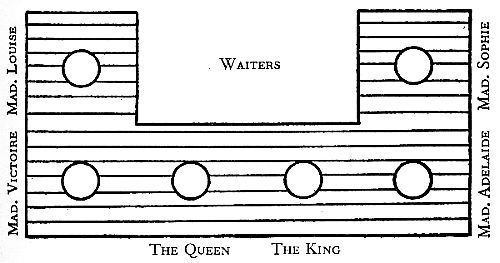
Versailles has had infinite Sums laid out in building it and supplying it with Water. Some say the Expences exceeded 80 Millions Sterling. The Range of Building is immense; the Garden-Front most magnificent, all of hewn Stone; the Number of Statues, Figures, Urns, &c., in Marble and Bronze of exquisite Workmanship, is beyond Conception. But the Waterworks are out of Repair, and so is great Part of the Front next the Town, looking with its shabby half-Brick Walls, and broken Windows, not much better than the Houses in Durham Yard. There is, in short, both at Versailles and Paris, a prodigious Mixture of Magnificence and Negligence, with every kind of Elegance except that of Cleanliness, and what we call Tidyness. Tho' I must do Paris the Justice to say, that in two Points of Cleanliness they exceed us. The Water they drink, tho' from the River, they render as pure as that of the best Spring, by filtring it thro' Cisterns fill'd with Sand; and the Streets by constant Sweeping are fit to walk in, tho' there is no pav'd footPath. Accordingly, many well-dress'd People are constantly seen walking in them. The Crowds of Coaches and Chairs for this Reason is not so great. Men, as well as Women, carry Umbrellas in their Hands, which they extend in case of Rain or two [sic] much sun; and a Man with an Umbrella not taking up more than 3 foot square, or 9 square feet of the Street, when, if in a Coach, he would take up 240 square feet, you can easily conceive that tho' the Streets here are narrower they may be much less encumber'd. They are extreamly well pav'd, and the Stones, being generally Cubes, when worn on one Side, may be turn'd and become new.
The Civilities we everywhere receive give us the strongest Impressions of the French Politeness. It seems to be a Point settled here universally, that Strangers are to be treated with Respect; and one has just the same Deference shewn one here by being a Stranger, as in England by being a Lady. The Customhouse Officers at Port St. Denis, as we enter'd Paris, were about to seize 2 doz of excellent Bordeaux Wine given us at Boulogne, and which we brought with us; but, as soon as they found we were Strangers, it was immediately remitted on that Account. At the Church of Notre Dame, where we went to see a magnificent Illumination, with Figures, &c., for the deceas'd Dauphiness, we found an immense Crowd, who were kept out by Guards; but, the Officer being told that we were Strangers from England, he immediately admitted us, accompanied and show'd us every thing. Why don't we practise this Urbanity to Frenchmen? Why should they be allowed to outdo us in any thing?
Here is an Exhibition of Paintings like ours in London, to which Multitudes flock daily. I am not Connoisseur enough to judge which has most Merit. Every Night, Sundays not excepted here are Plays or Operas; and tho' the Weather has been hot, and the Houses full, one is not incommoded by the Heat so much as with us in Winter. They must have some Way of changing the Air, that we are not acquainted with. I shall enquire into it.
Travelling is one Way of lengthening Life, at least in Appearance. It is but about a Fortnight since we left London, but the Variety of Scenes we have gone through makes it seem equal to Six Months living in one Place. Perhaps I have suffered a greater Change, too, in my own Person, than I could have done in Six Years at home. I had not been here Six Days, before my Taylor and Perruquier had transform'd me into a Frenchman. Only think what a Figure I make in a little Bag-Wig and naked Ears! They told me I was become 20 Years younger, and look'd very galante;
So being in Paris where the Mode is to be sacredly follow'd I was once very near making Love to my Friend's Wife.
This Letter shall cost you a Shilling, and you may consider it cheap, when you reflect, that it has cost me at least 50 Guineas to get into the Situation, that enables me to write it. Besides, I might, if I had staied at home, have won perhaps two Shillings of you at Cribbidge. By the Way, now I mention Cards, let me tell you that Quadrille is quite out of Fashion here, and English Whisk all the Mode at Paris and the Court.
And pray look upon it as no small Matter, that surrounded as I am by the Glories of this World, and Amusements of all Sorts, I remember you and Dolly and all the dear good Folks at Bromley. 'Tis true, I can't help it, but must and ever shall remember you all with Pleasure.
Need I add, that I am particularly, my dear good Friend, yours most affectionately,
B. Franklin.
ON THE LABOURING POOR
[From the Gentleman's Magazine, April, 1768.]
Sir,
I have met with much invective in the papers, for these two years past, against the hard-heartedness of the rich, and much complaint of the great oppressions suffered in this country by the labouring poor. Will you admit a word or two on the other side of the question? I do not propose to be an advocate for oppression or oppressors. But when I see that the poor are, by such writings, exasperated against the rich, and excited to insurrections, by which much mischief is done, and some forfeit their lives, I could wish the true state of things were better understood, the poor not made by these busy writers more uneasy and unhappy than their situation subjects them to be, and the nation not brought into disrepute among foreigners, by public groundless accusations of ourselves, as if the rich in England had no compassion for the poor, and Englishmen wanted common humanity.
In justice, then to this country, give me leave to remark, that the condition of the poor here is, by far, the best in Europe, for that, except in England and her American colonies, there is not in any country of the known world, not even in Scotland or Ireland, a provision by law to enforce a support of the poor. Everywhere else necessity reduces to beggary. This law was not made by the poor. The legislators were men of fortune. By that act they voluntarily subjected their own estates, and the estates of all others, to the payment of a tax for the maintenance of the poor, incumbering those estates with a kind of rent-charge for that purpose, whereby the poor are vested with an inheritance, as it were, in all the estates of the rich. I wish they were benefited by this generous provision in any degree equal to the good intention, with which it was made, and is continued: But I fear the giving mankind a dependance on any thing for support, in age or sickness, besides industry and frugality during youth and health, tends to flatter our natural indolence, to encourage idleness and prodigality, and thereby to promote and increase poverty, the very evil it was intended to cure; thus multiplying beggars instead of diminishing them.
Besides this tax, which the rich in England have subjected themselves to, in behalf of the poor, amounting in some places to five or six shillings in the pound, of the annual income, they have, by donations and subscriptions, erected numerous schools in various parts of the kingdom, for educating gratis the children of the poor in reading and writing, and in many of those schools the children are also fed and cloathed. They have erected hospitals at an immense expence for the reception and cure of the sick, the lame, the wounded, and the insane poor, for lying-in women, and deserted children. They are also continually contributing towards making up losses occasioned by fire, by storms, or by floods, and to relieve the poor in severe seasons of frost, in times of scarcity, &c., in which benevolent and charitable contributions no nation exceeds us. Surely, there is some gratitude due for so many instances of goodness.
Add to this all the laws made to discourage foreign manufactures, by laying heavy duties on them, or totally prohibiting them, whereby the rich are obliged to pay much higher prices for what they wear and consume, than if the trade was open: These are so many laws for the support of our labouring poor, made by the rich, and continued at their expence; all the difference of price, between our own and foreign commodities, being so much given by our rich to our poor; who would indeed be enabled by it to get by degrees above poverty, if they did not, as too generally they do, consider every encrease of wages, only as something that enables them to drink more and work less; so that their distress in sickness, age, or times of scarcity, continues to be the same as if such laws had never been made in their favour.
Much malignant censure have some writers bestowed upon the rich for their luxury and expensive living, while the poor are starving, &c.; not considering that what the rich expend, the labouring poor receive in payment for their labour. It may seem a paradox if I should assert, that our labouring poor do in every year receive the whole revenue of the nation; I mean not only the public revenue, but also the revenue or clear income of all private estates, or a sum equivalent to the whole.
In support of this position I reason thus. The rich do not work for one another. Their habitations, furniture, cloathing, carriages, food, ornaments, and every thing in short, that they or their families use and consume, is the work or produce of the labouring poor, who are, and must be continually, paid for their labour in producing the same. In these payments the revenues of private estates are expended, for most people live up to their incomes. In cloathing or provision for troops, in arms, ammunition, ships, tents, carriages, &c., &c., (every particular the produce of labour,) much of the public revenue is expended. The pay of officers, civil and military, and of the private soldiers and sailors, requires the rest; and they spend that also in paying for what is produced by the labouring poor.
I allow that some estates may increase by the owners spending less than their income; but then I conceive that other estates do at the same time diminish by the owners spending more than their income, so that when the enriched want to buy more land, they easily find lands in the hands of the impoverished, whose necessities oblige them to sell; and thus this difference is equalled. I allow also, that part of the expence of the rich is in foreign produce or manufactures, for producing which the labouring poor of other nations must be paid; but then I say, we must first pay our own labouring poor for an equal quantity of our manufactures or produce, to exchange for those foreign productions, or we must pay for them in money, which money, not being the natural produce of our country, must first be purchased from abroad, by sending out its value in the produce or manufactures of this country, for which manufactures our labouring poor are to be paid. And indeed, if we did not export more than we import, we could have no money at all. I allow farther, that there are middle men, who make a profit, and even get estates, by purchasing the labour of the poor, and selling it at advanced prices to the rich; but then they cannot enjoy that profit, or the income of estates, but by spending them in employing and paying our labouring poor, in some shape or other, for the products of industry. Even beggars, pensioners, hospitals, and all that are supported by charity, spend their incomes in the same manner. So that finally, as I said at first, our labouring poor receive annually the whole of the clear revenues of the nation, and from us they can have no more.
If it be said that their wages are too low, and that they ought to be better paid for their labour, I heartily wish any means could be fallen upon to do it, consistent with their interest and happiness; but, as the cheapness of other things is owing to the plenty of those things, so the cheapness of labour is in most cases owing to the multitude of labourers, and to their under-working one another in order to obtain employment. How is this to be remedied? A law might be made to raise their wages; but, if our manufactures are too dear, they will not vend abroad, and all that part of employment will fail, unless by fighting and conquering we compel other nations to buy our goods, whether they will or no, which some have been mad enough at times to propose.
Among ourselves, unless we give our working people less employment, how can we, for what they do, pay them higher than we do? Out of what fund is the additional price of labour to be paid, when all our present incomes are, as it were, mortgaged to them? Should they get higher wages, would that make them less poor, if, in consequence, they worked fewer days of the week proportionably? I have said, a law might be made to raise their wages; but I doubt much whether it could be executed to any purpose, unless another law, now indeed almost obsolete, could at the same time be revived and enforced; a law, I mean, that many have often heard and repeated, but few have ever duly considered. Six days shalt thou labour. This is as positive a part of the commandment, as that which says, The SEVENTH day thou shalt rest. But we remember well to observe the indulgent part, and never think of the other. Saint Monday is generally as duly kept by our working people as Sunday; the only difference is, that, instead of employing their time cheaply at church, they are wasting it expensively at the alehouse.
I am, Sir, &c. Medius.
TO DUPONT DE NEMOURS[74]
London, July 28, 1768.
I received your obliging letter of the 10th May, with the most acceptable present of your Physiocratie, which I have read with great pleasure, and received from it a great deal of instruction. There is such a freedom from local and national prejudices and partialities, so much benevolence to mankind in general, so much goodness mixt with the wisdom, in the principles of your new philosophy, that I am perfectly charmed with them, and wish I could have stayed in France for some time, to have studied in your school, that I might by conversing with its founders have made myself quite a master of that philosophy.... I had, before I went into your country, seen some letters of yours to Dr. Templeman, that gave me a high opinion of the doctrines you are engaged in cultivating and of your personal talents and abilities, which made me greatly desirous of seeing you. Since I had not that good fortune, the next best thing is the advantage you are so good to offer me of your correspondence, which I shall ever highly value, and endeavour to cultivate with all the diligence I am capable of.
I am sorry to find that that wisdom which sees the welfare of the parts in the prosperity of the whole, seems yet not to be known in this country.... We are so far from conceiving that what is best for mankind, or even for Europe in general, may be best for us, that we are even studying to establish and extend a separate interest of Britain, to the prejudice of even Ireland and our colonies.... It is from your philosophy only that the maxims of a contrary and more happy conduct are to be drawn, which I therefore sincerely wish may grow and increase till it becomes the governing philosophy of the human species, as it must be that of superior beings in better worlds. I will take the liberty of sending you a little fragment that has some tincture of it, which, on that account, I hope may be acceptable.
Be so good as to present my sincere respect to that venerable apostle, Dr. Quesnay, and to the illustrious Ami des Hommes (of whose civilities to me at Paris I retain a grateful remembrance), and believe me to be, with real and very great esteem Sir,
Your obliged and most obedient humble servant B. Franklin.
TO JOHN ALLEYNE[75]
Craven Street, [August 9, 1768].
Dear Sir
You made an Apology to me for not acquaintg me sooner with your Marriage. I ought now to make an Apology to you for delaying so long the Answer to your Letter. It was mislaid or hid among my Papers and much Business put it out of my Mind, or prevented my looking for it and writing when I thought of it. So this Account between us if you please may stand balanced. I assure you it gave me great Pleasure to hear you were married, and into a Family of Reputation. This I learnt from the Public Papers. The Character you give me of your Bride (as it includes every Qualification that in the married State conduces to mutual Happiness) is an Addition to that Pleasure. Had you consulted me, as a Friend, on the Occasion, Youth on both sides I should not have thought any Objection. Indeed, from the matches that have fallen under my Observation, I am rather inclin'd to think, that early ones stand the best Chance for Happiness. The Tempers and habits of young People are not yet become so stiff and uncomplying, as when more advanced in Life; they form more easily to each other, and hence many Occasions of Disgust are removed. And if Youth has less of that Prudence, that is necessary to conduct a Family, yet the Parents and elder Friends of young married Persons are generally at hand to afford their Advice, which amply supplies that Defect; and, by early Marriage, Youth is sooner form'd to regular and useful Life; and possibly some of those Accidents, Habits or Connections, that might have injured either the Constitution, or the Reputation, or both, are thereby happily prevented.
Particular Circumstances of particular Persons may possibly sometimes make it prudent to delay entering into that State; but in general, when Nature has render'd our Bodies fit for it, the Presumption is in Nature's Favour, that she has not judg'd amiss in making us desire it. Late Marriages are often attended, too, with this further Inconvenience, that there is not the same Chance the parents shall live to see their offspring educated. "Late Children," says the Spanish Proverb, "are early Orphans." A melancholy Reflection to those, whose Case it may be! With us in America, Marriages are generally in the Morning of Life; our Children are therefore educated and settled in the World by Noon; and thus, our Business being done, we have an Afternoon and Evening of chearful Leisure to ourselves; such as your Friend at present enjoys. By these early Marriages we are blest with more Children; and from the Mode among us, founded in Nature, of every Mother suckling and nursing her own Child, more of them are raised. Thence the swift Progress of Population among us, unparallel'd in Europe.
In fine, I am glad you are married, and congratulate you most cordially upon it. You are now more in the way of becoming a useful Citizen; and you have escap'd the unnatural State of Celibacy for Life, the Fate of many here, who never intended it, but who, having too long postpon'd the Change of their Condition, find at length, that 'tis too late to think of it, and so live all their Lives in a Situation that greatly lessens a Man's Value. An odd Volume of a Set of Books you know is not worth its proportion of the Set, and what think you of the Usefulness of an odd Half of a Pair of Scissors? It cannot well cut any thing. It may possibly serve to scrape a Trencher.
Pray make my Compliments and best Wishes acceptable to your Spouse. I am old and heavy and grow a little indolent, or I should ere this have presented them in Person. I shall make but small Use of the old Man's Privilege, that of giving Advice to younger Friends. Treat your Wife always with Respect; it will procure Respect to you, not from her only but from all that observe it. Never use a slighting Expression to her, even in jest, for Slights in Jest, after frequent bandyings, are apt to end in angry earnest. Be studious in your Profession, and you will be learned. Be industrious and frugal, and you will be rich. Be sober and temperate, and you will be healthy. Be in general virtuous, and you will be happy. At least, you will, by such Conduct, stand the best Chance for such Consequences. I pray God to bless you both; being ever your affectionate Friend,
B. Franklin.
TO THE PRINTER OF THE LONDON CHRONICLE[76]
August 18, 1768.
Queries, recommended to the Consideration of those Gentlemen who are for vigorous measures with the Americans.
1. Have the Colonists refused to answer any reasonable requisitions made to their Assemblies by the mother country?
2. If they have not refused to grant reasonable aids in the way, which they think consistent with liberty, why must they be stripped of their property without their own consent, and in a way, which they think inconsistent with liberty?
3. What is it for a people to be enslaved and tributary, if this be not, viz. to be forced to give up their property at the arbitrary pleasure of persons, to whose authority they have not submitted themselves, nor chosen for the purpose of imposing taxes upon them? Wherein consisted the impropriety of King Charles's demanding ship money by his sole authority, but in its being an exercise of power by the King, which the people had not given the King? Have the people of America, as the people of Britain, by sending representatives, consented to a power in the British parliament to tax them?
4. Has not the British parliament, by repealing the stamp act, acknowledged that they judged it improper? Is there any difference between the stamp act, and the act obliging the Americans to pay whatever we please, for articles which they cannot do without, as glass and paper? Is there any difference as to justice between our treatment of the colonists, and the tyranny of the Carthaginians over their conquered Sardinians, when they obliged them to take all their corn from them, and at whatever price they pleased to set upon it?
5. If that be true, what is commonly said, viz. That the mother country gains two millions a year by the colonies, would it not have been wiser to have gone on quietly in the happy way we were in, till our gains by those rising and flourishing countries should amount to three, four or five millions a year, than by these new fashioned vigorous measures to kill the goose which lays the golden eggs? Would it not have been better policy, instead of taxing our colonists, to have done whatever we could to enrich them; and encourage them to take off our articles of luxury, on which we may put our own price, and thus draw them into paying us a voluntary tax; than deluge them in blood, thin their countries, impoverish and distress them, interrupt their commerce, force them on bankruptcy, by which our merchants must be ruined, or tempt them to emigrations, or alliances with our enemies?
6. The late war could not have been carried on without America, nor without Scotland? Have we treated America and Scotland in such a manner as is likely in future wars to encourage their zeal for the common cause? Or is England alone to be the Drawcansir of the world, and to bully not only their enemies, but her friends?
7. Are not the subjects of Britain concerned to check a ministry, who, by this rage of heaping taxes on taxes, are only drawing into their own hands more and more wealth and power, while they are hurting the commercial interest of the empire in general, at the same time that, amidst profound peace, the national debt and burden on the public continue undiminished?
N. M. C. N. P. C. H.
POSITIONS TO BE EXAMINED, CONCERNING NATIONAL WEALTH
Dated April 4, 1769.
1. All food or subsistence for mankind arises from the earth or waters.
2. Necessaries of life, that are not food, and all other conveniences, have their values estimated by the proportion of food consumed while we are employed in procuring them.
3. A small people, with a large territory, may subsist on the productions of nature, with no other labour than that of gathering the vegetables and catching the animals.
4. A large people, with a small territory, finds these insufficient, and, to subsist, must labour the earth, to make it produce greater quantities of vegetable food, suitable for the nourishment of men, and of the animals they intend to eat.
5. From this labour arises a great increase of vegetable and animal food, and of materials for clothing, as flax, wool, silk, &c. The superfluity of these is wealth. With this wealth we pay for the labour employed in building our houses, cities, &c., which are therefore only subsistence thus metamorphosed.
6. Manufactures are only another shape into which so much provisions and subsistence are turned, as were equal in value to the manufactures produced. This appears from hence, that the manufacturer does not, in fact, obtain from the employer, for his labour, more than a mere subsistence, including raiment, fuel, and shelter; all which derive their value from the provisions consumed in procuring them.
7. The produce of the earth, thus converted into manufactures, may be more easily carried to distant markets than before such conversion.
8. Fair commerce is, where equal values are exchanged for equal, the expense of transport included. Thus, if it costs A in England as much labour and charge to raise a bushel of wheat, as it costs B in France to produce four gallons of wine, then are four gallons of wine the fair exchange for a bushel of wheat, A and B meeting at half distance with their commodities to make the exchange. The advantage of this fair commerce is, that each party increases the number of his enjoyments, having, instead of wheat alone, or wine alone, the use of both wheat and wine.
9. Where the labour and expense of producing both commodities are known to both parties, bargains will generally be fair and equal. Where they are known to one party only, bargains will often be unequal, knowledge taking its advantage of ignorance.
10. Thus, he that carries one thousand bushels of wheat abroad to sell, may not probably obtain so great a profit thereon, as if he had first turned the wheat into manufactures, by subsisting therewith the workmen while producing those manufactures; since there are many expediting and facilitating methods of working, not generally known; and strangers to the manufactures, though they know pretty well the expense of raising wheat, are unacquainted with those short methods of working, and, thence being apt to suppose more labour employed in the manufactures than there really is, are more easily imposed on in their value, and induced to allow more for them than they are honestly worth.
11. Thus the advantage of having manufactures in a country does not consist, as is commonly supposed, in their highly advancing the value of rough materials, of which they are formed; since, though six pennyworth of flax may be worth twenty shillings, when worked into lace, yet the very cause of its being worth twenty shillings is, that, besides the flax, it has cost nineteen shillings and sixpence in subsistence to the manufacturer. But the advantage of manufactures is, that under their shape provisions may be more easily carried to a foreign market; and, by their means, our traders may more easily cheat strangers. Few, where it is not made, are judges of the value of lace. The importer may demand forty, and perhaps get thirty, shillings for that which cost him but twenty.
12. Finally, there seem to be but three ways for a nation to acquire wealth. The first is by war, as the Romans did, in plundering their conquered neighbours. This is robbery. The second by commerce, which is generally cheating. The third by agriculture, the only honest way, wherein man receives a real increase of the seed thrown into the ground, in a kind of continual miracle, wrought by the hand of God in his favour, as a reward for his innocent life and his virtuous industry.
TO MISS MARY STEVENSON
Saturday Evening, Septr 2, 1769.
Just come home from a Venison Feast, where I have drank more than a Philosopher ought, I find my dear Polly's chearful, chatty Letter that exhilerates me more than all the Wine.
Your good Mother says there is no Occasion for any Intercession of mine in your behalf. She is sensible that she is more in fault than her Daughter. She received an affectionate, tender Letter from you, and she has not answered it, tho' she intended to do it; but her Head, not her Heart, has been bad, and unfitted her for Writing. She owns, that she is not so good a Subject as you are, and that she is more unwilling to pay Tribute to Cesar, and has less Objection to Smuggling; but 'tis not, she says, mere Selfishness or Avarice; 'tis rather an honest Resentment at the Waste of those Taxes in Pensions, Salaries, Perquisites, Contracts, and other Emoluments for the Benefit of People she does not love, and who do not deserve such Advantages, because—I suppose—because they are not of her Party.
Present my Respects to your good Landlord and his Family. I honour them for their conscientious Aversion to illicit Trading. There are those in the World, who would not wrong a Neighbour, but make no Scruple of cheating the King. The Reverse, however, does not hold; for whoever scruples cheating the King, will certainly not wrong his Neighbour.
You ought not to wish yourself an Enthusiast. They have, indeed, their imaginary Satisfactions and Pleasures, but these are often ballanc'd by imaginary Pains and Mortifications. You can continue to be a good Girl, and thereby lay a solid Foundation for expected future Happiness, without the Enthusiasm that may perhaps be necessary to some others. As those Beings, who have a good sensible Instinct, have no need of Reason, so those, who have Reason to regulate their Actions, have no Occasion for Enthusiasm. However, there are certain Circumstances in Life, sometimes, wherein 'tis perhaps best not to hearken to Reason. For instance; possibly, if the Truth were known, I have Reason to be jealous of this same insinuating, handsome young Physician;[77] but, as it flatters more my Vanity, and therefore gives me more Pleasure, to suppose you were in Spirits on acct of my safe Return, I shall turn a deaf Ear to Reason in this Case, as I have done with Success in twenty others. But I am sure you will always give me Reason enough to continue ever your affectionate Friend,
B. Franklin.
P.S. Our Love to Mrs. Tickell. We all long for your Return. Your Dolly was well last Tuesday; the Girls were there on a Visit to her; I mean at Bromley. Adieu. No time now to give you any acct of my French Journey.
TO JOSEPH PRIESTLEY
London, Sept. 19: 1772.
Dear Sir,
In the Affair of so much Importance to you, wherein you ask my Advice, I cannot for want of sufficient Premises, advise you what to determine, but if you please I will tell you how. When those difficult Cases occur, they are difficult, chiefly because while we have them under Consideration, all the Reasons pro and con are not present to the Mind at the same time; but sometimes one Set present themselves, and at other times another, the first being out of Sight. Hence the various Purposes or Inclinations that alternately prevail, and the Uncertainty that perplexes us.
To get over this, my Way is, to divide half a Sheet of Paper by a Line into two Columns; writing over the one Pro, and over the other Con. Then during three or four Days Consideration, I put down under the different Heads short Hints of the different Motives, that at different Times occur to me, for or against the Measure. When I have thus got them all together in one View, I endeavour to estimate their respective Weights; and where I find two, one on each side, that seem equal, I strike them both out. If I find a Reason pro equal to some two Reasons con, I strike out the three. If I judge some two Reasons con, equal to some three Reasons pro, I strike out the five; and thus proceeding I find at length where the Ballance lies; and if after a Day or two of farther Consideration, nothing new that is of Importance occurs on either side, I come to a Determination accordingly. And, tho' the Weight of Reasons cannot be taken with the Precision of Algebraic Quantities, yet, when each is thus considered, separately and comparatively, and the whole lies before me, I think I can judge better, and am less liable to make a rash Step; and in fact I have found great Advantage from this kind of Equation, in what may be called Moral or Prudential Algebra.
Wishing sincerely that you may determine for the best, I am ever, my dear Friend, yours most affectionately,
B. Franklin.
TO MISS GEORGIANA SHIPLEY[78]
London, September 26, 1772.
Dear Miss,
I lament with you most sincerely the unfortunate end of poor Mungo. Few squirrels were better accomplished; for he had had a good education, had travelled far, and seen much of the world. As he had the honour of being, for his virtues, your favourite, he should not go, like common skuggs, without an elegy or an epitaph. Let us give him one in the monumental style and measure, which, being neither prose nor verse, is perhaps the properest for grief; since to use common language would look as if we were not affected, and to make rhymes would seem trifling in sorrow.
EPITAPH.
Alas! poor Mungo! Happy wert thou, hadst thou known Thy own felicity. Remote from the fierce bald eagle, Tyrant of thy native woods, Thou hadst nought to fear from his piercing talons, Nor from the murdering gun Of the thoughtless sportsman. Safe in thy wired castle, Grimalkin never could annoy thee. Daily wert thou fed with the choicest viands, By the fair hand of an indulgent mistress; But, discontented, Thou wouldst have more freedom.
Too soon, alas! didst thou obtain it; And wandering, Thou art fallen by the fangs of wanton, cruel Ranger!
Learn hence, Ye who blindly seek more liberty, Whether subjects, sons, squirrels or daughters, That apparent restraint may be real protection; Yielding peace and plenty With security.
You see, my dear Miss, how much more decent and proper this broken style is, than if we were to say, by way of epitaph,
Here Skugg Lies snug, As a bug In a rug.
and yet, perhaps, there are people in the world of so little feeling as to think that this would be a good-enough epitaph for poor Mungo.
If you wish it, I shall procure another to succeed him; but perhaps you will now choose some other amusement.
Remember me affectionately to all the good family, and believe me ever,
Your affectionate friend, B. Franklin.
TO PETER FRANKLIN
[No date.][79]
Dear Brother,
I like your ballad, and think it well adapted for your purpose of discountenancing expensive foppery, and encouraging industry and frugality. If you can get it generally sung in your country, it may probably have a good deal of the effect you hope and expect from it. But as you aimed at making it general, I wonder you chose so uncommon a measure in poetry, that none of the tunes in common use will suit it. Had you fitted it to an old one, well known, it must have spread much faster than I doubt it will do from the best new tune we can get compos'd for it. I think too, that if you had given it to some country girl in the heart of the Massachusetts, who has never heard any other than psalm tunes, or Chevy Chace, the Children in the Wood, the Spanish Lady, and such old simple ditties, but has naturally a good ear, she might more probably have made a pleasing popular tune for you, than any of our masters here, and more proper for your purpose, which would best be answered, if every word could as it is sung be understood by all that hear it, and if the emphasis you intend for particular words could be given by the singer as well as by the reader; much of the force and impression of the song depending on those circumstances. I will however get it as well done for you as I can.
Do not imagine that I mean to depreciate the skill of our composers of music here; they are admirable at pleasing practised ears, and know how to delight one another; but, in composing for songs, the reigning taste seems to be quite out of nature, or rather the reverse of nature, and yet like a torrent, hurries them all away with it; one or two perhaps only excepted.
You, in the spirit of some ancient legislators, would influence the manners of your country by the united powers of poetry and music. By what I can learn of their songs, the music was simple, conformed itself to the usual pronunciation of words, as to measure, cadence or emphasis, &c., never disguised and confounded the language by making a long syllable short, or a short one long, when sung; their singing was only a more pleasing, because a melodious manner of speaking; it was capable of all the graces of prose oratory, while it added the pleasure of harmony. A modern song, on the contrary, neglects all the proprieties and beauties of common speech, and in their place introduces its defects and absurdities as so many graces. I am afraid you will hardly take my word for this, and therefore I must endeavour to support it by proof. Here is the first song I lay my hand on. It happens to be a composition of one of our greatest masters, the ever-famous Handel. It is not one of his juvenile performances, before his taste could be improved and formed: It appeared when his reputation was at the highest, is greatly admired by all his admirers, and is really excellent in its kind. It is called, "The additional Favourite Song in Judas Maccabeus." Now I reckon among the defects and improprieties of common speech, the following, viz.