Part 3 — CHAPTER V THE DISSOLUTION OF THE CHAPTER
Reading edition
The difference between the Southwell depicted by Byron and the Southwell of to-day is due to organic changes. In 1837 Notts, less the ecclesiastical jurisdiction of the chapter, was transferred from York to Lincoln; and four years later Southwell shared the same fate.
Thus was broken the long connection, not only with the diocese, but also with the province of York. In 1840 a clause or two in a Bill (3 and 4 Vict. c. 113), supplemented the next year by a special Act (4 and 5 Vict. c. 39), destroyed the chapter, after making allowance for vested interests, as a useless waste of ecclesiastical revenues. The canonries, as vacancies occurred, were not to be filled up, the minor canons were to be reduced to two (eventually to none at all); and the property was to go to the Ecclesiastical Commissioners, to help in founding Ripon and Manchester, although these two dioceses were quite wealthy enough to endow their own bishoprics. What the total revenues were at the time of the dissolution, it is impossible to say. A great part of the incomes, both of the common and trust funds and of the various prebends, was paid in lump sums, technically called “fines,” at the renewal of leases. It has been estimated as high as £30,000 a year: the real nett income of the whole of the properties may, perhaps, have reached a third of this high figure. It must, however, be remembered, in computing the real loss, that the Commissioners have borne the whole expense of restoring the edifice. In succession to the sixteen prebendaries and the six minor canons, a brand new benefice, a rectory, was created and endowed not over-liberally, and the minster reduced to the status of an ordinary parish church.
During a great part of the period of transition the two minor canons allowed temporarily to remain filled the duty usually assigned to canons in residence, and preached in the afternoon. The Act of 1840 for curtailing, or, as at Southwell, for abolishing, cathedral and collegiate chapters was passed during the heat wave of change which followed in the footsteps of the first Reform Bill. No one opposed it more vigorously than did the young Tory and High Church member for Newark, Mr W.E. Gladstone, who added to his rising fame by his great speech against its provisions. But, in spite of the numerous petitions that came pouring in, the general middle and upper class opinion of the day was against such colleges as Southwell, and in favour of devoting their revenues to other purposes. It has changed since; and if the present Bishop of Southwell were asked his opinion, he would probably answer that a chapter of sixteen prebendaries appointed by himself would have been of inestimable service in carrying on the administration of the diocese. So ended a clerical republic which had safely survived the storms of Henry VIII. and Edward VI.
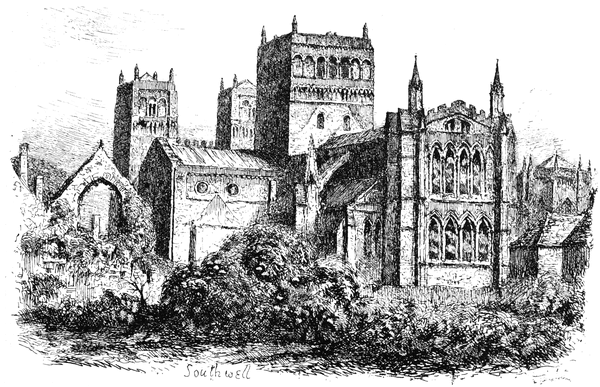
SOUTHWELL, SHOWING WEST TOWERS BEFORE RESTORATION— RUINS OF THE PALACE TO THE LEFT.
The Grammar School.—By yet another blow the Grammar School was crippled. Two fellowships and two scholarships at St. John’s, Cambridge, founded by Dr Keton in the reign of Henry VIII., with a preference for choristers, were confiscated. Under Dr William Fletcher (a first classman and Fellow of Brasenose) the school was the most flourishing in the county: thanks to the craze for meddling reform, it was afterwards reduced to three boys. It has been left for the present headmaster, who was appointed by Bishop Wordsworth when the fortunes of the school were at a low ebb, assisted by his son, to restore this time-honoured seat of education to a favourable and prominent position, although allowed by the Commissioners only the old sixteenth-century endowment of twenty-three pounds a year. At the next voidance of the one remaining minor canonry, the headmaster of the Grammar School will be the sole remaining officer allowed to continue; and a more generous policy might well be pursued with regard to the oldest educational establishment of the county. When it is added that the “very genteel society” of Byron successfully opposed the Nottingham and Lincoln Railway, it need not now be a cause for wonder that the town does not occupy that position the author of “Childe Harold” described.
The Foundation of the See.—The county of Nottingham had not time to settle into its new position before it was discovered that the reconstructed diocese of Lincoln, with over eight hundred benefices, was too large for one bishop to supervise. In Bishop Jackson’s time the need of a new diocese was mooted; with Bishop Wordsworth this idea took active shape; and during the administration of Lord Beaconsfield the necessary legislative sanction was obtained, although, as the main part of the endowment had to be collected by subscription, the see was not constituted until 1884. Bishop Wordsworth not only parted with a portion of his episcopal income, but was the most munificent subscriber; and to him it is due that Southwell had the preference as the see town over the large and growing city of Nottingham. It was also part of the scheme of this distinguished prelate that the diocese should be limited to the one county, and that the old palace should be restored for the bishop’s residence, but neither of these was carried into effect. The plan of Henry VIII. was adopted, and Derbyshire added, while the restoration of the palace was abandoned. The minster was thus chosen as the cathedral church out of sentiment; and it is to be regretted that it did not at the same time revert to its old province of York.
The new honorary canons of the diocese, with the bishop at their head as dean, took the names of the old prebends. The work they have done in the diocese has justified their appointment; but historical association, while respected in one sense, was here also strangely disregarded, since between the old prebendaries and the new canons there is no kind of connection. The first bishop, Dr George Ridding, headmaster of Winchester, has continued the untiring munificence of Dr Wordsworth; and his organising powers have found full scope in the working of the two counties.
Thus the outline of the story of this little town from the days of the Britons and Romans onwards comes to an end. Southwell may well take for her motto—
The old order changeth, yielding place to new, And God fulfils Himself in many ways.