Part 3 — APPENDICES
Reading edition
APPENDIX A THE CULDEES
The derivation is given from Cultor (or perhaps cola) Dei. The Culdees are generally supposed to have been a religious order founded by St. Columba in the middle of the sixth century; but this would seem to be a mistake, for, says Canon Ornsby, the name was unknown to Baeda, Eddi, and Andamnan, Deicola (= Gode-frihte, or God-fearing) was the appellation given first to anchorites, and afterwards to certain secular clergy.
The clergy of Canterbury were called Cultores [Dei] Clerici in 1006; those of York Colidei or Culdees so late as Henry I. Mr Leach says (p. xx.) that the clergy of Lichfield were likewise of Culdee origin under St. Chad. Perhaps the least unlikely inference is that at Southwell, as elsewhere, the Culdees represent an intermediate stage between the primitive missionaries and the prebendaries of a later time with their separate churches and endowments. They were allowed to marry, and shared in a common fund.
APPENDIX B A STORY OF THE SUPERNATURAL
Florence of Worcester says (under date 1137): “At Southwell, a ‘vill’ of the archbishop’s, while a grave was being made for a funeral, there were found some relics of saints, and a glass phial with raised sides to prevent its being broken, and full of very clear water; which being given to the sick, they were on tasting it restored to their former health.” Florence says that this story was told him by Henry, Bishop of Winchester.
APPENDIX C CHANTRIES, CHAPELS, AND ALTARS
The eight chantry foundations of the thirteenth century were St. Thomas the Martyr (three), St. Peter, St. Nicholas (with Halam annexed), St. Stephen, St. John Baptist, and St. John the Evangelist. After a lull of more than a century come St. Mary at the altar of St. Michael (with Wheatley annexed), a second St. John the Baptist, otherwise the Morrow Mass, St. Mary Magdalene, and Our Lady, and St. Cuthbert (two, founded in 1479).
The Lady Chapel is a puzzle: it was outside the choir, on the north side, and with the churchyard adjoining the east; and no site seems to satisfy these three conditions. Perhaps more than one chapel is so named in wills. The chapel of St. John the Baptist had two altars, one to that saint, and another to St. Cuthbert, each with two chantries: it was the Vavasour or Booth Chapel at the south-west of the nave, the place of the Grammar School. The chapel of St. John the Evangelist was in the north aisle (whether of nave or choir not stated).
The locality of St. Thomas’ Chapel with its three chantries is uncertain; and there is a mention of the chapels of St. Lawrence and of St. Margaret near one another, but their altars are not mentioned. The altar of St. Peter was within the choir, but the sites of the remaining chantry altars cannot be settled. Besides the parish altar of St. Vincent, that of Our Lady of Grace is twice mentioned in the wills. The high altar is in one place called “the greater altar of St. Mary.”
There were, besides, the chapels of St. Thomas the Martyr in the Burgage, St. Catherine at the end of Westhorpe near the holy well, two in Easthorpe half-a-mile apart, and one in Normanton. The names of the three last are unknown; and the five seem to have been chantries. I am chiefly indebted to Mr Leach for the above information.
APPENDIX D A STORY OF CHARLES I.
Robert Thoroton, who published his “Nottinghamshire” in 1677, says that a Mr Savage told him the following story:—The time of this visit of the king was between Naseby and the subsequent residence at Oxford. The king, with a few faithful followers, took refuge at Southwell. “The day after his arrival he walked about the town not known, and entered the shop of a shoemaker, whose name was Lee, who was a fanatic of the day. His majesty, after some conversation with this man, bid him take measure for a pair of shoes. Lee, in taking the king’s foot in his hand and looking at him attentively, refused to proceed. The king, astonished at the man’s behaviour, desired him to do what he had requested; but the shoemaker actually refused, giving a reason that the king was the customer he had been warned against in a dream the night before, in which he [the customer] was doomed to destruction, and those who worked for him would never thrive. The forlorn monarch, whose misfortunes had opened his mind to the impressions of superstitions, uttered an ejaculation expressive of his resignation to the will of providence, and returned to the palace, which was the place of his abode.”
Thoroton says that Charles was many times at Southwell, and once with the queen.
APPENDIX E PATRONAGE OF THE CHAPTER
The chapter were patrons of the daughter parishes of Bleasby-cum-Morton, Edingley, Farnsfield, Halam, Kirklington and Upton, and of Boughton, Kneesal, Rolleston, S. Wheatley and Woodborough in Notts; of Barnburgh in Yorkshire; and of Barnoldby, Beelsby, Brigsley, Hatcliffe, Howerby, Ravensdale, and Waltham in North Lincolnshire.
All the prebendaries but those of Normanton, Woodborough, Palishall, and the sacrist presented to their several vicarages, excepting that the two prebendaries presented alternately to both Oxton and Cropwell. The prebendary of Normanton presented to the Southwell parish vicarage, and North Muskham to Caunton. At the dissolution, after allowing for vested interests, the whole of this patronage was divided between the two new bishoprics of Ripon and Manchester, but until Mr Shepherd’s death, in 1873, the surviving prebendaries reserved their patronage. Barnburgh was at one time worth £550 a year nett, and Beelsby a hundred less; but most of the others were of small value. There were also some half-dozen chapelries.
APPENDIX F THE LAST OF THE CLERGY
Prebendaries.
Beckingham Thomas Henry Shepherd, the last of the prebendaries, died Feb. 1873, on whose death the patronage of the chapter went to the bishops of Ripon and Manchester. He was rector of Clayton and S. Wheatley.
Dunham Thomas Cozens Percival.
Eton William Barrow.
Halloughton Robert Lowe.
North Leverton Henry Smith.
North Muskham Charles Boothby.
South Muskham John Thomas Becher.
Normanton George Wilkins, vicar-general and Archdeacon of Nottingham. After the Act of Dissolution he lived at the Residence House, and died there 1865.
Norwell Overhall Chas. Geo. Venables Vernon.
Norwell Palishall Robert Chaplin.
Norwell Tertia Pars Edward Denison (B. of Salisbury).
Oxton and Cropwell James Jarvis Cleaver.
Oxton Altera Pars Frederick Anson (D. of Chester).
Rampton Fitzgerald Wintour.
Sacrist Charles Nixon.
Woodborough Edward Garrard Marsh.
Parish Vicar Morgan Watkins.
Minor Canons or Vicars-Choral.
Alfred Tatham (1841-76).
Robert Frederick Smith, M.A., vicar of Edingley-cum-Halam. Late scholar of Lincoln College, Oxford. Succeeded Mr Dimock (preferred to Barnburgh in 1863), and still remains. The last clergyman associated with the defunct chapter. He was ordained as curate to the Rector of Southwell in 1856.
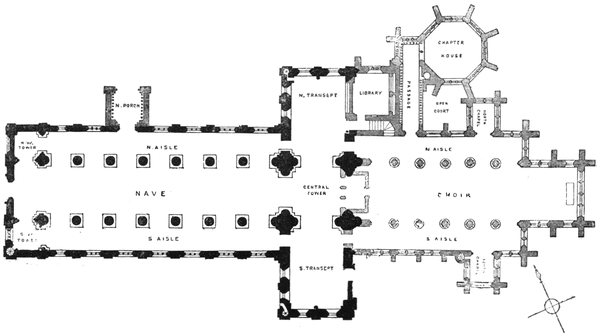
PLAN OF SOUTHWELL CATHEDRAL.
DIMENSIONS—EXTERIOR.
Length—318 feet. Length of Nave—185 feet. Width of Nave—72 feet. Choir—Length, 128 feet. Choir Aisles—Length, 98 ft. Choir, with Aisles—Breadth, 73 feet. Choir, with both Transept Chapels—Breadth, 108 feet. Height of Central Tower, 105 feet. Height of Western Tower, 99 feet. Do., including Modern Spires, 149 feet.