Chapter VII · ToC
Reading edition
CHAPTER VIIToC
CONCLUSION (1710-1897)
Wren's great friend and supporter on the Commission, John Evelyn, was long since dead; and in 1718, thanks to an intrigue, the Surveyor was dismissed in favour of an incompetent successor, chiefly famous for figuring in the Dunciad. Fortunately, says his grandson, "He was happily endued with such an Evenness of Temper, a steady Tranquillity of Mind, and Christian Fortitude, that no injurious Incidents or Inquietudes of human life, could ever ruffle or discompose." He continued for a time superintending at the Abbey, but soon took a house from the Crown at Hampton, where he could look upon another of his innumerable designs, and from time to time came up to see his cathedral, and, as the story goes, was wont to sit under the dome. Thanks to the regularity and temperance of his habits, for he profited by his medical studies, and his happy disposition, he lived five years longer, occupying his leisure with a variety of mathematical and scientific studies, and above all "in the Consolation of the Holy Scriptures: cheerful in Solitude, and as well pleased to die in the Shade as in the Light." A visit to London brought on a cold he failed to shake off. He was accustomed to take a nap after dinner; and on February 25, 1723, his servant, thinking he had slept long enough, entered the room. The good old man had passed quietly to his well-earned rest. His wife had long pre-deceased him. Steele declared that Wren was absolutely incapable of trumpeting his own fame, "which has as fatal an effect upon men's reputations as poverty; for as it was said—'the poor man saved the city, and the poor man's labour was forgot'; so here we find the modest man built the city, and the modest man's skill was unknown."[109] But Wren did not build only for the Commission who dismissed him, but for posterity; and posterity more impartial will yet pronounce that he belongs to the great men of two centuries ago, and accord him a place beside Marlborough and Addison and Newton.
About this time Parliament vested the fabric in three trustees—the Primate, the Bishop, and the Lord Mayor. With them rests the appointment of the surveyor, the examination and audit of his accounts, and in general the charge and maintenance of the cathedral.[110] This trust is unique, and has its origin in the large sums provided from taxation, whereas the other cathedrals were raised by voluntary offerings. The eighteenth century does not call for more than a passing notice. Wren's intentions continued to be delayed or frustrated in at least four important respects. The high railings shut out any complete view of the exterior: the dome area, isolated from the choir by the organ, was not used for the very purpose it was designed: the interior lacked mosaics: no monuments to the great dead filled the recesses ready for them. Reynolds headed a body of artists anxious to execute a scheme of adornment not in accordance with the architect's views, and was defeated by Bishop Terrick on grounds other than æsthetic. George III. gave thanks in 1789 for his recovery, and again eight years later for naval victories. On this latter occasion Nelson attended as one of the representatives of the Fleet; and as his one remaining eye rested on the Howard monument, did he think that the time was near at hand when he would be brought there, and when another monument would be erected to himself? For at last the cathedral was being put to its intended use; and the first memorial was accorded to a self-sacrificing philanthropist, who was not even a member of the Anglican communion. Another eight years, and amidst all that was high and distinguished, under the very centre of the dome, Dean Pretyman-Tomline, Bishop of Lincoln, committed to the ground the maimed body of the greatest of our sea captains. "As a youth," says Dean Milman, "I was present, and remember the solemn effect of the sinking of the coffin. I heard, or fancied that I heard, the low wail of the sailors who bore and encircled the remains of their admiral."[111] During the short peace before the return from Elba Wellington carried the sword of state before the Regent at the Thanksgiving service (July 9, 1814), and Dean Milman was called upon to officiate at the funeral of Wellington (November 18, 1852), which the Prince Consort attended, when the length of the procession may be estimated from Henry Greville's statement that it took one and three-quarter hours to pass Devonshire House.
The earlier Parliaments returned by the first Reform Bill brought about sweeping and ill-considered changes, both diocesan and capitular. Essex and the small archdeaconry of St. Alban's were separated from the diocese, and instead of being formed into a new one, were annexed to Rochester.[112] The capitular changes were chiefly the work of one sweeping Act which applied to the Chapters as a body (3 and 4 Vict. c. 113). The obligation of residence was removed from the prebends; four new resident canonries were created, and the revenues of the prebends alienated. By this scheme the greater part of the authority was entrusted to the dean and the residentiaries, and the thirty prebends became almost honorary, excepting that the old fees had still to be paid on installation. Thirty benefices—sinecures most of them in the modern sense and of large and increasing value—had become an anomaly and out of date; but were residents, officially non-resident for three-fourths of the year, the happiest method of reform? What Sydney Smith, one of the last of the old resident prebendaries, thought of these changes may be read in his life. A more competent authority on matters capitular than Sydney Smith, and like him in other respects an admirer of the first Victorian ministry, roundly declared, "The three months system is a mockery and worse";[113] and as a matter of fact the residentiaries prefer to discharge their duties by a more regular attendance. The patronage of three of these coveted stalls was reserved to the Crown; the fourth was left to the Bishop; but although the Archdeaconry of London was annexed to this fourth, one-third of the revenue was deducted for the remaining Archdeaconry of Middlesex. Since then the income of this fourth stall has been raised to the level of the others, and the prebendal stall of Cantlers re-endowed, the occupant being the diocesan inspector in religious knowledge. The one satisfactory feature in these changes is that the alienated revenues, estimated at £150,000, have been put to a good and practical use. By yet another change the mediæval college of the petty canons has been dissolved, and the minor canons reduced from twelve to six.
The best vindication of the new order of things is to look at results. It was left to Dean Milman and his Chapter, originally at the suggestion of Bishop Tait, to endeavour to carry out Wren's designs and Wren's ideas. The high exterior railings are gone: the organ removed to its proper position and the organ screen taken away, so that dome and choir are connected for congregational purposes: the system of decoration by mosaics well advanced. The absolute necessity of using the dome was emphasised, not only by the Sunday evening services, but by the appointment of Henry Parry Liddon to a resident's stall. Competent judges have asserted that Henry Melvill, though not the greater thinker, was the greater preacher of the two; but Melvill was almost past his best on his appointment in 1856, and he is rather associated with the choir than the dome. Be this as it may, Wren would have been gratified indeed to have seen the favourite offspring of his genius filled from arch to arch, and to have listened to the clear and melodious high-pitched voice of the great preacher, always articulate, and with an articulation after Wren's own heart that did not drop the last words of the sentences. Wren would have been further gratified to have seen his dome used, in addition to weekday services, three times each Sunday, as he would have been to have worked under those successive Deans—Milman, Mansel, Church, Gregory—who, in conjunction with their Chapters, have loyally endeavoured to put the cathedral to the use he wished from the day he first began to design his short Greek cross; and finally, he would have been gratified at Gounod's statement that the services are rendered to the finest music in the world, and to have seen the free facilities offered to the public for studying his architecture, and would have contrasted the orderly behaviour of the visitors from every quarter of the globe with the old-time swashbucklers and rowdies of Paul's Walk; and any objection to the lengthening westward would have been removed, had he lived to have seen his great cathedral filled from door to door with a congregation of from ten to twelve thousand at the special musical services.
This all too short summary must close by recording that the Queen attended the Thanksgiving service in February, 1872 for the recovery of the Prince of Wales; and on Queen Victoria's Day, Tuesday, June 22, 1897, again proceeded in state from Buckingham Palace to St. Paul's, where a Thanksgiving service was held at the West Front on occasion of the Diamond Jubilee, her Majesty returning by way of London and Westminster Bridges.
FOOTNOTES:
APPENDIX A.ToC
BISHOPS AND DEANS.
* Archbishop of Canterbury. § Archbishop of York.
BISHOPS BEFORE THE CONQUEST.
* * * * 772. Sighaeh 898. Wulfsize
314. Restitutus 774. Eadbert 926. Theodred
* * * * 789. Eadgar 953. Byrrthelm
604. Mellitus* 791. Coenwalh 959. Dunstan*d
* * * * 794. Eadbald 961. Aelstan
654. Cedd 794. Heathobert 996. Wulfstan
666. Wine 802. Osmund 1004. Aelihun
675. Erkenwald or Ercourvald 811. Aethilnoth 1014. Aelfwig
693. Waldhere 824. Coelberht 1035. Aelfward
706. Ingwald 860. Deorwulf 1044. Robert
745. Eggwulf 860. Swithwulf 1051. William the Norman
898. Heahstan
BISHOPS AND DEANS AFTER THE CONQUEST.
Bishops. Deans.
1075 Hugh de Orivalle
1085 Maurice
? Ulstan
1108 Richard de Belmeis Primus
1111 William
1128 Gilbert the Universal
1138 Ralph de Langford
1141 Robert de Sigillo
1152 Richard de Belmeis Secundus Hugo de Marny
1163 Gilbert Foliot
1181 Ralph de Diceto
1189 Richard de Ely or Fitzneal
1198 William de S. Maria
1210 Alardus de Burnham
1216 Gervase de Hobrogg
1218 Robert de Watford
1221 Eustace de Fauconberge
1228 Martin de Pateshull
1229 Roger Niger
1231 Galfry de Lucy
1241 William de S. Maria
1242 Fulk Basset
1244 Henry de Cornhill
1254 William de Salerne
1256 Richard de Barton
? Peter de Newport
? Richard Talbot
1259 Henry de Wingham
1263 Henry de Sandwich Galfry de Feringes
1268 John de Chishul
1274 John de Chishul Hervey de Borham
1276 Thomas de Inglethorp
1280 Richard de Gravesend
1283 Roger de la Leye
1285 William de Montford
1294 Ralph de Baldock
1306 Ralph de Baldock Raymond de la Goth
1307 Arnold de Cantilupe
1313 Gilbert de Segrave John de Sandale
1314 Richard de Newport
1317 Richard de Newport Vitalis Gasco
1319 Stephen de Gravesend
1323 John de Everden
1336 Gilbert de Bruera
1338 Richard de Bentworth
1340 Ralph de Stratford
1353 Richard de Kilmyngton
1354 Michael de Northburg
1362 Simon de Sudbury* Walter de Alderbury
1363 Thomas Trilleck
1364 John de Appleby
1375 William Courtenay*
1381 Robert Braybrooke
1389 Thomas de Evere
1400 Thomas Stow
1405 Roger Walden
1406 Nicholas Bubbewich Thomas Moor
1407 Richard Clifford
1421 Reginald Kentwoode
1422 John Kempe*§
1426 William Grey
1431 Robert Fitz-Hugh
1436 Robert Gilbert
1441 Thomas Lisieux
1450 Thomas Kempe
1456 Laurence Booth§
1457 William Say
1468 Roger Radclyff
1471 Thomas Wynterbourne
1479 William Worseley
1489 Richard Hill
1496 Thomas Savage§
1499 Robert Sherbon
1501 William Wareham*
1504 William Barnes
1505 John Colet
1506 Richard Fitz-James
1505-32 Richard Pace
1522 Cuthbert Tunstall
1530 John Stokesley
1536 Richard Sampson
1539 Edmund Bonner
1540 John Incent
1545 William May
1550 Nicholas Ridley
1553 Edmund Bonner
1554 John Howman de Feckenham
1556 Henry Cole
1559 Edmund Grindal*§ William May
1560 Alexander Nowell
1570 Edwin Sandys§
1577 John Aylmer
1595 Richard Fletcher
1597 Richard Bancroft*
1602 John Overall
1604 Richard Vaughan
1607 Thomas Ravis
1610 George Abbot*
1611 John King
1614 Valentine Carey
1621 George Monteigne§ John Donne
1628 William Laud*
1631-41 Thomas Winniff
1633 William Juxon*
1660 Gilbert Sheldon* Matthew Nicolas
1661 John Barwick
1663 Humfrey Henchman
1664 William Sancroft*
1675 Henry Compton
1677 Edward Stillingfleet
1689 John Tillotson*
1691 William Sherlock
1707 Henry Godolphin
1714 John Robinson
1723 Edmund Gibson
1726 Francis Hare
1740 Joseph Butler
1748 Thomas Sherlock
1750 Thomas Secker*
1758 John Hume
1761 Thomas Hayter
1762 Richard Osbaldeston
1764 Richard Terrick
1766 Frederick Cornwallis*
1768 Thomas Newton
1777 Robert Lowth
1782 Thomas Thurlow
1787 Beilby Porteous George Pretyman-Tomline
1809 John Randolph
1813 William Howley*
1820 William Van Mildert
1826 Charles Richard Sumner
1827 Edward Coplestone
1828 Chas. Jas. Blomfield
1849 Henry Hart Milman
1856 Archibald Campbell Tait*
1868 Henry Longueville Mansel
1869 John Jackson
1871 Richard William Church
1885 Frederick Temple*
1891 Robert Gregory
1896 Mandell Creighton
As regards the earlier periods, some of the dates are only approximate, and certain names are inserted and others omitted with hesitation.
APPENDIX B.ToC
COMPARATIVE SIZE OF ST. PAUL'S.
AREA IN SQUARE FEET OF SOME OF THE LARGEST CHURCHES.
Square Feet Square Feet
S. Peter's, Rome 227,000 St. Isaac's 68,845
Milan 108,277 Chartres 68,261
Seville 100,000(?) Rheims 67,475
Florence 84,802 Lincoln 66,900
St. Paul's 84,311 Winchester 64,200
Cologne 81,464 Paris, Notre Dame 64,108
York 72,860 Westminster 61,729
Amiens 71,208 Canterbury 56,280
Antwerp 70,000(?)
The Basilica of Constantine was 68,000 square feet.
St. Paul's is not so long as Winchester, Ely, York, and Canterbury.
Old St. Paul's was a trifle less in area than its successor, but counting St. Gregory's and the Chapter House, my estimate from Dugdale's plan is that it exceeded it. In length it exceeded every church the dimensions of which I have been able to ascertain, with the solitary exception of the 680 feet of St. Peter's.
DIMENSIONS.
EXTERIOR.
Length
Nave with Portico 223 feet.
Dome area 122 feet.
Choir 168 feet.
Total length 513 feet.
Length of Transepts 248 feet.
Breadth of Nave 123 feet.
Breadth of West Front with Chapels 179 feet.
Height:
Summit of balustrade 108 feet.
Statue of St. Paul, west front 135 feet.
Base of hemisphere 220 feet.
Golden Gallery 281 feet.
Cross (top) 363 feet.
Western Towers 222 feet.
INTERIOR.
Length, 460 feet, of which the Nave is a little over 200. Breadth (excluding recesses underneath the windows), about 100 feet. Length of Transepts, 240 feet. Height of Central Vaulting, 89 feet. Height of Whispering Gallery about 100 feet, and same diameter. Opening at apex of Dome, about 215 feet. Area, 59,700 square feet.
CHISWICK PRESS: CHARLES WHITTINGHAM AND CO. TOOKS COURT, CHANCERY LANE, LONDON.
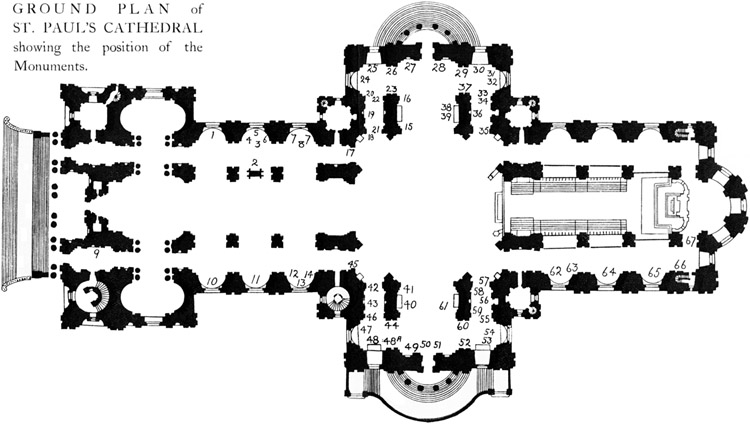
GROUND PLAN of ST. PAUL'S CATHEDRAL showing the position of the Monuments.ToList
Typographical error corrected in text:
Page 86: colonade replaced with colonnade