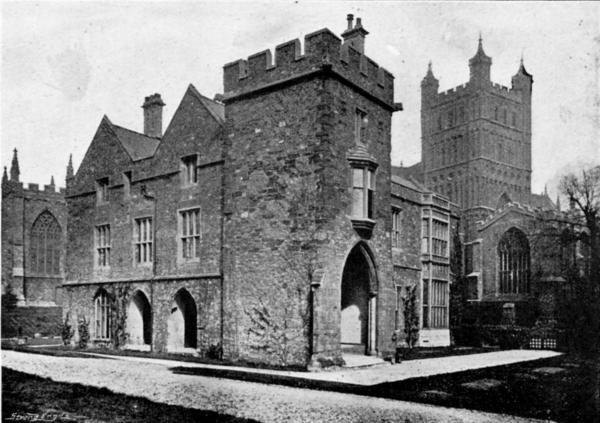
TOMBS IN THE CHOIR AND CHOIR AISLES.
Reading edition
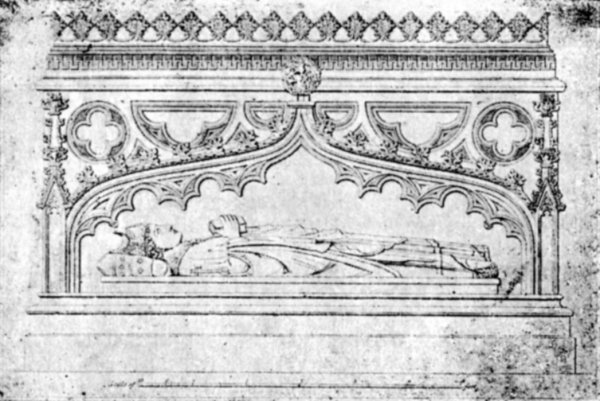
The first tomb to notice on the north side of the choir is that of the murdered bishop, Stapledon. The canopy was judiciously restored at the beginning of the century. From beneath it one observes a great image of Christ, the pierced hands raised to bless. The wounded feet stand upon a sphere, possibly to represent His dominion over the world, and an insignificant earthly king, in scarlet robes, seems to take refuge in the shadow of the Saviour. Beneath the canopy lies the figure of the bishop, grasping the crozier in his left hand and a book in his right. The keys upon his sleeve represent the arms of the see. Above the monument the arms of the bishop figure on the choir screen, and over the tombs of Lacy and Marshall the same plan has been observed. This screen was erected about the close of the fourteenth century.
Below the sacrarium, on the north, are the tombs of the Elizabethan bishop, William Bradbridge, and that of Bishop Lacy (1420-55). His arms, "Three shovellers heads erased," may be seen on the screen work above it. The tomb is despoiled of the brass that once adorned it—said to have been taken out by the Reformation Dean, Simon Hayes (who also despoiled St. Radegunde's Chapel), because pilgrims resorted to Lacy's tomb, and regarded him as a saint.
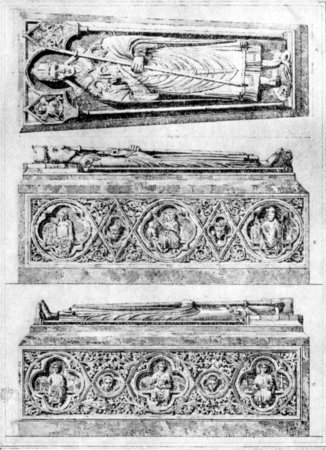
The next tomb, that of Marshall, is of peculiar interest, and it is unfortunate that a good view is not easily attainable. It has been pointed out by a specialist that the ornament on the chasuble is almost unique, reminding one of the foliage in Early English work. The medallions at the side are especially interesting.
At the west, near the Speke Chantry, is the remarkable monument, generally supposed to be the tomb of Sir Richard de Stapledon, an elder brother of the great bishop whose tragic death we have already described in the first chapter of this book. He was a lawyer and one of his Majesty's judges. Prince's quaint description of his tomb is worth quoting in full: "In a niche in the wall is a monument erected to his Memory, representing his Figure lively cut in stone sitting on horseback; where is cut out also in the same, a cripple taking hold of the foreleg of his horse: which seems to confirm the Tradition, That a certain Cripple, as Sir Richard was riding into the City of London with his Brother, lying at the gate, laid hold on one of his Horse's Fore-legs, and by crossing of it threw Horse and Rider to the Ground; by which means he was soon slain; and that from this occasion the place obtain'd the name of Cripple-gate, which it retains to this day." It is a pity so quaint a story belongs to the realm of legend, for there is no substantial proof forthcoming of its truth.
TOMB OF BISHOP STAPLEDON.
The next monument on this side is an emaciated figure, or Memento Mori, a gruesome style popular in the fifteenth century. It may have been intended for a cenotaph of Bishop Bothe, the legend, nearly erased, at the top, being the same as that on his brass in the church of East Horsley, Surrey, where he is buried.
MONUMENT OF BISHOP MARSHALL (FROM BRITTON'S "EXETER," 1826).
The monument to Anthony Harvey of Colomb John is of no great interest, being poorly designed. Its date is 1564. Harvey was steward of the abbeys of Hartland, Buckland, and Newenham at the time when the religious houses were suppressed. He is said to have amassed very considerable wealth; for, in addition to the profits derived from the spoliation of the above monasteries, he received from Henry VIII considerable lands belonging to the abbey of Tewkesbury, which he sold, probably most advantageously, to a clothier of Crediton. Harvey was connected with the Carews through the marriage of his daughter, and heiress, with George Carew, Dean of Exeter, the notorious pluralist. Their son, Harvey's grandson, was created Earl of Totnes, but died without issue.
At the west end of the south aisle is the monument of Bishop Gary (1621-26) and a mural tablet commemorating Robert Hall, eldest son of Bishop Hall, and treasurer of the cathedral. To him Exeter owes a perpetual debt of gratitude, for, when the city surrendered to Fairfax in 1646, he took down the Bishop's Throne and concealed it (buried it according to local tradition), and after the Restoration was able to re-erect in its proper place the most magnificent Bishop's throne in England.
Neither the effigy of Bishop Cotton (1621) nor the angel resting on the sarcophagus of Bishop Weston—a typical Georgian monument—are of much intrinsic merit. Flaxman's statue to General Simcox, the hero of the Queen's Rangers in the American War, is the only other notable monumental achievement in the south choir aisle.
The Peter, or Great Bell, of Exeter is said to have been a gift of Bishop Courtenay's. This opinion is very much disputed, as the Fabric Rolls show that there were bells here in the time of Edward II. As early as 1351 is an entry of 6s. for mending the Peter Bell. Again in 1453, twenty-five years before Courtenay was created bishop, mention is made of the spending of twenty pence "in una bauderick pro Maxima Campana in Campanili Boreali." Oliver, however, acutely points out that this last entry is dated the very year that Courtenay was appointed Archdeacon of Exeter, and suggests that "on that occasion he may have offered such valuable presents." On the 5th November, 1611, the bell was crazed, but was recast in 1676. Its reputed weight is 12,500 lb. If this is correct, it is the second largest bell in England. Great Tom of Christ Church, Oxford, is more than 5,000 lb. heavier, but it easily exceeds its other rivals, Tom of Lincoln and the Great Bell of St. Paul's, which weigh respectively 11,296 lb. and 8,400 lb.
The Chapter House lies at the south end of the transept beyond the Chapel of the Holy Ghost. The lower part of the room is the original building of the early thirteenth century, between 1224 and 1244, and the face of the wall is decorated with Early English arcades separated by delicate shafts. This building probably had a stone vaulted roof. Lacy heightened it, adding lofty Perpendicular windows; and the whole is completed by a rich tie-beam roof, partly the work of Bishop Bothe (1465-78), whose arms, with Lacy's, are painted on it (see p. 13). The east window, recently restored, contains many coats of arms in ancient glass. Among these is the Austrian eagle quartered with the lion of Bohemia, reminding us that Richard, Earl of Cornwall, brother of Henry III, and lord of Rougemont Castle, Exeter, was about 1260 elected King of the Romans, thus associating Exeter with the highest secular honour then known to Europe.
The Cloister.—Archdeacon Freeman thinks that originally the cloister "was confined to the east side, as a necessary communication between the chapter house and the great south door of the nave." During Stapledon's time a desire had been evinced to enlarge this cloister; and in 1323 there is a record to the effect that eight heads had been carved for vaulting the cloister. In the Fabric Rolls are entries that show the work of building proceeded with some activity and considerable cheapness. Here are a few extracts that are interesting:
"Twenty-five horse-loads of sand for the cloister, 9d. A thousand lath nails and healing pins for do. S. Clifford sculpanti 18 capites 3/9: 10 do. 2/-."
By 1342 the work was probably finished to the north, and forty years later the whole must have been completed. It has been said that the old cloister was inferior to those of Worcester and Gloucester. But they must have had considerable merit if Mr. Pearson's restoration really represents, and there is little doubt it does, the old structure.
It is curious that the cloister, certainly the least offensive and not the most beautiful part of the cathedral, should have suffered so severely at the hands of the Puritans. For on the whole the cathedral proper escaped with but small damage. Professor Freeman, in discussing the alleged desecrations suffered by St. Mary and St. Peter, after the entrance of Fairfax and his army into the city, writes thus: "The account in Mercurius Rusticus, which has given vogue to the common story is wholly untrue." He further adds: "Some fanatic soldier may, indeed, according to the story, have broken off the head of Queen Elizabeth, mistaking her for our Lady. But no general mutilation or desecration took place at this time. And at Exeter, one form of mutilation, which specially affected the west front, was not the work of enemies but of devotees. For ages the country folk who came into the city loved to carry home a Peter stone for the healing of their ailments." It is only fair to add that Archdeacon Freeman refers in very different language to the result of the occupation by the Puritans, but though the decorative portions of the cloister may have suffered, we cannot account for the disappearance of the exterior walls without a better reason for their destruction. It should be noted, however, that in the fifteenth century the Dean and Chapter bitterly complained of the conduct of the Exeter boys, who played "unlawfull games as the toppe, queke, penny pryke & most atte tenys" in the cloister, whereby they were "defowled & the glas windows all to-brost." But at this time the cathedral and municipal authorities were far from friendly to each other. Dr. Oliver writes of the ruins in his day that they "have disappeared with the exception of part of a fluted column at the west corner of the carpenter's shop." With the debris small and mean houses were built. On the 30th of October, 1657, we are given a hint as to what may have been the meaning of this wanton destruction. Apparently the ground set apart for "the convenience of the studious and contemplative" was found to have valuable attributes as a market-place, for on the above day the "Friday cloth market for serges and other drapery" was ordered to be held in this place. Commerce did not triumph for long, though, as only three years later the buyers and sellers were bundled back into South Street.
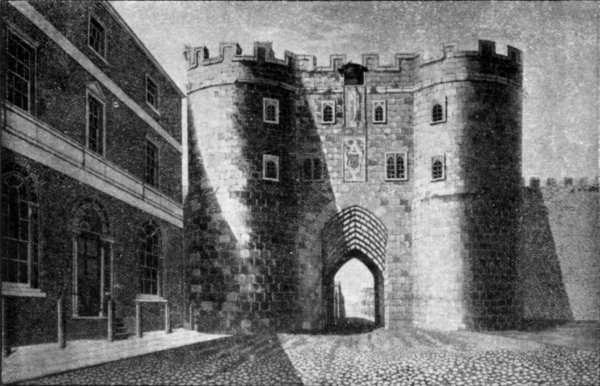
THE EAST GATE, PULLED DOWN IN 1784.
A large number of bosses and carvings of the original structure, discovered during the recent excavations, have been skilfully incorporated by Mr. Pearson in his restoration. Above the cloister is a library containing 8,000 volumes, many of them bequeathed by the late Chancellor Harrington.
The Close.—This was an important adjunct to all cathedrals in the days following the Conquest. We have seen that on one occasion at least the cathedral church of Exeter was severely bombarded, with the result that the northern tower differs considerably from the southern in places. The church, then, we may presume, was intended to be used, when necessary, as a fortress: but as it was also something else very different, this necessity was rather shunned than courted. Therefore it was customary to separate the church from the world by walls and gates of proved strength. This space so secured formed an outer fortress, against which the attacks of an enemy must, perforce, have been directed first. It placed entirely in the hands of the clergy the defence of their own church, a task they were quite capable of performing with credit; for Matthew Paris tells us of one bishop of Exeter, Bruere, that he displayed activity both "spiritual and temporal" in the Holy Land. The defence of the city, that of the sacred building being thus provided for, was the business of the captains and men-at-arms. The walls and gates of the close have vanished, without leaving a trace of their existence. One privilege, however, yet haunts the place—the corporation have no jurisdiction over it.
In the close at the north side of the cathedral has been placed a statue of Richard Hooker, the theologian (1553-1600), author of "The Laws of Ecclesiastical Polity." The "Judicious Hooker" was born in Exeter, and was a nephew of John Vowel, alias Hoker, Chamberlain and Historian of the city.
The Cathedral Library was founded by Leofric himself. One of his principal reasons for translating the see from Crediton to Exeter being his fear lest the valuable books he had collected should at any time be destroyed by raiders in an unfortified town.
When, in the beginning of the seventeenth century, Sir Thomas Bodley, himself a native of Exeter, founded the Bodleian Library at Oxford, the Dean and Chapter of Exeter presented to it a large number of books and manuscripts, many of which had belonged to Leofric. Fortunately one volume remained in Exeter, overlooked by owners then unaware of its value, possibly of its very existence. This volume, "The Exeter Book," is the greatest treasure possessed by the Dean and Chapter, being an Anglo-Saxon manuscript, containing almost a third of all the Anglo-Saxon literature that is known. The contents include "Cynewulf's Christus," a poem on the life of our Lord; some legends of saints; and a quaint collection of riddles and jokes. The ink of its writing, nearly one thousand years old, is as fresh as if it had been inscribed but recently.
As already mentioned, the muniments room was formerly above St. Andrew's Chapel. At a later date the library was placed in the Lady Chapel, and was thence removed to the chapter house. Towards the end of the last century Canon Cook and Chancellor Harrington left their valuable libraries to the Dean and Chapter, and in order to accommodate the books Dean Cowie restored the south side of the cloister, and built a new library over it.
Here may be seen the Exeter Book, the Exeter Domesday, Grandisson's Ordinale, Lacy's Pontifical, and other beautiful examples of illumination. Also the original charter of Edward the Confessor appointing Leofric Bishop of Exeter, signed by the King and Queen, Earl Godwin, and a notable group of Saxon Thanes.
Among the printed books are a First Folio of Shakespeare, and the sealed Prayer Book of King Charles II.
The library is open to the public after Matins on Tuesdays and Fridays.
The Palace is a building so closely associated with the cathedral as to demand a brief notice. In it is the chapel of St. Mary, which seems to have been frequently used in preference to the cathedral for the celebration of espiscopal functions. Ordination services were often held within its walls. It was originally built that services might be said there for the repose of the souls of dead bishops of Exeter. A document is quoted by Oliver, in which the parish of Alwyngton is called upon to pay the officiating chaplain a yearly sum of four marks and that of Harberton two. This chapel, now restored, is used for domestic purposes. But at one time it was clearly regarded as pertaining to the cathedral, for the Dean and Chapter, on the festival of St. Faith, presented to it a pair of wax candles. Brantyngham, in 1381, mentions the "fructus et proventus cantariae infra Palatium nostrum Exonie, pro animabus predecessorum nostorum ipsius fundatorum." The old entrance was under the great archway, and battlements, by gracious permission of royalty, surrounded the whole. In the great hall feasts were held for 100 poor people; but the palace now is shorn of a good deal of its grandeur. The Ecclesiastical Commissioners in 1845 decided to rebuild and repair what remained.
THE BISHOP'S PALACE.