Chapter III · ToC (continued 2)
Reading edition
This tomb was formerly ascribed to George, Duke of Clarence, and also to Thomas Despenser. The arms on the tabard, however, settle the question definitely. If further confirmation be required apart from the style of the architecture and the arms, Leland writes: "Hugo le Despenser tertius ... sepultus est apud Theokesbury juxta summum altare in dextera[26] parte." Of the Lady Elizabeth he says: "Sepulta est juxta Hugonem maritum apud Theokesbury."
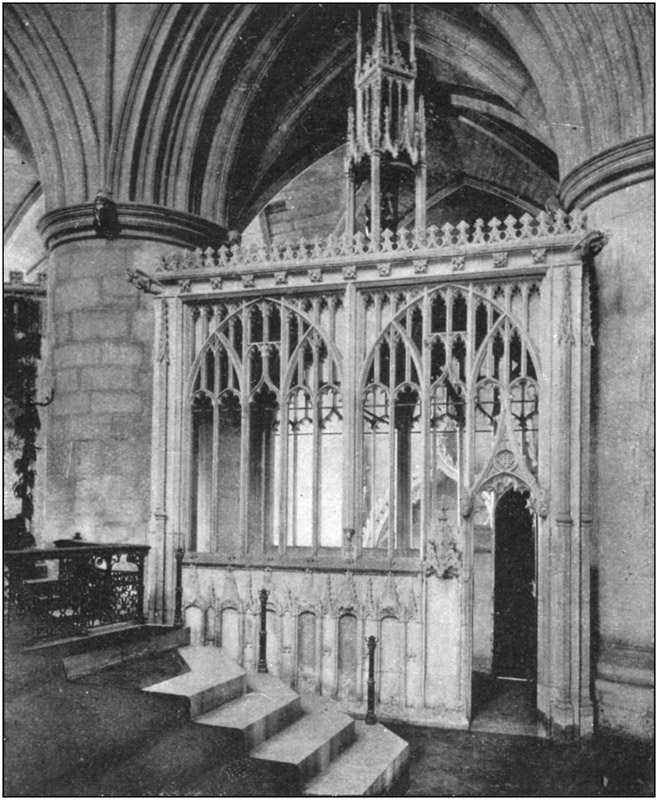
Trinity Chapel.—On the south side of the choir in the bay opposite to the Founder's Chapel is the Trinity Chapel [K], the building of which is ascribed to Elizabeth, Lady de Burghersh, the widow of Edward, Lord Despenser. Lord Despenser died at Cardiff in 1375, and was buried before the door of the vestry, near the presbytery. His widow, who died many years later (1409), was buried beside her chapel in the choir.
(H.J.L.J.M.)
THE TRINITY CHAPEL.ToList
The tomb has many beauties, of which the chief is the fan-tracery. Much damage has ruthlessly been done to the niches and canopies at the side.
A curious feature in the chapel is the figure of Lord Despenser under a canopy on the top of the chapel, kneeling in prayer, with his face turned towards the high altar. The canopy is very rich, supported by four slender shafts, and further enriched with carved pinnacles. The figure is probably unique, in such a position.[27] It is represented as wearing the martial equipment that was usual towards the end of the fourteenth century.
This chapel may have been built by the same builders as the Founder's Chapel on the opposite side of the choir, but some variety of treatment is very noticeable. The cresting is different in scale on the two sides (portions of it are modern insertions). Owing to the non-correspondence of the panelling in the lowest portion with the open work in the next tier, it has been thought that the upper portion is slightly later in point of date than that upon which it is built.
The chapel derives its name from its dedication to the Trinity as well as to St. Mary. At the east end of the chapel are traces of mural painting. Some of these represent the symbols of the Trinity, others the coronation of the Virgin Mary.
Other tombs of interest in the church will be found in making the circuit of the ambulatory. The first of these is the tomb of Sir Guy de Brien [D]. It has a central position in the stone screen-work which separates the chapel of St. Margaret from the north ambulatory. Sir Guy married Elizabeth, the widow of Hugh, Lord Despenser. The tomb is very similar in design to the Despenser tomb over against which it is placed. The knight is represented at full length, clad in his armour, with a lion at his feet. A vault-like canopy, still showing traces of the blue paint with which it was decorated, rises over the effigy. The monument is very lofty in proportion to its width, is full of rather heavy detail, and, though worthy of careful inspection, will not bear comparison with the Despenser tomb opposite.
The knight's lady elected to be buried in the tomb of her second husband, Lord Hugh Despenser, who, like Sir Guy, was a liberal benefactor to the Abbey.
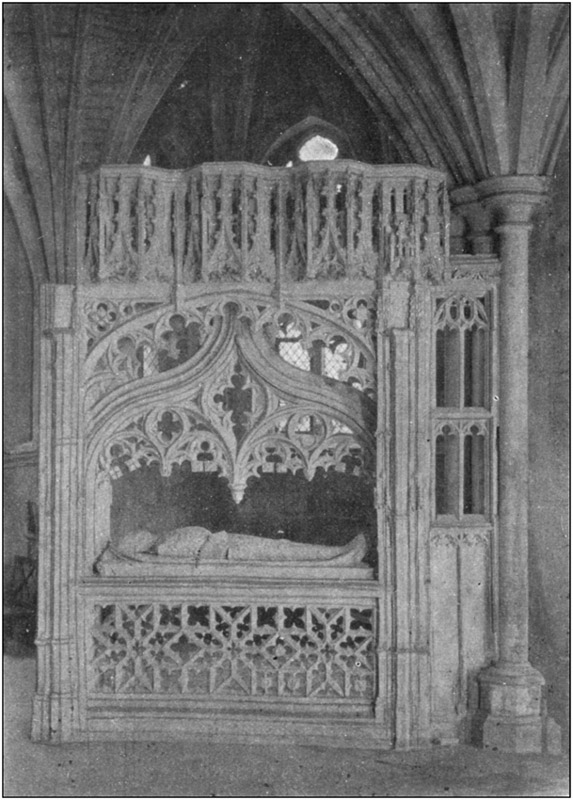
Photo. A.H. Hughes.
THE "WAKEMAN CENOTAPH."ToList
Three panels facing the aisle have shields with arms upon them. The central shield bears the arms of Sir Guy de Brien, and the other two bear his arms and those of the Montacutes, his wife having been Elizabeth Montacute.
The next chapel, that of St. Edmund, contains, lying across the eastern half of the entrance, a magnificent tomb which goes by the name of the Cenotaph of Abbot Wakeman [E]. It is not known when the tomb was built, but it is apparently earlier than Wakeman's time, who was abbot from 1531 to the dissolution of the monastery in 1539. Certainly Wakeman is not buried here, for he became the first bishop of Gloucester, and was buried at Forthampton.
The tomb is peculiarly beautiful, and consists of a slab supported by a rich piece of open or pierced work, in the pattern of which may be seen three crosses. Upon the slab rests a representation of the corpse of a monk undergoing the process of decay, and being devoured by various lizards, snails, &c. It is rather a gruesome subject for contemplation, reminding one of some of the drawings in the Dance of Death at Basle. Immediately over the body, in the centre of the tomb, is a massive ogee arch, richly foliated, from which descends a rather cumbrous pendant—itself ogee in form—which divides the main arch into equal parts, or arches, with rounded heads. These arches are again subdivided into two smaller round-headed arches, full of very fine carved work.
The front of the tomb, as seen from the ambulatory, is composed of a very fine arch which springs from the piers at the side. Its lower edge is foliated, and the spandrils are enriched with quatrefoils.
At the top of all is a projecting canopy in three main sections—a portion of the rest is gone—all of very delicate and intricate carved work.
In the south ambulatory in the middle one of the three chapels there is a tomb to Richard Cheltenham [I], who was abbot from 1481-1509. It is a table tomb in the Perpendicular style, with very rich tracery enriched with quatrefoils and shields. A depressed arch forms a canopy, in the spandrils of which are the abbot's initials R.C. and his pastoral staff.
Almost opposite to this is a depressed arch which supports a mass of delicate work decorated with vine-leaves and grapes. Over this are many canopied niches (much mutilated). The images they once contained have been destroyed. Under the arch is now a coffin of Purbeck marble, with a cross on the lid, and the inscription "Johannes Abbas hujus loci."
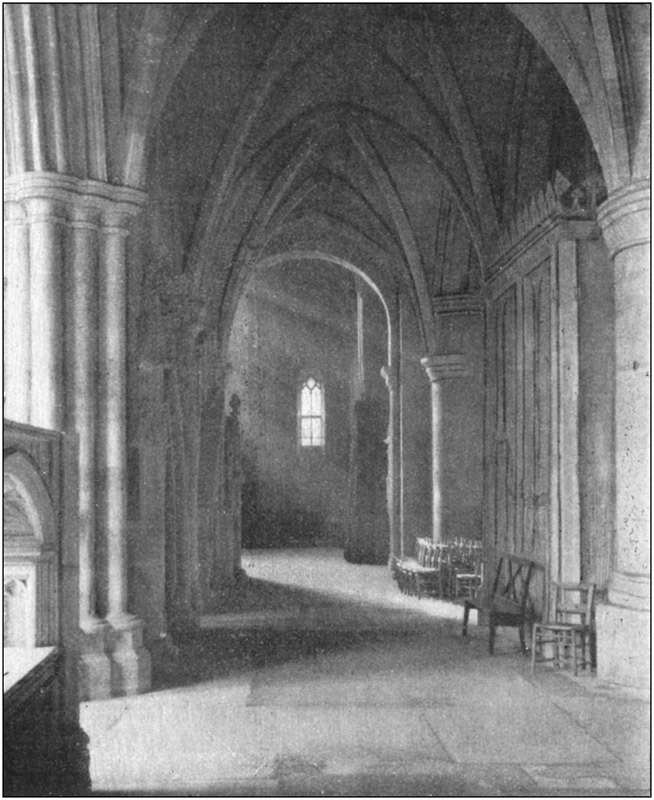
Photo. A.H. Hughes.
THE SOUTH CHOIR AISLE, LOOKING WEST.ToList
It is generally assumed that this is the coffin of John Cotes, who died in 1347. The tomb [H] is supposed to be that referred to by Leland as that in which some of the remains of Hugh Despenser the younger, the Earl of Gloucester who was hanged and quartered in Hereford in 1326—just three months before the murder of Edward II. in Berkeley Castle—were interred. Close to this tomb, but more to the east, is a fifteenth century tomb, presumably that of an abbot, but his name is unknown.
To the east of the door of the chapel which is now used as a vestry, is another tomb of an unknown abbot. The coffin lid bears a rich floriated cross, with a representation of an abbot at the one end, and that of a lamb at the other. The arch over the tomb is crocketed, and is enriched with a profusion of ball-flower ornament in the moulding. The finial is very heavy, though beautifully wrought to represent birds and foliage. At the spring of the arch is the very curious figure of a devil. Two pinnacles[28] at the sides have most grotesque faces at the corners instead of the conventional foliage. This idea has been adopted in the decoration of the tomb-recesses in the nave in Bristol Cathedral.
On the western side of the vestry door is a beautiful Early English tomb. The lid of the Purbeck marble coffin is inscribed "Alanus, Dominus Abbas" along the moulded edge, and a similar inscription is to be read at the right-hand end, "HIC IACET DOMINUS ALANUS ABBAS." This is the tomb of Alan, who was made Abbot here in 1187, after having previously been Prior at Canterbury. He was one of the most distinguished of the Abbots of Tewkesbury: he had known Thomas à Becket, and indeed wrote his biography. This tomb is no doubt the oldest monument in the church. The arch over it is a moulded trefoil arch, surmounted by a plain canopy of very simple and formal design. The top of the coffin bears a very beautiful cross.
Further westward, near to the south transept is a thirteenth century recessed arch, with pinnacles at either side and a decorated arch. The tomb has been removed. The floor has been laid with fragments of old encaustic tiles removed from other parts of the building.
Organs.—The church has two organs, both of which are noteworthy, viz., the old organ in the choir, of which the interest is historical, and the Grove organ in the north transept, the chief interest in which, apart from its tone, is the perfection of its many modern mechanical contrivances.
The organ in the choir was brought to Tewkesbury in 1737 from Magdalen College, Oxford, and was placed on the then existing screen, where it remained till 1875. It was built by John Harris, the grandfather of Réné or Renatus Harris, for Magdalen College, Oxford. By Cromwell's orders it was removed to Hampton Court, and is said to have been played upon there by Milton, who was Cromwell's Secretary. In 1660 the organ went back to Oxford, and was repaired in 1672. In 1690 Renatus Harris contracted, for £150, to put it into thorough repair, and make it "an extraordinary instrument and the best old organ in England." In 1736-37 the Magdalen College organ was sold to the then organ committee of Tewkesbury.
Sixty years later (1796) a sum of £186 18s. 2d. was spent in painting the case, in repairs, and in the addition of a swell organ; and in 1848 it was enlarged by Willis at a cost of £322 15s. 8d. Little of the original work remains, with the exception of some of the diapasons, the principal, and the tin pipes in the choir front. The old organ is in constant use for ordinary evening services, and for the services on Sunday mornings and afternoons. For the Sunday evening services the Grove organ is generally used. Sometimes the two organs are used together.
The Grove organ is a very fine instrument, but it is more fitted for a concert-room than for the accompaniment of ordinary church music. It was given, as the brass tablet sets forth, "To the greater glory of God, and to commemorate the Jubilee of the Queen in 1887." The specification is as follows:
Choir Organ (CC to C in alto., 61 notes).
1. Spitzflöte 8 ft.
2. *Viole Sourdine 8 ft.
3. *Lieblich Gedacht (w) 8 ft.
4. Gemshorn 4 ft.
5. *Zauber Flöte 4 ft.
6. Flautina 2 ft.
7. Clarionet 8 ft.
Accessory Stops.
1. Ventil.
2. Octave Coupler.
3. Pneumatic Piston, acting on No. 1 off and on.
4. Swell to Choir.
5. Tremulant.
Great Organ (CC to C in alto., 61 notes).
1. Violone 16 ft.
2. Great Open Diapason 8 ft.
3. Small Open Diapason 8 ft.
4. Claribel (w) 8 ft.
5. Octave 4 ft.
6. Flute Octaviante 4 ft.
7. Quint Mixture, 12, 15.
8. †Great Mixture (4 ranks), 19, 22, 26, 29.
9. †Tromba 16 ft.
10. †Trumpet 8 ft.
Accessory Stops.
1. Sub-Octave Choir to Great. 2. Swell to Great. 3. Solo to Great.
1. Ventil Flue to Quint Mixture.
2. Ventil Flue Great Mixture and Reed.
Two Pneumatic Pistons acting on Ventil placed beneath the keys as in the Choir.
Three Composition Pedals.
Swell Organ (CC to C in alto., 61 notes).
The swell-box is made in three thicknesses, each of one inch. Between each thickness is a layer of felt.
1. Flauto Traverso 8 ft.
2. Open Diapason 8 ft.
3. *Viole d'Orchestre 8 ft.
4. *Voix Celeste 8 ft.
5. Geigen 4 ft.
6. †Mixture—3 ranks, 15, 19, 22.
7. †Contra Posaune 16 ft.
8. †Horn 8 ft.
9. Oboe 8 ft.
Accessory Stops.
Octave Coupler. Ventil Flues to Geigen, Mixture, and Reeds.
Two Pneumatic Pistons acting on Ventils, as in the Great Organ.
Tremulant. Three Composition Pedals.
Solo Organ (CC to C in alto., 61 notes).
1. Harmonic Flute 8 ft.
2. *Violoncello 8 ft.
3. †Tuba 8 ft.
4. Voix Humaine (metal, enclosed in a Swell-box) 8 ft.
Accessory Stops.
Octave Coupler. Tremulant.
Two Ventils, two Pneumatic Pistons, as in the other manuals.
Pedal Organ (CCC to F, 30 notes).
1. *Harmonic Bass (w) 32 ft.
2. Great Bass (w) 16 ft.
3. *Dolce Bass (w) 16 ft.
4. Great Flute (w) 8 ft.
5. †Bombarde 16 ft.
* Stops thus marked are of novel construction, being fitted with prolongement harmonique. † Stops marked thus are on heavy wind. w Stops marked thus are of wood.
Pedal Couplers: 1. Choir to Pedals. 2. Great to Pedals. 3. Swell to Pedals. 4. Solo to Pedals. Manual Couplers: 1. Choir Octave. 2. Swell Octave. 3. Solo Octave. 4. Choir Sub-Octave to Great. 5. Swell to Great. 6. Solo to Great. 7. Swell to Choir.
The Tremulants are set in action by one pedal, or by the use of the draw-stops, separately or collectively.
Pneumatic action is applied to the Organ throughout, except to the Choir Organ, which is direct action.
Church Plate.—The oldest pieces of plate are two silver chalices, one dated 1576, the other 1618. There is also a paten of the latter date. A flagon weighing 54 ounces was given to the church by the bachelors and maidens of the borough in 1688, and another was given in 1724. Curiously they are both fitted with whistle-handles. There are also two cut-glass cruets, said to be of the fifteenth century.
The Church Registers.—These date from 1559, containing baptisms to 1598 and marriages to 1574, but are copies on parchment of an older register (on paper) now lost. Another register, on paper, dates from 1595, and contains baptisms down to 1610, marriages to 1629, and burials to 1608. Thenceforward, with few exceptions, the registers are complete. The register of baptisms, 1607-1629, contains a quaint composition:
"Lo, heare thou maiest with mortall eie beholde Thy name recorded by a mortall wighte; But if thou canst looke but spiritualie Unto that God which gives such heavenly sighte Thou maiest behold with comfort to thy soule Thy name recorded in the heavenly roule. And therefore praie the Register of heaven To write thy name within the booke of life; And also praie thy sinns maie be forgeven, And that thou maiest flee all ceare and strife: That when thy mortall bodies shall have end, Thy soule maie to the immortal bliss ascende.
"Per me, Guilielmus Parke, 1609."
Arms of the Abbey.—The arms are gules, within a border argent, a cross engrailed or, and are so given by Willis in his Seals of Parliamentary Abbeys, and by Tanner in Notitia Monastica. In Sir Charles Isham's copy of the Registrum Theokusburiæ, in a window in the choir, and also on the old organ the border is omitted. It is also a disputed point whether the Abbot was a mitred prelate or not. Fuller, in his Church History, is in doubt about it, while Bishop Godwin admits that some of the Abbots sat in Parliament. The Abbots, without enjoying any prescriptive right, were summoned to Parliament in the reigns of Henry III., Edward I., and Edward II., and the last Abbot (Wakeman) was certainly summoned as a mitred Abbot. It may be that the Abbot received the dignity in the time of Abbot Strensham, who died in 1481.
Old Tiles.—In the Founder's Chapel (1397) are some tiles containing the arms of Fitz-Hamon (a lion rampant), impaled with the arms of the Abbey, a cross engrailed, and showing the head of a crosier above the shield in the centre. In the Warwick chantry there is to be seen a set of tiles with the arms of Richard Beauchamp, Earl of Worcester, in whose honour the chapel was built. The arms are a fess between four crosslets with a crescent for difference. There are also some in the Trinity Chapel, showing the arms of the Despensers, impaled with those of Burghersh. Other tiles found in the church at different times give the arms of De Clare, Despenser, Berkeley, De Warrenne, De Bohun, Corbet, and De la Zouch.
ABBOTS OF TEWKESBURY.
Giraldus (1102-1109), previously Abbot of Cranbourn, was the first Abbot of the Benedictine foundation. Deprived by Henry I. in 1109.
Robert I. (1110-1124). In his time the greater part of the Abbey as it stands was finished, and dedicated in 1123.
Benedict (1124-1137).
Roger (1137-1161).
Fromundus (1162-1178). No new Abbot was instituted till—
Robert II. (1182-1183).
Alan (1187-1202). His tomb is in the south ambulatory of the choir. He was a friend of Thomas à Becket, having previously been Prior of St. Saviour's, Canterbury.
Walter (1202-1213), previously Sacrist of the monastery. He was succeeded by—
Hugh (1214), who had been the Prior. Dying in a year, his successor was Bernard, but the latter was never instituted.
Peter (1216-1231) was a monk from Worcester.
Robert Forthington (1232-1254), or Robert III. had previously been Prior. A tomb ascribed to him is in the south ambulatory.
Thomas de Stokes (1254-1275) had been Prior of St. James, Bristol.
Richard de Norton (1276-1282).
Thomas Kempsey (1282-1328).
John Cotes ( -1347).
Thomas de Legh (1347-1361).
Thomas Chesterton (1361-1389).
Thomas Parker, or Pakare (1389-1421).
William Bristow, or de Bristol (1421-1442).
John de Abingdon (1442- ), who was probably identical with
John de Salis, or Galys.
John Strensham, or Streynsham ( -1481). He was Abbot at the time of the Battle of Tewkesbury.
Richard Cheltenham (1481-1509).
Henry Beoly, or Bealy (1509- ), was Abbot in 1526.
John Walker (d. 1531).
John Wich, Wyche, or Wakeman (1531-1539). This ecclesiastic was the last Abbot of Tewkesbury. He, unlike the Abbot of Gloucester, seems to have been in no wise unwilling to surrender his Abbey. In return he obtained a pension of £266 13s. 4d., and also the house and park at Forthampton. When, later, Gloucester was made a bishopric, he was the first bishop. He was buried at Forthampton.