Chapter IV · ToC
Reading edition
CHAPTER IVToC
THE DIOCESE OF SOUTHWARK
The two dioceses with which St. Saviour's Church and parish have hitherto been associated are Winchester and Rochester. The former was originally one of the largest in England, extending as it did in one direction from the south of London to the Channel Islands; the latter the smallest of all, covering only a portion of the county of Kent. Various changes have been made from time to time in the area of both in attempts to equalise the duties of their Bishops, and to meet other altering conditions. Of these changes the first that concerns us was that made in August, 1877, when the parishes wholly or partly within the parliamentary divisions of East and Mid Surrey (with two exceptions) were transferred from the dioceses of Winchester and London to Rochester. The Borough of Southwark, including St. Saviour's Church, was thus brought from the jurisdiction of the first to the last of these dioceses. In the following year the portion of Surrey included in the transfer was formed into the new Archdeaconry of Southwark; and a few months later (August, 1878) the patronage of the benefices thus transferred, and hitherto held by the Bishops of London and Winchester, was vested in the Bishop of Rochester. In 1879, in 1886, and again in 1901, the Rural Deaneries of Rochester were rearranged, thus shifting more or less the boundaries of the Southwark Archdeaconry. But the area of the Rochester Diocese was left undisturbed till 1904, when "the Southwark and Birmingham Bishoprics Act" of that year allowed the Diocese of Southwark to be formed out of it. St. Saviour's had been popularly known as a pro-Cathedral for some years previous to 1905, when it was formally constituted the Cathedral of Southwark. The architecture of the fabric, with its long history and associations, had long pointed to this fine church for the purpose, for which it was further prepared by Sir Arthur Blomfield's restoration, begun in 1890.
Dr. Anthony Wilson Thorold was appointed to the See of Rochester in 1877, and translated to Winchester in 1891. It was, therefore, in his time that the first diocesan changes affecting St. Saviour's were made, and the restoration of the church was actively taken in hand. By far the most important part of this work was the rebuilding of the nave, which he had the satisfaction of seeing well advanced before his translation. Some of his predecessors had become alive to the necessity of reducing the onerous duties of the See, but it was left to him to give effect to their wishes by the creation of the Archdeaconry of Southwark, with an eye to its forming the nucleus of a separate diocese. His successor, Dr. Randall Thomas Davidson, now Archbishop of Canterbury, lent his full energies to the work thus begun, in which he was ably supported by the Suffragan Bishop of Southwark, Dr. Huyshe Yeatman-Biggs, consecrated in 1891 and promoted to the See of Worcester in 1905 in consequence of the episcopal changes brought about by the Act of Parliament just mentioned. Before Dr. Davidson's removal to Winchester in 1895, besides supervising the restoration of Rochester Cathedral, he was able to do a good work more directly concerning the Southwark Diocese, in the erection of the Bishop's House by Kennington Park. The funds were provided by the Ecclesiastical Commissioners from the sale of Danbury Palace, hitherto the residence of the Bishops of Rochester, but now disposed of as inaccessible and otherwise inconvenient. In place of it the new house was built in the heart of the most thickly peopled part of the diocese, within the Southwark Archdeaconry, and probably in view of its ultimately becoming the residence of the Bishop of Southwark. Dr. Davidson himself was not destined to occupy it, as it was not finished till he was on the eve of translation. On 12th November, 1895, Edward Stuart Talbot was enthroned as his successor in the See of Rochester, and at once took up his abode at Kennington, where he will continue to live at this easy centre of communication between him and his people now that he is Bishop of Southwark.
It will be seen from the accompanying map that the new diocese has been made to include the whole of the county of London south of the Thames, and the Archdeaconry of Kingston, thus reducing the area of Rochester to about half its previous size and relieving it of its most thickly crowded portion.
The population of the diocese of Rochester at the census of 1901 was 2,254,947. The population of the Southwark Diocese at the present time is roughly estimated at 2,000,000, rather more than less. It consists of 294 parishes, ministered to by 687 licensed clergy, or about one to every 3,000 people, except in South London, where the proportion is about one to every 4,000.
Bounded on the north by the Thames, on the east, south, and west by the dioceses of Canterbury, Chichester, and Winchester respectively, the space enclosed presents an irregular figure varying from some three miles in breadth, in its central portion, to about thirteen along its southern frontier, and about twenty in its widest part towards the north. Its greatest length in a straight line from London Bridge to Felbridge is about twenty-five miles. Geographically the map suggests a couple of small continents joined together by a sort of isthmus in the middle, where the breadth is narrowed by the sweeping bays, or inlets, formed by the encroaching dioceses on the right and left.
By Letters Patent, dated 17th May, 1905, Dr. Edward Stuart Talbot, previously Bishop of Rochester, was appointed to the newly-founded See of Southwark. For its better organisation he lost no time in applying to the Crown for the appointment of two Suffragan Bishops, suggesting one for Woolwich, as a place of great national importance and a centre of vigorous municipal and industrial life; the other for Kingston, as representing the ancient and rural side of the diocese. By the approval of His Majesty the appointments were made in the same month, viz.: the Rev. John Cox Leeke, Hon. Canon of Rochester Cathedral and Rural Dean of Woolwich, to be Bishop Suffragan of Woolwich; and the Rev. Cecil Hook, Vicar of All Saints', Leamington, and Hon. Canon of Worcester Cathedral, to be Bishop Suffragan of Kingston-on-Thames.
In one sense the most important difficulty to be overcome in the formation of the new diocese was the raising of the capital to provide for the endowment, a sine qua non to the Parliamentary sanction. The requisite sum was provided by voluntary contributions, great and small, throughout the undivided diocese of Rochester, and throughout the country; not the least interesting item being the "shilling fund," promoted by the Rev. T.B. Dover, Vicar of Maiden, which resulted in an Easter offering of exactly £2,200. The capital was brought up to £109,000 by the time the new appointments were made. It is intended to provide a minimum income of £3,000 for the Bishop of Southwark, and a house for his successor in the See of Rochester, in lieu of the house at Kennington Park, transferred from the old to the new diocese. The funds of the latter have since been augmented by a grant of £25,000 from the Bishop of London, out of the compensation money (£100,000), paid by the City and South London Electric Railway Company for undermining the City Church of St. Mary Woolnoth in order to build a station. This sum of £25,000 is specially destined for church extension, and Dr. Talbot set apart £2,000 of it, directly it was granted, for that purpose in the Woolwich area.
Mr. Harry Lloyd, of Woodlands, Caterham, is acting as Hon. Treasurer to the fund which has been opened for the complete equipment of the diocese.
The Cathedral Church of St. Saviour is as yet without endowment, and depends entirely upon voluntary offerings for its expenses. These were estimated on the average at about £2,500 till last year, when the cost of maintenance amounted to £3,096, besides which about £350 was required for the College of Clergy. Attention was called to this matter by the Ven. Archdeacon Taylor during his Visitation held in the Cathedral on 25th May, 1905, when he made an earnest appeal to the church people of the diocese for their help and sympathy on behalf of the Cathedral, the Bishop and his Suffragans, and all concerned in the work.
The duties before them, in the arrangement and control of the various elements of which the diocese is composed, will obviously not be light, but ought to be extremely interesting and rewarding. They will have to deal with extremes, which may there be said to meet, in a combination of rural and urban, ancient and modern, commercial, industrial, and aristocratic life, a variety in unity such as the Catholic Church itself presents, of which the diocese may be regarded as a miniature.
"In veste varietas sit: scissura non sit."
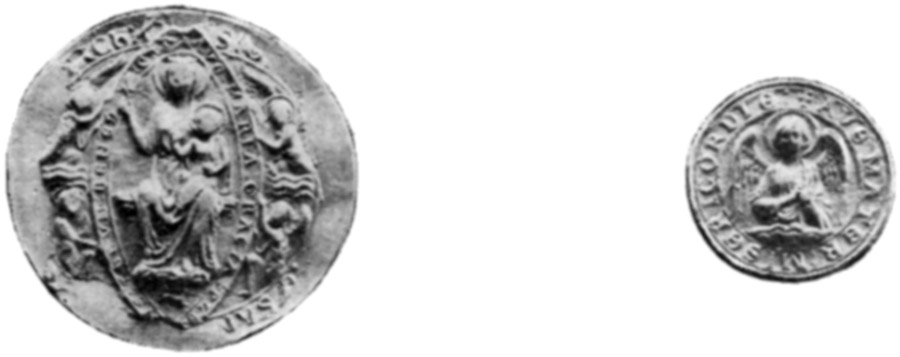
THE PRIORY SEAL. OBVERSE. REVERSE.ToList
APPENDIX
IToC
List of the Priors of St. Mary Overie
Appointed.
1. Aldgod 1106
2. Algar 1130
3. Warin 1132
4. Gregory 1142
5. Ralph 1150
6. Richard 1154
7. Valerianus 1163
8. William de Oxenford 1189
9. Richard de St. Mildred 1203
10. William Fitz Samari 1205
11. Martin 1206
12. Robert de Oseney 1218
13. Humphrey 1223
14. Eustachius 1240
15. Stephen 1253
16. Alan 1266
17. William Wallys 1283
18. Peter de Cheyham 1306
19. Thomas de Southwark 1326
20. Robert de Welles 1331
21. John de Peckham 1348
22. Henry Collingbourne 1359
23. John Kyngeston 1395
24. Robert Weston 1397
25. Henry Werkeworth 1414
26. John Bottisham 1452
27. Henry de Burton 1462
28. Richard Briggs 1486
29. John Reculver 1491
30. Richard Michell 1499
31. Robert Shouldham 1512
32. Bartholomew Linstede (alias Fowle) 1513
The last-named surrendered the Priory to Henry VIII in 1540, when he was granted a pension of £100 per annum, and the use of a house within the close. The aggregate granted to the other annuitants (eleven in number), amounted to £70. The pensions were to be paid half yearly. The annual value of the Priory at the surrender was estimated at £656 10s., from which "Reprisals," amounting to £32 3s. 6d., were deducted by the Commissioners, leaving £624 6s. 6d. net.
IIToC
The Priory Seal
The impressions given (p. 103) are taken from a fine, but imperfect, sulphur cast in the British Museum (4050 lxxii, 66 and 67) of the Seal in use in the twelfth century. It is circular, about 2-3/8 inches in diameter, and contains, within a vesical compartment, a figure of the Blessed Virgin, seated on a carved throne, holding a fleur-de-lis in her right hand, and supporting with her left the Infant Saviour upon her knee. The Holy Child is distinguished by a cruciform nimbus, while that of the Virgin is a plain circle. The Child is raising the right hand in benediction, and holds in the left an orb. The vesica is bordered with a double dotted line, containing the salutation: "Ave: Maria: gracia: plena: Dñs: tecum: benedicta." A similar border, immediately within the circumference, holds the legend: "Sigillum ecclesie sancte Marie de Suthewercha."
The space between the circumference and the vesica is occupied on each side by two angels, with expanded wings, those above issuing from waves, those below kneeling.
The reverse contains a small counterseal, 1-3/8 inch in diameter. The figure is an angel, with nimbus and expanded wings, issuing from waves, with (probably) an orb in the hands.
The inscription: "Ave: Mater: Misericordie."
It may be mentioned that the design of the seal varied with different Priors. The British Museum possesses several casts, and an original in red wax (attached to a deed), the design on which is indistinguishable. The specimen chosen appears to be the most interesting and elaborate, though not the most ancient, of those in the collection.
IIIToC
List of the Chaplains of St. Saviour's
(Compiled by the Rev. Dr. Thompson, and here reproduced by his permission.)
Appointed.
1. Rev. Kelle 1563
2. James Holyland 1564
3. Harman 1565
4. Styles 1578
5. Smythe 1582
6. Pattersle 1585
7. Hansonne 1585
8. Thos. Rattdcliffe 1585
9. M. Ed. Philips 1589
10. Butterton 1599
11. Marberry 1601
12. Currie 1603
13. Knapp 1604
14. Snape 1604
15. Church 1605
16. Symonds 1605
17. Francis 1606
18. James Archar 1614
19. Dr. Thomas Sutton 1615
20. Harris 1623
21. P. Micklethwaite 1625
22. Rev. Nicolas Morton 1627
23. Stephen Watkins 1654
24. Robert Knightly 1656
25. Dr. William Hoare 1678
26. Dr. Samuel Barton 1687
27. Dr. H. Sacheverell 1705
28. Dr. Thomas Horne 1709
29. Wainford 1724
30. Dr. Benj. Slocock 1725
31. John Smith 1729
32. Thomas Jones 1753
33. William Day 1762
34. Sambrook Russell 1768
35. Philip Batteson 1769
36. W. Winkworth 1794
37. W. Mann 1804
38. Thomas Bird 1807
39. Dr. W. Harrison 1808
40. W. Curling 1833
41. S. Benson 1843
42. Dr. W. Thompson 1879
Note.—An interval of over twenty years will be noticed between Nos. 24 and 25, during which the names of other "Ministers" appear in the Registers.
It was the rule for two Chaplains to be in office at once till 1881, when Dr. Thompson was made sole Chaplain. In 1885 he was appointed Rector, and in 1897 Canon and Chancellor of the Collegiate Church.
The Rev. Mr. Kelle was dismissed in January, 1564, for refusing to wear a surplice at the Communion; but in consideration of his old age he was presented with the sum of £4, "by the good wyllys" of the Vestry and Churchwardens.
Messrs. Holyland and Harman were then elected, as of a more compliant temper, their "wages" being fixed at £20 a year "and not the christenings, and to leave at a fortnight's warning." Mrs. Holyland was to receive "for her wages" ten shillings.
By far the most prominent in the list is Dr. Sacheverell. The two sermons which led to his impeachment were preached at the Derby Assizes on 15th August, and at St. Paul's Cathedral on 5th November, 1709. These, with his published Answer and the Speech in his Defence, delivered at Westminster Hall on the 7th March, 1710, are still exciting reading.
IVToC
Vestments, Plate, and Ornaments at St. Saviour's[33]
An examination was made on the 20th October, 1552, by the agents "assigned and appointed by the Commissioners, and by them sworn truly to enquire and find out the whole of all such plate, jewels, and ornaments, as since the beginning of the King's reign that now is belonged to the Church of Saint Saviour in Southwark, as far as in them lieth."
The duty of the agents involved a comparison of the goods which they actually found in the church with the existing inventories, the most important of which was the inventory made on 26th February, 1548, by the retiring Wardens, and handed to their successors in office with the property transferred to their care at the same time. The contents of this inventory are as follows; the entries, however, have been shortened and the spelling modernised:
Two principal copes of blue tissue "with priest, deacon, and sub-deacon, with all their apparel."[34]
Three other principal copes of the same material with ut supra.
Three principal copes of red tissue with ut supra.
A cope of cloth of gold with ut supra (lacking two albes and two head-pieces).[35]
A cope of blue velvet embroidered with flowers with ut supra.
Three copes of white camlet embroidered with flowers with ut supra (lacking two head-pieces and two "fannelles").[36]
Three copes of white damask, with holy-water "sprynkes" with ut supra.
A cope of white damask with flowers.
A cope of blue tinsel.
A cope of red worsted with flowers, and his vestment of the same, and a deacon of red damask, lacking an albe.
A cope of blue worsted with l. and x.
A cope of silk "bawdekyn"[37] for Sundays.
A cope of black worsted with priest, deacon, and subdeacon, with all their apparel.
Two "desk-cloths"[38] of blue with x. and l.
Two "desk-cloths" of silk with images.
A cope of white tissue given by "Maister Fowle."[39]
Workday Vestments.[40]
A vestment of red damask with an albe.
A vestment of red velvet with a green cross.[41]
A vestment of blue velvet with x. and l. and his albe.
A vestment of red velvet embroidered with moons and stars.[42]
A vestment of satin of Bruges, with a green cross, and a picture of Our Lady and her Son.
A vestment of red "bawdkyn," with a lion of gold.
A vestment of "bawdkyn," with a crucifix.
A "cross-cloth"[43] of purple damask, with an image of the Trinity of gold.
A "cross-cloth" of the same material, with St. Margaret.
A "cross-cloth" of green sarcenet, with the Assumption of Our Lady in gold.
Two "lawnes" for the cross,[44] one blue and one white, both fringed with gold.
Two "canabye-cloths,"[45] one of cloth of gold, the other of blue velvet with flowers of gold, both fringed.
Seven corporas-cases.[46]
A fore front of cloth of tissue.
Two pieces of blue velvet, with flower-de-luces.
A fore front of white damask embroidered.
Two cloths of tissue for the High Altar.
A fore front of red worsted.
A cloth of red and blue to hang over the table of the High Altar.[47]
A veil for Lent in the chancel.
Two hangings for Our-Lady altar (above and beneath) of red tissue.
Hangings for the same altar[48] (above and beneath) of white and green damask embroidered with flowers.
Hangings of the Trinity altar, of red damask with flowers of gold.
Hangings of red silk for the same altar, with a picture of the Trinity and Our Lady.
Another hanging of white taffata, with the Passion of Christ.
A black hearse-cloth[49] of worsted, with a white cross.
St. John's Altar.
Hangings, above and beneath, of cloth of gold.
Two hangings of blue damask embroidered.
Two hangings of white chamlet embroidered with flowers.
Hangings of russet sarcenet embroidered with "iij levyd gresse."[50]
One hanging of "dornyx."
Banner-cloths.
Two streamers of sarcenet, one blue, the other green.
Fourteen "cross-cloths," banner-cloths of all sorts, good and bad, silk and other.
Altar-cloths, etc.
Eight altar-cloths of diaper, and four plain.
Nine surplices.
Three towels—two of diaper and one plain.
A cushion of green silk.[51]
A carpet[52] before the high altar.
Latten.
One holy-water pot.
Two pair of great standards.[53]
One pair of small [standards].
The best hearse-cloth of St. Katherine.[54]
The Trinity hearse-cloth.[55]
Two other hearse-cloths, good and bad.[56]
Plate.
A monstrance of silver and gilt,[57] with a "burrall" (= beryl).
Two candlesticks of silver and parcel gilt.[58]
A pax of silver and gilt, with a "burrall."[59]
Two basons of silver and parcel gilt.[60]
A pair of censers of silver parcel gilt.[61]
A ship[62] of silver parcel gilt.
A single cross of silver parcel gilt.
A "maser" with a border and a "knop" of silver all gilt.[63]
Two pieces of silver "knoppis which was in the brest of the image of the Resurrection."
Other lists follow, and contain goods and ornaments that were missing, or that had been sold by various churchwardens since the beginning of the reign of Edward VI.
From these we learn that the church had also possessed such vestments and ornaments as the following:
"Item a vestment of blewe velvyt with a crosse of redde velvyt sprenged with gold with all thinges perteyninge to the same."
"All thinges perteyninge to the same" here includes the vestments for the assistants, and the stoles, maniples, and apparels.
"Item a vestment of white bustyan, with a redde cross and all thinges perteyninge to the same."
Evidently vestments of coarse white stuff such as were universal in England during the first four weeks of Lent, cf. the "ash-coloured," or white vestments still worn on weekdays in Lent in the South of France.
"Item an altar cloth hanginge afore the altare of redde silke with a crucyfix."
This was probably the frontal used in Passiontide, i.e., from Passion Sunday until Easter. Other Lenten ornaments were the following:
"Item iiij paynted clothes for altar clothes in Lent."
"Item iij paynted clothes to hange upon saynt Katerynes and saynt Margarettes in Lent."
The following is an interesting description of a panelled or striped frontal and frontlet:
"Item an altar cloth for the frontur of thalter of redde velvyt and yelowe & redde damask in paynes with Kateryn wheles in the bordour above."
The sales are quoted as realising in all £165 17s. 8d., but an addition of the separate items does not result in this total.
The difficulties in the way of an exact calculation are (1) lax or ambiguous entries, e.g.:
"Item iiij chalyces wayng liiij onz. wherof ij communyon cuppis were made by the said Calton (purchaser of a previous lot) waynge but lij onz.... xvijs viii.d"
(2) The omission of prices, and (3) the disappearance of articles quoted as "myssinge at the praysement of the vestry stuff," or (4) "myssinge and not delyveryd to the now Churche wardens neither sold or accompted for to thuse of the Churche."
The conclusion arrived at by the representatives of the parish is thus stated: "And where yt is a parcell of our othe to present howe and to what use the moneye cummynge of the sale of our ornamentes and plate is employd and in what place of our church it is bestowed, to that we saye yt is not in our wyttes to tell ... and surly yf there be not moche more reparacyons done upon the said churche shortly yt will utterly dekay."
The list of "plate and other things" left in the church is as follows:
Two communion cups with a cover all gilt.
Nineteen albes and six amices, lacking all their apparel, "whereof the wardens have made sixteen surplices for the choir, which was all that could be made of them."
Towels and tablecloths, good and bad, diaper and plain xij.
A cushion of green silk.
Three hearse-cloths, one of Our Lady, another of Saynt Katheryne, and one of blue and red velvet.
Six "bells of accorde" and one small bell.
Which bells the parish bought of the late king of famous memory king Henry the eight at the purchesing of the hole church.
A bible and a paraphrases.
Three communion books and four psalters printed.
Two pair of good organs furnished.
A chest with two locks for the alms for the poor.
Five "great pieces of leed squayr lyeinge upon the bellowes."
This is followed by a Memorandum, which is not without a touch of humour under the circumstances, pointing out that "it appears in the accounts of Nycholas Stokbrige and his companions (Wardens of the first and second year) that they have not charged themselves in their book a good carpet and a chapel bell."
(Signed by) Thomas Dyson, Roger Pylfold, and Thomas Dowman.
The Inventories are given in extenso among the "Inventories of the Goods and Ornaments of the Churches in the County of Surrey in the reign of Edward VI," carefully edited by J.R. Daniel Tyssen, Esq., F.S.A., for the "Surrey Archaeological Collections," from the original documents in the Public Record Office.
FOOTNOTES:
VToC
Specification of the Organ
(Furnished by the builders, Messrs. Lewis and Co., Limited)
Choir Organ, C C to C. 61 Notes.
Lieblich-gedact 16 feet
Geigen Principal 8 feet
Salicional 8 feet
Dulciana 8 feet
Lieblich-gedact 8 feet
Salicet 4 feet
Flauto Traverso 4 feet
Lieblich-gedact 4 feet
Lieblich-gedact 2 feet
Mixture (3 ranks) 2 feet
Ten Key-touches for Couplers and fixed Combinations.
Great Organ, C C to C. 61 Notes.
Contra Viola 16 feet
Bourdon 16 feet
Open Diapason, No. 1 8 feet
Open Diapason, No. 2 8 feet
Stopped Diapason 8 feet
Flûte Harmonique 8 feet
Octave 4 feet
Flûte Harmonique 4 feet
Octave Quint 2-2/3 feet
Super Octave 2 feet
Cornet (3, 4, and 5 ranks) 2-2/3 feet
Mixture (4 ranks) 1-1/3 feet
Trumpet 8 feet
Ten Key-touches for Couplers and fixed Combinations.
Swell Organ, CC To C. 61 Notes.
Bourdon 16 feet
Open Diapason 8 feet
Rohr-flöte 8 feet
Viole de Gambe 8 feet
Voix Célestes 8 feet
Geigen Principal 4 feet
Rohr-flöte 4 feet
Flautina 2 feet
Mixture (4 ranks) 1-1/3 feet
Bassoon 16 feet
Horn 8 feet
Voix Humaine 8 feet
Oboe 8 feet
Clarion 4 feet
Ten Key-touches for Couplers and fixed Combinations.
Solo Organ, CC To C. 61 Notes.
Flûte Harmonique 8 feet
Vox Angelica 8 feet
Unda Maris 8 feet
Flûte Harmonique 4 feet
Cor Anglais (Ten. C) 16 feet
Bombarde 16 feet
Clarionet 8 feet
Orchestral Oboe 8 feet
Tuba Magna 8 feet
Trompette Harmonique 8 feet
Solo Organ is inclosed in a separate Swell Box.
Ten Key-touches for fixed Combinations and Solo Stops.
Pedal Organ, C C C To F. 30 Notes.
Great Bass 32 feet
Major Violon 32 feet
Great Bass 16 feet
Violon 16 feet
Sub Bass 16 feet
Dulciana Bass 16 feet
Violoncello 8 feet
Flute Bass 8 feet
Flute 4 feet
Contra Posaune 32 feet
Posaune 16 feet
Trombone 16 feet
Trumpet 8 feet
Couplers.
Choir to Pedal. Great to Pedal. Swell to Pedal. Solo to Pedal. Choir to Great. Choir to Pedal. Swell to Great. Solo to Great. Swell to Choir. Solo to Swell. Solo Octave.
Tremulant to Swell.
Six Pedals for Interchangeable Combinations.
Ordinary Swell Pedal for Solo Organ.
Balanced Pedal for Swell Organ.
Balanced Pedal for Crescendo over Entire Organ, including the Solo Swell Shutters.
The entire action is Electro-pneumatic. The Console is detached and placed behind the Choir Stalls.
INDEXToC
Aisles, choir, 81, et seq. Nave, North, 60. Nave, South, 64.
Alleyn, Edward, 66.
Altar, 71.
—— Screens, 18, 28, 72.
Andrewes, Bishop, 25, 28, 43, 77-78.
Anglican Martyrs, 22, 78-79.
Applebee, Dorothy, 88.
Architectural remains, Early English, 17, 64. Norman, 16, 52, 53, 60, 84, 89.
Barford, Susanna, Tablet, 86.
Beaufort, Cardinal, 17, 44, 95-97.
Beaufort, Escutcheon, 96.
Beaufort, Joan, 97.
Beaumont, Francis, 66.
Bells, 48.
Benson, Rev. S., 80, 81.
Blomfield, Sir Arthur, 34, 46, 48, 54, 57, 88, 93, 97.
Bosses from the old Ceiling, 90.
Browne, Sir Anthony, 38.
Bunyan, John, 61.
Chandelier, 88.
Chapels, the Bishop's, or Little Lady Chapel, 28, 30,43, 76, 77. Lady Chapel, or Retro-Choir, 21, 42, 44, 75 et seq. St. John the Baptist, 18, 61. St. John the Divine (Harvard), 16, 84.
Chaplains, introduction of, 24. List of, 104.
Chapter House, 36-38.
Chaucer, Geoffrey, 62.
Child, Alwin, 20.
Choir, exterior, 43. Interior, 69, et seq. Stalls, 74.
Coffin, ancient, 89.
Collegiate Church, 15 n.
—— Chapter, 35.
—— House, 36.
Cruden, Alexander, 60, 61.
Crusader, effigy of, 81-82.
Cure, Thomas, 81.
Curling, Rev. W., 80.
Dauncey, William, 14.
Davidson, Archbishop, 34, 100.
De la Roche (de Rupibus), Bishop, 17, 42, 49.
Dimensions of the Church, 115.
Dissolution of Monasteries, 19.
Dollman, F.T., 34 n., 47, 48.
Doorways, Norman, 52, 60. South-west, 49. West, 18, 51.
Easter Sepulchre, 77.
Emerson, William, 95.
Exterior of the Church, 41-43.
Ferthing, Aleyn, 20.
Fletcher, John, 67, 68.
Font, 66.
—— In Lady Chapel, 77.
Foster Hall, 36.
Fox, Bishop, 18, 47, 72-73.
Giffard, Bishop, 15, 20, 49.
Goldsmith, Oliver, 60.
Gower, John, 17, 18, 61-62.
Gwilt, George, 30, 32, 42, 43, 47, 48, 54. Burial-place, 44. Memorial Tablet, 44, 80. Memorial Window, 86.
Harvard, John, 84-86. Memorial window, 54, 84-86.
Holy-water Stoup, 53.
Horne, Bishop, 23 n.
James I, of Scotland, 97.
Johnson, Dr. Samuel, 60 n.
Jones, Rev. Thomas, 95.
Lectern, 88.
Linstede, Bartholomew, 13, 19.
Massinger, Philip, 67, 68.
Muniment chest, 90.
Nave, exterior, North Side, 52. Nave, exterior, South Side, 48. Nave, exterior, West Front, 51. Nave, exterior, Interior, 57-59.
Newcomen, Elizabeth, 94.
Newland, Abraham, tablet, 86.
Organ, 86-87. Specification of, 111.
Ornaments and Vestments, sale of, under Queen Elizabeth, 23, 24. Inventories and sales (Edward VI), 105, et seq.
Overy, John, 15.
Overy, Mary, 14, 15.
Pews, introduced at the Church, 26.
Pont de la Arch, William, 14.
Priors of St. Mary Overie, 103.
Priory Seal, 104.
Pugin, A.W., quoted, 32.
Pulpit, 88.
Queen Anne, Escutcheon, 93.
Restorations, 33, 34, 48, 97.
Roman relics, 14, 54, 87.
Sacheverell, Dr., 60 n., 93.
St. Margaret, Church of, 20.
St. Mary Magdalene, Church of, 17, 21, 30, 44, 46, 76.
St. Mary Overie, etymology of, 15. Traditional origin of, 13.
St. Thomas, Church of, 36.
St. Thomas's Hospital, 17.
Shakespeare, Edmund, 68-69.
Shakespeare, William, 68-69.
Southwark, Diocese of, 99, et seq.
Sumner, Bishop, 32.
Talbot, Bishop, 34, 100-101.
Thorold, Bishop, 33, 34, 100.
Tombs and Monuments, Bishop Andrewes, 43, 77-78. William Austin, 92. Richard Benefeld, 95. John Bingham, 94. William Emerson, 95. John Gower, 18, 61-62. Richard Humble, 73. Rev. Thomas Jones, 95. Lionel Lockyer, 92. John Trehearne, 83-84.
Tower, exterior, 47. Interior, 87.
Transepts, North, 17, 88, et seq. South, 17, 44-47, 93, et seq.
Vestrymen, 20, 21, 22.
Wallace, Robert, 30, 44-46.
Wigan, Sir Frederick, Bart., 34, 74, 93, 94.
Windows, East, 62. West, 64. In Nave, North Aisle, 60-61. In Nave, South Aisle, 64-68. In Choir, North Aisle, 81. In Choir, South Aisle, 86. In Lady Chapel, 78, et seq. Harvard, 84, et seq. In North Transept, 88. In South Transept, 93.
Wood, George, 81.
Yeatman-Biggs, Bishop, 100.
CHISWICK PRESS: PRINTED BY CHARLES WHITTINGHAM AND CO. TOOKS COURT, CHANCERY LANE, LONDON.
DIMENSIONS
Length of nave internal 104 feet.
Length of choir internal 78 feet.
Retro-choir from east to west internal 78 feet.
Total length internal 248 feet.
Breadth, including aisles internal 60 feet.
Retro-choir from north to south internal 61 feet.
Transepts from north to south internal 116 feet.
Transepts from east to west internal 26 feet.
Height of nave internal 55 feet.
Height of choir internal 53 feet 6 inches.
Height of tower (exclusive of the pinnacles, which rise 34 feet above it). 129 feet 6 inches.
Area internal 17,113 sq. feet.
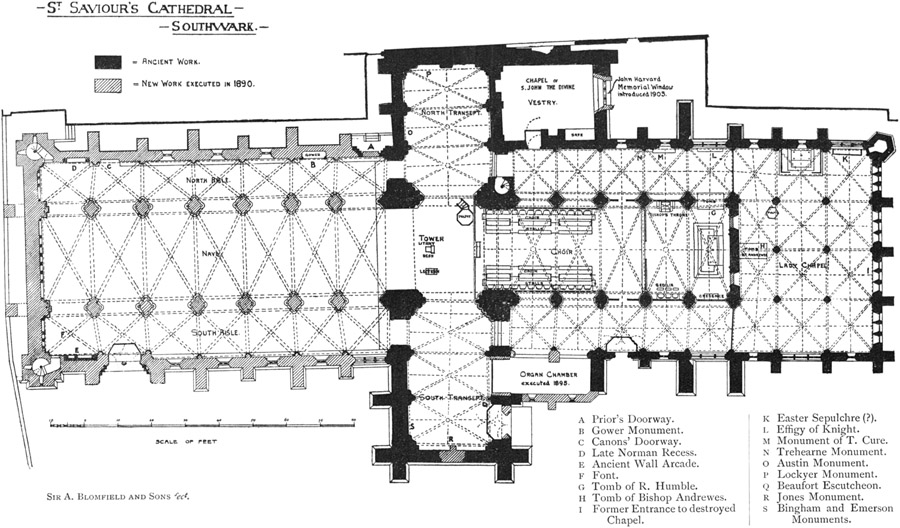
ST. SAVIOUR'S CATHEDRAL—SOUTHWARK. Sir A. Blomfield and Sons fect.ToList
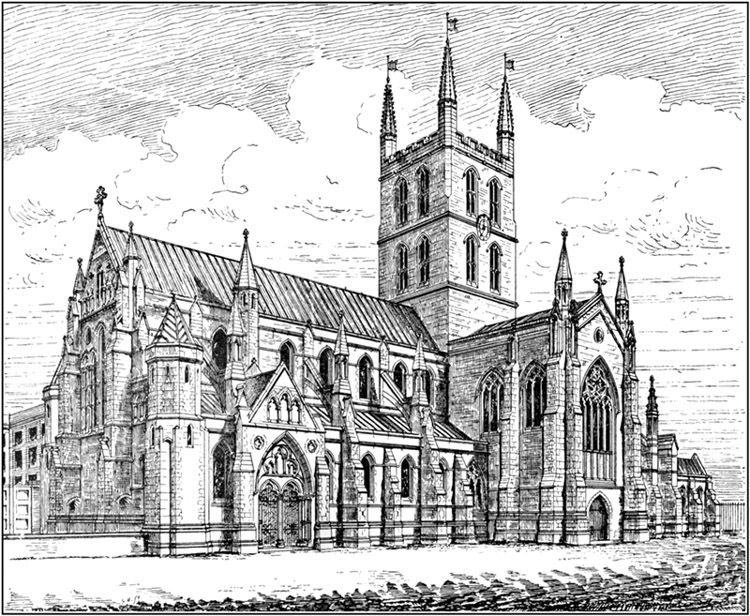
PROPOSED RESTORATION IN ST. SAVIOUR'S CHURCH, SOUTHWARK; FOUNDATION STONE LAID BY THE PRINCE OF WALES, JULY 24TH, 1890.ToList
Typographical errors corrected in text:
Page 67: CENTUNY replaced with CENTURY
Page 109: pertenyinge replaced with perteyninge