BEHIND THE SCENES IN PEKING
Reading edition
May 26, 1900.
When you were in Peking last year I don’t know whether you got out to the hills or not. They are about fifteen miles from the imperial city, and are the nearest point where foreigners can find relief from the insufferable heat of the capital, which begins with an intensely hot spring, continuing through a long, damp, sizzling summer.
Many of the diplomats have cottages and bungalows at Pei-ta-ho, on the seashore, but its distance from Peking is a great drawback to it as a summer residence, and they have been forced to accept the hills, as a nearer and more practical place for their summer colony.
A large, commodious house has been built here for the British Minister, as well as one for the officials of the Customs, both within their respective compounds. The greater part of this colony, however, 2have simply leased temples from Buddhist priests, and converted them into the most attractive and livable summer homes, the American and Russian Legations being the principal of these.
A huge, white pagoda, belonging to the temple of Linqua Su, in the centre of this district, with its temples of Buddha and houses of its priests surrounding it, is perched on the top of a hill at the base of Mount Bruce, and for miles around is the most picturesque feature of the landscape. In the highest point of this pagoda is hung a wonderful bell, the only motive-power of which is the wind, and which was placed there by the Chinese to frighten the evil spirits of the air. When the breeze is strong, which is often the case, the bell seems to thresh itself into a veritable fury, and again at midday, when the breeze is light, one can just distinguish the faintest tinkle.
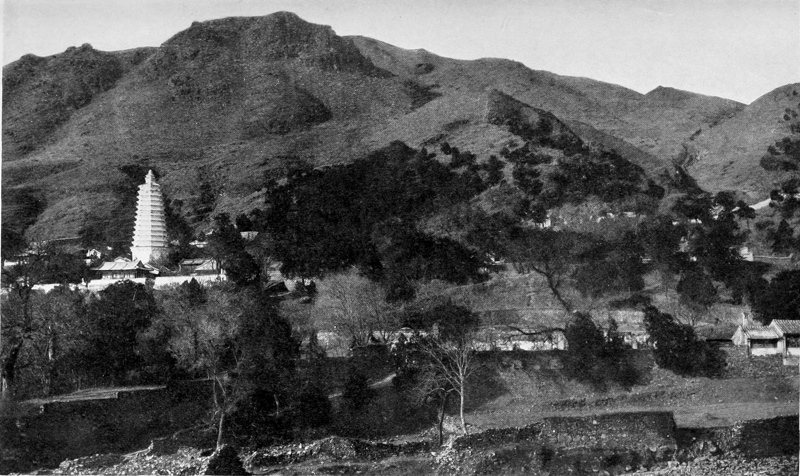
WHITE PAGODA IN THE TEMPLE OF LINGUA SU
High up in these hills, and built on the sides of Mount Bruce, stand these temples with their subordinate and associated buildings, each making up a separate community. Ours is somewhat above the temple of Linqua Su, with its white 3pagoda, and is built on a most wonderful natural shelf of the mountain-side. A terrace, edged by a low, ivy-covered parapet, runs the length of our temple home, from which we look right out on the world beneath us, down the valley towards Peking; or, if we look above us, it is to see Mount Bruce rise perpendicularly against the sky. Ancient and big are the stones that pave the outer and inner courts of this temple, and as picturesque as they are difficult to use are the stone steps, formed of heavy and irregular slabs, which lead down to the valley or ascend up unto the mountain, from which steps finally emerge innumerable tracks, leading in their turn to shrines, homes of hermits, and temples built on this continuous ridge. Nor is this barbaric and ancient setting for a modern life made less extraordinary by the fact that one is served by quiet, intelligent, besatined servants, who glide about and look as if they had stepped into life straight from the half-fabulous days of Kubla Khan; and you feel they have always been thus, and always will be, and you wonder how it is that although the spirit of the twentieth century is certainly felt in China, it is little seen.
4May 27.
To-day we started off on a long tramp, making first the ascent of Mount Bruce, which was so difficult at times that we could scarcely accomplish it, and had we not had the help of a young house-servant, known to us as “Number Three Boy,” I doubt if we could have reached the summit. The wind whistled round the high peaks of Mount Bruce to such an extent that Mrs. Squiers and I had to hold on to each other to keep from being blown off our feet.
From here we could see the Empress-Dowager’s summer palace and grounds, spread out below us like a toy garden, with its wonderful landscape effects and its series of artificial waterways. Then, perched high up on a mountain, we could see a white temple belonging to the eunuchs of the palace, and reserved solely for their use during the summer months; and to the west the Feng-tai station of the Peking-Paoting-fu Railway, winding through the valleys below us like a piece of grey thread. We then walked through the enclosure of the temple occupied by the Russian Legation, and in passing through a half shrine, half summer-house, most unexpectedly 5came to a wall upon which was drawn a rough but cleverly executed head of a lovely young girl. It was done in coloured pastels, and had been drawn by some artist diplomat. The subject was the Countess Marguerite Cassini, niece of the Russian Minister, who had been stationed in Peking some years previous. It was a beautiful bit of work, and was especially startling when seen surrounded by the hideous, grinning faces of Buddhist gods.
Heading for our own temple of Linqua Su, we walked miles, keeping to the top of a ridge, where the views were gorgeous and the air wonderful, and quite suddenly came upon a shepherd and his flock. Fancy it, a Chinese shepherd tending his Chinese sheep! His expression was gentler and happier by far than that of men leading a like monotonous existence in the mountains of Switzerland or elsewhere in the West. Could it be that there the shepherd longs to return to the life in the villages, while here the life of the poorest classes in the village communities is so hopeless a struggle that individual members are glad to leave the hopelessness of it and tend their flocks alone upon the mountains? This fascinating China! you 6have been here, and you know it. I must not bore you with my impressions, for if I attempted such a thing these letters to you would assume the proportions of an encyclopædia.
May 27 (continued).
Mr. Squiers returned to the American Legation this morning. He only gets out to the hills twice a week in time to dine and returns to Peking the following morning. He tells us that the Boxers daily become more daring, but the diplomats and people in general put these things down to the usual spring riots which yearly seize Peking, and are due to hunger and disease, prevalent among the poorer classes after a long, hard winter. Nevertheless, it was deemed wise to inform the Tsung-li Yamen (the Foreign Office) that we were in the hills at the temple of Linqua Su, and would expect official protection from all rioters or malcontents who might be in this region, and a guard of twelve Chinese soldiers was promptly detailed to protect “nos personnes et nos biens.” But such soldiers!—opera-bouffe mannikins in a Broadway theatre would frighten one with their martial air compared to these ridiculous apologies for soldiers, 7which were sent to us for our protection, their only weapons being dull-pointed rusty spears!
Clara, the German governess, returned from Peking to-day, where she had gone to do some shopping, and tells us that all the natives she passed seemed to be armed, and that in all the temple enclosures companies of Chinese were being drilled.
Our servants, mostly native Christians, assure us that these people are all Boxers, most of them flaunting the red sash, the insignia of that Society, and that they are preparing for a general uprising when the time shall be ripe—an uprising that has for its watchword, “Death and destruction to the foreigner and all his works, and loyal support to the great Ching dynasty.”
May 28.
The peace that settles on one after a long tramp in the mountains was rudely broken up for us a short while after our return from our walk yesterday, when we found ourselves thrown into the midst of a most exciting situation, from which we knew the chances were about even whether we should escape with our lives.
We could see from our mountain balcony that 8the railroad station at Feng-tai, with its foreign settlement, was burning. The immense steel bridge was gone, too, showing that dynamite and high explosives had been used to destroy it. The locality was thick with smoke and the flames sky-high. Our servants told us our highly picturesque guard of twelve had run away as soon as they were sure the Boxers were burning Feng-tai, for, they argued, the mob will surely sack this foreign-devil temple when they finish with Feng-tai. Since they had begun, they certainly would not desist until everything foreign this side of Peking was sacked and burned, and this guard had no desire to pose as the guardians of foreigners, but thought it much safer to join the so far victorious rabble at Feng-tai. We also learned that over a hundred men engaged in agricultural and other peaceful occupations in and around the temples, of which ours was one, had left during the day to join the Boxers.
Our position now, to say the least, was critical. Not a foreign man on the place to protect us; a quantity of badly frightened Chinese servants to reassure; three children, their governesses and ourselves, to make plans for. We did what women 9always have to do—we waited; and our reward came when we saw down in the valley a dusty figure ambling along on a dusty Chinese pony, coming from the direction of Feng-tai and making direct for our temple. It was Dr. Morrison, correspondent of the London Times, and an intimate friend of the Squierses.
On hearing early in the day of the mob at Feng-tai, and the burning of the place, he promptly started off in that direction to get as near as possible to the scene of action, and ascertain for himself if the wild rumours circulating in Peking were truths before cabling them to London. Finding the worst corroborated by what he saw from a point near the mob, yet unseen by it, he started on his return trip to Peking, hot haste for the cable office, when he became oppressed with the startling remembrance that we were at the temple, and probably alone and unprotected. So, instead of returning to Peking, he promptly came to us. He feared lest Mr. Squiers had not heard of the burning of Feng-tai, or, if he had heard of it, that possibly the city gates might be closed against the approaching mob, and he might be unable to leave the capital that night. The fact that our temple 10was directly on the line of march to Peking for the rioters made it look to Dr. Morrison as a most probable possibility that they would stop chez nous before proceeding to the capital. In case of such horrible eventuality he hoped to defend us for a while, and to send to glory as many Chinese as possible before turning up his own toes!
He was studying a possible defence of our balcony-home when Mr. Squiers arrived post-haste, bringing with him a Russian Cossack, whom he had borrowed from the Russian Minister. Plans were now made to defend the place from attack or incendiaries during the night. The Chinese servants worked with a will—our successful defence meant safety for us and life for them. Sentry work of the most careful sort continued all night, as well as the packing up of our clothes and valuables.
At 6 a.m. we were en route for Peking—an enormous caravan—most of us in Chinese carts, some riding ponies, mules, or donkeys, the forty servants placing themselves wherever they could—anywhere, in fact—so that they should not be left behind. The three protectors, heavily armed, rode by us, and three or four of the Chinese were armed also, and the carts held such a position in the 11caravan that in a moment they could be swung round as a defence in case of an attack.
The fifteen miles through which we travelled were utterly deserted except for the long, lonely lines of coal-carrying dromedaries. It seemed as if the country people en masse had deserted their villages and gone to some rallying-point for a demonstration; and how anxiously and slowly each half-hour of the trip passed, for, while it brought us nearer to our Legation, it also brought us nearer to the possibility that our caravan would run into yesterday’s rioters with added numbers of to-day’s malcontents.
At 10.30 we reached the American Legation compound, and most painfully but thankfully we untwisted ourselves from the awful position we were forced to take in the cart, and joyously grasped the hands of friends. William Pethick, Li Hung Chang’s private secretary for twenty years, a person of tremendous influence with the Chinese, was in the compound, and was on the point of going to the War Office to demand a regiment to go with him to our rescue out in the hills. He had feared for us desperately during the night following the burning of Feng-tai.
12May 30.
The times have become so dangerous that no women are allowed to leave the compound, but, of course, the diplomats and the military—such as are here—must move about and try to find out what the situation really is. The people who know the most about it are the most pessimistic as to what may happen before the marines arrive from Tien-tsin.
We were glad to hear that the Belgian officials at the Feng-tai station had heard of the intentions of the Chinese to burn them and the place, and had escaped to Peking without loss of life.
All the Legations that have battleships at Taku wired some days ago to them, and we are looking for a total of about three hundred marines of all nationalities to reach Peking at any moment.
Legations, such as the Belgian and Austrian, which are some distance from the Legation centre, are forced to do constant sentry work to guard against thieves and incendiaries; the Ministers’ secretaries, and their foreign servants take turn night and day. They are so surrounded by small streets and alleys that a few rioters could rush their Legations easily, and they are forced to keep the 13most alert watch. Melotte, the big blonde Belgian secretary, came to tea to-day, and gave us a most vivid description of the difficulties of their tiny garrison.
Sir Robert Hart, the beloved Inspector-General of the Customs, dropped in also, and, while he seems fairly sanguine about the present situation, I must say the tales of China and the Chinese that he unfolded to us were quite terrible. Especially the massacre of the Portuguese at Ning-po in 1870 by the Chinese in retaliation for their having taken so much of the Yangtse River trade made a stirring story when coming from his lips.
He was with that fascinating Englishman commonly known as “Chinese Gordon” when he was the central figure in the history of China during the early part of this century, and when Sir Robert was quite a young man. I was so obviously spellbound by these real reminiscences that, to my surprise and joy, he offered to send me, on his return to his compound, a photograph of himself taken with Gordon, marked with the latter’s autograph. I can’t say, however, that his visit reassured us in our present dangerous situation.
Before leaving he looked at Mr. Squiers’s 14wonderful collection of antique Chinese porcelains, which Mr. Pethick, a connoisseur in these things, has collected for him. The Dana Collection was also procured by him. Sir Robert is certainly a delightful person, and the cobalt-blue tie twisted into a most unusual knot around his low collar gives his personal appearance a tinge of rakishness and eccentricity.
This afternoon Dr. Morrison and some Customs students rode down toward the station of Magi-poo to take a look at the congested market-places and collections of angry rioters. Directly they were seen they were furiously stoned, but as their Chinese ponies were fleet of foot, they escaped with a few bruises.
May 31.
All day to-day everyone is wondering, “Will the marines get here to-night?” A wire came through Admiral Kempff, saying they were entrained. Last night we dined at Sir R. Hart’s, and danced until twelve. He has two bands, brass and string, of Chinese musicians whom he has taught. The secretary of the German Legation took me out to dinner—Von Below, a most soldierly-looking person.
15
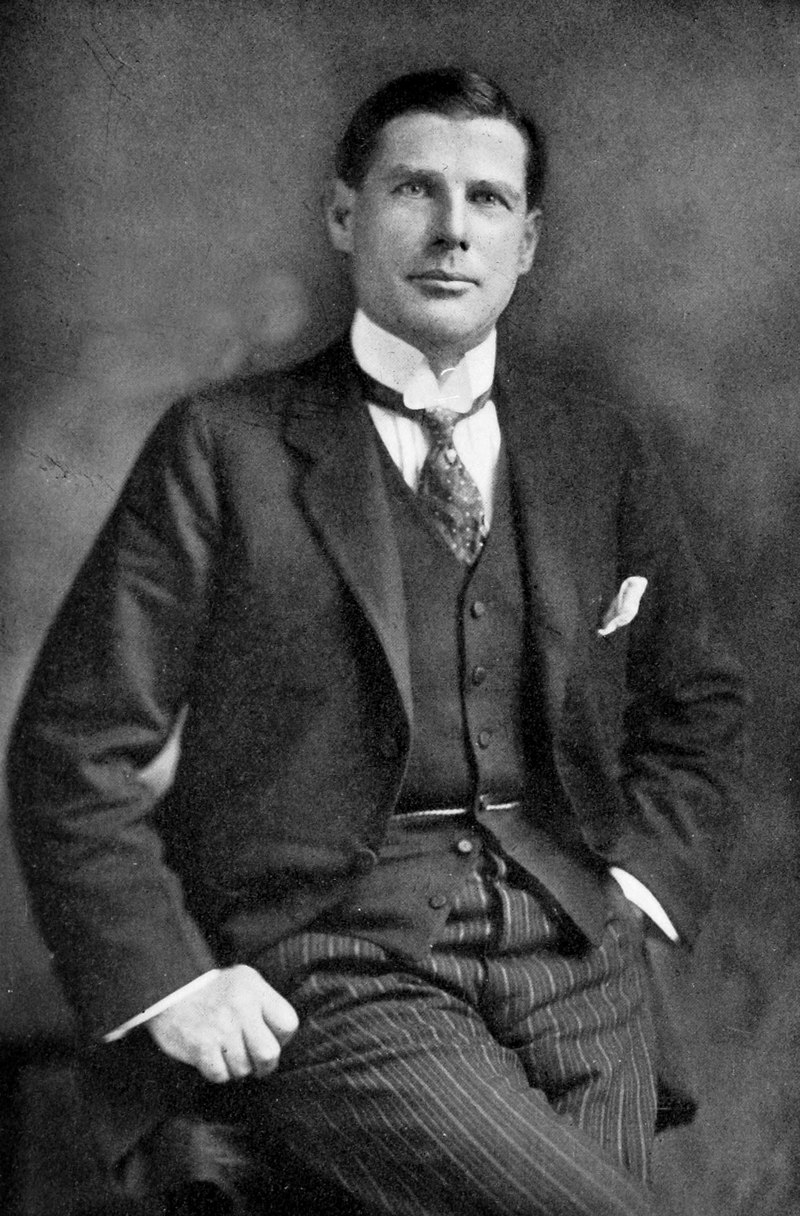
HERBERT SQUIERS
June 1.
Mr. Squiers, secretary of the Legation, and Mr. Cheshire, interpreter-secretary, met the troops at the station last night at 8.30. The marines of the United States, England, Russia, France, and Japan, formed the contingent of 365 men which were sent up from Tien-tsin by the fleet. They would have arrived earlier in the day, but the British in Tien-tsin had tried to send 100 marines instead of the 75 for which the Tsung-li Yamen had given them permission. The Chinese were obdurate, so the delay was caused.
When this polyglot contingent landed at the station in Peking there was great excitement as to which nationality should lead. Captain McCalla, who had come up with our fifty marines, hurried his men at the double-quick to get it, and our troops were the first to march up Legation Street. There was an enormous mob at the station, but no demonstration was made except to hurl and howl curses on the soldiers’ ancestors.
Mr. Squiers, who is one of the most hospitable people in the world, received Captain McCalla and the marine officers in a delightful manner, and did everything possible for them in an official and personal 16way. He was an officer in the army before entering the diplomatic service, which makes his help and advice invaluable in procuring quarters for the marines, and other arrangements.
June 3.
Yesterday Captain McCalla took the eleven o’clock train, with his secretary, back to Tien-tsin, to join his ship, the Newark, after having had a long talk discussing the situation with the Minister. We suppose Admiral Kempff will be up in a day or two, as his visit has been put off already several times.
The bad and suspicious part of this affair is that the Boxer outrages are not being punished by the Government, which proves that they either fear the perpetrators or sympathize with them. One hears from all sides that the Chinese soldiers are Boxers at heart, and would not fire on them if ordered to do so. The people who will suffer first from these riotous fanatics, if they get much worse than they are now, will be the Chinese Christians.
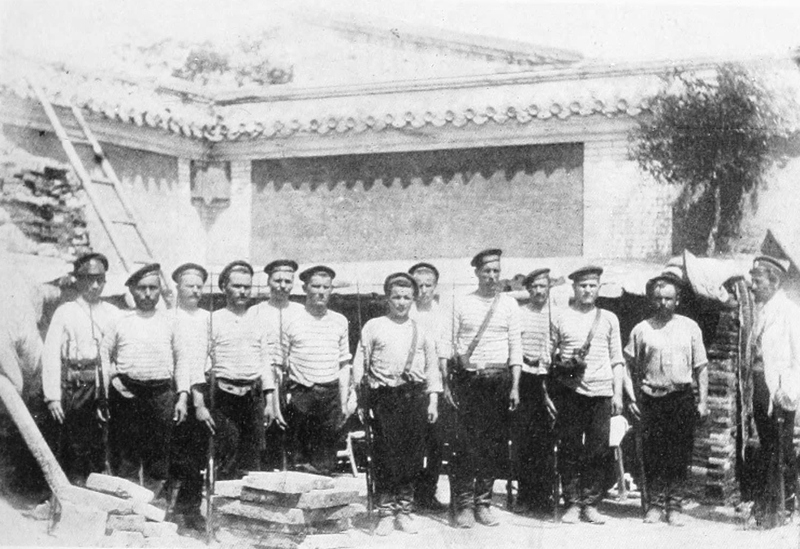
RUSSIAN MARINE GUARD
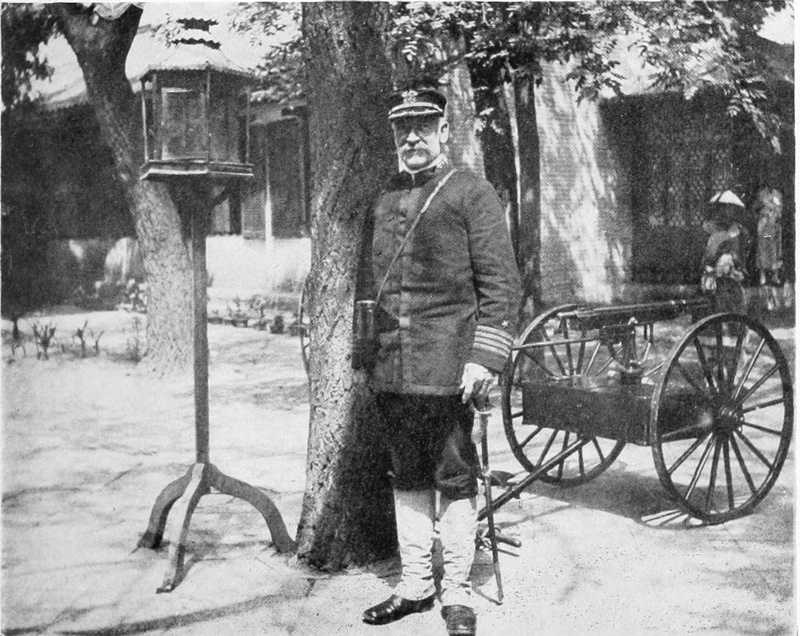
Copyright, M. S. Woodward CAPTAIN McCALLA, COMMANDING THE AMERICAN MARINES
The heat is becoming insufferable, and the children of the diplomatic corps are showing the bad effects of this enforced confinement. The 17British Minister’s wife, Lady Macdonald, has sent her little girls back to their legation bungalow in the hills, in the care of her charming sister, Miss Armstrong, with a guard of thirty marines. We cannot solve the problem in our Legation this way, as our guard is so much smaller.
June 5.
We expected Admiral Kempff yesterday from Tien-tsin, but the train did not come through, and we do not know whether he was on it or not. The invitations for a dinner in his honour have been cancelled.
Mrs. Brent, with whom I am to return to Japan, has sent me word to be ready to-morrow to take the morning train to Tien-tsin. So far all the trains from Peking down seem to get through, although the trains up are irregular. Rumour comes that yesterday two more stations were burnt, one on the Hankow line and one on the Tien-tsin line, but the actual tracks are not destroyed.
Everyone feels that this is the time to leave Peking—everyone, at least, who is not bound to remain to protect interests they have in charge—and to-morrow surely the exodus will be large. Captain Myers, in command of the United States 18marines, and Captain Strouts, of the British marines, had a long consultation to-day about these incredibly outrageous Boxers, in case they should dare impertinences on the Legations. Should we be forced to leave our American compound, we will go to the Russian Legation, which has a stronger defensive position than ours.
June 7.
Yesterday I was ready to start with Mrs. Brent, when a letter came for Mrs. Squiers from Sir Robert Hart, saying he thought the train would eventually “get through” to Tien-tsin, but that his secret service agents had informed him that there were rioters and Boxers at several stations prepared to stone the passenger coaches, and he urged me not to attempt the trip. He wrote: “Things must get better soon or very much worse.”
Captain Myers and his men were up all night guarding the compound. This United States Legation is such a wretched little irregular place to defend—it could so easily be fired.
The atmosphere of the compound is distinctly exciting. The quintessence of American interests are discussed right here in the open air, under a few scattered big trees, by people walking about 19gesticulating or standing on scorching hot flagstones, which pave part of this enclosure, arguing with one another as to how soon the coup d’état will take place, but all agreeing on one point—that a cable should be sent immediately to the State Department in Washington before telegraphic communication is lost; that nothing but a tremendous armed force can free the Americans in Peking from a surely approaching massacre; that many of the higher Chinese officials would try to protect us to the end. But the fact remains, if the Boxers and rioters continue to increase in numbers each day as they have been doing for the past week, it will be the mob we will have to deal with, and not the Tsung-li Yamen.
In nearly every instance the persons who voice these sentiments are men who have lived in China for years, who know the country, the language, and the people. They know that the strength of the Chinese lies in clever cunning and mob violence, that they cannot be trusted under any circumstances.
These men all agree that China was never before in such a condition. Mr. Pethick, familiar with every phase of tortuous Chinese government, forty 20years a resident in China, and an intimate friend of half the political leaders, knowing their weaknesses and wickednesses by heart, urges the Minister to state to Washington the situation as it is, but all to no avail.
The white dazzling star of optimism is blinding him to facts, and with the British Minister to stand with him in his position, he says that the Boxer movement is only a few fanatics, and the mobs and incendiaries are but slight demonstrations of the yearly spring riots!
Dr. Coltman, a clever American physician of Peking, and a correspondent for the Chicago Record, is sending to his paper some strong cables about affairs here, but the United States are so saturated with yellow journalism that probably his wires will not be believed. When we complain to the Yamen about the trains running no longer from Peking to Tien-tsin, as many ladies and children wish to leave, they smile and say “they regret the present state of affairs, but that in a few days all will be in working order again.” Mr. Pethick thinks they are not allowing the trains to leave Tien-tsin because they don’t want any more foreign troops to come to Peking.
21June 10.
A telegram arrived to-day from Tien-tsin, saying the second contingent that they have been so madly telegraphing for these past few days had practically seized a train and left at 10.10, that most of the track is supposed to be all right, but they expect to have difficulty with an occasional broken bridge. Captain McCalla is again in command of our marines, and the combined forces of this relief party number 1,600. We expect the train to arrive to-night, and, owing to the gates being closed at sundown, they will have to spend the night outside. To-morrow at daybreak they will be met with twenty carts for their ammunition and luggage.
June 11.
This morning Mr. Squiers, and Mr. Cheshire, and Captain Myers, with ten marines, waited at the station for the troops from daybreak until eleven o’clock, but there was no sign of them. The escort then returned to the Legation. The telegraph was broken last night. We have no more communication with the outside world; our world is this dangerous Peking.
22June 12.
Such intense excitement! This afternoon the Japanese Chancellor of Legation went down to the railway-station in the official Legation cart to see if there were any sign of the troops. Returning by the principal gate, he was seized by Imperial troops, disembowelled, and cut to pieces.
Mr. Squiers had sent about the same hour his maffu (groom) down to the station with a pony for Captain McCalla in case the troops had come. This man was also returning, after having waited there some hours, when they—the Imperial Chinese soldiers—saw that he was some foreigner’s servant, and tried to seize him, but he lashed both horses—the one he was on and the one he was leading—and just escaped. On reaching the Legation, he was so terrified he told Mr. Squiers he would have to leave his service immediately and try to save his life by running away to Tien-tsin.
Twenty of our marines have been sent with an officer to guard the big Methodist mission near the Ha Ta Men Gate, which is still holding out.
Rumours are the only subject of conversation now. To have them refuted or confirmed, a Russian bribed a reliable Chinese to go fifty miles 23down the track and to report where the troops are. He could find no sign of them. How very extraordinary! Where are these 1,600 men that left Tien-tsin two days ago? He also reported that the track was broken in several places.
To-day the house belonging to the British Minister in the hills, very near our temple, was looted and burnt by the Boxers. Most fortunately, Miss Armstrong brought the children back yesterday.
A Russian secretary, Mr. Kroupensky, has figures at the end of his fingers about the number of troops Russia can land in Tien-tsin from Port Arthur in a few days’ time, etc., and if things get much worse, the Russians say it is more than probable their people will march on to Peking by themselves to our rescue. Can we suppose they are trying to prepare us for a Russian coup d’état?
Dr. A. W. P. Martin, a famous savant in Chinese classics and other ancient languages, Director of the Imperial University in Peking, has temporarily become the refugee guest of Mr. Squiers, his own house being too unsafe for him to remain in. Mr. Pethick is also a guest in this hospitable house. The British Legation is already crammed with 24missionaries and refugees, who in their own quarters feared for their lives, and were obliged to leave their missions near Peking, and concentrate at some place capable of defence.
A message that has to be sent to the Tsung-li Yamen always gains more strength by being sent from each Legation the same day. To-day the Japanese were requested to join the others with this usual procedure, but they answered simply: “Impossible. The Chinese have murdered our Third Secretary of Legation, and Japan can have no more communication with China—except war.”
June 13.
All last night the sky was bright from the many fires in the Tartar city—work done by the Boxers and soldiers. The Roman Catholic Church, the “Tungchou,” was burnt to the ground, and all through the night the Christian Chinese who lived near it were massacred. Other less important missions have also been destroyed. Yesterday the people in the Austrian Legation rescued a Chinese Christian woman who was being burned to death very near their Legation wall.
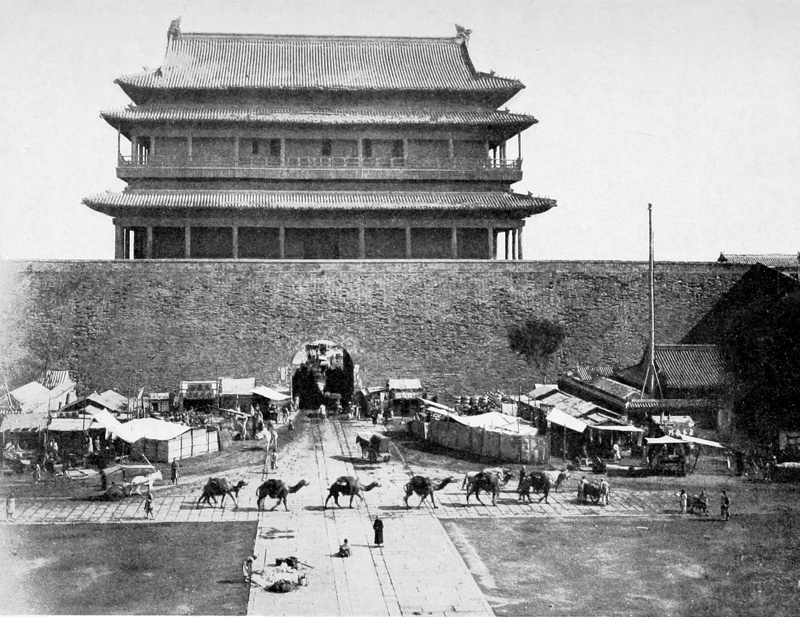
CH’IEN MEN GATE
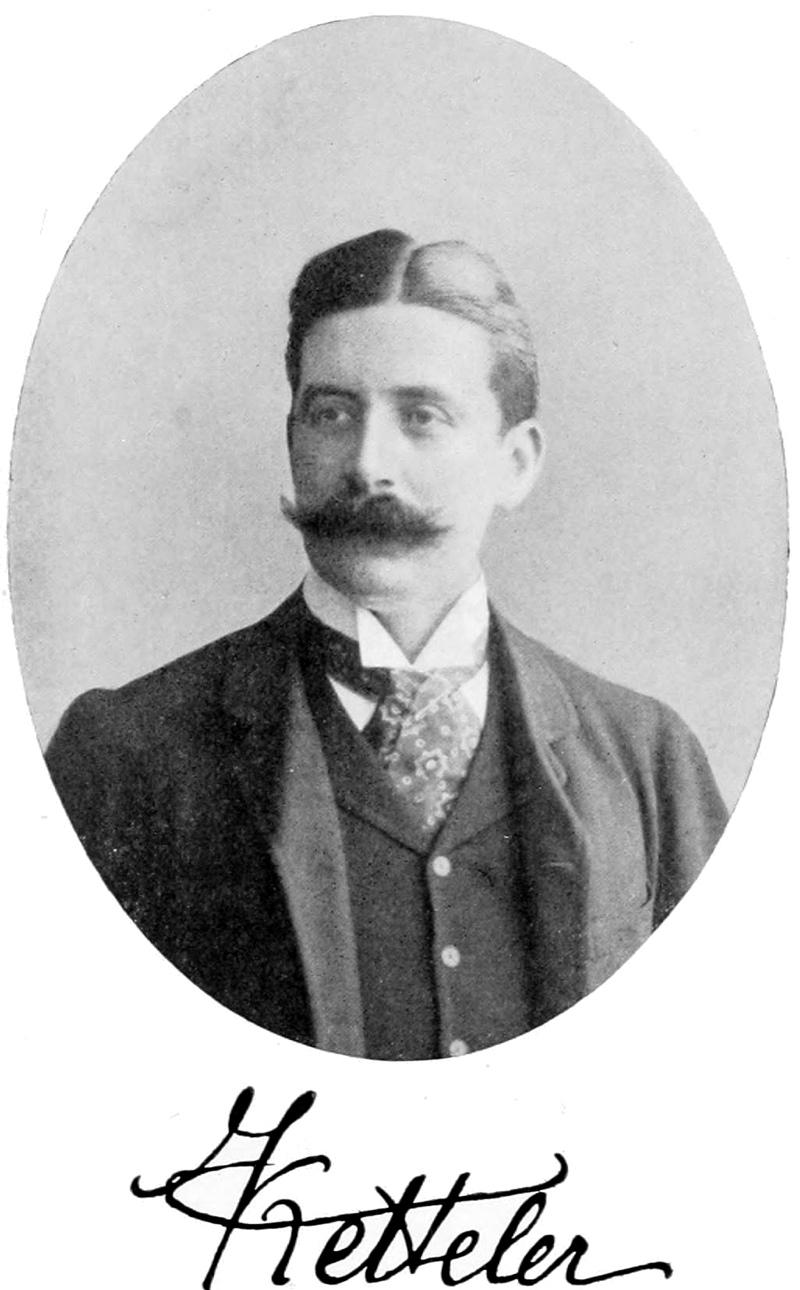
Baron von Ketteler, the German Minister, considered 25some Boxer who walked down Legation Street was impertinent to him, and chased him up the street as far as the Russian Bank, where he finally captured him. He was beating him over the head with his walking-stick even before the fellow stopped, and the crowd that collected was enormous. Captain Myers, Captain Strouts of the English, and Baron von Rahden, of the Russian guard, seized this opportunity to make a kind of rush down and up Legation Street, placing the Maxim-gun ready to use if necessary, and in this way completely cleared it of Chinese from the Dutch Legation down to the Italian. They had wanted to take this step for some time, deeming it has now become necessary to take real measures for our defence. They were glad of this excuse.
June 16.
In the afternoon yesterday we were horrified at the number of big fires that broke out in so many different parts of the Tartar city, and when we saw that the Ch’ien Men Gate was blazing, and all the houses around in the same condition, we felt we were in great danger. If this got a hold, it would burn up the Legation district of 26Peking very quickly. There are two parts of the city—the northern Manchu city, containing the Imperial palaces and garrison, also the foreign Legations; and the southern or Chinese city, containing the trading population, theatres, and markets. Both parts are joined in the form of the letter T, the leg or largest part being the Manchu city on the north, with walls 60 feet high, 40 feet wide at the top, loop-holed parapets 3 feet high at the side, and square bastions 100 yards apart on the outside face. At wide intervals along the inside face are pairs of inclined roads, 8 feet wide, for mounting the wall. The total length of this rectangular wall on the four sides of the Manchu city is about twelve miles. Joined to this great wall on the south is the much lower and weaker wall of the Chinese or southern city. All nationalities sent men, even these traitorous Pekingese, to aid us in extinguishing the fire. The Imperial fire-brigade arrived with great pomp, and could have furnished charming costumes for some “extravaganza” in their get-up. They had no idea how to put a fire out, but fortunately they had some hose, which, when used in the telling places, proved most efficacious.
Our men fought this terrible fire side by side 27with the Chinese, and this goes to show how a common danger levels most things, even active hostilities. The Cossacks worked exceptionally well. This fire had been started by the rioters and thieves in the rich bazaar district of the city, under cover of which they hoped to get much rich booty. The wind being high, the flames gained great headway, and the tremendous Ch’ien Men Gate was soon ablaze. By eight o’clock the fire was somewhat controlled; but it burned all night, and when seen from the Great Wall it looked like a huge torch.
June 17.
Just one week ago to-day we got the telegram that the combined forces of England, the United States, France, Japan, etc., now at Taku, numbering 1,600 men and over, had practically seized a train at Tien-tsin, and, with workmen on board to mend the track where it had been derailed, had left at 10 a.m. to go to the relief of the Legations in Peking. Night and day, ever since that telegram came, we have been looking for them. The day after we received the news that they had started the Chinese cut the telegraph-wires, and so for one week we have been absolutely cut off from all communication.
28No messenger has been able to get through the city gates, as they are carefully watched by the Chinese authorities, except—and I am proud of this—except that one old man whom Mr. Squiers had been good to (he used to be an old gardener of theirs) got through to Captain McCalla, who is with Admiral Seymour, and is in command of 100 men—Americans. The gardener had been able to deliver to him notes from Mr. Squiers, giving him most important information about ways and means to get into Peking in case they meet with opposition, and to bring back an answer, as well as other notes from commanders of other nationalities, to their respective Legations in Peking. From these letters we rather imagine that this “Tower of Babel” relief party does not agree as well as it might, but then, whoever expected a “Tower of Babel” to speak and work in unison? Certainly never before the miracle!
So it is due to Mr. Squiers’s personal management that we or any other nationality have heard anything from this party of 1,600 men, which undoubtedly must be but the beginning of large numbers of troops for what Lord Charles Beresford terms “the break-up of China.” Our Legation, 29thanks entirely to Mr. Squiers’s efforts, is the only one which has been in touch at all with the approaching column, and, by his minute instructions, when they get here they will be able to advance into the heart of our district—through the Water Gate—without having to take any of the city citadel gates. They say that in all crises, political or otherwise, some one man comes forward, takes the bull by the horns, so to speak, and does a man’s work. Mr. Squiers, as far as all the Americans here feel, is the man in Peking.
The fighting, the weak and terrorized Government, the expected attack on the Legations, the horrible massacre of the Chinese Christians, the burning of all the missions, churches, and entire Christian communities, and last, but not least, the continued attempts—made, we think, principally by Boxers—to “burn the Legations out,” all go to make these days very extraordinary ones.
Last night there was a scene enacted in our Republican compound that would be a fitting climax to any Bowery play where Jake, the villain, is finally run down. A regulation Boxer—red sash and all—was caught by a Russian sentry in the act of trying to set fire to the outhouses of this 30Legation. He was assisted into the compound by the Cossack who discovered him, with no especial tenderness of manner, the Chinaman still clutching the picturesque and glowing torch with which the conflagration was to have been started. In three minutes coolies, soldiers, gorgeously dressed Legation servants, the European men in the compound, and we women, who were in the midst of our dinner, rushed out to see what it was (as we did fifty times a day, so far as that goes), to find this poor, writhing creature, who knew that he had nothing to expect but death in the next half-hour, as he had been caught red-handed. He was questioned, but to no purpose, and was then turned over to the Russians, as they had been responsible for his discovery; and, although we all knew that that nation dislikes prisoners, we were hardly prepared for the bullet that, in less than ten minutes, whistled clear as a bell on the night air, and told us there was one Boxer the less in Peking.
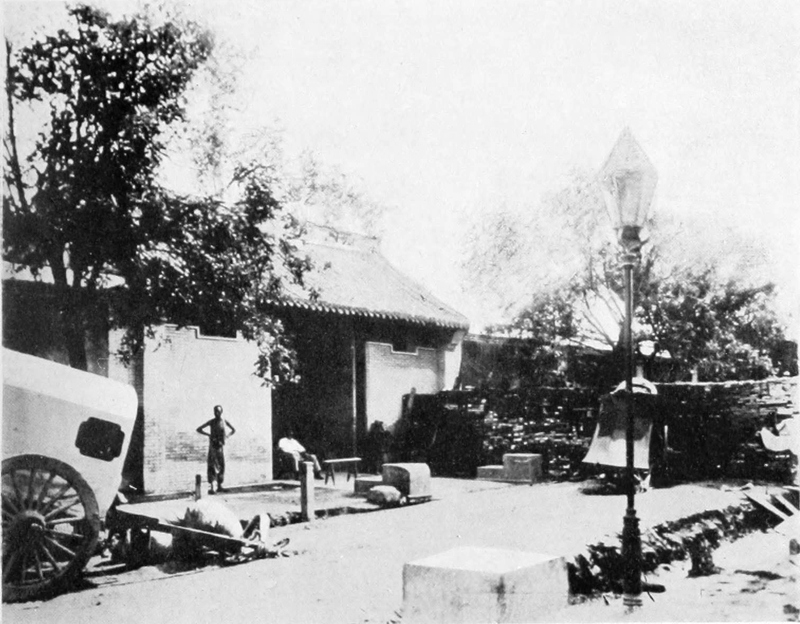
Copyright, M. S. Woodward BARRICADE BETWEEN THE AMERICAN AND RUSSIAN LEGATIONS
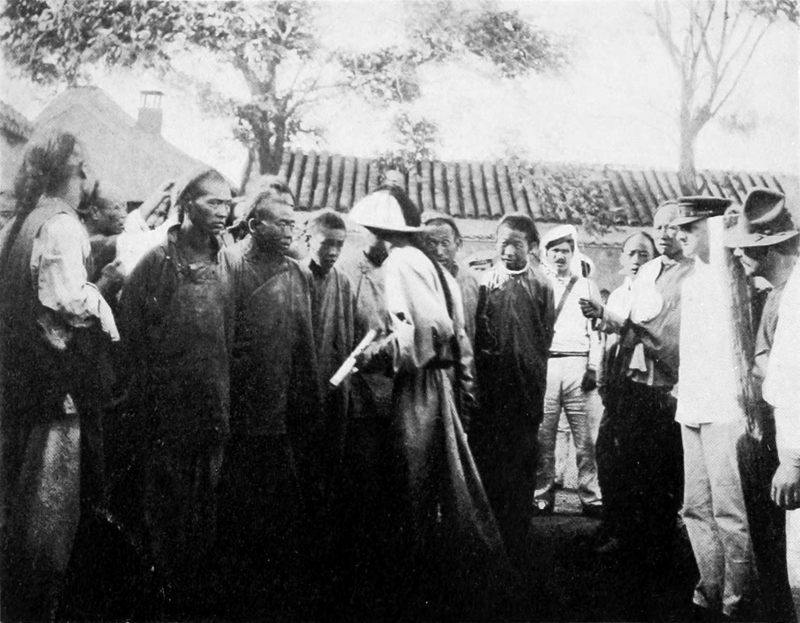
Copyright, M. S. Woodward READING THE SENTENCE OF DEATH TO THE BOXERS CAUGHT IN THE RUSSIAN LEGATION
Captain Myers has turned out to be a most competent officer, and the British Captain Strouts and the Russian Captain von Rahden have worked together splendidly for the object of saving our three Legations from attack and fire. These 31Legations form a kind of triangle, our corner of which is the weakest owing to its bad shape. The British compound is excellent for defence, having strong, high walls, with stables or houses at the corners, one side having the canal running parallel to it, and the other having the Imperial carriage park.
When the time comes that the United States and Russian Legations can no longer hold out, the British Legation will be the stage for a terrible last act. So far, of course, things are not as bad as that, and fire is what we dread more than the disaffected Chinese soldiers or Boxers. Nevertheless, things got so critical the day before yesterday that food for a week for our entire Legation was sent over to the British compound, and each of us had sent over a dress suit-case with a change of linen, brushes, etc., so that in the event of our having to leave our Legation on the moment, we would not be absolutely comfortless and unprepared for a siege of several days until Seymour and McCalla could relieve us.
Yesterday things got so bad that our bugler played the “call to arms” four different times, which is the signal here for all women and children 32and all non-fighting men to appear at the big gate of the Legation, and within five minutes from that time Captain Myers will decide what must be done—whether the marines will escort us over to the Russian or the British Legation. After each of these alarms, however, it was decided not to send us quite yet. At the last alarm they kept us waiting, all huddled together like sheep, for an hour. And such an hour as it was—the constant reports of Mauser rifles, the absolute lack of knowing what was happening!
But at one moment I was obliged to forget the terror of it all and look at the humorous side. Mrs. Squiers was holding her youngest boy, a baby of four, in her arms, busy in quieting him. Her other boys, Bard and Herbert, were there, too, rather subdued, and last, but not least, our little cortège was completed by the arrival of the French and German governesses, each of them arguing violently in her respective mother-tongue. Mademoiselle is a large woman of ample proportions in wrong places, and she had her bosom filled with recommendation papers, which she fingered nervously—they were all she was saving in the way of valuables. Clara, the German governess, had forgotten 33what her valuables were, and looked quite distraught with fear. She had a French clock in each hand, and was telling me in broken English, German, and Chinese how afraid and terrified she was. I said to her, “Gehen Sie mit mir,” and she clutched my arm most painfully for the next half-hour.
As I have said, fifty men came to Peking from the Newark on May 31, and twenty of them with an officer were sent to defend the big Methodist mission near the Ha Ta Men Gate, which, because of its area and large stone church, is capable of a very good defence, and where all of the American Protestant missionaries that are lucky enough to be in Peking have gone. Much to Captain Myers’ disgust—it is so hopeless to divide this small military force—the Minister insisted on sending this guard to them, instead of having them brought into our defended lines. Consequently, there is no officer to share the responsibility with him, or to give his men a sufficient number of hours off duty during the twenty-four. He himself gets about four hours sleep per diem, and that has to be taken in cat-naps and in a folding-chair. He is liable to have even that short period interrupted a dozen times by an over-anxious sergeant, who wakes him 34up to come and see this or hear that. He naturally feels the responsibility tremendously, and is on the qui vive at every shot. His men are in about the same condition. This strain has been without relief for eight days and nights.
Of the thirty marines here, ten, Dr. Lippitt tells me, should be on the sick-list, and imagine how they feel with a compound full of women to defend against perhaps thousands of half-crazed fanatics who at any moment may break into the Legation. Their work is splendid, and at all times they are prepared for the worst, but the constant strain is unimaginable.
Captain McCalla wrote in his letter, which Mr. Squiers’s old messenger brought back to us, that he was in despair, as others in the relief party were not hustling enough. Our cry by night and day is, “When will the troops arrive?” Will they get here before or after some horrible massacre?
The men in the compound carry their rifles with them at all times, even when dining. Mr. Squiers a few days ago presented modern rifles with ammunition to all missionaries coming to the Legation. Taken collectively, these missionaries 35are a splendid lot of men, and are one and all most grateful to him for these arms, given them in this moment of awful danger to their converts, their families, and themselves. One night all left the table four times to run to the outposts, where shots and fighting were heard. In most cases, fortunately, they are not serious alarms—a few venturesome Boxers or Imperial soldiers running amuck in Peking after loot, who have decided to devil the foreigners. About three days ago we expected the troops any minute; now we are not so sanguine.
A detachment of men from the English Legation, our Legation, and the Russian Legation, started off under an English officer to rescue some of the thousands of Chinese Christians who are being burned and tortured by their enemies like rats in their holes. The tales that reached us through our servants, many of whom are Christian converts, and whose mothers, fathers, and wives are undergoing this continuous St. Bartholomew, made our men feel that we should try to do something for their rescue, even if we were not successful. Fortunately this party of men did not meet any large number of disciplined Chinese 36soldiers, finding them only in small groups. They killed a great many, and one could easily imagine how happy our men were to be able to kill these wretches in the very act of burning, looting, killing, or torturing. Sergeant Walker told me he had sent eight devils to glory; many of his shots he had seen take effect, and others he hoped had done as good work.
The “Nan-t’ang,” a Roman Catholic church, founded in 1600 by the early Jesuit missionaries, was burnt by these Boxers, and as most of their converts and families live around the church, one can well imagine the slaughter that took place before it was finally fired. This is only one instance of the many missions and churches where the same kind of thing has happened. The Roman Catholics alone claim to have ten thousand converts in Peking.
The Pei-t’ang is a large fortress cathedral, and capable of splendid defence. It is the oldest and richest Roman Catholic stronghold. In its dual rôle of church and military position, which in the old days used to go hand in hand, this community reminds one of the wonderful and still extant example of feudal power, the Mont St. Michel 37in Brittany, where cathedral and fortress dominate the higher part, and its villages cluster around the base. So here this Roman Catholic stronghold boasts the same arrangements, only with added hospitals and orphan quarters. It is a wonderful church to exist now, when the world is so old, and is supposed to be so peaceful. The French Minister has sent a guard with two officers to help Archbishop Favier, Superior of the Pei-t’ang.
In some instances hundreds of Christians thought it better to be roasted in their houses and burnt to death than to try and escape. Then, of course, the soldiers, Boxers, and thieves would loot the entire entourage of these burning communities, and, having once begun, they would not stop to inquire if the family were Buddhist or Christian. They were busy in this pleasant work when our posse of soldiers arrived on the scene of action, and the Chinese companies that had been detailed for this work were so disorganized by their lust of loot and cruelties that they were practically unable to attack us, and generally ran away, except in some rare instances, when they would rally and fight.
Mr. Pethick and Mr. Cheshire would raise their 38voices in Chinese and tell the terrified people to come with them and they would be saved. Sometimes it was necessary to go into the houses to assure the people of this help. On entering the houses they saw many horrible sights—women and children whose lives it was too late to save. There was one small square compound that the Boxers had burned, while in the inside there was an entire family of Chinese Christians. The four walls were on fire, and these people were tied hand and foot. Our men were unable to save them in any way, and hastened to other places where they would not be too late. Babies were seen being torn in two. The result of this morning’s work was the rescue of about one thousand Chinese Christians, who otherwise would certainly have been burned or killed within a few hours.
The officer in charge had them brought up Legation Street, which has lately been barricaded, and, except foreigners, no one is allowed to walk or pass. Two big barricades have been made at each end, one beyond the Dutch Legation, the other below the Italian Legation. And such a lot of poor, wretched people I hope never to see again. Half starved, covered with soot and ashes 39from the fires, women carrying on their breasts horribly sick and diseased babies, and in one case a woman held a dead baby. One man of about fifty years old carried on his shoulders his old mother, who must have been every day of ninety years. She looked so withered and wrinkled, one had to think of the burning of Troy and Æneas. A great many of these people were terribly wounded—great spear-thrusts that made jagged wounds, scalp-cuts and gashes on the throat where the victim had been left for dead.
Dr. Lippitt, who came up with the marines, and the English and Russian surgeons set to work, and tried to patch these poor people together again, and they toiled, the three of them, steadily for many hours. I have never imagined that such stoicism as these wretched creatures exhibited could exist. They never uttered a cry or moved even when the surgeons were operating on them.
Then the question arose as to what should be done with them. They could not stay in the road; the Legations could not have them. Dr. Morrison and Dr. H. James hit upon one of the happiest of ideas—namely, the seizing of a lovely park belonging to a Prince Su, which runs parallel to the British 40Legation, and is on the other side of the canal. It is so big there would be plenty of room for as many of these poor people as we shall be able to rescue, and being so near us, it will be quite possible for us to defend it. Dr. Morrison saw that the idea was carried out, and Dr. H. James went personally to Prince Su, and interpreted to him that it would not only be kind, but wise, for him to present his palace and park to his distressed fellow-citizens, who were being massacred by the Imperial soldiers in different parts of Peking, and in this way to furnish them with a refuge from the brutes who had killed thousands of them, and who were desirous of killing the rest. Dr. James implied that unless he voluntarily gave up his “fu” (meaning park), we would take it.
Prince Su was most suave, and said nothing would give him greater pleasure. There was probably some truth in what he said. He was only too glad to get as far away as possible from these Legation people, notwithstanding he would have to give up his palace. The danger for his life might be very great if he were suspected, even for a moment, of sympathizing with the foreigners, as might easily have been maintained by his enemies 41had he continued to live in this palace, which we told him he might do, as it was only his big park we wanted for the Christians. He vacated the same day, leaving all of his treasure and half of his harem. Thanks are due to Dr. Morrison.
How queerly things happen! These poor wretches, who had been tortured and hounded to death only two hours before by Imperial troops, were now housed in the palace of a mighty Prince, and almost within the shadow of the Empress-Dowager’s palace. For three days this splendid work of rescuing has continued, but finally Captain Myers decided that, with all the night-watching and hard, long hours of sentry work, our men could no longer endure it. So it was discontinued, and I believe the other Legations have stopped for the same reason. The English, Russians, and our men usually went on these rescue parties together, and I never heard of friction, though they were sometimes under an officer of one nationality and the next day under another. The ten to twenty marines who were on these parties counted at a very low estimate that they must have killed 350 thieves, Boxers, and Imperial Chinese soldiers.
42English Compound, June 21.
Things are rapidly changing for the worse. On the afternoon of the 19th a communication came from the Yamen addressed to all the Ministers, saying that, as all, or most, of the European Powers had fired on the Taku Forts, war was practically declared, and, such being the case, they would be pleased for all the Legations to take their passports, and allow the Chinese Imperial troops to escort them safely to the coast, whence they could leave the country. This was a thunderbolt coming to the Ministers, and yet so plausible and possible did the proposition appear to Sir Claude Macdonald and Mr. Conger that they were almost ready to acquiesce if the Chinese promised proper transportation.
The German Minister, Von Ketteler, was very undecided—so much so that he determined to go by himself the next morning to the Tsung-li Yamen and have a quiet talk with the members, and in this way arrive at a conclusion as to whether there would be foul play in case we accepted their escort. As he had some knowledge of the Chinese language, he was able to probe a little deeper into a 43conversation than were his colleagues, who were naturally forced to speak entirely through an interpreter.
The majority of the Ministers—De Giers, Cologan, Knobel, Pichon, Salvago Raggi, etc.—were wavering, first to accept the proposition and then not to; but by five o’clock in the afternoon it was so generally believed that the Ministers as a body would accept the Tsung-li Yamen’s ultimatum that all foreigners should leave the next morning at ten, that the executive members of the different Legation staffs had been out buying or procuring in any way possible large numbers of Chinese carts for the Legation personnel, and we women were packing the tiny amount of hand-luggage we were to be allowed to take with us, wondering whether to fill the small bag with a warm coat, to protect us on this indefinite journey to the coast, or to take six fresh blouses. Our hearts were wrung as to what to do, and while we were arranging and worrying about these trivial details the great diplomatic question was at a white-heat.
The Ministers were moving about from one Legation to another, arguing, talking—always talking. The strong men felt we must not leave 44Peking until our own foreign soldiers arrived to escort us, but the weak men felt in despair as to which course to vote for. They did not like the idea of leaving either, but, oh dear, what a breach of diplomacy to receive their passports and then to decline to go! The strong, who knew, were so few, and the weak, who feared to disobey the Tsung-li Yamen, were so many, that it looked very much as if we were all to start out to our deaths the following morning.
During the afternoon two or three men made a visit to the Legations, hoping to be able to rally the Ministers into promising to cast an undiplomatic vote when the final conference should take place; and at one time Dr. Morrison took the floor, he being the spokesman for the vast crowd of intelligent individuals—engineers, bankers, trades-people, and missionaries—who one and all were in favour of waiting until Seymour and McCalla arrived. He looked the Ministers square in the eyes, and said:
“If you men vote to leave Peking to-morrow, the death of every man, woman, and child in this huge unprotected convoy will be on your heads, and your names will go through history and be known 45for ever as the wickedest, weakest, and most pusillanimous cowards who ever lived.”
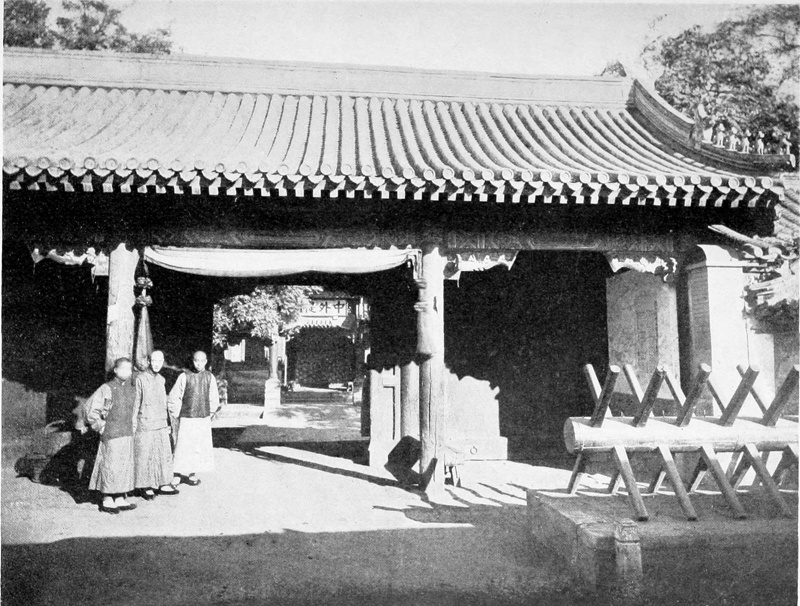
THE TSUNG-LI YAMEN
On the evening of the 19th Von Ketteler sent an official letter to the Yamen, saying on the following morning, at ten o’clock, he should go to the Foreign Office, as he wished to discuss with the Tsung-li Yamen the trip to Tien-tsin, etc. A little before ten on the morning of the 20th he started to keep this appointment. He was in his official chair, his interpreter in one behind him, and both unarmed. Four of his Legation guard started out with him, but, after proceeding a short distance, Von Ketteler saw the congested condition of the streets and the great number of excited soldiers everywhere, and, rather than run the possibility of his men getting into a row, he sent them back to the Legation, and proceeded on his way to the Yamen in just such a style as a high Chinese mandarin would go through the streets, with only his two maffus riding on in front as outriders. These Chinese servants, being mounted, were the first people to bring the news back to the German Legation of his murder. Von Ketteler was passing a kind of guard-house where at all times a fairly large number of Imperial Chinese soldiers was kept. A number of them rushed out, 46surrounded his chair, and shot him many times in the back of the head. His interpreter was shot at as he was escaping with great difficulty, and a volley of shot was fired at him as he started to run. He escaped, however, to the big Methodist mission, where his wounds were dressed and he was cared for.
When the horrible news came to the German Legation, all the soldiers and officers there made a sortie as near as possible over the route taken by Von Ketteler; but it was not feasible for them to continue the search for his body, as they could very easily have been cut off from the Legation quarter by the Chinese troops, and have been placed in a desperate position.
When the story of Von Ketteler’s murder had been confirmed, a shiver of horror shook each and every foreigner then in Peking; and we realized, perhaps for the first time, the horror of our position. Baroness von Ketteler, half crazed, wandered wildly about the most exposed and dangerous part of the German Legation. It was only by Lady Macdonald’s telling her that probably her husband’s body was at the British Legation that she was able to get her there, it being necessary, of course, for her to be put 47somewhere safe from bullet-fire, where women could be with her and do what little they could.
Those soldiers who killed Von Ketteler were Imperial Chinese troops, and represent the Empress-Dowager, and for them to have the audacity to kill a Minister shows us how much real power for the good there is in Peking to-day.
In the early afternoon the Ministers in conference decided that everyone must go to the British compound—that is to say, all women and children, missionaries, etc. The idea of getting our passports was no more discussed. Von Ketteler’s murder had opened our eyes to our real position and the real attitude of the Imperial troops, so that the question of being escorted by them to the coast was never again seriously thought of for a moment, except to feel that Von Ketteler’s death was the price we paid in order to learn of the positive treachery of the Chinese officials, although one must not forget there were many clever men in Peking who from the first argued in the strongest way against our going to Tien-tsin with a Chinese escort, begging the Ministers to wait until our own relief force, under Seymour, should arrive, and then let our own soldiers escort us to Tien-tsin. There is 48no question, however, that as a body the Ministers were for accepting the offer of the Chinese officials, and that it was only the tragedy of the 20th that made them see the impossibility of such a course.
The women and children and non-fighting men having gone to the British Legation, the men and marines in each Legation will stay and defend their respective fortresses as long as possible, and then make the English compound the one for a final stand. Legation Street, beginning with the Italian Legation, is completely cleared of all Chinese, and extends over the bridge up to our Legation, where we made big barricades, as we have this part of the street to defend; then the British Legation continues down from the bridge by the Imperial Wall up to the canal to the Tartar Wall. Besides this place of defence (which is the best position, and will be the final refuge for everyone), the Legations are defending themselves and their flags as long as they can; for, by keeping our lines as large as possible, when the end comes we shall be able slowly to retreat more and more, which will give us time, and by each day gained relief must be getting nearer.
As we have positive proof from the Chinese 49that the Admirals have taken the Taku Forts, it must be that relief is very near, or they would never have jeopardized our lives in Peking by this overt act of war, unless at the same time they were in a position to save us in case the Chinese in Peking would retaliate by attempting to massacre us.
The American missionaries of several denominations, who have been defended in their big missions near the Ha Ta Men Gate by twenty of our marines, have been brought to our Legation to-day bag and baggage, not to mention babies. They consist of seventy-six adults and a large number of children, and while here Mrs. Squiers arranged a luncheon for everybody—men, women, and children; and, although she knows her food-supplies may possibly run short for her own large family, she opened her storeroom, containing staple groceries and many crates of condensed milk and cream, and urged these women to take, individually or collectively, literally as much as they could carry of the articles they most needed to tide them over until the troops arrive. These women had all had a taste of siege life, and already knew what it was to see their children show the lack of proper food; 50and they consequently availed themselves fully of Mrs. Squiers’s more than generous offer. It was a happy “mothers’ congress” that denuded those storeroom shelves, and then this missionary convoy was taken over to the British Legation, and Lady Macdonald gave them the chapel for their lodging.
There are so many women in our United States Legation that the British have assigned us the doctor’s bungalow. Dr. Poole is the compound surgeon, and we are living in comparative comfort compared to the people of other Legations. Politics seem to enter into the distribution of the Legation houses that are assigned to the heads of each Legation, and after a Minister is given one, he proceeds to arrange his people as comfortably as he can. Our house has not many rooms, but they are large, whereas the Russian Minister has been given the second secretary’s house, which is in bad repair, and is anything but commodious. Sir R. Hart, as Chief of Customs, has one of the inferior houses, which is unfortunate, as his Customs officials are very numerous; but then, from time immemorial, the British Minister has never loved the Customs people’s great power in having control of the huge revenues of China.
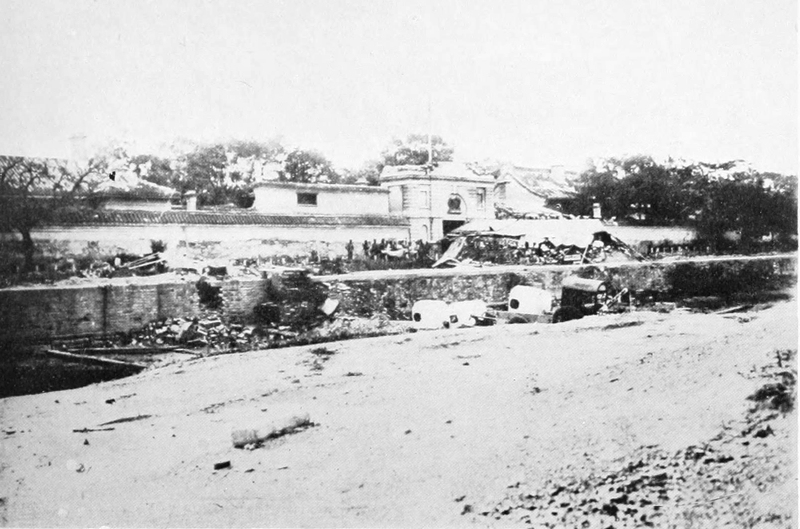
BARRICADE ACROSS THE CANAL TO THE FU
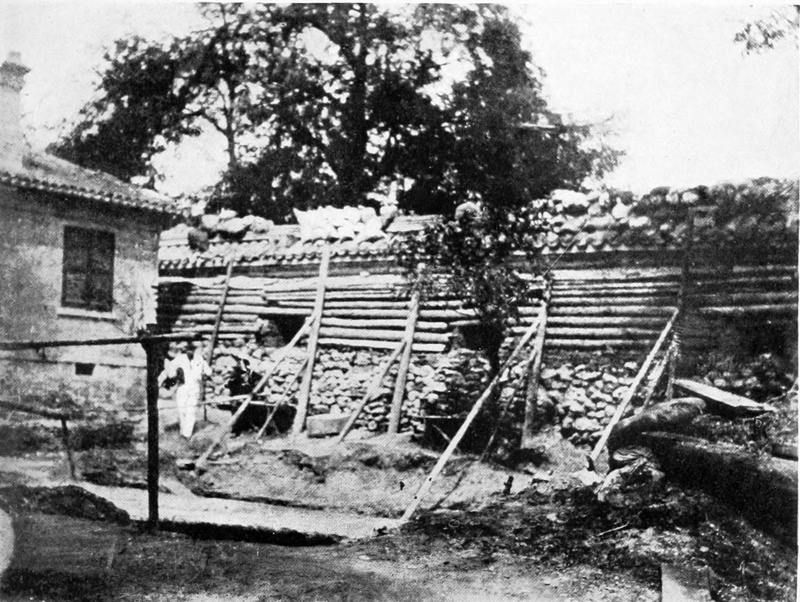
Copyright, M. S. Woodward SANDBAG BARRICADE IN AMERICAN LEGATION
51It is now almost two weeks since the troops started from Tien-tsin. Where are they? Seymour must be in command, and Sir Robert Hart suggests that, when he gets here, we call him Admiral See-no-more, or, if the Queen wishes to increase his rank for his rapid relief of Peking, she could with reason call him Lord Slow-come. The Russians themselves have christened Colonel Wogack Colonel Go-back.
Thank heavens that this compound is spacious—big trees and comparatively numerous houses. The Protestant missionaries are now all housed in the Legation chapel, where they have turned the vestry room into a model kitchen and the altar into a table d’hôte. A herd of sheep and a cow have been corralled and installed in the stables, so we shall have meat, in case we are besieged, for several weeks. But if we are not besieged so long, the most sanguine say that the Chinese, who are a nation of cowards, will get over their awe of the foreigner when they find how easily they have made him leave his Legations and collect in the strongest one. When the moment arrives when they entirely lose that awe, how easy it will be for Tung Fu-hsiang alone (even he controls about 10,000 troops around 52Peking) to make a rush on us, although perhaps the only strength of his force lies in its numbers! To get in, to fire and massacre all the hated foreigners at one catch, is not at all impossible.
Legation Street being held by us Americans, we were allowed to have our trunks brought over here and placed in the five-room house which was turned over to Mr. Conger for himself and official family. Dr. Poole, to whom this bungalow belonged, ate at a mess, so that, not having any need for his stove in the kitchen of his house, it was immaterial to him whether it was broken or not, but what a difference it made to us! Mr. Conger’s large family, increased by several guests from Chicago, had their meals cooked on this delightful stove at certain hours. Our family—that of the First Secretary of the Legation—is also very large, and accordingly we find it necessary to have meals at other hours; then, again, the Second Secretary, Mr. Bainbridge, arranges his chow at times during the day when it may be possible to cook something; and still again, Dr. Coltman, with his wife and six children, who have a room in the bungalow, have a definite time for their mess.
As we have come in so recently, our meals are 53mostly cold, in the spirit of catch as catch can. I find a great deal of coffee and tinned beef is devoured during the day with great gusto by our officers, soldiers, and civilians. Yesterday we brought all the tinned things over here from our Legation, but, as we are extremely uncertain as to the length of our siege, we realize it is just as well not to have too large appetites.
Mr. Squiers has been assigned two rooms of this house placed at the disposal of the United States Legation. They are situated at the back, opening directly on the filthy, dirty Chinese servants’ quarters. Mrs. Squiers, my maid, and I have the large room, which is practically the living-room for the family and mess of the First Secretary of the Legation. Our trunks, with two silver chests, and all the many dozens of tins of food that we brought from our Legation, are banked all round, up against the walls. The big double mattress on which we sleep is rolled up in the daytime, and we use it for seats as well as the trunks. We have no furniture, as Dr. Poole moved his bed to the hospital and found other places for the rest that he had, so the room is completely empty. Perhaps it is just as well, however, because we have great 54difficulty in finding a place big enough to spread our mattress out when night comes as our stores and trunks almost fill the room.
The three children have their respective cribs, which we were wise enough to bring over from our Legation. They are placed in the other room which looks out on the little avenue that runs through the compound. The air is much purer there than in our room, where we breathe the servants’ air and gas which rises from a broken sewer. The French and German governesses are placed in the ends of small halls.
When we were collecting a few comforts—mattresses, cribs for the children, etc.—in our Legation to bring over to this compound, we carelessly brought, too, a light-blue satin eiderdown quilt, which we took from one of the bedrooms, and now we are glad to have it, for it serves as a most admirable portable bed. When his services are not needed as orderly to Captain Strouts, Fargo Squiers gets some hours of good rest on it. He takes it to any particular spot where he thinks his services may be needed during the night, and, with a childlike ability to sleep anywhere, and an old veteran’s ability to wake up promptly, he finds 55this scrap of luxury from the old life doing excellent duty as a campaign adjunct. The sky-blue shade, however, is fast becoming a rich London smoke. Mr. Squiers, like other men who assist at the night-attacks, and must be ready to work anywhere at any time, sleeps in his clothes and his boots, usually in the American Legation, taking his rest in periods of forty Winks at such time as he is not needed.
As things are not systematically arranged yet—in fact, we hope the troops will be here before we need to get things in such a condition—we do a good deal of cooking on our chafing-dish. When we turn the room into a nursery for the children (for we cannot keep them always in their own room, nor can we allow them to be much in the compound, as half the time it is thick with exploding bullets), it is then a sight to behold. There are a good many children here. Their one game seems to be “Boxers,” and they copy in miniature what we grown-ups are playing in earnest. The younger ones are forced into being the attacking Chinese, and I am afraid when the big ones repulse them, they occasionally get very real bumps on their heads. They have small sandbags and barricades, and their Chinese warwhoop 56of Sha, sha! (Kill, kill!) is a creditable imitation of the real thing. It is all very clever, and they are all very full of life, and I help them to play, for it’s a good thing that they don’t realize what all this may mean, and we hope that relief will come before they lose their spirit and before they know.
One can see, on walking about, missionary children, of whom there are quantities, elbowing Ministers Plenipotentiary, and the latter going about without collars. The Belgian Minister, for instance, is a good example of the condition of to-day. He, with his First Secretary of Legation, M. Merghelynckem, Chevalier de Melotte, and his English valet, have been most gallantly defending their Legation for a long time without help of any kind. They killed many Boxers who attacked them, but they were so few that they found it impossible, after eight days, to hold out any longer, and were forced to leave. A party of Austrian soldiers went to their rescue and escorted them into the Legation lines, as the Belgian is quite distant from this centre. They had the pleasure of seeing their compound fired fifteen minutes after they left, and knew it was being looted as well. They then became “refugee colleagues,” and stopped first with the 57Austrians, then came here. They have for wardrobes the clothes they have on their backs, only M. Joostens has one extra blue cotton shirt and one piqué cravat.
Our Protestant missionaries are working steadily and continually wherever it is most essential, and besides doing everywhere the work of men, they have taken under their wing the care and feeding of that vast number of rescued Chinese converts who are now in Prince Su’s park. Most of the Roman Catholic brothers, in contrast, not only do not raise a finger to work, but in no way occupy themselves usefully.
Firing seems to continue at all times, but it is mostly over our heads. Yesterday Boxers tried to loot and fire the Dutch Legation, which is next to ours, and Captain Myers turned our machine-gun on the crowd for a minute and killed six Boxers, so the attempt to loot was not successful, but the burning of the compound continues. The Methodist Mission, so lately vacated, was looted and burned last night. So much happens in every twenty-four hours I can hardly keep account of it all, and as a background to the hourly horrors that develop is the continuous snipe, snipe, sniping, mostly 58by our own men, who are on roofs of buildings shooting at the constantly approaching incendiaries.
All food-supplies which can be procured in any way from anywhere by anyone have now to be turned in to the committee in charge of food, and everything is deposited with them on the erstwhile tennis-court of the British Legation, which is their headquarters. In fact, everything of a useful nature is stored there, whence it will later be distributed where most needed. The two foreign shops in Peking are Imbeck’s and Kieruff’s, and as they are too far up Legation Street to be defended in any way, they have been abandoned by their owners with their contents. The committee on food-supplies, although greatly desiring the stores on the shelves of these shops, would not attempt to get them, as anyone making the attempt would become a perfect target for Boxer snipers as soon as he left the protection of our last barricade on Legation Street.
Imagine our surprise when, late in the afternoon, a Chinese cart, driven by Fargo Squiers, a boy of fifteen years old, came thundering into the British compound with the upper part of the cart riddled with bullet-holes. He was heading for the two 59rooms in Dr. Poole’s house which had been allotted to his family, and his freight consisted of dozens of tins of the above-mentioned supplies from Imbeck’s death-surrounded shop, which he had procured at the greatest risk to his own life. The committee were about to order him to unload his desirable cargo with them, to be used for the good of the public, but upon hearing that the boy had ridden into the very jaws of death to procure these supplies, and had dared what no man in the compound had dared to do, they told him he could have the disposition of them, for by his rash valour he had well earned the lot.
It seems he procured a Chinese cart and forced two coolies to go with him. On their way to Imbeck’s one was killed by a bullet in his head, and though the other survived to help him load the cart, after arriving in the courtyard of the place, he had difficult work, as coolie number two tried to run away, and twice the boy had to point the muzzle of his rifle at him, indicating what he would do if he made any further attempts. They were fairly free from shots while actually loading the cart. On the return trip every yard of the way they were peppered by bullets, and the second coolie was wounded, 60but not killed. This boy saw what he thought he ought to do, and he did it; but what a terrible price might have been paid for these stores! Apropos of stores, these last certainly are welcome. Our mess is large, and so many tins were given to the missionaries and other needy people before we came to the British compound that we would have felt the lack of staple groceries tremendously had not this large windfall arrived.
The committee on food-supplies have two articles in tremendous quantities—all kinds of tobacco (long black cigars and Egyptian cigarettes) and dozens of cases of wines, mostly red and white, which will be a great help to the Continentals here. These supplies were procured by the committee from deserted shops near enough to the Legation centre to make their procuring not too dangerous. I think the general public was more pleased at the arrival of these stores than were the missionaries in charge, for with misgivings the question arose surely in their minds, Were these things sent to us from Heaven or from the other place?
Friday, June 23.
The excitement to-day is terrible, and much more intense than anything we have yet had. Fires 61are starting in all our “lines.” The horror and dislike of leaving our respective Legations to concentrate in the British is nothing compared to the fact that if we leave our Legation the Boxers and Chinese soldiers will immediately burn them and loot them, and this may give them such a lust for loot and pillage that it may become an incentive strong enough to overcome their national fear of attacking, and make it most terribly difficult for us to hold out until the troops come. Until the troops come! What a wail that is! and it is heard at all times, and all people take their turn in asking somebody else, “When will they come?”
This afternoon we were in Mrs. Coltman’s room, and her sweet baby was asleep in a funny, old-fashioned, high-backed crib. Although the sound of exploding bullets was to be heard outside the house, we were much startled to feel one—you can’t see them, they come so fast—enter the room, hit the headpiece of the baby’s crib, detaching it from the main part, and bury itself in the opposite wall. An inch lower and it would have cut through the baby’s brain. His mother picked him up, and all of us flew into a room on the other side of the 62house, where we felt we would be free from shot, at any rate coming from that direction.
We were accompanied by the wife of the Chief, Mrs. Conger, conspicuous for her concise manner, and an open follower of Mrs. Eddy. She earnestly assured us that it was ourselves, and not the times, which were troublous and out of tune, and insisted that while there was an appearance of warlike hostilities, it was really in our own brains. Going further, she assured us that there was no bullet entering the room; it was again but our receptive minds which falsely lead us to believe such to be the case. With these calming (!) admonitions she retired, and I can honestly say that we were more surprised by her extraordinary statement than we were by the very material bullet which had driven us from the room.
All women are busy sewing up sandbags to strengthen our defence, while bullets are raining into the compound like hailstones. A man comes rushing to where we are working, and tells whoever is in charge of filling the sandbags that a hundred, or as many as possible, must be taken to such and such a barricade, or it cannot hold out. We get snatches of the real state of affairs very often in this way.
63June 23.
Yesterday, the 22nd, the Austrian marines vacated their Legation, although Von Rostand, the Austrian Chargé d’Affaires, and other people greatly criticized them for having left too soon. These marines then went to the French Legation, and M. and Mme. von Rostand became Lady Macdonald’s guests at the British Legation. The Belgians stayed with the Austrians until they left, when they came to this compound, and the Belgian Minister also became a guest at the Legation. The Dutch compound and the Austrian compound are still burning.
Yesterday at ten o’clock in the morning a sort of terror, almost unaccountable, seemed to sweep over the entire length and breadth of our lines; the French soldiers got in a terrible funk, left their Legation to Boxers, fire, or anything else that might appear, and ran all the way without stopping to the British Legation, where they said everything was “lost.” The Germans also got the fright, but after coming up Legation Street half-way, they turned back, and not only took a stand in their own Legation again, but they sent men into the deserted French Legation and kept it manned, so that if the 64Boxers came they would be resisted, and not be allowed quietly to take possession.
The Russian compound is the only passage-way by which the American marines can escape and retire to the British Legation, and it was understood that in case of an attack from the Chinese serious enough to necessitate everyone leaving their Legations, the Russians would not close their big gate opening on Legation Street until our American soldiers had entered, when they would hold out there (in the Russian compound) as long as possible, and then retreat all together to the British Legation. Our Russian friends, however, forgot this little arrangement, and when our men were also seized with this panic and left the Wall, and retreated through our Legation across Legation Street to the Russian gate, they found it not only locked and barred against them, but no one near enough even to hear them knocking. They excused themselves afterward by saying they had left a tiny gate open farther down the street, but as none of our people knew there was such an entrance, we thought this a rather poor excuse.
However, in an hour’s time, after this terror had passed over the entire line, our marines had returned 65to the United States Legation, and had manned the Wall again. The French returned later to their Legation which the Germans had kindly guarded for them in the interim, rather disheartened to think that the scare they had started should prove to have been only in their own overwrought minds. As the French and German Legations occupy two important positions, and are constantly being attacked by Boxers and soldiers, the French Legation could have been taken very easily by the Chinese had the Germans not occupied both Legations. They are directly opposite each other in Legation Street.
Our men already have the reputation of being the crack shots of any of the guards in Peking. It has been noticed that when our men aim they bring down their game—whether the game is a Chinese soldier’s head or a Boxer.
Yesterday it seemed too hard that, after the nervous excitement and fright to everyone in the morning, Providence did not withhold the terrible fire that broke out almost in our very midst in the park directly next the Wall. Each hour seemed more terrible than the one before. A huge column of smoke went up into the air, and in its centre 66forked tongues of flame burst out. It seemed impossible that this enormous fire—one so large or so near I have never before seen in my life—would not in an hour or so completely burn us up. The Boxers or soldiers who had so successfully started it must have been overjoyed to see their work, knowing it would take almost superhuman power to put it out, although I am sure they could not have thought it possible that we could extinguish it.
There was little enough hope written on people’s faces in our compound to make us feel, for a time at least, that perhaps the Chinese might be successful, and by burning one wall that played so important a part in our defence, they could enter and massacre us without having to attempt an attack by scaling. Had there been a wind blowing this enormous column of fire in our direction, we could not have fought it at all, and the entire long wall which divides the British Legation from the Empress-Dowager’s carriage park would have fallen.
Our men scaled ladders and worked like New York firemen in the way they strove together and in the good sense they exhibited. I suppose man is able to keep his head clear when he knows that this may be his last chance in this world to save 67his skin from Chinese savages, and that his arm develops in consequence a good deal of strength. Men who were on top of the wall, throwing down buckets of water on the fire, and handling with as much care as possible the small rubber pipe that we are using as a hose, came down every fifteen minutes, to be relieved by others, for they were half scorched, some badly burned from cinders and falling débris, and all of them had lost their breath in that terrible heat.
It must be remembered that while these men were on this wall they were beautiful targets for Chinese sharp-shooters, and we found afterwards there were many in the Chinese troops. There were three wells in the compound, and from the two biggest there was a line of men and women passing buckets, ewers, and any other kind of vessel that was available, filled with water, to the men who were actually fighting the fire on the wall. One realizes the heroism it takes to continue working at a fire though half scorched, but what shall one say of these men who worked under the ordinary danger of a scorching fire, and who knew they were the target for the continuous rifle-fire and sniping that was kept up throughout? The sky was grey, 68and the men on the Wall made agonizingly big and black silhouettes for the Chinese to aim at.
If I live to be a thousand, I could never see a queerer collection of people working together to extinguish a fire, and with the object to save themselves from a massacre—coolies, missionaries, soldiers, and Ministers Plenipotentiary working and straining every muscle for the same object. Surely Peking never before saw such unanimity of her foreign residents. I was in that line of men and women passing buckets, and so was the wife of the French Minister, and many other well-known women.
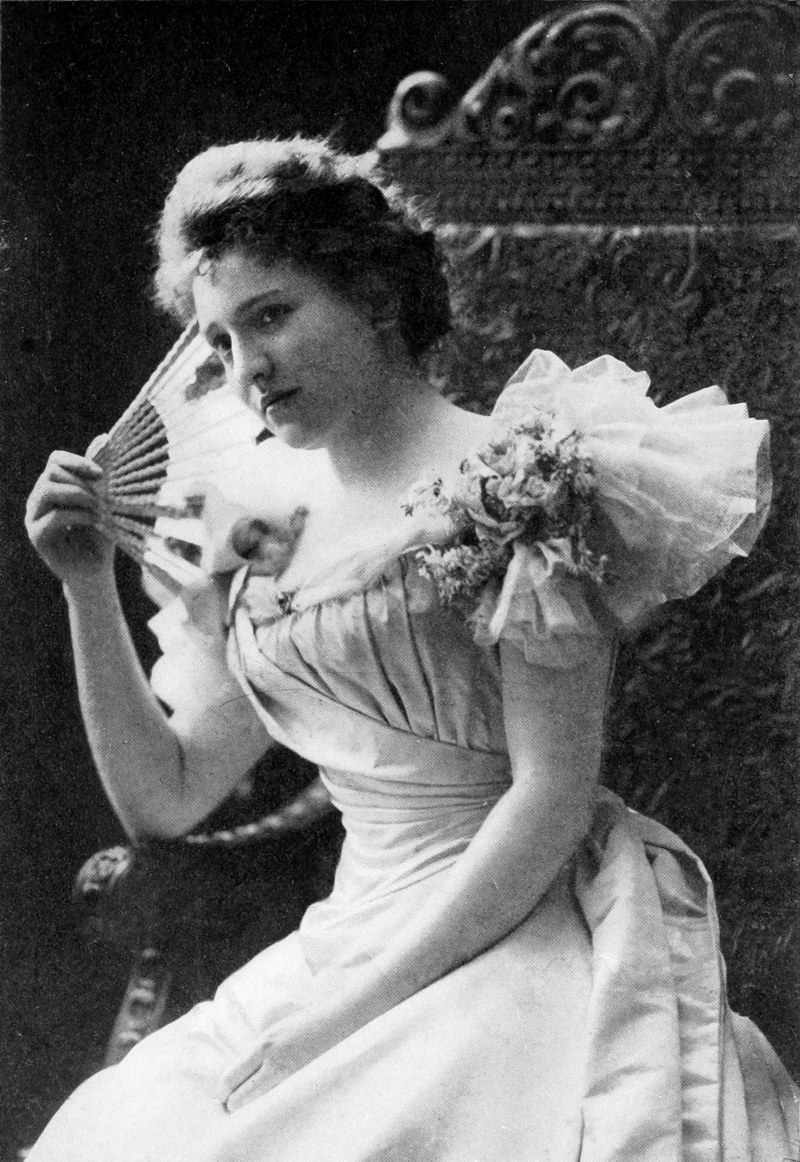
MRS. R. S. HOOKER
Fargo Squiers, Dr. Martin, and Dr. Poole, surgeon for the British Legation, were three soot-covered people who came to our rooms after the fire was entirely out,—which meant they had worked desperately for many hours without stopping. To say they were thirsty would not be truthful—they were parched. Dr. Poole whispered that the only cup he knew big enough to quench his thirst was a big loving-cup that was in a small closet in a corner of the room (this house having been his before the siege), and that if I would fill it with Apollinaris he would put in the whisky. 69I filled my order, and he poured out about four fingers of Scotch into the bottom of that big loving-cup, and as he drank it slowly, holding it by both hands, I thought I had never seen such thankful eyes as were his during that long and pleasant well-earned drink.
Again to-day thousands of sandbags have been made by the women. Shooting continues all the time, and to-day a cannon was fired from the Ch’ien Men Gate, which we hope may mean that our troops are coming and the Chinese resisting them. Prince Ching is supposed to have under his command in China fifty thousand troops, and he must be friendly to us, or we feel he would have ordered half of his troops to Peking before this to finish us. It is stated that some of them have shot at the Boxers, but this is hardly credible. Prince Ching is a Prince of the first Order, and head of the Tsung-li Yamen. Dr. Morrison is the most attractive at our impromptu mess; he works wherever a strong man is needed, and he is as dirty, happy, and healthy a hero as one could find anywhere.
June 24.
Two weeks ago to-day the troops started from Tien-tsin. Yesterday by 11.30 a.m. the Hanlin 70Library, directly behind Sir Claude’s house in the compound, was fired by the Chinese, and the way we fought the flames I described yesterday, only perhaps the men felt a little stronger. They have succeeded once in putting out an enormous fire, so why should they not be able to do so to-day? This time, however, the wind was against us, so that from the morning until seven o’clock at night we were fighting it desperately.
How absurd it is to have any “consideration” for people like the Chinese! After the big and dangerous fire of the day before yesterday, the committee on fortifications and defences suggested that the world-famous Chinese College (the Hanlin Library) should be burnt by us in such a way that the Chinese could not use it as a position to fire on us from. There was danger, too, that they would fire it themselves, taking it for granted that the fire would surely spread to such an extent—aided by themselves with kerosene—as to burn this entire end of the Legation. The Defence Committee was afraid of this, and at a conference of the Ministers it was discussed, and more or less unanimously disapproved of. “Such vandalism!” they said. “This trouble will soon be over, and then what 71a disgrace to have to acknowledge to the world that we deliberately burnt one of the finest, if not the finest, libraries in the East!” We only had to wait twenty-four hours to see that our consideration for the famous library was thoroughly thrown away, for, notwithstanding the troubles “will be over in a few days,” the Chinese seem so anxious to destroy us before these troubles have passed that they themselves burned this gorgeous old library, containing as it did all their oldest and most revered literature, in the hope that they could burn out a large enough part of our Wall to facilitate their getting in.
The great danger was over by seven o’clock, but careful sentries watched all night in case a strong wind should start, and small isolated buildings were burning all night, so that, looking down from our house to that end of the compound, it made one think of the blazing flames one sees at night in the oil districts of Pennsylvania. With these terrible fires the Chinese are clever enough to keep up a volley of rifle-fire, so our labour is a frightful danger to every man working. The suspense was hard to bear, because it was over five hours before the most optimistic dared say, “We are comparatively out of 72danger;” and nobody knew just what would happen if this end of the compound was to go, for this British compound is looked upon by all as the strongest and last resort in Peking, and that is why, of course, all of the women and children and stores of every description have already been sent here.
Twenty-five Chinese Sisters, who were rescued from the Nan-t’ang, come to our tiny little courtyard at the back of our house—on which charming view, by the way, our windows look—and cook in a big caldron their portion of rice that is allowed them by the General Committee. These people and all of the families of Mrs. Coltman’s “boys,” and Mrs. Squiers’s “boys,” fill up our tiny backyard with their cooking, etc., until, from the propinquity of these people, one is almost convinced that one is living and sleeping in the heart of the Chinese settlement of San Francisco.
The marines at our Legation, who naturally will not come here until they are forced to, are in a very bad way about food. From May 29, when they arrived in Peking, they were fed by a Chinaman who contracted to feed them all at so much per man, and he fed them splendidly, but since we have been besieged he naturally has no market to 73call upon. Mr. Squiers has fed them for some days out of his own storeroom, but each meal makes a terrific hole in his supplies. There are fifty men and two officers, and naturally they do not get satisfied on one tin of sardines and a loaf of bread. We have cooked rice in great quantities, putting many tins of corned beef into it, cooking it in the same big caldron that the Sisters use. Preparing the food over here makes it very difficult getting it to them, as there is constant sniping going on, and it is extremely dangerous to walk from one Legation to another.
June 25.
So far the moral of the Legation, or, I should say, of this compound, is decidedly good. The weather is very warm, but the heavy rains that generally come at this time of summer are not here yet. Only a few babies are sick with dysentery, and there are some cases of scarlet fever and malignant malaria. The hospital, a house of four rooms, only holds a comparatively small number of patients. Let us pray it will not have time to fill up. Dr. Velde, a surgeon of the German army, who has been detailed for three years to the Legation in Peking, is a man who for very clever and consecutive 74work has already been decorated by his Emperor. His forte is surgery, and it looks as if he would save the medical day here in Peking. Dr. Poole, I think, will consult and work with him. One of our marines has already been killed, and two are at the hospital wounded. These people, who are the first to lose their lives and get hurt, make one feel that truly this is war.
I was at the hospital with Mrs. Squiers this morning. Several men were brought in, and they all had to wait their turn to be operated on, and the two nurses were so busy assisting with the work in connection with the operation of the moment that nothing was done for a wounded Cossack who was laid on the floor. He was covered with blood, and it trickled down his chest and formed into a pool all around him, his face an olive-green—the colour one sees in unskilfully painted pictures of death—so livid, I never believed even dying people could look that way. He lay there for some time, everyone in authority too busy except to tell me to do what I could for him, and keep the flies from bothering him until he should die, probably in twenty minutes. He was shot through the lungs.
People continue to be cheerful, but it is strange 75considering that we have death around us morning, noon, and night. The gossip, if one can so call the reports and rumours that are circulating throughout the compound nearly every few hours, is that a Russian declares he knows their troops are coming, because during the night a sentry saw a green rocket go up into the sky. It is supposed that the Chinese have no green rockets; therefore, as the Russians constantly use green rockets, it must be a signal from the Russian troops to let us know they are practically at the door. And so on and so forth.
To-day Dr. Morrison went over to the Fu, where the Chinese Christians are, to assist Colonel Shiba in some difficult and dangerous barricading work, and incidentally to take a part in a sortie. He was in command of a squad of Japanese and Italian soldiers, the latter most ineffective, and the former magnificent. They cleared the Chinese out of some alleys which Colonel Shiba decided must be added to their lines for the protection of the Chinese converts. The brunt of the fighting fell on the Japanese, and one was killed and three wounded. Such a clever idea it was of Dr. Morrison’s and Dr. H. James’s to put these poor wretches in Prince Su’s park, which, owing to its close proximity to 76the Japanese Legation, seems now to fall upon the Japanese to defend.
Dr. H. James met with such a terrible end yesterday! From the gate of the British Legation facing the canal, he looked down towards the Imperial Wall, and seeing there several Chinese officers carrying a regimental flag with which he was familiar, he started out, as if on the impulse of the moment, to parley with them. He was watched with breathless interest. Although from the time he left our wall until he reached them he held his hands up to show he was unarmed, they grasped him in the fiercest way, dragging him over the bridge beyond our range of vision. The horror of his too probable fate is hanging like a pall over the compound. We cannot understand how a man, knowing the Chinese as well as he does, could have been so mistaken in their character as to trust himself to them with such confidence.
During the two fires in the Mongolian Market Place and in the Hanlin University a great many Chinese were shot by us, and when possible we straightway threw their bodies into the flames. Unfortunately, some Boxers were captured during the almost hand-to-hand fighting that has taken 77place, and confined in this compound. They were all shot at dawn this morning.
Captain Myers has been in command for two days and two nights on the Tartar Wall, with no sleep. This afternoon the marine quarters in the United States Legation caught fire and for a time it looked as if the whole American compound would go, but with hard fighting it was put out.
Mr. Cheshire, of the United States Legation, is willing to take the most difficult and dangerous work wherever an interpreter is needed, and for some nights now he has been on the Tartar Wall directing and encouraging the picked Chinamen forming the gang of labourers who nightly help our marines to strengthen the barricades. Many Chinamen who advance towards our lines too rashly, are killed every night, and after hours of this work the number of corpses that accumulate is astounding. For the sake of the health of the community, Mr. Cheshire has to spend much of his time superintending his gangs in throwing dead bodies over the Wall, and to-day he facetiously remarked he thought he should be dubbed Major-General of the Corpses, as he comes in touch with so many. Such gruesome tales as these do we hear and talk of daily!
78June 26.
Yesterday afternoon, at four, five gorgeously costumed Imperial Standard bearers appeared on the bridge in Legation Street with a flag of truce, saying the Emperor would send later a despatch to the bridge for us to read, and that there was in consequence an armistice. It was brought later, and it read: “The Emperor desires the Ministers to be protected. Therefore, firing must cease, and a despatch will be handed to them later on the bridge.” It was apparently not brought; but on seeing some mounted Chinese officers belonging to Jung Lu’s regiment passing over the Imperial bridge, we hailed them with a white flag, and with some soldiers to back up the meaning of the flag we spoke to them long enough to find that they were going the rounds of this part of the town, telling their people not to shoot this night on us, as there was an armistice. We told them to send the Emperor’s letter or despatch (which has not yet arrived on the bridge) to the British Legation. They promised that it should be brought to us, but it has not yet arrived at noon to-day.