BEHIND THE SCENES IN PEKING (continued 2)
Reading edition
Last night I was talking to M. Pichon, the French Minister, when the French Interpreter of 79Legation came up to us in great excitement, saying the Russian officers had heard, without any possible doubt, les sonneries du canon of the Russian troops. It is in this way we hear so many tales that one is lost when one tries to think. The captains of all nationalities have had a council of war, and they agree that with great care and hard work we can hold our own for eight or ten days longer, but after that we are lost.
Mrs. Coltman, the mother of six lovely children, was speaking of the impossibilities of clean linen or having any washing done. “But after all,” she said, “what does it matter? If the troops come within ten days, my children can wear what they are wearing; if Peking is not relieved within that time, we will all be dead.” She was not melodramatic, but spoke very quietly. A hundred other remarks of this sort that one hears daily go to show how the people really feel about our condition. Women with husbands and children suffer horribly. They dread lest their children may die of disease or by torture, as certainly would be the case if the Chinese get in—as they are notoriously cruel and without mercy even to babies—and fear for their husbands, who may be killed during any attack.
80At one o’clock this morning a terrific firing began, apparently coming from all sides at once, which proved to be the case later, when the officers in charge of the defence compared notes. At this Legation the air hummed with bullets, but the noise was so frightful one could not tell if all the Legations were being attacked or just the British. They tried to frighten us, and they certainly succeeded with women, children, and some men, but, thank heavens, the officers in charge of defending us and the sentries—most of them, at least—know that our high walls and strong barricades are our safety, and that, unless good and well-aimed artillery is brought to shell them down, with our soldiers and soldier-sailors to man them, it will be hard for the Chinese to get over the Wall and end our lives.
It all seems like a story from the Middle Ages to be able to place such confidence in the strength and manning of our walls. Certainly the foreign-drilled Chinese soldiers must be down at Tien-tsin, and we are owing our present immunity from properly aimed artillery-fire to the fact that the Chinese gunners here are utterly incompetent.
After this fiendish attack had been in progress long enough for everyone to get up and dress, 81Mrs. Conger came back to our room, and her manner was more than tragic when she saw me lying on my mattress on the floor, not even beginning to dress for what I suppose half of the women in the compound believed to be the beginning of the final fight. She said: “Do you wish to be found undressed when the end comes?” It flashed through my mind that it made very little difference whether I was massacred in a pink silk dressing-gown, that I had hanging over the back of a chair, or whether I was in a golf skirt and shirt waist that I was in the habit of wearing during the day hours of this charming picnic. So I told her that for some nights I had dressed myself and sat on the edge of the mattress wishing I was lying down again, only to be told, when daylight came, that the attack was over, when it was invariably too late for anything like sleep (which way of living is distinctly trying), and after a week of it, when one has so much to do in the day hours, I had come to the conclusion that, as it was absolutely of no benefit to anyone my being dressed during these attacks, I was going to stay in bed unless something terrible happened, when I should don my dressing-gown and, with a pink bow of ribbon at my throat, await my massacre. 82This way of looking, or I should rather say of speaking, did not appeal to the Minister’s wife, but I must say that at such terrible moments during the siege it is a great comfort to be frivolous. By making believe that one is not afraid one really lessen one’s own fear. “Assume a virtue if you have it not,” says our beloved Shakespeare. After Mrs. Conger’s visit on this same terrible, ear-deafening night came Clara, Mrs. Squiers’s German nursery governess, and she needed all sorts of assurances to convince her that a massacre was not in progress at that very moment.
These attacks are very terrifying, and to talk to a person two feet away one has to shriek. People one sees are either apparently most optimistic or desperately pessimistic, nothing between. It is a horrid thing to see big, strong men unable to hide their innate cowardliness, and shirking all duty of the slightest personal danger.
Friday, June 29.
One or two days have passed without my opening my diary, but they are very much like the days that I have already written about. The weather is very warm, but all able-bodied men are working desperately hard over trenches, bomb-proofs and 83barricades, or putting out more fires that have started at different places. Several attacks are constantly being made in opposite parts of our lines, with perhaps one big general attack in the afternoon and one during the night, which causes great excitement and sometimes great fear in everybody’s heart. Then comes more excitement when the rumour arrives that a big fire is breaking out in the French and American Legations, or we hear that someone, who has just come from one of these Legations, says that he has heard the officer say they probably cannot hold out much longer, with fire to fight as well as the Chinese, and in ten minutes the report is all over the compound that these Legations have been abandoned, and half of the soldiers defending them killed. Such a quantity of rumours that are circulating every day, only to be denied and proved untrue an hour later! It is incredible!
In the case of the Legations who are still holding their own, it is very hard on the women whose husbands are still staying with the soldiers until they finally evacuate. These poor women naturally wonder, “What is my husband doing? Is he dead, and when they evacuate will he be amongst the 84lucky number to retire to the British compound alive?”
Hard work is kept up on the important barricades, and men do hours and hours of manual labour. The women make thousands of sandbags daily, and help at the hospital, and make short rations go as far and look as attractive as possible under the circumstances. The only strong men in the compound who have no special work to do are Ministers Plenipotentiary. There is no head-work to be done now, and some of them don’t take kindly to physical work.
The British Legation Library is a complete one, and occasionally some inquisitive soul will go to it and try to find, compared with other sieges and massacres, what place this one will have in history. The nearest similar harrowing siege seems to be that of Lucknow, where a heterogeneous multitude, closed up in the Residency, were holding out against fearful odds in expectation of relief by Havelock’s Highlanders, resolved to die of starvation rather than surrender, for in surrendering the fate of Cawnpore awaited them; and in thinking of these things we recollect that the Tartar rulers of China are of the same tribal family as the Great 85Mogul, who was the head of the Indian Sepoy Mutiny. But the King of Delhi was trying to regain his throne, whereas the Empress Dowager has no such excuse in making war on practically all the nations of the civilized world.
The Tartars and Manchus are an alien race, although the rulers of China for many centuries, and have always been inimical to everything which tends to increase the power of foreigners; whereas the Chinese are cleverer, from being so constantly in contact with Europeans on the sea-coast, or anywhere where they can find gain or advantage in trading with them, and have become, compared, at least, to the ruling Manchus in Peking, progressive and modern. The Emperor and his party for progress were completely snowed under in 1898 by the Empress-Dowager and her old Manchu Conservatives, who, lacking the desire to accept anything modern—even diplomatic relations of the most simple kind—decided, in a childlike and unreasoning rage, that everything foreign must be swept down into the sea, and it really looks now as if the first steps of her policy may be realized.
Lady Macdonald has forty Europeans in all to feed three times a day including servants, and at 86table they sit down thirty-three. She is very sensible, and has only one dish. Nobody thinks of dressing for dinner, except the Marquis Salvago, and I think it shows things are truly far gone when English people dine, but do not dress.
Our little mess is very attractive, and as our stores are much more numerous and of a greater variety than those of almost any mess here, we manage to have, up to the present at least, a most satisfactory one. We have tinned beef as our pièce de résistance, and rice is our mainstay—of a necessity, as it is that of which we have most. Tomato catsup tastes very good in this hot weather. Oatmeal is another staple that we have, and as luxuries we have a good stock of jams, tinned fruits, tinned vegetables, sardines, tinned mackerel, Liebig’s extract, a big box of Stilton cheese, coffee, tinned butter, and white flour. Mr. Squiers has a large supply of champagne, and every night we have one or two quarts with our siege dinner. The men work so hard, and the women’s nerves are so much on edge, that a small amount of stimulants is surely a blessed help.
Our mess being comparatively small, these delicacies are lasting nicely, as we use them with 87discretion, for we remember in the old days before the siege a dollar was a dollar, and would buy a tin, but in these days a tin has no market value—they cannot be bought. When one’s tins are gone one can eat horse-meat and rice. We brought a small lead-lined ice-box with us from our Legation, which seemed foolish at the time, but which is a great comfort to us now. We keep our wine and drinking-water in it, and also well-water, which is very cool, so that our drink is somewhat cooled, and is not the same temperature as the air. No other mess can attempt to have things cool, and this is one of the features of our room—that we are as comfortable as we can be under these extraordinary circumstances. During this sizzling weather cool water is a great comfort. It is so hot that a tin of meat, if left open all night, spoils by morning.
There is an English newspaper-man, who, when he can spare a few moments from the siege-work, gets his camera and takes a few photographs of things as they are. He is fond of chaffing, and to-day the Committee on Fortifications are of opinion that the house used by the French Minister, M. Pichon, is being undermined by 88the Chinese from outside, though indistinct noises, etc., are as yet the only proof of it. The Minister was more than usually perturbed about this new personal danger, and was not pleased, or at all amused, at the remarks addressed him. “I am making photographs for the Paris Figaro of this siege. Very soon your quarters will be blown up by dynamite. My camera is ready to take the photographs, and as you will be the principal person in it, how would you prefer me to take you—as your Excellency is going up wholesale, or as you are coming down retail?”
At this time people are not well-balanced, it seems to me. Some take the daily horrors as a matter of course, are more callous than they should be, and the others are so miserably pessimistic and mournful that one shuns them, fearing to catch this infection. There is a young man here who has been known to indulge in temporary aberrations, usually at night, following long, hard days of work in the broiling sun. On one occasion he was on his sentry beat, and on being relieved by his chief, the sight of whom was too much for him after having walked some hours on his dangerous sentry route (which seemed doubly dangerous in 89the pitch-black night) he, doubtless brooding over his probable approaching death, pointed the muzzle of his gun straight at his relief. “C’est à cause de vous, misérable, que je suis venu à Pékin et encore c’est à cause de vous que ces belles années de ma jeunesse seront salement terminées ici!” By not moving an inch the man thus threatened undoubtedly saved his life, and most intelligently agreed with his attacker, “Probably so; let’s talk it over.” In a few minutes the crisis had passed, but the following day the man who had been in such danger requested the General Committee to change his night sentry duty to a different part of the compound, so that his young secretary should not again be tempted to hold him responsible.
Sunday, July 1.
I have been quite under the weather, to use a civilized expression, and I assure you that things have got (not are getting) to such a state that to live and act and talk as one would do at home is quite out of place. How soon people get accustomed to an idea! Now that we have prepared our minds for a possible massacre we seem to be getting back, to some degree at least, our old spirits. Now that 90I am well, how much nearer seem the soldiers who are coming to relieve us!
What a place this compound would be for an epidemic! There are barely enough mattresses for the wounded and dying at the hospital, so that, should we have one, and take a house for those taken sick, I am sure that there would be no ordinary comforts of any kind for them; they could only be isolated. Let us pray that we will have no such horror to add to the already long list.
The hospital is already full, men lying on straw bags in halls—crowded in every conceivable corner. They are brought in dying and wounded every day. Dysentery has its grip on almost everybody here. The treatment is almost to stop eating and to drink rice-water in large quantities. Our four-times-divided cook—the other three messes in the United States bungalow have a lien on him too—is off for some hours daily on work which all personal servants have to give to the General Committee. When the kitchen is comparatively free, Mrs. Squiers, my maid, and I make gallons of rice-water, thick, nutritious but tasteless, which we bottle in quart-bottles and place to cool in our zinc-lined, cold-water-filled box. It is placed in a corner 91of our two-roomed quarters, and the constant stream of men coming and going to that box would lead an uninitiated observer to believe that at least a Hoffman House bar was hidden there and doing a steady business.
The rainy season and the bad time of the year par excellence has begun, and the temperature is like a Turkish bath without the clean smell. Apropos of smell, a whole story-book could be written about the Peking smell. The dry heat was nothing compared with this damp temperature, that seems to soak out of Mother Earth the most incredibly disgusting odours. There are so many dead dogs, horses, and Chinese lying in heaps all around the defended lines, but too far for us to bury or burn them. The contamination of the air is something almost overpowering. All men who smoke have a cigar in their mouths from morning until night as a protection from this unseen horror, and even the women, principally Italians and Russians, find relief in the constant smoking of cigarettes.
On the 29th Dr. Lippitt, who came up from Taku with our marines, was sitting in front of the Minister’s house smoking a cigarette, when a bullet 92struck a limb of a tree nearby, and, glancing down, struck him in the thigh, fracturing the bone. He is most dangerously ill, and we shall not know for several days whether he will have to have his leg amputated or not. He is an attractive man and a thorough Virginian. We used to play tennis with him and Captain Myers before the times got so terribly out of joint.
To-day the Germans were driven off the Tartar Wall close to their Legation, which caused a great deal of excitement. They were driven off by Chinese soldiers, some of whom were Tung Fu-hsiang’s men, and others were Prince Ching’s especial troops, which seems queer, as we have supposed all along that Prince Ching was friendly.
The Germans could see from the Wall that the Ha Ta Men Gate is being strengthened, and people who know say that the troops who are closing the gates in such a warlike way are doing it as much against the violent and uncontrolled soldiers of Tu Fu-hsiang, who are notorious for the manner in which they loot and murder, as against the allied Powers. They say that all Chinese families in Peking who have anything to lose have left the capital, as they realize that if the foreign troops 93come there will be great looting, and if the Chinese troops are successful there will be looting and worse. Mr. Pethick tells me that during the Japan-China War, when it was considered highly probable that the Japanese would march on to the capital, thousands of Mandarins and people of wealth left Peking with their families and with as much treasure as they could carry. It is natural to suppose that the same fright exists to-day.
This morning our men, the Germans following, retired in a panic from their barricades on the Wall to the United States Legation, momentarily expecting to see Chinese hordes occupy the German position and theirs. After an hour’s wait they retook the Wall. This example, however, was not followed by the Germans. During this hour the excitement was intense in the British compound. The report that the Wall had been evacuated caused a panic, for this abandonment of the Wall would enable the Chinese to mount their guns on this portion of it, directly commanding the British Legation, and to fire down on us, and no one can say how long we could hold out against such an attack. In such an event we will put women and children into deep bomb-proofs that 94have been made for that purpose, which are covered with logs, sandbags, and dirt, and are shell-proof. These trenches we have made as near as possible like those used in the siege of Ladysmith.
As the Germans have been unable to regain their positions on the Wall, the difficulty for Uncle Sam’s men has been increased fifty per cent., as they must now be prepared at all times, either during the day or night, for an attack by Chinese from both directions. This sentence, “to give up the Wall,” could be, translated into siege language, “the beginning of the end,” and this news was most terrifying to us. I think that there are few who in their heart of hearts have given up hope of the troops coming soon. Nevertheless, the facts remain that if we cannot hold the place it would not take very long for us to be annihilated, and if the troops come a day after we are finished, a miss is as good as a mile, and we don’t care then when they come. If we had not had the greatest luck in the world we could never have held out like this to the present date, and what the Powers can be thinking about not to send a column to our immediate relief, knowing, as they must, that we could never hold out against artillery, is beyond the reasoning power of the people in this Legation. 95Are the allied Powers fighting each other, or are they fighting their way up here?
Yesterday an unsuccessful sortie was made by Colonel Shiba from the Fu to capture a gun, and six men were killed. These offensive measures seem to gain us nothing, and we always lose men.
Apropos of Colonel Shiba, he is a splendid, small person. He has taken his position here by the strength of his intelligence and good right arm, solely because the Ministers and the guard captains were not especially inclined at the first morning conference to listen to him—in fact, I don’t know that he tried to talk, but it is all changed now. He has done so splendidly in his active and continuous fighting in the Fu, and has proved himself such a general, that his opinion and help are asked by all the commanders. His men are all so patient and untiring in their long, long hours behind the barricades, and are so game, in great contrast to the Italians who are with him defending the Fu. One can only hope for Italy’s sake that her soldiers in Peking are the worst she has.
Now that we have got down to the primitive motif of all nationalities fighting for their lives, the racial friendships and animosities are very obvious. 96The British and American are almost one people here; although the expressions, “D—— Yankees!” and “D—— lime-juicers!” are interchanged, they are used in a spirit of affection. The dislike of the Russians for the British is so cordial that it is only equalled by the feeling the British entertain toward them. The frankness of this avowed enmity is delightful. Our compound joins the Russians, and they love us and we love them in as strong a fashion as they hate their English neighbours on their other side. Baron Von Rahden orders his men to work and fight as much as possible side by side with our marines, as in this way he hopes to increase the efficiency of his untrained guard. These men can’t speak the others’ language, but are the best of friends. The Russians are all called “Rouskies” by our guard.
The Germans are somewhat by themselves, and fraternize with no one. Their Legation is at one end of the defended lines, and opposite the French. They are full of sullen rage at the unavenged death of their Minister, and when they are fighting or defending barricades in conjunction with other nationalities, and perhaps under command of an American or British officer, they have 97become notorious for their utter disregard of ordinary military precaution and unnecessary daredevil recklessness. The French are also far from the base of the defended area, and come in for attacks. They are assisted by the Austrian guard, some Belgians, some Customs students and unattached Continentals who are able to use a gun. The Customs students constitute a splendid force of young men, but as they are of all nationalities, they are apt, in taking their active fighting positions, to gravitate to the guards of their respective countries, although in many instances they simply join the weakest spot. The Japanese are defending the Fu with the greatest valour, and, needless to say, are tremendously pro-English and anti-Russian.
We now feel that our tactics must be entirely defensive. Although to-day is Sunday, most of the women in the compound, missionary women included, are working hard at sewing sandbags, the non-fighting men filling them. Beautiful material of all kinds is being used for these bags. Liberty satin curtains from London and linen monogrammed sheets from Paris are cut up ruthlessly to be used. One hundred thousand bags, as 98near as they can be counted, have been made already. It was principally in the Fu, defended by gallant Colonel Shiba, that the materials procured were so gorgeous. Bags were made from the bolts and rolls of brocades and satins that constituted part of the treasure left by Prince Su in his palace when he so kindly turned it over to his persecuted fellow-citizens. This is the one bright, wonderful bit of colouring in the compound: it is the barricades of thousands of big sandbags made entirely of these gorgeous-coloured satin brocades—sky-blues, blood-red, Imperial yellows—thousands and thousands piled one upon the other. It has been built from the ground up to the second story of the Chancery building—a rather high house for Peking. It was made at this building, as the firing has been very heavy here—a most extraordinary, butterfly-coloured barricade; and if it were anywhere in the world except in this siege in Peking, there would be seen lines of artists, with sketch-book and easel, trying to put this unusual effect on canvas.
Tuesday, July 3.
For several days past the Chinese on the Tartar Wall have been bolder and bolder, and yesterday 99they built their last barricade so near ours that they could, and did, throw big rocks over into our lines, which, by a lucky chance, hurt no one. The moral effect of this dangerous propinquity was terrible on our men. They felt that there was only one almost ineffective barricade between them and hordes of Tu Fu-hsiang’s soldiers—the notoriously cruel Mohammedan chief and his bandits. Mr. Squiers was the first to appreciate this great danger, and certainly the first to think of the cure, and, what was more to the point, he put it through. The pros and cons were discussed with Sir Claude in conference, and it was decided that a charge down the Wall must be made, and soon, or else we must leave it entirely, and that none of the Americans were willing to do, as we had been there from the beginning, and although the Germans gave up their position on the Wall, we were not content to do the same.
Captain Myers was more than ready to lead the charge, and he was given twenty British marines, fifteen Russians, and thirty of our own men. At dawn this morning, about three o’clock, he charged the Wall. No one in the compound had gone to bed; the excitement was very great. We sent 100sixty of our fighting men on this sortie, and if they failed we should have lost what we could ill afford to lose. We felt that the odds were about even, and that waiting at the hour of dawn was frightful. The charge was successful, and two Chinese regimental flags were captured. Sixty-five dead Chinese soldiers were afterwards found between the two barricades, but the actual number killed and wounded is unknown. Our men came back at five o’clock carrying their dead and wounded. This has been the only effectual offensive measure accomplished during the siege. Captain Myers led it most gallantly—an inspiration to his men—and was wounded by a spear-thrust in the leg.
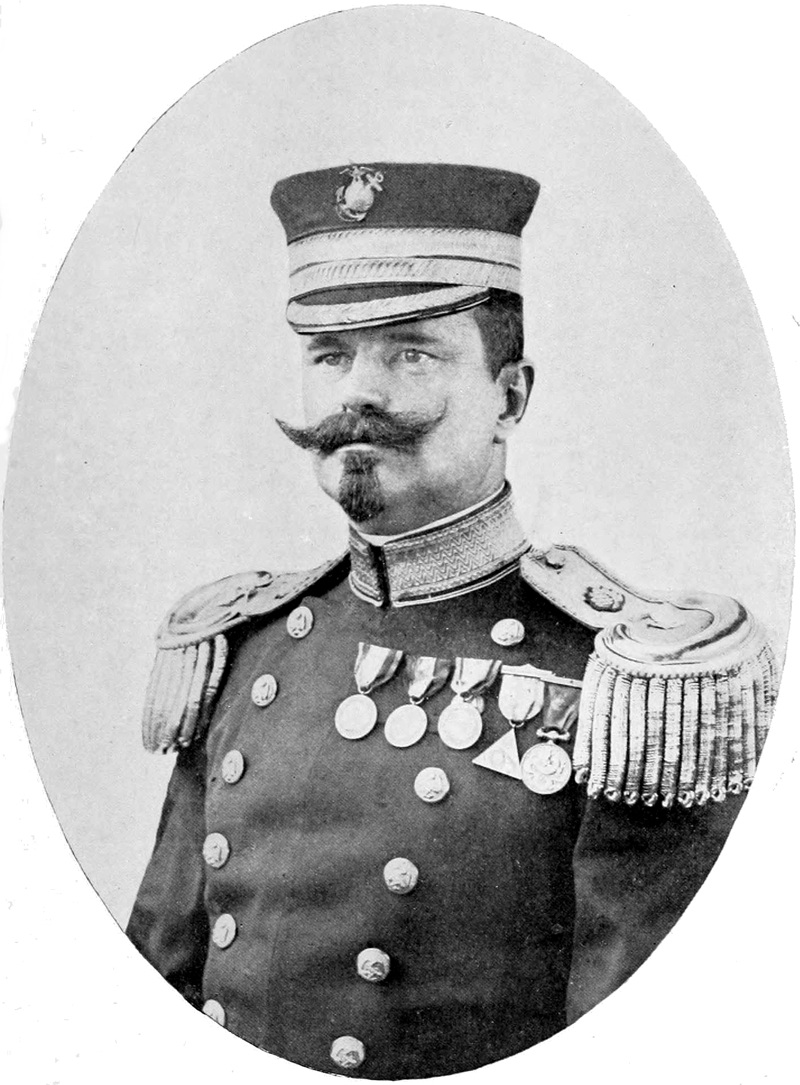
CAPTAIN JOHN T. MYERS
Thursday, July 5.
The Glorious Fourth came in during the last twenty-four hours, and the Chinese kindly announced the fact about 3 o’clock a.m. by a violent firing from all sides, which terrified everybody, but like most of the similar attempts recently made, only resulted in giving everyone a bad fright, and materially weakening some one or two points of our defence. Von Below, of the German Legation, notwithstanding his military physique, seems to be 101developing into a man of moods instead of a man of action, and the story comes over from his quarters that during this last terrifying attack he was seized with the premonition that this was the end. He preferred to meet his doom by making his piano interpret his last feeling. The music from the “Valkyrie” that he drew from that instrument was marvellous. He played, regardless of time and place, in a soul agony, but was rudely awakened some hours later to be told that the attack was all over, and that for this time at least he was not to be massacred in a storm of music.
To-day the moral atmosphere seems worse. I think that it is because absolutely nothing has reached us from the outside world to let us know that our respective Governments care what becomes of us. My personal attitude, compared with my co-besieged friends, is one of extraordinary cheerfulness, simply because, perhaps owing to my youth and health, I can feel no terrible fear for the future, but, on the contrary, am distinctly hopeful.
All the hope that has been caused by seeing nightly green lights that look like search-lights is falling very low, because they have not got nearer at all, which would not be the case were they 102signals used by our approaching troops. Where can the troops be? Are all the Governments so gullible as to believe the Chinese Ministers in their different countries, who are probably assuring them of our safety, or can they be so criminally selfish as to be fighting diplomatically among themselves as to what each Power shall have in the way of future sharing of China after our rescue?
The consensus of opinion among the Ministers here is that the different nations will agree to allow the Japanese or the Russians, who control large fighting forces within a week’s march of Peking, to send a relief column to Peking with the sole object of relieving their eleven Ministers Plenipotentiary, exacting a promise that on this expedition there should be no coup d’état or punitive measures, but simply relief of their distressed representatives. Weeks ago we were told to come to the British compound for a day or two, but as yet there is not a sign of help. Every day deaths occur of our best fighting men and officers, and the question is, with men going in this painfully regular way, how long can we hold out? Soon women and children will constitute the only forces of the compound. The deaths each day are fortunately small 103in number, but a great many are wounded, some very badly, which make them as good as dead as far as fighting goes. The Russian officer in command says that we cannot hold out longer than for one week at the most, but more sanguine people say that, with good luck, three weeks can be tided over.
Captain Myers’s wound of his spear-thrust is not as slight as was expected, and he has much fever. It was very sad to-day to see the funeral of another baby. The second funeral of the day was one of the most popular and attractive of the Customs students. He was shot through the liver while cutting down a tree near the Hanlin Library, and died two hours later.
Fifty men are in the hospital, twelve have been killed, and there are a few convalescents walking about the compound. We did not say so at the time, but we can say now, thank Heaven! the Chinese have tried to fire us on all sides, so that in this way there are very few places or houses where the Chinese, who are sniping at near range, can secure cover. By means of terrific efforts, in which everybody joined, to extinguish the fires, serious harm was averted, although our enormous wall, 104giving on to the Mongolian Market Place, had a breach in it that took a great deal of hard work on the part of the men to rebuild, or, I should say, to mend, with rocks and sandbags, in such a way as to make it safe.
These rocks were moved with great difficulty; they had been in place so long forming the pavements in this compound. How fortunate, from a defensive standpoint, that when we came here we were allowed some servants, our coolies included! Most of these are Christians, because the Buddha men as a rule deserted when they saw how things were going; and now these servants are put in gangs, all of them having to work for the common need in building barricades, filling the thousands of sandbags to strengthen the defences, and doing necessary sanitary work, also at times working shoulder to shoulder with our soldiers when a barricade caves in from the enemy’s heavy fire. One barricade, for instance, was destroyed by the Chinese. The coolies, working with the soldiers, rebuilt it, though exposed to a galling fire from Tu Fu-hsiang’s men all the time. One afternoon six coolies were killed.
These men, whom we call by the general term 105of “coolie,” classing them thus for convenience, are often scholars, being teachers of Chinese to the missionaries or interpreters, and yet they work without complaint in the gangs, though they are in every way unaccustomed to manual labour.
At four o’clock we had another funeral, for Oliphant, who was shot. I was present, and the English chaplain, Mr. Norris, gave us a short service. It was very sad to see his body, wrapped only in a piece of sacking, let down into the ground. The grey sky, occasional bullets flying over our heads, and a few claps of thunder, with flashes of lightning, made a fitting background for the burial of this lovable young man. His brother, a great tall, gaunt fellow, looked his part in the most pitiful way as chief mourner. Before we leave Peking many will be the Chinamen who will be killed without quarter by the Customs students in revenge for the untimely death of their comrade. All the Ministers Plenipotentiary were there, and poor Sir Robert Hart looked weak and haggard from deep grief at the loss of his favourite subordinate. Oliphant was buried only three hours after his death. We have no way of keeping the dead for a greater length of time.
106Horse is the principal article of diet. Several days after we arrived here the beef was eaten up, and there remained but a small flock of sheep, which fortunately was brought here while there was time. There are 1,293 Europeans to feed daily in this compound, and rice is the dish par excellence for everyone. Mutton, however, is distributed to the sick, women and children, to the extent of a quarter of a pound apiece every third day. There are a lot of horses, ponies, and mules in the compound which we have kept alive by feeding with straw, and every day two animals have been slaughtered and distributed among the messes. Then the coolies have a kitchen, where they can come whenever their work makes it possible, and they get rice and horse-meat. It is queer to see how many people acknowledge that they like it, having eaten it now for two weeks. Of course, a great deal depends upon the animal, but they agree that mule and pony are better than horse. Some people even who have among their stores plenty of canned or tinned beef prefer the fresh horse-meat. At our mess, however, we have a prejudice against it, and as long as we continue to have the 107tinned beef we will not send for our share of the animal.
The May races having come off before the siege, most of the diplomats had not disposed of their horses and polo ponies, and the all-important question now is not if “Cochon” will win more cups in future, but if his steaks will be tender. Things are so queer now. The one cow which still gives a small amount of milk, needless to say, has not been killed for her beef, but is carefully tended for her baby-saving fluid. The president of the largest and most influential bank in Peking, besieged here with us, has received a wound which absolutely incapacitates him for active work. He can only hobble around on a crutch. He has volunteered to tend “Miss Cow” and assist her to find the few blades of grass which are still to be had.
I went with an officer to the Hanlin Library, where the sniping is still constant, but not quite as severe as it was, owing to the good barricades with which we have strengthened the position. The Chinese fired this wonderful library of Peking so ruthlessly that nothing is left there but thousands of charred and burnt books, and some 108evidences of the charming courtyard and grass plot where the old Chinese savants used to go and read the ancient manuscripts in Sanskrit and other dead languages. Here I found the bank president, a great power in China in ordinary times, quietly tending the cow, watching her from an antique stone bench. Surely the shade of some ancient philosopher must be shocked into asking himself, “And what have we here?”
The Customs mess at Sir Robert Hart’s has an invariable menu. At breakfast, rice, tea, and jam; at tiffin, rice and horse; at dinner, rice, horse, and jam. We have splendid stores—better than any in the compound—so we live better than any mess here. We have quite a supply of Bishop’s wonderful preserved California fruits, not very sweet, which are most delicious during this hot weather, because they do not make one thirsty; then we have macaroni and tinned tomatoes. We make our corned beef into croquettes sometimes, but generally have it put into a curry with rice. Yesterday we had a great treat for dinner. Our cook, who is an enterprising and daring soul, went outside of our lines into the Mongol markets at great risk to his life from snipers or being 109waylaid by the enemy, and procured one dozen tiny chickens. Sir Robert Hart came to our party.
Menu.
Remarks.
Celery bouillon Liebig extract, celery.
Anchovy on toast Anchovy paste.
Broiled chicken Procured at risk of cook’s life.
Green peas, fried potatoes Tinned peas and two potatoes.
Bean salad Tinned beans.
Black coffee Plenty of coffee.
The chickens remaining from the cook’s raid are being kept in a basket and fed as if they were babies, and will be used entirely for the children. We count eight at our mess as regular members, but our guests are constant and numerous. Its personnel consists of Dr. Velde (who does such glorious surgical work), Dr. Morrison, Mr. Cheshire, Mr. Pethick, Mr. Squiers, Fargo Squiers (who is Captain Strouts’ orderly), Mrs. Squiers (who, because of the great generosity in freely supplying from her limited stores those who are in need, has been called by many in this compound the “Lady Bountiful”), the three children and two governesses, and myself. We usually have missionaries in to tiffin, and our more intimate 110friends, many of whom are sadly in need of food, to breakfast and dinner.
The Russian Legation is so situated that at one point their defence is very weak, and they have almost nightly attacks at such close quarters with the Chinese, that the fighting is sometimes hand to hand. The men of the Russian guard were undrilled sailors, who had been forcibly enlisted from inland villages in Russia, and Von Rahden, their commander, and his under-officer, to keep them from running away when these close-range fights begin, get behind them and stick them with the ends of bayonets, so that they in turn will advance on the Chinese with fury. He claims that this is the only way to teach undisciplined troops to advance at close quarters, as they always become seized with terror—and I don’t wonder a bit, for the Chinese in attacking blow on shrill horns, shriek, howl, dance with the wildness of dervishes, and advance with the cruelty and cunning of Indians.
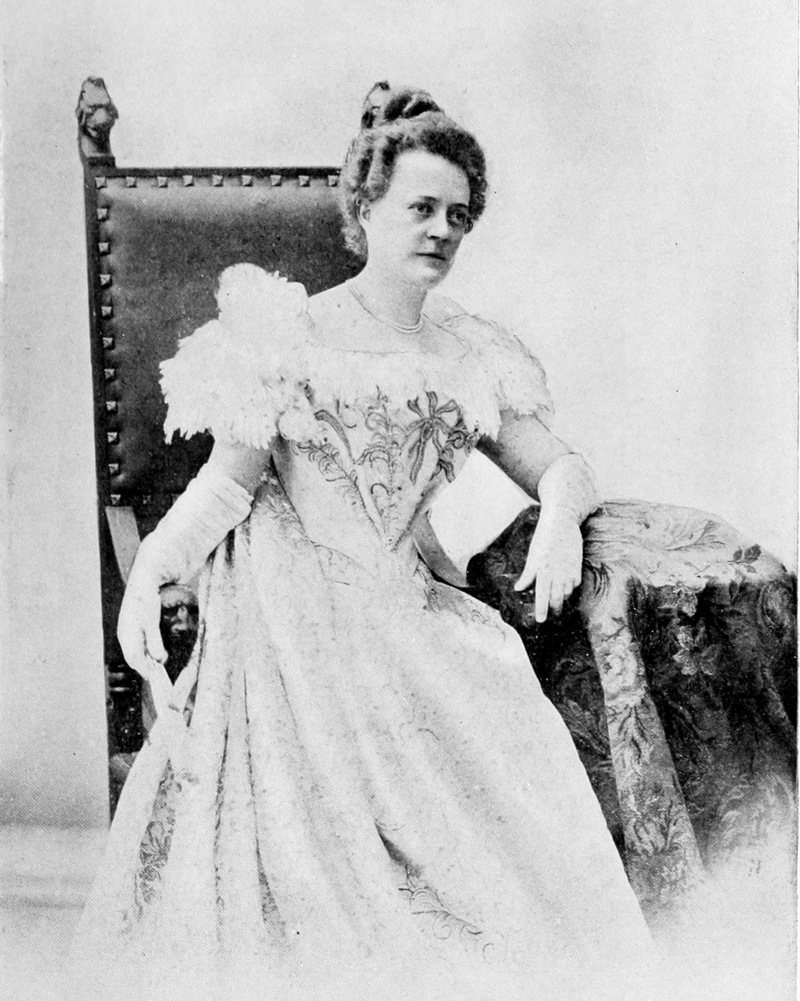
MRS. SQUIERS
Von Rahden is frequently up all night, and when he is, he usually comes to us for breakfast, which we have at any time between 6.30 and 8 o’clock. I have especial charge of the coffee-pot, and when the members of our mess have been up all night on 111duty, they look as if they could drink it all, instead of the one cup I have to limit them to. What a difference, instead of having your maid bring your breakfast-tray in the morning when you ring for it, to be waked up from a heavy morning nap at six o’clock by knocking on the door, to find two or three powder-begrimed members of your mess humbly inquiring: “How soon will breakfast be ready?” They have probably been up all night on the firing-line, and are dog-tired and faint.
We tell them to come back in half an hour, and then our skirmish begins. The sleepy cook is routed out of the Chinese-filled courtyard under our windows, and told it is time to cook the wheatena, the coffee and soda-raised biscuits, for which purpose he repairs to the broken stove in the box-like kitchen. We take a hasty sponge-bath, and our rough-dried shirt-waists and golf-skirts are donned, and we are ready for the day. Next we roll up our straw mattress, place it in a corner, and put the small eight-sided Chinese table in the middle of the room. We boast four chairs, and as our mess ranges from eight to twelve people, the ones who come late sit on the silver trunks or on the floor.
112A fresh table-napkin we have procured from somewhere, and on the table we place some green leaves for decoration, and breakfast is announced. Besides Von Rahden, another breakfast guest we have almost daily is the Rev. Mr. Gamewell, a missionary who appears the mildest of men, but who is developing into one of the strongest in Peking. He is the brains of the Defence and Fortification Committee. Before entering the ministry he was a star student at Cornell, in the engineering department; and now this entire compound and the outer lines are included in his hands, and his recommendation for barricades, countermining to protect against the Chinese undermining, of which we are constantly aware, are all carried out as near as possible from his orders. Before dawn he is at work to take advantage of these hours of comparative quiet, to see just where the weak spots are, and how he can best provide for their strengthening during the coming day. He is a stooping figure, very quiet, and rarely speaks to us, and, when he does speak, never about what he is doing. He told me his working hours are so continuous, and everybody calling for him from every quarter, that he did not believe he could keep on if it were not for the 113hour’s rest and good hot breakfast that he gets daily in Mrs. Squiers’s rooms.
Another member of the mess is Dr. Velde, the German surgeon, who is doing such wonderful and constant work at the hospital day and night. He performs unheard-of operations one after another, and on the same old kitchen table that we found for him. The antique rifles used so frequently by the Chinese inflict the most heart-rending wounds, the treatment of which, to be successful, surely calls for surgical genius, and, thank Heaven! Velde has that. He is short, thick-set, and blond, with stumpy little hands and a keen blue eye, and is wonderfully practical and matter-of-fact. The various messes near the hospital asked him to join them, but without affectation—he knows he is the only surgeon in Peking, and he must guard his health—he answered: “No, I go only where I get the best and the most food;” and having been asked by Mr. Squiers to come to us, he gladly accepted, while reiterating the same reason for joining us that he had given for refusing the others. His duties are so constant that he usually is only able to get in to breakfast and dinner.
114Another feature of this siege is one which shows what marvellous executive ability some people have. The proprietor of the Peking Hotel is Chamot, a Swiss who has played a wonderful part in the drama of our imprisonment. There have naturally been numbers of people without stores of any kind, and people who, if they had stores, would have no place to cook them; so Chamot stepped forward and undertook to feed daily I don’t know how many people. When we were first assembled in the British compound the confusion was something terrific, and he gave food to all those who had nothing, and later he made a permanent business arrangement to provide food for those who had no means of messing themselves. Among these are many Roman Catholic priests and twenty-five Roman Catholic Sisters, saved by himself and his wife from the Nan-t’ang just before it was burned, besides numerous families and detached individuals having no stores, who would have had a most serious time without his assistance.
These Sisters were fed by Mrs. Squiers for many days before Chamot volunteered their care. Of course, the variety that he supplies is not wonderful, but he gives them horse-meat, rice, occasionally 115some tinned vegetables, and a kind of coarse brown bread, made from an inferior flour, which he bakes himself. For so many people it is quite marvellous how he feeds them so regularly. He has a few coolies to help him at his hotel, which is near the French Legation, and there he personally superintends the cooking of the two messes, one at twelve and one at six o’clock, and brings it up in a Chinese cart to the British compound, always at the risk of his own life from snipers. One cannot but wonder how long he will be able to continue his good work. Chamot’s Hotel in Peking is known in the siege vernacular as the Swiss Legation.
Monday, July 9.
A day or two ago an old-fashioned cannon was found in a shop near Legation Street, where they made Chinese stoves—a kind of foundry. It is undoubtedly one of the guns brought up to Peking by the English and French in 1860. Mr. Squiers promptly took a great interest in this ancient piece of ordnance, hoping that we might make some use of it. He, with Mitchell, a gunner’s mate from the Newark, have worked assiduously in their efforts to clean off the rust of forty years and get it ready for 116use. During the cleaning process they made projectiles of bags of nails. They took the “International,” as the gun was christened, over to the Fu and fired the bags of nails at a Chinese barricade, thus serving the double purpose of cleaning the gun and causing some damage and immense fright to the enemy. The noise of the explosion was so much greater than anything the Chinese had heard coming from our lines that five sentries incautiously put their heads above the Imperial Wall to ascertain what was going on, and were promptly shot down by our guards. Some Russian ammunition is here, intended for a gun which should have been forwarded from Tien-tsin at the same time as the ammunition, but which, most unfortunately, Colonel Wogack failed to have put on the last, train, and we find it can be fired from the “International.”
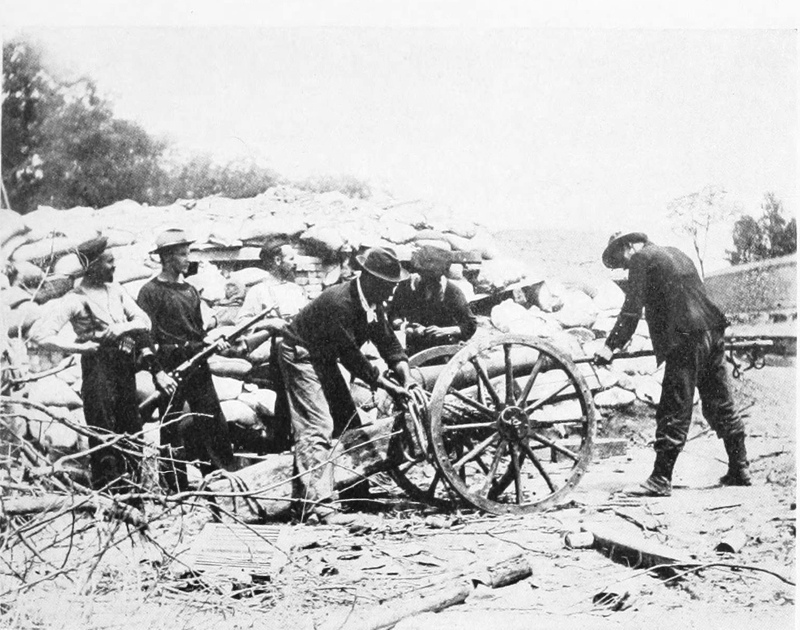
LOADING THE “INTERNATIONAL”
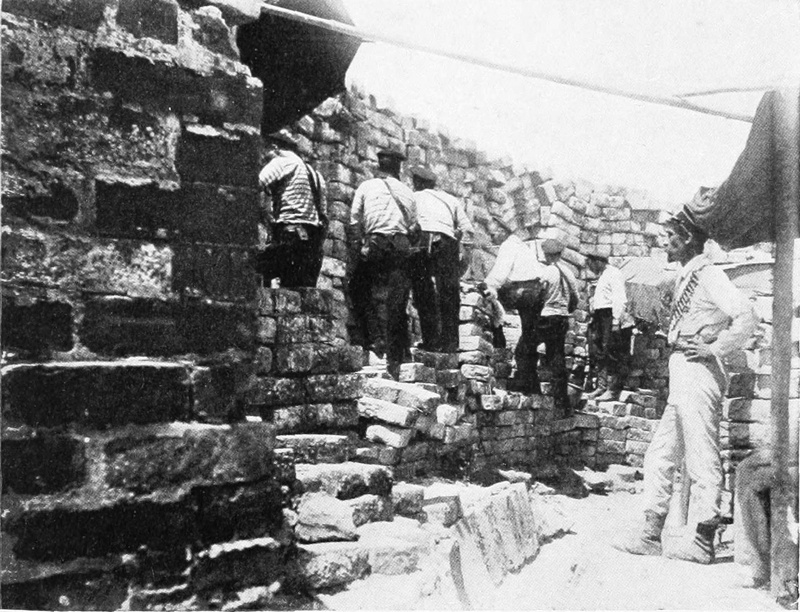
Copyright, M. S. Woodward AMERICAN AND RUSSIAN MARINES AT WORK ON THE BARRICADE. BARON VON RAHDEN ON THE RIGHT
To-day a European boy died of dysentery. Last night the “International” was taken over to the Hanlin, where it was used to great advantage in breaking up a barricade that the Chinese had made, and which they have been strengthening daily for their convenience and protection while engaged in the pleasant occupation of sniping our men. The 117day before yesterday Von Rostand, Austrian Chargé d’Affaires, was shot at the French Legation—where, I understand, the rifle-firing and shelling is terrific—somewhere near the eye, and they fear he may lose it. His wife is nursing him there. M. Merghelynckem, the First Secretary of the Belgian Legation, killed two Chinese yesterday, and in killing one he undoubtedly saved the life of the French commanding officer. He does good work, and is a fine shot, but is erratic to a degree, and I don’t believe he loves his English colleagues as much as he might. He left yesterday for the French Legation to take up his abode there, where he surely will be treated with great consideration, having saved the life of their officer, although there he is given eight hours of sentry duty, while here he had but six hours.
The other day he brought me five long Chinamen’s queues, which he had cut off the heads of Boxers he had killed, as a souvenir of a day’s work. It means to some Chinese—the cutting-off of the queue—a great and unholy mutilation, and these trophies hanging up in our living-room for a few days were obviously things of terror to our Chinese servants, although they had been cut from the 118heads of their dread enemies, and we soon disposed of them. Yesterday the Austrian commanding officer was killed, shot through the heart. At first we kept a record of the dead or badly wounded men as they would be brought into the hospital, but now they come in so often that we cease to note the exact number.
People—the sanguine ones—say that it is quite likely and reasonable that help will not come for a week or two, and in this way, if the troops do not come, they can say, with childish satisfaction, “Oh, I never expected them before.” When we first got here all the Ministers and everyone said: “Certainly by the first of July at the latest.” Now they are actually saying: “Certainly by the first of August”!
Yesterday—Sunday—there was a lot of good work done. Nevertheless, Mr. Norris, the chaplain, who is one of the hard-working members of the Committee on Fortifications, gave us half an hour for the service held in Lady Macdonald’s dining-room—the regular chapel of the compound being occupied by the American Protestant missionaries—and I must say that it was comforting. This room is something of a wreck, 119denuded of all draperies for sandbags, walls riddled with large and small bullet-holes, a life-sized painting of Queen Victoria occupying the entire wall at one end of the room, hung quite crooked and peppered with shot. A great beam from the ceiling protruded some 4 or 5 feet down into the room, where it had been forced by a spent cannonball crashing into the side of the house, and over all this ruin was the unmistakable atmosphere which clings to a room where many people eat three times a day, and where the staff of servants is not equal to the work. It was but six weeks ago that I was a guest at a most charming dinner given in this very room, surrounded by what then seemed to be the unutterable and interminable calm that comes from the possession of the best things to make life pleasant in the Far East. The other denominations had their services as well some time during the day.
The hot weather began last week, and the thermometer is 109° in the shade. I wear shirt-waists and short skirts; the men wear filthy clothes that they work in and most of them sleep in. They never wear collars—no washing of linen for three weeks, and, from the looks of them, most of 120them only shave every fourth or fifth day. Life is now settling down to a routine, and one would think that the people of this compound had never done anything else all their lives but get up during each night when a general attack begins. Each man goes to his appointed post, or if for a change we have no general attack, the men quietly get up at all hours and go to their sentry work.
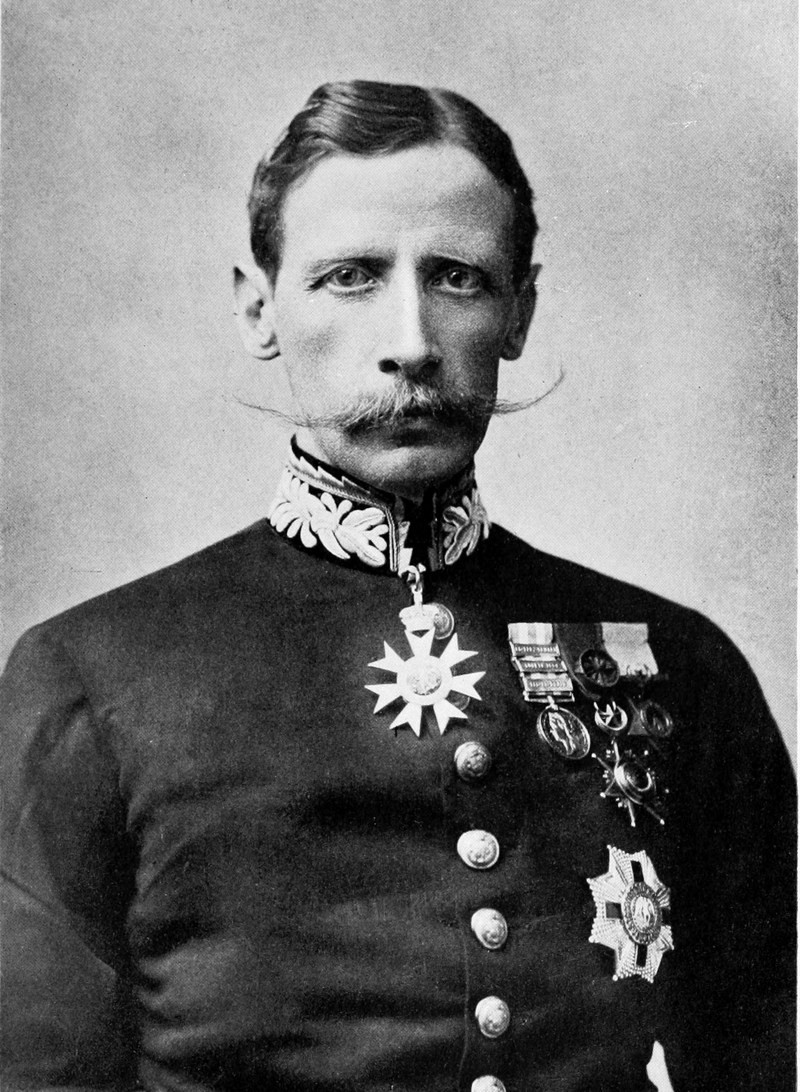
Photo, Elliott & Fry SIR CLAUDE MACDONALD
The Marquis Salvago sits chatting with his wife, a very beautiful woman, in a chaise longue most of his time. M. Pichon, the French Minister, nervously and ceaselessly walks about, telling every one who chats with him: “La situation est excessivement grave; nous allons tous mourir ce soir.” M. de Giers, the Russian Minister, walks eternally between his Legation and the British compound, and looks every inch a Minister. Poor Señor Cologan, the Spanish Minister, and doyen of the corps, is very ill. M. Knobel, the Dutch Minister, offered his services as a sentry to the Committee on Defences, but stated at the same time that he did not know how to shoot, and was very short-sighted. Needless to say, his offer was not accepted. Mr. Conger, the American Minister, walks about. Sir Claude Macdonald, the British 121Minister, is now the Commander-in-Chief, unanimously elected to that position by his colleagues, and he tries sincerely to do his duty as such. I believe he is fully competent, as he used to be a captain in the British army before entering the diplomatic service. His path is a thorny one, however; most of the Legations are so jealous of this compound being the centre and last stronghold par excellence, that they are outrageously inconsiderate of all orders issued, and, notwithstanding the great gravity of the situation, they put everything in Sir Claude’s way to keep his plans from reaching successful maturity. A small incident may be cited to show this horrid and prevalent spirit.
The French had put in an application with the Committee on Fortifications for picks and shovels to be sent to their Legation for important night barricade work. The missionary in charge of them at the British Legation failed to send them; either they were all in use on equally important work, or there was an oversight on his part. Having failed to receive them, Herr Von Rostand, the Austrian Chargé, who has joined the French in their compound, at twelve o’clock last night returned to the British Legation, where he and his wife were 122accepting Lady Macdonald’s hospitality, and took it upon himself to wake Sir Claude up, and insultingly shouted that Sir Claude was responsible, and he alone responsible; that the French Legation was not being properly defended, etc. (especially the etc.). Sir Claude said that he would discuss anything relative to the safety of the Legations at any time in the proper manner, but the way that Von Rostand spoke made it impossible for him to talk to him at all. The Von Rostands then took up their abode at the French Legation, which was natural more or less, as the Austrian soldiers are helping them.
A question going round the compound is: When the French and German Legations must be given up, where will the Von Rostands go? The fact that one is a Minister or Chargé does not help to find one new quarters, as every room, hall-way, and closet, was long ago appropriated. The charming doyen of the Corps Diplomatique, the Spanish Minister, Señor Cologan, sleeps on a mattress in the tiny hall of the house that was given to the French Minister for himself and official family. He has to go to bed late and get up early because people have to walk over him. He has a tiny shelf on 123which to put his few toilet possessions, but he sleeps in all his clothes, as everyone sees him. The Dutch Minister sleeps in a tiny storeroom of the very small Second Secretary’s house, that we now call the Russian Legation, where the fifty-one people composing M. de Giers’s official personnel are housed. As this room is a storeroom, his nights are a constant fight with cockroaches. Such is the way rank is treated when it is a fight for life.
July 16.
A steady rain has begun that promises to last for several days, a sure but not very heavy downpour, and with it comes a greater number of mosquitoes and fleas than would otherwise be the case. The sticky black flies seem to be of a different family from those one is accustomed to elsewhere. It is awful to see them feasting themselves on these filthy and ill-smelling Chinese people, half of whose bodies are usually covered with a hundred of these pests; but the Chinese are so accustomed to them that when they prepare their food they do not object if some, or I should say a great many, get into it. The “slaughter-house,” of course, is a great centre for these disgusting flies, and as we are only a few 124doors from it, the feeling of having these beasts swarming over everything in one’s room, oneself included, is distinctly unpleasant. To an imaginative person, who may have been so unfortunate as to study “The Life of the Microbe,” these scavenger flies would certainly cause him to lose his mind.
The room at the back of Dr. Poole’s house, which we occupy, is damp, and all night the fleas and cockroaches that appear would horrify anyone. We sent our mosquito-nets and hair-mattresses to the hospital, so that every night we lie on our straw-stuffed bag, doing duty as a mattress, on the floor, and unless one lies in a pool of bug-powder there is no such thing as sound sleep. Until quite recently we had no insect-powder, and the nights were unimaginable. Our bodies were most frightfully bitten. Lately, however, a steward at the hospital concocted a powder of materials which he had on hand. It makes one sneeze, it is so powerful; but under these circumstances sneezing is a joy. One knows our arch-enemies are dying, although this does not affect the ungetatable mosquito, who sings on nightly.
Last night young Warren, of the Customs, was carried through the compound on the way to the 125hospital, his face almost entirely shot off. I knew him quite well—had danced with him often; he was a charming fellow. He died at daybreak this morning. One of our wonderful shots, a marine named Fisher, who was stationed on the Wall, was shot and instantly killed this morning, and to-day really seems to be the most disheartening morning of the siege, for so many men are going, as the French Canadians would say, “on their last great trail,” or “over the Great Divide.”
About 8.30 this morning, after our mess had been straightened up, I was en route for the hospital, carrying a pot of coffee to the doctors and nurses, when some soldiers passed me, carrying a rough litter bearing Captain Strouts, mortally wounded. It was especially shocking to me to see him thus, as he had breakfasted with us at seven o’clock, and had seemed tired from his constant work, but hopeful and in good spirits. His arm was hanging limp, the hands and fingers stiff with agony. It seemed but a moment before that I had passed him at breakfast a cup of black coffee, to receive which he had held out that strong, slim hand, with the signet-ring on the little finger, and now it was all so changed. In less than two hours the hand 126was again being held out, but in his death-throes. He had been shot while going over to the Fu with Colonel Shiba and Dr. Morrison, to decide on some new plan of defence for that much-fought-over district, where the firing was constant. Dr. Morrison was hit at the same time, but not seriously, and the little Colonel had his cap shot off his head by two bullets.
These two wounded men were carried to the hospital, where Captain Strouts was attended to; but Dr. Morrison, owing to the great press of work, had to wait for some hours, nursing the exquisite agony of his wound, until his turn arrived. Poor Captain Strouts, with a cut artery in the thigh, only lived four hours, and died while asleep. He was so very, very tired. His work had been almost continuous night and day since he arrived from Tien-tsin, and especially hard, since he had to share the work and responsibility which necessarily fell on him by the death of so many officers. His death was very much felt by everyone. Dr. Morrison and Captain Strouts were frequent members of our mess, and in one day to have two leave thus—one wounded and one killed! Mrs. Squiers and I asked each other, “Who next?”
127Can it surprise us that to-day the whole compound looks dreary and disheartened? So many deaths in one short twenty-four hours! I could write a great deal if it were of any use—of this compound, with the shot and shell and bullets, making it dangerous for us to move about the small open place in the Legation; of weary waiting for the troops through heat and rain; of great dread over the weak places in our defences; of crowded hospital and growing cemetery, and principally of the nervous strain caused by all this worrying and fearing over the fate in store for us should we arrive at that point when we could no longer hold our own. A good sergeant or corporal is missed as much when he is wounded or killed as an officer; it is especially true of our own marines, for in many instances they do the work of an officer, and take as much responsibility. The deaths are coming so frequently now that a final stand seems not improbable, and if when that is taken we continue to have the same percentage of deaths, then we can well say our prayers. It is discussed quietly by men that they will certainly kill their wives when that time comes. God grant it never may! Apropos of this, I have in my pocket a 128small pistol loaded with several cartridges, to use if the worst happens. A Belgian secretary stole it from the armoury for me—“in case you need it, mademoiselle.”
Many is the time bullets passing through the tops of the trees have cut off branches or twigs which fall at our feet when attacks begin. We often see the flash of the cannon as it sends the shell over the compound, generally too high to do any damage, but passing before one knows it. And so it goes, shells and rifle-shots singing all around us. Late yesterday afternoon the shooting seemed to cease temporarily as I was sitting with Baroness von Ketteler on one of the benches which bore witness that this Supply Department had been, before the siege, the Legation tennis-court, when a bullet whistled with startling clearness within half an inch of my ear, passing between the Baroness and myself. Knowing that the sniper who had spied us was taking a moment to re-aim or reload, I immediately dropped from the bench on to the ground to get out of his range trying at the same time to pull Baroness von Ketteler with me. This I could not do, and it was some time before one of the Customs students 129who was working quite near us realized that we were the target for this new sniping, and forcibly led her back to the Legation. In her agony of mind I am sure a bullet to end her suffering would have been truly welcomed.
We no longer talk about the troops. If they come in time they will come in time, and our one aim will be to last as long as we can. The only subjects of conversation now are the necessary strengthening of this or that barricade, the digging of trenches at this or that corner, to guard against the Chinese undermining us, as they are sure to do, mining being one of their favourite methods of warfare.
We are trying to prepare for all emergencies. People who, before the siege began, seemed to have reasonable intelligence, and, if one had thought about such a thing, looked as if they would show up pretty well if they were put to it, have now gone to pieces entirely, lacking apparently the desire even to appear courageous. The men often make some trifling ailment an excuse to shirk all work for the common defence, and spend their time groaning over the situation, and becoming more hateful daily to the men and 130women upon whom the real responsibilities of the siege are resting; while the women who have collapsed simply spend their hours, day and night, behind the nearest closed door, and await each fresh attack to indulge in new hysterical scenes.
I can honestly say there are more men to the bad than women. When anyone becomes really seized with this terror they lose all sense of proportion—the slightest provocation brings forth torrents of self-pity, and they ask only for the impossible. To-day I took the French governess her dinner, into which, I must admit, the cook had dashed the curry-powder rather too strongly. With this small contretemps as a starter, she seized my hands, and with heart-breaking sobs begged me to save her, as she knew, from the unusual taste of her food, that someone was trying to poison her. “Mademoiselle, je ne demande que peu, simplement qu’on me retourne tout de suite en France.” To tell her we had all eaten the same curry, and that it was as impossible to send her to France as it was to send her to the moon, were words thrown away; she was hopelessly unbalanced with terror.
Several people have already lost their minds; 131among them a dear old Italian priest, Père Dosio, the Superior of the Nan-t’ang, which was looted and burnt with the accompanying horrors. I talked with him from day to day, and from being at first comblé with grief at the ruin of his life’s work in the destruction of his cathedral and hospital, he gradually has become full of hallucinations. His loss of mind has been a gentle affair compared to the violence shown by a Swedish missionary named Norregarde, who at times has to be confined with armed guards over him, as he is utterly deranged. He escaped once, and marched out of the British Legation gate to the canal, and it seems that he went direct to the Tsung-li Yamen, where he gave them, as far as we can learn by his own accounts when he returned, all the information they wanted, and especially urged them not to shoot so high, as few of their shots harmed us. Since his return he has been hourly guarded, but, unfortunately, we notice his advice has been taken, and Chinese shooting comes lower. The Chinese have a great respect for the insane, thinking the spirits who possess them are sacred. They gave him a good dinner, and he returned unharmed to the British Legation. The Chinese 132are working harder to take the Fu than any other point. It holds nearly three thousand native Christians, and it is these poor wretches whom the Chinese would first love to murder. Then, too, if they got the Fu, they could so easily mount guns on its wall and fire down on us. We must hold the Fu and the Tartar Wall directly behind the American Legation, but it will cost us the lives of all our marines to hold the latter.
On the 14th two messengers came to the British compound carrying a letter signed “Prince Ching and others.” This communication was interpreted by some as a desire of Jung Lu to incriminate Prince Ching, as the letter came from the former’s camp, and he is a well-known hater of both the foreigners and Prince Ching. If we answered it, and sent the answer to him to Jung Lu’s camp, from whom it came, nothing would be easier than for Jung Lu to take the communication to the Empress-Dowager, and thus prove to her Ching’s perfidy in writing to the Ministers.
Mr. Pethick disagrees entirely with this view, and urges the Ministers to answer it, as he feels convinced it is a genuine beginning of parleyings which, if nothing comes of them, would probably at least 133give us an armistice and a respite from the horrible attacks. This letter is fairly threatening, and it reads that we must now leave Peking, or they will do their worst; that they have tried to communicate with us before, but their advances were never “gracefully received”; that we had fired first, and they were glad that so far only one Minister Plenipotentiary had been killed. As for the way of going, we must all leave Peking in tens, or those who desire to remain temporarily would be afforded protection and lodging in the Tsung-li Yamen, etc. It was addressed to Sir Claude and other Ministers, and they threatened in a postscript that terrible things would happen to us if they received no letter in answer by twelve o’clock the next day.
Opinions vary about it, but everyone agrees that it is worth while answering whether it is a ruse or not. So the response was sent yesterday at noon. The messenger who brought us this letter was the Chinese Christian who took, or tried to take, Sir Claude’s communication to Admiral Seymour, and was caught by the Chinese, beaten in the most horrible way, and robbed of the letter containing information as to our numbers, strength, etc., which the Chinese must have been very glad to get. The 134messenger was then taken to Jung Lu’s camp, where this letter was given him to deliver to us, as he knew the way that would get him quickly into our lines. This man was again used to take our answer to Jung Lu’s camp. Some say the troops are on the way, and the Chinese are trying to start negotiations before they arrive, either to make us come out of our lines, so that they can murder us easily, or so that they can say to the Powers, when they finally arrive, that they kept up communication with us, and that it was our own fault that we barricaded ourselves in our Legations; others insist that it is altogether a blague and a canard.
The morning following Captain Strouts’ death the Ministers and guard-captains unanimously voted Mr. Squiers to be Sir Claude’s Chief of Staff, the position having been unfilled since Captain Strouts’ death. The atmosphere of the besieged in Peking is not one of peace, but of bitterest feeling, especially strong against the British, and for no other reason than that the other nations begrudge the strategical superiority of the English position. Everyone hopes, with Mr. Squiers in this rôle, that things will run smoothly, and that perhaps Sir 135Claude’s orders, when delivered to the different “guards” by an American Chief of Staff, and talked over with them in their own mother-tongues (for Mr. Squiers is a linguist), may be oil on the troubled waters. Let us hope so, for, should national feeling ever reach the top notch, this besieged area will separate—the Continentals on one side and the English and Americans on the other—and Heaven only knows how soon the end would come for everybody should this horror of military separation take place.
The strong feelings of friendship, that are perhaps due to the propinquity of our lines, have made the Russians our good friends and comrades, leading them to express to us freely their intense dislike of the British in violent phrases: “Ces chiens d’Anglais! Comment supportez-vous leurs arrogances et leurs manières de cochons?” And later on an Englishman would drop into our mess for a moment and admonish us with the words: “You Americans are the devil. You are on good terms with every d——d dago in the place; and as for the Russians, you love them as though they were your long-lost brothers!” It is unique, this feeling of ours of amity and good-will towards almost everybody 136here, and I am confident it is greatly due to the strong personality of Mr. Squiers that, as a Legation, we hold this extraordinary balance of things in Peking, which places the Americans in the lead on this diplomatic chess-board.
July 31.
In the afternoon of the 16th, the day of Captain Strouts’ death, and while we were all attending his funeral, Mr. Conger, Mr. Squiers, and M. de Giers were told to come and interview a messenger who had arrived with a white flag, bringing a letter from “Prince Ching and others” in answer to our letter of the 14th. The messenger apparently came from the Yamen, and had a cipher telegram for the American Minister from the State Department in Washington, reading simply, “Give tidings bearer,” then saying that we could send an answer to the Secretary of State through them; but, knowing it must be an open telegram, which they could easily change, no steps were taken to answer it. The following day came another letter from the Yamen to Mr. Conger that Minister Wu in Washington had written thus, “China is sent greetings and aid by the United States, and desires to know how is the health of Mr. Conger,” and this message stated 137that the American Minister would be allowed to send one cablegram in cipher. Realizing the great responsibility devolving upon us to send a clear and strong telegram to the outside world, our Legation consulted with Sir Claude and other Ministers about the wording. The gist of what they sent was that, “We are holding our last position under shot and shell in the British Legation, and we will be massacred shortly if help does not come.”

EDWIN H. CONGER (UNITED STATES MINISTER) REPRODUCED BY PERMISSION FROM “THE SPHERE”
The following day, when the Yamen messenger came for the telegram, the other Ministers sent cipher messages also, hoping they might be sent. They were returned, however, with no apology. Since then there has been a message of some sort on every other day from the Yamen, signed “Prince Ching.” The attacks are so irregular now that one cannot count on them, except that they are apt to occur at the most inopportune time during the day, and when least expected. Once, even two or three of the clerks or under-secretaries of the Tsung-li Yamen “called.” They were evidently frightened and nervous at what they considered actually coming into the lion’s den, but amenities only were discussed. We very naturally considered them of too inferior rank to treat officially. In one of the 138many letters in answer to Prince Ching’s, Sir Claude wrote that we could hold out indefinitely with food, soldiers, and ammunition, but that the ladies and children felt the need of ice, eggs, and fresh fruit; so yesterday, the 20th, came three carts full of melons, six bags of flour, egg-plants, and an uneatable Chinese vegetable—no eggs, no ice, or fruit, except the unripe melons.
We have been trying to make a kind of market with the Chinese soldiers doing duty on the Chinese sentry lines, but although they would be very glad to pocket the big commission which they could get out of the transaction, they have not been allowed to do so by their officers, but they smuggle in eggs for us every morning at high prices (bien entendu), just enough for a very small supply for the hospital.
An interesting rumour that comes to us by a captured Chinese, and is generally credited to be true, is that Tung Fu-hsiang’s army has retired south from Peking to meet the foreign troops. Another rumour, however, says that Tung Fu-hsiang has departed westward, and as he was only a Mohammedan brigand before the Empress-Dowager elevated him to the head of her army, the Chinese think he has gone, not to meet our troops, 139but to continue the good work and merry life as a bandit in Mongolia. A letter comes to-day to Sir Robert Hart from the Yamen which is most polite and gushing. They regret most sincerely that his house and compound have been burned, and state at the same time that the Customs affairs have been turned almost upside down in consequence of lack of orders during the past six weeks from the Inspector-General. It is probable that they will come to Sir Robert for help as soon as things become more quiet.
The other day, when they sent us fruit and vegetables, they said they regretted they could not send us ice, because, if they attempted to do so, the Boxers, who like ice, would be sure to capture it. Apropos of ice, another baby’s life could undoubtedly to-day have been saved had there been any in the compound. These “might-have-beens” are so agonizing.
M. Pichon, the French Minister, to-day had a very nice telegram sent him from France, saying: “You are unanimously voted to have the Legion of Honour. Your mother sends her love and greeting, and 15,000 Frenchmen are on their way to your support.”
140On the 18th a messenger got through from the Japanese Consul in Tien-tsin to Narahara, saying that he hoped the large foreign contingent of soldiers would get started by the 20th for the relief of Peking; he hoped there would be 24,000 Japanese, 6,000 Russians, 3,000 British, and 1,500 Americans; and that the Chinese city of Tien-tsin had been burnt, but not the foreign settlement.
The Russians seemed horribly worried about so many Japanese soldiers coming, but there are rumours that the Russians have been keeping away from Tien-tsin so as not to join the allied Powers, and perhaps be forced to make some promises which they might regret later, and that they are doing some seizing of territory at the present on their own account on the plea of defending their railways. An Englishman here, being, of course, anti-Russian, insists that this nation is absolutely careless about its Minister or the other Russian people trapped here, whether they live or not. If it is a question of making some coup for the aggrandizement of their country, they would not hesitate to sacrifice their people in Peking. One of the men in the Russian Legation is named Pompoff, and has a very pretty wife with a gorgeous 141voice, and as Russia is known to want Manchuria, he put it quite aptly in speaking of probable orders from St. Petersburg: “They will say, Mon Dieu, what is Madame Pompoff to Manchuria?”
A day or two ago, when news came to the Japanese that the allied troops were mobilizing in Tien-tsin, a letter came to M. Joostens, the Belgian Minister, from Kettles, the Belgian Consul, telling him in an excited way a little of the news we are all thirsting to hear—that Seymour’s relief party had got near Peking about the end of June, but had been driven back toward Tien-tsin, owing to great numbers of Chinese soldiers opposed to them, and lack of supplies and water. They were then cut off from Tien-tsin by the Chinese under General Neih, and their whole column would have been massacred there had not 3,000 troops from Tien-tsin gone out to their rescue. Neih was defeated, and, in consequence, committed suicide.
The foreigners and soldiers then in Tien-tsin proceeded to take and burn the native city, over 700 being killed and wounded. Towards the end of this interesting letter Mr. Kettles naïvely remarked that he doubted if the Belgian Minister 142would ever get this letter, but if he did it might please him to learn that his home Government had wired to M. de Cartier to remain in Shanghai and await orders, for he undoubtedly would be sent to Peking as Chargé d’Affaires, “the Minister, M. Joostens, having been massacred.” No matter what queer things happen in this world, humour is always left if one looks for it.
At the hospital an apparatus for applying X rays would have saved the lives of many. Poor Narahara, a Japanese officer, died this morning from lock-jaw produced by a bullet which pierced his thigh. He has suffered horribly for three weeks. Dr. Lippitt, after waiting four weeks for his leg to be in a condition for the surgeons to make another search for the bullet, had the pleasant news told him, after an agonizing examination, that it could not be found. We are hoping that if the troops arrive soon their medical corps will have X-ray machines, and that Lippitt’s leg may be saved. He has suffered and is suffering much physical pain, but more mental, I think, from the close proximity to the bed on which so many men have died, all the details of which he has seen, and the climax was reached during the night by the death of Narahara, 143whose wound was almost similar to his, although lately Narahara’s wound has been complicated by lock-jaw, whereas in the doctor’s case there have been no complications. If we get out of Peking, Dr. Velde deserves from every nation that is represented here a grateful acknowledgment of his services during the siege.
The wife of the Russian Minister, Madame de Giers, a handsome woman with a great charm of manner, has been a veritable angel of mercy in the hospital. She has personally nursed most of the Russian patients, for while all Russians of education speak either French or German, and the hospital nurses understand their wants, to the poor sailors, who can express themselves only in their own language, her nursing is a Godsend, and she is on duty with her suffering compatriots an incredible number of hours out of the twenty-four. A graduate trained nurse, working to make a record, could do no more than she is doing, and her physical strength, patience, and gentleness are a joy to witness.
No Minister’s wife in Peking can approach in any way to having helped with the burdens of the siege as Madame de Giers. The old saw of 144“Scratch a Slav and you find a Tartar” could be changed by those who see them here in Peking in so many instances “making good” to, “Scratch a Slav and you find a hero.” The past week while these negotiations, communications, and messengers have been arriving the calm has been very noticeable, only I must admit that it seems almost as if one would prefer to say, “If it is war, then let it be war,” for under these circumstances one would not, or, I should say, could not, have time to appreciate to the full extent this fiendish weather, this war and siege regimen, and the eternal and without end discussions about the troops. As long as the continual attacks were going on we knew it was a matter of life and death, and every man did his allotted work without a murmur, but now, owing to the half-armistice that exists, the five-week strain during this terrible weather is beginning to tell; everyone is seedy, and most of the work is done by dragging one leg after the other, while dysentery has a terrible hold on most of the people here. To me the most pitiful of all scenes in this compound is the collection of perambulators, huddled together in the shadiest part, with limp, languid babies in them, some looking so ill that their parents must feel 145that each day more of the siege brings their little ones nearer death.
Yesterday, July 25, another communication came from the Yamen, saying that they again asked us to leave Peking, under, of course, their solicitous care; that they feel that they can no longer protect us, although in any circumstances they will continue to do all in their power, and that they would like all the Ministers to send open telegrams to their respective Governments that they are all quite well.
We suppose that the pressure of the world is being brought to bear on such high Chinese officials as can be reached to find out how we are, and they in turn are trying to force us to reassure our Governments by these covert threats. At ten o’clock this morning the Ministers had a meeting, and sent a unanimous statement, saying that Legations never send telegrams unless in cipher, so they could not comply with the Yamen’s request, and that, as for wanting us all to leave for Tien-tsin immediately, we might consider the proposition if the Yamen would be kind enough to give us complete and accurate information as to what kind of a convoy they would give us, and what comforts 146would be furnished for the women and children. Of course, we have no idea of going anywhere with them as protectors; but it is well to keep up communication, as it gives us time.
Surely it will be a surprise to the world to find us not dead, and to hear how we held our own. Last night the hospital statement was as follows: 165 men killed and wounded—12 per cent. killed, and 20 per cent. wounded.
People’s larders are getting terribly empty, and the menu I quoted three weeks ago is now in the dim and distant past. We live quite sparingly, and are hungry most of the time. The chief comforts of our mess now are the Selzogene bottles that Mrs. Squiers brought with us from our Legation, in which we daily make enough soda-water to last throughout the day.
Last night I was walking round the compound with M. Knobel, a Minister Plenipotentiary, who has not seemed as yet to develop any special attributes during the siege beyond the very common one of being intensely hungry—so very hungry, in fact, that as we passed the bungalow given to the Russians, which boasts a few trees, Knobel’s hungry eyes descried in the gloom six or more fat hens, belonging 147to some woman in the Legation, roosting high up on the branches. There was no sniping going on, and we took advantage of the quiet to walk once again round the compound, and noticed that, though it was early, everyone seemed to have turned in to get what rest they could before being awakened by the usual nightly attack.
The night was also getting blacker, and by the time we got round to the Russian bungalow again Knobel’s fell purpose had seized him in a determined grip. He whispered to me, “If you will watch, I will get a chicken. There will be no noise, and to-morrow we will have a real dinner and eat that chicken.” It flashed through my mind that at home, if clever darkies could not steal chickens without making a racket, I did not see how Knobel, who has probably never in his life come nearer to one than to pay his steward’s bills, could expect to be successful. However, there was no time to argue. Knobel had left me standing in the road, watching his figure disappear in the darkness. A rustle, a slight squawk, and my Minister friend was by me again, with a squirming bundle under his coat. We ran, as if the Boxers were after us, straight to the Chinese courtyard, 148where we found our fat cook. Fortunately he had done his daily duty on the “gang,” and was obviously delighted to receive our stolen booty—“All lighty. Me flixy good dinner to-mollow,” and winked comprehendingly as he saw that Knobel had been holding Miss Chicken’s neck so tightly she could not utter a sound. With a sigh of relief, Knobel turned her over to the cook, and with another but deeper sigh of anticipation of to-morrow’s dinner, he stealthily started by a roundabout way to return to his quarters.
Colonel Shiba, the Japanese commander, who has won the sincerest admiration from everyone, states to-day that he confidently expects the troops by July 28.
July 28.
This day, which was to have been so auspicious, brings us the worst news of the siege. It is to the effect that as late as July 22 no troops had yet left Tien-tsin for our relief.
A little Chinese boy, of the Presbyterian mission, aged fifteen, small but clever, was sent out by us, on the night of July 5, for Tien-tsin, with a letter to the British Consul, Mr. Carles, telling him of our very terrible plight, and how we must have 149relief soon, and writing him in the strongest terms of our danger. This boy, after being let down over the Tartar Wall by a rope, made his way to Tien-tsin without many adventures, beyond being seized at one place and made to do coolie work for eight days. He then escaped, but, once arrived at Tien-tsin, he had great difficulty in getting through the outposts of the foreign troops who are apparently carefully guarding that part of Tien-tsin, which is in their lines. It is insisted here that the British Consul must be lacking in intelligence. He neither questioned the boy, who could have told him a great deal about our condition, nor did he give the boy any letters from the other Consuls, simply sending his own.
It took the boy a long time to walk back to Peking, and, finding the Water Gate too dangerous to enter by daylight, he waited until dark, and it was this letter that spread such a gloom over everything this morning. This communication of Mr. Carles was most unsatisfactory in every way, and the only excuse for this letter was that he was afraid it would fall into the hands of the Chinese. He wrote: “The rest of the British contingent, under General Gaselee, coming from Singapore, 150are expected on the 24th. Most of the Japanese troops are in Tien-tsin, and mobilized. The Russians are only landing at Taku. There are many Chinese troops between Tien-tsin and the coast. If you have plenty of food, and can hold out for a long time, the troops will save you. All foreign women and children have left Tien-tsin, and plenty of soldiers are on their way to your succour.” This was all very disheartening; but we realize more than ever before how long we still may be besieged, and the consequent economy of stores which should be practised, and there is talk of commandeering all private food-supplies.
The last sentence of his letter was hopelessly confusing. We did not know whether the troops had already started, or whether he was speaking of the Singapore contingent. Most people now feel that no reasonable Foreign Office should take two months to get a military relief party ready.
August 1.
This is a piping hot day, 108° in the shade. Our principal conversation now is asking each other, “Is Colonel Shiba’s messenger reliable?” This man brings in almost daily to the Japanese camp 151the most cheerful and apparently accurate news that the troops are not far from Tungchou. If he is reliable, we may expect them very soon, but we can hardly believe his statements, owing to Mr. Carles’ letter. This is simply another variation to our old song of the siege.
The day before yesterday a letter came to Sir R. Hart from the Yamen, asking him to be so kind as to send a telegram to London telling the people there of our safety, because the different Governments were clamouring for news of their Ministers, and if he (Sir Robert) would send this telegram, it would be received as truth by the world, but they could not allow the Ministers to use their own codes.
Sir Robert answered immediately that the Ministers were quite right to decline to telegraph without cipher, and that he distinctly refused to send any telegram of such a nature as to reassure the world, because if he telegraphed the truth, the world would be so horrified that they would not believe his telegram. Well answered, Mr. Inspector-General.
I had the good luck to-day of being allowed to go over our defences on the Wall, and saw all of 152our protective barricades while getting there. Baron von Rahden and Mr. Squiers took me, and, needless to say, it was most interesting and thrilling. The conditions I had heard discussed for nearly two months I can now understand by seeing them all. I could also now understand the all-pervading charnel-house smells which at times during the siege have almost caused us to faint.
On each defended barricade loopholes have been made so that we can see, to some degree at least, the enemy. In many instances the loopholes are arranged with small mirrors, as the Chinese snipers often hit even these peepholes when a sentry’s eye is seen, so that this further protection has been deemed necessary.
I looked through one from a barricade in the Hanlin, and what I saw was what I might see in looking through the wicket-gate of a horror chamber at the Eden Musée in New York. A group of gorgeously-apparelled Boxers with their insignia were pitilessly caught by death in a mad dash at this barricade, and there they were, stiff and stark, nearly all in the furious attitudes of assault! Even the standard-bearer was stiffly and conscientiously gripping his gay-coloured pennant. 153A couple were shot in the back as they had started to run, and were lying flat on the ground, but a dozen or so, making up the body of the attacking party, held these horrible life-like positions with the most incredible rigidity. The sentry tells us that this hideous, almost theatrically posed, death-group has been thus for a couple of days. The Chinese would not come for their bodies, we could not, and there they were to remain until the carrion-dogs finished them, or until they eventually decomposed.
The combinations of barricades here, there, and everywhere are glorious, especially on the Wall, and well they might be, as they are made out of the huge rocks that were used hundreds of years ago to pave this wonderful piece of masonry. To stand and look down from the Wall into the British compound makes one realize more than ever how delightfully easy it would be for the Chinese, if they ever manned this part of the Wall, to point their guns downward and annihilate us.
Forgetting this possible picture, let me look down and tell you what I see on this beautiful, sunshiny August morning. Before me lies what we could naturally call the terre du siège, and 154comprises the Japanese, German, French, Russian, American, and British compounds, all of which have their flags flying somewhere, although in most cases the original Legation flag-poles have been shot down. Then comes as a pretty piece of colouring, in contrast to the sacked, burnt, and charred Chinese houses, all that remains of the Hôtel de Pékin, with its collection of flags of all nations flying in seeming defiance from the upper windows.
Further up Legation Street one sees a dirty, tired-looking, slimy green canal, running parallel to the British Legation, with a strong and high barricade on the bridge that spans it, so that we still have communication with those Legations on the other side—namely, the Japanese, German, and French. Then between and around these oases of compounds one sees an occasional big tree which has escaped burning, and which makes the scene of desolation seem even more lonely and desolate. Hundreds of houses, half burnt, half broken up, and wholly uninhabitable, tell the story of how in those first horrible attacks at the beginning of the siege they were used by the Chinese as cover, and then looted 155and burnt. A stray dog of the large wolfish, mongrel type that is so common in Peking can be seen picking his way about from place to place with the queer look and walk that seem to mark carrion animals.