Front matter
Peter Wright translation
Anatole France
BEE:
THE PRINCESS OF THE DWARFS
BY ANATOLE FRANCE
DONE INTO ENGLISH BY PETER WRIGHT
NEW YORK E. P. DUTTON AND COMPANY J. M. DENT & SONS LTD - LONDON & TORONTO 1920
Title page
SOLE AGENT FOR SCOTLAND THE GRANT EDUCATIONAL CO. LTD. GLASGOW
All rights reserved
Contents headpiece
Contents
Chap.
I. Tells of the News that a White Rose brings to the Countess of the White Moor
II. How the Loves of Bee of the Clarides and George of the White Moor began
III. Which deals with Education in General, and that of George in Particular
IV. Tells how the Duchess took Bee and George to the Hermitage and of Their Meeting an Hideous Old Woman there
V. Is concerned with what you see from the Keep of the Clarides
VI. Tells how Bee and George went off to the Lake
VII. Shows the Penalty George of the White Moor paid for having gone near to the Lake where live the Sylphs
VIII. Shows how Bee was taken to the Land of the Dwarfs
IX. Tells faithfully the Welcome given by King Loc to Bee of the Clarides
X. In which the Wonders of the Kingdom of the Dwarfs are thoroughly described, as well as the Dolls which were given to Bee
XI. In which the Treasure of King Loc is described as well as possible
XII. In which King Loc proposes
XIII. Tells how Bee saw her Mother and could not kiss Her
XIV. In which the Great Grief that overtook King Loc is seen
XV. Relates the Words of the Learned Nur which gave an Extraordinary Pleasure to little King Loc
XVI. Tells the Marvellous Adventure of George of the White Moor
XVII. In which King Loc makes a Terrible Journey
XVIII. Tells the Marvellous Meeting that occurred to John, the Master Tailor, and of the Good Song sung by the Birds of the Grove to the Duchess
XIX. Tells of a little Satin Slipper
XX. In which a Dangerous Adventure is related
XXI. In which All ends well
Looking backward
The Sorrow of Demeter. By Sir G. W. Cox
The King of the Golden Mountain. By the Brothers Grimm
Persephone. By Jean Ingelow
The Writer of the Story of Bee
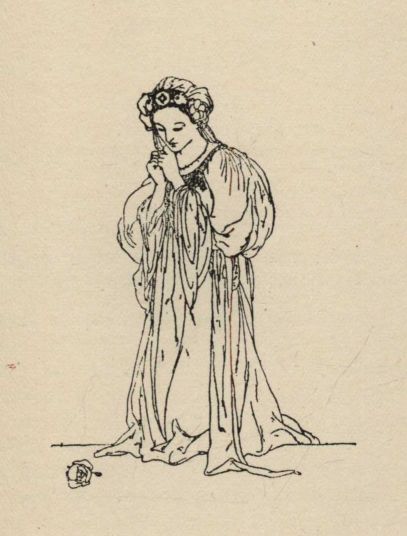
Princess Bee
Chapter I headpiece
BEE
PRINCESS OF THE DWARFS
CHAPTER I
TELLS OF THE NEWS THAT A WHITE ROSE BRINGS TO THE COUNTESS OF THE WHITE MOOR
Setting on her golden hair a hood spread with pearls and tying round her waist the widow's girdle, the Countess of the White Moor entered the chapel where she prayed each day for the soul of her husband, killed by an Irish giant in single combat.
That day she saw, on the cushion of her praying-stool, a white rose. At the sight of it she turned pale and her eyes grew dim; she threw her head back and wrung her hands. For she knew that when a Countess of the White Moor must die she finds a white rose on her stool.
Knowing that the time had come for her to leave this world, where she had been within such a short space of time a wife, a mother, and a widow, she went to her room, where slept her son George, guarded by waiting women. He was three years old; his long eyelashes threw a pretty shade on his cheeks, and his mouth was like a flower. Seeing how small he was and how young, she began to cry.
"My little boy," she said in a faint voice, "my dear little boy, you will never have known me, and I shall never again see myself in your sweet eyes. Yet I nursed you myself, so as to be really your mother, and I have refused to marry the greatest knights for your sake."
She kissed a locket in which was a portrait of herself and a lock of her hair, and put it round her son's neck. Then a mother's tear fell on his cheek, and he began to move in his cradle and rub his eyes with his little fists. But the Countess turned her head away and fled from the room. Her own eyes were soon to close for ever; how could they bear to look into those two adorable eyes where the light of understanding had just begun to dawn?
She had a horse saddled and rode to the castle of the Clarides, followed by her squire, Freeheart.
The Duchess of the Clarides kissed the Countess of the White Moor:
"What good chance has brought you here, my dear?"
"It is an evil chance that has brought me; listen, dearest. We were married within a few years of each other, and we became widows by a similar misfortune. In these times of chivalry the best die soonest, and only monks live long. When you became a mother I had already been one for two years. Your daughter Bee is as beautiful as day, and nothing can be said against my son George. I like you and you like me. For I must tell you I have found a white rose on the cushion of my stool. I am going to die. I leave my son to you."
The Duchess was aware of the news that the white rose brings to the ladies of the House of White Moor. She began to cry, and promised in her tears to bring up Bee and George as sister and brother, and not to give anything to one without giving half to the other. Then the two ladies put their arms round each other, and went to the cradle where little Bee slept under light blue curtains, as blue as the sky. Without opening her eyes she moved her little arms, and as she opened her fingers five small pink beams appeared to come out of each sleeve.
"He will defend her," said the mother of George. "And she will love him," the mother of Bee answered. "She will love him," a small, clear voice repeated.
The Duchess recognised it as that of a spirit that had long lived under the hearthstone.
On her return to her manor the Lady of the White Moor divided her jewels among her maids, and, having anointed herself with odorous essences and put on her most beautiful clothes to honour that body which will rise again on the Day of Judgment, she laid herself down on the bed and went to sleep for ever.
CHAPTER II
HOW THE LOVES OF BEE OF THE CLARIDES AND GEORGE OF THE WHITE MOOR BEGAN
The ordinary lot of women is to be more good than beautiful or more beautiful than good. But the Duchess of Clarides was as good as she was beautiful, and she was so beautiful that the princes who had only seen her picture had wished to marry her. To all their proposals she answered:
"As I have but one soul I will never have but one husband."
Yet she only wore mourning for five years. Then she put off her long veil and her black clothes, for she did not like to depress those around her or to prevent them smiling or being merry in her presence. Her Duchy included large tracts of land, and lonely moors covered in all their vast extent with heather; also lakes where fishermen caught fish, some of which were magical, and mountains, terrible and lonely, beneath which the dwarfs lived in their underground kingdom.
In the government of the Clarides she followed the advice of an old monk who had escaped from Constantinople. His belief in the wisdom of men was small, for he had seen how brutal and perfidious they are. He lived shut up in a tower with his birds and his books, and there he performed his duties as counsellor, acting according to a very few principles. His rules were: "Not to revive old laws; to give way to the wishes of the people for fear of rebellion, but to give way as slowly as possible, because, when one reform is carried out, the public immediately demand another. Princes are deposed for giving way too quickly, just as they are for resisting too long."
The Duchess, understanding nothing at all about politics, let him do as he pleased. She was charitable, and, as she could not like all men, she was sorry for those unfortunate enough to be wicked. She helped the unhappy in every possible way, visited the sick, consoled widows, and provided for orphans.
She brought up her daughter Bee with the most charming wisdom. She taught this child only to take pleasure in doing good, consequently she could indulge her to any extent.
This amiable lady kept her promise made to the poor Countess of the White Moor. She acted as a mother to George and made no distinction between Bee and him. They grew up together and George found Bee to his taste, though rather small. One day, when they were still in their earliest childhood, he came to her and said:
"Will you play with me?"
"I would like to," said Bee.
"We will find some sand and make sand pies," said George.
So they made pies, but as Bee did not make hers very well, George hit her on the fingers with his spade. Bee uttered the most piercing shrieks, and the squire, Freeheart, who was walking in the gardens, said to his young Lord:
"It is not a deed worthy of a Count of the White Moor to beat young ladies, your Highness."
George's first impulse was to thrust his spade right through the body of the squire. But as the difficulties of this enterprise seemed insuperable, he fell back upon an easier course of action, which was to turn his face against a big tree and weep copiously.
In the meanwhile, Bee took good care to keep her tears flowing by digging her fists into her eyes; and, in her despair, she flattened her nose against the trunk of a neighbouring tree. When night began to cover the earth, George and Bee were still weeping, each in front of their tree. The Duchess of the Clarides had to take her daughter with one hand and George with the other to bring them back to the castle. Their eyes were red, their noses were red, their cheeks were shiny; their sobs and snuffles were heart-rending. They ate their supper with a good appetite; then each was put to bed. But as soon as the candle was blown out they slipped out of bed like little ghosts and kissed each other shouting with laughter. So the loves of Bee of the Clarides and George of the White Moor began.
CHAPTER III
WHICH DEALS WITH EDUCATION IN GENERAL, AND THAT OF GEORGE IN PARTICULAR
George grew up in this castle next to Bee, whom he called sister in the way of friendship, though he knew she was not so.
He had masters to teach him fencing, riding, swimming, gymnastics, dancing, hunting, falconry, tennis and generally all the arts. He even had a writing master, an old clerk, humble in his ways, but inwardly proud, who taught him various styles of handwriting. The more beautiful the style was, the more difficult it was to read. George found little pleasure, and consequently little benefit, either in the lessons of this old clerk or in those of an old monk who gave grammatical instruction, using the most barbarous terminology. George could not make out why he should take the trouble to learn a tongue he could talk by nature, which is called the mother tongue.
The only person he liked being with was the squire, Freeheart, who, having sought adventures all over the world, knew the customs of men and of beasts, described all sorts of countries, and composed songs he did not know how to write down. Freeheart was the only master who taught George anything, because he was the only one who liked him, and affectionate lessons are the only good lessons. But the two pedants, the writing master and the grammatical master, who hated each other with all their heart, united in a common hatred of the old squire, whom they accused of inebriety.
It was true that Freeheart was rather too fond of going to the tavern called the Tin-jug. There he forgot his cares and composed his songs. He was certainly in the wrong.
Homer composed songs even better than Freeheart, and Homer only drank spring water. As to troubles, everybody has them, and it is not drinking wine but giving happiness to others that effaces them.
But Freeheart was an old man grown grey in the wars, loyal and meritorious, and the two masters ought to have hidden his weakness instead of reporting them with exaggeration to the Duchess.
"Freeheart is a drunkard," said the writing master, "and when he comes back from the tavern called the Tin-jug, he describes in the road large S's as he walks. I may say that this is the only letter he has ever shaped, for this drunkard is an ignoramus, your Grace."
The grammatical master added:
"As he staggers along he sings songs that offend against every rule and follow no received form; he is totally ignorant of synecdoche, your Grace."
The Duchess had a natural dislike of meanness and tale-bearing. She did what all of us would have done in the same situation: she disregarded them at first, but as they kept on repeating their reports she ended by believing them and determined to remove Freeheart. However, to make his exile honourable she sent him to Rome to get the blessing of the Pope. What made this journey so long to the Squire Freeheart was the large number of taverns, haunted by musicians, which lay between the Duchy of the Clarides and the papal city. The story will show how soon the Duchess was to regret she had deprived the two children of their most reliable protector.
CHAPTER IV
TELLS HOW THE DUCHESS TOOK BEE AND GEORGE TO THE HERMITAGE AND OF THEIR MEETING AN HIDEOUS OLD WOMAN THERE
One morning, that of the first Sunday after Easter, the Duchess issued from the castle on her big chestnut horse, having on her left George of the White Moor, riding a jet-black pony who had a white star in the middle of his forehead, and, on her right, Bee, who had a pink bridle to govern a pony with a cream-coloured coat. They were going to hear Mass at the Hermitage. Soldiers carrying lances escorted them, and there was a press of people on the way to admire them. And really each of the three was very beautiful. The Duchess looked stately and sweet under her veil spangled with silver flowers and her loose cloak: the mild splendour of the pearls which embroidered her headdress was becoming to the face and to the soul of this beautiful person. Next to her George, with his waving hair and bright eye, looked quite handsome, and the soft, clear colour of Bee's face, who was riding on her other side, was a delicious pleasure to the eye; but nothing was more wonderful than the flow of her fair hair, bound in a ribbon embroidered with three golden lilies. It fell down her shoulders like the splendid mantle of youth and beauty. The good folk looked at her and each said to the other, "What a pretty young lady!"
The master tailor, old John, lifted his grandson Peter in his arms to show him Bee, and Peter asked whether she was alive, or whether she was not really a piece of waxwork. He could not understand that a creature so white and delicate could belong to the same species as he, little Peter, did, with his chubby, sunburnt cheeks and drab rustic smock laced at the back.
While the Duchess received these marks of respect with kindness, the two children showed the contentment of pride, George in his flush, Bee in her smile. This is why the Duchess said to them:
"These good people greet us very cheerfully. George, what do you think of it? And what do you, Bee?"
"That they do well," said Bee.
"And that it is their duty," said George.
"And for what reason is it their duty?" the Duchess asked. Seeing they gave no answer, she continued:
"I am going to tell you. From father to son, for more than three hundred years, the dukes of the Clarides, lance in rest, protected these poor people, who owe it to them that they can reap the harvest they have sown. For more than three hundred years every Duchess of the Clarides has spun wool for the poor, visited the sick, and held their babies over the baptismal font. That is why, children, you are greeted."
George thought: "The ploughman will have to be protected," and Bee: "I will have to spin wool for the poor."
So, conversing and reflecting, they made their way through meadows enamelled with flowers. A range of blue hills ran its indented line along the horizon. George stretched out his hand towards the East.
"Is not that a large shield of steel that I see over there?"
"It is rather a silver buckle as large as the moon," said Bee.
"It is neither a shield of steel nor a silver buckle, children," the Duchess answered, "but a lake shining in the sun. The face of the water, that from a distance looks as smooth as a mirror, is broken into innumerable waves. The banks of this lake that seem to you as clean as if they were cut out of metal are really covered with reeds, waving their light plumes, and with irises, whose flower is like a human eye among drawn swords. Each morning white mists cover the lake, which shines like armour under the midday sun. But you must not go near it, for the Sylphs live there who draw travellers down into their crystal manor."
And now they heard the tinkle of the Hermitage bell.
"Let us get off," said the Duchess, "and go on foot to the chapel. It was neither on their elephants nor their camels that the Wise Men of the East approached the Manger."
They heard the Hermit's Mass. An old woman, hideous and in rags, knelt next to the Duchess, who offered her holy water as they went out of church, and said:
"Take some, my good woman."
George was astonished.
"Do you not know," said the Duchess, "that you must honour the poor as the favourites of Jesus Christ? A beggar woman just like this one held you over the baptismal font with the good Duke of the Black Rocks, and similarly your little sister Bee had a beggar as a godfather."
The old woman, who had guessed the feelings of the little boy, leaned towards him, leering, and said:
"I wish you the conquest of as many kingdoms as I have lost, my prince. I have been Queen of the Island of Pearls and of the Mountains of Gold; every day I had fourteen different kinds of fish served at my table, and a little blackamoor to carry my train."
"And by what misfortune did you lose your islands and your mountains, my good woman?" asked the Duchess.
"I offended the dwarfs, who have carried me off from my States."
"Have the dwarfs so much power?" asked George.
"Living under the earth," the old woman said, "they know the virtue of stones, fashion metal, and discover springs."
The Duchess:
"And what did you do to vex them, good mother?"
The old woman:
"On a night of December one of them came to me to ask my permission to prepare a great New Year's supper in the kitchens of the castle, which were larger than a capitular hall, and furnished with stew and preserving and frying pans, pipkins, caldrons, boilers, ovens, gridirons, porringers, dripping-pans, meat screens, fish-kettles, pastry-moulds, jugs, goblets of gold and silver and of grained woods, not to speak of the turnspit skilfully wrought of iron, and the huge black kettle hanging to the pothook. He promised that nothing should be lost or damaged. I refused his request, and he withdrew muttering dark threats. Three nights after, which was that of Christmas, the same dwarf returned to the room in which I was sleeping; he was accompanied by a multitude of others, who pulled me from my bed, and carried me off in my nightshirt to an unknown land.
"This," they said to me on leaving, "this is the punishment of rich people who will not grant a portion of their treasures to the industrious and gentle nation of Dwarfs, who fashion gold and cause the springs to flow."
So spoke the toothless old woman, and the Duchess, having comforted her with words and money, again took the road to the Castle with her two children.
CHAPTER V
IS CONCERNED WITH WHAT YOU SEE FROM THE KEEP OF THE CLARIDES
One day, not long after this, Bee and George, without being seen, climbed up the stairs of the Keep which rises in the middle of the castle. On reaching the platform they shouted loudly and clapped their hands. The view stretched over rolling downs, cultivated and cut up into small green and brown squares. On the horizon they could see hills and woods--blue in the distance.
"Little sister," cried George, "little sister, look at the whole earth."
"It is very big," said Bee.
"My professor," said George, "had taught me that it was big, but as Gertrude our governess says, seeing is believing."
They walked round the platform.
"Here is a marvellous thing, little brother," said Bee. "The castle is in the middle of the whole earth, and we, who are on the Keep, which is in the middle of the castle, are now in the middle of the whole world. Ha! ha! ha!"
And really the skyline was around the children like a circle of which the Keep was the centre.
"We are in the middle of the world. Ha! ha! ha!" George repeated.
Then both began to think.
"What a pity it is that the world is so big!" said Bee. "You can lose yourself in it and be separated from your friends."
George shrugged his shoulders.
"How nice it is that the world is so big! You can look for adventures in it. Bee, when I am grown up I mean to conquer those mountains which are right at the end of the earth. It is there that the moon rises. I will catch it as I go along and give it to you, my Bee."
"That's it," said Bee; "you will give it to me and I will set it in my hair."
Then they began to look for the places they knew as if on a map.
"I know perfectly where we are," said Bee (who knew nothing of the sort), "but I cannot guess what all those little square stones sown on the side of the hill are."
"Houses!" answered George; "those are houses! Don't you recognise, little sister, the capital of the Duchy of the Clarides? It is quite a big town; it has three streets, of which one is paved. We passed through it last week to go to the Hermitage. Don't you remember it?"
"And that winding stream?"
"That's the river. Look at the old stone bridge over there."
"The bridge under which we fished for lobsters?"
"The very one, which has in the recess the statue of the 'Headless Woman,' but you cannot see her from here because she is too small."
"I remember. Why has she no head?"
"Probably because she has lost it."
Without saying whether the explanation satisfied her, Bee kept her eyes fixed on the distance.
"Little brother, little brother, do you see what is shining near the blue mountains? It is the lake."
"It's the lake!"
They now remembered what the Duchess had told them of the lovely and dangerous waters, where the Sylphs had their manor.
"Let us go there," said Bee.
This decision overwhelmed George, who gaped and said:
"The Duchess has forbidden us to go out alone, and how can we get to this lake, which is at the end of the world?"
"How to get there I really don't know, but you ought to, who are a man and have a grammar master."
George was stung, and answered that it is possible to be a man, and even a fine man, without knowing all the roads in the world. Bee gave him a mincing, disdainful look, made him blush to the tips of his ears, and said to him primly:
"I am not the one who promised to conquer the blue mountains and to unhook the moon. I do not know the road to the lake, but I will find it; you see!"
"Ha! ha! ha!" said George, trying to laugh.
"You laugh like a booby, sir."
"Bee, boobies neither laugh nor cry."
"If they did they would laugh like you. I will go to the lake alone. And while I discover the lovely waters where the Sylphs live, you can stay at the castle all by yourself like a little girl. I will leave you my tapestry frame and my doll. Please take great care of them, George; please take great care of them."
George had pride. He felt the shame which Bee put upon him. With his head down, darkly, he cried in a muffled voice:
"All right! we will go to the lake!"
CHAPTER VI
TELLS HOW BEE AND GEORGE WENT OFF TO THE LAKE
Next day, after lunch, when the Duchess had retired to her room, George took Bee by the hand.
"Come along," he said to her.
"Where?"
"Hush!"
They went down the stairs and crossed the courts. When they had passed the gate Bee asked a second time where they were going.
"To the lake," George answered decisively.
The mouth of the stupefied Miss Bee gaped. Was it sensible to go that distance, and in satin slippers? For her slippers were of satin.
"We must go there, and we need not be sensible."
Such was the lofty answer given by George to Bee. She had put him to shame, and now she pretended to be astonished. It was now his turn to refer her disdainfully to her doll. Girls goad a man into adventures, and then draw back. Her behaviour was disgraceful. She might stay behind, but he would go himself.
She took him by the arm. He pushed her away. She flung herself round the neck of her brother.
"Little brother!" she said sobbing, "I will follow you."
Her repentance was complete, and it moved him.
"Come along," he said, "but do not let us go by the town, we might be seen. We had better follow the ramparts and reach the high road by a short cut."
They went holding each other by the hand. George explained the scheme he had drawn up.
"We will follow the road we took to go to the Hermitage; we are certain to see it as we saw it last time, and then we will go straight to it across the field in a bee-line."
In a bee-line is a pretty country way of saying a straight line, but the name of the little maid occurring quaintly in the idiom made them laugh.
Bee picked flowers growing by the ditch: flowers of the mallow and the mullein, asters and oxeyes, making a posy of them; the flowers faded visibly in her little hands, and they looked pitiful when Bee crossed the stone bridge. As she did not know what to do with her posy, the idea occurred to her of throwing them in the water to refresh them, but she preferred to give them to the "Headless Woman."
She asked George to lift her in his arms to make her tall enough, and she placed her handful of country flowers in the folded hands of the old stone figure.
At a distance she turned her head and saw a dove on the shoulder of the statue.
They walked some time, and Bee said:
"I am thirsty."
"So am I," said George, "but the river is far behind us, and I can see neither stream nor spring."
"The sun is so hot, it must have drunk them all up; what shall we do?"
Thus they talked and complained, when they saw a countrywoman with a basket full of fruit.
"Cherries," cried George. "What a pity it is that I have no money to buy any!"
"I have some money," said Bee.
She drew out of her pocket a purse with five pieces of gold in it, and addressed the country-woman.
"Good woman," she said, "will you give me as many cherries as my dress can carry."
As she spoke she held out the skirt of her frock with both hands. The countrywoman threw two or three handfuls of cherries into it. Bee took the fold of her skirt in one hand and with the other held out a piece of gold to the woman and said:
"Is that enough, that?"
The countrywoman seized the piece of gold, which would have been a high price for all the cherries in the basket, with the tree on which they had grown, and the orchard in which the tree was planted, and she cunningly answered:
"That will do to oblige you, my little Princess."
"Then," replied Bee, "put some more cherries in my brother's hat, and I will give you another gold piece."
This was done and the countrywoman pursued her way, thinking of the old stocking under the mattress in which she was to hide her two pieces of gold. And the two children went on their road eating the cherries, and throwing the stones to the right and the left. George looked for cherries held together in pairs by the stalk to make earrings of them for his sister, and he laughed to see the beautiful vermeil-coloured twin fruit swinging on the cheek of Bee.
A pebble checked their joyful progress. It had stuck in the slipper of Bee, who began to limp. At each hop she took her gold curls waved on her cheeks, and limping thus, she went and sat down. There her brother, kneeling at her feet, took off her satin slipper; he shook it, and a little white pebble rolled out.
Then looking at her feet, she said:
"Little brother, when we go again to the lake, we will put on boots."
The sun had by now declined in the radiant sky. A breath of wind fanned the necks and the cheeks of the young travellers who boldly, and with fresh alacrity, pursued their travels. To walk more easily, they held each other by the hand and sang, and they laughed to see their two black shadows, likewise united, moving in front of them. They sang:
Marian the maid,
Demure and staid,
Went riding to the mill,
She placed her load
Of corn, and rode
Upon her donkey Bill.
But Bee stops. She cries:
"I have lost my slipper, my satin slipper."
And it was as she said. The silk bows of the little slipper had got loose as she walked, and it lay all dusty in the road.
Then she looked behind her, and seeing the towers of the castle swimming in the distant mist, she felt a pang, and tears came into her eyes.
"The wolves will eat us," she said, "and our mother will never see us again, and she will die of grief."
But George brought her slipper to her and said:
"When the castle bell rings for supper, we will be back at the Clarides. Forward!"
The miller tight,
With flour white,
Stood close under the mill,
And fair and free.
Cried, "To that tree
Tie up your donkey Bill."
"The lake, Bee, look: the lake, the lake, the lake."
"Yes, George, the lake!"
George cried hurrah! and threw his hat in the air. Bee was too well behaved to throw up her coif in the same fashion. But taking off her slipper which barely held, she threw it over her head to show her joy. There it was, the lake, at the bottom of the valley the slopes of which ran round the silvery waters, holding them as in a cup of foliage and flowers. There it was, calm and clear, and a shiver still ran over the ruffled grasses of its banks. But the two children could not discover any road in the thickets to take them to this lovely mere. As they searched, their legs were bitten by geese, who were followed by a little girl, dressed in a sheepskin, with a switch in her hand. George asked her what she was called.
"Gill."
"Well, Gill, how do you go to the lake?"
"I don't go."
"Why?"
"Because."
"But if you did go?"
"If I did go, there would be a road, and I would take the road."
There was no answer to be given to the goose-girl.
"All right," said George, "we will certainly find a path in the wood further on."
"We will pick nuts there," said Bee, "and eat them, for I am hungry. We must, when we come again to the lake, bring a bag full of things good to eat."
George:
"We will do as you say, little sister. I now approve the plan of the squire Freeheart, who, when he set out for Rome, took with him a ham for hunger and a demijohn for thirst. But we must hurry, for it seems to me it is getting late, though I do not know the time."
"Shepherdesses know it by looking at the sun," said Bee; "but I am not a shepherdess. Yet it seems to me that this sun, which was above our heads when we started, is now over there, far behind the town and the land of the Clarides. I wish I knew whether this is the case every day, and what it means."
While they thus observed the sun a cloud of dust rose on the road, and they saw horsemen, who moved towards them at full gallop and whose armour glittered. The children were very frightened and went and hid in the underwoods. They are robbers, or rather ogres, they thought. But really they were men-at-arms sent by the Duchess of Clarides to search for the two little adventurers.
The two little adventurers found a narrow path in the underwood which was not a lover's path, for two could not walk side by side holding each other by the hand, as lovers do. Further, the footprints were not human. Only a track made by a multitude of little hoofed feet was visible.
"These are the footprints of elves," said Bee.
"Or roedeer," said George.
The problem is as yet unsolved. But what is certain is that the path led by an easy descent to the edge of the lake, which now unfolded itself to the children in all its languid and silent beauty. Willows bent their tender foliage over it. Reeds, like pliant swords, swayed their delicate plumes on the water. They stood ruffling in islands, and around them the water-lilies spread their broad heart-shaped leaves and their pure white flowers. Over the flowering islands shrill dragon-flies flew, whirling and darting, with emerald or sapphire breastplates and wings of flame.
And the two children enjoyed the exquisite pleasure of dipping their burning feet into the wet gravel where the thyme grew thick and the cattail darted its long spikes. From its lowly stem the iris yielded them its scent; all around the ribwort unrolled its lace on the edge of the sleeping waters which were studded with the loosestrife's purple flowers.
CHAPTER VII
SHOWS THE PENALTY GEORGE OF THE WHITE MOOR PAID FOR HAVING GONE NEAR TO THE LAKE WHERE LIVE THE SYLPHS
Bee went forward on the gravel between two clumps of willows, and in front of her the little genius of the place jumped into the water and made rings on its surface, which grew larger and larger till they vanished. This genius was a little green frog with a white stomach. All was silent: A fresh breath of wind swept over that clear lake, of which each wave rose in a gracious and smiling fold.
"This is a pretty lake," said Bee, "but my feet are bleeding in my little torn slippers, and I am very hungry. I wish I was in the castle."
"Little sister," said George, "sit on the grass. I am going to wrap your feet in leaves to cool them; then I will go and look for supper for you. I saw up there, close to the road, briars black with berries. I will bring you the largest and sweetest in my hat. Give me your handkerchief, I will fill it with strawberries, for there are plants close by the edge of the path, under the shade of the trees. And I will fill my pockets with nuts."
He made a bed of moss for Bee near the side of the lake, under a willow, and went off.
Bee lay with clasped hands on her bed of moss, and saw the stars kindle their tremulous lights in the pale sky; then her eyes half shut; yet she seemed to see in the air a little dwarf riding on a crow. This was not an illusion. The dwarf drew the bridle in the mouth of the black bird, stopped above the little girl, and fixed his round eyes on her. Then he struck his spurs, and went off at full flight. Bee saw these things confusedly and went to sleep.
She was sleeping when George came back with his harvest, which he put next to her. He then went down to the edge of the lake to wait till she woke. The lake was sleeping under its delicate crown of leafage. A light mist softly crept over it. All at once the moon showed itself between the branches and immediately the waters were strewn with points of light.
George plainly saw that the lights which glanced on the waters were not all broken reflections of the moon, for he noticed blue flames which came whirling nearer, and rose and fell and swayed as if they were dancing rounds. He soon discerned that these flames flickered on white foreheads, on the foreheads of women. In a short time lovely heads crowned with weed and shell, shoulders down which fell blue hair, bosoms glittering with pearls and from which veils were sliding, rose above the waves. The boy recognised the Sylphs, and tried to fly. But already pale, cold arms had seized him, and he was being carried, in spite of his struggles and screams, through the waters, in halls of crystal and porphyry.
CHAPTER VIII
SHOWS HOW BEE WAS TAKEN TO THE LAND OF THE DWARFS
The moon had risen above the lake, and only the broken fragments of its orb were reflected in the water. Bee still slept. The dwarf who had examined her came back on his crow. This time he was followed by a troop of little men. They were very little men. They had white beards reaching down to their knees. They were the size of children, but they had old faces. The leather aprons and the hammers which they carried hanging at their belts made it evident they were metal-workers. They moved in a strange way by jumping to a great height and turning wonderful somersaults; this incredible nimbleness made them less like men than spirits. But in their wildest antics their faces remained unalterably grave, so that it was impossible to make out their real character.
They placed themselves in a circle round the sleeper.
"Well," said the smallest of the dwarfs from the height of his feathered mount; "well, I did not deceive you when I warned you that the prettiest of princesses was sleeping on the edge of the lake, and do you not thank me for having shown her to you?"
"We thank you, Bob," answered one of the dwarfs, who looked like an old poet; "truly, there is nothing in the world as pretty as this maiden. Her complexion is rosier than the dawn upon the mountains, and the gold of our smithies is not as bright as that of her tresses."
"It is true, Pic; Pic, nothing could be more true!" answered the dwarfs; "but what shall we do with this pretty maid?"
Pic, who resembled an old poet, did not answer this question of the dwarfs, because he did not know more than they did what to do with the pretty maid.
A dwarf, named Rug, said to them:
"Let us build a large cage and we will shut her in it."
Another dwarf, named Dig, opposed this suggestion of Rug. According to Dig, only wild beasts were put in cages, and as yet there was nothing to indicate that the pretty maiden was one of them.
But Rug was taken with his own idea, for want of another to put in its place. He ingeniously defended it:
"If this person," he said, "is not wild, she will doubtlessly become so by being shut in the cage, which will consequently become useful, and even indispensable."
This argument displeased the dwarfs, and one of them, named Tad, denounced it indignantly. He was a dwarf of utmost goodness. He proposed taking back the beautiful girl to her parents, whom he thought to be powerful lords.
This view of the good Tad was rejected as contrary to the custom of the dwarfs.
"Justice should prevail," Tad went on to say, "and not custom."
He was no longer listened to; the crowd had fallen into disorder and tumult, when a dwarf, called Paw, who was simple, but sensible, gave his views as follows:
"We must first wake the maiden, as she does not wake of herself. If she spends the night like this, to-morrow her eyelids will be swollen and her beauty will be less, for it is very unhealthy to sleep in a wood on the edge of a lake."
This opinion met with general approval, because it was not opposed to any other.
Pic, who resembled an old poet overwhelmed with misfortune, went near to the little maid and gazed on her gravely, with the idea that a single one of his looks would suffice to rouse the sleeper from the deepest sleep. But Pic over-estimated the power of his eyes, and Bee continued to sleep with her hands clasped.
Seeing this, the good Tad gently pulled her sleeve. Then she opened her eyes and raised herself on her elbow. Seeing herself on a moss-couch, surrounded by dwarfs, she thought that what she saw was a dream, and she rubbed her eyes to open them and to let in, instead of this fantastic vision, the bright early morning light streaming into her blue room, where she imagined herself to be. For her mind, numb with sleep, did not recall the adventure of the lake. But rub her eyes as she might, the dwarfs stayed there; she had to believe they were real. Then, looking round anxiously, she saw the forest, her memory returned, she cried in agony:
"George! my brother George!"
The dwarfs pressed round her, and, for fear of seeing them, she hid her face in her hands.
"George! George! where is my brother George?" she cried sobbing.
The dwarfs did not tell her, and for this reason, that they did not know. So she wept bitterly, calling on her mother and her brother.
Paw felt inclined to cry like her; but anxious to console her, he spoke a few vague words.
"Do not alarm yourself," he said. "It would be a pity if such a beautiful lady spoilt her eyes by crying. But rather tell us your history; it is certain to be interesting. It would give us the very greatest pleasure."
She was not listening. She rose and tried to run away. But her swollen, naked feet gave her such sharp pain that she fell on her knee and burst into still more violent sobs. Tad held her up in his arms, and Paw gently kissed her hand. This is why she dared to look and saw that their faces were compassionate. Pic seemed to be an inspired but innocent creature, and noticing that all the little men looked upon her with kindliness, she said to them:
"Little men, it is a pity you are so ugly; but I will like you all the same if you will give me something to eat, for I am hungry."
"Bob!" all the dwarfs cried at the same time, "fetch some supper."
And Bob went off on his crow. Still the dwarfs felt that this little girl had been guilty of an injustice in considering them ugly. Rug was extremely angry. Pic said to himself, "She is only a child, and does not see the fire of genius burning in my looks so as to give them alternately masterful strength and fascinating grace." Paw thought, "Perhaps it would have been better not to wake this young lady who considers us ugly." But Tad said, smiling:
"You will consider us less ugly, Miss, when you like us better."
At these words Bob reappeared on his crow. He brought a roast partridge on a gold dish, with a loaf of meal bread and a bottle of red wine. He placed this supper at the feet of Bee, turning an endless number of somersaults.
Bee ate and said:
"Little men, your supper is very good. My name is Bee; let us look for my brother, and go together to the Clarides, where Mama is waiting for us in a state of great anxiety."
But Dig, who was a good dwarf, urged on Bee that she was incapable of walking; that her brother was old enough to find himself; that no accident could happen to him in this country, where all wild beasts had been destroyed. He added:
"We will make a stretcher, we will cover it with a litter of leaves and mosses, we will place you on it, we will carry you thus into the mountain, to introduce you to the King of the dwarfs, as the custom of our people requires."
All the dwarfs applauded. Bee looked at her sore feet and was silent.
She was relieved to hear there were no wild beasts in the country. In all other matters she relied on the friendship of the dwarfs.
Already they were constructing the stretcher. Those who had axes were hacking away at the stems of two young pines.
This revived his idea in the head of Rug.
"If, instead of a stretcher," he said, "we built a cage?"
But he raised a unanimous protest. Tad, looking at him with contempt, exclaimed:
"Rug, you are more like a man than a dwarf. But this, at least, is to the credit of our race that the wickedest of the dwarfs is also the stupidest."
Meanwhile, the work went on. The dwarfs leapt in the air to reach branches which they cut in their flight, and out of which they neatly built a lattice chair. Having covered it with moss and dry leaves, they made Bee sit there; then, all together, they seized the two poles, up! hoisted it on their shoulders, and swung off to the mountain.
CHAPTER IX
TELLS FAITHFULLY THE WELCOME GIVEN BY KING LOC TO BEE OF THE CLARIDES
They ascended the woody side of the hill by a tortuous path. Here and there blocks of granite, bare and rusty, rose in the grey foliage of the dwarf oaks, and the rugged landscape was enclosed by russet hills and their blue-grey ravines.
The procession, preceded by Bob on his winged steed, entered a cleft of the rocks hung with briar. Bee, with her golden hair scattered on her shoulders, looked like the dawn risen on the mountains, if it is true that sometimes the dawn gets frightened, calls for her mother, and tries to run away, for these three events occurred when the little girl dimly saw dwarfs terribly armed lurking in all crevices of the cliff.
They held themselves motionless with their bows strung and levelled lances. Their tunics of hide and long knives hanging at their belts gave them a terrible appearance. Game of fur and feather lay at their feet. But these hunters, as far as their faces went, did not look fierce; on the contrary, they seemed mild and grave like the dwarfs of the forest, whom they very much resembled.
Upright in their midst stood a dwarf of great majesty. He wore a cock's feather at his ear, and on his forehead a diadem studded with enormous jewels. His mantle was flung over his shoulder showing a robust arm, loaded with gold rings. A bugle of ivory and carved silver hung at his belt. He leant his left hand upon his lance in an attitude of repose and strength, and with the right he shielded his eye to look towards Bee and the light.
"King Loc," the dwarfs of the forest said to him, "we bring you the beautiful little girl we have found: her name is Bee."
"You do right," said King Loc. "She will live among us, as the custom of the dwarfs requires."
Then advancing to Bee,
"Bee," he said to her, "welcome!"
He spoke gently to her, for already his feelings towards her were friendly. He stood on tiptoe to kiss her hand which hung down, and re-assured her that not only should no kind of harm happen to her, but that all her wishes should be satisfied, even if she should ask for necklaces, mirrors, wool of Cashmere, and silks of China.
"I would very much like some slippers," answered Bee.
Then King Loc struck a gong of bronze which hung to the walls of rock with his lance, and immediately something was seen coming from the end of the cavern bounding like a ball. It grew bigger till it became a dwarf, the features of whose face recalled those given by painters to the illustrious Belisarius, but whose leather apron showed him to be a bootmaker.
As a matter of fact it was the chief bootmaker.
"True," said the King to him, "choose in our store the most supple leather, take cloth of gold and silver, ask the keeper of my treasures for a thousand pearls of the finest water, and construct a pair of slippers for little Bee out of the leather, the tissues and the pearls."
At these words True threw himself at the feet of Bee and measured them accurately. But she said:
"Little King Loc, you must give me the beautiful slippers you have promised me directly, and, when I have them, I will return to my mother at the Clarides."
"You will have your slippers, Bee," answered King Loc: "you will have them to walk about inside the mountain and not to return to the Clarides, for you cannot leave this kingdom where you will learn beautiful secrets that are unguessed upon the earth. Dwarfs are superior to men, and it is for your happiness that you have been found by them."
"It is for my unhappiness," answered Bee. "Little King Loc, give me wooden shoes like those worn by peasants, and let me return to the Clarides."
But King Loc shook his head to express that it was not possible. Then Bee clasped her hands and sweetened her voice:
"Little King Loc, let me go and I will love you."
"You will forget me, Bee, on the sunny earth."
"Little King Loc, I will not forget you, and I will love you as much as Breath-of-Wind."
"And who is Breath-of-Wind?"
"My cream-coloured pony; he has a pink bridle and eats out of my hand. When he was small, the squire Freeheart used to bring him up to my room of a morning, and I used to kiss him. But now Freeheart is at Rome and Breath-of-Wind is too big to go upstairs."
King Loc smiled.
"Bee, will you love me more than Breath-of-Wind?"
"I will."
"That is right."
"I will, but I cannot; I hate you, little King Loc, because you prevent me seeing my mother and George again."
"Who is George?"
"George is George, and I like him."
The friendship of King Loc for Bee had largely increased in a few moments, and, as he already hoped to marry her when she was of age, and through her to reconcile men and dwarfs, he feared that George might at some time become his rival and disturb his plans. This is why he knit his eyebrows and walked off, drooping his head like a worried man.
Bee, seeing she had vexed him, gently plucked at the skirt of his coat.
"Little King Loc," she said in a sad and tender voice, "why do we each of us make the other unhappy?"
"Bee, it is the fault of circumstances," answered King Loc; "I cannot take you back to your mother, but I will send her a dream which will inform her of your fate, dear Bee, and console her."
"Little King Loc," answered Bee, smiling through her tears, "you have had a good idea, but I will tell you what you ought to do. Every night you ought to send my mother a dream in which she will see me and send me a dream in which I will see my mother."
King Loc promised to do so. And what he said he did. Each night Bee saw her mother, and each night the Duchess saw her daughter. This satisfied their affection a little.
CHAPTER X
IN WHICH THE WONDERS OF THE KINGDOM OF THE DWARFS ARE THOROUGHLY DESCRIBED, AS WELL AS THE DOLLS WHICH WERE GIVEN TO BEE
The kingdom of the dwarfs was deep and stretched under a great part of the earth. Though the sky was only visible here and there through openings in the rock, the open places, the roads, the palaces, and hall were not buried in the thickest night. Only a few rooms and several caverns remained in darkness. The others were lighted, not by lamps and torches, but by planets and meteors which shed a wild, fantastic brightness, and this brightness shone upon strange marvels. Enormous buildings had been hewn in the face of the rock: in certain places palaces cut out of granite rose to such a height up under the vaults of the huge caverns that their stone carvings disappeared in a mist pierced by the yellowish light of little planets less luminous than the moon.
There were in those kingdoms fortresses of stupendous mass, amphitheatres whose stone tiers formed a semicircle which the eye could not embrace in its full extent, and vast wells with sculptured sides in which no plummet could ever have found a bottom. All these structures, apparently unsuited to the stature of their inhabitants, agreed perfectly with their quaint fantastic turn of mind.
The dwarfs wrapped in hoods with sprigs of fern-leaves stuck in them moved about these buildings with the nimbleness of spirits. It was quite common to see one jump from the height of two or three stories on to the lava pavement and rebound like a ball. His face retained in the act that calm, majestic expression which sculptors give to the heads of ancient great men.
There was no indolence, and all applied themselves to their work. Whole quarters resounded with the noise of hammers; the shrieks of machinery echoed against the cavern roofs, and it was a curious sight to see the crowd of miners, smiths, goldbeaters, jewellers, diamond polishers, handle their pickaxes, hammers, pincers, and files with the dexterity of monkeys. But there was a more peaceful quarter.
There, uncouth and huge figures, shapeless pillars dimly projected from the rough stone; they seemed to be aged and venerable. There rose a squat palace with low doors; it was the palace of King Loc. Just opposite was the house of Bee, house, or rather cottage, with only one room in it, and this was hung with white muslin; fir-wood furniture spread its pleasant scent in the room. A cleft in the rock let in the light of the sky, and on fine nights stars were visible.
Bee had no special servants, but the whole dwarf nation struggled in emulation to supply all her needs and anticipate all her wishes, except that of reascending above ground.
The most learned dwarfs who possess great secrets took pleasure in teaching her, not with books, for dwarfs do not write, but by showing her all the plants of the mountains and the valleys, the different kinds of animals, and the various stones which are drawn from the bosom of the earth. And it was by sights and examples that they, with their gay simplicity, taught her the wonders of nature and the methods of art.
They made toys for her such as no rich children on the earth have ever had, for these dwarfs were capable and invented marvellous machines. In those depths they put together for her dolls that could move with grace and express themselves according to the rule of poetry. When assembled in a little theatre, of which the scenery represented the sea shore, the blue sky, palaces, and temples, these dolls played tragedies of surpassing interest. Though they were not much longer than a man's arm they looked exactly, some like reverend old men, others like men in the prime of life, or like lovely maidens dressed in white robes. There were also among them mothers clasping to their bosoms innocent little children. And these eloquent dolls spoke and acted on the stage as if they were moved by hatred, love, or ambition. They passed cleverly from joy to grief, and so well did they imitate nature that they raised smiles or drew tears. Bee clapped her hands at the show. The dolls who aimed at tyranny made her shudder with disgust. On the other hand she poured treasures of compassion on the doll who, once a princess, now a widow and a captive, her head crowned with cypress, has no other means of saving the life of her child than marrying, alas! the barbarian who made her a widow.
Bee never grew tired of this game in which the dolls introduced infinite variety. The dwarfs also gave concerts for her and taught her to play the lute, the viola, the theorbo, the lyre, and divers other kinds of instruments. In such a fashion she became a good musician, and the plays represented by the dolls gave her an experience of men and life. King Loc was present at these plays and concerts, but he saw and heard no one else but Bee, and his whole soul was gradually drawn towards her.
Meanwhile days and months passed, years made their round, and still Bee stayed among the dwarfs, incessantly amused and always full of regret for the earth. She was growing into a beautiful young woman. Her strange fate gave a touch of strangeness to her face, only adding to it another charm.
CHAPTER XI
IN WHICH THE TREASURE OF KING LOC IS DESCRIBED AS WELL AS POSSIBLE
Bee had been among the dwarfs for six years to a day. King Loc summoned her to his palace and ordered his treasurer in her presence to displace a large stone which seemed fixed in the wall, but which was, in reality, only inserted into it.
They all three passed through the opening left by the removal of the large stone and found themselves in a crevice of the rock where two people could not walk abreast. King Loc went forward first along the dark path and Bee followed, holding on to the skirt of the royal mantle. They went on walking for a long time. At times the walls of rock came so close together that the girl was afraid of being caught between them, without being able to move forward or back, and of dying there. But the mantle of King Loc sped before her along the dark and narrow path. At last King Loc found a bronze door, which he opened, and there was a flood of light.
"Little King Loc," cried Bee, "I never knew before that light was such a beautiful thing."
But King Loc, taking her by the hand, led her into the hall from which the light came, and said to her:
"Look!"
Bee, dazzled, at first saw nothing, for this huge hall, resting on high marble pillars, was from the floor to the roof all glorious with gold.
At the far end, on a dais made of sparkling gems, enchased in gold and in silver, and the steps of which were covered by a carpet of marvellous embroidery, was set a throne of ivory and gold with a canopy of translucent enamels. At its side two palm-trees, three thousand years old, rose from two gigantic vessels carved long ago by the best craftsmen of the dwarfs. King Loc sat down on this throne and made the young girl stand on his right hand.
"Bee," he said to her, "this is my treasure; choose whatever you like."
Immense shields of gold, hung to the pillars, caught the sunbeams and flung them back in dazzling showers. Crossed swords and lances hung flaming their bright points. The tables which spread close to the walls were loaded with bowls, flagons, ewers, chalices, pyxes, patins, goblets, beakers, with drinking-horns of ivory ringed with silver, with enormous bottles of rock crystals, dishes of carved gold and silver, with coffers, with reliquaries in the shape of churches, with mirrors, with candelabra and censers as wonderful for their workmanship as for their material, and with thuribles in the shape of monsters, and on one of the tables a game of chess made of moonstones was spread out.
"Choose, Bee," King Loc repeated.
But raising her eyes above these riches, Bee saw the blue sky through an opening in the roof, and as if she had understood that the light of the sky alone gave these things their brightness, she only said:
"Little King Loc, I would like to go back to earth."
Then King Loc made a sign to his treasurer, who, lifting some heavy curtains, showed a huge coffer barred with plates and patterns of iron. The coffer being open there streamed from it a thousand beams of various and charming colours; each of these beams sprang from a precious stone cunningly cut. King Loc dipped his hand in them, and they saw rolling in luminous confusion the violet amethyst and the maiden stone; the emerald of three natures, the one dark green, the other called the honeyed emerald because it is of the colour of honey, the third of a bluish-green called beryl, which bestows beautiful dreams; the eastern topaz; the ruby beautiful as the blood of brave men; the dark blue sapphire called the male sapphire, and the pale blue sapphire called the female sapphire; the alexandrite, the hyacinth, the turquoise, the opal, whose lights are softer than those of the dawn, the hyalite, and the Syrian garnet. All the stones were of the most limpid water and the most luminous colour. And big diamonds cast their dazzling white lights among these coloured fires.
"Bee, choose," said King Loc.
But Bee shook her head and said:
"Little King Loc, I prefer a single one of the sunbeams which strike the slates of the castle of the Clarides to all these jewels."
Then King Loc had a second coffer opened which held nothing but pearls. But all these pearls were round and pure; their changing lights took on all the tints of the sky and the sea, and their glow was so mild that it seemed to express a lovely thought.
"Take some," said King Loc.
But Bee answered him:
"Little King Loc, these pearls remind me of the looks of George of the White Moor; I like these pearls but I like the eyes of George better."
Hearing these words, King Loc turned away his head. Yet he opened a third coffer and showed the young girl a crystal in which a drop of water had been a prisoner since the earliest time of the world, and, when shaken, the crystal showed this drop of water moving. He also displayed to her pieces of yellow amber in which insects more dazzling than jewels had been taken for millions of years. Their delicate legs and frail membranes were distinguishable, and they would have taken wing again if some power had melted like ice their scented prison-house.
"These are great natural curiosities; I give them to you, Bee."
But Bee answered:
"Little King Loc, keep the amber and the crystal, for I could not give back their liberty either to the fly or the drop of water."
King Loc looked at her for a time and said:
"Bee, the richest treasures will be well placed in your hands. You will possess them and they will not possess you. The greedy are the prey of their own gold; only those who despise wealth can possess it with safety; their souls will always be greater than their fortune."
Having thus spoken, he made a sign to his treasurer who presented a crown of gold on a cushion to the young girl.
"Receive this jewel as a sign of the esteem we have for you, Bee," said King Loc. "Henceforward you will be called the Princess of the Dwarfs."
And he himself placed the crown on the brow of Bee.
CHAPTER XII
IN WHICH KING LOC PROPOSES
The dwarfs celebrated the coronation of their first princess by festivals and rejoicings. In their perfect simplicity they played games at random in the huge amphitheatre, and the little men, with a sprig of fern or two oak leaves neatly fixed in their hood, went leaping joyfully along the subterranean streets. The rejoicings lasted thirty days. In his intoxication Pic had the look of an inspired mortal; the good Tad was enraptured with the general happiness; the tender Dig gave himself the pleasure of shedding tears; Rug, in his joy, again proposed that Bee should be put in a cage that the dwarfs might not fear losing so delightful a princess; Bob, riding on his crow, filled the air with such joyful cries that the bird itself grew merry, and gave forth wild little croaks.
King Loc alone was sad.
It came to pass that on the thirtieth day, having entertained the princess and the whole nation of the dwarfs at a splendid feast, he stood upon his arm-chair, and his kind face being thus raised to the level of Bee's ear:
"Princess Bee," he said to her, "I am going to make a request which you have full liberty to grant or to refuse. Bee of the Clarides, princess of the dwarfs, will you be my wife?"
And, speaking thus, King Loc, grave and tender, looked as handsome and mild as a majestic poodle. Bee pulled his beard and answered him.
"Little King Loc, I am willing to be your wife for fun; but I will never be your wife seriously. When you propose to marry me, you make me think of Freeheart, who, on the earth, used to tell me the most incredible tales to amuse me."
At these words King Loc turned away his head, but too slowly for Bee not to see a tear caught in the eyelashes of the dwarf. Then Bee was sorry she had hurt him.
"Little King Loc," she said to him, "I love you like a little King Loc that you are, and if you make me laugh as Freeheart used to, that ought not to annoy you, for Freeheart sang very well, and would have been good-looking without his grey hair and red nose."
King Loc answered her:
"Bee of the Clarides, princess of the dwarfs, I love you in the hope that you will one day love me. But had I not that hope I would love you just as much. I request you, in return for my friendship, always to be sincere with me."
"Little King Loc, I promise you I will."
"Well, Bee, tell me if you love any one enough to marry him."
"Little King Loc, I love no one as much as that."
Then King Loc smiled, and seizing his golden goblet he proposed in ringing tones the health of the princess of the dwarfs. And a vast murmur rose from the depths of the earth, for the table at which they feasted stretched from one end to the other of the dwarfish empire.
CHAPTER XIII
TELLS HOW BEE SAW HER MOTHER AND COULD NOT KISS HER
Bee, with a crown set on her forehead, was more pensive and more sad than in those days when her hair flowed unbound on her shoulders, and when she went laughing to the smithy of the dwarfs to pull the beards of her good friends, Pic, Tad, and Dig, whose faces, reddened by the glow of the flames, grew merry at her welcome. The good dwarfs, who once used to dandle her on their knees and call her their Bee, now bowed at her approach and kept deferentially silent. She regretted she was no longer a child, and she was oppressed by being the princess of the dwarfs.
It no longer gave her any pleasure to see King Loc since she had seen him cry on her account. But she liked him; for he was kind, and he was unhappy.
One day (if it can be said that there are days in the empire of the dwarfs) she took King Loc by the hand and drew him to the fissure of the rock admitting a beam in which golden motes danced gaily.
"Little King Loc," she said to him, "I am in pain. You are also a king, you love me, and I am in pain."
Hearing these words of the beautiful maiden, King Loc answered:
"I love you, Bee of the Clarides, princess of the dwarfs; and this is why I have kept you in this our world, so as to teach you our secrets which are more great and wonderful than anything you can learn on earth among men, for men are less clever and less learned than dwarfs."
"Yes," said Bee, "but they are more like me than the dwarfs; that is why I like them better. Little King Loc, let me see my mother again, if you do not wish me to die."
King Loc walked away without answering.
Bee, alone and dejected, gazed on the beam of that light which bathes the whole face of the earth and pours its radiant floods on all living men, and even on the beggars that tramp the roads. Slowly the beam grew faint and changed its golden splendour into a pale, blue light. Night had come upon earth. A star glittered through the fissure in the rock.
Then some one touched her on the shoulder and she saw King Loc wrapped in a black mantle. On his arm hung another mantle which he put round the girl.
"Come," he said to her.
And he led her from underground. When she again saw the trees swept by the wind, the clouds racing over the moon and the whole of the fresh, blue night, when she smelt the scent of the grasses, and took to her bosom in a flood the air she had breathed during her childhood, she gave a great sigh and thought to die of joy.
King Loc had taken her in his arms; small as he was, he carried her as easily as a feather, and the two went gliding over the earth like the shadow of two birds.
"Bee, you are going to see your mother again. But listen. Every night, as you know, I send your image to your mother. Every night, she sees your dear shape. She smiles and speaks to it, and kisses it. To-night I am going to show you, instead of your ghost. You will see her; but do not touch her, do not speak of her, for then the charm would be broken, and she will never again see you nor your image, which she does not distinguish from yourself."
"I will therefore be careful, alas! little King Loc ... there it is, there it is!"
There was the Keep of the Clarides rising black on the hill. Bee hardly had time to send a kiss to the old, well-beloved stones; now she saw, blooming with gilliflowers, the ramparts of the town of the Clarides fly past her; now she was going up along a slope where glow-worms shone in the grass to the postern gate, which King Loc opened easily, for the dwarfs, the metal workers, are not stopped by locks, padlocks, bolts, chains, and bars.
She went up the spiral staircase leading to her mother's room and stopped to put her two hands to her beating heart. The door opened slowly, and, by the light of a lamp hung from the ceiling, Bee saw, in the brooding, religious silence, her mother, worn and pale, her hair silvered at the temples, but more beautiful thus for her daughter than in the days gone by of splendid jewels and fearless rides. As the mother saw her daughter in a dream, she opened her arms to embrace her. And the child, laughing and sobbing, tried to cast herself into these open arms; but King Loc tore her from this embrace and carried her off like a straw over the dark champaign, down into the kingdom of the dwarfs.
CHAPTER XIV
IN WHICH THE GREAT GRIEF THAT OVERTOOK KING LOC IS SEEN
Bee, seated on the granite steps of the subterranean palace, again gazed at the blue sky through the fissure in the stone. High above the elder trees turned their white umbels towards the light. Bee began to cry. King Loc took her by the hand and said to her:
"Bee, why are you crying and what do you want?"
And, as she had been sad for several days, the dwarfs seated at her feet were playing to her very simple tunes on the flute, the flageolet, the rebec, and the cymbals. Other dwarfs turned, to please her, such somersaults, that one after the other they stuck in the ground the tips of their hoods decorated with a plume of leaves; nothing could be more diverting to see than the sports of these little men with their hermit beards. The good Tad, the romantic Dig, who loved her from the day they had seen her sleeping on the edge of the lake, and Pic, the old poet, took her gently by the arm and begged her to tell them the secret of her grief. Paw, who was simple but sensible, held up to her grapes in a basket, and all, tugging the edge of her dress, repeated with King Loc:
"Bee, princess of the dwarfs, why are you weeping?"
Bee answered:
"Little King Loc and you all, little men, my grief increases your grief because you are kind; you weep when I weep. Know that I weep thinking of George of the White Moor, who must to-day be a brave knight, and whom I shall never see again. I love him and I wish to be his wife."
King Loc drew his hand from the hand he was pressing and said:
"Bee, why did you deceive me and tell me, at the feast table, that you loved no one?"
Bee answered:
"Little King Loc, I did not deceive you at the feast table. I did not then wish to marry George of the White Moor, and it is to-day my highest desire that he should propose to marry me. But he will not propose, since I do not know where he is and he does not know where to find me. And this is why I cry."
At these words the musicians stopped playing their instruments; the leapers interrupted their leaps and remained motionless on their heads or their seats; Tad and Dig shed silent tears on Bee's sleeve; the simple Paw let drop the basket with the bunches of grapes, and all the little men gave fearful groans.
But the King of the Dwarfs, more dejected than all of them under his crown of sparkling stones, walked away without a word, letting his mantle drag behind him like a torrent of purple.
CHAPTER XV
RELATES THE WORDS OF THE LEARNED NUR WHICH GAVE AN EXTRAORDINARY PLEASURE TO LITTLE KING LOC
King Loc had not shown his weakness to the maiden, but when he was alone, he sat on the ground, and holding his feet in his hands, he gave way to grief.
He was jealous, and he said to himself:
"She is in love, and it is not with me! Yet I am a king and am full of learning; I have treasures, I know marvellous secrets; I am better than all the other dwarfs, who are superior to men. She does not love me, and she loves a young man who has not the learning of the dwarfs and who, perhaps, has none at all. Clearly she does not appreciate merit and is silly. I ought to laugh at her want of sense, but I love her and nothing in the world pleases me because she does not love me."
For many long days King Loc wandered alone in the wildest gorges of the mountains, revolving in his mind sad and sometimes wicked ideas. He thought of compelling Bee by captivity and hunger to become his wife. But discarding the idea almost as soon as he had formed it, he determined to go to the girl and to throw himself at her feet. Still he could not make up his mind, and did not know what to do. For truly, the power was not given to him to make Bee love him.
His anger turned all at once against George of the White Moor; he hoped that this young man would be carried far away by a magician, or at least, if he should ever be acquainted with Bee's love, that he would disdain it.
And the king thought:
"Without being old, I have already lived too long not to have suffered at times. But my suffering, deep as it was, was never so fierce as what I undergo to-day. These former pains being caused by tenderness or by pity had something of their heavenly gentleness. On the contrary, I feel at this hour that my grief has the blackness and bitterness of a bad passion. My soul is arid, and my eyes swim in tears as in a burning acid."
So thought King Loc. And, dreading that jealousy should make him unjust and wicked, he avoided meeting the young girl for fear of using, without wishing to, the tone of a weak or violent man.
One day, being more than ordinarily tortured by the thought that Bee loved George, he determined to consult Nur, who was the most learned of the dwarfs and lived in the bottom of a well dug in the entrails of the earth.
This well had the advantage of an even, mild temperature. It was not dark, for two little planets, a pale sun and red moon, alternately gave light to every part of it. King Loc went down this well and found Nur in his laboratory. Nur had the face of a pleasant old little man, and carried a wisp of wild thyme in his hood. In spite of his learning, he showed in all matters the innocence and candour of his race.
"Nur," said the king, embracing him, "I have come to consult you because you know many things."
"King Loc," answered Nur, "I might know many things and yet be only a fool. But I know the way to learn a few of the innumerable things I do not know, and this is why I am justly renowned as a man of learning."
"Well," continued Loc, "do you know where a boy called George of the White Moor is now?"
"I do not know, and I have never had the curiosity to learn," answered Nur. "Knowing how ignorant, stupid, and wicked men are, I do not care much what they think or what they do. Except that, to give some value to the life of the proud and wretched race, the men have courage, the women beauty, and the little children innocence, O King Loc, the whole of mankind is lamentable or ridiculous. Subject like the dwarfs to the necessity of working to live, men have rebelled against the divine law, and, far from being like us workmen full of jubilance, they prefer war to work, and would rather kill than help each other. But one must acknowledge, to be just, that the brevity of their life is the principal cause of their ignorance and their ferocity. They live too short a time for them to learn how to live. The Dwarf race, which lives under the earth, is happier and better. If we are not immortal, at least each of us will last as long as the earth which carries us in its bosom and pervades us with its inmost, fruitful warmth, while for the race which is born on its rough rind, its breath is burning or icy, spreading death as well as life. However, men are indebted to their extreme misery and wretchedness for a quality which makes the soul of some of them more beautiful than the soul of the dwarfs. This quality, as splendid to the mind as the mild sheen of pearls to the eye, King Loc, is compassion. Suffering teaches it, and the dwarfs do not know it well, because, being wiser than men, they have fewer sorrows. So the dwarfs sometimes leave their deep grottoes and mix with men on the inclement rind of the earth, in order to love them, to suffer with them and through them, and then to taste compassion, which falls on the soul like a heavenly, refreshing dew. Such is the truth about men, King Loc; but did you not ask me for the particular fate of one of them?"
King Loc having repeated his question, the old Nur looked into one of the glasses that filled the room. For the dwarfs have no books, those found among them come from man and are used as toys. To instruct themselves they do not refer as we do to signs made upon paper; they look into the glasses and see the subject of their researches. The only difficulty is to select the proper glass and direct it rightly.
These glasses are of crystal, also of topaz and opal; but those which have a big polished diamond as lens are the most powerful and are used to see very distant things.
The dwarfs also have lenses of a diaphanous substance, unknown to men. These allow the eye to pierce through walls and rocks as if they were glass. Others, more wonderful still, reproduce as faithfully as a mirror all that time has carried away in its course, for the dwarfs can recall, from the infinite vastness of the ether back into their cavern the light of former days together with the shapes and colours of vanished ages. They enjoy this view of the past by collecting the showers of light, which, having once fallen against the forms of men, of beasts, of plants and of rocks, recoil through the immeasurable ether for all time.
The old Nur excelled in reviving the shapes of the past and even those, impossible to imagine, which existed before the earth had taken upon it the aspect which we know. So it was mere play for him to find George of the White Moor.
Having looked for less than a minute in quite a simple glass, he said to King Loc:
"King Loc, he whom you seek is now among the Sylphs, in the manor of crystal from which none return, and whose iridescent walls march with your kingdom."
"He is there, is he? Let him stop there!" cried King Loc, rubbing his hands.
And having embraced the old Nur, he went out of the well in peals of laughter.
All along the road he held his sides to laugh at his ease; his head wagged with mirth; his beard rose and fell on his chest; "ha! ha! ha! ha! ha! ha! ha!" The little men who met him also began to laugh like him, out of sympathy. Seeing them laugh, others laughed too; this laughter spread from one to another till the whole inside of the earth was shaken with a jovial great guffaw.
CHAPTER XVI
TELLS THE MARVELLOUS ADVENTURE OF GEORGE OF THE WHITE MOOR
King Loc did not laugh long; on the contrary, he hid the face of a very unhappy little man under his bedclothes. Thinking of George of the White Moor, prisoner of the Sylphs, he could not sleep the whole night. So, at that hour of the morning when the dwarfs who have a dairymaid for a friend go to milk the cows in her place while she sleeps like a log in her white bed, little King Loc revisited Nur in his deep well.
"Nur," he said to him, "you did not tell me what he was doing among the Sylphs."
The old Nur thought that King Loc had gone out of his mind, and he was not very frightened, because he was certain that King Loc, if he became mad, would certainly turn into a graceful, witty, amiable, and kindly madman. The madness of the dwarfs is gentle like their sanity and delightfully fantastic. But King Loc was not mad; at least he was not more so than lovers usually are.
"I mean George of the White Moor," he said to the old man, who had forgotten this young man as completely as possible.
Then the learned Nur arranged the lenses and the mirrors in a careful pattern, but so intricate that it had the appearance of disorder, and showed to King Loc in the mirror the very shape of George of the White Moor, such as he was when the Sylphs carried him off. By properly choosing and skilfully directing the instruments, the dwarf showed the lovelorn king the whole adventure of the son of that countess who was warned of her end by a white rose. And here expressed in words is what the two little men saw in the reality of form and colour.
When George was carried away in the icy arms of the daughter of the lake, he felt the water press his eyes and his breast, and he thought it was death. Yet he heard songs that were like caresses, and he was steeped in a delicious coolness. When he opened his eyes again he found himself in a grotto; it had crystal pillars in which the delicate tints of the rainbow shone. At the end of this grotto there was a large shell of mother-of-pearl, irisated with the softest colours: it was a canopy spreading over a throne of coral and weeds where sat the queen of the Sylphs. But the aspect of the sovereign of the waters had lights softer than the sheen of mother-of-pearl and of crystal. She smiled at the child brought to her by her women and let her green eyes rest on him long.
"Friend," she at length said to him, "welcome in our world, where you will be spared every pain. For you, no dry books or rough exercises, nothing coarse that recalls the earth and its labours, but only the songs, the dances, and the friendship of the Sylphs."
So the blue-haired women taught the child music, waltzing, and a thousand amusements. They loved to bind on his forehead the shells that starred their own locks. But he, thinking of his country, gnawed his fists in impatience.
The years went by, and George's wish to see the earth again was unchanged and fervent, the hardy earth burnt by the sun, frozen by the snow, the native earth of sufferings and affections, the earth where he had seen, where he wished to see Bee again. Now he was growing into a big boy, and a slight golden down ran along his upper lip. Boldness came to him with his beard, and one day he appeared before the queen of the Sylphs, and having bowed, said to her:
"My lady, I have come, if you deign to permit it, to take leave of you. I am going back to the Clarides."
"Dear friend," the queen answered, smiling, "I cannot grant you the leave you demand, for I keep you in my crystal manor to make you my friend."
"My lady," George replied, "I feel unworthy of so great an honour."
"This is the effect of your courtesy. No good knight ever thinks he has done enough to win the love of his lady. Further, you are yet too young to know all your merits. Be sure, dear friend, that nobody wishes you anything but good. You only have to obey your lady."
"My lady, I love Bee of the Clarides, and I will love no other lady but her."
The queen, very pale, but still more beautiful, cried:
"A mortal woman, a gross daughter of men, this Bee, how can you love that?"
"I do not know, but I know that I love her."
"Very well, you will recover."
And she detained the young man in the delights of the crystal manor.
He did not know what a woman was, and was more like Achilles among the daughters of Lycomedes than Tannhauser in the magic mountain. So he wandered gloomily along the walls of the immense palace, looking for an opening to run away; but on all sides he saw the floods enclosing his luminous prison in their mute and magnificent kingdom. Through the transparent walls he watched the anemones bloom and the coral flowering, while purple, azure, and golden fish sparkled and sported above the delicate madrepores and the glistening shells. These marvels did not interest him; but lulled by the delicious songs of the Sylphs, he slowly felt his will give way, and his whole soul dissolve.
He was all slackness and indifference, when he found by chance in a gallery of the palace an old worn book of vellum, studded with copper nails. The book, found in a wreck at the bottom of the sea, dealt with chivalry and ladies, and there were told at length stories of the adventures of heroes who went through the world fighting giants, redressing wrongs, protecting widows, and assisting orphans for the love of justice and the honour of beauty. George flushed and grew pale in turn with admiration, shame, and anger at the tale of these splendid adventures. He could not contain himself:
"I also," he cried, "will be a good knight! I also will go through the world punishing the wicked and helping the unhappy for the good of men and the name of my lady Bee."
Then his heart grew great with courage. He strode with drawn sword through the crystal mansions. The white women fled and vanished before him like the silvery waves of a lake. Their queen alone saw him come upon her unmoved. She fixed on him the cold look of her green eyes.
He rushes to her; he cries:
"Unclasp the charm which you have thrown on me. Open me the road to earth. I wish to fight in the sun like a knight. I wish to return to love, to suffer, and to struggle. Give me back the true life and the true light. Give me action and achievement; if you do not I will kill you, wicked woman!"
She shook her head smiling, to say "no." She was beautiful and calm. George struck her with all his strength. But his sword broke against the glittering bosom of the queen of the Sylphs.
"Child!" she said.
And she had him shut up in a kind of crystal funnel which formed a cell under the manor; round it sharks prowled, opening their monstrous jaws armed with a triple row of sharp teeth. And it seemed as if at each charge they must break the thin partition of glass; it was not possible to sleep in this strange cell.
The point of this submarine funnel rested on a rocky bottom which was the dome of the furthest and the least known cavern of the Empire of the dwarfs.
This is what the two little men saw in the course of an hour as exactly as if they had followed George all the days of his life. The ancient Nur, after having displayed the cell scene in all its sadness, spoke to King Loc much in the way of a showman when he has shown the magic lantern to little children.
"King Loc," he said to him, "I have shown you all you wished to see, and, your knowledge being perfect, I can add nothing to it. I am not anxious to know whether what you have seen has pleased you; it is enough that it is true. Science takes no account of pleasing or displeasing. It is inhuman. It is not science, it is poetry which charms and consoles. That is why poetry is more necessary than science. King Loc, go and compose a song."
King Loc went out of the well without speaking a word.
CHAPTER XVII
IN WHICH KING LOC MAKES A TERRIBLE JOURNEY
On leaving the well of science King Loc went to his treasure, took a ring from a box of which he alone had a key, and put it on his finger. The bezel of this ring shone brightly, for it was made of magic stone whose virtues will be discovered in the course of this story. King Loc then went to his palace, where he put on a travelling cloak, drew on heavy boots, and took a stick. Then he set out through the crowded street, the broad roads, the villages, and the halls of porphyry, the lakes of petroleum, and the grottos of crystal which communicated with each other by narrow openings.
He seemed pensive and spoke words which had no sense. But he walked on steadily. Mountains blocked the way and he climbed the mountains; cliffs yawned at his feet and he went down the cliffs; he crossed fords, he passed through grisly regions darkened by the fumes of sulphur. He walked over burning lava, in which his feet printed themselves; he seemed to be an extremely determined traveller. He entered dark caverns where the sea water, trickling in drops, fell like tears along the weeds and made pools in the uneven soil in which innumerable crustaceans grew monstrously. Enormous crabs, giant crayfish, spiders of the sea, cracked under the feet of the dwarf and made off, leaving behind a claw, and waking in their flight hideous hoary cuttle-fish, who suddenly waved their hundred arms and spat from their beaks a reeking poison. King Loc went on all the same. He reached the end of these caverns staggering under a load of monsters armed with stings, double jagged pincers, claws that curled up to his neck, and sullen eyes brandished at the end of long branches. He climbed the side of the cavern clinging to the roughnesses of the rock, and the armoured beasts went up with him, and he only stopped when by groping he found a stone that jutted out of the vaulted summit. With his magic ring he touched this stone, which immediately fell with a great crash, and immediately a flood of light poured its lovely streams into the cavern and put to flight the beasts bred in darkness.