Front matter (continued 2)
Peter Wright translation
King Loc put his head through the opening where the light came from, saw George of the White Moor thinking of Bee and the earth, and mourning in his glass prison. For King Loc had made this subterranean journey to release the prisoner of the Sylphs. But seeing this big head, all hair, eyebrows, and beard, look at him from the bottom of the crystal funnel, George thought a great danger threatened him, and he felt for the sword at his side, forgetting he had broken it on the bosom of the green-eyed woman. Meanwhile King Loc examined him curiously.
"Pooh!" he said to himself, "it is only a child."
Certainly it was a very simple child, and he owed to his great simplicity his escape from the delicious and mortal kisses of the queen of the Sylphs. Aristotle with all his learning could not have got out of it so easily.
George, seeing himself defenceless, said:
"What do you want of me, big head? Why hurt me, if I have never hurt you?"
King Loc answered in a jovial and gruff tone:
"My dear boy, you do not know if you have hurt me, for you are ignorant of effect and cause, of reflex action, and generally of all philosophy. But do not let us talk of this. If you are not reluctant to leave your funnel, come through here."
George immediately insinuated himself into the cavern, slid down the wall, and, as soon as he reached the bottom:
"You are a good little man," he said to his deliverer, "I will like you all my life; but do you know where Bee of the Clarides is?"
"I know a great many things," answered the dwarf, "and especially that I do not like inquisitive people."
George, hearing these words, remained quite abashed, and he silently followed his guide through the thick and murky air where cuttlefish and crabs were moving. Then King Loc said to him with a grin:
"The road is rather rough, my young prince."
"Sir," George answered him, "the way to freedom is always pleasant, and I am not afraid of being lost by following my benefactor."
Little King Loc bit his lips. When he reached the hall of porphyry, he showed the young man a staircase made in the stone by which the dwarfs go up above ground.
"Here is your road," he said to him, "good-bye."
"Do not say good-bye," replied George, "tell me you will see me again. My life belongs to you after what you have done for me."
King Loc answered:
"What I have done was not for you, but for another. We had better not see each other again, because we might not like each other."
George replied unaffectedly and seriously:
"I did not think that my release would give me pain. And yet it has. Good-bye, sir."
"I wish you a good journey," King Loc cried roughly.
Now this staircase ended in a lonely quarry which lay less than a league from the castle of the Clarides.
King Loc pursued his way muttering:
"This boy has neither the learning nor the wealth of the dwarfs. I do not really know why he is loved by Bee, unless it is that he is young, handsome, loyal, and bold."
He returned to the town laughing to himself like a man who has played a practical joke on some one. Passing in front of Bee's house, he pushed his big head through the window, as he had done into the glass funnel, and he saw the young girl embroidering a veil with silver flowers.
"Rejoice, Bee," he said to her.
"And you," she answered, "little King Loc, may you never have anything to wish for, or at least anything to regret."
There was something he wished for, but really he had nothing to regret. This thought gave him a large appetite for supper. After eating a great number of truffled pheasants, he called Bob.
"Bob," he said to him, "get on your crow: go to the Princess of the Dwarfs and tell her that George of the White Moor, who was for a long time a prisoner of the Sylphs, returned to-day to the Clarides."
He spoke, and Bob flew off on his crow.
CHAPTER XVIII
TELLS THE MARVELLOUS MEETING THAT OCCURRED TO JOHN, THE MASTER TAILOR, AND OF THE GOOD SONG SUNG BY THE BIRDS OF THE GROVE TO THE DUCHESS
When George found himself on the earth where he was born, the first person he met was John, the old master tailor, carrying on his arm a scarlet suit for the steward of the castle. The old fellow gave a great cry at the sight of the young lord.
"St. James!" he said, "if it is not his Highness George of the White Moor, who was drowned in the lake seven years ago, then it is his ghost or the devil himself!"
"It is not a ghost or a devil, my good John, but it is that George of the White Moor who used to slip into your shop and ask you for little bits of cloth to make dresses for the dolls of my sister Bee."
But the old fellow exclaimed:
"So you were not drowned, your Highness? I am very pleased. You look quite well. My grandson, Peter, who used to climb up into my arms of a Sunday morning to see you go by on horseback next to the Duchess, has become a good workman and a fine, handsome lad. He will be glad to know you are not at the bottom of the water, and that the fish have not eaten you as he thought. He is accustomed to say about this the most amusing things in the world; for he is full of wit, your Highness. And it is a fact that everybody regrets you in the Clarides. You were such a promising little boy. I will remember to my last day how once you asked me for my needle, and as I would not give it to you, because you were not old enough to handle it without danger, you answered me that you would go into the wood and pick the fine needles of the pines. This is what you said, and it still makes me laugh. Upon my word this is what you said. Our little Peter used also to make excellent answers. He is a cooper at present, at your service, your Highness."
"I will employ none other but him. But, Master John, give me some news of Bee and the Duchess."
"Alas, where have you been, your Highness, not to know that Princess Bee was carried off, seven years ago, by the dwarfs of the mountain? She disappeared the very day you were drowned; and it can be said that on that day the Clarides lost their two sweetest flowers. The Duchess has mourned greatly ever since. This always makes me say that the great people of this world have their trouble like the poorest workmen, and this is a sign that we are all children of Adam. Accordingly a cat may look at a king, as they say. By the same token the good Duchess saw her hair grow grey and lost all her gaiety. And when, in the spring, she walks about in a black dress under the grove where the birds sing, the smallest of these birds is more enviable than the sovereign of the Clarides. Her sorrow, however, is not hopeless, your Highness; for, if she has no news of you, at least she knows by dreams that her daughter Bee is alive."
Old John said these things and many others, too; but George was not listening to him since he had heard that Bee was a prisoner of the dwarfs.
He reflected:
"The dwarfs detain Bee under the earth; a dwarf got me out of my crystal prison. These little men have not all the same habits; my deliverer surely does not belong to the tribe of those who carried off my sister."
He did not know what to think, unless it was that Bee must be released.
Now they were going through the town, and, as they passed, the old women standing at their thresholds asked each other who this young stranger was, and they agreed his appearance was handsome. The more wary, having recognised the Lord of the White Moor, thought they saw a ghost, and fled, crossing themselves vigorously.
"Holy water ought to be cast at him," said an old woman, "and he would vanish leaving a disgusting smell of sulphur. He is carrying off Master John, the tailor, and quite certainly he will plunge him all alive into the flames of hell."
"Gently, old woman," a burgess replied, "the young lord is alive and a good deal more so than you and me. He is as fresh as a rose, and rather seems to have come from some noble court than from the other world. Men come back from far, my good woman; witness the squire Freeheart, who came back to us from Rome last Candlemas."
And Mary, the armourer's daughter, having admired George, went up to her maiden room, and kneeling then before the image of the Holy Virgin: "Holy Virgin," she said, "grant me a husband like this young lord."
Every one spoke in their own way of the return of George, so much so that the news flew from mouth to mouth to the ears of the Duchess, who was then walking in the orchard. Her heart beat high, and she heard all the birds in the grove sing:
Teewhit, teewhit, teewhit,
Teewhit, teewhit, teewhit,
George of the White Moor,
Teewhit, teewhit, teewhit,
Whom you brought up,
Teewhit, teewhit, teewhit,
Is here, here, here, here.
Freeheart respectfully approached her, and said to her:
"Your Grace, George of the White Moor, whom you thought to be dead, has returned. I am going to make a song about it."
Still the birds sang:
Teewhit, teewhit, twit, twit,
Is here, here, here,
Is here, here, here.
And when she saw the child coming she had brought up as a son she opened her arms and fell in a swoon.
CHAPTER XIX
TELLS OF A LITTLE SATIN SLIPPER
People were pretty certain in the Clarides that Bee had been carried off by the dwarfs. It was also the belief of the Duchess; but her dreams did not give her any exact information.
"We will find her," said George.
"We will find her," answered Freeheart.
"And we will bring her back to her mother," said George.
"And we will bring her back," answered Freeheart.
"And we will marry her," said George.
"And we will marry her," answered Freeheart.
And they inquired among the inhabitants concerning the habits of the dwarfs and the mysterious facts of Bee's capture.
This led them to question the nurse Glauce, who had been the nurse of the Duchess of the Clarides; but now Glauce was old and fed the fowls in her farmyard.
There the squire and his master found her. She was crying "Ss! ss! ss! chick! chick! chick; ss! ss! ss! ss!" and throwing grain to the chicks.
"Ss! ss! ss! chick! chick! chick! It is your Highness! Ss! ss! ss! Is it possible that you have become so big ... ss! and so handsome? Ss! ss! shoo! shoo! shoo! Do you see that big one there eating the share of the small ones? Shoo! shoo! So it is everywhere in the world, your Highness. All the good goes to the rich. The lean get leaner, while the fat get fatter. For there is no justice on this earth. What can I do for you, your Highness? You will surely each of you take a glass of ale?"
"We will take one with pleasure, Glauce, and I will kiss you because you nursed the mother of her whom I love best in the world."
"It is quite true, your Highness; my baby had its first tooth in six months and fourteen days, and on that occasion the late Duchess made me a present. It is quite true."
"Well, tell us, Glauce, what you know of the dwarfs who carried off Bee."
"Alas! your Highness, I know nothing of the dwarfs who carried her off. And how can an old woman like me know anything? I forgot the little I ever learnt long ago, and I have not even enough memory to remember where I put my spectacles. I often look for them when I have them on. Try this ale, it is nice and cool."
"Your health, Glauce; but I am told your husband knew something about Bee's carrying off."
"It is quite true, your Highness. Though he had never got any education, he knew a great many things that he learnt in inns and taverns. He never forgot anything. If he was still in this world and sitting at this table with us, he could tell you stories by the week. He told me so many and so many of all kinds that they have made a muddle inside my head, and I cannot, at this moment, make head or tail of any of them. It is quite true, your Highness."
Yes, it is quite true, and the head of the old nurse was as useless as an old cracked kettle. George and Freeheart had all the trouble in the world to get any good out of her. At last, by sifting her, they drew out a story which began in this style:
"Seven years ago, your Highness, on the very day you and Bee got into the scrape from which neither of you came back, my late husband went into the hills to sell a horse. It is quite true. He gave his beast a good feed of oats with a dash of cider in it, so that it might have a firm leg and a bright eye; he took it to the market near the hills. His corn and his cider were not lost, for it made his horse sell better. It is the same with beasts as with men; they are judged by appearances. My late husband was pleased at the good business he had done; he offered to drink with his friends, undertaking to drink fair to them. And I must tell you, your Highness, that there was not a man in the whole Clarides who could drink fairer with his friends than my husband. So much so that, on this day, after a great deal of good feeling and harmony, he came back alone in the twilight and took a wrong road, for want of finding the right one. Finding himself near a cavern, he saw as clear as it was possible in his condition and at that hour a band of little men carrying a boy or a girl on a stretcher. He ran away for fear of a mishap, for wine did not deprive him of discretion. But at some distance from the cavern, having let his pipe fall, he bent to pick it up and took hold of a little satin slipper instead. He made a remark about it which he liked to repeat when he was in a good temper. 'This is the first time,' he said to himself, 'that a pipe changes into a slipper.' Now, as this slipper was the slipper of a little girl, he thought that she who had lost it in the wood had been carried off by the dwarfs, and that it was her capture he had seen. He was just on the point of putting the slipper in his pocket when little men, covered with hoods, threw themselves upon him and gave him so many smacks on the head that he remained on the spot quite dazed."
"Glauce! Glauce!" cried George, "it is Bee's slipper! Give it me that I may kiss it a thousand times. It shall lie on my heart for ever, in a bag of scented silk, and when I die it shall be put in my coffin."
"As you please, your Highness; but where will you go to get it? The dwarfs took it back from my poor husband, and he even thought that why he had been so thoroughly beaten was because he tried to put it in his pocket to show the magistrates. He was accustomed to say on the subject when he was in a good temper..."
"Enough! Enough! Only tell me the name of the cave."
"My lord, it is called the cave of the dwarfs, and it is well called so. My late husband..."
"Glauce! not a word more! But you, Freeheart, do you know where this cave is?"
"My lord," answered Freeheart, finishing his mug of ale, "you would be quite certain I do if you knew my songs better. I have composed at least a dozen on this cave, and I have described it without forgetting the smallest sprig of moss. I venture to say, my lord, that of these twelve songs, six are really worth something. But the six others are not to be disdained. I will just sing you one or two..."
"Freeheart," cried George, "we will seize the cave of the dwarfs, and we will deliver Bee!"
"Nothing could be more certain," answered Freeheart.
CHAPTER XX
IN WHICH A DANGEROUS ADVENTURE IS RELATED
As soon as night came, and the whole castle was asleep, George and Freeheart slipped into the low hall to get arms. There, under the smoky joists, gleamed lances, swords, dirks, espadons, hunting knives, daggers, all that is required to kill man and wolf. Under each rafter, a complete suit of armour stood upright, holding itself so sternly and proudly that it seemed as if it was still filled by the soul of the brave man who had arrayed himself in it in bygone days to go on great adventures. And the glove clasped the lance in ten iron fingers, while the shield rested on the tassets of the thigh, as if to teach that prudence is necessary to courage and that the good soldier is armed for defence as well as for attack. George selected amid so ample a choice the suit of armour which the father of Bee had carried as far as the isles of Avalon and of Thule. He put it on with the help of Freeheart, and he did not forget the shield on which was blazoned proper the golden sun of the Clarides. Freeheart, on the other hand, arrayed himself in the good old steel coat of his grandfather and crowned himself with an obsolete headpiece, to which he added a kind of moth-eaten and ragged plume, feather, or brush. He made this choice for fun and to look comical; for he considered that gaiety, good at all hours, is especially useful when there are great dangers to be incurred.
Having thus armed themselves, they went off, under the moon, over the dark fields. Freeheart had tied the horses at the edge of a little wood, near the fortress gate, where they found them gnawing the bark of the bushes; these horses were very swift, and it took them less than an hour to reach, amid dancing will o' wisps and confused visions, the mountains of the dwarfs.
"Here is the cave," said Freeheart.
The lord and squire dismounted. Sword in hand, they entered the cave. Great courage was required to engage in such an adventure. But George was in love and Freeheart was faithful. And as the most delightful of poets says:
"What cannot Friendship do guided by sweet Love?"
The lord and the squire walked in the darkness for nearly an hour; then they saw a great blaze, at which they were astonished. It was one of those meteors with which we know the dwarfs illuminate their kingdom.
By the light of this subterranean brightness they saw they were at the base of an ancient castle.
"Here," said George, "is the castle which we must seize."
"Certainly," answered Freeheart, "but allow me to drink a few drops of this wine which I brought with me as a weapon, for a good wine makes a good man, and a good man makes a good spear, and a good spear makes a bad foe."
George, not seeing a living soul, roughly struck with the hilt of his sword the door of the castle. A small quavering voice made him lift his head, and he saw at one of the windows a very small old man with a long beard who asked him:
"Who are you?"
"George of the White Moor."
"And what do you want?"
"I want to take back Bee of the Clarides, whom you unjustly detain in your mole-hill, ugly moles that you are!"
The dwarf disappeared, and again George found himself alone with Freeheart, who said to him:
"My lord, I do not know if I am guilty of exaggeration when I state that in your answer to the dwarf you did not perhaps exhaust all the resources of the most persuasive eloquence."
Freeheart feared nothing, but he was old. His manners, like the top of his head, had been smoothed by time, and he did not like to see people annoyed. George, on the other hand, rushed about yelling:
"Vile earthmen, moles, badgers, dormice, ferrets, and water-rats, only open the door and I will cut all your ears off."
But hardly had he finished speaking these words when the bronze door of the castle opened of itself. No one could be seen pushing the huge leaves.
George was frightened, and yet he stepped through the mysterious door because his courage was greater than his fear. Once inside the court, he saw at all the windows, in all the galleries, on all the roofs, on all the gables, inside the lamp and even on the chimney-pots dwarfs armed with bows and cross-bows.
He heard the bronze door shut behind him, and a shower of arrows began to fall hard on his head and his shoulders. For the second time he was very frightened, and for the second time he overcame his fear.
Shield on arm, and sword in hand, he went up the stairs, when suddenly he saw, standing on the highest step, and calmly majestic, a stately dwarf, bearing the golden sceptre, the royal crown, and the purple mantle. And this dwarf he recognised to be the little man who had freed him from his glass prison. Then he threw himself at his feet and said to him in tears:
"My benefactor, is it you? Are you one of those who have taken from me Bee whom I love?"
"I am King Loc," answered the dwarf. "I have kept Bee with me to teach her the secrets of the dwarfs. Child, you have come upon my kingdom like hail on a garden of flowers. But the dwarfs, less weak than men, do not grow irritated as they do. I am too much above you in mind to feel anger at your acts, whatever they may be. Of all the advantages I have over you there is one that I will carefully keep; it is that of being just. I will send for Bee, and I will ask her if she wishes to follow you. I will do this not because you demand it, but because it is my duty."
There was a deep silence, and Bee appeared in a white dress with her fair hair loose. As soon as she saw George she ran to throw herself in his arms, and clasped with all her might the iron breast of the knight.
Then King Loc said to her:
"Bee, is it true that this is the man whom you wish to marry?"
"It is true, very true, that this is the man, little King Loc," answered Bee. "Look, little men, how I laugh and how I am happy."
And she began to cry. Her tears fell on George's cheek, and they were tears of happiness; laughter mingled with the tears and a thousand delightful words which had no sense, like those murmured by little children. She did not reflect that the sight of her happiness could sadden the heart of King Loc.
"Dearest," George said to her, "I find you again just as I wished you to be: the most beautiful and the best of beings. You love me! Heaven be thanked, you love me! But, Bee, do you not also love King Loc a little, who drew me from the glass prison where the Sylphs kept me far from you?"
Bee turned to King Loc:
"Little King Loc, you did this!" she cried: "you loved me and you freed the one who loved me and whom I loved..."
She could say no more, and she fell on her knees, her head in her hands.
All the little men, witnesses of this scene, shed tears on their crossbows. King Loc alone kept an unmoved face. Bee, discovering in him so much magnanimity and so much kindness, felt for him the love of a daughter for a father. She seized the hand of her lover and said:
"George, I love you: heaven only knows how much I love you. But how can I leave little King Loc?"
"Ha, ha! you are both prisoners of mine," cried King Loc in a terrible voice.
He put on a terrible voice by way of amusement and to play a good joke. But really he was not angry. Freeheart came to him and bent a knee to the ground.
"Sir," he said, "will your Highness be pleased to let me share the captivity of the master I serve?"
Bee, recognising him, said to him:
"It is you, my good Freeheart. I am pleased to see you again. You are wearing a very ugly feather. Tell me, have you composed any new songs?"
And King Loc took them all three off to dinner.
CHAPTER XXI
IN WHICH ALL ENDS WELL
The next day George and Freeheart dressed themselves in sumptuous clothes which the dwarfs had prepared for them, and betook themselves to the Hall of State where King Loc, in the dress of an Emperor, soon came to join them as he had promised. He was followed by his officers wearing arms, and furs of a wild magnificence, and helmets on which swan-wings waved. The dwarfs, thronging in crowds, came in by the windows, the ventilators, and the chimneys, and even crept under the seats.
King Loc got up on a stone table, at the end of which were drawn up rows of flagons, candlesticks, bowls, and cups of fine gold and of marvellous workmanship. He motioned to Bee and to George to come near, and said:
"Bee, a law of the Dwarf people requires that a stranger received within our house should be free at the end of seven full years. You have spent seven years in our midst, Bee, and I would be a bad citizen and a guilty king if I detained you longer. But before I let you go away, I wish, not having been able to marry you, to betroth you myself to the man you have chosen. I do so with joy, because I love you more than myself, and my pain, if any is left, is like a little shadow unnoticed in my happiness. Bee of the Clarides, Princess of the Dwarfs, give me your hand; and you, George of the White Moor, give me yours."
Having put the hand of George in that of Bee, King Loc turned to his people and said in a loud voice:
"Little men, my children, you are witnesses that these two here undertake mutually to marry each other on earth. Let them return there together and together bring forth deeds of courage, modesty, and faithfulness, as good gardeners tend and bring to flower roses, carnations and peonies."
At these words the dwarfs shouted loudly, and, not knowing whether they ought to lament or to rejoice, they were distracted by contrary feelings. King Loc turned again to the two betrothed, and showing them the bowls, the flagons, all the splendid plate:
"These," he said, "are the presents of the dwarfs. Take them, Bee, they will recall your little friends; they are given by them and not by me. You will know in a moment what I mean to give you."
There was a long silence. King Loc gazed with a lovely look of tenderness at Bee, whose beautiful radiant head, crowned with roses, rested on the shoulder of her betrothed.
Then he spoke again in these terms:
"Children, it is not enough to love much; you must love well. Great love is good, undoubtedly; wise love is better. May yours be as mild as it is strong; may it want nothing, not even indulgence, and may some pity be mingled with it. You are young, beautiful and good; but you are human, and, for that very reason, subject to many miseries. This is why, if some pity does not form part of the feelings you have for each other, these feelings will not be adapted to the circumstances of your common life; they will be like holiday clothes which are no protection against the wind and the rain. You only love those securely whom you love even in their weaknesses and meannesses. Mercy, forgiveness, consolation, that is love and all its science."
King Loc stopped, overcome by sweet and powerful emotions. He resumed his speech:
"Children, be happy. Keep your happiness, keep it carefully."
While he spoke, Pic, Tad, Dic, Bob, Truc, and Paw, clinging to Bee's white mantle, covered with kisses the girl's naked arms and hands. And they begged her not to leave them. Then King Loc drew from his belt a ring, the stone of which flung showers of light. It was the magic ring with which he had opened the dungeon of the Sylphs. He slipped Bee's finger through it, and said:
"Bee, receive at my hands this ring, which will allow you to enter at all times, you and your husband, the kingdom of the dwarfs. You will be received with delight and helped in every way. On the other hand, teach the children you will have not to despise the innocent and industrious little men who live under the earth."
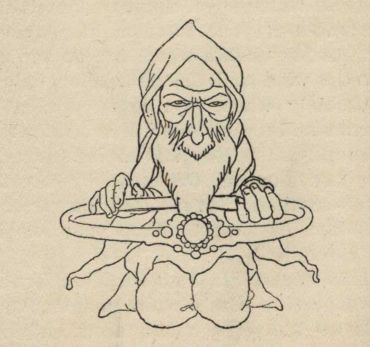
Dwarf
LOOKING BACKWARD
[Sidenote: Chapter I.]
Now that we know all about Princess Bee, we may find it pleasant to look backward and think a little about the story, chapter by chapter, to find out whether it has come to stay in our minds. Some stories do and others don't. We are glad to forget some stories, but I do not think that the story of Bee is one of that kind. Besides, it is told with such loving carefulness that, for the sake of the writer, who wrote that he might please and inspire us, we ought to read it again with a quiet mind, undisturbed by any thought of what is going to happen next; for now we know all about that.
It is a story of that wonder time so often spoken of as "long, long ago," and its date does not matter; but you will see from the first chapter that it belongs to the time of the knights, the best of whom tried to remedy things that were wrong and make the world a finer place in which to live.
Do you like the Countess of the White Moor? And why? How much older was George than Bee?
[Sidenote: Chapter II.]
Read over several times the description of the estates of the Duchess of Clarides (there are three bites to this cherry). It is such a good "pen-picture" and there are many more in this story for which you ought to watch with care. The old monk in the tower with his birds and his books is worth thinking about and so are his rules; so also are the rules of the Duchess. There is a good "pen-picture" with two trees and two children in it. I wonder if you could sketch it?
[Sidenote: Chapter III.]
Do they teach falconry in your school? If not, you might at least try to find out something about it, for it was a fascinating sport--except, of course, for the little birds--much better fun than learning several styles of handwriting or getting "grammatical instruction with barbarous terminology." What a lovely jumble of big words! What about that sentence, "affectionate lessons are the only good lessons"? And whatever is "inebriety "? It must be something very dreadful. I fancy it is something catching and can most easily be caught at "Tin-jugs," and "Red Lions," and "Indian Queens," and "Bull and Bushes," and suchlike places where they know absolutely nothing about synecdoche or aposiopesis either.
[Sidenote: Chapter IV.]
There are some lovely colours in the first bit of this chapter. Perhaps you could get someone to make a colour-sketch? And pearls have a "mild splendour," haven't they, quite different from diamonds or rubies? If you are a girl wouldn't you like to have a hair-ribbon like Bee's? George and Bee were taught a beautiful lesson that morning, and learnt it, too. I wish we could all describe beautiful scenery as beautifully as the Duchess could--and, by-the-way, look carefully at the iris flower when you meet with one again. Sylphs? Have you another name for them? What a sounding title the old beggar-woman gave herself, and what a well furnished kitchen she had! Have you a pipkin and a caldron at home? What are the duties of Dwarfs?
[Sidenote: Chapter V.]
Have you ever noticed that hills and woods are really "blue in the distance"? A great many writers have done so. What a charming definition (horrid word) Princess Bee gave of the horizon, and how differently she thought of the bigness of the world from George. Do you think they would find lobsters by fishing under the old stone bridge? (Perhaps, however, this is too severe a question for a tale about "long, long ago.") Those forbidden Sylphs were still in the children's minds, but Bee had less fear than George--or was she daring George to go? Which of the two children was the best quarreller?
[Sidenote: Chapter VI.]
And now, who is the brave adventurer? There is a pretty picture of which the "Headless Woman" is the centre. Read the description again and again and look at the picture with closed eyes. There is another with Bee in the centre, holding out her skirt for the cherries. Bee's teachers had not taught her economics, had they? It would be hard to find a more charming description of a walk than is contained in this chapter. Bee is soon plunged in despair, but George is a little Greatheart and soon has his reward. Read slowly and more than once the description of the lake. The sudden appearance of the goose-girl gives us another pretty picture. What is a demijohn? How does Bee tell us that the day is waning? Consider the words "Reeds, like pliant swords," and the pretty coloured flower-picture at the end of the chapter.
[Sidenote: Chapter VII.]
George still plays the part of Greatheart manfully and is ready for any event, having used his observing powers on the fruits and berries like a Boy Scout. Think of that sharp picture against the pale sky of evening--"a little dwarf riding on a crow." Then of the changing picture--like a lovely scene in a play--as night falls upon the lake. See how the Sylphs come while the boy stands entranced. Did he remember the words of Bee's mother as he was carried "through the waters, in halls of crystal and porphyry"? And what a lovely word the last one is!
[Sidenote: Chapter VIII.]
It would be good fun to try to draw a dwarf from the description given at the beginning of this chapter, helped by a glance at some of the little pictures in this book. Can't you feel how quick the dwarfs were as you say the words "incredible nimbleness," rolling them round your tongue? I wonder what it means to "look like an old poet." Pic's last sentence, at all events, is very like poetry. Rug is very good at argument and at sticking to his own opinion. Tad is a dwarf of character--"Justice should prevail, and not custom." As for Pan, he might have been a very sensible father, mightn't he? There is a pretty picture when Bee raises herself upon her elbow and another one of a different kind when Pic stands upon his dignity (to make himself taller) and speaks the sounding sentence which begins, "She is only a child." And what a depth of real truth there is in Tad's words, "You will consider us less ugly when you like us better." No one who is loved can be ugly to the one who loves.
And what a sad reproach there is in Tad's words to Rug: "You are more like a man than a dwarf." This chapter ends with another charming picture.
[Sidenote: Chapter IX.]
How many colours or tints are mentioned in the first paragraph of this chapter? In the next paragraph poetry and gentle fun have kissed each other. A dwarf of "great majesty"? Oh, yes. Majesty is not a matter of inches. The dwarf monarch understood little girls in a wonderful way and Bee was soon at her ease as every guest is who asks for a pair of slippers, right off. The next thing such a guest would do would be to poke the fire! The illustrious Belisarius? He was a famous general who won many victories in Italy and the East, and was brave, generous, just and faithful and afraid of nothing but his wife. Bee was just a little ungracious about those slippers, don't you think? But there was some excuse for her--she did want to be at home again. It would be a lovely arrangement if those who love each other could exchange dreams when they are parted for a time. Some people say they do, and possibly the dwarf poet believed it to be possible.
[Sidenote: Chapter X.]
It was a strange but beautiful underground world in which the dwarfs had their home. Why lava pavement? Bee's lessons must have been fascinating. If only we could all learn without books! Then perhaps we also should "move with grace and express ourselves according to the rule of poetry." What a delightful picture of a puppet show is given in this chapter! There are clever men and women to-day who can make dolls act in this way. Read the description again, for it is well worth while. Wouldn't you like to play the theorbo? It has a lovely name. Did the dwarfs change as the days and months passed and the years made their round?
[Sidenote: Chapters XI. and XII.]
The deep, deep darkness between the rocky walls makes the light shine all the brighter, and Bee's exclamation might be that of a blind girl whose sight is suddenly restored. Have you ever seen a chalice, a pyx, or a patin, and would you know them if you saw them again? Or a thurible? And wouldn't you like that set of moonstone chessmen? What a wonderful description of a coffer full of jewels! Yet, with all this wealth before her Bee chooses to go back to earth and into the sunshine back to her mother and George of the White Moor, more precious than pearls. Read again and again, nay, learn by heart what King Loc said to Bee after he had tested her--for he was only testing her all the time. Was there ever such a proposal of marriage? But little King Loc has his own dignity--also his hopes.
[Sidenote: Chapter XIII.]
Who would be a princess and wear a crown which interfered with flowing locks and merry gambols? The story-teller strikes a sad note. Bee and the little king are both unhappy and there is a pathetic and very beautiful picture of the princess gazing on the sunbeam; another of her arrival on earth again. The king's instructions are difficult and there is danger in them. The journey home is fascinating, reminding us of Peter and Wendy on the way to the Land of Lost Boys; so also is the arrival home, which is fully described. But the sad ending is told in a few curt words. It is much too pitiful for a long description.
[Sidenote: Chapter XIV.]
Is this story beginning to remind you of an old, old tale told long ago among the Ancient Greeks, a tale of a lost princess carried off to the Underworld by Pluto and mourned on earth by Ceres, the goddess of the corn? If you happen to know that old, old story you will be able to make interesting comparisons. But to return to King Loc. The secret comes out. Did Bee know that she loved George of the White Moor when King Loc had asked her, long before, whether she loved anyone else? Have you known Bee's secret all along? The effect of her declaration is rather piteous--with a smile behind the sadness. King Loc's exit is very dignified and dramatic and, by the way, what an excellent play could be made from this story, or a series of tableaux.
[Sidenote: Chapter XV.]
Poor King Loc cannot understand the situation. He is a king, he has learning, wealth, and merit. Why; therefore, does not Bee love him? Further, he is good and wishes to be just. Poor little King Loc! Nur introduces and describes himself in a speech worth learning and remembering. His long speech about ourselves is full of wisdom and warning. Read it again and again. The last portion is very beautiful. And what a wonderful way the dwarfs had of finding things out without books. George of the Moor was easily traced. King Loc is very undwarflike or, let us say, very human when he learns where George is. But would the laugh of these little creatures even in unison be a "jovial great guffaw"? Surely it is only jolly giants who make great guffaws. Perhaps you can describe the dwarf laughter in a better way. What do you think the writer means by making Nur live in a deep well?
[Sidenote: Chapter XVI.]
There is an interesting glimpse of one of the duties of the dwarfs in the first paragraph of this chapter. Have you read Mrs. Ewing's Lob-lie-by-the-Fire? If not, get it from the library and read about what one of our poets calls "the lubber-fiend." Dwarf madness seems to be an amiable thing. "A shell of mother-of-pearl irisated." Remember that Iris was the Greek goddess of the rainbow. George was no more happy among the beauties of the sea-world than was Bee among the treasures of the caves, and he learnt the same lesson as she did. You will find it in the sentence which begins: "The years went by." Compare King Loc with the Princess of the Sylphs. Achilles was the Greek hero who fought against Troy and killed their champion, Hector. Disguised as a girl, he was once sent by his mother to the court of King Lycomedes because she wished to prevent his setting out for the Siege of Troy. Tannhauser is the hero of the German story, who visited the court of Venus, the Goddess of Love, and there forgot everything but pleasure; but later he repented. The story is set to music in Wagner's opera. George was not the first, nor the last, to be saved from slackness and inspired to deeds of courage by a book. Compare his request to be set free with that of Bee in a former part of the story. What do you think about Nur's opinion on science and poetry?
[Sidenote: Chapter XVII.]
What is the "bezel" of a ring? And how would you like to go boating on a petroleum lake? There is a wonderful description of King Loc's journey through the sea cavern. Does it recall any piece of literature, prose or verse, song or story. There is a good picture in the story of the meeting of George and his rival. Aristotle was a Greek philosopher who knew almost everything there was to be known. If King Loc had belonged to our time we should call him a "sport." But it was too much to hurl Bee's name at him without any preparation. On the whole the shadows of the story appear to be lifting in this chapter, don't they?
[Sidenote: Chapter XVIII.]
John's exclamation was not quite polite. If he did not see a ghost he might have guessed that it was an angel. The people had given a natural cause for the disappearance of George, but explained Bee's absence in a more wonderful and mysterious way, with a touch of poetry. The home-coming of George has various effects, according to the character of the people he meets. Freeheart back again, too, and still at his old game of "making a song about it"! The light grows brighter and brighter.
[Sidenote: Chapter XIX.]
It was the common people who were expected to know all about the habits of the dwarfs. Glauce is good fun and a clever girl would love to act her part in a play; she is by no means unimportant in the story. Cider added to oats for a horse! I wonder what Glauce meant by "drinking fair"? And what the neighbours said afterwards about her late husband's story?
[Sidenote: Chapter XX.]
An "espadon" must be a terrible weapon, judging by its name. Avalon lies at the farthest verge of the western sea and is the last home of all good knights, including King Arthur:
The island-valley of Avilion;
Where falls not hail, or rain, or any snow,
Nor ever wind blows loudly: but it lies
Deep-meadowed, happy, fair with orchard-lawns
And bowery hollows crowned with summer sea.
And Thule is the northernmost land of all the world. Freeheart's ideas of costume are quite original; but his notion of wine-inspired courage is not so praiseworthy. He is, however, a better diplomatist than George, and has a very charming way of telling the young lover that he has been foolishly rude. George's entry, reception, and meeting with little King Loc make a splendid moving picture. Disappointment in love has not soured the little king, but has made him something of a poet; and how gently he reproves the hot-headed George! How kind George is, too, in the midst of his happiness. And all ends in mock-heroics and good fun.
[Sidenote: Chapter XXI.]
The last scene of all makes one long to have a play based upon this story. Who would not be proud to act King Loc and have such a lofty mind? It would be difficult, of course, to get together such a wedding present as he gave Bee, but the players could easily agree to play the game of "Let's pretend," as Shakespeare did when he hung up a card, on the curtain, bearing the words, "This is a wood."
A true story? Well---what is it all about? It is a story of mother-love, child-love, and lover's love. It is full of kindliness, courage, gaiety, forgiveness, compassion, helpfulness, resource, and fortitude. And these things have always been true, are true to-day and will be true long, long after we all reach the "island valley of Avilion." So, what greater truth could we ask for?
We give here for purposes of enjoyment and comparison a prose story and a poem, both of which tell the story of the Greek maiden who was carried off to the dark Underworld, but who, unlike Bee, became the bride of its king; also another story of dwarfs and their ways.
THE SORROW OF DEMETER
In the fields of Enna, in the happy island of Sicily, the beautiful Persephone was playing with the girls who lived there with her. She was the daughter of the Lady Demeter, and every one loved them both; for Demeter was good and kind to all, and no one could be more gentle and merry than Persephone. She and her companions were gathering flowers from the field, to make crowns for their long flowing hair. They had picked many roses and lilies and hyacinths which grew in clusters around them, when Persephone thought she saw a splendid flower far off; and away she ran, as fast as she could, to get it. It was a beautiful narcissus, with a hundred heads springing from one stem; and the perfume which came from its flowers gladdened the broad heaven above, and the earth and sea around it. Eagerly Persephone stretched out her hand to take this splendid prize, when the earth opened. and a chariot stood before her drawn by four coal-black horses; and in the chariot there was a man with a dark and solemn face, which looked as though he could never smile, and as though he had never been happy. In a moment he got out of his chariot, seized Persephone round the waist, and put her on the seat by his side. Then he touched the horses with his whip, and they drew the chariot down into the great gulf, and the earth closed over them again.
Presently the girls who had been playing with Persephone came up to the place where the beautiful narcissus was growing; but they could not see her anywhere. And they said, "Here is the very flower which she ran to pick, and there is no place here where she can be hiding." Still for a long time they searched for her through the fields of Enna; and when the evening was come, they went home to tell the Lady Demeter that they could not tell what had become of Persephone.
Very terrible was the sorrow of Demeter when she was told that her child was lost. She put a dark robe on her shoulders, and took a flaming torch in her hand, and went over land and sea to look for Persephone. But no one could tell her where she was gone. When ten days were passed she met Hekate, and asked her about her child; but Hekate said, "I heard her voice, as she cried out when some one seized her; but I did not see it with my eyes, and so I know not where she is gone." Then she went to Helios, and said to him, "O Helios, tell me about my child. Thou seest everything on the earth, sitting in the bright sun." Then Helios said to Demeter, "I pity thee for thy great sorrow, and I will tell thee the truth. It is Hades who has taken away Persephone to be his wife in the dark and gloomy land which lies beneath in the earth."
Then the rage of Demeter was more terrible than her sorrow had been; and she would not stay in the palace of Zeus, on the great Thessalian hill, because it was Zeus who had allowed Hades to take away Persephone. So she went down from Olympus, and wandered on a long way until she came to Eleusis, just as the sun was going down into his golden cup behind the dark blue hills. There Demeter sat down close to a fountain, where the water bubbled out from the green turf and fell into a clear basin, over which some dark olive-trees spread their branches.
Just then the daughters of Keleos, the king of Eleusis, came to the fountain with pitchers on their heads to draw water; and when they saw Demeter, they knew from her face that she must have some great grief; and they spoke kindly to her, and asked if they could do anything to help her. Then she told them how she had lost and was searching for her child; and they said, "Come home and live with us: and our father and mother will give you everything that you can want, and do all that they can to soothe your sorrow." So Demeter went down to the house of Keleos, and she stayed there for a whole year. And all this time, although the daughters of Keleos were very gentle and kind to her, she went on mourning and weeping for Persephone. She never laughed or smiled, and scarcely ever did she speak to any one, because of her great grief. And even the earth, and the things which grow on the earth, mourned for the sorrow which had come upon Demeter. There was no fruit upon the trees, no corn came up in the fields, and no flowers blossomed in the gardens. And Zeus looked down from his high Thessalian hill, and saw that everything must die unless he could soothe the grief and anger of Demeter. So he sent Hermes down to Hades, the dark and stern king, to bid him send Persephone to see her mother Demeter. But before Hades let her go, he gave her a pomegranate to eat, because he did not wish her to stay away from him always, and he knew that she must come back if she tasted but one of the pomegranate seeds. Then the great chariot was brought before the door of the palace, and Hermes touched with his whip the coal-black horses, and away they went as swiftly as the wind, until they came close to Eleusis. Then Hermes left Persephone, and the coal-black horses drew the chariot away again to the dark home of King Hades.
The sun was sinking down in the sky when Hermes left Persephone, and as she came near to the fountain she saw someone sitting near it in a long black robe, and she knew that it must be her mother who still wept and mourned for her child. And as Demeter heard the rustling of her dress, she lifted up her face, and Persephone stood before her.
Then the joy of Demeter was greater, as she clasped her daughter to her breast, than her grief and her sorrow had been. Again and again she held Persephone in her arms, and asked her about all that had happened to her. And she said, "Now that you are come back to me, I shall never let you go away again; Hades shall not have my child to live with him in his dreary kingdom." But Persephone said, "It may not be so, my mother; I cannot stay with you always; for before Hermes brought me away to see you, Hades gave me a pomegranate, and I have eaten some of the seeds; and after tasting the seed I must go back to him again when six months have passed by. And indeed, I am not afraid to go; for although Hades never smiles or laughs, and everything in his palace is dark and gloomy, still he is very kind to me: and I think that he feels almost happy since I have been his wife. But do not be sorry, my mother, for he has promised to let me come up and stay with you for six months in every year, and the other six months I must spend with him in the land which lies beneath the earth."
So Demeter was comforted for her daughter Persephone, and the earth and all the things that grew in it felt that her anger and sorrow had passed away. Once more the trees bore their fruits, the flowers spread out their sweet blossoms in the garden, and the golden corn waved like the sea under the soft summer breeze. So the six months passed happily away, and then Hermes came with the coal-black horses to take Persephone to the dark land. And she said to her mother, "Do not weep much; the gloomy king whose wife I am is so kind to me that I cannot be really unhappy; and in six months more he will let me come to you again." But still, whenever the time came round for Persephone to go back to Hades, Demeter thought of the happy days when her child was a merry girl playing with her companions and gathering the bright flowers in the beautiful plains of Enna.
THE KING OF THE GOLDEN MOUNTAIN
FROM "GRIMM'S FAIRY TALES"
There was once a merchant who had only one child, a son, that was very young, and barely able to run alone. He had two richly laden ships then making a voyage upon the seas, in which he had embarked all his wealth, in the hope of making great gains, when the news came that both were lost. Thus from being a rich man he became all at once so very poor that nothing was left to him but one small plot of land; and there he often went in an evening to take his walk, and ease his mind of a little of his trouble.
One day, as he was roaming along in a brown study, thinking with no great comfort on what he had been and what he now was, and was like to be, all on a sudden there stood before him a little rough-looking black dwarf. "Prithee, friend, why so sorrowful?" said he to the merchant; "what is it you take so deeply to heart?" "If you could do me any good I would willingly tell you," said the merchant. "Who knows but I may?" said the little man: "tell me what ails you, and perhaps you will find I may be of some use." Then the merchant told him how all his wealth was gone to the bottom of the sea, and how he had nothing left but that little plot of land. "Oh! trouble not yourself about that," said the dwarf; "only undertake to bring me here, twelve years hence, whatever meets you first on your going home, and I will give you as much as you please." The merchant thought this was no great thing to ask; that it would most likely be his dog or his cat, or something of that sort, but forgot his little boy Heinel; so he agreed to the bargain, and signed and sealed the bond to do what was asked of him.
But as he drew near home, his little boy was so glad to see him that he crept behind him, and laid fast hold of his legs, and looked up in his face and laughed. Then the father started, trembling with fear and horror, and saw what it was that he had bound himself to do; but as no gold was come, he made himself easy, by thinking that it was only a joke that the dwarf was playing him, and that, at any rate, when the money came, he should see the bearer, and would not take it in.
About a month afterwards he went upstairs into a lumber-room to look for some old iron, that he might sell it and raise a little money; and there, instead of his iron, he saw a large pile of gold lying on the floor. At the sight of this he was overjoyed, and forgetting all about his son, went into trade again, and became a richer merchant than before.
Meantime little Heinel grew up, and as the end of the twelve years drew near the merchant began to call to mind his bond, and became very sad and thoughtful; so that care and sorrow were written upon his face. The boy one day asked what was the matter, but his father would not tell for some time; at last, however, he said that he had, without knowing it, sold him for gold to a little, ugly-looking, black dwarf, and that the twelve years were coming round when he must keep his word. Then Heinel said, "Father, give yourself very little trouble about that; I shall be too much for the little man."
When the time came, the father and son went out together to the place agreed upon: and the son drew a circle on the ground, and set himself and his father in the middle of it. The little black dwarf soon came, and walked round and round about the circle, but could not find any way to get into it, and he either could not, or dared not, jump over it. At last the boy said to him, "Have you anything to say to us, my friend, or what do you want?" Now Heinel had found a friend in a good fairy, that was fond of him, and had told him what to do; for this fairy knew what good luck was in store for him. "Have you brought me what you said you would?" said the dwarf to the merchant. The old man held his tongue, but Heinel said again, "What do you want here?" The dwarf said, "I come to talk with your father, not with you." "You have cheated and taken in my father," said the son; "pray give him up his bond at once." "Fair and softly," said the little old man; "right is right. I have paid my money, and your father has had it, and spent it; so be so good as to let me have what I paid it for." "You must have my consent to that first," said Heinel; "so please to step in here, and let us talk it over." The old man grinned, and showed his teeth, as if he should have been very glad to get into the circle if he could. Then at last, after a long talk, they came to terms. Heinel agreed that his father must give him up, and that so far the dwarf should have his way: but, on the other hand, the fairy had told Heinel what fortune was in store for him, if he followed his own course; and he did not choose to be given up to his hump-backed friend, who seemed so anxious for his company.
So, to make a sort of drawn battle of the matter, it was settled that Heinel should be put into an open boat, that lay on the sea-shore hard by; that the father should push him off with his own hand, and that he should thus be set adrift, and left to the bad or good luck of wind and weather. Then he took leave of his father, and set himself in the boat; but before it got far off a wave struck it, and it fell with one side low in the water, so the merchant thought that poor Heinel was lost, and went home very sorrowful, while the dwarf went his way, thinking that at any rate he had had his revenge.
The boat, however, did not sink, for the good fairy took care of her friend, and soon raised the boat up again, and it went safely on. The young man sat safe within, till at length it ran ashore upon an unknown land. As he jumped upon the shore he saw before him a beautiful castle, but empty and dreary within, for it was enchanted. "Here," said he to himself, "must I find the prize the good fairy told me of." So he once more searched the whole palace through, till at last he found a white snake, lying coiled up on a cushion in one of the chambers.
Now the white snake was an enchanted princess; and she was very glad to see him, and said, "Are you at last come to set me free? Twelve long years have I waited here for the fairy to bring you hither as she promised, for you alone can save me. This night twelve men will come: their faces will be black, and they will be dressed in chain armour. They will ask what you do here, but give no answer; and let them do what they will, beat, whip, pinch, prick, or torment you, bear all; only speak not a word, and at twelve o'clock they must go away. The second night twelve others will come: and the third night twenty-four, who will even cut off your head; but at the twelfth hour of that night their power is gone, and I shall be free, and will come and bring you the water of life, and will wash you with it, and bring you back to life and health." And all came to pass as she had said; Heinel bore all, and spoke not a word; and the third night the princess came, and fell on his neck and kissed him. Joy and gladness burst forth throughout the castle, the wedding was celebrated, and he was crowned king of the Golden Mountain.
They lived together very happily, and the queen had a son. And thus eight years had passed over their heads, when the king thought of his father; and he began to long to see him once again. But the queen was against his going, and said, "I know well that misfortunes will come upon us if you go." However, he gave her no rest till she agreed. At his going away she gave him a wishing-ring, and said, "Take this ring, and put it on your finger, whatever you wish it will bring you: only promise never to make use of it to bring me hence to your father's house." Then he said he would do what she asked, and put the ring on his finger, and wished himself near the town where his father lived.
Heinel found himself at the gates in a moment; but the guards would not let him go in, because he was so strangely clad. So he went up to a neighbouring hill, where a shepherd dwelt, and borrowed his old frock, and thus passed unknown into the town. When he came to his father's house, he said he was his son; but the merchant would not believe him, and said he had had but one son, his poor Heinel, who he knew was long since dead: and as he was only dressed like a poor shepherd, he would not even give him anything to eat. The king, however, still vowed that he was his son, and said, "Is there no mark by which you would know me if I am really your son?" "Yes," said his mother, "our Heinel had a mark like a raspberry on his right arm." Then he showed them the mark, and they knew that what he had said was true.
He next told them how he was king of the Golden Mountain, and was married to a princess, and had a son seven years old. But the merchant said, "That can never be true; he must be a fine king truly who travels about in a shepherd's frock!" At this the son was vexed; and forgetting his word, turned his ring, and wished for his queen and son. In an instant they stood before him; but the queen wept, and said he had broken his word, and bad luck would follow. He did all he could to soothe her, and she at last seemed to be appeased; but she was not so in truth, and was only thinking how she should punish him.
One day he took her to walk with him out of the town, and showed her the spot where the boat was set adrift upon the wide waters. Then he sat himself down, and said, "I am very much tired; sit by me, I will rest my head in your lap, and sleep awhile." As soon as he had fallen asleep, however, she drew the ring from his finger, and crept softly away, and wished herself and her son at home in their kingdom. And when he awoke he found himself alone, and saw that the ring was gone from his finger. "I can never go back to my father's house," said he, "they would say I am a sorcerer: I will journey forth into the world, till I come again to my kingdom."
So saying, he set out and travelled till he came to a hill, where three giants were sharing their father's goods; and as they saw him pass, they cried out and said, "Little men have sharp wits; he shall part the goods between us." Now there was a sword, that cut off an enemy's head whenever the wearer gave the words, "Heads off!" a cloak, that made the owner invisible, or gave him any form he pleased; and a pair of boots that carried the wearer wherever he wished. Heinel said they must first let him try these wonderful things, then he might know how to set a value upon them. Then they gave him the cloak, and he wished himself a fly, and in a moment he was a fly. "The cloak is very well," said he; "now give me the sword." "No," said they; "not unless you undertake not to say, 'Heads off!' for if you do, we are all dead men." So they gave it him, charging him to try it on a tree. He next asked for the boots also; and the moment he had all three in his power, he wished himself at the Golden Mountain; and there he was at once. So the giants were left behind with no goods to share or quarrel about.
As Heinel came near his castle he heard the sound of merry music; and the people around told him that his queen was about to marry another husband. Then he threw his cloak around him, and passed through the castle-hall, and placed himself by the side of his queen, where no one saw him. But when anything to eat was put upon her plate, he took it away and ate it himself; and when a glass of wine was handed to her, he took it and drank it: and thus, though they kept on giving her meat and drink, her plate and cup were always empty.
Upon this fear and remorse came over her, and she went into her chamber alone, and sat there weeping; and he followed her there. "Alas!" said she to herself, "was I not once set free? why then does this enchantment still seem to bind me?"
"False and fickle one!" said he, "one indeed came who set thee free, and he is now near thee again; but how have you used him? ought he to have had such treatment from thee?" Then he went out and sent away the company, and said the wedding was at an end, for that he was come back to the kingdom. But the princes, peers, and great men mocked at him. However, he would enter into no parley with them, but only asked them if they would go in peace or not. Then they turned upon him and tried to seize him; but he drew his sword; "Heads off!" cried he; and with the word, the traitors' heads fell before him, and Heinel was once more king of the Golden Mountain.
PERSEPHONE[1]
[1] In some forms of this story the maiden is called Proserpina and her mother Ceres. Tennyson tells the story in his poem "Demeter."
I
She stepped upon Sicilian grass,
Demeter's daughter, fresh and fair;
A child of light, a radiant lass,
And gamesome as the morning air.
The daffodils were fair to see,
They nodded lightly on the lea,
Persephone--Persephone!
Lo! one she marked of fairer growth
Than orchis or anemone:
For it the maiden left them both,
And parted from her company.
Drawn nigh she deemed it fairer still,
And stooped to gather by the rill
The daffodil, the daffodil.
What ailed the meadow that it shook?
What ailed the air of Sicily?
She wandered by the prattling brook,
And trembled with the trembling lea.
"The coal-black horses rise--they rise:
O Mother, Mother!" low she cries--
Persephone--Persephone!
"O light, light, light!" she cried, "farewell;
The coal-black horses wait for me.
O shade of shades, where must I dwell,
Demeter, Mother, far from thee!
Ah, fated doom that I fulfil!
Ah, fateful flower beside the rill!
The daffodil, the daffodil!"
What ails her that she comes not home?
Demeter seeks her far and wide,
And gloomy-browed doth ceaseless roam
From many a morn till eventide.
"My life, immortal though it be,
Is nought," she cried, "for want of thee,
Persephone--Persephone!"
"Meadows of Enna, let the rain
No longer drop to feed your rills,
Nor dew refresh the fields again,
With all their nodding daffodils!
Fade, fade and droop, O lilied lea,
Where thou, dear heart, wast reft from me--
Persephone--Persephone!"
II
She reigns upon her dusky throne,
'Mid shades of heroes dread to see;
Among the dead she breathes alone,
Persephone--Persephone!
Or seated on the Elysian hill
She dreams of earthly daylight still,
And murmurs of the daffodil.
A voice in Hades soundeth clear,
The shadows mourn and flit below;
It cries--"Thou Lord of Hades, hear,
And let Demeter's daughter go.
The tender corn upon the lea
Droops in her golden gloom when she
Cries for her lost Persephone.
"From land to land she raging flies,
The green fruit falleth in her wake,
And harvest fields beneath her eyes
To earth the grain unripened shake.
Arise and set the maiden free;
Why should the world such sorrow dree[2]
By reason of Persephone?"
[2] Dree means endure or bear.
He takes the cleft pomegranate seeds,
"Love, eat with me this parting day;"
Then bids them fetch the coal-black steeds--
"Demeter's daughter, wouldst away?"
The gates of Hades set her free;
"She will return full soon," saith he--
"My wife, my wife Persephone."
Low laughs the dark king on his throne--
"I gave her of pomegranate seeds;"
Demeter's daughter stands alone
Upon the fair Eleusian meads.
Her mother meets her. "Hail!" saith she;
"And doth our daylight dazzle thee,
My love, my child Persephone?
"What moved thee, daughter, to forsake
Thy fellow-maids that fatal morn,
And give thy dark lord power to take
Thee living to his realm forlorn?"
Her lips reply without her will,
As one address who slumbereth still--
"The daffodil, the daffodil!"
Her eyelids droop with light oppressed,
And sunny wafts that round her stir,
Her cheek is on her mother's breast,
Demeter's kisses comfort her.
Calm Queen of Hades, art thou she
Who stepped so lightly on the lea--
Persephone, Persephone?
When, in her destined course, the moon
Meets the deep shadow of this world,
And labouring on doth seem to swoon
Through awful wastes of dimness whirled--
Emerged at length, no trace hath she
Of that dark hour of destiny,
Still silvery sweet--Persephone.
The greater world may near the less,
And draw it through her weltering shade,
But not one biding trace impress
Of all the darkness that she made;
The greater soul that draweth thee
Hath left his shadow plain to see
On thy fair face, Persephone!
Demeter sighs, but sure 'tis well
The wife should love her destiny;
They part, and yet, as legends tell,
She mourns her lost Persephone;
While chant the maids of Enna still--
"O fateful flower, beside the rill--
The daffodil, the daffodil!"
JEAN INGELOW (1820-89).
THE WRITER OF THE STORY OF BEE
The best way to learn something about the author of Bee is to study with care the portrait given as the frontispiece of this book. You shall form your own opinion of the man from the artist's drawing and that opinion will depend greatly upon the amount of enjoyment and the number of ideas you have got from his story.
His name is sufficient guide to his nationality, and you will know by easy guesswork that you have been reading a translation of his tale; but the change from French to English is so well made that not much is lost of the charm of the story as Anatole France wrote it. The best way to judge his work is, of course, to read it in French.
Anatole France is not, like Hans Andersen, a recognised fairy-tale writer, which from our point of view seems a pity, because he has the light touch which does not crush the gossamer or brush the dust from the wings of the butterfly. It is of no use having a heavy touch if you are dealing with things like Queen Mab's Wagon.
Her wagon-spokes made of long spinners' legs.
The cover of the wings of grasshoppers,
Her traces of the smallest spider's web,
Her whip of crickets' bone, the lash of film;
Her wagoner a small grey-coated gnat,
Her chariot is an empty hazel-nut
Made by the joiner squirrel, or old grub,
Time out o' mind the fairies' coach-makers.
One of our own writers, John Ruskin, wrote one fairy tale called The King of the Golden River, and the rest of his writings, like those of Anatole France, were for grown-up readers. There are some people who think that Ruskin's fairy tale is one of the best of its kind ever written, and Bee: the Princess of the Dwarfs is quite worthy to stand beside it. You may care to compare the two in matters of detail and style, and will find the work very interesting indeed; and you will remember that it is quite fair to compare these two stories, for they were both invented or "made-up" by their authors all out of their own heads.
Most of the old fairy tales, like Cinderella, seem to have grown like the cabbages, or, shall we say, the roses. They have been told again and again by one person after another as the years rolled by and they were well known before anyone set them down in print. In a sense, Bee and The King of the Golden River are not true fairy tales, but you will agree that they are very good imitations of the old models.
Anatole France, whose real surname is Thibault, was the son of a bookseller in Paris, and was born so long ago as 1844. He was brought up among books and among clever men who came to his father's shop not only to buy books but to discuss them. It is not surprising that when he grew up he should begin to write books.
As for his thoughts about things in general, you will find them all in the pages of Bee: the Princess of the Dwarfs.
THE TEMPLE PRESS LETCHWORTH ENGLAND