PART I MARY GARDEN
Reading edition
I SUPERWOMAN
LA BEAUTÉ
“Je suis belle, ô mortels! comme un rêve de pierre, Et mon sein, où chacun s’est meurtri tour à tour, Est fait pour inspirer au poëte un amour Éternel et meut, ainsi, que la matière.”
—Charles Baudelaire.
That little girl down Boston way, who had mastered William James and Boris Sidis before she was in her teens, behaved badly one afternoon. Possibly it was the sultry weather, or growing pains—in the psychic sphere, of course—or, perhaps, it may have been due to the reflexes from prolonged attention to the Freudian psycho-analysis and the significance of Twilight Sleep; but whatever the cause, that precocious child flew off her serene handle and literally “sassed” the entire household. The tantrum over—she afterward described it as a uric-acid storm—and order reigning once more in Bach Bay, she was severely interrogated by her male parent as to the whys and wherefores of her singular deviation from accustomed glacial intellectual objectivity. Her answer was in the proper key: “My multiple personalities failed to co-ordinate. Hence the distressing lack of centripetal functioning.” She was immediately forgiven. Multiple personalities are to blame for much in this vale of tears; that is, if you are unlucky or lucky enough to be possessed of the seven devils of psychology.
Mary Garden was, no doubt, a naughty little girl in her time. That she climbed trees, fought boys twice her size, stuck out her tongue at pious folk, scandalized her parents, and tore from the heads of nice girls handfuls of hair, I am sure. Hedda Gabler thus treated gentle Thea Elvstad in the play. But was this demon Mary aware of her multiple personalities? Of her complexes? Her art fusion is such perfect synthesis. Subconscious is nowadays an excuse for the Original Sin with which we are saddled by theologians.
Well, one bad turn deserves another, and we may easily picture the wild Scottish thistle defiantly shrugging shoulders at law and order. She did not analyze her Will-to-Raise-Merry-Hell. No genius of her order ever does. There had been signs and omens. Her mother before her birth had dreamed wonderful dreams; dreamed and prayed that she might become a singer. But even maternal intuition could not have foreseen such a swan triumphantly swimming through the troubled waters of life. A swan, did I say? A condor, an eagle, a peacock, a nightingale, a panther, a society dame, a gallery of moving-pictures, a siren, an indomitable fighter, a human woman with a heart as big as a house, a lover of sport, an electric personality, and a canny Scotch lassie who can force from an operatic manager wails of anguish because of her close bargaining over a contract; in a word, a Superwoman.
My dear friend and master, the late Remy de Gourmont, wrote that man differs from his fellow animals—he didn’t say “lower”—because of the diversity of his aptitudes. Man is not the only organism that shows multiple personalities; even in plant life pigmentation and the power of developing new species prove that our vaunted superiorities are only relative. I may refer you to the experiments of Hugo de Vriès at the Botanical Gardens, Amsterdam, where the grand old Dutch scientist presented me with sixteen-leaf clover naturally developed, and grown between sunset and dawn; also an evening primrose—Æonthera Lamarckiana—which shoots into new flowers. Multiple personalities again. In the case of Mary Garden we call her artistic aptitudes “the gift of versatility.” All distinguished actresses have this serpent-like facility of shedding their skin and taking on a fresh one at will. She is Cleopatra—with “serpent and scarab for sign”—or Mélisande, Phryne, or Monna Vanna; as Thaïs she is both saint and courtesan, her Salome breeds horror; and in the simplicities of Jean the Juggler of Notre Dame a Mary Garden, hitherto submerged, appears: tender, boyish, sweet, fantastic; a ray of moonshine has entered his head and made of him an irresponsible yet irresistibly charming youth.
Not without warrant is Karma believed in by people whose imagination cannot be penned behind the bars of Now. Before to-day was yesterday, and to traverse that Eternal Corridor of Time has been the fate of mankind. The Eternal Return—rather say, the Eternal Recommencement—mad as it seems, is not to be made mock of. It is always the same pair of eyes that peer through windows opening on infinity. What the Karmas of Mary Garden? In spirit-land what avatars! Is she the reincarnation of that Phryne of the “splendid scarlet sins,” or the Faustine who crowded into a moment the madness of joy and crime; or the recrudescence of a Sapho who turned her back on the Leucadian promontory, turned from the too masculine Phaon and sought her Anactoria, sought and wooed her with lyric sighs; has she recaptured, this extraordinary Mary of Aberdeen, the soul of Aspasia, who beguiled Pericles and artistic Athens with the sinuous irony of the serpent; and Gismonda, Louise, and Violetta, all those subtle sonorous sinners—was she in her anterior existence any or all of them? Did she know the glory that was Greece, the grandeur that was Rome? Henry James has warned us not to ask of an author why he selects a particular subject for treatment. It is a dangerous question to put; the answer might prove disconcerting. And with Miss Garden the same argument holds. Her preference for certain characters is probably dictated by reasons obscure even to herself. With her the play-instinct is imperious; it dominates her daylight hours, it overflows into her dream-life. Again the sounding motive of multiple personalities, Karma, subconsciousness, the profound core of human nature. And on the palette of her art there is the entire gamut of tones, from passionate purple to the iridescent delicacies of iris-grey.
That Mary Garden interprets a number of widely differentiated characters is a critical platitude. Chapter and verse might be given for her excellences as well as her defects. Nor does she depend upon any technical formula or formulas. Versatility is her brevet of distinction. An astounding versatility. Now, the ways and means of the acting-singer are different from actors in the theatre. Dramatic values are altered. The optique of the opera shifts the stock attitudes, gestures, poses, and movements into another and more magnified dimension. Victor Maurel, master of all singing-actors, employed a sliding scale of values in his delineation of De Nevers, Don Giovanni, Iago, and Falstaff. His power of characterization enabled him to portray a Valentine true to type, nevertheless individual; and if there is a more banal figure on the operatic boards than Valentine, we do not know his name (perhaps Faust...!). But every year the space that separates the lyric from the dramatic stage is shrinking. Richard Wagner was not the first composer to stress action; he is the latest, however, whose influence has been tremendously far-reaching. He insisted that the action should suit the singing word. To-day acting and singing are inextricably blended, and I can conceive of nothing more old-fashioned and outmoded than the Wagnerian music-drama as interpreted in the dramatic terms of the old Wagnerian singers. They walked, rather waddled, through the mystic mazes of the score, shouted or screamed the music, and generally were prodigious bores—except when Lilli Lehmann sang. After all, Wagner must be sung. When Jean de Reszke pictured a Tristan—a trifle of the carpet-knight—he both sang and acted. It was the beginning of the New Wagner, a totally changed Wagner, else his music-drama will remain in dusty pigeonholes. Debussy has sounded the modern key.
There is born, or reborn—nothing is new since the early Florentines—a New Opera, and in its train new methods of interpretation. Merely to sing well is as futile as attempting to act though voiceless. The modern trend is away from melodrama, whether Italian, French, or German; away from its antique, creaking machinery. Debussy patterned after Wagner for a time and then blazed new paths. As Serge Prokofieff so acutely observed to me: “In Pelléas and Mélisande Debussy rewrote Tristan and Isolde.” The emotional scale is transposed to fewer dynamic values and rhythms made more subtle; the action is shown as in a dream. The play’s the thing, and reality is muffled. Elsewhere we have studied the Mélisande of Mary Garden. Like her Monna Vanna, it reveals the virtues and shortcomings of the New Opera. Too static for popular taste, it is nevertheless an escape from the tyranny of operatic convention. Like the rich we shall always have “grand opera” with us. It is the pabulum of the unmusical, the unthinking, the tasteless. Its theatricalisms are more depressing than Sardou’s. The quintessence of art, or the arts, which the modern Frenchmen, above all, the new Russian composers (from the mighty Slavic races may come the artistic, perhaps the religious salvation of the world—for I am a believer in Dostoievsky’s, not Tolstoy’s, Christianity), are distilling into their work is for more auditors than the “ten superior persons scattered throughout the universe” of whom Huysmans wrote. There is a growing public that craves, demands, something different from the huge paraphernalia of crudely colored music, scenery, costume, lath and plaster, and vociferous singing. Oh, the dulness, the staleness, the brutal obviousness of it all! Every cadence with its semaphoric signalling, every phrase and its accompanying gesture. Poetry is slain at a stroke, the ear promise-crammed, but imagination goes hungry. The New Art—an art of precious essences, an evocation, an enchantment of the senses, a sixth sense—is our planetary ideal.
And in the New Opera Mary Garden is the supreme exemplar. She sounds the complex modern note. She does not represent, she evokes. She sings and she acts, and the densely woven web is impossible to disentangle. Her Gaelic temperament is of an intensity; she is white-hot, a human dynamo with sudden little retorsions that betray a tender, sensitive soul, through the brilliant, hard shell of an emerald personality; she is also the opal, with it chameleonic hues. Her rhythms are individual. Her artistic evolution may be traced. She stems from the Gallic theatre. She has studied Sarah Bernhardt and Yvette Guilbert—the perfect flowering of the “diseuse”—but she pins her faith to the effortless art of Eleonora Duse. The old contention that stirred Coquelin and Henry Irving does not interest her so much as does Duse. We have discussed the Coquelin-Irving crux: should an actor leave nothing to chance or should he improvise on the spur of high emotions?—that is what the question comes to. Miss Garden denied her adherence either to Coquelin or Irving. I asked her to give us a peep into her artistic cuisine while she prepared her sauces. Notwithstanding her refusal to let us participate in the brewing of her magic broth, I still believe that she sided with Coquelin. She is eminently cerebral. And yet her chief appeal is to the imagination. Not a stroke of her camel’s-hair brush, not the boldest massing of colors, are left to chance. She knows the flaming way she came, she knows the misty return. Not a tone of her naturally rich, dark voice but takes on the tinting of the situation. This doesn’t forbid a certain latitude for temperamental variations, which are plentiful at each of her performances. She knows tempo rubato and its value in moods. She has mastered, too, the difficult quality described by William Gillette as the First-time Illusion in Acting. Various are the Mary Gardens in her map of art.
And she is ours. Despite her Scottish birth she has remained invincibly Yankee. Despite long residence in her beloved Paris, enough American has rubbed off on her, and the resilient, dynamic, overflowing, and proud spirit that informs her art and character are American or nothing. Race counts. Can any good come out of our Nazareth of art? The answer is inevitable: Yes, Mary Garden. She is Our Mary. Lyrically, dramatically ours, yet an orchid. Dear old Flaubert forcibly objected to Sarah Bernhardt being called “a social expression.” But she was, and this despite her Dutch ancestry and the exotic strain in her blood. Miss Garden may not emphasize her American side, but it is the very skeleton of her artistic organism. Would that an Aubrey Beardsley lived to note in evanescent traceries her potent personality, a rare something that arouses the “emotion of recognition,” but which we cannot define. “Come,” said Berlioz to Legouvé in the early years of the third decade of the last century. “I am going to let you see something which you have never seen, and some one whom you shall never forget.” Berlioz meant the playing and personality of Frédéric Chopin. Garden is leagues asunder from Chopin—who was the rarest apparition of his age; but as an interpretative artist she is rare enough for sympathetic writers to embalm in the amber of their pagan prose; definitely to pin to their pages this gorgeous dragon-fly.
Another bribe to her audience is the beauty of Mary Garden. But I do not wish here to dwell upon its value in her unforgettable portrayals of the dear dead grand ladies, the stately courtesans of the dim past. Stéphane Mallarmé wrote a poem, though not in verse, depicting a crowd assembled in the canvas house of the Interpreter of Past Things.
George Moore thus Englished “The Future Phenomenon.” A showman tells the despairing, ugly men and women of his wonderful prize. “No sign regales you of the spectacle within, for there is not now a painter capable of presenting any sad shadow of it. I bring alive (and preserved through the years by sovereign science) a woman of old time. Some folly, original and simple, in ecstasy of gold, I know not what she names it, her hair falls with the grace of rich stuffs about her face and contrasts with the blood-like nudity of her lips. In place of her vain gown she has a body; and her eyes, though like rare stones, are not worth the look that leaps from the happy flesh; the breasts, raised as if filled with an eternal milk, are pointed to the sky, and the smooth limbs still keep the salt of the primal sea....” You think of fair-haired Mélisande as she exquisitely murmurs her pathetic “Je ne suis pas heureuse ici.”
Some years ago in Paris I saw and heard the Garden Traviata. The singing was superlative; she then boasted a coloratura style that would surprise those who now only know her vocalization. It was, however, the conception and acting that intrigued me. Originality stamped both. The death scene was of unusual poignancy; evidently the young American had been spying upon Bernhardt and Duse. This episode adumbrated the marvellous death of Mélisande, the most touching that I can recall in either the lyric or dramatic theatre. It is a pity that she cannot find sterner stuff than Massenet, Leroux, Fevrier, and the rest of that puff-paste decorative school. There are composers, too, of more vital calibre than Camille Erlanger. Debussy is a master; but there must be newer men who could view Mary Garden as the ideal exponent of their music. Meanwhile, she has discovered a rôle in which she would pique the curiosity of the most uncritical mossbacks. She has added Isolde to her long list. Mary Garden and Isolde! Incredible! Nevertheless, an interesting experiment this if she could be persuaded to voice the sorrows of the Irish Princess. It would be no longer Wagner. It would suffer a rich sea-change. Wagner muted, perhaps Wagner undone; certainly unsung if we remember glorious Olive Fremstad. But a magical Isolde, with more than a hint of the perversely exotic we feel in Aubrey Beardsley’s drawings of Isolde and Tristan. The modern note again. Beardsley paraphrasing Botticelli; Watteau plucking at the robe of Rubens; Debussy smiting the chords of Wagner. Such an Isolde would be too bewildering to be true.
II INTIMATE
“Et on fait la guerre avec de la musique, des panaches, des drapeaus, des hanches d’or....”
—Tentation de Saint Antoine (slightly altered).
The penalty of publicity is one which singers seldom evade. Little need to give the reason, nevertheless, for sensitive souls it is a trial to see one’s personality put in the wash, squeezed, and hung up to dry with other linen in the pitiless laundry of the press. Some singers are born advertisers, some achieve advertising, but few have advertising thrust upon them. That sort usually fade into shadow-land rather than face the fierce white light which beats about the operatic throne. Really, it must be disconcerting for a woman singer to hear herself discussed as if she were a race-horse. Every point in her make-up is put on a platter ready to serve hot in the newspapers. You fancy yourself overhearing the conversation of jockeys and trainers. “Oi sye, Bill, that there filly is goin’ queer. Jest look at her fetlocks, and her crupper is gettin’ too heavy. Take her out for an hour’s spin on the downs. Breathe her a bit and then give her a hard sweatin’ run and a rub down. No water, Bill, mind ye, or I’ll knock yer block off.”
The private life of a prima donna is not unlike that of a racing mare’s. Flesh reduction, with all the succulent food—and champagne—are banished; indulgence spells decadence, and decadence is eagerly noted by the psychic detectives known as music-critics. We are not in the game to find fault as simple souls imagine, but to register values, vocal and personal. It’s a pity, but this is a condition and not a theory. We have heard of a Mary Garden cult. Now, as has been said by Dr. Wicksteed, a cult is always annoying to those who do not join in it, and generally hurtful to those who do. But is there such a Garden cult? We doubt it. She has a certain elect following, and for those admirers she can do no wrong. She has aroused the critical antagonism of some who, rightly enough, point out her obvious limitations. To these the gruff reply of Brahms is appropriate. A presuming youth called his attention to a theme in a work of his which was evidently borrowed from Mendelssohn. “That any fool can see,” said the crusty Johannes. The voice of Miss Garden is sometimes a voice in the wilderness: sandy, harsh, yet expressive. The same may be said of Geraldine Farrar, who every year is gravitating toward the zone, not of silence, but of the singing-actress. A Gallic, not an Italian zone. Voice does not play the major rôle; acting, that is, dramatic characterization, does. Not to recognize in Miss Garden the quintessence of this art—not altogether a new one, and its most perfect flowering is the art of Yvette Guilbert—is to miss the real Mary Garden. Voilà tout! We saw a like misunderstanding of Eleonora Duse. Immediately she was compared, and unfavorably, with Sarah Bernhardt, when she was achieving something vastly different, and, I think, vastly finer. Sarah was more brilliant, Duse more human; the one an orchestra, the other an exquisitely balanced string quartet. Mary Garden is the nearest approach to Duse on the lyric stage.
Mary Garden, too, is “different,” in the sense Stendhal meant that banal word. Her cadenced speech is not singing in the Italian manner. To begin with, her tonal texture is not luscious. But there are compensations. Every phrase is charged with significance. She paints with her voice, and if her palette is composed of the cooler tones, if the silver-greys and sombre greens of a Velasquez predominate, it is because she needs just such a gamut with which to load her brush. She is a consummate manipulator of values. To be sure, we do not expect the torrential outbursts of Margaret Matzenauer. Why confuse two antithetical propositions? I don’t look at one of the Paul Cézannes in the rare collection of Miss Lillie Bliss expecting the gorgeous hues of a Monticelli. Cézanne is a master of values. And if these similes seem far-fetched—which they are not; music and color are twins in the Seven Arts—then let us pitch upon a more homely illustration: Mary Garden is an opal, Margaret Matzenauer a full-blown rose. Voltaire said that the first man who compared a woman to a rose was a poet; the second, an ass. I hope Mme. Matzenauer will accept the simile in the poetic sense.
Nuance, which alone makes art or life endurable, becomes an evocation with Miss Garden. I lament that she is not in a more intimate setting, as the misted fire and rhythmic modulations of her opaline art and personality are lost in such a huge auditorium as the Lexington Theatre. I saw her, a slip of a girl, at Paris, early in this century, and framed by the Opéra Comique, of whose traditions she is now the most distinguished exponent. She was then something precious: a line of Pater’s prose, the glance of one of Da Vinci’s strange ladies; a chord by Debussy; honey, tiger’s blood, and absinthe; or like the enigmatic pallor we see in Renaissance portraits; cruel, voluptuous, and suggesting the ennui of Watteau’s L’Indifférent.
She is all things to all critics.
There are those who see in her the fascinating woman. And they are justified in their belief. There are those who discover in her something disquieting, ambiguous; one of Baudelaire’s “femmes damnées” from whom he fashioned his Beethovenian harmonies, fulgurating, profound: “Descendez le chemin de l’enfer éternel! ... flagellés par un vent qui ne vient pas du ciel.” ... And there is still another group to which I adhere, one that envisages Mary in the more lucid light of an admirable artist, who has fashioned of her body and soul a rare instrument, giving forth the lovely music of attitude, gesture, pose, and rhythm. There are moments when she evokes the image of the shadow of a humming-bird on a star; and often she sounds the shuddering semitones of sex, as in Thaïs. The Mélisande moods are hers, the dim, remote poesy of antique sonorous tapestries; and the “modern” note of Louise, grazing the vulgar, though purified by passion. But the dissenters no doubt believe in the Cambodian proverb when estimating the singing of both Geraldine Farrar and Mary Garden. It runs thus: When in Hades it is bad form to speak of the heat.
Do you remember the night when Mary Garden came from the refectory of the monastery in Le Jongleur, and—oh, the winsome little devil!—paused on the stairway to remark to her audience: “La cuisine est très bonne”?
The accent was indescribable. At Paris they admired her individual French streaked with exotic intonations. That night it revealed the universal accent of a half-starved lad who had just filled his tummy; a real “tuck-out.” The joy of life! How human she was! It is the sartorial technique of Miss Garden that is supreme. Her taste in costumes is impeccable. In the eternal game of making masculine eyes misbehave, she is quite irresistible. But this orchidaceous Circe, this uncommon or garden variety, does not with her fatal philtres transform men into the unmentionable animal; rather does she cause them to scurry after their vocabulary and lift up their voices in rhetorical praise. And that is something to have accomplished. Did you ever read Casuals of the Sea, by William McFee, a fiction I had the honor to introduce to the American reading public? On page 443 there occurs at the chapter end the following dialogue: “Mother!” “Yes, Minnie.” “Mother, I was just thinking what fools men are! What utter fools! But oh, mother, dear mother, what fools we are, not to find it out—sooner!” Minnie had seen a bit of life on the Continent; she was then snug in the land-locked harbor of stagnant matrimonial waters. But she understood men. Miss Garden is a profounder philosopher than Minnie Briscoe. She knew her public “sooner,” and the result is—Mary Garden. Qui a bu, boira!
I have been asked whether Miss Garden believes that she is the wonderful artiste I believe her to be. I really don’t know. But I feel assured that if she discovers she does not measure up to all the qualities ascribed to her she will promptly develop them; such is the plastic, involutionary force of this extraordinary woman.
III THE BABY, THE CRITIC, AND THE GUITAR
George Saintsbury, that blunt literary critic who always called a cat a cat, wrote a study of Charles Baudelaire in an English magazine at least forty years ago. It practically introduced the poet to English readers, although Swinburne had imported no little of the “poisonous honey from France” in Laus Veneris. Prof. Saintsbury told of a friend to whom he had shown the etching of François Flameng after Herrera’s The Baby and the Guitar. “So,” said the friend, “you like this picture. I always thought you hated babies!” The remark is a classic example of that sin against the holy ghost of criticism, the confusion of two widely varying intellectual substances; a mixing up of the babies with a vengeance. The anecdote may serve to point a moral if not to adorn my sermon.
The operatic undertow of the past season cast up strange flotsam and jetsam and derelicts, usually in the shape of letters. Letters signed and unsigned. Two I select as illustrating the Baby and the Guitar crux. I stand for the Baby and two celebrated singing girls represent the Guitar. Both letters are unsigned, both reveal a woman’s handwriting, though different women. The first roundly accuses the dignified author of being madly in love with Mary Garden; the second wonders why I worship Margaret Matzenauer. Now, the venerable age of the present alleged and versatile “great lover”—Leo Ditrichstein should look to his laurels!—might serve as an implicit denial of these charges, were it not the fact that there are hoary-headed sinners abroad seeking whom they may devour. If I were a young chap I should pay no attention, but being as old as I am I proudly confess my crimes, merely pausing to ask, who isn’t in love with Mary Garden and Margaret Matzenauer? Their audiences, to an unprejudiced eye, seem to be very much so, men, women, and children alike. Why not that worm-of-all-work, the music-critic? We, too, have feelings like any other humans. But worse follows. A sympathetic singer sent me a telegram which read thus: “Why doesn’t your wife put you behind bars?” to which I promptly replied, Celtic fashion, by asking another question: “Which one?” meaning, of course, which bar. Here is a concrete case of the Baby and the Guitar muddle. One can’t praise the art of Mary Garden without loving the woman! One can’t admire the opulent voice of Margaret Matzenauer without being dragged a hopeless slave at her triumphant chariot wheels; a critic butchered to make a prima donna’s holiday! Absurd!
And there are others. What of radiant Geraldine with the starry eyes? What of Frieda Hempel, exquisite Violetta, delicious Countess in the Rose-Cavalier? And what of Olive Fremstad, always beautiful, an Isolde whose tenderness is without peer, a Sieglinde who plucks at your heartstrings because of her pity-breeding loveliness, or as that dazzling witch, Kundry; and to whose beauty the years have lent a tragic, expressive mask? There were queens, too, before Agamemnon’s. Lilli Lehmann, Emma Eames, Lillian Nordica, Emma Calvé—did we not burn incense under the nostrils of those beautiful women and great artists? Go to! Nor was our praise accorded only to the girls of yesteryear. The De Reszkes, Victor Maurel, Max Alvary—as perfect a type of the matinée idol as Harry Montague or Charles Coghlan—the stately, if slightly frigid, Pol Plançon—upon them we showered our warmest enthusiasms. And Ignace Jan Paderewski, once Premier Opus I of Poland—was he neglected? The piano god par excellence. No, such generalizations are unfair. The average music-critic or dramatic critic is nothing if not versatile in his tastes. Remember that either one has opportunities to see and hear the most comely faces and sweetest voices. Nevertheless I know of none who ever lost his head. We play no favorites. I also admit that this apologetic tone is the kind of excuse that is accusatory. But——!
But there is another name which slipped the memory of my faultfinders. What of Rosina Galli, whose pedal technique is as perfect as the vocal technique of Miss Hempel; whose mimique is as wonderful in its way as are the hieratic attitudes and patibulary gestures of Mary, the celebrated serpent of Old Nile? Don’t we, to a man, adore Rosina? Thunderous affirmations assail the welkin! And then there is the “poet’s secret,” as Bernard Shaw, the “Uncle Gurnemanz” of British politics, has it. The secret in question is as simple as Polchinelle’s. Do you realize that to a writer interested in his art such women as Mary Garden or Margaret Matzenauer serve as a peg for his polyphonic prose or as models upon which to drape his cloth-of-silver when writing of Geraldine Farrar? A susceptible critic may perforce sigh like a symphonic furnace, but apart from such fatuities he can’t keep up the excitement without a lot of emotional stoking. And coal is so costly this year. That alone negates the assertion of undue sentimentality. Pooh! I shouldn’t give a hang for a critic so cold that he couldn’t write overheated prose, Byzantine prose, purple-patched and swaggeringly rhythmed, when facing these golden girls. “Passionate press agents,” indeed, but in the strict sense intended when Philip Hale struck off that memorial phrase. There is Pitts Sanborn with his “lithe moon-blonde wonderful Mary,” which I envy him; after my spilth of adjectives he limns in five words the garden-goddess, Themes, those singers, for gorgeous vocables; nothing more. Footlight-prose quickly forgotten if you take from the shelf in your library the beloved essays of Cardinal Newman and swim in the cool currents of his silvery style. A panacea for the strained, morbid, fantastic atmosphere of grand opera.
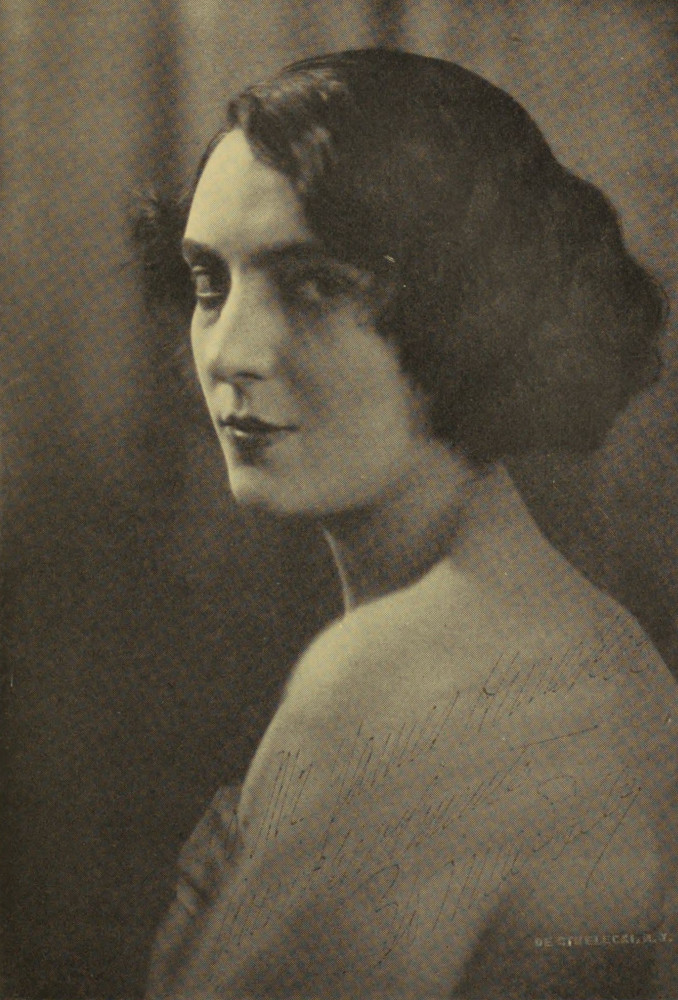
From a photograph by De Strelecki
ROSINA GALLI
A character in one of Goethe’s novels—Wilhelm Meister?—exclaims: “Five minutes more of this and I confess everything!” Another such season of overwrought reportage and my bag of highly colored phrases, all my trick adjectives, would be exhausted, else gone stale, and the same gang of girls ever expecting new and more miraculous homage in four languages with a brass band around the corner. Oh! la! la!
There was one critic that did fall in love with an actress. His name is Hector Berlioz, and he celebrated the charms of Henrietta Smithson, English born, a “guest” at a Parisian theatre, by passionately pounding the kettle-drums in the orchestra. His amatory tattoo, coupled with his flaming locks, finally attracted the lady’s attention, and after she broke her leg and was forced to abandon the stage she had her revenge—she married the kettle-drum critic and composer, and lived unhappily ever afterward. Yet the feeling against critics persists, probably prompted by envy. In a Dublin theatre gallery a fight broke out, and one chap was getting the worst of it. His more powerful adversary was pushing him over the rail into the orchestra, when a wag called out: “Don’t waste him. Kill a fiddler with him!” Nowadays he would say, “Kill a critic.” But sufferance is the badge of our tribe. There are times when I long for the unaffected charm of Heller rather than Chopin; when I prefer to gaze at Wagner’s Grane rather than hear Brunhilde sing.
Mary Garden makes herself beautiful, if only by thinking “beautiful.” “Whatever happens, I must be an emerald,” said Antoninus of the emerald’s morality. Havelock Ellis asserts, “the exquisite things of life are to-day as rare and as precious as ever they were.” She is rare and precious in Mélisande, Monna Vanna, Jean, and other rôles. And what imaginative intensity is hers! But I don’t care a fig for the depraved creatures of the Lower Empire she so marvellously portrays. It is Mary with the strain of mysticism, the woodland fay she shows us, its nascent soul modulating into the supreme suffering and sorrow of motherhood. Her bed of death in Mélisande is one of the high consolations in the memory of a critic whose existence has been spent in the quagmire of mediocrity. In the kingdom of the mystics there are many mansions, and Garden lives in one—at times.
But the détraqué lemans she pictures are often repugnant. The decadent art of Byzance. The Infernal Feminine. A vase exquisitely carved containing corruption. Sculptured slime. You close your eyes—but open your fingers; the temptation to peep is irresistible.
In his illuminative studies of Fremstad, Farrar, Garden, Mazarin, Interpreters and Interpretations, Carl Van Vechten says that to Miss Garden a wig is the all-important thing. “Once I have donned the wig of a character, I am that character. It would be difficult for me to go on the stage in my own hair.” However, she did so in Louise, adds the critic. Felix Orman reports that when he asked her if she would be content to give up singing and become a dramatic artist, she replied: “No. I need the music. I depend on it. Music is my medium of expression.” An art amphibian, hybrid, hers. The flying fish. The bird that swims. The dubious trail of the epicene is not a modern note. Rome and Alexandria knew it. It is vile, soulless, yet fascinating. Miss Garden incarnates it as no other modern since the divine Sarah. She is “cérébrale,” and a cerebral is defined by Arthur Symons as one who feels with the head and thinks with the heart. Richard Strauss is a prime exemplar. The image suggests both apoplexy and angina pectoris, yet it serves. She is as hard as steel in Louise or Cléopâtre, yet how melting as Monna and Mélisande. She may be heartless for all I know, and that is in her favor, artistically considered, for Steeplejack hath enjoined: A cool head and a wicked heart will conquer the world; also, what shall it profit a woman if she saves her soul but loseth love? Cynical Steeplejack? Yet, a half-truth—though not the upper half of that shy goddess, Truth.
As for Margaret Matzenauer, her art and personality transport the imagination to more exotic climes. That sombre and magnificent woman, who seems to have stepped from a fresco of Hans Makart, himself a follower of Paolo Veronese, is a singing Caterina Cornaro. She brought back an element of lyric grandeur to our pale operatic life; a Judith, a Deborah, Boadicea, Belkis, Clytemnestra, Dalila, Amneris, or Aholibah, all those splendid tragic shapes of the antique world, she evokes, and in her singing there is a largeness of dramatic utterance that proclaims her of the line royal: Lehmann, Brandt, Ternina, Fremstad, Schumann-Heink. Is it at all remarkable that I admire Matzenauer?
And now that we have cleared away some cobwebs of misapprehension with the aid of the Baby and the Guitar, let me relate a story of Châteaubriand, that Eternal Philanderer, as I once named him, who met at Rome gay Hortense Allart, afterward Madame Meritens. The supreme master of French prose regretfully exclaimed to her: “Ah, if I had back my fifty years.” Thereupon the sprightly lady replied: “Why not wish for twenty-five?” “No,” moodily returned the Ambassador, “fifty will do.” Which recalls the witty design of Forain, representing a very old man apostrophizing the shadow of his past: “Oh, if I only had again my sixty-five years!” I should be glad to have my threescore and ten if only to tell those great ladies of opera how much I admire them. “Barkis is willin’.”
Another picture and I shall have done. Listen. I, many years ago, visited the Fondation Ste. Perine at Auteuil, an institution endowed by the Empress Eugénie, one in which the benevolence is so cloaked as not to hurt the sensibilities of the resident superannuated ladies and gentlemen. The company boasted noble origins. Among the ladies I met was a Polish-born Marquise, with brilliant eyes and wonderful white hair, her own. She had studied with Chopin. She said he was fickle and that George Sand was often jealous of his pupils. For me she sang in a sweet, true, but quavering voice Chopin’s Maiden’s Wish, and compelled tears. The Marquise then tinkled with a still small tone a Nocturne by Field upon a pianoforte whose ivory keys looked as if they exhaled pearly sighs. She gently coquetted with a touch of exquisite Sarmatian evasiveness. For me she was adorable, although if she had laughed her face would have cracked its artistic plastering. What a new Diana of Poitiers! What wit, fire, malice, were in the glance of her soft, faded blue eyes! What a magically youthful heart! She must have been more than fourscore.
But yet a woman.
IV INTERPRETER
TO MARY GARDEN AS CLEOPATRA
“C’est Affreux Mourir”
“And now this scorchèd terrace is your sole domain, Your only subject Roman, dying Anthony; The outer vastnesses they held, the soldiery Of Cæsar; their stout captain will not here refrain. You lived, O Queen, but not to countenance that pain Which is surrender of the body’s sovereignty; You take your part; is it the frightful thing to die And see in dying just the realm you must regain? You have not let the game play you, my Queen, but fed The aspic at a famished breast—the rascal fresh From gluttony a glutton still!—Why, the hot land Is dim, alone lies Anthony save for the dead— One more ambition, Queen, for your expiring hand. The last adventure, woman of imperious flesh!”
—Pitts Sanborn.
CLEOPATRA
Though the first hearing of the work in New York was during the winter of 1919 at the Lexington Theatre, and sung by the Chicago Opera Association, Cleofonte Campanini, director, it had been presented before Chicago audiences when the impersonation of the supersubtle serpent of Old Nile by Mary Garden caused much comment, critical and otherwise. The libretto states that the conception of M. Payen radically differs from Shakespeare’s tragedy—a rather superfluous remark. It does considerably differ, the principal difference being that Shakespeare wrote great poetry as well as great drama.
Payen’s attempt resolves itself into a series of tableaux, the characterization generalized, his verse respectably tepid. In a word, not the Queen that Shakespeare drew. Of this Cléopâtre you dare not say: “Age cannot wither her, nor custom stale her infinite variety.” She is more germane to that Queen shown us in the sumptuous prose of Theophile Gautier’s Une Nuit de Cléopâtre than the imperial courtesan who turned the head of Anthony and stirred the pulse of Julius Cæsar to the supreme tune of Shakespeare’s music.
There is plenty of action, some picturesque episodes, and at least one brutal scene. Of love and the talk of love there is no end. Yet it is not all convincing. Moving pictures. You think of Gérôme, of Le Nouy, of the hundred and one painters who have celebrated on canvas this seductive creature of old Egypt. “For her own person, it beggar’d all description; she did lie in her pavilion, cloth-of-gold of tissue, o’er-picturing that Venus where we see the fancy out-work nature.”
Cléopâtre is Massenet and the modiste. Brackish-sweet, it is the ultimate expression of musical impotence. Clever craftsman Massenet could turn out martial music and amorous, the clangor of trumpets and voluptuous, dizzy dance measures. But here it is generally bosh. Languid, enervating, it attained a feeble climax in the ballet of the penultimate act. Ambiguous shapes and attitudes crowded the scene. Two dancers slipped and fell, but the recovery was so swift that the tumbled ensemble seemed a veritable climax. Cléopâtre cynically regarded this daring symbolism, though Marc-Antoine seemed rather shocked. And he should have been. Musically speaking, nothing happened in Act I; less followed in Act II, while Act III was a glittering triumph of vacuity. In the last act the asp played protagonist. As its name did not figure on the programme, it probably died from envy, or else inanition, doubtless humming Will Shakespeare’s mournful lay: “I am dying, Egypt, dying.” You also recall Swinburne’s: “Under those low, large lids of hers She hath the histories of all times....”
But the Cléopâtre! A youthful Sphinx, her entrance on the great burnished barge was an evocation. As she faced Antoine so must have looked Sheba’s Queen before the majesty of Solomon. It would have been trying on the nerves of the most pudic potentate from Herod down. A saucy lad, in a later scene, Cléopâtre got in a mix-up at an early-Egyptian boozing-ken. An extraordinary apparition, a fantastic faun of Aubrey Beardsley caught the roving riggish eye of the disguised Queen. She encouraged the advances of the anonymous animal. An Adonis à rebours. Pavley was this delicate monster and his subtle rhythms made Cléopâtre shiver. Here the music was too prudish.
Stravinsky or Richard Strauss would have given the screw an enharmonic wrench. Act III saw the Queen attired at once so sonorously and exquisitely that the vast audience gasped with admiration. It is, however, the tavern scene that will save the tawdry work. The anatomical wigwagging of the two golden lads set the lobby buzzing. Cléopâtre is doomed to packed houses in the future. Nothing succeeds like true spirituality.
Mary Garden is Cléopâtre, as she is Mélisande and Thaïs. It is not a rôle that taxes her dramatic resources or her personal pulchritude. All she did was to look beautiful and turn on the full voltage of her blandishments. Men went to the ground before that dynamic yet veiled glance, like soldiers facing a machine-gun. It is uncanny, the emotion she projects across the footlights and with such simple but cerebral means.
That she would have been burned at the stake a few centuries ago, this lovely witch, is no conjecture. Her nose is not “tip-tilted like the petal of a flower,” as Cléopâtre’s is said to have been; nevertheless, she is the tawny Egyptian. And she has never spoken so eloquently as in this parlando part. Perhaps the most poignant criticism was carelessly uttered by a big policeman who had strayed in during the garden scene. “Some Queen!” he said. And the definitive words had been spoken. Fie on naughty professional opinion after that memorial phrase!
MÉLISANDE
Once upon a time we called this “precious” lyric work Wagner and Absinthe, for there are many rumors of Tristan and Isolde in it, and the opalescent music, drugged with dreams, has the numbing effect of that “green fairy” no longer permitted in la belle France. Like all epigrams, this is only a half-truth. In the Belgian poet’s The Death of Tintagiles—so wonderfully interpreted in tone by Charles Martin Loeffler—his marionettes are beginning to modulate into flesh and blood, and, like the mermaid of the fairy story, the transformation is a painful one. We note the achievement of a new manner in Pelléas and Mélisande. Played in English first by Forbes-Robertson and Mrs. Patrick Campbell, the piece created a mixed impression in London, though it may be confessed that, despite the scenic splendor, the acting transposed to a lower realistic key this lovely drama of souls. No play of Maeterlinck’s is so saturated with poesy, replete with romance. There are episodes almost as intense as the second act of Tristan. We listen for King Mark’s distant, tremulous hunting-horns in the forest scene when Pelléas and Mélisande uncover their hearts.
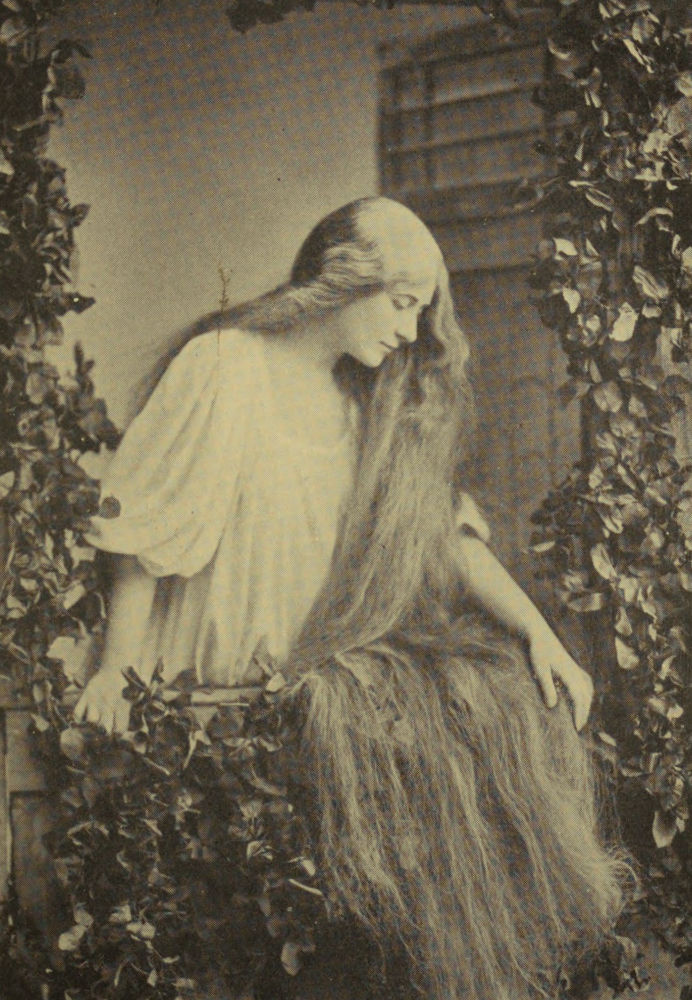
From a photograph copyrighted by Davis and Eickemeyer
MARY GARDEN AS MELISANDE
The second act begins at an immemorial fountain in the royal park. Here the young Prince sits with the wife of his brother. Mélisande is the most convincing full-length portrait of the poet. Exquisitely girlish, she charms with her strange Undine airs. Mélisande is enveloped in the haze of the romantically remote. At times she seems to melt into the green tapestry of the forest. She is a woodland creature. More melancholy than Miranda, she is not without traces of her high-bred temperament; less real than Juliet, she is also passion-smitten. You recall Melusina and Rautendelein. Not altogether comprehensible, Mélisande piques us by her waywardness, her fascinating if infantile change of moods. At the spring the two converse of the water and its healing powers. “You would say that my hands were sick to-day,” she murmurs as she dips her fingers into the pool. The dialogue is as elliptical as if written by Browning or Henry James. But the symbol floats like a flag.
The mad apostrophe to the hair of Mélisande is in key with this moving tableau. Perhaps Maeterlinck took a hint from the mournful tale of his friend, the Belgian poet Georges Rodenbach (Bruges-la-Morte), with its reincarnation of a dead woman in the form and features of a live one. The beautiful hair of the new love serves but to strangle her. Pelléas is more tender.
“I have never, never seen such hair as thine, Mélisande. I see the sky no longer through thy locks.... They are alive like birds in my hands.” The last scene, as Mélisande dies of a broken heart, even when read on the printed page, is pity-breeding. It is the tragedy of souls distraught. “She must not be disturbed,” urges the venerable Arkel. “The human soul is very silent.... The human soul likes to depart alone.... It suffers so timorously.... But the sadness, Golaud, the sadness of all we see.... ’Twas a little being so quiet, so fearful, and so silent. ’Twas a poor little mysterious being like everybody.” Pascal comes to the mind here. No matter the splendor of human lives, we must die alone.
The speech of the poet in its rhapsodic rush merges into Debussy’s music. That we shall ever see another such ensemble as at the Manhattan Opera House years ago is doubtful. Mary Garden is Mélisande. No further praise is needful. All her trumpery rôles, Thaïs, Gismonda, Cléopâtre, with their insincere music and pasteboard pathos, are quickly dismissed. Her Mélisande is unforgettable.
MONNA VANNA
This opera was first heard here on February 17, 1914, at the Metropolitan Opera House, with Mary Garden, Vanni Marcoux, and Huberdeau. It had been produced by the Boston Opera Company in December, 1913, and by the present organization January 23, 1918. Miss Garden was the heroine on that occasion, and was greeted with overwhelming applause. The première of the play Monna Vanna occurred at the Nouveau Théâtre, Paris, May 17, 1902. We had the good fortune to see it a week later. Georgette Leblanc was the original Monna. Jean Froment, Darmont, and Lugné Poé were the other principals. The drama enjoyed an immediate success all over Europe from Bergen to Palermo. London alone stood firm against its blandishments. The censor forbade a production. New York first saw it in English with Bertha Kalich at the old Standard Theatre, Harrison Gray Fiske, manager.
As a play it was a new departure for Maeterlinck. It is almost theatric. In the heyday of his glory Sardou never devised anything more arresting than the dénouement—setting aside consideration of the psychologic imbroglio. There are spots in the dramatic scheme which tax the credulity. However, something of the improbable must always be granted a playwright, be he never so logical. The rapid mental change of Vanna hints at a native-born casuist, an Italian Renaissance type of mind. Her love of Colonna could not have been deep-rooted. But she did not betray him in the tent, and yet she has been adjudged profoundly immoral; in a word, not to put an edge too fine upon the sophistries of the situation, this heroine committed an imaginative infidelity as well as uttering a splendid falsehood. The madness of the finale is the logical outcome of her passion for Prinzevalle. All that has gone before in her life had been a bad dream. The true, the beautiful moment is at hand. It will be both her revenge and justification.
She goes to Prinzevalle in his cell. “This must end here; it is too perfect.... It is one blaze about me and within me.... Oh, some death will run its sudden finger round this spark and sever us from the rest!” Thus Browning sings In a Balcony.
The play’s the thing! though it did not seem to catch the conscience of the composer. Nevertheless, Monna Vanna is more grateful to our ears than Gismonda. There are too many “things” that are set to music in the Sardou libretto, while Maeterlinck deals only with the primal passions—love, jealousy, hatred, conflict of wills. There is more unity in action and mood in the older score. The music is Wagnerian from first to final curtain, but it is cleverly assimilated and swifter, more poignant. The introduction to the third act recalls the third act of Valkyrs; so we were not surprised to find Brunhilde pleading, or to hear the chorus shrilly cry out the Valkyr theme. In the tent scene, Tristan and Isolde reign, as might be expected. The first act has been cut and to its advantage.
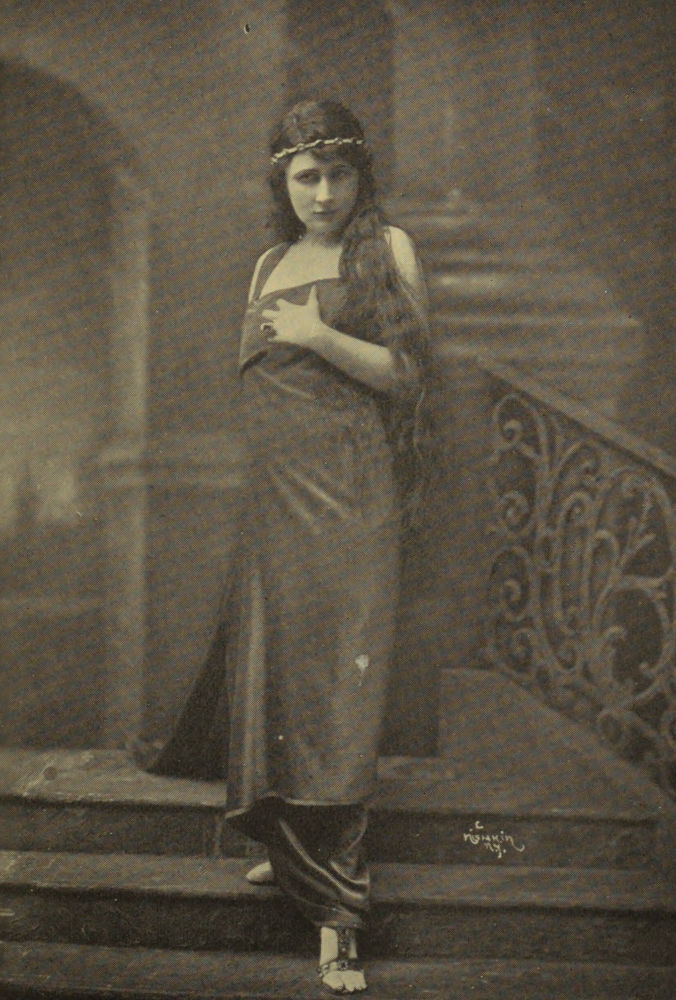
From a photograph copyrighted by Mishkin
MARY GARDEN AS MONNA VANNA
At our first view of Mary Garden as the mediæval Judith who fetches to Pisa her beloved Holofernes, we frankly confess that the impressions of her interpretation were strong. Monna Vanna will rank in her portrait-gallery among the finest. It far outshines Gismonda, as Monna herself outshines the incredible, erotic Duchess of Athens. There was no attempt to make a disrobing scandal in the tent scene, which would be obviously theatrical flimflam. Miss Garden disposed of the situation simply. She did not appear half-nude, but clothed in exquisitely-toned draperies. But if she did not show her lovely person, she spilled for us the soul of the heroine who saved her country and lost her reputation. In the opening act she did little, but suggested the psychology of a woman who had begun to loathe a supine husband. Note the nuance with which she uttered “J’rai, mon père,” and the repetition when she says it to Colonna. It was like molten steel at first; it was cold, rigid steel, the steel of unalterable resolution the second time. Yet how tender is her “Si” when she turns to her fuming spouse.
There was tenderness in the tent scene, yes, true tenderness, not expressed by the sentimental symbols of the English theatre, but in the restrained terms of the French tradition; therefore, more eloquent, more artistic, despair and pride modulating into amazed joyfulness at meeting her early friend, stern Prinzevalle. But the last scene gave us the most moving side of this wonderful woman’s art. The shock of incredulity caused by her husband’s suspicions, merging into the supreme ecstasy as she grasps the key that is to unlock the future—in sooth, no such acting has been witnessed for a long time. The scale was essentially smaller than Bernhardt’s, but as subtle as the art of Sarah were the indications of love triumphant with death staring her in the face. The tiny play of shadows round her eyes and mouth as she sees her lover trapped were touching. That she was a picture in every act is a matter of course. Her slow steps to the open door most impressive. It was a veritable march to the scaffold. Fevrier’s music in this last episode rings true.
GISMONDA
Of Mary Garden it is always the correct thing to say that she is charming. True. Charming, and also many other qualities she boasts. She is exquisite, and she is sometimes a great dramatic artist. But her voice is a sonorous mirage. The lower register is still rich, sombre in coloring, thrilling when she wills. The gift of temperamental ecstasy is hers, though the character she paints so subtly is hardly worth the powder and shot to blow it sky-high. A sensual prowling panther, notwithstanding the al fresco exhibition of mother-love in Act I.
The panther glides from its midnight jungle to meet its mate, and then Miss Garden’s magic begins to operate. Her soliloquy is the finest bit of psychology expressed in voice, mimique, and with the entire arsenal of her personal beauty that we have seen on any stage, dramatic or lyric, for years. She needs an intimate atmosphere. Her diction, her phrasing, her general grasp of the rôle are most impressive. She has distinction in every pose, distinction in the carriage of her head and arch of the neck.
Her cadenced step in the first scene is replaced by rhythmic movements in the second act that reveal her glowing inner life. She is all flame and gold—except when she sings above the staff. Even then she infuses it with a characteristic timbre. A singing-actress. People like Mary Garden because she has that rarest of artistic virtues—personality.
THAÏS
During the first week of last season’s Chicago opera the temperament of Mary Garden was carefully chained in its cage; nevertheless, we overheard its growls in Gismonda, but the mock-Fafner at the bottom of the cistern outroared Miss Garden’s tame panther. In Monna Vanna there were whimperings and menacing claws. The feline had no chance to spring, not even in the tent scene. At a matinée in the Lexington Theatre Thaïs was sung by the Chicago Opera Association, and now or never! we said, the temperament so artistically expressed, rather canalized and exquisitely distributed, in the two other operas, will leap. It did. In the palace of Thaïs the panther appeared for a few moments—and it assumed the form of hysteria. The famous courtesan of Alexandria experienced a true “conversion,” the physical manifestations of which were well-nigh pathological. “You have created a new shudder,” wrote Victor Hugo to Charles Baudelaire after the production of his Flowers of Evil. The “nouveau frisson” of Miss Garden is thrilling, and must have appalled the well-meaning, stupid Athanael.
This singing-actress does not widely depart from her usual interpretation, except that slight perpetual novelty which we expect from her. Her last scene is beautiful in conception and execution; the “spiritual” flirtation on the mossy bank as piously piquant as ever. The kiss suggested and evaded set us to wondering again at the morose monk. In the early acts Thaïs is too restless. The firm yet plastic lines of the character are thereby disturbed. She looked lovelier than ever, and she did not sing in the best of voice. A trying week was behind her; besides, the domesticated panther must have tugged hard and frequently at its leash.
CARMEN
I attended Miss Garden’s reading of the score for my first time, and freely admit my mixed feelings. We were assured by perfectly honorable lobbyists that the last season the Garden version was much better, more temperamental; and one who had overheard her in Paris swore that she was a seething caldron in Act II. Her interpretation seems to us to be “overpainted,” to employ studio argot. Like the canvas in Balzac’s Unknown Masterpiece, there is little left of the original design, except perhaps a miraculously painted foot.
There were bits here and there that are admirable; the slow awakening of her interest in the toreador as he thunders forth that supreme song of table d’hôtes. We see some delicate and definitive notations, yet it is lost in the cloudy chaos of the scene. All the strong theatrical points are deliberately renounced; the first tumultuous entrance, the Habanera, Seguidilla, and the duo in Act II. The renunciation suggests technical heroism, but it doesn’t help us much in the development of the character.
Her Carmen is essentially frigid. And it is neither sinister nor sensuous. To be sure, it is different, but then so is Hedda Gabler “different.” We went to see, to hear, Carmen, and Hedda—in a lyric mood—was more often adumbrated than the Mérimée-Bizet gypsy. The disturbing element of the performance was the undeniable fact that, granted her idea of the rôle, she didn’t even “get it across.” She missed fire in Act II, in the card episode particularly. Nor did she look bewitching. We quite understand her avoidance of the conventional posing, hipping, strutting, and inane postures; yet there should have been compensations. (In the days of Calvé the criticism was “Elle se hanche trop.”)
These were slim, not her singing, nor yet the beautiful shawl that might have been designed by Sorolla y Bastida. The famous fan we missed. If Mary Garden had but lavished a tithe of her blandishments on her Don José that she so recklessly, so alluringly bestowed upon Marc-Antoine Maguenat in Cléopâtre, we might have been won over a little to her general conception. This Carmen was a distinguished dame. Lilli Lehmann alone outshone her in aristocratic Sevillian courtesy. But Lilli could sing. And Lilli had not the Aberdeen-cum Philadelphia-cum Chicago-cum Boston complex of Mary.
We have since learned that the singer was grievously indisposed. And she surely missed the Don José of Dalmores and Muratore.
And on this rather chilly note of dissent I prefer to end. Of Miss Garden’s twenty or thirty other rôles it is hardly necessary to speak. Her Louise and Salome, so dissimilar, yet both incomparable, need no belated praise. She is unique. Thus endeth the Book of Mary the Garden.
V MÉLISANDE AND DEBUSSY
George Moore has remarked that we never speak of Shakespeare or Hugo or Flaubert as the authors of any particular work. Simply to utter their names suffices. I give the illustrations haphazard. Any great artist will do. From Claude Debussy we never ask of what he is the composer. Pelléas and Mélisande is his monument; rather, Mélisande and Pelléas; as, in the case of Isolde and Tristan, it is the woman who is protagonist. Is it because in creating characters of our mother’s sex that the Eternal Masculine is projected across the feminine soul? Or, is woman the genuine, the aboriginal force, that we unwittingly obey, all the while calling her “little woman”? (condescendingly, of course). Oh, what a joke of almost cosmical proportions it would be if the latter supposition be the truer one! But mere male mortals may always console themselves with the ineluctable fact that it is man who has endowed woman with a vital figure in the arts. He has created Ophelia and Gretchen, Beatrice and Francesca, the Milo Venus, the Winged Victory and Isolde, Lady Macbeth and Emma Bovary, Carmen and Mélisande. Honors, then, are even. Even if models existed in nature, the art of man it was that shaped them and breathed life into their clay. But Mélisande is the protagonist in the drama.
The music to Maurice Maeterlinck’s strangely haunting play is so wedded to the moods and situations that as absolute music it is unthinkable. And these moods are usually “con sordino.” Despite his musicianship, Debussy is obviously a “literary” composer; his brain had first to be excited by a dramatic situation, a beautiful bouquet of verse, an episode in fiction, or the contemplation of a picture.
Why demand if the initial impulse be the Monna Lisa or a quatrain by Verlaine? A composer who can interpret in tone the recondite moods of Baudelaire, Verlaine, Mallarmé, or the dramatic prose-poem of Maeterlinck, need not have been daunted by criticism; in sooth, it is the angle of critical incidence that must be shifted to adapt itself to the new optique. Pelléas and Mélisande is a study in musical decomposition; the phrase is decomposed, rhythms are dislocated, the harmonic structure melts and resolves itself into air. His themes are developed in opposition to the old laws of musical syntax. But what have laws in common with genius? Once assimilated, they may be broken as were broken the stone tablets by the mighty iconoclast, Moses. Besides, every law has its holiday. In the Debussyan idiom there seems to be no normal sequence. I say seems, for much water has gone under the bridge since his appearance, and compared with Schoenberg, Stravinsky, Ornstein, and Prokofieff he is a conservative; in another decade he may be called a reactionary. Life is brief and art is swift.
Our ears were not accustomed to his novel progressions and the forced marriage of harmonies. His tonalities are vague, but his values just. The introduction to the forest scene when Golaud discovers Mélisande is of an acid sweetness. Without anxious preoccupation Debussy has caught the exact Maeterlinckian note. As it is impossible to divorce music and text—Debussy seems to be Maeterlinck’s musical other self—so it is needless to dwell upon the characteristic qualities of the score. It is like some antique and lovely tapestry that hypnotizes the gaze. It has the dream-drugged atmosphere of Edgar Allan Poe; the Poe of the dark tarn of Auber, of Ligeia, of Ellenora, of Berenice, and Helen, those frail apparitions from claustral solitudes and the Valley of the Many-Colored Grass, all as exotic as they are incorporeal. It is the complete envelopment of the poem by an atmospheric musical haze shot through with gleams of light never shown before on land or sea.
We pardon the monotone of mood and music, the occasional muffled cacophonies, the lack of exterior action, and the absence of climaxes; after so long waiting for a passionate outburst, when it does come it is overpowering in its intensity. In music the tact of omission has never been pushed so far. From the pianoforte partition little may be gleaned of its poetic fervor, its reticences, its delicate landscapes, psychologic subtleties. The pattern seldom obtrudes, as the web is spun “exceeding fine.” The orchestration reveals the silver-greys of Claude Monet and the fire-tipped iridescence of Monticelli. His musical palette proclaims Debussy a symbolist, one in the key of Verlaine, who loved nuance for its own sake and detested flauntingly brilliant hues. “Pas la couleur, rien que la nuance ... et tout le reste est littérature,” sang Paul of the asymmetrical jaws and supernal thirst.
Debussy is the most interesting of contemporary music-makers and the most subtle composer for the pianoforte since Chopin. His originality is not profoundly rooted in the history of his art, but his individuality is indisputable. He is a musician doubled by a poet. He is almost as Gallic as Chopin is Polish. Debussy shows race. His artistic pedigree stems from a grafting of old French composers upon ultramodern methods. Wagner, Chopin, certain aspects of Liszt, and Moussorgsky. The visit he made to Russia in 1879 had important consequences. He read the manuscript score of Boris at Rome, he absorbed Moussorgsky and the whole-tone scale, and this influence contributed to the richness and complexity of his style. Above all, he is a stylist. He has Wagner at his finger-tips, and, like Charpentier, he can’t keep Tristan out of his music; it is his King Charles’s head. Naturally such highly peptonized aural diet is not nourishing. Like the poetry and prose-poems of Stéphane Mallarmé, too much Debussy becomes trying to the nerves. Schumann has spoken of the singularly irritating effect of muted dissonances. Pelléas is nearly all muted. The mental and emotional concentration involved in the hearing of this music fatigues as does no other music; not even Tristan.
The range of ideas, like the dynamic range, is limited. Yet there is magic in his music, the magic of evocation. Not to describe, but to evoke, in effortless imagery, is the quintessence of his art. He is a painter of cameos and aquarelles. Never does he carve from the big block; an exquisite miniaturist, he does not handle a bold brush, nor boast the epical sweep of his predecessors; Berlioz for one. But he is more intimate, he is the poet of crepuscular moods. The sadness of tender, bruised souls is in his pages. Of virility there is little trace, it is music of the distaff, and seldom sounds the masculine ring of crossed swords. Chopin, too, had his nocturnal moments, but he also wrote the A flat Polonaise, with its heroic defiance of a Poland crushed yet never conquered; with its motto: “Jescze Polska nie zginiela!”
Long before his death this French master was critically ranged. Lawrence Gilman, the most sympathetic of his commentators, is also the fairest. To his essays I go for delectation. It would be rash to say that Debussy had achieved his artistic apogee; he may have had surprises in store, but it is safe to conclude that Pelléas and Mélisande is his masterpiece, that the dewy freshness of L’Après Midi d’un Faune would never have been recaptured. The symphonic suite, Printemps, the Nocturnes, La Mer, and Images, at once reveal the strength and limitations of Debussy, who was not a builder of the “lofty rhyme,” though he is a creator of complex rhythms; not a cerebral composer—like Vincent d’Indy, for example—but an emotional one; not a master of linear design, but a colorist; a poet, not an architect. His vision is authentic. He knew that the core of reality is poetry; he lived not at the circumference but the hub of things. He loathed the academic. He is the antipodes of Saint-Saëns. He gave us a novel nuance in music, as did Maeterlinck in literature. (Think of Interior with its motive—again Poe—the fear of fear!) Debussy is a composer of nuance, of half-hinted murmurings of “the silent thunder afloat in the leaves,” of the rutilant faun with his metaphysical xenomania, of music overheard, and of mirrored dreams. Little wonder he sought to interpret in his weaving tones Baudelaire and Verlaine, Mallarmé and Maeterlinck. He was affiliated to that choir of sensitive and unhappy souls, of which Maurice Maeterlinck is the solitary survivor. A poet himself, Claude Achille Debussy, even if he had never written a bar of music.
One summer evening in 1903 I was introduced to him at a café on the Boulevard des Italiens. Debussy spoke a few polite words when I told him that I belonged to the critical chain-gang. He had written much musical criticism, chiefly memorable for its unsympathetic attitude toward Schubert and Wagner, not because of reasons chauvinistic, but doubtless the result of a natural reaction against the principal educative forces in his life. At least once in his career an artist curses his artistic progenitors. Wagner must have hated Weber because of his borrowings from him, and I am quite sure Chopin despised Hummel; internal evidence may be collated in the Pole’s wide departure from the academic patterns of Hummel’s passage-work. However, Debussy never went so far as his friend Jean Marnold, who in the Mercure de France concludes a comparative study of Pelléas and Tristan in these words: “Le pathos de Tristan vient trop tard; si tard, qu’il semble aujourd’hui, à sa place adéquate en notre Opéra toulousain.” Yet if Tristan came so late, how is it that there is so much of its music in Pelléas? a fact that Philip Hale doubts. There’s the score. Who steals my idea steals trash; ’tis something, nothing; ’twas mine, ’tis his, and has been slave to thousands; but he that filches from me my style robs me of that which not enriches him and makes me poor indeed! (This is reorchestrated to suit the simile.) Tristan always seems to be waiting in the wings when Pelléas is played, awaiting his cue to enter. It never fails to be given by Debussy.
Later I asked Maurice Maeterlinck his opinion of Debussy’s music to Pelléas and Mélisande. It was an imprudent question, for Lucienne Bréval had captured the rôle of Mélisande, not Georgette Leblanc. Maeterlinck is a polite man, and his answer was guarded; nevertheless, his dislike of the music pierced his phrases. To him it was evident that his play needed no tonal embellishment, that it was more poetic, more dramatic, without the Debussy frame. He is quite right. And yet the spiritual collaboration of poet and musician is irresistible. And in the garden of the gods there is only one Mélisande. Some little dramas, like little books, have their destiny. The composer of Pelléas and Mélisande suffered from the nostalgia of the ideal, suffered from homesickness for his patrie psychique, the land of fantasy and evanescent visions. The world will not willingly forget him.
VI THE ARTISTIC TEMPERAMENT
It was twenty minutes to Eternity on a sunny morning in Gotham. The breakfast room was large, airy, and the view of upper Manhattan from the various windows gave one a joyous sense of our quotidian life, its variety and spaciousness. Central Park, a square of dazzling emerald, the erect golden synagogue on the avenue, the silver hubs of the wheels on passing carriages across the East Drive, were pictures for eyes properly attuned. The four eyes, however, in this particular apartment, were busily engaged in devouring, not the dainty breakfast spread before them—eyes eat, too—but the morning newspapers. On the walls were framed photographs. She as Juliet. He as Tristan. She as Isolde. He as Faust. She, Carmen. He, Siegfried. A versatile pair. Theirs had been a marriage prompted by love. A magnificent, a devastating passion had amalgamated their destinies—Paul Bourget would have said “sublimes.” They still loved despite the poignant promiscuity of matrimony, although married nearly a year. They also loved others. And in the morning hours they hated one another with the holy hatred engendered by perfect sympathy. And they were so consumedly happy that they couldn’t stay indoors for a day. It is easy to love fervidly; it is hard to hate intelligently. On one point, however, this wonderful soprano and glorious tenor were united—they despised musical criticism, even when it was unfavorable. Banishing Mildred, the pretty English maid—she was too pretty about six in the evening, so He noticed—to the bedroom, they read the newspapers undisturbed. They read aloud, and occasionally as a duet. She freely embroidered her commentaries. He embellished his with indignant outbursts.
“Dearest, hear this. What a beautiful notice from Spoggs. I appreciate it all the more because he was once épris of that Garden woman. I honestly believe the man is truly in love with me.” “Pooh! Sweetheart, a music-critic has only ink and ice-water in his veins. Spoggs is in love with his hifalutin’ phrases. All the rest is cannonading canaries. If he saw you in the right key he would never speak of your second-act Isolde. That’s just where you fall down, darling. Whereas my third-act Tristan—” “Dear old boy. How you do run on. Always jealous when his poor little wifie is praised.” “I jealous? Of—you!” Longa pausa! Suddenly she exclaims: “Oh, you poor man! Did you read what he said of your make-up last night? I hate that man now. He is so unjust—to you; though he does admire me. Why, what’s the matter, baby? Where are you going? Your coffee is cold—” He storms out of the room, stumbling over Mildred on her knees near the door, either praying or polishing the keyhole with her lustrous eyelashes. Familiarity may breed contempt, but contiguity breeds, tout simple.
It really happened. In this instance I have transposed the key to opera. The true story deals with a well-known actress and her first husband, also her leading man. Two prima donnas under one roof. She read him to his death with unfavorable criticisms. I know of a more curious case. He was an idealist of an idealism so lofty that he often stumbled over the stars, enmeshed himself in constellations and took the sun for footstool. Her eyes, young as yesterday, were like an Irish sea-green mountain lake; at dusk, a sombre pool, profound at dawn as a sun-misted emerald. He painted. She sang. He painted her portrait. Then he painted other women’s portraits. Each portrait he painted was the portrait of his wife. She was beautiful. At first society was amused, flattered, and finally resented the unsought compliment. Time drove the enamored couple asunder. They were too happy. She married again, happily. He remarried. I saw the last portrait he had painted of his second wife, a lovely creature. As in a pictorial palimpsest the features of his first wife showed in the new text; the expression of her eyes peeped through the other woman’s eyes. A veritable obsession this, comparable to the exquisite and melancholy tale of Georges Rodenbach and the dear dead woman of Bruges-la-Morte.
What is the artistic temperament—so-called? Years ago I wrote to great lengths of “The Artist and His Wife,” quoting ancient saws and modern instances to fatten my argument that artistic people are, in private life, very much like others; if anything, more human. I proved, by a string of names beginning with the Robert Brownings and the Robert Schumanns, that artists may marry or mix without fear of sudden death, cross words, bad cookery, rocky behavior, or diminution of their artistic powers. “There are no women of genius,” said that crosspatch celibate, Edmond de Goncourt; “the only women of genius are men.” A half-truth and a whole lie. Artistic men are as “catty” as the “cattiest” women. But why dwell only upon the incompatibility of artists? Doesn’t Mr. Worldly Wiseman sometimes weary of his stout spouse? Why does the iceman in the adjacent alley beat the skinny mother of his children? Or why does a woman who never heard of Nora Helmer, Hedda Gabler, or Anna Karenina leave her husband, her family, not for the love of a cheap histrion, but because she thinks she can achieve fame as a “movie” actress? Is it not the call of the exotic, the far-away and unfamiliar? A woman can’t live alone on stone without the bread of life at intervals. The echoes of wanderlust are heard in the houses of bankers, tailors, policemen, politicians, as well as in the studies of artists, poets, and musicians.
But the artist’s misdemeanors get into print first. The news is published early and often. A beautiful young actress, or a rising young portrait-painter, a gifted composer, talented sculptor, rare poet, brilliant pianist, versatile writer—when one of these strays across the barrier into debatable territory, the watchmen on the moral towers lustily beat their warning gongs. It is prime matter for headlines. To the winds strong lungs bawl the naked facts. Depend upon it—no matter who escapes the public hue and cry, the artist is always found out and his peccadilloes proclaimed from pulpits or yawped over the roofs of the world. Why, you ask, should a devotee of æsthetic beauty ever allow his feet to lead him astray? Here comes in your much-vaunted, too-much-discussed artistic temperament—odious phrase! Hawked about the market-place, instead of reposing in the holy of holies, this temperament has become a byword and a stench in the nostrils. Every coney-catcher, prizefighter, or cocotte takes refuge behind “art.” It is become a name accursed. When the tripesellers of literature wish to rivet public attention upon their wares, they cry aloud: “Lo, the artistic temperament!” If an unfortunate woman is arrested she is usually described in the police-blotter as an “actress.” If a fellow and his wife tire of too much bliss, their “temperaments” are aired in the courts. Worse—“affinities” are dragged in. Decent folk shudder and your genuine artist does not boast of his “artistic temperament.” It has become gutter-slang. It is a synonym for rotten “nerves.”
A true artist abhors the ascription of temperament, keeping within the sanctuary of his soul the ideal that is the mainspring of his creation. The true artist temperament is, in reality, the perception and appreciation of beauty, whether in pigment, form, tone, words, nature, or in the loftier region of moral rectitude. It may exist coevally with a strong religious sense. And it may be gayly pagan. But always for the serious artist the human body is the temple of the Holy Ghost, as Mother Church, profoundest of psychologists, has taught. The dignity of men and women dare be violated only at the peril of their immortal souls. The artistic temperament adds new values to every-day life and character. But its possessor must not parade this personal quality as an excuse for self-indulgence. That he leaves to the third-rate artisan, to the charlatan, to the buffoon who grins through a horse collar, to the vicious who shield their vileness behind a torrid temperament. Now, art and sex are correlated. Sex is the salt of life. Art without sex is flavorless, hardly art at all, a frozen simulacrum. All great artists are virile. And their greatness consists in the victory over their temperaments; not in the triumph of mind over matter—futile phrase—but in a synthesis, the harmonious comminglement of intellect and artistic material. Sensualist your artist may be, but if he is naught else, then his technical virtuosity avails him not. He cannot achieve artistic grandeur. The noblest art is the triumph of imagination over temperament.
Too often a rainbow mirage is this entering into wedlock of two congenial souls.
When He whispers—it is the marrying month of June and the moon swims above in the tender blue—“Why, dear, it is just as easy for two to live as one on fifty dollars a week,” the recording angel smiles, then weeps. Nor has the hardy young adventurer spiders on his ceiling. He dares to be a fool, and that is the first step in the path of wisdom. But She? Oh, She is enraptured. Naturally they will economize; occasional descents into cheap Bohemias; sawdust, pink wine, pinker wit, pinkest women. No new gowns. No balls. No theatres. No operas. No society. It is only to be Art, Art, Art! So they bundle their incompatible temperaments before an official and are made one. At least they are legally hitched. She plays the piano. He paints. A wonderful vista, hazy with dreams, spreads before them. She will teach a few pupils, keep up her practice, and save enough to study some day with a pupil of a pupil of Leschetizky. He will manfully paint, yes, a few portraits, though landscape is his ambition. But it is hard to resist the bribes of our dear common life. They try, they fail.
A year passes. What a difference! Gone are the dreams. There are many spiders on the ceiling now. To pay for the food they eat, to own the roof over their heads, are their ultimate desires. She looks paler. He may or may not drink; it doesn’t much matter. There are no portraits painted; an artist must be doubled by a society man to capture commissions, to enjoy the velvet vulgarities of the new-rich. And artists demand too much of their wives. She must be a social success; also a combination of cook and concubine. Women are versatile. Women are born actresses. It was a woman, not a man, who discovered the art of leading a double life on ten dollars a week. But on thrice that amount they can’t run a household, watch the baby—oh, wretched intruder!—play like Fannie Bloomfield Zeisler, and look like an houri. To be a steam-heated American beauty, your father must be a billionaire.
The artist-woman is a finely attuned fiddle. You may mend a fiddle, but not a bell, says Ibsen. True, but if you smash your fiddle the music is mute. And every day of fault-finding snaps a string, or reduces its tautness. How long does beauty endure? Begin misunderstandings. Pity, the most subtly cruel of the Seven Deadly Virtues, stalks the studio. Secretly She pities him. Secretly He pities her. Pity breeds hatred. Difference develops discontent. At breakfast, the most trying time of the twenty-four hours—oh, the temperamental breakfasts when we were young and delightfully miserable!—even when you haven’t anything to eat—at breakfast, He pities her flushed face as She runs in from the kitchen with eggs and coffee. No longer is She a sylph in his eyes. The fifty dollars a week seem shrunken, not enough for one to live upon, much less two or three. She pities him because He is flushed from his night’s outing. His appetite, like his temper, is capricious. In her eyes He is the ordinary male brute (feed the brute!). Then He becomes imprudent and flings Schopenhauer at her head. That old humbug of a misogynist, who was always elbow-deep in woman scrapes! But She has no time to retort with Ibsen and Shaw for his swift discomfiture. The milkman is dunning her, and as baby must have pure milk She smiles at her foolish young man and teases him for the money. He looks blankly at her as He dives into empty pockets. This sort of thing may last for years. In reckless despair He may throw his lamp at the moon, She her bonnet over the windmill. Female suffrage will make such conditions impossible in the future by forbidding men the ballot. Like a sensible shoemaker let him stick to his last, or, to shift the image, let him grind the handle of the domestic barrel-organ while She collects the coppers.
It is when the lean years are upon the philandering artist, the years of thin thoughts and bleak regrets, that he may miss the loving wives of his past. Then will he cry in the stillness of his heart: O Time! Eternal shearer of souls, spare me thy slow clippings. Shear me in haste, shear me closely! You see, he remains the literary artist, and in the face of death he wears his shop mask. His artistic affinity, encountered late in their earthly pilgrimage, congratulates herself that her latter lonesome years won’t be burdened by the ills and whims and senile vanity of an old man. She may be a spinster and boast the artistic temperament. Or she may escape that fate by marrying a sensible business or professional man, who pays the freight and admires her pasty painting, her facile, empty music-making, her unplayed plays, unread verse and novels—that are privately printed. Thus doth Nature hit the happy mean. He who could hold hands with a pretty girl in eleven languages consoles himself with his corroded memories. After all, has he not been a success, has he not eluded entangling matrimonial alliances? Ah, the artistic temperament!
During a certain London silly season some enterprising imbecile posed this query: Can a woman on the boards remain virtuous? This absurd question set Great Britain buzzing. His Grace the Archbishop answered, and every Tom, Dick, and Harry rushed into type to record their precious opinions. The theatrical profession rose as a single woman. Mrs. Kendal and Mary Anderson were held up as shining patterns, which they are. But there were many sceptics. George Moore’s Mummer Worship was hurled at the camp of the optimists. Rachel, Sarah Bernhardt, and Duse were adduced by the pessimists. Finally it occurred to the one intelligent person in all London to interview George Bernard Shaw.
“Mr. Shaw, do you think a woman can be virtuous in the theatre?”
“Why should she be?” asked St. George, and then and there the moral symposium went up in a burst of uncontrolled laughter. Mr. Shaw is like the little candid girl in the crowd; for him the truth is always naked. So is the artistic temperament.
VII THE PASSING OF OCTAVE MIRBEAU
Octave Mirbeau was a prodigious penman. When Remy de Gourmont called Paul Adam “a magnificent spectacle” he might have said with equal propriety the same of Mirbeau. A spectacle and a stirring one it is to watch the workings of a powerful, tumultuous brain such as Mirbeau’s. He was a tempestuous force. His energy electric. He could have repeated the exclamation of Anacharsis Clootz: “I belong to the party of indignation!” His whole life Mirbeau was in a ferment of indignation over the injustice of life, of literature, of art. His friends say that he was not a revolutionist born; nevertheless, he ever seemed in a pugnacious mood, whether attacking society, the Government, the Institutes, the theatre, the army or religion. There is no doubt that certain temperaments are uneasy if not in opposition to existing institutions, and while his sincerity was indisputable—an imperious sincerity, a sincerity that was perilously nigh an obsession—Mirbeau seemed possessed by the mania of contradiction. After his affiliations with Jules Vallès and the anarchistic group he was nicknamed “Mirabeau,” and, indeed, there was in him much of the fiery and disputatious, though he never in oratory recalled the mighty revolutionist. Nevertheless, he was a prodigious penman.
He was born in Normandy, 1850 (Ernest Gaubert says 1848), the country of those two giants, Gustave Flaubert and Barbey d’Aurevilly. He died early in 1917. His Odyssey, apart from his writings, was not an exciting one. Well born and well educated, he took a violent dislike to his clerical instructors, and as may be noted in Sébastien Roch (1890), he suffered from the result of a shock to his sensibilities because of an outrageous occurrence in the course of his school years. He early went to Paris, like many another ambitious young man, and began as an art-critic, but his first article on Monet, Manet, and Cézanne was also his last in the journal l’Ordre; it created so much scandal by its attack on those mud-gods of art, Meissonier, Cabanel, Lefebvre and Bouguereau, that he was drafted into the dramatic department. There he did not last long. After a violent diatribe against the House of Molière he found himself with several duels on his hands and enjoyed the distinction of a personal reply from Coquelin. He wrote for a little review Les Grimaces, and in 1891 defended Jean Grave’s La Société Mourante and composed a preface for that literary firebrand. He had dipped into the equivocal swamp of politics and had been a sous-préfet (at St. Girons, 1877), but the experience did not lend enchantment to his patriotism. He saw the inner machinery of a democracy greasy with corruption and it served him as material for his political polemics.
His first decade in Paris he wrote for such publications as Chroniques Parisiennes, La France, Gaulois, and Figaro. The entire gamut of criticism was achieved by him. He was fearless. His pen was vitriolic and also a sledge-hammer. Like old Dr. Johnson, if his weapon missed fire he brained his adversary with its butt-end. A formidable antagonist, yet the obverse of his medal shows us a poet of abnormal sensibilities, a leather of all injustice, a Quixote tilting at genuine giants, not missing windmills; also a man of great literary endowment and achievement. His critics speak of a period of discouragement during which he smoked opium, though without ill consequences. His was not a passive temperament to endure inaction. Like others, he had perversely imitated Baudelaire and De Quincey, but soon gave up the attempt. A nature trembling on the verge of lytic pantheism and truculent satire, Mirbeau had a hard row to hoe, and it is gratifying to learn that as he conquered in his art so he conquered himself. He waged war against Octave Mirbeau to the last. And no wonder. He has written stories that would bring a crimson blush to the brow of Satan.
Turning the pages of the principal Paris reviews to which he copiously contributed we find him calling the financial press blackmailers; the law reporters “vermine judiciaire”; French journalism decidedly decadent: “The press kills literature, art, patriotism; it aggrandizes the shop and develops the shopkeeping spirit. It exalts the mediocre painters, sculptors, writers. Its criticism is venal.” As for the theatre—from the frying-pan into the fire! The theatre is the prey of mediocrity, wherein Le Maître de Forges is pronounced a masterpiece!
The comedians (“les tripots revenus; cabotinisme”) of La Comédie Française come in for their share. Emile Zola, naturally enough, has his allegiance, but he dealt hard raps on the skulls of his followers, the Zolaettes, who hung on the fringe of the novelist’s dressing-gown. He admired Barbey d’Aurevilly and Elémir Bourges, as well he might; he attacked Daudet, Paul Bourget, Ohnet, Legouvé, Feuillet, Sarcey—dear old Uncle Sarcey, how Huysmans and Mirbeau did pound him!—and, last and worst, the art-critic of the Figaro, Albert Wolff. But he deserved the flaying.
In La Presse Mirbeau saluted the genius of Rodin, Maupassant, and praised Paul Hervieu. He adored Victor Hugo, not only as supreme poet but as humanitarian—the very quality that to-day so many find monotonous in his lyrics. But there was more than a strain of humanitarianism in Mirbeau. He was truly a Brother to Man, but he never exploited it as do sentimental socialists. It was the spectacle of poverty, of the cruelty of man to man, of the cruelty to animals—he wrote a novel about a dog—that set the blood boiling in his veins and forced him to utter terrible, regrettable phrases. His friends grieved, yet the spectacle was not unlike a volcano in action. That all this was prejudicial to the serenity of his art is not to be doubted. Mirbeau cared little. Let art perish if he accomplished a reform! Yet he has written some almost perfect pages, and in the presence of nature his angry soul was soothed, ennobled. A poet was slain in him before his vision became voice. He loved the figure of Christ and he drifted into the mystic and lovable theories of Kropotkine, Elisée Reclus, and Tolstoy. Their influence is manifested in his Lettres de ma Chaumière (1886). These tales overflow with sympathy and indignation. The French peasant as he is, neither idealized by Millet nor caricatured by Zola, is painted here with an intimate brush—it is painted miasma, one is tempted to add. That he was an unyielding Dreyfusard is a matter of history.
It may be said in passing that Mirbeau had not the stuff in him to make a sound or satisfactory critic of the Fine Arts. He was too one-sided in his Salons, his enthusiasms were often ill-placed, and he resembled Zola in his vocabulary of abuse if any one disagreed with him. M. Durand-Ruel, where he was liked for his sterling qualities, has a pamphlet of Mirbeau’s on the Impressionists. Published here it would have resulted either in a libel suit or a prosecution for obscenity. His definition of a certain art-critic is unprintable. When he hated he stopped short of nothing. A true Celt. But how he could tune down the peg of the false heroic to make sound the mean music of mean souls! There are a dozen men in Paris who were riddled by his shot and shell. He did not spare the Government and told some wholesome truths about the Tonkin affair. But he was not all fire and fury. He had intellectual charity, and the artist in him often prevailed. He was destructive, and he could be constructive. He could be charming and tender, too, and his style ranged from thunder-words to supple-sweet magic.
The constructive in him was artistic, but when the propagandist reins were between his teeth his judgments were muddied by his turbulence. And how clearly he could judge was proved by his clairvoyant article in Le Figaro on an unknown Belgian, by name Maurice Maeterlinck (1890). Mirbeau literally discovered Maeterlinck; and while we now smile over the title of “Belgian Shakespeare,” there is no denying the flair of the Parisian critic. Certainly he made a better guess than the amusing Max Nordau, who once described the author of The Treasures of the Humble as “a pitiable mental cripple.” In 1888 L’Abbé Jules appeared. It was Mirbeau’s first novel. For the chief character he went to his uncle, a priest of rather singular traits. The book became a burning scandal.
Le Calvaire (1887) confirmed the reputation of the young writer. He certainly had a predilection “pour la poésie de la pourriture,” as one critic puts it. But Calvary is a masterpiece and his least offensive fiction. The story of the little soldier who shoots an Uhlan in the war of 1870 and then tries to revive the dead man, finally kissing him on the forehead as a testimony of his fraternal feeling, is touching. Sébastien Roch, the third novel, is full of verity and power only marred by a page, one of the most hideous in French fiction (irrespective of avowedly crapulous stories). But Mirbeau has testified to its truth elsewhere. The hero becomes a victim to aboulia, or the malady of doubt. Happiness is not for him and he dies in the Franco-Prussian conflict. Le Jardin des Supplices (1899) set Paris cynically shivering with a new sensation. This garden of tortures is the most damnably cruel book in contemporary fiction. It was conceived by a Torquemada of sadism. Yet Mirbeau disclaimed any notion of writing for mere notoriety. These sombre pages of blood and obscenity were printed to show the cruelty and injustice of all Governments. The Chinese were selected as masters of the most exquisite tortures. A vile nightmare is the result. It demands strong nerves to read it once through; a rereading would seem incredible. Swift is in comparison an ironical comedian.
Les Mémoires d’une Femme de Chambre (1901) is backstairs gossip, though the purpose is not missing; again satire of the better classes, so-called. Les vingt-et-un jours d’un Neurasthénique (1902) need not detain us, nor such one-act pieces as Vieux Ménage (1901), Amanto (1901), Scrupules (1902), or Le Foyer, with Natanson (1908). He also wrote a preface to Margaret Andoux’s story, Marie Claire. The first important dramatic work of Mirbeau was Les Mauvais Bergers, in five acts, produced at the Théâtre de la Renaissance (December 14, 1897). We can still evoke the image of Sarah Bernhardt in the last act, an act charged with pity and irony. The play, because of its political and social currents, created a dolorous and profound impression. The work has in it something of both The Conquest of Bread and The Weavers. In Les Affaires sont les Affaires, produced at the Théâtre Français (April 20, 1903), Mirbeau is at his satirical best. The play has been shown here, but in a colorless, unconvincing style. In De Feraudy’s hands the character of Isidore Lechat, both a type and an individual—one of our modern captains of industry (in the old days, a chevalier of industry?)—was perfectly exhibited. After witnessing in June of the same year a performance of this bitterly satirical comedy I met the author, who appeared as mild-mannered a pirate as ever cut a poet or scuttled a ship of State.
Paul Hervieu told me at the time that the bark of this old growling mastiff was worse than his bite; but his victims did not believe this. He was, in his dynamic prime, the best-hated publicist in all Paris—and that is saying a lot, for there were also Barbey d’Aurevilly, Ernst Hello, Louis Veuillot, J. K. Huysmans and several other virtuosi in the noble art of making foes. Decidedly, Mirbeau was not a lagger behind those pamphleteers and dealers in corrosive verbal values.
That he could be human was shown in his vertiginous automobile story La 628-E8, where, after retelling what Victor Hugo had hinted at in his Choses vues, Mirbeau made an apology to the daughter—or was it granddaughter?—of Mme. Hanska Balzac for a certain chapter which relates the Russian lady’s doings on the heels of her great husband’s death. Mirbeau was not legally compelled to withdraw this chapter, as it was a thrice-told tale in Paris, but a friend explained to him the lady’s distress and he promptly made the only amend he could. This man had also a prodigious heart.
VIII ANARCHS AND ECSTASY
Lest we forget. While competition is the life of cocottes, the rival opera companies that fill the air of Gotham with their lyric cries offer to the truly musical only the choice between two despairs; with our accustomed happy indecision we prefer Leopold Godowsky to Puccini. We frankly confess our love of symphonic music, and would rather listen to a Beethoven string quartet played by the Flonzaleys than all the operas ever written; the majority of them depicting soul-states in a sanatorium. However, there is the charm of aversion, and that piques the curious. Music in opera is prodigal, never generous. It is the too-much that appalls. It is as reticent as a female politician and a hundredfold more attractive. Flying fish, these singing-actors. They needs must swim and fly. Winged fish, birds with fins. It is an ambiguous art, the operatic, and it is devised to tickle the ears, dazzle the eyes, of the unmusical and myopic. It breeds personal gossip, never thought. For God’s sake, let us sit upon the ground and tell sad stories of Mary Garden’s celebrated eyebrows! (This modern instance, for Mary always goes first, as Henry Arthur of the Jones family would say, does not necessitate Shakespearean quotation marks.)