PART I MARY GARDEN (continued 2)
Reading edition
From Bach to Scriabin, have not all composers been anarchs? At first blush the plodding John Sebastian Bach of the Ill-Tempered Clavichord seems a dubious figure with which to drape the red flag of revolt. He grew a forest of children. He taught early and late. He played the organ in church of Sundays. Nevertheless, his music proves him a revolutionist. And, like any good social democrat, he quarrelled with his surroundings. He even went out for a drink during a prosy sermon—all sermons are necessarily prosy, else they wouldn’t be sermons—and was almost discharged by his superiors for returning late; a perpetual warning to thirsty organists. If Lombroso had been cognizant of this suspicious fact he would have built a terrific structure of degeneration theories with all sorts of inferential subcellars. Stranger still, the music of Bach remains as revolutionary as the hour it was written. No latter-day composer has gone so far as some of his fantasies. Mozart and Gluck depended too much on aristocratic patronage to play the rôles of anarchs; yet tales are extant of their refusal to lick the boots of the mighty or curve the spine of the suppliant. Handel! A fighter, a revolutionist born, a hater of tyrants. And the most virile among musicians except the peasant Beethoven—since the recent war become a Belgian composer! His contempt for rank and its entailed snobberies was like a blow from a muscular fist. Haydn need not be considered. He was a henpecked Croatian, and strange stories are related of this merry little blade, truly a chamber-music husband. Mendelssohn was Bach watered down for general consumption. Schubert and Schumann were anarchs, but the supreme anarch of art was Beethoven, who translated into daily practice the radicalism of his music.
Because of its opportunities for the expansion of the soul, music has ever attracted the strong free sons of the earth. It is, par excellence, the art masculine. The profoundest truths, the most blasphemous ideas, may be incorporated within the walls of a symphony, and the police none the wiser. Think of Chopin and Tchaikovsky and the arrant doctrines they preached. It is its freedom from the meddlesome hand of the censor that has made of music a playground for brave hearts. In his Siegfried and under the long nose of royalty Richard Wagner preached anarchy, put into tone, words, gestures, attitudes, lath, plaster, paint, and canvas, pronouncements so terrible that the Old Man of the Mountain, as Bernard Shaw calls Government, if it but knew, would forbid his music, not because it was penned by a German, but because it is inimical to tyranny, therefore the most democratic music ever composed.
Chopin presents us with a psychic “equivalent of war,” as William James has put it, in portions of his music, notably the polonaises; while Richard Strauss has buried more bombs in his work than ever Chopin with his cannon smothered in roses, or Bakounine and his nihilistic prose. Liszt, midway in his mortal life, was bitten by the socialistic theories of Saint-Simon, and, though a silken courtier, he was an innovator in his music. Brahms was a free-thinker and a democrat, but closely hugged the classic line and seldom strayed from the boundaries of his Romantic park. Berlioz, Hector of the Flaming Locks, was, his life long, a fiery individualist. He would have made a picturesque figure waving a blood-red flag on the barricades. His fantastic symphony is charged with the tonal commandments of anarchy. Richard Wagner may not have shouldered a musket during the Dresden uprising of 1849, yet he was, with Roeckel and Bakounine, one of its inspirers. Luckily for us he ran away, else Tristan might have remained in the womb of eternal silence. Wagner may be called the Joseph Proudhon among composers; his music is anarchy incarnate, passionately deliberate, like the sad and logical music we find in the great Frenchman’s Philosophy of Misery (by the way, a subtitle). His very scheme of harmonization is the symbol of a soul insurgent in the music of Richard Strauss. And what shall we say to the exquisite anarchy of Debussy and Ravel? To the cerebral insurrection of Schoenberg? To the devastating sirocco blasts of Scriabin, Stravinsky, Ornstein, and Prokofieff? The Neo-Scythians, who, like their savage forebears, throw across their saddle-bow the helpless diatonic and chromatic scales and bear away their prisoners to their ultimate goal; the unknown land of the sinister duodecuple scale! Ah! we did not heed years ago the wise words of our critical Nestor, H. E. Krehbiel, when he said, “’Ware the Muscovite!” (He denies having used this precise phrase. Too late. We have pinned it to paper and it will go marching down the corridor of destiny wearing his label.) Ecce Cossakus! Bad Latin, but reality. The Tartars are coming. Anarchs all.
And ecstasy! It is not an eminently modern quality in the Seven Arts. Sculpture did for a time resist the universal disintegration, this imbroglio of all the arts. Before Rodin no sculptor had so greatly dared to break the line, had dared to shiver the syntax of stone. Sculpture is a static, not a dynamic, art; therefore, let us observe the rules, preserve the chill spirit of the cemetery! What Mallarmé attempted in poetry Rodin accomplished in clay. His marbles do not represent, but present emotion, are the evocation of emotion; as in music, form and substance coalesce. If he does not, as did Mallarmé, arouse “the silent thunder afloat in the leaves,” he summons from the vasty deep the spirits of beauty, love, hate, pain, joy, sin, ecstasy, above all, ecstasy. The primal and danger-breeding gift of ecstasy is bestowed upon few. Keats had it, and Shelley; despite his passion, Byron missed it, as did the austere Wordsworth—who had, perhaps, loftier compensations. Swinburne had it from the first. Not Tennyson, and Browning only in occasional exaltation. Like the “cold devils” of Félicien Rops, coiled in frozen ecstasy, the winds of hell booming about them, the poetry of Charles Baudelaire is ecstatic. Poe and Heine knew ecstasy, and Liszt too; but Wagner, ill-tempered like all martyrs, was the master adept of his century. Tchaikovsky closely follows him, and in the tiny piano pieces of Chopin ecstasy is pinioned in a few bars, the soul rapt to heaven in a phrase. Richard Strauss has shown us a variation on the theme: voluptuousness troubled by pain, the soul tortured by the very ecstasy of ecstasy. Like Yeats, he is “Master of the Still Stars and of the Flaming Door.” William Blake and his figures rushing down the secret pathway of the mystic, which zigzags from the Fourth Dimension to the bottomless pit of materialism, was a creator of the darker nuances of pain and ecstasy. A sadistic strain in all this.
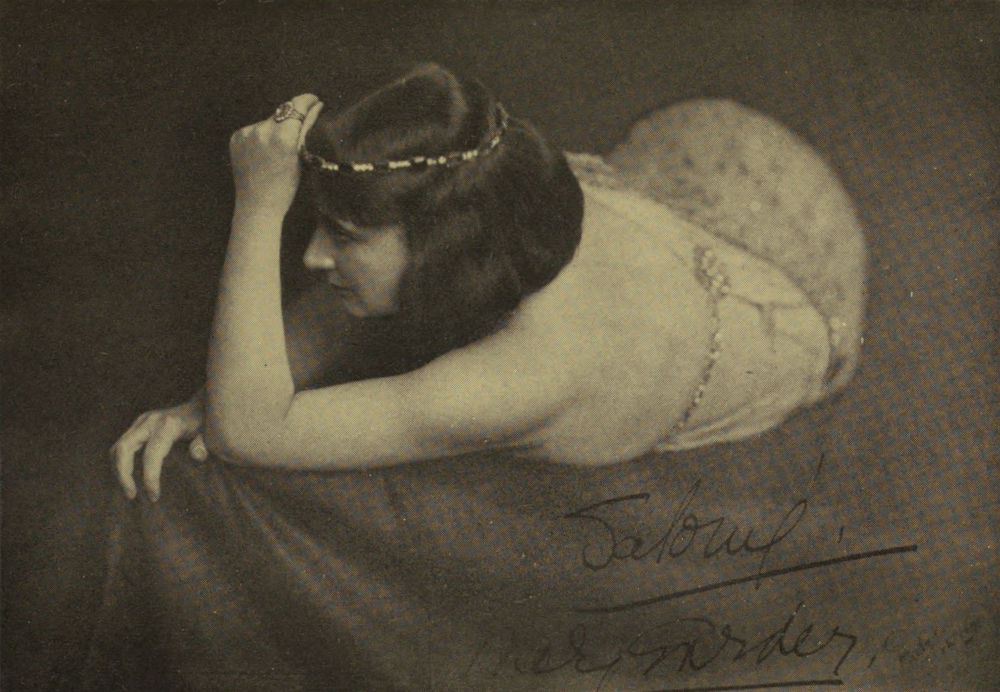
From a photograph copyrighted by Matzene
MARY GARDEN AS SALOME
Scriabin is of this tormented choir; as Arthur B. Davies, our own mystic, primitive painter. And Charles Martin Loeffler. It may be the decadence, as any art is in decadence which stakes the parts against the whole. That ecstasy may be aroused by pictures of love and death, as in the cases of Poe and Baudelaire, Wagner and Strauss, should not, therefore, be adjudged morbid. In the Far East they hypnotize neophytes with a bit of broken mirror, for in the kingdom of art, as in heaven, there are many mansions. It was possibly a relic of his early admiration for the Baudelaire poems that set Wagner to extorting ecstasy from his orchestra by images of love and death, though doubtless the temperament which seeks assuagement in such a comminglement—a temperament more often encountered in mediæval art than now—was natural to Wagner. He makes his Isolde sing madly and mournfully over a corpse, and, throwing herself upon the dead Tristan, she dissolves into the ecstasies of sweet, cruel love; in Salome, Richard Strauss closely patterns after Wagner; there is the head of a dead man—though on a charger—and there follows a poignant ecstasy not to be found in all music. Both men play with similar counters: love and death, and death and love. In Pisa may be seen (attributed by Vasari) Orcagna’s fresco, The Triumph of Death. It has been set to grotesque music by Liszt in his Dance of Death. Let us not forget the great Italian, Gabriele d’Annunzio, whose magnificent prose, from The Triumph of Death to Forsé Che Si, Forsé Che No, is a pæan to the tutelar gods of humanity, love and death. The sting of the flesh and the way of all flesh are intermingled in Rodin’s astounding fugue, The Gate of Hell. First things and Last things, love and life, bitterness and death, have ever ruled the arts; and all great art is anarchic, cosmos and chaos cunningly proportioned.
But between the sublime and the silly there is only a hair’s breadth. If not guided by tact and vision, the ecstatic in art and literature may degenerate into the erotic, and from the erotic to the tommyrotic is only a step. All this tumultuous imagery, this rhapsody Hunekeresque, is prompted by a photograph of Mary Garden, whose enigmatic eyes collide with my gaze across the Time and Space of my writing-desk. Your memory is wooed by the golden trumpets of Byzance, and when Mary speaks she wears the sacred Zaïmph of Salammbo. Voltaire, in Candide, was wise when he advised us: “Il faut cultiver notre Jardin.”
IX PAINTED MUSIC
Painted music. The common identity of the Seven Arts was a master theory of Richard Wagner and a theory he endeavored his life long to put into practice. Walter Pater, in his essay on The School of Giorgione, has dwelt upon the same theme, declaring music the archetype of the arts. In his Essays Speculative, John Addington Symonds has said some pertinent things on the subject. Camille Mauclair, in Idées Vivantes, seriously proposed a scheme for the fusion of the arts. The fusion would be cerebral, as the actual mingling of sculpture, architecture, music, drama, acting, painting, and dancing could never evoke the sensation of unity. Not thus is synthesis to be attained. It must be the “idea” of the arts rather than their material blending. A pretty chimera! Yet one that has piqued the attention of artists for centuries. It was the half-crazy E. T. W. Hoffmann, composer, dramatist, painter, poet, stage manager, and a dozen other professions, including those of genius and drunkard, who set off a train of fireworks that dazzled the brains of Poe, Baudelaire, and the later symbolists.
Persons who hear painting, see music, touch poems, taste symphonies, and write perfumes are now classed by the psychical police as decadent, though such notions are as old as art and literature. In his L’Audition Colorée, Suarez de Mendoza has said that the sensation of color-hearing, the faculty of associating tones and colors, is often a consequence of an association of ideas established in youth. The colored vowels of Arthur Rimbaud, which should be taken as a poet’s crazy prank; the elaborate treatises by René Ghil, which are terribly earnest; the casual remarks that one hears, such as “scarlet is like a trumpet blast”—it was scarlet to the young Mozart; certain pages of Huysmans and Mallarmé, all furnish examples of the curious muddling of the five senses and the mixing of artistic genres. Naturally, this confusion has invaded criticism, which, limited in imagery, sometimes seeks to transpose the technical terms of one art to another.
Whistler, with his Nocturnes, Color-Notes, Symphonies in Rose and Silver, his Color-Sonatas, boldly annexed well-worn musical phrases that, in their new estate, took on fresher meanings, while remaining knee-deep in the swamp of the nebulous. Modern composers have retaliated. Musical Impressionism is enjoying its vogue and the New Poetry is desperately pictorial. Soul-landscapes and etched sonnets are titles not unpleasing to the ear. What if they do not mean much! There was a time when to say “she had a sweet voice” aroused a smile. What has sugar to do with sound? It may be erratic symbolism, this mélange of terminologies, yet, occasionally, it strikes sparks. There is a deeply rooted feeling that the arts have a common matrix, that, emotionally, they are akin. “Her slow smile” in fiction has had marked success, but when I wrote of the “slow Holland landscape,” the phrase was suspiciously regarded. (I probably found it in Verlaine or Rodin.) The bravest critic of the arts was Huysmans, who pitched pell-mell into the hell-broth of his critiques any image that assaulted his fecund brain. He forces us to see his picture; for he was primarily concerned with the eye, not the ear. Flaubert represents in its highest estate a fusion of sound and sense and seeing; he was both an auditive and a visualist. His prose sings, while its imagery sharply impinges upon the optic nerve. Nor are taste and smell neglected—recall the very flavor of arsenic that killed Emma Bovary or the scents of the woodland where that adorable girl lingered with her lover. Joined to those evocations of the five senses there is a classic balance of sentence, phrase, paragraph, page; the syntactic architecture is magnificent, though not excelling the eloquent Bossuet or the pictorial Châteaubriand as to complex, harmonious structure. These three great French writers had polyphonic minds, and their books and the orations of the superb Bossuet englobe a world of ideas and sensations, music and painting.
And Botticelli? Was Botticelli a “comprehensive,” as those with the sixth, or synthetic, sense have been named by Lombroso-Levi? Beginning as a goldsmith’s apprentice (Botticello, the little bottle), Botticelli as a painter became the most original in all Italy. His canvases possess powers of evocation. He was a visionary, this Sandro Filipepi, pupil of the mercurial Fra Lippo Lippi and of the Brothers Poliajuolo, and his vision must have been something more than paint and pattern. A palimpsest may be discerned by the imaginative—rather let us say fanciful, since Coleridge set forth the categories—whose secrets are not to be easily deciphered, and are something more than those portrayed on the flat surfaces of his pictures. Like most artists of his period he painted the usual number of Madonnas; nevertheless, he did not convince his world, or succeeding generations, that his piety was orthodox. During his lifetime suspected of strange heresies, this annotator and illustrator of Dante, this disciple of Savonarola, is now definitely ranged as a spirit saturated with paganism, and yet a mystic. Does not the perverse clash in such a temperament produce exotic dissonances?
All Florence was a sounding-board of the arts when Botticelli paced its narrow streets and lived its splendid colored life. His sensitive nature absorbed, as does a sponge water, the impulses and motives of his contemporaries. The secrets lurking in the “new learning”—doctrines that made for damnation, such as the recrudescence of the mediæval conception of an angelic neuter host, neither for heaven nor hell, not on the side of Lucifer, nor yet with the starry hosts—were said to have been mirrored in his pictures. Its note is in Città di Vita, in the heresies of the Albigenses, and it may well go back to Origen. Those who could read his paintings—and there were clairvoyant theologians abroad in Florence—might make of them what they would. Painted music is less understandable than painted heresy. Matteo Palmieri is reported to have dragged Botticelli into dark corners of disbelief; there was in the Medicean days a cruel order of intelligence that delighted to toy with the vital faith and ideals of the young. A nature like Botticelli’s, which frankly surrendered to new ideas if they but wore the mask of subtlety, was swept, no doubt, away in the eddying cross currents of Florentine intellectual movements. Mere instinct never moved him from his moral anchorage, for he was a sexless sort of man. Always the vision. He did not palter with the voluptuous frivolities of his fellow artists, yet his canvases are feverishly disquieting. The sting of the flesh is remote. Love is transfigured, though not spiritually, and not served to us as a barren parable, but made more intense by the breaking down of the thin partition between the sexes; a consuming emotion, not quite of this world nor of the next. However, the rebellion that stirred in the bosom of Botticelli never took on concrete aspects. His religious subjects are Hellenized, not after the sterner, more inflexible method of Mantegna, but resembling those of a philosophic Athenian who has read and comprehended Dante. His illustrations show us a different Dante, one who might not have altogether pleased that gloomy exile. The transpositions of the Divine Comedy by William Blake seem to sound the depths; Botticelli, notwithstanding the grace of his “baby Centaurs” and the wreathed car of Beatrice, is the profounder man of the pair.
His life, veiled toward the last, was not happy, although he was recognized as a great painter. Watteau concealed a cankering secret; so Botticelli. Melancholy is the base of the Florentine’s work. As a young man he created in joy and freedom; but the wings of Dürer’s Bat were outstretched over his brooding head. Melencolia! He could ask if there is anything sadder under the sun than a soul incapable of sadness. There is more poignant music in his Primavera, in the weary, indifferent countenances of his lean, neuropathic Madonnas—Pater calls them “peevish”—in his Venus at the Uffizi, than in the paintings of any other Renaissance artist. The veils are there, the consoling veils of an exquisite art, which are missing in the lacerated and realistic holy folk of the Flemish Primitives. Joyfulness cannot be denied Botticelli; but it is not the golden joy of Giorgione; “Big George of Castelfranco.” An emaciated music emanates from the eyes of that sad, restless Venus, to whom love has become a scourge of sense and spirit. Music? Yes, there is the “colored-hearing” of Mendoza. The canvases of Botticelli sound the opalescent overtones of an unearthly composition. Is this Spring, this tender, tremulous virgin, whose right hand, deprecatingly raised, signals as a conductor from invisible orchestra its rhythms? Hermes, supremely impassive, hand on thigh, plucks the fruit as the eternal trio of maidens with woven paces tread the measures of a dance we but overhear. Garlanded in blossoms, a glorious girl keeps time with the pulsing atmospheric moods; her gesture, surely a divine one, shows her casting flowers upon the richly embroidered floor of the earth. The light filters through the thick trees, its rifts as rigid as a candle. The nymph in the brake is threatening. Another epicene creature flies by her. Love shoots his bolt in mid-air. Is it from Paphos or Mitylene? What the fable? Music plucked down from vibrating skies, music made visible. A mere masque, laden with the prim, sweet allegories of the day, it is not. That blunt soul, Vasari, saw at best its surfaces. The poet Politian got closer to the core. Centuries later our perceptions sharpened by the stations traversed of sorrow and experience, lend to this immortal canvas a more sympathetic, less literal interpretation.
There is music, too, in the Anadyomene of the Uffizi. Still stranger music. Those sudden little waves that lap an immemorial strand; that shimmering shell, its fan-spokes converging to the parted feet of the goddess; her hieratic pose, its modesty symbolic, the hair that serpentines about her foam-born face, thin shoulders that slope into delicious arms; the Japanese group blowing tiny gem-like buds with their puffed-out cheeks; the rhythmic female on tiptoe offering her mantle to Venus; and enveloping all are vernal breezes, the wind that weeps in little corners, unseen, yet sensed, on every inch of the picture—what are these mundane things but the music of an art, original at its birth, and since never reborn? The larger, simpler, curved rhythms of the greater men, Michelangelo, Da Vinci, Shakespeare, Beethoven, are not in Botticelli. Nevertheless, his voice is irresistible.
Modern as is his spirit, as modern as Watteau, Chopin, or Shelley, he is no less ethereal; ethereal and also realistic. We can trace his artistic ancestry; but what he became no man could have predicted. Technically, as one critic has written, “he was the first to understand the charm of silhouettes, the first to linger in expressing the joining of the arm and body, the flexibility of the hips, the roundness of the shoulder, the elegance of the leg, the little shadow that marks the springing of the neck, and, above all, the carving of the hand; but even more, he understood “le prestige insolent des grands yeux”.”
Pater found his color cold and cadaverous, “and yet the more you come to understand what imaginative coloring really is, that all color is no mere delightful quality of natural things, but a spirit upon them by which they become expressive to the spirit, the better you like this peculiar quality of color.” Bernard Berenson goes further. To him the entire canvas, Venus Rising from the Sea, presents us with the quintessence of all that is pleasurable to our imagination of touch and movement.... The vivid appeal to our tactile sense, the life-communicating motion is always there. And writing of the Pallas in the Pitti galleries, he most eloquently declares: “As to the hair—imagine shapes having the supreme life of line you may see in the contours of licking flames, and yet possessed of all the plasticity of something which caresses the hand that models it to its own desire!” And, after speaking of Botticelli’s stimulating line, he continues: “Imagine an art made up entirely of these quintessences of movement-values and you will have something that holds the same relation to representation that music holds to speech—and this art exists and is called lineal decoration. In this art of arts Sandro Botticelli may have had rivals in Japan and elsewhere in the East, but in Europe never!... He is the greatest master of lineal design that Europe ever had.”
Again, painted music; not the sounding symbolism of the emotions, but the abstract music of design. Nevertheless, the appeal of Botticelli is auditive. Other painters have spun more intricate, more beautiful webs; have made more sensuous color-music; but the subtle sarabands of Botticelli they have not composed. Here is a problem for the psychiatrist. In paint, manifestations of this order could be set down to mental lesion; that is how Maurice Spronck classifies the sensation. He studied it in the writings of the Goncourts and Flaubert. The giant of Croisset told the Goncourts that to him Salammbo was purple and L’Education Sentimentale grey, Carthage and Paris. A characteristic fancy. But why is it that scientific gentlemen, who predicate genius as eye-strain, do not reprove poets for their sensibility to the sound of words, to the shape and cadence of the phrase? It would appear that only prose-men are the culpable ones if they overhear the harping of invisible harps from Ibsen’s Steeplejacks, or describe the color of the thoughts of Zarathustra. In reality, not one but thousands of people listen in the chill galleries of Florence to the sweet, nervous music of Botticelli. This testimony of the years is for the dissenters to explain. “Fantastico, Stravagante,” as Vasari nicknamed Botticelli, has literally created an audience which learned to use its eyes as he did, fantastically and extravagantly.
He passed through the three stages dear to arbitrary criticism. Serene in his youthful years; troubled, voluptuous, and visionary during the Medicean period; sombre, mystic, a convert to Savonarola at the end. He traversed a great crisis not untouched. Certain political assassinations and the Pazzi conspiracy hurt him to the quick. He noted the turbulence of Rome and Florence, saw behind the gayly tinted arras of the Renaissance the sinister figures of supermen and criminals. He never married. When Tommaso Soderini begged him to take a wife he responded: “The other night I dreamed I was married. I awoke in such horror and chagrin that I could not fall asleep again. I arose and wandered about Florence like one possessed.” Evidently not intended by nature to be husband or father. Like Watteau, like Baudelaire, like Nietzsche, grand visionaries abiding on the thither side of the facile joys of life, Botticelli was not tempted by the usual baits of happiness. His great Calumnia, in the Uffizi, might be construed as an image of the soul of Botticelli. Truth, naked and scorned—we see again the matchless silhouette of his Venus—misunderstood and calumniated, stands in the hall of a vast palace. She points to the heavens. She is a living interrogation-mark. Pilate’s question? Botticelli was adored. But understood? An enigmatic malady ravaged his innermost being. He died poor, solitary, did this composer of luminous chants and pagan poems, this moulder of exotic dreams, and of angels who long for gods other than those of Good and Evil. You think of the mystic Joachim of Flora and his Third Kingdom; the Kingdom of the Holy Spirit which is to follow the Kingdom of the Father and the Kingdom of the Son; the same Joachim who declared that the true ascetic counts nothing of his own, save only his harp. “Qui vere monachus est nihil reputat esse suum nisi citharam.” And you also recall St. Anselm, who said that he would rather go to hell sinless than be in heaven smudged by a single transgression.
A grievously wounded, timid soul, an intruder at the portals of Paradise, Botticelli had not the courage either to enter or withdraw. He experienced visions that rapt him into the ninth heaven, but when he reported them in the language of his design his harassed, divided spirit chilled the ardors of his art. In sooth, a spiritual dichotomy. And thus it is that the multitude does not worship at his shrine as at the shrine of Raphael. Do they unconsciously note the adumbration of a paganism long dead, but revived for a brief Botticellian hour? Venus or Madonna! Adonais or Christ! Under which god? The artist never frankly tells us. Legends are revived of fauns turned monks, of the gods in exile and at servile labor in a world that has forgotten them, but with a sublimated ecstasy not Heine’s. When we stand before Botticelli and hear the pallid, muted music of his canvases we are certain that the last word concerning him shall not be uttered until his last line has vanished; even then his archaic harmonies may reverberate in the ears of mankind. But always music painted.
X POE AND HIS POLISH CONTEMPORARY
In the City of Boston, January 19, 1809, a son was born to David and Elizabeth Poe. On March 1, 1809, in the village of Zelazowa-Wola, twenty-eight English miles from Warsaw, in Poland, a son was born to Nicholas and Justina Chopin (Chopena or Szop). The American is known to the world as Edgar Allan Poe, the poet; the Pole as Frédéric François Chopin, the composer. On October 7, 1849, Edgar Poe died, poor and neglected, in Washington Hospital at Baltimore, and on October 17, 1849, Frédéric Chopin expired at Paris surrounded by loving friends, among whom were titled ladies. Turgenev has said there were at least one hundred princesses and countesses in whose arms the most wonderful among modern composers yielded up his soul. Poe and Chopin were contemporaries, and, curious coincidence, two supremely melancholy artists of the Beautiful lived and died almost synchronously.
My most enduring artistic passions are for the music of Chopin and the prose of Flaubert. In company with the cool, clear magic of a Jan Vermeer canvas, that of the Pole and Frenchman grazes perfection. But as a lad Chopin quite flooded my emotional horizon. I had conceived a fantastic comparison between Poe and Chopin, and I confess I was slightly piqued when Ignace Jan Paderewski, not then Premier of Poland, assured me that Chopin was born in the year 1810, and not the year earlier. The date chiselled on Chopin’s Paris tomb in Père Lachaise—a sad tribute to the mediocre art of Clésinger, who married Solange Sand—is, after all, the correct one, and this new date, which is also the old, is inscribed on the Chopin Memorial at Warsaw, Poland. I shall not attempt to dispute the claim; even the most painstaking of Chopin biographers, Prof. Frederick Niecks, admits his error. The latest biography, said to be definitive, by the Polish musicograph, Ferdinand Hoesick, I have not seen; the war impeded the translation. Yet I am fain to believe that too many parish registers were in existence, and perhaps the next one that is unearthed may give as new dates either 1808 or 1811. I prefer 1809, while apologizing for my obstinacy. Unhappily for future investigators, Russian Cossacks in 1915 ravaged with torch and sword the birthplace, not only destroying the Chopin monument, but burning his house and the parish church. These once highly esteemed vandals, pogrom heroes, and butchers of thousands of helpless Jewish women, children, and old men, only repeated at Zelazowa-Wola the actions of their forebears at Warsaw during the sanguinary uprising of 1831. The correspondence of Chopin, treasured by his sister, Louise Jedrzejewicza, and the piano of his youth were completely destroyed. (Louise died in 1855, and the other sister, Isabella Barcinska, in 1881.)
The love of Poe began early with me. My father had been a friend of the poet’s in Philadelphia, and a member of the Poe circle during the forties of the last century; “roaring forties”, indeed. That prime old comedian, Billy Burton, the ideal Falstaff of his day; John Sartain, the engraver, and father of William Sartain, the painter; Judge Conrad, who could move his listeners to tears when he recited the Lord’s Prayer; the elder Booth, a noble tragedian much given to drink; Graham, the publisher, and several others whose names have escaped my memory, composed this interesting group. In his memoirs John Sartain has written of Poe and of a certain wild midnight walk in Fairmount Park. I remember the elder Sartain as an infrequent visitor at our house, and I also remember how I hung on his words when he spoke of Poe. My father told me that Poe would become a raving maniac after a thimbleful of brandy, so sensitive was his cerebral mechanism. But other authorities contradict this theory. Poe had been often seen to toss off a tumblerful of cognac neat. Last year at Atlantic City I met Mr. Hutzler, a well-known merchant of Baltimore, a spry young octogenarian and a seasoned raconteur. He told me, and in a vivid manner, of seeing Edgar Poe and Junius Brutus Booth hanging on to the same lamp-post, both helplessly drunk at midday. This happened about 1845, as the boys, Mr. Hutzler among the rest, trooped out to dinner from the public school on Holliday Street. Mr. Hutzler’s memory has a mirror-like clearness, and he described the occurrence as if it had happened yesterday. Like irreverent school-boys, they surrounded the greatest living Shakespearean actor and the greatest American poet and mocked at them.
We lived on North Seventh Street, and twice a day, on my trip to and from school, I passed the house where Poe had lived during his sojourn in Philadelphia, from 1838 to 1844. That house I should not have been able to locate to-day if my friend, Christopher Morley (charming writer, with a name that recalls spacious Elizabethan times: Kit Morley!), hadn’t described it. This house, in which Poe wrote The Raven and The Gold Bug, is at the northwest corner of Seventh and Brandywine Streets. Another critic friend, Albert Mordell, assures me that the old pear-tree in the back yard still bears fruit for the present resident, Mrs. Owens. The house is the rear building of another numbered 530 North Seventh Street. Mr. Mordell sent me a photograph which shows a typical Philadelphia red brick structure with white shutters and marble steps. I have heard of many spots where Poe wrote The Raven, Fordham among the rest, but as boys we told ourselves when we stared at the old building: “Poe wrote his Raven and Gold Bug there!” It is something to remember in these piping times of hypocrisy and universal hatred of art, music, and literature.
It would be a strained parallel to compare Poe with Chopin at all points; nevertheless, chronological coincidences are not the only comparisons that might be instituted without exaggeration. True, the roots of Chopin’s culture were more cosmopolitan, more richly nurtured than Poe’s; the poet, like an air-plant, found his spiritual sustenance from sources unknown to the America of his day. Of Poe’s intellectual ancestry, however, we may form some conception, though his learning was not profound, despite his copious quotations from half-forgotten and recondite authors, Glanvil, for example. Nevertheless, the matchless lines, “Helen, thy beauty is to me like those Nicéan barks of yore,” ... were struck off in the fire of a boyhood passion. Chopin had a careful training under the eye of his Polish teacher, Elsner; but who could have taught him how to compose his Opus 2, the Variations on Mozart’s La ci darem la mano? Both Poe and Chopin were full-fledged artists from the beginning, their individualities and limitations sharply defined. Perhaps the most exquisite music penned by Poe is this same Helen, while the first mazourka of Chopin stamps him as an original poet. In the later productions of these men there is more than a savor of morbidity. Consider the Fantaisie-Polonaise, Opus 61, with its most musical, most melancholy cadences; or the F minor Mazourka, composed during the last illness of Chopin; a sick brain betrays itself in the rhythmic insistence of the theme, a soul-weary Wherefore? In the haunting repetitions and harmonies of Ulalume there is a poetic analogue. This poem, in which sense swoons into sound, possesses a richness of color and rhythmic accent that betoken the mentality of a poet whose brain is perilously unhinged. If alcohol produced this condition, then might a grateful world erect altars to such a wondrous god of evocation. Prohibition has not thus far produced a Poe. But he wasn’t the creation of either alcohol or drugs, though they were contributory causes; they prodded his cortical cells into abnormal activity, made leap the neuronic filaments with surprising consequences. No, a profound cerebral lesion was the real reason why Poe resorted to brandy to soothe his exacerbated nerves, and not because he drank did he go to wrack and ruin. His “case” is like Baudelaire’s and E. T. W. Hoffmann’s; not to mention the names of James Clarence Mangan and Monticelli, one the singer of Dark Rosaleen, the other that master of gorgeous hues, fantasies of enchanted lands and crumbling linear designs.
Poe, then, like Chopin, did not die too soon. Neurotic natures, they lived their lives with the intensity which Walter Pater has declared is the true existence. “To burn always with this hard, gem-like flame, to maintain this ecstasy, is success in life. Failure is to form habits.” Alas! that way madness lies for the majority of mankind, notwithstanding the æsthetic exhortation of Pater. Poe and Chopin fulfilled the Pater conditions during their brief sojourn on our parent planet. They ever burned with the flame of genius, and that flame devoured them. They were not citizens of moral repute. Nor did they accumulate “mortal pelf.” They failed to form habits, and while the psychic delicacy of Chopin proved a barrier against self-indulgence of the grosser sort, he contrived to outrage social and ethical canons even in tolerant Paris. The influence of George Sand, her ascendancy over his volition, worked evil and unhappiness. The delicate porcelain of his genius could not float down-stream in company with her brassy ware without ensuing disaster for the finer of the twain. Alcoholic neurosis did not trouble him, but he was tubercular, and that malady is more fatal than alcoholism. Poe was not precisely a drunkard; probably masked epilepsy accounts for his vagaries; such victims are periodical dipsomaniacs, “circulaires” is the term of the psychiatrists. His personality was winning, his speech electric, his eye alight with genius; but, then, the obverse of the medal! A sad, slouching creature, with a cynic’s sneer, a bitter tongue which lashed friend and foe alike, a gambler, a libertine—what has this unhappy poet not been called? Baudelaire asked whether the critical hyenas could not have been prevented from defacing the tomb of Poe. (He used Rabelaisian language in the original French.) Charles Baudelaire, a spiritual double of Poe, was another unhappy wraith of genius, and of the same choir of self-lacerated and damned souls.
Fancy Poe and Chopin in New York during the prosaic atmosphere of those days! If Chopin had not achieved artistic success at the Soirée of Prince Radziwill in Paris, 1831, he would probably have gone to America, where he might have met Poe. He had declared his intention to leave Paris for New York, and his passport was viséd “passing through.” Poe and Chopin conversing! The idea is rather disquieting. Stendhal, not hoodwinked by Châteaubriand, with his purple phrases and poetic visions of virgin forests and sweet Indian girls in an impossible Louisiana, declared that America was materialistic beyond hope of redemption. Talleyrand knew better. However, it was better for the artistic development of the Polish composer that he remained in the Old World. Think of Chopin giving piano lessons to the daughters of the New-Rich at the fashionable Battery, and Poe encountering him at some conversazione—they had conversaziones then—and propounding to him Heine-like questions: Are the roses at home still in their flame-hued pride? Do the trees sing as beautifully as ever in the moonlight? Are humming-birds and star-dust—Francesca Astra—still as rare as ambergris? At a glance Poe and Chopin would have sympathized. In sensibility the American was not inferior to the Pole. Poe would have felt the “drummed tears” in the playing of Chopin, and in turn Chopin would not have failed to divine the vibrations of Poe’s high-strung nature. Both men were mystics, were seers. What a meeting that would have been; yet inevitable misery might have come to the Pole in unsympathetic New York. A different tale if Poe had gone to Paris and enjoyed a meed of artistic success. Baudelaire, who was born in April, 1821, therefore a young chap in 1845, would have known him and, congenial souls, they would surely have gone to the devil quicker than apart. Baudelaire and Poe! There’s a marvellous combination for you of fantasy, moonlight, rotten nerves, hasheesh, and alcohol! The fine flower of the genius of Poe might have bloomed more fragrantly on French soil; perhaps with the added note of depravity not in his sexless creations, and so corroding a note in Les Fleurs du Mal. Who may dare say! But then we might not have had the sinister melancholia, so sweetly despairing, so despairingly sweet, that we enjoy in the real Poe.
The culture of Chopin was not of a finer stamp than Poe’s, nor was his range so wide. In their intellectual sympathies both were rather narrow, though intense to an emotional poignancy, and both were remarkable in mood-versatility. Born aristocrats, purple raiment became them well. Both were sadly deficient in planturous humor and the Attic salt that conserves the self-mockery of Heine. Irony they possessed to a superlative degree. Both created rhythmic beauty, evoked the charm of evanescence. A crepuscular art; the notations of twilit souls and the “October of the sensations.” Both were at their best in smaller artistic forms. When either one spreads his pinions for symphonic flight we think of Matthew Arnold’s interpretation of Shelley: “beating in the void his luminous wings in vain.” Which phrase truly is of Mat’s own making, yet somehow misses the essential Shelley. Poe and Chopin supremely mastered their intellectual instruments. Artificers in precious cameos, they are of an artistic consanguinity because of their extraordinary absorption in the Beautiful. Poe wrote in English, but was he really as American as Hawthorne and Emerson were American? His verse and prose depict characters and landscapes that belong to No Man’s Land, in that mystic region east of the sun, west of the moon. The American scene was unsympathetic to him, and he refused to become even morally acclimated. His Eldorado is “over the mountains of the moon, down the valley of the shadow.” His creations are bodiless; shadow of shadows, the incarnation of Silence, set forth in spectral speech. Unlike any other native-born writer, he sounds better in a French garb; the Baudelaire translations improve his style, and Stéphane Mallarmé has accomplished an almost miraculous transposition of Ulalume. (The Raven—Le Corbeau—by the same master I do not care for as much, and with its refrain, “Jamais plus!” is not so musically sonorous as “Nevermore!”)
Henry Beyle-Stendhal wrote in his witty, malicious manner that “Romanticism is the art of presenting to the people literary works which in the actual state of their habitudes and beliefs are capable of giving the greatest possible pleasure; Classicism, on the contrary, is the art of presenting literature which gave the greatest possible pleasure to their great-grandfathers.” Stendhal is half right. A Classic is sometimes a dead Romantic. But Poe and Chopin remain invincibly Romantic, yet are Classics. Chopin is more human than Poe, inasmuch as he is patriotic. His polonaises are “cannons buried in flowers,” his psychic bravery overflows in the Revolutionary Etude. He is Chopin. And he is also Poland. Like the national poet, Adam Mickiewicz, he struck many human chords, though some of his melodies could dwell in Poe’s “misty mid-region of Weir,” where Beauty boasts an icy reign. There is a disturbing dissonance in the Poe-Chopin case: Poe was a man without a country; Chopin had the priceless possession of Poland. On his heart was engraved “Poland.” The love of Frédéric Chopin for his native land dowered him with a profounder nature than the Lucifer of American poetry, Edgar Allan Poe. But what enigmatic, beautiful souls!
XI GEORGE LUKS
Of course, I knew in a vague way where Edgecombe Road and Jumel Place spotted the map, for I am a seasoned Manhattan cockney. But, after all, I mixed up the Jumel Mansion and the house of George Luks, and so I asked that painter for some travel indications. He sent me a map that was clarity itself. All I had to do was to sit in the Broadway subway till I reached One Hundred and Sixty-eighth Street; then take the elevator—as deep down in the bowels of the earth as if in the London Underground; on reaching the sidewalk proceed northward to One Hundred and Seventieth Street—the little arrows on the chart are marked; then eastward (another arrow) and behold! Amsterdam Avenue. There you enter a delicatessen bureau and tactfully inquire after Edgecombe Road.
I did all these things, and was recently told on a fine, breezy afternoon by a foreign youth that the road was in front of my face, as was Highbridge Park; around the corner was Jumel Place. Enfin! I said to the polite guide, and nosed my way till I saw an ideal cottage—though rather large for a cottage—with a big studio window facing the north. Recalling what Luks had often said—“To hades with a north light; a man ought to be able to paint in a cellar!”—I wondered. Then I traversed a garden and broke into the house, a burglar, armed with a pen and a bagful of question-marks. It was the home of the only George Luks, who, happy boy, has a painting temperament with an “angel in the house” to protect him from the contact of a world of cruel critics, and is also the possessor of the disposition described as “bubbling.” His favorite exclamation is: “Yours for happiness.” He means it. It is the leading-motive of his life.
Here are domestic comfort, a north light, and plenty of models across the road in the open air, splashed by sunshine or shadowed by trees; babies, goats, nurse-girls, park loafers, policemen, lazy pedestrians, noisy boys, nice little girls with hoops, and the inevitable sparrows. Rocks are in abundance. The landscape “composes” itself. And you are not surprised, when ushered into the great studio on the second floor, to be confronted by canvases registering various phases of the vibrating world hard-by. Since he moved from down-town the painter is becoming more of a plein-airiste.
Luks doesn’t wander afar for subjects. He still loves the familiar, the homely, the simple. It had been several years since I saw his work. Occasionally in Holland I would rim across a canvas by Jan Steen, Adrien Brouwer, or even Hals, that recalled Luks. His artistic affinities are Dutch rather than French; above all, he is an American painter to his blunt finger-tips. Beginning in the field of illustration, he was plunged up to his eyes in New York life. I believe it was Arthur Brisbane who first suggested to him that he should go in for painting in oils.
He went to Düsseldorf and survived that trying experience—a school that would submerge a Manet. Paris followed. But George is not a product of the schools. Theories sit lightly on his mercurial shoulders. He loathes “movements,” and refers to the “new” men, cubists, lamp-post impressionists, and futurists in words that curdle the blood. Indeed, his vocabulary is as variegated and picturesque as his palette. As for the personality of the man—well, it is absolutely impossible to set down on paper any adequate description of him. He is Puck. He is Caliban. He is Falstaff. He is a tornado. He is sentimental. He can sigh like a lover, and curse like a trooper. Sometimes you wonder over his versatility; a character actor, a low comedian, even song-and-dance man, a poet, a profound sympathizer with human misery, and a human orchestra. The vitality of him!
Perhaps the simile of a man-orchestra is the most fitting. Did you ever see and hear those curious creatures, less rare in our streets a quarter of a century ago than now? I remember one in a small French city, a white-haired fellow who, with fife, cymbals, bells, concertinas—he wore two strapped under either arm—at times fiddles, made epileptic music as he quivered and danced, wriggled and shook his skull. The big drum was fastened to his back, upon its top were cymbals. On his head he wore a pavilion hung with bells that pealed when he twisted his long skinny neck. He carried a weather-worn violin with a string or two missing; while a pipe that might have been a clarinet years before emitted but cackling tones from his thin lips. By some incomprehensible co-ordination of muscular movements he contrived simultaneously to sound his armory of instruments; and the whistling, screeching, scratching, drumming, wheezing, and tinkling of metal were appalling. But it was rhythmic, and at intervals the edge of a tune might be discerned sharply cutting through the dense cloud of vibrations, like the prow of a boat cleaving a fog. And the reverberating music swelled, multifarious and amazing, as if a military band, from piccolo to drum, were about to descend upon the town. A clatter and bang, a sweet droning and shrill scraping were heard, as the old chap alternately limped and danced in the middle of the roadway.
Now, George Luks is not venerable; he is a comparatively young man, yet he reminds me of that human orchestra. It is an image of lithe activity that he suggests. What has this to do with his art? Much. It is rhythmic, many-colored, intensely alive, charged with character and saturated with humanity, not forgetting humor. Pathos is not absent. In his latest productions I noted with satisfaction more repose, deeper feeling, more solicitude for his surfaces, the modulation of tones; and the same old riotous joy in color for color’s sake. Yes, in his themes he still belongs to the illustrators. He seldom tells a definite story, but there is no mistaking his point of view.
I saw portraits of girls in masquerade that were expressed in terms of beautiful paint. A little red-head, the sheer tonal charm immediate, made me think of both Henner and Whistler. Then a Hals-like head, virile and sincere; a sensitively limned portrait of a young girl, his niece; a large canvas; charming girls under umbrageous trees, a veritable gamut of greens; an old woman who simply cried to be framed and exhibited—how many things did I not stare at, wondering over the inexhaustible fecundity, and groaning over the reckless prodigality, of this gifted man! With a tithe of his talent and personal quality other painters have achieved renown. However, he is not lacking in honors. He has plenty of admirers, plenty of commissions; yet do his friends wish that he would sometimes apply the brakes to that fiery temperament of his and steer his bark into less tumultuous waters. His art would gain thereby in finish, and distinction, and repose. And it might also die.
I once called George Luks “a hand and an eye.” His power of observation is great. He has the intensity of a Spaniard and the realism of a Dutchman. He is both exact and rebellious. Wherever he happens to pitch his tent becomes his studio; preferably in the open. But the East Side is his happy hunting-ground. In the Yiddish restaurants where old men with Biblical heads drink coffee and slowly converse; on Houston Street, when, apparently, the entire population is buying fish Shabbas-abend; in vile corners where the refuse of humanity drift, helpless, hopeless—there Luks catches some gleam of humor or pathos, some touch that Gorky-like brings before us in a dozen strokes of the brush or pencil a human trait which emerges to the surface of this vast boiling kettle like a spar thrown up by an angry sea. All happiness is not lost in those mean streets; a rift of wintry sunlight, a stray tune from some wheezy barrel-organ, and two children waltz with an unconscious zest of life that will survive until they are nonogenarians. Of such contrasts Luks is the master.
His Spielers is like a quivering page from—from whom? The East Side is yet to boast its Dickens. And Dickens would have enjoyed the picture of the little tousled Irish girl, with her red locks, who dances with the pretty flaxen-haired German child, surely a baker’s daughter from Avenue B. Now, you might suppose that this vivid art, this painting which has caught and retained the primal jolt and rhythm of the sketch, must be necessarily rude and unscientific in technique. It is the reverse. This particular picture is full of delicious tonalities. The head of the blonde girl might be from an English eighteenth-century master, and the air—it fills the spaces with a fluid caress.
And his Little Gray Girl, a poor wisp of flesh wearing a grotesque shawl and hat, shivering in the chill of a gloomy evening, sounds touching music. The note of sentiment is not forced; indeed, the passages of paint first catch the eye, modulations of grays and blacks that tell of the artist’s sensitive touch. He has wanton humors. He paints a French coachman, life-size, seated at a café table about to swill brandy. It is so real that you look another way. Or you are shown a collection of beggars who were famous a few years ago on Sixth Avenue, Broadway, the east side, Fulton Market: Matches Mary, the Duchess, the tottering Musician, the old Italian, “Gooda nighta, Boss!” and a host of nocturnal creatures since dead or in the hospital, perhaps in jail. Luks is their interpreter. Nor does he lean to the pessimistic; he is a believer in life and its characteristic beauty. The pretty he abhors.
There is the Duchess. In life she was an elderly hag with a distinguished bearing, a depraved woman of rank, who wore five or six dresses at once, on her head a shapeless yet attractive gear, and in her pocket she carried a fat roll of bills for purposes of dissipation, or bribery, or for bailing out some Tenderloin wreck. She is maleficence incarnate. Just fancy this bird of the night set forth by a sympathetic brush, endowed with a life that overflows the canvas, and you see this grande dame strut by, the embodiment of evil, yet a duchess à la Sir Johsua, though à rebours. It is a sinister art which recalls the genius of Toulouse-Lautrec. With Lautrec the work of Luks has certain affinities. He may never have studied that painter; rather is it a temperamental resemblance, a certain tolerant way of seeing men and things. But Luks is not so cynical as the Frenchman.
And that striking embodiment of Whisky Bill, a once well-known personage in the American Parisian colony! Several judges have praised the Fraser portrait, which we greatly admire for its excellent qualities, but personally we plump for the head of Whisky Bill, the head of a great violinist and also a profound alcoholist. In Gorky’s Nachtasyl there is an old actor who runs about the play exclaiming: “I have poisoned my organism with alcohol.” We have never seen Whisky Bill, but we are sure from the canvas that he has poisoned his organism with alcohol. Nevertheless, a man who thinks, one who has suffered from the mirage of thirst, not one of the Hals or the Steen jovial drinkers. The spleen of life has killed the ideals of Bill. They are submerged in his melancholy eyes. As for his hair, we might almost compare it to Masson’s engraving of the gray-haired man, Guillaume de Brisacier, after Mignard; but with a difference—the hair is treated more luminously in mass than detail.
There are the usual number of studies from life, of Old Mary Curling Her Hair, a companion piece to the Goose Girl. The most characteristic picture in the Luks collection is an ideal head of Bobbie Burns’s Suter Johnnie. Therein is the synthesis of all the more admirable qualities of Luks: humor, technical audacity, solid modelling, vital color, sweet sentiment, and a searching humanity, all of which combined make a vigorous appeal to the spectator. Luks sometimes plays to the gallery, but at the core he is sincere. His feet are set upon the mountain. He is not pausing to grasp at the flowers or the applause. But do not imagine because he is the smiling George Luks with the Napoleonic brow, round cherubic cheeks, and nimble wit, that he is easy to decipher.
As for The Pawnbroker’s Daughter—she might have stepped out from some old Holland master’s studio. The Dutch strain in Luks and his shrewd Yankee humor are here blended in the happiest manner. The girl is carrying a carafe on a tray. The rich comminglement of tones, the tribal “awareness” of the girl’s glance, her tangled hair, and the smouldering splendor of her garb are indicated without a suspicion of bravura; yet one is conscious of virtuosity, clairvoyance, and sympathetic observation.
There is the reverse of the medal. No man is made all of a piece, and the art of Luks has its seamy side. He displays an infernal impatience, that chief sin of heresiarchs, according to Cardinal Newman. He sometimes takes criticism in no amiable way. And the corollary of impatience is haste in execution. Luks seldom finishes a canvas. He must have five hundred stowed away in his studio. Many are not half-begun. Nevertheless, this rough handling of his material—neither irreverent nor careless—bears special fruits. Some subjects respond instantly to this treatment. Swift, brutal, seldom subtle, though suggestive, his portraits leap from the bare canvas into vital being. In the fury of his execution, when the fit is upon him he could cover miles of walls with figures. This itching of the nerves, this tugging of the muscles, which impels a pianist to play until Jericho falls or his listeners die, is but the special artistic organ of any artist keyed up to the pitch of intensity. Luks is the most normal man imaginable. Full of the kindly sap of life, he too often boasts his powers when he should be making lines and color patches. That is his very human side; “human—all too human”—as Nietzsche would say. Slightly inhuman is his capacity for sustained work—mind you, we don’t say sustained in the sense of sticking at one picture until he has exhausted its possibilities, but a capacity for toil, prolonged, laborious.
This exuberance, this boiling over of energy, these dashes at reality, these slices of life, bold portraits of men and women who dare to live, though only painted, this Human Comedy merely hinted at, are testimonies to the creative and tumultuous powers of a man who is of Rabelaisian energies. The saving fact is that Luks is not old, and knows what he most lacks. To advise him to paint like some one else, to make slim silk purses when he so superbly paints sows’ ears, would be futile. He is not academic. He has a grim vein of irony that spells at a glance the tragi-comedy of life—his Parisian sketch-books would have attracted Daumier—and also a superabounding confidence that sometimes leads its owner into dubious, as well as devious, places.
But he is one of our native, commanding talents, and with study and experience must come the purging of the dross; with his mellowing Luks will take his proper place among his contemporaries, and it will be in the seats of the mighty—or nowhere. The only possible schooling that will hasten this result will be the stern self-schooling of George Luks. But he is just the style of man who may bid criticism go hang and nevertheless win out at the end. Like the turbulent and fleshly Bard of Camden, he can “sound his barbaric yawp over the roofs of the world,” and make of this “yawp” an art extremely personal and arresting.
As a portraitist he has his good days and bad. When he is deeply gripped by his subject he is usually successful. The head of Senator Root was criticised because of a certain hardness and rigidity in texture and pose, but there were critics who declared that the painter’s psychology had revealed the essential Root—austere, profound, Machiavellian statesman and scholar. The self-portrait, like the Smoker of Brouwer, is the record of a passing mood. It is a swift sketch, and is Luks in the heydey of a happy, devil-may-care humor. Truly a ‘human document.’ I admire his landscape, Round Houses at High Bridge. The atmosphere is finely evoked; Luks knows his values. Steam, and again steam, is painted in a delicate scale of pearl-greys.
But even Lux pinxit becomes a long-drawn-out line of light. I bade my hosts good day. “I’ll see you as far as the subway,” said Luks. He accompanied me to the station, where you go down to the train in a lofty elevator, as you do in the gloomy London Underground. I had passed an admirable afternoon with a human painter. Some painters are not human.
XII CONCERNING CALICO CATS
This is to be a sober Sunday sermon, even though it largely concerns Calico Cats. What is a calico cat? you will ask. The first we ever heard of the strange beast, after the Eugene Field poem, was at a concert of the Philharmonic Society, when Mortimer Wilson conducted a clever orchestral suite in which figured the Funeral of the Calico Cat; that is, a specific cat, one, let it be said in passing, that was quite tiny at the beginning of the music, but grew to monstrous proportions before its interment; a cat that would have put to blush the “Cheshire Puss” of Alice’s in the fable. Cats in calico may be seen on the streets any Gotham summer day, but a calico cat—what in the world may that be? The simulacrum of a feline, an eidolon, such as Mr. Howell once described? We can’t ask Mr. Wilson, because he might refer us to his charming score, which speaks for itself. Verhaeren, the Belgian poet, the greatest living poet at the time of his death at Rouen, with the solitary exception of Gabriele d’Annunzio, Emile Verhaeren has written about “Cats of ebony, Cats of flame,” but, manifestly, a cat can’t be both flaming and calico. We must turn to that lover of cats, Charles Baudelaire, who wrote sonnets to his cats as others have penned praises of their mistresses’ eyebrows. He discovered to France the genius of Richard Wagner and the genius of Edouard Manet, not to mention Poe’s. Jules Claretie relates that Baudelaire said to him, with a grimace: “I love Wagner; but the music I prefer is that of a cat hung by his tail outside of a window, and trying to stick to the panes of glass with its claws. There is an odd grating on the glass which I find at the same time strange, irritating, and singularly harmonious.”
Now, obviously, this is an invention. Perverse as Baudelaire undoubtedly was, he loved cats too much to torture them. Without knowing it, the late director of the Théâtre Français has described, “avant la lettre,” as the etchers say, the music of the future: Schoenberg, Stravinsky, Ornstein, and Prokofieff. But calico cats! Not a spoor of them in all this, so we are forced to fall back upon symbolism, which seems to be the art of saying the reverse of what you think. (I nearly meant this.) In his Hunting of the Snark Lewis Carroll finds that it is a Boojum. Perhaps our calico cat is not a cat at all, but a critic. But then a cat may look at a critic, as a critic is privileged to stare a composer out of countenance. A calico cat may, for all we know, house the soul of a real cat. Therefore, children, do not treat it rudely! It may be watching you with its malignant, beady eyes, ready to spring, ready to scratch when you least expect it! And we should not forget Baudelaire, who would lower his voice when showing his friends some Polynesian idol of wood, bidding them not mock, because once upon a time a deity may have inhabited the rude carving. The remote ancestor of a calico doll may have been that scourge of a vanished geological epoch, the sabre-toothed tiger, just as the iridescent dragon-fly that flashes winged sunshine as it skims is the pitiful reduction of the dread Pterodactyl, the flying saurian, which also reappears as the Jabberwock (furnished with a monocle by Sir John Tenniel, ever a stickler for etiquette). The calico cat might be a prowling version of the Frumious Bandersnatch, with the claws that scratch.
But a truce to paleontology! Let us of the nonce assume that the cat in question stands for the tutelar totem of criticism. A mere figure of speech, “Hypocrite lecteur—mon semblable—mon frère!” I can see my surprised colleagues: He has called us musical lounge lizards, now we are calico cats! What the next recrudescence? In Hindu-land what Avatar? I remember the sage advice of Vance Thompson: When all trumps fail, write about your liver! He was speaking of criticism. Musical trumps are, as a rule, mesugah, in the classic parlance of pinochle; hence I fall back on a hypothetical hepatic condition, i. e., calico cats and criticism; criticism of music, art, literature, or mixed. Swinburne’s theory that “I have never been able to see what should attract a man to the profession of criticism but the noble art of praising” was vitiated in practice by the poet himself, who wrote scurrilously of any one who disagreed with him. “After all, what are critics?” asked Balzac, and later Disraeli-Beaconsfield. “Men who have failed in literature and art.” Mascagni, the Single-Speech Hamilton of Italian composers, cried aloud in resentment that a critic was only a “compositore mancato.” (Probably some fellow musician had wounded him with a pen.)
But every one is a critic, a calico cat, your gallery god, as well as the most stately practitioner of the gentlest art. The difference between your criticism and mine, as I have remarked elsewhere, is that I am paid for mine, and you must pay for your privilege to criticise. As some Paris wit said of a certain actress: “She is not beautiful, she is worse.” A critic is never unjust—he is worse. Nevertheless, I prefer the plain critic’s opinions rather than the professional pronouncement of a composer. He always knows more than the critic, yet I doubt his attitude, which is seldom disinterested. How could it be? Why should it be? Schumann, who “discovered” Chopin and Brahms, missed Wagner. In Wagner he met his critical Waterloo, and as George Moore wrote of Ruskin vs. Whistler: “It is the lot of critics to be remembered by what they have failed to understand.” Berlioz also missed Wagner—Wagner who had helped himself so generously to the ideas on instrumentation of the Frenchman. But Balzac did not miss Stendhal, whose generation refused to recognize his genius. The “creative” critics are few. Montaigne, Goethe, Sainte-Beuve, Taine, Baudelaire, Georg Brandes, Nietzsche, Pater, Benedetto Croce, Havelock Ellis, Matthew Arnold, Arthur Symons, Anatole France, De Gourmont, Edgar Saltus, Brownell—the list might be spun out, but these names suffice. Yet my idol among them, Sainte-Beuve, missed Balzac, Stendhal, Flaubert, and to Victor Hugo was inconsiderate—possibly on account of his affair with Adèle Hugo. Consider the Osrics of literature eternally embalmed in the amber of Sainte-Beuve’s style, a fatal immortality for so many futile butterflies, and you will admit that he still lives when many a mighty reputation has withered.
In sheer wonderment George III asked how the apples got inside the dumpling. How can a critic criticise a creator! Oscar Wilde, shrewd enough when he so willed, has a middle term; critics who are “creative.” But isn’t he the man who looks on while the other fellow does things! He should be artist as to temperament, and he should have a credo. And like most prima donnas, he is “catty.” He need not be a painter to write of painting, a composer to speak of music. His primary appeal is to the public. He is the interpreter. The psycho-physiological processes need not concern us. There are the inevitable limitations. Describing music in terms of prose is hopeless. The only true criticism of music is the playing thereof. We are again confronted by the Vance Thompson crux: write about your liver, or the weather, or calico cats, as I am now doing. All the rest is technical camouflage. Of course, a catholic critic doesn’t mean an unprejudiced one. A critic without prejudices would be a faultless monster, and like Aristides the Just, should be stoned.
Carl Van Vechten has told us of Erich Satie, the eccentric French composer, who sets snails and oysters to music, and, no doubt, has composed a Cooties Serenade for wind instruments with a fine-tooth comb obbligato, and we are amazed at the critical exposition of such a perplexing “case.” To let his music speak for itself, would be unwise, as it is not sufficiently explicative. Rhizopods can’t converse. Just here is where your music-critic, your calico cat, intervenes. After Van Vechten has polished off his man, we feel that we know all about Satie, so much so that we never wish to hear a bar of his crustacean music. The difference between tweedle-dum and tweedle-dee is infinitesimal, but that very difference may contain great art.
Professor, now Sir Walter Raleigh, has said that “Criticism, after all, is not to legislate but to raise the dead.” Sometimes it raises hades. Millet declared that “there is no isolated truth”; Constable denied that a good thing is ever done twice, and Alfred Stevens—the Belgian painter, not the English sculptor—defined art as “nature seen through the prism of an emotion,” thus forestalling the more pompous pronouncement of Zola in The Experimental Novel. These are not merely epigrams, but truths. On the other hand, recall what Velasquez is reported to have said to Salvator Rosa, according to Boschini and Carl Justi. Salvator had asked the incomparable Spaniard whether he did not believe Raphael to be the best of all the painters he had seen in Italy. Velasquez answered: “Raphael, to be plain with you, for I like to be candid and outspoken, does not please me at all.” There were the mountains criticising, deep calling unto deep. All said and done, a question of temperament, this opinion of one great man about the work of another.
Therefore, brethren, it behooves us to be humble, as pride goeth before a fall. Like the industrious crow, the critic, or, as you will, the calico cat, should hop after the sowers of beauty, content to pick up in the furrowed field the grains dropped by genius. At best the critic sits down to a Barmecide’s feast, to see, to smell, but not to taste the celestial manna vouchsafed by the gods. We are only contemporaries of genius, all of us, and the calico cat is the badge of our tribe. But who dares confess this shocking truth? And who shall bell the calico cat?
XIII CHOPIN OR THE CIRCUS?
Rather hotly I argued the question with my editor: “After all, music-critics are men and brethren,” I said. “Except when they are sisters,” he ironically interposed. I sternly resisted a temptation to blush and continued: “Because I love Chopin must I forever write of his music—toujours perdrix! It’s an indigestion of strawberries, clotted cream, and green eyes. I’m suffering from spring-fever. Let me write a story about the circus.” “Why not Ibsen?” interposed my editor, who is subtle or nothing. “He was a grand man,” I assented, “but in the present case he is only red-herring across the trail. Suppose I mix up Chopin with sawdust merely for the sake of the mélange?” My chief assented, wearily. There are more important problems on the carpet than Chopin. Jim Beck vs. Pop Hylan in a catch-as-catch-can for the welter-weight championship. Or the celebrated Mrs. J. and the Beethoven-Hamburger steak controversy. Why not Chopin and sawdust? I retired with a thoughtful mien.
Had I ever been to the circus? What a singular question. Yet, yet—! No, I confessed to myself, I had not been to the circus for at least three decades. Critics are tame cats away from their regular guests. In the concert-room or at the play, armed with our little hammers, we are as brave as plumbers; but on a roof garden, in church, at a circus, or innocently slumbering, we are the mildest gang of pirates that ever scuttled an American sonata or forced ambitious leading-ladies to walk the plank. We may go alone to the theatre with impunity and another fellow’s girl, but at the circus we need a nurse to show us the ropes and keep us from falling under the elephants’ hoofs. A private nurse—not necessarily old—say I, is the only safety for a critic out of his element; otherwise a sense of the dignity of our calling is not maintained.
Therefore, I swallowed my Chopin scheme without undue fervor and went to the circus. No matter which one. All circuses are in an attractive key to me. Thackeray said the same thing about the play, and said it better. Any circus will serve as a peg for my sawdust symbolism. Any Garden will do, so that it has a capitalized initial letter. (No allusion to Magical Mary.) The circus! What a corrective for the astringent Ibsen or the morbidezza of Sarmatia’s sweet singer, Chopin! The circus. It is a revelation. One thing I regretted—that I could not be a boy again, with dirty hands, a shining brow, and a heart brimming over with joy. Peter Pan! Oh! to recapture that first careless rapture, as Browning or some other writing Johnny said; surely he must have meant the circus, which is the one spot on our muddy planet where rapture rhymes with the sawdust ring.
“Have you ever seen Hedda Gabler?” I asked of the Finland giantess. We were wedged in front of the long platform at the Garden, upon which were the Missing Link, the Snake-Enchantress, the Lion-Faced Boy, the English Fat Girl—so fat—the Human Skeleton, the Welsh Giant, the Lilliputians, tattooed men, a man with an iron skull, dancers, jugglers, gun-spinners, “lady” musicians, and the three-legged boy. Eternal types at the circus. The noise was terrific, the air dense with the aura of unwashed humanity. This aura was twin to the aura in a monkey-house. But I enjoyed my “bath of multitude,” as Charles Baudelaire names it, and I should not have bothered the tall creature with such an inept question. She coldly regarded me:
“No, I haven’t seen Hedda to-day, but I remember George Tesman always teased her with one question, ‘What do you know about that, Hed?’ Shoo! Sardou for mine.” “Do you read George Blarney Shaw?” I persisted. “He ought to be in a cage here. He would draw some crowds. But I’m told he lives in Germany now on account of the beer.” I backed away quickly as an East Side family consisting of a baker’s dozen would allow. Why had I asked such a question of a perfect stranger? This giantess, I mused before the rhinoceros with the double prongs, is Finnish. That’s why she knew the name of Hedda Gabler. Why didn’t I speak of Rosmersholm? Rebecca West had Finnish blood in her veins. Careful, careful—this Ibsen obsession must be surmounted, else I shall be inquiring of the giraffe if neck or nothing is the symbol of Brand. All or Nothing! of course. How stupid of me. Among the animals I regained my equilibrium. Their odors evoked memories. Yes, I recalled the old-time circus, with its compact pitched canvas tent on North Broad Street, Philadelphia; the pink lemonade, the hoarse voice of the man who entreated us to buy tickets—there were no megaphones in those days—the crisp crackling of the roasting peanuts, the ovens revolved by the man from Ravenna, the man from Ascoli, and the man from Milan. They followed the circus all the way from Point Breeze, and I swear they were to me far more human than the policemen who gently whacked us with their clubs when we crawled under the tent.
The sense of smell is first aid to memory. As I passed the cages saluting our pre-Adamic relatives, bidding the time of day to the zebu, nodding in a debonair fashion to the yak, I could not help longing for my first circus. Again I saw myself sitting in peaceful agony on a splintery plank; again I felt the slaps and pinches of my tender-hearted Aunt Sue—now in Paradise, I hope; again my heart tugged like a balloon at its moorings as the clowns jumped into the ring, grimacing, chortling, and fascinating us with their ludicrous inhumanity.
Other days, other ways. I sighed as I tore myself loose from the prehensile trunk of a too friendly baby elephant and passed into the huge auditorium where Gilmore had played. Ah! the sad, bad, glad, dear, dead, tiresome, poverty-stricken, beautiful days when we were young imbeciles and held hands with a fresh “ideal” every week (sometimes two). Ah! the sentimental “jag” induced by peanut eating, and the chaste, odoriferous apes.
It is time. We seat ourselves. I look about me. Two resplendent gentlemen wearing evening clothes at high noon, after the daring manner of our Gallic cousins, toll a bell. I became excited. Why those three-and-thirty strokes? What the symbolism! Chopin, or Ibsen; again, I groaned, and turned my attention to my neighbors, one of whom I could feel, though did not see. I raised my voice, employing certain vocables hardly fit to print. The effect was magical. “Johnny, take your feet out of the gentleman’s collar. That’s a good boy.” It was the soothing voice of a mother. Bless her clairvoyance! I sat comfortably back in my seat. Johnny howled at the interference with his pleasure. I felt sorry for him. Childhood is ever individualistic, even pragmatic. But I only had one collar with me, and it was well the matter ended thus.
Hurrah! Here they come! A goodly band. The clowns! the clowns! Some hieratic owl of wisdom has called the clown the epitome of mankind. He certainly stands for something, this “full-fledged fool,” as good old Tody Hamilton used to write, and “surcharged with the Roe of Fun,” which phrase beats Delaware shad. Odds fish! There was only one Hamilton. What a Rabelaisian list of names boast these merry clowns! If the years have passed over the skulls of these lively rascals, the jolly boys do not show them. The same squeaks, the identical yodling, the funny yet sinister expression of the eyes, the cruel, red-slitted mouths—not a day older than ten did I seem as they came tumbling in and began their horse-play, punctuated with yelling, yahoo gestures, ribald ejaculations, and knock-about diversions. It must all mean something, this hooting, in the economy of the universe, else “life is a suck and a sell,” as Walt Whitman puts it. As in a dream-mirror I saw Solness slowly mount the fatal tower when Hilda Wangel cries to him: “My—my Master-builder!” She sings The Maiden’s Wish, and he hears the harps of Chopin hum in the air. I rub my ears. It is not Hilda who is crying, but a pet pig in a baby carriage, wheeled by a chalk-faced varlet. How difficult it is to escape the hallucinations of the critical profession. I couldn’t forget Chopin or Ibsen, even at the circus.
It was a relief, after more bellmanship from the man with the shiny silk hat and spiked coat, when the elephants majestically entered. Followed the horses. Tumblers and wire-walkers, women who stood on their heads and smiled—as they do in life, something like the “inverted pyramid,” as James Hinton called modern civilization—plastic poseurs, Oriental jugglers, the show was let loose at last. Human projectiles were launched through mid air to the tap of a drum. My nerves forbade me to look at them, so I read a programme advertisement of wallpaper for bathrooms. Some people like such horrible sights. I do not. They dare not precisely formulate to themselves the wish that “something” would happen, and if it does they shudder with sadistic joy. I close my eyes when the Whirl of Death or any other sensational act is staged. “Something” might happen.
The mad dancers delight our rhythmic sense as they make marvellous arabesques. The chariot races stir the blood. The crash around curves, the patters of gleaming metal excite so that you stand up, and, brushing the feet of inevitable Johnny from your neck (notwithstanding his remonstrances), you shout with woolly mouth and husky voice. Instinctively you turn down your thumbs: “Pollice verso,” which Bayard Taylor translated “the perverse police.” You remember the Gérôme painting?
“This beats Ibsen,” I hilariously exclaimed to Johnny’s mother. (She was a comely matron.) “His name is John, and when he gets home his father will beat him,” she tartly replied. With the prevoyance of boyhood Johnny burst into despairing howls. I at once folded up my mind. A million things were happening in the haze of the many rings. The New Circus is polyphonic, or naught.
Enough! Filled to the eyes with the distracting spectacle, ear-drums fatigued by the blare and bang of the monster brass band, my collar quite wilted by Johnny’s shoemaker, my temper in rags because of the panting, struggling army of fellow beings, I reached the avenue in safety, perspiring, thirsty, unhappy. Like Stendhal, after his first and eagerly longed-for battle with love, I exclaimed: “Is that all?” In sooth, it had been too much. The human sensorium is savagely assaulted at the twentieth century circus. I was in pessimistic enough humor to regret the single ring, the antique japes of a solitary clown, and the bewitching horsemanship of Mlle. Leonie, with her gauze skirts and perpetual rictus. As a matter of fact, we wouldn’t endure for five minutes the old-fashioned circus and its tepid lemonade. Where are the mullygrubs of yesteryear? But the human heart is perverse. It always longs for the penny and the cake in company, while ineluctable destiny separates them ever. Perhaps my editor was right. Render unto Chopin the things that are Chopin’s; send Ibsen back to his Land of the Midnight Whiskers. Smell the sawdust at the Garden, not forgetting that the chilly, dry days are at hand when even Panem et Circenses shall be taboo; when pipe and prog and grog will be banned; when these United States shall have been renamed Puritania; when a fanatically selfish minority shall take all the joy from life. Ergo, carpe diem! I thank you.
XIV CARUSO ON WHEELS
That trip was all the fault of Billy Guard, better known to the musical world as Signor Guglielmo Guardi—though no relative of the famous painter of Venetian waterscapes by the same name; it is even rumored that Guardi originally hails from the “Quid Dart,” but that knotty question will be solved, no doubt, by future historians. He is none the less 110-percent American in the shade. However, to my story. I was standing in the concourse of the Pennsylvania Station when Billy interrupted my meditation on the evils of near-beer. “Are you going with us?” he hospitably inquired. I was about to board the regular three o’clock train to Philadelphia and I cheerfully accepted his invitation. And then something happened. Not far from us a circle of spectators enclosed as a focal point the natty person of Enrico Caruso and a Red Cross girl. Evidently curiosity had ascended to the blood-heat mark of the human thermometer. With difficulty was the mass kept from swamping the border of safety, and, literally, embracing the well-beloved Italian tenor. What was he doing in such a place at the uncanny hour of 2.30 P. M.? Singers operate their throats all night and sleep out the daylight. It was not difficult to guess that he was going to Philadelphia on the Metropolitan Opera House Special, which during the season leaves every Tuesday afternoon at 2.54, returning some time after 2 o’clock the next morning. The present intermezzo piqued my interest. I shouldered my diminutive frame through the mob, exclaiming, “Tickets, please!” and because of this official camouflage soon reached the centre of attraction. Attired in garb of fashionable hue and cut, Signor Caruso held earnest converse with a pretty Red Cross nurse, whose face beamed with joy. Something had been given which pleased her sense of the fitness of things, and later I heard that Caruso had enrolled the names of his two sons as members of the Red Cross Association; both lads were then fighting in the Italian army; Caruso is patriotic.
“Say, ain’t dat guy Caroos?” was asked of me by one of the chaps at the news-stand. “Doesn’t he get ten thousand dollars a night?” he further queried. “More,” I replied. “Well, he don’t look it,” came the unexpected comment. Young America thus paid tribute to the absence of fuss and feathers in the personality of the singer. It is true Caruso does not look like the typical tenor of Italian opera, nor does he behave like one. There he was, happy as a boy out on a lark, the dingy December day not depressing him, and his spirits so high that we expected him to waltz with that gentle nurse on the finest dancing esplanade in the world. Nor did the young lady seem averse from the diversion. To the disappointment of the crowd—by this time grown to monstrous size—Caruso did not dance, contenting himself with lustily carolling a basketful of precious high notes as he descended to his drawing-room car. Manager Gatti-Casazza would have shuddered if he had been present. His supreme vocal planet prodigally wasting his golden wind in a hall bigger than the Metropolitan Opera House and no box-office in view! Besides, it was flying in the face of nature. Tenors always bundle up to the eyebrows; they do not speak, much less vocalize, and usually are as cross as the proverbial bear. Caruso, who has defied doctors and vocal hygiene since he opened his magical mouth, is a false beacon to other singers. His care-free behavior should be shunned by lesser men who attempt to bend the bow of this great singing Ulysses.
But Caruso is careful about tobacco. He does not enter the compartment where others smoke. He prefers the odor of his own choice cigarettes. I never saw him without one, either in mouth or fingers. The despair he is of any throat specialist. He sits in company with his old friend, Signor Scognomillo, otherwise the Man-Mountain. Sits and smokes. He is to sing and so he doesn’t talk, only smokes, or makes caricatures. Returning is another tale. In hilarious mood, he orders carte-blanche supper for the chorus. He plays pranks on his fellow passengers. Even that most potent, grave, and bearded Signor, Manager Gatti, is forced to smile. Caruso is irresistible. He recalls the far-away days when he sang two operas every Sunday in the Teatro Mercadante at Naples or the good old summer-time at Salerno, when, during entr’actes, he would drop a string from his dressing-room window and draw up the fond prize—sardine and cream-cheese sandwiches. He was thin in those youthful days, and thin boys always have hollow legs that must be filled. Prosperity has not spoiled Caruso. He is human and tolerant, with a big heart, and he is devoid of professional megalomania. In common with oldsters I have railed betimes at altered musical tastes and often declared that in the days of my youth there were better singers. I still abide by this belief. There were vocal giants in those days; but there was not Enrico Caruso.
Since my dear old friend Italo Campanini there has been no one to match Caruso. Italo was a greater actor, indeed more versatile. His Lohengrin, the first I ever heard, I shall never forget. Mr. Finck is happy in his suggestion that Caruso add Lohengrin to his long list of operatic portraits. I have heard tenors from Brignoli to Gayarre, from Campanini to Tamagno, Masini and Nicolini—this second husband of Aunt Adelina Patti wasn’t such a mediocrity as represented by some critics; he suffered only from contiguity to a blazing star of the first magnitude—yet no one possessed a tithe of the vocal richness of Camerado Enrico. Some have outpointed him in finesse, Bonci; Tamagno could have outroared him; Jean de Reszke had more personal charm and artistic subtlety; nevertheless, Caruso has a marvellous natural voice, paved with lyric magic. It is positively torrential in its outpouring, and with the years it grows as mellow as a French horn. Why, there are men in this vast land of ours who would rather be Caruso than the President of the United States of Europe. Can you blame them? In his golden prime, happily mated, full of verve, gayety—and healthy—well, his presence, apart from his art, consoles us for many a gray day on this ocky little orb we inhabit.
The recognition of personality has become in my “middle-years” a veritable obsession. With Henry James I could say that “I have found myself, my life long, attaching values to every noted thing in respect to a great person.” Please strike out “great” from this sentence and substitute “any”; any person is interesting to me. Himself exquisitely aware of the presence of others, Henry James placed his fastidious preference amid certain castes, social and artistic. Like Walt Whitman, I prefer the company of “powerful uneducated persons,” and nothing inhuman or human is foreign to me. I shouldn’t be surprised to find more interesting “stories” among the members of the chorus than in the ranks of the “stars”; but the “stars” alone capture the curiosity of the public, and thus it is that I speak of some of them to-day instead of la bella ragazzina in Mr. Setti’s forces. I was bundled on Manager Gatti’s special car and promptly paid my fare to a conductor who suspiciously appraised my presence; to him I was neither fish nor flesh, nor good red chorus. I should have liked very much to walk through the chorus car, but with Otto Weil on one side and Edward Ziegler on the other I couldn’t escape; furthermore, young Ziegler thus admonished me: “Sir, it’s no place for an elderly inflammable person, is that car full of pretty young song-birds; Pattis and Scalchis en herbe.” I meekly submitted and found myself in a smoking-compartment where a card-table was promptly installed.
A friendly game of old cat bridge-whist. Now, I play Bach inventions every morning, but I can’t play cards. I despise card games, agreeing with my friend J. K. Huysmans, who asserted that a monument should be erected to the memory of the inventor of cards because “he did something toward suppressing the free exchange of human imbecility.” If the distinguished French pessimist and master of jewelled prose could have been with us that day he might have revised his polite judgment. Such gabbling. Such “kachesse,” such feminine squabbles. No hotel piazza on the Jersey coast of an August afternoon could have held a candle to the shrewd repartee and vivacious wrangling over a few painted pasteboards. Antonio Scotti, drumming on the table the rhythm of the Rataplan, would suddenly scowl, and, with Scarpia-like intensity, demand: “Why you play that ace?” And Technical Director Siedle would groan in reply. A flash of lightning from a blue sky. Then Otto Weil banged down his cards and audibly expressed his opinion of his partner’s playing. It is not fit to print. Judels never turned a hair, and he isn’t bald. Even Scotti relaxed for a moment his ferocious Neapolitan air. No one can “stay mad” long with Judels. Pan Ordynski drops in, and Amato, Chalmers, or Althouse. Scotti is smoke-proof. It is pleasant to record that this big operatic organization with its divers nationalities is en route a happy family. Music, after all, is the solvent, the real melting-pot of which we hear so much and see so little in every-day life.
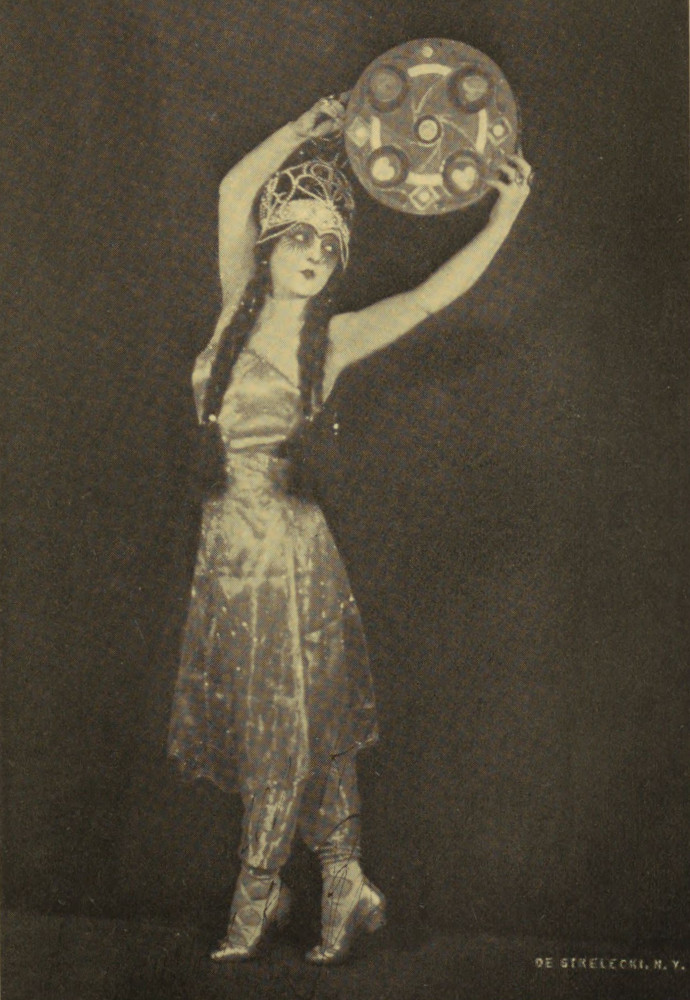
From a photograph by De Strelecki
ROSINA GALLI AS THE PRINCESS IN “LE COQ D’OR”
Caruso is not the only funmaker on the wheels of this Opera Special. Rosina Galli of the dainty, tapering toes and woven paces is always rollicksome. Her imitations would make her fortune in vaudeville. Signor Gatti philosophically reposes after the fatigue of travel and Union League Club terrapin. Scotti munches chicken, resting after his Sergeant Sulpizio rôle, and still strums the Rataplan. Caruso smokes. Friend Scognomillo sleeps with one eye open. Florence Easton, wrung from her triumph as Santuzza, is there. In a compartment sits Geraldine Farrar. She sips coffee. Her mother is with her. So are chicken sandwiches. “Our Jerry” is bright-eyed and keyed up as might be expected. I mention the name “Sid” Farrar, my boyhood’s idol. The ladies become sympathetic. When I stoutly declared that I had never fallen in love with a prima donna during four decades as a music reporter, my “specialty” being admiration of the mothers of singers, the air is charged with interrogation-marks. Why hasn’t some authoritative pen been employed in behalf of the mother of the singer who has succeeded? What a theme! What peeps into a family inferno! I think that Mrs. Farrar could write a better book about her brilliant daughter than did Mrs. Lou Tellegen of herself.
Another time I talk with Frieda Hempel, who is one of the rapidly dwindling race of artists who know Mozart as well as Donizetti. What a Marguerite she would be! On the train she is like her contemporaries. She sits. She chats. For all I know, she may doze. Singers are very human. To fancy them as “gloomy, grand, and peculiar” is to imagine a vain thing. In private they behave like their butchers, bakers, candlestick makers. If they have one weakness peculiar to their tribe, it is never to read newspaper criticism of their performances! This is discouraging for music-critics. But the public likes sentimental flimflam, and the opera singer is pictured as a strange and fearful bird of prey; when seen at close range she is in reality a domesticated fowl. The much-advertised artistic temperament is only intermittent; even arrant bohemians are normal at least twice every twenty-four hours.
The call is sounded. Again New York! A jumble of voices is heard in the smoking-compartment. “If you hadn’t played that trump!”—it is Judels speaking. “Oh!” groans Papa Siedle. Scotti is now whistling the Rataplan. The blond Ordynski, having wished the Polish curse on Otto Weil—“may you have hangnails and dandruff!”—dons his greatcoat. “Addio, Hunekero!” sings Caruso. After refusing Ned Ziegler’s kind offer of “First Aid to Flatbushers,” which means his private car, I find myself alone on the chilly concourse. The hour of disillusionment, three past midnight. I’ve been on and off wheels with Caruso for twelve times sixty minutes. I ponder Flatbush and the possibilities of getting there by dawn. The scrubwomen are at work, a new postwoman saunters along. The luncheon-room cat rubs against me, almost coos with joy. I slink away, being superstitious regarding cherry-colored cats, step-ladders, and cross-eyed theatre managers. (I am writting plays.) Then, resigned to the inevitable, I seek my trusty Glenn Curtiss hydro-aeroplane, which is anchored in the Thirty-third Street enclosure, and fly home to Flatbush-by-the-Sea. I’ve had a crowded and enjoyable day.
XV SING AND GROW VOICELESS
Sing and grow voiceless! Why not? We know of a dozen methods that are guaranteed to ruin even a Rose Ponselle vocal equipment in thirty lessons by mail, better known as absent treatment. We have had over forty years’ experience in the fair land of song, a scarred battle-field strewn with the shards and wrecks of beautiful voices and high hopes. In no sphere of music are there so many sharks, cormorants, swindlers, humbugs, criminals, as in the ranks of vocal teaching—so-called. The hard-earned, carefully saved money of parents is extorted from victims, who usually return home with health impaired, voices gone, even worse. It is pitiful. It is cruel. What are you going to do about it? The profession of medicine is protected. Why not music? Malpractice is swiftly punished. Why not lock up the rascals who ruin a voice and get money under false pretenses? No, chewing gum in public is of far more importance to people; now a national neurosis, it will soon be elevated to the dignity of a Fine Art. If we had our way we should drive every one of these vocal parasites who infest the temple of music into the swamp of public odium.
Now, having worked off my chronic bad humor, let us look at the matter through the spectacles of the absurd. There is a comic side to everything, from a volcano to a prohibitionist. The fake singing-teachers are as funny as their fakery is pernicious.
I am reminded of all the pamphlets from How to be Happy Though Divorced, How to Starve and Grow Fat when I read the pompous pronouncements of certain Voice Builders. I confess that I am not an expert in vocal hygiene, but I have heard all the great men and women for the past half-century who have made this drab, dreary planet worth living on with their beautiful voices. And that is a brevet of taste. Standards. Without standards we critically perish, says, in effect, Mr. Brownell. I also confess that I don’t know a resonator from a refrigerator, or the difference between a lynx and a larynx. Both growl, I believe, if you rub them the wrong way. I have not the science of W. J. Henderson or Holbrook Curtis. But I do know when a singer slathers her phrases or sings above or below pitch—and there are more who sing sharp than you think. The main thing is that I criticise by ear, not with a laryngoscope or a mirror to peep at the breath-control.