Front matter (continued 3)
Reading edition
But now a courtly throng pressed around, a hundred eyes were bent on the embarrassed stranger and her singular companion, a hundred hands out-stretched to assist her in her descent from the carriage. But no sooner had the King himself touched the ground in safety, than he turned, and taking her hand in his, led her slowly up the broad white marble steps into the central hall of his magnificent palace.
She had scarcely time to glance round her ere her royal host, divining both her fatigue and her bashfulness, summoned and gave minute directions to the women of the palace regarding her welfare, and resigned her into their charge. Smiling kindly on their unexpected guest, they ushered her along lofty passages to a chamber widely different from any the simple maiden had ever beheld either in her wanderings or even in her dreams.
Thoroughly overcome by fatigue, and hardly pausing even to partake of the tempting fare presented to her, or to survey the beauties of her new abode, Fidunia sought her pillow. The neat-handed abigails, after preparing a bed for Fido within the recess where stood his mistress's couch, retired, first bidding her summon them at will, as their apartments were close at hand.
Youth and exhaustion soon closed the stranger's eyes, and it was late on the following day before Fidunia could rouse herself completely from her heavy slumbers.
At length a continuous plashing sound mingled itself with her dreams. She thought she was once more in her forest home, and that the little fountain with its clear bubbling waters invited her to her morning bath.
She slowly unclosed her eyes. But no leafy branches spread their matted foliage above her head; lovely rosy curtains fell instead on either side of her soft little couch. She raised herself—surprised and wondering—at her first movement, Fido already on the alert, capered across the tesselated floor, oddly slipping hither and thither on its smooth surface.
She stepped carefully from her alcove, and proceeded on a voyage of exploration. She soon ascertained that the sound of running water was no vain product of her own imagination, but that it came from a recess corresponding to that in which she had slept. Within this niche a marble Triton poured through his conch-shell a continuous stream. On either side the entrance to the snowy basin beneath, a nymph so stood that the roseate curtains could either be held back in their extended arms, or loosened completely to shut off the recess from the rest of the room.
Overjoyed at discovering this welcome substitute for her oft-regretted forest spring, Fidunia swiftly performed her simple toilet.
With all the carelessness of one little accustomed to regard her personal appearance, she hardly even glanced at the magnificent burnished mirror and its costly accessories, but hastened from window to window, eager to become acquainted with her new abode.
Towards the south, connected outside by a shady verandah, three long windows fronted the open bay, commanding the same extensive view that had delighted her the evening before. Two of similar form opened eastward, and Fidunia could scarcely repress a shudder, as raising her eyes to scan the more distant horizon, she beheld, frowning behind nearer slopes of verdant loveliness, the grim mountain of her dreams, whose gloomy boundaries she had skirted on the previous day. A slumberous cloud partially shrouded its dark heights. In the vista of coast, cape, and blue headland lengthening beyond, earth, sea, and sky, melted into one indistinguishable haze of atmospheric beauty.
Easily unfastening one of these eastern windows, Fidunia perceived a flight of steps leading thence into the palace gardens below. Followed by Fido, the fearless child of nature quickly descended the stairs, and plunged into the artificial intricacies of the pleasure grounds beneath.
A thrill of remembrance came upon her. Surely she had trodden these trim-kept walks before, and inhaled the strange rich odour of the blossoming orange that hung heavy on the air?
Stopping, bewildered, she raised her hand to her brow. As she thus stood rapt in thought, the noise of approaching voices apprised her that Antiphates, leaning on the arm of Domenichino, drew near. Swift as lightning, recollection flashed across her. While the impatient monarch came towards her, guided by his servant, she half expected to see and hear the tiny elves who in her forest dreams had swung and sung their eerie refrain amid just such scenes as these.
When the King learned that she had not yet broken her fast, he commanded food to be brought to an arbour near at hand, where he himself joined his guest. He found much entertainment in trying to follow the movements of the little dog, who, summoned by his mistress, went through all his pretty tricks.
With unwonted softness in his voice and manner, Antiphates strove to set Fidunia at her ease, and to engage her in conversation. He led her on to speak of herself and of her previous lonely life. He encouraged her to tell him all that had befallen her since she left the forest.
Domenichino oftentimes listened in surprise. His master, hitherto so hasty and imperious, with rare patience, endeavoured to overcome Fidunia's timidity and reserve. Antiphates even forgot to murmur continually at his own affliction—nay, he felt a certain pleasure in claiming the young girl's assistance, as they wandered together in the gardens, or moved from room to room of the palace.
Day after day glided swiftly away, and life became a fresh pleasure to the weary King as he listened to the strange adventures and artless sayings of the ingenuous maiden. He derived perpetual amusement from her novel descriptions of familiar objects presented to him under a widely different aspect by her humorous remarks.
For years upon years he had existed with all of visible beauty veiled from his sight; and he now conjured up to himself an exquisite ideal of his youthful companion. Her low melodious voice, her gentle touch, and her soft light step, full of grace, taught him insensibly to dream of a far fairer form than poor Fidunia actually possessed.
He became so deeply interested in his new friend, that ere long that interest was merged in love. Morning, noon, and night, he was her inseparable companion, nor could he rest quiet when she was absent from him. He found in her society a nameless charm that tamed and softened his arrogant spirit. With extraordinary humility he learnt to defer to her slightest wish. With unwonted self-abnegation, he laid siege to the citadel of her heart.
Listening entranced to his tender words, there now ensued a period when, for the first time to the guileless Fidunia, if not to her more experienced suitor,
"Love took up the glass of Time, and turned it in his glowing hands; Every moment, lightly shaken, ran itself in golden sands. Love took up the harp of Life, and smote on all the chords with might; Smote the chord of self, that, trembling, passed in music out of sight."
Antiphates soon told the wondering maiden all he had heard in the cave. His thoughts turned continually upon the mysterious prophecy, and they often held sweet counsel together over those singular but well-remembered words.
A dim foreboding of evil in the future, and an intense clinging to the peaceful joyous life of the present, led Fidunia to approach this subject with secret reluctance. An inward voice told her she possessed not beauty's potent charm; yet she felt that to her blind monarch she was all in all. Again and again she had to stifle the rising fear of possible change in his love, and chided herself for unworthy thoughts and lukewarm energy.
With all the eagerness of his impetuous nature, Antiphates constantly recurred to the charge, urging Fidunia to do her utmost to deliver him from his infirmity. In glowing terms he depicted the pleasures of their common existence if he were able, not merely to hear and to feel, but to watch and to guide his heart's beloved through her future life.
As he spoke, the forest maid often felt the hidden talisman rise and fall with the heavings of her tender bosom. Obedient to the donor, she never disclosed its existence, even to Antiphates, or told him of her strange dreams. It needed, however, no small resolution on her part to avail herself of the charm so solemnly committed to her charge by Dame Anna. At length, unable longer to resist the oft-repeated solicitations of her royal lover, she faithfully promised him to exert her feeble powers to the utmost on his behalf.
With a lingering footstep she sought her chamber that evening, filled with awe at the prospect of invoking the aid of her scarce known friend. When all was silent for the night, Fidunia trimmed the classic lamp by her bedside, for it was the new moon, and no light came from without. Watched only by the wakeful Fido, she drew the sparkling prism from its accustomed place. Remembering her instructions, she placed it in the palm of her hand, then bent (for another's sake), on peering into futurity, she resolutely fixed her eyes on the talisman. Swaying to and fro with the intensity of her emotions, she chanted the required invocation:
Strange gem, upon thy crystal core I gaze, the while I aid implore; Trembling upon the verge of fate, Oh, point my path ere yet too late! I fain would gain the boon I ask. Is mine the strength for such a task? Canst thou unloose the links that bind, Or vanquish powerful foes combined? Then show whate'er there lurks of art Within thine own mysterious heart; On thee I turn a hopeful eye, Bright stone of silence, make reply.
The magic stone grew larger and larger. Its brilliant centre, like a searching eye, returned Fidunia's gaze with dazzling refulgence. Heavier and heavier drooped her falling lids, her recumbent form sought more and more the support of her little couch, at length borne down by resistless force, she lay unnerved and motionless.
The lamp became extinguished. All was dark, silent, and blank. Her corporeal frame slumbered inert and passive. But now every spiritual faculty throbbed into keen activity. The whole chamber was filled with soft penetrating light. The kind Anna's well-remembered form stood beside her. With one hand she raised Fidunia on her couch, with the other she pointed towards the south.
To Fidunia's intense surprise, she beheld a ray of moonlight illumine the sombre waters of the Bay of Deva, reaching in one narrow unbroken line to what she well knew as the distant though hitherto unvisited island of Spera. She gazed bewildered from her raised alcove, which commanded an easy view of the landscape beneath, through the wide, open windows.
How could the small silver horn of the newborn moon cast such brilliant light on the dark ocean? She turned a troubled glance towards her unwonted visitant, but her voice was spell-bound; the questions she fain would have uttered died upon her lips. With a sad and solemn gesture her protectress still pointed towards the heights of Spera, then sighed, rather than said these lines:
Far, far o'er the depths of that shimm'ring blue sea, The drops trickle slowly so sought for by thee; Enwrapt by the jealous embrace of the deep, A lake without sky, without motion doth sleep. Though distant, and hidden the shrine of the cave By the busy bright waters its entrance that lave, Yet only the touch of an innocent maiden Can e'er give effect to those drops virtue-laden. At midnight a ray shall illumine the portal All sombre and silent, ne'er threaded by mortal. At midnight, by moonlight, that path can be crossed, By her, who heroic, ne'er counteth the cost. Oh, chilly the ocean, and lonely the hour, Or the charm that thou seekest is reft of its power; And voiceless and mute thine endeavours must be, Or fruitless thy labours and harmful to thee. Yet, maiden, forbear! ere thou challenge the spell Remember—with thee and with thine it is well! In thee and thy love the blind monarch is blest: Then dwell in his palace—Fidunia—at rest.
As the last couplet fell on Fidunia's ears all else became as nought. The dear thought of her first and faithful lover filled her imaginative mind. What recked she of trouble or sorrow to be undergone in his service! Would she not even give life itself for the sake of him who had first called into existence all the passionate but unknown wealth of her unselfish soul! Dreamily she recalled to herself his whispered vows, his ardent tones, and thus from waking dreams slowly fell on sleep, undisturbed and profound.
It was late the following morning before she awoke to the realities of life. As she dressed herself she pondered much over the visions of the night. Was all a dream, like her forest fancies?
She looked everywhere for the talisman, but it was nowhere to be seen. Its absence weighed somewhat heavily on her mind. The reality of her midnight experience was brought home to her, as she perpetually missed the shining stone from its wonted hiding-place.
Fidunia now hastened to her monarch's presence. Considering that the loss of the talisman released her from her promise of secrecy, she confided its whole history to the astonished King. She told him also her waking vision of the previous night. She described Dame Anna's appearance, and repeated some of her words.
Thoroughly roused Antiphates entreated Fidunia to keep nothing more concealed from him. Using all his powers of persuasion he at length drew from her unwilling lips the particulars of her three wild forest dreams.
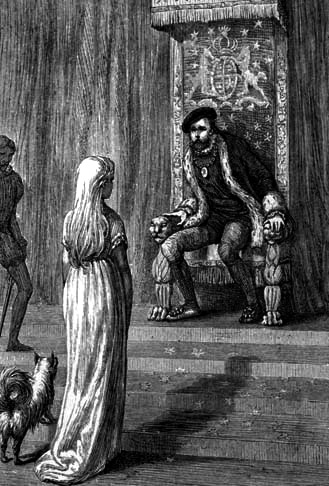
FIDO AND FIDUNIA. "Thoroughly roused, Antiphates entreated Fidunia to keep nothing more concealed from him."—P. 170.
In a voice trembling with emotion he hailed the forest maiden as his predestined deliverer, nor was his eager curiosity satisfied till he had asked innumerable questions. Fidunia sighed as she noted his feverish agitation. Remembering the warning contained in the last rhythmical lines, she feared lest his hopes should be dashed to the ground.
As they sat together in his favourite turret above the castle porch, he explained to her that rumour spoke of a hidden cave in the Isle of Spera. Recalling to mind the line of light she had so distinctly seen across the bay, Fidunia pointed it out as having terminated beneath the highest peak of the island. Antiphates decided that an endeavour to find the cave should be made when the moon next became full. He would fain himself have aided in the search; but Fidunia, anxious to have her mind steadfastly set on the one object of the expedition, persuaded him to remain within the palace, and to allow her to go forth guarded only by Domenichino.
Domenichino secretly hired, as for his own use, one of the boats belonging to a fisherman of Spera. He carefully questioned the men of the place about their island. They all seemed aware of the probable existence of a cave only accessible from the sea, but partly from the dreamy indolence common to those climes, partly from superstition, no one had as yet discovered its entrance. A thousand old legends, however, sung of the hidden beauties of this wondrous grotto, a hundred wild tales were told among these simple people of the magic and wonder-working fountain therein concealed from mortal eyes.
At last the time arrived when, at midnight, Cynthia should reach her cold meridian of beauty. Fidunia resolved to leave Fido for the first time behind her. She committed him to the willing charge of the King, but the little animal, who from the first had taken a dislike to Antiphates, could not be got away from his mistress's chamber. There, extended on the moonlit verandah, he remained during her absence, disconsolate and wakeful.
It was a night of peaceful calm. As the sturdy rowers urged on their vessel, her bows parted the waters into a thousand phosphorescent ripples, which, widening as the boat moved onward, spread into one broad, flaming wake in their rear.
Fidunia carried with her an ancient gold goblet, wherein the King besought her to place the precious drops, should she succeed in obtaining them. Grasping it tightly in her hand, as if to persuade herself she was not dreaming, she gazed awestruck on the overwhelming beauty of the landscape, arrayed in night's fairest covering.
Already distant, the City of Deva lay white and ghost-like under the moon's pale ray. Here and there a gleam of light showed that there were watchers on land, and from the high turret window of Castle Xylina one ruddy gleam shot a quivering reflection far along the ever-lengthening track of their little craft.
Before them the nearing crags of Spera rose abrupt and beetling towards the sky. The boat moved rapidly along. Now became audible the surging swell and low muffled boom of the ocean, ever chafing, ever restless, even when apparently at peace; and ever repelled by those giant sentinels of the deep. Numbers of sea-birds, disturbed by the unwonted splash of oars, wheeled screaming above their heads, and suddenly brought to Fidunia's mind with agitating distinctness the recollection of her second forest dream.
But all other thoughts were merged in the approaching performance of her self-imposed task. They had gradually rounded the opening to a little bay where the water seemed more shallow, and the sea only broke in tiny wavelets upon a small shelf of pearly white sand. Here Fidunia stepped from the boat. Leaving human companionship behind, she slowly paced along the narrow margin. Finally, following the moon-lit line and heedful of Domenichino's oft-repeated instructions, she disappeared behind the frowning ledge of rock which bounded the narrow inlet.
Only a very few minutes after she had thus gone from their sight, they could hear dimly across the intervening waters, the faint tolling of the midnight bells in the great City. In indescribable anxiety Domenichino, who alone (among these rude boat-men) knew her peril, counted the minutes till Fidunia's return, and resolved that at the expiration of a certain time he would at all risks persist in following the unprotected maiden.
But, ere the appointed period had elapsed, Fidunia, with buoyant steps, turned swiftly the dark boundary and rapidly drew near. High resolve sat upon her brow and stamped her features with a noble ardour. Closely clasped to her bosom she held the precious vase, but to no mortal ear might she unfold the thrilling tale of her solitary experience.
Had she within those mystic precincts heard a warning voice which bade her pause ere she dashed the cup of earthly happiness from her lips? How and where had she obtained the crystal liquid that leapt and sparkled in its golden prison? Had she entered the ice-cold waters and braved the wave-engulfing arms of the merry, malicious mer-men, who warily watch, and at the midnight hour have power to bear to their coral haunts the bold earth-maiden who shall step within their native element?
These, and numberless other questions, crowded into Domenichino's mind as he sped to meet her; but she raised her finger to her lips, and with a mute gesture of entreaty silently took her place in the little vessel. The weather-beaten boatmen shrank back as she passed them by, her hair and garments glistening with a thousand rainbow-coloured drops; yet, as she dreamily took her place in the stern, one, less bashful than his compeers, awkwardly placed his rough coat so as to shelter and keep her warm.
The wind had arisen. It swept moaningly around, hurrying dark clouds across the face of the moon, and presently shrouding her altogether from their sight. But the red tower-light from distant Xylina guided the homeward-bound crew, and ere very long they were safely landed below the slumbering City.
Still voiceless, Fidunia, with lagging footsteps, ascended the steep hill. Her energy was gone; she leant heavily on Domenichino's arm, and but for his aid must have fallen more than once exhausted by the way. At last the castle was reached. In answer to her signal the faithful esquire knocked at his master's turret door. An impatient voice bade them enter. Antiphates himself, stumbling hastily to meet them, started as he took Fidunia's cold hand in his. She gently withstood his eager inquiries and solicitude for her health. "Sire," she murmured, "I am very weary, but these poor hands must this night bathe your eyes."
At her words the King, obedient, sank on a couch near at hand, and Fidunia, dipping her fingers into the golden goblet, timidly pressed them again and again over his burning eyelids. Her cool, soft touch soothed his irritated nerves and brought refreshing peace to his restless mind. A strange calm folded its enshadowing wings around those busy brows and wrapt the imperious monarch in a sweet and childlike slumber.
Raising her finger again to her lips, in token of silence, and signing to Domenichino to leave his sovereign for the night, Fidunia quitted the turret chamber and sought her own apartment. Here the listening Fido greeted her approaching footsteps with a whine of delight, and testified his joy at her return by many expressive gambols.
Long into the night she sat on her balcony, acting over in thought again and again the exciting scenes of that eventful evening. It seemed to her she had only just fallen asleep when she was suddenly startled from her slumbers by a loud pæan of rejoicing blown from the castle wall by the silver trumpets.
For a moment recollection failed her, but then glad certainty flashed on her mind, and, as if to make assurance doubly sure, some of the women of the palace, rushing abruptly into her chamber, confirmed the glad tidings. They urged her to arise and dress in haste, for the King could not rest till he had seen and thanked his deliverer in person.
Fidunia hurriedly arrayed herself. Accompanied by Fido, she hastened along the now well-known passages of the palace. She ascended the broad stairs and passed the tall guards in the corridor, with their nodding plumes. The doors of the presence chamber were thrown open before her. On the threshold she stood a moment irresolute. Then, notwithstanding their intimacy, knowing his newly-gained power, she advanced timidly towards the great King. There was a pause, she raised her eyes to his. The monarch seemed transformed! Instead of half-closed, unseeing eyes, and all the accompanying hesitation and uncertainty, two searching orbs now bent their dark majesty full on the bashful maiden. In that one moment she drank in the fatal secret, which no after-words could disguise.
It was but too true!
A passionate adorer of beauty, Antiphates had, during the past months, almost unknown to himself, clothed his unseen love with perfect loveliness. His heart therefore beat high with expectation as her footfall was heard at the door, and when, with her attendant Fido, she entered alone, he could not control the impulse of disappointment too plainly written on his expressive, speaking countenance.
The dawn of light on his long-darkened orbs revealed to him the unattractive colouring and irregular features of the being he had in blindness learned to adore, and no self-command on his part could conceal from love's unerring instinct his change of mood.
Now, however, with well-simulated alacrity, he rose from his throne. Stepping down with a free, unfettered gait, widely different from his wonted stumbling manner, he took the maiden's hand in his own. Pouring confused and hurried thanks into her ear, he led her to the seat where she had passed so many happy hours.
In vain he strove to conjure back the fascination Fidunia once possessed for him. Oh! subtle influence! who can accurately define the thrilling tie that makes the one we love different from all the world beside? who, when the frail chain of enchantment is once severed, can join again those mystic links?
The King and Fidunia conversed in low tones, apparently unchanged: the gay courtiers around at least observed no cloud on the horizon. Waiting within call, they clustered eagerly around Domenichino to hear his adventures of the previous night, and to discuss together the approaching marriage of the maiden, now beloved by all, with their fortune-favoured prince. They recked not of the cold shadow that crept slowly into the little maid's heart, and clouded her fair and hitherto untroubled sky.
Fido alone, close and vigilant, marked the awakening sorrow of his beloved mistress. He felt the hand that caressed him grow cold and pulseless. He noted the accent of despair in Fidunia's choking voice. His unsophisticated nature rose indignant at the selfishness of the human friend, who (after such vows breathed, and responded to by her to whom they were addressed), could change and grow indifferent to the being who had gone through so much for his sake.
How true it is that maidens, like flowers, expand in the presence of him they love, in the warm sunshine of adoration. When that cheering beam is withdrawn, how colourless and scentless, how devoid of beauty, do their drooping blossoms become!
Even so it was with Fidunia, the happy light that had of late dawned in her gray eyes now faded away. Hour after hour she wept alone on her sleepless pillow, sadly musing over times departed,
"Departed never to return."
One wakeful night she poured out her thoughts in these words:
The silent hour of night prevailed, the Earth Was in her first and dewy slumber, while The Moon unveiled her pure and peerless light, And threw her radiance o'er the dusky haunts Of men. An atom on the world's broad breast Alone, beneath those chilly beams I mused, On Death and Immortality. My soul Sped swiftly upward on the ethereal ray, And left enthralled the grosser part of self, The slumbering mortal portion of my frame. * * * * * The spirit world was gained, and for a space Enchantment wove mine aching heart a strange Bright web of many hued delight. She gave To that brief Dream all the reality That made its flying moments passing sweet. The kindly echoes lent their magic aid, And tones reverberated in mine ear Whose music gently whispered rapture, not Of Earth, but of some far-off lovely Land, A Time when all that is not yet may be. * * * * * With trembling sigh, from happiness too great, I all unknowing broke the mystic spell, And shivering back, through dark and dreary ways, No Moon to guide the weary feet, no Light To cheer the falling spirit, once again Within dull clay poor Psyche found her home, And woke to bitter loneliness and woe.
She had in truth a rough awakening from her dream of happiness. As day by day the restless monarch showed more and more the change in his feelings that perfect vision had wrought, Fidunia not only passed through the deep waters of sorrow in realizing his alienation, but experienced moreover a fresh and equally poignant pain as the veil of illusion fell from her disenchanted eyes, and taught the simple-hearted young girl that she could never again regard her monarch with the same trusting faith.
To one of hasty impulsive temperament like Antiphates, dissimulation proved impossible: however much he was bound, alike by the ties of honour and of gratitude, to keep the vows publicly pledged to his deliverer, he could not forgive the hapless girl her lack of outward beauty. He valued not the delicate refinement of her nature. He marked not the ethereal spirit that shone unconquerable through her transparent eye. His affection had been of the earth, earthy; evanescent as frail mortality itself.
Nor was Fidunia's spirit formed in a mould to sicken and die of unrequited affection. In happier days, the happiest of her short life, she had, in spite of the vast difference in their ages, learned to regard the gifted King with something akin to reverential love. The eager wooing of one so talented and fascinating could not fail to produce some corresponding effect on the imagination of the forest maiden. Not unsolicited she had yielded up her gentle heart, and come gradually to centre all the hopes and thoughts of her young life upon Antiphates.
She now grew to spend longer hours each day in wandering round the precincts of Xylina. The child of nature, she ever found her truest solace beneath the wide canopy of heaven. There no walls pent in her labouring sobs, no human eye beheld the slowly falling tears, mourners over a vanished past, that welled up one by one from her burning heart; tears that slowly rising, purified still further her much afflicted spirit, and weaned her soul from the earthly love which for a time had satisfied that strange immortal portion of mortality.
Fido, ever beside his mistress, grew like her, pensive and forlorn. He knew she was in grief, and his mute sympathy gave her comfort, as together they climbed through the mazy wood, or explored the hills that rose behind the castle.
In these wanderings, Fidunia came frequently to a knoll, commanding the lovely expanse of waters beneath. Looking across the broad bay of Deva, the horizon was bounded only by the fair island of Spera, so fraught with memory's brightest records. Here upon a bank of wild thyme, sheltered by the cool olive trees, and fanned by the passing breeze, she pondered over her mysterious lot, and shudderingly thought of the blank untrodden future.
But counsel and comfort already approached. One day as she thus sat, rapt and musing, a gentle voice addressed her; turning half alarmed, she beheld the sweetest face her eyes had ever dwelt upon. That countenance shone with heaven-born beauty. "Sister Angela" (for thus the stranger was called) had also sorrowed, but she had found lasting comfort in the convent of Saint Sebastian. This monastery was near at hand, though partially concealed by the dense foliage and the masses of creepers which clothed its outer walls. Angela had oftentimes seen and yearned over the sorrowful young girl, and at last, issuing forth, ventured to greet her.
She tenderly saluted Fidunia, who, before long, learnt to love and trust her new friend. She soon came daily to seek for guidance and comfort at her hands, confiding to Angela's sympathizing ears the chequered story of her brief life.
Meantime, to add still further to the griefs of poor Fidunia, her little dog disappeared. She first missed him one afternoon as, after long converse with her new found friend, she turned to descend the grassy slopes to Castle Xylina.
During those hours she had formed a high and holy resolution. Alone in the world, she aspired to become one of the sisterhood to whom Angela belonged, and to find an asylum for her wearied wounded heart within the sacred walls of Saint Sebastian.
On reaching the Castle, Fidunia sought everywhere for Fido, but no one had seen him, or could tell whither he had gone. While occupied in threading the long passages and calling anxiously for her missing companion, she met Domenichino hastening to entreat her attendance on the King. Without returning to her chamber to alter her attire, Fidunia turned and accompanied him to the royal presence.
Antiphates met her at the entrance of the hall. In kind yet constrained tones the monarch condoled with her as he heard of Fido's disappearance. He gave orders moreover that the strictest search should at once be instituted throughout Deva and its environs for Fidunia's dear little favourite.
"But now," continued the King, leading her to a deep embrasure, whence could be seen the fair landscape beneath, "I am anxious you should name the day for the ceremony that is to unite the debtor to his mistress, and thus permit me to fulfil my plighted troth." So saying, he carried her hand lightly to his lips, and looked searchingly upon her. But even his bold eyes fell rebuked beneath Fidunia's pure enquiring gaze, now divested of all hesitation or embarrassment. No word of reproach for his altered behaviour towards her, since she had restored his sight, fell from her. No murmur escaped her. But her voice quavered as, in a few simple sentences, she unfolded to him the purpose she had that day formed of taking upon herself the vows of Saint Sebastian.
A sense of momentary shame at his own want of generosity dyed the King's rough cheek a deeper hue. He felt his inability to urge Fidunia with any zest to renounce her lofty aspirations. He strove to conceal his satisfaction, but he knew too well that her voluntary self-devotion relieved him from a perplexing dilemma.
Nevertheless he cast about in his mind for some form of remonstrance; but before he could frame the words on his unwilling lips, she was gone.
Stung to her inmost heart by the inscrutable changes in his variable nature, and already overwrought by the day's emotions, the hapless Fidunia only reached her chamber in time to shut from every human eye her deadly struggle, her last overwhelming battle with wounded mortal love.
Days slowly elapsed without intelligence of Fido, and the arrangements became gradually completed by which, upon the Festival of All Saints, Fidunia was to enter her noviciate.
All Hallow's Eve drew near. On the morrow the lonely Fidunia was to bid farewell to the outer world, and rest her wearied tempest-tossed head within the peaceful cloistered shades.
She sought her luxurious chamber for the last time, and unfastening the window, stepped out on the broad balcony. The glorious full moon once more illuminated with clear cold light each beloved object in the exquisite panorama so dear to her.
Human sorrow asserted its own in the maiden's breast, as in spirit she bade farewell to the slumbering monarch who, for a brief period, had been her sun and firmament, the "all" for which in the forest depths her innocent soul had insensibly pined.
A sudden pattering footstep sounded near, and looking inwards, lo! through the moonlit chamber, approached the truant Fido. In the imperfect light he seemed faint and weary; but Fidunia sprang to meet him, and raised and fondled the little wanderer in her arms, asking him the while many a question about his strange absence, half reproaching him for his desertion.
As she held the little dog close to her breast, rejoicing over his return, she felt something of a novel character around his neck. She gently unfastened a cord, and found attached to it a small phial carefully sealed, yet emitting a wondrous fragrance.
Somehow assuming from her companion's quiescent attitude that the flask was for her own use, she slipped it into her bosom, and forgetting all else, again yielded herself to vague yearnings over the unfulfilled visions of the past. It was long before she stepped from the window, and placing Fido on the ground prepared for her last night's rest in the palace.
As she let down the now lengthened tresses of her thick hair, Fido though evidently exhausted, refused to lie down. Seemingly ill at ease, he watched her every movement with painful anxiety. When at length she drew near the marble bath, wherein she nightly plunged, his agitation knew no bounds, and as in undressing she displaced the phial from her garments he uttered a series of short sharp barks restlessly springing the while backwards and forwards from his mistress to the edge of the alcove. So close was the companionship between Fidunia and her faithful companion, that she at once divined his meaning, and undoing the seal and extracting the stopper from the bottle, she emptied its contents into the water. Scarcely had she done so when the whole chamber became filled with a delicious perfume. As one in a trance, half overcome by the powerful scent, Fidunia entered her bath, and felt at once the extraordinary invigorating power which seemed to emanate from those few drops of liquid.
All sorrow was lifted from her heart. Already in imagination she joined in the sweet praiseful strains of the Sebastian sisters. Angelic forms moved around her, and the moon's pale rays at length guided the weary maiden to her pillow. Stretching out one soft arm over her faithful dog, lying in his cot by her side, and lulled by a foretaste of heaven's own music, Fidunia sank into dreams of ecstatic beauty.
The loud pealing of a thousand bells for the Festival of All Saints at last awoke the neophyte from her deep repose. For a moment she started and half forgot her resting place; but her eye fell upon her little dog. Something strange in his attitude struck her. Startled, she sprang to her feet and bent over him.
His sleep was surely very deep! Yes, Fidunia! sound are those slumbers from which not even the touch of thy beloved hand can rouse his wearied form, or call forth a response from the wistful eyes, wont to hang upon thy lightest gesture.
With an exceeding bitter cry, Fidunia fell beside her lost favourite and vainly chafed his stiffening limbs. As she stooped over him, her eyes swimming in tears, she perceived in the morning light a small scroll lying on the floor by his couch. She hastily raised it, and noted "This for Fidunia" traced upon the outer covering. She tore it open, and through the mists of sorrow that perpetually dimmed her vision, she read these words:
"Sweet daughter, when thou readest this, thy faithful servant will be no more. Know that the little dog, Fido, through many past days and nights hath mourned over thine exceeding sorrow and thy low estate.
"He held thee altogether lovely, but he knew from human fellowship that those who owed most to thy labours, my child, had weighed thine outward beauty in the balance and found it wanting. He watched thine affliction till his own heart went nigh to break; and then, calling to remembrance my counsels and assistance to thee, he left thy side, and through many hardships and with great fatigue he gained once more my little cottage by the wide and spreading common. I made known to him that the gift of earthly beauty could only be thine through the self-sacrifice of one who loved thee to the death. Thy faithful companion hath cheerfully laid down his sinless existence for thy dear sake.
"Heaven guard thee and guide thee, Fidunia!
"Anna."
As Fidunia, penetrated to her very inmost soul by the dying fidelity of her beloved dog, sank again over his inanimate frame, a loud and persistent knocking made itself heard at her chamber door. She had barely time to cast on her outer garments before the palace women, alarmed by her first cry, and hearing no response to their summons, thrust open the door and drew inquisitively near the weeping maiden.
Fidunia rose from her knees, and casting an indignant look on the amazed intruders, she exclaimed, "Behold your thoughtless work! It was through you and yours that my poor dog learnt the small esteem in which his mistress was held, and has thus been goaded to his death."
No answer came from the gathering throng. Awed and abashed, they herded together. Whence came the ineffable beauty that sat upon Fidunia's brow, and cast a radiance over her shining hair? That it was the forest maiden none could doubt, but how exquisitely soft and fair her lineaments, as standing in the morning sun before her dead comrade's couch, she gave vent to her feelings of passionate reproach.
At this moment Domenichino, hastily entering, heralded the King's approach. The news of the death of Fido and of Fidunia's miraculous and new-born beauty had spread like wild-fire through the Castle.
Antiphates, no less bewildered than his subjects, hesitated half awe-struck on the threshold of the young girl's chamber, which he now for the first time proposed to enter. Recovering himself promptly, however, with an imperious gesture he signed to his surrounding people to leave the apartment, and then slowly advanced to the now silent but still weeping Fidunia.
In bygone days, all unknown to the sightless monarch, the very sound of his approaching footsteps had power to suffuse her cheek with blushes. Now coldly conscious of his presence, she stood before him without responsive sign, the loveliest creature upon God's wide earth, the realized ideal of his fairest dreams.
Wrapped in her white morning robe, with her yet unbound hair falling back in rich clustering masses from her pure pale brow and pearly skin of dazzling whiteness; a solemn depth shone from her dark blue eyes, bearing still a wealth of tears unshed; while a faint evanescent colour like the transparent petal of the wood anemone played upon her rounded cheek.
All unknown to herself, clothed in this wondrous panoply of beauty, Fidunia awaited her sovereign's commands. To her unspeakable surprise the monarch seemed overcome with some unbidden emotion. Again and again he vainly assayed to speak; at length, drawing near, he bent his proud knee before her, and in agitated tones besought her pardon.
"Sire," replied Fidunia, "as regards myself, I have little to forgive, but would that my dumb companion had been spared the knowledge that hath cost him his faithful life."
"Oh, Fidunia!" cried the enamoured Prince, "forget these sad weeks wherein we have suffered disquiet, and during which untoward shadows have obscured my vision, and consent, as you once promised, to be my bride. I swear to you, my darling," continued he, pressing closer to the shrinking girl, "that in my love and tender care you shall find consolation even for the death of your poor lost favourite."
With an effort Fidunia extricated her hand from his nervous grasp, and the red flush of indignation mounting higher and higher, she exclaimed, "Nay, my liege, this is neither the time nor the place wherein to renew the vows which of late have sat so light on thy heart and conscience. Here in the presence of the faithful dead, spare me, I pray thee, all reference to the unfaithful past. That chapter is closed for ever. On this morning, with thy free consent, I take upon myself new and holy vows. Yes," repeated she, raising her speaking eyes to the glorious eastern sky, "I am accounted worthy to become the lowly bride of Heaven." And as if in confirmation of her words, a gust of wind brought faintly to their ears, through the wide open window, the glad chiming of the Saint Sebastian bells, ringing in anticipation of the ceremonial of the day.
"Now by my crown and kingdom," whispered Antiphates, in burning ardent tones, "that thou never shalt become, for mine thou art and mine thou shalt remain while I have life and power to keep thee." So saying he sprang to his feet and enfolding Fidunia in his arms, pressed her fiercely to his breast.
Weary and distraught, and well nigh overcome with the struggle, as she felt the loud pulsations of his throbbing heart, and experienced the mesmeric influence of strong earthly passion, the sorely bestead maiden breathed from her fainting soul an earnest prayer for guidance; and her silent petition for aid in the hour of need was answered.
A low strain of music sounded through the chamber, and the reluctant King involuntarily released his trembling captive, as the door slowly opening admitted two by two the veiled and white arrayed sisters of Saint Sebastian coming to adorn their promised novice for the approaching ceremony.
In vain the distracted Prince commanded them to pause in their holy duties, in vain he implored Fidunia to delay even for a day her irrevocable vows.
Borne back by the gentle but resistless force of the sacred band, and secretly abashed at the recollection of his own conduct, Antiphates stood spell-bound, devouring with hungry eyes the peerless beauty of the maid, whom too late, he knew to be the one golden hope of his life. They arrayed her in bridal robes of exceeding splendour. They placed a coronal of blooming orange flowers upon her faultless head.
When all was completed Fidunia, turning to Domenichino, pleaded with him to convey what remained of her devoted servant to the little thymy knoll beneath the olive trees, and there within easy reach of her convent walls, to lay to rest the still beautiful form of the faithful Fido.
Then, stepping aside as if to bid him farewell, she raised and kissed the silent Prince's hand, murmuring in tones that he alone could hear, "while life lasts I shall pray for thee." Ere he could respond the procession slowly re-formed, and descending the broad palace-stairs, swept onwards along the avenue of grassy sward, and through the orange-scented gardens of Xylina to the hallowed precincts of Saint Sebastian on the Hill.
Within the chapel where the holy fathers waited, many had collected to witness the ceremony, but the King and his cortége occupied the places nearest to the sisters and the young aspirant.
Through his intervention her meditations were yet again disturbed, as he besought her once more to turn from her purpose, and to remain amid the outer world as his loved and honoured bride. She steadfastly refused to listen to his entreaties. The service proceeded, and the novice at length prepared to pass through the iron gateway that should now close to all eternity between her and the world without. A ray from heaven fell on her beautiful figure, and illumined her devout features, as she stood waiting to receive the white consecrated veil of the sisterhood.
The long enveloping folds shrouded her from head to foot, and as Fidunia's golden head disappeared for ever from the sight of man, the whole air became filled with the celestial voices of the choir, singing these glorious words,
"She is not dead, but liveth."
EUDÆMON:
OR
THE ENCHANTER OF THE NORTH.
On the eastern side of the Isle of Raasay there still stands a lonely ruin known as Castle Brochel. Perched upon precipitous rocks at the very verge of the ocean, it is easy to imagine how, armed and provisioned, this fortress held its own amid the perpetual warfare of early Celtic times.
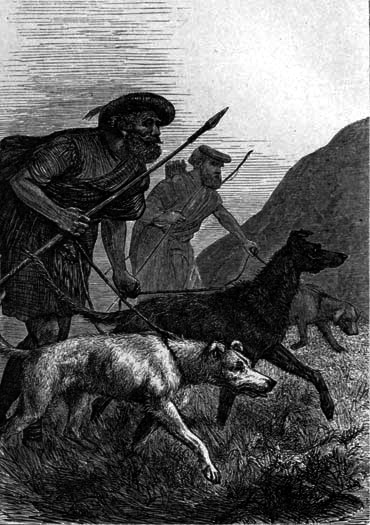
EUDÆMON P. 199.
Castle Brochel has always borne a doubtful reputation. According to tradition, it was originally built with the price of blood, for the ancient legend runs somewhat after this fashion.
Shiel Torquil went forth with his dogs one morning to hunt the red deer on the wild mountains Blaven and Glamaig, in the neighbouring Island of Skye. Shiel Torquil had with him only one retainer, but he was a host in himself, being surnamed, from his immense size and strength, the Gillie More. After some time they sighted a stag. In the ardour of the chase the dogs soon ran out of sight, pursuing their quarry towards the shore at Sligachan.
Now it so happened that the young Kreshinish in his galley was anchored on that side of the island within sight of the beach. He saw the hunted animal about to take to the water, and swim, as deer are often known to do, across the narrow strait which lies between Skye and Raasay. Kreshinish and his men at once landed and took possession, not only of the stag itself, but of the dogs which, panting and exhausted, were unable to offer any resistance.
Shiel Torquil presently appeared on the scene and angrily asked for his deer and his hounds. Kreshinish refused to deliver them up. A bloody struggle ensued, during which the Gillie More inflicted a fatal wound upon the ill-fated young chieftain who unwittingly (at first) had interfered with the sports of another. This brought the affray to a speedy conclusion, and Shiel Torquil with his follower carried off deer and dogs in triumph.
Not long after this the poor old father of Kreshinish came to Skye to seek for the murderer of his son, and publicly offered the reward of a bag of silver to any one who would show him the guilty man. The Gillie More, hearing of the promised guerdon, boldly entered the presence of the elder Kreshinish. Confessing that he himself had slain the youthful chieftain, he urged in self-defence the young man's overbearing conduct in attempting to carry off Shiel Torquil's stag-hounds and game.
The bereaved father, obliged by the stringent laws of Highland honour to fulfil his solemn promise, reluctantly bestowed the bag of silver on the very man who had cut off his only child in the early bloom of manhood. The Gillie More, however, haunted by remorse, and still fearing the avenger's footstep, entreated his master to accept the money and build therewith a retreat for them both.
Shiel Torquil granted his henchman's request. After some time spent in searching for a suitable site, they at last selected the wild easterly shore of Raasay. Here were speedily raised the frowning walls of Castle Brochel. Secured from sudden attack by the inaccessible situation of their refuge, the Gillie More and his master lived in peace for many years.
Their retired habits, and their dislike to intruders, coupled with this strange tale of robbery and murder, caused the Castle, though newly-built, to be regarded with no friendly eye. When they died, it was left untenanted for a considerable time. Many reports were circulated concerning the strange sights and sounds to be seen and heard at the eerie hour of twilight, or amid the silent watches of the night, by the belated traveller who chanced to pass that way by sea or by land.
At the period of which we speak, Castle Brochel had however for some time been inhabited by a being whose origin was partially shrouded in mystery, the gloomy Eudæmon, known as the "Enchanter of the North."
Long years ago, Valbiorn, the wild sea-king, persuaded the lovely Bragela, Sorglan's fair-haired daughter, to fly with him from her home. Terrible was Sorglan's wrath when he discovered that his hereditary enemy had deprived him of his only child, and undying was his resentment. But filial disobedience brought its own punishment. Before very long the restless Valbiorn was once more roaming alone on the high seas, spreading war and confusion in his wake.
It was next rumoured that the gentle Bragela, heart-broken and deserted, had, with her little babe and an old and faithful attendant, one-eyed Donald, taken up her abode in the lonely Castle Brochel. Here she reared her son, within whose infant mind the powers of good and evil seemed to struggle with unwonted energy.
Unceasing were the prayers that the loving mother offered up over her child, for his strange nature caused her many tears. At times he would sit contented by her side, and fixing on her his large dark eyes, listen attentively to her words of instruction and wisdom. Or wandering with her, as soon as he could run alone, over the hills near at hand, he learnt the names and properties of various medicinal herbs, and the hours when they should be gathered to render their use efficacious. Wondrously effectual was the healing touch he inherited from his fair young mother and brought to light in future years.
On other days a mad spirit of wild wantonness seemed to possess the boy. He would destroy everything upon which he could lay his hand, or tear along recklessly over the rugged walls and dangerous precipices on which the Castle stood, where a single false step would have dashed him to pieces on the rocks beneath. If his mother tearfully besought him to return to her, he would burst into loud fits of laughter, and shriek until the very sea-birds flew affrighted from the spot.
When these strange paroxysms seized him, Bragela found that nothing had the least effect upon her wayward child save music. It was wholly by accident she first discovered the soothing charm of melody on his turbulent nature.
One day, after watching his wild antics till her very heart grew sick within her, she re-entered the hall wearied and discouraged. Gradually consoling herself as she remembered how often the young rebel had come down in safety from his perilous haunts, she drew to her the harp, her father's gift in days of yore, which in all her wanderings she had carried with her. Striking chord after chord on its well-worn strings, she at length began to mingle her sweet voice with its thrilling tones. She sang of her childhood's happy home, and her tenderly-loved father, of the still beloved though faithless Valbiorn, of the perils they had together undergone, of the blissful hours she had once enjoyed when the fierce warrior forgot everything save her gentle strains, and lay entranced at her feet drinking in every word, and whispering in ardent tones that "her voice was as that of the angels in heaven."
She would have sung on of sorrow and forlorn solitude, but voice and heart alike failed her. Clasping her arms around her cold harp, the forsaken Bragela bowed her head on its shoulder and wept aloud.
But a little rough hand was laid upon her neck. "Mother, mother," whispered her boy; "you must not weep, you are not forlorn or lonely, for I am here to care for you, and to protect you."
Surprised and touched, Bragela turned to look upon the child. The wild light had died out of his eyes, and in its place shone through those brilliant orbs the tender protecting instinct of his sex. He drew closer to her, and pressing his little curly head on her soft bosom, he murmured, "I am sorry, mother dear; forgive me this time."
Poor Bragela gladly folded the young truant to her heart. Henceforward she derived unspeakable comfort from this new influence over his boisterous spirit. For his sake she cheerfully resumed the art she had deemed laid aside for ever. When the wild fit again and again returned upon her boy, she would even carry her harp into the outer court. There inuring herself, with all a mother's courage, to behold without shuddering his maddest freaks, by her sweet singing and playing she gradually lured him to her side, and awakened his better self.
These happy days, however, could not continue for ever. Eudæmon's mother had gone through too many trials, and was of too tender a nature to endure such grief with impunity. There came a time when the gentle Bragela laid down her wearied head to rest; her dim eye kindled not with affection when her terrified boy bent over her, her cold hand for the first time gave him no responsive caress. Her sorrows were over, but loud and long were the lamentations of her child; thus left alone with one poor old man and his faithful dog Luachan.
At dead of night strange lights and sounds arose about that rugged dwelling. Watchers at a distance beheld the lonely castle enveloped in fiery smoke. Amid the wreathing vapours a figure of unearthly proportions carried to the sea a white-robed form with long flowing hair. The repentant Valbiorn, too late to save, or even to hold converse with his neglected Bragela, bore to his immortal home her precious remains. There he was able by his magic skill to endow her inanimate body with the semblance of life. He mournfully placed the beautiful image in the vaulted halls of Thuisto, where he could for ever gaze on the fatal beauty that had brought such misfortune on its possessor.
Valbiorn tried every art to persuade his son to accompany him; but before her death Bragela had warned her child of the cruel nature of the sea-kings. She told him of her humble trust that notwithstanding her early disobedience (so heartily repented of), her soul might ascend to heaven, and though the still heathen Valbiorn could take her body, yet she felt her spirit would be safe with Him who gave it.
She explained to Eudæmon that if he came under his dread father's influence, the sea-king and his wild companions would strive their utmost to make him forget and neglect her careful instructions. She entreated him to be steadfast in his resistance to temptation, prophesying that eventually he might even have the great happiness of rescuing his father from the darkness of heathendom; if only he lived on in faith and simplicity, serving his unseen but all-powerful Maker, studying the books she left him, and endeavouring as best he might to help the poor ignorant Highlanders around.
The crafty Valbiorn finding all his endeavours powerless to persuade Eudæmon to quit his abode of safety, resolved to destroy his disobedient son and his refuge at the same time. But here the loving mother's foresight helped in the preservation of her child. Among the other treasures carried by the fugitive Bragela to Castle Brochel, were some fowls of the famous breed first reared by the witch Fantunina, which by their watchfulness are able to protect their possessors from the powers of evil.
Night after night, therefore, when the emissaries of the baffled sea-king strove to destroy the Castle by fire, the magic cock, ever on the alert, flapped his wings and loudly proclaimed the approach of danger. Then Eudæmon arising from his lonely couch, wrestled in silent prayer until the first faint streaks of daylight in the eastern sky showed him that night's dominion was over. Thus baulked of his prey, Valbiorn withdrew in a terrible tempest to Thuisto, nor did his son again hear of him for many and many a long day.
A considerable period elapsed, during which Eudæmon grew apace in stature and in knowledge. He not only studied the many books of magic lore left to him, but he also learnt marvellous lessons from Nature herself. In his lonely isolation he had leisure to attend to what our common mother is ready to teach us all, would we but tarry awhile in our busy lives and hearken to her still small voice.
Separated by his birth and dwelling-place from mankind in general, Eudæmon strove to benefit the few he could befriend. The island people, as a rule, rarely beheld him. But in sickness or trouble they ever turned (tremblingly, it is true) to the Castle gate, where they waited while the trusty Donald apprised his master of the presence of the suppliants without.
Strange cures were wrought by the simple remedies Eudæmon compounded from the various herbs and minerals his mother had shown to him, or with which his studies had rendered him familiar. To seek these herbs at a propitious time, the youth issued from the Castle at dead of night, with his faithful Luachan, and traversed the hills till break of day, when, wearied, and full of sleep, he often, on his return, passed the daylight hours in repose.
He was, moreover, a keen and unerring marksman, swift and sure of foot, and of iron nerve. The shuddering Highlanders sometimes marked his eager pursuit of the wild goats, which at that time abounded in the island. Master and hound seemed alike dauntless and fearless in the chase, and whether from his early love of climbing, or from his mixed descent, it is hard to say, but it is very certain that Eudæmon and his dog were often seen scrambling across the beetling crags that overhung the sea, in places where no human foot has trodden before or since. He and Luachan also knew where the golden eagle built her eyrie. He even caught and tamed a young nestling, which loved Castle Brochel as its home, and would only feed from her master's hand. With Donald's assistance moreover he had constructed a rude boat, in which they went forth occasionally to seek a portion of their subsistence by fishing.
Passionately fond of companionship, and denied that of his own fellows, Eudæmon, by dint of long perseverance, collected around him a motley variety of animals. Tame seals lived on the rocks below his dwelling. In perfect security around and beneath the Castle walls roosted and nested a perfect colony of sea-birds. A little flock of goats amply supplied the three inhabitants with milk; while conies, blue hares, domestic fowls of various kinds, and last, but not least, serpents, from time immemorial the emblems of wisdom, throve and multiplied within the precincts or in close proximity to Eudæmon's home.
In those remote times, it is not surprising that old Donald, with his queer, misshapen figure, and solitary glaring eye, his youthful master, so wise beyond his years, and even the poor collie Luachan, whose sagacity was far above the average, were one and all regarded with some degree of superstitious mistrust.
It was said, that in the little turret chamber, highest in the Castle wall, from which at night streamed forth a ruddy ray of light, Eudæmon held converse with visitants from another world, and that many a storm was concocted and wafted abroad by their dark agency.
While the young student strove anxiously to benefit the cases of sickness brought before him—sometimes, indeed, spending whole nights wrestling face to face with death, by the side of some poor peasant's bed—a few of the people were ungrateful enough to attribute his cures to magic art and to an unholy alliance with the powers of darkness. Some humble hearts, however, throbbed with responsive gratitude at the very mention of his name; and there was one mother who, though the King of Terrors had proved too powerful for his adversary's skill, never forgot the tear of sorrow that fell from the young man's eye, as, after long watching and many unavailing remedies, her bonnie bairn breathed out her innocent life in Eudæmon's arms.
His fame was gradually bruited abroad, and as years rolled on he became widely known as "the Enchanter of the North."
From all the surrounding districts the inhabitants flocked in boats to seek his advice. Fishermen asked for charms, to ensure a successful summer. Ere the sailors put to sea, they deemed themselves lucky if they could secure one of Eudæmon's so-called "amulets" against disaster. These were, in reality, small bags manufactured and sold (in private) by the one-eyed seneschal, whose master would have been sorely displeased, had he discovered the chaffering trade driven in "charms" by the cunning old man, who thus rivalled Gehazi of ancient times!
Now it chanced that about this time there dwelt on the Lowland Borders, a King and Queen of Clutha, whose only daughter was afflicted with a terrible misfortune.
The Princess Miranda was beautiful as the day. Her parents, who had long lived in the bonds of matrimony without possessing any children, felt inexpressible joy as they welcomed their sweet little girl into the world. Bells were rung and bonfires lighted upon all the hills on either side of the river Clutha, which ran through her father's domains. Everything went on propitiously, until, in an hour of woe, it was discovered that the infant Princess could not speak!
This dire and unexpected calamity threw the whole Court, and indeed the nation at large, into deep distress. All, both high and low, heartily sympathized with the grief-stricken parents. Philosophers, astrologers, physicians, and wise women were each consulted in their turn; but all, alas! in vain. At last, in desperation, the unhappy parents even offered the hand and dowry of their daughter as a reward to any man who should be fortunate enough to set her tongue at liberty.
Years rolled on. The King and Queen were disappointed in their hope of other offspring. Their feelings became more and more bitter, as they reflected on the confusion that would inevitably arise, should they die, and the dumb Miranda be called to the throne. They feared, with reason, that wicked men might take advantage of the Princess's helpless condition, and wrest the crown and kingdom from her hands.
Ambassadors from many surrounding countries were attracted by the beauty of Miranda's portraits, carefully and widely disseminated by her prudent mother. One by one, however, these envoys disappeared, on finding that the beautiful Princess, though possessed of every other charm, was dumb.
The King and Queen, to soften as far as possible their child's misfortune, gave orders that her play-mates and attendants were always to address her in writing. All at court were told to conceal from the Princess as much as possible the difference between her own condition and that of the maidens around her.
The consequence of these ill-judged regulations was that the Court of Clutha became almost as silent as the grave. Even musical instruments—with the exception of the fife and the drum, necessary for military and state occasions—were completely banished from the precincts of the palace, to save the youthful Miranda from discovering what it was to be without a voice for singing or speaking.
Under these circumstances it is not to be wondered at that foreign courtiers found King Murdoch's Court insufferably dull, especially as the lovely Princess, herself a prey to melancholy, spent the greater part of her time amid the wild moors and glens surrounding her father's castle, where at least she could uninterruptedly listen to the sounds of Nature. The sweet singing, or startled calls of the various birds, the rippling and murmuring of the rushing waters, the ceaseless humming of the insects, the sighing of the wind among the leaves and branches of the trees—each and all she heard and learnt to love.
Among the ambassadors referred to there was one representing a Prince, whose ardour could not be checked by the Princess's cruel misfortune.
Some short time before the period of which we speak, the King and Queen of Clutha, accompanied by their daughter, paid a visit to the Queen's sister, a powerful Princess in Ireland.
Left early a widow, Queen Hildegonda had long since forgotten all the softer charms of womanly nature. Forced, when hardly more than a girl herself, to protect her infant son, Prince Eochy, the heir to his father's wide domains, from the continued assaults, not only of neighbouring chieftains, but also of rebellious and usurping subjects, she had become a very amazon. By her wise and judicious regency, she had secured a peaceful rule for her son. But when the time came for him to take his rightful place, the proud mother could not bring herself to resign the reins of power. Eochy, as effeminate and weak as his mother was masculine and daring, willingly yielded to her the responsibilities of government, and passed his life in idle poetical dreams and frivolous amusements.
On Miranda's appearance, however, the susceptible Prince, as might have been expected, was captivated by his fair cousin's matchless beauty. In vain the maiden's parents bestowed upon Eochy their own approval. In vain the enamoured youth besought his mother to favour his suit. Hildegonda, inexorable and unyielding, declared that no dumb Queen should ever reign in Cashel, and commanded her son to retire to a distant province until his relatives had departed.
Murdoch and his spouse lost no time in quitting with their daughter these inhospitable shores. When they once more reached home, they were roused by Hildegonda's insulting behaviour to attempt still more earnestly to unravel the cruel mystery that bound the lips of their beautiful daughter.
In the meantime the hapless Eochy utterly failed to make any deep impression on his cousin's heart. He languished in all the misery of unrequited love, and continually breathed forth his lamentations in odes and poems such as this:—
"What though I be King of the Emerald Isle, And my Court in its Castle with beauty be bright, To me it were brighter by far could the smile Of the one I remember but gladden my sight. "Ah yes! I remember too faithfully yet That evening and all its enchantment to me, That silvery wreath I shall never forget, That star-spangled Maiden from over the sea. "I had gazed on the snow-mantled vale as it lay In the silence of morning all spotless and white, And I wished that unchanged the fair prospect would stay To delight me, no sunset, no evening, no night: "But the evening would come, and with evening a glow So rosy and glorious and delicate shone, Bright Phœbus, I vowed, must be wooing the snow, And I envied the sweet bridal blush he had won. "I had gazed on the ocean so calm and serene, The breezes seemed hushed to be watching her sleep: I whispered, could mortal imagine a scene More sweet than the peacefully slumbering deep? "But the sun shining forth, on a sudden there grew Such a change, every ripple seemed laughing and glad, Such a dazzling and glancing of golden and blue, I wondered it e'er could seem slumbering or sad. "Sweet, when I had met thee the charms were united, The snow of that morn of that evening the glow On thy cheek and thy brow,—Oh, I would they were plighted To me, as they were 'twixt the sun and the snow! "And the laughter of ocean I saw in thine eyes, When a light from within had enkindled the flame,— How I wished I knew what might be worthy the prize Those fair joyous glances for ever to claim! "Let them boast that the daughters of Erin are bright, Let them sing their wild songs to the maids of Kildare; I'll sing, and I'll sing till they own I am right, There's a maiden in Scotland, a maiden more fair!"
When Miranda received by special messengers these and other similar effusions from the love-sick Eochy, she conjured up before her mind's eye the sandy locks, the unmeaning grey eyes, the ungraceful lounging figure, and the good-natured but facile countenance of the effeminate young Prince. She smiled to herself as she contrasted him with the ideal hero of her imagination, sprung from the well-remembered tales of the dark impetuous sea-kings of the north.
About this time the King and Queen heard of and resolved to consult the oracle at Cumbrae for their afflicted daughter. They hoped to gain from the shrine of the far-famed lion some insight into her dark destiny.
After they had offered the richest gifts, and personally invoked its mysterious aid, the oracle returned the following enigmatical answer to their prayers, nor could the utmost entreaties gain from it any further explanation:—
"The Eagle that soared o'er Kyle Akin's swift strait, Hath wooed and hath won the soft dove for his mate; Affliction hath wearied affection to rest, And cold is the heart in that mother's fond breast. "The strange freaks of fate in one web have entwined, What the Eaglet and maiden alone can unbind; By chequered adventure, and music's soft thrill, The compass shall aid in deliverance from ill. Arise and speed northward, the prophet hath spoken, Miranda's long silence by love shall be broken."
Enquiries were at once set on foot regarding the mysterious "Eaglet" mentioned by the oracle. It was discovered that a certain Enchanter of the north named Eudæmon, was sometimes called "the Tamer of the Golden Eagle," and was indeed by some supposed to have been reared in an eagle's nest. The hopes of the afflicted parents rose high as they listened to the wondrous tales told of the great Enchanter's power.
A gorgeous galley was forthwith prepared wherein the King and Queen with their daughter embarked, taking with them but a slender retinue, for it was rumoured that the wise man lived secluded from his fellows, and would not brook intrusion. A small flotilla to protect and watch over the royal vessel received orders to hover near, but on no account to come within sight of the wizard's castle, for fear of exciting his displeasure.
The voyage was long and perilous. Autumn had already far advanced. Equinoctial gales lashed the western sea into swelling billows, so that after struggling with difficulty up the stormy sounds of Mull and Sleat, the galley containing the Princess and her parents, at length became separated from all her convoys and stranded on the western coast of Raasay. The King, Queen, and Princess barely escaped with their lives; their attendants also were saved, but the choice treasures intended to propitiate the Enchanter were carried by mermaidens as spoil to the palace of the sea gods.
Drenched and perishing with cold, the unfortunate voyagers were rescued from the bleak shore, and hospitably entertained by the poor islanders, who little imagined that in these storm-beaten mariners they beheld the great King Murdoch, the wise Queen Margaret, and the unfortunate Princess Miranda.
It is true that the Queen, with that prudence and forethought which occasionally guided her smaller actions, had caused her chief dresser to sew their three second-best Crowns into a small package, which was still attached to her belt and concealed by her dress, but with this exception (which seemed of little practical use), nothing remained to mark the exalted station of the royal wanderers.
Great, however, was their satisfaction to find that they were shipwrecked on the very island where the Enchanter of the North had his lonely abode. They made many enquiries concerning him, and heard that his actions were beneficent, and his cures almost certain. They were, nevertheless, warned by the islanders that nothing more excited his indignation than the presence of many people at his gate. He had, indeed, been known to refuse aid altogether to their comrades, who, from superstition or folly, had gone in numbers to beset the Castle entrance.
It was now therefore customary among these simple yet considerate people, to convoy the suppliant within a short distance of Castle Brochel. They then remained waiting on the hill above, while their fellow descended and returned. So universal had this practice become, that a small shieling was gradually thrown together stone upon stone by islanders waiting on different occasions for some friend below; exposed for the time being to all the inclemency of that most variable climate.
Here then the King and Queen waited while their beloved daughter (bearing with her the white and silver tablets by means of which she was wont to communicate with others) was told to present herself at the wicket-gate of the Castle. She was moreover given money wherewith to propitiate the much-dreaded Donald—the stern one-eyed guardian of the Enchanter's abode.
It was one of those days in early November when the exquisite "Indian summer" sometimes casts a perfect halo of beauty over the "soft" north-western atmosphere of Scotland. The little group paused on the eminence immediately commanding the tall gaunt building below. In reality, the Castle top was above them; but to gain access to its portals, it was necessary to descend to a considerable depth, and then remount by a narrow cause-way to its frowning door.
The afternoon sun gilded the turrets with golden radiance, beyond slumbered the blue rippling waters, calm and treacherous, giving no sign of their cruel strength. Far in the distance like faint clouds, lay the curving outline of the Highland hills, tipped with snow, and dimly visible as they blushed pink in the parting rays of the monarch of day.
The last farewell spoken, and the afflicted child tenderly pressed to her parents' hearts; the gentle Miranda, with slow footstep, descended the fateful path.
In the meantime Eudæmon, by his consultations with the stars (an art partly taught him by his mother, who had carried away for her child, when she escaped from Valbiorn's terrible dwelling, strange manuscripts of astrological and magic lore), had become aware of the impending visit of a being whose fate was mysteriously connected with his own.
He was absorbed in abstruse calculations when Luachan, suddenly pricking up his ears, and impatiently scratching at the door, gave notice that some stranger approached the castle. On his master's unfastening the latch, the fleet animal made one bound, and disappeared down the narrow staircase, while the magician heard old Donald's querulous quavering tones raised high, as if to refuse admittance. Quick as thought Eudæmon sprang lightly after his dog, and entered the hall, where an astonishing sight greeted his bewildered eyes.
A maiden of surpassing beauty had evidently made her way into the Castle when the seneschal was off his guard. She now stood irresolute in the centre of the apartment. Luachan, contrary to immemorial custom (for, as a rule, he was surly to strangers), gambolled around the beautiful unknown with extravagant gestures of affectionate welcome, while the one-eyed Donald, shaking in his hoary wrath, poured forth an incomprehensible flood of Celtic indignation.
Eudæmon rushed forward, and signed to the old man to hold his peace, then turning to his fair visitant, he gently asked her will. Miranda, amazed to behold in the dreaded Enchanter no ancient, withered seer, no venerable prophet, as she had anticipated, but the dark-haired ideal of her wild dreams about the sea kings of the north, remained rooted to the spot, ashamed of her wilful intrusion and covered with burning blushes.
Eudæmon gazed, like one entranced, on his mysterious guest. Her long golden tresses, and her exquisite beauty of feature and form, startled the recluse of the rock. At first he almost imagined her to be of angelic extraction; but her unmistakeable confusion betrayed mortal birth, and in bolder tones the Enchanter again requested her to make known her wishes.
The Princess, seized with sudden terror, looked towards the door by which she had entered, but it was closed, and Donald stood before it, glaring at her angrily with his solitary orb. In her distress her hand involuntarily sought the tablets, where she now remembered that she herself had written the following explanatory lines, during her long and tedious journey from the south. With a bashful half-smile, therefore, she unclasped the ivory pages from her side, and timidly handed them to the Magician, who there beheld inscribed these lines.
"Hearken mighty seer, Eudæmon, Tamer of the golden Eagle, Aquila the golden Eagle, Hearken, merciful Eudæmon, Measurer of the raging tempest, Of the unseen raging tempest, Hearken to a lowland maiden, To the silent maid Miranda To the sad Princess Miranda. "I am come from Clutha's waters, From its distant tranquil waters, Where through changing isles of sunshine, Looms the ocean, where the west wind Rustles through the matted foliage, Or, with a delicious shiver, Sweeps along the silver beeches. I am come to sea-girt Raasay, To the wave-washed island Raasay, To the storm-swept, rugged Raasay, I have braved Kintyre's wild headlands— Braved its mountain-rising billows, Braved dark Cory-Vreckan's whirlpool, Braved the fortress of Artornish, Braved the fabled Ardnamurchan, Ship-engulfing Ardnamurchan, Braved the blasts from Scuir-na-gillean, But to plead with thee for succour, Aid against the fell enchantment, Terrible unknown enchantment, Which hath bound my lips to silence— Gloomy unresponsive silence. Maidens' mouths were made for singing, Song and laughter are their sunshine; Cheering thus the world around them, Wakening mirth with voice melodious. Pity, then! oh, great Enchanter! Pity the poor spell-bound Princess, Silent, sorrowful, dumb maiden, And with pity give assistance, Read the tale she cannot tell thee, Charm the woes no sighs can cure."
Eudæmon perused the tablets with eager attention more than once, then, turning a keen, piercing eye on Miranda, he exclaimed.
"Princess! I do not now hear of your misfortune for the first time. I knew that you and your parents were in search of me and of my castle. During my researches and observations I have discovered that the conjunction of stars at your birth left one unfavourable moment. This was taken advantage of by Valbiorn to avenge upon your innocent lips a grudge he owed to your father, having been, in days gone by, an unsuccessful suitor for your mother's hand.
"By much careful study of the heavens I have ascertained that the enchantment can only be dissolved by my aid and that under very difficult conditions. Rest assured, however, that no effort on my part shall be wanting to set you free. But," continued Eudæmon, bending low before Miranda, "will your parents consent to remain under my humble roof a while, since what we must go through together will take days, if not weeks, to accomplish?"
The Princess joyfully clasped her hands, and while tears of joy ran down her fair cheeks at the prospect of deliverance, she inclined her head over and over again, to intimate that her parents would thankfully accept Eudæmon's welcome invitation.
The Enchanter now offered his hand to Miranda, and while Luachan testified his delight by bounding around them, led her through the Castle gate and accompanied her in search of the King and Queen. With all the unreasonableness of human nature, these potentates advancing to meet them, half expected to hear their daughter already speaking. They graciously accosted Eudæmon, however, and anxiously listened to his explanations.
It was finally arranged that the Queen and her daughter, with their solitary waiting-maid, (much to Donald's disgust), should be installed in a part of the Castle now never used, but where were still to be seen, when the doors were unlocked, the last traces of the gentle Bragela's feminine occupations. The islanders cheerfully lent what aid they could, and King Murdoch with his attendant was permanently fixed in the small shieling on the hill. It was impossible to accommodate him in the Castle, for though lofty, its proportions were narrow and cramped. Except to sleep therefore he very seldom left the precincts of Eudæmon's dwelling.
For several days and nights the Enchanter shut himself up alone in his high turret, examining dusty old volumes, and reading the heavens, by the aid of an instrument he himself had constructed. At the end of that time he emerged from his solitary chamber, descending with eager rapid step to join his guests at their evening meal. He bore under his arm a small box and a piece of board roughly marked in squares of two colours. His dark features wore an expression of anxious excitement.
No sooner had the last traces of the repast been cleared away than Eudæmon placed his board upon the table. Opening the box he then displayed to the Princess's delighted gaze a number of little men of various sizes and shapes. These were in fact neither more nor less than a set of chessmen which he had laboriously carved in wood with his own hands, and stained in two different colours, having ascertained the mode of using them from the careful study of ancient manuscripts.
Long before the Princess Miranda appeared in Raasay, Eudæmon had known and pondered over the mystic answer returned to her parents by the Cumbrae oracle. He diligently sought among his mother's ancient volumes of magic lore for some solution of the phrase "chequered adventure." At length he came upon the description of the ancient game of chess illustrated by rough drawings.
His attention was at once arrested by discovering that this game must be played upon a "chequered" board. After careful research he finally resolved to make the trial. It took him, however, a considerable time to fashion the various pieces from the old pictures he possessed.
The Princess, her countenance lit up with curiosity and interest, was soon seated at the little table opposite the Enchanter. Several evenings were spent in teaching her the various moves of the different pieces, and explaining to her the rules of the game.
Eudæmon was fully aware that only one hour during the twenty-four was available for the purpose of disenchantment.
Some evenings later the King and Queen, already grown somewhat sleepy, nodded drowsily in their chairs. The faithful Luachan lay between his master and the fair young guest, whose bright eyes gleamed with unwonted animation. Then the dark Enchanter arising from his seat trimmed the torch above their heads, and prepared, at midnight, to play in earnest the mystic game, so fraught with meaning to the afflicted Princess.
Miranda sat in an old-fashioned chair of curiously carved wood. Her white dress and her fair tresses reflected the flickering light, thus giving some brightness to the lofty hall, whose gloomy proportions were but partially revealed by the blazing fire and the fitful glare of the torch. The most profound silence reigned in the chamber, only broken by the cheerful crackling of the firewood or an occasional snore from the slumbering King.
Fully instructed in the moves by Eudæmon during the previous nights, the Princess and the Enchanter played an interesting game. He had cast aside his long upper robe of black velvet and showed the tightly fitting red under-suit which set off his active form to greatest advantage. He placed himself on a somewhat ricketty "creepie," for the unwonted number of guests had used up all his available chairs. As he bent eagerly forward the ruddy light fell on his swarthy face, and his small closely cropped, though curly black head. His burning eyes fixed alternately on the game, and on his silent opponent, seemed to pierce through all they surveyed.
The hour wore on, they exchanged several pieces. Eudæmon then moving a bishop, placed his antagonist's king in "check." He uttered the prophetic word. Miranda, thoroughly absorbed, took up her King, and was about to place him within range of her enemy's Queen. The Enchanter gently motioned her hand aside, pointing to his own piece in explanation.
At this moment Miranda broke into such silvery peals of laughter, that Luachan, affrighted, sprang barking from his resting place. Eudæmon in his surprise and delight moved suddenly and upset the whole board incontinently on the floor, ruining the game. Queen Margaret starting up, rushed across the hall. She first held her child at arm's length as if to examine into and convince herself of her identity, then clasping her tightly to her heart, shed tears of gladness over her laughing daughter. It was indeed evident that the "chequered adventure" had fulfilled its mission, and broken the first link in the silent Miranda's chain of enchantment.
The excited parents knew not how to express their feelings of gratitude, but listened in wondering astonishment to Miranda's ringing peals of laughter, as, enraptured with her newly gained accomplishment, she danced round the hall, accompanied by Luachan, who vied with her in gambols of ecstatic joy. Eudæmon had never before beheld anything more graceful than the young Princess appeared to him in all her unconscious beauty of movement.
Inspired by a sudden desire to emulate and join in her mirthful steps, he stretched forth his hand as she passed him; she swiftly caught it, and drew him merrily on; thus maid, master, and dog together paced a wild impromptu measure of delight.
Donald, hastening in to ascertain the cause of this unusual commotion, gazed around, rubbed his solitary eye, and looked again and again. Where was the gloomy Eudæmon, the dreaded Enchanter of the North? The youth heretofore so staid and reserved now flushed and laughing, pirouetted round the bewildered old man with the smiling maiden. Together they clapped their hands at his amazement.
But now the Queen, with the dignity of manner that she well knew how to assume, bade her daughter remember who and what she was. Forgetting her late gratitude to their benefactor, she swept haughtily from the apartment, followed by her husband and her unwilling child. Miranda's pleading eyes, however, gave Eudæmon the thanks he most cared to receive, and entirely obliterated from his mind all thought of resentment against her uncertain parents. At the same time he determined to take no further steps until the King and Queen themselves again spoke of their daughter's affliction.
Several days elapsed. The character of the Castle was completely changed. The hitherto hermit like Eudæmon felt impelled to try and elicit again those silvery peals of laughter that rang on his ear with such a curious thrill of pleasure. Nor was he unsuccessful in his efforts. Again and again the old walls re-echoed with the welcome sound. The Enchanter himself felt once more a boy as he played long games of chess with Miranda, or pointed out to her his numerous pets and their diverse habits. The Princess, however, was admonished to keep carefully within her mother's sight; she wast herefore unable to scramble with him as he wished among the wild hills and cliffs around.
But the time flew swiftly by, and at length one morning the King and Queen craved an audience of their young host. Laying aside all traces of their late assumption of majesty they humbly entreated him to strive to work out still farther their daughter's cure.
Eudæmon listened in silence, fixing on them his piercing dark eye, until they moved uneasily beneath his searching glance. "I am esteemed worthy to aid in your child's disenchantment," he answered sternly, "but am too much beneath her in your eyes to tread with her the mazy measures of the dance, or to join in her everyday pursuits."
King Murdoch and his wife eagerly disclaimed any idea of making so ungenerous a return for his kindness. At length Eudæmon (who completely saw through their shallow minds, and only spoke to obtain more freedom for their daughter) promised to continue his lucubrations.
That evening for the first time since her death, he drew from a deep recess the dust-covered harp that had once quivered in responsive melody beneath the musical touch of his fair young mother. Miranda and the Queen curiously examined the quaint instrument, and helped to disentangle and divest it of its broken strings. Eudæmon, who had often studied its mechanism, brought forth new strings he himself had manufactured, and showed Miranda where and how they should be placed.
Several evenings passed in putting the harp to rights, then the Princess under Eudæmon's magical tuition strove to place aright upon it her slender fingers. Morning, noon, and night Miranda strove to play the melodies that ever floated before her mind's eye as sung to her by Eudæmon, who placed beside her scrolls, on which the words of the songs were written out.
One of them ran thus:
Thou speak'st of to-morrow, yet seemest to sigh, And something there gleams like a tear in thine eye, But though the sweet days of our converse are o'er, The friendship that binds us shall cease nevermore. When music entrancing shall steal on thine ear, And songs shall be sung thee thou lovest to hear, Oh, may one wild note of my harp seem to thrill, And recall to thee one who remembers thee still. And ever amid the dark shadows of life, When faint from the battle or weary with strife, Ah! then shall arise like the sun through a shower, The remembrance of all we have felt in this hour. When moonlight around thee shall flood the pale sea, May thoughts of the north come like visions to thee, And remind thee of hours when we once used to stray, By the ocean's dark verge at the close of the day. Roll onwards, roll onwards, thou swift flowing Clyde, Yet may our loved friends ne'er resemble thy tide, But changeless and steadfast look back through long years, To the parting that left us in silence and tears.
This song, which Eudæmon had himself composed, and set to an old tune, was an especial favourite of Miranda's. She made the Enchanter sing it over again and again; though, strange to say, the master who taught her fair hands to stray over the harp, could not himself draw one sound from its capricious chords. The Princess, however, soon became enabled to accompany all his songs, every day she learnt some new, and to her more entrancing, melody. For it will be remembered that her parents had hitherto, through mistaken affection, carefully kept all music from her knowledge.
The black and gold harp, which Eudæmon and Miranda had together tuned and restored, formed a beautiful contrast to the white flowing robes and the fair arms of the young Princess. Her long tresses bound only by the pale blue snood of the Scottish maiden, waved around her. As she raised her eyes to watch every motion of Eudæmon's mouth, she gave one the idea of an inspired being, from whose very finger-tips emanated the soul of melody. Thus they often sat late into the night, drinking in sweet sounds, and poring together over poor Bragela's old manuscripts. Meanwhile Miranda's parents, closely guarding as they thought their precious daughter, hardly suspected that, while engaged in finding a tongue, she might hopelessly lose her heart.
At last, one evening Eudæmon for the hundredth time sang again that verse beginning
When music entrancing shall steal on thine ear.
Just as he reached the end, Miranda suddenly, as if by an irresistible impulse, opened her lips. With wonderful pathos, and in a voice which seemed to the young man the sweetest that could sound on earth, she finished the line:—
Recall to thee one who remembers thee still.
Amazed at her own daring, and astonished by her unwonted power, the fair songstress started blushing from her seat. In an uncontrollable burst of emotion she rushed weeping from the chamber. Queen Margaret, unable to believe it was her dumb child's voice she had heard give utterance to such melodiously thrilling notes, rose also from her chair, and cast an eager inquiring glance upon Eudæmon. Himself overcome with emotion, the Enchanter did not trust his voice to speak, but merely bowed his head; then, filled with yearning sympathy for the strangely-afflicted Princess, he opened the outer door of the hall, and hastily stepped forth on to the turreted court that overhung the shore.
It was a night of exquisite beauty—the water, calm as a mirror, stretched its dark amplitude between the solitary watcher and the far mainland of the Ross-shire hills. Orion, in all his resplendent grandeur, sparkled before him, and seemed in silent majesty to rebuke the feverish turbulence of the Enchanter's too human heart. High and cold above his head the silver crescent moon travelled dreamily across the vaulted heaven, and, as if to remind Eudæmon of her presence, cast her glittering likeness into the deep ocean's embrace, far below his feet. One by one, in gentle crashing cadence, the tiny wavelets broke beneath the Castle wall.
Insensibly soothed and quieted by nature's wondrous charm, the philosopher leant his burning head upon his hands, and absently gazed seawards.
Suddenly the casement above was thrown violently open, and Queen Margaret, in terror-stricken accents, besought his speedy aid.
He re-entered the hall. It was empty and desolate, the torch was extinguished, the fire flickered low upon the hearth. He heard a confused murmur of voices, and recognised Luachan's muffled howl of distress in the distance.
Following the sounds, he hastened up the narrow stair, and found a sorrowful group at the door of the room set apart for the Queen and her daughter. Pressing past Murdoch and Donald, and angrily motioning to Luachan to be silent, the Enchanter himself uttered a cry of anguish as his eye fell upon Miranda's death-like form. Stretched upon the rude bed, with her dishevelled tresses tangled around her pale face, on which were still the traces of tears, the poor Princess looked as if she had for ever closed her eyes to mortal scenes.
On Eudæmon's entrance, the unhappy mother rushed towards him, exclaiming, "Save her, save her! restore our darling; all shall be as you wish, if but you bring her back to life!" A deep red flush mounted to the Enchanter's very temples as the Queen, fervently pressing his hand, whispered these words, fraught with so much meaning, into his willing ear. But he needed no promised guerdon to urge him to his labour of love.