Front matter (continued 2)
Reading edition
"The final undoing of Fate hath begun, And Esgair's frail portion of happiness done; Arise and return to us, child of the lake, Nor nursling nor husband thy slumbers shall wake."
Quick as light Esgair turned a strange look of terror on her husband. "The waters, the cruel waters!" she cried; "haste to the hills ere it be too late—hasten, or they will overwhelm you!" No thought of her own fate unnerved the heroic woman. Waving wildly to the workmen, she bade them escape for their lives, and indeed the nurse had already seen from above, and turned to warn them of an impending tempest. Lurid clouds veiled the sun, wild winds sighed around, strange shapes arose in the bed of the little river, madly leaping to and fro, while, stranger than all, and striking consternation to the bravest heart, with low growls as of far thunder, arose a huge black wall of water in the distant sea, and seemed ever approaching nearer. Sea gulls and cormorants wheeled in the air above, uttering dissonant cries. Affrighted and amazed, the terrified workmen left tools, clothes, and implements behind and fled in desperate haste towards the mountains.
At this moment Esgair, turning, perceived that Llewelyn, paralyzed with terror and remorse, could move neither hand nor foot to save himself or the child. Endued for the time being with superhuman strength, she snatched the babe from his arms, and crying "Follow me," swept rapidly across the uneven ground, sometimes stumbling and nearly falling, but never stopping to take breath until, on the slopes of Moel Llys, she reached the trembling crowd, who from this vantage-ground watched the wild work of destruction below. Breathless and exhausted she flung herself down on the soft turf and soothed the bitterly crying and frightened infant.
Esgair's hurried flight awoke Llewelyn from the stupor of despair. He followed and aided her as best he could, and now stood by her side. In silent awe that little assembly beheld the appalling inroad of the waters. Like a dark pall, the slow moving mass spread itself over the fertile lands below; ere long it reached the castle; the unfinished walls disappeared, and soon a wide watery waste covered the whilome scene of busy labour and the rich fields around. At length the remorseless waves dashed unavailingly beneath the rising ground where stood the trembling fugitives. Loud thanksgivings for their safety arose from these simple pious men, and they gratefully acknowledged the hand of Providence in their wonderful escape from a watery grave.
But now low sobs of anguish were heard, a mother—like Rachel of old—weeping over her child, and refusing to be comforted. The gentle Esgair, wan and weary, lay prostrate upon the ground. Painfully she drew her labouring breath and strained Rhiwallon to her poor aching heart. Her eyes were mournfully fixed on Llewelyn, as if to take a last farewell. His grief could find no utterance. With gloomy foreboding he recalled the words of the ancient legend, and a cold thrill ran through him as he remembered that his fatal impatience had not only tempted Esgair's fate, but according to the old prophecy had riveted still more firmly the spell that bound her hapless kinsmen; for was it not written—
But if that wedded peace be riven, By blows at random three times given, Esgair must seek her father's cave, Nor quit again the gloomy wave, No slow revolving years shall wake The spell-bound slumberers of the lake.
By this time the tempest had gradually died away. A faint melody of unearthly beauty fell on their ears—as they listened wondering and entranced, they heard these thrilling words:
Three times lost, and three times won, Thou hast wedded Dafydd's son: Brow that holy sign hath crossed Ne'er can be by witchcraft lost. By thy faith and suffering power Thou hast won the conquering hour; Though the spell on thee must break, Rhuddlan's race from sleep shall wake; Thou and thine shall dwell in light, Saved by glory infinite. Rise, the evil spell is broken, Peace be thine, and this the token.
As the voice ceased the sun broke through the clouds, and from his western declivity threw a long radiance across the calming ocean. Within this glittering pathway stood an angel of exceeding beauty, and of grave and majestic countenance. With his left hand he beckoned to Esgair. With his right he pointed to the golden rays behind him, within which myriad shapes of brightest loveliness seemed to move. The light fell on Esgair's head as she arose with new strength from the earth. Already a solemn stillness hushed the grief of her pale features and a new expression beamed from her pure face.
"Heaven guard and guide thee, my babe," she said, and placing him tenderly in his nurse's arms, turned to Llewellyn imploring him to wish her farewell. He approached and wildly cast his arms around her—the strong passions of earth still raged uncontrolled in his unchastened bosom—but she slowly disengaged herself from his despairing caress and hopefully trod the brief steps that divided her from the heavenly visitant. The angel took her by the hand—once more with overflowing tenderness she waved adieu to her husband, and ere the awestruck Llewelyn could move from where he stood, the red sun disappeared with a sudden dip behind the distant island. With him also, alas! were gone the last faint traces of that pathway of light, wherein had moved, but a moment before, those bright blessed forms, connecting earth with the upper world.
Breaking from his trancelike despair, Llewelyn madly rushed to the water's brink and again and again strove to end his miserable existence by flinging himself into the gloomy sea. But his people restrained him, and the nurse brought the little Rhiwallon to his side. The unhappy father turned to look on his child, then with renewed agony, as he remembered how he had for ever deprived that tender nursling of a mother's care, he groaned aloud and smote his hands wildly together. But now, through the quiet evening air—calm and serene—like dew on the parched and weary herb, was borne this soothing message from invisible realms:
Farewell to the home of my brief mortal years, Farewell to the valley of sunshine and tears. Now over our castle on Arvon's pale shore The waters of Meinai shall surge evermore. Llyn Idwyl! sleep calmly—thou desolate lake. Dark Glydirs! no Esgair your echoes shall wake. But mourn not, Llewelyn, the fate of thy love, She smiles still upon thee from regions above. Arise and walk onward, nor idly repine, A mission that angels might sigh for is thine, To guide and to shelter through life's opening days Rhiwallon, whose future all Cymri shall praise. The Spirit Divine hath inclined to my voice, And parents and kindred around me rejoice. My fate is accomplished—the spell overcome, And Paradise opens to Rhuddlan a home.
The sudden shadow that had followed sunset now gave way to gorgeous colouring. From the closed western portals of the day emerged rich waving lines of gold and roseate hue, and spread far overhead. Behind the distant islands where the sun had disappeared glowed an atmosphere of living amber. For a brief moment the gates of Paradise were indeed "standing ajar" to receive the now immortal Esgair and her long lost kindred.
Awhile the watchers on the shore continued on their knees hoping once more to see that heavenly visitant or hear again the soul-stirring voice that had fallen from unseen lips. At last one by one they arose, and gazing seawards by the waning light beheld the broad band of waters still covering the fertile plains, the green meadows, and the unfinished castle. Little rippling waves broke at their feet and marked the boundary line, where to this day, the waves surge and swell between the mighty Penmaens upon the Cambrian Coast.
At this moment Gwynneth arrived breathless in their midst and joined her lamentations to those of the little babe, who, missing his mother, bewailed her loss in heart-rending tones.
The workmen now turned to seek a night's lodging where they could, for their temporary dwellings had shared the fate of the more lordly castle. Llewelyn, still carrying his child, motioned to his mother to draw somewhat aside, and as they slowly remounted the hill, frequently pausing to cast wistful glances around, and to strain their eyes in vain toward the fading west, he related to her the various occurrences of that fatal day and repeated the farewell words of his lost wife. "Hear me, mother," exclaimed he, as they gained the door of the shieling; "by the remembrance of my Esgair's pure and holy life, I devote myself henceforth to the fulfilment of her behest, and while life and strength remain I promise so to cherish and bring up our child (aided by heavenly power) that he shall renew the memory of his sainted mother, and become the benefactor of mankind."
Clasping the babe closer in his arms he turned to enter at the lowly door, but with a cry of joy the infant stretched out its little arms, and lo! soft and pure in the western sky gleamed through the dusk the gentle Evening Star. Then Llewelyn knew in his heart that his vow had been heard, and that an angel spirit shone approval of his humble resolution.
With mournful resignation, aided by his mother and cheered by the ministrations of the good Father Tudno, Llewelyn passed the remainder of his days in the careful up-bringing of his son. They never returned to the Castle of the Lakes. For at daybreak on the morning which succeeded Esgair's translation, a messenger arrived footsore and weary bringing strange tidings of devastation. As the last stroke of midnight clanged from the castle clock the whole mighty fabric disappeared, and with it the numerous servants, the fleet steeds, and the fabulous wealth which Esgair's bridal night had brought to Llewelyn.
Gwynneth and Llewelyn now fixed their abode on the giant slopes of Penmaenmaur, and often at sunset the father was seen pointing up the golden pathway and watching with his little son for the first pale ray of the Evening Star.
Rhiwallon grew and flourished apace. His was a fearless nature. He loved the sea, the hills, the birds, and the flowers. His childish brow only became clouded with pain or sorrow for the sufferings of man and beast, which even in earliest boyhood he ever yearned to alleviate.
When still an infant he was often found with a sweet smile upon his countenance, and in after years could recall the dim vision of an angel form that bent over and lulled him in his dreams, but was ever absent when he awoke. Gwynneth and Llewelyn were long spared to foster his awakening talents, and ere they were gathered to their fathers the name of Rhiwallon had become a household word, for the sweet songs of the gentle bard are to this day remembered and sung wherever the Cymri tongue is known and loved. [1]
EOTHWALD: THE YOUNG SCULPTOR.
It will not surprise you, dear children, to learn that after Hans Christian Andersen wrote his touching story of "The Little Mermaid," the whole world sighed with a strong desire to behold the true likeness of that loving and lovely heroine.
Painters and sculptors wandered anxiously by the sea-shore; not alone in Denmark, but in many other countries, seeking thus to obtain a glimpse of one of the mermaidens—whose whole race has been for ever immortalized by the gentle Dane—longing to depict on canvas, or to carve in marble, the fair lineaments of the faithful sea-child who gave her voice and her life for the Prince she loved.
Now for successive ages it has been well known among the denizens of the ocean that trouble and misfortune must certainly fall on the mermaiden who should visit the shore too frequently, or permit her likeness to be taken in any form whatsoever.
Long, long ago, the most beautiful of the sea-nymphs rose in her gambols to the surface of the billows; and as in those days mermaids wore no tails, and were consequently unable to steer themselves properly, she was carried on shore by the force of the waves, where such was the confusion caused by her charms, that gods and goddesses themselves quarrelled about her, and artists in their enthusiasm neglected everything else to depict in all its bewildering beauty the sea-born loveliness of "Aphrodite." Great was the indignation excited by the appearance of this fair interloper in the aerial courts, and "Hera," the Queen of Olympus, persuaded her husband, the awful "Jove," to issue a decree ordaining that henceforth and for evermore all mermaidens should bear long tails; thus confining their dangerous influence to their own native element; and furthermore forbidding them, on pain of severest penalties, to hold communication with the inhabitants of earth or sky.
Though centuries have rolled away, this dread command is still remembered and obeyed, and hence the extreme difficulty experienced by those whose artistic longings had been kindled afresh by the glowing descriptions of the sweet Danish writer.
One golden evening during the brief but glorious northern summer, the young sculptor, Eothwald, after a weary day of unavailing search for the far-famed mermaidens, threw himself down on the soft grass by a river's side, and lulled by the soft ceaseless murmur of the rushing waters, sank into deep dreamless sleep. As the drowsiness of fatigue wore itself away, he became gradually conscious of ravishing strains of music, and rousing himself half awakened to listen to the dulcet sounds, he still heard the harmonious cadences of some stringed instrument swell and thrill in tones of unearthly beauty.
Eothwald arose softly from his grassy couch, and stole noiselessly along. Keeping himself carefully concealed behind rocks and brushwood, he followed the sound, till at a bend of the stream he beheld the young river god Näcken, seated at the entrance to a grotto, playing and singing to his harp strains of heaven-born music; while, bathed in the evening sunshine, and with their arms lovingly intertwined, there on the surface of the water, in rapt attention, floated the lovely mermaiden sisters, Duva and Himingläfa, unsuspicious of danger, and forgetful of all else, for the spell of love's magic numbers hung over them and rivetted their attention.
The inspired Näcken continued his impassioned lay; the blushing Himingläfa, to whom his song of homage was addressed, shook her long chestnut tresses until they formed a veil around her, and laid her soft cheek on the shoulder of the innocent Duva, who, childlike, wondered at her sister's excess of emotion.
A while Eothwald remained motionless, overwhelmed by the beauty of the scene, but soon the surpassing loveliness of the sea-sisters fired his artistic mind with keen ardour; he felt within himself that could he but reproduce these enchanting forms in marble, he would die content. He resolved to seek his home, and return thence provided with all the necessary materials for working. He had noticed during his wanderings, not far from this very spot, a cave, where he fancied he could work undisturbed. The clay by this river being famous for its plastic properties, it would be easy for him to model by day concealed from all beholders, and at eventide to steal forth unobserved, and gain new ideas of beauty from the fair sisters now before him.
As he silently pondered and matured this plan, a silvery voice was heard afar, and, quick as light, Duva and Himingläfa sprang away through the darkening waters at their mother's call, while Näcken, carrying his harp with him, abruptly disappeared within the shadowy entrance of the grotto.
Darkness came suddenly on; the river, cold and black, ran past Eothwald with sullen murmurings; the wild owl swept close by where he stood, brushing his face with her wing, and uttering her desolate cry. The startled sculptor well-nigh missed his footing, and only escaped falling into the stream by catching hold of the boughs above his head. But undismayed and undaunted, he groped his way successfully out of the wood, and then hastened cheerfully homewards, light-hearted and content; for what were darkness, danger, or fatigue? The quenchless fire of genius burned within his breast; the long dreamt-of ideal was no longer a faint, far-off vision, but had become to him a reality of dazzling beauty.
Ere daylight returned Eothwald had been to his home and informed his old housekeeper that he was bound for a few days' trip into the country. He put together his working tools, and having at her earnest request taken some provisions in his knapsack, he swallowed a hasty meal, and before the sun was yet high in the heavens, was already ensconced in the cave and fast asleep in its welcome shade, after all the fatigue and excitement of the last few but eventful hours.
And now night after night, sheltered by brushwood, rock, and fern, the enthusiastic youth engraved on his heart the exquisite beauty of those fair denizens of the sea; nay more, in the ardour of his pursuit he became himself enamoured of the lovely childlike Duva. Often while Näcken and Himingläfa held sweet converse together, their companion unobserved would float silently nearer and nearer to the shore. Sometimes she amused herself by twining long wreaths of the ferns and creepers which hung over the river bank. Sometimes she laughingly lifted small silvery fish from their holes beneath the bank; then remembering that air to them was death, she would place them gently once more in their native element, and smiling, watch their playful movements when they frisked around her, as if in gratitude, before they swam away. Sometimes flinging her long tresses of hair over the grass by the river margin, clasping her hands above her head, reposing half on land and half on water, she would lie with all a maiden's dreamy thoughts of the unknown future, her clear blue eyes fixed on the starry vault above, her every action a study of grace and poetry, until Himingläfa's soft summons roused her, when springing again into life and motion, the agile Duva excited new admiration in the sculptor's mind as with the swiftness of a startled bird she flitted across the water and disappeared with her sweet sister beneath the briny wave.
It is not given to me to say how Duva and Eothwald first became acquainted; but it is certain that before the young sculptor had spent many nights by the water's side, that innocent child of the sea grew to know what it was that made the long hours pass so swiftly to Himingläfa and Näcken, when they were together; for a feeling hitherto unknown sprang up within her own simple breast, and taught her to welcome with beating heart the appearance of her new friend.
What long happy hours they passed together by starlight and moonlight on that river brink! How endless were the words they had to say to each other in those stolen interviews! and yet, though all seemed so untroubled, a secret care disturbed the peace of either loving bosom. It is true that Duva had attempted to lighten hers by confiding it to her lover, for early in their acquaintance she told him that she longed to whisper in her mother's ear the story of her Eothwald, and to find in the majestic Ran's motherly bosom a soft pillow whereon to still the flutterings of her awakened heart; but in tones of displeasure the young sculptor chid her childlike impulse, and went so far as to threaten that should she ever breathe to her family the fact of his existence, he could never seek her more.
Chilled and frightened at hearing Eothwald address her in accents such as he had never used before, the gentle Duva tearfully promised to comply with his request, and to conceal from all the knowledge of her earthly lover. But the concealment preyed on her mind, and though in his presence she forgot all save the bliss of being beloved, yet she had for ever lost the joyous serenity of her early youth; while the very look which roused her watchful mother's anxiety, gave her in her lover's eye, a more etherial air of languor and grace.
Eothwald's secret care was widely different: he knew that his Duva might in some terrible unknown manner have to suffer for his love; but his anxiety was lest he should not succeed in obtaining her perfect likeness, and thence partly came his reluctance to allow her to speak of him to her people. He made sure they would remind her of the perils of holding intercourse with mankind, and probably put a complete stop to their clandestine meetings, now only carried on under the shadow of the more legitimate attachment of Himingläfa and Näcken.
While the inexperienced Duva only knew and felt she loved, the more worldly Eothwald gazed upon her with a critical and artistic eye, and often sent a chill of cold presentiment to her very heart's core, when to her gentlest words he vouchsafed no answer; but, absently scanning her perfect form, would strive to compare and calculate in his mind the accuracy of his progressing model in the cave.
He found it easy to obtain Duva's compliance with all his requests save one; but it was for long in vain that he besought her to leave her watery home. Many a time and oft they parted almost in anger, and the poor little sea-nymph more than once weepingly entreated him sooner to quit her for ever, and go back to his own kith and kind. But Eothwald always returned afresh to the charge, for, besides his real attachment to the gentle maid herself, he knew that could he but once behold her fair proportions near him in the cave, he could successfully finish his now nearly completed model; and, by imparting to it those life-like touches which alone it required, he would be enabled to give to the world for the first time the perfect image of a mermaiden. With true artistic fervour he forgot his mortal love in the eager pursuit of his immortal art, and, brought completely to a standstill by the harassing intensity of his longing to have the living form at hand to aid him in his work, he grew so unkind towards Duva that with saddened heart the poor child promised to comply with his prayer, and arranged to accompany him through the wood the following night, when the yellow harvest moon would reign in her fullest beauty.
Words cannot paint the overflowing sorrow that oppressed the pale mermaiden's heart that eventful day as she joined her parents and sisters, for what an inward voice told her, was the last time. Old Agir, her father, gathered her to his bosom, and pressed his little Duva to tell her trouble, but with a forced smile she first nestled closer to that protecting shoulder and then sprang half sobbing away, and they thought she grieved over the approaching bridals of Näcken and Himingläfa and the prospect of losing her favourite sister.
The wild young Kolga blew through her shell, and in her efforts to cheer Duva made such a bubbling amid the water, that people passing in boats far above the sea-king's palace, paused on their oars to watch the agitated surface and thought they had discovered a new ocean spring.
Häfring and Blodughadda caressed their little sister and playfully asked her to choose whether they should all wear coral or pearls at Himingläfa's wedding, but with trembling lip she turned away, unable to trust her voice in answer to their laughing affection, and for the first time they deemed their pet Duva was sullen. Ah! how little they knew the aching throbs of pain that strangled her sweet voice and silenced their sorrow-stricken playmate.
At last the hour of sunset drew near. Together, as usual, Himingläfa and Duva rose to the surface of the darkening ocean, and soon were greeted by the entrancing strains of Näcken's harp. Slowly Duva disengaged herself from her sister's embrace and lingered long near the companion, till now the sharer of every joy or care. But time's relentless wheel rolled on, and through the woods by the river's brink gleamed the golden radiance of the harvest moon, as the mermaiden at length approached the shore where her lover kept anxious watch. With joyful eagerness Eothwald greeted her, and in low trembling tones whispered loving thanks into her ear; even then Duva would have withdrawn her consent, but the impatient Eothwald, without pausing, threw his strong arms around her, raised his beloved burden from the glittering water, and bore her swiftly towards the cave.
A feeling of deadly sickness came over the little sea-maid as she was thus lifted from her native element, but the soothing words of her lover infused new life into her fainting frame, and in safety they reached the cave, where Eothwald joyfully deposited his lovely charge on the couch he had so long prepared for her use.
Uttering but scant welcome the sculptor flew rapidly to his work, for already fatigue and exhaustion clouded the sweet eyes, that were wont to sparkle so merrily, and spread a new languor over the limbs of his exquisite model. With passionate energy Eothwald moulded his plastic clay, completely forgetting in his ardour the unwonted position of the sea-king's daughter, and her need of watchful tenderness.
A stranger in a new and untried world—a timid maiden strayed for the first time far beyond the protecting care of parents and brethren, the little Duva reclined amazed upon her fragrant bed of leaves. Strange thrills were sent through her by the strong night perfumes exhaled on every side from earthly leaf, tree, and flower.
At last she was upon that land about which from childhood she had dreamed, with an eager desire to explore its forbidden mysteries. But she thought not of these things, her whole heart was absorbed in Eothwald. The young sculptor no longer gazed on her with the melting eye of love. By the flickering light of the torch which shed its ruddy glow over the cave, she could perceive the artist's glance now fixed on his clay figure, now turned upon herself with a searching look of restless dissatisfaction due in reality to the shortcomings of his own handiwork, but which chilled and saddened Duva's sensitive heart.
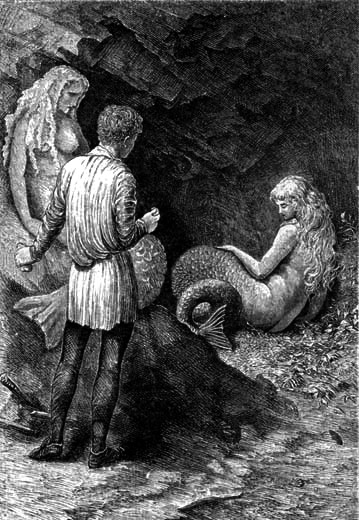
EOTHWALD AND DUVA IN THE CAVE. P. 102.
Again and again the gentle maiden nerved her voice to speak, but faintness overpowered her, and a dreamless sleep already fanned her with its over-shadowing wings. Eothwald's form swam magnified before her eyes, and then vanished altogether amid the mist of gathering tears. The cave grew dim—the little sea-child again beheld the palace of her father—her lovely sisters waved a mute welcome through the changing atmosphere. With the tremulous sigh of a repentant child that has erred, but returns with glad sorrow to fling itself on its mother's breast, Duva, forgetting all save that joyful vision, stretched forth her innocent arms with a low murmur of tenderness, and a gesture of delight.
"Can you not remain as I placed you?" impatiently muttered the sculptor, as the sudden movement of Duva's arms altered her whole position, and lost irretrievably the graceful attitude he was striving faithfully to immortalise. Even as he spoke, something about his beloved alarmed him; he rushed across the cave, but ere he could touch her, Duva's fair form had disappeared—she was gone!
The red torch flickered high, and suddenly expired. The moon's ray, cold and pale, penetrated within the cave, and lo! upon the spot so lately pressed by the enchanting figure of the poor little stranger, pure and transparent in the silvery light, glistened a white pearly shell, while a tiny rivulet stole silently from beneath it, and trickled into the moonlit glen without.
Eothwald threw himself wildly on his knees, and felt the couch all over in vain—in vain!—then in desperation he fled out into the wood and searched for his lost love, breathing her name in fondest accents through the silence of the night, but alas! awakening no response from the desolate solitudes around him. Wearied and heart-broken he returned at length from his fruitless errand, and sank into heavy slumber.
Hours had passed unheeded away, when with troubled recollection he awoke and sprang to his feet. Gradually he remembered that in his dreams Duva had again appeared to him. With bitter tears she sorrowfully told him that his own thoughtless actions had parted them. He first tempted her by mortal love to deceive and leave her fond parents and her beloved home; then as he moulded his clay from her beautiful form, in the self-abstraction of genius, he half forgot her sacrifice, and neglected her tender spirit. Wounded and unable to struggle against her altered condition of life without the comforting care of her mortal lover, she had fallen a victim to the law that ruled supreme over herself and her kindred, and lost her visible shape, which became again transformed into the water, whence it originally sprang. With streaming eyes she waved a long farewell, then, lovely as a morning dream, faded from his view.
Eothwald flew back to his work with fierce energy; he felt indeed a high soaring ambition. He yearned to represent worthily, to this and future generations, the fair lineaments, the tender immortal beauty of the sea-king's daughter, who had given him her simple young heart, and whose affection he had so rudely requited. A solemn inward voice told him he had no time to spend in useless remorse, or in unavailing lamentation. Death's shadowy finger already beckoned him to the "silent land." Grief had snapped the first chord of life's hitherto sweet melody, and his days on earth were numbered.
He returned in a short space to his native city. His half-finished work was slowly removed to the studio. There by day and by night he laboured almost ceaselessly, and wove into a wild poetical dream the young life of the fair Duva and her family, as she herself in days gone by had frequently, half romancing and half in earnest, described it to him.
He designed a lofty fountain, and upon its six sides placed in groups of wondrous imagery her parents, their nine lovely daughters, and the young river-god Näcken, whose strains had first led him to his beloved. As in his lonely studio he ceaselessly toiled, he wrote down at intervals this explanation of his labours—that to all futurity might be known the names and history of those whose divine beauty he thus strove to commemorate. [2]
"Agir, the ocean god, who hates mankind, I represent in the prime of life, with a long flowing beard, which he holds back with one hand, in the other he grasps a sceptre. Enthroned on a gigantic shell, and planting his foot on a dolphin, his handsome features wear an expression of proud disdain.
"When the winter has passed (as our Northern poets have sung) and the May sun melts the ice, the ships in the harbour lift their anchors ready to sail, and only the wind is wanting. Thereupon Agir (who delights in punishing the pride of mankind by robbing them of their treasures—taking husbands from their homes, their wives, and their children, and drowning the mourners in floods of bitter tears) calls to his youngest daughter Kolga to begin the sport.
"In the next shell-like division of the fountain, I place Kolga, who, with short rough hair and hoydenish action, distends to the full her rosy cheeks as she blows through the valves of her shell a soft, seductive wind, sufficient to swell the sails, and tempt the ill-fated ships to sea. Above her, shrouded in her long veil, is the mysterious and majestic Ran (Agir's princely consort, and the anxious mother of his many children). She encourages Rönn, her second youngest, who gently and dreamingly along the blue ripples stirs the first breath on the calm waters. Häfring, Unn, and Bylgia, with the little water-elves and sprites, help to raise the swelling seas until the waves are mountains high.
"Then the hard-hearted and vindictive Boara (once scorned and deserted by a mortal lover) crushes the prows to atoms. She delights in the destruction of human handiwork, and is therefore portrayed with a sternly beautiful though cruel countenance. Next Agir calls on Blodughadda, enveloped in her long flowing tresses, to descend through the deeper waters and secure the ships' rich treasures, for no lock or key any longer protects them.
"But the fond father misses his favourite children, Himingläfa and Duva; he loudly calls on Ran to tell him where they are. 'Alas,' answers his queen, 'our daughters are held captive in the web of Näcken; up there, on the fresh water-stream, they float, like one charmed, listening to his melodious song. I have begged and threatened, but all in vain. Methinks one or both of them is befooled by first love.'
"Then Agir arose in fearful rage, calling upon his remaining daughters to entice Näcken forth from the precincts of his grotto (which, being in fresh water, was beyond the sea-king's domain) into the deep ocean, there to take him captive, and deliver their sisters from his thraldom.
"So they all float on, displaying their charms like roses and lilies playing on the waters: their beautiful dishevelled hair, their graceful forms, their coral chains, their strings of pearls, triumphantly making sure of enticing the hapless youth into the salt waters. But no sooner have they reached the entrance to the grotto, than behold! a youth, divinely beautiful, is seen. Harp in hand, he sings a soft, melancholy strain with the purest of voices. The beauteous sisters, scarce moving, tarry on the heaving waters, and listen, entranced, to his heart-thrilling song.
"Awakening from his own love-dreams as he marks the approach of Himingläfa's lovely sisters, the young river-god sings of his happy youth, when amid green meadows, and under verdant trees, he listened to the melodies of birds, and learnt from them the sweet art of song—until, restless and eager for change, he wandered forth from his early home into the wide world, with endless longing for the unattainable. To punish his presumption, he was at length condemned only to exist in water, and became the genius of running streams. Thus he pours out his lament in strains so moving, that even the wild swan is arrested in her flight, and the daughters of Agir, deeply enthralled, heedless of their parents' call to action, remain motionless before the grotto, allowing ships and mariners to sail by in perfect calm.
"At length, Agir and Ran, angry and impatient, hasten towards them, when, enchanted like their children, by Näcken's exquisite lay, they also remain to listen, forgetful of the time and of the passing hours, till daylight breaks suddenly upon them. The relentless laws of fate forbidding their escape (if found within fresh water at sunrise), they all then become spell-bound."
Such was the description Eothwald wrote of his wondrous fountain, on which Näcken still dreams on, harp in hand, singing of the days of yore. The beautiful Himingläfa leans forward, modestly drawing her long tresses across her white shoulders, drinking in, with downcast eyes, every intonation of her betrothed. The child-like Duva, adorned as when the sculptor first beheld her, with long strands of priceless pearls intertwined on hair, neck, and bosom, raises herself from the water in the attitude he had studied a thousand times, and half surrounds her beloved sister with her arm, listening intently, as on that well-remembered evening, to Näcken's heart-thrilling music. No shadow of future sorrow clouds Duva's fair brow; but moulded in all the fresh innocence of her dewy youth, she remains to this hour the loveliest mermaiden that ever gladdened mortal eye.
The shell she left upon the couch of leaves, the artist introduced again and again in his labour of love, and indeed took from its shape the designs for the six sides of his fountain, the figures on which were the size of life.
At last the story of Duva's early life was given. Raised from ocean, cavern, and grotto by Eothwald's genius, her family were immortalized by his art. The sculptor's task was completed. In a paroxysm of agony, he fell on his knees as he realized that though instinct with life his inspired work arose in all its chill perfection before him, yet the living, loving, lovely mermaiden would never more greet him with her warm, shy smile, and her low, tender voice.
At daybreak the old housekeeper came to light the studio fire; for it was now winter-time, and the snow lay thick upon the ground. By the first dim ray of light she descried Eothwald kneeling before his finished sculpture. Her heart misgave her; he was her foster-child—dear to her as her own. She stumbled forward and touched his arm; it was cold and motionless as his own marble figures. Then a loud cry of grief told the tale of death. Eothwald was no more. His immortal spirit had fled. Whether in the regions of the unknown invisible world he may once more meet and clasp his Duva to his breast by the blessed waters of Paradise, we cannot tell, but such may be the merciful will of that loving Father who watches unceasingly over the creatures of his hand, and feels a divine sympathy in their sorrows.
One of Eothwald's hands rested on the word Duva, which he had finished chiselling beneath his beauteous beloved. In his other hand was found, fast clasped—so fast indeed that they could not remove it from his stiffened fingers—a gleaming white pearly shell.
FIDO AND FIDUNIA.
Once within a deep and gloomy forest there dwelt a lonely maiden. She had never known any companionship but that of nature, animate and inanimate. She loved the birds, the shy playful squirrels, and all the various animals, which having always known her there, friendly and harmless, regarded her in their turn, with trustful affection.
It made no difference in their feelings towards the young girl that she was not beautiful. Her thick sandy hair hung in coarse straight elf locks on her shoulders. Her skin looked rough, and her features were not prepossessing. But these poor ignorant creatures only noticed that her voice was low and exceeding sweet. When she stooped to fondle the frolicsome rabbits, or perchance to bind up the leg of some wounded hare, they thought her tender fingers wondrous soft, and her warm cheek felt very smooth to them as she pressed it against their furry coats, and pettingly coaxed them to linger a moment on her lap.
Strange to say, though the little maid had no distinct remembrance of human fellowship, yet she spoke in silvery tones a language which you or I, dear children, should very well understand.
She dwelt in the hollow of an old tree, and few were the wants of her simple life. A clear spring, bubbling up among the rocks near at hand, in the centre of an open grassy space, formed a natural bath, where every morning, undisturbed by fear of man, she bathed herself, and wrung the water from her dripping tresses.
In summer time she often slept high up between the forked branches of a mighty cedar-pine, where with sticks and long grass she had woven herself a sort of nest. From hence also she could contemplate the stars, between whom and herself there ever seemed a link of sympathy. To her untaught imagination it appeared that the heavenly luminaries were happy in being among others of their kind. Whereas, had she but known it, each one of those seemingly tiny lights glowed myriads of miles apart from its nearest neighbour.
Fidunia dwelt serene, content with her lot; yet it was only natural that in her maturing bosom the yearning instincts of womanhood should awake, and that she longed, with an intensity of which she herself was hardly aware, for some creature to whom she could recount, and with whom she could share, the pleasures and pains of her solitary life.
In the forest where she had her home there were no great alternations of heat and cold, nor was the length of the days so different as we find it in our own more northerly climate. Still it was spring-time in this land of which I speak. The fair soft tread of summer already sent a reviving thrill through the woods and glades, and Fidunia's thoughts turned anew to her forlorn condition.
She remarked, as was her wont, the habits of the brute-world around. Every bird had its mate. The sober rooks perambulated the green sward in pairs. The thrush wooed his love in songs of gushing melody. The tender turtle-doves cooed ceaselessly to each other. The very mole that burrowed by the fountain side, brought a sable bride to enjoy with him the hidden comforts of his subterranean dwelling.
Fidunia sat and pondered over these things. Again and again she tried, like Narcissus, to see her image in the crystal spring. But kind nature, careful to spare the little maid a needless pang, ruffled the translucent surface so perpetually, that the young girl's face only cast a dancing shadow on the bubbling water amid the rocks.
Baffled in her hopes of even a shadowy companion, Fidunia, with a tear in her eye, murmured "Alone, ever alone! Ah, cruel fate! How I sigh for something really to love me."
Awhile she remained motionless, gazing moodily into the troubled spring, but anon her quick ear caught the pattering sound of little feet upon the dead beech-leaves that formed a rich carpet near at hand. She thought it was the squirrels, yet theirs was a bounding lighter tread. She turned—and, lo! running towards her across the open space, she saw a beautiful dog. In colour he was almost golden; his silky hair fell soft as feathery down on either side of his little body. His tail and ears of darker chestnut tinge imparted piquancy to his shape. His paws were exquisitely clean, and covered with lovely hair. His brilliant dark brown eyes shone with extraordinary intelligence—at least, so Fidunia thought—as the little fellow slowly trotted up and stood before her, wagging his bushy tail.
"Art thou come to be my companion?" the maiden joyfully cried. In answer to her question, the small quadruped came nearer still, and very very gently laid himself down at her feet. His mute gesture was most expressive.
Fidunia surveyed him carefully, she thought she saw the marks of sadness in his wistful countenance—he gambolled not around her, nor attempted to lick her hand, but fixing on her his large anxious eyes, seemed to implore permission to remain by her side. Naturally fearless and fond of animals, Fidunia drew him upon her knee, and gently stroking the while his silky coat she asked him "whence he came, where his home, and what his name." The little creature could not reply in human tongue, but he continued to wag his eloquent tail, and to gaze earnestly in her face.
"If you are going to be my companion, I must know what to call you," said the wondering maiden. "My name is Fidunia," added she dreamily—but at this last word the dog sprang from her lap to the ground, and assumed a begging attitude in front of the little damsel. "Nay, nay, my dear doggie, I cannot call you Fidunia," cried she, but, after a moment's reflection, "would not 'Fido' do as well?"
Hardly had this name dropped from her lips than the wise animal bounded into the air, and then ran round and round in a manner most expressive of joy. Fidunia delighted, clapped her hands, and as at this well-known signal all her feathered and furred friends came trooping around to enquire her will, she at once introduced Fido to their notice, and an alliance offensive and defensive was forthwith agreed upon between the community at large, and their mistress's new favourite.
Ere long Fidunia discovered that her comrade was both active and playful, and though he could not speak her language nor she understand his, and she therefore never discovered his previous history, yet she surmised that he must have been separated from some one he dearly loved. For this reason she bore patiently with his occasional fits of low spirits. Soothed and cheered by her gentle companionship and thoughtful sympathy, Fido, before very long forgot his sorrows, and became the gayest of the gay.
Echoes hitherto unknown to Fidunia in the solemn forest, were roused by his shrilly bark of joy, as capering round his young mistress, they wandered together far adown those sylvan glades. Fidunia could now indeed venture farther from home, as however long they roamed abroad, the dog's wondrous instinct always led them back to the gnarled tree, the crystal fountain, and the green velvety lawn, for so many years the little maiden's happy abode.
She soon discovered that Fido was very accomplished in various ways—and she fancied also that he understood all she said to him—he watched so keenly every word that fell from her lips.
About this time strange dreams began to haunt the young girl. Night after night she wandered in regions such as she never remembered to have seen in her waking hours.
At one time she walked amid beautiful gardens—on either side of her bloomed a rich profusion of lovely fragrant flowers. Within each sweet floweret lurked a tiny elf, and as she passed along, fairies swung themselves forth singing through the perfume laden air in soft musical tones, "King Antiphates is blind! King Antiphates is blind! and the maid who alone can deliver him knows not her mission!"
At another time she climbed painfully along a steep path, leading through scenes perfectly unknown to her. The hot sun beat on her bare head, and she toiled on and on, ever ascending, yet never reaching the craggy summit towering far above. Beneath her feet, an unfathomable ocean surged and swelled, and broke in hoarse grumblings upon the frowning iron-bound shore, sending vast sheets of spray aloft, and awakening strange terrors in the woodland maiden's breast. White screaming sea-birds dashed around her, and as they brushed her face with their wings, she heard them cry wildly, "The great king is blind, only Fidunia can deliver him—but she knows it not! she knows it not!"
Again the little maiden found herself upon a lonely terrible mountain. She stood upon dismal rocks whereon appeared no vestige of life. Tossed and wreathed in fantastic shapes, the very stones seemed to bear the impress of writhing agony. Though now cold and motionless, they had passed through the seething horrors of fire. Scathed and withered, repulsive alike to man, beast and herb, amid their desolate clefts, only the slimy reptile traced his sinuous course; or the bright-eyed lizard peered warily forth on the shuddering beholder. Turning to escape, if possible, from this dreary place, Fidunia found herself on the very verge of a huge chasm. She felt a burning heat scorch her face, and penetrate her feet. Long tongues of horrid flame darted in lurid flashes from the thick darkness below. A sulphurous vapour enveloped her in its hot and suffocating fumes. She endeavoured to cry for help, but could not utter a sound—an echo like the reverberating growl of distant thunder filled the air around her with these words, "He will never see now, for the maiden dreams away her life in the forest, and knows not that she alone can save him."
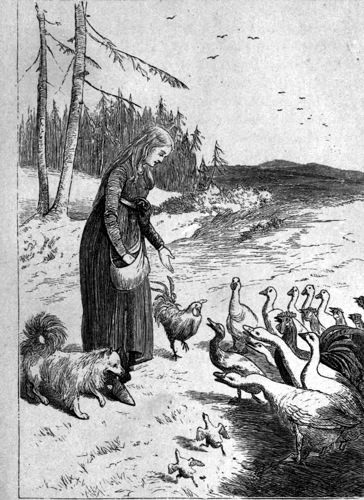
FIDO AND FIDUNIA. P. 123.
From this last and most frightful of all her visions, Fidunia woke agitated and confused. Why were words of the same import evermore repeated in her slumbers? Whence came these awful voices that sounded through the gloom of night? Who was the Antiphates whose misfortune was known, as it seemed, to all the world save herself? It was early morning as she sat up and pondered over these things. Her feverish heart was refreshed by the dewy silence around. Only through the trees came the faint twitter of half awakened birds. The sky, brightening towards the East, heralded the approach of sunrise.
Her resolve was taken. She would set off that very day and journey forth into the unknown world which hitherto she had only visited in dreams. She awoke Fido therefore, and explained to him despite his melancholy dissuading looks, that they must leave the fountain, the lawn, and the tree, and travel far beyond the forest to seek their fortunes among the children of men.
Clapping her hands together, she summoned her faithful forest friends, who sorrowfully accompanied their beloved mistress and her companion as far as their strength would permit, then bade them a melancholy farewell.
Quite overcome by losing sight (perchance for ever) of her sylvan home and her attached little subjects, Fidunia that night sobbed herself to sleep, with Fido in her arms, and half regretted her determination. But in her dreams angels hovered over her, and whispered encouragement to the weary sad-hearted maiden.
For several days more the adventurers journeyed through the dense wood. At night they found shelter in some leaf-strewn cave or upon some mossy bank, beneath over-arching trees. Then the innocent pair, under the protection of heaven, slumbered until day's reviving beams once more cheered them on their way.
At length one afternoon they drew near the out-skirts of the vast forest within whose mighty depths they had so long sojourned. The setting sun reddened the stems of the tall out-standing firs, and the scent of fallen pine leaves hung rich and heavy on the air, as they left the shade of the trees and stepped on to a wide stretching common.
Fidunia, bewildered by the apparently illimitable space before her, stopped perplexed and half wished to retrace her steps; but Fido bounded on, entreating her by unmistakeable signs to follow him.
After crossing some old sand-pits, and scrambling across an expanse of furze and heather, they saw before them a small cottage; blue smoke curled cosily above it into the still evening sky; an atmosphere of peace seemed to surround the lowly walls. As they approached, however, a large flock of geese and poultry of all kinds, disturbed by their footsteps, made a terrible cackling, and presently a hale old woman opened the door, and came out to see what agitated her flock.
Fidunia, accustomed to the ways of birds, had already taken from her wallet some of the seeds she was wont to collect for her feathered forest friends. The geese, well pleased, quickly gathered round, and eagerly fed from her hand.
Meanwhile, Fido gambolled up to the cottage dame, and begged before her as if to solicit her good-will. Thus, propitiating mistress and fowls, the little maid and her dog were kindly made welcome for the night by the ancient hen-wife.
Next morning, refreshed and thankful, they prepared to resume their journey. The good dame now asked Fidunia her history, and whither she was bound; the young girl replied evasively that she only wished to see the world, and was going with her dog to seek their fortunes.
"Nay, my child, that is not all," said the old woman; "tell me, I pray you, the exact truth." So saying, she fixed so keen, yet withal so friendly a glance upon the maiden's blushing countenance, that moved by a sudden impulse, Fidunia poured forth her whole story.
Her hostess listened carefully to her long account, and then resumed: "You have done well to confide in me; I am more powerful than my mean surroundings would lead you to imagine. I would fain have kept from you the dreams that have broken the peaceful charm of the forest, and set you wandering. I have, however, sisters who are otherwise minded, and they (to work out their own purposes) have sent these visions to harass and perplex you. I was anxious to know how much had been revealed, and therefore threw myself in your way to help you. My intentions, however, would have been frustrated had not you, dear maiden, given me straightforward answers.
"The King Antiphates, of whom you have heard in your dreams, dwells, in reality, in the great City of Deva. You will come to it in time if you travel along the high-road, which you can discover beyond that clump of firs," continued she, pointing through the open door to a little hill at some distance. "I am unable to render you more assistance at present, but if, after reaching the far-off city, you are ever in great straits, take this crystal from your bosom (where you must always carry it, concealed from every eye, or it will lose its virtue); place it in the palm of your hand, fix your eyes steadfastly upon it, repeating, meanwhile, in a low tone, these words:—
"Strange gem! upon thy crystal core I gaze, the while I aid implore; Trembling upon the verge of fate, Oh point my path ere yet too late! I fain would gain the boon I ask, Is mine the strength for such a task? Canst thou unloose the links that bind, Or vanquish powerful foes combined? Then, show whate'er there lurks of art Within thine own mysterious heart; On thee I turn a hopeful eye, Bright stone of silence, make reply!"
So saying, she drew from her own breast a beautiful sparkling prism, about the size of a pigeon's egg, and gave it, with some solemnity of manner, to her wondering guest. Deeply grateful, Fidunia threw her arms round the kind Anna's neck, and warmly thanked her for the precious talisman. With the good woman's aid she then committed to memory the needful lines.
When she had successfully mastered them, the old wife drew her hand across her eyes, and resumed, in a somewhat trembling tone, "I know not wherefore you interest me so strangely, my little maid; but if you will be advised by one who has drained the cup of earthly pleasure to its very dregs, return, as yet innocent and inexperienced, with your faithful companion to the quiet joys of your peaceful forest; nor seek, amid the busy haunts of men, those more exciting scenes where many a grief and anxiety must of necessity be yours."
She paused; how could she cast a blight over the joyousness of that poor unsuspecting heart by explaining to Fidunia that maidens, plain in feature, and devoid of dowry, have oftentimes, from no fault of their own, but a sorry lot in this hard world compared with that of their lovelier or more wealthy sisters?
Clothed in her long, grey dress, Fidunia still knelt at Dame Anna's knee; the light from the cottage window fell full on her rough sunburnt face; her straw-coloured hair contrasted unfavourably with her dark reddish skin, and though her eyes were in some measure expressive of the gentle spirit within, yet their faint colour, and the absence of visible eyebrow or eyelash, detracted seriously from their possible charm. Her figure was not ungraceful, but her strangely-fashioned robes (which, prettily donned by some fairer being, could have given a certain bizarre attraction of their own) were but ill calculated to add comeliness to the young girl's unformed limbs and tanned though shapely hands.
As the compassionate dame hesitated, unwilling to speak too bitterly to Fidunia of nature's apparent injustice, her young guest laughingly replied, "Thank you, kind mother; but I could not now remain satisfied without seeking my fate in the unknown world. I shall never forget your promise, however, but seek your aid with this amulet in the hour of need. Yet," added she, "ere I and my dog leave your friendly hearth, we will do our best to afford you some small return for the hospitality you have shown us."
Fidunia and Fido, who had a thousand times alone together practised various little tricks, now went through many evolutions before the delighted old woman.
First, said the little maid, "What will you do for your mistress?" No sooner had she asked this question, than the dog fell mute, and apparently lifeless, at her feet. His stiffened limbs made it plain that he would willingly "die" for her dear sake. Bidding him revive, Fidunia then drew from her pocket one of the chestnuts she kept for the purpose. When the little fellow caught sight of this, he "begged" for it, but his mistress was obdurate. He then "jumped" high into the air to try and win his plaything; still in vain. Next he "asked" for it in doggish fashion, by loudly barking. Fidunia remained relentless. But now a sudden thought seemed to strike the clever animal. Raising himself once more on his hind-legs, he uttered such a tuneful howl—his apology for "singing"—that his mistress, with a pretended sigh, was fain to reward him by placing the promised guerdon upon the ground. Instead of rushing upon it, however, Fido, in an exceedingly graceful attitude, bent his head on one side, and gravely "considered" the desired reward. His meditations coinciding with his wishes, at the word of command he dashed nimbly forward, seized the round nut, threw it up in the air, and caught it again and again; playing, in fact, by himself a game of ball. Finally, he laid the prize gently down at his comrade's feet to demonstrate that no matter what he won, he would be content to surrender all he possessed to her care.
Dame Anna, delighted with the pretty dog's sagacity, caressed and praised him, and, after amply provisioning his little mistress for the journey, wished them both God-speed on their way. She strictly enjoined Fidunia to refrain from mentioning this adventure, and advised her also to keep her dreams to herself, and only enquire as she went along, for the great city of Deva. Leaning over her low garden-gate, surrounded by her long-billed and splay-footed court, the kind henwife long watched her late guests as they crossed the bleak common, and reached the small clump of trees which she had pointed out to them as a landmark on their way to the desired haven.
Soon after passing the summit crowned by these few lonely firs, Fidunia stepped on to a broad high-road, which she at once recognized as that described by their good friend, and leading to the capital of the country.
They now walked on and on for a weary time. The hot sun poured down its noontide rays, the dust arose in parching clouds, and followed with the wind their flagging footsteps.
At last they came to a part of the road bounded by a stone wall. On the other side lay a beautiful green park, stretching far away in upland slopes of rich pasturage. Fatigued and footsore, Fidunia and her little dog clambered over the fence, and composed themselves comfortably to rest in the soft grass. Sheltered from the mid-day heat in their seat among low brushwood and high overshadowing trees, they gratefully partook of the food pressed on them ere their departure by the worthy cottage wife.
Half playing, half teaching her faithful companion, Fidunia held aloft a little bit of meat in one hand, while with the other she bent down the branch of a neighbouring tree, over which Fido at her gentle command, bounded nimbly backwards and forwards.
Suddenly, a loud, harsh voice exclaimed, "What business have you here? No tramps are allowed in my park."
Looking timidly round, Fidunia beheld a stout, red-faced, grizzle-haired man, in leathern gaiters, who angrily threatened herself and Fido with an uplifted stick. Absolutely terrified by this, her first experience of man, poor Fidunia felt as if glued to the spot. She could not move hand or foot. A surging tide of red blood rushed over her face and neck, and covered the poor child of nature with confusion.
Had she looked beautiful in her distress, perhaps the rough proprietor might have treated her more tenderly. As it was, increasing in violence, he drew nearer still, when Fido, who already bristled with rage, flew upon him, and ere he could lay hands upon his trembling mistress, fixed his sharp white teeth apparently in the fierce stranger's leg; but, luckily for the savage Baron, Fido's jaws only met in his legging.
Coward, as well as bully, the rough man changed his tone and implored Fidunia to call off her dog. Recovered from her first terror, the little maid beckoned to Fido to follow her, and ere this selfish squire could look calmly about him, she had flown nimbly over the wall, followed by her dog.
They both ran a considerable way in their terror, not knowing that the friendly Anna (in reality a good fairy) had thrown so much dust in the rude Baron's eyes, that confused and bewildered, he knew not which way the intruders had escaped, but continued to search for them with wicked words and impotent threats long after they had left him and his inhospitable domains behind.
Meantime the travellers pursued their way until, worn out and hungry, they came, towards nightfall, into a small hamlet upon the great high-road.
The village inn, with its gay painted sign of the "Golden Boar" flapping to and fro in the evening breeze, stood invitingly open. Fidunia approached its threshold. The spruce landlady, airing herself with arms akimbo at the open door, stared hard at the little maiden as she paused longingly in front of the steps. "Can you pay for a night's lodging?" she asked in a matter of fact tone. Alas, no—poor Fidunia possessed not one single piece of that hitherto unneeded money—without which she was soon to find she could gain nothing in the pleasant world she had so longed to explore.
She sorrowfully passed the cheerful preparations for wayfarers better supplied than herself with all-conquering gold, and heart-sore and weary sat herself down on an old stump of wood outside the village smithy.
Here, however, she soon forgot her fatigue for a while in watching the red furnace, and the grimy fire-illumined men who moved briskly to and fro, striking bright sparks from the glowing metal. They interested her strangely by their easy motions of power, and apparently inexhaustible store of latent strength. She was gradually recalled to herself, however, by perceiving that she and Fido had become the centre of attraction to a gathering crowd. The children accustomed to cluster round the entrance of the warm and busy workshop now turned their attention to this solitary maiden, and the beautiful dog, which, standing before her, ever on the alert, seemed ready to guard his mistress to the death.
The heated smith, coming for a moment to cool himself at the half-barred entrance, found an inquisitive group pressing round the young girl, regardless of Fido's low growls, as with hair on end and quivering tail, he prepared to spring on anyone who might touch or insult her.
Of a kindly and generous nature, and ever ready to befriend the helpless, Master Franz stepped up to the stranger and civilly asked her pleasure.
Fidunia, frightened, as well she might be, by the rude remarks of the gaping village girls, exclaimed in a tearful voice, "Oh, sir, I know not where to go for a night's lodging, I and my poor dog, we are travelling to the great city of Deva, but we are tired, and unable to journey farther this day." Franz, sorely puzzled, looked around in vain for help or counsel. He knew better than the shivering little maid before him what rustic gossip meant. A stalwart bachelor living all alone above his smithy, he himself, however compassionate, could offer no shelter to the poor wanderers. A sudden thought struck him. "Come with me," he cried, "to my good friend Dorothy of the "Golden Boar;" I warrant me she will blithely give thee food and lodging for the night."
"Kind, sir," answered the poor girl sorrowfully, "I have no money to offer to the good lady of the inn, and she has already bidden me from her door; but," continued Fidunia timidly, "I and my dog are able to make some few passes together, which might give amusement to the worthy Dorothy, and even induce her to grant us leave to rest for the night beneath her roof."
The friendly Franz chuckled with delight as he exclaimed, "By my halidome, damsel, thy words are well-flavoured. Dame Dorothy shall give to thee and thy pretty beast a hearty meal; and then, my mates," he added, turning to the assembled villagers, "we will step up to the "Golden Boar" when our labours for the day are ended, and see whether we cannot help the maiden and her dog on their voyage."
At these words Fidunia felt greatly comforted, and she and Fido fearlessly retraced their steps in the wake of the burly smith.
Dame Dorothy had long ere this left her door, and was now engaged in the great kitchen superintending with her own hands the preparation of a savoury pie, which somehow or other she hoped Master Franz would that very evening help her to consume. Her old husband had been gathered to his fathers many months agone. Since his death the worthy woman often felt the hours after dark pass very slowly. No one knew this interesting fact better than the shrewd yet simple smith, who, early or late, felt sure of a warm welcome whenever he crossed the comfortable threshold of the "Golden Boar."
When the landlady heard steps in her passage, a slight cloud of annoyance rose to her brow—for what mistress likes to be interrupted in her mysterious culinary rites? The incipient frown, however, speedily changed to a smile as Franz's broad figure appeared in the doorway. With a "welcome, neighbour," she hurriedly stooped to shut the oven door, an exertion which called additional colour into her round healthy cheek.
"Friend Dorothy," said Franz, "I bring thee this forlorn maiden; for my sake thou wilt refresh her and her dog. I must away. I have a coat of mail in hand that cannot be left; but anon I will return." So saying, and without pausing for queries or doubts, the brawny smith disappeared, leaving in his place the weary drooping Fidunia and her little comrade.
Dorothy cast a keen scrutinizing glance on the young girl, eagerly scanning her form and features. Reassured by the brief inspection, her eye travelled back to the polished mirror by the fire which reflected her own buxom charms. With some complacency she readjusted the snowy coif (slightly disarranged by her labours), over her brilliant black hair, and wiping her hands upon the rough apron assumed for kitchen-work, she turned towards Fidunia, and in no unkindly voice bade her welcome.
Nor did she do this by halves. She exerted herself with real good will. Before long, rested, comforted and composed, the little maid sat by her new friend, and, while she fondled her faithful Fido, she related her adventures (always excepting her possession of the talisman and her dreams) to the wondering Dorothy.
But now Franz, true to his promise, returned, bringing with him many of the villagers; for the fame of the stranger and her beautiful companion had spread apace, and a rumour indeed had been set afloat that the animal was gifted with supernatural powers. Refreshed and inspirited, Fidunia and her dog went joyfully through all the exercises previously described. Besides this, she borrowed a kerchief from Dorothy. She then put Fido out of the room and closed the door, carefully concealing the white ensign in the blacksmith's wide hanging pocket. She next called her favourite; with eager zest he burst open the half-latched door, and ran round and round the chamber sniffing in every direction. At last, after a long search, he was successful, and amid loud shouts of surprise and delight drew forth from the depths of Franz's coat the blushing Dorothy's badge, the good man the while looking not one whit more composed than his hostess. Fidunia then neatly folded up the kerchief; and Fido, bearing it in his mouth, lightly sprang on the landlady's knee and placed it gently in her hand.
They repeated similar tricks over and over again. Hearty plaudits were showered on the sagacious dog and his youthful mistress, who, flitting to and fro in anxious excitement, and finding herself impeded in her swift motions by the long folds of her grey robe, drew them in a hasty yet picturesque fashion through her waist-belt. Flushed and animated by the friendly approval manifested on all sides, she now stooped forward, wreathing her arms into a natural hoop, through which Fido flew backwards and forwards with frolicsome ardour. Nor was this all, for the trim landlady, in answer to an earnest whisper, also rose. Clasping hands with the stranger maiden, she soon learnt how to twist and retwist beneath her own and Fidunia's arms in a quaint manner that Franz and his comrades thought exceedingly bewitching. At the same time Fido, watching his opportunity, continually sprang between Dorothy and his mistress, thus making a merry third in this pretty exhibition.
As they at last paused, exhausted and laughing over their own exertions, the swart blacksmith stood forth in their midst. In sober manly tones he addressed his neighbours, and gave them an outline of Fidunia's history, as he had gathered it from herself and from Dorothy. He explained, that she was travelling to the great city of Deva, but that, friendless and forlorn, she was destitute of the money requisite to procure for herself and her companion the necessaries of life. He added, that since the little maid and her pretty favourite had given them so much pleasure, he considered that it would only be making her a fair return if he and his fellows collected a small sum to help their guest on her way.
His well-timed appeal met with an enthusiastic response. Grey-haired old men, tender-hearted mothers carrying their babes, blooming young wenches with their awkward rustic swains, all pressed around to deposit in Franz's cap their hard-earned yet freely-bestowed mite for the astonished maiden. The children whispering their thanks into Fido's willing ear, threw their soft little arms around his neck, and pressed their chubby faces on his coat of golden silk.
The bustling landlady meantime bestirred herself and her household, and ere long set before the company the pie she had already prepared, with sundry enticing concomitants. Foaming tankards, moreover, were placed on the board, wherein the villagers deeply pledged the wanderer and her inseparable companion.
Overcome with gratitude, Fidunia could only murmur half-inarticulate thanks to her kind friends, as they warmly shook her by the hand. They patted Fido also, as she raised him in her arms to conceal her blushing face, and wished them both every success on their journey.
Nothing is so alluring to a man as the sight of the woman in whom his heart is already interested, engaged in works of benevolence and charity. Dorothy's second thoughts regarding Fidunia stood her in good stead on that eventful evening. Her softened voice, as she encouraged and soothed Fido and his shy mistress, sounded unusually sweet to the rough blacksmith's ear. When she smiled good-night to the villagers, placing the while a friendly hand on Fidunia's shoulder, Franz, for the first time, thought her face actually beautiful. Though no words passed between them, Dorothy, when she laid her head on her pillow, felt a glad thrill of joy as she recalled the warm parting clasp of that hard and honest hand.
In long after years, when Franz and Dorothy reigned together over the far-famed "Golden Boar," surrounded by a blooming family and blessed with peace and plenty, the prosperous wife and mother, in the fulness of her joy, often wiped a tear from her eye as she remembered the true kindness first shown by her husband to the poor stranger. A kindness that had melted her own harder heart, and (undeservedly for her) led to the happiest days of her life. No wayfarer was ever again turned away from the open door of the hostelry. Heaven increased fourfold the worldly possessions of the honest couple who liberally shared their portion with the poor and the needy.
Followed by the good wishes, and laden with the unexpected gifts conferred upon her by her kind benefactors, Fidunia next day set forth once more upon her solitary journey—solitary, at least, so far as human society was concerned. But this strange girl never considered herself lonely while she had her intelligent though canine fellow-traveller. Now bounding far before his young mistress, now lingering in her rear or trotting quietly along by her side, Fido gave her an astonishing sense of companionship and protection.
For many days they continued to traverse long tracts of beautiful undulating country. At night they always found shelter in some humble farm or cottage. Constant and unfailing were the bounties showered around the gentle maiden and her fascinating dog, when in gratitude for hospitality received they went through their performances together. The money collected by Franz was like the contents of the widow's cruse. As fast as the purse grew empty it was refilled.
Fidunia knew not that her ill-favoured countenance protected her from many a rough jest and coarse compliment. But it was so; her modest demeanour and unassuming ways rendered her less effectual service in preserving her from insult than her want of beauty. Nor was the young girl as yet conscious that she lacked those personal charms without which life may sometimes become so bitter to the sensitive heart.
During the last days of their journey, the high road gradually led the travellers towards the ocean. Fidunia paused, therefore, one morning, amazed at the beauty and novelty of the scene before her. The road emerging from wooded valleys turned abruptly to the right along the summit of perpendicular cliffs some two or three hundred feet in height. At their base, the blue main, hitherto unknown to the forest-bred maiden, broke in tiny ripples on the silver sands. It was a tideless expanse of sea, and therefore no unsightly marks of ebbing waters strewed the beach. Only a long bright undulating line showed where the unstable element found its limits and mother-earth claimed her own.
Resting on the bosom of the mighty deep, and looming indistinctly through summer haze, Fidunia saw the azure outline of a fair and distant island. There also, gleaming faint across the broad bay, her eager longing eyes at last discerned the white environs of the far-famed city of Deva. After revelling for some moments in the glad beautiful prospect, Fidunia hastened her footsteps, well knowing she had still several miles to traverse before she could reach the town, in which she hoped to sleep that night.
It was very pleasant to trip gaily along the grass by the roadside, with a lovely view before her, and fresh sea-breezes to fan her brow as she sped swiftly on. But as the day advanced, the heat grew oppressive. Again leaving the sea, the pathway led them by degrees from the midst of abundant vegetation into an arid and desolate region. Absorbed in hopeful musings, Fidunia did not for some time observe the change of scene. At last a sense of oppression made her look around. The stillness was frightful. No sounds of tuneful ocean saluted her ear; no melodious birds charmed, as heretofore, the wayfarer with their thrilling notes. All was mute and silent as the grave.
Fido, with drooping tail and disconsolate bearing, paced soberly beside her, casting doubtful glances around. With a sudden shudder Fidunia recognised some of the horrid features last seen in her forest visions. Here were the wreathed and fantastic shapes she remembered too well, the wildly tossed, the bare and herbless rocks. There, as she doubtfully raised her eyes to its summit (now visible through the opening gorge), was a cloud of black smoke, issuing from the very mountain round whose base they were journeying.
Appalled by this vivid resemblance, and seeing before her an apparently endless continuance of a similar loathly landscape, Fidunia's trembling and really wearied limbs refused to carry her farther. Looking around for a resting-place, she was compelled to seat herself in the road itself, for a creeping sensation came over her as she caught sight of the bright-eyed lizards peeping between the rocks near at hand, and surmised that the snakes of her dream could not be far off.
Fido came and lay down beside her quite subdued, and she opened their little store of cold roast chestnuts and other provisions neatly packed in her wallet. While she was thus employed, forcing her thoughts from the surrounding desert, by endeavouring to play with her dog over each morsel of their food, they all at once heard the tramp of approaching horses.
Fido, though seemingly hungry, dropped his untasted meat on the ground. Pricking his ears, he listened acutely to the distant sounds, uttering the while a low growl. Nearer and nearer rang the iron hoofs along the hard metal causeway. At length, sweeping rapidly past the corner Fidunia herself had so recently rounded, she beheld a splendid cavalcade.
Beckoning to Fido, she sprang alarmed to her feet. Forgetting in her haste the dreaded reptiles, she flew quickly to the rocks above, where, having gained a vantage ground of comparative safety, she paused to mark the unaccustomed pageant below.
But a few moments before, the sun, shorn of his beams by thick vapours belched forth from the crater above, rode lustreless aloft like a dim red ball.
Now, however, bursting through the mirksome canopy, his rays fell with renewed splendour upon the gay accoutrements and glancing arms of a troop of mounted soldiers, whose advance was heralded by all the merry pomp of prancing steeds and clanging steel.
Fido, instead of obeying his mistress, had remained behind her in the centre of the road, and now, regardless of her earnest commands, he dashed forward vehemently barking.
Startled by the apparition of a species of animal but little known in these parts (the few dogs in that country being smooth-coated, and very different in appearance from the long-haired Fido) the horse nearest at hand shied to one side, and crushed against his next neighbour. The two riders (hitherto sitting careless and at ease) thus nearly came together to the ground. Enraged at this misadventure, one of the men raised himself in the stirrup, and with his long lance was about to make a thrust at Fido; but Fidunia, foreseeing her favourite's danger, rushed down and seized him in her arms ere the wrathful trooper had time to execute his purpose.
This little by-play could not occur, however, without in some measure hindering the onward progress of the whole company; and before Fidunia or the irate men could utter one word in explanation or abuse, a loud voice from the rear peremptorily demanded the cause of this abrupt halt. Fidunia was already escaping as fast as she could with her burden up the steep hill-side, when another cavalier, of more pleasing appearance, rode up and informed her that "the King" wished to speak with her. Reassured by his courteous address, she hesitated in her flight, and finally remained rooted to the spot in amazement and instinctive expectation.
By this time the procession was once more moving on at a slower pace than before, and she now perceived in its midst, surrounded by the glittering squadron, a stately chariot, drawn by four grey horses, caparisoned in blue and gold. As this carriage drew nearer, Fidunia saw seated in it a middle-aged man of singular yet noble bearing. Impatience and dissatisfaction were imprinted on his speaking countenance as he turned fretfully from side to side. He seemed unable to notice surrounding objects, for his eyes, though wide open, stared vacantly into space; while the restless motion of his hands betokened a mind ill at ease with itself, if not with all the world around.
When this gorgeous equipage reached the spot where Fidunia stood, the horses were drawn up in obedience to the signal of Domenichino, the official who had previously accosted her. Stepping up to its occupant, he now made some deferential communication. With a quick gesture, the King (for it was he) leant over the side of the carriage, and demanded, in surly tones, who and what had dared to impede his royal progress. While he spoke, his eyes gazed aimlessly around, thus revealing to the most unobservant bystander the painful fact of his physical defect.
Inspired with sudden forebodings, agitated by these swiftly following events, and frightened by the strange looks of her interrogator, the maiden knew not what to answer, but stood irresolute, holding her dog in her arms. Every eye turned upon her, and the King angrily repeated his question before she found courage to reply, tremblingly,
"Oh, sire, if indeed thou art the great monarch Antiphates, pardon the imprudence of my faithful dog: he comes with me from the depths of our forest home, where gallants and horses are alike unknown, and on the approach of thy proud train he sprang forth to defend his poor mistress, thus discomfiting in some measure thy brave men-at-arms."
At this curious answer, given in all simplicity, the soldiers exchanged doubtful glances, imagining Fidunia to be crazy for thus bearding their passionate sovereign. But the King hungrily fastened on her words. He threw himself from his chariot with wonderful rapidity, and, half groping his way, half guided by Domenichino (who hastily dismounted to assist his royal master), seized hold of Fidunia's hand, crying, "Ha! from the forest, sayest thou, and by thy voice a fair and gentle maiden?" Ere he could utter another word, however, Fido, already watching his stumbling movements with considerable mistrust, broke into such angry snarling that Fidunia, freeing her hand, stepped backwards, and did not see the gestures of merriment exchanged among the cavaliers around, as the unfortunate monarch spoke of her being "fair."
Though Fido's repeated interference was decidedly provoking, yet Antiphates preserved unusual command over his short, uneven temper. He entreated Fidunia to consider herself his guest; to enter his chariot and accompany him to his palace, whither he was now returning after a noonday drive. She demurred at first, because of her dog, fearing that his misbehaviour might be severely visited upon him. As if reading the cause of her hesitation, however, and aware of her fatigue, Fido leapt from her arms, and, hastily flying past the attendants, bounded upon the carriage-seat, wagging his tail, and motioning to his mistress to follow. Aided, therefore, by Domenichino, she soon found herself ensconced in the carriage, opposite that great potentate, whose well-remembered name had first been made known to her in her dreams.
As she mused on his peculiar appearance, unable to discover, as he turned on her his dark expressive eyes, whether the King was able to scan her countenance or no, he bent suddenly towards her, saying, "Maiden, I have more for thine ear than may be heard by others; meantime, I bid thee welcome to my kingdom." Ere she could frame a reply to this gracious speech, he leant back again and relapsed into complete silence, apparently absorbed in unquiet meditations.
The swift onward motion of the chariot was new and strange to Fidunia. Leaving the desert region behind them, they descended nearer the water's edge, and sped lightly along the smooth high road.
Smiling vineyards clothed the mountain's side on the one hand; on the other, the broad blue sea stretched her "ample field." The jangling of the military trappings gave forth a sound not unpleasing to the ear, as the escort swept merrily on.
Weary with her exertions, and lulled by the monotonous movement of the carriage, Fidunia half slumbered as she leant back on the luxurious cushions, her mind filled with youth's vague ecstatic visions of future happiness. But Fido, wary and watchful, folded lovingly in his mistress's arms, turned a vigilant eye alternately upon the uneasy King and his glittering body-guard.
It would be impossible adequately to describe the forlorn condition of the monarch, in whose stately equipage destiny had thus strangely placed the forest maiden and her dog. Surrounded by all the pomp and wealth of his splendid court, he was yet debarred by his misfortune from enjoying the visible beauties of nature, or the works of art with which his palace and kingdom abounded.
Unable to employ his powerful mind in perusing the records of the past, or the writings of the poets and philosophers of his own day, incapable of discerning the commonest objects in the world around, and conscious only of a difference between light and darkness, night and day, the great King's melancholy affliction demanded double commiseration in an age when comforts for the blind had neither been invented nor studied.
Music became a source of constant pleasure to him; nor was it surprising that he invariably judged people by their voices as they spoke or sung before him, forming in this unusual way a wonderfully accurate conception of character.
It is needless to say that remedies of all sorts had been tried upon the eyes of the hapless monarch. Many physicians had exerted their utmost skill in endeavouring to ameliorate his condition. He had visited in turn not only the most celebrated baths and watering-places, but also the various oracles then existing in Europe.
Disheartened and hopeless, he had at last well-nigh succumbed to his fate, when a strange incident once more roused the seemingly subdued, yet ever dormant passion of hope in his breast.
Antiphon (the foster-brother of the blind King), while wandering on the hills surrounding Deva, in his vocation of shepherd, noticed sulphureous fumes issuing from a cleft he had never before observed in the mountain's side. Taking with him a torch, he cautiously entered the yawning aperture, and groped his way along, until he suddenly found himself in a lofty subterranean cave. In the centre of this cave lay a marble block, fashioned like a huge coffin. Antiphon hastened home to tell his neighbours of his discovery and to gain assistance. Returning to the cave, he and his fellows succeeded in pushing off the ponderous lid, which fell crashing to the ground, and broke into a thousand pieces.
Within the sarcophagus was now exposed to view a shrivelled though perfect mummy; and an old man of the party recollected having heard an ancient prophecy which foretold that answers regarding future events should one day issue from "withered lips, dumb with the silence of ages, and awful in their semblance to humanity."
Antiphon at once carried the news of this prophecy to King Antiphates, who, ready to do anything to vary the horrors of his solitary existence, though secretly doubting the efficacy of such attempts, disguised himself as a shepherd, and, unknown to his courtiers, accompanied his foster-brother to the cave.
Here, after observing the accustomed ceremonies of purification and prayer, Antiphates approached the sarcophagus, and kneeling beside it, craved some knowledge of his future fate, humbly demanding at the same time whether any sacrifice on his part would procure for him the priceless gift of sight.
Having made these inquiries, the reluctant monarch, had now to lay low his kingly head upon the breast of the long dead, and thus in a stifling and constrained attitude await the much-desired response. Each moment seemed an age to the afflicted prince. All alone with these terrible emblems of mortality (for Antiphon remained without to guard the entrance of the cave) he listened for he knew not what.
At last there arose upon the still dank air, as if from echoing vaults beneath, an unearthly monotonous voice, chanting slowly the following words:
A mighty King is blind, And severed from his kind; In his proud breast broods dark unrest, No solace can he find. The lands he calls his own, His kingdom and his throne, Are his by right; yet that fair sight Is kept from him alone. Revolving decades pass, All flesh, we know, is grass; With whitening hair, the king sits there, He groweth old alas! No joys of life are his, He tastes no wedded bliss; A monarch born, a man forlorn, Nor wife nor babe to kiss. Far, 'mid the forest drear, A maiden without peer His fate shall hear, and wake with fear From dreams of little cheer. By long and lonesome way Two loving hearts shall stray, That sovereign blind, in haste to find, And Fate's behest obey. Yet guard thyself, oh king! Lest kindness sorrow bring! Forbear to love, or time shall prove That joy may hide a sting. That pearl—a woman's love— Might angels' envy move, But powers that be, in wonder see, How mortals changeful prove. Joyous and fancy-free Then let the maiden be, Nor teach that child from regions wild The meed of misery. But if thou dost, thine own the cost, And woe shall fall on thee!
The hollow voice ceased, once more all was still. Antiphates in vain asked other questions, and listened impatiently for further replies. Meeting with no more response, and thoroughly exhausted by the foul atmosphere, he hailed his foster-brother, and, aided by him, breathed again with thankfulness the pure outer air.
They returned to the palace in silence, for Antiphates, proud and reserved, vouchsafed no hint of the mysterious words to which he had listened. He had indeed ample food left him for meditation.
This visit to the mummy took place during the night, and the disguised King passed and repassed his unslumbering sentinels by means of his own signet-ring, occasionally entrusted by him to confidential emissaries.
The apt rhymes he had heard haunted him incessantly. The mere mention of a forest was extraordinary—for with the exception of a fair-sized plantation in the midst of which Castle Xylina (the king's summer palace) stood, no large wood of any kind existed within many miles of his capital.
As to love, the poor benighted King knew little about the capricious god, save what he gathered from the songs of the minstrels and troubadours, birds of passage who, ever certain of kind welcome and liberal patronage, flocked in numbers to his court.
Unwilling to display his infirmity unnecessarily, Antiphates kept himself aloof in general from his people. His palace was indeed the resort of all the most talented and intellectual men of the day. His feasts were celebrated for the brilliant conversation and witty repartee in which, not only his guests, but the monarch himself, occasionally indulged; at the expense of many an aching hour of lonely reaction.
But at these banquets no ladies were present, nor had the isolated sovereign any opportunity of becoming intimately acquainted with his fairer subjects. There were, it is true, the singing-girls, who nightly performed before him with guitars and cymbals, and gave the blind king some of the happiest hours of his life. Though he could not see their graceful forms as they gaily danced to their own music, yet the tinkling of the silver bells on their arms and ankles formed a rhythmical and tuneful accompaniment to their melodious voices, that wafted fourfold enjoyment to the listening monarch. He showered generous gifts on these damsels, each of whom he knew apart by her voice and step. They were, however, but the toys of the hour.
When in pomp and state the King went abroad in his chariot, his fair subjects anxiously pressed together to catch a glimpse of their sovereign's stern yet handsome features; but though they gratified their own curiosity, no reciprocal vision of bewildering charms crossed the darkened vision of their lonely prince, as he was whirled proudly by in his dazzling equipage.
Unwonted feelings therefore stirred in Antiphates' bosom as the prophecy of the cave again and again rang through his mind. After several days spent in musing and reflection, he resolved to return to the oracle, and demand more exact particulars concerning the forest maiden and the "two loving hearts" mentioned, anxious to set forth in pursuit of them, if need be, round the world.
Antiphon therefore, favoured by the darkness, once more led his royal foster-brother to the mountain side, but no cave could they discover, though for several hours they wandered up and down the very spot where the shepherd had carefully noted the entrance by certain landmarks.
Irritated and disappointed, Antiphates at last gave up the useless search, and during the succeeding days busied himself in sending forth express couriers over the country, north, west, and east, to seek for the forest, and to find out and bring to Deva all discoverable denizens of woods, forests, and thickets. Besides this, he issued a royal mandate, setting forth that every wandering maiden should instantly be conducted to his palace. A few strolling gipsies were in consequence brought before him, and told innumerable falsehoods concerning their previous lives and companions, but none of them were able to throw the least light upon the cause of the King's defective eyesight.
Pending the result of more active measures, however, Antiphates was roused from the apathy into which he had been plunged for many years regarding his misfortune, and taught himself to hope he hardly knew what, from the hidden pages of the future. But day after day went by, and no fresh event enlivened the dismal tranquillity of the palace precincts.
We may thus more readily understand the monarch's abrupt condescension and excitement on hearing Fidunia's first words, and learning that she had but lately quitted a forest. Her sweetly modulated voice at once carried a favourable impression to his sensitive ear, and, conjoined with the mysterious and ever-present prophecy, touched a slumbering chord in his jaded breast.
Indeed, as they now drove back to the city from whence he had issued so short a time before in listless uncertainty, his mind ran riot with wild chaotic fancies.
They drew near the frowning gates of Deva. A sudden pause, as the massive portals rolled back on their hinges, and the soldiers presented arms, awoke Fidunia from her trance. She started and looked around, eagerly surveying the splendours of that enchanting capital.
Meanwhile the fairer inhabitants of the town gathering, according to primeval custom, by balcony, window, and doorway, to feast their eyes on the royal pageant and the gallant escort of cavaliers; passed from mouth to mouth the incredible news that a stranger damsel was seated in their monarch's chariot. Ere the gaping crowd had time, however, to note more than the mere outline of a drooping form, the narrow streets were swiftly threaded, and scaling the little hill on which Xylina stood, the whole squadron disappeared within the leafy boundaries of King Antiphates' summer residence.
Fidunia could not repress an exclamation of delighted wonder as they halted at the palace door.
Castle Xylina rose in turreted heights of dazzling whiteness above them, pure as the day it was completed. In that favoured climate neither smoke nor inclement weather marred the snowy beauties of its marble walls and terraces. It was approached by seven broad alleys: six of these, carpeted with natural greensward, converged through the small wood already mentioned, towards the broad central plateau. The seventh avenue, leading from the town, up which the King had just driven, was like the city itself, paved with lava.
The castle from its elevated situation, commanded an exquisite prospect towards the south across the open bay of Deva. The surrounding trees completely shut out the neighbouring town. Only faint, distant sounds, and the chiming of church and convent bells borne upon the air, betokened the near presence of the busy thousands below. Innumerable craft, moreover, moored or moving on the still blue waters, gave an air of life to the otherwise dreamy silence, that with mistlike wings enfolded the fair prosperous Deva and her environs as Fidunia thus first beheld them.