The Art of Penmanship
Reading edition
How to Become a Handsome Writer.
The subject of the importance of good writing is as broad as its use. Reaching out in every direction, and pervading every corner of civilized society, from the humblest up to the highest employments, it is a servant of man, second only in importance to that of speech itself. In the world of business its value is seen, from the simplest record or memorandum, up to the parchment which conveys a kingdom. Without it, the wheels of commerce could not move a single hour. At night it has recorded the transactions of the Bank of England during the day; of London; of the whole world.
Through the art of writing, the deeds of men live after them, and we may surround ourselves with the companionship of philosophers, scientists, historians, discoverers and poets; and their discoveries, and reasonings and imaginings become ours. In the amenities of social life, through the medium of the pen, heart speaks to heart, though ocean rolls between. Thoughts of tenderness and affection live when we are gone, and words and deeds of kindness are not preserved by monuments alone. What fountains of grief or joy have been opened in the hearts of those who have read the records of the pen! The pen has recorded the rapturous emotions of love reciprocated. The pen has written the message of sadness which has covered life's pilgrimage with gloom. The pen has traced the record of noble and useful lives, spent in humanity's cause. The songs of the poet, the beautiful tints of his imagination, the flights of the orator in the realms of fancy, and the facts of history, would all perish as the dew of morning, without this noble art of writing.
As a means of livelihood, there is perhaps no other department of education which affords such universal and profitable employment, as writing. From the mere copyist, up to the practical accountant, and onward into that department of penmanship designated as a fine art, the remuneration is always very ample, considering the time and effort required in its acquisition.
Teachers, editors, farmers, doctors and all persons should possess a practical and substantial knowledge of writing, and should be ready with the pen. Business men must of course be ready writers, and hence, in a treatise on business, designed for the education and advancement of the youth of the country, it seems eminently fitting to first make the way clear to a plain, practical handwriting. Neatness and accuracy should characterize the handwriting of every one. Botch-work and bungling are inexcusable, as well in writing as in the transaction of business. No person has a right to cause a tinge of shame to their correspondent, by sending a letter addressed in a stupid and awkward manner, nor to consume the time of another in deciphering the illegible hooks and scrawls of a message. Every one should have the ambition to write respectably as well as to appear respectable on any occasion.
MATERIALS USED IN WRITING.
Having a suitable desk or table, arranged with reference to light, in order to learn to write, it is necessary to be provided with proper materials. Writing materials are so abundant and so cheap in these times that no excuse is afforded for using an inferior or worthless quality. The materials consist of Pens, Ink and Paper.
PENS.
Steel pens are considered the best. Gold pens have the advantage of always producing the same quality of writing, while steel pens, new or old, produce finer or courser lines. Notwithstanding this advantage in favor of the gold pen, steel pens adhere to the paper, and produce a better line. The pen should be adapted to the hand of the writer. Some persons require a coarse pen, and some fine. Elastic pens in the hand of one writer may produce the best results, while a less flexible pen may suit the hand of others best. Pens are manufactured of almost an infinite grade and quality, in order to suit the requirements of all. About the only rule that can be given in selecting pens, is to write a few lines, or a page, with each of the pens on trial, and then compare the writing. If it be shaded too heavily, select a less flexible pen, if the hair lines are too delicate, select a coarser pen.
INK.
Black ink is always preferable. That which is free from sediment and flows well, should be selected. Use an inkstand with broad base as being less liable to upset. With persons in learning to write it is perhaps best to have a quality of ink which is perfectly black when put on the paper, in order that they may see the results of their labor at once. Business men and accountants prefer a fluid ink, however, which, although not black at first, continues to grow black, and becomes a very bright and durable black, notwithstanding the action of light and heat. Avoid the use of fancy colored inks, especially the more gaudy, such as blue, red or green, in writing all documents which you desire to command attention and respect.
PAPER.
There are almost as many grades of paper to be found in the stationery stores, as there are of pens. For practicing penmanship, nothing is more suitable than foolscap, which may be easily sewed into book-form, with cover of some different color, and thus serves every requirement. The paper should have a medium surface, neither rough and coarse, or too fine and glazed. Have a few extra sheets beside the writing book, for the purpose of practicing the movement exercises and testing the pens. Be provided at all times with a large-sized blotter, and when writing, keep this under the hand. Do not attempt to write with a single sheet of paper on a bare table or desk; there should be many sheets of paper underneath, in order to make an elastic surface.
STUDY WITH PRACTICE.
Aimless, indifferent, or careless practice, never made a good writer, and never will. In order to succeed in this, as in other things, there must be will and determination to succeed, and then persevering and studious effort. Study the models until their forms are fixed in the mind.
No one can execute that which he does not clearly conceive. The artist must first see the picture on the white canvas, before he can paint it, and the sculptor must be able to see in the rough and uninviting stone, the outlines of the beautiful image which he is to carve. In writing, a clear idea of the formation of the different letters, and their various proportions, must become familiar by proper study, examination and analysis. Study precedes practice. It is, of course, not necessary, nor even well, to undertake the mastery of all the forms in writing, by study, until some have been executed. It is best that each form should, as it is taken up, be first measured and analyzed and then practiced at once.
It is the act which crowns the thought. After study, careful and earnest practice can hardly fail to make a good writer of any one. Some persons secure a good style of penmanship with less labor than others, and attain to the elegant, and beautiful formation. But it is only fair to presume that no greater diversity of talent exists in this direction than in the study of other things. All do not learn arithmetic or history with like ease, but no one will assert that all who will, may not learn arithmetic or history. And so, all who will put forth the proper exertion in study and practice may learn to write a good business style, while many of the number will attain to the elegant. The conditions of practice in writing are, Positions of the Body, Position of the Hand an Pen, and Movement.

POSITION of the BODY.
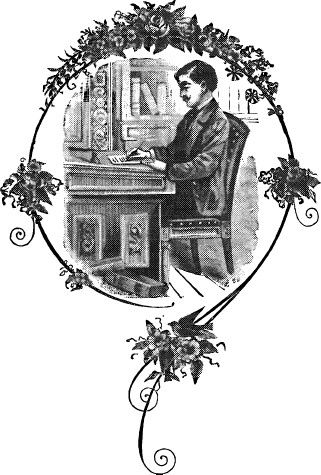
Sitting squarely fronting the desk, with feet placed firmly on the floor, and both arms on the desk, is, as a rule, the best position for practice in writing, or correspondence. The right side, may, however, be placed to the desk, with the right arm, only, resting thereon, and some persons prefer this position. Avoid crossing the feet, sitting on the edge of the chair, or assuming any careless attitude. The body should be erect, but slightly inclined forward, in order that the eye may follow the pen closely. This position will never cause curvature of the spine. The body should never be allowed to settle down into a cramped and unhealthy position with the face almost on the paper. By thus compressing the lungs and the digestive organs they are soon injured, and if the stomach lose its tone, the eyesight is impaired, there is such a close sympathy between these organs of the body. The practice of writing should be, and properly is, a healthful exercise, and injurious effects result only from improper positions of the body, at variance with good writing as well as good health.
When wearied by sitting and the effort at writing, lay aside paper and pen, arise from the chair, and take exercise and rest by walking about the room or in the open air. Then come back refreshed, and vigorous, for the practice of writing.
In general, the light should fall on the paper from the left side, thus enabling a writer to clearly see the ruled lines, and render the labor of writing easier and more rapid. If one writes left-handed, of course He will sit so as to get his light from the right side, or over the right shoulder.
SHADING.
As a beautifier of the handwriting, by causing a diversity of light and shade among the letters, shading has its value; but in the practical handwriting for business purposes, it should, as a rule, be classed with flourishing, and left out. Requiring time and effort, to bring down the shades on letters, business men, clerks and telegraph operators find a uniform and regular style of writing, without shade, the best, even though it may not be as artistic.
UNIFORMITY.
A most necessary element in all good penmanship is uniformity. In the slope of the letters and words which form a written page there must be no disagreement. With the letters leaning about in various directions, writing is presented in its most ridiculous phase. Uniformity in the size of letters, throughout the written page; how greatly it conduces to neatness and beauty. All letters resting on the line, and being of uniform hight, adds another condition towards good penmanship. This essential element of uniformity may be watched and guarded closely and cultivated by any learner in his own practice.
SLANT OF WRITING.
As said before, it matters not so much what angle of slant is adopted in writing, provided it is made uniform, and all letters are required to conform exactly to the same slant. Writing which is nearest perpendicular is most legible, and hence is preferable for business purposes. The printed page of perpendicular type; how legible it is. But for ease in execution, writing should slant. It follows then that writing should be made as perpendicular as is consistent with ease of execution. The slant of writing should not be less than sixty degrees from the horizontal.
POSITION of the BODY WHILE STANDING
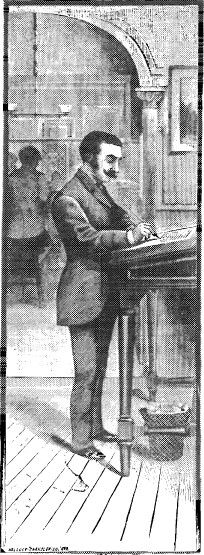
The practical book-keeper finds it advantageous to do his writing while standing; in fact, where large books are in use, and entries are to be transferred from one to another, the work of the book-keeper can hardly be performed otherwise than in a standing position, free to move about his office. Cumbrous books necessitate a different position at the desk, from that of the correspondent, or the learner. Since large books must lie squarely on the desk, the writer, in order to have the proper position thereto, must place his left side to the desk. The body thus has the same relative position, as if squarely fronting the desk with the paper or book placed diagonally. In other words, the writer, while engaged in writing in large, heavy books, must adjust himself to the position of the books. Should the correspondent or bill clerk perform his work while standing, he would assume the same as the sitting position—squarely fronting the desk.
LEGIBILITY.
Children, in learning to write, are apt to sacrifice all other good qualities of beauty, regularity and grace, for the quality of legibility, or plainness. With some older persons this legibility is considered of very little consequence, and is obscured by all manner of meaningless flourishes, in which the writer takes pride. In the estimation of the business man, writing is injured by shades and flourishes. The demand of this practical time is a plain, regular style that can be written rapidly, and read at a glance.
FINISH.
By a careless habit, which many persons allow themselves to fall into, they omit to attend to the little things in writing. Good penmanship consists in attention to small details, each letter and word correctly formed, makes the beautiful page. By inattention to the finish of one letter, or part of a letter of a word, oftentimes the word is mistaken for another, and the entire meaning changed. Particular attention should be devoted to the finish of some of the small letters, such as the dotting of the i, or crossing of the t. Blending the lines which form a loop, often causes the letter to become a stem, similar to the t or d, or an e to become an i. In many of the capital letters, the want of attention to the finish of the letter converts it into another or destroys its identity, such, for instance, as the small cross on the capital F, which, if left off, makes the letter a T. The W often becomes an M, or vice versa, and the I a J. Mistakes in this regard are more the result of carelessness and inattention than anything else. By careful practice a person will acquire a settled habit of giving a perfection to each letter and word, and then it is no longer a task, but is performed naturally and almost involuntarily, while the difference in the appearance of the written page, as well as the exactness and certainty of the meaning conveyed, may be incalculably great.
While practicing penmanship, or while endeavoring to correct a careless habit in writing, the mind must be upon the work in hand, and not be allowed to wander into fields of thought or imagination; by thus confining the attention, any defect or imperfection in the formation of letters may be soon mastered or corrected.