POSITION OF THE HAND AND PEN
Reading edition
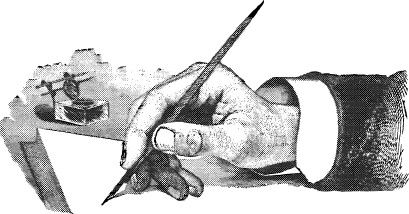
The right arm should rest on the muscles just below the elbow, and wrist should be elevated so as to move free from paper and desk. Turn the hand so that the wrist will be level, or so that the back of the hand will face the ceiling. The third and fourth fingers turned slightly underneath the hand will form its support, and the pen, these fingers and the muscles of the arm near the elbow form the only points of rest or contact on desk or paper. The pen should point over the shoulder, and should be so held that it may pass the root of the nail on the second finger, and about opposite the knuckle of the hand. An unnatural or cramped position of the hand, like such a position of the body, is opposed to good writing, and after many years of observation and study, all teachers concur in the one position above described, as being the most natural, easy and graceful for the writer, and as affording the most freedom and strength of movement.
Avoid getting the hand in an awkward or tiresome position, rolling it over to one side, or drawing the fore finger up into a crooked shape. Hold the pen firmly but lightly, not with a grip as if it were about to escape from service. Do not say, "I can't" hold the pen correctly. Habits are strong, but will may be stronger, and if you hold the pen correctly in spite of old habits, for a few lessons, all will then be easy, and the pen will take its position at each writing exercise, with no effort whatever. Everything being in readiness, and the proper position assumed, the writer must now obtain complete control of hand and pen, by practice in movement.
RAPIDITY.
One of the essentials of a practical business style of writing must be rapidity of execution, in order to be of any avail in the necessities and press of a business position. The demand of the merchant is, that his clerk shall not only write well, but with rapidity, and the volume of letters to be answered, bills to be made out, or items to be entered on the books of account, compel the clerk to move the pen with dexterity and rapidity, as well as skill. While there is great diversity among persons as to the rapidity as well as quality of their penmanship, some being naturally more alert and active than others, yet by securing the proper position of the hand, arm and body, favorable to ease and freedom of execution, then following this with careful practice in movement, until all the varied motions necessary in writing are thoroughly mastered, the person may, with suitable effort, acquire the quality of rapidity in writing, gradually increasing the speed until the desired rate is accomplished.
BEAUTY.
In the handwriting, as in other things, beauty is largely a matter of taste and education. To the man of business, the most beautiful handwriting is that which is written with ease, and expresses plainly and neatly the thought of the writer. To the professional or artistic taste, while such a hand may be regarded as "a good business hand," it would not be considered as beautiful, because it conforms to no rule as to proportion, shade, and spacing. In the practical art of writing, it is not very unfair to measure its beauty largely by its utility.
MOVEMENT.
Finger movement, or writing by the use of the fingers as the motive power, is entirely inadequate to the requirements of business. The fingers soon become tired, the hand becomes cramped, the writing shows a labored effort, and lacks freedom and ease so essential to good business penmanship. In the office or counting-room, where the clerk or correspondent must write from morning till night, the finger movement of course cannot be used.
What is designated by writing teachers as the Whole Arm, or Free Arm Movement, in which the arm is lifted free from the desk and completes the letter with a dash or a swoop, is necessary in ornamental penmanship and flourishing, but has no place in a practical style of business writing. The man of business would hardly stop, in the midst of his writing, to raise the arm, and execute an "off-hand capital," while customers are waiting.
But adapted to the practical purposes of business is the muscular movement, in which the arm moves freely on the muscles below the elbow, and in cases of precise writing, or in the more extended letters, such as f, is assisted by a slight movement of the fingers. The third and fourth fingers may remain stationary on the paper, and be moved from time to time, or between words, where careful and accurate writing is desired, but in more rapid, free and flowing penmanship, the fingers should slide over the paper.
MOVEMENT EXERCISES.
Having everything in readiness, the student may begin his practice on movement exercises, the object of which is to obtain control of the pen and train the muscles. Circular motion, as in the capital O, reversed as in the capital W, vertical movement as in f, long s and capital J, and the lateral motion as in small letters, must each be practiced in order to be able to move the pen in any direction, up, down, or sidewise.
The simplest exercise in movement. Try to follow around in the same line as nearly as possible. Do not shade.
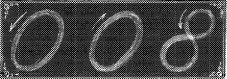
The same exercise, only with ovals drawn out and and slight shade added to each down stroke.
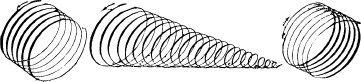
Sides of ovals should be even, forming as nearly a straight line as possible. Reverse the movement as in third form.

The following three exercises embrace the essential elements in capital letters, and should at first be made large for purposes of movement:
Capital O, down strokes parallel.

Capital stem. Down stroke a compound curve. Shade low. Finish with a dash.

Capital loop. Curves parallel. First curve highest.

Having succeeded to some extent with these exercises, the learner may next undertake the vertical movement. In order to obtain the lateral movement, which enables one to write long words without lifting the pen, and move easily and gracefully across the page, exercises like the following should be practiced:
Down strokes straight. Even and resting on line.

In all movement exercises the third and fourth fingers should slide on the paper, and the finger movement should be carefully avoided. The different movements having been practiced, they may now be combined in various forms

Lateral and rolling movement combined. Vertical movement and rolling movement combined.
Do not shade the circles. Lines should be parallel.
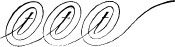
Movement exercises may be multiplied almost indefinitely by studying the forms used in writing and their combinations. Repeating many of the small letters, such as m, u, e, r, s, a, d, h and c, also capitals D, J, P, etc., forms an excellent exercise for the learner.
PRINCIPLES IN WRITING.
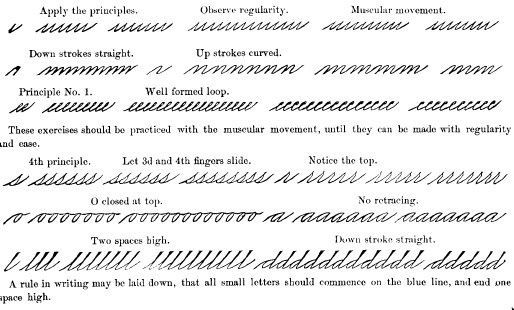
In order to enable the learner to examine, analyze and criticise his writing, the following principles are given as his standards of measurements and form. By combining them in various ways the essential part of all letters in the alphabet may be formed.
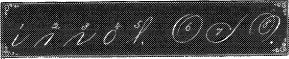
The principles must be first carefully studied, and separated into the primary lines which compose them and the form of each principle well understood. The student may then form a scale like the one following, by dividing the distance between the blue lines on the paper into four equal spaces, with a lightly ruled line. The letters of the small alphabet should then be placed in the scale and the height of each letter fixed in the mind.

Notice that the contracted letters, or those which occupy only one space, as a, m, n, o, s, v, w and e, and that part of d, g, h, q and y, found in the first space, are all well rounded and developed. These letters and parts of letters, found in the first space, form the essential part of all writing, and therefore deserve especial care. Also notice that the loop letters, above the line, such as b, f, h, k and l, extend two and one-half spaces above the blue line, while the loop below the line, such as g, f, j, q, y and z, extend one and one-half spaces below the blue line, thus two and one-half and one and one-half making the four spaces of the scale, and the upper loops on one line will just meet the lower loops of the line above, but never conflict, to the destruction of neat body writing. Notice the type of the printer. The extensions above the shorter letters are quite insignificant, and are only used to save the letter from resembling some other letter of the alphabet. They never conflict, and how legible they are.
The Types. A Resemblance. An Absurdity.
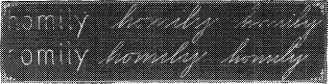
Besides, to make long loops, requires more time, and more power with the pen, while shorter loops are in every way easier to acquire, quicker, and better. Telegraph operators, some of whom are among our best business penmen, make all extended letters very short, while accountants, and business men, favor the style of short loops, well developed letters, and small capitals.
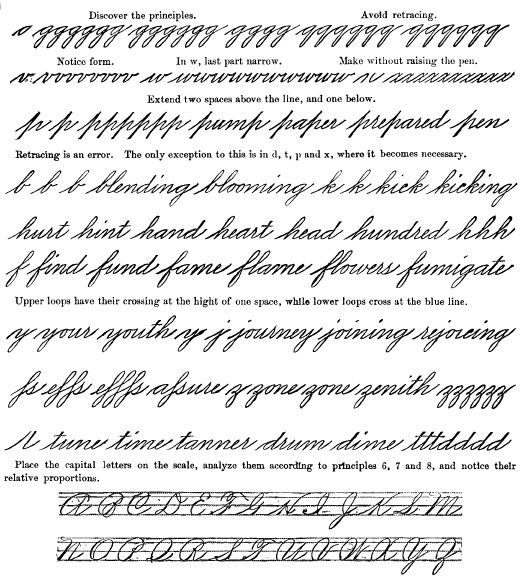
In order to practice capital letters to advantage, as well as to study them, collect in a group or family all those letters which have some one form or principle as an essential part. Take first the 6th principle, or oval, and we group the letters as follows:

The excellence of an oval depends largely on its fullness and roundness. No corners or flat sides.
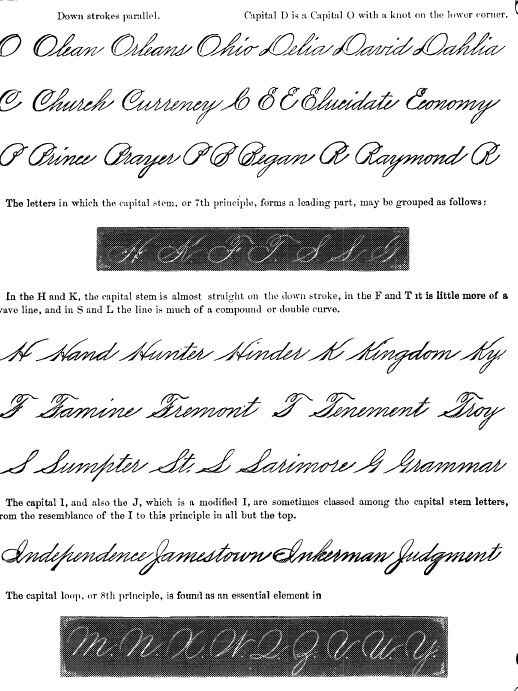
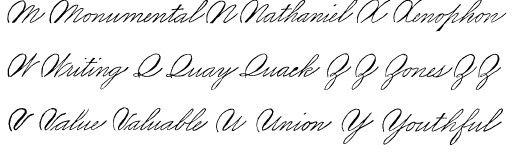
In the capital loop, or 8th principle, another oval may be made within the large turn at the top, but for practical purposes the letter is perhaps better without it, and may be simplified even more, as in the N below.
FIGURES.
Make figures small, neat, and of form exact. Each figure must show for itself, and cannot be known by those which precede or follow it, as is the case with letters. The common tendency is to make figures too large and coarse. Mind the ovals in figures and have them full and round. The chief excellence of the zero lies in its roundness; the 3, 5, 6 or 9, without care in making the ovals, may degenerate into a straight line, or simply a meaningless hook, which it would hardly be safe to use in expressing sums of money, ordering goods, or the transaction of other business.

COPIES FOR PRACTICE
Having proceeded thus far in the study and practice of writing, and having obtained the proper control of the pen through the movement exercises, all that is necessary now in order to secure a good handwriting, is continued and well-directed practice.
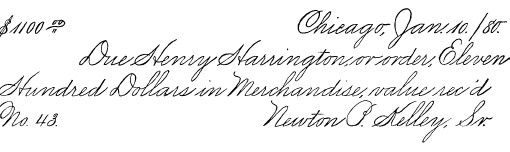
$1100.00 Chicago, Jan. 10./80. Due Henry Harrington, on order, Eleven Hundred Dollars in Merchandise, value rec'd No. 43. Newton P. Kelley, Sr.