Man in the San Juan Valley
Reading edition
The San Juan River and its tributaries drain the region known as the Four Corners country—the area surrounding the point where New Mexico, Colorado, Utah, and Arizona meet in a common boundary at right angles. Rising high in the Rocky Mountains of Colorado, the San Juan flows southwestward to dip down into the northwestern corner of New Mexico; then it courses northwestward into Utah almost at the point of juncture of the four states. With many twists and curves, roaring through deep canyons and gulches, it proceeds generally westward to empty into the mighty Colorado River in the southeastern part of Utah.
The San Juan Basin is the major drainage basin of the Four Corners country. As such, its lower reaches formed a formidable barrier to travel by migrant primitive groups and to early white settlers as well. Its upper portions, however, especially its tributaries, were easier of access and supplied that most important element of all for life in the desert: water—water for drinking, water for irrigation.
The land between the tributaries is highly diversified; much is arid or semiarid with small streams running intermittently or with scattered springs that may be dry during parts of the year. Other areas are mountainous with swift-flowing streams. In places there are mesas, or large tablelands, which frequently are covered with forests of pine, juniper, and pinyon. It is a land of warm, often hot, summers and cool, sometimes very cold, winters; a land of sharp contrasts; a land that seems perpetual, yet never appears exactly the same on any two successive days.
Into this area many hundreds of years ago, possibly even thousands, came small bands of wandering hunters. Gradually some of them learned how to adapt to the rigors of the land. Eventually two [2] centers arose in which the local inhabitants successfully adjusted to their environment: one along the Chaco Wash in northwestern New Mexico, and the second in southwestern Colorado in many places on the La Plata, Mancos, and McElmo drainages. Chaco, the first of these cultural manifestations, takes its name from the best known and finest examples of such ruins in Chaco Canyon National Monument. The other is best known at, and named for, the area incorporated in Mesa Verde National Park.
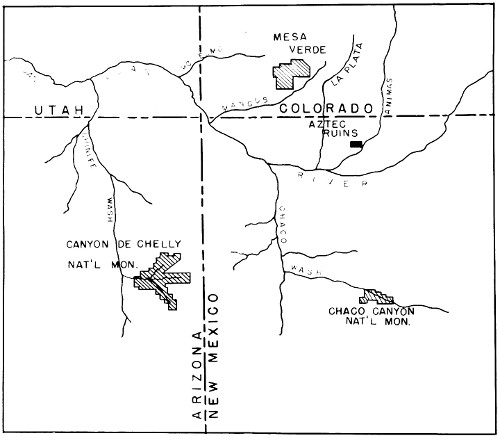
On the northern side of the San Juan, most of its tributaries are perennially flowing streams and rivers, with broad, fertile valleys and bountiful plant and animal resources nearby. On one of these streams, the Animas, there existed a series of prehistoric towns and villages which exemplify the successful blending of cultural influences from both the major centers of Chaco and Mesa Verde. This is the general story of the San Juan River area, of the people who lived there long ago, and in particular the story of the great ruined pueblo on the Animas River near the present-day town of Aztec, N. Mex.
[3]
EARLY HUNTERS AND GATHERERS.
Ten thousand years ago, a small band of weary, footsore, hungry hunters cautiously approached a few bison which they had managed to stampede away from the main herd. Ten in number, the bison had finally paused to drink at a small spring in a rincon of the canyon wall and to graze upon the thick, tall grass. For a day and a half, the hunters had carefully followed the large, hairy mammals, hoping the beasts would lose their sense of danger and allow themselves to be boxed into a place where the hunters could approach close enough to kill them.
At last the moment was at hand! Warily, two hunters crawled along the slope of the canyon wall from opposite sides, seeking places from which they could throw large rocks upon the animals or hurl their spears with devastating force. Patiently five more hunters waited below, concealed by the tall grass or behind convenient boulders. When the first two were in place, the leader gave the signal. Rocks came crashing down on the startled bison; spears whistled through the air and thudded into soft flesh; one or two missed, but most found their targets. Shouts and cries filled the air. The bison, caught by surprise, whirled and milled around the waterhole for a moment, then several broke for the open country. One was wounded, the spear in its flank bobbing like a wave-tossed spindle. On this animal the hunters concentrated; three more spears found their target, and the great beast went down thrashing wildly. Two other animals lay maimed at the waterhole; one young calf, hobbling painfully, tried to get away to the open country but was quickly dispatched. The remaining six bison disappeared through the thickets and tall grass to the west.
The animals which were down but not dead were swiftly killed with spear thrusts through the eyes. Then the assembled hunters fell to the most important task of all. With quick strokes of their razor-sharp stone knives, they carefully peeled away the hide from one of the carcasses. The soft inner parts—the heart, kidneys, and liver—they immediately cut into pieces and ate raw on the spot, for they had not tasted meat for many days. In fact, for the last several days on the hunt, they had subsisted entirely on the few edible plants and roots they could easily find while tracking the bison. Now great chunks of meat were cut from the flanks and likewise consumed raw, until each hunter could eat no more. Then the men gathered up their weapons—long wooden spears with carefully made chipped flint or obsidian points. Some of the points were so deeply buried in the bodies that they broke loose from the shafts when the men tried to pry them free. Other shafts had broken, leaving the points embedded when the bison thrashed about trying to escape the sudden devastation. This was of minor concern—new shafts could be made, new points fashioned. It was [4] more important that once again there was meat enough to go around for the hunters, their mates, and their children.

Spear point and foreshaft. Length 8″.
Now surfeited, the hunters dozed quietly in the shade out of the noonday sun. But not for long, for they must bring the rest of the band to participate in the feast. One hunter started back to the last camp where the women and children waited, existing on the remnants of the last kill and whatever edible plants, roots, nuts, and berries they might be able to find nearby. The other hunters proceeded with the skinning of the animals. To build a fire, one man found a dry log, in which he made a small hole with his stone knife. He sharpened another dry but tougher stick. Thrusting this into the hole, he twirled it rapidly between his hands until he built up sufficient friction to make a few small sparks in the log. These he deftly transferred to a little dry tinder, the flame of which he carefully nursed until twigs and branches could be added to make a real blaze. The fire would be welcome in the evening, for the days were getting shorter and the nights colder. When the women and children arrived, they would make crude lean-to or windbreak structures to help break the cold night winds from the north. They would scrape, clean, and dry the bison skins so that as the band headed southward, they would have the warm skins to wrap themselves in at night. During the day, while hunting or working around the camp, they needed little in the way of clothing—just simple loincloths. On damp, rainy days—and there seemed too many of these—brush shelters, fires, and the warm skins of the animals they had killed were sufficient.
By now the vultures were circling overhead, but it would be several days before these carrion birds could feast on what little might remain of the kill. The hunters and the rest of the band would stay at this spot until all the meat was exhausted, rancid as it might become. Then once again they would take up their spears and start after more game. This time they would head toward the south, for with the shortening days winter was coming, and the game was going south. But they would worry about the next hunt later. In the meantime all was well. It was a time for relaxation and rejoicing—they had food for many days; they had water; soon they would have shelter; and this was without doubt the best of all possible worlds in which to live.
[5]
Of course, such a scene is imaginary, but it could have taken place about 10,000 years ago, almost anywhere among the valley and canyon bottoms of what is now known as the Four Corners country of the Southwest. The great continental ice sheets never got this far south, and 10,000 years ago they were already retreating northward from their farthest expansion. Yet smaller glaciers in some of the surrounding mountains were also shrinking, and the general climate of the area must have been far different than it is today. No doubt it was colder and damper, with more rain and many swamps, lagoons, and lakes abounding in game animals and birds of all varieties. With a colder climate, the scenery too did not resemble that of today. High grasslands, extensive hardwood forests, and full-flowing streams and rivers characterized the region. The general land formations, however—the mountains, canyons, mesas, and plateaus—had been formed long millenia before, and as short a time as 10,000 years ago they would have been very much as they are today.
Geologists believe that after the last of the four great continental glaciations (i.e. the Wisconsin) there were three broad climatic periods over most of the western United States. These are called the Anathermal, which was cool and moist, becoming gradually warmer; the Altithermal, which was exceptionally dry; and the Medithermal, a relatively cool, moist period which is still in progress. Our imaginary tale about the hunters, if it had taken place, would have occurred during the Anathermal period.
These variations in climate have been determined by studying old stream terraces (streams cut deeper when there is more water, and they can carry a greater load of abrasive sands and gravels); old beach levels around ancient lakes (such as are prominent today around the Great Salt Lake in Utah); and ancient annual lake deposits of fine silts which form thin bands, or varves. Studies of animal life, both vertebrate and invertebrate, and plant life are important, for some life forms can exist only under certain limited climatic conditions. Bones and shells found in various deposits may help to indicate the type of climate existing when they were laid down. Plant fragments, pollen grains, and diatoms (microscopic plants with siliceous skeletons), are clues in telling the story of prehistoric times.
What the early hunters may have looked like no one really knows, for archeologists so far have not found a single undisputed trace of their physical remains. Skeletal fragments of what might be early man in this country have turned up in several places, but usually geologists, archeologists, and others cannot agree as to just how ancient these remains might be. One of the most likely candidates for the distinction of “earliest man” yet found in America was discovered in 1953 near Midland, Tex. Actually, these remains, [6] which consist of parts of a skull and fragments of other bones, were those of a female. They were found under geologic conditions that might indicate considerable age and in indirect association with types of artifacts which are dated, by other means, as being of Folsom age or slightly more recent. Unfortunately, since radiocarbon dates on some of this material vary widely and the local geology is so complicated, it is not positive that “Midland Man” is the oldest known American.
Many anthropologists, however, believe that even the earliest inhabitants of this country were of Asiatic descent and thus might well have resembled some of the modern American Indians.
We do not even know if they used animal skins as clothing. With a rather cool, damp climate, it can be assumed they had some sort of shelter and some types of body covering, even if nothing more than generous swabbings of bear grease. Today, near the tip of South America, a tribe of Indians—the Ona—exist in a very damp, cold climate. Eating mostly fish and sea mammals, they live in crude brush shelters and wear little if any clothing most of the time. In Africa certain primitive Pygmy tribes hunt game as large as giraffes with small bows and arrows. They wound their quarry first and then follow it, often for days, until they can bring down the weary animal at close range with their spears.
Perhaps that is how the early hunters in America survived. We cannot be positive, but we do know that scattered around the Four Corners country are a few sites where spear points, scrapers, and other implements have been found under conditions indicating great antiquity. In other cases throughout the greater Southwest, points have been found embedded in the remains of slaughtered animals of now extinct species. Often these remains are found in ancient swamps and waterholes, where it had been possible to trap or mire the animals and finally kill them; the mucky swampland has helped preserve the bones so that today the archeologist can tell the story of how they were slaughtered.
As the glaciers disappeared and the climate became warmer, the lakes, swamps, and lagoons gradually dried up, the grasslands became desiccated, the hardwoods disappeared from the valley bottoms. Small regional differences in climate, sometimes due to altitude, left some areas more desirable than others. Large mammals disappeared entirely, and the hunting and gathering people had to turn to smaller types of game such as elk, deer, rabbit, bear, and rodents. No doubt wild edible plants, berries, fruits, nuts, and even roots were gathered and eaten. In the Four Corners country, however, evidence for occupation by man during the Altithermal (or second post-glacial period) is almost entirely lacking. This was an exceptionally dry period, and few if any people could live there. It wasn’t until the climate became wetter and cooler again, [7] more like it is today, that man once again inhabited the Four Corners area in any great numbers.
THE BASKETMAKERS.
About the time of Christ, in some parts perhaps even earlier, small bands of Indians entered the Four Corners country. It is possible that a few small groups of wandering hunters and gatherers who had survived the Altithermal were already living there, but the archeological evidence for their presence is very scanty. Under the impetus of new ideas, such as agriculture, these people may have been slowly settling down to become farmers.
Or possibly under the pressure of expanding populations elsewhere, groups seeking new lands suitable for agriculture moved into the area and either amalgamated with, or drove out, any local groups. If so, we do not know exactly where these people came from. Perhaps they came from the south, around the Mogollon Rim country of New Mexico where there is evidence that even earlier an agriculturally-based sedentary population had developed. Corn had been known in parts of the Southwest for a considerable time. (At Bat Cave in New Mexico, archeologists have uncovered a primitive type of corn which was grown at least several thousand years before the birth of Christ.)
Only with an assured food supply, part of which can be stored against bad years, can a group find time to devote its energies to the arts and to the development of greater skill in crafts. The idea of agriculture must have spread slowly, for it forced a radical change in the living habits of those who practiced it, compared to their old subsistence pattern of hunting and gathering. At first, the hunting group would regard this new plant as just another seed crop—to be gathered when it was ripe. They dumped the seed in the ground and went on about their business; when it ripened they returned to harvest the crop, much as they went each year to harvest the pinyon crop when it was ripe.
But as they became more dependent upon corn and added the cultivation of squash, these people discovered that two things are necessary for a group dependent upon agriculture: one, that most of the group has to remain nearby while the crop is planted, matured, and harvested (to protect it from rodents, deer, birds, and, probably, marauding tribes); second, that there must be a secure storage place for the surplus food and the seeds for next year’s crop. This latter requirement forced them to build storage pits lined with stone slabs, bark, and adobe which could be securely covered so that rodents and insects would not eat the surplus harvest.
Archeologists have long called these early inhabitants of the area “Basketmakers” because of the variety of beautiful baskets and sandals which they wove from fibrous plant materials. In the earlier part of this period, they did not know how to make or use pottery, [8] and baskets were important as storage containers or as vessels in which to cook by stone boiling. Although their descendants also made and used baskets, they never achieved the fine quality and artistry of the early Basketmakers.
Archeologists divide this Basketmaker phase into an early period of about 400 years and a later period (sometimes referred to as “Modified Basketmaker”) of about 350 years. The Modified Basketmakers had several important traits which the earlier ones lacked: namely, the bow and arrow, which replaced the atlatl (throwing stick); beans, which added important protein to the diet; and a knowledge of how to make pottery, which permitted much easier cooking and better storage of perishables.
The necessity for an assured food supply was of increasing importance, for there was a slowly but steadily growing population. Agriculture provided such a supply and freed a part of the population from subsistence activities, giving them leisure to devote to pursuits which were not necessary for mere existence. For example, turquoise—worked and polished into ornamental jewelry—seems to have been first used at this time. Small crude pottery figurines are also found, indicating a growing interest in religion and an increasing awareness of religious ideas. Kivas—developed from the idea of the older pithouse—first appear in this period. These provided a place for the performance of religious ceremonies and other nonsecular functions. The men evidently had the time to meet in council and debate communal problems. While the family unit was still important, the clan and even the entire community took on new important aspects of “togetherness.”
We do know what these people looked like, since quite a few well-preserved “mummies” have been found buried in dry caves. They were short, averaging 5 feet 3 or 4 inches for the men and about 5 feet for the women. Their general build was medium slender to stocky; their faces moderately long and narrow; skin color was light to dark brown; and their eyes were brown to black, as was their hair.
The Basketmakers used clothing of a sort; that is, they may have worn a loincloth or apron and probably had shoulder robes of untailored tanned hide for protection against cold. Woven bands or loincloths have been found in several sites. Most burials had no type of clothes but sometimes were wrapped in mantles or dried skins. Probably clothing was never worn very much. Certain “aprons” attached to waist cords and made of strings of cedar or yucca bast were evidently used as menstrual pads. Finely woven aprons may have been worn by the women on special “dress-up” occasions, but the scarcity of such items would indicate they were not for everyday wear.
They wore sandals made of woven yucca strips or cleaned fibers, [9] or sometimes of very fine cross-woven cord, with fringed toes and colored ornamentation. Human hair was used in making rope in considerable quantities; either it was cut off after death and utilized for this purpose, or was hacked short from time to time during life. Some burials, especially among the males, indicate rather fancy hair styles, and it may, therefore, have been the women who had their hair cropped to supply the material for ropes and belts.
Both men and women wore ornaments—bracelets, necklaces, and pendants fashioned of stone, bone, or even various dried berries. Beads were also made of olivella, conus, and abalone shell which probably were imported from the Pacific Coast by trading with intervening tribes. Fur blankets were fashioned by wrapping yucca-fiber strings with long narrow strips of rabbit fur and tying these fur-covered strings together in close parallel rows.
The Basketmakers were especially known for the fine types of woven containers they produced. Flexible seamless sacks, beautifully decorated in black, red-brown, and gray are sometimes found. Large, wide-mouthed ovoid baskets, carried on the back with the aid of a tumpline across the forehead, were used for bringing home seeds and other crops. Basket trays and bowls, with both close coiling and spaced coiling, were often highly ornamented, always in a symmetrical pattern. Designs usually consist of red figures outlined with black, alternating with black figures outlined in red.
The women ground corn on metates—flat slabs of rock in which eventually a deep groove was worn—with manos, or small hand stones. Stone of various sorts was used in making spear and dart points (and in the later part of the period, arrow points), knives, drills, gravers, pipes, and atlatl weights. Animal bone was carefully fashioned into awls, fleshers, scrapers, whistles, jewelry, and even gaming pieces. Wood was used for the atlatl and the dart, and later for bows and arrows, for digging sticks (for planting crops), scoops, feather boxes, and hair ornaments.
Basketmaker remains are found throughout the Four Corners country, the better specimens being recovered from dry caves where the more perishable materials are preserved. In open sites, only the stone and bone objects are left, along with the remains of house structures and storage pits.
In the Animas Valley, north of Durango, Colo., there was quite a concentration of early Basketmakers. Earl H. Morris, who conducted the first scientific explorations of Aztec Ruins, excavated a number of these sites in 1938 and 1939. Here, in an open talus site, he found the first evidence that the early Basketmakers had actual house structures. He gives a graphic description of a typical one:
A site for the dwelling was secured by digging a drift into the steep hillside and piling the excavated earth and stone out in front until a [10] terrace large enough to accommodate the projected house had been provided. The floor area was scooped out to shallow saucer shape—in this case 9 m. in diameter—and coated with mud. At the margins, the mud curved upward to end against the half-buried foot logs which were the basal course of the wall. The walls were composed of horizontal wood and mud masonry. They rose with an inward slant to a little better than head height, then were cribbed for a distance to reduce the diameter of the flat portion of the roof, which was of clay supported by parallel poles. The arc of stones was a retaining device placed to hold back the ever-growing accumulation of refuse that was dumped at the brink of the terrace.
Interior furnishings generally consisted of a heating-pit, slab-lined storage cists, some with above-floor mud domes, and usually grinding stones and metates. How such a structure was entered is not known; possibly it was through a smoke hole in the roof, as in the later and deeper pithouses, or perhaps it was through a lateral doorway with a high sill, traces of which no longer remain.
By A.D. 700, the Four Corners country was evidently well populated. In this later part of the Basketmaker period, the houses in open sites were usually more subterranean. These later houses, often with slab-lined and adobe-plastered walls, had a smaller second room or antechamber added on the front through which entrance was made. A few such ruined dwelling sites are known along the Animas River south of Durango. Morris felt that an adequate archeological survey would reveal a great many more, but extensive plowing of the area in recent historic times has long since removed the evidence. In the latter part of this period, the early Basketmakers evidently moved downstream where there was better land for cultivation and the growing season was slightly longer.
That they had a firm belief in a life in the hereafter is shown by the care with which they buried their dead and by the offerings placed with them. It is with these burials in dry caves that most of the perishable material relating to this period has been found. Frequently the bodies were wrapped in mantles of fur or feather string, and sometimes wrapped again in the tanned skins of deer or mountain sheep. Often the bodies have sandals on the feet (and occasionally an extra pair for replacement if the first wore out) and are accompanied by hair ornaments, necklaces, beads, pendants, baskets of corn and pinyon nuts, pipes and smoking material, gaming sets, flutes, and implements of warfare and the chase. The bodies were usually buried in the flexed position, that is, with the knees drawn up tightly and the hands folded across the chest. In the earlier part of the period, cave storage pits were used as burial places. Some bodies were placed in crevices behind fallen rocks within the cave. Other burials were in the open or in the talus slopes below the caves. In the latter part of the period, so much of the cave was used by the living that the dead were frequently [11] buried in the open in specially dug pits. In these cases, evidence of the perishable material has usually disappeared. In a few of the later graves, pottery is found as a grave offering. Morris reports one burial of this period that contained 11 pottery vessels.
The Basketmakers must have had warm feelings of affection for their young. There was a high mortality rate among the infants and children, but despite this they lavished great care on each small burial. Children might be buried in baskets or in large skin bags, but babies were carefully buried in their cradles. These cradles were made by bending a long slender stick into an oval shape, on which a framework of rods was tied to the outer oval in a crisscross pattern. The interior was padded with juniper bark and covered with fur-cloth blankets, which were often made from the soft, white stomach skins of rabbits. The cradle could be carried on the mother’s back, hung from a convenient peg in the home or on a tree branch when out of doors, or laid carefully on the ground in the shade, all without upsetting the baby. Diapers were made of soft shredded juniper bark, and juniper bark pads wrapped in soft skins were tied on the infants to prevent umbilical hernia.
Archeologists have dug up some unusual burials from this period. One was a male who, presumably after death, had been cut in two at the waist and then sewed together again. Why this was done, nobody knows. He was also wearing a pair of leather moccasins, an item not often found among the Basketmakers. Another burial, from the Canyon del Muerto in northeastern Arizona, consisted of only a pair of forearms and hands, lying palms up, side by side on a bed of grass. Wrapped around the wrists were three necklaces with abalone shell pendants. Ironically enough, included in the grave offerings were two pairs of the finest sandals ever found. Over the whole lay a large basket about 2 feet in diameter. Conjectures as to the “whys” and “whats” of this burial have been numerous, but probably the true reason will never be known.
THE PUEBLOS.
The second broad period in the history of the San Juan area is that in which the Indians built communal dwellings called pueblos. These were stone and adobe structures, sometimes multistoried, facing a central plaza which contained one or more kivas. Very similar structures and village plans can be seen in a number of the existing pueblos of the Rio Grande today, notably Taos, Santo Domingo, and San Ildefonso.
Over the previous centuries the inhabitants of the San Juan Basin, and especially the Animas Valley, had gradually developed a different way of life from that of the early Basketmakers. Certainly, they still grew corn, beans, and squash; still hunted and snared game; still grew old, died, and were buried. But in addition to having some of the better material things in life such as [12] pottery and the bow and arrow, they now placed a greater emphasis upon agriculture; hunting and seed gathering were secondary sources of food. In the spring, the corn seeds were carefully planted, watched over, watered, and cared for. As the plants matured, the men and young boys spent more time in the fields. During the day it was necessary to drive off the squirrels and birds; at night the green tender plants must be protected from the deer, rabbits, and nocturnal rodents. Water in this semiarid land had to be carefully managed, whether flood irrigation or planned canal irrigation was used. If all these factors were not judiciously controlled, there would be no crop. The forces of nature seemed increasingly important; too much sun could be as disastrous as too much water. Ceremonies were devised to propitiate the spirits and the gods, who, to the Indians resided in all aspects of nature. More time was devoted to seasonal religious activities, and great care was taken to educate the young in the proper performance of the ceremonies so they, too, might continue to prosper and live in harmony with nature.
Cotton was probably introduced at about the beginning of the Pueblo period, along with loom weaving. This allowed the making of true cloth, suitable for blankets, poncho-like shirts, sashes, wrap-around skirts, and other necessary items. One other important change at this time affected physical appearance. The soft cradle of the Basketmakers was replaced by the hard cradleboard of the Pueblos. Since the infant usually was bound securely upon his back in the cradle and was unable to roll around, the pressure of the hard board, instead of the softer cradle, caused the back of its head to become flattened, thus giving the whole head a much broader and rounder appearance. This skull flattening in no way affected the mentality of the child, but it must have been obvious to the parents what was causing it. Through continued use of the cradleboard, skull flattening must quickly have become a mark of distinction and charm and, in a few generations, it must have become the traditional head shape of the Pueblo Indians.
Dogs and turkeys were still the only domesticated animals, the turkeys probably kept as much for their feathers (and thus periodically plucked) as for their food value. Burials of both dogs and turkeys occur, indicating they were evidently regarded as more than mere food. Bones from the refuse piles indicate the people hunted—or acquired by trade—bear, elk, bison, wolf, mountain sheep, deer, and rabbits.
There was no sharp break between this period and the preceding Basketmaker. The Indians themselves did not know when they left one period and embarked upon the next. Actually, such “periods” are the classification devices of the archeologists, who need names to apply to the times at which different cultural and [13] evolutionary changes occur. In retrospect, the archeologist can see certain important changes which began to take place about A.D. 750. Liking to classify and categorize the remains they study, archeologists first divided this broad Pueblo period into five substages labeled Pueblo I, II, III, IV, and V. Later, the first two substages were grouped together as the Developmental Pueblo Period, the third was called the Great Pueblo Period, the fourth became known as the Regressive Pueblo Period, and the last as the Historic Pueblo Period. These terms are more meaningful and will be used hereafter. The last two do not concern us, for at the end of the Great Pueblo Period, seemingly at the time of the well-known drought (A.D. 1276-99), most of the pueblo-dwelling peoples left the San Juan area, never to return.
The most obvious change in the Developmental Pueblo Period, as compared to the preceding Basketmaker, was a gradual shift in the type of house construction. The single-unit mud, slab, and jacal semisubterranean house was giving way to the huge multistoried stone and adobe structures, which were to predominate in the Great Pueblo Period 250 years later. In some areas, even earlier than A.D. 750 a few people began to build single-room houses aboveground in a contiguous arrangement, often crescent-shaped, forming small villages. The construction varied from district to district. Some houses were quadrangular in form and wholly aboveground, made of adobe and mud with upright, supporting posts; others were still semisubterranean; some even showed the beginnings of true stone masonry.
At this time also, a new type of structure was coming into existence (though a few examples are known from late Basketmaker times). This new structure, the kiva, was simply a modification of, and change in, the use of the old pithouse. A kiva is a ceremonial room and clubhouse for the men, usually constructed underground (or, where aboveground, so clustered in other rooms as to appear belowground in its relation to the surrounding rooms). It is circular like the early pithouses, but normally contains a fireplace, a deflector (to prevent the draft from fanning the fire too much), and a ventilator shaft by which to bring in the fresh air. A “sipapu” (a small hole which supposedly leads to the underworld) was located in the floor on the opposite side of the fireplace from the deflector. Usually there was a bench around the inside of the kiva near the floor, which may either have been used as a place on which to store religious objects and other paraphernalia or may have served the functional purpose of strengthening the lower part of the kiva wall. Smaller kivas frequently had pilasters built upon the bench and extending upward a short distance; these supported the cribbed roof structure. Large kivas had four centrally located posts which helped support the roof. Entrance to a kiva was normally gained by means of a ladder through the central smoke hole in the roof.
[14]
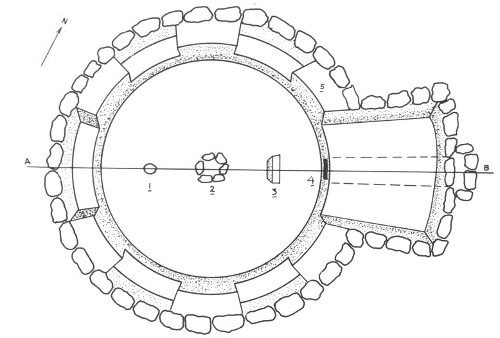
GROUND PLAN OF A TYPICAL KIVA
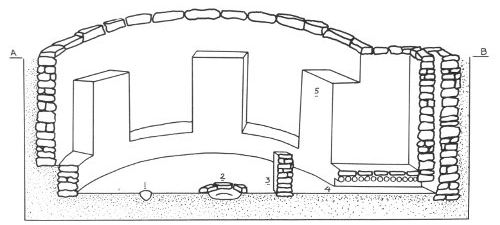
CROSS SECTION OF A TYPICAL KIVA 1. SIPAPU 2. FIREPIT 3. DEFLECTOR 4. AIR SHAFT (VENTILATOR) 5. PILASTER (ROOF SUPPORT)
[15]
It is difficult to assign the same dates to this Developmental Pueblo Period in all areas of the San Juan Basin. Culturally some sections seemed to lag behind others; some ideas, concepts, and artifacts spread and were accepted faster than others. Also, certain regions have been much better explored archeologically, and we know more about them.
Unfortunately, the Animas is one of the river valleys in the San Juan drainage which has not been particularly well surveyed or investigated archeologically. Accounts by early settlers, and passing references in some of Morris’ reports, indicate that in aboriginal times (certainly during Pueblo times), the valley was no doubt heavily populated. It should have been. Good water is readily available in the river and the climate is healthful; prehistorically, game must have abounded in the nearby foothills and mountains. Settlement and clearing of lands in more recent times have eliminated many of the prehistoric remains, but the higher banks along the river terraces still show low mounds of rubble, obviously man made, with indications of cobble and sandstone walls, which evidently were dwellings of the Pueblo Period.
Best known in this valley area are the cave and open sites that Morris excavated north of Durango and which contained the remains of early Basketmaker peoples already mentioned and the great pueblo of Aztec, near the town of the same name about 15 miles above the confluence of the Animas and San Juan Rivers. As described elsewhere, this latter structure was also excavated by Morris in 1916-21. Without doubt, parts of the valley were more or less continuously occupied from early Basketmaker times until the final abandonment of the Four Corners country about A.D. 1300. Although we have no firm data on which to base conclusions, it would be safe to assume that the Developmental Pueblo Period in the Animas Valley lasted from about A.D. 750 or 800 to 1050 or 1100, and that conditions in the living patterns of the people elsewhere were reflected in the Animas Valley.
As the Developmental Pueblo Period progressed, house arrangements became more complex. The next step seems to have been an extension of the earlier linear or crescent-shaped alinement of contiguous houses by adding on one or more wings, so that the resulting plan was L-shaped or formed a rectangular U. In these cases, the semisubterranean kiva was still retained in the courtyard as a definite religious structure. These types of planned communities are called “unit houses.” Most were single storied, though some may have had a second story added on the back tier of rooms.
Changes in pottery styles, and especially in decoration, are very marked during this period. Although plain gray ware was still [16] made, pottery with black designs on a white background shows up in great quantities. In the western part of the San Juan area, painted pottery with a pinkish-orange background and red designs makes its first appearance; examples of this type show up as trade pieces in eastern San Juan sites. The differences between culinary and nonculinary wares become more marked. The former are usually corrugated vessels, formed by pinching or indenting the clay coils while they were still plastic and before the pot was fired. Later in the period, this type of corrugation became quite decorative in itself and some of the better cooking ware aesthetically rivals the painted wares.
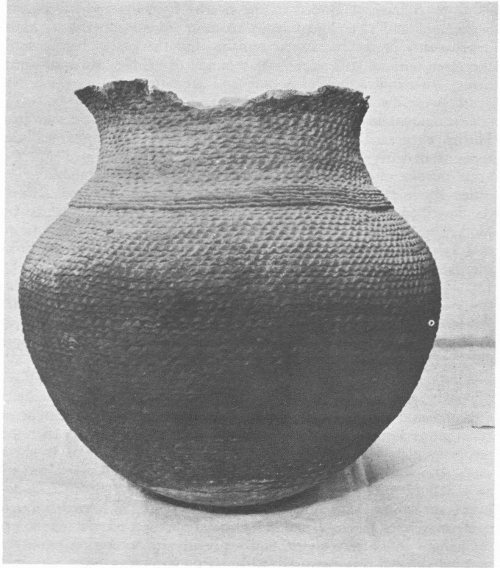
Corrugated cooking pot. Diameter at mouth, 11½″; Maximum diameter, 16⅓″; Height, 16″.
[17]
There was a greater variety of vessel forms and painted designs. For example, designs were no longer confined to the interiors of the bowls, but were also painted on the exteriors and upon a great variety of vessel forms. Many of these designs still seem to be derived from those inherent in basketry, others may have been taken from textile designs, and still others originated especially for use on pottery vessels. Principal design elements seem to have been parallel lines—sometimes straight, sometimes stepped or wavy—zigzags, triangles, checkerboards, and interlocking frets. In the latter part of the period, these elements became broader and heavier and were rendered with greater assurance. A slip or wash of very fine clay was now smeared on the vessel before firing to give it a smooth finish.
Burials were generally in refuse heaps, abandoned storage pits and rooms, or beneath the floors of houses. Infants and small children were frequently buried beneath the floors of houses, as though the parents either desired to keep them around as long as possible, or believed that the soul of the dead child would return with the birth of the next one if the body were close by. Grave offerings consist mainly of pottery, but we may be sure that various perishable objects also accompanied the dead; however, conditions for preservation are so poor in these open sites that most traces of perishable materials have long since disappeared.
In a few areas there are rather puzzling features about some of the burials. For example, along the La Plata drainage there are too few burials to account for the rather large population that must have lived there. Diligent searching has failed to reveal how the La Plata people disposed of most of their dead. In other places skull burials are found—without any bodies—and sometimes bodies are found without any skulls. Perhaps some of these people practiced taking trophy heads of warriors killed in combat or ambush. Now and then burials are found with an arrow embedded in the body, or with scrape marks on the skull which indicate that a person had been scalped, or with the skull smashed in, as though by a stone ax.
While open-armed warfare, as we know it today, was unfamiliar to the Pueblo Indians, life may not have always been calm and peaceful. Raiding or ambush parties, economic strife, the strains of increasing population, arguments over land and water rights, all may have contributed to making life uncertain during this period. And difficulties of a slightly different sort are shown in skeletons from Alkali Ridge in southwestern Utah, which show marked signs of malnutrition and diseases.
This was evidently a period of growth, development, transition, and some struggle. As in other periods, it is difficult to place sharp lines of demarcation between the Pueblo Period and the earlier [18] Basketmaker and between it and the later Great Pueblo Period. In all of the San Juan Basin, at any given moment, examples could be found of both old and new trends. Even in adjacent areas, there was no uniformity of cultural development. But by the end of this period, in one area or another, all the basic Pueblo traits were established. All that remained was for certain of these areas to become specialized along different lines, to become cultural “centers,” diffusing their ideas to neighboring groups, and in turn absorbing ideas from them. Throughout the San Juan Basin, the people were physically much alike; their language may well have been the same, or closely related, and there were probably free movements of people between towns and even between the more isolated groups and the larger centers of activity.
It is doubtful if any group was completely isolated. Intermarriage must have been common. Whole family and clan groups may have left one village and joined another, sometimes only a short distance away, sometimes far away. It would be almost impossible to trace such minor shifts in population; large-scale mass migrations might leave their imprint on the archeological record, but such evidence does not seem to exist, and it is doubtful if any mass movements of people occurred at this time.
At the close of this period, what were conditions in the lower Animas Valley, especially in the immediate vicinity of what is now the Aztec Ruins? Was there a small, early-type Developmental Pueblo Village at this particular spot? Or possibly a large “unit house” type structure? Lack of knowledge about the Animas Valley precludes a definite answer, and early excavations at Aztec Ruins were largely confined to the main ruins themselves. In most places the digging did not penetrate to what may have been the underlying and earlier remains. In a few places beneath the great ruins, where the excavations went deep enough and where the later building of the great pueblo had not eradicated them, there seem to be indications that there were kivas of an earlier type, and possibly a few scattered aboveground dwellings. An early-type Developmental Pueblo village may have stood at this same spot.
THE AZTEC PUEBLO.
At the beginning of the Great Pueblo Period in the Animas Valley there may well have been a sizeable population living in scattered unit house dwellings and small villages, built largely of river cobbles and adobe mud. The area to the south of Aztec, in and around Chaco Canyon, and that to the northwest, in and around Mesa Verde, had each developed local variations in architectural style, religious concepts, and minor arts and crafts. Cultural influences from these two areas were to have a marked effect upon the large pueblo at Aztec that was built, abandoned, and reoccupied during this period.
[19]
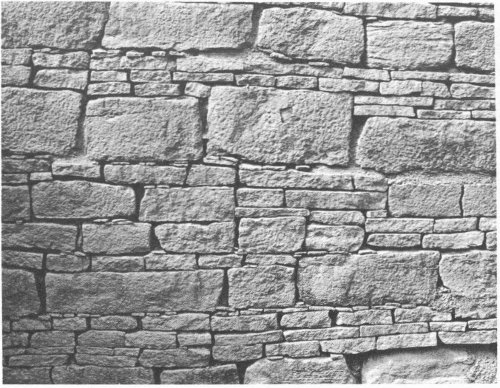
Chaco-style masonry wall.
The Chaco Wash (today a dry streambed during much of the year) rises in the high plains north of the Chacra Mesa, extends westward for 68 miles, and then twists sharply to the north to join the San Juan just above Shiprock, N. Mex. For about 20 miles it flows westward through a beautiful yellowish-brown sandstone canyon, the cliffs of which step back in a series of gigantic sandstone ledges. In places the canyon bottom is broad and level, but today it is scarred by a deep arroyo with branches which extend up each little side canyon, so that travel on foot across or up and down the canyon is difficult. A thousand years ago this arroyo did not exist, and the Chaco Wash was a shallow, clear-flowing year-round stream, meandering through a lush green valley. Where today the sandstone ledges stand starkly denuded of all trees, there was once a dense forest of pines and junipers. Along this canyon bottom and on the mesatops to the north and south, the prehistoric Chacoans erected some of the finest sandstone masonry pueblos in North America. A number of other large Chaco-like sites were built in places outside the canyon proper, and the influence of this building style was felt for 50 miles around.
To the northwest of Aztec, between the La Plata Mountains and the Sleeping Ute, in and around the area dominated by the large [20] tableland of Mesa Verde, a second regional culture center developed. These Indians lived along the main watercourses of the area—the McElmo and Montezuma—or dry-farmed the surrounding mesas. It was toward the end of this period that the Indians living in the Mesa Verde itself built their large imposing cliff dwellings.
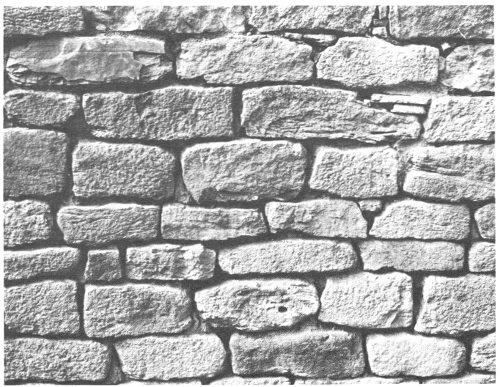
Mesa Verde-style masonry wall.
By the end of the preceding Developmental Pueblo Period the communities in the San Juan area began to be more centralized and to be built according to preconceived plans. Such planning denotes a form of community control, or at least some kind of control over a fair-sized labor force. Today, community projects are frequently carried out in the pueblos by the majority of the people under the direction of their caciques, or leaders, after careful discussions and proper religious observances by the elders of the group. A similar form of self-government must have existed in the prehistoric pueblos. It was probably based on a time-honored tradition given sanction by religious beliefs which extended back as far as the late Basketmaker period where there were beginnings of large community kivas and centralized religious group activities.
With large groups of people living together, greater cooperation was mandatory, and through such cooperation the necessary tasks [21] were accomplished more quickly. Thus there was greater leisure for many people which could be devoted to the more interesting arts and crafts. Sometimes societies limit this greater freedom and leisure to a ruling class, but such does not seem to have been the case among the Pueblos. There are some indications, however, that especially in this period there may have been developing the concept of a priestly hierarchy that also exercised civil controls.
The Great Pueblo Period was a period of continued specialization, not only in architecture but also in ceramics and in the minor arts and crafts. North of the San Juan, most of the pottery seems to have been decorated with a carbon paint, that is, a paint made from vegetal dye. South of the San Juan, in the Chaco area, they generally seem to have used mineral paints. The pottery designs of this period were often hachured patterns, with the thin filling lines surrounded by heavier boundary lines. Band designs of steps, frets, and triangles were also used. Bowls, pitchers, ollas, and ladles were the common shapes; and some cylindrical vessels and effigy pots are known.
An equally popular ware, which was not painted, was the cooking, or “corrugated” ware mentioned earlier. In this period the coils of the vessel wall were still sometimes pressed together to form decorative designs, or sometimes were smoothed over so that an almost-plain vessel resulted.
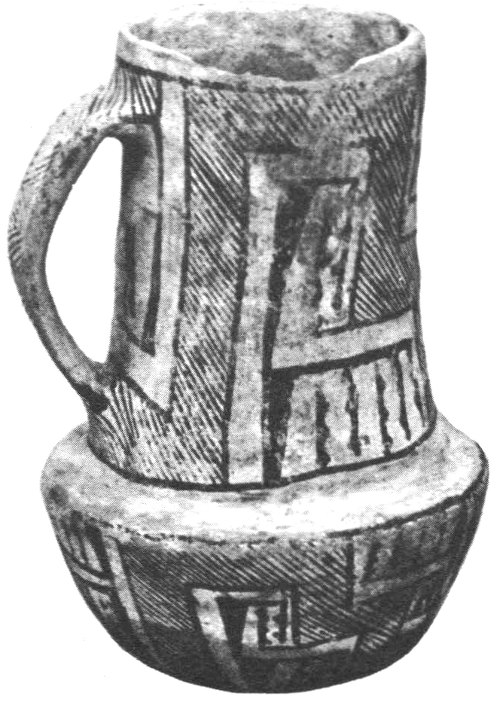
Chaco-style pottery pitcher. Diameter at mouth, 2½″; Maximum diameter, 4″; Height, 6¼″.
In the field of minor arts and ornaments, the people of this period reached a high degree of achievement. Olivella shell beads were [22] still widely used as well as stone beads and stone and shell pendants carved in the forms of birds and animals. Turquoise, which first seems to have been used in late Basketmaker times, was used extensively for some of the finest ornaments, not only for beads and pendants but also in beautiful mosaics.
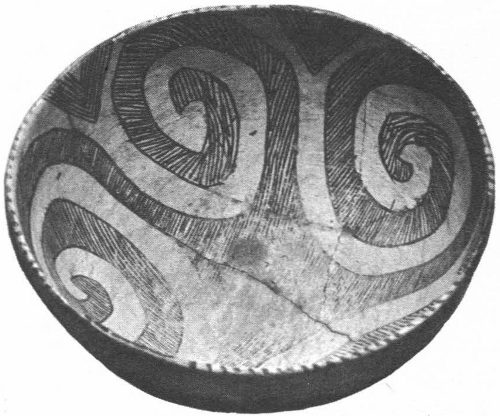
Chaco-style pottery bowl. Maximum diameter, 9″; Height, 4¼″.
However, it is the large multistoried pueblos of the Chaco Canyon and the great cliff dwellings of the Mesa Verde that attract the most attention. The native sandstone at Chaco Canyon made an excellent building material—it was easily obtainable, it fractured along natural cleavage planes into thin slabs, and it could be ground and pecked into large rectangular blocks. Both the availability of sandstone and the relative ease with which it could be worked were important factors in developing the Chaco style of architecture.
Some of these pueblos may have been as high as five stories; most were at least three or four stories. All show signs of constant alteration in individual rooms and in their general layout, as though some feverish urge was forcing the people to keep shifting the arrangement of their dwellings. Not all the rooms in any of the large pueblos were occupied simultaneously; usually the rooms toward the rear were used for storage or, in many cases, as dumps for refuse and garbage. Occasionally, burials are found in them.
All the great Chaco pueblos form self-contained units—that is, they were built around central plazas or courtyards, as in the case of Pueblo Bonito, with a low row of single-storied rooms closing off the formerly open side of the plaza, or they were roughly rectangular with closely knit contiguous rooms and internal kivas as in Yellow House. This closure, plus the fact that the doors and windows which formerly had opened outward at the rear or sides are now sealed up, has led many people to believe the later parts of this period were marked by trouble and strife and that this self-containment was a defensive measure.
[23]
At Chaco Canyon, many parts of the pueblo walls were finely made. Different styles of decoration were produced by using sandstone blocks of various sizes. An unusual effect was achieved by alternating bands of large rectangular blocks with a series of bands of much smaller, finely laminated standstone blocks. The interior of the walls consisted of crude rubble in adobe mud, and, where some form of banding technique was not used in the outer or veneer wall, the chinks between the larger stones were filled with adobe mud and spalls or very small chink stones. When carefully done, this technique also produced an attractive appearance. Since both the interiors and exteriors of walls were usually plastered with numerous thin layers of adobe, it is something of a mystery why the Indians took the trouble to produce such pleasing effects in their stone work and then to cover it up with plain plaster. It may be that what we regard as decoratively charming was to them simply a structural and engineering feature. They may have considered carefully spalled and banded masonry to be structurally sounder than simple rock, rubble, and plaster walls. Usually the walls of the upper stories are successively thinner, and a similar idea was used in the beams which form the room ceilings (and thus the floors of rooms above)—the heaviest beams were in the lower rooms, and those in the upper stories were correspondingly lighter and smaller.
In the Chaco-type great pueblo of this period, the majority of the rooms were large by pueblo standards. They were rectangular in shape (except for the kivas, which are circular) and often 8 to more than 12 feet long and 6 to 8 feet wide. Ceilings were 8 or 10 feet high, and doorways, usually with a raised sill, were 3 to 4 feet high and 2 to 3 feet wide. In comparison with the typical rooms in the Mesa Verde area, those in Chaco were very spacious.
In the Mesa Verde region the people were also learning to build in sandstone, but the available standstone was coarser than that in Chaco and did not have the clean fracture planes, and the masonry was of a thicker and seemingly cruder sort. Walls were made of rectangular blocks of tan sandstone which quite often were carefully shaped and ground to give a pleasing effect.
On the sloping green tabletop mountain, known as the Mesa Verde (from which the surrounding area gets its name), in the early part of this period (A.D. 1050-1200), the people built large unit-type pueblos upon the long finger-like mesatops which extend southward from an abruptly rising escarpment on the north. Most of these units were multistoried, and although they centered around a central plaza, they were much smaller, more tightly contained units than their Chaco Canyon counterparts of the same period. Frequently they contained at least one towerlike structure connected by an underground passage to a nearby kiva. One or more other [24] kivas might be located in, or front on, the small central plaza.
Although the rooms are smaller than the ones in the great communal houses of Chaco, they are solidly built of double course standstone blocks. Because in most cases the mesas are sloping southward, many of these unit houses were built upon one or more terraced flats. Frequently the only entrance into the pueblo was by staired entranceway leading from the south into the small interior court or plaza.
At Mesa Verde, in the latter part of this period (about A.D. 1200-1225), the people who had been living on the mesatops in the unit house type of dwelling seem suddenly to have abandoned these dwellings and taken up residence in the nearby caves. Here they built great pueblo-type structures, often of several hundred rooms with numerous associated kivas. Since they were limited by the ceiling of the caves to two and three-story structures, and not so exposed to the elements, it was not necessary to use such thick, strong walls, roofs, and ceilings. The general construction at Mesa Verde was therefore thinner than at Chaco, and the rooms and doorways are considerably smaller. In fact, with the warm southern exposure of the caves which were used, the people must have done most of their living and daily chores outside, in the small plaza areas and on the roofs of the lower tiers of rooms. The rooms themselves could be small, for they were probably used only for sleeping and storage. Because the native sandstone at Mesa Verde is coarser grained and does not fracture as easily into blocks and spalls, the style of alternating large and small banded masonry found at Chaco was not adopted there. But much of the stonework at Mesa Verde is nonetheless excellent; perhaps some builders had greater artistry than others, for some of the rooms, especially the circular towers, contain blocks which have been carefully pecked, ground, polished, and fitted into exact position with loving care.
In this period, also, a structure known as a Great Kiva comes into prominence. It usually has an entrance on the north side (instead of through the smoke hole), often with a stairway. It has a large raised firebox in the center of the south side, and occasionally another entrance there. In addition, on the east and west sides of the floor are large, rectangular stone-lined pits, built up above the floor. Their exact use is still a mystery, and perhaps they served more than one purpose. It has been suggested that when covered with boards, they would make excellent foot drums for the dances, or good places for the medicine men to conceal themselves while performing certain magical rites during initiation ceremonies. Finally, four large posts set into the floor of the kiva supported the roof. Great Kivas are fairly common in the Chaco area, but in the Mesa Verde vicinity they seem to be very rare.
In each of the two areas mentioned above—Chaco Canyon and [25] Mesa Verde—archeological work has revealed a continuous occupation of the sites and the immediate vicinity. At the great Aztec ruin, however, there is still some doubt as to what really happened. In two different time periods there seem to be strong architectural relations to both the Chaco and Mesa Verde centers, as well as close ties in ceramics and other items of material culture. Part of the intriguing mystery at Aztec is whether these similarities represent actual migrations from those centers on a fairly large scale, or an exchange of ideas, or small groups of migrants who strongly influenced the local population.
In the midst of the populous Animas Valley, along the edge of an old river terrace, early in the 1100’s a large multistoried stone pueblo was built in an architectural style reminiscent of that in Chaco Canyon. Did a large migrant group from the Chaco area—or some other area where Chaco-like people were living—move into the Animas Valley and erect this structure? Or did some of the local citizenry decide to join in a community effort and copy the building techniques of their neighbors to the south? If so, what was the impetus which launched the local people upon this ambitious project? Perhaps a small group of highly skilled technicians, under the leadership of a few “priests” or medicine men, came from the Chaco area into the Animas Valley. Once established there, by persuasion, teachings, or by religious magic and psychological control, they may have prevailed upon some of the local population to join them and to build their homes and kivas of sandstone blocks, in the traditional Chaco style.
We may never know the exact answer to these questions, but wherever the people came from, whoever they may have been, whatever the guiding impetus, Aztec pueblo, like Rome, was not built in a day. Dates from tree rings—as described later—indicate that the pueblo was built between A.D. 1110-1124, with the major construction periods in 1111 and 1115. Probably a small group, or just a clan, moved into the site about 1110, and finding it suitable for habitation erected the first small part of the pueblo. The next year a much larger group, perhaps several clans or more, joined the earlier settlers and more than 50 percent of the pueblo was finished. Then, in 1114 or 1115, a third wave of migrants arrived and essentially completed the pueblo, except for the one-story row of rooms which closed off the south side. It is possible that some of the indigenous Animas population joined these newcomers and moved in with them. From 1115 until about 1124 or 1125, occasional rooms were added as new quarters were necessary for newly married couples and as old rooms were used as refuse dumps.
To the northwest of the ruins, less than 2 miles away, the Indians found an outcropping of sandstone which could be broken into shape and then ground into rectangular blocks. These were hauled to the [26] proposed building site, where the women took over the construction. Holes were dug in the clay soil nearby, water poured into them, and then stirred to produce a thick adobe mud. This was used, along with crude unshaped sandstone blocks, as filler for the walls. On the outside, the women laid up the well-shaped blocks in regular courses, chinking them with small spalls or potsherds.
The rooms were laid out in rows adjoining one another; as one row was finished, another was added alongside of it. When several rows had been completed, second and possibly even third stories were added. The first group to arrive probably completed the major part of one wing; later groups added to this and erected the other wings and associated kivas until the entire pueblo had the traditional planned aspect of a typical plaza-enclosed Chaco pueblo. In the central plaza area several kivas were dug and roofed over at ground level. The fourth side consisted of a single row of one-storied rooms. Finally, even a fourth story may have been added in places. Sometimes a large square space was temporarily left open, later to be filled by a circular kiva.
Out in the plaza, during the latter part of this first occupation, work started on the Great Kiva, for this was the center of the ceremonial life of the entire pueblo. Here would be performed the ceremonies which would insure the inhabitants that theirs would be a long and happy life and that everything would prosper for the new community.
For roofing the rooms, main stringers of pine or juniper were used, and over these were laid splits of juniper or long poles of cottonwood. Next came a layer of rush or reed mattings and then a layer of dirt and adobe which formed the top of the roof, or the floor of the room above if there was more than one story.
The pine logs used for the main stringers are good-sized, many being 1 foot to 1½ feet in diameter and up to 10 or 12 feet long. Although juniper is still fairly abundant in the nearby country, good stands of pine today are many miles away. At the time the first parts of this pueblo were constructed, the pine forest may have been much closer. Perhaps extensive cutting hastened soil erosion and thus caused the forest growth to retreat.
Prehistorically it still was a long haul to bring in such big logs. Many people have assumed that the logs were floated down the Animas River. This would have been the easy way of doing it, but the logs found in situ in the ruins were obviously fresh cut, peeled while green, and show no scars. They must therefore have been carried overland from their source, no matter how far away, for it would have been impossible to float them downstream without being scarred and bruised in transit.
Through the growth of tree rings on pine logs, it is possible to date the time at which they were cut. If a tree is cut today, the [27] outermost ring constitutes its growth for the year in which it is cut. Counting toward the center of the tree ring by ring, you will arrive at the date at which the tree was a young sapling. Climatic factors, dry and wet spells, are reflected in the width of the rings. Dry years usually show small, odd-shaped or stunted rings; normal years show regular well-shaped rings, and extremely wet years may result in excessively large rings. These various rings, which are arranged into patterns, can be matched with similar tree-ring patterns from still older trees, and a chart of patterns can be prepared which will extend as far back in time as you can find specimens with overlapping patterns. Against this master chart the ring pattern of any particular tree can be compared and the specimen dated. Today archeologists have such a tree-ring master chart which extends back to the time of Christ for the San Juan area.
At Aztec, samples of tree rings were secured from some of the beams that still existed at the time this dating process was discovered. Such samples fall into two groups of dates. One group (with numerous samples) was placed between A.D. 1110 and 1124; the second group (with only six samples) between 1225 and 1252. The tree-ring dates indicate that the great pueblo at Aztec had undergone at least two major periods of construction. Since a large number of dates range from 1111 and 1115, this would appear to have been the first peak of building activity.
It is possible that earlier samples have rotted away or have been destroyed by later Indians or by the early white settlers. Moreover, all building activity probably did not suddenly cease in A.D. 1124; it may well have continued for another 10 years, but the beams representative of this later period have since been destroyed. We can safely say that the first construction period at Aztec pueblo occurred sometime between 1110 and 1130, with most of the development occurring around 1111 and 1115. Likewise, a second major construction period at Aztec occurred sometime between 1220 and 1260, with major development in the 25-year span between 1225 and 1250.
The two construction periods at Aztec, as indicated by the tree-ring dates, are corroborated nicely by other evidence found by Morris that Aztec actually was built by one group of people, abandoned, and then reoccupied at a later date by a slightly different group of people. Throughout all the rooms he dug, he found sterile layers of windblown sand and ruined debris from falling walls and ceilings. In this debris and under the sand he found Chaco-like pottery and artifacts. In addition there were surprisingly few burials. The last point might seem strange, except for the fact that even today, 40 years after Morris’ work and despite endless searching, archeologists have located few Chaco-type burials in Chaco Canyon itself. Whatever the burial customs of the Chaco people may have [28] been, they have eluded archeologists for many years. The absence of burials of this period at Aztec is a clue that probably a group of Chaco-like people, bearing the distinctive Chaco culture, may actually have moved into the Aztec area.
Morris wrote that he found many rooms built in typical Chaco-style architecture. Granting that the local sandstone was not quite as easily worked as that at Chaco, the large-size rooms, the high ceilings, the banded-veneer masonry walls, the large doorways, and other techniques used were very similar to the architectural techniques of the Chaco area.
Overlying the Chaco debris and sterile sand layers, Morris found pottery, household utensils, and burials characteristic of the classic Mesa Verde Period—a period which occurred later than the great Chaco Period. In addition, there were obvious architectural signs of rebuilding and remodeling within the pueblo. Large Chaco-type rooms had been made smaller by wattle-and-daub partition walls, while doorways had been shortened and narrowed more like the ones at Mesa Verde.
Thus there were two definite periods of occupation at Aztec, one by a Chaco-like people and one by a Mesa Verde-type people. The two major construction periods, as indicated by the tree rings, agree with Morris’ evidence of two occupation periods and, so far as we know, closely date those periods during which the pueblo was actively inhabited.
Aztec, at the height of the Chacoan occupation, must have been a fascinating sight. On a sunny summer day, the plaza and rooftops would have been a busy swarm of activity—mothers nursing and tending their young, grinding corn for tortillas, preparing meat for the stew pot, making baskets, and molding clay pots for later firing. Old men basked in the sun or instructed the young boys. Most of the men and older boys were busy tending the corn, beans, and squash in the fertile fields surrounding the pueblo. This was exacting work, since each plot, clan by clan, had to receive its carefully husbanded share of water from the irrigation ditch that ran along the slope of the high terrace just to the north of the pueblo. At times during the day, hunters would straggle in happily if burdened with game, sadly and slowly if empty-handed after a fruitless chase. Occasionally a wandering group of strangers would pass by with items to trade. They were made welcome and fed, and the whole plaza took on a festive air.
At night the pueblo must have presented a vastly different appearance: dark, mysterious, and quiet. Here and there a small dying fire cast a flickering glow upon a brown adobe wall. In one or two of the kivas, a faint light through the hatchway in the roof indicated preparations under way for a ceremony, or perhaps a special highly secret meeting of one of the clan societies. If you looked [29] closely you might make out one of the sentinels, silhouetted briefly against the night sky as he shifted position. But the pueblo was silent—a silence only broken by an occasional dog’s bark or baby’s wail—until, shortly after the morning star appeared, the hunters crept quietly out of the pueblo, and as the star faded, the broadening morning light heralded the approach of another day in the life of Aztec pueblo.
But something happened. For no reason we can ascertain today, the pueblo was abandoned by its first occupants. Presumably, this was a fairly fast exodus, but one in which the people had time to take most of their treasured possessions with them. There is no evidence that they were driven away by invaders, or by any other major catastrophe such as fire, flood, or pestilence. We do not know if they left en masse or perhaps more gradually, as they arrived, in clans and groups. If a few hardy souls stayed behind, or if a few weak stragglers couldn’t make the trip, there is no evidence. All we know is that by about A.D. 1125, or perhaps 1130, the pueblo was empty. For almost a hundred years the great structure stood alone, untended and uninhabited. Perhaps the local people occasionally used a loosening beam from the structure, or gathered up a few blocks from the slowly crumbling walls, or helped themselves to any readily useful articles left behind, but otherwise they and any passing wanderers seem to have left the place alone.
For years the wind blew the sand into the open doorways, through the widening cracks in the walls, past the sealed doorways, down through the floors, until even the deepest and most inaccessible rooms had a layer of 4, 6, or 8 inches of fine sand deposited over them and whatever secrets they held. Rats and other rodents infested the place and little disturbed the brooding silence except for their piping squeals. Occasionally weakened beams gave way or a wall here and there crashed down as its plaster and rubble fill were washed out by rains and melting snows. Bit by bit the old pueblo slowly crumbled.
Why and how the first great pueblo was built by a Chaco-like people and then suddenly and for no apparent reason abandoned is a real mystery. Strangely, this abandonment seems to agree roughly with the time at which the Chaco area itself was being depopulated. In Chaco Canyon, an arroyo, much like the one which exists today, was cutting its way backward up the canyon, and this arroyo-cutting would have made it impossible for many of the inhabitants to continue to flood-irrigate their fields. It may have been the basic factor involved in the general abandonment of the great communal dwellings of the Chaco Canyon around A.D. 1150, no doubt coupled with a certain amount of strife and considerable periods of drought.
But this would not have been true at Aztec. The Animas River is a perennial stream, and there is no apparent cause for the abandonment [30] of the pueblo by the Chaco-like people, unless for some reason they decided to leave Aztec because the last of their kinfolk in Chaco were leaving that area.
In fact, it could better be proposed that some of the first groups, which had to leave Chaco Canyon about 1100 because of the incipient arroyo and its accompanying loss of irrigation water and generally lowering water table, might actually have moved to the Animas and established Aztec. Perhaps a rather coincidental event may have occurred at Aztec which caused its abandonment just as Chaco Canyon was almost depopulated. The early settlers in the Animas recall evidence of a prehistoric canal flowing along the lower slopes of the terrace to the north of Aztec Ruins, somewhat lower than the modern one. This canal took off on the right bank of the river, several miles upstream from the pueblo. A major shifting of the river, a swing of the main stream against this old river terrace on the right bank, would have effectively cut the canal at a point below which the people could not take off water to irrigate their fields and in a manner they could not repair. Such a disaster would have forced them to move to other cultivable fields; if none were available nearby (and they may have all been taken up by other local groups), they would have had to go far away. They couldn’t return to Chaco Canyon or other areas near there, for these places too were being depopulated. So perhaps they followed some of their Chaco kinfolk who were intermittently migrating in groups to the Rio Grande, or to the Hopi country. In these new areas, mixing with the local population, they lost their distinct cultural identity. We can look at the modern Pueblo Indians of today and wonder if perhaps some of their long ago ancestors may not have actually lived at Aztec or in Chaco Canyon.
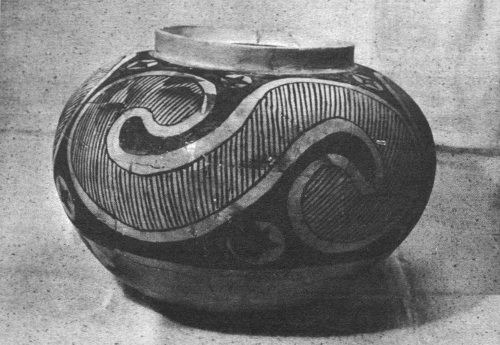
A pottery “kiva” jar. Mesa Verde style. Diameter at mouth, 4½″; Maximum diameter, 13⅓″; Height, 9½″.
[31]
But there is a double mystery at Aztec: as indicated earlier, overlying the evidences of a Chaco-phase occupation, Morris found evidence of rebuilding and rehabitation of many rooms. Large-sized Chaco rooms had been shortened, reduced, or cut off by interior walls and lowered ceilings. Older doorways had been blocked up, or had been partially filled and reduced in size. In some cases entire small rooms, complete with ceilings, had been built within larger rooms. New floors had been laid down upon the debris and windblown sand which partially filled some of the older rooms. Older beams had been pulled out of rooms and reused elsewhere, or new walls in a different style had been built in place of those that had collapsed.
A newer style of pottery, reminiscent of the Mesa Verde-type pottery, was prevalent. The majority of burials found within the ruins, 149 out of a total of 186, seemed to belong to a different period as shown by the type of artifacts associated with them. T-shaped doorways, an architectural trait characteristic of Mesa Verde times, was prevalent in the later parts of the pueblo. Keyhole-shaped kivas, another Mesa Verde trait, were inserted into and between rooms of the earlier period. And finally, the Great Kiva in the central plaza, which had fallen into disuse, was rehabilitated—in a much poorer style of construction, surely, but nonetheless obviously repaired and temporarily put back into use.
These factors inclined Morris to feel that some time after A.D. 1124 the pueblo at Aztec was abandoned by the Chacoan builders. Then about 1225, a new group arrived, bringing with them the general styles and culture of the area we know as Mesa Verde.
As with the earlier occupation at Aztec, we do not know exactly who these second people were or exactly where they came from, although it is obvious that they had a close affiliation with the people of the Mesa Verde area. Nor do we know if they were a large group, representing a mass migration, or whether once again some of the local population may have decided to attempt building a large community. Perhaps for a second time a few people, possessing special abilities or representing a religious organization, prevailed upon either the local population of the Animas Valley or wandering migrant groups to assist them in erecting large community structures.
We do know that at about this time there was a considerable [32] population shift all over the Mesa Verde area. The people were dispersing from their normal habitats and moving into more protected locations or consolidating into larger, more defensible units. In the Mesa Verde itself, for example, they were abandoning their mesatop pueblos and crowding together in the caves or moving out of the area entirely. In the Hovenweep area, they retreated to the heads of the canyons and built watchtowers along the canyon sides and bottoms to protect their dwindling water supplies. It was evidently a period of considerable strife and turmoil. There were short periods of recurrent drought, and possibly many of these groups had begun to fight among themselves over land and water rights and other necessities of life.
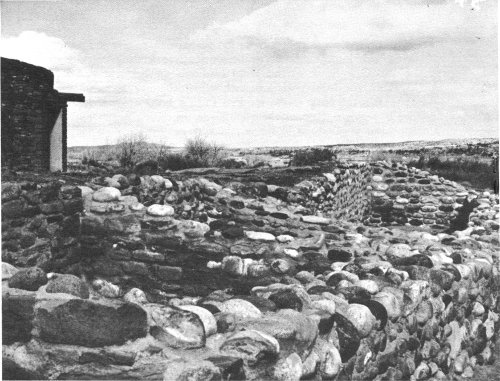
Cobblestone walls at Aztec Ruins.
The second occupation at Aztec was more intensive and one in which parts of the local population participated actively. The construction style of this period shows a considerable use of local cobblestones set in adobe mortar, as in many of the small ruins throughout the Animas. Sometimes cobblestone walls are overlaid or underlaid by, or even intermingled with, sandstone walls. It [33] was at this time also, as far as we know, that the other pueblo units—now all ruins—within the monument boundary were constructed, as well as several other major Mesa Verde-phase structures elsewhere in the Animas Valley.
In addition, large quantities of new material had to be secured fairly rapidly to keep pace with the feverish building activities at Aztec. While some of the rooms of the large Chaco-style pueblo were rehabilitated by these new inhabitants, others were dismantled and their materials, in addition to those from fallen walls, were used elsewhere. But even this great pueblo could not supply all the stone needed. So from the old quarry to the site of the pueblo two paths were built, side by side, each wide enough for eight men to walk abreast. For many months, men with stone mauls and hammers cracked and chopped and ground the sandstone into building blocks. Other men and the stronger boys toiled all day in straggling lines, carrying the blocks on large wooden litters or in great slings strung on poles. Long lines of workers streamed down one path, loaded with blocks, to return over the other path with their empty litters and slings.
Although the Great Kiva was repaired, with rather sloppy workmanship in many places, it was probably only used for a brief period. The focal point of the community’s religious life seems to have centered around the peculiar and somewhat puzzling tri-wall structures, two of which exist at Aztec. One is the excavated Hubbard Mound site just to the northwest of the main ruin; the other is Mound F, which is also to the northwest of the other major but largely unexcavated ruin—the East Ruin. If there was such a thing at this time as the beginning of a priestly hierarchy among the Pueblo peoples, these tri-wall structures with their centralized kivas may have been the domiciles and religious quarters of this hierarchy.
Once again life seemed to flourish at Aztec. This time, with all the extra pueblo units close to each other, the area must have resembled a veritable beehive. It would have taken an extensive farming area to support the population. If a shift in the river had cut the Chacoans’ canal, another shift back again may have made it possible to restore the old canal, improve it, and once again make the surrounding fields green in summer with growing corn, beans, squash, and cotton.
In contrast to the Chacoan occupation, Morris found a large number of burials (149) from this period, mostly in the rooms. Many were buried with great care and had numerous and varied grave offerings. For a while, evidently, the Pueblos prospered and traded far and wide for luxury items. But once again bad times set in, possibly accompanied by almost constant armed harassment by less fortunate groups. Although Morris did not find any direct evidence [34] that the people at Aztec were actually killed off or driven out by armed conflict, the later burials were all hastily made and usually unaccompanied by grave offerings. In addition, almost the entire east wing had been destroyed by fire. This could have been accidental and such a disaster might have proven the final straw for an already beleaguered group; or they may have fired the pueblo before leaving, or some marauding group might have been responsible.
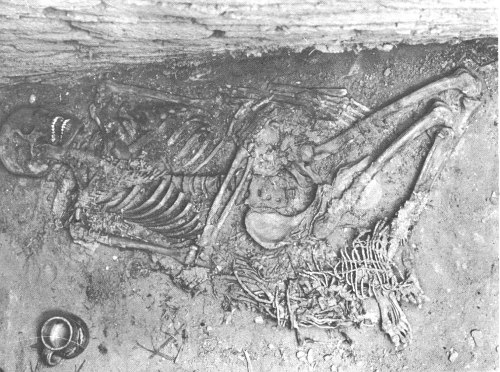
An Aztec Ruins burial with pottery mug in situ.
Exactly why, after 25 or 30 years, the second group also abandoned the site we may never know. Times were hard in the Four Corners country, and by 1300 this area seems to have been virtually depopulated. Perhaps the abandonment of Aztec, sometime after 1252, was simply a local manifestation of this much larger dispersal.
No doubt the great drought of the last quarter of that century contributed substantially to this general abandonment, but there must have been other factors at work as well. The Indians regard the forces of nature in a different manner than we do. They may have been struggling through long years, not only with nature but among themselves. They may have felt that their gods were against them, that somehow they had offended them, and that nothing [35] they could do in that country would be right again. It may have seemed easier to them, family by family, group by group, and perhaps pueblo by pueblo, to give up the struggle and go elsewhere, to start over in new surroundings where the gods might smile upon them once again.