YOUR SCIENCE PROJECT
Reading edition
Choosing the Topic
Since you will necessarily spend considerable thought, time, physical effort, and (sometimes) money on your project, pick a topic from which you can expect to learn something. If you can avoid the temptation to pick one with which you are already familiar, you will probably get more out of it. Your project should be an adventure, not merely a drill!
On the other hand your science project need not be in utterly unexplored areas; to be successful you need not come up with data and conclusions which will confound professional scientists who have spent their lives in similar work. You are a student and a hobbyist, not yet a professional research scientist. Primarily your project should advance your personal knowledge, and your abilities to observe, speculate, hypothesize, experiment, deduce, and conclude.
You should choose a project which you can expect to follow to a successful conclusion, but which is enough above your current knowledge to make you “stretch” your abilities.
But it is important not to bite off more than you can chew. The project should not demand so much time that you neglect other responsibilities. However, you need not pass up an interesting topic because covering all of it would consume too much time. Instead, zero in on just those aspects which interest you most.
5
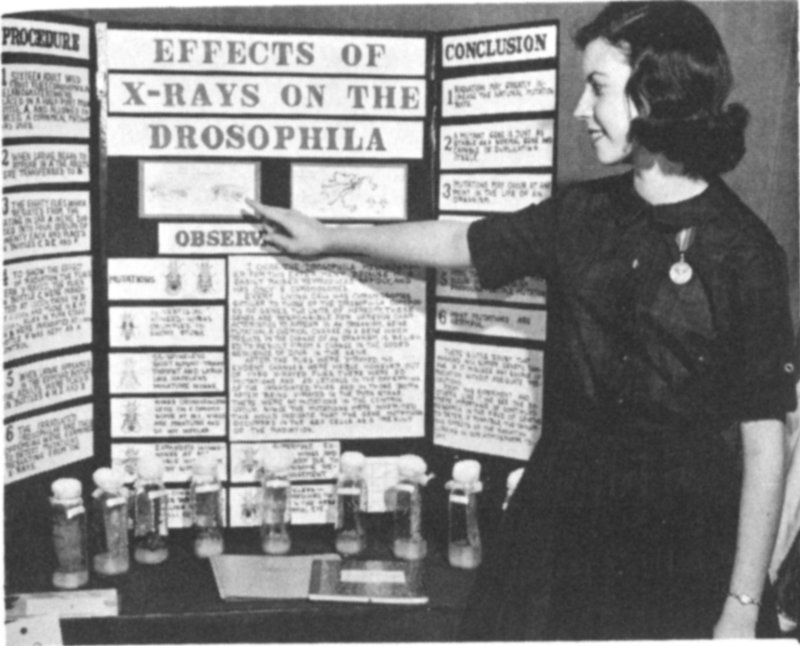
Sophomore Eileen O’Brien of New Dorp High School, Staten Island, New York, displayed this nuclear-related exhibit at the 13th NSFI at Seattle in 1962, but did not win any AEC recognition.
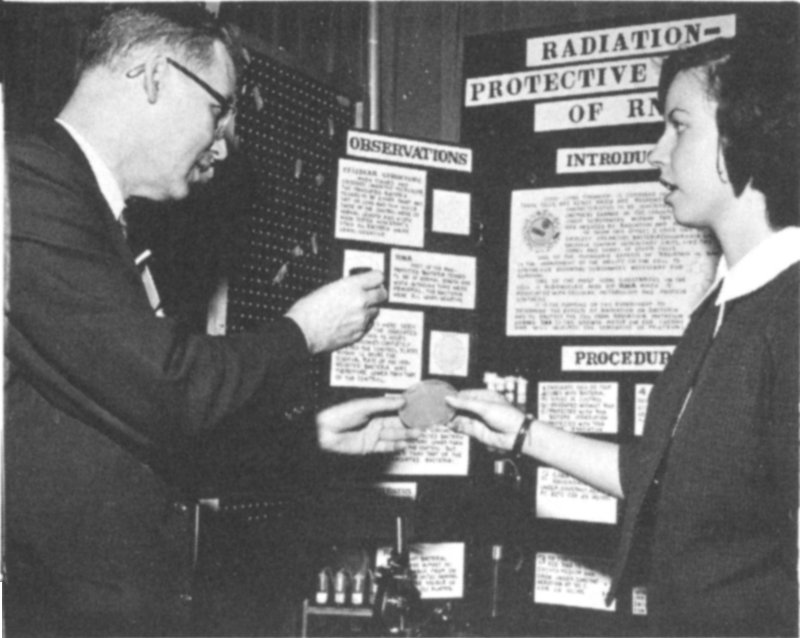
At the 14th NSFI at Albuquerque in 1963, junior Eileen O’Brien returned with a new and better exhibit of a related but more advanced project...
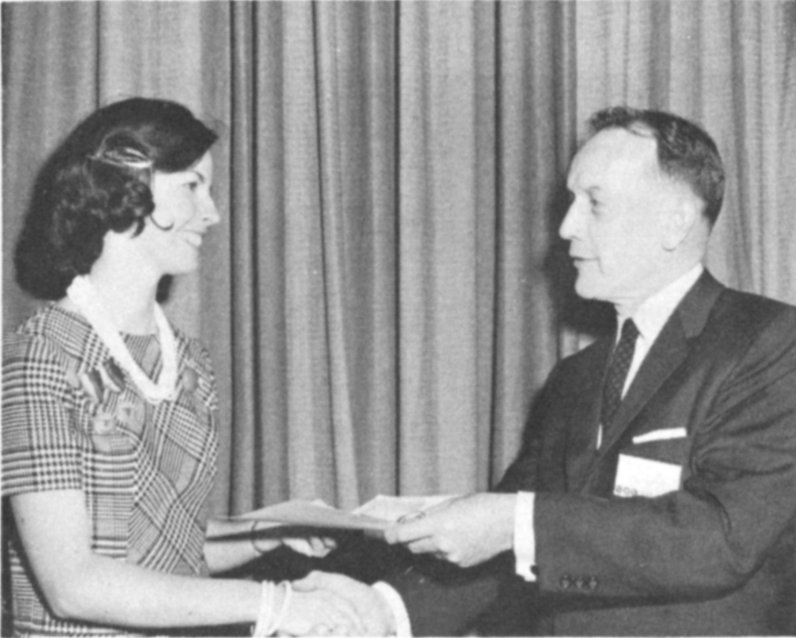
... and found herself an AEC Special Awards winner invited, with her science teacher, to spend a week at Argonne National Laboratory.
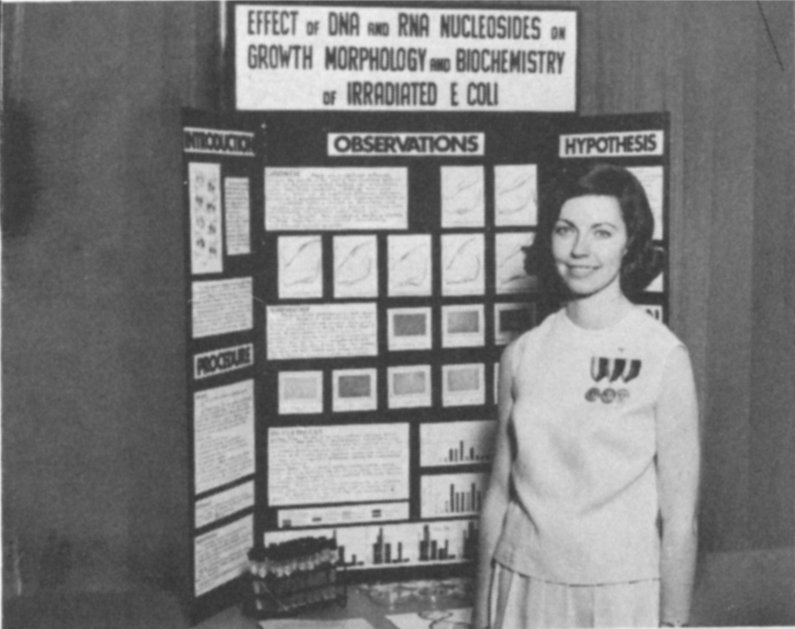
At the 15th NSFI at Baltimore in 1964, senior Eileen O’Brien qualified again as an AEC Special Awards winner by exhibiting a more advanced project, but one still related to her earlier ones. Courtesy Science Service
6
You may be able to select a project which will be of continuing interest in later years. For example, a 9th-grade general-science student might begin by making an overall survey of a topic to discover what is already known about it and what remains to be discovered. As a 10th-grade biology student, he might investigate biological aspects of his topic, and then follow with investigations of chemical and physical aspects of it while studying 11th grade chemistry and 12th grade physics. Some outstanding science fair exhibits have resulted from such progressive development of a single project which the exhibitors undertook first in junior high school.
Whenever you ask a question about some aspect of nature you have a possible project topic. “How does a chicken hatch?” “What is the best way to treat a burn?” “How could nuclear energy be used in space travel?” You need only examine the questions that occur to you every day to find dozens of topics on which to base projects.
You might identify promising topics by reviewing the table of contents in your science text, noting chapters or topics of particular interest. Or you may find it helpful to consult the references listed in the appendix to this booklet. If you are interested in a project related to atomic energy, the appendix lists also many nuclear topics and research areas.
It is probably wise to select several potential project topics, do a little reading on each of them, and then pick one. Before reaching a decision, discuss them with your teachers and parents. Your science teacher can help you pick a topic that will relate closely to classroom work, and may be able to suggest interesting approaches you haven’t considered. By talking your project topic over with your parents and advisers you can make sure that you will have the time, working space, moral support, and financial resources needed to complete it successfully.
7
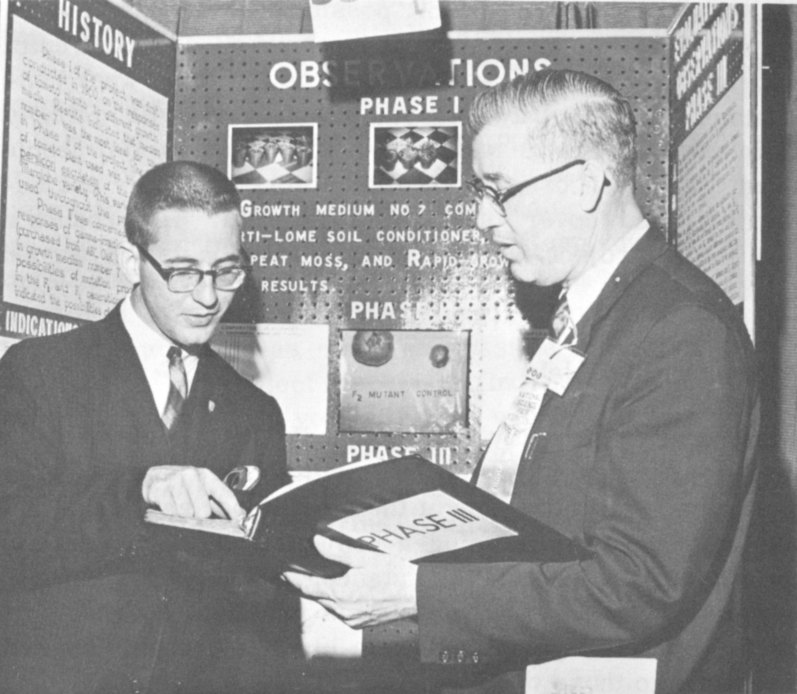
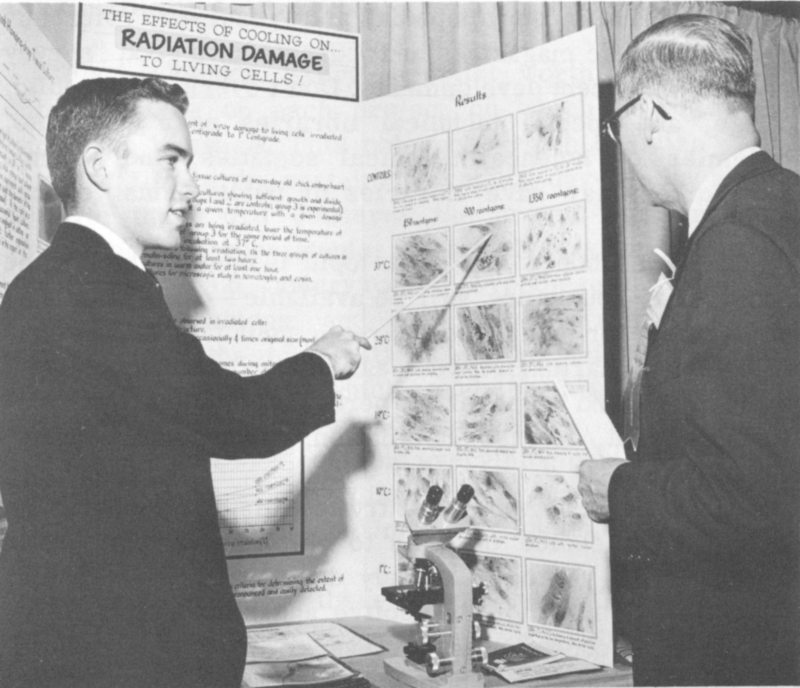
After failing as sophomores to qualify for AEC Special Awards at Seattle, both these Texans came back as juniors to win at Albuquerque with better exhibits of similar, but more refined projects. James L. Ash (below) is from Dallas, and Michael A. Haralson (above) is from Abilene.
8
At the outset, the exhibit possibilities of your chosen project may not be clearly apparent. You cannot predict exactly what procedures you will follow nor what conclusions you will draw. As you proceed, you will probably uncover many facts which you will want to tell people about. If you choose a good topic, work carefully and accurately, and cover the topic fully, you will produce a successful project which can form the basis for a good exhibit.
Where to Get Help
One mark of a truly educated individual is his willingness to discuss his problems with others and profit by their advice and help. One of the most important things that you can learn while doing a project is how and where to obtain information and assistance.
Your science teacher may be an excellent source. If he cannot provide specialized help himself probably he can direct you to those who can.
Your school librarian can point out specialized references such as scientific encyclopedias and “reserved” reference books. Scientific magazines and journals have good “survey articles” on recent developments. Don’t overlook the public, college, and special technical libraries near you. Also, academies of science, technical societies, and science laboratories may have libraries or publications you can use.
It is to be hoped that your topic is one on which some expert local counseling will be available—from your science teacher or one of your parents, your family physician or the local pharmacist, your agricultural extension agent, or scientific and engineering personnel of a nearby manufacturing plant, defense installation, research laboratory, or college.
Select a project adviser and try to enlist his cooperation. Explain your choice of topic to him and how you plan to develop it. (If you have already done background reading you may find him more receptive and more helpful.) You may need to consult him on several different occasions. You will probably want him to check you project plan to 9 make sure that you have not left out an important step, or included some potential pitfall. Also, you may want him to review the final written report in which you summarize your work and findings.
However, your project must rest upon work done by you. It is permissible to obtain assistance from others, but never to the extent that you are standing on the sidelines watching someone else do your work. Keep your interviews brief and approach each conference with a clear idea of what you are seeking and why, and always only after you have already done as much as possible—whether by way of reading or project work—to find the answer on your own. By doing this you will gain valuable habits of self-reliance, and added stature in your adviser’s eyes.
Special equipment and materials may be obtained or borrowed through laboratories. College laboratories assist sometimes. Some industrial organizations may have surplus equipment and materials that they are willing to lend or donate.
Documenting Your Work
Project Notebook Every scientist worth his salt keeps detailed notes on each project on which he works. You should do likewise. This notebook, which could as well be a set of file cards, contains a running, day-by-day account of everything that concerns the project—observations, speculations, experiments, materials, expenses, procedures, data and observations, hypotheses, checks for validity, conclusions, and conjectures. From such notebooks comes the information for the scientist’s formal report, or “paper”, by which he advises his employers and colleagues of the progress of his work.
Since the notebook contains everything pertaining to your project, it may become disarranged, no matter how well you organize it in the beginning. If so, don’t worry—just keep it up to date.
Project Report But there should be nothing haphazard about the final report on your project. In some science fairs, this report is displayed in the exhibit and considered 10 in the judging. Even where not required, the project report belongs with your exhibit.
After writing your report you will find that much of your exhibit planning—and even some of the text which will appear in your exhibit—is already accomplished.
If you are doing your project as a classroom assignment, your teacher may specify the manner in which your report is to be organized. Otherwise, you can follow a format such as this:
1. TITLE. Keep it short. If accuracy requires more than a few words, consider using a very brief main title and a more definitive subtitle.
2. ABSTRACT. This is a very brief condensation of the entire report summarizing the objectives of the project, what you did, and the conclusions you came to.
3. INTRODUCTION. Describe your topic and give some background information such as relevant work done by others. Summarize your purpose, scope, and method of investigation. State the questions or hypotheses your examined. Include the most significant findings of your investigations.
4. MATERIALS AND METHODS. Describe in detail the materials, equipment, methods, experiments, controls, unforeseen difficulties and remedies.
5. OBSERVATIONS AND DATA. Describe your observations. Include some of your observational data here as an example. You may wish to put the bulk of it in an appendix.
6. DISCUSSION OF RESULTS. Give the main conclusions your observations tend to prove or deny. (Disproval of your initial hypothesis may be as important as proof of it!) Include the evidence developed for each main conclusion and any exceptions, or for opposing theories. Offer possible explanations. Compare your results and interpretations with those of other workers in the same field.
7. NEW QUESTIONS, POSSIBLE APPLICATIONS, AND FUTURE PROJECTS, IF ANY.
8. APPENDIX. Give more detailed and supplementary information, often including graphs, tables, photographs, and drawings.
9. BIBLIOGRAPHY. Keep it brief, listing only those books and periodicals which you actually used to provide background information.
10. ACKNOWLEDGEMENTS. Both prudence and the best traditions of science require that you acknowledge all help which you receive. Usually student scientists do not produce 11 laboratory work of professional quality, nor do student exhibitors match the skill of commercial designers and fabricators. Consequently, when judges encounter very exceptional unacknowledged work, they may reasonably wonder if the exhibitor received some professional help. And if on part, they speculate, on how much more? Result: they might be tempted to disqualify the exhibit entirely, whereas if you had acknowledged frankly—“Professor James Smith, Alpha University, for loan of four color transparencies”, or “My father, who devised the lighting system”—you might lose a point or two on their scorecards, but remain in competition.
Your project notebook and your formal project report are important components of your exhibit to follow. If both are completed first, you will find planning the rest of your exhibit a much simpler task.