SCIENCE PROJECTS, EXHIBITS, AND FAIRS
Reading edition
In almost every area of endeavor, we learn best by doing. Books and lectures provide background, but it is by putting theory into practice that we make knowledge truly our own. To learn a language, we read and speak it. Our knowledge of mathematics follows practice at problem solving, and so it is with science.
Science Projects
In conducting a good science project, we work in much the same manner as professional scientists. Like them, we observe, experiment, investigate, speculate, and check the validity of our speculations with more experiments, all in order to learn something. If our work is good, others may learn from it too, but only if we present it adequately.
Better understanding of an area of science is the least that we can gain from doing a science project. At their best, science projects foster habits of effective planning, attention to detail, careful work, and high performance standards that will serve us well throughout our lives. Moreover, there is always the promise that the project will open the door to a satisfying career.
2
Project Exhibits
More and more, scientists are called upon to share their work not only with other scientists but also with legislators, administrators, sociologists, artists—all kinds of people in all kinds of professions. To follow this lead, student scientists also must tell other people about their science projects.
When executed properly, exhibits are an effective way to do this. Exhibits which combine interesting visual materials with well-written messages can communicate much in very limited time and space. Good exhibits can speak clearly to a great variety of viewers. Those already generally familiar with the subject may absorb the entire message, but even the uninitiated will find something of interest.
Science Fairs
Fairs have been popular throughout history. Generally they have been occasions to display work or feats of which people are proud. Often they have stimulated progress and the exchange of goods and ideas.
Early in this century some teachers encouraged their students to undertake individual science projects, then exhibit them before their classmates and fellow students. Between the two World Wars some individual school systems developed citywide science fairs to show the most outstanding of these exhibits from each school. The science fair movement gained momentum rapidly after World War II, and in 1950 the First National Science Fair was held in Philadelphia, drawing exhibitors from 13 affiliated area fairs.
Today the national event draws exhibitors from more than 200 affiliated state and regional fairs. Recent entry of competitors from several other countries has produced its new title—National Science Fair-International (NSFI). It is the “Olympic Games” for science fair exhibitors, conducted by Science Clubs of America, an activity of Science Service, 1719 N Street N. W., Washington, D. C.
3
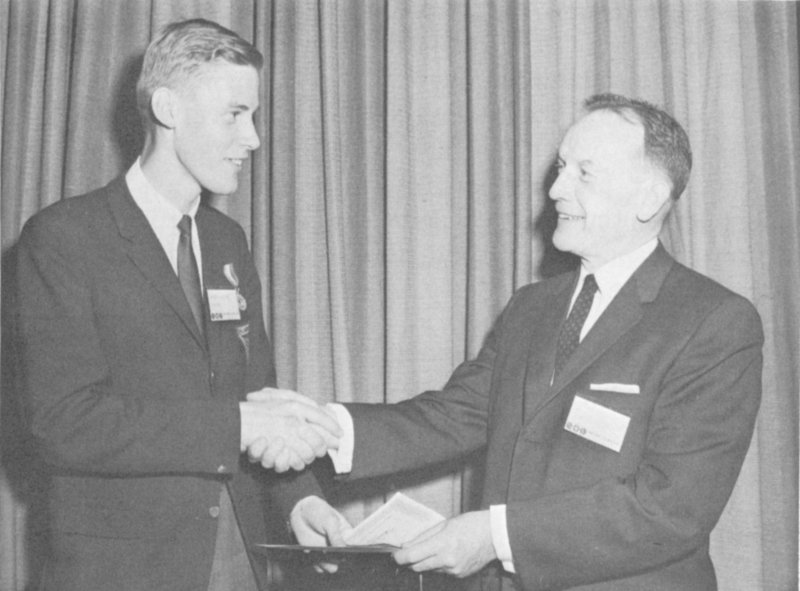
The growing international flavor of the national science fair is exemplified in contestants like Anders S. Brahme, Sweden’s entrant at Albuquerque in 1963, and the first non-U. S. student to achieve Atomic Energy Commission Special Awards recognition. He was one of 10 alternates to the 10 winners and is shown receiving a Certificate of Achievement from Harry S. Traynor, AEC Assistant General Manager.
Usually state and regional science fairs are limited, like the national event, to the 10th, 11th, and 12th grades, but occasionally they have a division for junior high school entrants. In school districts where junior high schools hold fairs, the district fair frequently includes both senior high and junior high divisions. Some elementary schools conduct science fairs for their 4th, 5th, and 6th grade students. In both the elementary and junior high school divisions, exhibitors usually compete against entrants of their own grade level, for example, 5th graders against 5th graders, and 9th graders against 9th graders. In the senior division each entrant competes against all others. Although the overall quality of exhibits at local fairs is rarely up to that of regional, state, and national fairs, the local events are possibly the most valuable educational tools because they are viewed by so large a “grass-roots” audience of classmates, parents, teachers, and other local citizens.
4
In science fairs—as in athletics or music—top prizes are seldom won by first-time competitors. Almost all national fair exhibitors have participated in science fairs at various levels for a year or more before winning their way into the national event. Both experience in science projects and practice in display techniques are required to develop outstanding exhibits. Since this is true, the time to start the science project which will form the basis for your exhibit is now!