Front matter (continued 3)
Reading edition
He mounted the steps leading to the door of Squire Sylvester's office, and hesitatingly entered that impressive business sanctum. Squire Sylvester was standing at his desk biting the end of a lead-pencil, and studying the columns of figures on the paper before him.
"Squire Sylvester, do--do--you know of any vacant situation in business?" asked Dave.
The squire looked up.
"Humph! Nothing to do?"
"Can't find it, sir."
"Well, I wish I could find somebody to work for me."
"Have you anything?" asked Dave eagerly, thinking how nice it would be to occupy a desk in the squire's office and assist in the management of such business enterprises as the building of ships or the sailing of them.
"I have been trying to find somebody to cut up some wood for me and stow it away, but I can't get hold of any unoccupied talent."
Dave's countenance dropped. It went up again, though.
"It will pay a week's board, maybe," he said to himself.
"I--I'll take that job, sir. I know how to swing an axe, and I'd rather be doing that than go loafing about."
"Good! I thought there was some stuff in you worth having."
Dave disregarded this compliment, and asked, "When shall I go to work?"
"Any time. Saw is behind the chopping-block in my shed, hung on a nail, or ought to be; and axe, I guess, is keeping the company of the block."
"I will begin to-day. There will be a comfort in knowing I am doing something."
"That is a good spirit, young man; and let me assure you if you stick to that style of doing things, some day you will be able to take comfort--a lot of it."
The squire went to the window of the office when Dave had left, and watched him cross the street in the direction of the squire's home.
"I like that young chap," murmured the squire.
Dave found the house of his employer, left word at the door that he was sent to look after the wood, and went into the shed.
"Here is the chopping-block, and there is the axe, and the saw is all right. I will take my tools outdoors, where my wood is," said Dave.
It was a day in early spring. Snow still clung to the corners of gardens, and hid away under the bushes, and lay thick on the shaded side of buildings. The sun, though, was strengthening its fires every day, and had coaxed a few bluebirds to come north, and say that warm weather had surely started from its southern home, and would be here in due season, though a bit delayed, perhaps. Two hours later, Dave's axe was striking music out of the pieces of wood the saw had first played a tune on; and it is that kind of music that helps a man to feel independent and self-reliant, contented and cheerful.
"Hollo! that you?" sang out a voice. "How are you, old man?"
Dave looked up, and saw Dick Pray nodding over the fence.
"The old man has found work, you see," replied Dave.
"None of that sort for me," sang out Dick.
In about half-an-hour another voice was calling to him across the garden fence. This was not the flexible, smooth, rounded voice of youth addressing Dave, but there were the tones of an old man. There was a world of friendship, though, in this old man's salutation, "How d'ye do? how d'ye do?"
Dave turned toward it, and there was the old light-keeper, Toby Tolman.
"May I come in?" asked the light-keeper, approaching the gate.
"Oh yes, sir, do! Glad to see you."
The light-keeper came up the gravelled walk, approached the pile, and said, "How much more of a job have you got?"
"Oh, a couple of days."
"Well, then, do you want another?"
"Yes, sir. But how did you know I was here?"
"May, my granddaughter, knew, and she told me. I was at the house, you see. My job for you is to go to the lighthouse and be my assistant. She told me, and I said to myself, 'There's the man for me!'"
"You don't mean it! Why, where's Timothy Waters?"
"Got all through."
"His time up?"
"Well, he went before he wanted to. Wasn't just particular in reckoning what belonged to others."
Dave recalled at once the little affair about the two pennies.
"Who's at the light now, Mr. Tolman?"
"Oh, an old hand, who is just piecing me out at this time when I need help. He leaves day after to-morrow. Now, come! I'm up here trying to look somebody up to be my assistant. Can't bring it about at once; but if you'll go and stay a while I think you'll get the berth, and I don't know of anybody I'd like better to have."
"And I should like to come, too, and I will, just as soon as I finish this job."
"Maybe the squire would let you off now."
"I daresay."
"I'd like to take you back with me to-day."
"And I'd like to go, but I'd better finish up."
"You're right, on second thought. The squire wouldn't hesitate a moment, I venture to say; but then people sometimes grant us favours when at the same time they say to themselves, 'I wish they hadn't asked me.' You stay and finish your job."
The second day after this the task was completed, the saw going to its place on the nail behind the chopping-block, and the axe finding quarters near by.
"There!" said the squire: "I don't know that I ever paid for a job with greater satisfaction."
He was handling a roll of bills as he said this, and handed one of these to Dave.
"It is too much, sir."
"Oh no. That was a peculiar pile of wood, and it took a peculiar kind of merit to get the better of it. For ordinary wood," said the squire, his eyes blinking, "I should only pay an ordinary price; but this wood was something more than ordinary, and of course the price goes up. When I can do you a favour, you let me know."
That day toward sunset a dory was gently tossing at the foot of the lighthouse on Black Rocks.
"Hollo!" shouted Dave, looking up from the boat and aiming his voice at the door above.
"Oh, that you?" asked the light-keeper, quickly appearing in the doorway and looking down. "My man will be here in a jiffy and go home in your boat, as we fixed it, you know."
Dave exchanged the boat for the lighthouse, and the retiring assistant quit the lighthouse for the boat, then rowing to his home. Dave heard that night the wind humming about the lantern, saw the friendly rays beckoning from other lighthouses, heard the wash of the waves around the gray tower of stone, and felt that he had reached a home.
XIV.
GUESTS AT THE LIGHTHOUSE.
In a month Dave Fletcher was established at the light on Black Rocks as assistant-keeper--a position that would bring him a far handsomer salary than could any present clerkship at Shipton. This berth was not secured without a struggle by Dave's friends, as several candidates were willing to take the duties and profits of the place.
"You've got the place, though others wanted it," said the keeper, returning from town one day and wiping his round, red face with his handkerchief. "News came to-day. I don't know but you would have lost it, but they say a friend of yours interceded and told them up and down you must have it any way."
"Who was it?"
"Somebody that said he had seen you run a saw and knew you could run a lighthouse. That's what folks tell me he said."
"Oh, Squire Sylvester!"
"Yes. Queer feller; but he isn't all growl, though he does look like it, maybe."
Some time after this there were visitors at the light. One was expected, the other was not. The first was Bart Trafton, brought by the light-keeper one soft, sunny April day. Bart was very much interested in the lantern.
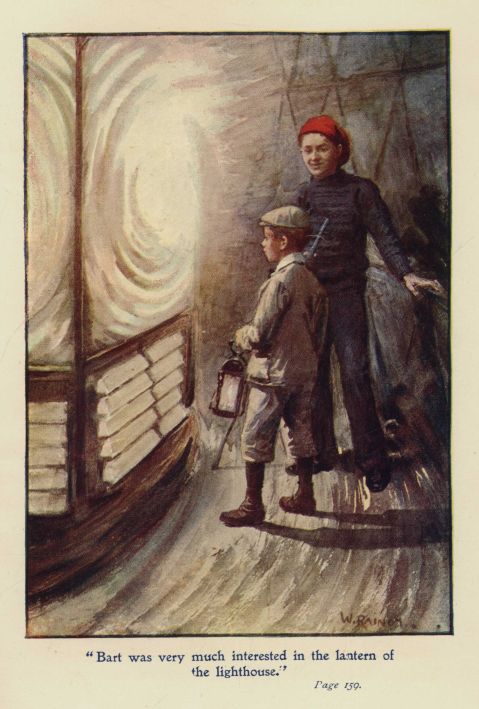
"Bart was very much interested in the lantern of the lighthouse." Page 159
"Can I go up with you and see the lantern?" he asked.
"Oh yes," said Dave, leading Bart up the iron stairway that mounted from room to room.
"There!" said Bart, looking round on the glass windows enclosing the lantern and the lamp in its centre: "I think this is a dreadful interestin' place."
"I think so too, Bart."
"And what I think is interestin' is that lamp in the centre. Why, granny uses a lamp that, it seems to me, is no bigger than that, but it can't throw anywhere near such a light as that. I saw your light last night."
"You did? where?"
"From the hill behind our house. I went up there and saw it."
"I did not know that. Then we could signal to one another."
"Signal?"
"Yes, this way. Supposing, now, I should hang a lantern out on the side of the lighthouse toward the land, toward your home, and you could see it: you might take it as a sign that I wanted--well--we will say--a doctor."
"I think I could see it with father's spy-glass; it is real powerful. Say, will you try it to-morrow night? You hang it out, and I will take father's spy-glass and see if I can make out anything. Then I will send you word by the mail. You don't think it is too far from our house to the light?"
"Too far to see? oh no. Now, I said a man might want a doctor here. I have often thought if one of us was sick--and you know the keeper is getting old--and if the other couldn't get off to bring a doctor, it might be a very serious thing for the sick man."
"Well, if you are in trouble and will hang out a light, and I see it, I will tell the people, and they will get to you."
Dave thought no more of this, but silently said, "I wonder if I haven't something else interesting to show the boy! Yes, I have got it."
He went down from the lantern to the kitchen, and took from its shelf the strange box of sandal-wood, whose story Dave already knew.
The light-keeper now repeated to Bart the tale of the drifting relic. He held it to his ear. Did the boy think it was a shell--that it would murmur a song of wave and cloud and the broad sunshine sweeping down on lonely surf-washed ledges?
"It won't talk," said the light-keeper, beaming on him.
Bart shook his head.
"I wish it would talk," thought the keeper. "It might tell about that man whom we picked up and brought into the light, and who seemed to know something about it. I wonder if he will ever call for it!"
He spoke of it to Dave afterward. The two were up on the lantern-deck at sunset looking off upon the sea. The water was still and glassy. It was heaving gently, as if with the dying day it too was dying, but feebly pulsating with life. One vast surface of shining gray, it gradually darkened till it was a mass of shadows across which were drawn the lines of white surf cresting the ledges.
"Several vessels in the harbour," said Dave.
"Yes: they have been coming down from Shipton this afternoon; but the wind has all died away, and they seem to have made up their mind to anchor there to-night. It is getting cool. Perhaps we had better go down," said the keeper, shrugging his shoulders. While within the lantern he glanced at the lamp, and then descended to the kitchen. Without the twilight deepened. Out of the gloom towered the lighthouse, bearing aloft its guiding, warning rays. The keeper was in the kitchen, trimming an old lantern which had done him much faithful service. That small visitor, Bart, had gone with Dave up into the lantern, anxious to see the working of the lamp.
The keeper lighted his lantern, and then started for the fog-signal tower. He was descending the stairs, when he heard a cry outside of the lighthouse.
"Somebody at the foot of the ladder, I guess, wants me," concluded the keeper, "and I will go to the door and see who it is."
He went to the door, lantern in hand, and looked down.
"Hollo, there!" sang out a man from the shadows below. "Shall I come up?"
"Ay, ay!" responded the keeper. "Low water down there, isn't it, so you can come up the ladder?"
"I guess so. I will make fast and try the ladder."
The keeper heard the steps of somebody on the ladder, and then a man's form wriggled up through the hole in the platform outside the door.
"I get up with less trouble to you than I did the last time I was here," said the man.
The keeper looked at him.
"Ho! this you?" he asked.
"Nobody else."
It was the man who one day, when intoxicated, had been rescued from the bar, and the next morning had shown singular interest in the little box of sandalwood.
"Come up!" said the keeper, leading the man to the kitchen.
"I have been some time coming, haven't I?"
"Better late than never. Always glad to see people. Take that chair before the fire, and make yourself at home. I did not know as I should ever see you again. You are a Shipton man?" asked the keeper bluntly.
"Yes, I belong to Shipton; but then I am off about all the time. I think I have seen you on the street there."
"I was thinking myself I had seen you, but I couldn't say when, except that time you were at the lighthouse."
"Have you got that box now?"
"Oh yes. Here it is. Nobody has come to claim it."
He took the box down from its shelf and placed it on the table.
The keeper's companion said, "Now I will tell you the story about that box, and this letter, too, will confirm it."
As he spoke he took a letter from his pocket and opened it.
"The man who wrote that was an old shipmate, Grant Williams, a warm friend, and faithful too. He knew I had a weakness, and used to say he was afraid his shipmate would get into the breakers. He sent me a letter from a foreign port; here it is. You look at it. You will see that he gave me some good advice. He laid it all down like a chart; but I was a poor hand to steer by it. 'I expect to sail for Shipton in a Norwegian bark,' he wrote (I think he was born in Norway himself, but had been a long time in America), 'and I am going to get and bring my old shipmate a present of a box of sandal-wood, and I shall pack a few keepsakes into it. I will put my picture in, just to make it seem all the more like a present from me. I will put your initials and mine on the under side of the box. I will leave it at Shipton with your father if you are not there. And now don't forget this: it is to be a reminder of my desire that you should let liquor alone. When you see it, think of an old shipmate, and look at my face you will find in the box.' The first time I saw the box was that morning after the night you found me in a state that was no credit to the one found. I knew the ship had been wrecked, and only that, and when I saw the face of my old shipmate, and knew that he had been lost on the bar where I came pretty near losing my own life through what he warned me against, I--I--felt it. I didn't see how I could take the box until I was in a condition to give some promise, you know, that I would be a better man; and now I hope I am, God being my helper."
"Well, I think it is plain proof that you are the one whom the man Williams meant, and the owner of this box, if those are your initials on the bottom--if--"
The keeper was about to ask the man for his name, but the sound of a light step tripping downstairs arrested their conversation, and both turned toward the stairway.
It was Bart Trafton. He looked up, stopped, started forward, and exclaimed, "Why, father!"
"This you, Bart?" said Thomas Trafton. "How came you here?--My boy, Mr. Tolman. My vessel is off there in the stream, and while waiting for the wind I just rowed over."
There they stood, side by side, Bart and his father, while the keeper was rising to hand the box to Thomas Trafton. The lighthouse kitchen never presented a more interesting scene than that of the reformed sailor in the presence of his oft-abused child, taking into his hands this gift, that had survived a wrecking storm, to be not only a pledge of the friendship of the dead, but to the living a stimulus to right-doing and a warning against wrong.
Thomas Trafton rowed back to the vessel that night. Bart was carried to town the next day. Bart reached home at sundown, and first told granny about the affair of the box as far as he had been able to pick up the threads of the details and weave them into a story; then he asked, "Where is father's spy-glass?"
"Behind the clock, Bartie," said granny. "What do you want it for?"
"Just to look off," he said, seizing the glass and bearing it out-doors. Granny followed him into the yard and there halted; for Bart was going farther, already bestriding the fence.
"Where is that boy going?" wondered granny.
"Bartie!" she called aloud, "it is a-gittin' too late to see things clear."
He was now mounting a hill beyond the yard.
"Back in a moment, granny!" he shouted.
She soon saw his figure standing out, clear and distinct, against the western sky, and he was elevating the glass.
"Too soon to see anything yet," he said, when he returned.
"Where you lookin', child?"
"Off to the lighthouse."
"They haven't more than lighted her up."
"I know it. I was too early."
"You want to see the light? You won't have to take a glass for that; you just wait."
"I want to see something else. You come with me, granny, when I go again."
"Sakes, child, what you up to?"
Later two figures crept up the hill, one carrying a spy-glass.
"There, granny!" said the bearer of the glass. "Now you look off to the light at Black Rocks, and right under it see if you can't see another light--a little one."
"La, child," declared granny, vainly looking through the glass, "I can't see nothin'. This thing pokes out what there is there."
"Eh? can't you, granny?" replied Bart, levelling the glass toward the harbour. "I see the light. And--and--I think--I see a--something else underneath. Seems like a little star under a moon."
The next day this was dropped in the post-office:--
"DEAR DAVE,--I saw your lantern, I know. Did you hang it out? Your friend, BART."
Dave answered this in person within a week.
"I'm having a holiday," he said to granny--"off for a day--and thought I would call. I want you, please, to say for me to Bart I got his note, and that I did hang out my lantern the night that he looked for it."
"Now, did you ever see sich a boy? He has been up every night to look for that lantern, and he says he feels easier if he don't see it."
"You tell him not to worry. We are very comfortable. A person might live there a century and nothing happen to them."
Notwithstanding this assertion about the safety of century-serving keepers, Bart would sometimes steal out in the dark and climb the bare, lonely hill. Then he would search the black horizon.
"There's the reg'lar light," he would say, "but I don't see anything more. All right!"
XV.
THE STORM GATHERING.
There was a tongue of land not far from the lighthouse known as "Pudding Point." How long the water-trip to it might be depended upon the state of the tide. In the immediate vicinity of the lighthouse there was, in the direction of this Pudding Point, such an accumulation of sandy ridges that at low-water the voyage was only a quarter of a mile. At high tide all the yellow flats were covered, and an oarsman must pull his boat across half-a-mile of water to go from the light to the point. Sometimes Dave had occasion to visit Pudding Point. A few houses were there, and they might be able to supply an article needed at the light, and that would save a trip to Shipton. One sunny morning Dave had rowed over from the light, and was drawing his boat up the sands, when he noticed a familiar figure striding along a ridge beyond the beach. It was a person of handsome carriage, and one well aware of it.
"I should know that form anywhere," said Dave. "Hollo, Dick!" he shouted.
Dick Pray came running down a sandy slope and gave Dave his hand.
"I am trying to hunt up Thomas Trafton," said Dave. "I believe he has a fish-house around here, hasn't he?"
"You'll find him on that ledge a little way back."
Dave hunted up the fish-house--a black, weather-beaten box. Thomas Trafton was spreading fish on the long fish-flakes in the rear of his humble quarters.
"That you, Dave?" asked the fisherman. "I thought I saw you down on the shore a half-hour ago."
"I was over at the light half-an-hour ago."
"Then it was Timothy Waters."
"How so?"
"Don't you know that if one takes a back view of you and Timothy, although he is really older than you by half-a-dozen years, it wouldn't be easy to tell you apart? Let me see. You are twenty-one?"
"So they say at home."
"Timothy is twenty-seven at least.'
"And I look like Timothy?"
"Rear view only, and I can only tell it is him if in walking he throws his arms out. You never do that."
"I am not anxious to resemble Timothy Waters. I thought he was at sea."
"Off and on. He is now, I suppose, in that craft off in the stream."
"The Relentless?"
"That's the one. I know I am glad to be out of her. My health improved steadily after quitting her. I am going to be at home, fishing, this season."
"How do they all do at home?"
"Oh, comfortable."
"Bart is getting to be a big boy, isn't he?"
"Yes, he is. He thinks a good deal of you. Now, you know that habit he got into once--"
"What was that?"
"Of taking my spy-glass and going out to look at the lighthouse at night--"
"To see if I had hung out a lantern because we were disabled--by sickness, you know, or something of the kind?"
"That is it. Well, his granny says he hasn't wholly dropped it now. She will see him go out, and when he comes back she will say, 'Anything?' 'Nothing,' he will say."
"Oh, I guess there never will be any need of his looking."
"No, I s'pose not; but it shows his interest."
"Yes; I am thankful for that.--Well, let us have a fish to broil; have come out for that."
Dave received his fish, paid for it, and very soon turned away, striding off energetically in the direction of his boat.
When Dave returned to the lighthouse, the tide, gradually dropping, had uncovered the rocky foundations, and the water was playing with the fringes of seaweed all about the rocks.
"How gracefully that seaweed rises and falls! Those curves of its motion are very delicate.--Hollo! what is that?" he asked.
Looking at the foundations, he saw in a crevice a little object that was not a lump of rock-weed or a rock, and what was it?
"A pocket-book!" said Dave, leaning out of his boat and picking up this relic tightly wedged between the stones. "I'll look at that when I get up into the kitchen."
Reaching the kitchen, he hastily opened the pocket-book, noticed that it was empty, and then placed it to dry on a shelf. It was very peaceful in the kitchen, and the stove purred and the clock ticked contentedly and quietly as ever. But where was the light-keeper? his assistant wondered.
"Upstairs probably," was the thought in reply; and yet this consideration, reasonable as it might seem at the moment, did not dispose of the question wholly. True, in a lighthouse, where one might say if a man were not downstairs he must be upstairs, that he could not be "out in the yard" or "in the cellar," Dave's conclusion seemed to be correct. He felt, however, a peculiar sense of loneliness. If Dave were a person given to moods, if he were likely to be sombre, he might have said it was only a fancy; but for one of his temperament that was unusual. Dave with reason had been somewhat worried about his principal. Toby Tolman was growing old. It had been in certain quarters openly said that he was too old for his position. He had been such an efficient keeper, and he had as his assistant a man so valuable, that no one cared to make an effort to remove him from his position. The person who would probably be benefited by any change, and would be invited to take charge of the light, was David Fletcher, and he would not move, for that reason, against his kind old friend. Dave had worked all the harder to fill up any deficiencies on the part of his principal, and the principal would doubtless have been invited to step out if his assistant had not worked so hard to keep him in. Often Dave noticed an indisposition in the light-keeper to attend to that fraction of the duties of the place falling to him, and Dave rightly attributed the indisposition to inability. During the watch-hours belonging to the keeper his assistant had sometimes found him asleep, and when the rest-hours belonging to the keeper arrived, he would unduly prolong his sleep in the morning, and neglect duties to which he had hitherto given prompt attention. Dave also noticed that Mr. Tolman lingered at an unusual length over his Bible. It would be an exceedingly good sign if it could be said of many people that they spent twice as much time as previously with their Bibles; but when a man usually giving to this habit an hour and a half may take three hours, neglecting other daily duties, there may be occasion for inquiry into the change. The light-keeper did not himself notice this peculiarity about to be mentioned, and yet any one seeing the passages read would have appreciated it. The keeper now found unusual comfort in the psalms that spoke of God as a hiding-place, a refuge, a high tower. Was he like the mariner who sees the storm pressing him closely and hastens to find the harbour where he can let fall each straining sail, like the tired bird that drops its wings because it has found its nest?
Dave had other reason for worry. There were in circulation mysterious stories that everything in the administration of the lighthouse at Black Rocks was not satisfactory. There were sly whisperings that goods belonging to Government were given out to others by the keepers, but when, where, and why, nobody said. There was only the repeated story of a mysterious disappearance of Government property. Several friends of Dave tried to catch and hold these rumours. Catch them they did, but hold them they could not. They were like birds that you may think are yours, but when you turn them into a room, lo, they fly out of an open window in the opposite direction.
Thomas Trafton was very indignant.
"Look here!" he said with a reddened face to a fisherman repeating some of these charges, "who told you that?"
"Almost everybody."
"Name one."
"Well, Timothy Waters was one."
"Timothy Waters, a man that had trouble at the light! You wait before you believe the story."
"But others have said the same thing."
"Well, wait; I am going to track these stories to their start."
Thomas Trafton imagined that he was a hunter, and like one following up the trail of an animal, he endeavoured to track these slanders back to their den. Sometimes he would follow the accusations back to Timothy Waters, and then somebody else would be found to assert them, and so the trail would start away again. Amid the multitude of tracks, but without evidence of their origin, this hunter from the Trafton family was bewildered. He mentioned the affair to Dave, feeling that here was an innocent person whom others were attacking, and yet he might be entirely ignorant of the assault.
"I--I--don't want to make you uneasy, but I feel friendly more than you can imagine," said Thomas, "and I thought you ought to know about the stories that are going round."
"Oh, I suppose people are always talking. Life would be dreadful dull if there wasn't something to talk about; and if I save the world from dulness I may flatter myself that I am doing some good."
"Oh, but it isn't just gossip."
"Isn't?" replied Dave, taking a hint from Thomas
Trafton's significant look more than from any language. "What is it then?"
"Now, I don't believe it, mind ye. I try to stop it, but it is like trying to stop a sand-piper on the beach without a gun. Running after it don't bring it."
"Well, what is it? I know you wouldn't believe anything unfair, but I am bothered to know what it is."
"Why--and I thought you had better know it--they say things belonging to Government are given out from the lighthouse: 'misappropriated'--I believe that is the word."
"Long word! Well, who says it?" asked Dave sternly.
"Oh, I'm sorry to say I've heard a good many tell it who ought to know better."
"It is all a lie! Misappropriation! That good man Toby Tolman--as if he would do such a thing! Why, any one with a head might know better. Toby never would do it!"
"Of course he wouldn't, nor you neither. That is not the p'int, but how to stop 'em?"
Dave was silent. Then he broke out,--
"Who has mentioned it?"
Thomas mentioned the fisherman he had recently confronted and rebuked. Then he added,--
"I have tried to run the story down to its hole. It don't seem to start with him, for he says somebody told him, and--"
"Who is that?"
"Timothy Waters."
"Indeed!"
"Now, I want to know how to stop the story."
"You let me think it over, Thomas. I am much obliged to you."
"I am real sorry to tell you," replied Thomas, "but I thought you ought to know of it, and I'll stand by you and Toby to--the last."
This conversation was only three days before Dave's visit to Pudding Point. Thomas had said if anything new turned up he would report to Dave. "Nothing," he had said to Dave during that call at the fish-house, looking significantly at him.
"I understand," replied Dave, "and I have nothing. All I can do is to grin and bear it."
To suit the act to the sentiment, he gave a smile with compressed lips. It was a rather grim smile.
Dave was thinking of the unpleasant subject continually. What added to his burden was the conviction that he did not think it would be wise to tell his principal, for he suspected--and he judged rightly--that it would do no good, that it would only grieve the light-keeper, and that this burden of grief he was not just then in a condition to easily carry.
"I am acting for two," he said to himself, "and that makes it all the harder. If it were just one, just myself, I could seem to tell what to do; but I think it would do an injury to the old man to tell him now; and what shall I do? I guess I must take the advice of that psalm to myself."
He had in mind the close of the twenty-seventh psalm, read the night before: "Wait on the Lord: be of good courage, and he shall strengthen thine heart: wait, I say, on the Lord." And this was Dave's comment on the verse: "I can rest on that promise. I was not aware when a man didn't know what to do, which way to turn, that this psalm could help and rest one like that."
So Dave, like many pilgrims perplexed and tired, came to the shadow of the mountain-promises of God. and there comforted his soul in the assurance that God thought of him, loved him, and would strengthen him. He needed this comfort when he returned to the lighthouse, after his visit to Thomas Trafton's fish-house, and missed the keeper.
"I will go upstairs to find him," he said.
How hard and heavy was the sound of his footsteps as he ascended the first flight of stairs leading from the kitchen! Dave went up as if he were carrying a burden. He pushed open the door at the head of the stairway and looked into the keeper's room, anxiously and yet timidly, as if desirous to find him and yet afraid.
"Ah, there he is," thought Dave.
He was lying on his bed, his eyes closed.
"Is he asleep?" wondered Dave. He stepped to the bed.
"Yes, he must be asleep. Shall I speak to him?"
He hesitated. He wanted to wake him and make sure that an ugly suspicion was without foundation.
He watched the old man's breast, and saw a movement there as of a pulsation of the heart. He held his hand before the keeper's mouth.
"Yes, I feel his warm breath. It must be sleep, and yet--"
He paused. He did not like to express in language what he could not help in thought.
"I will not disturb him," he finally said, "for it may be only just sleep. I will wait, any way, till after dinner."
Deferring and still suspecting, he went downstairs. The kitchen had not changed, and yet it seemed a different place. The clock and the fire now made discordant noises. The sunshine that fell through the window and rested on the floor seemed not so much to bring the light as to show how empty and comfortless the place was. He felt lonelier than ever, this man that people outside suspected of theft, who was cut off from the sympathy of the man suspected with him. He was like one of the ledges in the sea, so isolated, so much by itself, upon which the waves beat without mercy, without rest. In that hour what society, sympathy, strength, he found in the psalms!--a face to smile upon him, a voice to cheer, and a hand to uplift.
XVI.
THE STORM STRIKING.
After dinner Dave mounted the stairway leading to the keeper's room.
"Still sleeping," thought Dave, lingering on the threshold and hesitating to go forward. He advanced, though, in a moment, for he was startled at the keeper's appearance. It was like an intermittent stupor rather than the continued unconsciousness of sleep. Dave touched the keeper, and he found the temperature to be that of a high fever. At times the old light-keeper would start and open his eyes, and when Dave left the room to search the pantry for some simple remedy on the medicine-shelf, he found on his return that his patient had left his bed and was standing by the narrow window in the thick stone walls. He murmured something about "storm," about the "light," and suffered Dave to lead him back to bed.
"I must look out how I leave him again," thought Dave; and yet how could he manage the case alone?
"I must have help," he said, "and soon as I have a chance I must hang a signal out at the door. Perhaps some one will call, and I'll wait before showing the signal."
Nobody came. Why should they come because suspecting any trouble? The afternoon was pleasant. The sea broke gently upon the stone walls of the lighthouse, and the sun shed its quiet glow like some benediction of peace upon the sea. It was the very afternoon when a spectator would be likely to conclude that the lighthouse was in no need of help.
"I'll go now," at last concluded Dave. "He is asleep; his fever is running lower. I will step to the door of the signal-tower, and throw out a white sheet there, and somebody may see it."
Nobody came, and yet here was a man who might be dangerously sick. At the hour of sunset he ran up to the lantern and lighted the lamp. He quickly descended, saying to himself, "How glad I am that it is not foggy! So much to be thankful for! How could I start that signal! But it won't do to try to get through the night in this fashion. What, what can I do?"
The twilight thickened; the shadows trailed longer, broader, and darker folds across the sea. Dave sat alone with the sick man, who moaned as if in pain.
"I have it!" he suddenly exclaimed, recalling what Thomas Trafton told him. "I can do one thing more. I'll hang the lantern out from the tower; maybe Bart will possibly see it."
Watching his chance when the keeper was less uneasy, he ran downstairs, lighted a lantern, and then suspended it outside a window on the landward side of the tower. The cool air of the sea blew refreshingly on his heated face as he leaned out.
"The air feels good; but I can't stop here," said Dave, hurrying away and returning to the keeper's room. "There! I have done all I could, and now--"
There came to him again the words of the psalmist, "Wait on the Lord: be of good courage, and he shall strengthen thine heart: wait, I say, on the Lord."
He could rest on that promise. He was beginning to find out what God could be in the time of trouble. Friends might fail him; on every side there might be an emptiness, a loneliness. All about him settled the presence of God, filling up this solitude, this waste, this night. He could lean on God and--wait. Others might suspect his integrity. He knew he was not guilty, and he welcomed the thought of God's knowledge--that God saw to the bottom of his heart, and into the depths of his life, and God knew he was innocent. Yes, he could wait.
That evening Thomas Trafton, his old mother, and Bart sat around the little table of pine on which the kitchen lamp had been placed. The father was telling where he had been that day and whom he had seen.
"Dave Fletcher was down at the fish-house to-day. He spoke, Bart, of your looking through the spy-glass, but he did not think it necessary."
"Did he speak of it?" said Bart eagerly. "I have a great mind to--"
"To go out?" asked his father--"to go out and see? Oh, nonsense! No more need of it than my going to Australia."
"Oh, let him go if he wants to," pleaded the grandmother; and the father assented.
Bart reached up to the spy-glass resting on a shelf, took it down, and seizing his hat also, hurried outdoors. He was going through the yard, when he saw somebody stealing away from a shed in the rear of the house.
"Why, if that don't look like Dave Fletcher himself!" thought Bart. "Dave Fletcher!" he shouted.
Whoever it was--and the form certainly did resemble Dave's--he made no reply, but hurried through the yard down into the street.
"Somebody else, I suppose!" murmured Bart. "Wonder what he wanted! Perhaps it was one of the fishermen who wanted to leave something for father. Can't stop to see now."
He hurried to the top of the hill, raised his glass, and pointed it toward the lighthouse.
"Father!" he said, appearing the next minute in the kitchen, and speaking hurriedly, "oh--oh--come here! and you--granny--and see if--"
He said no more, for this was sufficient to startle his auditors, and all three hastened up the hill.
"You didn't see a second light at the lighthouse?" asked the father.
"Yes, I did," replied Bart; "I know I did."
"Guess you were mistaken," suggested granny.
"No, I wasn't; you just look and see your--yourself."
Granny could not see anything except a hazy glow where the lighthouse might be supposed to stand.
"Can't say I saw even that as well as I wanted to," she confessed to herself.
Thomas Trafton's keen eyes, though, detected a bright little star under the light in the lantern of the sea-tower, and exclaimed, "No doubt about it! Afraid there's trouble there, and--"
"Could take our boat, father," said Bart eagerly, who had been already planning for this emergency, "and pick up a doctor; for that is what the signal must mean after what Dave told me, you know, and--and--"
"We will go right off," said Thomas Trafton, in his quick, decided way.
As they were rowing across the river to obtain the services of Dr. Peters, Bart thought of the time, half-a-dozen years ago, when his quest for the physician ended in a river-bath.
"Dave Fletcher did a good thing for me then," thought Bart, "and I will stand by him now."
How he bent to his oars and made them bend in their turn! It was a pleasure to be of some use in the world.
It was that evening that the light-keeper came back for a moment to consciousness, and looking steadily at Dave, said in a very serious tone of voice, "How long have I been lying here?"
"Oh, only since morning," replied his nurse, delighted to hear his voice. "Now, you be quiet and tell me if you want anything--any medicine you take when you are sick this way."
Here the keeper's thoughts wandered again. He talked about the fog that was coming, and a craft that was caught on the bar, and then, looking at Dave steadily, said in a hesitating way, "Hadn't you better--put it--back--Dave?"
"Put back what, sir?"
"What you--took? Let me--as a--friend--advise you."
"Took?"
The keeper lifted himself on his elbow and looked all around, as if trying to find something.
"David, don't hide it!"
Then the keeper fell back upon his bed, and murmuring a few words indistinctly, he was lost again in a stupor. He was no sooner quiet than his assistant's quick ear caught the sound of steps and voices down in the signal-tower; for all the doors this summer evening were open between the keeper's room and the platform at the entrance of the lighthouse. It was the arrival of Thomas Trafton's party, and Dr. Peters was a member of it. If Dave felt that its coming was like the reaching out of a hand that lifted him up and strengthened him, the words of the keeper were like a hand smiting him down.
What did Toby Tolman mean?
XVII.
THOMAS TRAFTON, DETECTIVE.
"Well!" said Dr. Peters, after a night of careful watching of the light-keeper's symptoms. He was a tall, elderly gentleman, with a very smooth, melodious voice, its tones seeming to have been dipped in syrup.
He began again,--
"Well, Mr. Fletcher, I think Mr. Tolman will recover from this. We shall get him through." And when he spoke, Dr. Peters waved his hands as if he had already disposed of this case and now passed it out of sight.
"However, Mr. Fletcher, the case will need careful watching, and you had better take charge of it, unless his daughter might come down to relieve you."
"Possibly his granddaughter," thought Dave.
"I don't think we can ever rely on Toby Tolman's resuming his old duties here--might do a little something, you know--and you had better get Thomas Trafton or some trusty man to help you. When will the inspector be here?"
"Our lighthouse inspector, Captain Sinclair, doctor?"
"Yes."
"In about a fortnight, perhaps sooner. The steamer that brings supplies for the lighthouse will soon be here, and Captain Sinclair will come in her, I think."
"The inspector, to look after matters?"
"Yes, sir. Of course I shall report what you say about the keeper to headquarters at once."
"I would. It is very important. And when Captain Sinclair comes, let me know, please."
"I will, sir."
"Of course it is necessary that things should be inspected. I am glad he is coming. Well to be careful."
"What does he mean?" wondered Dave. "Has he got hold of those stories about misappropriation? Well, when Captain Sinclair comes I hope he will sift things to the bottom. I am not afraid of an investigation."
Dave took satisfaction in the consciousness of his integrity; still it was not pleasant to be suspected. It was Toby Tolman's mysterious language, indicating that he too held Dave in some kind of suspicion, which troubled Dave painfully. The day after Dr. Peters's visit the light-keeper again referred to this mystery. He roused himself into a state of seeming consciousness, and then relapsed. Again he awoke. He looked around him and fastened his eyes on the top of a clothes-press in the room.
"What do you want, sir? Anything there that you want to put on?" asked Dave.
The keeper shook his head. Pointing at the top of the press, he said, "Dave, I would put it back."
"What do you mean? I don't understand you."
The keeper, though, was gone again, murmuring about the tide, which he said was very late, and when would it come in? He had been awake long enough to cruelly wound Dave once more.
Bart Trafton had gone home with Dr. Peters, rowing him to town in the same dory that brought him to the light the night before. In two days Bart was down again. As he sat in the kitchen eating some apple-pie offered him by his father, he said, "Father, I found something in our shed."
"What was it, Bart?"
Laying down his lunch, Bart drew out of a package a chronometer.
"Found that in the shed?" asked the surprised father.
"Yes, on a shelf."
"Why, Bart, this has got the letters of our lighthouse on it. Must have come from here. And in our shed! How did it get there? I must show this to Dave," said Thomas Trafton.
"Hush-sh!" exclaimed Dave, when his assistant entered the room; "Toby is trying to get some sleep."
"See here!" said Thomas, in low tones. "Must show you something."
"I never saw it before," replied Dave, handling the chronometer. "It belongs here, though. There are the initials. Where did you get it?"
A stir among the bedclothes arrested the attention of the two men. Toby Tolman had opened his eyes, and was looking at them. Something he saw must have pleased him, for he smiled.
"That is right, Dave. I am glad you brought it back. I would put it up."
"Where?" asked the astonished Dave, anxious to lay hold of any clue to a serious mystery.
"Up there."
He pointed at the top of the clothes-press. The press was not a tall one. Dave standing on tiptoe could reach to its top, and he now laid the watch there.
"Is that right?" asked Dave.
The keeper nodded his head, and then closed his eyes, his face wearing a satisfied expression foreign to it all through his sickness.
"Is not that queer?" whispered Dave. "Some mystery that is too deep for me."
He beckoned Thomas and Bart out of the room, and then followed them downstairs.
"Now, how do you explain that?" asked Dave, as the three clustered about the stove, whose heat that day was acceptable, for the air was chilly and the wind was a prophet of storm.
"Don't know," said Thomas.
"I'd give this old pocket-book full of silver," declared Dave, "to have that thing cleared up. It takes a load off my mind, I tell you. The old man has been harping on the fact that I took something, and he has been looking toward that old clothes-press in such a strange way. I didn't know anything was up there. Did you see how he acted, smiled about it?"
"Where did you get this pocket-book?" asked Thomas.
"The day that Toby was taken sick I picked it up among the rocks here. I had been over at your fish-house, and found it when I was coming back. Been in the water, you see."
"Here are some letters on it--T.W."
"That means Tobias Winkley or--"
"Thomas Winkley. Can't prove it to be Thomas Trafton; and if you could no money is in it. 'T.W.,' that is Timothy Watson."
"Or Timothy Waters."
"Yes; Timothy Waters, or anything that would go with those initials. Toby Tolman wouldn't go."
"Now I must go upstairs again to be with my patient."
Dave Fletcher's heart was lighter as he went upstairs again, but the burden now lightening on his shoulders seemed to be transferred to those of Thomas Trafton.
"Don't understand this!" he exclaimed. "Where is Bart? Bart!"
There was no response to this call, and the father went downstairs into the storeroom to hunt up Bart.
"Nobody here. I'll go into the signal-tower," said Thomas; and up in the engine-room, looking soberly out of a window fronting the breakers on the bar, stood Bart.
"You here, Bart? What are you doing here?"
"Thinking," said the boy gloomily.
"What makes you so sober, Bart?"
"Don't like to have folks suspected."
"Neither do I. That old thing was found in our shed, but I don't know anything about it."
It relieved Bart to hear his father's stout assertion of innocence, but his burdens had not all dropped.
"You know they talk about Dave, father."
"Well, you don't believe it?"
How could Bart consent to take Dave Fletcher down from that high pedestal to which he had elevated him? How could he believe that his marble statue was after all only common clay, and even of an inferior earth?
"I won't believe it till it is proved," said Bart stoutly, "nor of you either, father."
This relieved Thomas Trafton.
"Bart, you see if I don't turn this rascally thing over and get at the truth! I'll find the mischief-maker; yes, I will."
Thomas Trafton was by nature a detective. He put himself on the trail of this mystery, and if a trained hound he could not have followed the track more keenly and resolutely. He announced his purpose to Dave, and the latter would ask him occasionally if he had any clue.
"I am at work on it, still running. The scent is good, and I have something of a trail. I'll tell you when I get through," was one reply he made.
XVIII.
INTO A TRAP.
"Cap'n Sinclair!" called out a voice. The man projecting the voice stood up in a boat rocking gently in the harbour. The man addressed stood in a small black steamer, the Spitfire, employed in conveying supplies to the lighthouses. He leaned over the steamer's rail and asked, "What is it?"
"I suppose you remember me, Timothy Waters?"
"Oh, that you, Waters?"
"Yes. Could I see you?"
"Here I am."
Captain Sinclair was a middle-aged man, rather stout, wearing a moustache, and flashing a friendly look out of his brown eyes.
"I don't think I was fairly treated," said Timothy, "when I lost my place in the lighthouse, and I wanted to make some explanations. Besides me, you may have heard the stories all round about the goods they are wasting at the light?"
"Well, I have heard something," said the captain impatiently. "Somebody wrote to me about it, but he wasn't man enough to sign his name. May have been a woman, for all I know."
"If you'd let me come aboard--"
"Oh, you can come aboard; but I won't be here long. I must go into the light, and the steamer is going off--at once. Just row over to the lighthouse, and I'll talk with you there."
Timothy turned away and shrugged his shoulders. He said to himself, "I don't want to go in there. However, I think I saw Trafton and that Fletcher rowin' off. I can stand the old man." He turned to the captain and said in a fawning tone, "All right, cap'n. I want you to have your say about it."
When Captain Sinclair and Timothy entered the kitchen of the lighthouse, to the surprise of Timothy he saw Trafton and Dave Fletcher. They had "rowed off," and had also rowed back. Timothy was so unprepared for their appearance that he would have allowed the opportunity for presenting his cause to slip by unimproved. Dave Fletcher, though, was ready to begin at once, and did so.
"Captain Sinclair, be seated, please, and the rest of you. When you were here yesterday I called your attention to certain charges made against Mr. Tolman and myself that--"
"Oh yes, I remember; and here is a letter full of them somebody sent to me, but they were too cowardly to add any name. Let me have the light-book. That will give me some of last year's records."
Timothy was looking on in apparent unconcern, but really in bewilderment, and wondering when his turn would come. He began to address the inspector.
"Cap'n--"
Thomas was ahead of him, and by this time had said three words to Timothy's one,--
"Cap'n Sinclair, I--Cap'n Sinclair, I have something to say. I think the author of all this trouble is here. He"--pointing a finger at Timothy--"came to this lighthouse, took a chronometer, carried it to Shipton, left it in my shed--"
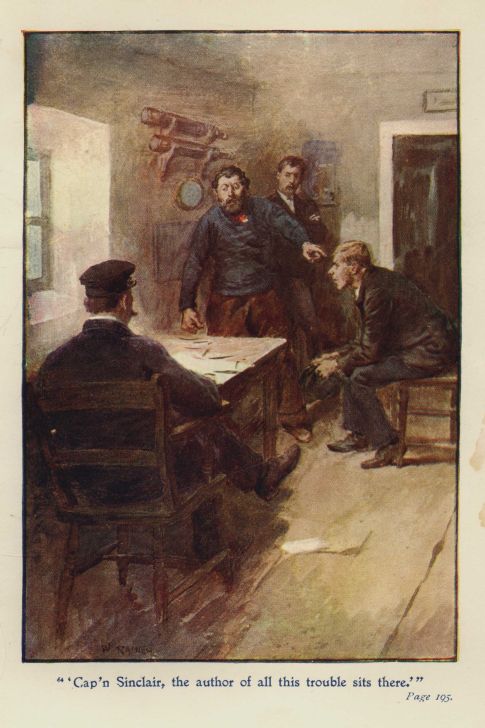
"'Cap'n Sinclair, the author of all this trouble sits there.'" Page 195]
This torrent of charges, so unexpected, swept away the statements Timothy had prepared for Captain Sinclair. He attempted to stem the torrent, and cried, "It is easy to say you know, cap'n"--Timothy tried to be very bland, restraining his temper--"easy to say you know--"
"I can say that he came to this lighthouse," Thomas broke out again, "and when the keeper was lyin' sick on his bed--asleep, as he thought, is my guess--he took a chronometer--"
Timothy, who had been curbing his temper, now threw away all reins.
"Where is the keeper?" he asked stormily. "I don't believe he can say that."
"Oh, he is upstairs, and well enough to see us. The doctor says he is doing well. And walk up, gentlemen," said Dave, "walk up!"
Bart was reading to the old man, who was seated in a rocking-chair near his bed. The company almost filled the little room, but the light-keeper bade them welcome.
"Mr. Tolman," said Thomas, "won't you tell Cap'n Sinclair what you told me about the taking of the chronometer?"
"Oh yes," said the old light-keeper slowly. "I was feeling very sick, so much so that I concluded to lie down. I s'pose I was lying with my eyes 'most shut, when I heard a step and saw a man come in, and he looked at me, and then he stood on a chair, examined the top of that clothes-press, and took down a chronometer--an old thing, but it might be fixed up. The man thought I was asleep, and I didn't see his face, only it seemed to me as if he had whiskers, and when he stood on a chair to reach the chronometer he looked--standing with his back to me---as if it was Dave Fletcher. Well, I was that weak I couldn't speak, and my visitor went off, supposing, I daresay, that I was asleep. Well, I kept it on my mind, forgetting the whiskers, that it was Dave, and I charged him with it. Sorry I did--"
"Well," said Timothy fiercely, "why wasn't it Fletcher? It is about time that innocent chap should do something."
"He says--Mr. Tolman says," observed Captain Sinclair, "that you and Fletcher look alike."
"Wall," bawled Timothy, "why couldn't it have been Fletcher much as me, don't you see? Come you--you feller--you stand by this clothes-press and reach up, and let's see how you look."
"This 'feller' is ready," said Dave, going to the clothes-press and reaching to its top.
"And here I am. Why ain't it him?" asked Timothy, also standing by the press and reaching up.
"They do look alike when their backs are turned toward us," observed Captain Sinclair.
"Only the keeper said the one he saw had whiskers, and there are Timothy's," remarked Thomas.
Dave wore only a moustache. Thomas's remark called the attention of everybody to Timothy's whiskers, projecting like wings from his cheeks. These wings were red, but their colour was not as vivid as that of Timothy's face.
"Besides," continued Thomas, "Dave wasn't here. He can prove an alibi. He was over at Pudding P'int; came to get a fish from me."
"Why," said Timothy indignantly, "I was--two miles away."
"I saw you round the shore myself; and here is your pocket-book that Dave found at the foot of the light-tower that very morning."
Timothy opened his eyes, swelled up his cheeks, puffed, declared he didn't see how that was, "and--and--"
Here Bart interrupted his stammering, and said,--
"And I saw you up at our shed that evening. I thought it was Dave Fletcher, taking a back view; but when I called 'Dave!' there was no answer to it;--and, Dave, you'd speak if I called, wouldn't you?"
"I think I would."
"This other person that looked like you didn't say a word."
Timothy puffed and protested and denied, growing redder and redder.
"See here, Waters," said Captain Sinclair: "I have been looking at the lighthouse records last year, and I have hunted up places where you have written, and the style is like this in the letter I received--that anonymous one--about the charges against the keepers in the lighthouse. You come up into the room above with me."
Stuttering in his confusion, still asserting his innocence, blushing, he stumbled up the stairway, and then alone with Captain Sinclair he was urged to make a clean breast of it.
"Yes," said the captain, "tell the whole story; for there is enough against you to shut you up in quarters of stone, and it won't be a lighthouse."
Timothy was startled by this. He broke down, and made a full confession to the inspector.
XIX.
A PLACE TO STOP.
Here is a place to bring into a harbour our story drifting on like a boat. Dave Fletcher was appointed keeper of the light at Black Rocks, and Thomas Trafton became his assistant. Bart, though, said he considered himself to be second assistant, and should fit himself as rapidly as possible for a keeper. He wanted, he added, to be as useful as he could be--an idea that never forsook him since the old days of his career as Little Mew. Dick Pray went on in the old style, full of plans and projects, stirred by an intense ambition to do some big thing, but impatient of the little things necessary to the execution of the whole. Always ready to dare, he was as uniformly averse to the doing of the hard work that might be demanded.
Toby Tolman took up his quarters in his old home ashore. As he could not go where Dave was, he said he thought Dave ought to come to him as often as possible. Dave promised to do all in his power, and as a pledge of his sincerity he married the light-keeper's granddaughter, black-eyed, bright-eyed May Tolman. She lived under Toby Tolman's roof; and as Dave improved every opportunity to visit the grand-daughter, he was able to fulfil his promise made to the grandfather.
THE END.
――――
Nelson's Books for Boys.
The Books below are specially suitable for Boys, and a better selection of well-written, attractively-bound, and beautifully-illustrated Gift and Prize Books cannot be found. The list may be selected from with the greatest confidence, the imprint of Messrs. Nelson being a guarantee of wholesomeness as well as of interest and general good quality.
Many Illustrated in Colours.
"CAPTAIN SWING." Harold Avery. HOSTAGE FOR A KINGDOM. F. B. Forester. FIRELOCK AND STEEL. Harold Avery. A CAPTIVE OF THE CORSAIRS. John Finnemore. THE DUFFER. Warren Bell. A KING'S COMRADE. C. W. Whistler. IN THE TRENCHES. John Finnemore. IN JACOBITE DAYS. Mrs. Clarke. HEADS OR TAILS? (A School Story.) H. Avery. JACK RALSTON. (Life in Canada.) H. Burnham. A CAPTAIN OF IRREGULARS. (War in Chili.) Herbert Hayens. IN THE GRIP OF THE SPANIARD. Herbert Hayens. HELD TO RANSOM. (A Story of Brigands.) F. B. Forester. RED, WHITE, AND GREEN. (Hungarian Revolution.) Herbert Hayens. THE TIGER OF THE PAMPAS. H. Hayens. TRUE TO HIS NICKNAME. Harold Avery. RED CAP. E. S. Tylee. A SEA-QUEEN'S SAILING. C. W. Whistler. PLAY THE GAME! HIGHWAY PIRATES. (A School Story.) Harold Avery. SALE'S SHARPSHOOTERS. Harold Avery. A rattling story of how three boys formed a very irregular volunteer corps. FOR KING OR EMPRESS? (Stephen and Matilda.) C. W. Whistler. SOLDIERS OF THE CROSS. E. F. Pollard. TOM GRAHAM, V.C. William Johnston. THE FELLOW WHO WON. Andrew Home. BEGGARS OF THE SEA. Tom Sevan. A TRUSTY REBEL. Mrs. Henry Clarke. THE BRITISH LEGION. Herbert Hayens. SCOUTING FOR BULLER. Herbert Hayens. THE ISLAND OF GOLD. Dr. Gordon Stables. HAROLD THE NORSEMAN. Fred Whishaw. MINVERN BROTHERS. Charles Turley. IN DAYS OF DANGER. Harold Avery. LADS OF THE LIGHT DIVISION. Colonel Ferryman. A LOST ARMY. Fred Whishaw. DOING AND DARING. Eleanor Stredder. BAFFLING THE BLOCKADE. J. Macdonald Oxley. TOM BROWN'S SCHOOLDAYS. Hughes. HEREWARD THE WAKE. Charles Kingsley.
THE "LONE STAR" SERIES.
Handsome Gift Books at a moderate price. Uniformly bound and well illustrated.
UNDER THE LONE STAR. Herbert Hayens. CLEVELY SAHIB. Herbert Hayens. AN EMPEROR'S DOOM. Herbert Hayens. A VANISHED NATION. Herbert Hayens. A FIGHTER IN GREEN. Herbert Hayens. THE DORMITORY FLAG. Harold Avery. KILGORMAN. Talbot Baines Reed. IN THE WILDS OF THE WEST COAST. J. Macdonald Oxley. EVERY INCH A SAILOR. Dr. Gordon Stables. AT THE POINT OF THE SWORD. Herbert Hayens. RED, WHITE, AND GREEN. Herbert Hayens. A HERO OF THE HIGHLANDS. E. E. Green. HELD TO RANSOM. F. B. Forester. VICTORIES OF THE ENGINEER. A. Williams.
Recent engineering marvels graphically described and fully illustrated.
HOW IT IS MADE. A. Williams. HOW IT WORKS. A. Williams.
Splendid books for boys, telling them just what they want to know. Profusely illustrated.
IN FLORA'S REALM. Edward Step, F.L.S. A NATURALIST'S HOLIDAY. Edward Step, F.L.S.
Two books by one of the most popular of living writers on natural history subjects.
THE "ACTIVE SERVICE" SERIES
FOR THE COLOURS. Herbert Hayens. A Boy's Book of the Army. YE MARINERS OF ENGLAND. Herbert Hayens. A Boy's Book of the Navy. TRAFALGAR REFOUGHT. Sir W. Laird Clowes and Alan H. Burgoyne. AUTOBIOGRAPHY OF A SEAMAN. Abridged from Lord Dundonald. ADVENTURES IN THE RIFLE BRIGADE. Sir John Kincaid. FOR THE EMPEROR. Eliza F. Pollard. THE GOLD KLOOF. H. A. Bryden. SEA DOGS ALL! Tom Bevan. THE FEN ROBBERS. Tom Bevan. RED DICKON, THE OUTLAW. Tom Bevan. HAVELOK THE DANE. Charles W. Whistler. KING ALFRED'S VIKING. Charles W. Whistler. THE VANISHED YACHT. Harcourt Burrage. A splendid story of adventure. MY STRANGE RESCUE. J. Macdonald Oxley. DIAMOND ROCK. J. Macdonald Oxley. UP AMONG THE ICE-FLOES. J. Macdonald Oxley. CHUMS AT LAST. Mrs. G. Forsyth Grant. MOBSLEY'S MOHICANS. (A Tale of Two Terms.) Harold Avery. KNIGHTS OF THE ROAD. E. Everett-Green. ROBINSON CRUSOE. Defoe. WON IN WARFARE. C. R. Kenyon. THE WIZARD'S WAND. Harold Avery. A PRINCE ERRANT. C. W. Whistler. BRAVE MEN AND BRAVE DEEDS. M. B. Synge. RALPH THE OUTLAW. Mrs. H. Clarke. THE "GREY FOX." Tom Sevan. THE JEWELLED LIZARD. W. D. Fordyce. THE CHANCELLOR'S SPY. Tom Sevan. HIS MAJESTY'S GLOVE. Miss Whitham. A FORTUNE FROM THE SKY. S. Kuppord. FRANK'S FIRST TERM. Harold Avery. THREE SAILOR BOYS; or, Adrift in the Pacific. Commander Cameron. RIVERTON BOYS. K. M. Eady.
TRAVEL SERIES.
ADVENTURERS ALL. K. M. Eady, ALIVE IN THE JUNGLE. Eleanor Stredder. CABIN IN THE CLEARING. Edward S. Ellis. THE CASTAWAYS. Captain Mayne Reid. LOST IN THE BACKWOODS. Mrs. Traitt. LOST IN THE WILDS OF CANADA. Eleanor Stredder. THE THREE TRAPPERS. Achilles Daunt. THROUGH FOREST AND FIRE. E. S. Ellis. WITH STANLEY ON THE CONGO. Miss Douglas.
Books for the Young.
NELSON'S "ROYAL" LIBRARIES
The finest and most attractive series of Gift and Reward Books in the market at so moderate a price. They are mainly COPYRIGHT works, carefully selected from the most popular and successful of the many books for the young issued by Messrs. Nelson in recent years, and are most attractively illustrated and tastefully bound. Each volume has eight coloured plates, with the exception of a few, which have eight monochrome illustrations. The books are issued in three series at 2/-, 1/6, and 1/. For lists see following pages.
THOMAS NELSON AND SONS,
London, Edinburgh, Dublin, and New York
NELSON'S "ROYAL" LIBRARIES.
THE TWO SHILLING SERIES.
IN TAUNTON TOWN. E. Everett-Green. IN THE LAND OF THE MOOSE. Achilles Daunt. TREFOIL. Margaret P. Macdonald. WENZEL'S INHERITANCE. Annie Lucas. VERA'S TRUST. Evelyn Everett-Green. FOR THE FAITH. Evelyn Everett-Green. ALISON WALSH. Constance Evelyn. BLIND LOYALTY. E. L. Haverfield. DOROTHY ARDEN. J. M. Callwell. FALLEN FORTUNES. Evelyn Everett-Green. FOR HER SAKE. Gordon Roy. JACK MACKENZIE. Gordon Stables, M.D. IN PALACE AND FAUBOURG. C. J. G. ISABEL'S SECRET; or, A Sister's Love. IVANHOE. Sir Walter Scott. KENILWORTH. Sir Walter Scott. LÉONIE. Annie Lucas. MAUD MELVILLE'S MARRIAGE. E. Everett-Green. OLIVE ROSCOE. Evelyn Everett-Green. QUEECHY. Miss Wetherell. SCHÖNBERG-COTTA FAMILY. Mrs. Charles. "SISTER." Evelyn Everett-Green. THE CITY AND THE CASTLE. Annie Lucas. THE CZAR. Deborah Alcock. THE HEIRESS OF WYLMINGTON. Everett-Green. THE SIGN OF THE RED CROSS. Everett-Green. THE SPANISH BROTHERS. Deborah Alcock. THE TRIPLE ALLIANCE. Harold Avery. THE UNCHARTED ISLAND. Skelton Kuppord. THE WIDE WIDE WORLD. Miss Wetherell.
NELSON'S "ROYAL" LIBRARIES.
THE EIGHTEENPENCE SERIES.
SECRET CHAMBER AT CHAD. E. Everett-Green. SONS OF FREEDOM. Fred Whishaw. SONS OF THE VIKINGS. John Gunn. STORY OF MADGE HILTON. Agnes C. Maitland. IN LIONLAND. M. Douglas. MARGIE AT THE HARBOUR LIGHT. E. A. Rand. ADA AND GERTY. Louisa M. Gray. AFAR IN THE FOREST. W. H. G. Kingston. A GOODLY HERITAGE. K. M. Eady. BORIS THE BEAR HUNTER. Fred Whishaw. "DARLING." M. H. Cornwall Legh. DULCIE'S LITTLE BROTHER. E. Everett-Green. ESTHER'S CHARGE. E. Everett-Green. EVER HEAVENWARD. Mrs. Prentiss. FOR THE QUEEN'S SAKE. E. Everett-Green. GUY POWERS' WATCHWORD. J. T. Hopkins. IN THE ROCKY MOUNTAINS. W. H. G. Kingston. IN THE WARS OF THE ROSES. E. Everett-Green. LIONEL HARCOURT, THE ETONIAN. G. E. Wyatt. MOLLY'S HEROINE. "Fleur de Lys." NORSELAND TALES. H. H. Boyesen. ON ANGELS' WINGS. Hon. Mrs. Greene. ONE SUMMER BY THE SEA. J. M. Callwell. PARTNERS. H. F. Gethen. ROBINETTA. L. E. Tiddeman. SALOME. Mrs. Marshall. THE LORD OF DYNEVOR. E. Everett-Green. THE YOUNG HUGUENOTS. "Fleur de Lys." THE YOUNG RAJAH. W. H. G. Kingston. WINNING THE VICTORY. E. Everett-Green.
NELSON'S "ROYAL" LIBRARIES.
THE SHILLING SERIES.
ACADEMY BOYS IN CAMP. S. F. Spear. ALL'S WELL THAT ENDS WELL. Miss Gaye. ESTHER REID. Pansy. TIMOTHY TATTERS. J. M. Callwell. AMPTHILL TOWERS. A. J. Foster. IVY AND OAK. ARCHIE DIGBY. G. E. Wyatt. AS WE SWEEP THROUGH THE DEEP. Gordon Stables, M.D. AT THE BLACK ROCKS. Edward Rand. AUNT SALLY. Constance Milman. CYRIL'S PROMISE. A Temperance Tale. W. J. Lacey. GEORGIE MERTON. Florence Harrington. GREY HOUSE ON THE HILL. Hon. Mrs. Greene. HUDSON BAY. R. M. Ballantyne. JUBILEE HALL. Hon. Mrs. Greene. LOST SQUIRE OF INGLEWOOD. Dr. Jackson. MARK MARKSEN'S SECRET. Jessie Armstrong. MARTIN RATTLER. R. M. Ballantyne. RHODA'S REFORM. M. A. Paull. SHENAC. The Story of a Highland Family in Canada. SIR AYLMER'S HEIR. E. Everett-Green. SOLDIERS OF THE QUEEN. Harold Avery. THE CORAL ISLAND. R. M. Ballantyne. THE DOG CRUSOE. R. M. Ballantyne. THE GOLDEN HOUSE. Mrs. Woods Baker. THE GORILLA HUNTERS. R. M. Ballantyne. THE ROBBER BARON. A. J. Foster. THE WILLOUGHBY BOYS. Emily C. Hartley. UNGAVA. R. M. Ballantyne. WORLD OF ICE. R. M. Ballantyne. YOUNG FUR TRADERS. R. M. Ballantyne.
T. NELSON AND SONS, London, Edinburgh, Dublin, and New York.