Front matter (continued 2)
Reading edition
"'BARTHOLOMEW TRAFTON.'"
Dave was so much pleased with this communication that he read it to the light-keeper.
"Dave, I wish you would invite your sister and her friends to come down here. Ask those boys who were with you in the schooner."
"That would be pleasant. Thank you."
"I will try to make it interesting for them."
"Oh, I wish you would do one thing."
"What is that?"
"Tell us what you know about lighthouses."
"Well, let me think. There is one thing I could do. I have in my drawer an account of lighthouses I have written off at spare moments, just to keep me busy, you know, and I could read that."
"I think we would all like that very much."
"All right; let us plan for a visit."
"I think you have had some visitors since you have been here that you did not plan for."
"Yes, indeed; and they may come any time, just as your party surprised me. Sometimes, though near me, they may not get to me. I was saying the first day you came here it was the tenth anniversary of a great storm. It was a foreign vessel, a Norwegian bark. The vessel struck on the bar--"
"Couldn't they see the light?"
"The fog was very thick, so that they couldn't have got much warning from the light. The first thing to do now in a fog, of course, is to start the signal. But we had none then--only an old bell I used to strike; but when the wind was to south'ard it carried away from the bar the sound of the bell. This was a southerly storm, and such storms are not likely to be long, but they may blow very hard while they do last. I heard the storm roaring through the night; and when I looked out in the morning, there was this vessel just on the bar! Oh, what a tumult she was in! Such a raging of the waves all around that vessel! I always go off to the help of people if I can reach them; but there was no reaching that vessel with a boat. Yes, I could see them and they could see me in the morning, when the fog lifted, but there was no getting from one to the other. I could see them clinging to the rigging, hanging there as long as the waves would let them. I would watch some immense sea--and they roll up big in a storm, I tell ye--come rushing at the vessel, rolling over it, completely burying the deck. After such seas some one would be missing. I never want to see that sight again. There they were dying, and I couldn't get anywhere near them! The vessel did not break up at once. She was there the next day, and I went to her, and others went, but we found nobody aboard. I think they saved part of her cargo; but the waves pounded her up fearfully, and carried off many things of her cargo. One by one they came ashore. It did touch me one day, when I was down on the rocks fishing, near the lighthouse at low tide, to see something floating on the water. 'Why, that is a box,' I said. We are all curious, you know, and I wondered what was in that box. I went to the lighthouse, got a long pole, and reached the box and brought it ashore. I'll show it to you if you would like to see it."
"I would, very much."
"I have always kept it here, for it seems to belong to the lighthouse rather than anywhere else. Here it is."
He went to the closet in the kitchen, and reaching up to the highest shelf, took down a box of sandalwood. It was an elaborately carved piece of work, and had served among the articles for a lady's toilet. When the light-keeper opened it Dave saw two handkerchiefs, a hair-brush, a comb, and there was also a man's picture. Dave looked with interest at this relic washed up out of the buried secrets of the sea, and still keeping its own secret there in the light-keeper's kitchen.
"Did you ever get any clue to the ownership of this, Mr. Tolman?" asked Dave.
"Let me tell you of one strange thing that happened about a year ago. One night I was very sure I heard a cry out on the bar. The waves make so much noise that it is hard to hear anybody if they do shout; but sometimes when the sea is still you can hear a call. Said I to Waters, 'Timothy, I hear a hollering.' Said he, 'I think I hear it myself. Let us go to the door and listen.' We were both in the kitchen, you know. 'Twas the fore part of the evening, though dark. Sure enough, at the door we could hear somebody shout. 'Timothy,' said I, 'that is a plain case. Let's launch the boat.' So off we put. The person kept hollering and we kept rowing. There on the bar we found a man. Crazy he acted, and he couldn't tell much about himself--how he got there, or where his boat was. He was not sober. On our way to the light what should we run into but a boat. 'Here is the rest of him,' whispered Timothy. We took him and his boat to the light. How we got him up the ladder I don't know, but we tied a rope round him, and drew him, and shoved him, and somehow got him into the lighthouse. The next morning he was entirely sober. Of course he was very much ashamed, but he could not give any account of himself, only that he had been in a boat and had trouble. Well, for some reason I had that box down from the shelf that morning he left, and I had been looking at it. He saw it. He started as if the box had struck him. He stepped up to it softly, looked into it, and said, with an amazed look as I ever saw on a person, 'Where--where--did you get it?' 'It floated from a wreck off here.' 'Anybody ever claim it?' 'Never,' I said; 'but I am ready to give it up to any claimant.' 'Well,' said he, 'if anybody comes and claims it, you give it up; but if not, don't part with it till you hear from me.' I asked him what he meant; but he would make no explanation, only repeating his request. He was very grateful for what we had done, and I took the liberty to say in a proper way that he must take warning, or he would be wrecked on a bar where there would be no saving. He burst into tears, thanked me, said he knew he was a great fool, and left in his boat. We watched him, and saw him row to a vessel lying at anchor in the harbour. Then we guessed he had been ashore the day before in the ship's boat, and got into mischief. I told Timothy we would find out about the vessel; but a fog came up and kept us here. She slipped out to sea as much a stranger as ever. Fishermen afterwards told us it was a vessel that ran in for shelter.
"From that day to this I have never heard about the man. Sometimes I think it was a foreigner; again I fancy it is somebody at Shipton, but I could not say. I am there very little to know about people; and Timothy couldn't tell about it. He don't belong to Shipton. There is the box. Pretty, isn't it?"
Dave nodded a yes.
"Mr. Tolman, could you tell the man if you should see him again?" asked Dave.
"Could I? yes, indeed."
"How did he look? What was the colour of his hair, his eyes; and how was he dressed?"
"Now--you will think it strange--I can't tell any of his features or what clothes he wore, and yet if I should see him I don't believe I should miss him. I could tell him by the look of his eyes--a look that somehow appealed to me--a look without hope. Often when at night I see the froth on the bar in the moonlight, I seem to hear that man calling to me, and I take it as a sign that he is still in a worse fix than if on the bar. It is an awful curse, rum, and I am a sworn foe to it."
Here the light-keeper placed the sandal-wood box again on its shelf, and Dave turned to look out of the window near the kitchen table.
"See here, Mr. Tolman; what's that?"
"Where?"
"Floating and curling over that point!"
"Can't you guess?"
"Looks like fog! Yes, I can see now plainly. Oh, can we start up the fog-signal?"
"Wait a while. When the fog is so thick that you can't see Breakers P'int, then we start the fog-signal. That is the sign in that direction. On the other side of the lighthouse it is Jones's Neck that must be hidden. I guess both the P'int and the Neck will be covered this time. I must start the fire in the engine and have everything ready, at any rate. Let us go into the fog-signal tower."
Dave was delighted.
"I suppose, Mr. Tolman, people like to hear the signal?"
"Yes, if in a fog. They want to know which way to go. Even fishermen about here, who are supposed to know the way about the harbour, may be bothered by the fog; but people just off for pleasure may be bothered a good deal."
"See here! Isn't the fog lifting round Jones's Neck, Mr. Tolman?"
Dave was looking out of a window in the tower, and Mr. Tolman joined him.
"You are right; and Breakers P'int is clear too. We will hold on then, have everything ready, you know, for the fog may shut down suddenly."
Dave continued to look out of the window.
"Coming again!" he cried to the light-keeper, who had kept up his fires in the engine-room, but had gone for a few minutes to the kitchen. "Fog is round Breakers Point and Jones's Neck!"
Yes: like an immense gray sponge the mist had once more advanced, wiping out the vessels slowly sailing into harbour, the far outlying points of land, and now erased an islet called the Nub, mingling all in one confusing cloud.
"All right," said the light-keeper; "we will start the signal."
There was the driving of a stout piston; there was the stirring of a big wheel; there was the movement of other machinery; and there was finally--"What a noise overhead!" thought the listening Dave. It seemed as if five thousand bees all buzzing at once, twenty-five thousand crickets all shrilly piping at once, and fifty thousand wood-sawyers all sawing at once, had combined their noises and were forcing all through the flaming fog-trumpet above. For ten seconds Dave held his fingers in his ears. Then there was a blessed stillness, save as the play of the machinery interrupted it.
"What do you think of that?" asked Mr. Tolman, grinning broadly. "Some lung power left in it yet."
"Lung power! They can hear that down to the Cape of Good Hope. One is enough for both sides of the ocean."
"Want another? Time is 'most up. Here she goes!"
She went.
"Toot--buzz--boom--whiz--fizz-z-z--bim-m-m-m!"
Among the breakers tumbling on the sandy shores, along the face of weather-beaten island-edges, down amid the waves and up in the clouds echoed the sharp, strong, fog-piercing, ear-cutting blast. And wherever it went it said, "Of fog I warn-n-n-n-n!" for ten seconds.
In one of the intervals of rest Dave remarked, "Now that must be kept up as long as the fog lasts?"
"Of course."
"Doesn't it get tiresome?"
"Well, that's how you take it. I was told of a lighthouse where the signal was going twenty-one days."
"Day after day! Just think of it!"
"Well, there is this side of it: off on the water there is somebody bewildered by the mist, perplexed day after day, it may be, and they catch the sound of the signal. Oh, ain't that good news? That's what makes me contented at it. I have sometimes wished I was a musician, and could please others by my playing; but I tell you I have stood by this old engine dark, rainy, foggy nights, and oh, I have been so happy starting up and sending out this old whistle. There it is!"
"Toot--buzz--boom--whiz--bim-m-m-m!"
"Somebody heard that, you may believe, and somebody, too, more pleased than if I had been a whole band of music, and had sent out just the sweetest tune."
The light-keeper stood by the tugging engine and wiped the perspiration from his brow, and his big, rosy face was as happy as that of a school-boy going off on a long vacation.
"Hark! what is that? Sounds like a bell," said Dave.
"It is the bell-buoy at Sunk Rock. We only hear that when the wind is blowing off the sea."
"Didn't hear it before."
"Wind hasn't been just right to hear it loud. I have caught it since you came; but then I am used to its sound, and can tell it easily."
"I must see it."
"Oh, we shall have a chance, I guess."
The fog-signal had been shrieking away an hour, and Dave heard another sound.
"That isn't a bell I hear now," he said.
"Well, no; that's a hollering."
Was it a cry from the lighthouse tower or a cry outside of it? a cry from what quarter? Dave looked out of a window near him. He could see only fog above and waves below.
"I will go down to the door and try to see who or what it is," said Dave, "for there is that cry again."
He descended to the door of the tower and looked down through the hole in the platform. Then he saw a dory tossing in the water that now flowed all about the tower, swashing against its iron walls. There was a boy in the boat. He was not looking up, but clinging to a rope stretched for purposes of mooring from the tower to a sunken rock forty feet away. Steadying his boat by this rope, he was waiting for some response to his repeated calls.
"Hullo, there!" shouted Dave.
The boy looked up, still grasping the rope.
"That you, Dave?"
"Yes. That you, Dick? Where did you come from?"
"Yes, Dick Pray, and nobody else."
"Won't you come up?"
"Well, yes, I should like to, but the water is uneasy. Can't get out of my boat."
"Hold on; I will come down and help you." He stepped within the tower and reported, "Mr. Tolman, this fog has brought somebody."
"Don't wonder at it. Give him any help he needs."
"I want a short rope."
"There's one hanging on that nail."
Dave took the rope, went to the door of the tower, and descended the ladder.
"Here, Dick! Take your painter and tie it to that mooring-rope, allowing enough slack to bring your boat almost to the tower and yet not touch it. There! if that length isn't right you can try it again. Now catch this rope and make fast to the stern there. So! That's it! Now I'll pull you in."
Dave drew on his end of the rope, and pulled Dick's boat so near the ladder that Dick could spring to it, and yet the boat itself was left to swing in the waves while it could not strike the tower.
"I'll just make fast my end of the rope, Dick, and we will go up the ladder."
"All right. Glad to get out of that old boat and go up with you."
"Why, where under the sun and moon have you been?"
"Me? Been camping out on the Nub."
"You haven't!"
"But I have."
"That your tent over there?"
"Mine and Sam Whittles's."
"Tolman and I noticed it to-day for the first time. How long have you been there?"
"Long enough to eat you or Toby Tolman--you may draw lots for the honour--if you don't give me some food."
"Oh, we will soon give you that. Among other things I will give you some fish. Got some splendid cunners, and I will divide with you."
"Good! I could eat 'em raw. Hungry as a shark. Sam is hungrier. I don't know as he will wait for me, but throw himself into the water and go after the fish himself."
"O Dickie, we will make you feel like a new being. Come in and see Tolman. He is a splendid old fellow. Come in this way."
The boys went up into the engine-room.
"An old acquaintance, Mr. Tolman," said Dave.
"I see, I see," replied the light-keeper, recognizing Dick as one of the schooner party.
"Whiz--bim--fizz--"
"It sounded splendid out at Shag Rocks," shouted Dick to the light-keeper.
"You been there?" inquired Mr. Tolman.
"Yes; and this old fog came up and confused me, and I didn't know where I was, and I heard the signal and I put for it," said Dick.
"Out there fishing?"
"Yes, sir; or--I wanted to fish, but didn't catch a fin."
"Shag Rocks you went to?"
"Yes, sir; two ledges with a strip of sand between them."
"Oh, those are 'Spectacle Rocks,' as the fishermen say. They look like a pair of spectacles. You wouldn't catch much there. Shag Rocks are to the nor'ard."
"Well, I'm willing they should stay there."
"Next time, you come here. Splendid chance off this very ledge; Black Rocks, as we call them."
"That would be wise, I think."
"Well, make yourself at home.--Dave, you give him something to eat."
"I thought I would let him have some of those cunners to take with him."
"So do, but give him something now.--And you don't want to go back in this fog?"
"Well, I'd rather have clear weather if I have got to find the Nub," said Dick.
The fog, though, refused to clear up that day, and Dick remained all night.
"I pity Sam," he told Dave; "but he has got a teapot, and he must live on that till morning. I'll give him a surprise to-morrow, I tell you. I will throw my line into the water off these rocks here, and carry to camp a string of fish worth having. I'll open Sam's eyes for him."
Dick, though, overslept his intended hour of rising. It was Dave who came rushing into the assistant-keeper's room, where Dick had been sleeping, and he cried, "Dick, Dick! there is a furious shouting for you. Two men and a young fellow are down in a boat at the foot of the tower, and want you."
"I'll be there directly," said Dick, springing out of his bed. He dressed quickly, and rushed down to the door of the signal-tower. Looking below, he exclaimed, "That you, Sam Whittles?"
"Yes. Where have you been? Didn't sleep a wink last night. Thought you were drowned and everything else. Got these two fishermen who came along to pull me here in their boat. Come, boy, come home!"
"Fury!" said Dick in his thoughts. "Won't--won't you come up?" he asked aloud. "I was going to surprise you, take you some fish, and so on."
"Fish!" said Sam contemptuously; "these men will sell it to me by the acre."
"Squar mile, ef he wants it," said one of these piscatory individuals, looking up and grinning.
"Won't you all come up?" asked Dave Fletcher.
"Can't, thank you," said Sam. "Just throw that Jonah overboard, and we will go home."
"Jonah" said it was "too bad," and stole down the ladder, feeling worse than on the day he returned in the runaway schooner.
VII.
THE CAMP AT THE NUB.
Two days later the light-keeper gave Dave a holiday, that he might spend a day at the Nub. Dick Pray came after him, and as he rowed off from the lighthouse he called out to the keeper, who stood in the tower door, "Don't worry about your assistant. I will bring him home after dinner. Get here by four."
The keeper nodded his head. He said to himself, "May be; but if I don't see a boat starting off from the Nub by a quarter of four, I shan't leave it to you to bring him, but go myself for him. You are great on what you are going to do; I like the kind that does."
It was a pleasant boat-ride to the Nub.
"Welcome!" shouted several young men in chorus as Dick's dory neared the shore of the Nub. They stood on a broad, flat stone, for which the rock-weed had woven a brown mat, and on the crown of the ledge behind them rose a tent tipped with a dirty flag.
"Hurrah!" responded Dick.
"Hurrah!" shouted Dave.
"I thought, Dick," said Dave, "only Sam Whittles was here."
"Oh, these fellers came down last night. Just to spend a couple of days, you know."
"Who are they?"
"Oh, Jimmy Dawes, I believe, and there's Steve Pettigrew and a Keese Junkins."
Dave's feelings of like and dislike were very quick in their operation, and he now said to himself, "Don't fancy those specimens!"
They were showily rather than tastefully dressed, strutted about with a self-important air, and their talk was loud, coarse, and slangy.
"Who is that little fellow?" asked Dave, noticing a small boy in the rear of the tent.
"Oh, that is a kind of servant they brought down with them. He came down, and waits on them just for his board. He is a queer chap, and makes fun for us all. We call him Dovey. Don't know what his real name is. Splendid place here for camp!"
"Tolman doesn't like it; says you can't get on or off easy."
"O Dave, Tolman is an old fogey. But here we are."
The boat was bumping against the landing-rock, and Dick and Dave disembarked amid a chorus of "How are ye?" "Step ashore!" and other friendly salutations. So cordial were these that Dave's dislike was put to sleep, and he said to himself, "They are pleasant. Good-hearted, I daresay."
The tent within was an assortment of bedding, camp-chests, old clothes, and provisions, all mixed up in great confusion. Dave thought the outside of the tent would be more agreeable than the inside, which was clouded with tobacco smoke. He took a seat without, and looked off upon the sea. It was a vivid summer day. All the colouring of nature was very bright and sharp. The sky was very blue; the clouds were very white; the water was very dark, and the foam of the breakers white as the flakes scattered by the storms of January. Dick and the others were discussing plans for dinner. As Dave sat alone, watching the white sails slowly drifting across the distant sea, a light hand was laid on his shoulder by some one who had stepped up behind him. It was not a big, coarse hand, but a gentle pressure such as a child might make.
"Oh, it is the boy Dick told about," thought Dave; "it's that Dovey." He looked up, and to his surprise there was Little Mew!
"Why, Bartie, you down here?" exclaimed Dave, turning and looking with interest at the small, twisted features of Bartholomew Trafton.
"Yes; and I am glad to see you. Did you get my letter?"
Bart had seated himself beside Dave, and rested his hand on Dave's knee as if he were a little boat gladly tying up to a friendly pier.
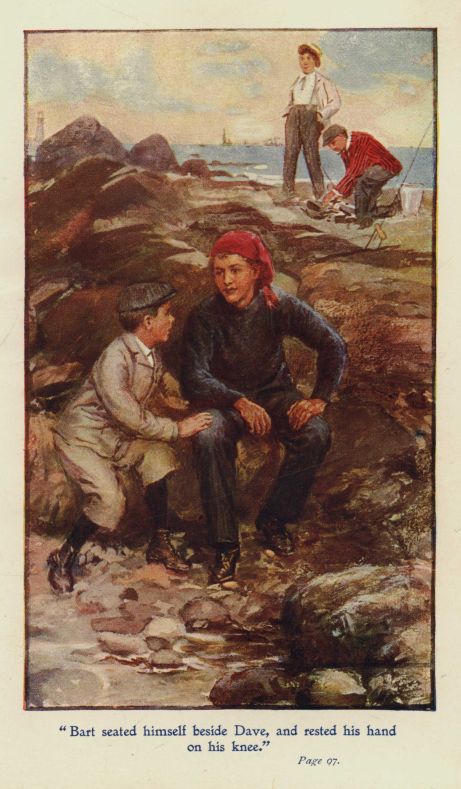
"Bart seated himself beside Dave and rested his hand on his knee." Page 97.]
"Yes, I got your letter, and it was a very nice one. There is a party, too, coming down to the lighthouse, and I thought you might be in it. My sister will be one, I expect."
"Teacher?"
"Yes; and Mr. James Tolman, my teacher when I was in the school, is going to bring them."
"Oh, I wish I could go. I don't like it here."
As he spoke he turned his head and looked about as if to make sure that no one heard him save Dave.
"Well, how did you come here?"
"Reese Junkins," said Bartie, again looking back. "He lives near us. He came to the house and told gran'sir and granny they wanted a boy to go with them and just wait in the tent, and he would look after me, and I might like it. But I don't like it."
Here if his eyes had been straight, and Dave had followed their glance, he would have noticed that Bartie was looking at a basket of bottles near a rear corner of the tent.
"I don't like to be with such people; they make too much noise."
He bravely concealed the fact that they made fun of him, though his soul was vexed and torn by their unkind jokes.
"Well, you know Dick."
"Yes; but he has forgotten me. He only saw me that day."
That day meant the time of the rescue from the water. Dave looked into the face turned trustingly toward his own.
"Don't you worry, Bartie; I will look after you."
The boy looked up so gratefully, and the hand on Dave's knee pressed harder. The little boat rejoiced to have found such good moorings.
――――
About half-past three Dave said to Dick, "I think I must be going, if you can row me across. You know I said I would be back by four, and I shall be needed at the light."
"All right," replied Dick.
"Going?" called out Sam. "Don't hurry."
"Thank you; but I think I must be starting," said Dave.
"Don't go!"
This last was a timid, pitiful voice.
Dave turned, and there was Little Mew.
"Oh, I must go, Bartie. You see I said I would go back this afternoon, and the keeper will look for me at the light."
"Oh take me!" he begged aside.
"You really want to go--really, Bartie?"
"Oh yes; I'll ask them."
Bart turned to Dick and Sam, and asked if he could go to the lighthouse.
"We have no objection," they said.
"Very well," said Dave, who saw the place was a prison for the little fellow.
But what did it mean that Steve, Billy, and Reese leaned against the boat, and looked sullen as a fog-bank on the horizon?
"You can't have this boat!" muttered Steve.
"But it's one I borrowed," shouted Dick angrily. "Hands off! This fellow is my company, and he shall be treated as he ought to be."
"We will row him over ourselves in the morning, or--or--maybe--we will spill him out half-way across. Ha! ha!"
Billy's tone was sarcastic and offensive.
"No, you won't!" said Dave, who, indignant beyond the power to quietly state his feeling, had remained silent. "Somebody's coming after me."
"What?" said Reese in amazement, looking toward Black Rocks.
"Who's a-coming?"
They all looked off and saw a dory advancing from the direction of the lighthouse.
"That's Tolman, the light-keeper!" explained Dick.
"Who cares for Tolman, the light-keeper?--Boy," said Billy Dawes, turning to Dave and shaking a dirty fist insultingly, "we don't want anything to do with you."
"You may be glad to have my help," replied Dave.
"No help from babies. Remember that," said Billy.
Dave's face was red with wrath. What would he do? He was in no danger, for close at hand was Toby Tolman, a champion of no mean size, and the rowdies stupidly gazed at him rowing his boat with all the ease of a strong, skilled oarsman.
"All ready!" exclaimed Dave, advancing to meet the light-keeper's boat. "Good-bye, Dick."
"Oh--oh--take me!" sobbed Bart.
"What does that booby want?" asked Reese.
"He wants to go to the lighthouse," explained Sam.
"Well, let him go," replied Reese. "He has been a bother ever since he came."
With what joy Bart's small legs wriggled over the side of the keeper's dory!
"This little fellow, in whom I am interested, wants to go, if you will let him," said Dave to the light-keeper; "and he can go to Shipton with the party expecting to come down, you know, to visit us."
"All right; and tumble in yourself, Dave."
"Here I am!" replied Dave. "Let me push off!"
Toby Tolman's boat was quickly rising and falling with the sea that rocked about the Nub, and the departure was watched in an amazed, ignoble silence by the three rowdies leaning against Dick's boat.
"I am so much obliged to you for coming," said Dave to the keeper, "though I did not mean to trouble you. Things were rather squally at the Nub, and you came just in time. I will tell you about it."
When Dave had given his story, the light-keeper, resting on his oars, exclaimed, "There! I guessed as much. I didn't feel easy about you. That Dick is a well-meaning boy, I don't doubt; but when I found out that Sam Whittles was with him, I guessed what kind of a camp they would have at the Nub, and it seems my guess was about right.--And this little lamb?"
Bart's eyes brightened at this pitying title; the appellatives bestowed upon him had generally been of a different nature.
It was a happy party that went into the lighthouse after the trip from the Nub.
"Oh, isn't this nice!" cried Bart, as he entered the kitchen. The sense of peaceful, safe seclusion, the warm fire in the kitchen stove, above all, the protecting friends near him, made the place seem like--Bart whispered to himself what he thought it must be like--"heaven!"
When he thought of the Nub he shuddered.
What a happy boy it was that tumbled into the bed where the keeper told him he could sleep that night! Dave added to his happiness by an acknowledgment made. "Bartie," he whispered.
"What, Davie?"
"I owe you a good deal for stopping me at the dinner at the Nub."
"Stopping you?"
"When I didn't think, and lifted that glass, you know."
"Oh, but you wouldn't have touched it."
"If you had not been there, Bart, I don't know what might have happened."
"Oh, I am sure you would have come out all right," shouted confidently this diminutive mentor. And yet as he was falling asleep that night, hushed by the sound of the waves musically breaking against the walls of the lighthouse, a thought came to him and steeped his soul in comfort, that as Dave might have yielded, he--just Little Mew--might have been of some use, and so not for nought had God sent into the world this puny little fellow.
VIII.
VISITORS.
Into the kitchen of the old lighthouse they came trooping the next day--Annie Fletcher, with all her winning vivacity; Jimmy Davis and his sister Belle, Dab and John Richards, and May Tolman, with her black, lustrous eyes, in which diamonds seemed to be dissolving continually (so Dave thought). May Tolman was the light-keeper's granddaughter. Then there was Mr. James Tolman, who came as skipper of the sail-boat bringing the party. Dave and Bart joined them at the door of the fog-signal tower; and to what a scampering, laughing, singing, and shouting did the gray stone walls listen as this flock of young people hurried in! Behind all was the gray-haired keeper; but no heart was lighter than his that day. Unobserved he went to a window through which blew the cool, sweet, strong air from the sea, and he silently thanked God for the gift of youth renewed that day in his own soul and lifting him on wings, so that he too wanted to sing and shout, to race up and down the iron stairs, to clap his hands jubilantly, as from the parapet around the lantern he saw the breakers foam below and the white sea-gulls soar up and then down on strong, steady wing.
"Yes, bless God, I am still young--and ever shall be," thought the old light-keeper. Ah, he had renewed his youth long ago at the fountains of spiritual life, in the drinking of whose waters the soul becomes perennial in a new sense.
"Now, what shall I do for all these young folks?" he said to himself. "I will certainly do whatever I can."
He showed them the lighthouse from storeroom to lantern, and then he carried them into the engine-room of the fog-signal tower and explained all the machinery there.
"If--if--we could only hear one toot!" exclaimed Annie Fletcher.
"Maybe the fog will come," replied Toby Tolman.
"Oh, if it would!" said Annie; and--it didn't.
"Too bad," everybody said.
"What else can I do?" wondered the light-keeper. Dave reminded him of one thing.
"Oh yes," the keeper replied. "Well, get them all together in the kitchen."
There clustered, the keeper told them, if they would excuse it, he would by request read them something about lighthouses.
"Don't expect much, though," he warned them, as he lifted his spectacles and adjusted them to his sight. "I have written this off at different times, perhaps in the evening when I have been watching, or in a storm when I could catch a little rest from work, or when I felt a bit lonely and wanted something to occupy me. I won't read all I have got, only what I think will interest. I first speak of ancient lighthouses."
Hemming vigorously several times, blushing modestly behind his spectacles in the consciousness that the world was summoning him forth to be a lecturer, he then began:--
"I suppose the first lighthouses were very simple--that is, they were not lighthouses at all, but men just built big fires and kept them burning at points along an ugly shore, or to show where a harbour was. Not long ago I was looking at a picture of a lighthouse doing work in our day and generation in Eastern Asia. It looked like a structure of wood. It probably had on top a hearth of some kind of earth, for there a fire was burning away. Not far off was the water. That looked primitive.
"If one turns to Rollin's 'Ancient History,' he will find in the first volume an interesting account of an old lighthouse, and it was so wonderful they called it one of the seven wonders of the world. It was built by order of Ptolemy Philadelphus, and he laid out eight hundred talents on it. One estimate of the value of this sum would bring it pretty well up to £180,000. As it stood on an island called Pharos, near Alexandria, the tower had the name of the island. That has given a name to like towers. In French, I am told, the word phare means 'lighthouse.' In Spanish, faro means 'lighthouse.' In English, too, when we say a pharos, we know, or ought to know, what it means. I can see how useful this old lighthouse may have been. On its top a fire was kindled. Alexandria was in Egypt, and the city is standing to-day, as we all know. It had at that time a very extensive trade, and as the sea-coast there is a dangerous one, it was very important that the ships should have some guide at night. I can seem to see the old craft of those days plodding along, the sailors wondering which way to go, when lo, on Pharos's lofty tower blazes a fire to tell them their course.
"The architect of this tower was Sostratus, and there was an inscription on the tower said to have read this way: 'Sostratus, the Cnidian, son of Dexiphanes, to the protecting deities, for the use of sea-faring people.' His master, Ptolemy Philadelphus, was thought to have been very generous because he allowed the putting of Sostratus's name in place of his own. But Sostratus's name seems to have been put there by a trick, and it was finally found out. Sostratus cut in the marble this inscription that had his name; but what did he do but cover it with plaster! In the lime he traced the name of the king. How pleased Ptolemy must have been to see his name there! The lime, though, crumbled finally, and the king's name crumbled with it, and the tricky architect's inscription came out into notice. This lighthouse was built about three hundred years before Christ.
"In later years the tower of Dover Castle was used as a lighthouse. It was called Caesar's Altar. Great fires of logs were kept burning on the top. This was before the time of the Conquest, so called in English history. Then at the end of the sixteenth century a famous lighthouse a hundred and ninety-seven feet high was built at the mouth of the Garonne in France.
"About fourteen miles off Plymouth are the Eddystone Rocks. They are very much exposed to south-western seas. One light-builder was Winstanley, and he was at his work four seasons, finishing in 1698. The lighthouse was eighty feet high. Made stouter and carried higher afterward, it was almost a hundred and twenty feet high. It stood until November 20, 1703. A very fierce blow of wind occurred then, and the tower was wrecked by the storm. Two grave mistakes were made. Its shape was a polygon, and not circular. Waves like to have corners to butt against, and these should therefore be avoided. It was highly ornamented for a lighthouse, and ornaments are what winds and waves are fond of. It gives them a chance to get a good grip on a building and bring it down.--In 1706 one Rudyerd thought he would try his hand, and he did much better. The tower was built principally of oak; yet when finished it stood for forty-six years, fire bringing it down in 1755. Its form commended it, for it was like the frustum of a cone, circular, and was without fancy work for the waves to take hold of.--In 1756 Smeaton began to build at Eddystone his famous tower. He was the first engineer who built a sea-tower of masonry and dovetailed the joints. The stones averaged a ton in weight. He reduced the diameter of the tower at a small height above the rock. He reasoned about the resemblance of a tower exposed to the surf and an oak tree that faces the wind. That has been shown not to be good reasoning; and looking at the shape of his tower, I should say the idea would not stand fire--or in this case water; for if at a small distance above the rock you reduce the diameter of the tower very much, it gives the waves a good chance to crowd down on the sides of the tower. However, Smeaton's tower stood a good many years. Its very weight enabled it to offer great resistance to the waves, and weight is one thing we must secure hi a tower, avoiding ornament and all silly gingerbread work. In 1882 a new tower was built in place of Smeaton's."
The light-keeper then gave some details of our lighthouse service. His paper deeply interested his auditors.
Subsequently Annie Fletcher asked, "What is that ringing like the sound of a little church-bell?"
"Then your ears were quick enough to catch it?" replied the keeper. "The window, too, is up, and so you could hear it. That is a bell-buoy at a bad ledge off in the sea."
"A bell-buoy?" asked Annie.
"Yes. It is a frame from whose top is suspended a bell. The bell is fixed, while the tongue, of course, is movable. The buoy floats on the water--fastened, you know, to the rocks beneath; and as the waves move the buoy the bell moves with it, and rings also--like a cradle rocking!"
"The buoy is the cradle, and the bell is the baby in it," suggested Dave.
"And waves are the mother's hand rocking the cradle," added May Tolman.
"Mother's hand--that is, the ocean--is pretty rough out there sometimes," said the light-keeper. "In a storm, when the wind brings the sound this way, the baby cries pretty loud."
"It squalls," declared Dave.
"I'd like to see that bell-buoy," said Johnny Richards.
"Should you?" replied the keeper. "Well, the sea is smooth, and we can all go easily in two boats.--James, you manage one, and I'll cap'n the other. It won't take more than twenty minutes to row there."
The two boats now commenced their journey.
The two boats from the lighthouse were quickly at the bell-buoy. It was a bell hung in a frame, which was swung by the waves. It was an object of deep interest to the visitors, and they lingered about it, and then rowed back to the lighthouse.
IX.
THAT OPEN BOOK.
Toby Tolman, keeper of the light at Black Rocks, sat by the kitchen stove in this lighthouse on the frothing, stony rim of the sea. He liked the seclusion of this kitchen in the strong rock tower. He liked to hear the steady beating of the clock--"tick, tick, tick, tick." He liked the feeling, too, of the warm fire, and especially on this cool, windy day. True it was August, but then the wind was blowing from the north-west as if from an ice-floe up in Alaska, and the air was chilly. As he glanced out of either of the two windows--the deep recessed windows in the kitchen--he saw a cold, angry sea broken up into little waves, each seeming to carry a white snow-flake of the size of the crest of the wave. The distant ships, too, had a cold look, as if they also were snowflakes.
"A cool day," thought the light-keeper; "and the fire feels good."
While he was in the kitchen Dave was up in the watch-room, hunting in the little library for a history he meant to read, in accordance with a plan suggested by the keeper, "a little every day, and to keep at it."
Mr. Tolman had a book in his lap--"The best book in the world," he said to himself. It was his big-print Bible, and especially did he rejoice in that sense of protection, its promises give on days like this, when he heard the wind rushing and storming at the window, suggestive of the wild tempests that might blow any hour.
Just this moment the keeper was not reading. He was thinking, and the Bible was the occasion of his meditation about Dave Fletcher.
"I don't see Dave reading his Bible much," he said to himself; "and I don't believe he cares very much about prayer--acts that way, at any rate. I should like to help him; but how?"
He called Dave before his mind, this brown-haired, blue-eyed boy, with his quiet manners and methods, but, as the keeper put it, "loaded with a lot of grit."
"Yes, I should like to help that boy," continued the keeper in his thoughts. "I would like to influence him to be a Christian; but how, I wonder? He is one of that kind of self-reliant chaps you feel that he had rather find out a thing himself than be told of it. He doesn't want me, I know, to tell him all the time about his duty, and yet--yet--I should like to influence him, and I wonder how?"
Of course, there was one's example first of all.
"Try to do what I can here," thought the keeper. "I might speak to him, though I don't want to run the thing into the ground. Well, I shall be guided."
The thought came to him, "Now there is a bit of a thing I can do which certainly won't do harm."
The thought was just to leave his Bible open on the kitchen table.
"Perhaps he may see a verse," thought the keeper, "and it will set him to thinking."
After that on the table would lie the keeper's Bible turned back to some impressive chapter. Dave would have been uneasy if in contact with some styles of religion, but such a kindly natured, sunny, generous, and tolerant soul as Toby Tolman he could not find disagreeable. Toby's religion was never obtrusive, never unpleasantly in the way of people; though always prominent, out in open sight, it was the prominence of the sunshine, of a bird's happy singing, of nature on a spring morning. Dave felt it, but he was a silent lad over important subjects. He was different from his sister Annie. If her soul were stirred by any profound emotion, she must in some way give expression to it. Dave, though, would look very serious and continue silent. His mother, who knew him so well, said that Dave felt most when he said the least, and the hours of his greatest stillness were to her the surest signs of an intense activity within.
"Dave is fullest when he seems to be emptiest," Mrs. Fletcher would say. Because now-a-days at the light he would often have long seasons of silence, was it any sign of mental occupation?
"I don't think I understand that boy yet," was Toby Tolman's thought. "He is thinking about something, I know."
It was a day near the close of Dave's stay at the lighthouse that the keeper said in the morning,--"Beautiful day! Everything just as calm! It seems as if it would stay so always, but it won't."
How the sea might rock and roar in twenty-four hours! The lighthouse was very peaceful. The morning's work was despatched promptly, and the tower was very quiet. With any rocking, roaring sea would come a change in the life of the tower. There would be hurrying feet, and the fog-signal would shriek out its sharp, piercing warning.
The flow of life in nature, though, out on the sea, up in the sky, was undisturbed all that day, and in the tower of the fog-signal the machinery stirred not, while the light breeze playing around the mouth of the fog-trumpets aroused no answering blast. It was peaceful on the sea and in the tower. And yet in the light-keeper's own bosom it seemed that afternoon as if an ocean tempest had been evoked and was suddenly raging. About three Dave, who chanced to be in the storeroom of the tower, heard a voice outside.
"There's some one down at the foot of the ladder," thought Dave. "I will see who it is."
He went to the door of the signal-tower and looked down.
"Ho! that you, Timothy? Coming back?" said Dave.
Down in a boat lightly resting on the smooth, glassy water was Toby Tolman's assistant, Timothy Waters. Dave knew that Timothy was coming back very soon, and he thought that Timothy might have concluded to anticipate the date appointed for his return and resume work now.
"Not just yet," replied Timothy. "Get the cap'n soon as you can. I won't come up. Spry, please."
The keeper was quickly at the door.
"What's wanted, Timothy? Coming up, are you not?"
"Wish I could, cap'n, but I want to take you to town. Your--is--very--"
The sea heaved just then sufficiently to disturb the speaker's balance and also to interfere with his message. There he stood, trying to steady himself by the help of the mooring-rope and then looking up again.
"What? who?" asked the keeper.
"Why, your granddarter May, cap'n," replied Timothy. "She is very sick. They don't know that she will live. She has been begging to see you, and if you could come a few hours I will get you back again all right afterwards."
"I will be with you right off." The keeper turned to Dave: "You heard that. It's ugly news. Now if I go, can't you light up and watch till half-past eight? I'll be back, sure. Don't worry. It will be a quiet night; no sign just yet of any change in the weather."
"Oh yes, Mr. Tolman; that is all right. You go. I would if I were you. I will look after things. I can handle them."
"I think you can; and I shall be obleeged to you. My, my! this is sudden. Wasn't looking for May's sickness."
He was quickly in the boat with Timothy Waters; and then Dave watched the two men pulling stoutly on their oars and making quick progress landward. The boat turned the corner of a bluff projecting into the harbour and disappeared. Dave stepped back into the lighthouse, and sat down beside the kitchen stove. It was very peaceful there. The clock ticked as usual on the wall; and on the table, lying open, as if laid down a moment ago by the keeper, was his Bible. Dave glanced at the opened pages a moment. As his eyes slipped down the line of verses he noticed such assurances as these:--
"He that dwelleth in the secret place of the Most High shall abide under the shadow of the Almighty.... Thou shalt not be afraid for the terror by night.... For he shall give his angels charge over thee, to keep thee in all thy ways. They shall bear thee up in their hands, lest thou dash thy foot against a stone."
He lingered a moment looking at these passages, and then turned away.
"I will go upstairs," he said, "into the lantern, and make sure that everything is ready for the lighting at sunset. That's sudden about May Tolman," he began to reflect. "Why, I seem to see her going up and down these stairs the day she was here, so full of life."
He could hear her voice; he could see her black, glowing eyes, that had a peculiar fascination for Dave.
"Sorry," he said. "That's real sudden. Things do happen quick in this life sometimes."
Dave felt unusually sober that day. If he had told all his thoughts to any one, he would have confessed to a singular soberness of feeling for some time.
He had been shut up for several weeks with a man whose religion, without any pretence, any show, and any peculiarities, controlled his life, and came prominently to the surface in everything. Dave felt his sister's religious influence at home; but there were influences interfering with it and partly neutralizing it. Dave Fletcher's mother was too busy, she assured herself, to attend to religion; and Dave's father declared--also to himself--that he did not "feel the need of it." "I am as good as my neighbours; and I guess that will do," he said. He quoted in his thoughts Dave's lack of interest, saying, "There is Dave, good boy; and he takes his father's view of things."
But here at the lighthouse Dave declared that he was "cornered." Here was a simple, humble, unselfish life living in communion with his heavenly Father, bringing that presence down to that lonely tower in the sea, and filling it, and surrounding the boy who was the light-keeper's companion. No neutralizing associations here.
"It sets me to thinking," declared Dave, as he climbed the successive stairways to the lantern the afternoon of the keeper's absence. "And May Tolman's sickness--that is sudden. Nothing is certain. Well, we must just look after matters right around us. One can't give his thoughts to all these possibilities of accident. I'll just remember that I am a keeper of a lighthouse."
Keeper of a lighthouse! The moment he uttered this thought to himself there settled down upon his shoulders a new and serious weight of responsibility. He began to realize that for several hours he must carry the burden of a keeper's duties. He must look after the fog-signal, if a dusky veil of mist should suddenly be dropped from the sky and curtain off both the sea and the land. If there should be any accident upon the sea in the neighbourhood of the lighthouse, where the keeper might be expected to give any aid, Dave must render that help. When night came, or sunset rather, he must light the lamp in the lantern, and he must watch it, and see that for the sake of the many vessels upon the sea this light burned with steady lustre. Upon just a boy's shoulders how heavy a care seemed to be pressing down!
"I can stand it," he said, in pride and confidence. The very pressure of the responsibility aroused within him a corresponding measure of strength. However, it did not lessen the shadow of that sober thinking in which he often walked nowadays.
"I'll take that history I am reading," he said on his return from the lantern, "and get over a good number of pages to-day."
He read until supper-time, but somehow his thoughts did not seem to stay on his book. They were like birds on the telegraph wires along the railroad track--flying off and then alighting again, only to lift their wings and beat the air in another flight.
"A long afternoon!" he said finally, laying down his book. "I am glad it is tea-time."
How lonely the kitchen began to seem! The rattle of his knife and fork, the clink of his spoon, the occasional clatter of dishes, usually such pleasant sounds to a hungry man, now sounded lonely and harsh.
"Don't like eating by myself," declared Dave. "Glad tea is over. Wonder when Mr. Tolman will be here?" He looked at the clock and said, "I believe he thought he should be back by half-past eight. I wonder how May Tolman is getting along. Poor girl!"
The sun seemed that night a longer time than usual in setting, as if it were an invalid, and there must be a very deliberate and lengthy bundling up in yellow blankets.
"At last the sun is about going down," said Dave. He was now up in the lantern, match in hand. He looked off through the broad windows of glass upon the surface of the sea, growing calmer and more shining in the west; but in the east its lustre had faded out, and there was a great expanse of dull, heavy, lead-like shades. Two fishing-boats were creeping into harbour. The surf on the bar rolled lazily, as if it would like to go to sleep, even as the sun. A schooner was creeping along the channel, its sails hanging in loose, flapping folds.
"There goes the sun!" thought Dave, watching the disappearance of the last embers of its fires below a blue hill. He turned with relief to the lamp, removed its chimney, kindled its wick, replaced the chimney, and then carefully adjusted the flame.
"There--that is done! Now do your duty, and burn all right," was Dave's direction. Rising, he looked away, and saw that in other lighthouses their keepers had kindled guiding tapers, burning slender and silvery in the still lingering daylight.
"Everything here is all right, I believe," said Dave, looking about the lantern. "Holloa! what is that up there in the corner? A cobweb? Guess I must take it down. Don't want the window to have that thing up there. Can't reach it. I will get a little box down in the watch-room. That will elevate me."
When he had brought the box, standing on it he saw that the web was on the outside of the lantern, and he went without to remove the film from the glass.
"There!" he said, reaching up to the corner of the window as he stood on the box. "Come down here. Don't have cobwebs on the windows of this lantern."
He now turned about, and chanced to face the tall red pipes projecting from the roof of the signal-tower with their trumpet-shaped mouths.
"Is one of those pipes damaged?" wondered Dave. "Afraid so. I must take a sharper look at that."
At the foot of the railing of the parapet he placed the box, and from that elevation, leaning his arms on the railing, inspected as closely as he could the fog-signal. This parapet for timorous people was an ugly spot. When the wind blew hard it was not easy to maintain one's footing outside the lantern. One could cling to the railing, which was firm, but it consisted only of an iron bar resting on upright iron rods three feet apart. There was no danger of a fence-break, but the gaps between the iron rods were wide and ugly, and if one should chance to drop on the smooth stone floor and just tip a little--over--toward--the--edge--ugh! One did not like to think of that fall down--down--into the sea--perhaps upon the Black Rocks when the tide was out. Toby Tolman had told Dave that for a long time he did not care to go near the rail about the lantern and stand there a while, as it made him "nervous;' but he had ceased to be a "land-lubber," and could now face, sailor-like in confidence, any quarter of the sea and sky, just clinging to that little rail. Dave had felt pleased with his steadiness of nerve when he found he could look over that rail and then down upon the whirling sea without very much trepidation.
"Shouldn't like to have a dizzy fit when I was looking over," he said. "No danger, though."
He repeated this as he now stood on the box planted at the foot of one of the iron supports of the rail, and continuing to rest his arms on the rail, inspected closely, as already said, the fog-signal. Suddenly his arms slipped, and over the horrible edge of that narrow little railing he found himself going. Sometimes we compress years into moments apparently. We go back, we go forward, we gather it all up into the thought of a very brief now. But oh, how vivid!--like all the electric force in a great mass of cloud concentrated in one dazzling, blinding lightning-stroke. As Dave felt that his body was sliding over that rail, he seemed to realize where he had been in the past. He thought of his parents--his home--Uncle Ferguson at Shipton--how it was that he came to the lighthouse, and then he seemed to realize vividly his situation there in the lighthouse: that he was there as the responsible keeper just then; that the safety of many vessels at sea all relied on the thoroughness of his watch; and yet he was sliding over that rail, going down toward the waves, the rocks--he dared not look toward them! He could see only this one thing between him and death: beneath his hands was an iron support of the railing. There was no other object he could grasp for three feet on each side of him. It is true there was the granite rim of this lantern-deck, so called sometimes, but he could not grasp it. His hands would slide over it. Just that iron stanchion was his hope, and as he was sinking down he convulsively clutched at it, caught it, clung to it--shutting his eyes as if blinded. He dared not look anywhere until he felt that his grasp was sure, and then he somehow worked himself back, up, over the railing, and the whole of his body was on the lantern-deck again. He crawled into the lantern, shut the door, and threw himself on the floor weak as a baby.
"Horrible!" was his one word. There he lay thinking. What if he had gone down into that yawning pit of the sea! When would they have found his body? Horrible! horrible! When he was steady enough he slowly crept down the stairs. He entered the kitchen. It had seemed as if everything threatened to fall when he was in danger of going down into the sea--lantern, watch-room, lighthouse--all into the merciless sea. But here was the kitchen. No change here. It was so quiet, so restful. A lamp burned on the table. The fire murmured in the stove. The clock sang its cheerful little tune of a single note. And there was the old light-keeper's Bible. It still lay open, its pages shining in the lamp-light, and there were the promises of the psalm Dave had already noticed. What did it say? "They shall bear thee up in their hands, lest at any time thou dash thy foot against a stone."
Dave started. Up on the high lantern-deck had any mighty angel stepped between him and death, lifting him back on the floor of stone? Who could say it was not so? Dave sat down in a chair, and then bowed his head and rested it on the table. Here was God, the kindest, dearest being in the universe, Dave's great Father, from whose arms he had been turning away, trying to avoid them; and now, up on the lofty parapet, they had been held out, restraining him, saving him.
"Oh, I can't go on this way any longer," thought Dave. "And I won't, either! If God will only have me--will only--"
He fell on his knees. What he whispered to God he never could recall. He only knew that he felt very sorry that he had been neglecting God--pushing away the arms reached out to him and feeling after him. He murmured something about gratitude, something about forgiveness. Then he was conscious of a surrender, of sliding down--not into a horrible pit from the lighthouse parapet, but into arms tender yet strong, that went about him, that bore him up, that held him. How long he stayed there he knew not. Some time he arose, and went upstairs to see if the lantern were all right. Its light burned steadily, vividly, hopefully. He looked out on the lantern-deck. There was the box still on the floor. With a shudder he took it in and went downstairs again. Then he prayed once more, and said aloud the words, "They shall bear thee up in their hands, lest at any time thou dash thy foot against a stone." He was so thankful for this night's deliverance, so sorry for his forgetfulness of God in the long past! He rose to read again. He heard a step at last in the passage-way between the fog-signal tower and the lighthouse,--a heavy, echoing step, now in the tank-room, then on the stairway to the kitchen.
Dave sprang up to meet the keeper, and he held the lamp in the shadowy stairway.
"Glad to see you, Mr. Tolman."
"Same to you. Here I am, all right, you see. Glad I went."
"How is May?"
"Better. Yes, thank God, she is better. There was a sudden change, and the doctor has hope. She has been in a pretty hard place, but I think she is out of it."
"Good! That's the way I feel myself."
"What!" The light-keeper looked at Dave for an explanation, but Dave was silent. He could not tell everything at once, or even a little to-night. The keeper went to the table, saying to himself, "He meant May when he said that. Ah!" he thought, "my book is turned round. Guess Dave has been reading this. Good! I thought he would get to it some time."
That was a very peaceful night whose hush was on the great sea, on the surf gently rolling along the bar, and in the lighthouse tower. The deepest peace was in Dave Fletcher's soul.
Dave's stay at the lighthouse was exceedingly brief after this event in his life.
"I am really sorry to have you go," said Toby Tolman the day that Dave left. "I shall miss you. I will take you up to town, as Timothy has come back."
Dave received his pay from Timothy, for whom he had acted as substitute, and then with the keeper left the lighthouse.
The journey to Shipton over, Dave quickly walked to Uncle Ferguson's, and was welcomed warmly.
X.
THE CHRISTMAS GIFT.
Christmas was approaching--Christmas with its white fields, and its skies that seem to part like the opening of doors in a big blue wall, and from it issue the sweet songs of the Bethlehem angels. Still more acceptable is it when our souls seem to open like doors that fly apart, and out to our neighbour and all souls everywhere go assurances of peace and good-will.
To Dave Fletcher and Dick Pray Christmas meant an end of school-days and a return home.
"You will come and see us 'fore you go," was Bart Trafton's meek request to Dick and Dave when he met them in the street. Dick made the first call, just three days before Christmas. Things did not have a festival appearance in the Trafton home that day. Gran'sir was lying on a lounge not far from the fire, and his cough was shaking him harder than ever. Bart, just before Dick's call, had been down on the shore of the river to see if the last tide had remembered the poor, and deposited any more drift on the beach. He brought back only a puny armful, and this armful he divided between the oven and the fire, the first half to dry and be ready to start up the flames which the other half would be quite sure to put down and almost put out. Granny had been calling at a neighbour's, to borrow timidly a little tea, and met Dick just outside the door of the Trafton home. Such a difference as there was between youth with its ruddy cheeks and bright eyes, between plenty with its cheerful and contented spirit, and poor old Granny Trafton!
"Bartie wanted me to call," said Dick.
"Come in, come in," said granny, hospitably. "We're poor folks, but we're glad to see people."
When Dick went away he said to himself, "'Poor folks,'--they're all that. I wish something could be done for them."
Dave made his call, and he left the house saying, "Something must be done."
The two callers met in the street the day of Dave's call, and the same thought was in their minds.
"Dick, see here. Those Traftons are real poor," said Dave. "I wonder if we couldn't get them a little something for Christmas."
"Dave, that very thought was in my mind, and I wanted to speak of it. Come on. It's done."
Hardly done; but that was Dick's way, and when a soul may be timid and discouraged, that confident, self-assured style in another is very strengthening.
"Let's see. There is no other way than to go right round and ask our friends. I know they will give something, Dick."
"Hold on, hold on, Dave. That is a slow way, Let's make a dash and capture the enemy at once. I will pick out some millionaire--"
Here Dick turned round as if to see which "millionaire" he would select from all of Shipton's wealthy residents.
"Yes," he continued; "I will look after that. Don't you give yourself a moment of uneasiness on that score. I will pick out some rich fellow, tell him what he ought to do, and bag the game on the spot. There!"
Dave laughed. He knew Dick's style thoroughly. At the same time it did give one like Dave, who shrank from begging, new courage to have Dick talk so boldly.
"Let's see, Dick. It is now Monday. We might meet on Wednesday at your cousin's store, and find out how we stand, and send our things to the Traftons on Wednesday afternoon; and Christmas is on Thursday, you know."
"Dave, don't worry about the wherewithal." Here Dick, with a very solemn air of assurance, looked Dave steadily in the eye. "I purpose to bag a millionaire and make him do his duty, Dave Fletcher."
The two friends laughed, shook hands, and separated. Dave listened as he was about turning a corner of the street, for he heard somebody whistling. It was Dick whistling, in a loud, bold, cheery way.
"Well," thought Dave, "I'll make a beginning now. I will speak to Aunt Nancy soon as I get home."
Aunt Nancy was stoning raisins in preparation for a Christmas baking.
"Will I give something to the Traftons? Oh, certainly. I expect a good warm blanket would be just the thing for gran'sir, and I'll give that as my share. My share, remember. Your uncle must give his mite. I tell ye, David," said Aunt Nancy in a whisper, "your uncle has some first-class Baldwins down in the cellar. Just touch him upon those."
"I will, aunt, thank you."
And next, would the home of James Tolman give anything?
"Pies and potatoes; you can count on us for some of both kinds," said Mrs. Tolman.
The next place was the home of the light-keeper, Toby Tolman, when ashore. His wife was dead, and a widowed daughter and her only child, May, lived in his house. He preferred to keep up the home, although personally there but a very little of the time.
"Should we like to give anything? Of course," said the keeper's daughter; "that is what Christmas is for. Only last week I heard father say we could give some wood off our pile, for he calculated we had more than enough to carry us through the winter."
"Don't you let young folks help?" asked a silvery voice, sending at Dave an arch look out of two penetrating black eyes. "You must not think I am an invalid and past helping, if I was so sick last summer. Now I can just go round in the neighbourhood and get together some eatables, I know, and perhaps clothing that might do for Bart."
"That would be splendid," said Dave, stirred deeply by those black eyes, and wishing that in every house visited he was the individual of whom May Tolman would solicit.
When Dave brought these donations into one collection, he found not only the blanket for gran'sir but a shawl for granny. There also were clothes for Bart, and any amount of things for the Christmas dinner.
The next point was how to get them taken up to the Traftons. For the clothing and eatables Dave borrowed Uncle Ferguson's cart, but for the wood only James Tolman's waggon would answer. That procession of two teams, the waggon and the cart, had a Christmas look that would have been recognized anywhere.
"Whoa-a-a!" shouted Dave, as the procession neared the boot and shoe shop kept by Dick's cousin Sam. Dick was behind the counter waiting on a customer. As he saw Dave entering he ran his hand through his hair in a nervous, despairing style, but said nothing until the customer had left.
"There, Dave, it is too bad, but--but--whose are those teams out in the street?"
"Just things I picked up."
"And the wood?"
"Going to the same place."
"That's good. Then I don't feel so bad."
"Well, anything you find, good, you know, for Christmas, why, send it along."
"I shouldn't wonder, though, if--if--it might be too late now; but--you have got something--if--I should be too late--and I do believe I am too late. Sorry. Glad, though, I put you up to it. I knew you would attend to it."
With a triumphant wave of his hand, as if he were permitting Dave to drive off with a donation that Dick Pray had gathered, he accompanied Dave to the door and then retreated to the counter.
"If that isn't Dick Pray all over!" said Dave.
It would be difficult to tell the feelings of joy occasioned in the Trafton home by those gifts.
"Davie," said Bart, "I had a dream last night, and I guess it is a-comin' true. I thought I saw that ladder that Jacob had a look at, you know, when the angels were a-goin' up and down, and comin' down they had bundles in their arms."
Dave entered the house, bringing in bundle after bundle. Bart thought the angels looked somewhat like that.
"Hadn't you better try this shawl?" said Dave to granny, who looked cold and purple. And would gran'sir be willing to be wrapped in the blanket? The thin, worn consumptive responded with a glad smile, and said in a whisper that he hadn't been so comfortable since he was sick. And the wood--how it set that old stove to shaking and laughing and glowing till its front seemed like a jolly face full of sparkling eyes! That is one good result coming from a stove cracked everywhere in front.
Granny told the minister, Mr. Potter, two days after, how all this generosity affected gran'sir.
"Why, sir, it made him just heavenly! He cried and laughed--it was so good to be warm, you know. And he's softened so, sir. I think it begun when Bartie begun to read the Bible to him, and it has been a-keepin' on, sir, a-softenin', sir--don't scold, you know, or be harsh-like. I--I--I--" Here granny buried her face in her apron and cried. "I'm afraid--sir--may be--he won't live--long--he's--softened so--sir--he has."
It was nothing wonderful. Like the warm breath of the spring on the chilled and torpid flowers, arousing them into the activity of bud and blossom time, the thoughtful kindness of God's creatures brought God nigh to gran'sir; brought the breath of his benediction to gran'sir's soul, and gave him a new life.
"God has been so good--he draws me," gran'sir said to granny an early day in January. "It is--like he's callin' me--and--I guess I'll go."
His going was so peaceful that to say when it was would be like marking the spot where the current crosses the line between the river and the ocean; and yet his soul did cross from time, so short and river-like, into the broad and boundless ocean of eternity. People said it would be as well for the comfort of granny and Little Mew, and even better, for gran'sir they declared to be exacting. They did not know how it was. Granny and Little Mew felt that they were the exacting ones, for they wanted gran'sir to stay. Little Mew's soul was clouded by the shadow of a thought that by the death of gran'sir his mission in this world was very much abridged. He was tempted to wonder again for what God had sent a little fellow like him into this world.
XI.
AT SHIPTON AGAIN.
"Nothing for me?"
"Nothing."
"Sure?"
"Well--"
The postmistress, in response to Dave Fletcher's anxious inquiry, looked again at a package of letters she had been handling.
"Oh yes, here is something! I didn't see it the first time. Beg pardon."
"All right. I wasn't really expecting anything, but it is so long since I have had a letter that I was kind of hungry for one."
Dave took his letter from the postmistress and walked away.
"Postmarked Shipton!" said Dave, looking at the envelope. "Don't seem to know the address. Let's break that and see what it says."
He glanced down at the name with which the letter closed.
"James Tolman; what does he want?" wondered Dave. He then returned to the first line and began to read:--
"DEAR DAVID,--I have not forgotten that you were in my Sunday-school class when in Shipton, and I felt that I knew you well enough to ask you to take this into consideration, whether you wouldn't like to come and be my clerk. I am in the ship-chandlery business, and have two clerks. One of them is going away, and may leave me for good. I have promised to keep his place open for him three months. At the end of that time he may come back. Now, if I ask you to come for three months, I know--"
Dave crumpled the letter in his hand, thrust it into his pocket, and springing into his waggon, cried, "Get up there, Jimmy! Don't know that you and I will be travelling this road together much longer. Get up there!"
"Jimmy" was urged at an unusual rate over the road, and pricked up his ears in astonishment as his master cried, "Faster, faster!"
"There, mother!" said Dave, when he entered the Fletcher kitchen; "just what I wanted has happened."
"What is that?" replied Mrs. Fletcher.
"Read this, mother, and you will see."
"For three months, Dave, and perhaps no longer, it means."
"Oh, well, it will be a stepping-stone to something, if I have to leave it. Just get started in Shipton and I can go it."
"But you haven't read about the pay, Dave."
"Well, mother, the fact is I like the place--I mean Shipton. I love to be near the salt water and where I can see the ships--"
"And the lighthouse--"
"Yes."
"And May Tolman," sang out a voice from the adjoining sitting-room, and Annie Fletcher appeared at the kitchen door, asking, "How is it, Dave?"
Dave felt it to be the wisest course to keep still and blush.
In a few days he was ready to start for Shipton. He called one evening to see some of his old acquaintances, and the next day started for Shipton.
On arriving he reported for duty at the shop of "James Tolman, Ship-chandler." He was now eighteen, and he felt that active life was beginning in earnest. The shop was an old one, and before James Tolman's business days it had been kept by his father. It was packed with all kinds of goods available for ship-furnishings. As one opened the door a scent of tar issued, strong enough to make the most thorough-going old salt say, "This seems like home." There were coils of rope of every size ranged on either side of the passage-way. There were capstans and anchors and blocks and ring-bolts. There were all kinds of shining tin and copper ware for the cook's galley. There were compasses, and ship-lanterns, and speaking-trumpets, and sheath-knives, and suits of oiled clothing, and slouching "tarpaulins." On stormy days, when Dave from the back windows could see that the waves in the river had stuck in their crests saucy feathers of foam, it seemed to him as if he heard the coils of rope creak in the store and the suits of sailors' clothing rustle; and what wonder if some old salt had waddled forward in one of those stiff suits, and, seizing a trumpet, cried in ringing tones to the pots and kettles hanging from the brown, dusty beams, "Furl your top-sails." It was a pleasure to Dave when an old Shipton sea-captain might heave in sight on stormy days, and, entering the shop, take a seat by the crackling fire and tell of gales round Cape Horn or in the Bay of Biscay.
"I believe I am cut out for this business," said Dave.
His former Shipton acquaintances were glad to see him back. Dick Pray for six months had been in town, a clerk in his cousin's shop. He now came to bring his congratulations to Dave.
"Glad to see you, Dave," he said.
"Thanks, Dick. How is business?"
"Oh, booming! booming!"
All business that Dick's magnificent abilities came in contact with either had "boomed," or was "booming," or would "boom" very soon. No tame word was fit to describe Dick's business ventures.
And the boy who came shyly, timidly after Dick was--Bart Trafton.
"You well, Bartie?" asked Dave.
"Oh, better!"
"Why?"
"Because you've got back," said the caller, with snapping eyes.
"That's encouraging. And granny, is she well?"
"Oh yes, when--"
He did not finish. If he had completed his sentence, he would have said "when father isn't at home."
The same day two other people were in the shop whom Dave had met previously, though he did not recognize them at once. There stood before the counter a rather tall man, wearing a tall hat and closely muffled about the face, for the day was one of cold blasts of storm.
"I want a good ship's lantern," said the customer.
"Yes, sir," replied Dave, ranging before the man an array of lantern goods.
"You have come to be clerk?" asked the man.
Dave looked up more carefully, and saw that the man wore spectacles.
"Yes, sir," replied Dave.
The man inquired the price of the lanterns, selected one, and went out.
"Halloo! he has given me twopence too much!" exclaimed Dave.
"That doesn't matter," said a man who was watching through a window in the door the storm driving without.
"Oh yes, it does," murmured Dave.--"Johnny!" he called aloud to a younger clerk in the counting-room, "just look after things a moment while I go out."
Johnny came out into the shop, and Dave seized his cap and ran after the customer. The latter was a fast walker, and was hurrying round a corner of the street when Dave overtook him.
"See here, sir! A mistake in the change. I counted it, and you gave me too much."
"Oh--ah! Thank you! I see you don't know me."
The man slipped down a scarf wrapped about his face, took off his spectacles, and there was--somebody, but Dave could not say who.
"Not so rough up here as down at the bar--in a schooner, say."
"O--Squire Sylvester!"
"That's it. I think I was too rough with you that day, for I found out afterward you had nothing to do with it."
"Oh, well, sir--I--"
"I just wanted to say that, and am glad you think enough of another man's property, though only two-pence, to chase after him and give it to him."
Then the tall man tramped on.
"It shows," thought Dave, "that he hasn't forgotten what happened some time ago, and I suppose he had been wanting to say what he got off to me. I don't harbour it against you, Squire Sylvester. When a man's property has been run off with, it would be a wonder if he didn't say something."
When Dave returned to the store the man at the door still stood there, looking out through the little window.
"I think I know that chap's face," thought Dave, "but I really can't say who it is."
The man was disposed to talk. "Did you catch the squire?" he asked.
"Oh yes."
"Did he take the twopence?"
"Oh yes."
"Catch him not take it! The squire would hold on to a halfpenny till it cankered if he could possibly git along without spendin' it. I don't believe in worryin' yourself about sich people."
"Twopence didn't seem much, but then it wasn't mine."
"I see you don't mean to be rich?"
"I mean to be honest."
"And die poor?"
"That doesn't follow."
"Oh, it does 'em good--these rich fellers--to lose a little now and then."
"But they ought not to lose it if we have it and it is theirs."
"Oh, you are too honest. Say, I see you don't know me."
"Well, yes, I ought to know your face."
"I've let my whiskers grow. I didn't have any the last time you saw me. Cut all these off," said the man, lifting a big beard, "and it would make a big difference. Don't you remember Timothy Waters, at the lighthouse?"
"Why, yes. You Timothy?"
"Yes."
"And are you at the light now?"
"Just the same."
"How is Mr. Tolman?"
"Holdin' on. Oh, he likes it! You must come and see us."
Having given this invitation, Timothy left the store. Dave watched him as he moved down the street, turning at last into a little lane leading down to the wharves. Then he thought of Timothy rowing his dory down the river, tossing on the uneasy tide, battling his way forward until he halted at the foot of a great gray-stone tower in the sea. Looking up at the doorway of the tower, Dave saw the keeper's familiar face.
XII.
ON WHICH SIDE VICTORY?
"Well, how goes the temperance fight, Dave?" asked Dick one day.
"We are pushing it. We have organized our society, and are going to hold meetings."
"The fight," as Dick called it, was conducted on the principles of peace; but if peaceable it was not sleepy. A series of meetings of various kinds had been carefully planned, and of these one was a young people's meeting. All the exercises, like speaking and singing, were to be conducted by Shipton's youth. Bart expected to have a humble part in this meeting, and say a few Scripture verses bearing on the sin of liquor-drinking. His father was at home, and Bart did wish that in some way he could be persuaded to go to this meeting. There did not seem to be much prospect of his attendance. One day he received a mortifying check to his course. Having drunk up all his money at the public-house, he was roughly turned out of doors. This time he realized the disgrace of his situation; and the next morning, to granny's astonishment, he did not visit the saloon. To her still greater surprise, he did not leave the house all day. He even sawed and cut some wood for the fire. This was deservedly ranked as a wonder in the history of the man. When Bart returned at night his father was upstairs, "lying down," granny reported.
"Ain't that queer, granny?" whispered Bart.
"I haven't known anything like it, Bartie. He's been cuttin' more wood this afternoon. P'raps he is sick."
Not sick, but mortified and penniless. To such people publicity is not attractive.
"I don't know what it is," said granny, "but Miss Perkins says she hearn there has been trouble down in the saloon."
Miss Perkins was a gossip with a news-bag that seemed to have the depth and roominess of the Atlantic.
"Awful place, ain't it, granny, where they sell rum?"
Granny turned on him--turned quickly, fiercely.
"Bartholomew!"
She rarely addressed him that way. When she did she meant something serious. Bart's timorous face shrank before her sharp, fierce gaze.
"Bartholomew, I want you to promise never to sell rum. Put your hand on this Bible!"
"Oh, I--I never will sell."
"And you won't drink it? Promise!"
"Never!"
It was like Hamilcar of Carthage taking his son Hannibal to the altar, and there making him swear eternal hatred to Rome. Then Bart went softly out of the room.
Into some refuge he desired to steal, tell God that he, Little Mew, was weak; that he wanted to be taken care of; that he did wish to get help somehow for his father--help to be better--and he wanted to remember granny. Up over the steep, narrow, worn stairway he stole into his little bedroom, that, small and humble, had yet been a precious refuge to him, and his bed had been a boat bearing him away across waters of forgetfulness of poverty and hunger to the restful isle of dreams. If he could only forget now! He could pray, and if prayer does not make forgetful it makes restful. He leaned against his bed and told all his trouble to God--told him of his desire for his father, how much he wished God would make his father a new heart; how he wanted help for himself, that he might be kind and patient. It was touching to hear his boyish outcries, as kneeling he pleaded for one so weak, so lost, as his father. Then he went downstairs again. The moment his feet were heard on the stairs, Bart's father, who had been lying in the dark on the side of the bed nearest to the wall, arose, sighed, and went down also. Bart was standing in the little entry leading to the kitchen.
"Bart--I--want to be--" The father stopped.
It was not so much anything he said, for he said nothing definite, but it was his tone that encouraged Bart, and he listened eagerly.
"I want to be a good father to you, Bart; God knows I do."
What? Bart had never heard such language before from this parent with agitated voice and frame. Bart caught instantly at a hope that had just begun to take shape. Would his father go to the temperance meeting with him?
"Father, your ship, they say, won't sail to-morrow; and if it don't, will you go to the temperance meeting with me to-morrow night?"
"Bartholomew, if my ship don't sail, then I will go with you."
He turned and went upstairs again.
"O Bart," exclaimed granny, "let us pray that God will keep the winds off shore and not let Thomas's ship get to sea!"
The next day the winds still were unfavourable, and Bart and granny looked at one another with happier faces than they had been carrying ever since Thomas Trafton's return.
"Granny, the wind is not fair yet," Bart would exclaim, after eying the vane on the nearest church steeple. Granny would then take her turn, and go out, her apron thrown over her head, and watch the vane. At last they could say, "The ship won't go to-night."
When ever before had that vane been watched to see if it indicated a wind that would keep Thomas Trafton at home?
"Hear me say my verses once more," Bart whispered to his grandmother; and assured that his contribution to the evening's exercises was in readiness, he went with his father to the temperance meeting. Bart's place was among the speakers, and they filled several pews, their bright, hopeful faces lifted above the railings of the pews like flowers above the garden-bed. Bart's father was in the rear of the church. Bart was afraid to leave him at that distant, unguarded point; but he had promised Bart faithfully to stay, and not go out. Was ever any attendant at a meeting in a more discouraged, helpless mood than Thomas Trafton? He had been thinking, somewhat as he was accustomed to think when off at sea and away from temptation, that never again would he touch liquor; but could he keep his resolution if he made one? He felt burdened with a weighty desire, burdened with a sense of shame, burdened with a conviction of weakness, burdened every way and always.
The meeting began. Mr. James Tolman conducted it, but only to call the names of those participating in it. The recitations were varied. Several had quite pretentious speeches, and others gave only a modest extract from some appeal in poetry or prose. There were those who simply had Bible verses, and in this section Bart Trafton had a place. His verses were on the sin of intemperance. When his turn was reached he came to the platform quite readily, and then turned toward the audience. He looked once, saw great, bewildering rows of faces, and all his courage left him. He could not look again at those hundreds of staring eyes. He dropped his head, blushed, and every idea he had taken with him to the platform seemed hopelessly to have left him. Like birds, those verses had flown away, and how could he possibly call them back from that sudden flight? However, he did catch one bird. He could think of one word--"Wine!" He resolved to begin with that. A decoy bird will sometimes bring a flock about it, and if he said that one word he might think of the others. "Wine--" he screamed. Then he waited for the rest of the flock. He shrieked again, "Wine!" Once more, "W-w-wine!"
People were now smiling to see that timorous, blushing, stammering lad on the platform, and some of the children broke out into an embarrassing titter. Bart, turned in helpless confusion to Mr. Tolman.
"Forgot it," he whispered,
"Say something," said Mr. Tolman, in an encouraging tone.
Something? What would it, could it be? Bart gave one timid glance at the tittering, gaping rows before him, and feeling that he must say something, gave the first words that came into his mind. Annie Fletcher had taught them to him. Bart's voice was sharp and high, and it pierced all the space between Thomas Trafton and the platform, and the father plainly heard the boy.
"'Come unto me, all ye that labour and are heavy laden, and I will give you rest. Take my yoke upon you, and learn of me; for I am meek and lowly in heart: and ye shall find rest unto your souls. For my yoke is easy, and my burden is light.'"
Some of the people wondered what that had to do with intemperance. Thomas Trafton did not wonder. He heard nothing else. He did not notice whether Bart stayed on the platform or left it; he did not notice who followed Bart; he heard only those verses. The pew was an old one, and when improvements had been made in the church, this pew was not touched, but, being so far away from notice, was left undisturbed in all its odd and antique furnishings. Thomas Trafton never forgot the exact place where he sat and heard through his son's voice this short gospel that came down from God's lofty throne of love. He would in later days come to this old pew and gladly occupy it and recall this night of the temperance meeting. He would hear again the invitation given in his boy's piercing voice, and again would be repeated, though not as vividly, his experience that night; for he had an experience. It seemed to him as if while sitting there burdened and weary, yet willing, longing to find relief, One came to him,--One who had in his brow the print of thorns, and in his side the mark of a spear, and in his feet the scar of driven nails. Thomas Trafton met his Saviour there, and into peace and strength came the soul of the once drunkard.
Not long after this the west wind blew, its strong wings beating fast and sweeping Thomas Trafton's vessel far away to sea. Very few knew of his surrender to God, which brought a victory over his appetite. The minister of the church, Mr. Potter, knew, and Dave Fletcher knew.
XIII.
WHAT TO DO NEXT.
When Dave Fletcher became a clerk with Mr. Tolman, he knew he was taking the place of another who might come back in three months, and back he did come.
"Sorry, David, I haven't a place for you," said Mr. Tolman.
"Well," replied Dave, "if there isn't a place here I must find one elsewhere."
But where? He knew that his father did not need him at home, as he had already made plans for all needed farm-work.
"I don't want to go home and be just a burden, hanging round," reflected Dave. "Then I must find work here."
He talked over the situation with Dick Pray.
"What would I do, Dave? Well," said Dick, putting his hands deep down in his pockets, "I should advertise and--wait."
"I mean to advertise, but I think I had better stir round also."
"Just as well to say you want something--say it loud and strong, you know--and then let others ask what is wanted."
Dick did like to sound a trumpet, giving as loud a blast as possible, and then let the world run up and see what "Lord Dick" wanted.
"Oh, I shall advertise, and stir round also, though I don't just fancy it, and I can't say what will come from it."
And what did come the first day?
Nothing.
The second day?
Nothing.
The third day?
Nothing.
"It is getting to be fearfully tiresome," said Dave the fourth day. "I have inquired in all directions, but I can't seem to hear of anything. Oh dear! I shall always know after this how to pity folks out of work. Well, I suppose I must keep at it. If I stop, I shall surely get nothing; if I keep at it, I may be successful. Here goes for Squire Sylvester, though I don't know why I should ask him."