CHAP. XVIII. Of Eclipses: Their Number and Periods. A large Catalogue of Ancient and Modern Eclipses.
Reading edition
A shadow, what.
312. Every Planet and Satellite is illuminated by the Sun; and casts a shadow towards that point of the Heavens which is opposite to the Sun. This shadow is nothing but a privation of light in the space hid from the Sun by the opake body that intercepts his rays.
Eclipses of the Sun and Moon, what.
313. When the Sun’s light is so intercepted by the Moon, that to any place of the Earth the Sun appears partly or wholly covered, he is said to undergo an Eclipse; though properly speaking, ’tis only an Eclipse of that part of the Earth where the Moon’s shadow or [64]Penumbra falls. When the Earth comes between the Sun and Moon, the Moon falls into the Earth’s shadow; and having no light of her own, she suffers a real Eclipse from the interception of the Sun’s rays. When the Sun is eclipsed to us, the Moon’s Inhabitants on the side next the Earth (if any such there be) see her shadow like a dark spot travelling over the Earth, about twice as fast as its equatoreal parts move, and the same way as they move. When the Moon is in an Eclipse, the Sun appears eclipsed to her, total to all those parts on which the Earth’s shadow falls, and of as long continuance as they are in the shadow.
Plate X.
J. Ferguson delin.
J. Mynde Sculp.
A proof that the Earth and Moon are globular bodies.
314. That the Earth is spherical (for the hills take off no more from the roundness of the Earth, than grains of dust do from the roundness of a common Globe) is evident from the figure of its shadow on the Moon; which is always bounded by a circular line, although the Earth is incessantly turning its different sides to the Moon, and very seldom shews the same side to her in different 157Eclipses, because they seldom happen at the same hours. Were the Earth shaped like a round flat plate, its shadow would only be circular when either of its sides directly faced the Moon; and more or less elliptical as the Earth happened to be turned more or less obliquely towards the Moon when she is eclipsed. The Moon’s different Phases prove her to be round § 254; for, as she keeps still the same side towards the earth, if that side were flat, as it appears to be, she would never be visible from the third Quarter to the first; and from the first Quarter to the third, she would appear as round as when we say she is Full: because at the end of her first Quarter the Sun’s light would come as suddenly on all her side next the Earth, as it does on a flat wall, and go off as abruptly at the end of her third Quarter.
And that the Sun is much bigger than the Earth, and the Moon much less.
315. If the Earth and Sun were equally big, the Earth’s shadow would be infinitely extended, and all of the same breadth; and the Planet Mars, in either of its nodes and opposite to the Sun, would be eclipsed in the Earth’s shadow. Were the Earth bigger than the Sun, it’s shadow would increase in breadth the farther it was extended, and would eclipse the great Planets Jupiter and Saturn, with all their Moons, when they were opposite to the Sun. But as Mars in opposition never falls into the Earth’s shadow, although he is not then above 42 millions of miles from the Earth, ’tis plain that the Earth is much less than the Sun; for otherwise it’s shadow could not end in a point at so small a distance. If the Sun and Moon were equally big, the Moon’s shadow would go on to the Earth with an equal breadth, and cover a portion of the Earth’s surface more than 2000 miles broad, even if it fell directly against the Earth’s center, as seen from the Moon: and much more if it fell obliquely on the Earth: but the Moon’s shadow is seldom 150 miles broad at the Earth, unless when it falls very obliquely on the Earth, in total Eclipses of the Sun. In annular Eclipses, the Moon’s real shadow ends in a point at some distance from the Earth. The Moon’s small distance from the Earth, and the shortness of her shadow, prove her to be less than the Sun. And, as the Earth’s shadow is large enough to cover the Moon, if her diameter was three times as large as it is (which is evident from her long continuance in the shadow when she goes through it’s center) ’tis plain, that the Earth is much bigger than the Moon.
The primary Planets never eclipse one another. PLATE X.
316. Though all opake bodies on which the Sun shines have their shadows, yet such is the bulk of the Sun, and the distances of the Planets, that the primary Planets can never eclipse one another. A Primary can eclipse only it’s secondary, or be eclipsed by it; and never 158but when in opposition or conjunction with the Sun. The primary Planets are very seldom in these positions, but the Sun and Moon are so every month: whence one may imagine that these two Luminaries should be eclipsed every month. But there are few Eclipses in respect of the number of New and Full Moons; the reason of which we shall now explain.
Why there are so few Eclipses. The Moon’s Nodes. Limits of Eclipses.
317. If the Moon’s Orbit were coincident with the Plane of the Ecliptic, in which the Earth always moves and the Sun appears to move, the Moon’s shadow would fall upon the Earth at every Change, and eclipse the Sun to some parts of the Earth. In like manner the Moon would go through the middle of the Earth’s shadow, and be eclipsed at every Full; but with this difference, that she would be totally darkened for above an hour and half; whereas the Sun never was above four minutes totally eclipsed by the interposition of the Moon. But one half of the Moon’s Orbit, is elevated 51⁄3 degrees above the Ecliptic, and the other half as much depressed below it: consequently, the Moon’s Orbit intersects the Ecliptic in two opposite points called the Moon’s Nodes, as has been already taken notice of § 288. When these points are in a right line with the center of the Sun at New or Full Moon, the Sun, Moon, and Earth are all in a right line; and if the Moon be then New, her shadow falls upon the Earth; if Full the Earth’s shadow falls upon her. When the Sun and Moon are more than 17 degrees from either of the Nodes at the time of Conjunction, the Moon is then too high or too low in her Orbit to cast any part of her shadow upon the Earth. And when the Sun is more than 12 degrees from either of the Nodes at the time of Full Moon, the Moon is too high or too low in her Orbit to go through any part of the Earth’s shadow: and in both these cases there will be no Eclipse. But when the Moon is less than 17 degrees from either Node at the time of Conjunction, her shadow or Penumbra falls more or less upon the Earth, as she is more or less within this limit. And when she is less than 12 degrees from either Node at the time of opposition, she goes through a greater or less portion of the Earth’s shadow, as she is more or less within this limit. Her Orbit contains 360 degrees; of which 17, the limit of solar Eclipses on either side of the Nodes, and 12 the limit of lunar Eclipses, are but small portions: and as the Sun commonly passes by the Nodes but twice in a year, it is no wonder that we have so many New and Full Moons without Eclipses.
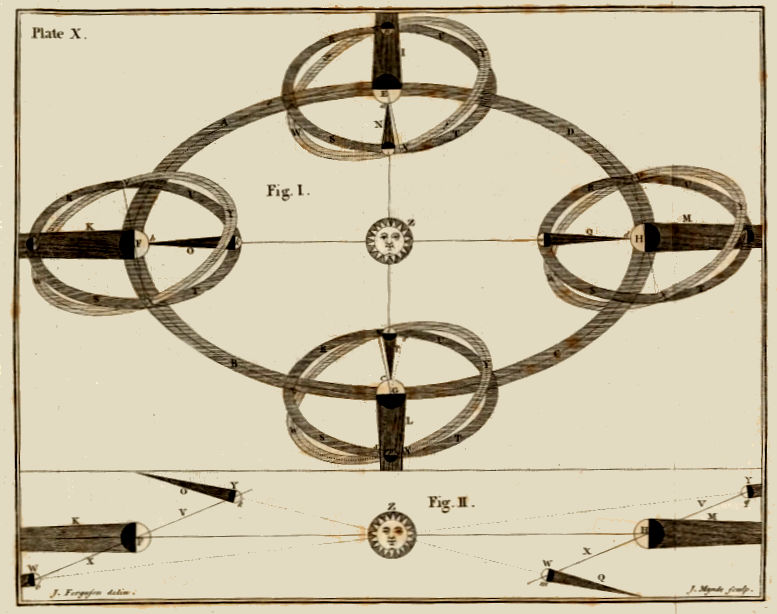
Fig. I. PLATE X. Line of the Nodes.
To illustrate this, let ABCD be the Ecliptic, RSTU a Circle lying in the same Plane with the Ecliptic, and VWXY the Moon’s Orbit, 159all thrown into an oblique view, which gives them an elliptical shape to the eye. One half of the Moon’s Orbit, as VWX, is always below the Ecliptic, and the other half XYV above it. The points V and X, where the Moon’s Orbit intersects the Circle RSTU, which lies even with the Ecliptic, are the Moon’s Nodes; and a right line as XEV drawn from one to the other, through the Earth’s center, is the Line of the Nodes, which is carried almost parallel to itself round the Sun in a year.
If the Moon moved round the Earth in the Orbit RSTU, which is coincident with the Plane of the Ecliptic, her shadow would fall upon the Earth every time she is in conjunction with the Sun; and at every opposition she would go through the Earth’s shadow. Were this the case, the Sun would be eclipsed at every Change, and the Moon at every Full, as already mentioned.
But although the Moon’s shadow N must fall upon the Earth at a, when the Earth is at E, and the Moon in conjunction with the Sun at i, because she is then very near one of her Nodes; and at her opposition n she must go through the Earth’s shadow I, because she is then near the other Node; yet, in the time that she goes round the Earth to her next Change, according to the order of the letters XYVW, the Earth advances from E to e, according to the order of the letters EFGH, and the line of the Nodes VEX being carried nearly parallel to itself, brings the point f of the Moon’s Orbit in conjunction with the Sun at that next Change; and then the Moon being at f is too high above the Ecliptic to cast her shadow on the Earth: and as the Earth is still moving forward, the Moon at her next opposition will be at g, too far below the Ecliptic to go through any part of the Earth’s shadow; for by that time the point g will be at a considerable distance from the Earth as seen from the Sun.
Fig. I and II.
When the Earth comes to F, the Moon in conjunction with the Sun Z is not at k, in a Plane coincident with the Ecliptic, but above it at Y in the highest part of her Orbit: and then the point b of her shadow O goes far above the Earth (as in Fig. II, which is an edge view of Fig. I.) The Moon at her next opposition is not at o (Fig I) but at W where the Earth’s shadow goes far above her, (as in Fig. II.) In both these cases the line of the Nodes VFX (Fig. I.) is about 90 degrees from the Sun, and both Luminaries as far as possible from the limits of Eclipses.
PLATE X.
When the Earth has gone half round the Ecliptic from E to G, the line of the Nodes VGX is nearly, if not exactly, directed towards the Sun at Z; and then the New Moon l casts her shadow P on the 160Earth G; and the Full Moon p goes through the Earth’s shadow L; which brings on Eclipses again, as when the Earth was at E.
When the Earth comes to H the New Moon falls not at m in a plane coincident with the Ecliptic CD, but at W in her Orbit below it: and then her shadow Q (see Fig. II) goes far below the Earth. At the next Full she is not at q (Fig. I) but at Y in her orbit 51⁄3 degrees above q, and at her greatest height above the Ecliptic CD; being then as far as possible, at any opposition, from the Earth’s shadow M (as in Fig. II.)
So, when the Earth is at E and G, the Moon is about her Nodes at New and Full; and in her greatest North and South Declination, (or Latitude as it is generally called) from the Ecliptic at her Quarters: but when the Earth is at F or H, the Moon is in her greatest North and South Declination from the Ecliptic at New and Full, and in the Nodes about her Quarters.
The Moon’s ascending and descending Node. Her North and South Latitude.
318. The point X where the Moon’s Orbit crosses the Ecliptic is called the Ascending Node, because the Moon ascends from it above the Ecliptic: and the opposite point of intersection V is called the Descending Node, because the Moon descends from it below the Ecliptic. When the Moon is at Y in the highest point of her Orbit, she is in her greatest North Latitude; and when she is at W in the lowest point of her Orbit, she is in her greatest South Latitude.
The Nodes have a retrograde motion. Fig. I. Which brings on the Eclipses sooner every year than they would be if the Nodes had not such a motion.
319. If the line of the Nodes, like the Earth’s Axis, was carried parallel to itself round the Sun, there would be just half a year between the conjunctions of the Sun and Nodes. But the Nodes shift backward, or contrary to the Earth’s annual motion, 191⁄3 degrees every year; and therefore the same Node comes round to the Sun 19 days sooner every year than on the year before. Consequently, from the time that the ascending Node X (when the Earth is at E) passes by the Sun as seen from the Earth, it is only 173 days (not half a year) till the descending Node V passes by him. Therefore, in whatever time of the year we have Eclipses of the Luminaries about either Node, we may be sure that in 173 days afterward we shall have Eclipses about the other Node. And when at any time of the year the line of the Nodes is in the situation VGX, at the same time next year it will be in the situation rGs; the ascending Node having gone backward, that is, contrary to the order of Signs from X to s, and the descending Node from V to r; each 191⁄3 degrees. At this rate the Nodes shift through all the Signs and degrees of the Ecliptic in 18 years and 225 days; in which time there would always be a regular period of Eclipses, if any compleat number of Lunations were finished without a fraction. But this never 161happens, for if the Sun and Moon should start from a conjunction with either of the Nodes in any point of the Ecliptic, whilst the same Node is going round to that point again the Earth performs 18 annual revolutions about the Sun and 222 Degrees (or 7 Signs 12 Degrees) over; and the Moon 230 Lunations or Courses from Change to Change and 85 Degrees (or 2 Signs 25 Degrees) over; so that the Sun will be 138 Degrees from the same Node when it comes round, and the Moon 85 Degrees from the Sun. Hence, the period of Eclipses and revolution of the Nodes are completed in different times.
A period of Eclipses. The defects of it.
320. In 18 years 10 days 7 hours 43 minutes after the Sun Moon and Nodes have been in a line of conjunction, they come very near to a conjunction again: only, if the conjunction from which you reckon falls in a leap-year, the return of the conjunction will be one day later. Therefore, if to the [65]mean time of any Eclipse of the Sun or Moon in leap-year, you add 18 years 11 days 7 hours 43 minutes; or in a common year a day less, you will have the mean time of that Eclipse returned again for some ages; though not always visible, because the 7 hours 43 minutes may shift a solar Eclipse into the night, and a lunar Eclipse into the day. In this period there are just 223 Lunations, and the Sun is again within half a degree of the same Node, but short of it. Therefore, although this period will serve tolerably well for some ages to examine Eclipses by, it cannot hold long; because half a degree from the Node sets the Moon 21⁄2 minutes of a degree from the Ecliptic. And as the Moon’s mean distance from the Earth is equal to 60 Semidiameters of the Earth, every minute of a degree at that distance is equal to 60 geographical miles, or one degree on the Earth; consequently 21⁄2 minutes of declination from the Ecliptic in the Moon’s Orbit, is equal to 150 such miles, or 21⁄2 degrees on the Earth. Consequently, if the Moon be passing by her ascending Node at the end of this period, her shadow will go 150 miles more southward on the Earth than it did at the beginning thereof. If the Moon be passing by her descending Node, her shadow will go 150 miles more northward: and in either case, in 500 years the shadow will have too great a Latitude to touch the Earth. So that any Eclipse of the Sun, which begins (for example) to touch the Earth at the south Pole (and that must be when the Moon is 17 degrees past her descending Node) will advance gradually northward in every return for about a thousand years, and then go off at the north Pole; and cannot take such another course again in less than 11,683 years.
162This falling back of the Sun and Moon in every period, with respect to the Nodes, will occasion those Eclipses which happen about the ascending Node to go more southerly in each return; and those which happen about the descending Node to go more northerly: for the farther the Moon is short of the ascending Node, within the limits of Eclipses, the farther she is south of the Ecliptic; and on the contrary, the more she is short of the descending Node, the farther she is northward of the Ecliptic.
From Mr. G. Smith’s dissertation on Eclipses, printed at London, by E. Cave, in the year 1748.
321. “To illustrate this a little farther, we shall examine some of the most remarkable circumstances of the returns of the Eclipse which happened July 14, 1748, about noon: This Eclipse, after traversing the voids of space from the Creation, at last began to enter the Terra Australis Incognita, about 88 years after the Conquest, which was the last of King Stephen’s reign; every [66]Chaldean period it has crept more northerly, but was still invisible in Britain before the year 1622; when on the 30th of April it began to touch the south parts of England about 2 in the afternoon; its central appearance rising in the American South Seas, and traversing Peru and the Amazon’s country, through the Atlantic ocean into Africa, and setting in the Æthiopian continent, not far from the beginning of the Red Sea.
“Its next visible period was after three Chaldean revolutions in 1676, on the first of June, rising central in the Atlantic ocean, passing us about 9 in the morning, with four [67]Digits eclipsed on the under limb; and setting in the gulf of Cochinchina in the East-Indies.
“It being now near the Solstice, this Eclipse was visible the very next return in 1694, in the evening; and in two periods more, which was in 1730, on the 4th of July, was seen above half eclipsed just after Sun-rise, and observed both at Wirtemberg in Germany, and Pekin in China, soon after which it went off.
“Eighteen years more afforded us the Eclipse which fell on the 14th of July 1748.
“The next visible return will happen on July 25, 1766, in the evening, about four Digits eclipsed; and after two periods more, on August 16th, 1802, early in the morning, about five Digits, the center coming from the north frozen continent, by the capes of Norway, through Tartary, China, and Japan, to the Ladrone islands, where it goes off.
163“Again, in 1820, August 26, betwixt one and two, there will be another great Eclipse at London, about 10 Digits; but happening so near the Equinox, the center will leave every part of Britain to the West, and enter Germany at Embden, passing by Venice, Naples, Grand Cairo, and set in the gulf of Bassora near that city.
“It will be no more visible till 1874, when five Digits will be obscured, the center being now about to leave the Earth on September 28. In 1892 the Sun will go down eclipsed at London, and again in 1928 the passage of the center will be in the expansum, though there will be two Digits eclipsed at London, October the 31st of that year; and about the year 2090 the whole Penumbra will be wore off; whence no more returns of this Eclipse can happen till after a revolution of 10 thousand years.
“From these remarks on the intire revolution of this Eclipse, we may gather, that a thousand years, more or less (for there are some irregularities that may protract or lengthen this period 100 years) complete the whole terrestrial Phenomena of any single Eclipse: and since 20 periods of 54 years each, and about 33 days, comprehend the intire extent of their revolution, ’tis evident that the times of the returns will pass through a circuit of one year and ten months, every Chaldean period being ten or eleven days later, and of the equable appearances about 32 or 33 days. Thus, though this Eclipse happens about the middle of July, no other subsequent Eclipse of this period will return to the middle of the same month again; but wear constantly each period 10 or 11 days forward, and at last appear in Winter, but then it begins to cease from affecting us.
“Another conclusion from this revolution may be drawn, that there will seldom be any more than two great Eclipses of the Sun in the interval of this period, and these follow sometimes next return, and often at greater distances. That of 1715 returned again in 1733 very great; but this present Eclipse will not be great till the arrival of 1820, which is a revolution of four Chaldean periods: so that the irregularities of their circuits must undergo new computations to assign them exactly.
“Nor do all Eclipses come in at the south Pole: that depends altogether on the position of the lunar Nodes, which will bring in as many from the expansum one way as the other; and such Eclipses will wear more southerly by degrees, contrary to what happens in the present case.
164“The Eclipse, for example, of 1736, in September, had its center in the expansum, and set about the middle of its obscurity in Britain; it will wear in at the north Pole, and in the year 2600, or thereabouts, go off into the expansum on the south side of the Earth.
“The Eclipses therefore which happened about the Creation are little more than half way yet of their etherial circuit; and will be 4000 years before they enter the Earth any more. This grand revolution seems to have been entirely unknown to the antients.
Why our present Tables agree not with antient observations.
“322. It is particularly to be noted, that Eclipses which have happened many centuries ago, will not be found by our present Tables to agree exactly with antient observations, by reason of the great Anomalies in the lunar motions; which appears an incontestable demonstration of the non-eternity of the Universe. For it seems confirmed by undeniable proofs, that the Moon now finishes her period in less time than formerly, and will continue by the centripetal law to approach nearer and nearer the Earth, and to go sooner and sooner round it: nor will the centrifugal power be sufficient to compensate the different gravitations of such an assemblage of bodies as constitute the solar system, which would come to ruin of itself, without some new regulation and adjustment of their original motions[68].
Thales’s Eclipse.
“323. We are credibly informed from the testimony of the antients, that there was a total Eclipse of the Sun predicted by 165Thales to happen in the fourth year of the 48th [69]Olympiad, either at Sardis or Miletus in Asia, where Thales then resided. That year corresponds to the 585th year before Christ; when accordingly there happened a very signal Eclipse of the Sun, on the 28th of May, answering to the present 10th of that month[70], central through North America, the south parts of France, Italy, &c. as far as Athens, or the Isles in the Ægean Sea; which is the farthest that even the Caroline Tables carry it; and consequently make it invisible to any part of Asia, in the total character; though I have good reasons to believe that it extended to Babylon, and went down central over that city. We are not however to imagine, that it was set before it past Sardis and the Asiatic towns, where the predictor lived; because an invisible Eclipse could have been of no service to demonstrate his ability in Astronomical Sciences to his countrymen, as it could give no proof of its reality.
Thucydides’s Eclipse.
“324. For a farther illustration, Thucydides relates, that a solar Eclipse happened on a Summer’s day in the afternoon, in the first year of the Peloponnesian war, so great that the Stars appeared. Rhodius was victor in the Olympic games the fourth year of the said war, being also the fourth of the 87th Olympiad, on the 428th 166year before Christ. So that the Eclipse must have happened in the 431st year before Christ; and by computation it appears, that on the 3d of August there was a signal Eclipse which would have past over Athens, central about 6 in the evening, but which our present Tables bring no farther than the antient Syrtes on the African coast, above 400 miles from Athens; which suffering in that case but 9 Digits, could by no means exhibit the remarkable darkness recited by this historian; the center therefore seems to have past Athens about 6 in the evening, and probably might go down about Jerusalem, or near it, contrary to the construction of the present Tables. I have only obviated these things by way of caution to the present Astronomers, in re-computing antient Eclipses; and refer them to examine the Eclipse of Nicias, so fatal to the Athenian fleet[71]; that which overthrew the Macedonian Army[72] &c.” So far Mr. Smith.
The number of Eclipses.
325. In any year, the number of Eclipses of both Luminaries cannot be less than two, nor more than seven; the most usual number is four, and it is very rare to have more than six. For the Sun passes by both the Nodes but once a year, unless he passes by one of them in the beginning of the year; and if he does, he will pass by the same Node again a little before the year be finished; because, as these points move 19 degrees backward every year, the Sun will come to either of them 173 days after the other § 319. And when either Node is within 17 degrees of the Sun at the time of New Moon, the Sun will be eclipsed. At the subsequent opposition the Moon will be eclipsed in the other Node; and come round to the next conjunction again ere the former Node be 17 degrees past the Sun, and will therefore eclipse him again. When three Eclipses fall about either Node, the like number generally falls about the opposite; as the Sun comes to it in 173 days afterward: and six Lunations contain but four days more. Thus, there may be two Eclipses of the Sun and one of the Moon about each of her Nodes. But when the Moon changes in either of the Nodes, she cannot be near enough the other Node at the next Full to be eclipsed; and in six lunar months afterward she will change near the other Node: in these cases there can be but two Eclipses in a year, and they are both of the Sun.
Two periods of Eclipses.
326. A longer, and consequently more exact period than the above-mentioned § 320, for comparing and examining Eclipses which happen at long intervals of time, is 57 Julian years 324 days 21 hours 41 minutes and 35 seconds; in which time there are just 716 mean Lunations, 167and the Sun is again within 5 minutes of the same Node as before. But a still better period is 557 years 21 days 18 hours 30 minutes 12 seconds; in which time there are 6890 mean Lunations; and the Sun and Node meet again so nearly as to be but 11 seconds distant.
An account of the following catalogue of Eclipses.
327. We shall subjoin a catalogue of Eclipses recorded in history, from 721 years before Christ to A. D. 1485; of computed Eclipses from 1485 to 1700; and of all the Eclipses visible in Europe from 1700 to 1800. From the beginning of the catalogue to A.D. 1485 the Eclipses are taken from Struyk’s Introduction to universal Geography, as that indefatigable author has, with much labour, collected them from Ptolemy, Thucydides, Plutarch, Calvisius, Xenophon, Diodorus Siculus, Justin, Polybius, Titus Livius, Cicero, Lucanus, Theophanes, Dion Cassius, and many others. From 1485 to 1700 the Eclipses are taken from Ricciolus’s Almagest: and from 1700 to 1800 from L’art de verifier les Dates[73]. Those from Struyk have all the places mentioned where they were observed: Those from the French authors, viz. the religious Benedictines of the Congregation of St. Maur, are fitted to the Meridian of Paris: And concerning those from Ricciolus, that author gives the following account.
Because it is of great use for fixing the Cycles or Revolutions of Eclipses, to have at hand, without the trouble of calculation, a list of successive Eclipses for many years, computed by authors of Ephemerides, although from Tables not perfect in all respects, I shall for the benefit of Astronomers give a summary collection of such. The authors I extract from are, an anonymous one who published Ephemerides from 1484 to 1506 inclusive; Jacobus Pflaumen and Jo. Stæflerinus, to the Meridian of Ulm, from 1507 to 1534: Lucas Gauricus, to the Latitude of 45 degrees, from 1534 to 1551: Peter Appian, to the Meridian of Leysing, from 1538 to 1578: Jo. Stæflerus to the Meridian of Tubing, from 1543 to 1554: Petrus Pitatus, to the Meridian of Venice from 1544 to 1556: Georgius-Joachimus Rheticus, for the year 1551: Nicholaus Simus, to the Meridian of Bologna, from 1552 to 1568: Michael Mæstlin, to the Meridian of Tubing, from 1557 to 1590: Jo. Stadius, to the Meridian of Antwerp, from 1554 to 1574: Jo. Antoninus Maginus, to the Meridian of Venice, from 1581 to 1630: David Origan, to the Meridian of Franckfort on the Oder, from 1595 to 1664: Andrew Argol, to the Meridian of Rome, from 1630 to 1700: Franciscus Montebrunus, to the Meridian of Bologna, from 1461 to 1660: 168Among which, Stadius, Mæstlin, and Maginus, used the Prutenic Tables; Origan the Prutenic and Tychonic; Montebrunus the Lansbergian, as likewise those of Duret. Almost all the rest the Alphonsine.
But, that the places may readily be known for which these Eclipses were computed, and from what Tables, consult the following list, in which the years inclusive are also set down.
From 1485 to 1506 The place and author unknown.
1507 1553 Ulm in Suabia, from the Alphonsine.
1554 1576 Antwerp, from the Prutenic.
1577 1585 Tubing, from the Prutenic.
1586 1594 Venice, from the Prutenic.
1595 1600 Franckfort on Oder, from the Prutenic.
1601 1640 Franckfort on Oder, from the Tychonic.
1641 1660 Bologna, from the Lansbergian.
1661 1700 Rome, from the Tychonic.
So far Ricciolus.
N. B. The Eclipses marked with an Asterisk are not in Ricciolus’s catalogue; but are supplied from L’art de verifier les Dates.
From the beginning of the catalogue to A. D. 1700, the time is reckoned from the noon of the day mentioned to the noon of the following day; but from 1700 to 1800 the time is set down according to our common way of reckoning. Those marked Pekin and Canton are Eclipses from the Chinese chronology according to Struyk; and throughout the Table this mark signifies Sun, and this Moon.


169Struyk’s Catalogue of ECLIPSES.
Bef. Chr. Eclipses of the Sun and Moon seen at M. & D. Middle Digits eclipsed
H. M.
721 Babylon Mar. 19 10 34 Total
720 Babylon Mar. 8 11 56 1 5
720 Babylon Sept. 1 10 18 5 4
621 Babylon Apr. 21 18 22 2 36
523 Babylon July 16 12 47 7 24
502 Babylon Nov. 19 12 21 1 52
491 Babylon Apr. 25 12 12 1 44
431 Athens Aug. 3 6 35 11 0
425 Athens Oct. 9 6 45 Total
424 Athens Mar. 20 20 17 9 0
413 Athens Aug. 27 10 15 Total
406 Athens Apr. 15 8 50 Total
404 Athens Sept. 2 21 12 8 40
403 Pekin Aug. 28 5 53 10 40
394 Gnide Aug. 13 22 17 11 0
383 Athens Dec. 22 19 6 2 1
382 Athens June 18 8 54 6 15
382 Athens Dec. 12 10 21 Total
364 Thebes July 12 23 51 6 10
357 Syracuse Feb. 28 22 -- 3 33
357 Zant Aug. 29 7 29 4 21
340 Zant Sept. 14 18 -- 9 0
331 Arbela Sept. 20 10 9 Total
310 Sicily Island Aug. 14 20 5 10 22
219 Mysia Mar. 19 14 5 Total
218 Pergamos Sept. 1 rising Total
217 Sardinia Feb. 11 1 57 9 6
203 Frusini May 6 2 52 5 40
202 Cumis Oct. 18 22 24 1 0
201 Athens Sept. 22 7 14 8 58
200 Athens Mar. 19 13 9 Total
200 Athens Sept. 11 14 48 Total
198 Rome Aug. 6 ---- ----
190 Rome Mar. 13 18 -- 11 0
188 Rome July 16 20 38 10 48
174 Athens Apr. 30 14 33 7 1
168 Macedonia June 21 8 2 Total
141 Rhodes Jan. 27 10 8 3 26
104 Rome July 18 22 0 11 52
63 Rome Oct. 27 6 22 Total
60 Gibralter Mar. 16 setting Central
54 Canton May 9 3 41 Total
51 Rome Mar. 7 2 12 9 0
48 Rome Jan. 18 10 0 Total
45 Rome Nov. 6 14 -- Total
36 Rome May 19 3 52 6 47
31 Rome Aug. 20 setting Gr. Ecl.
29 Canton Jan. 5 4 2 11 0
28 Pekin June 18 23 48 Total
26 Canton Oct. 23 4 16 11 15
24 Pekin April 7 4 11 2 0
16 Pekin Nov. 1 5 13 2 8
2 Canton Feb. 1 20 8 11 42
Aft. Chr. Eclipses of the Sun and Moon seen at M. & D. Middle Digits eclipsed
H. M.
1 Pekin June 10 1 10 11 43
5 Rome Mar. 28 4 13 4 45
14 Panonia Sept. 26 17 15 Total
27 Canton July 22 8 56 Total
30 Canton Nov. 13 19 20 10 30
40 Pekin Apr. 30 5 50 7 34
45 Rome July 31 22 1 5 17
46 Pekin July 21 22 25 2 10
46 Rome Dec. 31 9 52 Total
49 Pekin May 20 7 16 10 8
53 Canton Mar. 8 20 42 11 6
55 Pekin July 12 21 50 6 40
56 Canton Dec. 25 0 28 9 20
59 Rome Apr. 30 3 8 10 38
60 Canton Oct. 13 3 31 10 30
65 Canton Dec. 15 21 50 10 23
69 Rome Oct. 18 10 43 10 49
70 Canton Sept. 22 21 13 8 26
71 Rome Mar. 4 8 32 6 0
95 Ephesus May 21 ---- 1 0
125 Alexandria April 5 9 16 1 44
133 Alexandria May 6 11 44 Total
134 Alexandria Oct. 20 11 5 10 19
136 Alexandria Mar. 5 15 56 5 17
237 Bologna Apr. 12 ---- Total
238 Rome April 1 20 20 8 45
290 Carthage May 15 3 20 11 20
304 Rome Aug. 31 9 36 Total
316 Constantinople Dec. 30 19 53 2 18
334 Toledo July 17 at noon Central
348 Constantinople Oct. 8 19 24 8 0
360 Ispahan Aug. 27 18 0 Central
364 Alexandria Nov. 25 15 24 Total
401 Rome June 11 ---- Total
401 Rome Dec. 6 12 15 Total
402 Rome June 1 8 43 10 2
402 Rome Nov. 10 20 33 10 30
447 Compostello Dec. 23 0 46 1 --
451 Compostello April 1 16 34 19 52
451 Compostello Sept. 26 6 30 0 2
458 Chaves May 27 23 16 18 53
462 Compostello Mar. 1 13 2 11 11
464 Chaves July 19 19 1 10 15
484 Constantinople Jan. 13 19 53 0 0
486 Constantinople May 19 1 10 5 15
497 Constantinople Apr. 18 6 5 17 57
512 Constantinople June 28 23 8 1 50
538 England Feb. 14 19 -- 8 23
540 London June 19 20 15 8 --
577 Tours Dec. 10 17 28 6 46
581 Paris April 4 13 33 6 42
582 Paris Sept. 17 12 41 Total
590 Paris Oct. 18 6 30 9 25
170592 Constantinople Mar. 18 22 6 10 0
603 Paris Aug. 12 3 3 11 20
622 Constantinople Febr. 1 11 28 Total
644 Paris Nov. 5 0 30 9 53
680 Paris June 17 12 30 Total
683 Paris April 16 11 30 Total
693 Constantinople Oct. 4 23 54 11 54
716 Constantinople Jan. 13 7 -- Total
718 Constantinople June 3 1 15 Total
733 England Aug. 13 20 -- 11 1
734 England Jan. 23 14 -- Total
752 England July 30 13 -- Total
753 England June 8 22 -- 10 35
753 England Jan. 23 13 -- Total
760 England Aug. 15 4 -- 8 15
760 London Aug. 30 5 50 10 40
764 England June 4 at noon 7 15
770 London Feb. 14 7 12 Total
774 Rome Nov. 22 14 37 11 58
784 London Nov. 1 14 2 Total
787 Constantinople Sept. 14 20 43 9 47
796 Constantinople Mar. 27 16 22 Total
800 Rome Jan. 15 9 0 10 17
807 Angoulesme Feb. 10 21 24 9 42
807 Paris Feb. 25 13 43 Total
807 Paris Aug. 21 10 20 Total
809 Paris July 15 21 33 8 8
809 Paris Dec. 25 8 -- Total
810 Paris June 20 8 -- Total
810 Paris Nov. 30 0 12 Total
810 Paris Dec. 14 8 -- Total
812 Constantinople May 14 2 13 9 --
813 Cappadocia May 3 17 5 10 35
817 Paris Feb. 5 5 42 Total
818 Paris July 6 18 -- 6 55
820 Paris Nov. 23 6 26 Total
824 Paris Mar. 18 7 55 Total
828 Paris June 30 15 -- Total
828 Paris Dec. 24 13 45 Total
831 Paris April 30 6 19 11 8
831 Paris May 15 23 -- 4 24
831 Paris Oct. 24 11 18 Total
832 Fulda Apr. 18 9 0 Total
840 Paris May 4 23 22 9 20
841 Paris Oct. 17 18 58 5 24
842 Paris Mar. 29 14 38 Total
843 Paris Mar. 19 7 1 Total
861 Paris Mar. 29 15 7 Total
878 Paris Oct. 14 16 -- Total
878 Paris Oct. 29 1 -- 11 14
883 Arracta July 23 7 44 11 --
889 Constantinople April 3 17 52 9 23
891 Constantinople Aug. 7 23 48 10 30
901 Arracta Aug. 2 15 7 Total
904 London May 31 11 47 Total
904 London Nov. 25 9 0 Total
912 London Jan. 6 15 12 Total
926 Paris Mar. 31 15 17 Total
934 Paris Apr. 16 4 30 11 36
939 Paris July 18 19 45 10 7
955 Paris Sept. 4 11 18 Total
961 R pl prhemes May 16 20 13 9 18
970 Constantinople May 7 18 38 11 22
976 London July 13 15 7 Total
985 Messina July 20 3 52 4 10
989 Constantinople May 28 6 54 8 40
990 Fulda Apr. 12 10 22 9 5
990 Fulda Oct. 6 15 4 11 10
990 Constantinople Oct. 21 0 45 10 5
995 Augsburgh July 14 11 27 Total
1009 Ferrara Oct. 6 11 38 Total
1010 Messina Mar. 18 5 41 9 12
1016 Nimeguen Nov. 16 16 39 Total
1017 Nimeguen Oct. 22 2 8 6 --
1020 Cologne Sept. 4 11 38 Total
1023 London Jan. 23 23 29 11 --
1030 Rome Feb. 20 11 43 Total
1031 Paris Feb. 9 11 51 Total
1033 Paris Dec. 8 11 11 9 17
1034 Milan June 4 9 8 Total
1037 Paris Apr. 17 20 45 10 45
1039 Auxerre Aug. 21 23 40 11 5
1042 Rome Jan. 8 16 39 Total
1044 Auxerre Nov. 7 16 12 10 1
1044 Cluny Nov. 21 22 12 11 --
1056 Nuremburg April 2 12 9 Total
1063 Rome Nov. 8 12 16 Total
1074 Augsburgh Oct. 7 10 13 Total
1080 Constantinople Nov. 29 11 12 9 36
1082 London May 14 10 32 10 2
1086 Constantinople Feb. 16 4 7 Total
1089 Naples June 25 6 6 Total
1093 Augsburgh Sept. 22 22 35 10 12
1096 Gemblours Feb. 10 16 4 Total
1096 Augsburgh Aug. 6 8 21 Total
1098 Augsburgh Dec. 25 1 25 10 12
1099 Naples Nov. 30 4 58 Total
1103 Rome Sept. 17 10 18 Total
1106 Erfurd July 17 11 28 11 54
1107 Naples Jan. 10 13 16 Total
1109 Erfurd May 31 1 30 10 20
1110 London May 5 10 51 Total
1113 Jerusalem Mar. 18 19 0 9 12
1114 London Aug. 17 15 5 Total
1117 Trier June 15 13 26 Total
1117 Trier Dec. 10 12 51 Total
1711118 Naples Nov. 29 15 46 4 11
1121 Trier Sept. 27 16 47 Total
1122 Prague Mar. 24 11 20 3 49
1124 Erfurd Feb. 1 6 43 8 39
1124 London Aug. 10 23 29 9 58
1132 Erfurd March 3 8 14 Total
1133 Prague Feb. 20 16 41 3 23
1135 London Dec. 22 20 11 Total
1142 Rome Feb. 11 14 17 8 30
1143 Rome Feb. 1 6 36 Total
1147 Auranches Oct. 25 22 38 7 20
1149 Bary Mar. 25 13 54 5 29
1151 Eimbeck Aug. 28 12 4 4 29
1153 Augsburgh Jan. 26 0 42 11 --
1154 Paris June 26 16 1 Total
1154 Paris Dec. 21 8 30 4 42
1155 Auranches June 10 8 45 0 53
1160 Rome Aug. 18 7 53 6 49
1161 Rome Aug. 7 8 15 Total
1162 Erfurd Feb. 1 6 40 5 56
1162 Erfurd July 27 12 30 4 11
1163 Mont Cassin. July 3 7 40 2 0
1164 Milan June 6 10 0 Total
1168 London Sept. 18 14 0 Total
1172 Cologne Jan. 11 13 31 Total
1176 Auranches April 25 7 2 8 6
1176 Auranches Oct. 19 11 20 8 53
1178 Cologne March 5 setting 7 52
1178 Auranches Aug. 29 13 52 5 31
1178 Cologne Sept. 12 -- -- 10 51
1179 Cologne Aug. 18 14 28 Total
1180 Auranches Jan. 28 4 14 10 34
1181 Auranches July 13 3 15 3 48
1181 Auranches Dec. 22 8 58 4 40
1185 Rhemes May 1 1 53 9 0
1186 Cologne April 5 6 -- Total
1186 Franckfort April 20 7 19 4 0
1187 Paris Mar. 25 16 17 8 42
1187 England Sept. 3 21 54 8 6
1189 England Feb. 2 10 -- 9 --
1191 England June 23 0 20 11 32
1192 France Nov. 20 14 -- 6 --
1193 France Nov. 10 5 27 Total
1194 London April 22 2 15 6 49
1200 London Jan. 2 17 2 4 35
1201 London June 17 15 4 Total
1204 England April 15 12 39 Total
1204 Saltzburg Oct. 10 6 32 Total
1207 Rhemes Feb. 27 10 50 10 20
1208 Rhemes Feb. 2 5 10 Total
1211 Vienna Nov. 21 13 57 Total
1215 Cologne Mar. 16 15 35 Total
1216 Acre Feb. 18 21 15 11 36
1216 Acre March 5 9 38 7 4
1218 Damietta July 9 9 46 11 31
1222 Rome Oct. 22 14 28 Total
1223 Colmar April 16 8 13 11 0
1228 Naples Dec. 27 9 55 9 19
1230 Naples May 13 17 -- Total
1230 London Nov. 21 13 21 9 34
1232 Rhemes Oct. 15 4 29 4 25
1245 Rhemes July 24 17 47 6 --
1248 London June 7 8 49 Total
1255 London July 20 9 47 Total
1255 Constantinople Dec. 30 2 52 Annul.
1258 Augsburgh May 18 11 17 Total
1261 Vienna Mar. 31 22 40 9 8
1262 Vienna March 7 5 50 Total
1262 Vienna Aug. 30 14 39 Total
1263 Vienna Feb. 24 6 52 6 29
1263 Augsburgh Aug. 5 3 24 11 17
1263 Vienna Aug. 20 7 35 9 7
1265 Vienna Dec. 23 16 25 Total
1267 Constantinople May 24 23 11 11 40
1270 Vienna Mar. 22 18 47 10 40
1272 Vienna Aug. 10 7 27 8 53
1274 Vienna Jan. 23 10 39 9 25
1275 Lauben Dec. 4 6 20 4 29
1276 Vienna Nov. 22 15 -- Total
1277 Vienna May 18 -- -- Total
1279 Franckfort Apr. 12 6 55 10 6
1280 London Mar. 17 12 12 Total
1284 Reggio Dec. 23 16 11 9 13
1290 Wittemburg Sept. 4 19 37 10 30
1291 London Feb. 14 10 2 Total
1302 Constantinople Jan. 14 10 25 Total
1307 Ferrara April 2 22 18 0 54
1309 London Feb. 24 17 44 Total
1309 Lucca Aug. 21 10 32 Total
1310 Wittemburg Jan. 31 2 2 10 10
1310 Torcello Feb. 14 4 8 10 20
1310 Torcello Aug. 10 15 33 7 16
1312 Wittemburg July 4 19 49 3 23
1312 Plaisance Dec. 14 7 19 Total
1313 Torcello Dec. 3 8 58 9 34
1316 Modena Oct. 1 14 55 Total
1321 Wittemburg June 25 18 1 11 17
1323 Florence May 20 15 24 Total
1324 Florence May 9 6 3 Total
1324 Wittemburg Apr. 23 6 35 8 8
1327 Constantinople Aug. 31 18 26 Total
1328 Constantinople Feb. 25 13 47 11 --
1330 Florence June 30 15 10 7 34
1330 Constantinople July 16 4 5 10 43
1330 Prague Dec. 25 15 49 Total
1331 Prague Nov. 29 20 26 7 41
1721331 Prague Dec. 14 18 -- 11 --
1333 Wittemburg May 14 3 -- 10 18
1334 Cesena Apr. 19 10 33 Total
1341 Constantinople Nov. 23 12 23 Total
1341 Constantinople Dec. 8 22 15 6 30
1342 Constantinople May 20 14 27 Total
1344 Alexandria Oct. 6 18 40 8 55
1349 Wittemburg June 30 12 20 Total
1354 Wittemburg Sept. 16 20 45 8 43
1356 Florence Feb. 16 11 43 Total
1361 Constantinople May 4 22 15 8 54
1367 In China Jan. 16 8 27 Total
1389 Eugibin Nov. 3 17 5 Total
1396 Augsburg Jan. 11 0 16 6 22
1396 Augsburg June 21 11 10 Total
1399 Forli Oct. 29 0 43 9 --
1406 Constantinople June 1 13 -- 10 31
1406 Constantinople June 15 18 1 11 38
1408 Forli Oct. 18 21 47 9 32
1409 Constantinople Apr. 15 3 1 10 48
1410 Vienna Mar. 20 13 13 Total
1415 Wittemburg June 6 6 43 Total
1419 Franckfort Mar. 25 22 5 1 45
1421 Forli Feb. 17 8 2 Total
1422 Forli Feb. 6 8 26 11 7
1424 Wittemburg June 26 3 57 11 20
1431 Forli Feb. 12 2 4 1 39
1433 Wittemburg June 17 5 -- Total
1438 Wittemburg Sept. 18 20 59 8 7
1442 Rome Dec. 17 3 56 Total
1448 Tubing Aug. 28 22 23 8 53
1450 Constantinople July 24 7 19 Total
1457 Vienna Sept. 3 11 17 Total
1460 Austria July 3 7 31 5 23
1460 Austria July 17 17 32 11 19
1460 Vienna Dec. 27 13 30 Total
1461 Vienna June 22 11 50 Total
1461 Rome Dec. 17 -- -- Total
1462 Viterbo June 11 15 -- 7 38
1462 Viterbo Nov. 21 0 10 2 6
1464 Padua Apr. 21 12 43 Total
1465 Rome Sept. 20 5 15 8 46
1465 Rome Oct. 4 5 12 Total
1469 Rome Jan. 27 7 9 Total
1485 Norimburg Mar. 16 3 53 11 --
The following ECLIPSES are all taken from Ricciolus, except those marked
with an Asterisk, which are from L’Art de verifier les Dates.
Aft. Chr. M. & D. Middle Digits eclipsed
H. M.
1486 Feb. 18 5 41 Total
1486 Mar. 5 17 43 9 0
1487 Feb. 7 15 49 Total
1487 July 20 2 6 7 0
1488 Jan. 28 6 -- *
1488 July 8 17 30 4 0
1489 Dec. 7 17 41 Total
1490 May 19 Noon *
1490 June 2 10 6 Total
1490 Nov. 26 18 25 Total
1491 May 8 2 19 9 0
1491 Nov. 15 18 -- *
1492 Apr. 26 7 -- *
1492 Oct. 20 23 -- *
1493 April 1 14 0 Total
1493 Oct. 10 2 40 8 0
1494 Mar. 7 4 12 4 0
1494 Mar. 21 14 38 Total
1494 Sept. 14 19 45 Total
1495 Mar. 10 16 -- *
1495 Aug. 19 17 -- *
1496 Jan. 29 14 -- *
1497 Jan. 18 6 38 Total
1497 July 29 3 2 3 0
1499 June 22 17 -- *
1499 Aug. 23 18 -- *
1499 Nov. 17 10 -- *
1500 Mar. 27 In the Night
1500 Apr. 11 At Noon
1500 Oct. 5 14 2 10 0
1501 May 2 17 49 Total
1502 Sept. 30 19 45 10 0
1502 Oct. 15 12 20 2 0
1503 Mar. 12 9 -- *
1503 Sept. 19 22 -- *
1504 Feb. 29 13 36 Total
1504 Mar. 16 3 -- *
1505 Aug. 14 8 18 Total
1506 Feb. 7 15 -- *
1506 July 20 3 11 2 0
1506 Aug. 3 10 -- *
1507 Jan. 12 19 -- *
1508 Jan. 2 4 -- *
1508 May 29 6 -- *
1508 June 12 17 40 Total
1509 June 2 11 11 7 0
1509 Nov. 11 22 -- *
1510 Oct. 16 19 -- *
1511 Oct. 6 11 50 Total
1512 Sept. 25 3 56 Total
1513 Mar. 7 0 30 6 0
1513 Aug. 30 1 -- *
1515 Jan. 29 15 18 Total
1516 Jan. 19 6 0 Total
1516 July 13 11 37 Total
1516 Dec. 23 3 47 3 0
1517 June 18 16 -- *
1731517 Nov. 27 19 -- *
1518 May 24 11 19 9 11
1518 June 7 17 56 11 0
1519 May 28 1 -- *
1519 Oct. 23 4 33 6 0
1519 Nov. 6 6 24 Total
1520 May 2 7 -- *
1520 Oct. 11 5 22 3
1520 Oct. 25 19 -- *
1520 Mar. 21 17 -- *
1521 April 6 19 -- *
1521 Sept. 30 3 -- *
1522 Sept. 5 12 17 Total
1523 Mar. 1 8 26 Total
1523 Aug. 25 15 24 Total
1524 Feb. 4 1 -- *
1524 Aug. 16 16 -- *
1525 Jan. 23 4 -- *
1525 July 4 10 10 Total
1525 Dec. 29 10 46 Total
1526 Dec. 18 10 30 Total
1527 Jan. 2 3 -- *
1527 Dec. 7 10 -- *
1528 May 17 20 -- *
1529 Oct. 16 20 23 11 55
1530 Mar. 28 18 23 8 24
1530 Oct. 6 12 11 Total
1531 April 1 7 -- *
1532 Aug. 30 0 49 3 35
1533 Aug. 4 11 50 Total
1533 Aug. 19 17 -- *
1534 Jan. 14 1 42 5 45
1534 Jan. 29 14 25 Total
1535 June 30 Noon *
1535 July 14 8 -- *
1535 Dec. 24 2 -- *
1536 June 18 2 2 8 0
1536 Nov. 27 6 21 10 15
1537 May 24 8 3 Total
1537 June 7 7 -- *
1537 Nov. 16 14 56 Total
1538 May 13 14 24 3 0
1538 Nov. 6 5 31 3 37
1539 Apr. 18 4 33 9 0
1540 April 6 17 15 Total
1541 Mar. 11 16 34 Total
1541 Aug. 21 0 56 3 0
1542 Mar. 1 8 46 1 38
1542 Aug. 10 17 -- *
1543 July 15 16 -- *
1544 Jan. 9 18 13 Total
1544 Jan. 23 21 16 11 17
1544 July 4 8 31 Total
1544 Dec. 28 18 27 Total
1545 June 8 20 48 3 45
1545 Dec. 17 18 -- *
1546 May 30 5 -- *
1546 Nov. 22 23 -- *
1547 May 4 10 27 8 0
1547 Oct. 28 4 56 11 34
1547 Nov. 12 2 9 9 30
1548 April 8 3 -- *
1548 Apr. 22 11 24 Total
1549 Apr. 11 15 19 2 0
1549 Oct. 6 6 -- *
1550 Mar. 16 20 -- *
1551 Feb. 20 8 21 Total
1551 Aug. 31 2 0 1 52
1553 Jan. 12 22 54 1 22
1553 July 10 7 -- *
1553 July 24 16 0 0 31
1554 June 29 6 -- *
1554 Dec. 8 13 7 10 12
1555 June 4 15 0 Total
1555 Nov. 13 19 -- *
1556 Nov. 1 18 0 9 41
1556 Nov. 16 12 44 6 55
1557 Oct. 20 20 -- *
1558 April 2 11 0 9 50
1558 Apr. 18 1 -- *
1559 Apr. 16 4 50 Total
1560 Mar. 11 15 40 4 13
1560 Aug. 21 1 0 6 22
1560 Sept. 4 7 -- *
1561 Feb. 13 19 -- *
1562 Feb. 3 5 -- *
1562 July 15 15 50 Total
1563 Jan. 22 19 -- *
1563 June 20 4 50 8 38
1563 July 5 8 4 11 34
1565 Mar. 7 12 53 ------
1565 May 14 16 -- *
1565 Nov. 7 12 46 11 46
1566 Oct. 28 5 38 Total
1567 April 8 23 4 9 34
1567 Oct. 17 13 43 2 40
1568 Mar. 28 5 -- *
1569 Mar. 2 15 18 Total
1570 Feb. 20 5 46 Total
1570 Aug. 15 9 17 Total
1571 Jan. 25 4 -- *
1572 Jan. 14 19 -- *
1572 June 25 9 0 5 26
1573 June 28 18 -- *
1573 Nov. 24 4 -- *
1573 Dec. 8 6 51 Total
1574 Nov. 13 3 50 5 21
1575 May 19 8 -- *
1575 Nov. 2 5 -- *
1576 Oct. 7 9 45 ------
1577 April 2 8 33 Total
1577 Sept. 26 13 4 Total
1578 Sept. 15 13 4 2 20
1579 Feb. 15 5 41 8 36
1579 Aug. 20 19 0 *
1580 Jan. 31 10 7 Total
1581 Jan. 19 9 22 Total
1581 July 15 17 51 Total
1582 Jan. 8 10 29 0 53
1582 June 19 17 5 7 5
1583 Nov. 28 21 51 Total
1584 May 9 18 20 3 36
1584 Nov. 17 14 15 Total
1585 Apr. 29 7 53 11 7
1585 May 13 5 2 6 54
1586 Sept. 27 8 -- *
1586 Oct. 12 Noon *
1587 Sept. 16 9 28 10 2
1588 Feb. 26 1 23 1 3
1588 Mar. 12 14 14 Total
1588 Sept. 4 17 30 Total
1589 Aug. 10 18 -- *
1589 Aug. 25 8 1 3 54
1590 Feb. 4 5 -- *
1590 July 16 17 4 3 54
1590 July 30 19 57 10 27
1591 Jan. 9 6 21 9 40
1591 July 6 5 8 Total
1591 July 20 4 2 1 0
1591 Dec. 29 16 11 Total
1592 June 24 10 13 8 58
1592 Dec. 18 7 24 5 54
1593 May 30 2 30 2 38
1594 May 19 14 58 10 23
1594 Oct. 28 19 15 9 40
1595 April 9 Ter. de Fuego
1595 Apr. 24 4 12 Total
1595 May 7 22 -- *
1595 Oct. 3 2 4 5 18
1595 Oct. 18 20 47 Total
1596 Mar. 28 In Chili
1596 Apr. 12 8 52 6 4
1596 Sept. 21 In China
1596 Oct. 6 21 15 3 33
1597 Mar. 17 St. Pet. Isle
1597 Sept. 11 Picora 9 49
1598 Feb. 20 18 12 10 55
1598 Mar. 6 22 12 11 57
1598 Aug. 16 8 15 Total
1741598 Aug. 31 Magel. 8 34
1599 Feb. 10 17 21 Total
1599 July 22 4 31 4 18
1599 Aug. 6 ------ Total
1600 Jan. 15 Java 11 48
1600 Jan. 30 6 40 2 58
1600 July 10 2 10 5 39
1601 Jan. 4 Ethiop. 9 40
1601 June 15 6 18 4 52
1601 June 29 China 4 29
1601 Dec. 9 7 6 10 53
1601 Dec. 24 2 46 9 52
1602 May 21 Greenl. 2 41
1602 June 4 7 18 Total
1602 June 19 N. Gra. 5 43
1602 Nov. 13 Magel. 3 --
1602 Nov. 28 10 2 Total
1603 May 10 China 11 21
1603 May 24 11 41 7 59
1603 Nov. 3 Rom. I. 11 17
1603 Nov. 18 7 31 3 26
1604 Apr. 29 Arabia 9 32
1604 Oct. 22 Peru 6 49
1605 April 3 9 19 11 49
1605 Apr. 18 Madag. 5 31
1605 Sept. 27 4 27 9 26
1605 Oct. 12 2 32 9 24
1606 Mar. 8 Mexico 6 0
1606 Mar. 24 11 17 Total
1606 Sept. 2 Magel. 6 40
1606 Sept. 16 15 6 Total
1607 Feb. 25 21 48 1 13
1607 Mar. 13 6 36 1 22
1607 Sept. 5 15 40 4 7
1608 Feb. 15 at the Antipo.
1608 July 27 0 30 1 53
1608 Aug. 9 4 39 0 40
1609 Jan. 19 15 21 10 32
1609 Feb. 4 Fuego 5 22
1609 July 16 12 8 Total
1609 July 30 Canada 4 10
1609 Dec. 26 19 -- 5 50
1610 Jan. 9 1 31 Total
1610 June 20 Java 10 46
1610 July 5 16 58 11 13
1610 Dec. 15 Cyprus 4 50
1610 Dec. 29 16 47 4 23
1611 June 10 Califor. 11 30
1612 May 14 10 38 7 22
1612 May 29 23 38 7 14
1612 Nov. 8 3 22 9 49
1612 Nov. 22 Magel. 9 0
1613 Apr. 20 Magellanica
1613 May 4 0 35 Total
1613 May 19 East Tartary
1613 Oct. 13 South Amer.
1613 Oct. 28 4 19 Total
1614 April 8 N. Gui. 8 44
1614 Apr. 23 17 36 5 25
1614 Oct. 3 0 57 5 2
1614 Oct. 17 4 38 4 56
1615 Mar. 29 Goa 10 38
1615 Sept. 22 Salom Isle
1616 Mar. 3 1 58 Total
1616 Mar. 17 Mexico 6 47
1616 Aug. 26 15 33 Total
1616 Sept. 10 Magel. 10 33
1617 Feb. 5 Magellanica
1617 Feb. 20 1 49 Total
1617 Mar 6 22 -- *
1617 Aug. 1 Biarmia
1617 Aug. 16 8 22 Total
1618 Jan. 26 Magellanica
1618 Feb. 9 3 29 2 57
1618 July 21 Mexico ------
1619 Jan. 15 California
1619 June 26 12 40 3 10
1619 July 11 Africa 11 39
1619 Dec. 20 15 53 10 47
1620 May 31 Arctic Circle
1620 June 14 13 47 Total
1620 June 29 Magel. 7 20
1620 Dec. 9 6 39 Total
1620 Dec. 23 Magellanica
1621 May 20 14 54 10 44
1621 June 3 19 42 9 53
1621 Nov. 13 Magellanica
1621 Nov. 28 15 43 3 38
1622 May 10 C. Verd 11 52
1622 Nov. 2 Malacca In.
1623 Apr. 14 7 19 10 54
1623 Apr. 29 ------ ------
1623 Oct. 8 0 22 8 35
1623 Oct. 23 Califor. 10 46
1624 May 18 N. Zem. 6 0
1624 Apr. 3 7 9 Total
1624 Apr. 17 Antar. Circle
1624 Sept. 12 Magellanica
1624 Sept. 26 8 55 Total
1625 Mar. 8 Florida
1625 Mar. 23 14 11 2 11
1625 Sept. 1 St. Peter’s Isl.
1625 Sept. 16 11 41 5 6
1626 Feb. 25 Madag. 8 27
1626 Aug. 7 7 48 0 25
1626 Aug. 21 In | Mexico
1627 Jan. 30 11 38 10 21
1627 Feb. 15 Magellanica
1627 July 27 9 4 Total
1627 Aug. 11 Tenduc 10 0
1628 Jan. 6 Tenduc 5 40
1628 Jan. 20 10 11 Total
1628 July 1 C Good Hope
1628 July 16 11 26 Total
1628 Dec. 25 In England
1629 Jan. 9 1 36 4 27
1629 June 21 Ganges 11 25
1629 Dec. 14 Peru 10 14
1630 May 25 17 56 6 0
1630 June 10 7 47 9 8
1630 Nov. 19 11 24 9 27
1630 Dec. 3 N. Gui. 10 10
1631 Apr. 30 Antar. Circle
1631 May 15 8 15 Total
1631 Oct. 24 C Good Hope
1631 Nov. 8 12 0 Total
1632 Apr. 19 C Good Hope
1632 May 4 1 24 6 35
1632 Oct. 13 Mexico 8 37
1632 Oct. 27 12 23 5 31
1633 April 8 5 14 4 30
1633 Oct. 3 Maldiv. Total
1634 Mar. 14 9 35 11 18
1634 Mar. 28 Japan 10 19
1634 Sept. 7 5 0 Total
1634 Sept. 22 C.G.H. 9 54
1635 Feb. 17 Antar. Circle
1635 Mar. 3 9 26 Total
1635 Mar. 18 Mexico 0 16
1635 Aug. 12 Iceland 5 0
1635 Aug. 27 16 4 Total
1636 Feb. 6 In Peru
1636 Feb. 20 11 34 3 23
1636 Aug. 1 Tartary 11 20
1636 Aug. 16 4 34 1 25
1637 Jan. 26 Camboya
1637 July 21 Jucutan
1637 Dec. 31 0 44 10 45
1638 Jan. 14 Persia 9 45
1638 June 25 20 17 Total
1638 July 11 Magellan 9 5
1638 Dec. 5 Magellan 2 10
1638 Dec. 20 15 16 Total
1639 Jan. 4 Tartary 0 30
1639 June 1 5 59 10 40
1639 June 15 2 41 11 9
1639 Nov. 24 Magel. 11 0
1639 Dec. 9 11 57 3 46
1751640 May 20 N. Spa. 10 30
1640 Nov. 13 Peru 10 36
1641 Apr. 25 1 2 9 49
1641 May 9 Peru 10 16
1641 Oct. 18 8 19 6 31
1641 Nov. 2 18 46 ------
1642 Mar. 30 Estotl. 4 0
1642 Apr. 14 14 31 Total
1642 Sept. 25 Magellan
1642 Oct. 7 16 45 Total
1643 Mar. 19 13 53 ------
1643 April 3 21 10 3 9
1643 Sept. 12 17 0 ------
1643 Sept. 27 7 38 6 0
1644 Mar. 8 6 20 ------
1644 Aug. 31 18 10 ------
1645 Feb. 10 7 45 8 52
1645 Feb. 26 Rom. I. 10 46
1645 Aug. 7 2 4 Total
1645 Aug. 21 0 35 4 40
1646 Jan. 16 Str. of Anian.
1646 Jan. 30 18 11 Total
1646 July 12 6 57 ------
1646 July 27 6 2 Total
1647 Jan. 5 12 10 ------
1647 Jan. 20 9 43 4 47
1647 July 2 0 9 ------
1647 Dec. 25 13 38 ------
1648 June 5 0 55 4 28
1648 June 20 13 28 ------
1648 Nov. 29 19 17 7 40
1648 Dec. 13 21 48 ------
1649 May 25 15 20 Total
1649 June 9 Arct. C. 4 0
1649 Nov. 4 2 10 5 19
1649 Nov. 18 19 56 Total
1650 Apr. 30 5 54 ------
1650 May 15 8 37 7 57
1650 Oct. 24 17 17 ------
1650 Nov. 7 20 29 5 3
1651 Apr. 19 Tuber. ------
1651 Oct. 14 2 15 ------
1652 Mar. 24 16 52 8 50
1652 April 7 22 40 9 59
1652 Sept. 17 7 27 9 49
1652 Oct. 2 5 2 ------
1653 Feb. 27 -- -- ------
1653 Mar. 13 17 9 Total
1653 Aug. 22 -- -- ------
1653 Sept. 6 23 45 Total
1654 Feb. 16 9 10 ------
1654 Mar. 2 19 25 3 14
1654 Aug. 11 22 24 2 28
1654 Aug. 27 11 49 1 53
1655 Feb. 6 2 37 4 20
1655 Aug. 1 14 19 ------
1655 Aug. 16 16 -- *
1656 Jan. 11 9 4 10 0
1656 July 6 3 17 Total
1656 July 21 11 48 ------
1656 Dec. 30 23 30 Total
1657 June 11 11 20 ------
1657 June 25 9 35 Total
1657 Dec. 4 20 0 ------
1657 Dec. 20 7 47 3 9
1658 May 31 16 0 ------
1658 June 14 22 58 ------
1658 Nov. 9 13 56 0 10
1658 Nov. 24 11 36 ------
1659 May 6 8 34 8 5
1659 May 20 17 4 ------
1659 Oct. 29 16 16 5 52
1659 Nov. 14 4 25 9 51
1660 Apr. 24 21 58 Total
1660 Oct. 3 22 34 ------
1660 Oct. 18 0 32 Total
1660 Nov. 2 13 48 ------
1661 Mar. 29 22 32 ------
1661 Apr. 14 4 28 ------
1661 Sept. 23 1 36 11 19
1661 Oct. 7 14 51 7 4
1662 Mar. 19 15 8 ------
1662 Apr. 12 1 8 ------
1663 Feb. 21 16 11 3 14
1663 Mar. 9 5 47 ------
1663 Aug. 18 8 45 Total
1663 Sept. 1 8 8 ------
1664 Jan. 27 20 40 ------
1664 Feb. 11 3 16 ------
1664 July 22 14 48 ------
1664 Aug. 20 22 10 ------
1665 Jan. 30 18 47 4 34
1665 July 12 7 48 ------
1665 July 26 13 31 0 10
1666 Jan. 4 21 33 ------
1666 July 1 19 0 11 10
1667 June 5 Noon ------
1667 July 21 2 32 ------
1667 Nov. 15 11 30 ------
1668 May 10 Setting ------
1668 May 25 16 26 9 32
1668 Nov. 4 2 53 9 50
1668 Nov. 18 3 54 6 45
1669 Apr. 29 18 18 ------
1669 Oct. 24 10 13 ------
1670 Apr. 19 7 0 ------
1670 Sept. 10 19 0 ------
1670 Sept. 28 15 43 9 7
1670 Oct. 13 12 5 ------
1671 April 8 23 29 ------
1671 Sept. 2 21 25 ------
1671 Sept. 18 7 44 Total
1672 Feb. 28 3 38 ------
1672 Mar. 13 3 17 ------
1672 Aug. 22 6 43 ------
1672 Sept. 6 18 54 ------
1673 Feb. 16 7 29 ------
1673 Aug. 11 21 44 ------
1674 Jan. 21 18 22 11 21
1674 Feb. 5 9 4 ------
1674 July 17 9 40 Total
1675 Jan. 11 8 29 Total
1675 Jan. 25 10 36 ------
1675 July 6 16 31 Total
1676 June 10 21 26 4 34
1676 June 25 6 26 ------
1676 Dec. 4 20 52 ------
1677 Nov. 24 12 5 ------
1677 May 16 16 25 8 15
1678 May 6 5 30 ------
1678 Oct. 29 9 17 Total
1679 Apr. 10 21 0 ------
1679 Apr. 25 11 53 5 47
1680 Mar. 29 23 22 ------
1680 Sept. 22 7 57 ------
1681 Mar. 4 Noon ------
1681 Mar. 10 13 43 ------
1681 Aug. 28 15 22 10 35
1681 Sept. 11 15 43 ------
1682 Feb. 21 12 28 Total
1682 Aug. 17 18 56 Total
1683 Jan. 27 1 35 10 30
1683 Feb. 9 3 39 ------
1683 Aug. 6 20 36 ------
1684 Jan. 16 6 34 ------
1684 June 26 15 18 1 35
1684 July 12 3 26 Total
1684 Dec. 21 11 18 9 45
1685 Jan. 4 16 0 ------
1685 June 16 6 0 ------
1685 Dec. 10 11 26 Total
1686 May 21 17 9 ------
1686 June 6 Noon ------
1686 Nov. 29 12 22 Total
1687 May 11 1 -- *
1687 May 26 14 -- *
1687 Apr. 15 7 4 6 49
1688 Apr. 29 16 27 ------
1688 Oct. 9 Noon ------
1761688 Oct. 25 19 40 ------
1689 April 4 7 42 Total
1689 Sept. 28 15 46 Total
1690 Mar. 10 -- -- ------
1690 Mar. 24 11 14 5 43
1690 Sept. 3 -- -- ------
1690 Sept. 18 2 42 ------
1691 Feb. 27 17 30 ------
1691 Aug. 23 5 51 ------
1692 Feb. 2 3 20 ------
1692 Feb. 16 17 31 ------
1692 July 27 16 9 Total
1693 Jan. 21 17 25 Total
1693 July 17 Noon ------
1694 Jan. 11 Noon ------
1694 June 22 4 22 6 22
1694 July 6 13 51 0 47
1695 May 11 6 3 ------
1695 May 28 Noon ------
1695 Nov. 20 8 0 6 55
1695 Dec. 5 17 7 ------
1696 May 16 12 45 Total
1696 May 30 12 56 ------
1696 Nov. 8 17 30 Total
1696 Nov. 23 17 32 ------
1697 Apr. 20 14 32 ------
1697 May 5 18 27 ------
1697 Oct. 29 8 44 8 54
1698 Apr. 10 9 13 ------
1698 Oct. 3 15 29 ------
1699 Mar. 15 8 14 9 7
1699 Mar. 30 22 0 ------
1699 Sept. 8 23 22 ------
1699 Sept. 23 22 38 9 58
1700 Mar. 4 20 11 ------
1700 Aug. 29 1 42 ------
The Eclipses from Struyk were observed: those from Ricciolus calculated: the following from L’Art de verifier les Dates, are only those which are visible in Europe for the present century: those which are total are marked with a T; and M signifies Morning, A Afternoon.
Visible ECLIPSES from 1700 to 1800.
Aft. Chr. Months and Days. Time of the Day or Night.
1701 Feb. 22 11 A.
1703 Jan. 3 7 M.
1703 June 29 1 M. T.
1703 Dec. 23 7 M. T.
1704 Dec. 11 7 M.
1706 Apr. 28 2 M.
1706 May 12 10 M.
1706 Oct. 21 7 A.
1707 Apr. 17 2 M. T.
1708 April 5 6 M.
1708 Dec. 14 8 M.
1708 Sept. 29 9 A.
1709 Mar. 11 2 A.
1710 Feb. 13 11 A.
1710 Feb. 28 1 A.
1711 July 15 8 A.
1711 July 29 6 A. T.
1712 Jan. 23 8 A.
1713 June 8 6 A.
1713 Dec. 2 4 M.
1715 May 3 9 M. T.
1715 Nov. 11 5 M.
1717 Mar. 27 3 M.
1717 May 20 6 A.
1718 Sept. 9 8 A. T.
1719 Aug. 29 9 A.
1721 Jan. 13 3 A.
1722 June 29 3 M.
1722 Dec. 8 3 A.
1722 Dec. 22 4 A.
1724 May 22 7 A. T.
1724 Nov. 1 4 M.
1725 Oct. 21 7 A.
1726 Sept. 25 6 A.
1726 Oct. 11 5 M.
1727 Sept. 15 7 M.
1729 Feb. 13 9 A. T.
1729 Aug. 9 1 M.
1730 Feb. 4 4 M.
1731 June 20 2 M.
1732 Dec. 1 10 A. T.
1733 May 13 7 A.
1733 May 28 7 A.
1735 Oct. 2 1 M.
1736 Mar. 26 12 A. T.
1736 Sept. 20 3 M. T.
1736 Oct. 4 6 A.
1737 Mar. 1 4 A.
1737 Sept. 9 4 M.
1738 Aug. 15 11 M.
1739 Jan. 24 11 A.
1739 Aug. 4 5 A.
1739 Dec. 30 9 M.
1740 Jan. 13 11 A. T.
1741 Jan. 1 12 A.
1743 Nov. 2 3 M. T.
1744 Aug. 26 9 A.
1746 Aug. 30 12 A.
1747 Feb. 14 5 M. T.
1748 July 25 11 M.
1771748 Aug. 8 12 A.
1749 Dec. 23 8 A.
1750 Jan. 8 9 M.
1750 June 19 9 A. T.
1750 Dec. 13 7 M.
1751 June 9 2 M.
1751 Dec. 2 10 A.
1752 May 13 8 A.
1753 Apr. 17 7 A.
1753 Oct. 26 10 M.
1755 Mar. 28 1 M.
1757 Feb. 4 6 M.
1757 July 30 12 A.
1758 Jan. 24 7 M. T.
1758 Dec. 30 7 M.
1759 June 24 7 A.
1759 Dec. 19 2 A.
1760 May 29 9 A.
1760 June 13 7 M.
1760 Nov. 22 9 A.
1761 May 18 11 A. T.
1762 May 8 4 M.
1762 Oct. 17 8 M.
1762 Nov. 1 8 A.
1763 Apr. 13 8 M.
1764 Apr. 1 10 M.
1764 Apr. 16 1 M.
1765 Mar. 21 2 A.
1765 Aug. 16 5 A.
1766 Feb. 24 7 A.
1766 Aug. 5 7 A.
1768 Jan. 4 5 M.
1768 June 30 4 M. T.
1768 Dec. 23 4 A. T.
1769 June 4 8 M.
1769 Dec. 13 7 M.
1770 Nov. 17 10 M.
1771 Apr. 28 2 M.
1771 Oct. 23 5 A.
1772 Oct. 11 6 A. T.
1772 Oct. 26 10 M.
1773 Mar. 23 5 M.
1773 Sept. 30 7 A.
1774 Mar. 12 10 M.
1776 July 31 1 M. T.
1776 Aug. 14 5 M.
1777 Jan. 9 5 A.
1778 June 24 4 A.
1778 Dec. 4 6 M.
1779 May 30 5 M. T.
1779 June 14 8 M.
1779 Nov. 23 8 A.
1780 Oct. 27 6 A.
1780 Nov. 12 4 M.
1781 Apr. 23 6 A.
1781 Oct. 17 8 M.
1782 Apr. 12 7 A.
1783 Mar. 18 9 A. T.
1783 Sept. 10 11 A. T.
1784 Mar. 7 3 M.
1785 Feb. 9 1 A.
1787 Jan. 3 12 A. T.
1787 Jan. 19 10 M.
1787 June 15 5 A.
1787 Dec. 24 3 A.
1788 June 4 9 M.
1789 Nov. 2 12 A.
1790 Apr. 28 12 A. T.
1790 Oct. 23 1 M. T.
1791 April 3 1 A.
1791 Oct. 12 3 M.
1792 Sept. 16 11 M.
1793 Feb. 25 10 A.
1793 Sept. 5 3 A.
1794 Jan. 31 4 A.
1794 Feb. 14 11 A. T.
1794 Aug. 25 5 A.
1795 Feb. 4 1 M.
1795 July 16 9 M.
1795 July 31 8 A.
1797 June 25 8 A.
1797 Dec. 4 6 M.
1798 May 27 7 A. T.
1800 Oct. 2 11 A.
328. A List of Eclipses, and historical Events, which happened about the same Times, from Ricciolus.
Historical Eclipses.
Before Christ.
754 July 5 But according to an old Calendar this Eclipse of the Sun was on the 21st of April, on which day the Foundations of Rome were laid if we may believe Taruntius Firmanus.
721 March 19 A total Eclipse of the Moon. The Assyrian Empire at an end; the Babylonian established.
585 May 28 An Eclipse of the Sun foretold by Thales, by which a peace was brought about between the Medes and Lydians.
523 July 16 An Eclipse of the Moon, which was followed by the death of Cambyses.
178502 Nov. 19 An Eclipse of the Moon, which was followed by the slaughter of the Sabines, and death of Valerius Publicola.
463 April 30 An Eclipse of the Sun. The Persian war, and the falling off of the Persians from the Egyptians.
431 April 25 An Eclipse of the Moon, which was followed by a great famine at Rome; and the beginning of the Peloponnesian war.
431 August 3 A total Eclipse of the Sun. A Comet and Plague at Athens[74].
413 Aug. 27 A total Eclipse of the Moon. Nicias with his ship destroyed at Syracuse.
394 Aug. 14 An Eclipse of the Sun. The Persians beat by Conon in a sea engagement.
168 June 21 A total Eclipse of the Moon. The next day Perseus King of Macedonia was conquered by Paulus Emilius.
After Christ.
59 April 30 An Eclipse of the Sun. This is reckoned among the prodigies, on account of the murther of Agrippinus by Nero.
237 April 12 A total Eclipse of the Sun. A sign that the reign of the Gordiani would not continue long. A sixth persecution of the Christians.
306 July 27 An Eclipse of the Sun. The Stars were seen, and the Emperor Constantius died.
840 May 4 A dreadful Eclipse of the Sun. And Lewis the Pious died within six months after it.
1009 ---- An Eclipse of the Sun. And Jerusalem taken by the Saracens.
1133 Aug. 2 A terrible Eclipse of the Sun. The Stars were seen. A schism in the church, occasioned by there being three Popes at once.
Plate XI.
J. Ferguson delin.
J. Mynde Sculp.
The superstitious notions of the antients with regard to Eclipses. PLATE XI.
329. I have not cited one half of Ricciolus’s list of potentous Eclipses; and for the same reason that he declines giving any more of them than what that list contains: namely, that ’tis most disagreeable 179to dwell any longer on such nonsense, and as much as possible to avoid tiring the reader: the superstition of the antients may be seen by the few here copied. My author farther says, that there were treatises written to shew against what regions the malevolent effects of any particular Eclipse was aimed: and the writers affirmed, that the effects of an Eclipse of the Sun continued as many years as the Eclipse lasted hours; and that of the Moon as many months.
Very fortunate once for Christopher Columbus.
330. Yet such idle notions were once of no small advantage to Christopher Columbus; who, in the year 1493, was driven on the island of Jamaica, where he was in the greatest distress for want of provisions, and was moreover refused any assistance from the inhabitants; on which he threatened them with a plague, and that in token of it there should be an Eclipse: which accordingly fell on the day he had foretold, and so terrified the Barbarians, that they strove who should be first in bringing him all sorts of provisions; throwing them at his feet, and imploring his forgiveness. Ricciolus’s Almagest, Vol. I. 1. v. c. ii.
Why there are more visible Eclipses of the Moon than of the Sun.
331. Eclipses of the Sun are more frequent than of the Moon, because the Sun’s ecliptic limits are greater than the Moon’s § 317: yet we have more visible Eclipses of the Moon than of the Sun, because Eclipses of the Moon are seen from all parts of that Hemisphere of the Earth which is next her, and equally great to each of these parts; but the Sun’s Eclipses are visible only to that small portion of the Hemisphere next him whereon the Moon’s shadow falls; as shall be explained by and by at large.
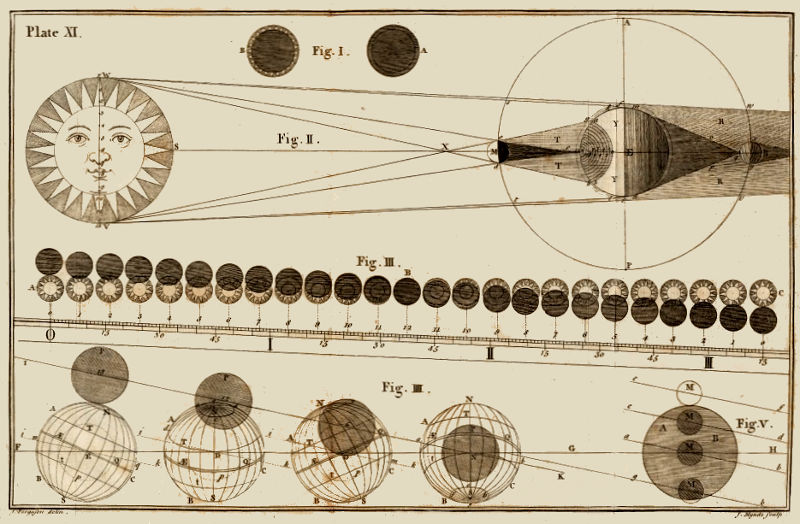
Fig. I. Total and annular Eclipses of the Sun. PLATE XI.
332. The Moon’s Orbit being elliptical, and the Earth in one of its focuses, she is once at her least distance from the Earth, and once at her greatest in every Lunation. When the Moon changes at her least distance from the Earth, and so near the Node that her dark shadow falls on the Earth, she appears big enough to cover the whole [75]Disc of the Sun from that part on which her shadow falls; and the Sun appears totally eclipsed there, as at A, for some minutes: But when the Moon changes at her greatest distance from the Earth, and so near the Node that her dark shadow is directed towards the Earth, her diameter subtends a less angle than the Sun’s; and therefore she cannot hide his whole Disc from any part of the Earth, nor does her shadow reach it at that time; and to the place over which the point of 180her shadow hangs, the Eclipse is annular as at B; the Sun’s edge appearing like a luminous ring all around the body of the Moon. When the Change happens within 17 degrees of the Node, and the Moon at her mean distance from the Earth, the point of her shadow just touches the Earth, and she eclipseth the Sun totally to that small spot whereon her shadow falls; but the darkness is not of a moment’s continuance.
The longest duration of total Eclipses of the Sun.
333. The Moon’s apparent diameter when largest exceeds the Sun’s when least only 1 minute 38 seconds of a degree: And in the greatest Eclipse of the Sun that can happen at any time and place, the total darkness continues no longer than whilst the Moon is going 1 minute 38 seconds from the Sun in her Orbit; which is about 3 minutes and 13 seconds of an hour.
To how much of the Earth the Sun may be totally or partially eclipsed at once.
334. The Moon’s dark shadow covers only a spot on the Earth’s surface, about 180 English miles broad, when the Moon’s diameter appears largest and the Sun’s least; and the total darkness can extend no farther than the dark shadow covers. Yet the Moon’s partial Shadow or Penumbra may then cover a circular space 4900 miles in diameter, within all which the Sun is more or less eclipsed as the places are less or more distant from the Center of the Penumbra. When the Moon changes exactly in the Node, the Penumbra is circular on the Earth at the middle of the general Eclipse; because at that time it falls perpendicularly on the Earth’s surface: But at every other moment it falls obliquely, and will therefore be elliptical; and the more so, as the time is longer before or after the middle of the general Eclipse; and then, much greater portions of the Earth’s surface are involved in the Penumbra.
Duration of general and particular Eclipses. The Moon’s dark shadow. And Penumbra.
335. When the Penumbra first touches the Earth the general Eclipse begins: when it leaves the Earth the general Eclipse ends: from the beginning to the end the Sun appears eclipsed in some part of the Earth or other. When the Penumbra touches any place the Eclipse begins at that place, and ends when the Penumbra leaves it. When the Moon changes in the Node, the Penumbra goes over the center of the Earth’s Disc as seen from the Moon; and consequently, by describing the longest line possible on the Earth, continues the longest upon it; namely, at a mean rate, 5 hours 50 minutes: more, if the Moon be at her greatest distance from the Earth, because she then moves slowest; less, if she be at her least distance, because of her quicker motion.
Fig. II.
336. To make the last five articles and several other Phenomena plainer, let S be the Sun, E the Earth, M the Moon, and AMP the 181Moon’s Orbit. Draw the right line Wc 12 from the western edge of the Sun at W, touching the western edge of the Moon at c and the Earth at 12: draw also the right line Vd 12 from the eastern edge of the Sun at V, touching the eastern edge of the Moon at d and the Earth at 12: the dark space ce 12 d included between those lines is the Moon’s shadow, ending in a point at 12 where it touches the Earth; because in this case the Moon is supposed to change at M in the middle between A the Apogee, or farthest point of her Orbit from the Earth, and P the Perigee, or nearest point to it. For, had the point P been at M, the Moon had been nearer the Earth; and her dark shadow at e would have covered a space upon it about 180 miles broad, and the Sun would have been totally darkened as at A (Fig I) with some continuance: but had the point A (Fig. II) been at M, the Moon would have been farther from the Earth, and her shadow would have ended in a point about e, and therefore the Sun would have appeared as at B (Fig. I) like a luminous ring all around the Moon. Draw the right lines WXdh and VXcg, touching the contrary sides of the Sun and Moon, and ending on the Earth at a and b: draw also the right line SXM 12, from the center of the Sun’s Disc, through the Moon’s center, to the Earth at 12; and suppose the two former lines WXdh and VXcg to revolve on the line SXM 12 as an Axis, and their points a and b will describe the limits of the Penumbra TT on the Earth’s surface, including the large space a0b12a; within which the Sun appears more or less eclipsed as the places are more or less distant from the verge of the Penumbra a0b.
Digits, what.
Draw the right line y 12 across the Sun’s Disc, and parallel to the plane of the Moon’s Orbit; divide this line into twelve equal parts, as in the Figure, for the twelve [76]Digits of the Sun’s diameter: and at equal distances from the center of the Penumbra TT to its edge on the Earth, or from 12 to 0, draw twelve concentric Circles, as marked with the numeral Figures 1 2 3 4 &c. and remember that the Moon’s motion in her Orbit AMP is from west to east, as from s to t. Then,
The different phases of a solar Eclipse. PLATE XI. Fig. III.
To an observer on the Earth at b, the eastern limb of the Moon at d seems to touch the western limb of the Sun at W, when the Moon is at M; and the Sun’s Eclipse begins at b; appearing as at A in Fig. III at the left hand; but at the same moment of absolute time to an observer at a in Fig. II the western edge of the Moon at c leaves 182the eastern edge of the Sun at V, and the Eclipse ends, as at the right hand C of Fig. III. At the very same instant, to all those who live on the Circle marked 1 on the Earth E in Fig. II, the Moon M cuts off or darkens a twelfth part of the Sun S, and eclipses him one Digit, as at 1 in Fig. III: to those who live on the Circle marked 2 in Fig. II the Moon cuts off two twelfth parts of the Sun, as at 2 in Fig. III: to those on the Circle 3, three parts; and so on to the center at 12 in Fig. II, where the Sun is centrally eclipsed as at B in the middle of Fig. III: under which Figure there is a scale of hours and minutes, to shew at a mean state how long it is from the beginning to the end of a central Eclipse of the Sun on the parallel of London; and how many Digits are eclipsed at any particular time from the beginning at A to the middle at B, or the end at C. Thus in 16 minutes from the beginning, the Sun is two Digits eclipsed; in an hour and five minutes, 8 Digits; and in an hour and thirty-seven minutes, 12 Digits.
Fig. II. The Velocity of the Moon’s shadow on the Earth. Fig. IV.
337. By Fig. II it is plain, that the Sun is totally or centrally eclipsed but to a small part of the Earth at any time; because the dark conical shadow e of the Moon M falls but on a small part of the Earth: and that the partial Eclipse is confined at that time to the space included by the Circle a 0 b, of which only one half can be projected in the Figure, the other half being supposed to be hid by the convexity of the Earth E: and likewise, that no part of the Sun is eclipsed to the large space YY of the Earth, because the Moon is not between the Sun and that part of the Earth: and therefore to all that part the Eclipse is invisible. The Earth turns eastward on its Axis, as from g to h, which is the same way that the Moon’s shadow moves; but the Moon’s motion is much swifter in her Orbit from s to t: and therefore, altho’ Eclipses of the Sun are of longer duration on account of the Earth’s motion on its Axis, than they would be if that motion was stopt, yet in 3 minutes and 13 seconds of time, the Moon’s swifter motion carries her dark shadow quite over any place that its center touches at the time of greatest obscuration. The motion of the shadow on the Earth’s Disc is equal to the Moon’s motion from the Sun, which is about 301⁄2 minutes of a degree every hour at a mean rate; but so much of the Moon’s Orbit is equal to 301⁄2 degrees of a great Circle on the Earth, § 320; and therefore the Moon’s shadow goes 301⁄2 degrees or 1830 geographical miles on the Earth in an hour, or 301⁄2 miles in a minute, which is almost four times as swift as the motion of a cannon-ball.