CHAP. XIX. The Calculation of New and Full Moons and Eclipses. The geometrical Construction of Solar and Lunar Eclipses. The examination of antient Eclipses.
Reading edition
353. To construct an Eclipse of the Sun, we must collect these ten Elements or Requisites from the following Astronomical Tables.
Requisites for a solar Eclipse.
I. The true time of conjunction of the Sun and Moon: to know at what conjunctions the Sun must be eclipsed; and to the times of those conjunctions,
II. The Moon’s horizontal parallax, or angle which the semi-diameter of the Earth subtends as seen from the Moon.
III. The Sun’s true place, and distance from the solstitial colure to which he is then nearest, either in coming to it or going from it.
190IV. The Sun’s declination.
V. The angle of the Moon’s visible path with the Ecliptic.
VI. The Moon’s Latitude or Declination from the Ecliptic.
VII. The Moon’s true hourly motion from the Sun.
VIII. The Angle of the Sun’s semi-diameter as seen from the Earth.
IX. The Angle of the Moon’s semi-diameter as seen from the Earth.
X. The semi-diameter of the Penumbra.
And for an Eclipse of the Moon, the following Elements.
Requisites for a lunar Eclipse.
I. The true time of opposition of the Sun and Moon; and for that time,
II. The Moon’s horizontal parallax.
III. The Sun’s semi-diameter.
IV. The semi-diameter of the Earth’s shadow.
V. The Moon’s semi-diameter.
VI. The Moon’s Latitude.
VII. The Moon’s true hourly motion from the Sun.
VIII. The Angle of the Moon’s visible path with the Ecliptic.
These Elements are easily found from the following Tables and Precepts, by the common Rules of Arithmetic.
Note, 60 minutes make a Degree, 30 degrees a Sign, and 12 Signs a Circle. A Sign is marked thus s, a Degree thus °, and a Minute thus ʹ.
When you exceed 12 Signs, always reject them and set down the remainder. When the number of Signs to be subtracted is greater than the number you subtract from, add 12 Signs to that which you subtract from; and then you will have a remainder to set down.
How the Signs are reckoned.
354. As we fix arbitrarily upon the beginning of the Sign Aries to reckon from, when we speak of the places of the Sun, Moon, and Nodes; we call Aries 0 Signs, Taurus 1 Sign, Gemini 2 Signs, Cancer 3 Signs, &c. So, when the Sun is in the 10th degree of Aries, we say his Place or Longitude is 0 Signs 10 Degrees, because he is only 10 Degrees from the beginning of Aries: if he is in the 5th, 10th, &c. Degree of Taurus, we say his Place or Longitude is 1 Sign, 5, 10, &c. Degrees: and so on, till he comes quite round again. But in reckoning the Anomalies of the Sun and Moon, and their distance from the Nodes, we only consider the number of Signs 191and Degrees the Luminaries are gone past their Apogee or Nodes; not how far they have to go to these points, were the distance ever so little. The Sun, Moon, and Apogee move according to the order of Signs, but the Nodes contrary. We shall now give the Precepts and Examples for the above Requisites in their due order.
To calculate the time of New and Full Moon.
First Element or Requisite.
355. Precept I. For any proposed year in the 18th Century, take out the mean time of the New Moon in March from Table I., and the mean time of Full Moon from Table III., for the Old Stile; or from Tables II and IV for New Stile; with the mean Anomalies of the Sun and Moon for these times, and set them by themselves. Then, from Table VI, take out as many Lunations as the proposed Month is after March, with the days, hours, and minutes belonging to them; and also the mean Anomalies of the Sun and Moon for these Lunations.
II. Add the days, hours, and minutes of these Lunations to the time of New or Full Moon in March, and the Anomalies for the Lunations to the Anomalies for March: the sums give the hours and minutes of the mean New or Full Moon required, and the mean Anomalies of the Sun and Moon for that time.
III. Then, with the number of days enter Table VII, under the given Month, and right against this number, in the left hand column you have the day of New or Full Moon; which set before the hours and minutes above-mentioned.
IV. But, (as it will sometimes happen) if the number of days fall short of all those under the given Month, add one Lunation with its Anomalies from Table VI to the foresaid sums; so you will have a new sum of days wherewith to enter the 7th Table under the given Month, where you are sure to find that sum the second time, if the first falls short.
V. With the Signs and Degrees of the Sun’s Anomaly enter Table VIII, The Moon’s annual Equation, and take out the minutes of time of that Equation by the Anomaly; remembring, that if the Signs are at the head of the Table, the degrees are at the left hand, in which case the Equation found in the Angle of meeting must be subtracted from the mean time of New or Full Moon, as the title Subtract, at the head of the Table directs: but if the Signs are at the foot of the Table their degrees are in the right-hand column, and the Equation where the Signs and Degrees meet in the Table is to be added to 192the mean time, as the title Add, at the foot of the Table directs; which Equation, so applied, gives the mean time of New or Full Moon corrected.
VI. With the Signs and Degrees of the Sun’s Anomaly enter Table IX, Equation of the Moon’s mean Anomaly, and take out the Equation thereof; adding it to the mean Anomaly or subtracting it therefrom, as the titles at the head or foot of the Table direct; and it gives the mean Anomaly corrected. Then, with the Sun’s Anomaly enter Table XII, Equation of the Sun’s mean Place, and take out that Equation, applying it to the Moon’s corrected Anomaly as the titles direct; and it will give the Moon’s Anomaly equated[77]. N. B. In all these Equations, care must be taken to make proper allowance for the odd minutes of Anomaly; the Tables having the Equations only for compleat Degrees.
VII. With the Moon’s equated Anomaly enter Table X, The Moon’s elliptic Equation, and take out that Equation in the same manner as the preceding: adding it to the former corrected time if the Signs be at the head of the Table, or subtracting it if they be at the foot, as the Table directs; and this gives the mean time equated.
VIII. Lastly, enter Table XI, The Sun’s Equation at New and Full Moon, with the Sun’s Anomaly, and take out the Sun’s Equation in the same manner as the others; adding it to, or subtracting it from the former equated time, as the titles direct: and by this last Equation you have the true time of New or Full Moon, agreeing with well regulated Clocks and Watches. But to make it agree with true Sun-Dials, the Equation of time must be applied as taught § 225.
193
EXAMPLE I. To find the time of New Moon in April 1764, N. S.
Days Hours Min. Sun’s Anom. Moon’s Ano.
s ° ʹ s ° ʹ
Tab. II. Mean time of New Moon in March 2 8 57 8 2 23 10 13 32
Add, for Lunation, from Tab. VI. 29 12 44 0 29 6 0 25 49
Mean New Moon and Anomaly 31 21 41 0 1 29 11 9 21
To which Time add the Moon’s Ann. Equ. Tab. VIII. + 0 22 Equ. Moon’s Anom. - 20
And it gives the Mean time corrected 31 22 3 Anom. cor. 11 9 1
From which subtract the Moon’s elliptic Equ. Tab. X. - 3 10 Sun’s Equat. + 1 56
Moon’s Ano. 11 10 57
And it gives the Mean time equated 31 18 53 h. m.
To which add the Sun’s Equation, Tab. XI. + 3 32 Moon’s ann. Equ. 0 22 add
Her ellipt. Equ. 3 10 sub.
And it gives the true time of Conjunction 31 22 25 Sun’s Equation 3 32 add
Which true time answers to the first of April, at 25 minutes past 10 in the forenoon: for, as the Astronomical Day begins at Noon, then 22 hours 25 min. after the Noon of March 31, is April 1, at 10 hours 25 min. in the Forenoon.
EXAMPLE II. To find the time of Full Moon in May 1761, N. S.
Days Hours Min. Sun’s Anom. Moon’s Ano.
s ° ʹ s ° ʹ
Mean time of Full Moon in March 20 12 9 8 20 2 9 1 13
Add, for two Lunations 59 1 28 1 28 13 1 21 38
The several sums are 79 13 37 10 18 15 10 22 51
The days, in Tab. VII, answer to May 18 18 13 37 Equ. Moon’s Anom. - 13
Moon’s annual Equation add + 14 Anom. cor. 10 22 38
Mean time corrected 18 13 51 Sun’s Equat. + 1 15
Moon’s elliptic Equation subtract - 5 38 Moon’s Ano. 10 23 53
Mean time equated 18 8 13 h. m.
Sun’s Equation add + 2 19 Moon’s ann. Equ. 0 14 add
Her ellipt. Equ. 5 38 sub.
True time of Opposition, May 18 10 32 Sun’s Equation 2 19 add
Namely, the 18th day, at 32 minutes past 10 at night.
The Leap-years are allowed for in the Tables, so as to give no Trouble in these Calculations.
194To compute the time of New and Full Moon in a given year and month, of any particular Century, between the Christian Æra[78] and 18th Century.
Precept I. Find the like year of the 18th Century in Table I., for New Moon, or Table III., for Full Moon; and take out the New or Full Moon in March for that year, with the Anomalies of the Sun and Moon.
II. From Table V, take as many compleat Centuries, as when subtracted from the above year of the 18th Century, will answer to the given year; and take out the Conjunctions and Anomalies of these Centuries.
III. Subtract the Conjunctions and Anomalies of these Centuries from those of the New or Full Moon in March above taken out, and the remainders will shew the mean time of New or Full Moon in March the given year, with the Anomalies of the Sun and Moon at that time. Then, work in all respects for the true time of the proposed New or Full Moon, as taught by the Precepts already given § 355.
EXAMPLE I. To find the time of New Moon in July 1581, O. S.
From 1781 subtract 200 years, and there remains 1581.
Days Hours Min. Sun’s Anom. Moon’s Ano.
s ° ʹ s ° ʹ
Table I. Mean time of New Moon in March 1781 13 7 52 8 23 37 0 0 53
Tab. V. Conj. and Anom. for 200 years subtract 8 16 22 0 6 42 5 0 44
Remain the Conj. and Anom. for March 1581 4 15 30 8 16 55 7 0 9
Tab. VI. Add, for five Lunations, to bring it to July 147 15 40 4 25 32 4 9 5
The sums are 152 7 10 1 12 27 11 9 14
The Days in Tab. VII. answer to July 30th 30 7 10 Equ. Moon’s Anom. + 13
Sum of the three Equations subtract - 7 9 Anom. cor. 11 9 27
Sun’s Equat. - 1 16
True time of Conjunction, July 30 0 1 Moon’s Ano. 11 8 11
Which is the 30th day, at one minute past noon, as shewn by well regulated Clocks or Watches Moon’s ann. Eq. 0h 14m sub.
Her ellipt. Equ. 3 35 sub.
Sun’s Equation 3 20 sub.
Sum 7 9 sub.
195EXAMPLE II.
To find the time of Full Moon in April A. D. 30, O. S.
From 1730 subtract 1700, and there remains 30.
Days Hours Min. Sun’s Anom. Moon’s Ano.
s ° ʹ s ° ʹ
Tab. III. Mean time of Full Moon in March 1730 22 6 58 9 2 40 3 13 23
Tab. V. Conj. and Anom. for 1700 years subtract 14 17 37 11 28 46 10 29 36
Rem. the Opposition and Anom. in March A. D. 30 7 13 21 9 3 54 4 13 47
Tab. V. Add, for one Lunation, to bring it into April 29 12 44 0 29 6 0 25 49
The sums are 37 2 5 10 3 0 5 9 36
The Days in Tab. VII. answer to April 6 6 2 5 Equ. Moon’s Anom. - 17
To which add the sum of the three Equations 6 1 Anom. cor. 5 9 19
Sun’s Equat. + 1 35
True time of Opposition April A. D. 30 6 8 6 Moon’s Ano. 5 10 54
Which is the 6th day, at 6 minutes past 8 in the Evening. And thus, the time of New or Full Moon may be found for any given year and month after the Christian Æra. Moon’s ann. Eq. 0h 18m add
Her ellipt. Equ. 2 46 add
Sun’s Equat. 2 57 add
Sum 6 1 add
Remark.
N. B. Sometimes it happens that the days annexed to the Centuries in Table V are more in number than the days on which the New or Full Moon happens in March the year of the 18th Century, with which the computation begins; as in the third following Example, viz. for the Full Moon in March the year before Christ 721: in which case, a Lunation and it’s Anomalies must be added, from Table VI, to the days and Anomalies of the New or Full Moon in March; and then, subtraction can be made: and having gained a remainder, work in all respects as taught in § 355.
To find the time of New or Full Moon in any given year and month before the Christian Æra.
356. Precept I. Find a year of the 18th Century, which added to the given number of years before Christ, diminished by one, shall make a number of whole Centuries.
196II. Find this number of Centuries in Table V, and subtract the Time and Anomalies answering to it from the Time and Anomalies answering to the mean New or Full Moon in March the year of the 18th Century thus found; and they will give the mean time of New or Full Moon in March the given year before Christ, with the Anomalies answering thereto. Whence the true time of that New or Full Moon may be had by the Precepts already delivered § 355.
III. The Tables are calculated for the Meridian of London: therefore, in computing for any place westward of London, four minutes of time must be subtracted from the time shewn by the Tables, for every degree the place is westward; and added for every degree it is eastward. See § 210.
EXAMPLE I. To find the time of New Moon at London and Athens in March, the year before Christ 424.
The years 423 added to 1777 make 2200, or 22 Centuries.
Days Hours Min. Sun’s Anom. Moon’s Ano.
s ° ʹ s ° ʹ
Tab. I. Mean New Moon in March A. D. 1777 27 7 53 9 7 27 5 25 51
From which subtract 2200 years in Tab. V. 6 21 47 11 16 26 4 20 37
Mean Conj. and Anom. in March before Chr. 424 20 10 6 9 21 1 1 5 14
Which with, the total of the three Equations added 9 20 Equ. Moon’s Anom. - 19
Anom. cor. 1 4 55
Gives the true time of Conjunction 20 19 26 Sun’s Equat. + 1 48
Which was the 21st day of March, at 26 minutes past 7 in the morning at London: and if 1 hour 35 minutes be added for Athens, which is 23° 52ʹ east of the meridian of London, we have the time at Athens; namely, 1 minute past 9 in the morning. Moon’s Ano. 1 6 43
Moon’s ann. Eq. 0h 20m add
Her ellipt. Equ. 5 43 add
Sun’s Equation 3 17 add
Total 9 20 add
197
EXAMPLE II. To find the time of Full Moon in October, the year before Christ 4030.
The years 1771 added to 4029 make 5800, or 58 Centuries.
Days Hours Min. Sun’s Anom. Moon’s Ano.
s ° ʹ s ° ʹ
Tab. III. From the mean Full Moon in March 1771 19 7 11 8 29 6 7 22 30
Tab. V. Subtr. the numbers for 5800 years 5000 10 7 56 10 23 56 0 17 36
800 5 4 43 11 27 43 7 7 7
Which collected make 15 12 39 10 21 39 7 24 43
Rem. the mean Full Moon &c. March before Chr. 4030 3 18 32 10 7 27 11 27 47
To which add eight Lunations to carry it to October 236 5 52 7 22 50 6 26 32
And the several sums will be 240 0 24 6 0 17 6 24 19
Which, for Full Moon day, Tab. VII, is October 26 26 0 24 h. m.
Moon’s ellipt. Equation subtr. there being none besides 3 28 Moon’s Ann. Eq. 0 0 add
Moon’s ellipt. Eq. 3 28 sub.
Rem. the true time of Full Moon, October 25 20 56 Sun’s Equation 0 0 add
Which is the 26th day, at 8 hours 26 minutes in the forenoon[79]. Total 3 28 sub.
Age of the world uncertain.
By the method prescribed § 248 it will be found, that the Autumnal Equinox in the year before Christ 4030, fell on the 26th of October; as this Example shews the Full Moon to have been on the same day: and by working as hereafter taught, it will appear that the Dominical Letter was then G, which shews the 26th of that October to have been on a Friday; namely our sixth day of the week, but the Ante-Mosaic fifth day. And as, according to Genesis, chap. i. ver. 14. the Sun and Moon were created on the fourth day of the week, those who are of opinion that the world was made at the time of the Autumnal Equinox, and that the Moon at her first appearance was in full lustre, opposite to the Sun, or nearly so, may perhaps look upon this as a Criterion for ascertaining the year of the creation; since it shews the Moon to have been Full the next day after she was made: and this is only 9 years sooner than Rheinholt makes it, and 11 years later than according to Lange. Whereas, they who maintain that the world was created in the 4007th year before Christ, with the Sun on the Autumnal Equinoctial Point, October 26, and the Moon then Full; will find, if they compute by the best Tables extant, that the Moon was New, instead of being Full, on that day.
198If it could be proved from the writings of Moses that the Sun was created on the point of the Autumnal Equinox, and the Moon in opposition; as well as it can be proved that these Luminaries were made (or according to some, did not shine out till) on the fourth day of the creation-week, there would be Data enough for ascertaining the age of the world: for supposing the Moon to have been Full on an Equinoctial Day, which was the fourth day of the week, it would require many thousands of years to bring these three characters together again. For, the soonest in which the Moon returns to be New or Full on the same days of the Months as before, is 19 years wanting an hour and half, but then the days of the week return not to the same days of the months in less than 28 years, in which time the Moon has gone through one Course of Lunations, and 9 years over; therefore a co-incidence of the Full Moon and day of the Week and Month cannot happen in that time, and if we multiply 19 by 28, which is the nearest co-incidence of these three characters, namely 532 years; the Moon’s falling back an hour and half every 19 years will amount to 42 hours in so many years; and the Equinox will have anticipated five days. From all which we may venture to say, that 200000 years would not be sufficient to bring all these circumstances together again.
EXAMPLE III. To find the time of Full Moon at Babylon in March, the year before Christ 721.
The years 720 added to 1780 make 2500, or 25 Centuries.
Days Hours Min. Sun’s Anom. Moon’s Ano.
s ° ʹ s ° ʹ
Tab. I. To the mean F. Moon and Anom. in Mar. 1780 9 4 41 8 19 48 7 8 10
Add one Lunation and it’s Anomalies from Tab. VI[80] 29 12 44 0 29 6 0 25 49
The several sums are 38 17 25 9 18 54 8 3 59
Fr. which subt. the Days & Anom. of 2500 years, Tab. V 19 22 20 11 26 19 6 6 43
Rem. the mean time and Anom. of F.M. in Mar. b.C. 721 18 19 5 9 22 25 1 27 16
To which add the sum of the three Equations + 11 36 Equ. Moon’s Anom. - 18
And it gives the true time of Full Moon, Mar. b.C. 721 18 6 41 Anom. cor. 1 26 48
Sun’s Equat. + 1 47
Which was the 19th day, at 41 minutes past 6 in the evening, at London; to which time, if[81] 2 hours 51 minutes be added, we shall have the time at Babylon, namely, 9 hours 51 minutes. Moon’s Anom. 1 28 35
Moon’s ann. Eq. 0h 20m add
Her ellipt. Equ. 8 1 add
Sun’s Equation 3 15 add
Sum 11 36 add
199357. To know whether the Sun will be eclipsed or no, at the time of any given New Moon; collect the Sun’s distance from the Node at that time, and if it be less than 17 degrees he will be eclipsed, otherwise not.
EXAMPLE. For the time of New Moon in April 1764.
Sun from Node
s ° ʹ
Table II, mean New Moon in March 1764, New Stile, 11 4 57
Table VI, add for 1 Lunation to carry it to April 1 0 40
Sun’s distance from the Node at New Moon in April 0 5 37
Which, being within the above limit, the Sun must be eclipsed: and therefore, we proceed to find the rest of the Elements for computing this Eclipse.
To find the Moons Horizontal Parallax, or the Angle of the Earth’s semi-diameter as seen from the Moon.
Second Element.
358. Precept. Having found the Moon’s mean Anomaly for the above time, by the first and second Precepts of § 355, enter the XVth Table with the signs and degrees of that Anomaly, and thereby take out the Moon’s Horizontal Parallax: only note, that this is given but to every 6th degree of Anomaly in the Table, because it is very easy to make proper allowance by sight. So the Moon’s Horizontal Parallax April the 1st 1764, at 10 hours 25 minutes in the Forenoon, answering to her mean Anomaly at that time (namely 11s 9° 21ʹ) is 55ʹ 7ʺ; which, diminished by 10ʺ, the Sun’s constant Horizontal Parallax, gives for the semi-diameter of the Earth’s Disc 54ʹ 57ʺ.
To find the Sun’s true Place, and his distance from the nearest Solstice.
Third Element.
359. Precept I. We are to consider, that the beginning of Aries and of Libra, which are the Equinoctial Points, are equidistant from the beginning of Cancer and of Capricorn, which are the Solstitial Points. Hence, when we know in what Sign and Degree the Sun is, we can easily find his distance from the nearest Solstice. Now, to find the Sun’s Place, or Longitude from Aries, April the 1st, 1764, at 10 hours 21 minutes in the Forenoon; being the equated time of New Moon.
200Precept II. This being to the time of New Moon, take out the Sun’s mean Place and Anomaly from Table II. for that time, and the Equation of his mean Place from Table XII by his Anomaly; adding the Equation to his mean Place or subtracting it from the same, as the Table directs, will give his true Place.
EXAMPLE.
Sun’s Long. from Aries. Sun’s mean Anomaly.
s ° ʹ s ° ʹ
Table I. To the Sun’s mean Place and Anomaly at the mean time of New Moon in March 1764, N. S. 11 17 7 8 2 23
Add the same from Tab. VI. for one Lunation, to carry it to April 0 29 6 0 29 6
Mean Place and Anomaly at the time of New Moon in April 0 10 13 9 1 29
To which place add the Sun’s Equation from Tab. XII. 1 56 Equal 1° 56ʹ
And it gives the Sun’s true place 0 12 9 Additive.
Which is Aries 12° 9ʹ; and this, when taken from three Signs, or the beginning of Cancer, leaves 2 signs 17 deg. 51 min., or 77° 51ʹ for the Sun’s distance from the then nearest Solstice.
360. But because the Sun’s true Place is often wanted when the Moon is neither New nor Full, we shall next shew how it may be found for any given moment of time: though this be digressing from our present purpose.
In Table XVI find the nearest lesser year to that in which the Sun’s Place is sought; and take out the Sun’s mean Longitude and Anomaly answering thereto; to which add his mean motion and Anomaly for the compleat residue of the years, with the month, day, hour, and minute, all taken from the same Table, and you have the Sun’s mean Longitude and Anomaly for the given time. Then, from Table XII take out the Sun’s Equation by means of his Anomaly (making proportions for the odd minutes of Anomaly) which Equation being added to or subtracted from the Sun’s mean Longitude from Aries, as the titles in the Table direct, gives his true Place, or Longitude from the beginning of Aries, reckoned according to the order of the Signs § 354.
201
EXAMPLE. To find the Sun’s true Place April 30th, A. D. 1757, at 18 minutes 40 seconds past 10 in the morning.
Sun’s Long. Sun’s Anom.
s ° ʹ ʺ s ° ʹ
The year next less than 1757 in the Table is 1753, at the beginning of which, the Sun’s mean Longitude from the beginning of Aries, and his mean Anomaly, is 9 10 16 52 6 1 38
To which add his mean Mot. and Anom. for four years to make 1757 0 0 1 49 11 29 58
And likewise his mean Mot. and Anom. for April 2 28 42 30 2 28 42
days 29 0 28 35 2 0 28 35
hours 22 0 54 13 0 54
min. 18 0 44 1
sec. 49 2 0
Sun’s mean Longitude and Anomaly for the given time is 1 8 31 12 9 29 48
To which add the Equation of the Sun’s mean Place 1 40 14 Sun’s Eq.
And it gives his true Place, viz. ♉ Taurus 10° 11ʹ 26ʺ 1 10 11 26 1° 40ʹ 14ʺ
N. B. In leap-years after February, the Sun’s mean Motion and Anomaly must be taken out for the day next after the given one.
361. To calculate the Sun’s true Place for any time in a given year before the first year of Christ: subtract the mean Motions and Anomalies for the compleat hundreds next above the given year; to the remainder add those for the residue of years, months, &c. and then work in all respects as above taught.
EXAMPLE. To find the Suns true Place May the 28th at 4 hours 3 min. 42 sec. in the afternoon, the year before Christ 585, which was a Leap year[82].
Sun’s Long. Sun’s Anom.
s ° ʹ ʺ s ° ʹ
From the Sun’s mean Longitude and Anomaly at the beginning of the year Christ 1 9 7 53 10 6 29 54
Subtract his mean Motion and Anomaly for 600 years 0 4 32 0 11 24 2
And the remainder, or radix, is 9 3 21 10 7 5 52
To which add what 585 wants of 600, viz. 15 years 11 29 22 27 11 29 7
And also those of May 3 28 16 40 3 28 17
days 28 Bissextile 0 28 35 2 0 28 35
hours 4 0 9 51 0 10
min. 3 0 7
sec. 42 2 0 2 1
Sun’s Anom.
Sun’s mean Long. May 28th, at 4 hour 3 min. 24 sec. afternoon 1 29 45 19
Equation of the Sun’s mean Place subtract 2 2 2ʹ 22ʺ
Sun’s Equat.
Rem. his true Place for the same time, viz. ♉ Taurus 29° 43ʹ 17ʺ 1 29 43 17 subtract.
202N. B. As the Longitudes or Places of all the visible Stars in the Heavens are well known, we have an easy method of finding the Sun’s true Place in the Ecliptic: for the Sun is directly opposite to that Point of the Ecliptic which comes to the Meridian at mid-night.
To find the Sun’s Declination.
Fourth Element.
362. Precept. Enter Table XVII with the Signs and Degrees of the Sun’s Place; and making proportions, take out his Declination answering thereto. If the Signs are at the head of the Table, the Degrees are at the left hand; but if the Signs are at the foot of the Table, the Degrees are at the right hand. So, the Sun’s Declination answering to his true Place (found by § 359 to be 0s 12° 9ʹ) is 4 degrees 48 minutes 54 seconds, making allowance for the 9ʹ that his Place exceeds 12°.
To find the Angle of the Moon’s visible Path with the Ecliptic.
Fifth Element.
Precept. This we may state at 5 degrees 38 minutes, as near enough for the purpose; since it is never above 8 minutes of a degree more or less.
To find the Moon’s Latitude.
Sixth Element.
363. Precept. Having found the Sun’s distance from the Ascending Node by § 357, at the mean time of New Moon, and his Anomaly for that time by § 359, find the Equation of the Node in Table XIII, by the Sun’s Anomaly, and the Equation of the Sun’s mean Place in Table XII by his Anomaly: these two Equations applied (as the titles direct) to the Sun’s mean distance from the Ascending Node, give his true distance from it, and also the Moon’s true distance at the time of Change: but when the Moon is Full, this distance must be increased by the addition of 6 Signs, which will then be the Moon’s true distance from the same Node.
The Moon’s true distance from the Ascending Node is called the Argument of the Moon’s Latitude; with the Signs of which, at the head of Table XIV, and Degrees at the left hand, or with the Signs at the foot of the Table and Degrees at the right hand, take out the Moon’s Latitude: which is North Ascending, North Descending, South Ascending, or South Descending, according to the letters NA, ND, SA or SD, annexed to the Signs of the said Argument.
Plate XII.
The Geometrical Construction of Solar and Lunar Eclipses.
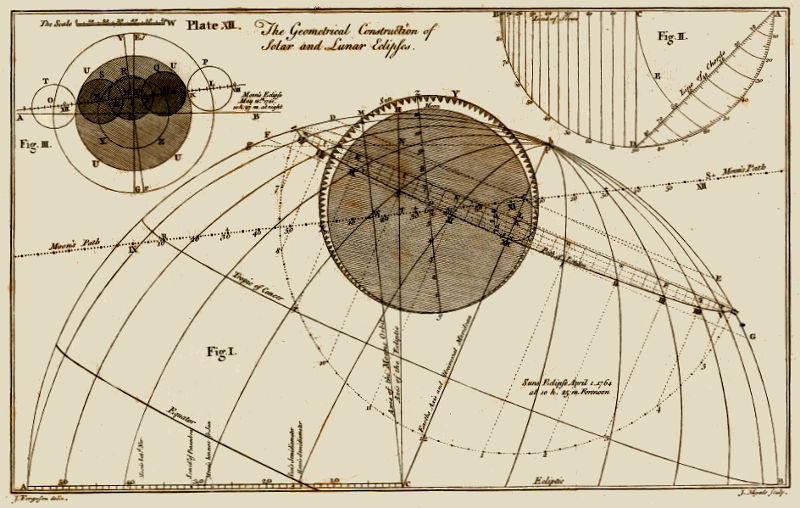
J. Ferguson delin.
J. Mynde Sculp.
203
EXAMPLE.
s ° ʹ
Sun’s mean Dist. from the [83]Node at New Moon in April 1764 0 5 37
To which add the Equation of the Node + 10
And it gives the Sun’s corrected Distance from the Node 0 5 47
To which cor. Dist. add the Eq. of the Sun’s mean Place + 1 56
And it gives the Sun’s true Distance from the Node 0 7 43
Which, being at the time of New Moon, is the Argument of Latitude; and in Table XIV, (making proportions for the 43ʹ) shews the Moon’s Latitude to be 40ʹ 9ʺ North Ascending[84].
To find the Moon’s true hourly Motion from the Sun.
Seventh Element.
364. Precept. With the Moon’s Anomaly enter Table XV, and thereby take out her true hourly Motion: then with the Sun’s Anomaly take out his true hourly Motion from the same Table: which done, subtract the Sun’s hourly Motion from the Moon’s, and the remainder will be the Moon’s true hourly Motion from the Sun; which, for the above time § 359, is 27ʹ 50ʺ.
To find the Semi-diameters of the Sun and Moon as seen from the Earth at the above-mentioned time.
Eighth and Ninth Elements.
365. Precept. Enter the XVth Table with the Sun’s Anomaly, and thereby take out his Semi-diameter; and in the same manner take out the Moon’s Semi-diameter by her Anomaly. The former of which for the above time will be found to be 16ʹ 6ʺ; the latter 14ʹ 58ʺ.
To find the Semi-diameter of the Penumbra.
Tenth Element.
366. Precept. Add the Sun’s semi-diameter to the Moon’s, and their Sum will be the Semi-diameter of the Penumbra; namely, at the above time 31ʹ 4ʺ.
Pl. XII.
204366. Having found the proper Elements or Requisites for the Sun’s Eclipse April 1, 1764, and intending to project this Eclipse Geometrically, we shall now collect them under the eye, that they may be the more readily found as they are wanted in order for the Projection.
The proper Elements collected.
D H M
367. I. The true time of Conj. or New Moon April 1 10 25
° ʹ ʺ
II. The Earth’s Semi-Disc, which is equal to the Moon’s Horizontal Parallax 55ʹ 7ʺ diminished by the Sun’s Horizontal Parallax which is always 10ʺ 0 54 57
III. The Sun’s distance from the nearest Solstice, viz. ♋ 77 51 0
IV. The Sun’s Declination, North 4 48 54
V. The Angle of the Moon’s vis. path with the Eclipt. 5 38 0
VI. The Moon’s true Latitude, North Ascending 40 9
VII. The Moon’s true Horary Motion from the Sun 27 50
VIII. The Sun’s Semi-diameter 16 6
IX. The Moon’s Semi-diameter 14 58
X. The Semi-diameter of the Penumbra 31 4
368. Having collected these Elements or Requisites, the following part of the work may be very much facilitated by means of a good Sector, with the use of which the reader should be so well acquainted, as to know how to open it to any given Radius, as far as it will go; and to take off the Chord or Sine of any Arc of that Radius. This is done by first taking the extent of the given Radius in your Compasses, and then opening the Sector so as the distance cross-wise between the ends of the lines of Sines or Chords at S or C, from Leg to Leg of the Sector, may be equal to that extent; then, without altering the Sector, take the Sine or Chord of the given Arc with your Compasses extended cross-wise from Leg to Leg of the Sector in these lines. But if the operator has not a Sector, he must construct these lines to such different lengths as he wants them in the projection. And lest this Treatise should fall into the hands of any person who would wish to project the Figure of a solar or lunar Eclipse, and has not a Sector to do it by, we shall shew how he may make a line of Sines or Chords to any Radius.
Fig. II. How to make a line of Chords. Pl. XII.
369. Draw the right line BCA at pleasure; and upon C as a Center, with the distance CA or CB as a Radius, describe the Semi-circle BDA; and from the Center C draw AC perpendicular to BCA. Then divide the Quadrants AD and BD each into 90 equal parts or degrees, and join the right line AD for the Chord of the Quadrant AD. This done, setting one foot of the Compasses in A, extend the other to the different divisions of the Quadrant AD; and so transfer them to the right line AD as in 205the Figure, and you have a line of Chords AD to the Radius CA. N. B. 60 Degrees on the Line of Chords is always equal to the Radius of the Circle it is made from; as is evident by the Figure, where the Arch E, whose Center is A, drawn from 60 on the Quadrant AD, cuts the Chord line in 60 degrees, and terminates in the Center C.
And of Sines.
Then, from the divisions or degrees of the Quadrant BD, draw lines parallel to CD, which will fall perpendicularly on the Radius BC, dividing it into a line of Sines; and it will be near enough for the present purpose, to have them to every fifth Degree, as in the Figure. And thus the young Tyro may supply himself with Chords and Sines, if he has not a Sector. But as the Sector greatly shortens the work, we shall describe the projection as done by it, so far as Signs and Chords are required.
Fig. II. Earth’s Semi-Disc.
370. Make a Scale of any convenient length (six inches at least) as AC, and divide it into as many equal parts as the semi-diameter of the Earth’s Disc contains minutes, which in this construction of the Eclipse for London in April 1764, is 54 minutes and 57 seconds; but as it wants only 3ʺ of 55ʹ the Scale may be divided into 55 equal parts, as in the Figure. Then, with the whole length of the Scale as a Radius, setting one foot of your Compasses in C as a center, describe the Semi-circle AMB for the northern Hemisphere or Semi-disc of the Earth, as seen from the Sun at that time. Had the Place for which the Construction is made been in South Latitude, this Semi-circle would have been the Southern Hemisphere of the Earth’s Disc.
Axis of the Ecliptic.
371. Upon the center C raise the straight line CH for the Axis of the Ecliptic, perpendicular to ACB.
North Pole of the Earth.
372. Make a line of Chords to the Radius AC, and taking from thence the Chord of 231⁄2 Degrees, set it off from H to g and to h, on the periphery of the Semi-disc; and draw the straight line gNh, in which the North Pole of the Disc is always found.
373. While the Sun is in Aries, Taurus, Gemini, Cancer, Leo, and Virgo, the North Pole of the Disc is illuminated; but while the Sun is in Libra, Scorpio, Sagittary, Capricorn, and Aquarius, the North Pole is hid in the obscure part behind the Disc.
374. And, whilst the Sun is in Capricorn, Aquarius, Pisces, Aries, Taurus, and Gemini, the Earth’s Axis CP lies to the right hand of the Axis of the Ecliptic CH as seen from the Sun, and to the left hand while the Sun is in the other six Signs.
Earth’s Axis. Universal Meridian.
375. Make a line of Sines equal in length to Ng or Nh, and take off with your Compasses from it the Sine of the Sun’s distance from the nearest Solstice, which in the present case is 77° 51ʹ § 367, 206and set that distance to the right hand, from N to P, on the line gNh, because the Sun being in Aries § 359, the Earth’s Axis lies to the right hand of the Axis of the Ecliptic § 374: then draw the straight line CXIIP, for the Earth’s Axis and the Universal Meridian; of both which P is the North Pole.
Path of a given Place on the Disc as seen from the Sun.
376. To draw the parallel of Latitude of any given Place (suppose London) which parallel is the visible Path of the Place On the Disc, as seen from the Sun, from the time that the Sun rises till it sets; subtract the Latitude of the Place (London) 511⁄2 degrees from 90 degrees, and there remains 381⁄2; which take from the Line of Chords in your Compasses, and set it from h (where the Universal Meridian CP cuts the periphery of the Semi-disc) to VI and VI; and draw the occult Line VILVI. Then, on the left hand of the Earth’s Axis, set off the Chord of the Sun’s Declination 4° 48ʹ 5ʺ § 367, from VI to D and to F; set off the same on the right hand from VI to E and to G; and draw the occult Lines DsE and FXIIG parallel to VI L VI.
Situation of the Place on the Disk from Sun-rise to Sun-set.
377. Bisect s XII in K, and through the point K draw the black Line VIKV1 parallel to the occult or dotted Line VILVI. Then, making AC the Radius or length of a Line of Lines, set off the Sine of 381⁄2 degrees, the Co-Latitude of London, from K to VI and VI; and with that extent as a Radius, describe the Semi-Circle VI 7 8 9 &c. and divide it into 12 equal parts, beginning at VI. From these divisions, draw the occult Lines 7m, 8l, 9k, &c. all to the Line VIKVI, and parallel to CXIIP. Then, with KXII as a Radius, describe the Circle abcdef, round the Center K, and divide the Quadrant aXII into six equal parts, as ab, bc, cd, de, &c. Then, through these points of division b, c, d, e, and f, draw the occult Lines VIIbV, VIIIcIIII, IXdIII, &c. intersecting the former Lines 7m, 8l, 9k, 10i, &c. in the points VII, VIII, IX, X, XI, &c. which points mark the situation of London on the Earth’s Disc as seen from the Sun at these hours respectively, from six in the morning till six at night: and if the elliptic Curve VI, VII, VIII, &c. be drawn through these points, it will represent the parallel of London, or the path it seems to describe as viewed from the Sun, from Sun-rise to Sun-set. N.B. When the Sun’s Declination is North, the said Curve is the diurnal Path of London; and the opposite part VIsVI is it’s nocturnal Path behind the Disc, or in the obscure part thereof, § 338, 339. But if the Sun’s Declination had been South, the Curve VIsVI would have been the diurnal path of London; in which case the Lines 7m, 8l, &c. must have been continued thro’ the right Line VIKVI, and their lengths beyond that line determined by dividing the Quadrant s a of the little Circle 207abcd into six equal parts, and drawing the parallels VIIb, VIIIc &c. through that division, in the same manner as done on the side K XII; and the Curve VII, VIII, IX, &c. would have been the nocturnal Path. It is requisite to divide the hours of the diurnal Path into quarters, as in the Diagram; and if possible into minutes also.
Axis of the Moon’s Orbit.
378. From the Line of Chords § 372 take the Angle of the Moon’s visible Path with the Ecliptic, viz. 5° 38ʹ § 367: and note, that when the Moon’s Latitude is North Ascending, as in the present case, the Chord of this Angle must be set off to the left hand of the Axis of the Ecliptic CH, as from H to M, and the right line CM drawn for the Axis of the Moon’s Orbit: but when the Moon’s Latitude is North Descending, this Angle and Axis must be set to the right hand, or from H toward h. When the Moon’s Latitude South Ascending, the Axis of her Orbit lies the same way as when her Latitude is North Ascending; and when South Descending, the same way as when North Descending.
Path of the Penumbra’s center over the Earth.
379. Take the Moon’s Latitude, 40ʹ 9ʺ § 367, from the Scale CA, and set it from C to T on the Axis of the Ecliptic; and through T, at right Angles to the Axis of the Moon’s Orbit CM, draw the straight Line RTS; which is the Moon’s Path, or Line that the center of her shadow and Penumbra describes in going over the Earth’s Disc. The Point T in the Axis of the Ecliptic is the Place where the true Conjunction of the Sun and Moon falls, according to the Tables; and the Point W, in the Axis of the Moon’s Orbit, is that where the center of the Penumbra approaches nearest to the center of the Earth’s Disc, and consequently the middle of the general Eclipse.
It’s Place on the Earth’s Disc shewn for every minute of it’s Transit.
380. Take the Moon’s true Horary Motion from the Sun 27ʹ 50ʺ § 367, from the Scale CA with your Compasses (every division of the Scale being a minute of a Degree) and with that extent make marks in the Line of the Moon’s Path RTS: then divide each of these equal spaces by dots into 60 equal parts or horary minutes, and set the hours to every 60th minute, in such a manner that the dot; signifying the precise minute of New Moon by the Tables, may fall in the Point T where the Axis of the Ecliptic cuts the Line of the Moon’s Path; which, in this Eclipse, is the 25th minute past ten in the Forenoon: and then the other marks will shew the places on the Earth’s Disc where the center of the Penumbra is, at the hours and minutes denoted by them, during its transit over the Earth.
Middle of the Eclipse. It’s Phases.
381. Apply one side of a Square to the Line of the Moon’s Path, and move the Square backward or forward until the other side cuts the same hour and minute both in the Path of the Place (London, in this Construction) and Path of the Moon; and that minute, cut at the same 208time in both Paths, will be the precise minute of visible Conjunction of the Sun and Moon at London, and therefore the time of greatest obscuration, or middle of the Eclipse at London; which time, in this Projection, falls at t, 34 minutes past 10 in the Moon’s Path; and at u, 34 minutes past 10 in the Path of London. Then, upon the Point u as a center, describe the Circle zYy whose Radius uy is equal to the Sun’s semi-diameter 16ʹ 6ʺ § 367, taken from the Scale CA: And upon the Point t as a center, describe the Circle Hy whose Radius is equal to the Moon’s semi-diameter 14ʹ 58ʺ § 367, taken from the same Scale. The Circle zYy represents the Disc of the Sun as seen from the Earth, and the Circle Hy the Disc of the Moon. The portion of the Sun’s Disc cut off by the Moon’s shews the Quantity of the Eclipse at the time of greatest obscuration: and if a right Line as yz be drawn across the Sun’s Disc through t and u, the minute of greatest obscuration in both Paths, and divided into 12 equal parts, it will shew what number of Digits are then eclipsed. If these two Circles do not touch one another, the Eclipse will not be visible at the given Place.
It’s beginning and ending.
382. Lastly, take the Semi-diameter of the Penumbra 31ʹ 4ʺ § 367, from the Scale CA with your Compasses; and setting one foot in the Moon’s Path, to the left hand of the Axis of the Ecliptic, direct the other toward the Path of London; and carry this extent backwards or forwards until both Points of the Compasses fall into the same instants of time in both Paths: which will denote the time of the beginning of the Eclipse: then, do the same on the right hand of the Axis of the Ecliptic, and where both Points mark the same instants in both Paths, they will shew at what time the Eclipse ends. These trials give the Points R in the Moon’s Path and r in the Path of London, namely 9 minutes past 9 in the Morning for the beginning of the Eclipse at London, April 1, 1764: t and u for the middle or greatest obscuration, at 35 minutes past 10; when the Eclipse will be barely annular on the Sun’s lower-most edge, and only two thirds of a Digit left free on his upper-most edge: and for the end of the Eclipse, S in the Moon’s Path and x in the Path of London, at 4 minutes past 12 at Noon.
In this Construction it is supposed that the Equator, Tropics, Parallel of London, and Meridians through every 15th degree of Longitude are projected in visible Lines on the Earth’s Disc, as seen from the Sun at almost an infinite distance; that the Angle under which the Moon’s diameter is seen, during the time of the Eclipse, continues invariably the same; that the Moon’s motion is uniform, and her Path rectilineal, for that time. But all these suppositions do not exactly agree 209with the truth; and therefore, supposing the Elements § 367, given by the Tables to be perfectly accurate, yet the time and phases of the Eclipse deduced from it’s Construction will not answer exactly to what passeth in the Heavens; but may be two or three minutes wrong though done with the utmost care. Moreover, the Paths of all Places of considerable Latitude go nearer the center of the Disc as seen from the Moon than these Constructions make them; because the Earth’s Disc is projected as if the Earth were a perfect sphere, although it is known to be a spheroid. Consequently, the Moon’s shadow will go farther North in places of northern Latitude, and farther South in places of southern Latitude than these projections answer to. Hence we may venture to predict that this Eclipse will be more annular at London (that is, the annulus will be somewhat broader on the southern Limb of the Sun) than the Diagram shews it.
383. Having shewn how to compute the times and project the phases of a Solar Eclipse, we now proceed to those of the Lunar. And it has been already mentioned § 317, that when the Full Moon is within 12 degrees of either of her Nodes, she must be eclipsed. We shall now enquire whether or no the Moon will be eclipsed May 18, 1761, N. S. at 32 minutes past 10 at Night. See page 193.
Table IV. Table VI.
s ° ʹ
Sun from Node at Full Moon in March 1761 9 25 27
Add his distance for two Lunations, to bring it into May 2 1 20
And his distance at Full Moon in that month is 11 26 47
Subtract this from a Circle, or 12 Signs, and there will remain 3° 13ʹ; which is all that the Sun wants of coming round to the Ascending Node; and the Moon being then opposite to the Sun, must be just as near the Descending Node: consequently, far within the limit of an Eclipse.
384. Knowing then that the Moon will be eclipsed in May 1761, we must find her true distance from the Node at that time, by applying the proper Equations as taught § 363, and then find her true Latitude as taught in that article.
Table IV. Table XIII. Table XII.
s ° ʹ
Sun’s mean distance from the Node at F. Moon in May 1761 11 26 47
Add the Equation of the Node, for the Sun’s Anomaly 10s 18° 15ʹ[85] + 6
Sun’s mean distance from the Node corrected 11 26 53
Add the Equation of the Sun’s mean Place + 1 15
Sun’s true distance from the Ascending Node 11 28 8
To which add 6 Signs, See § 363 6
The sum is the Moon’s true distance from the same Node 5 28 8
Pl. XII.
210Or the Argument of her Latitude; which in Table XIV, gives the Moon’s true Latitude, viz. 9ʹ 56ʺ North Descending.
385. Having by the foregoing precepts § 355 found the true time of Opposition of the Sun and Moon in a lunar Eclipse, with the Moon’s Anomaly enter Table XV and take out her horizontal Parallax, also her true horary Motion and Semi-diameter: and likewise those of the Sun by his Anomaly, as already taught § 364 & seq. Then add the Sun’s horizontal Parallax, which is always 10 Seconds, to the Moon’s horizontal Parallax, and from their sum subtract the Sun’s Semi-diameter; the remainder will be the Semi-diameter of that part of the Earth’s shadow which the Moon goes through.
386. From the Sum of the Semi-diameters of the Moon and Earth’s Shadow, subtract the Moon’s Latitude; the remainder is the parts deficient. Then, as the Semi-diameter of the Moon is to 6 Digits, so are the parts deficient to the Digits eclipsed.
387. If the parts deficient be more than the Moon’s Diameter, the Eclipse will be total with continuance; if less, it will not be total; if equal, it will be total, but without continuance.
388. Now collect the Elements for projecting this Eclipse.
ʹ ʺ
Moon’s horizontal Parallax 55 32
Sun’s horizontal Parallax (always) 10
The Sum of both Parallaxes 55 42
From which subtract the Sun’s Semi-diameter 15 54
Remains the Semi-diameter of the Earth’s Shadow 39 48
Semidiameter of the Moon 15 2
Sum of the two last 54 50
Moon’s Latitude subtract 9 56
Remains the parts deficient 45 0
Moon’s horary motion 30 46
Sun’s horary motion subtract 2 24
Remains the Moon’s horary motion from the Sun 28 22
To project a lunar Eclipse. Fig. III.
389. This done, make a Scale of any convenient length as W, whereof each division is a minute of a degree; and take from it in your Compasses 54 Minutes 50 Seconds, the Sum of Semi-diameters of the Moon and Earth’s shadow; and with that extent as a Radius, describe that Circle OVLG round C as a Center.
From the same Scale take 39 Minutes 48 Seconds, the Semi-diameter of the Earth’s shadow, and therewith as a Radius, describe the Circle UUUU for the Earth’s shadow, round C as a Center. Subtract the 211Moon’s Semi-diameter from the Semi-diameter of the Shadow, and with the difference 24 Minutes 46 seconds as a Radius, taken from the Scale W, describe the Circle YZ round the Center C.
Draw the right line AB through the Center C for the Ecliptic, and cross it at right Angles with the line EG for the Axis of the Ecliptic.
Because the Moon’s Latitude in this Eclipse is North Descending, § 384, set off the Angle of her visible Path with the Ecliptic 5 Degrees 38 Minutes (Page 202.) from E to V; and draw VCv for the Axis of the Moon’s Orbit. Had the Moon’s Latitude been North Ascending, this Angle must have been set off from E to f. N. B. When the Moon’s Latitude is South Ascending, the Axis of her Orbit lies the same way as when she has North Ascending Latitude; and when her Latitude is North Descending, the Axis of her Orbit lies the same way as when her Latitude is South Descending.
Take the Moon’s true Latitude 9ʹ 56ʺ in your Compasses from the Scale W, and set it off from C to F on the Axis of the Ecliptic because the Moon is north of the Ecliptic; (had she been to the South of it, her Latitude must have been set off the contrary way, as from C towards v:) and through F, at right Angles to the Axis of the Moon’s Orbit VCv, draw the right line LMHNO for the Moon’s Orbit, or her Path through the Earth’s shadow. N. B. When the Moon’s Latitude is North Ascending, or North Descending, she is above the Ecliptic: but when her Latitude is South Ascending, or South Descending, she is below it.
Take the Moon’s true horary motion from the Sun, viz. 28 Minutes 22 Seconds, from the Scale W in your Compasses; and with that extent make marks in the line of the Moon’s Path LMHNO: then divide each of these equal spaces into 60 equal parts or minutes of time: and set the hours to them as in the Figure, in such a manner that the precise time of Full Moon, as shewn by the Tables, may fall in the Axis of the Ecliptic at F, where the line of the Moon Path cuts it.
Lastly, Take the Moon’s Semi-diameter 15 Minutes 2 Seconds from the Scale W in your Compasses, and therewith as a Radius describe the Circles P, Q, R, S, and T on the Centers L, M, H, N, and O; the Circles P and T just touching the Earth’s Shadow UU, but no part of them within it; the Circles Q and S all within it, but touching at its edges; and the Circle R in the middle of the Moon’s Path through the shadow. So the Circle P shall be the Moon touching the shadow at the moment the Eclipse begins; the Circle Q the Moon just immersed into the shadow at the moment she is totally eclipsed; 212the Circle R the Moon at the greatest obscuration, in the middle of the Eclipse; the Circle S the Moon just beginning to be enlightened on her western limb at the end of total darkness; and the Circle T the Moon quite clear of the Earth’s shadow at the moment the Eclipse ends. The moments of time marked at the points L, M, H, N and O answer to these Phenomena: and according to this small projection are as follow. The beginning of the Eclipse at 8 Hours 36 Minutes P. M. The total immersion at 9 Hours 42 Minutes. The middle of the Eclipse at 10 Hours 26 Minutes. The end of total darkness at 11 Hours 12 Minutes. And the end of the Eclipse at 12 Hours 18 Minutes; but the Figure is too small to admit of precision.
The examination of antient Eclipses.
390. By computing the times of New and Full Moons, together with the distance of the Sun and Moon from the Nodes; and knowing that when the Sun is within 17 Degrees of either Node at New Moon he must be eclipsed; and when the Moon is within 12 Degrees of either Node at Full she cannot escape an Eclipse; and that there can be no Eclipses without these limits; ’tis easy to examine whether the accounts of antient Eclipses recorded in history be true. I shall take the liberty to examine two of those mentioned in the foregoing catalogue, namely, that of the Moon at Babylon on the 19th of March in the 721st year before Christ; and that of the Sun at Athens, on the 20th of March, in the 424th year before Christ.
The time of Full Moon for the former of these Eclipses is already calculated, Page 198, and the time of New Moon for the latter, Page 196, both to the Old Style; so that we have nothing now to do but find the Sun’s distance from the Nodes the same way as we did the Anomalies; and if the Full Moon in March 721 years before Christ was within 12 degrees of either Node, she was then eclipsed; and if the Sun, at the time of New Moon in March 424 years before Christ was within 17 degrees of either Node, he must have been eclipsed at that time.
EXAMPLE I. To find the distance of the Sun and Moon from the Nodes, at the time of Full Moon in March, the year before Christ 721, O. S.
The years 720 added to 1780 make 2500, or 25 Centuries.
213
Sun from Node
s ° ʹ
To the mean time of Full Moon in March 1780, Table III. 10 3 1
Add the distance for 1 Lunation [See N. B. Page 195, and Example III, Page 198] 1 0 40
Sum 11 3 41
From which subtract the Sun’s distance from the Node for 2500 years, Table V 5 4 11
Remains the Sun’s distance from the Node, March 19, 721 years before Christ 5 29 30
To which add 6 Signs for the Moon’s distance, because she was then in opposition to the Sun 6 0 0
The Sum is the Moon’s dist. from the Ascend. Node 11 29 30
That is, she was within half a degree of coming round to it again; and therefore, being so near, she must have been totally, and almost centrally eclipsed.
EXAMPLE II To find the Suns distance from the Node at the Time of New Moon in March, the year before Christ 424, O. S.
The years 423 added to 1777 make 2200, or 22 Centuries.
Sun from Node
s ° ʹ
At the mean time of New Moon in March 1777, Tab. I. 8 23 33
From which subtract the Sun’s distance from the Node for 2200 years, Table V 3 6 0
Remains the Sun’s distance from the Ascending Node, March 21, 424 years before Christ 5 17 33
Which, taken from 6 Signs, the distance of the Nodes from each other 6 0 0
Leaves the Sun’s distance at that time from the Descending Node, Descending viz. 0 12 27
Which being less than 17 degrees, shews that the Sun was then eclipsed. And as from these short Calculations we find those two antient Eclipses taken at a venture, to be truly recorded; it is natural to imagine that so are all the rest in the catalogue.
Here follow Astronomical Tables, for calculating the Times of New and Full Moons and Eclipses.
214
Table I. The mean time of New Moon in March, the mean Anomaly of the Sun and Moon, the Sun’s mean Distance from the Ascending Node; with the mean Longitude of the Sun and Node from the beginning of the Sign Aries, at the times of all the New Moons in March for 100 years, Old Style.
Years of Christ. Mean time of New Moon in March. The Sun’s mean Anomaly. The Moon’s mean Anomaly. The Sun’s distance from the Node. The Sun’s Longitude from Aries. The Node’s Longitude from Aries.
D. H. M. s ° ʹ s ° ʹ s ° ʹ s ° ʹ s ° ʹ
1701 27 13 45 9 8 23 0 28 5 7 23 15 0 16 3 4 22 48
1702 16 22 34 8 27 39 11 7 53 8 1 17 0 5 20 4 4 3
1703 6 7 23 8 16 55 9 17 41 8 9 20 11 24 37 3 15 17
1704 24 4 55 9 4 30 8 23 18 9 18 3 0 13 0 2 24 57
1705 13 13 44 8 23 54 7 3 6 9 26 6 0 2 17 2 6 11
1706 2 22 32 8 13 48 5 12 54 10 4 9 11 21 34 1 17 25
1707 21 20 5 9 2 17 4 18 31 11 12 52 0 9 57 0 27 5
1708 10 4 54 8 21 10 2 28 19 11 20 55 11 29 14 0 8 19
1709 29 2 26 9 9 48 2 3 56 0 29 38 0 17 37 11 17 59
1710 18 11 16 8 28 32 0 13 44 1 7 40 0 6 54 10 29 14
1711 7 20 5 8 17 27 10 23 33 1 15 43 11 26 11 10 10 28
1712 25 17 36 9 5 8 9 29 10 2 24 26 0 14 34 9 20 8
1713 15 2 25 8 25 48 8 8 58 3 2 29 0 3 50 9 1 21
1714 4 11 14 8 14 52 6 16 46 3 10 32 11 23 7 8 12 35
1715 23 8 46 9 3 37 5 24 22 4 19 15 0 11 30 7 22 15
1716 11 17 35 8 21 26 4 4 11 4 27 18 0 0 47 7 3 29
1717 1 2 23 8 11 58 2 13 59 5 5 20 11 20 4 6 14 44
1718 19 23 56 9 0 31 1 19 36 6 14 3 0 8 27 5 24 24
1719 9 8 45 8 19 47 11 29 24 6 22 6 11 27 43 5 5 37
1720 27 6 17 9 8 9 11 5 1 8 0 49 0 16 6 4 15 17
1721 16 15 6 8 27 25 9 14 49 8 8 52 0 5 23 3 26 31
1722 5 23 55 8 16 41 7 24 38 8 16 55 11 24 40 3 7 45
1723 24 21 27 9 5 3 7 0 15 9 25 38 0 13 4 2 17 26
1724 13 6 16 8 24 19 5 10 3 10 3 41 0 2 22 1 28 41
1725 2 15 4 8 13 45 3 19 51 10 11 43 11 21 39 1 9 56
1726 21 12 37 9 1 57 2 25 28 11 20 26 0 10 3 0 19 37
1727 10 21 26 8 21 13 1 5 16 11 28 29 11 29 20 0 0 51
1728 28 18 58 9 9 35 0 10 53 1 7 13 0 17 43 11 10 30
1729 18 3 47 8 28 51 10 20 41 1 15 15 0 7 0 10 21 45
1730 7 12 36 8 18 7 9 0 29 1 23 18 11 26 17 10 2 59
1731 26 10 8 9 6 29 8 6 6 3 2 1 0 14 40 9 12 39
1732 14 18 57 8 25 45 6 15 54 3 10 3 0 3 57 8 23 54
1733 4 3 45 8 14 49 4 25 43 3 18 6 11 23 14 8 5 7
1734 23 1 18 9 3 25 4 1 20 4 26 49 0 11 37 7 14 48
1735 12 10 7 8 22 39 2 11 8 5 4 52 0 0 54 6 26 1
2151736 30 7 39 0 11 1 1 16 45 6 13 35 0 19 17 6 5 42
1737 19 16 28 9 0 1 11 26 33 6 21 38 0 8 34 5 16 56
1738 9 1 17 8 19 33 10 6 21 6 29 42 11 27 51 4 28 9
1739 27 22 49 9 7 55 9 11 58 8 8 24 0 16 14 4 7 50
1740 16 7 38 8 27 11 7 21 46 8 16 27 0 5 30 3 19 3
1741 5 16 26 8 16 27 6 1 34 8 24 30 11 24 47 3 0 16
1742 24 13 59 9 4 49 5 7 11 10 3 12 0 13 10 2 9 58
1743 13 22 48 8 24 5 3 16 59 10 11 15 0 2 27 1 21 12
1744 2 7 36 8 13 21 1 26 48 10 19 18 11 21 44 1 2 25
1745 21 5 9 9 1 43 1 2 25 11 28 0 0 10 7 0 12 7
1746 10 13 58 8 20 59 11 12 13 0 6 3 11 29 44 11 23 20
1747 29 11 30 9 9 21 10 17 50 1 14 45 0 17 47 11 3 2
1748 17 20 19 8 28 37 8 27 38 1 22 49 0 7 4 10 14 15
1749 7 5 8 8 17 53 7 7 26 2 0 53 11 26 21 9 25 28
1750 26 2 40 9 6 15 6 13 3 3 9 35 0 14 44 9 5 9
1751 15 11 29 8 25 32 4 22 51 3 17 38 0 4 1 8 16 23
1752 3 20 17 8 14 47 3 2 39 3 25 41 11 23 18 7 27 37
1753 22 17 50 9 3 10 2 8 16 5 4 24 0 11 41 7 7 17
1754 12 2 39 8 22 26 0 18 4 5 12 27 0 0 59 6 18 32
1755 1 11 27 8 11 41 10 27 52 5 20 30 11 20 16 5 29 45
1756 19 9 0 9 0 4 10 3 30 6 29 13 0 8 39 5 9 27
1757 8 17 49 8 19 20 8 13 18 7 10 15 11 27 56 4 20 41
1758 27 15 21 9 7 42 7 18 55 8 15 58 0 16 19 4 0 21
1759 17 0 10 8 26 58 5 28 43 8 24 1 0 5 36 3 11 36
1760 5 8 58 8 16 13 4 8 31 9 2 4 11 24 53 2 22 49
1761 24 6 31 9 4 35 3 14 8 10 10 47 0 13 16 2 2 29
1762 13 15 19 8 23 52 1 23 56 10 18 51 0 2 33 1 13 44
1763 3 0 8 8 13 7 0 3 44 10 26 53 11 21 50 0 24 57
1764 20 21 41 9 1 29 11 9 21 0 5 36 0 10 13 0 4 37
1765 10 6 30 8 20 46 9 19 9 0 13 38 11 29 30 11 15 52
1766 29 4 2 9 9 8 8 24 46 1 22 21 0 17 53 10 25 32
1767 18 12 51 8 28 24 7 4 35 2 0 24 0 7 10 10 6 47
1768 6 21 39 8 17 39 5 14 23 2 8 27 11 26 27 9 18 1
1769 25 19 12 9 6 2 4 20 0 3 17 0 0 14 50 8 27 41
1770 15 4 1 8 25 17 2 29 48 3 25 12 0 4 7 8 8 56
1771 4 12 49 8 14 33 1 9 36 4 3 16 11 23 24 7 20 8
1772 22 10 22 9 2 56 0 15 13 5 11 49 0 11 47 6 29 48
1773 11 19 10 8 22 11 10 25 1 5 20 1 0 1 4 6 11 3
1774 1 3 59 8 11 27 9 4 49 5 28 4 11 20 21 5 22 17
1775 20 1 32 8 29 50 8 10 26 7 6 4 0 8 44 5 1 57
2161776 8 10 20 8 19 5 6 20 14 7 14 50 11 28 1 4 13 12
1777 27 7 53 9 7 27 5 25 51 8 23 23 0 16 24 3 22 52
1778 16 16 42 8 26 43 4 5 40 9 1 36 0 5 41 3 4 6
1779 6 1 30 8 15 59 2 15 28 9 9 39 11 24 58 2 15 19
1780 23 23 3 9 4 21 1 21 5 10 18 22 0 13 21 1 24 59
1781 13 7 52 8 23 37 0 0 53 10 26 24 0 2 38 1 6 14
1782 2 16 40 8 12 53 10 10 41 11 4 27 11 21 54 0 17 27
1783 21 14 13 9 1 15 9 16 18 0 13 10 0 10 17 11 27 7
1784 9 23 2 8 20 32 7 26 6 0 21 13 11 29 34 11 8 22
1785 28 20 35 9 8 54 7 1 43 1 29 56 0 17 57 10 18 2
1786 18 5 23 8 28 9 5 11 31 2 7 59 0 7 14 9 29 16
1787 7 14 11 8 17 25 3 21 19 2 16 2 11 26 31 9 10 29
1788 25 11 44 9 5 47 2 26 56 3 24 45 0 14 54 8 20 9
1789 14 20 33 8 25 3 1 6 45 4 2 47 0 4 11 8 1 25
1790 4 5 21 8 14 19 11 16 33 4 10 50 11 23 28 7 12 38
1791 23 2 54 9 2 41 10 22 10 5 19 33 0 11 51 6 22 18
1792 11 11 43 8 21 57 9 1 58 5 27 56 0 1 7 6 3 32
1793 0 20 31 8 11 12 7 11 45 6 5 39 11 20 24 5 14 45
1794 19 18 4 8 29 35 6 17 23 7 14 22 0 8 48 4 24 27
1795 9 2 52 8 18 51 4 27 11 7 22 25 11 28 6 4 5 41
1796 27 0 25 9 7 13 4 2 48 9 1 8 0 16 29 3 15 21
1797 16 9 14 8 26 29 2 12 36 9 9 10 0 5 46 2 26 36
1798 5 18 2 8 15 44 0 22 24 9 17 13 11 25 3 2 7 50
1799 24 15 35 9 4 6 11 28 1 10 25 56 0 13 26 1 17 30
1800 13 0 24 8 23 23 10 7 49 11 3 59 0 2 43 0 28 44
Table II. The mean New Moons, &c. in March to the New Style.
Years of Christ. Mean time of New Moon in March. The Sun’s mean Anomaly. The Moon’s mean Anomaly. The Sun’s distance from the Node. The Sun’s Longitude from Aries. The Node’s Longitude from Aries.
D. H. M. s ° ʹ s ° ʹ s ° ʹ s ° ʹ s ° ʹ
1753 4 5 6 7 4 2 1 12 27 4 3 44 11 12 35 7 8 50
1754 23 2 39 8 22 26 0 18 4 5 12 27 0 0 59 6 18 32
1755 12 11 27 8 11 41 10 27 52 5 20 29 11 20 16 5 29 45
1756 30 9 0 9 0 3 10 3 29 6 29 12 0 8 39 5 9 27
1757 19 17 49 8 19 19 8 13 17 7 7 15 11 27 56 4 20 41
1758 9 2 37 8 8 35 6 23 5 7 15 18 11 17 13 4 1 54
1759 28 0 9 8 26 58 5 28 43 8 24 1 0 5 36 3 11 36
1760 16 8 58 8 16 14 4 8 31 9 2 4 11 24 53 2 22 49
2171761 5 7 47 8 5 29 2 18 19 9 10 9 11 14 10 2 4 1
1762 24 15 19 8 23 52 1 23 56 10 18 51 0 2 33 1 13 44
1763 14 0 8 8 13 7 0 3 44 10 26 53 11 21 50 0 24 57
1764 2 8 57 8 2 23 10 13 32 11 4 57 11 11 7 0 6 10
1765 21 6 30 8 20 46 9 19 9 0 13 38 11 29 30 11 15 52
1766 10 15 18 8 10 1 7 28 58 0 21 41 11 18 47 10 27 5
1767 29 12 51 8 28 23 7 4 35 2 0 23 0 7 10 10 6 47
1768 17 21 39 8 17 39 5 14 23 2 8 26 11 26 27 9 18 1
1769 7 6 28 8 6 55 3 24 11 2 16 29 11 15 44 8 29 15
1770 26 4 1 8 25 18 2 29 48 3 25 11 0 4 7 8 8 56
1771 15 12 49 8 14 33 1 9 36 4 3 16 11 23 24 7 20 8
1772 3 21 38 8 3 49 11 19 24 4 11 19 11 12 41 7 1 22
1773 22 19 10 8 22 11 10 25 1 5 20 1 0 1 4 6 11 3
1774 12 3 59 8 11 27 9 4 49 5 28 4 11 20 21 5 22 17
1775 1 12 48 8 0 43 7 14 37 6 6 7 11 9 38 5 3 30
1776 19 10 20 8 19 5 6 20 14 7 14 50 11 28 1 4 13 12
1777 8 19 9 8 8 21 5 0 2 7 22 53 11 17 18 3 24 25
1778 27 16 42 8 26 43 4 5 40 9 1 36 0 5 41 3 4 6
1779 17 1 30 8 15 59 2 15 28 9 9 39 11 24 58 2 15 19
1780 5 10 19 8 5 15 0 25 16 9 17 42 11 14 15 1 26 32
1781 24 7 52 8 23 37 0 0 53 10 26 24 0 2 38 1 6 14
1782 13 16 40 8 12 53 10 10 41 11 4 27 11 21 54 0 17 27
1783 3 1 29 8 2 8 8 20 29 11 12 30 11 11 11 11 28 40
1784 20 23 2 8 20 32 7 26 6 0 21 13 11 29 34 11 8 22
1785 10 7 50 8 9 47 6 5 54 0 29 16 11 18 51 10 19 35
1786 29 5 23 8 28 9 5 11 31 2 7 59 0 7 14 9 29 16
1787 18 14 11 8 17 25 3 21 19 2 16 2 11 26 31 9 10 29
1788 6 23 0 8 6 41 2 1 7 2 24 5 11 15 48 8 21 43
1789 25 20 33 8 25 3 1 6 45 4 2 47 0 4 11 8 1 25
1790 15 5 21 8 14 19 11 16 33 4 10 50 11 23 28 7 12 38
1791 4 14 10 8 3 34 9 26 21 4 18 53 11 12 44 6 23 51
1792 22 11 43 8 21 57 9 1 58 5 27 36 0 1 7 6 3 32
1793 11 20 31 8 11 12 7 11 45 6 5 39 11 20 24 5 14 45
1794 1 6 20 8 0 29 5 21 34 6 13 42 11 9 22 4 7 15
1795 20 2 52 8 18 51 4 27 11 7 22 25 11 28 6 4 5 41
1796 8 11 41 8 8 6 3 6 59 8 0 28 11 17 23 3 16 54
1797 27 9 14 8 26 29 2 12 36 9 9 10 0 5 46 2 26 36
1798 16 18 2 8 15 44 0 22 24 9 17 13 11 25 3 2 7 50
1799 6 2 51 8 5 0 11 2 12 9 25 16 11 14 20 1 19 3
1800 25 0 24 8 23 23 10 7 49 11 3 59 0 2 43 0 28 44
218
Table III. The mean time of Full Moon in March, the mean Anomaly of the Sun and Moon, the Sun’s mean Distance from the Ascending Node; with the mean Longitude of the Sun and Node from the beginning of the Sign Aries, at the time of all the Full Moons in March for 100 years, Old Style.
Years of Christ. Mean time of Full Moon in March. The Sun’s mean Anomaly. The Moon’s mean Anomaly. The Sun’s distance from the Node. The Sun’s Longitude from Aries. The Node’s Longitude from Aries.
D. H. M. s ° ʹ s ° ʹ s ° ʹ s ° ʹ s ° ʹ
1701 12 19 23 8 23 56 6 15 11 7 7 55 0 1 30 4 23 35
1702 2 4 12 8 13 6 4 24 59 7 15 57 11 20 47 4 4 48
1703 21 1 45 9 1 28 4 0 35 8 24 40 0 9 10 3 14 30
1704 9 10 33 8 19 57 2 10 24 9 2 43 11 28 27 2 25 43
1705 28 8 6 9 8 27 1 16 0 10 11 26 0 16 50 2 5 25
1706 17 16 54 8 28 11 11 25 48 10 19 29 0 6 7 1 16 38s
1707 7 1 43 8 17 44 10 5 37 10 27 32 11 25 24 0 27 51
1708 24 23 16 9 5 43 9 11 14 0 6 15 0 13 47 0 7 33
1709 14 8 4 8 25 15 7 21 2 0 14 18 0 3 4 11 18 46
1710 3 16 54 8 13 59 6 0 50 0 22 21 11 22 21 11 0 0
1711 22 14 27 9 2 0 5 6 27 2 1 3 0 10 44 10 9 42
1712 10 23 14 8 20 35 3 16 16 2 9 6 0 0 1 9 20 55
1713 29 20 47 9 10 21 2 21 52 3 17 48 0 18 23 9 0 35
1714 19 5 36 8 29 25 1 1 40 3 25 53 0 7 40 8 11 48
1715 8 14 24 8 19 4 11 11 28 4 3 56 11 26 57 7 23 1
1716 26 11 57 9 5 59 0 17 5 5 12 38 0 15 20 7 2 43
1717 15 20 45 8 26 31 18 26 53 5 20 41 0 4 37 6 13 56
1718 5 5 34 8 15 58 7 6 42 5 28 44 11 23 54 5 25 10
1719 24 3 7 9 4 20 6 12 18 7 7 26 0 12 17 5 4 52
1720 12 11 55 8 23 36 4 22 7 7 15 29 0 1 34 4 16 5
1721 1 20 44 8 12 52 3 1 55 7 23 32 11 20 51 3 27 18
1722 20 18 17 9 1 14 2 7 32 9 2 15 0 9 14 3 6 59
1723 10 3 5 8 20 30 0 17 21 9 10 18 11 28 31 2 18 12
1724 28 0 38 9 8 52 11 22 57 10 19 0 0 16 55 1 27 55
1725 17 9 26 8 28 18 10 2 45 10 27 3 0 6 12 1 9 9
1726 6 18 15 8 17 24 8 12 34 11 5 6 11 25 30 0 20 23
1727 25 15 48 9 5 46 7 18 10 0 13 49 0 13 53 0 0 5
1728 14 0 36 8 25 2 5 27 59 0 21 52 0 3 10 11 11 18
1729 3 9 25 8 14 18 4 7 47 0 29 55 11 22 27 10 22 32
1730 22 6 58 9 2 40 3 13 23 2 8 38 0 10 50 10 2 13
1731 11 15 46 8 21 56 1 23 12 2 16 41 0 0 7 9 13 26
1732 29 13 19 9 10 18 0 28 48 3 25 23 0 18 30 8 23 8
1733 18 22 7 8 29 22 11 8 37 4 3 26 0 7 47 8 4 21
1734 8 6 56 8 18 50 9 18 26 4 11 29 11 27 4 7 15 34
1735 27 4 29 9 7 12 8 24 2 5 20 12 0 15 27 6 25 15
2191736 15 13 17 8 26 29 7 3 51 5 28 15 0 4 44 6 6 29
1737 4 22 6 8 15 44 5 13 39 6 6 18 11 24 1 5 17 42
1738 23 19 39 9 4 6 4 19 15 7 15 1 0 12 24 4 27 24
1739 13 4 27 8 23 22 2 29 4 7 23 4 0 1 41 4 8 37
1740 1 13 16 8 12 38 1 8 52 8 1 7 11 20 57 3 19 50
1741 20 10 48 9 1 0 0 14 28 9 9 49 0 9 20 2 29 30
1742 9 19 37 8 20 16 10 24 17 9 17 52 11 28 37 2 10 44
1743 28 17 10 9 8 38 9 29 53 10 26 35 0 17 0 1 20 26
1744 17 1 58 8 27 54 8 9 42 11 4 38 0 6 17 1 1 39
1745 6 10 47 8 17 10 6 19 31 11 12 41 11 25 34 0 12 52
1746 25 8 19 9 5 32 5 25 7 0 21 24 0 13 57 11 22 34
1747 14 17 8 8 24 48 4 4 56 0 29 27 0 3 14 11 3 47
1748 3 1 57 8 14 4 2 14 44 1 7 30 11 22 31 10 15 0
1749 21 23 30 9 2 26 1 20 20 2 16 12 0 10 54 9 24 42
1750 11 8 18 8 21 42 0 0 9 2 24 15 0 0 11 9 5 59
1751 30 5 51 9 10 5 11 5 45 4 2 58 0 18 34 8 15 37
1752 18 14 39 8 29 20 9 15 33 4 11 1 0 7 51 7 26 50
1753 7 23 18 7 18 35 7 25 21 4 19 4 11 27 8 7 8 4
1754 26 21 1 9 6 59 7 0 58 7 27 47 0 15 32 6 17 45
1755 16 5 49 8 26 14 5 10 46 6 5 49 0 4 49 5 29 0
1756 4 14 38 8 15 30 3 20 35 6 13 52 11 24 6 5 10 14
1757 23 12 11 9 3 53 2 26 12 7 25 35 0 12 29 4 19 54
1758 12 20 59 8 23 8 1 5 59 8 0 38 0 1 46 4 1 9
1759 2 5 47 8 12 25 11 15 48 8 8 41 11 21 3 3 12 22
1760 20 3 20 9 0 46 10 21 25 9 17 24 0 9 26 2 22 2
1761 9 12 9 8 20 2 9 1 13 9 25 27 11 28 43 2 3 16
1762 28 9 41 9 8 25 8 6 50 11 4 11 0 17 6 1 12 57
1763 17 18 30 8 27 40 6 16 38 11 12 13 0 6 23 0 24 11
1764 6 3 19 8 16 56 4 26 26 11 20 16 11 25 40 0 5 24
1765 25 0 52 9 5 19 4 2 3 0 28 58 0 14 3 11 15 5
1766 14 9 40 8 24 34 2 11 52 1 7 1 0 3 20 10 26 20
1767 7 18 29 8 13 50 0 21 41 1 15 4 11 22 37 10 7 34
1768 21 16 1 9 2 12 11 27 17 2 23 47 0 11 0 9 17 14
1769 11 0 50 8 21 28 10 7 9 3 1 49 0 0 17 8 28 28
1770 0 9 39 8 10 44 8 16 57 3 9 52 11 19 54 8 9 42
1771 19 7 11 8 29 6 7 22 30 4 18 36 0 7 57 7 19 21
1772 7 16 0 8 18 22 6 2 18 4 26 39 11 27 14 7 0 35
1773 26 13 32 9 6 44 5 7 55 6 5 21 0 15 37 6 10 16
1774 15 22 21 8 26 0 3 17 43 6 13 24 0 4 54 5 21 31
1775 5 7 10 8 15 16 1 27 31 6 21 27 11 24 11 5 2 44
2201776 23 4 42 9 3 38 1 3 8 8 0 10 0 12 34 4 12 25
1777 12 13 31 8 22 54 11 12 56 8 8 13 0 1 51 8 23 30
1778 1 22 20 8 12 10 9 22 45 8 16 16 11 21 8 3 4 52
1779 20 19 52 9 0 32 8 28 22 9 24 59 0 9 31 2 14 32
1780 9 4 41 8 19 48 7 8 10 10 3 1 11 28 48 1 25 47
1781 28 2 14 9 8 9 6 13 47 11 11 44 0 17 11 1 5 27
1782 19 11 2 8 27 28 4 23 34 11 19 47 0 6 27 0 6 41
1783 6 19 51 8 16 44 3 3 23 11 27 50 11 25 44 11 27 54
1784 24 17 24 9 5 4 2 9 0 1 6 35 0 14 7 11 7 35
1785 14 2 12 8 24 20 0 18 48 1 14 36 0 3 24 10 18 48
1786 3 11 1 8 13 36 10 28 37 1 22 39 11 22 41 10 0 2
1787 22 8 33 9 1 57 10 4 13 3 1 22 0 11 4 9 9 42
1788 10 17 22 8 21 14 8 14 2 3 9 25 0 0 21 8 20 57
1789 29 14 55 9 9 36 7 19 39 4 18 7 0 18 44 8 0 38
1790 18 23 43 8 28 52 5 29 27 4 26 10 0 8 1 7 11 51
1791 8 8 32 8 18 8 4 9 15 5 4 13 11 27 17 6 23 4
1792 26 6 5 9 6 20 3 14 52 6 12 56 0 15 40 6 2 45
1793 15 14 53 8 25 46 1 24 40 6 20 59 0 4 58 5 13 59
1794 4 23 42 8 15 2 0 4 29 6 29 2 11 24 15 4 25 13
1795 23 21 14 9 3 14 11 10 5 8 7 45 0 12 39 4 4 54
1796 12 6 3 8 22 39 9 19 53 8 15 48 0 1 56 3 16 8
1797 1 14 52 8 11 55 7 29 42 8 23 50 11 21 13 2 27 23
1798 20 12 24 9 0 7 7 5 18 10 2 33 0 9 36 2 7 3
1799 9 21 13 8 19 33 5 15 6 10 10 36 11 28 53 1 18 18
1800 27 18 46 9 7 46 4 20 43 11 19 19 0 17 16 0 27 57
Table IV. The mean Full Moons, &c. in March to the New Style.
Years of Christ. Mean time of Full Moon in March. The Sun’s mean Anomaly. The Moon’s mean Anomaly. The Sun’s distance from the Node. The Sun’s Longitude from Aries. The Node’s Longitude from Aries.
D. H. M. s ° ʹ s ° ʹ s ° ʹ s ° ʹ s ° ʹ
1753 18 23 18 7 18 35 7 25 21 4 19 4 11 27 8 7 8 4
1754 8 8 17 7 7 53 6 5 10 4 27 7 11 16 26 6 19 18
1755 27 5 49 8 26 14 5 10 46 6 5 49 0 4 49 5 29 0
1756 15 14 38 8 15 30 3 20 35 6 13 52 11 24 6 5 10 14
1757 4 23 27 8 4 36 2 0 23 6 21 55 11 13 23 4 21 27
1758 23 20 59 8 23 8 1 5 59 8 0 38 0 1 46 4 1 9
1759 13 5 47 8 12 25 11 15 48 8 8 41 11 21 3 3 12 22
1760 1 14 36 8 1 41 9 25 37 8 16 44 11 10 20 2 23 35
2211761 20 12 9 8 20 2 9 1 13 9 25 27 11 28 43 2 3 16
1762 9 20 57 8 9 19 7 11 2 10 3 31 11 18 0 1 14 29
1763 28 18 30 8 27 40 6 16 38 11 12 13 0 6 23 0 24 11
1764 17 3 19 8 16 56 4 26 26 11 20 16 11 25 40 0 5 24
1765 6 12 8 8 6 13 3 6 15 11 28 19 11 14 57 11 16 38
1766 25 9 40 8 24 34 2 11 52 1 7 1 0 3 20 10 26 20
1767 18 18 29 8 13 50 0 21 41 1 15 4 11 22 37 10 7 33
1768 3 3 17 8 3 6 11 1 29 1 23 7 11 11 54 9 18 46
1769 22 0 50 8 21 28 10 7 5 3 1 49 0 0 17 8 28 28
1770 11 9 39 8 15 45 8 16 54 3 9 52 11 19 34 8 9 42
1771 30 7 11 8 29 6 7 22 30 4 18 36 0 7 57 7 19 21
1772 18 16 0 8 18 22 6 2 18 4 26 39 11 27 14 7 0 35
1773 8 0 48 8 7 38 4 12 7 5 4 42 11 16 31 6 11 49
1774 26 22 21 8 26 0 3 17 43 6 13 24 0 4 54 5 21 31
1775 16 7 10 8 15 16 1 27 31 6 21 27 11 24 11 5 2 44
1776 4 15 58 8 4 32 0 7 20 6 29 30 11 13 28 4 13 58
1777 23 13 31 8 22 54 11 12 56 8 8 13 0 1 51 3 23 39
1778 12 22 20 8 12 10 9 22 45 8 16 16 11 21 8 3 4 52
1779 2 7 8 8 1 26 8 2 34 8 24 19 11 10 25 2 16 5