William Le Queux (continued 4)
Reading edition
“He can ruin her financially, that’s certain,” I remarked, sighing. “But read this, old chap,” and I gave him her strangely-worded letter.
“Good Heavens!” he gasped, when he glanced at it, “she’s in deadly terror of those people, that’s very certain. It’s to avoid them and you that she’s escaped—to Liverpool and America, perhaps. Remember she’s been a great traveller all her youth and therefore knows her way about.”
“We must find her, Reggie,” I declared decisively.
“But the worst of it is that she’s bent on avoiding you,” he said. “She has some distinct reason for this, it seems.”
“A reason known only to herself,” I remarked pensively. “It is surely a contretemps that now, just at the moment when we have gained the truth of the Cardinal’s secret which brought Blair his fortune, Mabel should voluntarily disappear in this manner. Recollect all we have at stake. We know not who are our friends or who our enemies. We ought both to go out to Italy and discover the spot indicated in that cipher record, or others will probably forestall us, and we may then be too late.”
He agreed that the record being bequeathed to me, I ought to take immediate steps to establish my claim to it, whatever might be. We could not disguise from ourselves the fact that Dawson, as Blair’s partner and participator of his enormous wealth, must be well aware of the secret, and that he had already, most probably, taken steps to conceal the truth from myself, the rightful owner. He was a power to be reckoned with—a sinister person, possessed of the wiliest cunning and the most devilish ingenuity in the art of subterfuge. Report everywhere gave him that character. He possessed the cold, calm manner of the man who had lived by his wits, and it seemed that in this affair his ingenuity, sharpened by a life of adventure, was to be pitted against my own.
Mabel’s sudden resolution and disappearance were maddening. The mystery of her letter, too, was inscrutable. If she were really dreading lest some undesirable fact might be exposed, then she ought to have trusted me sufficiently to take me entirely into her confidence. I loved her, although I had never declared my passion, therefore, ignorant of the truth, she had treated me as I had desired, as a sincere friend. Yet, why had she not sought my aid? Women are such strange creatures, I reflected. Perhaps she loved that fellow after all!
A fevered, anxious week went by and Mabel made no sign. One night I left Reggie at the Devonshire about half-past eleven and walked the damp, foggy London streets until the roar of traffic died away, the cabs crawled and grew infrequent and the damp, muddy pavements were given over to the tramping constable and the shivering outcast. In the thick mist I wandered onward thinking deeply, yet more and more mystified at the remarkable chain of circumstances which seemed hour by hour to become more entangled.
On and on I had wandered, heedless of where my footsteps carried me, passing along Knightsbridge, skirting the Park and Kensington Gardens, and was just passing the corner of the Earl’s Court Road when some fortunate circumstance awakened me from my deep reverie, and I became conscious for the first time that I was being followed. Yes, there distinctly was a footstep behind me, hurrying when I hurried, slackening when I slackened. I crossed the road, and, before the long high wall of Holland Park I halted and turned. My pursuer came on a few paces, but drew up suddenly, and I could only distinguish against the glimmer of the street lamp through the London fog a figure long and distorted by the bewildering mist. The latter was not sufficiently dense to prevent me finding my way, for I knew that part of London well. Nevertheless, to be followed so persistently at such an hour was not very pleasant. I was suspicious that some tramp or thief who had passed me by and found me oblivious to my surroundings had turned and followed me with evil intent.
Forward I went again, but as soon as I had done so the light, even tread, almost an echo of my own, came on steadily behind me. I had heard weird stories of madmen who haunt the London streets at night and who follow unsuspecting foot-passengers aimlessly. It is one of the forms of insanity well known to specialists.
Again I recrossed the road, passing through Edwarde’s Square and out into Earl’s Court Road, thus retracing my steps back towards the High Street, but the mysterious man still followed me so persistently that in the mist, which in that part had grown thicker until it obscured the street lamps, I confess I experienced some uneasiness.
Presently, however, just as I was turning the corner into Lexham Gardens at a point where the fog had obscured everything, I felt a sudden rush, and at the same instant experienced a sharp stinging sensation behind the right shoulder. The shock was such a severe one that I cried out, turning next instant upon my assailant, but so agile was he that, ere I could face him, he had eluded me and escaped.
I heard his receding footsteps—for he was running away down the Earl’s Court Road—and shouted for the police. But there was no response. The pain in my shoulder became excruciating. The unknown man had struck me with a knife, and blood was flowing, for I felt it damp and sticky upon my hand.
Again I shouted “Police! Police!” until at last I heard an answering voice in the mist and walked in its direction. After several further shouts I discovered the constable and to him related my strange experience.
He held his bull’s eye close to my back and said—
“Yes, there’s no doubt, sir, you’ve been stabbed! What kind of a man was he?”
“I never saw him,” was my lame reply. “He always kept at a distance from me and only approached at a point where it was too dark to distinguish his features.”
“I’ve seen no one, except a clergyman whom I met a moment ago passing in Earl’s Court Road—at least he wore a broad-brimmed hat like a clergyman. I didn’t see his face.”
“A clergyman!” I gasped. “Do you think it could have been a Roman Catholic priest?” for my thoughts were at that moment of Fra Antonio, who was evidently the guardian of the Cardinal’s secret.
“Ah! I’m sure I couldn’t tell. I couldn’t see his features. I only noted his hat.”
“I feel very faint,” I said, as a sickening dizziness crept over me. “I wish you’d get me a cab. I think I had better go straight home to Great Russell Street.”
“That’s a long way. Hadn’t you better go round to the West London Hospital first?” the policeman suggested.
“No,” I decided. “I’ll go home and call my own doctor.”
Then I sat upon a doorstep at the end of Lexham Gardens and waited while the constable went in search of a hansom in the Old Brompton Road.
Had I been attacked by some homicidal maniac who had followed me all that distance, or had I narrowly escaped being the victim of foul assassination? To me the latter theory seemed decidedly the most feasible. There was a strong motive for my death. Blair had bequeathed the great secret to me and I had now learnt the cipher of the cards.
This fact had probably become known to our enemies, and hence their dastardly attempt.
Such a contingency, however, was a startling one, for if it had become known that I had really deciphered the record, then our enemies would most certainly take steps in Italy to prevent us discovering the secret of that spot on the banks of the wild and winding Serchio.
At last the cab came, and, slipping a tip into the constable’s palm, I got in, and with my silk muffler placed at my back to staunch the blood, drove slowly on through the fog at little more than foot’s-pace.
Almost as soon as I entered the hansom I felt my head swimming and a strange sensation of numbness creeping up my legs. A curious nausea seized me, too, and although I had fortunately been able to stop the flow of blood, which tended to prove that the wound was not such a serious one after all, my hands felt strangely cramped, and in my jaws was a curious pain very much like the commencement of an attack of neuralgia.
I felt terribly ill. The cabman, informed by the constable of my injury, opened the trap-door in the roof to inquire after me, but I could scarcely articulate a reply. If the wound was only a superficial one it certainly had a strange effect upon me.
Of the many misty lights at Hyde Park Corner I have a distinct recollection, but after that my senses seemed bewildered by the fog and the pain I suffered and I recollect nothing more until, when I opened my eyes painfully again, I found myself in my own bed, the daylight shining in at the window and Reggie and our old friend Tom Walker, surgeon, of Queen Anne Street, standing beside me watching me with a serious gravity that struck me at the moment as rather humorous.
Nevertheless, I must admit that there was very little humour in the situation.
Chapter Twenty Three.
Which is in Many Ways Amazing.
Walker was puzzled, distinctly puzzled. He had, I found, strapped up my wound during my unconsciousness after probing it and injecting various antiseptics, I suppose. He had also called in consultation Sir Charles Hoare, the very distinguished surgeon of Charing Cross Hospital, and both of them had been greatly puzzled over my symptoms.
When, an hour later, I was sufficiently recovered to be able to talk, Walker held my wrist and asked me how it all happened.
After I had explained as well as I could, he said—
“Well, my dear fellow, I can only say you’ve been about as near to death as any man I’ve ever attended. It was just a case of touch and go with you. When Seton first called me and I saw you I feared that it was all up. Your wound is quite a small one, superficial really, and yet your collapsed condition has been most extraordinary, and there are certain symptoms so mysterious that they have puzzled both Sir Charles and myself.”
“What did the fellow use?”
“Not an ordinary knife, certainly. It was evidently a long, thin-bladed dagger—a stiletto, most probably. I found outside the wound upon the cloth of your overcoat some grease, like animal fat. I am having a portion of it analysed and do you know what I expect to find in it?”
“No; what?”
“Poison,” was his reply. “Sir Charles agrees with me in the theory that you were struck with one of those small, antique poignards with perforated blades, used so frequently in Italy in the fifteenth century.”
“In Italy!” I cried, the very name of that country arousing within me suspicion of an attempt upon me by Dawson or by his close friend, the Monk of Lucca.
“Yes; Sir Charles, who, as you probably know, possesses a large collection of ancient arms, tells me that in mediaeval Florence they used to impregnate animal fat with some very potent poison and then rub it upon the perforated blade. On striking a victim the act of withdrawing the blade from the wound left a portion of the envenomed grease within, which, of course, produced a fatal effect.”
“But you surely don’t anticipate that I’m poisoned?” I gasped.
“Certainly you are poisoned. Your wound would neither account for your long insensibility nor for the strange, livid marks upon your body. Look at the backs of your hands!”
I looked as he directed and was horrified to find upon each small, dark, copper-coloured marks, which also covered my wrists and arms.
“Don’t be too alarmed, Greenwood,” the good-humoured doctor laughed, “you’ve turned the corner, and you’re not going to die yet. You’ve had a narrow squeak of it, and certainly the weapon with which you were struck was as deadly as any that could be devised, but, fortunately, you had a thick overcoat on, besides other heavy clothing, vests and things, all of which removed the greater part of the venomous substance before it could enter the flesh. And a lucky thing it was for you, I can tell you. Had you been attacked like this in summer, you’d have stood no chance.”
“But who did it?” I exclaimed, bewildered, my eyes riveted upon those ugly marks upon my skin, the evidence that some deadly poison was at work within my system.
“Somebody who owed you a very first-class grudge, I should fancy,” laughed the surgeon, who had been my friend for many years and who used sometimes to come out hunting with the Fitzwilliams. “But cheer up, old chap, you’ll have to live on milk and beef-tea for a day or two, have your wound dressed and keep very quiet, and you’ll soon be bobbing about again.”
“That’s all very well,” I replied, impatiently, “but I’ve got a host of things to do, some private matters to attend to.”
“Then you’ll have to let them slide for a day or two, that’s very certain.”
“Yes,” urged Reggie, “you must really keep quiet, Gilbert. I’m only thankful that it isn’t so serious as we at first expected. When the cabman brought you home and Glave tore out for Walker, I really thought you’d die before he arrived. I couldn’t feel any palpitation of your heart, and you were cold as ice.”
“I wonder who was the brute who struck me!” I cried. “Great Jacob! if I’d have caught the fellow, I’d have wrung his precious neck there and then.”
“What’s the use of worrying, so long as you get better quickly?” Reggie asked philosophically.
But I was silent, reflecting that in the belief of Sir Charles Hoare an old Florentine poison dagger had been used. The very fact caused me to suspect that the dastardly attack had been made upon me by my enemies.
We, of course, told Walker nothing of our curious quest, for the present regarding the affair as strictly confidential. Therefore he treated my injury lightly, declaring that I should quickly recover by the exercise of a little patience.
After he had left, shortly before midday, Reggie sat at my bedside and gravely discussed the situation. The two most pressing points at that moment were first to discover the whereabouts of my well-beloved, and secondly to go out to Italy and investigate the Cardinal’s secret.
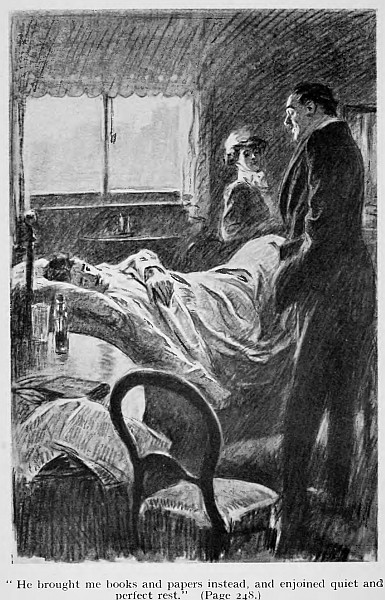
The days passed, long, weary, gloomy days of early spring, during which I tossed in bed impatient and helpless. I longed to be up and active, but Walker forbade it. He brought me books and papers instead, and enjoined quiet and perfect rest. Although Reggie and I still had our little hunting box down at Helpstone we had not, since Blair’s death, been down there. Besides, the season in the lace trade was an unusually busy one, and Reggie now seemed tied to his counting-house more than ever.
So I was left alone the greater part of the day with Glave to attend to my wants, and with one or two male friends who now and then looked in to smoke and chat.
Thus passed the month of March, my progress being much slower than Walker had at first anticipated. On analysis a very dangerous irritant poison had been discovered mixed with the grease, and it appeared that I had absorbed more of it into my system than was at first believed—hence my tardy recovery.
Mrs Percival, who at our urgent request still remained at Grosvenor Square, visited me sometimes, bringing me fruit and flowers from the hothouses at Mayvill, but she had nothing to report concerning Mabel. The latter had disappeared as completely as though the earth had opened and swallowed her. She was anxious to leave Blair’s house now that it was occupied by the usurpers, but we had cajoled her into remaining in order to keep some check upon the movements of the man Dawson and his daughter. Ford had been so exasperated at the man’s manner that, on the fifth day of the new régime, he had remonstrated, whereupon Dawson had calmly placed a year’s wages in banknotes in an envelope, and at once dispensed with his further services, as, of course, he had intended to do all along.
The confidential secretary was, however, assisting us, and at that moment was making every inquiry possible to ascertain the whereabouts of his young mistress.
“The house is absolutely topsy-turvy,” declared Mrs Percival one day, as she sat with me. “The servants are in revolt, and poor Noble, the housekeeper, is having a most terrible time. Carter and eight of the other servants gave notice yesterday. This person Dawson represents the very acme of bad manners and bad breeding, yet I overheard him remarking to his daughter two days ago that he actually contemplated putting up for the Reform and entering Parliament! Ah! what would poor Mabel say, if she knew? The girl, Dolly, as he calls her, the common little wench, has established herself in Mabel’s boudoir, and is about to have it re-decorated in daffodil yellow, to suit her complexion, I believe, while as for finances, it seems, from what Mr Leighton says, that poor Mr Blair’s fortune must go entirely through the fellow’s hands.”
“It’s a shame—an abominable shame!” I cried angrily. “We know that the man is an adventurer, and yet we are utterly powerless,” I added bitterly.
“Poor Mabel!” sighed the widow, who was really much devoted to her. “Do you know, Mr Greenwood,” she said, with a sudden air of confidence, “I have thought more than once since her father’s death that she is in possession of the truth of the strange connexion between her father and this unscrupulous man who has been given such power over her and hers. Indeed, she has confessed to me as much. And I believe that, if she would but tell us the truth, we might be able to get rid of this terrible incubus. Why doesn’t she do it—to save herself?”
“Because she is now in fear of him,” I answered in a hard, despairing voice. “She holds some secret of which she lives in terror. That, I believe, accounts for the sudden manner in which she has left her own roof and disappeared. She has left the fellow in undisputed possession of everything.”
I had not forgotten Dawson’s arrogance and self-confidence on the night he had first called upon us.
“But now, Mr Greenwood, will you please excuse me for what I am going to say?” asked Mrs Percival, settling her skirts after a brief pause and looking straight into my face. “Perhaps I have no right to enter into your more private matters in this manner, but I trust you will forgive me when you reflect that I am only speaking on the poor girl’s behalf.”
“Well!” I inquired, somewhat surprised at her sudden change of manner. Usually she was haughty and frigid in the extreme, a scathing critic who had the names of everybody’s cousins aunts and nephews at her fingers’ ends.
“The fact is this,” she went on. “You might, I feel confident, induce her to tell us the truth. You are the only person who possesses any influence with her now that her father is dead, and—permit me to say so—I have reason for knowing that she entertains a very strong regard for you.”
“Yes,” I remarked, unable to restrain a sigh, “we are friends—good friends.”
“More,” declared Mrs Percival, “Mabel loves you.”
“Loves me!” I cried, starting up and supporting myself upon one elbow. “No, I think you must be mistaken. She regards me more as a brother than a lover, and she has, I think, learnt ever since the first day we met in such romantic conditions, to regard me in the light of a protector.
“No,” I added, shaking my head, “there are certain barriers that must prevent her loving me—the difference of our ages, of position and all that.”
“Ah! There you are entirely mistaken,” said the widow, quite frankly. “I happen to know that the very reason why her father left his secret to you was in order that you might profit by its knowledge as he had done, and because he foresaw the direction of Mabel’s affections.”
“How do you know this, Mrs Percival?” I demanded, half inclined to doubt her.
“Because Mr Blair, before making his will, took me into his confidence and asked me frankly whether his daughter had ever mentioned you in such a manner as to cause me to suspect. I told him the truth of course, just as I have now told you. Mabel loves you—loves you very dearly.”
“Then for the legacy left me by poor Blair, I am, in a great measure, indebted to you?” I remarked, adding a word of thanks and pondering deeply over the revelation she had just made.
“I only did what was my duty to you both,” was her response. “She loves you, as I say, and therefore, by a little persuasion you could, I feel convinced, induce her to tell us the truth concerning this man Dawson. She has fled, it is true, but more in fear of what you may think of her when her secret is out, than of the man himself. Recollect,” she added, “Mabel is passionately fond of you, she has confessed it to me many times, but for some extraordinary reason which remains a mystery, she is endeavouring to repress her affection. She fears, I think, that on your part there is only friendship—that you are too confirmed a bachelor to regard her with any thoughts of affection.”
“Oh, Mrs Percival!” I cried, with a sudden outpouring, “I tell you, I confess to you that I have loved Mabel all along—I love her now, fondly, passionately, with all that fierce ardour that comes to a man only once in his lifetime. She has misjudged me. It is I who have been foolishly at fault, for I have been blind, I have never read her heart’s secret.”
“Then she must know this at once,” was the elderly woman’s sympathetic answer. “We must discover her, at all costs, and tell her. There must be a reunion, and she on her part, must confess to you. I know too well how deeply she loves you,” she added, “I know how she admires you and how, in the secrecy of her room, she has time after time wept long and bitterly because she believed you were cold and blind to the burning passion of her true pure heart.”
But how? The whereabouts of my well-beloved were unknown. She had disappeared completely, in order, it seemed, to escape some terrible revelation which she knew must be made sooner or later.
In the days that followed, while I lay still weak and helpless, both Ford and Reggie were active in their inquiries, but all in vain. I called in the solicitor, Leighton, in consultation, but he could devise no plan other than to advertise, yet to do so was, we agreed, scarcely fair to her.
Curiously enough the dark-faced young woman, Dorothy Dawson, otherwise Dolly, also betrayed the keenest anxiety for Mabel’s welfare. Her mother was Italian, and she spoke English with a slight accent, having always, she said, lived in Italy. Indeed, she called upon me once to express her regret at my illness, and I found that she really improved on acquaintance. Her apparent coarseness was only on account of her mixed nationality, and although she was a shrewd young person possessed of all the subtle Italian cunning, Reggie, I think, found her a bright and amusing companion.
All my thoughts were, however, of my sweet lost love, and of that common, arrogant fellow who, by his threats and taunts, held her so irresistibly and secretly in his power.
Why had she fled in terror from me, and why had such a dastardly and ingenious attempt been made to kill me?
I had solved the secret of the cipher only to be plunged still deeper into the mazes of doubt, despair and mystery, for what the closed book of the future held for me, was as you will see, truly startling and bewildering.
The truth when revealed was hard, solid fact, and yet so strange and amazing was it that it staggered all belief.
Chapter Twenty Four.
Contains a Terrible Disclosure.
Many long and dreary weeks had passed before I had sufficiently recovered to leave the house, and, accompanied by Reggie, take my first drive.
It was mid April, the weather was still cold, and gay London had not yet returned from wintering in Monte Carlo, Cairo or Rome. Each year the society swallows, those people who fly south with the first chill day of autumn, return to town later, and each London season appears to be more protracted than before.
We drove down Piccadilly to Hyde Park Corner, and then, turning along Constitution Hill, drove along the Mall. Here a great desire seized me to rest for a brief while and enjoy the air in St. James’s Park; therefore we alighted, paid the cabman, and, leaning upon Reggie’s arm, I strolled slowly along the gravelled walks until we found a convenient seat. The glories of St. James’s Park, even on an April day, are a joy for ever to the true Londoners. I often wonder that so few people take advantage of them. The wondrous trees, the delicious sheet of water, all the beauties of English rural scenery, and then the sense that all around you are the great palaces and departments, and offices in which the government of our great Empire is carried on—in other words, that commingling of silence at the core of feverish and tumultuous life outside—all these make St. James’s Park one of the loveliest retreats in England.
These things Reggie and I repeated to each other, and then, under the soothing influence of the surroundings, there came musings and reminiscences and the long silences which come between friends and are the best symbols of their complete accord of feeling and opinion.
While we were thus seated I became conscious of the fact that we were in the spot above all others where one was certain to see pass, at that time of day most of the prominent political figures of the hour on their way to their various Departments, or to Parliament where the sitting was just commencing. A Cabinet Minister, two Liberal peers, a Conservative whip, and an Under-secretary passed in rapid succession away in the direction of Storey’s Gate.
Reggie, who took a great interest in politics, and had often occupied a seat in the Strangers’ Gallery, was pointing out to me the politicians who passed, but my thoughts were elsewhere—with my lost love. Now that Mrs Percival had revealed to me the truth of Mabel’s affection I saw how foolish I had been in making pretence of a coldness towards her that was the very opposite to the feeling which really existed in my heart. I had been a fool, and had now to suffer.
During the weeks I had been confined to my room I had obtained a quantity of books, and discovered certain facts concerning the late Cardinal who had divulged the secret—whatever it was—in return for his release. It appeared that Andrea Sannini was a native of Perugia, who became Archbishop of Bologna, and was afterwards given the Cardinal’s hat. A great favourite of Pius IX, he was employed by him upon many delicate missions to the various Powers. As a diplomatist he proved himself possessed of remarkable acumen, therefore the Pope appointed him treasurer-general, as well as director of the world-famous museums and galleries of the Vatican. He was, it appeared, one of the most powerful and distinguished figures in the College of Cardinals, and became extremely prominent for the part he played on the occasion of the entry of the Italian troops into the Eternal City in 1870, while on the death of Pius IX, eight years later, he was believed to be designated as his successor, although on election the choice fell upon his colleague, the late Cardinal Pecci, who became Leo XIII.
I was reflecting upon these facts which I had established after a good deal of heavy reading, when Reggie suddenly cried in a low voice,—
“Why, look! there’s Dawson’s daughter walking with a man!”
I glanced quickly in the direction indicated and saw, crossing the bridge that spanned the lake and approaching in our direction, a well-dressed female figure in a smart jacket of caracul and neat toque, accompanied by a tall thin man in black.
Dolly Dawson was walking at his side leisurely, chatting and laughing, while he ever and anon bent towards her making some remarks. As he raised his head to glance across the water I saw that above his overcoat showed a clerical collar with a tiny piece of Roman purple. The man was evidently a canon or other dignitary of the Catholic Church.
He was about fifty-five, grey-haired, clean-shaven and wore a silk hat of a somewhat ecclesiastical shape, a rather pleasant-looking man in spite of his thin sensitive lips and pale ascetic face.
In an instant it struck me that they had met clandestinely and were sauntering there in order to avoid possible recognition if they walked the streets. The old priest appeared to be treating her with studied politeness, and as I watched him I saw from his slight gesticulations as he spoke that he was no doubt a foreigner.
I pointed out the fact to Reggie, who said—“We must watch them, old chap. They mustn’t see us here. I only hope they’ll turn off the other way.”
For a moment we followed them with our eyes, fearing that, having crossed the bridge, they would turn in our direction, but fortunately they did not, but turned off to the right along the shore of the lake.
“If he really is Italian then he may have come specially from Italy to have an interview with her,” I remarked. For ever since I had met the monk, Antonio, there had seemed some curious connexion between the secret of the dead cardinal and the Church of Rome.
“We must try and find out,” declared Reggie. “You mustn’t remain here. It’s getting too cold for you,” he added, springing to his feet. “I’ll follow them while you return home.”
“No,” I said. “I’ll walk with you for a bit. I’m interested in the little game,” and, rising also, I linked my arm in his and went forward by the aid of my stick.
They were walking side by side in earnest conversation. I could tell by the priest’s quick gesticulations, the way in which he first waved his closed fingers and then raised his open hand and touched his left forearm, that he was speaking of some secret and the possessor of it who had disappeared. If one knows the Italian well, one can follow in a sense the topic of conversation by the gestures, each one having its particular signification.
Hurrying as well as I could we gradually gained upon them, for presently they slackened their pace, while the priest spoke earnestly, as though persuading the daughter of the ex-boatswain of the Annie Curtis to act in some way he was directing.
She seemed silent, thoughtful and undecided. Once she shrugged her shoulders, and half-turned from him as though in defiance, when in a moment the wily cleric became all smiles and apologies. They were talking in Italian without a doubt, so as passers-by might not understand their conversation. His clothes, too, I noticed were of a distinctly foreign cut and he wore low shoes, the bright steel buckles of which he had evidently taken off.
As they had come across the bridge she had been laughing merrily at some quaint remark of her companion’s, but now it appeared as though all her gaiety had died out and she had realised the true object of the stranger’s mission. The path they had taken led straight across to the Horse Guards’ Parade, and feeling a few moments later that my weakness would not allow me to walk farther, I was compelled to turn back towards the York Column steps, leaving Reggie to make what observations he could.
I returned home thoroughly exhausted and very cold. Even my big frieze overcoat, which I used for driving when down at Helpstone, did not keep out the biting wind. So I sat over the fire for fully a couple of hours until my friend at last returned.
“I’ve followed them everywhere,” he explained, throwing himself into an armchair opposite me. “He’s evidently threatening her, and she is afraid of him. When they got to the Horse Guards they turned back along Birdcage Walk and then across the Green Park. Afterwards he drove her in a cab to one of Fuller’s shops in Regent Street. The old priest seems mortally afraid of being recognised. Before he left the Green Park he turned up the collar of his overcoat so as to hide that piece of purple at his collar.”
“Did you discover his name?”
“I followed him to the Savoy, where he is staying. He has given his name as Monsignore Galli, of Rimini.”
There our information ended. It, however, was sufficient to show that the ecclesiastic was in London with some distinct purpose, probably to induce the Ceco’s daughter to give him certain information which he earnestly desired, and which he intended to obtain by reason of certain knowledge which he possessed.
The days passed with gloom and rain, and Bloomsbury presented its most cheerless aspect. No trace could I discover of my lost love, and no further fact concerning the white-haired monsignore. The latter had, it appeared, left the Savoy on the following evening, returning, in all probability, to the Continent, but whether successful in his mission or no we were in complete ignorance.
Dolly Dawson, with whom Reggie had struck up a kind of pleasant friendship, more for the purpose of being able to observe and question her than anything else, called upon us on the day following to inquire after me and hear whether we had learnt anything regarding Mabel’s whereabouts. Her father, she told us, was absent from London for a few days, and she was about to leave for Brighton in order to visit an aunt.
Was it possible that Dawson, having learned of my solution of the cipher, had returned to Italy in order to secure the Cardinal’s secret from us? I longed hour by hour for strength to travel out to that spot beside the Serchio, but was held to those narrow rooms by my terrible weakness.
Four long and dreary weeks passed, until the middle of May, when I had gathered sufficient strength to walk out alone, and take short strolls in Oxford Street and its vicinity. Burton Blair’s will had been proved, and Leighton, who visited us several times, told us of the recklessness with which the man Dawson was dealing with the estate. That the adventurer was in secret communication with Mabel was proved by the fact that certain cheques signed by her had passed through his hands into the bank, yet strangely enough, he declared entire ignorance of her whereabouts.
Dawson had returned to Grosvenor Square, when one day at noon the footman, Carter, was ushered in to me by Glave.
I saw by his face that the man was excited, and scarcely had he been shown into my room before he exclaimed, saluting respectfully—
“I’ve found out Miss Mabel’s address, sir! Ever since she’s been gone I’ve kept my eyes on the letters sent to post, just as Mr Ford suggested that I should, but Mr Dawson never wrote to her until this morning, by accident I think, he sent a letter to the post addressed to her, among a number of others which he gave to the page-boy. She’s at the Mill House, Church Enstone, near Chipping Norton.”
In quick delight I sprang to my feet. I thanked him, ordered Glave to give him a drink and left London by the half-past one train for Oxfordshire.
Just before five o’clock I discovered the Mill House, a grey, old-fashioned place standing back behind a high box hedge from the village street at Church Enstone, on the highroad from Aylesbury to Stratford. Before the house was a tiny lawn, bright with tulip borders and sweet-smelling narcissi.
A broad-spoken waiting-maid opened the door and ushered me into a small, low, old-fashioned room, where I surprised my love crouched in a big armchair, reading.
“Why? Mr Greenwood!” she gasped, springing to her feet, pale and breathless, “you!”
“Yes,” I said, when the girl had closed the door and we were alone, “I have found you at last, Mabel—at last!” and, advancing, I took both her small hands tenderly in mine. Then, carried away by the ecstasy of the moment, I looked straight into her eyes, saying, “You have tried to escape me, but to-day I have found you again. I have come, Mabel, to confess openly to you, to tell you something—to tell you, dearest, that—well, that I love you!”
“Love me!” she cried, dismayed, starting back, and putting me from her with both her small, white hands. “No! no!” she wailed. “You must not—you cannot love me. It is impossible!”
“Why?” I demanded quickly. “I have loved you ever since that first night when we met. Surely you must long ago have detected the secret of my heart.”
“Yes,” she faltered, “I have. But alas! it is too late—too late!”
“Too late?” I exclaimed. “Why?”
She was silent. Her countenance had suddenly blanched to the lips, and I saw that she was trembling from head to foot.
I repeated my question seriously, my eyes fixed upon her.
“Because,” she answered slowly at last in a tremulous voice so low that I could scarce distinguish the fatal words she uttered, “because I am already married!”
“Married!” I gasped, standing rigid. “And your husband! His name!”
“Cannot you guess?” she asked. “The man you have already seen—Herbert Hales.” Her eyes were cast down from me as though in shame, while her pointed chin sank upon her panting breast.
Chapter Twenty Five.
The Sacred Name.
What could I say? What would you have said?
I was silent. I knew not what words to utter. This scoundrelly young groom, the ne’er-do-well son of the respectable old seafarer who spent the evening of his days at the crossways, was actually the husband of the millionaire’s daughter! It seemed utterly incredible, yet, on recollecting that midnight scene in Mayvill Park, I at once recognised how powerless she was in the hands of that low, arrogant cad, who, in a moment of mad frenzy, had made such a desperate attempt upon her.
I recognised, too, that the love between them, if any, had ever existed, had disappeared long ago, and that the man’s sole idea was to profit by the fact of his union with her, and blackmail her just as so many wealthy and upright women are being blackmailed in England at this very moment. It flashed through my mind that the reason she did not follow and punish the fellow for that dastardly attempt on her life was now made plain.
She was his wife!
The very thought convulsed me with jealousy, regret and hatred, for I loved her with all the passion, honest and true, of which a man is capable. Since Mrs Percival had revealed to me the truth, I had lived only for her, to meet her again and openly declare my love.
“Is this the truth?” I asked her at last in a voice the hardness of which I could not control. I took her cold, inert hand in my own and glanced at her bowed head.
“Alas for me it is,” was her faltering response. “He is my husband, therefore all love between us is debarred,” she added. “You have always been my friend, Mr Greenwood, but now that you have forced me to confess the truth our friendship is at an end.”
“And your husband, is he here with you?”
“He has been here,” was her answer, “but has gone.”
“You left London in secret to join him, I suppose?” I remarked bitterly.
“At his demand. He wished to see me.”
“And to obtain money from you by threats as he attempted on that night at Mayvill?”
The broken, white-faced girl nodded in the affirmative.
“I came to this place,” she explained, “as a paying-guest. A girl I knew at school, Bessie Wood, lives here with her mother. They believe I made a runaway match, and have been extremely kind to me these last two years.”
“Then you’ve been a wife for two whole years!” I exclaimed in blank surprise, utterly amazed at the manner in which I had been deceived.
“For nearly that time. We were married at Wymondham in Norfolk.”
“Tell me the whole story, Mabel,” I urged, after a long pause, endeavouring to preserve an outward calm, which certainly did not coincide with my innermost feelings.
Her breast heaved and fell beneath its lace and chiffons, her great wonderful eyes were filled with tears. For fully five minutes she was overcome by her emotion and quite unable to speak. At last, in a low, hoarse voice, she said—
“I don’t know what you must think of me, Mr Greenwood. I’m ashamed of myself, and of the manner in which I’ve deceived you. My only excuse is that it was imperative. I married because I was forced to by a chain of circumstances, as you will realise when you know the truth.” Then she was silent again.
“But you’ll tell me the truth, won’t you?” I urged. “I, as your best friend, as indeed the man who has loved you, have surely a right to know!”
She only shook her head in bitter sorrow, and looking at me through her tears, answered briefly—
“I have told you the truth. I am married. I can only ask your pardon for deceiving you and explain that I was compelled to do so.”
“You mean that you were compelled to marry him? Compelled by whom?”
“By him,” she faltered. “One morning two years ago I left London alone and met him at Wymondham, where I had previously been staying for a fortnight while my father was fishing. Herbert met me at the station, and we were married in secret, two men, picked at haphazard from the street, acting as witnesses. After the ceremony we parted. I took off my ring and returned home, no one being the wiser. We had a dinner-party that evening. Lord Newborough, Lady Rainham and yourself were there, and we went to the Haymarket afterwards. Don’t you recollect it? As we sat in the box you asked me why I was so dull and thoughtful, and I pleaded a headache. Ah! if you had but known!”
“I recollect the night perfectly,” I said, pitying her. “And it was your wedding evening? But how did he compel you to marry him? The motive is, of course, quite plain. He wished either to profit by the fact that you could not afford to allow the truth to be known that you were the wife of a groom, or else his intention was to gain possession of your money at your father’s death. Yours is certainly not the first marriage of the sort that has been contracted,” I added, with a feeling of blank dismay.
At the very moment when my hopes had been raised to their highest level by Mrs Percival’s statement the blow had fallen, and in an instant I saw that love was impossible. Mabel, the woman I loved so fondly and so well, was the wife of a loutish brute who was torturing her to madness by his threats, and would, as already had been proved, hesitate at nothing in order to gain his despicable ends.
My feelings were indescribable. No words of mine can give any adequate idea of how torn was my heart by conflicting emotions. Until that moment she had been beneath my protection, yet now that she was the wife of another I had no right to control her actions, no right to admire, no right to love.
Ah! if ever man felt crushed, despairing and hopeless, if ever man realised how aimless and empty his lonely life had been, I did at that moment.
I tried to induce her to tell me how the fellow had compelled her to marry him, but the words stuck in my throat and choked me. Tears must, I suppose, have stood in my eyes, for with a sudden sympathy, an outburst of that womanly feeling so strong within her, she placed her hand tenderly upon my shoulder and said in a low, calm voice—
“We cannot recall the past, therefore why reflect? Act as I asked you to act in my letter. Forgive me and forget. Leave me to my own sorrows. I know now that you have loved me, but it is—”
She could not finish the sentence, for she burst into tears.
“I know what you mean,” I said blankly. “Too late—yes, too late. Both our lives have been wrecked by my own folly—because I hid from you what I as an honest man, should have told you long ago.”
“No, no, Gilbert,” she cried, calling me for the first time by my Christian name, “don’t say that. The fault is not yours, but mine—mine,” and she covered her face with her hands and sobbed aloud.
“Where is this husband of yours—this man who tried to kill you?” I demanded fiercely a few moments later.
“Somewhere in the North, I think.”
“He has been here. When?”
“He came a week ago and remained a couple of hours.”
“But he shall not blackmail you in this manner! If I cannot remain your lover. I’ll nevertheless still stand your champion, Mabel!” I cried in determination. “He shall reckon with me.”
“Ah no!” she gasped, turning to me in quick apprehension. “You must do nothing. Otherwise he may—”
“What may he do?”
She was silent, gazing aimlessly out of the window across the broad meadow-lands, now misty and silent in the dusk.
“He may,” she said, in a low, broken voice, “he may tell the world the truth!”
“What truth?”
“The truth he knows—the knowledge by which he compelled me to become his wife,” and she held her hand to her breast, as though to stay the wild beating of her young heart.
I tried to induce her to reveal that secret to me, her most devoted friend, but she refused.
“No,” she said in a low, broken voice, “do not ask me, Gilbert—for I know now that I may be permitted to call you by your Christian name—because I cannot tell you of all men. It is for me to remain silent—and to suffer.”
Her face was very pale, and I saw by her look of determination that her mind was made up; even though she trusted me as she did, nevertheless no power would induce her to reveal the truth to me.
“But you know what reason your father had in appointing his friend Dawson to be controller of your fortune,” I said. “I felt confident that a word from you would result in his withdrawal from the office he now holds. You cannot affect ignorance of this mysterious motive of your father’s?”
“I have already told you. My poor father also acted under compulsion. Mr Leighton also knows that.”
“And you are aware of the reason?”
She nodded in the affirmative.
“Then you could checkmate the fellow’s plans?”
“Yes, I might,” she answered slowly, “if I only dared.”
“What do you fear?”
“I fear what my father feared,” was her answer.
“And what was that?”
“That he would carry out a certain threat he has many times made to my father, and later to myself. He threatened me on the day I left home—he dared me to breathe a single word.”
Yes, that one-eyed man held power complete and absolute over her, just as he had boasted to Mrs Percival. He also knew the truth concerning the Cardinal’s secret.
We sat together in that small, low, old-fashioned room, until dusk darkened into night, when she rose wearily and lit the lamp. Then I was startled by discovering by its light how her sweet face had changed. Her cheeks had grown wan and pale, her eyes were red and swollen, and her whole countenance betrayed a deep, burning anxiety a terror of what the unknown future held for her.
Surely hers was a strange, almost inconceivable position—a pretty young woman with a balance of over two millions at her bankers, and yet hounded by those who sought her ruin, degradation and death.
The fact that she was married had struck me a staggering blow. To her I could now be no more than a mere friend like any other man, all thoughts of love being bebarred, all hope of happiness abandoned. I had never sought her for her fortune, that I can honestly avow. I had loved her for her own sweet, pure self, because I knew that her heart beat true and loyal; that in strength of character, in disposition, in grace and in beauty she was peerless.
For a long time I held her hand, feeling, I think, some satisfaction in thus repeating the action of other times, now that I had to bid farewell to all my hopes and aspirations. She sat silent, troubled sighs escaping her as I spoke, telling her of that strange, midnight adventure in the streets of Kensington, and of how near I had been to death.
“Then, knowing that you have gained the secret written upon the cards, they have made an attempt to seal your lips,” she said at last, in a hard, mechanical voice, almost as though speaking to herself. “Ah! did I not warn you of that in my letter? Did I not tell you that the secret is so well and ingeniously guarded that you will never succeed in either learning it or profiting by it?”
“But I intend to persevere in the solution of the mystery of your father’s fortune,” I declared, still with her hand in mine, in sad and bitter farewell. “He left his secret to me, and I have determined to start out to Italy to-morrow to search the spot indicated, and to learn the truth.”
“Then you can just save yourself that trouble, mister,” exclaimed the voice of a common, uneducated man, startling me, and on turning suddenly, I saw that the door had opened noiselessly, and there upon the threshold, watching us with apparent satisfaction, was the man who stood between me and my well-beloved—that clean-shaven, skulking fellow who claimed her by the sacred name of wife!
Chapter Twenty Six.
Face to Face.
“I’d much like to know what your business is ’ere?” demanded the coarse-featured fellow, whose grey bowler hat and gaiters gave him a distinctly horsey appearance. And as he stood in the doorway, he folded his arms defiantly and looked me straight in the face.
“My business is my own affair,” I answered, facing him in disgust.
“If it concerns my wife, I have a right to know,” he persisted.
“Your wife!” I cried, advancing towards him, with difficulty repressing the strong impulse within me to knock the young ruffian down. “Don’t call her your wife, fellow! Call her by her true name—your victim!”
“Do you mean that as an insult?” he exclaimed quickly, his face turning white with sudden anger, whereupon Mabel, seeing his threatening attitude, sprang between us and begged me to be calm.
“There are some men whom no words can insult,” I replied forcibly. “And you are one of them.”
“What do you mean?” he cried. “Do you wish to pick a quarrel?” and he came forward with clenched fists.
“I desire no quarrel,” was my quick response. “I only order you to leave this lady in peace. She may be legally your wife, but I will stand as her protector.”
“Oh!” he sneered, with curling lip. “And I’d like to know by what right you interfere between us?”
“By the common right every man has to shield an unprotected and persecuted woman,” I replied, firmly. “I know you, and am well aware of your shameful past. Shall I recall one incident, that, now you attempt to defy me, you appear to have conveniently forgotten? Do you not recollect a certain night in the park at Mayvill not so very long ago, and do you not recollect that you there attempted to commit a foul and brutal murder—eh?”
He started quickly, then glared at me with the fire of a murderous hatred in his eyes.
“She’s told you, damn her! She’s given me away!” he exclaimed, with a contemptuous glance at his trembling wife.
“No, she has not,” was my response. “I myself chanced to be witness of your dastardly attempt upon her. It was I who succeeded in rescuing her from the river. For that action of yours you must now answer to me.”
“What do you mean?” he inquired, and from the lines in his countenance I saw that my outspoken manner caused him considerable uneasiness.
“I mean that it is not for you to attempt defiance, having regard to the fact that, had it not been for the fortunate circumstance of my presence in the park, you would to-day be a murderer.”
He shrank at that final word. Like all his class, he was arrogant and overbearing to the weak, but as easily cowed by firmness as a dog who cringes at his master’s voice.
“And now,” I continued, “I may as well tell you that, on the night when you would have killed this poor woman who is your victim, I also overheard your demands. You are a blackmailer—the meanest and worst type of criminal humanity—and you seem to have forgotten that there is a severe and stringent law against such an offence as yours. You demanded money by threats, and on refusal made a desperate endeavour to take your wife’s life. In the assize court the evidence I could give against you would put you into a term of penal servitude—you understand? Therefore I’ll make this compact with you; if you will promise not to molest your wife further, I will remain silent.”
“And who the deuce are you, pray, to talk to me in this manner—like a gaol chaplain on his weekly round!”
“You’d better keep a civil tongue, fellow, and just reflect upon my words,” I said. “I’m no man for argument. I act.”
“Act just as you like. I shall do as I think proper—you hear?”
“And you’ll take the risk? Very well,” I said. “You know the worst—prison.”
“And you don’t,” he laughed. “Otherwise you wouldn’t talk like a silly idiot. Mabel is my wife, and you’ve no say in the matter, so that’s enough for you,” he added insultingly. “Instead of trying to threaten me, it is I who have a right to demand why I find you here—with her.”
“I’ll tell you!” I cried angrily, my hands itching to give the impudent young blackguard a sound good hiding. “I’m here to protect her, because she is in fear of her life. And I shall remain here until you have gone.”
“But I’m her husband, therefore I shall stay,” sneered the fellow, perfectly unmoved.
“Then she leaves with me,” I said decisively.
“I’ll not allow that.”
“You will act just as I think proper,” I exclaimed. Then, turning to Mabel, who had remained white, silent and trembling, in fear lest we should come to blows, I said, “Put on your hat and coat at once. You must return to London with me.”
“She shall not!” he cried, unflinchingly. “If my curses could blast yer you’d have ’em thick.”
“Mabel,” I said, taking no notice of the ruffian’s words, but drawing back to allow her to pass out, “please get your coat. I have a fly waiting outside.”
The fellow made a movement as though to prevent her leaving the room, but in an instant my hand was heavily upon his shoulder, and by my face he saw that I was strong and determined.
“You’ll repent this!” he hissed threateningly, with an imprecation, between his teeth. “I know what you are searching for—but,” he laughed, “you’ll never obtain that secret which gave Blair his millions. You think you’ve a clue to it, but before long you’ll discover your mistake.”
“In what?”
“In not uniting with me, instead of insulting me.”
“I have no necessity for the assistance of any man who would kill a helpless woman,” I responded. “Recollect that in this affair you hold aloof from her, or, by Gad! without further ado, I’ll seek the aid of the police, when your past history will prove rather unwelcome evidence of character.”
“Do what you like,” he laughed again defiantly. “By giving me over to the police you’ll only be doing her the worst turn possible. If you doubt me, you’d better ask her. Be careful how you act before you make a fool of yourself and a victim of her.” And with this harsh, hollow sneer he threw himself into the armchair and placed his feet on the fender in an attitude of carelessness and calmly lit a cheap, rank cigar.
“There will be only one sufferer, never fear,” I said meaningly. “And that will be yourself.”
“All right,” he said, “we shall see.”
Then turning I left the room, and meeting Mabel, who stood ready dressed in the hall, whispering a hurried adieu to Bessie Wood, her old schoolfellow, I hurried her out, put her into the station fly, and drove with her back to Chipping Norton.
Even then, however, I could not understand the exact position of that young ruffian, Herbert Hales, or the true meaning of his final ominous words of open defiance.
For the present I had rescued my love from the arrogant, cold-blooded brute and blackmailer, but for how brief a space I dreaded to anticipate. My own position, utterly in the dark as I remained, was one of uncertainty and insecurity. I loved Mabel, but now had no right to do so. She was already the wife, alas! the victim, of a man of low type and of criminal instinct.
Our journey up to Paddington was uneventful, and in almost complete silence. Both our hearts, beating sadly, were too full for mere words. The insurmountable barrier had fallen between us; we were both grief-stricken and heart-broken. The hopeful past had ended, the future was one of dull and dark despair.
On arrival in London she expressed a desire to see Mrs Percival, and as she declined to return beneath the same roof as Dawson, I took her to the York Hotel in Albemarle Street, then, re-entering the cab, I drove to Grosvenor Square, where I informed the chaperon of my lost love’s whereabouts.
Not an instant did Mrs Percival delay in seeking her, and at midnight, accompanied by Reggie, I called again at the hotel, giving her certain injunctions to refuse to see her husband, even if he discovered her, and taking a lingering farewell of her, as we had arranged to leave Charing Cross for Italy by the mail at nine o’clock on the following morning.
Both Reggie and I had arrived at the conclusion that, now I was sufficiently recovered to travel, we should not lose an instant in going out to Tuscany, and investigating the truth regarding that cipher record.
So she bade us both farewell, and urging us not to worry further upon her account, although we did not fail to detect her wild anxiety as to the result of my defiance of her ruffianly husband, she wished us all good fortune and Godspeed in the exciting venture we were about to undertake, with success and a safe return.
Chapter Twenty Seven.
The Directions of His Eminence.
The green, winding valley of the Serchio looks its brightest and best in the month of May the time of flowers in old-world Italy. Far removed from the great routes over which the English, Americans and Germans swarm in winter, unvisited, unknown and unexplored by any save the simple contadini of the hills, the rippling river winds with tortuous bends around sharp angles and beneath overhanging trees, great cliffs and huge grey boulders worn smooth by the action of the water of ages. In those lonely reaches of the river as it dashes on with many cascades from the giant Apennines to the sea, the brilliant kingfisher and the stately heron are in possession, and live their lives undisturbed by human intrusion. As we walked on, having left the carriage that had brought us up from Lucca at the quaint mediaeval bridge called the Ponte del Diavolo, the rural, quiet and picturesque beauty of the scene became impressed upon us. The silence was unbroken, save for the hum of the myriad insects in the sun, and the low music of the water which at that point is shallow, running over its rocky bed.
On arrival at the Universo in Lucca, my first impulse was to go up to the monastery and see Fra Antonio. Yet so intimate did he appear to be with Blair’s partner, the ex-boatswain Dawson, that we resolved to first explore the spot and take some observations. Therefore at eight that morning we had entered one of those dusty old travelling Tuscan carriages, the horses of which bore many jingling bells, and now, as noon was approaching, we found ourselves on the left bank of the river, counting the four hundred and fifty-six foot-paces as directed by the secret record upon the cards.
To avoid being watched by our driver, to whom we had given instructions to go back to a little wayside trattoria, or eating-house, which we had passed, but who we knew would endeavour to secretly watch our movements, we were at first compelled, on account of the absence of a path, to make a détour through a small wood, rejoining the river bank at some distance further up.
Therefore, as we reached the water, standing amid the high undergrowth that grew upon the banks, we could only look back at the bridge and guess that we were about one hundred foot-paces from it.
Then, tramping steadily forward in single file we pushed our way with difficulty through the tall grass, briars, giant ferns and tangled creepers, slowly onward towards the spot indicated. In places the trees met overhead, and the sun shining through the foliage struck the rippling water with pretty effect.
According to the record the spot must be in the open, for the sun shone upon it for one hour at noon on the fifth of April and for two hours on the fifth of May. It was now the nineteenth of May, therefore the duration of the sunshine would, we roughly calculated, be about a quarter of an hour longer.
In some places the river was open to the sun, while in others, so high were the banks on either side, the light could never penetrate there. From the crevices of the overhanging rocks, mountain pines and other trees had taken root and grown to huge size, bending over until their branches almost swept the stream, while our progress was made slower and more difficult by the unevenness of the bank and the wild tangle of the undergrowth.
One fact was proved—no one had approached the spot for a considerable time, for we found not a twig severed or a leaf disturbed by previous intruders.
At last, after we had climbed high along a rocky cliff that descended sheer into the water, and had calculated four hundred and twenty steps from the old pointed bridge, we suddenly rounded a bend in the river and came upon a space where the stream, still a hundred feet or so below, broadened out, so that it lay open to the sky for forty yards or so.
“It must be here!” I cried in eager anticipation, halting and quickly surveying the spot. “The directions are to descend twenty-four foot-holes. I suppose that means steps cut in the rock. We must find them.” And both of us began to search eagerly, but in that tangled growth we could discover no trace of them.
“The record says that we go down behind where a man can hold himself against four hundred,” exclaimed Reggie, reading from a copy of the transcript which he took from his pocket. “That appears as if the entry is in some narrow crevice between two rocks. Do you see any such likely spot?”
I looked eagerly around but was compelled to admit that I discerned nothing that coincided with the description.
So sheer was the grey limestone cliff, going down to the water, that I approached its edge with caution and then, throwing myself upon my stomach, I crept forward and peered over its insecure edge. In doing so a huge piece of rock became loosened and fell with a roar and splash into the stream.
I took careful observations, but could distinguish absolutely nothing to correspond with what the old outlaw, Poldo Pensi, had recorded.
For a full half-hour we searched in vain, until it became plain that, as we had not measured accurately the foot-paces from the Devil’s Bridge, we were not at the exact spot. We therefore retraced our steps slowly and laboriously through the tangled briars and undergrowth, our clothes suffering considerably, and then restarted from the actual base of the bridge. So completely had we been out of reckoning that at the three hundred and eighty-seventh pace we passed the spot where we had made such minute search, and continuing our way forward we halted at the four hundred and fifty-sixth foot-pace in the top of a high encampment very similar to the other, only wilder and even more inaccessible.
“There seems nothing here,” remarked Reggie, whose face was torn by brambles and was bleeding.
I gazed around and was reluctantly compelled to endorse his statement. The trees were large and shady where we stood, some of them overhanging the deep chasm through which the river wound. Cautiously, we both crept forward, flat upon our stomachs, to the edge of the cliff, taking that precaution as we knew not whether the edge might be rotten, and presently we peered over.
“Why, look!” cried my friend, pointing to a spot about half-way down the deep swirling stream as it came round the sudden bend, “there’s steps and a path leading down just a little higher up. And see! what’s that?”
Chapter Twenty Eight.
Describes a Startling Discovery.
I looked and saw that upon a kind of natural platform on the rock was built a small stone hut, upon the grey-tiled roof of which we were gazing down.
“Yes, there are the ‘twenty-four foot-holes’ mentioned in the record, no doubt,” I said. “I wonder if anybody lives down there.”
“Well, let’s descend and investigate,” suggested Reggie anxiously, and a few moments later we had struck a narrow track leading from the chestnut wood direct to the roughly-cut steps that went down to a narrow opening between two rocks. Upon the right hand one we found deeply graven an old-fashioned capital E, about a foot long, and passing by it we saw that a rough and perilous track led zigzag down to the small hut, the closed door and small barred window of which caused us the wildest curiosity as to what was within.
Next moment, however, the truth was plain. The front of the little place was pointed, and upon the apex was a small stone cross.
It was a hermit’s cell, like so many similar ancient places of retreat and contemplation in old-world Italy, and an instant later, as we passed the rocks and came cautiously down the path, the door opened, and there issued forth the hermit himself, who, to my surprise, I recognised as no other person than the burly, dark-bearded monk, Antonio!
“Gentlemen,” he exclaimed, speaking in Italian, as he greeted us, “this is certainly an unexpected meeting,” and he indicated the stone bench that ran along the outside of the low little hut, which I saw was so cunningly concealed by the overhanging trees as to be invisible either from the river or from the opposite bank. As we seated ourselves at his direction, he hitched up his faded brown habit beneath his waist-cord and himself sat down beside us.
I expressed surprise at finding him there, but he only smiled, saying—
“You are disappointed at discovering nothing else—eh?”
“We expected to reveal the secret of the Cardinal Sannini,” was my frank response, well knowing that he was in possession of the truth, and suspecting that, with the one-eyed Englishman, he had been partner with Blair.
The monk’s strongly-marked, sunburnt features assumed a puzzled expression, for he saw that we had gained some knowledge, yet he hesitated to make inquiry lest he should betray himself. Capuchins, like Jesuits, are wonderful diplomatists. Doubtless, the monk’s personal fascination was somewhat due to his splendid presence. A man of fine physique, he had a handsome, open face, with clean-cut, powerful features, softened by eyes in which seemed the light of perpetual youth, with a candid, unassuming expression, brightened by a twinkling humour about the lips.
“You have recovered the record, then,” he remarked at last, looking straight into my face.
“Yes, and having read it,” I answered, “I am here to investigate and claim the secret bequeathed to me.”
He drew a long breath, glanced for an instant at both of us, and his shaggy black brows contracted. It was hot where we sat, for the brilliant Italian sun beat straight down upon us, therefore, without replying to me, he rose and invited us into his cool little cell, a square bare room with boarded floor, the furniture consisting of a low, old-fashioned wooden bedstead, with a piece of old brown blanket for coverlet, a Renaissance prie-dieu in old carved oak, black with age, a chair, a hanging lamp, and upon the wall a great crucifix.
“Well, and the Signor Dawson?” he asked at last, when Reggie had seated himself on the edge of the bed, and I had taken the chair. “What does he say?”
“I have no necessity to ask his opinion,” I responded quickly. “By law the Cardinal’s secret is mine, and no one can dispute it.”
“Except its present holder,” was his quiet remark.
“Its present holder has no right to it. Burton Blair has made gift of it to me, and it is therefore mine,” I declared.
“I do not dispute that,” answered the dark-faced monk. “But as guardian of the Cardinal’s secret, I have a right to know the manner in which the record upon the cards came into your hands, and how you gained the key to the cipher.”
I related to him exactly what he wished to ascertain, whereupon he answered—
“You have certainly succeeded where I anticipated that you would fail, and your presence here to-day surprises me. Apparently you have overcome every obstacle, and are now here to claim from me what is undoubtedly yours by right.” He seemed fair-minded, yet I confess I was loth to trust men of his stamp very far, and was therefore still suspicious.
“Before we go further, however,” he said, standing with his hands in the wide sleeves of his habit, “I would ask whether it is your intention to continue the methods of the Signor Blair, who allotted one-eighth part of the money derived from the secret to our Order of Capuchins?”
“Certainly,” I answered, rather surprised. “My desire is to regard in every particular my dead friend’s obligations.”
“Then that is a promise,” he said with some eagerness. “You make that solemnly—you take an oath? Raise your hand!” And he pointed to the great crucifix upon the white-washed wall.
I raised my hand and exclaimed—
“I swear to act as Burton Blair has acted.”
“Very well,” answered the monk, apparently satisfied that I was a man of honour. “Then I suppose the secret, strange as it will strike you, must now be revealed to you. Think, Signore, at this moment you are a comparatively poor man, yet in half an hour you will be rich beyond your wildest dreams—worth millions, just as Burton Blair became.”
I listened to him, scarcely believing my ears. Yet what was the possession of riches to me, now that I had lost my love?
From a little cupboard he took a small, rusty old hurricane lamp, and carefully lit it, while we both watched with breathless interest. Then he closed the door and securely locked and barred it, afterwards placing the shutters to the iron-barred window, so that we were quickly in darkness. Was some supernatural illusion about to be shown us? We stood open-mouthed in expectation.
A moment later he dragged his low ponderous bedstead away from the corner, where we saw that in the floor was a cunningly-concealed trap-door, which, on being lifted, disclosed a deep, dark, well-like hole beneath.
“Be careful,” he cautioned us, “the steps are rather difficult in places,” and holding the lantern he soon disappeared, leaving us to follow him down a roughly-hewn spiral flight of foot-holes in the stone, deeper and deeper into the solid rock, damp and slimy in places where the water percolated through and fell in loudly-sounding drops.
“Bend low!” ordered our guide, and we saw the faint glimmer of this lamp lighting our path along a narrow, tortuous burrow which ran away at right angles and sloped down still further into the heart of the cliff. In places we went through a veritable quagmire of mud and slime, while the close atmosphere smelt foul and earthy.
Suddenly we emerged into a great opening, the dimensions of which we could not ascertain with that one single glimmering light.
“These caverns run for miles,” explained the monk. “The galleries run in all directions right under the city of Lucca and over towards the Arno. They have never been explored. Listen!”
In the weird darkness we heard the distant roaring of tumbling waters far away.
“That is the subterranean river, the stream that divides the secret from all men save yourself,” he said. Then he went forward again, keeping along one side of the gigantic cavern through which we were passing, and we followed, approaching nearer those thundering waters, until at last he told us to halt, and appeared to be examining the rough walls upon which shone great glittering stalactites.
Presently he found a large white mark similar to the letter E on the rock upon the cliff-side, and placed his lantern on the floor.
“Don’t move another step forward,” he said. Then he produced from a hole, where it appeared to be well hidden, a long, roughly-made footbridge, consisting of a single plank, with a light handrail on each side. This he pushed before him while I held the lantern, until he came to the edge of a deep chasm and then bridged it across so that we could pass over.
When in the centre, he held aloft the lantern, and as we peered down a hundred feet we shuddered to see, deep down in the chasm, the rushing flood of black water roaring away into the bowels of the earth, a terrible trap to those who ventured to explore that weird, dank place.
Having passed safely over we again skirted a wall of rock to the right, traversed a long, narrow tunnel and at last emerged into another open space, of the dimensions of which we could gather no idea.
Here the monk set down his lantern in a niche wherein stood several candles stuck upon rude boards and secured between three nails. When they were lit and our eyes grew accustomed to the light, we saw that the chamber was not a large one, but that it was long, narrow and somewhat drier than the rest.
“See!” exclaimed the Capuchin, with a wave of his hand. “It is all there, Signor Greenwood, and all yours.”
Then I realised to my utter amazement that around the walls of the place, piled high, one on the other, were sacks of untanned hide filled to bursting. One pile close to my hand I touched, and found that what was within them was hard, angular and unyielding. There were many small, old-fashioned chests which, from their strong appearance, banded with rusted iron and studded with nails, must, I knew, contain the mysterious riches that raised Burton Blair from homeless wayfarer to millionaire.
“Why, surely this is an actual hoard of treasure!” I cried.
“Yes,” answered Fra Antonio in his deep, bass voice. “The hidden treasure of the Vatican. See,” he added, “it is all here except that portion taken out by the Signor Blair,” and opening one of the massive chests, he held his lantern above and displayed such a miscellaneous collection of golden chalices, monstrances, patens, jewel-embroidered vestments and magnificent gems, such as had never before dazzled my eyes.
Both Reggie and I stood utterly dumbfounded. At first I seemed to be living in some fairy world of legend and romance, but when a moment later the rugged, bearded face of the Capuchin recalled to me all the past, I stood open-mouthed in wonder.
The secret of Burton Blair was disclosed—and the secret was now mine!
“Ah!” exclaimed the monk, laughing, “no doubt this revelation is, to you, an amazing one. Did I not, however, promise you that in half an hour you would become many times over a millionaire?”
“Yes; but tell me the history of all this great wealth,” I urged, for he had cut open one or two of the leathern bags, and I saw that each of them was filled with gold and gems mostly set in crucifixes and ornaments of an ecclesiastical character.
Chapter Twenty Nine.
In which a Strange Tale is Told.
“I suppose it is only just that you should now know the truth, although a most strenuous effort has been made to keep it from you,” the monk remarked, as though to himself. “Well, it is this. You, as a Protestant, probably know that the treasures in the Vatican in Rome are the greatest in the world, and also that each Pope, on his jubilee or other notable anniversary, receives a vast number of presents, while the church of St. Peter’s itself is constantly in receipt of quantities of ornaments and jewels as votive offerings. These are preserved in the treasury of the Vatican, and constitute a collection of wealth unequalled by all the millions of modern millionaires. Well, in the early part of 1870, Pope Pius IX received, through the marvellous diplomatic channels our Holy Church possesses, secret information that it was the intention of the Italian troops to bombard and enter Rome, and sack the Palace of the Vatican. His Holiness confided his fears to his favourite, the great, Cardinal Sannini, the treasurer-general, who, having lived in this district when a peasant lad, was aware of the existence of this safe hiding-place. He, therefore, succeeded, during the months of June, July and August 1870, in secretly removing a vast quantity of the Vatican treasure from Rome and storing it in this place in order to save it from the enemy’s hands. True to the fears of His Holiness, on September 20 the Italian troops, after a five days’ bombardment, entered Rome, but, fortunately, no serious attack was made upon the Vatican, while the treasure removed has remained here ever since. Cardinal Sannini was, it appears, a traitor to the Church, for although he induced Pio Nono to allow the treasure to be removed in secret, he never told him the exact spot where it was concealed, and curiously enough the two members of the Swiss Guard who had assisted the Cardinal, and alone knew the secret, both disappeared—in all probability, I believe, precipitated into that subterranean river we have just crossed. Originally, the small entrance to these galleries was only hidden by brambles, but, directly after the treasure had been safely secreted, His Eminence the Cardinal suddenly discovered that the spot on the cliff-side was well adapted for a hermitage, and he built the present hut over the small opening in the rock in order to conceal it, having first closed the hole with his own hands so that the stone-masons should not discover the entrance. For many months, during the struggle between the Italian Government and the Holy See, he doffed the purple and lived in the cell, a hermit, but in reality guarding the enormous treasure he had so cleverly secured. But, as you know, he was captured by the terrible Poldo Pensi, dreaded down in Calabria, and was compelled, in order to save his life and reputation, to betray the existence of his hoard. Upon this, Pensi came here in secret, saw the treasure, but being extremely superstitious, as are all his class, he dare not touch one single object. A man who had once served in his band and who had entered our monastery, a certain Fra Orazio, he sought out, and to him gave the hermitage, without, however, telling him of the secret tunnel and caves beneath. Both Sannini and the Pope died, but Fra Orazio, in ignorance of the fact that he resided over a veritable mine of wealth, continued here sixteen years, until he died, and I succeeded him in the occupancy of the cell, spending nearly six months each year here in meditation and prayer.
“In the meantime, however, the secret of His Eminence inscribed in the secret cipher used by the Vatican in the seventeenth century, seems to have passed through Poldo Pensi into the hands of Burton Blair, his shipmate and intimate friend. The first I knew of it was about five years ago, when one day my peace was disturbed by a visit from two Englishmen, Blair and Dawson. They told me a story of the secret being given to them, but at first I would not believe that there was any truth in the hidden hoard. We, however, investigated, and after a very long, difficult and perilous search we succeeded in revealing the truth.”
“Then Dawson shared in the secret, as well as in the profits?” I remarked, astounded at the amazing truth.
“Yes, the three of us alone knew the secret, and it was then mutually arranged that it having been given by the repentant brigand to Blair, he was entitled to the greater share, while Dawson, to whom Pensi had apparently spoken before his death concerning the treasure, and who had been in possession of certain facts, should be allotted one quarter of the annual out-take, and to myself, appointed guardian of the treasure-house, one eighth to be paid, not to myself direct, as that would arouse suspicion, but by Blair’s bankers in London to the Vicar-General of the Order of the Capuchins at Rome. Through five years this arrangement has been carried out. Once every six months we entered this chamber in company and selected a certain amount of gems and other articles of value which were sent by certain channels—the gems to Amsterdam for sale and the other articles to the great auction-rooms of Paris, Brussels and London, and others into the hands of renowned dealers in antiques. As you may see for yourself, this collection of gems is almost inexhaustible. Three rubies alone fetched sixty-five thousand pounds in Paris last year, while some of the emeralds have realised enormous sums, yet so ingeniously did the Signori Dawson and Blair arrange the channels by which they were placed upon the market that none ever guessed the truth.”
“But all this is, strictly speaking, the property of the Church of Rome,” remarked Reggie.
“No,” answered the big monk in his broken English; “according to Cardinal Sannini, His Holiness, after the peace with Italy, made a free gift to him of the whole of it as a mark of regard, and knowing too that with Rome in the occupation of the Italian troops it would be difficult to get the great collection of jewels back again into the treasury without exciting suspicion.”
“Then all this is mine!” I exclaimed, even then unable to fully realise the truth.
“All,” answered the monk, “except the share to me, or rather to my Order, for distribution to the poor, as payment for its guardianship, and that to the Signor Dawson—with, I suppose,” and he turned towards Reggie, “some acknowledgment to your friend. I warned you against him once,” he added, “but it was owing to what Dawson told me—lies.”
“I have already pledged myself to continue to act towards your Order as Burton Blair has done,” I replied. “As to Dawson that is another matter, but certainly my friend Seton here will not be forgotten, nor you personally, as the faithful holder of the secret.”
“Any reward of mine goes to my Order,” was the manly fellow’s quiet reply. “We are forbidden to possess money, our small personal wants being supplied by the father superior, and of this world’s riches we desire none save that necessary to relieve the poor and afflicted.”
“You shall have some for that purpose, never fear,” I laughed.
Then, as the air exhausted by the lights seemed to grow more foul, we decided to return to the cell so cunningly constructed at the mouth of the narrow outer gallery.
We had reached the brink of that terrible abyss where the black flood roared deep below, and I had passed over the narrow hand-bridge and gained the opposite side safely, when, without warning, a pair of strong hands seized me in the darkness, and almost ere I could utter a cry I was forced backwards to the edge of the awful chasm.
The hands held me in an iron grip by the throat and arm, and so suddenly had I been seized that for the first instant I believed it to be a joke on Reggie’s part—for he was fond of horseplay when in jubilant spirits.
“My God!” I however heard him cry a second later, as I suppose the flickering lamplight fell upon my assailant’s countenance, “why, it’s Dawson!”
Knowledge of the terrible truth that I had been seized by my worst enemy, who had followed us in, well knowing the place, aroused within me a superhuman strength, and I grappled with the fellow in a fierce death struggle. Ere my two companions could reach and rescue me we were swaying to and fro in the darkness on the very edge of the abyss into which it was his intention to hurl me to the same death that the two Swiss Guards had probably been consigned by the wily cardinal.
I realised his murderous intention none too quickly, for with a fierce oath he panted—
“You sha’n’t escape me now! That blow in the fog didn’t have the desired effect, but once down there you’ll never intrude again upon my affairs. Down you go!”
I felt my strength fail me as he forced me back still further, locked in his deadly embrace. In the darkness one of my companions gripped me and saved me, but at that instant I had recourse to an old Charterhouse trick, and twisting suddenly, so that my opponent stood in my place, I tripped him backwards, at the same moment slipping from his grasp.
It was the work of a second. In the uncertain glimmer from the lamp I saw him stumble, clutch wildly at the air, and with an awful cry of rage and despair he fell backwards, down into the Stygian blackness where the rushing waters swept him down to subterranean regions, unknown and unexplored.
My escape from death was assuredly the narrowest man had ever had, and I stood panting, breathless, bewildered, until Reggie took me by the arm and led me forward in silence more impressive than any words.
Chapter Thirty.
The Motive and the Moral.
On the following night we took leave of the strong, big-handed monk on the railway platform in Lucca, and entered the train on the first stage of our journey back to England. He was to return at once to his hermit cell above the swirling Serchio, and remain, as before, the silent guardian of that great secret which, had it been revealed, would have astounded the world.
Anxiety consumed us, knowing not how Mabel had fared. Yet with the knowledge that the baneful influence of the adventurer Dawson had been now removed, we returned home somewhat easier in mind. I was wealthy, it was true, rich beyond my wildest dreams, yet the hope of the possession of Mabel as my wife, that had been the mainspring of my life, had been snapped, and in those pensive hours as the sleeping-car express tore northward across the plains of Lombardy and through Switzerland and France, my despairing thoughts were all of her and of her future.
A cab took us direct from Charing Cross to Great Russell Street, where I found a note from her dated from Grosvenor Square, asking me to call there on the instant of our return. This I did after a hasty wash, and Carter showed me unceremoniously and at once up to that big white-and-gold drawing-room so familiar to me.
In a few moments she entered, looking sweet and charming in her mourning, a smile upon her lips, her hand extended to me in glad welcome. Her face, I thought, betrayed a keen anxiety, and the pallor of her cheeks showed how sorely her heart was torn by grief and terror.
“Yes, Mabel, I am back again,” I said, holding her hand and gazing into her eyes. “I have discovered your father’s secret!”
“What?” she cried in eager surprise, “you have? Tell me what it is—do tell me,” she urged breathlessly.
I first obtained from her a promise of secrecy, and then, standing with her, I described our visit to the lonely hermit’s cell, our reception by the monk Antonio, and our subsequent discoveries.
She listened in blank amazement at my story of the hidden treasure of the Vatican, until I described the attack made upon me by Dawson, and its tragic sequel, whereupon she cried—
“Then if that man is dead—actually dead—I am free!”
“How? Explain!” I demanded.
“Well, now that circumstances have combined to thus liberate me, I will confess to you,” she responded after a brief pause. Her face had suddenly flushed and glancing across at the door, she first reassured herself that it was closed. Then in a deep, intense voice she said, looking straight into my face with those wonderful eyes of hers, “I have been the victim of a foul, base plot which I will explain, so that, knowing the whole truth, you may be able to judge how I have suffered, and whether I have not acted from a sense of right and duty. For devilish cunning and ingenuity the conspiracy against me surely has no equal, as you will see. I have only now succeeded in discovering the real truth and the deep hidden motive behind it all. My first meeting with Herbert Hales was apparently accidental, in Widemarsh Street, Hereford. I was only a girl just finishing my schooldays, and as full of romantic ideas concerning men as all girls are. I saw him often, and although I knew that he picked up a precarious living on race-courses, I allowed him to court me. At first I confess that I fell deeply in love with him, a fact which he did not fail to detect, and during that summer at Mayvill I met him secretly on many evenings in the park. After we had thus been acquainted about three months, he one night suggested that we should marry, but by that time, having detected that his love for me was only feigned, I refused. Evening after evening we met, but I steadfastly declined to marry him, until one night he showed himself in his true colours, for to my abject amazement he told me that he was well acquainted with my father’s life-story, and further he alleged that there was one dark incident connected with it—namely that my father, in order to possess himself of the secret by which he had gained his wealth, had murdered the Italian seaman, Pensi, on board the Annie Curtis off the Spanish coast. I refused to hear such a terrible allegation, but to my surprise he caused me to meet my father’s friend, the man Dawson, by appointment, and the last-named declared that he was the actual witness of my father’s crime. When we were alone that same night as we walked by a bypath across the park he put his intentions to me plainly—namely, that I should be compelled to accept him as my husband, and marry him in secret against my father’s knowledge. Otherwise he would give information to the police regarding the allegation against my father.”
“The blackguard!” I cried.
Continuing, she said, “He pointed out how Dawson, my father’s closest friend, was the actual witness, and so completely did I find myself and my father’s reputation in his unscrupulous hands, that I was compelled, after a week of vain resistance, to accept his condition of secrecy and consent to the odious marriage. From that moment, although I returned home the instant we were made man and wife, I was completely in his power, and had to pay blackmail to him at every demand. After he had secured me as his victim, his true passionate instincts—those of a man who lived by his wits and to whom a woman’s heart was of no account—were almost instantly revealed, and from that moment until the present, although believed to be a single girl, and chaperoned to all sorts of functions in the brightest set in London, yet I lived in mortal terror of the man who was by law my husband.”
She paused to gain breath, and I saw that her lips were white, and that she was trembling.
“Fortunately,” she went on at last, “you were able to rescue me, otherwise the plot would have been successful in every particular. Until yesterday, I was entirely unaware of the real motive of forcing me into that marriage, but now it is revealed I can see the deep cunning of the master mind that planned it. Herbert Hales, it seems, first sought me out because of a chance remark of old Mr Hales regarding my father’s great and mysterious fortune. An adventurer, he saw that he might contract marriage with myself, as heiress to my father’s possessions. When we had been acquainted about a month, Dawson chanced to be over from Italy, staying with us at Mayvill for a few days, and one evening while out shooting wood pigeons he discovered us walking together at the edge of the wood skirting the park. The instant he saw us he formed a devilish design, and next day, set about making inquiries regarding Hales, and, ascertaining the character of the man, met him and made a curious compact with him to the effect that if he, Dawson, so arranged matters that a secret marriage was contracted between myself and Hales, the latter was, in the case of my father’s death, to receive the sum of two thousand a year in lieu of any claim against the estate on his wife’s behalf. He pointed out to Hales that by a secret marriage with me he would obtain a source of continual revenue, as I dare not refuse his demands for money, because if I, on my part, exposed the secret of our union, he could at once take up his correct position as the husband of the millionaire’s daughter. This having been arranged, he told Hales many true facts concerning my father’s life at sea in order to mislead me, but added an allegation which, being corroborated by himself, I unfortunately believed to be true, that my father had committed murder in order to obtain that little pack of cards with the cipher upon them. Dawson, who had quickly judged the character of Hales, secretly aided him to get me completely in his power, although, of course, I was entirely unaware of it. His motive in securing my marriage in such compulsory circumstances was a far-seeing one, for he recognised that had I married the man I loved, my husband would, on my father’s death, see that my rights as heiress were properly established, while if, on the other hand, I were Hales’ wife, afraid to acknowledge my matrimonial mésalliance, and Hales was by the compact entirely in his power, he would in the end obtain complete possession of my father’s money. He knew, of course, that his position as one of the holders of the secret of the Vatican treasure, as it now turns out to be, made it imperative for my father to leave the management of my affairs in his hands, and therefore he took every precaution to secure complete possession upon my poor father’s death. The ingenious manner in which he secretly placed Herbert Hales in possession of certain facts which, I believed, were only known to my father and myself, the subtle manner in which he corroborated his own untruth, alleging that my father was guilty of a crime, and the secrecy with which he aided Hales to marry me under sheer compulsion were, I can now see, marvels of clever conspiracy. I feared, nay, I felt convinced all along, that the terrible secret of my father as known to Hales was the awful truth, and it is only yesterday that, with the aid of old Mr Hales, I succeeded in discovering in a back street in Grimsby a man named Palmer, who was seaman on board the Annie Curtis and present at the Italian’s death. He tells me that the allegation against my father is absolutely false, and that on the contrary he was the man’s best and kindest friend, and in acknowledgment of this, the Italian gave him the little chamois leather bag containing the cards. My fears as to the secret having been obtained by foul play are therefore entirely set at rest; and the stain removed from my poor father’s memory.”