William Le Queux (continued 2)
Reading edition
The other men present on that occasion were all acquaintances of mine, two of them financiers in the City whose names were well known on the Stock Exchange, a third the heir to an earldom to which he had since succeeded, and the fourth Sir Charles Webb, a smart young Guardsman of the modern type. After a dinner of that exquisite character of which Burton Blair’s French chef was famous, we all drove to the Empire, and afterwards spent a couple of hours at the Grosvenor Club, concluding the evening at the Bachelors, of which Sir Charles was a member.
Now as I stood within the hushed gloom of that grand old church, watching the dark mysterious figure pacing the aisle in patience and awaiting the person who would never come, I recollected what had, on that evening long ago, aroused within me a curious feeling of resentment against him. It was this. Having left the Empire, we were standing outside on the pavement in Leicester Square calling cabs, when I overheard the Italian exclaim in his own language to Blair, “I do not like that friend of yours—Greenwood. He is far too inquisitive.” At this my friend laughed, saying, “Ah, caro mio, you don’t know him. He is my very best friend.” The Italian grunted, replying, “He has been putting leading questions to me all the evening, and I have had to lie to him.” Again Blair laughed. “It is not the first time you’ve committed that sin,” was his answer. “No,” the other responded in a low voice, intending that I should not overhear him, “but if you introduce me to your friends be careful that they are not quite so astute or so inquisitive as this man Greenwood. He may be a good fellow, but even if he is he surely must not know our secret, if he did, it might mean ruin to us, remember!”
And then, before Blair could make response, he mounted into a hansom which at that moment had pulled up at the kerb.
From that moment I had entertained a distinct dislike of the man who had been introduced to me as Salvi, not that I hold every foreigner in suspicion as some insular Englishmen so foolishly do, but because he had endeavoured to poison Blair’s mind against me. Yet after a week the incident had entirely slipped my memory and I had never recollected it until that strange and unexpected re-encounter.
Was it possible that this monk with the sun-bronzed, bearded face was the same man who rented that apartment in the Florence slum, and whose visits there were so surreptitious and mysterious? Perhaps so, because all the secrecy of his habitation would be accounted for by the fact that a Capuchin is not allowed to possess any property outside his monastery. Those infrequent visits to Florence might be made at times when, being a lay brother, he would no doubt be sent out into the country to collect from the contadini alms and presents in kind for the poor in the city. Everywhere throughout Tuscany, in peasant’s hut as in prince’s palace, the humble, patient and charitable Capuchin is welcomed; a flask of wine and a crust is ready for him at the house of every contadino, and in the villas and palaces of the rich there is always a place for him in the servants’ hall. How many of the Italian poor are saved annually from sheer starvation by the soup and bread dispensed daily at the door of every Capuchin monastery, it would be impossible to estimate. Suffice it to say that the Order in their snuff-coloured habits and their black skull-caps is the greatest and truest friend the starving poor possesses.
Babbo Carlini was no doubt idling outside upon the steps of the church awaiting my reappearance. Would he, I wondered, recognise in this monk the description he had obtained of Paolo Melandrini, the unknown man who was to be Mabel Blair’s secretary and adviser?
The last loiterers in the antique Chapel of the Holy Sacrament had left, their footsteps echoing away across the flags to the exit, and I found myself alone with the silent, almost statuesque, man beside whom I had, only one year before stood in the Grand Circle at the Empire watching and criticising a ballet.
Should I address him and claim acquaintance? His openly-expressed disapproval of myself caused me to hesitate. It was quite apparent that he had held me in apprehension on that night at Grosvenor Square, therefore in the present circumstances his suspicion would undoubtedly become increased. Should I boldly address him and thus show my fearlessness, as well as my acquaintance with his subterfuges? or should I withdraw and watch his subsequent movements?
I at length decided on the former course—for two reasons. The first was that I felt confident he had recognised me as Burton’s friend; and the second because in dealing with such a man the open declaration of knowledge is always the more advantageous in the end than the careful concealment of such facts as I already knew. If I set a watch upon him his suspicions would become heightened, whereas if I acted openly I might succeed in disarming him.
Therefore, turning upon my heel, I strolled straight towards where he had halted as though he were patiently awaiting Blair’s arrival.
“Pardon me, signore,” I exclaimed in Italian, “but if I mistake not we have met before—in London, a year ago—was it not?”
“Ah,” he exclaimed, his face relaxing into a pleasant smile as he extended his big, hard hand, “I have been wondering all this time, Signor Greenwood, if you would recognise me is this dress. I am very pleased to resume our acquaintance—very.” And he emphasised his words, meant or feigned, by a strong, close grip.
I expressed surprise at finding the erratic traveller and man-of-the-world to be, in reality, an inhabitant of the cloister, to which in a low voice, in reverence that we were within that sacred place, he responded—
“I will tell you all about it later. It is not so remarkable as it no doubt strikes you. As a Capuchin I assure you my quiet, reflective life is far preferable to that of the man who, like yourself, mixes with the world and is compelled to live the fevered life of to-day, wherein fortunate unscrupulousness is accounted meritorious and the greatest of sins is that of one’s evil living being found out.”
“Yes, I quite understand,” I replied, surprised nevertheless at his assertion and wondering whether, after all, he was merely attempting to mislead me. “The life of the cloister must be one of a sweet and infinite calm. But if I mistake not,” I added, “you are here by appointment to meet our mutual friend, Burton Blair.”
He raised his dark eyebrows slightly, and I could have sworn that my words caused him to start. Yet so cleverly did he conceal any surprise I had caused him that he replied in a quiet, natural tone—
“That is so. I am here to see him.”
“Then I regret to tell you that you will never see him again,” I said in a low, earnest voice.
“Why?” he gasped, his black eyes wide open in surprise.
“Because,” I answered, “because poor Burton Blair is dead—and his secret has been stolen.”
“What!” he cried, with a look of abject terror and in a voice so loud that his exclamation echoed along the high, vaulted roof. “Blair dead—and the secret stolen! Dio! impossible—impossible!”
Chapter Nine.
The House of Silence.
The effect of my words upon the burly Capuchin, whose form seemed almost gigantic on account of the thickness of his inartistic habit, was as curious as it was unexpected.
My announcement of Blair’s death seemed to completely unnerve him. Apparently he had been waiting there, keeping the appointment, all unconscious of the untimely end of the man with whom he had been on terms of such secret and intimate friendship.
“Tell me—tell me how it happened,” he gasped in Italian in a low, hushed voice, as though he feared that some eavesdropper might be lurking in those dark recesses.
In a few brief words I explained the truth, to which he listened in silence. Then, when I had finished, he muttered something, crossed himself, and, as the approaching footsteps of the sacristan aroused us both, we walked forward and out into the dusk of the broad piazza.
Old Carlini, was was lounging upon a bench smoking the end of a cigar, noticed us in an instant and I saw him open his eyes in wonderment, although further than that he betrayed no sign.
“Poverino! Poverino!” repeated the monk as we strolled together slowly beside the old red walls of the once-proud city. “To think that our poor friend Burton died so suddenly—and without a word!”
“Not exactly without a word,” I said. “He gave several directions, one of which was that he placed his daughter Mabel beneath my care.”
“Ah, the little Mabel,” he sighed. “Surely it is ten years since I saw her in Manchester. She was then about eleven, a tall, dark-haired, rather pretty child, a striking likeness of her mother—poor woman.”
“You knew her mother, then?” I asked in some surprise.
He nodded in the affirmative, but gave no further information.
Suddenly turning to me as we walked towards the city gate, the Ponto Santa Maria, where the uniformed officers of the dazio were lounging ready to tax every pennyworth of food-stuff entering there, he demanded—
“How did you know that I had an appointment with our friend to-night?”
“By the letter which you wrote him, and which was found in his bag after his decease,” I responded frankly.
He grunted with distinct satisfaction. It struck me indeed as though he were apprehensive that Burton had before his death told me some details regarding his life. I recollected that curious cipher upon the playing-card, although I made no reference to it.
“Ah! I see!” he exclaimed presently. “But if that little wallet, or whatever it was, that he always wore either concealed within his clothes or suspended around his neck, is missing, does not it point to a tragedy—theft and murder?”
“There are distinct suspicions,” was my reply. “Although, according to the doctors, he died from a purely natural cause.”
“Ah! I don’t believe it!” cried the monk, fiercely clenching his fist. “One of them has succeeded at last in stealing that sachet of which he was always so very careful, and I’m positive that murder has been committed in order to conceal the theft.”
“One of whom?” I inquired anxiously.
“One of his enemies.”
“But are you aware what that little bag contained?”
“He never would tell me,” was the Capuchin’s reply, looking me straight in the face. “He only said that his secret was concealed within—and I have reason to believe that such was a fact.”
“But you knew his secret?” I said, my eyes full upon him.
I noted, by the change in his dark countenance, how my allegation caused him quick apprehension. He could not totally deny it, yet he was certainly seeking some means of misleading me.
“I only know what he explained to me,” he responded. “And that was not much, for, as you are aware, he was a most reticent man. He has long ago related to me, however, the somewhat romantic circumstances in which you met, what a good friend you were to him before his stroke of fortune, and how you and your friend—I forget his name—put Mabel to school at Bournemouth, and thus rescued her from that weary tramp which Burton himself had undertaken.”
“But why was he on tramp in that manner?” I asked. “To me it has always been an enigma.”
“And also to me. He was, I believe, in search of the key to that secret which he carried with him—the secret which, you say, he has bequeathed to you.”
“Did he reveal to you nothing more?” I inquired, recollecting that from this man’s remarks regarding Mabel’s youth, he and Blair must have been old friends.
“Nothing. His secret remained his own, and he revealed it to nobody always fearing betrayal.”
“But now that it is in other hands, what do you anticipate?” I inquired, still walking at his side, for we had passed out of the city and were out upon that wide, dirty road that led away to the Moriano Bridge and then fifteen miles up into the mountains to that leafy and rather gay summer resort well known to all Italians and some English, the Baths of Lucca.
“Well,” responded my companion, very gravely, “from what I learned in London on the occasion we met, I anticipate that poor Blair’s secret has been most ingeniously stolen, and will be put to good account by the person into whose possession it has now passed.”
“To the detriment of his daughter Mabel?”
“Most certainly. She must be the principal sufferer,” he replied, with just a suspicion of a sigh.
“Ah, if he had only confided his affairs in some one who, knowing the truth, might have combated this cunning conspiracy! But, as it is, we seem all utterly in the dark. Even his lawyers know nothing!”
“And you, to whom the secret is left, have actually lost it!” he added. “Yes, signore, the situation is indeed a most critical one.”
“In this affair, Signor Salvi,” I said, “being mutual friends of poor Blair, we must endeavour to do our best to discover and punish his enemies. Tell me, therefore, if you are aware of the source of our unfortunate friend’s vast wealth?”
“I am not Signor Salvi here,” was the monk’s quiet reply. “I am known as Fra Antonio of Arezzo, or Fra Antonio for short. The name of Salvi was given to me by poor Blair himself, who did not wish to introduce a Capuchin among his worldly friends as such. As to the source of his wealth, I believe I am acquainted with the truth.”
“Then tell me, tell me!” I cried anxiously.
“For it may give us the clue to these persons who had so successfully conspired against him.” Again the monk turned his dark, penetrating eyes upon me, those eyes that in the gloom of San Frediano had seemed so full of fire and yet so full of mystery.
“No,” he answered in a hard, decisive tone. “I am not permitted to tell anything. He is dead—let his memory rest.”
“But why?” I demanded. “In these circumstances of grave suspicion, and of the theft of the secret which is my property by right, it is surely your duty to explain what you know, in order that we may gain a clue? Recollect, too, that the future of his daughter depends upon the truth being revealed.”
“I can tell you nothing,” he repeated. “Much as I regret it, my lips are sealed.”
“Why?”
“By an oath taken years ago—before I entered the Order of the Capuchins,” he responded. Then after a pause, he added, with a sigh, “It is all strange—stranger perhaps than any man has dreamed—yet I can tell you nothing, Mr Greenwood, absolutely nothing.”
I was silent. His words were highly tantalising, as well as disappointing. I had not yet made up my mind whether he was actually my enemy or my friend.
At one moment he seemed simple, honest and straightforward as are all men of his religious order, yet at others there seemed within him that craft and cunning, that clever diplomacy and far-seeing acumen of the Jesuit, traits of a character warped into ingenuity and double-dealing.
The very fact that Burton Blair had always hidden from me his friendship—if friendship it were—for this stalwart monk with the bronzed and furrowed face, caused me to entertain a kind of vague distrust in him. And yet, when I recollected the tone of the letter he had written to Blair, how could I doubt but their friendship, if secret, was a real and genuine one? Nevertheless, I recollected those words I had overheard on the pavement of Leicester Square, and they caused me to ponder and to doubt.
I walked on beside this man, heedless of our destination. We were quite in the country now. The immobility of everything, the luminous brilliancy of the tints of that winter afterglow gave the grey, olive-clad Tuscan hills something of sadness. That great, calm silence over everything, that unchanging stillness in the air, those motionless lights and great shadows gave one the impression of a pause in the dizzy movement of centuries, of a reflectiveness, of an intense waiting, or rather a look of melancholy thrown back on a past anterior to suns and human beings, races and religions.
Before us, as we rounded a bend in the road, I saw a huge, white old monastery standing high upon the hillside half hidden by the grey-green trees.
It was the Convent of the Cappuccini, he told me—his home.
I halted for a moment, gazing upon the white, almost windowless building, scorched by three hundred summers, standing like a stronghold, as once it was, against the background of the purple Apennines. I listened to the clanking of the old bell that sent out its summons with the same note of age, the same old voice as in centuries gone. It was then, in that moment, that the charm of old-world Lucca and her beautiful surroundings became impressed upon me. I felt, for the first time, stealing up from everywhere, an atmosphere of separateness, as it were, from the rest of the world, of mystery—a living essence of what the place is—destructible, alas! but still impregnating all things, exhaling from all things—surely the dying soul of once-brilliant Tuscany.
And there beside me, overwhelming all my thoughts, as the shadow of the giant Sphinx falls lengthening upon the desert sands, stood that big, bronzed monk in the faded brown habit, his feet bare, his waist bound by a hempen cord, his countenance a mystery, yet within his heart the great secret which no power could induce him to divulge—the secret of wealth that had been bequeathed to me.
“Poor Blair is dead!” he repeated again and again in fairly good English, as though almost unable as yet to realise that his friend was no more. Nevertheless, I was slow to become convinced that he spoke seriously. He might be misleading me, after all.
At his invitation I accompanied him up the steep, winding road until we came to the ponderous gate of the monastery, at which he rang. A solemn bell clanged loudly, and a few moments later the little grille was opened, revealing the white-bearded face of the janitor, who instantly admitted us.
He took me across the silent cloister, in the middle of which was a wonderful mediaeval well of wrought ironwork, and then along endless stone corridors, each lit by its single oil lamp, which rendered the place only more gloomy and depressing.
From the chapel at the end of the great building came the low chanting of the monks, but beyond, the quiet was that of the grave. The dark, ghostly figures passed us noiselessly and seemed to draw aside into the darkness; the door of the refectory stood open, showing by the two or three dim lights magnificent carvings, wonderful frescoes and the two long rows of time-blackened oak benches at which the Brothers sat at meals.
Suddenly my conductor stopped before a small door, which he opened with his key, and I found myself within a tiny, carpetless cubicle containing a truckle bed, a chair, a well-filled bookcase and a writing-table. Upon the wall was a large wooden crucifix before which he crossed himself on entering.
“This is my home,” he explained in English. “Not very luxurious, it is true, but I would not exchange it for a palace in the world outside. Here we are all brothers, with the superior as our father to supply us with all our worldly wants, even to our snuff. There are no jealousies, no bickerings, no backbitings or rivalry. All are equal, all perfectly contented, for we have each one of us learnt the very difficult lesson of brotherly love.” And he drew the single chair for me to seat myself, for I was hot and tired after that long, steep ascent from the town.
“It is surely a hard life,” I observed.
“At first, yes. One must be strong in body and in mind to successfully pass the period of probation,” he answered. “But afterwards the Capuchin’s life is surely one of the pleasantest on earth, banded as we are to do good and to exercise charity in the name of Sant’ Antonio. But,” he added, with a smile, “I did not bring you here, signore, to endeavour to convert you from your Protestant faith. I asked you to accompany me, because you have told me what is a profound and remarkable mystery. You have told me of the death of Burton Blair, the man who was my friend, and to whose advantage it was to meet me in San Frediano to-night. There were reasons—the very strongest reasons a man could have—why he should have kept the appointment. But he has not done so. His enemies have willed it otherwise, and they have stolen his secret!” While he spoke he fumbled in a drawer of the little deal writing-table, and drew forth something, adding in deep earnestness—
“You knew poor Blair intimately—more intimately, perhaps, than I did of later years. You knew his enemies as well as his friends. Tell me, have you ever met the original of either of these men?”
And he held before my gaze two cabinet photographs.
One of them was quite unfamiliar to me, but the other I recognised in an instant.
“Why!” I said, “that’s my old friend Reginald Seton—Blair’s friend.”
“No,” the monk declared in a hard, meaning tone, “not his friend, signore—his bitterest enemy.”
Chapter Ten.
The Man of Secrets.
“I don’t understand you,” I exclaimed, resenting this charge against the man who was my most intimate friend. “Seton has been even a better friend to poor Blair than myself.”
Fra Antonio smiled strangely and mysteriously, as only the subtle Italian can. He seemed to pity my ignorance, and inclined to humour me in my belief in Seton’s genuineness.
“I know,” he laughed. “I know almost as much as you do upon the one side, while upon the other my knowledge extends somewhat further. All I can say is that I have watched, and have formed my own conclusions.”
“That Seton was not his friend?”
“That Seton was not his friend,” he repeated slowly and very distinctly.
“But surely you make no direct charge against him?” I cried. “You surely don’t think he’s responsible for this tragedy—if tragedy it really is.”
“I make no direct charge,” was his ambiguous reply. “Time will reveal the truth—no doubt.”
I longed to ask him straight out whether he did not sometimes go under the name of Paolo Melandrini, yet I feared to do so lest I should arouse his suspicion unduly.
“Time can only reveal that Reginald Seton has been one of the dead man’s best friends,” I said reflectively.
“Outwardly, yes,” was the Capuchin’s dubious remark.
“An enemy as deadly as the Ceco?” I inquired, watching his face the while.
“The Ceco!” he gasped, instantly taken aback by my bold remark. “Who told you of him? What do you know regarding him?”
The monk had evidently forgotten what he had written in that letter to Blair.
“I know that he is in London,” I responded, taking my cue from his own words. “The girl is with him,” I added, utterly unaware however of the identity of the person referred to.
“Well?” he asked.
“And if they are in London it is surely for no good purpose?”
“Ah!” he said. “Blair has told you something—told you of his suspicions?”
“Of late he has gone about in daily dread of secret assassination,” I replied. “He was evidently afraid of the Ceco.”
“And surely he had need to be,” exclaimed Fra Antonio, his dark, brilliant eyes again turned upon mine in the semi-darkness. “The Ceco is not an individual to be dealt with easily.”
“But what took him to London?” I demanded. “Did he go with harmful intentions?”
The burly monk shrugged his shoulders, answering—
“Dick Dawson was never of a very benevolent disposition. He evidently discovered something, and swore to be avenged.”
His remarks made plain one very important fact, namely, that the man who went by the nickname of the “blind man” in Italy was really an Englishman of the name of Dick Dawson—an adventurer most probably.
“Then you suspect him of complicity in the theft of the secret?” I suggested.
“Well, as the little sachet of chamois leather is missing, I am inclined to think that it must have passed into his hands.”
“And the girl, what of her?”
“His daughter, Dolly, will assist him, that’s plain. She’s as shrewd as her father, and possesses a woman’s cunning into the bargain—a dangerous girl, to say the least. I warned poor Blair of them both,” he added, suddenly, it seemed, recollecting his letter. “But I am glad you have recognised one of these photographs. His name is Seton, you say. Well, if he is your friend, take my advice and beware. Are you certain you have never seen this other man—a friend of Seton’s?” he asked very earnestly.
I carried the picture in my hand to where the dim oil lamp was burning, and examined it very closely. It was a vignette of a long-faced, bald-headed, full-bearded man, wearing a stand-up collar, a black frock-coat and well-tied bow cravat. The stud in his shirt-front was somewhat peculiar, for it seemed like the miniature cross of some foreign order of chivalry, and produced a rather neat and novel effect. The eyes were those of a keen, crafty man, and the hollow cheeks gave the countenance a slightly haggard and striking appearance.
It was a face that, to my recollection, I had never seen before, yet such were its peculiarities that they at once became photographed indelibly upon my memory.
I told him of my failure to recognise who it was, whereupon he urged—
“When you return, watch the movements of your so-called friend Seton, and you will perhaps meet his friend. When you do, write to me here, and leave him to me.” And he replaced the photograph in the drawer, but as he did so my quick eye detected that within was a playing-card, the seven of clubs, with some letters written upon it very similar to those upon the card in my pocket. I mentioned it, but he merely smiled and quickly closed the drawer.
Yet surely the fact of the cipher being in his possession was more than strange.
“Do you ever travel away from Lucca?” I inquired at last, recollecting how I had met him at Blair’s table in Grosvenor Square, but not at all satisfied regarding the discovery of the inscribed card.
“Seldom—very seldom,” he answered. “It is so difficult to obtain permission, and then it is only given to visit relatives. If there is any monastery in the vicinity of our destination we must beg our bed there, in preference to remaining in a private house. The rules sound irksome to you,” he added with a smile. “But I assure you they do not gall us in the least. They are beneficial to man’s happiness and comfort, all of them.”
Again I turned the conversation, endeavouring to ascertain some facts concerning the dead man’s mysterious secret, which I somehow felt convinced was known to him. But all to no avail. He would tell me nothing.
All he explained was that the reason of the appointment in Lucca that evening was a very strong one, and that if alive the millionaire would undoubtedly have kept it.
“He was in the habit of meeting me at certain intervals either in the Church of San Frediano, or at other places in Lucca, in Pescia, or Pistoja,” the monk said. “We generally varied the place of meeting from time to time.”
“And that, of course, accounts for his mysterious absences from home,” I remarked, for his movements were frequently very erratic, so that even Mabel was unaware of his address. He was generally supposed, however, to be in the North of England or in Scotland. No one had any idea that he travelled so far afield as Central Italy.
The monk’s statement also made it plain that Blair had some very strong motive for keeping these frequent appointments. Fra Antonio, his secret friend, had undoubtedly also been his most intimate and most trusted one.
Why had he kept this strange and mysterious friendship from us all—even from Mabel?
I gazed upon the Italian’s hard, sunburnt face and tried to penetrate the mystery written there, but in vain. No man can keep a secret like the priest of the confessional, or the monk in his cell.
“And what is your intention, now that poor Blair is dead?” I asked at length.
“My intention, like yours, is to discover the truth,” he replied. “It will be a difficult matter, no doubt, but I trust that we shall, in the end, succeed, and that you will regain the lost secret.”
“But may not Blair’s enemies make use of it in the meantime?” I queried.
“Ah! of course we cannot prevent that,” answered Fra Antonio. “We have to look to the future, and allow the present to take care of itself. You, in London, will do your best to discover whether Blair has met with foul play and at whose hands, while I, here in Italy, will try to find out whether there was any further motive than the theft of the secret.”
“But if the little chamois-bag had been stolen, would not Blair himself have missed it?” I suggested. “He was quite conscious for several hours before he died.”
“He might have forgotten it. Men’s memories often fail them completely in the hours preceding death.”
Night had fallen before the great wooden clappers, used to arouse the monks to go to prayers at two o’clock in the morning, resounded through the cloister as a reminder that I, a stranger, must take my departure.
Fra Antonio rose, lit a great old brass lantern, and conducted me along those silent corridors, out across the small piazza and down the hillside to the main road which lay straight and white in the darkness.
Then, having directed me on the road, he grasped my hand in his big palm, rough through hard toil at his patch of garden, and said—
“Rely upon me to do my best. I knew poor Blair—yes, knew him better than you did, Signor Greenwood. I knew, too, something of his remarkable secret, and therefore I am aware how strange and how mysterious are all the circumstances. I shall work on here, making inquiries, while you return to London and pursue yours. I would, however, make the suggestion to you that if you meet Dick Dawson strike up a friendship with him, and with Dolly. They are a strange pair, but friendship with them may be profitable.”
“What!” I exclaimed. “Friendship with the man whom you declare was one of Blair’s bitterest enemies?”
“And why not? Is it not diplomacy to be well received in the enemy’s camp? Recollect that your own stake in this affair is the greatest of any one’s. The secret is bequeathed to you—the secret of Burton Blair’s millions!”
“And I intend to recover it,” I declared firmly.
“I only hope you will, signore,” he said in a voice which to me sounded full of a double meaning. “I only hope you will.”
Then wishing me “Addio, e buona fortuna,” Fra Antonio, the Capuchin and man of secrets, turned and left me standing in the dark highway.
Hardly had I advanced fifty yards before a short dark figure loomed out from the shadow of some bushes, and by the voice that hailed me I knew it to be old Babbo, whom I had believed had grown tired of awaiting me. He had, however, evidently followed us from the church, and seeing us enter the monastery had patiently awaited my return.
“Has the signore discovered what he wished?” inquired the old Italian, quickly.
“Some of it, not all,” was my rejoinder. “You saw that monk whom I met?”
“Yes. Since you have been in the convent I have made some inquiries, and find that the most popular Capuchin in the whole of Lucca is Fra Antonio, and that his charitableness is well known. It is he who begs from door to door through the city for contesimi and lire in order that the poor shall have their daily soup and bread. Report accredits him with great wealth, which on entering the Order of the Capuchins he made over as a gift to the fraternity. He is also known to have a friend to whom he is very much attached—an Englishman who has one eye so badly injured that he is known by the townspeople as the Ceco.”
“The Ceco!” I cried. “What have you discovered regarding him?”
“The keeper of a little cheese-shop close to the gate by which we left the city proved very communicative. Like all her class, she seemed to greatly admire our friend the Cappuccino. She told me of the frequent visits of this one-eyed Englishman who had lived so long in Italy that he was almost an Italian. The Ceco was in the habit, it seemed, of staying at the old albergo, the Croce di Malto, sometimes accompanied by a young and very pretty lady, his daughter.”
“Where do they come from?”
“Oh! I’ve not yet been able to discover that,” was Babbo’s reply. “It seems, however, that the constant visits of the Ceco to the monastery have aroused the public interest. The people say that Fra Antonio nowadays is not so active in his searches after money for the poor now he is too much occupied with his English friend.”
“And the girl?”
“It is evident that her beauty is remarkable, even in Lucca, this city of pretty girls,” answered the old man with a grin. “She speaks Tuscan perfectly, and could, they say, easily pass for an Italian. Her back is not straight like those Inglese one sees in the Via Tornabuoni—if the signore will pardon the criticism,” the old fellow added apologetically.
This proof that Dick Dawson, against whom the monk had warned Burton Blair, was actually the friend of the Capuchin brother rendered the situation more puzzling and more complicated. I recognised in these frequent consultations a secret plot against my friend, a conspiracy which had apparently been carried to a successful issue.
The girl Dolly, whoever she was, had of course never been to the monastery, but she had evidently been in Lucca as a participator in the plot to obtain Burton Blair’s valuable secret, the secret that was now mine by law.
We there and then resolved to make inquiries at the Croce di Malto, that antique old hostelry in a narrow side street peculiarly Italian, and which still prefers to be designated as an albergo, in preference to the modern name of hotel.
Dick Dawson, known as the Ceco, was undoubtedly in London, but with the connivance and aid of that crafty and ingenious man of secrets, who had so cleverly endeavoured to establish with me a false friendship.
Was it actually this man who hid his evil deeds beneath his shabby religious habit who was responsible for the death of poor Blair and the mysterious disappearance of that strange little object which was his most treasured possession. I somehow felt convinced that such was the actual truth.
Chapter Eleven.
Which Explains the Peril of Mabel Blair.
From inquiries made by old Babbo next morning at the Cross of Malta, it appeared quite plain that Mr Richard Dawson, whoever he was, constantly visited Lucca, and always with the object of consulting the popular Capuchin brother.
Sometimes the one-eyed Englishman who spoke Italian so well would journey up to the monastery and remain there several hours, and at others Fra Antonio would come to the inn and there remain closeted in closest secrecy with the visitor.
The Ceco, so called because of his defective vision, was apparently a man of means, for his tips to the waiters and maids were always generous, and when a guest, he and his daughter always ordered the best that could be procured. They came from Florence, the padrone thought, but of that he was not quite certain. The letters and telegrams he received securing rooms were dispatched from various towns in both France and Italy, which seemed to show that they were constantly travelling.
That was all the information we could gather. The identity of the mysterious Paolo Melandrini was, as yet, unproven. My primary object in travelling to Italy was not accomplished, but I nevertheless felt satisfied that I had at last discovered two of poor Blair’s most intimate and yet secret friends.
But why the secrecy? When I recollected how close had been our friendship, I felt surprised, and even a trifle annoyed that he had concealed the existence of these men from me. Much as I regretted to think ill of a friend who was dead, I could not suppress a suspicion that his acquaintance with those men was part of his secret, and that the latter was some dishonourable one.
Soon after midday, I crammed my things into my valise, and, impelled by a strong desire to return to safeguard the interests of Mabel Blair, left Lucca for London. Babbo travelled with me as far as Pisa, where we changed, he journeying back to Florence and I picking up the sleeping-car express on its way through from Rome to Calais.
While standing on the platform at Pisa, however, the shabby old man, who had grown thoughtful during the past half-hour or so, suddenly said—
“A strange idea has occurred to me, signore. You will recollect that I learned in the Via Cristofano that the Signor Melandrini wore gold-rimmed glasses. Is it possible that he does so in Florence in order to conceal his defective sight?”
“Why—I believe so!” I cried. “I believe you’ve guessed the truth! But on the other hand, neither his servant nor the neighbours suspected him of being a foreigner.”
“He speaks Italian very well,” agreed the old man, “but they said he had a slight accent.”
“Well,” I said, excited at this latest theory. “Return at once to the Via San Cristofano and make further inquiries regarding the mysterious individual’s eyesight and his glasses. The old woman who keeps his rooms has no doubt seen him without his glasses, and can tell you the truth.”
“Signore,” was the old fellow’s answer. And I then wrote down for him my address in London to which he was to dispatch a telegram if his suspicions were confirmed.
Ten minutes later, the roaring Calais-Rome express, the limited train of three wagon-lits, dining-car and baggage-car, ran into the great vaulted station, and, wishing the queer old Babbo farewell, I climbed in and was allotted my berth for Calais.
To describe the long, wearying journey back from the Mediterranean to the Channel, with those wheels grinding for ever beneath, and the monotony only broken by the announcement that a meal was ready, is useless. You, who read this curious story of a man’s secret, who have travelled backwards and forwards over that steel road to Rome, know well how wearisome it becomes, if you have been a constant traveller between England and Italy.
Suffice it to say that thirty-six hours after entering the express at Pisa, I crossed the platform at Charing Cross, jumped into a hansom and drove to Great Russell Street. Reggie was not yet back from his warehouse, but on my table among a quantity of letters I found a telegram in Italian from Babbo. It ran:—
“Melandrini has left eye injured. Undoubtedly same man.—Carlini.”
The individual who was destined to be Mabel Blair’s secretary and adviser was her dead father’s bitterest enemy—the Englishman, Dick Dawson.
I stood staring at the telegram, utterly stupefied.
The strange couplet which the dead man had written in his will, and urged upon me to recollect, kept running in my head—
“King Henry the Eighth was a knave to his queens. He’d one short of seven—and nine or ten scenes!”
What hidden meaning could it convey? The historic facts of King Henry’s marriages and divorces were known to me just as they were known to every fourth-standard English child throughout the country. Yet there was certainly some motive why Blair should have placed the rhyme there—perhaps as a key to something, but to what?
After a hurried wash and brush up, for I was very dirty and fatigued after my long journey, I took a cab to Grosvenor Square, where I found Mabel dressed in her neat black, sitting alone reading in her own warm, cosy room, an apartment which her father had, two years ago, fitted tastefully and luxuriously as her boudoir.
She sprang to her feet quickly and greeted me in eagerness when the man announced me.
“Then you are back again, Mr Greenwood,” she cried. “Oh, I’m so very glad. I’ve been wondering and wondering that I had heard no news of you. Where have you been?”
“In Italy,” I answered, throwing off my overcoat at her suggestion, and taking a low chair near her. “I have been making inquiries.”
“And what have you discovered?”
“Several facts which tend rather to increase the mystery surrounding your poor father than to elucidate it.”
I saw that her face was paler than it had been when I left London, and that she seemed unnerved and strangely anxious. I asked her why she had not gone to Brighton or to some other place on the south coast as I had suggested, but she replied that she preferred to remain at home, and that in truth she had been anxiously awaiting my return.
I explained to her in brief what I had discovered in Italy: of my meeting with the Capuchin brother and of our curious conversation.
“I never heard my father speak of him,” she said. “What kind of man is he?”
I described him as best I could, and told her how I had met him at dinner there, in their house, during her absence with Mrs Percival in Scotland.
“I thought that a monk, having once entered an Order, could not re-assume the ordinary garments of secular life,” she remarked.
“Neither can he,” I said. “That very fact increases the suspicion against him, combined with the words I overheard later outside the Empire Theatre.” And then I went on to relate the incident, just as I have written it down in a foregoing chapter.
She was silent for some time, her delicate pointed chin resting upon her palm, as she gazed thoughtfully into the fire. Then at last she asked—
“And what have you found out regarding this mysterious Italian in whose hands my father has left me? Have you seen him?”
“No, I have not seen him, Mabel,” was my response. “But I have discovered that he is a middle-aged Englishman, and not an Italian at all. I shall not, I think, be jealous of his attentions to you, for he has a defect—he has only one eye.”
“Only one eye!” she gasped, her face blanching in an instant as she sprang to her feet. “A man with one eye—and an Englishman! Why,” she cried, “you surely don’t say that the man in question is named Dawson—Dick Dawson?”
“Paolo Melandrini and Dick Dawson are one and the same,” I said plainly, utterly amazed at the terrifying effect my words had had upon her.
“But surely my father has not left me in the hands of that fiend—the man whose very name is synonymous of all that is cunning, evil and brutal? It can’t be true—there must be some mistake, Mr Greenwood—there must be! Ah! you do not know the reputation of that one-eyed Englishman as I do, or you would wish me dead rather than see me in association with him. You must save me!” she cried in terror, bursting into a torrent of tears. “You promised to be my friend. You must save me, save me from that man—the man whose very touch deals death!” And next instant she reeled, stretched forth her thin white hands wildly, and would have fallen senseless to the floor had I not sprang forward and caught her in my arms.
Whom, I wondered, was this man Dick Dawson that she held in such terror and loathing—this one-eyed man who was evidently a link with her father’s mysterious past?
Chapter Twelve.
Mr Richard Dawson.
I confess that I was longing for the appearance of this one-eyed Englishman of whom Mabel Blair was evidently so terrified, in order to judge him for myself.
What I had gathered concerning him was, up to the present, by no means satisfactory. That, in common with the monk, he held the secret of the dead man’s past seemed practically certain, and perhaps Mabel feared some unwelcome revelation concerning her father’s actions and the source of his wealth. This was the thought which occurred to me when, having raised the alarm which brought the faithful companion, Mrs Percival, I was assisting to apply restoratives to the insensible girl.
As she lay, her head pillowed upon a cushion of daffodil silk, Mrs Percival knelt beside her, and, being in ignorance, held me, I think, in considerable suspicion. She inquired rather sharply the reason of Mabel’s unconsciousness, but I merely replied that she had been seized with a sudden faintness, and attributed it to the overheating of the room.
Presently, when she came to, she asked Mrs Percival and her maid Bowers to leave us alone, and after the door had shut she inquired, pale-faced and anxious—
“When is this man Dawson to come here?”
“When Mr Leighton gives him notice of the clause in your father’s will.”
“He can come here,” she said determinedly, “but before he crosses this threshold, I shall leave the house. He may act just as he thinks proper, but I will not reside under the same roof with him, nor will I have any communication with him whatsoever.”
“I quite understand your feelings, Mabel,” I said. “But is such a course a judicious one? Will it not be best to wait and watch the fellow’s movements?”
“Ah! but you don’t know him!” she cried. “You don’t suspect what I know to be the truth!”
“What’s that?”
“No,” she said in a low hoarse voice, “I may not tell you. You will discover all ere long, and then you will not be surprised that I abhor the very name of the man.”
“But why on earth did your father insert such a clause in his will?”
“Because he was compelled,” she answered hoarsely. “He could not help himself.”
“And if he had refused—refused to place you in the power of such a person—what then?”
“It would have meant his ruin,” she answered. “I suspected it all the instant I heard that a mysterious man was to be my secretary and to have control of my affairs. Your discovery in Italy has only confirmed my suspicions.”
“But you will take my advice, Mabel, and bear with him at first,” I urged, wondering within my heart whether her hatred of the man was because she knew that he was her father’s assassin. She entertained some violent dislike of him, but for what reason I entirely failed to discover.
She shook her head at my argument, saying—“I regret that I am not sufficiently diplomatic to be able to conceal my antipathy in that manner. We women are clever in many ways, but we must always exhibit our dislikes,” she added.
“Well,” I remarked, “it will be a very great pity to treat him with open hostility, for it may upset all our future chances of success in discovering the truth regarding your poor father’s death, and the theft of his secret. My strong advice is to remain quite silent, apathetic even, and yet with a keen, watchful eye. Sooner or later this man, if he really is your enemy, must betray himself. Then will be time enough for us to act firmly, and, in the end, you will triumph. For my own part I consider that the sooner Leighton gives the fellow notice of his appointment the better.”
“But is there no way by which this can be avoided?” she cried, dismayed. “Surely my poor father’s death is sufficiently painful without this second misfortune!”
She spoke to me as frankly as she would have done to a brother, and I recognised by her intense manner how, now that her suspicions were confirmed, she had become absolutely desperate. Amid all the luxury and splendour of that splendid place she was a wan and lonely figure, her young heart torn by grief at her father’s death and by a terror which she dare not divulge.
There is an old and oft-repeated saying that wealth does not bring happiness, and surely there is often a greater peace of mind and pure enjoyment of life in the cottage than in the mansion. The poor are apt to regard the rich with envy, yet it should be remembered that many a man and many a woman lolling in a luxurious carriage and served by liveried servants looks forth upon those toilers in the streets, well knowing that the hurrying millions of what they term “the masses” are really far happier than they. Many a disappointed, world-weary woman of title, often young and beautiful, would to-day gladly exchange places with the daughter of the people, whose life, if hard, is nevertheless full of harmless pleasures and as much happiness as can to obtained in this our workaday world. This allegation may sound strange, but I nevertheless declare it to be true. The possession of money may bring luxury and renown; it may enable men and women to outshine their fellows; it may bring honour, esteem and even popularity. But what are they all? Ask the great landowner; ask the wealthy peer; ask the millionaire. If they speak the truth they will tell you in confidence that they are not in their hearts half so happy, nor do they enjoy life so much, as the small man of independent means, the man who is subject to an abatement upon his income-tax.
As I sat there with the dead man’s daughter, endeavouring to induce her to receive the mysterious individual without open hostility, I could not help noticing the vivid contrast between the luxury of her surroundings and the heavy burden of her heart.
She suggested that the house should be sold and that she should retire to Mayvill and there live quietly in the country with Mrs Percival, but I urged her to wait, at least for the present. It seemed a pity that Burton Blair’s splendid collection of old masters, and the fine tapestries that he had bought in Spain only a few years ago, and the unique collection of early Majolica, should go to the hammer. Among the many treasures in the dining-room was Andrea del Sarto’s “Holy Family,” for which Blair had given sixteen thousand five hundred pounds at Christie’s, and which was considered one of the finest examples of that great master. Again, the Italian Renaissance furniture, the old Montelupo and Savona ware and the magnificent old English plate were each worth a fortune in themselves, and should, I contended, remain Mabel’s property, as they had been all bequeathed to her.
“Yes, I know,” she responded to my argument. “Everything is mine except that little bag containing the sachet, which is yours, and which is so unfortunately missing.”
“You must help me to recover it,” I urged. “It will be to our mutual interests to do so.”
“Of course I will assist you in every way possible, Mr Greenwood,” was her answer. “Since you’ve been away in Italy I have had the house searched from top to bottom, and have myself examined all my father’s dispatch-boxes, his two other safes, and certain places where he sometimes secreted his private papers, in order to discover whether, fearing that an attempt might be made to steal the little bag, he left it at home. But all in vain. It certainly is not in this house.”
I thanked her for her efforts, knowing well that she had acted vigorously on my behalf, but feeling that any search within that house was futile, and that if the secret were ever recovered it would be found in the hands of one or other of Blair’s enemies.
Together we sat for a long time discussing the situation. The reason of her hatred of the man Dawson she would not divulge, but this did not cause me any real surprise, for I saw in her attitude a desire to conceal some secret of her father’s past. Nevertheless, after much persuasion, I induced her to consent to allow the man to be informed of his office, and to receive him without betraying the slightest sign of annoyance or disfavour.
This I considered a triumph of my own diplomacy. Up to a certain point I, as her best friend in those hard, dark days bygone, possessed a complete influence over her. But beyond that, when it became a question involving her father’s honour, I was entirely powerless. She was a girl of strong individuality, and like all such, was quick of penetration, and peculiarly subject to prejudice on account of her high sense of honour.
She flattered me by declaring that she wished that I had been appointed her secretary, whereupon I thanked her for the compliment, but asserted—
“Such a thing could never have been.”
“Why?”
“Because you have told me that this fellow Dawson is coming here as a matter of right. Your father wrote that unfortunate clause in his will under compulsion—which means, because he stood in fear of him.”
“Yes,” she sighed in a low voice. “You are right, Mr Greenwood. Quite right. He held my father’s life in his hands.”
This latter remark struck me as very strange. Could Burton Blair have been guilty of some nameless crime that he should fear this mysterious one-eyed Englishman? Perhaps so. Perhaps the man Dick Dawson, who had for years been passing as an Italian in rural Italy, was the only living witness of an incident which Blair, in his prosperous days, would have gladly given a million to efface. Such, indeed, was one of the many theories which arose within me. Yet when I recollected the bluff, good-natured honesty of Burton Blair, his sterling sincerity, his high-mindedness, and his anonymous charitable works for charity’s sake, I crushed down all such suspicions, and determined only to respect the dead man’s memory.
The next night, just before nine o’clock, as Reggie and I were chatting over our coffee in our cosy little dining-room in Great Russell Street, Glave, our man, tapped, entered, and handed me a card.
I sprang from my chair, as though I had received an electric shock.
“Well! This is funny, old chap,” I cried turning to my friend. “Here’s actually the man Dawson himself.”
“Dawson!” gasped the man against whom the monk had warned me. “Let’s have him in. But, by Gad! we must be careful of what we say, for, if all is true of him, he has the cuteness of Old Nick himself.”
“Leave him to me,” I said. Then turning to Glave, said, “Show the gentleman in.”
And we both waited in breathless expectancy for the appearance of the man who knew the truth concerning the carefully-guarded past of Burton Blair, and who, for some mysterious reason, had concealed himself so long in the guise of an Italian.
A moment later he was ushered in, and bowing to us exclaimed with a smile—
“I suppose, gentlemen, I have to introduce myself. My name is Dawson—Richard Dawson.”
“And mine is Gilbert Greenwood,” I said rather distantly. “While my friend here is Reginald Seton.”
“I have heard of you both from our mutual friend, now unfortunately deceased, Burton Blair,” he exclaimed; and sank slowly into the grandfather armchair which I indicated, while I myself stood upon the hearthrug with my back to the fire in order to take a good look at him.
He was in well-made evening clothes, over which he wore a black overcoat, yet there was nothing about him suggestive of the man of strong character. He was of middle height, and his age I judged to be nearly fifty. He wore gold-framed round eye-glasses with thick pebbles, through which he seemed to blink at us like a German professor, and his general aspect was that of a sedate and studious man.
Beneath a patchy mass of grey-brown hair his forehead fell in wrinkled notches over a pair of sunken blue eyes, one of which looked upon the world in speculative wonder, while the other was grey, cloudy, and sightless. Straggling eyebrows wandered in a curiously uncertain manner to their meeting-place above a somewhat fleshy nose. Below the cheeks and beard and moustache blended in a colour-scheme of grey. From the sleeves of his overcoat, as he sat there before us, his lithe, brown fingers shot in and out, twisting and tapping the padded arms of the chair with nervous persistence, and in a manner which indicated the high tension of the man.
“My reason for intruding upon you at this hour,” he said half apologetically, yet with a mysterious smile upon his thick lips, “is because I only arrived back in London this evening and discovered that my friend Blair has, by his will, left in my hands the control of his daughter’s affairs.”
“Oh!” I exclaimed in pretended surprise as though it were news to me. “And who has said this?”
“I have received information privately,” was his evasive answer. “But before proceeding further, I thought it best to call upon you, in order that we might from the outset thoroughly understand each other. I know that both of you have been Blair’s most intimate and kindest friends, while owing to certain somewhat curious circumstances I have been compelled, until to-day, to remain entirely in the background, his friend in secret as it were. I am also well aware of the circumstances in which you met, of your charity to my dead friend and to his daughter—in fact, he told me everything, for he had no secrets from me. Yet you on your part,” he continued, glancing at us from one to the other with that single blue eye, “you must have regarded his sudden wealth as a complete mystery.”
“We certainly have done,” I remarked.
“Ah!” he exclaimed quickly in a tone of ill-concealed satisfaction. “Then he has revealed to you nothing!”
And in an instant I saw that I had inadvertently told the fellow exactly what he most desired to know.
Chapter Thirteen.
Burton Blair’s Secret is Revealed.
“Whatever Burton Blair told me was in strictest confidence,” I exclaimed, resenting the fellow’s intrusion, yet secretly glad to have that opportunity of meeting him and of endeavouring to ascertain his intentions.
“Of course,” answered Dawson with a smile, his one shining eye blinking at me from behind his gold-rimmed glasses. “But his friendliness and gratitude never led him sufficiently far to reveal to you his secret. No. I think if you will pardon me, Mr Greenwood, it is useless for us to fence in this manner, having regard to the fact that I know rather more of Burton Blair and his past life than you ever have done.”
“Admitted,” I said. “Blair was always very reticent. He set himself to solve some mystery and achieved his object.”
“And by doing so gained over two millions sterling which people still regard as a mystery. There is, however, no mystery about those heaps of securities lying at his banks, nor about the cash with which he purchased them,” he laughed. “It was good Bank of England notes and solid gold coin of the realm. But now he’s dead, poor fellow; it has all come to an end,” he added with a slightly reflective air.
“But his secret still exists,” Reggie remarked. “He has bequeathed it to my friend here.”
“What!” snapped the man with one eye, turning to me in sheer amazement. “He has left his secret with you?”
He seemed utterly staggered by Reggie’s words, and I noted the evil glitter in his glance.
“He has. The secret is now mine,” I answered; although I did not tell him that the mysterious little wash-leather bag was missing.
“But don’t you know what that involves, man?” he cried, and having risen from his chair he now stood before me, his thin fingers twitching with excitement.
“No, I don’t,” I said, laughing in an endeavour to treat his words lightly. “He has left me as a legacy the little bag he always carried, together with certain instructions which I shall endeavour to act upon.”
“Very well,” he snarled. “Do just as you think fit, only I would rather you were left possessor of that secret than me—that’s all.”
His dismay and annoyance apparently knew no bounds. He strove hard to conceal it, but without avail. It was therefore at once plain that there was some very strong motive why the secret should not be allowed to fall into my possession. Yet his belief that the little sachet had already passed into my hands negatived my theory that this mysterious person was in any way connected with Burton Blair’s death.
“Believe me, Mr Dawson,” I said quite calmly, “I entertain no fear of the result of my friend’s kind generosity. Indeed, I can see no ground for any apprehension. Blair discovered a mystery which, by dint of long patience and almost superhuman effort, he succeeded in solving, and I presume that, possibly from a feeling of some little gratitude for the small help my friend and myself were able to render him, he has left his secret in my keeping.”
The man was silent for several moments with that single irritating eye fixed upon me immovably.
“Ah!” he exclaimed at last with impatience. “I see that you are in utter ignorance. Perhaps it is as well that you should remain so.” Then he added, “But let us talk of another matter—of the future.”
“Well?” I inquired, “and what of the future?”
“I am appointed secretary to Mabel Blair, and the controller of her affairs.”
“And I promised Burton Blair upon his deathbed to guard and protect the young lady’s interests,” I said, in a cold, calm voice.
“Then may I ask, now we are upon the subject, whether you entertain matrimonial intentions towards her?”
“No, you shall not ask me anything of the kind,” I blazed forth. “Your question is a piece of outrageous impertinence, sir.”
“Come, come, Gilbert,” Reggie exclaimed.
“There’s surely no need to quarrel.”
“None whatever,” declared Mr Richard Dawson, with a supercilious air. “The question is quite simple, and one which I, as the future controller of the young lady’s fortune, have a perfect right to ask. I understand,” he added, “that she has grown to be very attractive and popular.”
“Your question is one which I refuse to answer,” I declared with considerable warmth. “I might just as well demand of you the reason why you have been lying low in Italy all these years, or why you received letters addressed to a back street in Florence.”
His jaw dropped, his brows slightly contracted, and I saw my remark caused him some apprehension.
“Oh! and how are you aware that I have lived in Italy?”
But in order to mislead him I smiled mysteriously and replied—
“The man who holds Burton Blair’s secret also holds certain secrets concerning his friends.” Then I added meaningly, “The Ceco is well known in Florence and in Lucca.”
His face blanched, his thin, sinewy fingers moved again, and the twitching at the corners of his mouth showed how intensely excited he had become at that mention of his nickname.
“Ah!” he exclaimed. “He has played me false, then, after all—he has told you that—eh? Very well!” And he laughed the strange hollow laugh of a man who contemplates revenge. “Very well, gentlemen. I see my position in this affair is that of an intruder.”
“To tell you the truth, sir, it is,” exclaimed Reggie. “You were unknown until the dead man’s will was read, and I do not anticipate that the young lady will care to be compelled to employ a stranger.”
“A stranger!” he laughed, with a haughty touch of sarcasm. “Dick Dawson a stranger! No, sir, you will find that to her I am no stranger. On the other hand you will, I think, discover that instead of resenting my interference, the young lady will rather welcome it. Wait and see,” he added, with a strangely confident air. “To-morrow I intend to call upon Mr Leighton, and to take up my duties as secretary to the daughter of the late Burton Blair, millionaire,” and laying stress on the final word, he laughed again defiantly in our faces.
He was not a gentleman. I decided that on the instant he had entered the room. Outwardly his bearing was that of one who had mixed with respectable people, but it was only a veneer of polish, for when he grew excited he was just as uncouth as the bluff seafarer who had so suddenly expired. His twang was pronouncedly Cockney, even though it was said he had lived in Italy so many years that he had almost become an Italian. A man who is a real born Londoner can never disguise his nasal “n’s,” even though he live his life at the uttermost ends of the earth. We had both quickly detected that the stranger, though of rather slim built, was unusually muscular. And this was the man who had had those frequent secret interviews with the grave-eyed Capuchin, Fra Antonio.
That he stood in no fear of us had been shown by the bold and open manner in which he had called, and the frankness with which he had spoken. He was entirely confident in his own position, and was inwardly chuckling at our own ignorance.
“You speak of me as a stranger, gentlemen,” he said, buttoning his overcoat after a short pause and taking up his stick. “I suppose I am to-night—but I shall not be so to-morrow. Very soon, I hope, we shall learn to know one another better, then perhaps you will trust me a little further than you do this evening. Recollect that I have for many years been the dead man’s most intimate friend.”
It was on the point of my tongue to remark that the reason of the strange clause in the will was because of poor Burton’s fear of him, and that it had been inserted under compulsion, but I fortunately managed to restrain myself and to wish the fellow “Good-evening” with some show of politeness.
“Well, I’m hanged, Gilbert,” cried Reggie, when the one-eyed man had gone. “The situation grows more interesting and complicated every moment. Leighton has a tough customer to deal with, that’s very evident.”
“Yes,” I sighed. “He has the best of us all round, because Blair evidently took him completely into his confidence.”
“Burton treated us shabbily, that’s my opinion, Greenwood!” blurted forth my friend, selecting a fresh cigar, and biting off the end viciously.
“He left his secret to me remember.”
“He may have destroyed it after making the will,” my friend suggested.
“No, it is either hidden or has been stolen—which is not at all plain. For my own part, I consider that the theory of murder is gradually becoming dispelled. If he had any suspicion that he had been the victim of foul play, he surely would have made some remark to us before he died. Of that I feel absolutely convinced.”
“Very probably,” he remarked, rather dubiously, however. “But what we have now to discover is whether that little bag he wore is still in existence.”
“The man Dawson was evidently in England before poor Blair’s death. It may have passed into his possession,” I suggested.
“He would, in all probability, endeavour to get hold of it,” Reggie agreed. “We must establish where he was and what he was doing on that day when Blair was so mysteriously seized in the train. I don’t like the fellow, apart from his alias and the secrecy of friendship with Blair. He means mischief, old chap—distinct mischief. I saw it in that one eye of his. Remember what he said about Blair giving him away. It struck me that he contemplates revenge upon poor Mabel.”
“He’d better not try to injure her,” I exclaimed fiercely. “I’ve my promise to keep to poor Burton, and I’ll keep it—by Heaven, I will!—to the very letter. She sha’n’t fall into the hands of that adventurer, I’ll take good care.”
“She’s in fear of him already. I wonder why?”
“Unfortunately she won’t tell me. He probably holds some guilty secret of the dead man’s, the truth of which, if exposed, might, for all we know, have the effect of placing Mabel herself outside the pale of good society.”
Seton grunted, lolled back in his chair, and gazed thoughtfully into the fire.
“By Jove!” he exclaimed, after a brief silence. “I wonder whether that is so?”
On the following morning, as we were seated at breakfast, a note from Mabel was brought by a boy-messenger, asking me to come round to Grosvenor Square at once. Therefore without delay I swallowed my coffee, struggled into my overcoat, and a quarter of an hour later entered the bright morning-room where the dead man’s daughter, her face rather flushed by excitement, stood awaiting me.
“What’s the matter?” I inquired quickly as I took her hand, fearing that the man she loathed had already called upon her.
“Nothing serious,” she laughed. “I have only a piece of very good news for you.”
“For me—what?”
Without answering, she placed on the table a small plain silver cigarette-box, upon one corner of the lid of which was engraved the cipher double B, that monogram that was upon all Blair’s plate, carriages, harness and other possessions.
“See what is inside that,” she exclaimed, pointing to the box before her, and smiling sweetly with profound satisfaction.
I eagerly took it in my hands and raising the lid, peered within.
“What!” I cried aloud, almost beside myself with joy. “It can’t really be?”
“Yes,” she laughed. “It is.”
And then, with trembling fingers, I drew forth from the box the actual object that had been bequeathed to me, the little well-worn bag of chamois leather, the small sachet about the size of a man’s palm, attached to which was a thin but very strong golden chain for suspending it around the neck.
“I found it this morning quite accidentally, just as it is, in a secret drawer in the old bureau in my father’s dressing-room,” she explained. “He must have placed it there for security before leaving for Scotland.”
I held it in my hand utterly stupefied, yet with the most profound gratification. Did not the very fact that Blair had taken it off and placed it in that box rather than risk wearing it during that journey to the North prove that he had gone in fear of an attempt being made to obtain its possession? Nevertheless, the curious little object bequeathed to me under such strange conditions was now actually in my hand, a flat, neatly-sewn bag of wash-leather that was black with age and wear, about half-an-inch thick, and containing something flat and hard.
Within was concealed the great secret, the knowledge of which had raised Burton Blair from a homeless seafarer into affluence. What it could be, neither Mabel nor I could for a moment imagine.
Both of us were breathless, equally eager to ascertain the truth. Surely never in the life of any man was there presented a more interesting or a more tantalising problem.
In silence she took up a pair of small buttonhole scissors from the little writing-table in the window and handed them to me.
Then, my hand trembling with excitement, I inserted the point into the end of the leather packet and made a long sharp cut the whole of its length, but what fell out upon the carpet next instant caused us both to utter loud exclamations of surprise.
Burton Blair’s most treasured possession, the Great Secret which he had carried on his person all those years and through all those wanderings, now at last revealed, proved utterly astounding.
Chapter Fourteen.
Gives an Expert Opinion.
Upon the carpet at our feet lay scattered a pack of very small, rather dirty cards which had fallen from the little sachet, and which both of us stood regarding with surprise and disappointment.
For my own part I expected to find within that treasured bag of wash-leather something of more value than those thumbed and half worn-out pieces of pasteboard, but our curiosity was instantly aroused when, on stooping, I picked up one of them and discovered certain letters written in brown faded ink upon it, similar to those upon the card already in my possession.
It chanced to be the ten of diamonds, and in order that you may be able to the more clearly understand the arrangement of the letters upon them, I reproduce it here:—
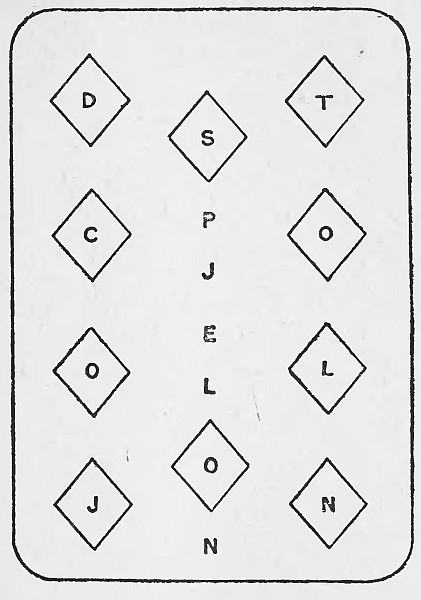
“How strange!” cried Mabel, taking the card and examining it closely. “It surely must be some cipher, the same as the other card which I found sealed up in the safe.”
“No doubt,” I exclaimed, as, stooping and gathering up the remainder of the pack, I noticed that upon each of them, either upon the front or upon the back, were scrawled either fourteen or fifteen letters in a treble column, all, of course, utterly unintelligible.
I counted them. It was a piquet pack of thirty-one, the missing card being the ace of hearts which we had already discovered. By the friction of having been carried on the person for so long the corners and edges were worn, while the gloss of the surface had long ago disappeared.
Aided by Mabel I spread them all upon the table, utterly bewildered by the columns of letters which showed that some deep secret was written upon them, yet what it was we were utterly unable to decipher.
Upon the front of the ace of clubs was scrawled in three parallel columns of five letters each, thus:—
E H N W E D T O L I E H W H R
Again, I turned up the king of spades and found on the reverse only fourteen letters:—
Q W F T S W T H U O F E Y E
“I wonder what it all means?” I exclaimed, carefully examining the written characters in the light. The letters were in capitals just as rudely and unevenly drawn as those upon the ace of hearts, evidently by an uneducated hand. Indeed the A’s betrayed a foreign form rather than English, and the fact that some of the cards were inscribed on the obverse and others on the reverse seemed to convey some hidden meaning. What it was, however, was both tantalising and puzzling.
“It certainly is very curious,” Mabel remarked after she had vainly striven to construct intelligible words from the columns of letters by the easy methods of calculation. “I had no idea that my father carried his secret concealed in this manner.”
“Yes,” I said, “it really is amazing. No doubt his secret is really written here, if we only knew the key. But in all probability his enemies are aware of its existence, or he would not have left it secreted here when he set forth on his journey to Manchester. That man Dawson may know it.”
“Most probably,” was her reply. “He was my father’s intimate acquaintance.”
“His friend—he says he was.”
“Friend!” she cried resentfully. “No, his enemy.”
“And therefore your father held him in fear? It was that reason which induced him to insert that very injudicious clause in his will.”
And then I described to her the visit of the man Dawson on the previous night, telling her what he had said, and his impudent, defiant attitude towards us.
She sighed, but uttered no reply. I noticed that as I spoke her countenance went a trifle paler, but she remained silent, as though she feared to speak lest she should inadvertently expose what she intended should remain a secret.
My chief thought at that moment, however, was the elucidation of the problem presented by those thirty-two well-thumbed cards. The secret of Burton Blair, the knowledge of which had brought him his millions, was hidden there, and as it had been bequeathed to me it was surely to my interest to exert every effort to gain exact knowledge of it. I recollected how very careful he had been over that little bag which now lay empty upon the table, and with what careless confidence he had shown it to me on that night when he was but a homeless wanderer tramping the muddy turnpike roads.
As he had held it in his hand, his eyes had brightened with keen anticipation. He would be a rich man some day, he had prophesied, and I, in my ignorance, had then believed him to be romancing. But when I looked around that room in which I now stood and saw that Murillo and that Tintoretto, each of them worth a small fortune in themselves, I was bound to confess that I had wrongly mistrusted him.
And the secret written upon that insignificant-looking little pack of cards was mine—if only I could decipher it!
Surely no situation could be more tantalising to a poor man like myself. The man whom I had been able to befriend had left me, in gracious recognition, the secret of the source of his enormous income, yet so well concealed was it that neither Mabel nor myself could decipher it.
“What shall you do?” she inquired presently, after poring over the cards in silence for quite ten minutes. “Is there no expert in London who might find out the key? Surely those people who do cryptograms and things could help us?”
“Certainly,” was my answer, “but in that case, if they were successful they would discover the secret for themselves.”
“Ah, I never thought of that!”
“Your father’s directions in his will as to secrecy are very explicit.”
“But possession of these cards without the key is surely not of much benefit,” she argued. “Could you not consult somebody, and ascertain by what means such records are deciphered?”
“I might make inquiries in a general way,” I answered, “but to place the pack of cards blindly in the hands of an expert would, I fear, simply be giving away your father’s most confidential possession. There may be written here some fact which it is not desirable that the world shall know.”
“Ah!” she said, glancing quickly up at me. “Some facts regarding his past, you mean. Yes. You are quite right, Mr Greenwood. We must be very careful to guard the secret of these cards well, especially if, as you suggest, the man Dawson really knows the means by which the record may be rendered intelligible.”
“The secret has been bequeathed to me, therefore I will take possession of them,” I said. “I will also make inquiries, and ascertain by what means such ciphers are rendered into plain English.”
I had at that moment thought of a man named Boyle, a professor at a training-college in Leicester who was an expert at anagrams, ciphers, and such things, and I intended to lose no time in running up there to see him and ascertain his opinion.
Therefore at noon I took train at St. Pancras, and about half-past two was sitting with him in his private room at the college. He was a middle-aged, clean-shaven man of quick intelligence, who had frequently won prizes in various competitions offered by different journals; a man who seemed to have committed Bartlett’s Dictionary of Familiar Quotations to memory, and whose ingenuity in deciphering puzzles was unequalled.
While smoking a cigarette with him, I explained the point upon which I desired his opinion.
“May I see the cards?” he inquired, removing his briar from his mouth and looking at me with some surprise, I thought.
My first impulse was to refuse him sight of them, but on second thoughts I recollected that of all men he was one of the greatest experts in such matters, therefore I drew the little pack from the envelope in which I had placed them.
“Ah!” he exclaimed the moment he took them in his hand and ran quickly through them. “This, Mr Greenwood, is the most complicated and most difficult of all ciphers. It was in vogue in Italy and Spain in the seventeenth century, and afterwards in England, but seems to have dropped into disuse during the past hundred years or so, probably on account of its great difficulty.”
Carefully he spread the cards out in suits upon the table, and seemed to make long and elaborate calculations between the heavy puffs at his pipe.
“No!” he exclaimed. “It isn’t what I expected. Guess-work will never help you in this solution. You might try for a hundred years to decipher it, but will fail, if you do not discover the key. Indeed, so much ingenuity is shown in it that a writer in the last century estimated that in such a pack of cards as this, with such a cipher upon them, there are at least fully fifty-two millions of possible arrangements.”
“But how is the cipher written?” I inquired much interested, yet with heart-sinking at his inability to assist me.
“It is done in this way,” he said. “The writer of the secret settles what he wishes to record and he then arranges the thirty-two cards in what order he wishes. He then writes the first thirty-two letters of his message record, or whatever it may be, on the face or on the back of the thirty-two cards, one letter upon each card consecutively, commencing with the first column, and going on with columns two and three, working down each column, until he has written the last letter of the cipher. In the writing, however, certain prearranged letters are used in place of spaces, and sometimes the cipher is made still more difficult for a chance finder of the cards to decipher by the introduction of a specially arranged shuffle of the cards half-way through the writing of the record.”
“Very ingenious!” I remarked, utterly bewildered by the extraordinary complication of Burton Blair’s secret. “And yet the letters are so plainly written!”
“That’s just it,” he laughed. “To the eye it is the plainest of all ciphers, and yet one that is utterly unintelligible unless the exact formula in its writing be known. When that is ascertained the solution becomes easy. The cards are rearranged in the order in which they were written upon, and the record or message spelt off, one letter on each card in succession, reading down one column after another and omitting the letter arranged as spaces.”
“Ah!” I exclaimed fervently. “How I wish I knew the key.”
“Is this a very important secret, then?” asked Boyle.
“Very,” I replied. “A confidential matter which has been placed in my hands, and one which I am bound to solve.”
“I fear you will never do so unless the key is in existence,” was his answer. “It is far too difficult for me to attempt. The complications which are so simply effected in the writing, shield it effectually from any chance solution. Therefore, all endeavours to decipher it without knowledge of the pre-arrangement of the pack must necessarily prove futile.”
He replaced the cards in the envelope and handed them back to me, regretting that he could not render me assistance.
“You might try every day for years and years,” he declared, “and you would be no nearer the truth. It is too well protected for chance discovery, and is, indeed, the safest and most ingenious cipher ever devised by man’s ingenuity.”
I remained and took a cup of tea with him, then at half-past four entered the express and returned to London, disappointed at my utterly fruitless errand. What he had explained to me rendered the secret more impenetrable and inscrutable than ever.
Chapter Fifteen.
Certain Things we Found at Mayvill.
“Miss Blair, sir,” announced Glave next day just before noon, while I was sitting alone in my room in Great Russell Street, smoking vigorously, and utterly bewildered over the problem of the dead man’s pack of cards.
I sprang to my feet to welcome Mabel, who in her rich warm furs was looking very dainty and charming.
“I suppose if Mrs Percival knew I had come here alone, she’d give me a sound lecture against visiting a man’s rooms,” she said, laughing after I had greeted her and closed the door.
“Well,” I said, “it’s scarcely the first time you’ve honoured me with a visit, is it? And surely you need not trouble very much about Mrs Percival.”
“Oh, she really grows more straight-backed every day,” Mabel pouted. “I mustn’t go here, and I mustn’t go there, and she’s afraid of me speaking with this man, and the other man is not to be known, and so on. I’m really growing rather sick of it, I can tell you,” she declared, seating herself in the chair I had just vacated, unloosing her heavy sable cape, and stretching a neat ankle to the fire.
“But she’s been an awfully good friend to you,” I argued. “As far as I can see, she’s been the most easy-going of chaperons.”
“The perfect chaperon is the one who can utterly and effectually efface herself five minutes after entering the room,” Mabel declared. “And I will give Mrs Percival her due, she’s never clung on to me at dances, and if she’s found me sitting out in a dim corner she has always made it a point to have an urgent call in an opposite direction. Yes,” she sighed, “I suppose I oughtn’t to grumble when I recollect the snappy old tabbies in whose hands some girls are. There’s Lady Anetta Gordon, for instance, and Vi Drummond, both pretty girls out last season, but whose lives are rendered perfect tortures by those two ugly old hags who cart them about. Why, they’ve both told me they dare not raise their eyes to a man without a snappy lecture next day on polite manners and maiden modesty.”
“Well,” I said frankly, standing on the hearthrug, and looking down at her handsome figure: “I really don’t think you have had much to complain about up to the present. Your poor father was most indulgent, and I’m sure Mrs Percival, although she may seem rather harsh at times, is only speaking for your own benefit.”
“Oh, I know I’m a very wilful girl in your eyes,” she exclaimed, with a smile. “You always used to say so when I was at school.”
“Well, to tell the truth, you were,” I answered quite openly.
“Of course. You men never make allowance for a girl. You assume your freedom with your first long trousers, while we unfortunate girls are not allowed a single moment alone, either inside the house or out of it. No matter whether we be as ugly as Mother Shipton or as beautiful as Venus, we must all of us be tied up to some elder woman, who very often is just as fond of a mild flirtation as the simpering young miss in her charge. Forgive me for speaking so candidly, won’t you, Mr Greenwood, but my opinion is that the modern methods of society are all sham and humbug.”
“You’re not in a very polite mood to-day, it seems,” I remarked, being unable to restrain a smile.
“No, I’m not,” she admitted. “Mrs Percival is so very aggravating. I want to go down to Mayvill this afternoon, and she won’t let me go alone.”
“Why do you so particularly wish to go there alone?”
She flushed slightly, and appeared for a moment to be confused.
“Oh, well, I don’t want to go alone very particularly, you know,” she tried to assure me. “It is the foolishness of not allowing me to travel down there like any other girl that I object to. If a maid can take a railway journey alone, why can’t I?”
“Because you have the convenances of society to respect—the domestic servant need not.”
“Then I prefer the lot of the domestic,” she declared in a manner which told me that something had annoyed her. For my own part I should have regretted very much if Mrs Percival had consented to her going down to Herefordshire alone, while it also seemed apparent that she had some secret reason of her own for not taking her elder companion with her.
What, I wondered, could it be?
I inquired the reason why she wished to go to Mayvill without even a maid, but she made an excuse that she wanted to see the other four hunters were being properly treated by the studs-man, and also to make a search through her father’s study to ascertain whether any important or confidential papers remained there. She had the keys, and intended to do this before that odious person, Dawson, assumed his office.
This suggestion, evidently made as an excuse, struck me as one that really should be acted upon without delay, yet it was so very plain that she desired to go alone that at first I hesitated to offer to accompany her. Our friendship was of such a close and intimate character that I could of course offer to do so without overstepping the bounds of propriety, nevertheless I resolved to first endeavour to learn the reason of her strong desire to travel alone.
She was a clever woman, however, and had no intention of telling me. She had a strong and secret desire to go down alone to that fine old country house that was now her own, and did not desire that Mrs Percival should accompany her.
“If you are really going to search the library, Mabel, had I not better accompany and help you?” I suggested presently. “That is, of course, if you will permit me,” I added apologetically.
For a moment she was silent, as though devising some means out of a dilemma, then she answered—
“If you’ll come, I’ll of course be only too delighted. Indeed, you really ought to assist me, for we might discover some key to the cipher on the cards. My father was down there for three days about a fortnight before his death.”
“When shall we start?”
“At three-thirty from Paddington. Will that suit you? You shall come and be my guest.” And she laughed mischievously at such utter break-up of the convenances and the probable chagrin of the long-suffering Mrs Percival.
“Very well,” I agreed; and ten minutes later I went down with her and put her, smiling sweetly, into her smart victoria, the servants of which were now in mourning.
You perceive that I was playing a very dangerous game? And so I was; as you will afterwards see.
At the hour appointed I met her at Paddington, and putting aside her sad thoughtfulness at her bereavement we travelled together down to Dunmore Station, beyond Hereford. Here we entered the brougham awaiting us, and after a drive of nearly three miles, descended before the splendid old mansion which Burton Blair had bought two years before for the sake of the shooting and fishing surrounding it.
Standing in its fine park half-way between King’s Pyon and Dilwyn, Mayvill Court was, and is still, one of the show places of the county. It was an ideal ancestral hall. The grand old gabled house with its lofty square towers, its Jacobean entrance, gateway and dovecote, and the fantastically clipped box-trees and sun-dial of its quaint old-fashioned garden, possessed a delightful charm which few other ancient mansions could boast, and a still further interesting feature lay in its perfectly unaltered state throughout, even to the minutest detail. For close on three hundred years it had been held by its original owners, the Baddesleys, until Blair had purchased it—furniture, pictures, armour, everything just as it stood.
It was nearly nine o’clock when Mrs Gibbons, the elderly housekeeper, welcomed us, in tears at the death of her master, and we passed into the great oak-panelled hall in which hung the sword and portrait of the gallant cavalier. Captain Harry Baddesley, of whom there still was told a romantic story. Narrowly escaping from the battle-field, the captain spurred homewards, with some of Cromwell’s soldiers close at his heels; and his wife, a lady of great courage, had scarcely concealed him in the secret chamber when the enemy arrived to search the house. Little daunted, the lady assisted them and personally conducted them over the mansion. As in so many instances, the secret room was entered from the principal bedroom, and in inspecting the latter the Roundheads had their suspicions aroused. So they decided to stay the night.
The hunted man’s wife sent them an ample supper and some wine which had been carefully drugged, with the result that the unwelcome visitors were very soon soundly asleep, and the gallant captain, before the effects of the wine had worn off, were far beyond their reach.
Since that day the old place had remained absolutely unchanged, with its rows of dark, time-mellowed family portraits in the big hall, its Jacobean furniture and its old helmets and pikes that had borne the brunt of Naseby. The night was bitterly cold. In the great open hearth huge logs were blazing, and as we stood there to warm ourselves after our journey, Mrs Gibbons, who had been apprised of our advent by telegraph, announced that she had prepared supper for us as she knew we could not arrive in time for dinner.
Both she and her husband expressed the deepest sympathy with Mabel in her bereavement, and then having removed our coats we went on into the small dining-room, where supper was served by Gibbons and the footman with that old-fashioned stateliness characteristic of all in that fine old-world mansion.
Gibbons and his wife, old retainers of the former owners, were, I think, somewhat surprised that I had accompanied their young mistress alone, nevertheless Mabel had explained to them how she wished to make a search of her father’s effects in the library, and that for that reason she had invited me to accompany her. Yet I must confess that I, on my part, had not yet formed any conclusion as to the real reason of her visit. That there was some ulterior motive in it I felt certain, but what it was I could not even guess.
After supper Mrs Gibbons took my pretty companion to her room, while Gibbons showed me the one prepared for me, a long big chamber on the first floor, from the windows of which I had a wide view over the undulating lawns to Wormsley Hill and Sarnesfield. I had occupied the room on several occasions, and knew it well, with its great old carved four-poster bed, antique hangings, Jacobean chests and polished oaken ceiling.