V A Sketch in Outline of Jacques Callot
Reading edition
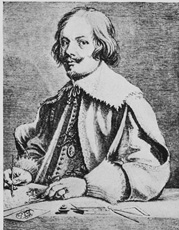
In the Print Room of the New York Public Library are a large number of etchings by Jacques Callot, which are a mine of wealth to the painter-etcher of to-day, curious of the methods of his predecessors. Looking at the portrait of Callot in which he appears at the height of his brief career with well formed, gracious features, ardent eyes, a bearing marked by serenity and distinction, an expression both grave and genial, the observer inevitably must ask: "Is this the creator of that grotesque manner of drawing which for nearly three centuries has borne his name, the artist of the Balli, the Gobbi, the Beggars?" In this dignified, imaginative countenance we have no hint of Callot's tremendous curiosity regarding the most fantastic side of the fantastic times in which he lived. We see him in the rôle least emphasized by his admirers, although that to which the greater number of his working years were dedicated: the rôle, that is, of moralist, philosopher and historian, one deeply impressed by the sufferings and cruelties of which he became a sorrowful critic.
There surely never was an artist whose life and environment were more faithfully illustrated by his art. To know one is to know the other, at least as they appear from the outside, for with Callot, as with the less veracious and ingenuous Watteau, it is the external aspect of things that we get and from which we must form our inferences. Only in his selection of his subjects do we find the preoccupation of his mind; in his rendering he is detached and impersonal, helping us out at times in our knowledge of his mental attitude with such quaint rhymes as those accompanying Les Grandes Misères de la Guerre, but chiefly confining his hand to the representation of forms, relations and distances, with as little concern as possible for the expression of his own temperament, or for psychological portraiture of any sort.
In the little history, more or less authenticated, of his eventful youth is the key to his charm as an artist, a charm the essence of which is freedom, an easy, informal way of looking at the visible world, a light abandon in the method of reproducing it, an independence of the tool or medium, resulting in art which, despite its minuteness of detail, seems to "happen" as Whistler has said all true art must. The beginning was distinctly picturesque, befitting a nature to which the world at first unfolded itself as a great Gothic picturebook filled with strange, eccentric and misshapen figures.
One spring day in 1604, a band of Bohemians, such as are described in Gautier's Le Capitaine Fracasse, might have been seen journeying through the smiling country of Lorraine on their way to Florence to be present there at the great Fair of the Madonna. No gipsy caravan of to-day would so much as suggest that bizarre and irresponsible company of men, women, and children, clad in motley rags, some in carts, some trudging on foot, some mounted on asses or horses rivaling Rosinante in bony ugliness, the men armed with lance, cutlass and rifle, a cask of wine strapped to the back of one, a lamb in the arms of another. A couple of the swarming children were decked out with cooking utensils, an iron pot for a hat, a turnspit for a cane, a gridiron hanging in front apron wise. Chickens, ducks, and other barnyard plunder testified to the marauding course of the troop whose advent at an inn was the signal for terrified flight on the part of the inmates. The camp by night, if no shelter were at hand, was in the forest, where the travelers tied their awnings to the branches of trees, built their fires, dressed their stolen meats, and lived so far as they could accomplish it on the fat of the land—for the most part of their way a rich and lovely land of vine-clad hills and opulent verdure.
The period was lavish in curious gay figures to set against the peaceful background of the landscape. Strolling players of the open-air theaters, jugglers, fortune-tellers, acrobats, Pierrots, and dancers amused the pleasure-loving people. The band of Bohemians just described was but one of many. Its peculiarity consisted in the presence among its members of a singularly fair and spirited child, about twelve years of age, whose alert face and gentle manner indicated an origin unmistakably above that of his companions. This was little Jacques Callot, son of Renée Brunehault and Jean Callot, and grandson of the grandniece of the Maid of Orleans, whose self-reliant temper seems to have found its way to this remote descendant.
Already determined to be an artist, he had left home with almost no money in his pocket and without the consent of his parents, set upon finding his way to Rome, where one of his playfellows—the Israel Henriet, "son ami," whose name is seen upon so many of the later Callot prints—was studying.
Falling in with the gipsies, he traveled with them for six or eight weeks, receiving impressions of a flexible, wanton, vagabond life that were never entirely to lose their influence upon his talent, although his most temperate and scholarly biographer, M. Meaume, finds little of Bohemianism in his subsequent manner of living. Félibien records that according to Callot's own account, when he found himself in such wicked company, "he lifted his heart to God and prayed for grace not to join in the disgusting debauchery that went on under his eyes." He added also that he always asked God to guide him and to give him grace to be a good man, beseeching Him that he might excel in whatever profession he should embrace, and that he "might live to be forty-three years old." Strangely enough this most explicit prayer was granted to the letter, and was a prophecy in outline of his future.
Arriving in Florence with his friends the Bohemians, fortune seemed about to be gracious to him. His delicate face with its indefinable suggestions of good breeding attracted the attention of an officer of the Duke, who took the first step toward fulfilling his ambition by placing him with the painter and engraver, Canta Gallina, who taught him design and gave him lessons in the use of the burin. His taste was already for oddly formed or grotesque figures, and to counteract this tendency Gallina had him copy the most beautiful works of the great masters.
Possibly this conventional beginning palled upon his boyish spirit, or he may merely have been impatient to reach Israel and behold with his own eyes the golden city described in his friend's letters. At all events, he shortly informed his master that he must leave him and push on to Rome. Gallina was not lacking in sympathy, for he gave his pupil a mule and a purse and plenty of good advice, and started him on his journey.
Stopping at Siena, Callot gained his first notion of the style, later to become so indisputably his own, from Duccio's mosaics, the pure unshadowed outline of which he bore in mind when he dismissed shading and cross-hatching from the marvelously expressive little figures that throng his prints. He had hardly entered Rome, however, when some merchants from the town of Nancy, his birthplace, recognized him and bore him, protesting, back to his home.
Once more he ran away, this time taking the route to Italy through Savoy and leading adventurous days. In Turin he was met by his elder brother and again ignominiously returned to his parents. But his persistence was not to go unrewarded. The third time that he undertook to seek the light burning for him in the city of art, he went with his father's blessing, in the suite of the ambassador dispatched to the Pope by the new duke, Henry II.
It is said that a portrait of Charles the Bold, engraved by Jacques from a painting, was what finally turned the scale in favor of his studying seriously with the purpose of making art his profession. He had gained smatterings of knowledge, so far as the use of his tools went, from Dumange Crocq, an engraver and Master of the Mint to the Duke of Lorraine, and from his friend Israel's father, chief painter to Charles III. He had the habit also of sketching on the spot whatever happened to attract his attention.
In truth he had lost but little time. At the age of seventeen he was at work, and very hard at work, in Rome under Tempesta. Money failing him, he became apprenticed to Philippe Thomassin, a French engraver, who turned out large numbers of rubbishy prints upon which his apprentices were employed at so much a day. Some three years spent in this fashion taught Callot less art than skill in the manipulation of his instruments. Much of his early work is buried in the mass of Thomassin's production, and such of it as can be identified is poor and trivial. His precocity was not the indication of rapid progress. His drawing was feeble and was almost entirely confined to copying until 1616, when, at the age of twenty-four, he began regularly to engrave his own designs, and to show the individuality of treatment and the abundant fancy that promptly won for him the respect of his contemporaries.
While he was in Thomassin's studio, it is reported that his bright charm of face and manner gained him the liking of Thomassin's young wife—much nearer in age to Callot than to her husband—and the jealousy of his master. He presently left the studio and Rome as well, never to return to either. It is the one misadventure suggestive of erratic tendencies admitted to Callot's story by M. Meaume, although other biographers have thrown over his life in Italy a sufficiently lurid light, hinting at revelries and vagaries and lawless impulses unrestrained. If, indeed, the brilliant frivolity of Italian society at that time tempted him during his early manhood, it could only have been for a brief space of years. After he was thirty all unquestionably was labor and quietness.
From Rome he went to Florence, taking with him some of the plates he recently had engraved. These at once found favor in the eyes of Cosimo II, of the Medici then ruling over Tuscany, and Callot was attached to his person and given a pension and quarters in what was called, "the artist's gallery." At the same time he began to study under the then famous Jules Parigi, and renewed his acquaintance with his old friend Canta Gallina, meeting in their studios the most eminent artists of the day—the bright day not yet entirely faded of the later Renaissance.
Portrait of Jacques Callot Engraved by Vosterman after the painting of Van Dyck
Still his work was copying and engraving from the drawings of others. Had he been under a master less interested and sympathetic than the good Parigi, it is possible that his peculiar talent would never have declared itself. At all events, Parigi urged him, and the urging seems to have been necessary, to improve his drawing, to drop the burin and study the great masters. Especially Parigi prayed him to cultivate his precious talent for designing on a very small scale the varied and complicated compositions with which his imagination teemed. His taste for whatever was fantastic and irregular in aspect had not been destroyed by his study of the beautiful. The Bohemian side of human nature, the only nature for which he cared, still fascinated his mind, whether it had or had not any influence upon his activities, and Parigi's remonstrances were silenced by his appreciation of the comic wit sparkling in his pupil's sketches.
We see little of Callot among his friends of this period, but the glimpses we get reveal a lovable and merry youth in whose nature is a strain of sturdy loyalty, ardent in work and patient in seeking perfectness in each individual task undertaken, but with a curious contrasting impatience as well, leading him frequently to drop one thing for another, craving the relaxation of change. An anecdote is told of him that illustrates the sweet-tempered blitheness of spirit with which he quickly won affection.
In copying a head he had fallen into an error common among those who draw most successfully upon a small scale, he had made it much too large. His fellow-students were prompt to seize the opportunity of jeering at him, and he at once improvised a delightful crowd of impish creatures on the margin of his drawing, dancing and pointing at it in derision.
His progress under Parigi's wise instruction was marked, but it was four years after his arrival in Florence before he began to engrave to any extent from his own designs. In the meantime, he had studied architecture and aerial and linear perspective, and had made innumerable pen and pencil drawings from nature. He had also begun to practice etching, attaining great dexterity in the use of the needle and in the employment of acids.
In 1617—then twenty-five years old—he produced the series of plates which he rightly deemed the first ripe fruits of his long toil in the domain of art. These were the delightful Capricci di varie figure in which his individuality shone resplendent. They reproduced the spectacle of Florence as it might then have been seen by any wayfarer; street people, soldiers, officers, honest tradesmen and rogues, mandolin players, loiterers of the crossways and bridges, turnpike-keepers, cut-throats, buffoons and comedians, grimacing pantaloons, fops, coquettes, country scenes, a faithful and brilliant study of the time, the manners, and the place. Parigi was enthusiastic and advised his pupil to dedicate the plates to the brother of the Grand Duke.
After this all went well and swiftly. Passing over many plates, important and unimportant, we come three years later to the Great Fair of Florence, pronounced by M. Meaume, Callot's masterpiece. "It is doubtful," says this excellent authority, "if in Callot's entire work a single other plate can be found worthy to compete with the Great Fair of Florence. He has done as well, perhaps, but never better."
At this time his production was, all of it, full of life and spirit, vivacious and fluent, the very joy of workmanship. He frequently began and finished a plate in a day, and his long apprenticeship to his tools had made him completely their master. In many of the prints are found traces of dry point, and those who looked on while he worked have testified that when a blank space on his plate displeased him he was wont to take up his instrument and engrave a figure, a bit of drapery, or some trees in the empty spaces, directly upon the copper, improvising from his ready fancy.
For recreation he commonly turned to some other form of his craft. He tried painting, and some of his admirers would like to prove that he was a genius in this sort, but it is fairly settled that when once he became entangled in the medium of color he was lost, producing the heaviest and most unpleasing effects, and that he produced no finished work in this kind. He contributed to the technical outfit of the etcher a new varnish, the hard varnish of the lute-makers which up to that time had not been used in etching, and which, substituted for the soft ground, enabled him to execute his marvelous little figures with great lightness and delicacy, and also made it possible for him to keep several plates going at once, as he delighted to do, turning from one to another as his mood prompted him.
This Florentine period was one of countless satisfactions for him. More fortunate than many artists, he won his fame in time to enjoy it. His productions were so highly regarded during his lifetime that good proofs were eagerly sought, and to use Baldinucci's expression, were "enfermées sous sept clefs." He was known all over Europe, and about his neck he wore a magnificent gold chain given him by the Grand Duke Cosimo II, in token of esteem. In the town which he had entered so few years before in the gipsy caravan, he was now the arbiter of taste in all matters of art, highly honored, and friend of the great. When Cosimo died and the pensions of the artists were discontinued, Callot was quite past the need of princely favors, and could choose his own path. He had already refused offers from Pope and emperor and doubtless would have remained in Florence had not Prince Charles of Lorraine determined to reclaim him for his native place.
In 1621 or 1622 he returned to Nancy, never again to live in Italy. He went back preeminent among his countrymen. He had done in etching what had not been done before him and much that has not been done since. He had created a new genre and a new treatment. He had been faithful to his first lesson from Duccio and had become eloquent in his use of simple outline to express joy, fear, calm or sorrow, his work gaining from this abandonment of shadows a largeness and clearness that separates him from his German contemporaries and adds dignity to the elegance and grace of his figures. His skill with the etching needle had become so great that technical difficulties practically did not exist for him. What he wished to do he did with obvious ease and always with distinction. His feeling for synthesis and balance was as striking as his love of the curious, and as these qualities seldom go together in one mind, the result was an art extremely unlike that of other artists. It was characteristic of him that he could not copy himself, and found himself completely at a loss when he tried to repeat some of his Florentine plates under other skies.
Arrived at Nancy, he found Henry II, the then reigning Duke of Lorraine, ready to accord him a flattering welcome, and under his favor he worked with increasing success. Among the plates produced shortly after his return is one called Les Supplices, in which is represented all the punishments inflicted throughout Europe upon criminals and legal offenders. In an immense square the revolting scenes are taking place, and innumerable little figures swarm about the streets and even upon the roofs of the houses. Yet the impression is neither confused nor painful. A certain impersonality in the rendering, a serious almost melancholy austerity of touch robs the spectacle of its ignoble suggestion. Inspection of this remarkable plate makes it easy to realize Callot's supreme fitness for the tasks that shortly were to be laid upon him.
He was chosen by the Infanta Elisabeth-Claire-Eugenie of Austria to commemorate the Siege of Breda, in a series of etchings, and while he was in Brussels gathering his materials for this tremendous work he came to know Van Dyck, who painted his portrait afterward engraved by Vosterman, a superb delineation of both his face and character at this important period of his eminent career. Soon after the etchings were completed, designs were ordered by Charles IV, for the decorations of the great carnival of 1627. Callot was summoned to Paris to execute some plates representing the surrender of La Rochelle in 1628, and the prior attack upon the fortress of St. Martin on the Isle of Ré. In Paris he dwelt with his old friend Israel Henriet, who dealt largely in prints and who had followed with keen attention Callot's constantly increasing renown. Henriet naturally tried to keep his friend with him in Paris as long as possible, but Callot had lost by this time the vagrant tendencies of his youth. He was married and of a home-keeping disposition, and all that Henriet could throw in his way of stimulating tasks and congenial society, in addition to the formidable orders for which he had contracted, detained him hardly longer than a year. Upon leaving he made over all his Parisian plates save those of the great sieges to Henriet, whose name as publisher appears upon them.
Callot's return to Nancy marked the close of the second period of his art, the period in which he painted battles with ten thousand episodes revealed in one plate, and so accurately that men of war kept his etchings among their text-books for professional reference. The next demand that was made upon him to represent the downfall of a brave city came from Louis XIII, upon the occasion of his entering Nancy on the 25th of September, 1633. By a ruse Richelieu had made the entry possible, and the inglorious triumph Louis deemed worthy of commemoration by the accomplished engraver now his subject. Neither Callot's high Lorraine heart nor his brilliant instrument was subjugated, however, and he respectfully begged the monarch to absolve him from a task so revolting to his patriotism. "Sire," he said, "I am of Lorraine, and I cannot believe it my duty to do anything contrary to the honor of my Prince and my Country." The king accepted his remonstrance in good part, declaring that Monsieur of Lorraine was very happy to have subjects so faithful in affection. Certain courtiers took Callot to task, however, for his refusal to obey the will of His Majesty, and to them Callot responded that he would cut off his thumb rather than do violence to his sense of honor. Some of the artist's historians have made him address this impetuous reply to the king himself, but M. Meaume reminds us that, familiar with courts, he knew too well the civility due to a sovereign to make it probable that he so forgot his dignity. Later the king tried to allure Callot by gifts, honors and pensions, but in vain. The sturdy gentleman preferred his oppressed prince to the royal favor, and set himself to immortalizing the misfortunes of his country in the superb series of etchings which he called "Les Misères de la Guerre." He made six little plates showing in the life of the soldier the misery he both endures and inflicts upon others. These were the first free inspiration of the incomparable later set called "Les Grandes Misères," "a veritable poem," M. Meaume declares, "a funeral ode describing and deploring the sorrows of Lorraine." These sorrows so much afflicted him that he would gladly have gone back to Italy to spend the last years of his life, had not the condition of his health, brought on by his indefatigable labor, prevented him.
He lived simply in the little town where he had seen his young visions of the spirit of art, walking in the early morning with his elder brother, attending mass, working until dinner time, visiting in the early afternoon with the persons, many of them distinguished and even of royal blood, who thronged his studio, then working until evening. He rarely attended the court, but grew constantly more quiet in taste and more severe in his artistic method, until the feeling for the grotesque that inspired his earlier years were hardly to be discerned. Once only, in the tremendous plate illustrating the Temptation of Saint Anthony, did he return to his old bizarre vision of a world conceived in the mood of Dante and Ariosto.
Callot died on the 24th of March, 1635, at the age of forty-three. Still a young man, he had passed through all the phases of temperament that commonly mark the transit from youth to age. And he had used his art in the manner of a master to express the external world and his convictions concerning the great spiritual and ethical questions of his age. He enunciated his message distinctly; there were no tender gradations, no uncertainties of outline or mysteries of surface in his work. It is the grave utterance of the definite French intelligence with a note of deeper suggestion brought from those regions of ironic gloom in which the Florentine recorded his sublime despair.