XI One Side of Modern German Painting
Reading edition
The best substitutes for the judgments of posterity are the judgments of foreigners. A group of pictures by the artists of one country, taken to another country for exhibition and criticism, is subjected to something the same test as the pictures of one generation coming under the scrutiny of another generation.
When a collection of pictures by modern German artists was exhibited in America in 1909, the American people were prompt in their recognition of a certain quality which they termed national. The critics—many of them—saw this quality from the adverse side and were far from complimentary to the Germans in their comparisons between American art and German art, but a general impression was given of a vitality sufficiently marked to make itself felt by the least initiated observer. A number of the pictures by the older men had little enough of this vitality, but where it existed it was so decided as to leaven the mass. And there was almost none of the sentimentality characterizing the Teutonic ideal as it had manifested itself in the pictures formerly brought to this country.
Compared, then, with the paintings of American artists and with those of the Frenchmen, whose work we have known so much better than that of any other country, compared also with the work of the modern Spaniards, whose paintings were on exhibition the same winter at the Hispanic Museum, we find the special character of the German painting to exist in a resolute individualism, a determination to express the inner life of the artist, his temperament and predilections and his mood at whatever cost of technical facility. Expressiveness, getting the idea into circulation, getting something said, this appears to be the common goal of the German painter of the present day.
In such case, of course, the idea is of particular importance. If it is to take precedence over purely esthetic qualities it is reasonable to expect it to be an idea of no little importance. Let us examine some of the painters represented in the exhibition arranged for America, and see whether in most cases the idea is emotional as with the artists of China and Japan, and therefore peculiarly appropriate to translation by rhythms of line and harmonies of color, or intellectual, and therefore demanding a complex and difficult expression and the solution of technical problems that do not come into the question at all when nothing else is required than to evoke an especial mood or temper of soul.
The oldest of the painters represented was Adolf von Menzel, who was born in 1815 and died in his ninetieth year. As he began work at an early age his accomplishment practically covers the period of the nineteenth century. He has been designated by one of his German critics as three Menzels in one: the first, the historian of the Freiderician period; the second, the historian of his own time, recording the court life in which he played his part; the third, the acute observer of the life of the streets and workrooms and a commentator on the amusing details of the passing show.
A number of his sketches were shown at the exhibition, a couple of landscapes, a ballroom scene and a theater subject, beside a little mediaeval subject in gouache. These displayed his dexterity of hand which was truly astounding, and also his memory, as the "Théâtre Gymnase" was painted fully a year after he left Paris. The ballroom supper was painted in an ironic mood and the gluttony of his fellow humans, their unattractive personalities, their curious aspect of the educated animal, appear with an intense and pitiless fidelity to the fact which is of the essence of intellectual realism, but which could equally have been achieved through the medium of words. In spite of a cultivated color sense and a fine control over his instrument he was from first to last essentially an illustrator. It was difficult for him to omit any detail that would add to the piquancy or fulness of his story, however much the omission might have done for his general effect. He said himself, "There should be no unessentials for the artist," and he advised his pupils to finish as much as possible and not to sketch at all. This passion for completeness rarely accompanies a strong feeling for the romantic aspects of nature or for atmospheric subtleties. Neither does the painter who observes human nature closely and represents it with a detailed commentary upon its characteristics usually convey the impression of any subjective emotion.
Menzel is no exception to this rule. In his work he appears as emotionless as a machine, but his accomplishment is not mechanical. It is, on the contrary, the record of a busy, highly individualized, accurate mind. A Berlin man, he had the alertness, the clear-cut effectiveness, the energy, and the coldness typical of a cosmopolitan product. If we compare his "Ball Supper" in which the glare of lights, the elaboration of costume, the rapacity and shallow glittering superficiality of a Court festivity are presented almost as though in hackneyed phrases, so devoid is the picture of any meaning beyond the obvious, with the "Steel Foundry" in which the unsentimental acceptance of labor as a necessary factor in civilization is conspicuous, it is clear that his mind was free from dreams and visions whichever side of society he looked upon. In this respect his influence is salutary. It is like a cool and wholesome breeze blowing away all miasmic vapors, and there is a positively exhilarating quality in his firm assumption of the power of the human being over his material. His workmen are men of strong muscle and prompt brain. In the "Steel Foundry" we see their efficient handling of the great bars of metal with admiration as we should in life, and we note what in modern times is not always present for notation, the intelligence and interest in their faces. In one corner of the room, behind a screen or partition, a little group is devouring luncheon. Here we strike once more the note of the ballroom supper in the munching eagerness of the eaters, but seen in juxtaposition with the physical force and effort of the workers it ceases to be revolting, and seems to symbolize the lusty joy of living with a sympathetic zest of realization.
In all of Menzel's work we have this sense of physical and mental competency. It shows nothing of the abnormal or decadent, and it must also be admitted that only in a few instances does it show anything of esthetic beauty. He was able to paint crowds of people and he managed to get a remarkable unity of effect in spite of his devotion to detail, but his masses of light and shade are not held in that noble harmonious relation achieved by the peasant Millet who was Menzel's contemporary, his lines have no rhythmic flow, his color, though often charming, is seldom held together in a unified tone. Some one has called him "the conscience of German painting," but he is more than that. He is both conscience and brain. It is always possible to obtain an intellectual satisfaction from his point of view. What is lacking is emotion.
We feel this lack in other Berlin masters. Professor Max Liebermann is one of the most distinguished of the modern group, and his large, cool, definite art is innocent of the moving quality. He was represented in the exhibition by a portrait of Dr. Bode, a vigorous little composition called "The Polo-players," the "Flax Barn at Laren," and "The Lace Maker." The last two were especially typical of his steady detachment from his subject. The old lace maker, bending over her bobbins, suggests only absorption in her task. There is no ennobling of her form, no idealizing of her features, no enveloping of her occupation with sentiment, nothing but the direct statement of her personality which is neither subtle nor complex and the description of what she is doing. But she is intensely real, more real, even, than Menzel's closely observed individuals. Liebermann, born in 1847, was the leader of the new tendency characterizing the Germany of the seventies, the tendency toward constant reference to nature as opposed to the old-fashioned conventionalism and Academic methods. There could have been no safer leader for a band of rebels since he was the sanest of thinkers and worked out a style in which the classic qualities of nobility in the disposition of lines and spaces and remarkable purity of form played a prominent part.
Courtesy of Berlin Photographic Company. Peasant Women of Dachauer From a painting by Leibl
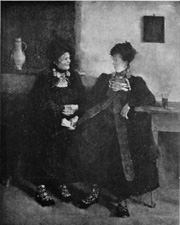
Observing his "Flax Barn," in comparison with the work of his compatriots, its fine freedom from triviality of detail was apparent, and the beauty of its cool light, spread over large spaces and diffused throughout the interior of the low shed, made itself felt. One noted also, as elements of the picture's peculiarly dignified appeal, the severe arrangement of the figures with the long row of workers under the windows, the long threads of flax passing over their heads to the women in the foreground, and the almost straight line formed in turn by these women. The composition, quite geometrical in its precision, gave a sense of deep repose in spite of the vitality of the individual figures and the impression they made of being able to turn and move at will, an impression nearly always missed by Leibl, Liebermann's great forerunner in the painting of humble life. We get much the same austere effect from the almshouse pictures of old men and women on benches in the open square, always arranged in a geometrical design, and always calm in gesture and mild in type, which appear from time to time in the foreign exhibitions of Liebermann's work.
Liebermann has done for the Germans something of what Millet did for the French. He has built his art upon the daily life of the poor, but while, like Millet, he has introduced a monumental element into his work, it is clearer, more closely reasoned, more firmly knit than Millet's art, and at the same time less emotional. Liebermann's hospitality to purely technical ideas, his interest in problems of light and air, his diligent analysis of motion, his ability to translate a scene from the life of the laboring class without sentimentality, without prettiness or eloquence or any of the attributes that catch the multitude, give to his art a touch of coldness that is not without its charm for those who care for a highly developed orderly product of the mind.
Most of the Berlin men who are in any degree notable share somewhat in this attribute. Arthur Kampf, although he has less than Liebermann of cool detachment, has both elegance and gravity. He could hardly have had a better representation by any one or two canvases than by the "Charity" and the "Two Sisters" of the American exhibition. In the first he depicts a street scene with its contrasts of poverty and wealth. A man and woman in evening dress, returning from their evening's pleasure, are besought by poor people clustering around a soup stall and drop coin into the insistent hands. The smoking caldron of soup in the center and the circle of sharply differentiated faces form an admirable composition, the apparently accidental lines of which play into a dignified linear scheme. The "Two Sisters" reveals the influence of Velasquez in its flat modeling and subtle characterization, and in its atmospheric grays enlivened with geranium reds. Both of these pictures indicate a modern temper of mind in the fluency of their technique and the realism of their treatment together with the attention paid to the tonal quality and to the character of the space composition. Kampf, however, although a young man—he was born in 1864—has passed through many phases of development which are recorded in his many-sided art. His subjects range from the historical themes of his wall decorations at Magdeburg and Aachen through portraiture in which he grasps characters essentially diverse and suggests with unerring instinct the dominant quality, scenes of labor as in his "Bridge-Building," scenes of brutality and excitement as in his "Bull-fight," scenes from the drama of the Biblical story, scenes of domestic life as in his delicately humorous picture of the absorbed reader eating his breakfast with the morning paper propped up in front of him, and scenes of peaceful holiday-making among the poor as in his idyllic "Sunday Afternoon" which shows a peasant boy playing his harmonicum under the trees, with his old father and mother sitting by in placid enjoyment. Various as these pictures are and closely as the manner has in each case been adapted to the special subject, we nowhere miss the note of individuality, although in such a portrait as that of the Kaiser, which was shown in America, it unquestionably is subdued. Neither do we miss the note of locality. Born at Aachen, Kampf is a true Rheinlander and one of his German critics notes that we must look to this fact for the explanation of his special qualities, declaring that without the Rheinlander's cheerfulness and energetic temperament, and without the background of the ancient Rhenish culture, he would be inconceivable. On the other hand his turning to drama and romance for his inspiration speaks of his Duesseldorfian training and his realism of representation allies him to Menzel. At forty-two he was made president of the Royal Academy of Art in Berlin, and it is probable that the wholesome Rhenish energy of which his critic speaks will save him from sinking into the formalism of the academic tradition.
In his art, however, as in that of his compatriots, it is apparent that the world of ideas is the world in which he lives, and he works to express his mind rather than his soul, his thoughts rather than his emotions, if we follow the indefinite and arbitrary division between thought and feeling that does service as a symbol of a meaning difficult to express clearly.
There were other interesting painters represented in the Berlin group at the American Exhibition, Otto Engel, Fritz Berger, Hans Hartig—and of all it is more or less true that the idea in their work is more important than the feeling. It is true also that the tradition of the peasant Leibl, a great painter, but invariably cold, rests upon most of them. His wonderful manipulation of pigment is equaled by none of them, but his accurate, detached observation, his balanced rendering, the firmness of his method, have entered more or less into their scheme of art. And it is to be noted that his ideas and theirs are ideas appropriate to the painter's medium. Menzel's literary bent is not shared by them, his predilection for a story to illustrate almost never appears among the younger Berlin painters, and he cannot in any real sense be considered their prototype.
When we turn to the older members of the modern Munich school we find the influence of Boecklin dominant. Arnold Boecklin, a Swiss by birth, and possessed of the Swiss ingenuity of mind, has been the subject of endless discussion among the Germans of the present day. He exhausted his very great talent in painting a symbolic world, and by his appreciation of the value of coherence he made his paintings impressive. They are each a perfectly coherent arrangement of parts, making a whole which has the appearance of simplicity, however numerous the elements composing it may be. By a combined generalization and intensity he turned the actual world which he studied closely enough, into his own unreality. Thus, in his Italian landscapes, he reveals the architectonic structure of his scene stripped of all incidental ornament, the upright and horizontal lines left severe and uncompromised, and the blue of the heavens and the sea, and the dark green of the cypresses, pushed to an almost incredible depth. Everything is more significant than in nature, yet nature has provided the elements of significance. It is in his ability to see things whole and to co-ordinate the selected details that Boecklin is most an artist. This largeness of generalization gives him power over the imagination, and is, perhaps the only, certainly the chief source of his power. His color by its very intensity overdoes the intended effect. The imagination instead of being stimulated is sated, and his obvious symbolism fails to pique the curiosity. Moreover, his handling of paint lacks sensitiveness. He has something of the disregard shown by the English painter Watts for the beauty inherent in his material which might as well be clay or textile as pigment in his hands. But his appreciation of the effect upon the mind of noble arrangements of space and mass raises him to a much higher place as an artist than he can be said to occupy as a painter.
Fiddling Death From a portrait by Arnold Boecklin
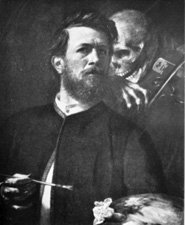
Franz von Stuck is Boecklin's most distinguished follower. When we turn from the examples of Boecklin's work, by no means the most impressive examples, exhibited in America, to Stuck's "Inferno" we perceive both the influence of Boecklin and the powerful individuality that mingles with it.
There is Boecklin's insistence upon the symbol, and upon the bodying forth of things unseen, there is the solid violence of color, there is the pompous statement of the half-discerned truths which more sensitive artists are content to whisper. But there is also a splendid arabesque of line and a deeper reading of the spiritual content of the subject.
If we compare Stuck with William Blake whose fancy also was haunted by Dantesque conceptions, we see how much more impressive Blake's visions of the unreal world are and we find the reason in their swift energy of conception and in the artist's tenacity in holding his conception. With both Boecklin and Stuck we feel that the manner of rendering the conception becomes more important than the initial conception, and this seldom, if ever, is true of Blake. In spite of Boecklin's superb restraint in the disposition of his masses, when it comes to color he is at the mercy of the material pigment and permits it to obliterate where it should enhance and reveal. His forms, also, and even more than Stuck's, lose vitality under the weight of significance forced upon them, while Blake's emerge from the blank panel clean and strong and unencumbered. We feel that Blake, with all his struggle to utter truth by means of symbol, never allows his mind to lose the idea that "Living form is eternal existence," but in Boecklin's pictures "living form" is often buried beneath his colored clays.
Thus we see that it cannot truly be said of him and his followers that the idea is of first importance to them. It is their material that is of first importance, otherwise they would learn so to subordinate their material as to support and disclose their idea. This is the more obvious that their idea is emotional and therefore perfectly suited to expression through the medium of art. Liebermann's ideas although they are intellectual are not of a kind that cannot appropriately be translated into pictures, and his respect for them leads him to fit his manner of expression closely to their requirements. Like Leibl he is a painter and a thinker in one, and the faculties of the two work in complete coordination.
Painters of Boecklin's type, on the other hand, wish to produce in the observer a strong emotion, but they become slaves to their medium because their own emotion is not sufficiently powerful to conquer their minds, which become diverted by the colors and forms they produce. One of Blake's swift upward soaring lines has more power to carry the imagination heavenward than all the versions of Boecklin's "Island of Death."
Against Boecklin's followers, whose minds are more or less befogged by their lack of appreciation of paint as a means to an end, we must place Wilhelm Truebner who is a clear thinker and a great painter, with more warmth than Liebermann and with a reticent color sense, a feeling for expressive form, a love of reality, and no apparent desire to re-invent the grotesque. His elegance of line in itself sets him apart from most of his compatriots, and his knowledge of how to extract from his color scheme its essential beauty is greater than that of most modern painters, whatever their nationality. His blacks have the depth and luster without unctiousness characteristic of black as the great colorists use it, and in his touches of pale refined color enlivening a black and white composition, we have the delightful effect so often given by Manet, as of a bunch of bright flowers thrown into a shadowy corner.
If young Germany were content to follow in Truebner's footsteps we should soon have a revival of the ancient craftsmanship and conscience that animated Holbein and Dürer. Young Germany, however, has other plans. To learn of them the reader is referred to Meier-Graefe's comprehensive and stimulating volume on modern art. The only representation of the painters of the immediate present given in the American exhibition was confined to the Scholle School, which, however, indicates clearly the creative impulse that is stirring in the younger painters. "A warlike state," Blake wrote, "never can produce Art. It will Rob and Plunder and accumulate into one place and Translate and Copy and Buy and Sell and Criticize, but not Make." This has been true of the Germans, but the present generation is bent upon making and it is natural that the strongest impulse toward originality should come to the Munich painters rather than to the cosmopolitan Berlin men.
The Scholle is a Munich association consisting of a group of young men who, taking the humble and fecund earth as their symbol, as the title of the society implies, seek to get into their painting the vigor and intensity of life and force which devotion to the healthy joys provided by our mother Earth is supposed to engender.
They are like the giant Antaeus whose strength was invincible so long as he remained in contact with the earth, but who easily was strangled when lifted into the upper air. Their strength also melts into helplessness when confronted by problems of atmosphere and the delicate veils of tone which enwrap the material world for the American painter.
But the energy of these young Germans in their own field is something at which to wonder. They remind one of their critics of a band of lusty peasant boys journeying in rank from their University to the nearest beer garden, singing loud songs by the way. Leo Putz, Adolf Muenzer, Fritz Erler, are the leaders of the group, although Alex Salzmann and Ferdinand Spiegel were Erler's collaborators in the famous Wiesbaden frescoes which offended the taste of the Kaiser. These young men are entirely capable of offending a less conventional taste than the Kaiser's, but they all are doing something which has not been done in Germany for many a long year; they are busying themselves with the visible world and painting frankly what they see. It does not matter in the least that in their decorative work they give rein to their fancy and produce such symbolism as we find in Erler's "Pestilence," or that in the illustrations for Jugend they tell a story with keen appreciation of its literary significance. Their eyes are open upon the aspect of material things and they paint flesh that is palpitating with life, forms that live and move, and color that vibrates.
Here again as with Liebermann and Truebner the idea and the execution are in harmony, but with the Scholle painters the idea is apt to be a very simple one, depending upon straightforward representation for its impressiveness. Above all it reflects the national temper of mind, for all these individualists are German to the core and not to be mistaken for any other race.
One characteristic of this national temper is directness. Not necessarily simplicity, of course, since the German painter as well as the German writer has frequently complex thoughts to express and uses corresponding elaborations of expression. But he does not often say one thing while seeming to say another; he does not often give double and contradictory meanings to the same subject. He does not present for your contemplation the disheartening spectacle of sophistication masquerading as innocence, or duplicity masquerading as frankness. To that extent he is an optimist, however deep his native pessimism may go in other directions.
There is, for example, a picture by the French artist Jacques Blanche, entitled "Louise of Montmartre," and known to many Americans, in which the girl to whom Paris irresistibly calls is shown in her boyish blouse and collar, her youthful hat and plainly dressed hair, in a nonchalant attitude, pretty and plebeian, with honest eyes, yet revealing in every line of her frank and fresh young face the potentiality of response to all the appeals made by the ruthless spirit of the city. It is impossible to discern at what points the artist has betrayed that artless physiognomy in order to reveal the secrets of temperament, but the thing is done.
It is not what the German is interested in doing. His imagination works subjectively, giving form to his own conceptions, rather than objectively or as an interpreter of others. Hence the downright, and, in a sense, confiding aspect of so much of this brave art. Hence, also, its affinity with the American spirit, for the American still bends a rather unsuspecting gaze upon life and accepts character and temperament as they choose to present themselves. The German, however, is articulate and ratiocinating where we are more purely instinctive. We are not inclined to reason about our moods and we seldom are able to express them in our literature. In our art, on the other hand, especially in our landscape art, we manage to translate our subtlest emotion. We are able to suggest what is too delicate for analysis, and in this we stand almost alone in the painting of the present day.